




Abstract
Much scientific discussion has focused on rising greenhouse gas emissions and changing rainfall patterns in an increasingly warmer world. In fact, preventing the worst impacts of climate change on future human well-being will mean dealing with heightened flood and drought risks. The authors explain why the complex science of the shifting rainfall patterns and intensities caused by global warming is made even more complex by increasingly extreme air pollution. The article describes how scientists now think that the so-called “atmospheric brown cloud” over India affects the summer monsoon more than global warming does. In India, agriculture, industrial productivity, and life in general depend on monsoonal downpours that bring huge amounts of water to the subcontinent, feeding rivers and aquifers and cooling the land between June and September. As bad as it sounds, the scenario in which air pollution plays a major role in climate is actually good news for developing nations such as India. Pollution control is a regional and local problem that developing nations need to address in any case because of the huge human health costs related to it. The authors also warn that once pollution is brought under control, the full extent of global warming caused by developed nations’ greenhouse gas emissions from decades ago will become more prevalent and its impacts on the Indian monsoon will be unmasked.
Keywords
Monsoons are an irreplaceable source of water for India, which is dry for the better part of the year, and they support the livelihood of 1.3 billion Indians. The failure of the South Asian summer monsoon in 2002 is estimated to have cost the government of India $340 million in drought relief programs (International Research Institute for Climate and Society, 2002) not to mention the toll on humans, including an apparent increase in suicides among farmers (Economist, 2009). Since then, climatologists have intensified their research into how global warming might modify monsoons and whether it has already begun to do so.
Much of this research grows out of computerized models that try to simulate as realistically as possible the complex behaviors of and interactions between the oceans, the landmasses, and the atmosphere. These models are created to study climatic change under rising greenhouse gas emission scenarios. The climate scientists Brian Held and Isaac Soden (2006; see also Huang et al., 2013), who analyzed the outputs of these model runs, find very robust changes of the global rainfall amounts and patterns in concurrence with global warming. This worldwide rainfall response is often expressed in a hypothesis: The wet regions get wetter and the dry regions get drier. 1
Researchers studying the South Asian monsoon records of the past, however, have made some surprisingly different findings. For the present, it seems, the monsoon intensity has not changed but the monsoon starts earlier and earlier. They further argue that the factor altering the onset and geographic pattern of the Indian monsoon is not worldwide climate change. It is the heating aloft in the South Asia region and dimming of the surface caused by air pollution so severe that a name was coined: the atmospheric brown cloud, or ABC. 2
The cloud is largely the result of pollution from coal-fired power plants, other dirty industries, slash-and-burn agriculture, wood stoves, and dust particles from deserts. This haze layer reacts in three ways: It blocks sunlight from reaching the Indian Ocean surface, weakening evaporation and monsoonal circulation; it makes monsoonal clouds more reflective, thereby weakening the land-sea temperature contrast; and it absorbs sunlight and heats the atmospheric layer over the subcontinent, creating updrafts that change weather patterns. These processes are believed to bring the monsoon to northern India earlier and cut the amount of rain that falls in South and Central India later in the summer.
This is not to say that climate change does not also affect weather patterns in India, but clearly pollution is having a large effect in this region. The bad news is that pollution-driven changes are disrupting the monsoon; the good news is that this pollution is a regional problem that can be solved without the need for a worldwide agreement.
The importance of the South Asian monsoon
From a global perspective, monsoons are an integral player in the redistribution of energy from the tropics to the mid-latitudes that sustains the general circulation of the Earth’s atmosphere. In the tropics, solar energy evaporates water from the ocean’s surface and instigates atmospheric rising motions (called convection). In the upper air, where temperatures are lower, the water vapor condenses again and this condensed water falls out as rain in highly localized, narrow zones, thereby releasing its energy to the atmosphere. The rising air eventually flows pole-ward and sinks over extensive subtropical regions that experience dry, fair weather. The localized zones of rising warm, humid air are the “intertropical convergence zones,” areas near the equator that are narrow on the north-south axis but elongate around the globe. The intertropical convergence zone moves north of the equator in spring, following the sun’s movement. Over southern Asia, the zone regionally merges with the developing Indian monsoon system in early summer (Gadgil, 2003).
The monsoon system itself is a regional phenomenon that is driven by the thermal contrast between the Asian landmass and the Indian Ocean. 3 Specifically, the differences in heat capacity of land and ocean intensify over the course of spring and set up a land-ocean temperature gradient. Indian Ocean winter trade winds blow from Northeast to Southwest and shift in spring to a monsoonal onshore flow, bringing warm maritime air across the equator northward towards the Indian subcontinent. Large amounts of this humid air rise while flowing toward the Himalayas, thereby intensifying convective vertical motions and causing the immense downpours characteristic of the South Asian monsoon (Boos and Kuang, 2010). 4
The moistening of air over the Arabian Sea and Bay of Bengal and its flow over the complex terrain of the subcontinent can be complicated by remote influences. For example, researchers have found consistent positive relationships between Himalayan snowmelt in late spring and the intensity of the South Asian monsoon. 5 The strength of the monsoon is also tightly coupled with the states of the tropical Pacific Ocean known as El Niño and La Niña (Kumar et al., 2006).
Monsoonal rainfall is not homogeneous over India. Terrain and wind create a spatially distinct pattern of rainfall. The monsoon wall advances from the southeast to the northwest, beginning in late May to mid-July, when the entire subcontinent is under monsoonal influence, and retreats again in the opposite direction, beginning in September. Mean rainfall rates during the rainy season increase from south to north from 670 to 980 millimeters. There is a strong rainfall gradient in Northern India, with 480 mm of rainy season precipitation in the western Thar Desert to 1,400 mm in the east at the coast of the Bay of Bengal (Lau and Kim, 2010).
All of these local complexities and remote influences on the monsoon system raise obvious questions: How will climate change affect the intensity of monsoonal rainfall? And will global warming impact the monsoon’s geographical footprint? Considering the monsoon observations at hand, we ask: What else besides human-made greenhouse gas warming can affect the monsoon?
The role of the “atmospheric brown cloud”
India’s air temperature warmed by only 0.5 degrees Celsius in the 20th century, as the global average increased by about 0.8 degree. It is noteworthy that India’s warming in the last century occurred most consistently at night and mainly during winter, after the monsoon was over, and not in the months during and before the monsoon (Jain and Kumar, 2012). Scientists argue that monsoonal rain insulates India’s summer temperatures from becoming extreme. Right before the onset of the monsoon—in spring and not in mid-summer—is usually the hottest time of the year in India. 6
Besides anthropogenic greenhouse gas warming, a major problem has emerged in Asia: air pollution that chokes all of India. Particularly in the Indo-Gangetic Plain of Northern India, pollution from coal-fired power plants and dirty industries mixes with dust particles from the nearby Thar Desert west of Delhi. All of India has a wide-ranging, humanmade pollution problem that goes beyond industrial emissions; among other major pollution sources are slash-and-burn methods of agriculture and the use of wood stoves for cooking and heating in much of the country’s rural area. The result has been the creation of an increasingly dense haze layer over large parts of Asia. Scientists coined the apt term atmospheric brown cloud to describe this phenomenon.
The haze layer can become so thick that satellites easily detect it, especially in spring (see Figure 1). In spring, before the monsoonal rains begin, the shifting onshore winds and approaching monsoonal wall keep the pollution cloud confined over the subcontinent and push the haze further north towards the Himalayan mountain range. Once the monsoon starts in earnest, however, heavy downpours wash the pollution particles out of the atmosphere. After the monsoon season, northeasterly winter trade winds prevail again and the air pollution is transported offshore over the Indian Ocean, providing some relief for the Indian subcontinent. This means that the monsoon modifies the severity of the haze layer. Conversely, the atmospheric brown cloud can influence the monsoon system as well. Scientists think of three possible explanations of how the atmospheric brown cloud can affect monsoonal rainfall characteristics: One is “solar dimming” through the ABC directly, the second through ABC induced cloud thickening, and the last the “elevated heat pump” hypothesis.
The atmospheric brown cloud over Northeastern India and Bangladesh, observed in mid-January 2008 by the Moderate Resolution Imaging Spectroradiometer (MODIS) on NASA’s Terra satellite. In this image, the haze appears as a dull gray blur that hugs the Himalaya and extends southward into India and Bangladesh. Areas of clear sky appear in the north (over the mountains) and in the southwest and southeast. Credit: NASA's Earth Observatory image created by Jesse Allen, using data obtained from the Goddard Land Processes data archives (LAADS)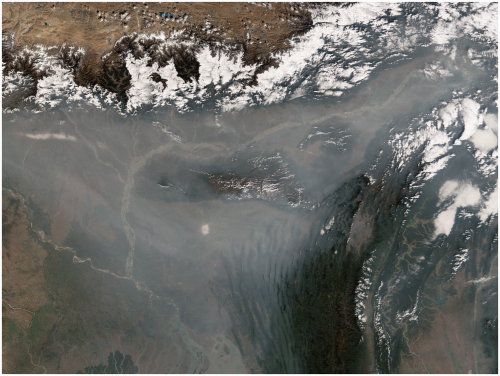
As the name atmospheric brown cloud implies, this low-level haze layer is brown, and it therefore not only blocks sunlight from reaching the ocean surface, it also absorbs sunlight. The absorbed energy is so intense that the resulting atmospheric heating of the haze layer is believed to cause shifts in regional rainfall patterns of South and East Asia. 7 This can be observed in early spring in India, when offshore winds push the atmospheric brown cloud out of the subcontinent over the Indian Ocean. The ABC impedes solar energy from reaching the sea surface, creating a stronger cooling in the northern compared to southern Indian Ocean below and a heating of the polluted layers above. The ABCs can therefore increase stabilization of the lower troposphere and inhibit evaporation feeding the monsoon. Consequently, the strength of the monsoonal “land–sea breeze” circulation can be suppressed and the monsoonal system weakened (Ramanathan et al., 2005). Other scientists (Bollasina et al., 2011) suggest that pollution particles can interact with cloud droplets making clouds look darker 8 and therefore dimming sunlight and weakening the monsoon circulation even further.
Apart from solar dimming, the more potent process seems to be what has come to be known as the elevated heat pump. Lau and Kim (2006) have explained the connection of air pollution and monsoonal rainfall patterns with the elevated heat pump hypothesis in this way: While solar dimming works in winter, later on in spring and early summer the low level winds shift northward again and push the pollution clouds over the subcontinent toward the Himalaya Mountains (see Figure 1). The dry Indo-Gangetic Plain becomes particularly heavily polluted during this time of year. The brown cloud absorbs enough solar energy that air warms significantly and initiates convection over the Himalayan foothills. In this configuration, the increasing strengths of the ABC act as an “elevated heat pump” that enhances the lifting of air masses over the Himalaya range, creating warming of upper air over Northern India and the Tibetan Plateau. With enhanced lifting, more water vapor condenses and rainfall intensifies, strengthening the monsoon and advancing it faster in Northern India in May and June.
The Indian Monsoon and climate change
A record of total Indian monsoon rainfall has been collected since 1871 and it has been surprisingly stable over the past 100 years. Year-to-year variability of summer temperatures over India can be directly related to monsoonal strength variations but an imprint of long-term global warming in the all-India rainfall record is not apparent (see Figure 2). Nor has the influence of increasing air pollution been detected in this overall rainfall record. What did change, however, are regional patterns of rainfall and the timing and onset of the monsoon (Lau and Kim, 2010). For example, in northern India and the Himalayan foothills, rain arrives earlier and has intensified in May and June at least since the 1960s. But rainfall over South and Central India declined in the late monsoon months of July and August during these decades. These spatial and temporal pattern shifts are in line mainly with the elevated heat pump and also to some extent solar dimming hypotheses of an increasingly dense atmospheric brown cloud over India and the Indian Ocean; the shifts in the pattern of monsoonal rainfall seem less aligned with global warming and its more general “wet gets wetter and dry gets drier” hypothesis. This result does not mean global warming has no role in shifting monsoon patterns (see Himalayan snowmelt and El Niño/La Niña). It only means that atmospheric brown clouds can have huge climate impacts in tropical regions where sunshine is abundant.
All-India summer monsoon rainfall from 1871 to 2014. There is no obvious long-term tendency in the monsoonal rainfall record. As shown by the yellow and blue dots, the monsoon system is tightly coupled with the states of the tropical Pacific Ocean known as El Niño and La Niña. But recent research shows a weakening of this coupling during the 20th century because of global warming. Credit: Figure originally created by D. R. Kothawale and Jayashree Revadekar from the Indian Institute of Tropical Meteorology in Pune, India (http://www.tropmet.res.in/~kolli/mol/Monsoon/Historical/air.html)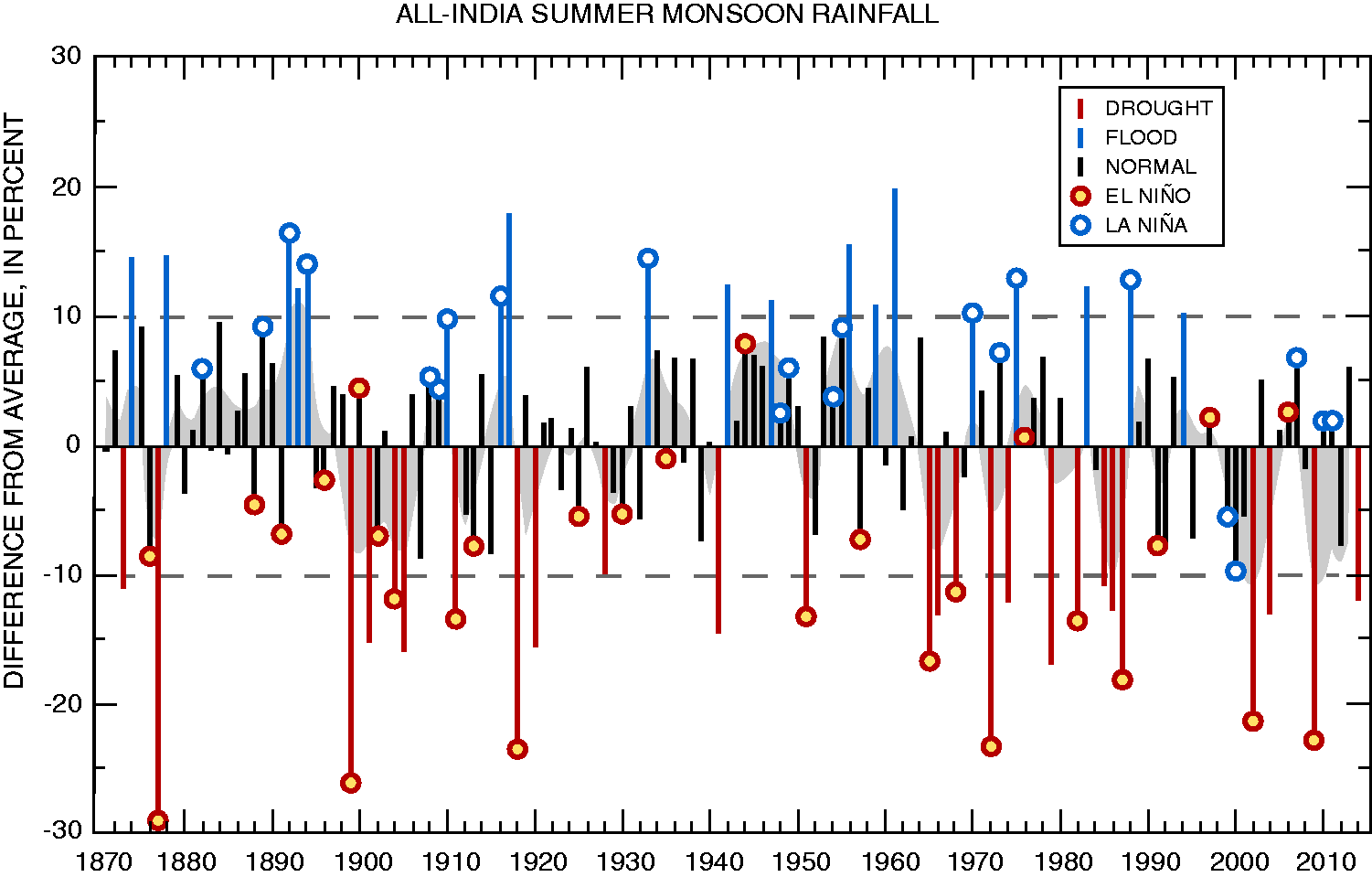
These effects of atmospheric brown clouds may be interpreted as a warning: Local and regional actions matter more to the regional phenomenon of the monsoon than global warming caused by humanmade greenhouse gases. This reality has a positive side: Air pollution can be reduced on a local-to-regional level. A variety of measures are available for developing modern, less-polluting factories and agricultural practices. Such reforms will reduce pollution’s huge effect on human health and may also benefit South Asia’s climate. The solution to the pollution problem lies with India and other developing nations because pollution control must be addressed on the local to regional level. The pointing of fingers at societies that were developing in the 19th century and the delaying of clean-air regulations in South Asia won’t help prevent the changes in the monsoon system described here.
But the developed nations are not off the hook either. Once air pollution is brought under control, the full extent of global warming caused by developed nations’ greenhouse gas emissions from decades ago will become apparent.
Footnotes
Funding
This research received no specific grant from any funding agency in the public, commercial, or not-for-profit sectors.