




Abstract
Switzerland has long met a good portion of its energy needs by using nuclear power. But in the wake of the accident at Fukushima, the country will have to turn elsewhere—while still remaining true to its history of self-sufficiency and energy independence. This effort is made more complicated by fears that one of its traditional energy sources, hydropower, may no longer be as reliable as in the past. But with a combination of energy conservation, greater efficiencies, alternative energy sources, the “smart grid,” and the introduction of new technologies currently on the drawing board, the country may readily be able to replace the energy lost by the closing of its existing nuclear power plants. And the loss of the snowpack and glaciers (due to climate change) may not be as dire for Switzerland’s hydropower as first anticipated.
Keywords
Switzerland has a long tradition of using nuclear energy. With no reserves of coal, oil, or natural gas of its own, the country had to turn to other sources to meet its energy needs. As a result, a nation of only 8 million people—a bit larger in population than the state of Massachusetts—has five nuclear power plants, making Switzerland one of the top seven nuclear-powered nations on the planet on a per capita basis (IAEA, 2014). (The nuclear power plant at Beznau, in the country’s far north, is the world’s oldest operating nuclear power plant.) All told, nine percent of Switzerland’s total energy demand is met by nuclear power—a figure triple that of the United States (World Nuclear Association, 2015a).
Another telling statistic is that nearly 40 percent of Swiss electrical generation comes from nuclear power (see Figure 1). To give a sense of what that proportion means, only 19 percent of US electricity is generated from nuclear power (World Nuclear Association, 2015b). (The burning of coal has been of almost no consequence in Switzerland’s total energy mix for the past 50 years—in sharp contrast to the United States, where 44 percent of the nation’s electricity comes from coal (Union of Concerned Scientists, 2015)). The country’s famed train and trolley systems are all electric, with the energy to power them coming nearly entirely from a combination of hydro and nuclear power.
Energy use in Switzerland. Electricity (right) accounts for just under one-quarter of total energy demand and is met nearly entirely by a combination of nuclear and hydro power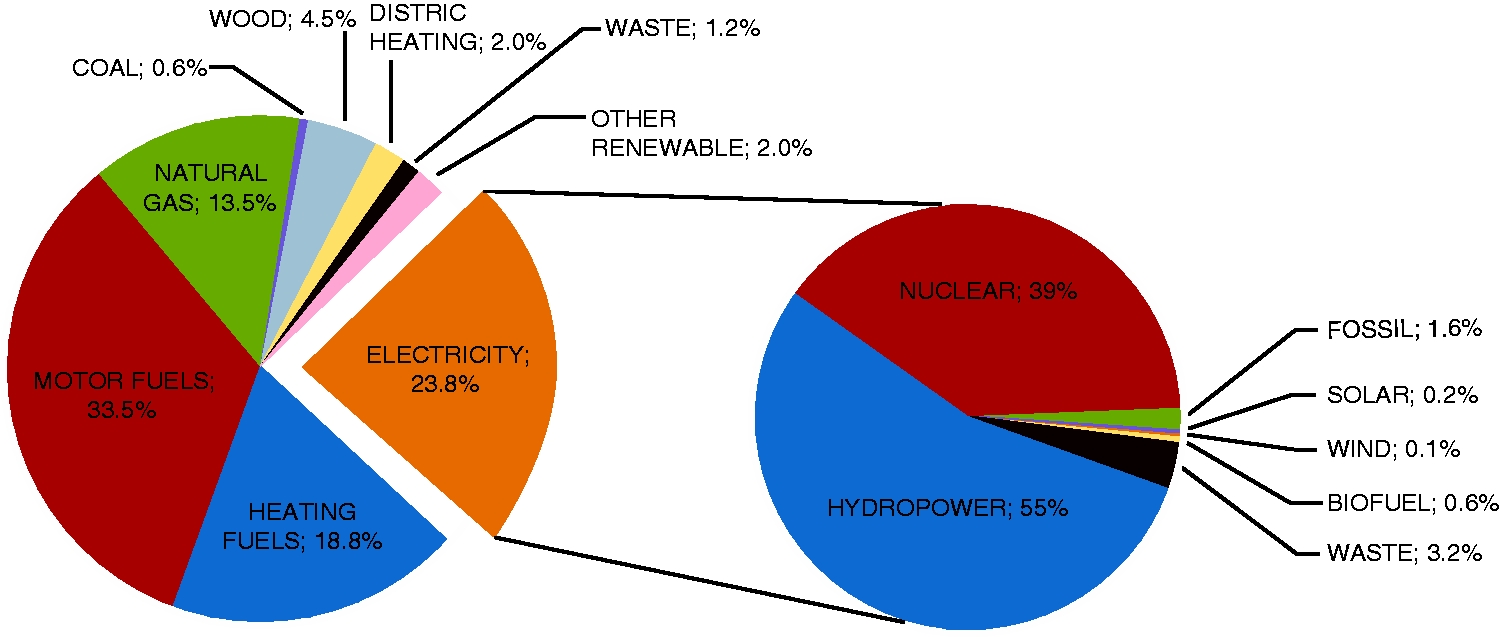
But after Fukushima the Swiss government decided to close down all its nuclear power plants, without a clear vision of what will take their place—a pressing concern at a time of ever-increasing demand. In the past Switzerland had relied heavily on wood, native hydropower, and imported fossil fuels (namely coal, crude oil, and natural gas) to meet its energy needs. But each of these energy sources faces problems: The supply of wood is diminishing (and burning wood as a fuel introduces particulates into the atmosphere (Notter, 2015)); the variety of coal most commonly available in the neighboring countries of central Europe is high in sulfur, contributing heavily to acid rain and global warming; and climate change is making the snowpack in the high mountains shrink, causing uncertainty about how much longer the country can rely on hydropower.
Consequently, phasing out nuclear power could be tricky. Discussions are under way as to exactly when to close which nuclear power stations, and more importantly, how to replace the power they now generate. Will it come from purchasing—or possibly sharing—electricity from neighboring countries? Photovoltaics? Wind power? Energy conservation? No one solution is perfect, especially at a time when the economics of energy in Europe is being turned upside down by new German policies on wind and solar power. What’s more, there are geographic and strategic aspects to any decision that Switzerland makes. How will the country make the change to something more sustainable, and what will its likely energy future look like? The solution may lie not in one answer but in many answers; the solutions that Switzerland comes up with may well portend the future for other countries.
Why go it alone?
Switzerland could, of course, simply try to buy all the energy it needs from the excess produced by neighboring countries such as France or Germany. But the Swiss are committed to energy independence—the country was surrounded by hostile powers in World War II and endured periods of great scarcity. Consequently, Switzerland prefers to be as self-sufficient and energy-independent as possible.
This attitude is in keeping with historic cultural, political, and geostrategic factors. Switzerland has always tried to be as independent from other countries as possible; sovereignty has been a high priority going back centuries (Müller, 1994). To this day, Switzerland issues its own currency rather than use the euro, and the country is not a member of the European Union even though it is located in the geographic heart of Europe. In light of this history, buying all the energy that Switzerland needs from neighboring countries is not a first-choice option.
As for its present energy supply, electrical power is used to satisfy one-quarter of Switzerland’s total energy demand (see Figure 1; Swiss Federal Statistical Office, 2015). Of that figure, more than 55 percent of Switzerland’s electricity is generated from hydropower, 40 percent from nuclear power, 3 percent from waste incineration, and less than 2 percent from conventional fossil fuels—largely natural gas. And almost none of Switzerland’s electrical generation comes from the burning of coal (Leuenberger and Frischknecht, 2010).
For the three-quarters of Switzerland’s energy needs that are not covered by electricity, 65 percent comes from fossil fuels; the rest comes from renewables and waste incineration. The main consumers of Switzerland’s fossil fuels are in transportation, heating, private households, and industry. (In contrast, about 85 percent of all the energy used in the United States comes from fossil fuels—largely in the form of coal and oil—while 9 percent comes from nuclear power, 2.5 percent comes from hydropower, and the rest from an assortment of other renewable energy sources (National Academy of Sciences, 2008). And the United States has some of the world’s largest plants for generating electricity through the burning of coal (Georgia Power, 2014).)
Rising discontent
But the old status quo regarding Switzerland’s nuclear power plants will not hold. There has been increasing public resistance to nuclear power in Switzerland over time, starting with a loss-of-coolant accident in 1969 at a small pilot test reactor in the village of Lucens. Though largely overlooked by the outside world, the event did cause a partial core meltdown (Swissinfo.ch, 2003; World Nuclear Association, 2015a). There were no fatalities and the underground cave housing the facility was successfully sealed up (Britt, 2013) but the incident planted discontent. After the 1986 disaster at Chernobyl, the Swiss population voted for a 10-year moratorium on the construction of any new nuclear power plants starting in the year 1990. Over time, however, memories of Lucens and Chernobyl dimmed and the industry saw a partial resurgence in popularity at the end of the 1990s, when fears began to grow of a lack of energy resources for the future.
Consequently, the moratorium on new nuclear power plants was allowed to lapse, several energy companies planned new nuclear plants, and the population of the canton of Bern even approved the construction of a new nuclear power plant—the first in decades. But after the accident at Fukushima (occurring in the same month that construction was approved) the Swiss government announced that it would phase out nuclear power entirely. Until recently it looked like Switzerland would shut down all its nuclear power plants between 2019 and 2034 after the plants reached the end of their planned 50-year lifetimes. As of this writing, however, the lifetime of some plants may be extended, as long as the safety of any given plant can be “guaranteed”—whatever that means. And so the debate continues, with the road map as to exactly when to shut down which plants remaining undefined.
But shut down they will be, because the groundswell of public opinion against nuclear energy is having a powerful effect. Perhaps in response to continuing public concern, on October 27, 2014 the Swiss Federal Office of Public Health began distributing iodide tablets to everyone who lives within 31 miles of a nuclear power plant in Switzerland, an endeavor that would include 4.6 million people—more than half the country’s population. The idea behind the program is that if a disaster happened that involved the release of radiation, people living downwind could quickly saturate their thyroid glands with normal iodine and prevent the absorption of any harmful radioactive iodine. Critics call such “pre-distributing” a drop in the bucket; others suggest it would be more effective to limit the consumption of milk, cheese, cream, and yogurt after a nuclear accident (Bosley and Bennett, 2014)—not a popular idea in a country known for its dairy industry.
There are other conflicts as well. For example, in case of any energy shortfall, the Swiss Federal Council proposes to temporarily fill the gap by using natural gas to operate the combined heat and power plants and gas steam power plants, even though natural gas is a significant contributor to climate change—a concern at a time when Switzerland’s glaciers are melting and there may be less water in the future for hydropower.
All of this is grist for the mill to opponents of a nuclear phase-out, with the ironic result that climate change is used to justify the continuation of nuclear power production.
An ambitious vision
With so many forces pulling in different directions, the government launched several large-scale research projects in recent years including the Swiss Competence Centers for Energy Research, known as SCCER CREST (http://www.sccer-crest.ch/), to plan for the future.
Each center has a different focus; one investigates scientific and technological aspects of changes in energy while another studies social, economic, and regulatory aspects.
These centers have seven “action areas”: energy efficiency; electrical grids; energy storage; power supplies; economy, environment, law, and behavior; mobility; and biomass.
The goal is to gradually phase out of nuclear power and into renewables by 2034 and to be largely independent of fossil fuels. Reaching it is based upon the idea of combining highly efficient energy production processes with substantial reductions in energy consumption.
Optimistic scenarios show that the amount of carbon produced per person could be reduced from the current 5.7 tons of carbon dioxide to about 1 to 1.5 tons.
In Switzerland, energy consumption per capita has already been decreasing in a moderate way since 1990 (Swiss Statistics, 2015). To hit the target, average energy consumption needs to drop by about another 30 to 40 percent by the year 2050 when Switzerland’s electricity consumption is expected to be about 60 terawatt hours (TWh), or 60 billion kilowatt hours (kWh).
To give a sense of scale, Switzerland’s nuclear power plants currently produce about 25 TWh of electricity per year. To replace that amount of electrical power with, for example, photovoltaics, a surface area equivalent to about 25,000 soccer fields would need to be covered with solar panels. (On average, a square meter of solar panel yields about 140 kWh in the Swiss lowlands, not accounting for seasonal fluctuations.) Or, if the nuclear power plants were to be replaced by wind turbines, 5,000 units would have to be installed.
At first glance, these may seem like impossibly large numbers of solar cells and wind turbines; however, Germany already gets 30 TWh from photovoltaics and another 45 TWh from wind power (Burger, 2014). These figures far exceed the projected Swiss electrical demand for 2050.
In addition, there is enormous potential for electricity savings in all the appliances and gadgets circulating today. In assessing the potential for electricity savings in households and industry, the Swiss Energy Foundation found that more than 25 TWh could be saved if all inefficient, energy-hungry old devices were replaced with best available new technology (SAFE, 2015). This includes better, more efficient lighting, such as compact fluorescents and light-emitting diodes; more energy-efficient computers, printers, and communications devices; improved electrical motors in industry; more efficient electric baseboard heating units and hot water heaters; and improved building services, to name a few.
If Switzerland exploited all the potential in energy efficiency, the amount of electricity saved would equal all the electricity produced from all nuclear power plants in Switzerland in 2013.
What’s more, there is a basic, fundamental, major change to the electrical grid that occurs when electricity production is switched from a small number of large nuclear power plants to a large number of small-scale plants that use renewable sources. While it will take a huge amount of money to renovate the grid—about 18 billion Swiss francs, or roughly 18.6 billion US dollars as of April 2015—there is a substantial amount of money and energy to be saved in such a complete, top-to-bottom overhaul, due to the fact that the present Swiss grid is out-of-date and inefficient. Rather than being perceived as a burden, the process of such “decentralization” should be looked at for what it truly is: an opportunity.
Renovation of the electricity grid would allow for installing new technologies such as the “smart grid”—which uses information and communications technology to collect information about the behavior of suppliers and consumers which is then automatically used to improve the efficiency of the production and distribution of electricity. For example, if the grid recognizes that demand spikes at certain times of day for the use of, say, electric heaters, then the grid would start domestic combined heat and power plants, producing more electricity to support the grid and at the same time filling hot water tanks for heating. As soon as peak demand passes, the machines would be turned off. All is controlled and directed by the communications technology of a smart grid.
The improved flexibility of the smart grid also allows for the easier introduction of new, highly variable, renewable energy sources such as solar power and wind power. Current network infrastructure is not built to allow for these sources with their many, widely distributed feed-in points.
And an additional benefit to such wholesale revamping is that as the distance from the supplier to the consumer gets shorter there is much less energy lost to transportation. For every mile that electricity has to travel down a typical high-tension wire some energy is dissipated. Overall, the US Energy Information Administration estimates that about 6 percent of the electricity that is transmitted and distributed in the United States each year is lost over the nationwide grid (Energy Information Administration, 2014).
Last but not least, with subsidies and bonuses the electricity producers could be rewarded for making their customers more energy-efficient, which would undoubtedly lead to more efficient products—an approach that the Swiss Federal Council recently approved (Swiss Federal Council, 2012).
Other sectors
Transportation is probably the single biggest area with the greatest room for improvement. Even in a country renowned for its rail system, commuting by car is popular. The Swiss road system is extremely dense, with most people living within 10 kilometers (approximately 6 miles) of a superhighway on-ramp. More new highways are on the drawing board, while existing highways are being widened from four lanes to six. Consequently, more vehicles are traveling more kilometers. So, even while vehicles become more fuel-efficient, carbon dioxide emissions remain the same.
There are many ways to cut emissions, such as switching to battery-powered electric vehicles (Notter et al., 2010). This approach could work well in Switzerland because most car drivers cover short distances—ideal for electric vehicles. And because the lifetime of a car is rather short, that means that it will not be long before consumers look into getting new vehicles—hopefully electric ones. Thus as soon as the technology is available, competitive, and affordable, purchasers could be found.
Vehicles powered by hydrogen fuel cells could be a promising alternative as well, especially because there is the potential for cheap and environmentally friendly hydrogen to be produced via electrolysis at power plants during periods of excess production from renewable sources (Notter et al., 2015). This would address a major problem: occasional spurts of overproduction. With the increasing roles of wind and solar power, there are often fluctuations in the amount of electricity, causing an oversupply that has to be handled in the electricity grid. Such events have already occurred in Germany, leading to severe problems. (For example, during a period of heavy winds over Europe in April 2015, Germany’s wind turbines produced as much energy as about 30 nuclear power plants of the size of the country’s nuclear power plant in Gösgen. The electrical grid was heavily stressed and electricity prices became severely negative—meaning that the grid operator paid if you consumed electricity. This has happened regularly since about 2010.) Consequently, the direct conversion of electricity into chemically stored energy in the form of hydrogen would be a welcome method of easing the pressure on the grid during peaks in supply.
Another big consumer of energy at the moment is home heating. But it is possible that in the future Switzerland’s homes may not require heating oil and natural gas; instead, the buildings could act as small-scale, decentralized power plants that produce more energy than they consume (http://nest.empa.ch/en/) through the use of photovoltaics and other technologies. Already, Switzerland’s average annual energy consumption per square meter of heated area has dropped from about 220 kilowatt hours per year in the 1970s to below 70 kWh today (RePower, 2011). Further decarbonization could be achieved by heat pumps, which have been steadily replacing traditional heating systems based on fossil fuels. (A heat pump is a device that transfers thermal energy from a source, such as heat stored in the ground, to a destination, such as a house (Newsham, 2014).) Air conditioners and freezers are familiar examples of the general idea of transferring heat—in those cases with the aim of removing it from a given locale rather than adding it to a target. In 2012, nearly 80 percent of new buildings in Switzerland had heat pumps (Swiss Agency for Energy Efficiency, 2015). However, given that the average building in Switzerland has a life span of 80 years (with major renovations usually occurring after 40 years) it will be a long time before fossil fuels disappear as a source of home heating.
Finally, great strides may be expected through greater energy conservation, particularly via the “2,000-Watt Society” concept in which each inhabitant aims to consume a maximum of only 2,000 watts (48 kilowatt hours per day) without lowering their standard of living. The idea (2,000-Watt Society, 2015) was first introduced about 15 years ago at the Swiss Federal Institute of Technology—or ETH Zurich—an elite science, engineering, and research institution sometimes referred to colloquially as MIT’s rival. The strategy behind this figure is to get energy-intensive countries to reduce their consumption from present-day amounts (6,000 watts in Switzerland; 12,000 watts in the United States) to a number closer to the world average in annual energy consumption at the end of the last century: 2,000 watts.
While this goal has yet to be accepted nationwide in Switzerland, many smaller communities within the country have already enrolled in a pilot program, among them the region of Basel (2,000-Watt Society Basel, 2015). Three-quarters of Zurich’s population voted in favor of achieving 2,000-Watt Society goals by 2050, the first city in the world to do so (City of Zurich, 2015). Many other regions in Switzerland, Germany, and Austria are working toward this vision as well.
It should be noted that while a key argument against such a goal was the fear of a decline in living standards. A recent study estimated energy consumption and greenhouse gas emissions for 3,369 Swiss citizens based on an environmental survey (Notter et al., 2013). Only 2% of the population investigated consumed less than 2,000 watts. Within this sample the net income reached up to 80,000 Swiss francs or$84,000—not at all a salary where people are assumed to suffer from a low standard of living.
Other solutions
This vision of Switzerland’s future energy supply is admittedly ambitious, which makes it susceptible to uncertainties such as the political impact of decisions about energy made by the surrounding states of the European Union. (Although Switzerland is not a member, it is heavily affected by any EU decisions.) Public opinion and referendums, pro or con, can radically change policies regarding nuclear power, climate change agreements, and renewable power, for example.
And then there are the scientific uncertainties. The Swiss long-term electricity supply has traditionally been based on hydropower, which in turn depends on the amount of snowpack in the mountains—something which may see some real changes.
Hydropower. Each year, the glaciers of the Alps—a mountain range that encompasses parts of eight different European countries—lose an average of 1 percent of their volume. Forecasts for the glaciers of Switzerland’s portion of the Alps are bleak, with more researchers venturing to publicly say that the country’s glaciers are beyond hope of saving. By the end of this century, climate change will cause Switzerland’s glaciers to largely disappear, apart from a few modest residues (see Figure 2). A recent national research program (Haeberli, 2014) found the situation to be irreversible; even if we were to successfully combat climate change and return overnight to, say, the climate of 1900, it would still take centuries to slow down the rushing freight train of existing temperature increases. Different computer models, using different scenarios, show that while there is uncertainty about precise details, Switzerland’s glaciers—an icon of the country—will, sadly, be gone (Linsbauer et al., 2013), causing a permanent change to the feel of the high-Alpine environment. (Try to imagine the Matterhorn without glaciers or fields of snow.)
The Trift Glacier in Switzerland on June 30, 2005 (left panel) and exactly one year earlier, on June 30, 2004 (right panel)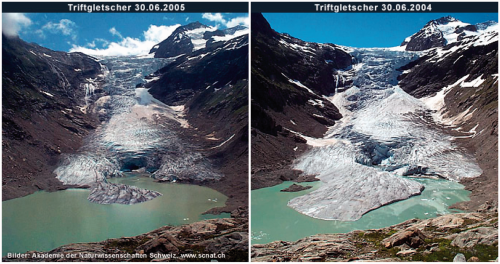
In addition, the permafrost will largely go away, causing rocks to unfreeze and leading to the Alpine equivalent of landslides, exposing the people in valleys below to great risk. But such issues are beyond the narrow scope of this article; while Switzerland will certainly be different without its glaciers, how will that affect hydropower?
It may be counterintuitive at first glance, but Switzerland will probably not suffer in the long term from water shortages, according to the calculations of ETH Zurich (2013). In a nutshell, long after the glaciers melt, Switzerland as a whole will have plenty of water coming from annual snowfall and the country will remain “Europe’s reservoir” (Funk, 2014).
At the risk of oversimplifying, the reasoning lies in the fact that scientists differentiate between the melting of glaciers (which contain precipitation in the form of ice that has been stored over hundreds of years) and the melting of snow (which contains annual precipitation and which is not expected to change). The glaciers will indeed melt but the centuries of precipitation locked up in them will merely emerge in the form of water. And the precipitation that comes down every year in the form of rain, snow, sleet, and hail will continue to arrive.
Admittedly, as the glaciers rapidly melt, the Alpine landscape will change radically. Icescapes have already given way to rocks, rubble, and lakes in many places; in the Swiss part of the Alps alone, about 500 to 600 small-to-large lakes will form. Some of these lakes can be up to 300 meters deep—nearly as deep as Lac Léman (aka Lake Geneva), one of Europe’s deepest lakes—with a volume of about 10 million cubic meters of water, the equivalent of a medium-size reservoir.
These newly formed lakes offer tremendous energy potential. A rough guess is that between 20 and 40 new glacial lakes could be found which could be used for generating hydropower. At the moment only 5 percent (one billion cubic meters) of the country’s annual precipitation is used to supply water to hydroelectric dams, meaning that 95 percent is lost as runoff—water that could potentially be used in the future to make turbines spin and generate electricity.
What’s more, minor increases in the height of existing dams would make it possible to catch more of that runoff and increase winter production—critical to Switzerland’s electric power supply—by more than 2 TWh.
Admittedly, local and regional bottlenecks may occur due to a considerable shift in the seasonal distribution of runoff. But computer models show that while stocks of water will decline, they will not fall to zero (Beniston et al., 2011). And for some power plants, the annual water inflow as a result of glacier meltdown would even increase by up to 20 percent by mid-century before gradually decreasing. Thus, the new reservoirs could offer the chance to maintain the current production of electricity from hydropower for at least the near future.
The key factor in accessing these new lakes or modifying existing dams is whether the political willingness exists for increased exploitation of these resources. There are justified concerns from environmental protection associations that highly sensitive Alpine species would be sacrificed when valleys are flooded with water for hydropower generation.
But such reservoirs may become a necessity for reasons beyond electricity production. In the future, more dams will be needed in the high mountains to absorb increasingly high flood crests. This is because glaciers act like a sponge and retain water; as the glaciers diminish in size or disappear, any new heavy precipitation will come down as rain rather than snow and no longer heap up. In other words, the water storage function provided by glaciers will disappear and reservoirs must take over the important function of mitigating the risk of floods. With this in mind, more dams, more dikes, and more hydropower are likely on the horizon.
But Switzerland may have other sources of renewable energy available as well, even with their drawbacks.
Wind power. Wind power plants disturb landscapes—a big issue in land use planning, especially in a country like Switzerland where space is limited. In addition, some fear that the blades of wind turbines can sometimes be dangerous to birds or bats during their spring and fall migrations. The sound generated by a wind turbine—about 60 decibels—can also be a nuisance for those living near the structures. All these arguments limit the potential for wind power plants.
An alternative to conventional wind power plants may lie in kite power. At higher altitudes, the winds tend to be stronger and more consistent—so much so that there is a vibrant adventure sports business in gliding adjacent to the Alps—and large kites can go up to several hundred meters, capturing the vast amount of energy available in these higher winds.
The kite power generation system operates much like what happens when one allows a conventional kite to climb—but while pulling a line wound around a drum at the same time. As the drum rotates to pay out the line, it is coupled to a generator to produce electricity. When it reaches its target altitude, the kite’s angle to the wind is reduced, causing it to descend, and the line is reeled back in with minimum tension. Once the descent is completed the kite begins a new climb phase, again generating electric power (Swiss Kite Power, 2015). The technology is still in pilot phase but since there is very constant wind at higher altitudes, the kite remains more or less constantly in the air without stopping. It may provide a valuable base load, in contrast to most other renewable energies.
Photovoltaics. In theory the potential for solar power is tremendous in a small mountain country. But one of the chief drawbacks to photovoltaics is that the electricity it yields is discontinuous and subject to seasonal and weather-dependent variations. For those reasons, the technology has to be accompanied by smart electricity storage technology.
Production costs are still relatively high, which may have implications for the competitiveness of any Swiss businesses using solar power. The yield per square meter of solar panels is rather modest, meaning that they could take up large amounts of land in a country with limited space. Recent investigations have successfully increased the panels’ efficiency but they consume rare earth elements or scarce metals such as indium, gallium, cadmium, or telluride for thin-film photovoltaics. On the other hand, the price of solar panels has declined by 75 percent in the past five years in countries such as the United States, so it is difficult to predict what will happen.
Biomass and wood. Small-scale combined heat and power plants fueled with logs, wood chips, or wood pellets are attractive: they are easy to handle and get great overall efficiency (up to 90 percent) in the conversion from fuel to electricity and heat. The drawback of the technology is that partly toxic emissions are released into ambient air. And biomass production requires a lot of energy, fertilizer, and pesticides, which spoil the energy efficiency. In addition, the burning of biomass or wood harms biodiversity, and biomass directly competes with food production, raising ethical issues. Biowaste fed into a fermentation plant and converted to biogas is a real option that is already established but the technology has very limited potential due to the limited amount of biowaste.
The outlook ahead
Over the next four decades, Switzerland will face a huge restructuring of its entire energy supply system. The new supply mix will be free from nuclear power, rather low in carbon intensity, and resting upon much higher efficiencies based on the newest and most energy-efficient technologies—along with the development of smart grids, decentralized power suppliers, hydropower, wind power, photovoltaics, biomass, wood, and the rigorous use of burning waste to generate energy whenever materials cannot be recycled. In case of a shortfall of electricity, natural gas-powered, combined heat and power plants may be used as an intermittent alternative.
The most likely future energy supply mix is currently under investigation. The fact of the matter—and most stakeholders in Switzerland agree—is that importing electricity on a large scale is not an option. The country aims for as much energy independence as can be reasonably achieved from an environmental, social, economic, and technical perspective. The Swiss Federal Council considers imports to be necessary only as stopgap measures to ensure security of supply and to cover temporary fluctuations (Swiss Federal Office of Energy, 2011).
It is a simple statement of fact that Germany today produces more solar and wind power than the entire projected electricity demand for Switzerland in 2050. What is possible in Germany should be manageable in Switzerland too. However, it is probably unreasonable to copy Germany’s policy wholesale. Switzerland has a unique position within the European electricity supply system and it would be wise to maintain it, not only from an economic perspective but also from technical, geostrategic, and environmental points of view. Therefore Switzerland may opt to place more emphasis on hydropower to cover peak loads.
A single “magic bullet” suitable for every purpose is not available. Switzerland most likely has to find its own energy supply mix with the biggest sustainability potential. For each technology—and for brand-new technologies still on the drawing board such as kite power—the best locations should be chosen to produce a well-balanced energy mix that meets the country’s growing needs while combatting climate change and preserving energy independence and at the same time being integrated into international European energy policy.
Conservation, greater efficiencies, alternative energy sources, the smart grid, and the introduction of new technologies mean that Switzerland should be readily able to find ways to replace the energy lost by the closing of its existing nuclear power plants.
Footnotes
Acknowledgements
The author wishes to thank biologist Claudia Notter and agronomist Paul Walser for their helpful comments regarding the current political discussions about renewable energy.
Funding
This research received no specific grant from any funding agency in the public, commercial, or not-for-profit sectors.