




Abstract
Merely for working in their field of expertise, Iranian nuclear scientists face perils and pressures that are nothing less than Shakespearean. The question for them is, in a very real sense, “to be or not to be.” In the course of the last four decades, these scientists have faced intimidation and severe punishment, including prison terms, at the hands of their own government. In recent years, at least five Iranian nuclear scientists have been the target of assassination attempts often attributed to Israeli intelligence. Regardless of their source, all such threats against scientists are morally indefensible. They offend the scientific spirit, working against the free exchange of ideas that is necessary for humanity to advance. And in the final analysis, the authors assert, these threats against scientists in Iran undermine global peace, targeting experts whose international collaboration is required to deal effectively with the nuclear risks facing the world today. Simply put, killing nuclear scientists makes reducing the threat of nuclear war harder, not easier.
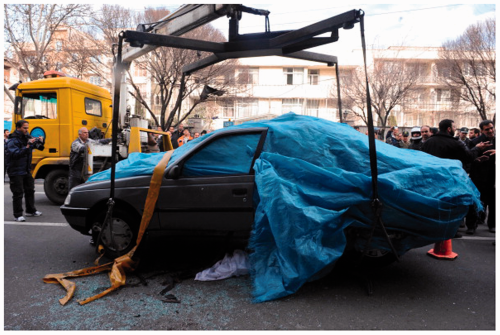
Photo credit: SAJAD SAFARI/AFP/Getty Images.
Early one morning in November 2010, a scientist was driving to work in Tehran, Iran. As he and his wife waited in traffic, a motorcycle pulled alongside their car. According to an account by New York Times national security expert David E. Sanger, “There was a faint ‘click’ as a magnet attached to the driver’s side door. The huge explosion came a few seconds later, killing him and injuring his wife” (Sanger, 2011).
The scientist was Majid Shahriari, who managed a major project for Iran’s Atomic Energy Organization, and his murder was no random event.
For Iranian nuclear scientists, in fact, the perils and promises of working in their field are nothing less than Shakespearean. The question for them is, in a very real sense, “to be or not to be.” In the course of the last four decades, these scientists have faced intimidation and severe punishment, including prison terms, at the hands of their own government. In recent years, at least five Iranian nuclear scientists have been the target of assassination attempts (Raviv, 2014) often attributed to Israeli intelligence.
Regardless of their source, all such threats against scientists—in Iran or elsewhere—are morally indefensible. They also offend the scientific spirit, working against the free exchange of ideas that is necessary for science to thrive and humanity to advance. And in the final analysis, we firmly believe, these threats against scientists in Iran undermine global peace, because they target experts whose international collaboration is required—is, in fact, absolutely central—to deal effectively with the nuclear risks facing the world today. In very practical terms, killing nuclear scientists makes reducing the threat of nuclear war harder, rather than easier.
The oppression and assassination of Iran’s nuclear scientists
Iran’s nuclear program began under Shah Mohammed Reza Pahlavi; its founder was Akbar Etemad, a physicist who led the Atomic Energy Organization of Iran from 1974 to 1979. He was forced into exile as the new Islamic regime came to power in 1979, because the country’s new leaders believed that the nuclear program was useless “junk” imposed on the shah by the West, particularly by the United States. As the chief architect of the program, Etemad was forced to leave Iran for France. Only in recent years, after coming out in favor of Iran’s right to pursue its current nuclear program, has he apparently been allowed to revisit his homeland.
If Etemad’s “crime” was working in the nuclear program under the shah, the young scientist Omid Kokabee has been languishing in prison now for many months because he refused to work in the nuclear program that the new Islamic regime restarted in the mid-1980s. As an undergraduate, Kokabee was one of Iran’s top engineering students, and he went on to pursue graduate work in laser physics, first in Europe and then in America. During a trip home to visit his family, the Iranian government asked him to work on the country’s nuclear program. When he refused, he was arrested. In a letter he later wrote to the head of Iran’s judiciary, he describes pressures brought upon him, first pushing him to work for the government and then, after his refusal, trying to force him to make false confessions of treason. In a sardonic tone, he writes that he had been “asked to cooperate with the most secret parts” of Iran’s nuclear program, but when he refused he was given a five-year prison sentence for, allegedly, working for a foreign government.
Since his trial, Kokabee was awarded the American Physical Society’s prestigious Andrei Sakharov Prize for “his courage in refusing to use his physics knowledge to work on projects that he deemed harmful to humanity” (American Physical Society, 2013). In 2014, he also received the Scientific Freedom and Responsibility Award from the American Association for the Advancement of Science for “his courageous willingness to endure imprisonment rather than violate his moral stance that his scientific expertise not be used for destructive purposes” (Zambon, 2014). The Rouhani regime has just granted him a retrial after three years of incarceration.
If Etemad and Kokabee paid with prison and banishment for their decisions to work or not work on Iran’s nuclear program, in recent years other scientists have paid with their lives for cooperation with the program. To its credit, the American Physical Society has not only praised Kokabee for his resistance but also responded vigorously after the assassinations of multiple Iranian nuclear scientists in Tehran between 2010 and 2013. In an open letter, the group condemned the wave of killings and reaffirmed its “belief that science can be used to promote international peace” (Byer, 2012).
The Iranian government has claimed, with some corroborating (if circumstantial) evidence, that foreign countries were involved in these assassinations—and, almost needless to say, the Iranian regime has pointed its finger at the Israeli and US governments. A book by an experienced Israeli journalist and his American colleague (Spies Against Armageddon: Inside Israel’s Secret Wars) seems to all but confirm Iranian claims about Israel’s role in this secret war (Raviv and Melman, 2012).
Of those scientists who have paid with their lives for working with the Iranian regime, Shahriari stands out because he was, at least arguably, the most important physicist killed in the secret war. Praised by sources inside the regime as the man most responsible for rapidly developing Iran’s capacity to enrich uranium, Shahriari is also said to have played a key role in the regime’s eventual success in stopping the highly sophisticated Stuxnet virus that apparently destroyed some 20 percent of all of Iran’s centrifuges.
In a drive-by bombing of his car in November 2010, another scientist, Fereydoon Abbasi, was also injured. He was later rewarded for his suffering when he was named as the new head of the Atomic Energy Organization of Iran, where he served from 2011 to 2013. During his tenure, he played an intransigent role in nuclear negotiations, and since being replaced by a new director he has become a fierce critic of the more conciliatory policies followed by the new administration of President Hassan Rouhani. Other top nuclear scientists assassinated during this secret war include the associate director of Iran’s Atomic Energy Organization, Darius Rezainejad, killed in July 2011, and the vice president of the Natanz uranium enrichment facility, Mustafa Ahmadi Roshan, killed in January 2012.
Early in November 2014, several Syrian nuclear scientists were killed, and a Syrian human rights group alleged that an Iranian nuclear scientist working with them had also died in the attack. Iran has denied the story.
The Iranian government has taken pains to publicize the confessions of alleged assassins of scientists killed in Iran, with Iranian media broadcasting clips from secret security cameras spliced together with recreated scenes in “documentaries” that supposedly show how the killings took place. The assassins claimed to be members of the Mujahedeen Khalgh (MEK)—a group that has been fighting the Islamic regime for almost three decades and that has played a role in exposing some secret aspects of Iran’s nuclear program. The alleged assassins “confessed” to having been trained by and worked in conjunction with Israeli and American intelligence agencies.
The Iranian regime has also ominously claimed that some international scientific conferences and cooperative efforts—particularly the SESAME (Synchrotron-light for Experimental Science and Applications in the Middle East) project, 1 dedicated to establishing a “major international research center in the Middle East/Mediterranean region, promoting peace and understanding through scientific cooperation”—are forums in which US and Israeli intelligence agencies do reconnaissance to discover Iran’s top scientists and either try to enlist their cooperation or, failing that, pick them as targets for assassins. (After the end of the Ahmadinejad administration, Iran resumed its cooperation with SESAME.)
Shahriari is the highest-ranking scientist killed so far in a drive-by bombing. But the murder of nuclear physics professor Massoud Ali Mohammadi shows just how ambiguous the situation can become when terror becomes a tool for intimidating or eliminating scientists for working (or not working) on nuclear programs. Mohammadi was killed in a motorcycle bombing in January 2010. He had at one time been involved with the Islamic Revolutionary Guard Corps (IRGC) and Iran’s nuclear program, but the exact nature of his involvement has never been clear. At some point it appears he became a critic of the regime and seemingly severed his ties with the country’s nuclear program. During the prelude to the contested 2009 Iranian election, Mohammadi was openly critical of the status quo in his classes. Reports from family and friends suggest he had even accepted a fellowship in the West and planned to leave Iran.
When he was killed, the Iranian government immediately blamed foreign hands, but soon thereafter came whispers that the Islamic government had been involved. It has been suggested that the regime feared his departure from Iran or his increasing alienation from the regime and decided to kill him. A high-ranking advisor to Rouhani’s nominee for the post of Minister of Science recently suggested that Mohammadi’s murder was the work of the regime, the Farsi-language website rajanews.com has reported.
Why the assassination of Iranian nuclear scientists threatens world science and peace
The truth of who killed Massoud Ali Mohammadi and other Iranian nuclear scientists might never be established to a certainty. But the persecution and intimidation of Iranian scientists—from outside or inside that country—should serve to raise serious questions in the international scientific community. Is it still safe for scientists to collaborate with others around the globe? Is it safe to travel for the sake of science, or is scientific diplomacy simply too risky?
These questions are of truly global import. Scientists often provide a bridge between one intransigent government and another. Scientists throughout the world share the common language of science and a respect for the work of scientists. Respect builds trust; trust lies at the core of working on difficult policy problems, especially in the nuclear arena.
Scientists in autocratic countries often constitute the very pockets of civility that must be reached to deal with complex nuclear issues. Based on the experience of one of us (Hecker), the scientists in the nuclear weapons establishment of the Soviet Union and now Russia have been such an island of civility.
Just imagine if Andrei Sakharov, the father of the Soviet hydrogen bomb, had been targeted for assassination early in his remarkable career because he worked on the Soviet nuclear program. In his memoirs he explained that he understood the “terrifying, inhuman nature of the weapons they were building,” but stated: I regarded myself as a soldier in this new scientific war.… But above all, I felt myself committed to the goal, which I assumed was Stalin’s as well: after a devastating war, to make the country strong enough to ensure peace. (Sakharov, 1990: 97, 164)
Sakharov was a scientist, a patriot, and a humanist. He became a voice of caution in the Soviet nuclear program, trying to convince Premier Nikita Khrushchev in 1961 not to test the 100-megaton hydrogen bomb Sakharov had helped to design. Sakharov became disillusioned and left Sarov, the Russian Los Alamos, in 1968. He was later banished, living in internal exile under house arrest in Gorky (now Nizhny Novgorod) before Gorbachev released him in December 1986. He then became the social conscience of the movement to end communist rule.
Other Soviet scientists worked on the Soviet and then Russian nuclear programs their entire professional careers, believing they were helping to make the world safer by ensuring that no country had a nuclear monopoly. They were essential to an orderly transition from the Soviet nuclear complex to the Russian complex after the fall of the Iron Curtain.
In an upcoming book, one of the co-authors of this article (Hecker) and two former Russian nuclear weapons institute directors describe how the scientific ties between US and Russian nuclear scientists helped to mitigate the enormous risks in Russia’s nuclear complex resulting from the breakup of the Soviet Union. The scientists were the first to reach across the ideological divide to tackle these issues as the Cold War began to thaw. They collaborated over the next 20 years to help keep Russia’s nuclear assets safe and secure and to keep their nuclear weapon scientists at home, away from rogue countries bent on building covert nuclear weapons capabilities. Today, unfortunately, we find the US and Russian governments once again driving the two sides toward isolation.
Targeting and killing scientific leaders has not been effective in ending or greatly inhibiting the Iranian nuclear program. Much of Iran’s progress in centrifuge technology and facilities has been made since the assassinations began. The nuclear programs of other countries have also survived the loss of key leaders. For example, J. Robert Oppenheimer left the Manhattan Project and returned to academia shortly after the end of World War II, as did many of the other scientific giants who worked on the bomb at Los Alamos. The Russian program saw the departures of Igor Tamm, Yakov Zeldovich, and Andrei Sakharov, three giants of Soviet science. Yet both nuclear programs continued unabated, until political leaders practiced restraint and ended the Cold War.
In 2014, the Iranian scientist Omid Kokabee sent a letter from prison to Maryam Mirzakhani, a Stanford professor who, like Kokabee, was a graduate of Sharif University in Iran and went on to graduate work in America. Kokabee wrote what is tantamount to his manifesto, expressing hope for a world where all scientists, particularly young scholars, can use their talent and science “free from intimidation and intellectual pressure” in the service of “peace and of a world bereft of fear and terror.” 2
We share his noble sentiments and hope that one day scientists in Iran—no less than in other parts of the world—can conduct research and exchange ideas in an atmosphere free from terror and intimidation. The assassinations of Iranian scientists were likely intended both to decimate that country’s nuclear leadership and to intimidate other scientists. But fear and bullets do not stop nuclear programs; they beget ever more secrets and ever more hidden nuclear sites. It is the light of reason and exchanged ideas that will help save the world from the most potentially perilous consequences of nuclear power and create the transparency that is, in Iran and elsewhere, the sine qua non of a peaceful nuclear program.
Footnotes
Funding
This research received no specific grant from any funding agency in the public, commercial, or not-for-profit sectors.