




Abstract
The author explores the reasons why scientists such as Albert Einstein, Richard Feynman, Carl Sagan, Stephen Hawking, and Neil deGrasse Tyson became celebrities, as well as sharing his own experience. He describes how public acclaim is often uncorrelated to scientific accomplishment and depends more on communication skills and personality traits. Nevertheless, he argues that the entire scientific community benefits when credible scientists gain a wider audience, and that celebrity is an opportunity that should not be squandered. Scientists who become recognizable have a chance and perhaps even a responsibility, which they have often exploited, to promote science literacy, combat scientific nonsense, motivate young people, and steer public policy discussions toward sound decision making.
Keywords
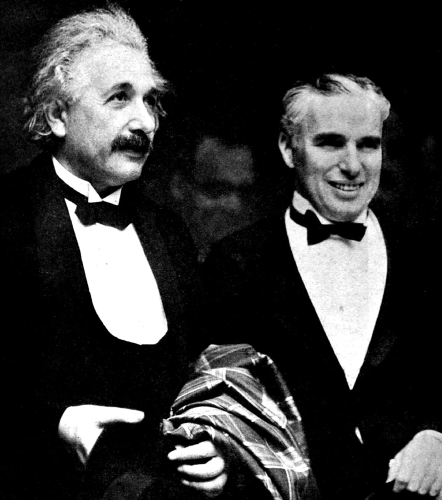
Albert Einstein with Charlie Chaplin at the Hollywood premier of Chaplin’s City Lights in January of 1931. Source: Photoplay magazine
When I was young, I became fascinated with science in part because of the scientists I had heard of: Galileo, Newton, Einstein, Feynman, Gamow, Sagan, Bronowski. As I studied to become a physicist, I, like many young students, aspired to join their ranks. But I didn’t really have an idea of whose ranks it was I actually wanted to join. After many years as a practicing scientist, and perhaps a decade or so as a public personality, I have come to understand that there are many reasons for scientific celebrity. As in the rest of human affairs, public recognition of scientists often has little to do with actual scientific accomplishment, but that does not diminish the opportunities it provides for responsible scientists to promote a fascination with the world around us, and to help science play a more useful role in our society.
We live within a culture of celebrity and, whatever the reasons for scientific celebrity, it is important and useful for some scientists to be included in the list of recognizable public figures. Those scientists who have a public audience have an opportunity, and also in some sense a responsibility, to help combat scientific nonsense, motivate young people to study science, and also to help steer public policy discussions toward decision making based on empirical evidence and sound theory. Happily, many of the most recognizable scientific names have a good track record of doing just that.
Albert Einstein: First modern A-list science celebrity
Albert Einstein developed his Special Theory of Relativity, which changed everything about the way we think about the relationship between space and time, and then laid the foundation of quantum mechanics, which changed everything about the way we think about the interactions of matter and radiation, all within a few months in 1905. Yet it was not until 1919, shortly after the end of World War I, when a team from one of the protagonist countries (Britain) launched an expedition to South America to test the ideas of a scientist from another (Germany), that Einstein’s name was known to anyone outside the scientific community.
He would go on to win the Nobel Prize in 1921, but Nobel laureates’ names are forgotten by most people by the time the newspaper that announces them has hit the trash. For Einstein, the significance of appearing on the front page of The New York Times and other newspapers on that fateful day in 1919 played a far more important role in making him famous than any prize ever would.
Even though by 1919 Einstein was already revered by physicists around the world, it was only after that date that his opinions mattered to anyone outside the scientific community. But boy did they matter after that. Every quote he made in public hit the newswires, and when Israel was established as a state he was asked to be its first president (to which he wisely said no).
Einstein was the first modern A-list scientific celebrity, and to some extent he established a paradigm that lasted for much of the first half of the 20th century. I remember watching Sam Jaffe’s portrayal of the “world’s greatest scientist” in the 1951 film The Day the Earth Stood Still, made four years before Einstein’s death, and it is hard to imagine who else the quiet, gray-haired, unkempt, and rather unworldly man who bemoaned the sad state of world affairs while promoting peace could have been modeled after.
As Spider-Man is wont to say, with great power comes great responsibility, and Einstein exercised his celebrity status carefully to promote the causes, mostly social, he cared about. While his letter to President Franklin D. Roosevelt led to the development of the atomic bomb, Einstein, along with physicist J. Robert Oppenheimer, later worked ceaselessly to rid the world of atomic weapons, or at least bring them under international control—leading, in fact, to the creation of the Bulletin of the Atomic Scientists and its scientific Board of Sponsors, which I am now privileged to co-chair—and from there toward the creation of a world government, which he felt was necessary to deal with the new technological threats science had helped create.
Like Isaac Newton before him, Einstein achieved celebrity status because of his remarkable scientific achievements, although it is fair to say that most people had no idea in depth of what they were (except that they led to the famous equation E = mc2). At the same time, his appearance, especially later in life, as a thoughtful if bemused and playful grandfatherly type, with a spark in his eye, an amusing quote at the ready, and an old-world German accent, certainly helped play to the press and public.
Richard Feynman: Bestselling author
By contrast, Richard Feynman was largely unknown until a series of events that had little or nothing to do with his scientific accomplishments propelled him to the fore in the public imagination. Feynman was one of the greatest theoretical physicists of the last half of the 20th century, and among the current generation of physicists he was idolized as perhaps few other physicists have ever been. Although he was a colorful personality if ever there was one, he received widespread recognition among the public only after a series of books based on his oral reminiscences was published, and the books became bestsellers. After the first one, Surely You’re Joking, Mr. Feynman!, appeared in 1985, Feynman began his ascendance as a popular cult hero, a name people recognized.
Feynman had more personal charisma than almost anyone I have ever met, and while in matters of science he religiously eschewed hyperbole, there is little doubt that he enjoyed fanning the folklore associated with his history, from his safecracking pranks at Los Alamos while working on the development of the atomic bomb, to his traveling van covered in Feynman diagrams. A man with an intense interest in exploring all aspects of the world with the same curious fascination that he brought to his scientific research, Feynman was perhaps one of the few scientists whose personal life was as interesting as his scientific life. He even approached his own death with a scientific eye, stating on his deathbed, “I’d hate to die twice, it’s so boring.”
A man who largely avoided positions of responsibility in the public arena, he nevertheless agreed, at his wife’s urging several years before his death, to be on the commission that investigated the Challenger space shuttle disaster. True to form, he ignored convention, spoke to engineers rather than administrators, and, in a masterly act of showmanship at a televised hearing, dipped a famous O-ring into ice water to demonstrate its lack of elasticity, and thereby provide evidence that it was such O-rings that had caused the disaster. Probably more people of my generation remember Feynman for that than anything else.
Carl Sagan: Television personality
The first outsized celebrity scientist of the latter part of the 20th century, however, was Carl Sagan. He was probably the first scientist as recognizable to the average person as most TV or movie stars, and with good reason: he was a TV star. His series, Cosmos, produced in 1978 and 1979 for an astronomical sum of $6.3 million, was the first television documentary to use videotape, and thus special effects, and remains the most widely watched public television series of all time. His regular appearances on The Tonight Show Starring Johnny Carson also helped make Sagan, for many people, both the face and the voice of science.
Sagan, more than any of the other scientists I have described thus far, nurtured his popular appeal, and used it to provide him a larger forum to not only explain the wonders of nature but also to argue on behalf of social issues—like the possibility of nuclear winter, or the negative influence of religion, myth, and superstition. In spite of this public advocacy for science, or perhaps because of his impressive manipulation of the media, he was more widely respected among the public than by many of his peers, who were either jealous or felt his reputation was overblown given his scientific contributions (relative to their perceptions of their own, no doubt).
There is little doubt that successful popularization efforts can be viewed with skepticism in parts of the scientific community, and the more successful one is in this regard the less some will view you as a “serious scientist.” Nevertheless, it is curious that at the same time there is also great respect for the general enterprise of public science education. In a prime example of this dichotomy, Sagan was voted down for membership in the National Academy of Sciences but later received its highest award for public service.
Stephen Hawking: Voice of science
Sagan created a precedent for a new kind of celebrity scientist, one who was in some sense a celebrity by virtue of being a celebrity. Since Sagan, perhaps the best-known celebrity scientist has been Stephen Hawking. Hawking, more than Sagan, was a true leader in his field—his seminal work on black holes helped return General Relativity to mainstream science and has guided or motivated much of the research associated with Quantum Gravity over the past 40 years.
However, it is fair to say that the remarkable and unprecedented popularity of Hawking’s A Brief History of Time, and following that a public fascination with his every utterance, is due in large part to a fascination with the man—a remarkably brave individual who has overcome incredible adversity to succeed—rather than the scientist. Perhaps because of his difficulty in communicating, literally every time he makes a statement to the press it appears in papers and on television around the world. Hawking is quite aware of this, and has used it to good effect to promote issues he finds of interest, including his recent statement about the dangers of attempting to communicate with other intelligent species in the universe, or the reasons for his own atheism.
Neil deGrasse Tyson: Straight to the stratosphere
More recent is another celebrity scientist who has been following in Sagan’s footsteps, literally. Neil deGrasse Tyson has recently starred in a remake of the Sagan Cosmos series, and while it may not have had the impact of the original series it nevertheless has helped firmly propel Tyson into the stratosphere as far as popular recognition is concerned. (He was already very high-profile even before the series appeared.) Interestingly, Tyson differs from those scientists I have previously mentioned in that essentially he has not followed a research career at all. Shortly after receiving his PhD, he moved directly to the Hayden Planetarium, which has served as a base for his scientific outreach efforts ever since.
Tyson, Sagan, and Hawking’s experiences over the past 30 years demonstrate a simple fact that has probably always been true but has become more obvious, given what I perceive to be an increasing focus of the media over this period on promoting celebrity: For scientists to have a public impact, they generally need to reach out to the public using those tools that have a public presence—from books to newspapers to radio, and particularly television and film—and not rely on their scientific accomplishments or reputation among their colleagues. Indeed, there need be little correlation at all between the two.
Having said this, when young scientists ask for advice about reaching the public, I tell them that if they are interested in communicating they should take advantage of every opportunity to do that, but nevertheless the best use of their time is on science if they can make a contribution. In the first place, contributing to scientific progress is important. In the second place, while there are exceptions, the more credibility they have with their colleagues the easier it will be to reach out beyond the walls of academia.
In this regard, as I alluded to at the beginning of this article, I write from the perspective of a scientist who has in some sense also become a public figure. I think I can honestly say that I had no strategic plan for that. I became a scientist because science fascinates me, and at the same time I like to explain it. I was driven as a young scientist primarily by the desire to have an impact on the scientific enterprise, just as by nature I was equally driven to communicate this interest. Nevertheless, my original fascination was only possible because of scientists like many of those I have mentioned, who had the opportunity to reach out beyond the walls of academia to the general public, and I have chosen to take advantage of similar opportunities in my own career.
I am acutely aware that public adulation should not be confused with scientific impact, which is why I personally try as best I can to balance science and public activities. Nevertheless, I am aware that I am better known to the public than a number of my more accomplished colleagues, including many friends who have won the Nobel Prize. I don’t see the point in doing anything other than accepting this reality, but at the same time I am proud to have this privilege, and I recognize that it implies a responsibility to use whatever celebrity I may have both to promote science in the public arena and to adequately and accurately represent the scientific enterprise.
Responsible use of a public voice
Science has changed the world, made modern civilization possible, and also produced challenges and threats that society needs to come to grips with. The scientific community has a responsibility to communicate to the public both the results of the knowledge it generates and also the possible public impact of that knowledge, not only because the public funds us but also because an informed public is an essential part of a healthy democracy.
Nevertheless, that does not mean that all scientists have a responsibility to reach out. Indeed, as I often say, there are many of my colleagues who are distinctly better left far away from public display. Happily, however, most scientists are excited enough about what they are doing to want to talk about it, and a significant fraction of scientists have a social conscience that also drives them to want to have a positive impact on public policy and education.
Invariably, some scientists will be more successful at this than others, either because they are simply larger than life as scientists, like Einstein, or because they have captured the public’s imagination and attention for other reasons, like Feynman and the others who have succeeded him. It is also true that, for some reason, physicists have been unduly successful at achieving public recognition. While this is not universally true, and scientists such as the biologists Richard Dawkins and E. O. Wilson are also household names, I think it is because physics is somehow the most mysterious, and at times the most esoteric, of the sciences, and therefore the most capable of generating public awe.
It is also true that most of the well-known scientific celebrities are men. This is not surprising, because until relatively recently males dominated the scientific establishment. I expect that as this has been changing so too will the public’s willingness to recognize that outstanding science is not just done by old white men.
In any case, whatever the reason and whoever they are, once scientists obtain a public voice they should use it responsibly, and happily most do. Even Feynman, who until the Challenger disaster didn’t actively participate in public policy debates, moderated himself for a reason. After winning the Nobel Prize, he discovered that people, particularly Army generals, sought his advice on many issues, and after beginning to dispense it freely he suddenly realized he was pontificating on issues that he really knew very little about. As a result, he reined himself in.
Like it or not, we live in a culture of celebrity, and the reasons for celebrity are many and varied. Reality may not always be well correlated to public perception, but it seems to me that the scientific community on the whole benefits when any credible scientists, and by credible I mean scientists whose perception of and communication about the modern scientific enterprise is reasonably accurate, gain a public voice. We should encourage these individuals, and also help provide advice and guidance so that the opportunity gained is not squandered. Certainly the Bulletin of the Atomic Scientists has benefited tremendously over the past 70 years from the high public profile of committed scientist-celebrities—from Einstein and Oppenheimer, who helped establish its Board of Sponsors, to the distinguished men and women who now lend their names and voices to the enterprise of alerting the public to the global existential threats and challenges we now face.
Science plays a special role in the development of human civilization, and the scientific process provides tools and examples that can have particular utility in the public arena. Thus, we should be encouraged, not discouraged, if at least some scientists successfully break out beyond the confines of science to become genuine public celebrities. Whatever their background and experience, they are a priori no less worthy than those other figures from sports, politics, or entertainment who help steer public opinion. At the very best, they can provide fresh and much-needed voices to counter much of the heat that is generated in public debate without much associated light.
Footnotes
Funding
This research received no specific grant from any funding agency in the public, commercial, or not-for-profit sectors.