




Abstract
In this essay, the author describes how the destruction wrought by the indiscriminate firebombing of a small Basque town during the Spanish Civil War came to inspire Pablo Picasso’s most famous painting, Guernica.
There is a room. Medium-sized, comfortably furnished. Curtains at the window. An armchair. A table with a bowl of fruit. A saint’s portrait or a print of flowers on the wall. Monsters outside, to be sure, but not in the room.
The room is Picasso’s room, argues the art historian T. J. Clark, the characteristic space of the 19th-century bourgeois society into which the great Spanish artist was born (Clark, 2013). Picasso hardly painted anything else. Someone asked him once why he seldom painted landscapes. “I never saw any,” he answered. “I’ve always lived inside, myself” (Clark, 2013: 214).
But if Picasso and many other 20th-century artists lived in that comfortable room, says Clark, lived within bourgeois society (however much they mocked it), “they felt this society was coming to an end” (Clark, 2013: 18). And of course it was—in pathological ideologies, in mass killing, in war and wreckage and death. “The Century of Violence,” Clark remembers an old textbook calling it, and adds, “the time of human smoke” (Clark, 2013: 14).
In the 20th century, the monsters forced their way into the room. At least insofar as one of Picasso’s paintings is concerned—perhaps his best painting, certainly his best known—the problem then was how to represent the catastrophe of that invasion without trivializing it. The answer Picasso found, hard-won over months first of resistance and then of experimentation, was Guernica.
The subject of Picasso’s painting was a bombing. Until World War II, it was the most notorious bombing of the century. The main attack against the small Basque town of Gernika (as the Basques spell it) came on April 26, 1937 at 6:30 p.m., half an hour before sunset: three squadrons of German Junker 52 trimotor bombers, the clattery square-sided planes the Republicans called tranvias—trams, streetcars. They were reliable aircraft, with fuselages of corrugated duralumin and two bomb bays capable of carrying 3,300 pounds of ordnance, the heaviest bombers that Germany had sent to Spain in support of the Nationalist rebels whom the traitor General Francisco Franco commanded. The planes were loaded that clear April night with 40 to 50 tons of bombs. The Junker 52s, writes the Spanish historian Cesar Vidal, “made their attacks arranged in successive wedge formations of three airplanes, which meant an attack front of about 150 meters”—500 feet wide (Vidal, 1997: 2). Carpet-bombing took its name from such wide attack fronts, planes advancing in formation across a town like a carpet being unrolled.
Pablo Picasso, Guernica, 1937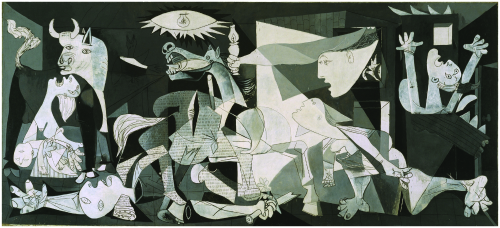
Most of the buildings in Gernika were constructed of wood above the ground floor. For that reason, the Junkers had been loaded with both high-explosive bombs and incendiaries—the HEs to make kindling, as Kurt Vonnegut once explained to me from his similar experience in Dresden, the incendiaries to light the fires. The HEs were 100- and 500-pounders. The lightweight incendiaries—tubes 14 inches long and 2 inches in diameter, made of Elektron (an alloy of 92 percent magnesium, 5 percent aluminum and 3 percent zinc) filled with thermite—were packed in droppable dispensers, each holding 36 bombs.
Thousands of Elektron incendiaries fell on Gernika that night, skittering down like icicles broken off a roofline. Pure metal burning at 2,200 degrees Celsius, they were almost impossible to quench. The Australian journalist Noel Monks describes the aftermath (Monks, 1955: 97): [On arrival] I … was immediately pressed into service by some Basque soldiers collecting charred bodies that the flames had passed over. Some of the soldiers were sobbing like children. There were flames and smoke and grit, and the smell of burning human flesh was nauseating. Houses were collapsing into the inferno. In the Plaza, surrounded almost by a wall of fire, were about a hundred refugees. They were wailing and weeping and rocking to and fro … . Most of Guernica’s streets began or ended at the Plaza. It was impossible to go down many of them, because they were walls of flame. Debris was piled high. I could see shadowy forms, some large, some just ashes. I moved round to the back of the Plaza among survivors. They had the same story to tell, aeroplanes, bullets, bombs, fire.
“When news of the bombing of the town of Guernica reached us in Paris, [Picasso] was completely upset,” the photographer Man Ray recalled. “Until then, and since the First World War, he had never reacted so violently to world or outside affairs” (Baldassari, 2006: 166). Picasso had at last found his subject for a mural the Republican government of Spain had commissioned in January for the Spanish Pavilion at the upcoming 1937 Paris World’s Fair.
“A thousand incendiary bombs dropped by the aircraft of Hitler and Mussolini reduce to ashes the city of Guernica
On May 1, 1937, Picasso outlined his initial conceptions of Guernica in quick pencil gestures on blue paper in a spacious Paris studio at 7 rue des Grands Augustins. The form of the finished painting was already there in that first gesture drawing, but to test his ideas the artist explored alternatives in a series of more than 40 such studies and sketches over the next week.
And then suddenly, on Sunday, May 9, the whole canvas emerged in a big composition study, drawn in pencil on a two-by-four-foot sheet crowded with figures. Reading from the viewer’s right to left: a burning roof above a partly opened door; a muscular arm with a raised fist extending from a lower window of the next building; a mother and her dead baby; a dying horse; below the horse a dead soldier; behind the horse a wagon wheel; behind the wagon wheel a building with a tile roof, from the upper window of which extends a woman’s head and arm holding a torch; to the left of the building a bull, its body in left profile but its head turned back to the scene of death and looking surprised; other buildings behind the bull, from an upper window of which extends another raised fist; a woman sitting in a doorway looking stricken, holding the bodies of a dead man and a dead woman—a jumble of figures and events. At this point, Picasso may have been considering a crowd scene in a burning town. Many of the figures he would use in his finished mural painting are present, but the composition doesn’t yet cohere.
Tuesday, May 11, brought major change. Confident now that he knew where he was going, Picasso stretched canvas on a full-sized wooden frame, 11½ feet high by 25½ feet wide, and set it up in the big attic space. It was so large that it had to be jammed in at a tilt under the sloping attic rafters and painted with long-handled brushes, sometimes reaching from a stepladder. With black paint and a narrow brush on that vast canvas, Picasso drew in the first full version of the painting. “Picasso worked fast,” writes his biographer Roland Penrose, “and the outline of the first version was sketched in almost as soon as the canvas was up” (Penrose, 1981: 302).
A number of books and essays have described the process Picasso followed in creating Guernica, painting and overpainting until his composition cohered. Less well known are the many visual references to other paintings that he layered into the work. He did so, I think, to anchor and extend Guernica into history, to deepen it with the visual equivalent of allusion and metaphor. Almost every image in the painting has its near double and triple in previous works by a range of well- and little-known masters, adding meaning much as the previous uses of a word, back historically to its first appearance in print, add meaning to its present sense.
The best-documented example of this layering process is the figure of the lightbearer—the woman in the window. She is female—Picasso added breasts at the window to make sure that was clear—and in the final painting resembles his mistress Marie-Thérèse. (In some of his earlier sketches, Picasso had given the lightbearer his other mistress Dora Maar’s hair and features instead—Dora Maar was his partner in the production of the work, encouraging him, sometimes assisting in the painting itself and photographing its stages for what may have been the first time in the history of art.)
One source of the lightbearer image is private: Dora Maar used to extend a lamp out of an upper-story window to see who was knocking when guests arrived after dark at Picasso’s country estate at Boisgeloup, northeast of Paris (Museum of Modern Art, 1947: 67).
From there the trail leads to Picasso’s own work, in particular the Minotauromachy of 1935, one of Guernica’s precursors, in which a virginal young girl holds out a candle to give pause to a huge-headed minotaur that has just killed a female matador with a sword. Peter Paul Rubens’s 1638 The Horrors of War is another evident precursor to Picasso’s painting; if you reverse Rubens’s image, it depicts, from right to left, a partly opened door, a woman reaching up with both arms in horror, a nude woman reaching left across a soldier in armor with an upraised fist, and various figures of soldiers standing and fallen, one of whom holds up a torch. Picasso clearly associated the soldier’s upraised arm with the raised arm holding a hammer and a sickle that he had drawn once in disgust on the front page of the right-wing newspaper Paris-soir and had included in early versions of Guernica. As the painting developed, he gradually replaced that propagandistic arm with a representation first of the sun and then of a sun-like eye with a light bulb for a pupil. That representation in turn clearly alludes to the Ojo de Dios of some Spanish churches, the Eye of God painted or inlaid on the interior of the dome that looked down on the congregants and saw and judged all, much as does the sun-light-bulb-eye in Guernica.
Another torch-bearer to whom the one in Guernica alludes is the winged figure of Justice in Pierre-Paul Prudhon’s c. 1805 Justice and Divine Vengeance Pursuing Crime, which includes a fallen male nude bleeding from a chest wound and a criminal running away to the left. A less obvious allusion, but a likely one, is to Jacob Jordaens’s 1642 Diogenes Searching for an Honest Man, which bears compositional similarities to Picasso’s painting—Diogenes at the center holding up a lantern, a figure on the left looking out of an upper window, cattle looking on below where Picasso would paint a bull, a horizontal format. The story of Diogenes going about in daylight with a lantern looking for an honest man resonates with the lightbearer’s action in Guernica, holding out a lamp to reveal the horror of the bombing of Gernika to the world.
Finally, and perhaps most surprisingly, the lightbearer with her lantern and her spiky hand at the window evokes the Statue of Liberty with her torch and spiky nimbus of light, a statue constructed in France and donated to the United States in 1886. The Spanish poet and critic Juan Larrea, who first commented on the connection, believed the allusion to Liberty to be unconscious on Picasso’s part, but there were at least three smaller-scale but still monumental models of the Statue of Liberty in Paris. It’s probable that Picasso had seen them all, and his visual memory was immense.
Picasso worked intensely on Guernica day and night and through the weekends throughout the month of May and into June; cigarette butts litter the attic floor in Dora Maar’s sequence of photographs of the work in progress.
In May as well, the Spanish artist responded to rumors circulating in Paris that he was pro-Franco with the first public statement of his political beliefs (O’Brian, 1976: 321): The Spanish struggle is the fight of reaction against the people, against freedom. My whole life as an artist has been nothing more than a continuous struggle against reaction and the death of art. How could anybody think for a moment that I could be in agreement with reaction and death? When the rebellion began, the legally elected and democratic republican government of Spain appointed me director of the Prado Museum, a post which I immediately accepted. In the panel on which I am working which I shall call Guernica, and in all my recent works of art, I clearly express my abhorrence of the military caste which has sunk Spain in a sea of suffering and death.
All the human beings still alive in Guernica are women. “The horror and inquisitiveness of the women,” Clark comments, “—their bearing witness even at the point of extinction—have been given sufficient substance [in the painting]. What fixes and freezes them is felt as a mechanism, a rack. The bomb is the abstractness of war—war on paper, war as war rooms imagine it, war as ‘politics by other means’—perfected. Here is what happens when it comes to earth” (Clark, 2013: 270).
“A machine for suffering,” Picasso once called woman in a remark that some have judged to be misogynistic, but which was also a secret revealed: “I am a woman,” the Spanish artist, late in life, lowered his guard enough to admit—that is, a machine for suffering as well (Clark, 2013: 225). A woman, yes, and a man, and an artist: the bull in Guernica, staring ahead with an auroch’s opaque carriage—“here a noble adversary,” says Daix, “turning away from the killing which humiliates him,”—the bull has Picasso’s eyes (Oppler, 1988: 97).
“Picasso continued his picture during May and June,” the Catalan architect Josep Lluís Sert recalls, “and one day he brought it to the Pavilion. I think it was late June. I don’t remember the date exactly. He brought it there. He was in love with his picture and he really considered it very important and a part of himself. … He brought the Guernica to the pavilion. He put it on the concrete floor and put it on a stretcher and put it on the wall” (Freedberg, 1986: 661).
Part of the power of Picasso’s great painting is its ambiguity. Its events take place simultaneously inside and outside of the interior space it seems at first to define; its foreground and background overlap. Is it a town square, the feria the people of Gernika were closing down at the end of the day when the German bombers struck? Is it the anchorage of a 19th-century bourgeois interior as well? It’s both, and the monsters have penetrated and overwhelmed its fragile security, leaving behind a dead infant, a mother screaming in grief, a decapitated dead soldier, a spear-pierced dying horse, and a woman falling terrified from a burning roof.
Picasso suspected, but he could not know, that his painting was a vision not only of the present but also of the future. The bombing of Gernika was the first intentional aerial destruction of a city, a city targeted not for its military value—it had none—but deliberately to terrorize its civilian population. The technology would evolve to terrorize the Germans in turn at Hamburg and Berlin and Dresden; Britain and the United Sates would drop a total of 2.8 million tons of bombs on German and Italian cities during World War II, producing a death toll in Germany alone of 400,000 to 600,000 lives. And then Hiroshima, and then Nagasaki.
Picasso’s only weapon was painting. The clear-eyed young woman with her torch and then her lantern had already taken her place at the window in his first Guernica sketch. The raised fist with its hammer and sickle went early. Picasso gradually overpainted it in Guernica’s successive iterations, replacing it with a glaring sun. Then the sun itself acquired a pupil, a light bulb like the lights Dora Maar set up to photograph the painting—thus a resonance, the light that illuminated the painting illuminating the light that illuminated the massacre.
What else is there in the world with which to confront terror except light, light and the naked truth? Even today, unsuspecting visitors walk into the gallery devoted to Guernica at Madrid’s Reina Sofia museum and burst into tears.
Footnotes
Funding
This essay received no specific grant from any funding agency in the public, commercial, or not-for-profit sectors.