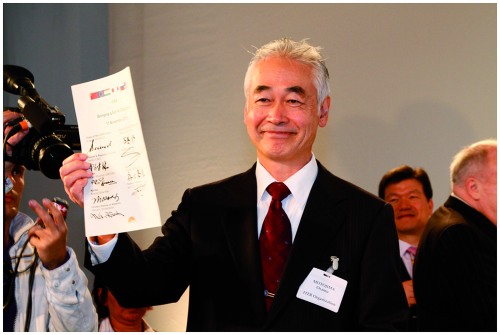
Today, seven members—the European Union, the United States, Japan, China, Russia, South Korea, and India—have formed an organization and invested in what is planned to be the world’s first reactor-scale fusion machine. By 2027, the France-based, multibillion-euro experiment known as ITER aims to produce 10 times the energy it consumes. In this interview, Osamu Motojima, the project’s director general, discusses the skepticism surrounding fusion as a practical energy source, the staggering costs of a large-scale fusion project, and the likelihood that ITER will be the silver bullet that slays the world’s future energy woes.
In 2010, Japanese physicist Osamu Motojima took the helm of one of the most controversial energy efforts in the world: ITER, a multibillion-euro nuclear fusion experiment tucked inside a lavender-scented village in southern France. To its skeptics, ITER—originally known as the International Thermonuclear Experimental Reactor before it reclaimed its acronym, a Latin translation for “the way”—is a money pit of an energy project that is always 20 (and sometimes 30) years away from happening. But Motojima and his optimistic international staff of more than 400 willingly accept the scientific challenge of large-scale fusion. They see a bleak year in the not-too-distant future—2030, say—when a world inhabited by an ever-larger population with an ever-greater need for energy will have no significant alternative power source prepared to satisfy the demand. For them, it is better to try something that might solve the problem and, even if it fails, at least know why it failed. If it works, of course, even better.
ITER is planned as the world’s first reactor-scale fusion machine, which, if successful, will release 10 times the energy it consumes: that is, 50 megawatts in, 500 megawatts out. Today, the Joint European Torus, or JET, in the United Kingdom holds the record for fusion energy release with 16 megawatts.
The ITER staff spends its waking hours working on a variety of pieces that are part of the same overall puzzle: how to sustain fusion reactions in the vacuum vessel of the 23,000-ton tokamak, an 840-cubic-meter vacuum chamber in which hydrogen isotopes are heated and compressed until they fuse, form helium, and release energy.
Seven members—the European Union, the United States, Japan, China, South Korea, Russia, and India—make up the ITER consortium, and each contributes money and resources to the project. Following on the preliminary successes of JET, as well as China’s Experimental Advanced Superconducting Tokamak and South Korea’s Superconducting Tokamak Advanced Research project, ITER is seen by some as a holy grail, the fusion machine that will achieve sustained energy production.
A member of the ITER Council since 2007, Motojima was named the organization’s director general three years later. Before that, he had devoted 20 years of his career to Japan’s National Institute for Fusion Science, where he served as director general from 2003 to 2009. Today, because of Motojima’s efforts, the institute now houses the Large Helical Device—an experiment that confines extremely hot plasma with magnetic fields in order to sustain fusion—which, before ITER, was the world’s largest superconducting device in plasma research.
The Bulletin spoke with Motojima about his career, fusion, and whether the day will come when large-scale fusion lights homes around the world.
BAS: Within 13 years of earning your PhD in electrical engineering, you joined Japan’s National Institute for Fusion Science—and ultimately headed it. What attracted you to fusion?
Motojima: My father was a chemist who worked on nuclear fuel and radioactive waste treatment at the former Japan Atomic Energy Research Institute; his vision was to provide people with energy through nuclear power. He introduced me to the nuclear sciences. However, in contrast to my father, I chose to become a physicist. My main motivation for choosing fusion in the early phase of this research field was that I felt fusion would one day contribute to the future energy supply of humankind and—more so—to world peace. In 1969, when I graduated from Kyoto University, the faculty of science operated a tabletop nuclear fusion device, a so-called mirror machine. The tokamak, the most developed fusion concept as of today, had already been invented by the Soviet physicists Igor Tamm and Andrei Sakharov, but this technology was not yet shared due to the Cold War. I never had the feeling that a linear mirror machine could achieve fusion, so I actively investigated other routes to fusion energy, based on the principle of magnetic confinement. The heliotron, invented by Professor Koji Uo, was such an approach. Uo and his successor, Professor Atsuo Iioshi, gave me the chance to work on and build this machine. I later had the opportunity to build the Large Helical Device [LHD]. With the LHD, we reached the breakeven condition, which is the moment when plasmas in a fusion device release at least as much energy as is required to produce them.
BAS: What is the record for this?
Motojima: The current record for energy release is held by JET in the United Kingdom, with 16 megawatts. With ITER, we plan to produce 10 times more power than it consumes: For 50 megawatts of input power, we will gain 500 megawatts of output power.
BAS: In 1998, while leading the LHD experiment at the institute, you worked on creating the world’s largest superconducting stellarator, which confines hot plasma in order to sustain a controlled nuclear fusion reaction. You have been quoted as saying that March 31, 1998—the day the device first created a high-temperature plasma—was the “greatest moment in my life as a researcher.” Describe what that was like and what it meant to you.
Motojima: You can imagine that after eight years of designing and constructing such a device, it is quite a relief to see the machine you have devoted so much time and sweat to—the world’s biggest superconducting machine before ITER—actually working. And even more, that it was working as predicted, taking fusion into a new era by achieving more than 100 million degrees Celsius. We were, of course, also lucky that we succeeded in achieving this result on the 31st of March. One day later, and we would have been the “April fool” and nobody would have believed us.
BAS: From a stellarator to a tokamak: This leads us to ITER, where you have been since 2010. Slated to begin power-production experiments in 2027, ITER’s 13-billion-plus-euro, 23,000-ton tokamak will, at times, reach 150 million degrees Celsius—10 times the temperature of the sun’s core. From 93 million miles away, that’s one expensive and impressive human-made super sun. There is a chance that the project will work—in that fusion will be attainable—but there is also a chance it won’t. With a project this large, presumably there will be scientific gains or discoveries in the meantime that make the project worthwhile, even if fusion isn’t achieved at the end. Have you had any revolutionary insights so far?
Motojima: Since my background is plasma physics, I hope to answer from that point of view. Three things are key in a fusion plasma: density, confinement time, and temperature. This combination is known as the “fusion triple product,” and it is what measures the performance of a fusion reactor. Before ITER, this product doubled every 1.8 years; at ITER, it has doubled every 18 months. However, plasma is full of nonlinearity and far from any state of equilibrium; moreover, it is extremely complex and is known as the “fourth state of matter.” Ultimately, ITER will be the culmination of research and development on all scientific aspects of achieving a burning plasma. But until ITER is actually fully operating, I cannot yet speak about breakthroughs.
BAS: ITER has been both praised and criticized in the media. The project, which is a global partnership among seven members, has been characterized as a boondoggle, climbing billions of dollars over budget and falling years behind schedule. What is your response to these criticisms?
Motojima: Compared with the initial 2001 cost estimates of 5 billion euros for the 10-year construction phase, the price tag has increased to an estimated 13 billion euros. Each ITER member chose what it would be responsible for with regard to the in-kind contribution of components; thus, each invests money into its own research and development, as well as into the construction of these components. The cost growth is different for each member, in part depending on how it funds the project and whether it formed new institutes to manage its technological contributions to ITER.
BAS: What caused the overruns?
Motojima: There have been some common factors related to the greater effort than had originally been foreseen for completion of the design of ITER: increased cost of raw materials, administrative costs associated with creating a new organization, and a larger-than-planned team. When we first set out in 1992 with the conceptual design activities, ITER consisted of the Soviet Union, the United States, the European Union, and Japan; today, that number is seven, which includes China, South Korea, and India. Ultimately, ITER will provide enough return to the stakeholders by intellectual property gains during construction, operation, experimental data, and human resources, which will become valuable when building the next step, a demo reactor [demonstration power plant].
BAS: 2012 was a difficult year for your members, particularly for the European Union and the United States, which both had to beg their governments for more ITER funding. On the chopping block in the United States, for example, were three domestic fusion program budgets to make room for the growing ITER budget. Now that cuts are part of the picture, the honeymoon with ITER, for some, could be over. With the economy as it is—and the unproven nature of the great breakthrough fusion gain that ITER is after—do you think you can retain all seven members until the experiments begin in 2020?
Motojima: At the 10th ITER Council meeting held last year in the United States, all of the members recognized the importance of the project and reiterated their sustained strong support. The large increase in the European Union’s funding—that is, the EU’s 2010 contribution of 6.6 billion euros for construction, up from the initial 2001 number of 2.7 billion euros—represents a major commitment to the success of the project despite other budgetary constraints in Europe. Similarly, despite the budget issues in the United States, the Obama administration proposed a 2013 budget increase for ITER. We are optimistic that the members will remain committed. Nonetheless, we recognize the need for each member to maintain a strong national fusion research program to maximize its contribution to ITER—likewise, these members obtain scientific and technical accomplishments from ITER that can be applied to their own domestic programs.
BAS: Of the seven members that are involved in ITER, when broken down into percentages, Europe is responsible for about 45.5 percent of the construction costs, and then the others—Russia, the United States, China, South Korea, Japan, and India—each contribute 9.1 percent. Most of these costs are delivered as in-kind contributions of components and structures, rather than cash. ITER is an innovative large-scale project that must withstand extreme heat; thus, unique devices, parts, and technologies will not only be conceptualized for this project, but also designed and manufactured. How do you ensure quality control—and technological uniformity—when seven different members are contributing?
Motojima: The ITER Organization applies the same quality requirements throughout the project and performs independent surveillance inspections in all member countries during the manufacturing of all ITER components. We train all members how to enforce these requirements with their own personnel, and also with any suppliers with which they interact.
BAS: Even in layperson’s terms, it is difficult to get seven people to bring seven complementary dishes to a potluck dinner. How does this work with a multibillion-euro project?
Motojima: Orchestrating such an ambitious project with so many stakeholders involved is, of course, a challenge. But we all have to understand that ITER is far more than a simple construction project. With ITER we have created a new standard and a new culture for international cooperation in science. ITER, therefore, is not only one of the major scientific and technological challenges of the 21st century, but it is also an unprecedented model for international research collaboration.
BAS: What do you mean by “new standard?” How is this model different, say, from the Manhattan Project, or CERN, which is just a few hours away from ITER?
Motojima: As the overall coordinator of the program, the ITER Organization is responsible for designing, building, and operating the machine, while the seven members provide most of the machine’s components. These members have all created domestic agencies, which act as the liaison between national governments and ITER and deliver each member’s in-kind contributions to ITER. This is certainly a unique approach in the field of science. We are continuously investigating how to improve the way to work together harmoniously, while paying heed to the different cultural practices of each of the members.
BAS: If you could redesign the structure of ITER today, what would you do differently?
Motojima: The structure of ITER is defined in its originating agreement. That, we cannot change. But since I took over as director general in 2010, I have implemented new principles to make the complicated clockwork of this megaproject more efficient. Since the ITER project is progressing and is under construction, it would be difficult to implement major changes at this stage. It would be more practical to discuss a new set-up once we start designing the demo reactor.
BAS: And has that been suggested?
Motojima: No, ITER is not discussing any restructuring plans.
BAS: Some supporters argue that ITER is the only hope to know whether fusion can meet the world’s demand for power. This is quite sobering language. Say it’s 2027, and we flip the switch on ITER and nothing happens. What then?
Motojima: ITER is an experimental reactor. Its goal is to demonstrate the scientific and technological feasibility of fusion power for peaceful purposes. As one of the few options for a large-scale, non-carbon future supply of energy, fusion has the potential to make an important contribution to sustainable energy supplies. Fusion can deliver safe and environmentally benign energy, using abundant and widely available fuel, without the production of greenhouse gases or long-term nuclear waste. Realizing fusion’s potential is technically challenging, but the major world powers have decided to work together to take the next step toward producing fusion energy. The question the critics have to ask themselves is: Can we afford not to try it?
BAS: Many scientists argue that it is urgent that we begin reducing emissions immediately, and we can’t afford to wait for a magic solution. What do you think we should be doing between now and fusion?
Motojima: Fusion will most likely contribute to the world’s energy demand around 2050. However, it is obvious that fusion energy alone will not solve the world’s energy problem. A lot of wisdom is necessary to solve the problem in order to help humankind survive. Now and in the future we will have to further develop intelligent and sustainable energy technologies that will feed the world’s ever-growing energy demand. Saving energy could be a good start.
BAS: One criticism of ITER is that the project is swallowing money that could be better spent on more immediate, functioning alternatives, like solar and wind. Is this a fair criticism?
Motojima: Again, knowing about the huge potential of fusion energy, the people that decide on where to put the money have to ask themselves: Can we afford not to try it?
BAS: A fusion reactor would be an even more complex piece of machinery than a fission reactor. What concerns do you have about maintenance and safety?
Motojima: Concerning safety, which is the strongest cost issue, the hazards present in a fusion plant are limited. There is no chain reaction, no possibility of a runaway reaction, no large after-heat, so no equivalent of “core meltdown.” If there is a problem, the plasma just stops. There is also no created fissile material or other actinides, no fission products. The only radiological hazards are the tritium fuel and structure near the plasma that are activated by neutrons. In both cases, the risks are controlled by reliable confinement systems, and safety analyses of both ITER and of future power plant concepts have shown that the consequences of postulated accidents would be minor.
BAS: Speaking of fission, ITER is literally next door—in that you share a driveway—to the largest nuclear research site in Europe, which houses reactors, waste, and a research center. ITER will employ the deuterium-tritium fusion process; thus, tritium received from Canada’s Candu reactors will be stockpiled and stored on site. How is ITER thinking about the proliferation risks involved here?
Motojima: The ITER Organization is well aware of the potential proliferation risk. This is already recognized in the text of the ITER Agreement. We are working, and will continue to work, with the French authorities in this area. The maximum amount of tritium in the facility will be set by the French safety authorities, and will not exceed 4 kilograms. The actual amount in ITER at any time will be determined by operational needs based on our research plan. There are currently no international safeguards related to tritium, so our limitation is set by the French nuclear regulator.
BAS: In the United States last year, both presidential candidates campaigned on an “all of the above” energy strategy, which called for developing multiple energy sources—coal, gas, nuclear, and, in Obama’s case, renewable energy. But no one talked about fusion. Do you foresee fusion as just one part of the world’s future energy mix, or could it—as some proponents claim—someday provide all of the energy we need?
Motojima: One of the missions of ITER is to disseminate the viability of fusion energy to the public. I expect that the progress in ITER’s construction will attract more interest in fusion: 500 megawatts thermal output will surely have an impact.
BAS: The joke about fusion is that it’s always 20 years (or even 30) away, and indeed it looks like it will be at least 13 years before ITER begins energy-producing experiments. What’s taking so long?
Motojima: Fusion research was declassified following the International Conference on the Peaceful Uses of Atomic Energy in 1958 in Geneva—also known as the Atoms for Peace Conference. At that time, scientists believed that within 30 years fusion would reach ignition. But it was a big mistake since, at that time, we only had tabletop-level devices and could not predict the future correctly; that’s why it is often said “it’s always 30 years away.” We fusion scientists struggle with this quote while working very hard to improve the plasma parameters. Today, with the ITER project being constructed within 10 years’ time, fusion energy is no longer a dream but becoming a reality. This, to me, is the most important point for you to take note of. The 13 years that you cite are occupied mostly by fabrication, assembly, and commissioning; that timeline is determined by the complexity of the project and the need to construct this large facility in a safe manner, as appropriate for a nuclear facility.
BAS: Even if ITER succeeds in producing a lot more energy than it consumes, what gives you confidence that it would be cost-effective to scale it up for worldwide power production? What if fusion turns out to be feasible but not particularly economical?
Motojima: The cost issue is very important for fusion. There was a study done by the European Fusion Development Agreement, called the “Times Model,” exactly on this topic. It shows that, depending on oil prices and the taxes that we’ll have to pay for carbon dioxide releases, fusion is very well suited to compete.
BAS: How do physicists maintain excitement about a project that may not even be completed before their careers are over?
Motojima: Solving hard, cutting-edge problems motivates scientists and engineers. In the near term, they have enthusiastically addressed the hard problems during the design phase and leading up to the construction phase. There are relatively few energy options that can address long-term needs for base electricity production that do not have significant environmental effects. They are motivated by the realization that their current contributions—which address unique scientific and technological issues that only ITER can address—will enable future experiments for fusion energy.