




Abstract
Shortly after the accident at the Fukushima Daiichi Nuclear Power Station, Germany’s government started preparing legislation that would close the country’s last nuclear power plant by 2022. But this wasn’t an entirely new development: Germany had been planning to leave nuclear energy behind for decades, and to understand its nuclear phase-out requires a close look at the past. Several projects and events mark the beginnings of the German anti-nuclear power movement: Among them are the huge protests over the Brokdorf reactor, which began in 1976 and led to civil war-like confrontations with police, and the controversy over the Kalkar fast-neutron reactor in the mid-1970s. Because of these and subsequent developments—including the 1986 Chernobyl accident—by the 1990s, no one in German political life seriously entertained the idea of new reactor construction. This tacit policy consensus led to energy forecasts and scenarios that focused on energy efficiency, demand reduction, and renewable energy sources. By the time of the Fukushima accidents, many of these new energy priorities had already begun to be implemented and to show effect. Replacing nuclear power in Germany with other energy sources on an accelerated schedule is likely to come with a price tag, but, at the same time, Germany’s nuclear phase-out could provide a proof-of-concept, demonstrating the political and technical feasibility of abandoning a controversial high-risk technology. Germany’s nuclear phase-out, successful or not, may well become a game changer for nuclear energy worldwide.
Keywords
Within days of the Fukushima nuclear accidents in March 2011, it became clear that Germany’s response to the disaster would be determined and drastic; the nation’s eight oldest reactors were taken offline immediately, 1 and the government began to prepare new legislation that would ultimately mandate closing the last nuclear power plant by 2022. Public support for the phase-out reached almost 90 percent. Outside Germany, however, the decision to phase out nuclear power on this accelerated schedule—or on any schedule for that matter—has often been depicted as reckless and irresponsible. 2 At a time when climate change has risen to the top of the political and public debate, how could a country that committed itself to nuclear power early on—building a large fleet of power reactors that provided 20 percent of the country’s electricity demand—dare to walk away from one of its low-carbon energy sources?
Indeed, replacing nuclear power with other energy sources will require the phase-in of renewable energy sources at a faster rate than previously anticipated, and the accelerated transition is likely to come with a price tag. At the same time, however, Germany’s nuclear phase-out could provide a proof-of-concept, demonstrating the political and technical feasibility of abandoning a controversial high-risk technology and therefore creating a blueprint for others to follow. Germany’s phase-out, successful or not, may well become a game changer for nuclear energy worldwide.
The idea of a nuclear phase-out did not come out of the blue, and to understand it requires a careful review of the past. The trajectory of Germany’s nuclear program is closely related to its post-war history and developments in West German society. The controversy over nuclear power has its origins in the late 1960s and early 1970s, but most important, there has been a continuity of debate over nuclear power from that time to the present, transformed over several decades by domestic developments and re-energized (and, in many ways, justified) by the accidents at Three-Mile Island, Chernobyl, and finally Fukushima. When the critical stages and events of the debate are viewed in perspective, the logic—and perhaps even the inevitability—of the German phase-out decision becomes apparent. Germany has been planning to leave nuclear energy behind for decades.
The origins of German nuclear skepticism
As in many other industrialized countries, support for atomic energy in West Germany was originally considered a progressive position. 3 In the early years of the Atoms for Peace program, nuclear power held the promise of modernity and a solution to mankind’s energy problems. At the time, it was the utilities that perceived this early interest in nuclear power as unwarranted atomic hysteria and were generally reluctant to adopt a new and unproven technology that came with many economic and technical uncertainties. To overcome this resistance, the German government established major research centers at Karlsruhe and Jülich in the mid-1950s, 4 and they would both become important hubs of European nuclear research and development. Work at these centers focused not only on reprocessing and enrichment—pursuits usually noted warily by Germany’s neighbors 5 —but also on the development of a variety of novel reactor concepts, often advocated as alternatives to dependency on US technology and fuel supply. 6
In the early 1970s, however, the enthusiasm for the technology began to wane, and by 1980, the historian Joachim Radkau was led to title his definitive account of nuclear power development in Germany The Rise and Fall of the German Atomic Industry, 1945–1975: Displaced Alternatives in Nuclear Technology and the Origin of the Nuclear Controversy. 7 Numerous examples illustrate the early crisis that put nuclear power technology on a downward path from which it would never recover. In hindsight, however, a few particularly important projects played critical roles in the public debate; taken together, they help explain Germany’s phase-out decision decades later.
The Brokdorf reactor
If one event had to be singled out to mark the origins of a movement opposed to nuclear power that went beyond local interests, it would probably be the Brokdorf protests, which ultimately led to numerous civil-war-like confrontations between police forces and opponents of the project (Aust, 1981). 8
The planning for a light-water reactor at the Brokdorf site, 45 miles northwest of Hamburg, had been underway since the late 1960s, but became a public issue only in November 1973, at a time when several power reactors were already operating in Germany. The Brokdorf controversy had a lesser-known prelude at another proposed reactor site near the town of Wyhl, where the peaceful occupation of the construction site by local community groups (including clerics and winemakers who worried that the steam from cooling towers could negatively affect wine production in the region) led to a construction stop and ultimately the cancellation of the project (Radkau, 1983: 452). After this accidental success of an essentially local-issue movement, the German federal government decided to set a precedent and avoid a second Wyhl at all costs. In October 1976, within hours of receiving the construction permit, police secured the Brokdorf site with barbed wire while construction workers were moving in equipment. That night, police forces clashed with opponents who were trying to occupy the site, just as in Wyhl three years earlier. Only this time, violence rapidly escalated, attracting significant national media attention. 9
Four weeks later, more than 30,000 people gathered to demonstrate against the Brokdorf project. These protests led to a construction stop in October 1977, which was formally justified by the lack of a disposal strategy for spent fuel. Brokdorf had become a powerful symbol of the German anti-nuclear movement, and, when construction was about to resume in February 1981, about 100,000 demonstrated against the project, confronting a police contingent of more than 10,000—at the time, the largest police operation in the history of West Germany. More confrontations and political tugs of war followed, but the Brokdorf reactor eventually came online in October 1986; ironically, it would be among the first new grid connections worldwide after the Chernobyl accident.
What is remarkable about these early events is that the opposition to the Brokdorf and the Wyhl projects did not explicitly target nuclear power per se, or even focus on particular issues of nuclear power, such as reactor safety or waste disposal (Radkau, 1983: 458). Instead, the early opposition movement largely developed in response to the nontransparent and authoritarian style in which the federal government pursued its big-industry projects, exemplified by excessive use of police force. Only later would this non-specific focus of the anti-nuclear movement be complemented by a technical critique targeting specific issues of nuclear power. This transition begins most clearly with the debate over the fast breeder reactor at Kalkar.
10
Police stand guard outside the Brokdorf Nuclear Power Plant in 1981. Photo credit: Günter Zint/panfoto.de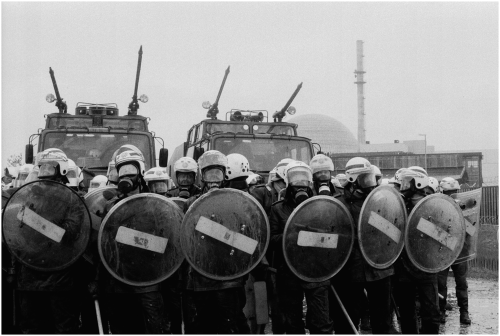
The Kalkar fast-neutron reactor
Between 1957 and 1991, West Germany pursued an ambitious—and ultimately unsuccessful—fast breeder reactor project. After an initial research and development phase, the project envisioned the construction of a 300-megawatt electric prototype reactor, the SNR-300, which would be followed by a full-scale demonstration reactor (Keck, 1981; Marth, 1994). Construction of the SNR-300 near the city of Kalkar in North Rhine-Westphalia began in April 1973. In the wake of Wyhl and Brokdorf, protests against the Kalkar reactor began to escalate in the mid-1970s. A large demonstration in September 1977 involved a massive police operation that included the complete closure of autobahns in northern Germany and identity checks of almost 150,000 people. 11
But along the way, a new dimension emerged. In the course of a court case first initiated by a local farmer against the Kalkar reactor in 1972, independent experts began to testify on issues related to proliferation and security risks of separated plutonium and, more important, the unique safety risks of fast breeder reactors. One particular scenario, the hypothetical Bethe-Tait accident—in which, after a loss of coolant, the core of a fast breeder reactor collapses and leads to a small-scale nuclear explosion (Bethe and Tait, 1956)—later became fateful for the Kalkar project.
Top: The autobahn is closed for identity checks because of protests of the Kalkar fast-breeder reactor in September 1977. Bottom: Police await protests near Kalkar in North Rhine-Westphalia. Photo credit: Günter Zint/panfoto.de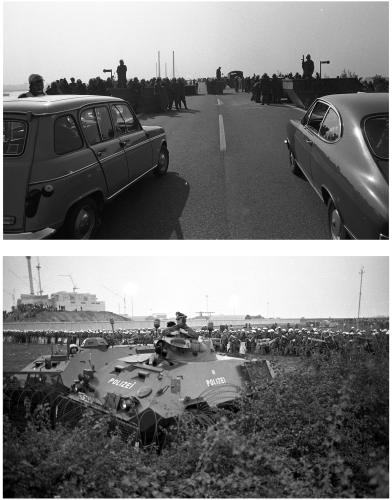
During hearings that started in 1978, a group of independent experts, originally based at the University of Bremen, pointed to the possibility of a Bethe-Tait accident and supported their analysis with estimates of the energy release associated with it. In response, the Kalkar project leaders tried to argue that such an accident could be contained, which ultimately proved difficult to demonstrate, given that the reactor had not been designed with this particular type of accident in mind. Moreover, by the time of the hearings in the late 1970s, major concrete and steel structures were already in place and impossible to modify or replace. The decision to proceed with the project was reached in 1982, 12 but for the first time, outside technical experts made critical contributions to a safety evaluation as part of the licensing process of a nuclear reactor in Germany. In hindsight, the Kalkar case helped establish independent nuclear expertise that would later be called upon in many other circumstances, 13 and some of the experts who began their work as outsiders in the 1970s and 1980s would eventually become members of the Federal Reactor Safety Commission (RSK), the Radiation Protection Commission (SSK), and the Society for Reactor Safety (GRS)—all involved in regulating nuclear power in Germany.
Construction of the Kalkar reactor was complete in mid-1985, but a newly elected state government was clearly opposed to the project, and the Chernobyl accident in April 1986 made it effectively impossible to let such a controversial initiative go forward. In March 1991, the German federal government announced that the facility would not be put into operation. 14 By that time, the costs of the project had escalated from an original estimate of $150 to $200 million to about $4 billion. The site now hosts an amusement park. 15
Two additional projects of that era stand out: the proposed Wackersdorf reprocessing and mixed-oxide fabrication plant and the Gorleben final repository. These projects are notable because they mark the shift of attention to fuel-cycle facilities and the back-end of the fuel cycle. The Wackersdorf reprocessing plant was eventually canceled in the spring of 1989. It was clear to everyone that breeder reactors would not play a relevant role in the foreseeable future, and the main customer of the plant signed an agreement with the French industrial group Cogema to reprocess spent fuel in La Hague, France, instead. About $5 billion had been spent on the project since its beginnings in 1980. Cancellation of the Wackersdorf plant, however, put further emphasis on the final repository site near Gorleben, which had been selected in 1977 and was located in the eastern-most corner of West Germany. 16 The project played a particularly significant role because it remained a focal point of the anti-nuclear movement throughout the 1990s; it also is the only controversial nuclear project in Germany that is still relevant today—its ultimate fate and role are still open.
Chernobyl: The idea of a phase-out goes mainstream
By the time of the 1986 Chernobyl accidents, the skepticism about the future of nuclear power in Germany was already widespread; the Green Party had been in the Bundestag since 1983, and the nuclear phase-out was a key element of its political agenda. In March 1986, four weeks before the Chernobyl accidents, more than 100,000 people protested against the Wackersdorf reprocessing plant. Even if the Chernobyl accident further intensified the debate, it was not the turning point it perhaps was in other western European countries. In the aftermath of the 1986 Chernobyl accident, however, the notion of a nuclear phase-out became mainstream in the public and political debate. Most important, the Social Democratic Party (SPD), then the major opposition party, formulated a new and critical position toward nuclear power. 17 The idea of a nuclear phase-out and a ban on reprocessing were first articulated in a new SPD policy statement in late 1989, shortly after the fall of the Berlin Wall: “We want to achieve a secure and environment-friendly energy supply without nuclear power as soon as possible. We consider the plutonium economy a mistake.” 18
The conservative federal government remained in power until 1998 and, in principle, government support of nuclear power was still a given. Several important pre-Chernobyl projects, however, began to fall apart. The notion of building new nuclear reactors in Germany became completely unrealistic. Given that the climate change debate was still in its infancy and the economics of nuclear power unattractive, new nuclear construction was essentially a non-issue.
Surprisingly, in the 1990s the critical attitude toward nuclear power in Germany did not dissipate, even though few nuclear issues were relevant in this period—except for one. In April 1995, the first shipments of nuclear waste to the interim storage facility at the Gorleben site began. They included spent fuel from various German reactor sites and high-level waste from reprocessing facilities in France. These shipments provided a focus—arguably, the only one available—for public political debate on the future of nuclear power in Germany. The anti-nuclear movement was able to concentrate its energy on these so-called Castor transports, 19 using them to transform otherwise innocuous operations into mega-events that would dominate national media coverage for several days at a time.
The first transport in April 1995 included a total of just two casks but mobilized 4,000 protesters and 7,600 police; the second transport in May 1996 included a single cask coming from the La Hague reprocessing plant and required a police force of 19,000. The third transport in March 1997 included a total of six casks, and it faced 10,000 protesters and 30,000 police. 20 As their forerunners from the 1970s and 1980s, these events turned extremely violent. The government’s handling of these protests was often perceived as disproportionate and, in the unified Germany of the 1990s, increasingly anachronistic, even in the eyes of the broader public. In hindsight, the Castor-transport controversy would build a bridge between the early debate over nuclear power, when new facilities were actually planned or built, and a forthcoming change in the federal government.
The nuclear phase-out
When the Social Democratic Party won the 1998 elections, forming a government with the Green Party, one of the much-anticipated key provisions in the coalition agreement was the nuclear phase-out. It took two years to reach an agreement between the government and the utilities, and new legislation entered into force only in April 2002. The law prohibited the construction of new commercial nuclear power plants in Germany, limited electricity production from plants already in operation, prohibited sending spent fuel for reprocessing after mid-2005, and required the construction of dry-cask storage facilities at reactor sites. Among these provisions, the end of reprocessing and the on-site dry-cask storage have been implemented on schedule and without much controversy, which is in and of itself a remarkable accomplishment. Beyond that, the major opposition parties (and future Chancellor Angela Merkel) formally maintained their disapproval of the nuclear phase-out.
Police protect a Castor transport in 1997. Photo credit: Günter Zint/panfoto.de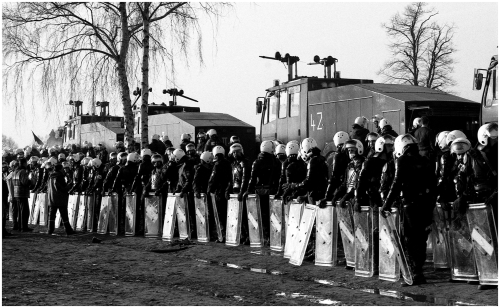
In the 1990s, however, a new and more subtle process gradually took hold: No one, including the parties opposed to a phase-out, seriously entertained the idea of new reactor construction in Germany, in spite of growing concerns about climate change. Based on the lessons learned in the 1970s and 1980s, such a proposal would have been impossible to defend, and so, a de facto policy consensus in favor of a decreasing role for nuclear power in Germany emerged. This general perspective has determined the scope of every significant energy outlook for Germany published since the late 1990s (Glaser, 2011). 21 Assessments produced over the years may have disagreed on the best strategies to meet certain climate targets, but they all worked from the fundamental starting point that—sooner or later— nuclear power would no longer be available in Germany. For this reason, even when Angela Merkel became chancellor in November 2005, government policy toward nuclear power did not fundamentally change.
In the first years in coalition with the Social Democratic Party, Merkel and her Christian Democratic Union avoided the issue of the phase-out. 22 After 2009, a new Conservative–Liberal coalition under Merkel was in principle able to reverse the phase-out—which was, after all, the flagship accomplishment of a political opponent—but this did not happen immediately. In fact, it took Merkel’s majority a year to decide what to do, exactly. It is worth noting that, at the time, public opposition to nuclear power in Germany remained surprisingly strong. In April 2010, about 120,000 demonstrators formed a 75-mile-long human chain between two reactor sites to commemorate the 1986 Chernobyl accident and to protest the widely anticipated federal government plans to extend the operational life of the remaining nuclear power plants.
Based on a number of options proposed in a government-commissioned report in late 2010 (Federal Ministry of Economics and Technology, 2010), the Merkel government opted for an average life extension of 12 years for nuclear power plants, now framing nuclear energy as a “bridge technology” that would be necessary until renewables fully penetrated the electricity market. Most important, however—and it is hard to overemphasize the significance of this fact—the revised law of 2010 did not fundamentally challenge the core of the atomic energy law of 2002. The previous government had changed the purpose of the law from promoting the development and deployment of nuclear power for peaceful purposes to a qualitatively different aim: the structured termination of its use. This remained the basis for Germany’s atomic energy law, even after the 2010 revision. 23
Fukushima and the road ahead
For Germany, the Fukushima accidents happened at an awkward political moment. The government had just negotiated a fragile compromise that extended the lives of the existing plants while retaining the fundamental idea of the phase-out, including the prohibition of new construction. It was a compromise that reactor operators were happy to accept, while it avoided a public uproar. In the German political calculus, Fukushima made that compromise instantly obsolete.
Perhaps the most remarkable impact of the accidents on Germany’s energy future is that they consolidated the broadest conceivable consensus for the phase-out in the public, a consensus that reached across the entire political spectrum, 24 and even to many parts of the industry. 25 The future of nuclear power in Germany is no longer a contested issue, while the energy debate has moved on to other questions. Foreign commentators sometimes suggest that Germany will rethink its decision for this accelerated phase-out once the dust of Fukushima has settled. This view overlooks the long and complex history of nuclear power development in Germany, which has been dominated by confrontation and failure. The decision to abandon nuclear power is inconvenient and—in the medium term—costly, leaving tens of billions of euros worth of assets stranded, and it has by no means been taken lightheartedly.
Time will tell whether what some have called Germany’s “great energy experiment” (Talbot, 2012) will be considered a success. 26 For those who find Germany’s model appealing, the lessons to be learned are complex, and they are not easily transferred to other countries.
In Japan, where Fukushima shattered the decades-long political consensus in favor of nuclear energy, officials may well look to the German example. For the first time, there is now considerable public support for a phase-out policy, and leading politicians and political parties are scrambling to respond. In September 2012, the Japanese government agreed to consider plans to phase out its nuclear program on the basis of a cap on existing reactor lifetimes and prohibition of new reactor construction. The German experience suggests, however, that Japan may struggle to reach this goal within the next 20 years from a standing start. As a result of Germany’s original decision in 1998 to phase out nuclear power, energy planners produced a barrage of energy forecasts and scenarios with a strong focus on energy efficiency and demand reduction. By the time the Fukushima accidents occurred, many of these new energy priorities had already begun to show their effects. Germany also had alternative energy scenarios available, already understood nuclear power as a technology that would have a decreasing role in the country’s energy portfolio, and considered a clear direction for energy policy more important than a particular phase-out schedule. This is perhaps the most important lesson to be learned from the German experience: Countries ought to develop energy alternatives early on, so they can respond flexibly when new opportunities and challenges arise.
Footnotes
Acknowledgements
This article is part of a three-part series on the implications of phasing out civilian nuclear power in Germany, France, and the United States. Additional editorial services for this series were made possible by grants to the Bulletin of the Atomic Scientists from Rockefeller Financial Services and the Civil Society Institute.
Funding
This research received no specific grant from any funding agency in the public, commercial, or not-for-profit sectors.