




Abstract
In this Nuclear Notebook, guest author Timothy McDonnell reviews the five states that developed nuclear weapons outside the Nuclear Non-Proliferation Treaty—India, Israel, North Korea, Pakistan, and South Africa—and explores the milestones associated with each country’s weapons program. These states tend to have smaller, less technologically sophisticated nuclear arsenals, and have conducted fewer nuclear tests than the five nuclear powers—China, France, Great Britain, Russia, and the United States. But in some cases, the author writes, the line separating the technical differences between the two groups’ nuclear arsenals is starting to blur.
Keywords
Over the past decade, a number of governments around the world have begun to declassify more information on their nuclear weapons programs—Brazil, India, China, and South Africa, to name a few. Though this progress is patchy, and could even be reversed in certain cases, the material helps scholars begin to understand the underlying sources of national decision making when it comes to nuclear issues.
The states that have developed nuclear arms can be divided into two categories. In the first group are the nuclear weapon states, which, as defined under the Nuclear Non-Proliferation Treaty (NPT), are allowed to possess nuclear weapons—China, France, Great Britain, Russia, and the United States. In the second group are the nuclear-armed states—India, Israel, North Korea, Pakistan, and South Africa—which have developed nuclear weapons outside the framework of the treaty. Unsurprisingly, a considerable amount of information is known about the nuclear weapon states’ arsenals because of their maturity and relative stability. With the exception of South Africa, considerably less is known and understood about the arsenals that belong to the nuclear-armed states.
Historically, the nuclear-armed states have had smaller, less technologically sophisticated nuclear arsenals and have conducted fewer nuclear tests than the five NPT nuclear powers. But in some cases, the line separating the technical differences between the two groups’ nuclear arsenals is starting to blur. While more declassified documents can help policymakers formulate informed judgments about the future, only time will tell whether this blurring trend will continue.
A tale of two arsenals
Basic information on non-P-5 nuclear-armed states
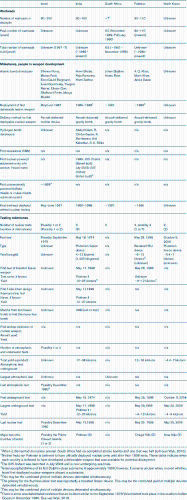
When it dismantled its nuclear arsenal, South Africa had six completed atomic bombs and one that was half built (van Wyk, 2010).
Neither India nor Pakistan is believed to have officially deployed nuclear arms until after their 1998 tests. These dates indicate when each country is believed to have developed a deliverable weapon that was available for potential deployment.
The INS Arihant was launched in July 2009 and is now undergoing sea trials.
Israel accepted delivery of its first Dolphin-class submarine in approximately 1999; however, it remains unclear when, or even whether, Israel first deployed nuclear weapons aboard a submarine.
This may be the combined yield of multiple devices detonated simultaneously.
The primary for the thermonuclear test was reportedly a boosted fission device. This may be the combined yield of multiple devices detonated simultaneously.
This may be the combined yield of multiple devices detonated simultaneously.
There is some unsubstantiated evidence that an incident similar to the September 1979 Vela incident took place in the southern Indian Ocean in December 1980. See van Wyk, 2010.
Arsenal size
The global nuclear stockpile stands at roughly 19,000 nuclear weapons—the nuclear-armed states account for an estimated 420 of those weapons, while the nuclear weapon states have the rest. 1 Though, at first blush, this great disparity in arsenal sizes seems to provide little insight into future trends, this is not the case when peak arsenal sizes are scrutinized.
With stocks of fissile material sufficient for an arsenal of up to 200 nuclear warheads, Israel may have the largest stockpile among the nuclear-armed states, while both India and Pakistan each have around 100 warheads. Today, these three countries have the largest arsenals they have ever had. This growth trend among key nuclear-armed states stands in stark contrast to Britain, which, with an estimated 225 warheads, has the smallest arsenal of the nuclear weapon states; its arsenal peaked between 1975 and 1980 with 520 warheads (Kristensen and Norris, 2011a).
Readiness posture
Aside from China, all of the nuclear weapon states typically mate their nuclear warheads and their delivery systems, with aircraft-delivered nuclear weapons being an important exception. The opposite is the norm, however, for the nuclear-armed states. India and Pakistan keep warheads and delivery vehicles de-mated. South Africa, when it had a weapons program, was thought to have kept its nuclear cores separate from the bomb casings. Israel is believed to keep nuclear warheads de-mated from its land-based systems, though the same may not be true of nuclear weapons placed aboard Israeli submarines. Similarly, it is anticipated that India, when the INS Arihant’s sea trials are complete, will send the submarine to sea with nuclear warheads mated to its K-15 ballistic missiles.
Technical capabilities
Sophisticated technologies that were once exclusive to the nuclear weapon states are now appearing in the arsenals of the nuclear-armed states. Whereas every nuclear weapon state has developed thermonuclear weapons, India and (likely) Israel are the only two nuclear-armed states that have chosen to pursue this capability. Neither is known to have been successful yet. Though none of the nuclear-armed states has deployed full-range land-based intercontinental ballistic missiles (ICBMs), India, Israel, and North Korea are working in this direction with varying degrees of success; Britain and France are the only nuclear weapon states without ICBMs, though they both deploy intercontinental-range submarine-launched ballistic missiles (SLBMs). None of the other nuclear-armed states have fitted their ballistic missiles with multiple, independently targetable re-entry vehicles (MIRVs); this is the opposite for the nuclear weapon states, as all but China have this technology. India is the only country outside all the nuclear weapon states that has nuclear-powered submarines.
Testing records
Nuclear weapon states have conducted a total of 2,046 tests (Kristensen and Norris, 2012a), whereas the nuclear-armed states have only conducted between eight and ten tests. More and better test data help nations develop sophisticated technologies. This may partially explain why the nuclear-armed states, for example, have been slow to develop thermonuclear and small, sophisticated warhead designs suitable for use on ICBMs or SLBMs. Extensive testing is necessary to ensure that complex, thermonuclear and miniaturized warheads will function reliably.
Domestic politics, national pride, and technical misunderstandings on the part of government officials are just a few of the reasons for poor and sometimes intentionally deceptive official statements on nuclear tests. Objective scientific analysis using seismic data and other remote sensing tools has partially filled the gap; however, lack of information on test-site geology, among other factors, contributes to significant uncertainty on even basic facts about the nuclear tests conducted by the nuclear-armed states.
Israel
Israel’s interest in becoming a nuclear-armed state can be traced back to the 1950s, when it turned to Norway and France for nuclear technology and infrastructure (Cohen, 1999). The Dimona reactor, moderated by Norwegian heavy water (Bergen, forthcoming), and constructed with significant French assistance, was the source of the plutonium used in Israel’s two or three deliverable nuclear devices assembled before the June 1967 Six-Day War. Evidence suggests that this nuclear capability was to be delivered by helicopter, and would have required extensive ground assistance involving scientists, engineers, and technicians. In the military sense of the word, this was not a truly “deployed” capability, as its improvised nature would have placed important limitations on its battlefield utility. In fact, Israel likely did not achieve a semi-deployable nuclear weapons delivery capability until 1969 or 1970. 2
Israel has always refused to acknowledge its possession of nuclear weapons; this opacity, known in Hebrew as amimut, has severely limited international understanding of the country’s nuclear development (Cohen, 2010). But opacity has not prevented Israel from drawing upon outside assistance in the form of German-built Dolphin-class submarines (Bergman et al., 2012) and (likely) South African nuclear test support, for example.
While Indian and Pakistani government officials have selectively released information on their own countries’ nuclear programs for various reasons over the years, the same is not true of Israeli leaders. For example, the US intelligence community estimates that Israel has roughly 80 warheads, with enough fissile material to build up to 200 warheads. Israeli nuclear opacity contributes to uncertainty about how, if at all, Israel may alter its nuclear posture—or the size of its arsenal—in response to ongoing developments in Iran.
The country’s nuclear testing record is among the most mysterious aspects of its nuclear program. In September 1979, a US Vela early-warning satellite detected what was almost certainly a nuclear detonation over the southern Indian Ocean near South Africa’s Prince Edward Islands. Based upon data from the satellite, as well as radiological data collected from the thyroids of slaughtered Australian sheep, many experts believe that Israel and South Africa collaborated on a clandestine test and, in fact, tested a nuclear device (Cohen, 2012; Polakow-Suransky, 2010; Weiss, 2012). Details surrounding the origin and the nature of the device tested and disposition of the vital test data remain a source of intense speculation (Richelson, 2006).
India
India’s initial interest in nuclear technology began around 1947, when nuclear technology was cutting-edge, and newly independent India was determined not to be left behind by the West (Sarkar, 2012).
Though India’s “peaceful nuclear explosion” in May 1974 was not a test of a deliverable weapon, the data collected from the test certainly was applicable to weapons design. Despite having demonstrated its ability to build a nuclear arsenal, India did not immediately move toward weaponization; in fact, it is likely that the country did not field its first nuclear weapon and accompanying delivery system until between 1986 and 1988. Like every other state that has had nuclear weapons, save for Israel and possibly North Korea, India’s first deliverable nuclear weapon was an aircraft-delivered gravity bomb. 3
In May 1998, India conducted its second round of nuclear tests, which included a thermonuclear device. The 288 months that passed since its first explosion in 1974 was the longest interval between fission and thermonuclear tests of any of the nuclear weapon states and the only confirmed test of a thermonuclear device by a nuclear-armed state (though it remains unclear whether the device performed as designed). By way of comparison, China successfully tested a thermonuclear device only 32 months after its first atomic test, and France—the nuclear weapon state with the longest fission-to-thermonuclear-test interval—took 102 months.
In August 2012 the Indian navy began sea trials of the INS Arihant, making India the sixth country in the world—and the only one of the nuclear-armed states—to build a nuclear-powered submarine. When sea trials are completed, the Arihant is expected to be armed with K-15 ballistic missiles, making India the first nuclear-armed state to field a sea-based nuclear deterrent using ballistic missiles. 4
South Africa
South Africa voluntarily dismantled its nuclear weapons program between 1989 and 1990, and joined the Nuclear Non-Proliferation Treaty as a non-nuclear weapon state in 1991. While it is no longer a nuclear-armed state, information about its program remains educational.
There are many unanswered questions about South Africa’s involvement in the Vela-satellite incident; however, the country, in 1979, did not possess a nuclear device of its own to test. South Africa’s first prototype nuclear device was not completed until sometime between 1980 and 1982 (Slabber, 2012).
By 1989 the arsenal had peaked at almost 7 warheads; this is likely the smallest peak arsenal size of the nuclear-armed states, with the possible exception of North Korea. 5
South Africa’s limited nuclear development was connected with its unique nuclear strategy, which was intended to force the United States to intervene on South Africa’s behalf during a crisis. In the event of an existential threat, South Africa planned to use a three-step plan to ensure US intervention on its behalf: first, to share news privately of its nuclear weapons stockpile with the United States; then, to announce this publicly to the world; and, finally, to perform a nuclear test. If necessary, South Africa could have toss-dropped a bomb from a Mirage or Buccaneer bomber (Reiss, 1995).
The country did not seem officially to entertain the potential combat uses of its nuclear weapons, though recently there has been evidence that some within the South African defense establishment considered the development of tactical nuclear weapons (Pabian, 2012). Additional archival research will shed light upon the nature and scope of these programs.
Pakistan
Pakistan had strong interest in acquiring a nuclear weapons capability after its devastating defeat in the 1971 Indo-Pakistani war; however, in 1974, when India exploded a peaceful device, Pakistan became unarguably determined in its race to the bomb.
Pakistan’s nuclear program has benefitted extensively from foreign technologies that have been mastered, and in some cases improved on, by Pakistani experts. Most famous is A. Q. Khan, the nuclear scientist who stole critical centrifuge design information from the European enrichment consortium Urenco and has been accused of selling state secrets to North Korea and Iraq. These designs formed the basis for what became Pakistan’s first-generation centrifuge, the P-1.
Many observers agree that China has aided in the development of Pakistan’s nuclear weapons program, such as by providing detailed designs for a rudimentary nuclear device; it is also argued that China hosted the country’s test of this device at Lop Nor on May 26, 1990 (Reed and Stillman, 2009).
Pakistan has shown clear signs of its intention to grow its nuclear arsenal. Most recently, the country has begun to increase its plutonium production capabilities, with two new plutonium production reactors under construction, as well as a new chemical reprocessing facility (Kristensen and Norris, 2011b). The country’s increased interest in plutonium demonstrates its likely goal to develop smaller, lighter warheads more suitable for use on missiles. In 2011, Nuclear Notebook reported that, in the next decade, Pakistan’s arsenal could grow larger than that of Britain’s (Kristensen and Norris, 2011b).
North Korea
North Korea’s nuclear development remains very poorly understood. Its interest in acquiring nuclear capability dates back to the 1960s, yet its nuclear development is the most limited of all of the nuclear-armed states. North Korea has conducted two nuclear tests. The first, in 2006, was certainly a fizzle—the second, in 2009, was most likely one also, though there is no detailed information about what precisely may have gone wrong. In the case of both tests, even their yields remain a matter of conjecture.
While most media accounts state that North Korea has sufficient fissile material to make roughly eight bombs, there is no evidence that it has done so. It is possible that like India—and unlike any of the other nuclear-armed states—North Korea may not have proceeded directly from testing a nuclear device to developing a deliverable nuclear weapon. Distinct from India, lack of technical capacity, rather than lack of political will, is the most likely explanation.
It is also not clear how North Korea would deliver any nuclear weapons that it did possess. There is no publicly available information to suggest that the country has attempted to modify any of its aging Soviet-era bomber and attack aircraft to deliver nuclear weapons. Moreover, robust South Korean air defenses would make delivery by air extremely challenging for the North.
Instead, North Korea has focused on ballistic missile development, apparently with the goal of developing an ICBM capable of threatening the United States. The Taepodong-2 missile has never been successfully tested, but its estimated range of up to 9,000 kilometers would give it the ability to threaten the West Coast of the United States.
Interestingly, however, North Korea’s proximity to South Korea—its main adversary—and its history of using tunnels and small boats to send small teams of guerilla soldiers into the South, suggest that if North Korea does have an operational nuclear weapon, its delivery method could be decidedly unconventional. This would make North Korea unique among all of the nuclear-armed states.
Opening chapters
As more governments around the world open their archives, it becomes clearer why different countries make the decisions that they do when it comes to nuclear issues. Diplomatic cables, meeting notes, policy papers, and other materials answer important questions—such as why countries pursued certain options and why they chose a particular path—and provide the perspective necessary to help policymakers design more effective future policies.
Footnotes
Editor’s note
Nuclear Notebook has been published by the Bulletin of the Atomic Scientists since May 1987. Today, Robert S. Norris and Hans Kristensen, of the Federation of American Scientists, are the authors of this bimonthly feature. The authors personally invited Timothy McDonnell to guest author the January/February edition of this column, and they have reviewed and approved its accuracy and content. In the January/February 2012 issue of the Bulletin of the Atomic Scientists, Norris and Kristensen looked at the nuclear pursuits of the P-5 nuclear weapon states.
Funding
This work was supported by the Wilson Center and the Carnegie Corporation of New York.