




Abstract
A nuclear war between Russia and the United States, even after the arsenal reductions planned under New START, could produce a nuclear winter. Hence, an attack by either side could be suicidal, resulting in self-assured destruction. Even a “small” nuclear war between India and Pakistan, with each country detonating 50 Hiroshima-size atom bombs—only about 0.03 percent of the global nuclear arsenal’s explosive power—as air bursts in urban areas, could produce so much smoke that temperatures would fall below those of the Little Ice Age of the fourteenth to nineteenth centuries, shortening the growing season around the world and threatening the global food supply. Furthermore, there would be massive ozone depletion, allowing more ultraviolet radiation to reach Earth’s surface. Recent studies predict that agricultural production in parts of the United States and China would decline by about 20 percent for four years, and by 10 percent for a decade. The environmental threat posed by even a small number of nuclear weapons must be considered in nuclear policy deliberations. Military planners now treat the environmental effects as collateral damage, and treaties currently consider only the number of weapons needed to assure destruction of opposing forces. Instead, treaties must call for further reductions in weapons so that the collateral effects do not threaten the continued survival of the bulk of humanity. Proliferation cannot be treated as a regional problem. A regional conflict has the potential to cause mass starvation worldwide through environmental effects.
In the early 1980s, as the arms race pushed the world’s total tally of nuclear weapons beyond 50,000, nuclear winter changed everything. Scientists, including us, made the world aware of the environmental impacts of the smoke that would be generated by fires in cities and industrial areas in the event of a nuclear war. A war between the United States and the Soviet Union could produce so much smoke that it would block out the sun, plunging the world into sub-freezing temperatures, killing virtually all crops, and condemning the planet to mass starvation.
This shocking possibility, and the intense debate surrounding it, brought the insanity of the continuing nuclear arms race to the front burner. The scientific message, from research done jointly by American and Soviet scientists, was based on primitive computer models of the climate system, yet the physics were clear: If you block out enough sunlight, it gets cold, dark, and dry at the surface, and the destruction of the ozone layer allows deadly ultraviolet radiation to penetrate the atmosphere. The scientists’ models motivated US President Ronald Reagan and Soviet General Secretary Mikhail Gorbachev (Hertsgaard, 2000; Zubok, 2000) to reach agreement on a nuclear arms reduction treaty.
The principle of mutually assured destruction (MAD) has presumably been part of the reason that nuclear war has been avoided since those terrible days in August 1945, when more than 250,000 residents of Hiroshima and Nagasaki were incinerated by nuclear explosions. MAD posits that, if country A attacks country B, the retaliation from country B will be so devastating that a first strike would be suicidal (e.g., Elkind, 2012).
Nuclear winter theory tells us that it would be suicidal for country A to launch a full-scale nuclear attack on country B regardless of whether country B responds in kind. The resulting climate changes, triggered by smoke, would be so damaging to food and water supplies that infrastructure breakdown would assure starvation in the attacking country as well as the rest of the world. Call it self-assured destruction, or SAD.
We now know that SAD has existed since the 1950s. This was made explicit in the 1980s by the first work showing the potential for nuclear winter after a war between the United States and Russia (Aleksandrov and Stenchikov, 1983; Robock, 1984, 1989; Turco et al., 1983). Research in the past few years has shown that SAD exists even for the nuclear states with much smaller arsenals: Britain, France, China, Israel, India, and Pakistan (Mills et al., 2008; Robock and Toon, 2010; Robock et al., 2007b; Toon et al., 2007b). Yet policy makers seem to be unaware of this situation or are keeping it to themselves. When the policy implications of SAD are considered, elementary planetary hygiene demands a much more rapid reduction in nuclear arsenals than currently planned, along with intensified efforts to prevent further nuclear proliferation.
Nuclear arsenals
The total number of nuclear weapons worldwide peaked at about 70,000 in 1986, when Reagan and Gorbachev agreed to reduce them (Figure 1). Currently, there are about 15,000 warheads (Norris and Kristensen, 2010). New START, signed by Presidents Barack Obama and Dmitry Medvedev in 2010, requires each side, within seven years of the treaty coming into force, to reduce deployed warheads to a maximum of 1,550. However, each long-range bomber counts as one warhead no matter how many warheads it has, and the treaty does not limit the much larger number of weapons that are in storage or reserve. While the United States and Russia possess the bulk of the global nuclear arsenal, as of 2010 France had 300 nuclear weapons, the United Kingdom had 225, China had 180, Pakistan had between 70 and 90, Israel and India each had between 60 and 80, and North Korea was thought to have fewer than 10 nuclear weapons (Norris and Kristensen, 2010). By 2012, the arsenals of India and Pakistan had grown by an estimated 20 weapons each (Kristensen and Norris, 2011, 2012).
A history of nuclear weapons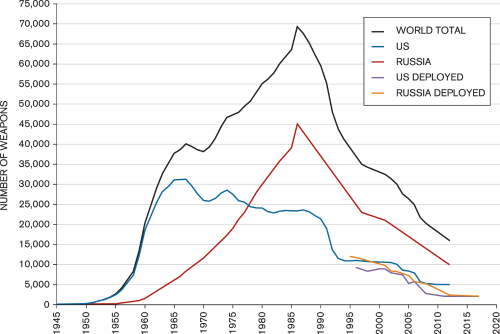
Studies of the effects of nuclear weapons began soon after their invention. These studies were largely based on the military view that damage to specified targets had to be assured to maintain a deterrent. Hence, only the most certain and quantifiable effects—such as blast and prompt radiation—were considered.
Nuclear winter
That changed in 1982, when the journal of the Royal Swedish Academy of Sciences, Ambio, published a groundbreaking article (Crutzen and Birks, 1982) that identified the issue of smoke generated by nuclear-ignited forest fires as a global concern, following earlier suggestions by a graduate student in political science that the burning of forests and grasslands could cause changes in continental weather (Lewis, 1979). We and our colleagues then discovered that smoke from urban fires posed an even greater global hazard in the form of climate anomalies, defined as a “nuclear winter,” capable of causing the worldwide collapse of agriculture (Aleksandrov and Stenchikov, 1983; Robock, 1984; Turco et al., 1983). A nuclear war would also threaten much of the world’s population by causing societal chaos and the loss of transportation and energy production.
Modern climate models not only show that the nuclear winter theory is correct, but also that the effects would last for more than a decade (Robock et al., 2007a, 2007b) because of an unexpected phenomenon: Smoke would rise to very high altitudes—near 40 kilometers (25 miles)—where it would be protected from rain and would take more than a decade to clear completely. As a consequence, the smoke’s climate impacts would be more extreme than once thought. For example, the new models show that a full-scale nuclear conflict, in which 150 million tons of smoke are lofted into the upper atmosphere, would drastically reduce precipitation by 45 percent on a global average, while temperatures would fall for several years by 7 to 8 degrees Celsius on average and would remain depressed by 4 degrees Celsius after a decade (Robock et al., 2007a). Humans have not experienced temperatures this low since the last ice age (Figure 2). In important grain-growing regions of the northern mid-latitudes, precipitation would decline by up to 90 percent, and temperatures would fall below freezing and remain there for one or more years.
Global precipitation and temperature changes as a function of smoke emitted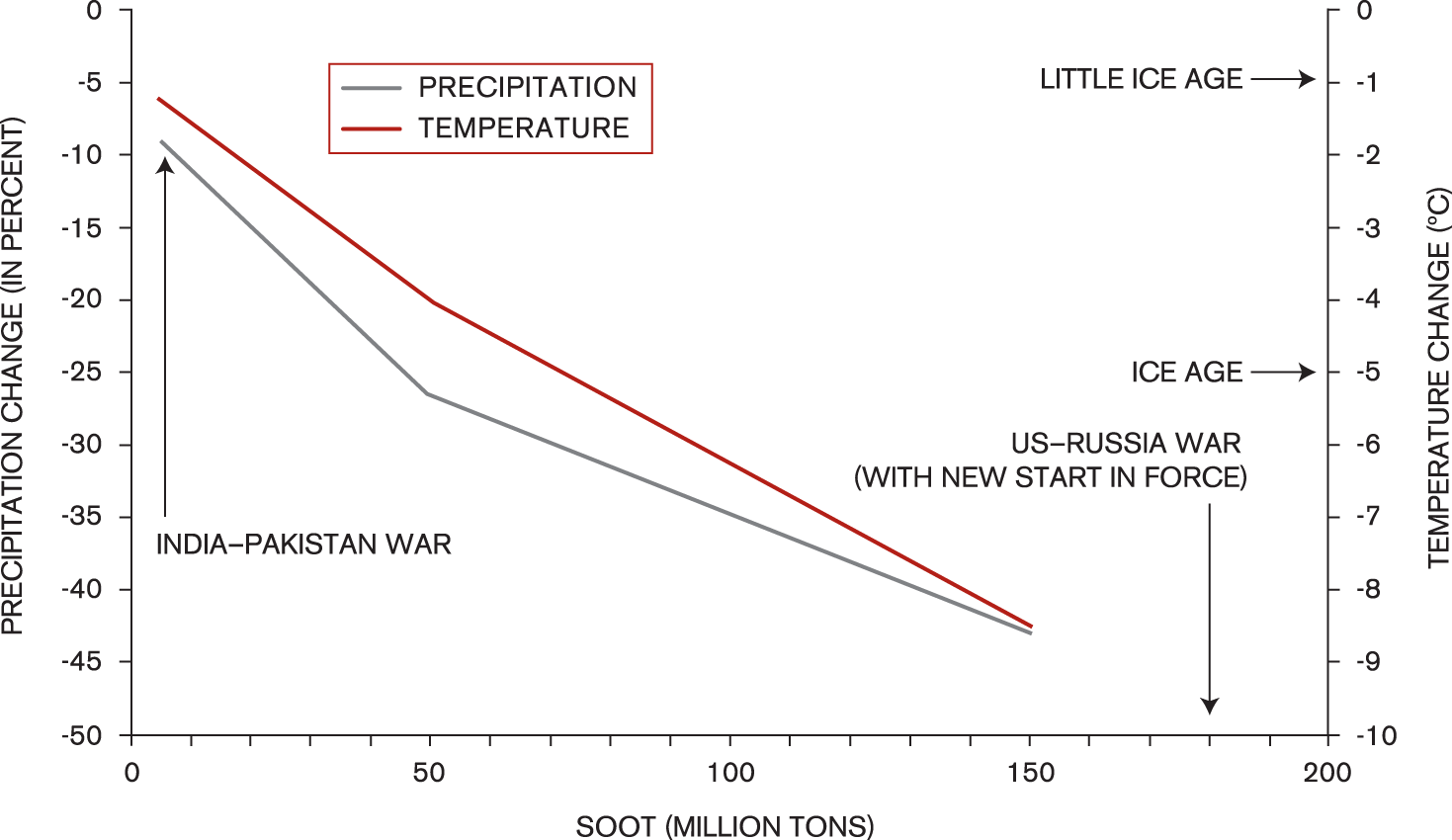
The number of weapons needed to initiate these climate changes falls within the range of arsenals planned for the coming decade (Toon et al., 2008). For instance, the use of 4,000 weapons (the rough total for US and Russian arsenals in 2017 under New START), each with a yield of 100 kilotons (a typical yield for submarine weapons, but at the low end for most nuclear weapons), against urban or industrial targets would produce about 180 million tons of soot. A single US submarine carrying 144 weapons of 100-kiloton yield could produce 23 million tons of smoke if these weapons were used on densely populated Chinese cities.
Regional nuclear war
The United States and Russia are not the only countries capable of wreaking worldwide climate havoc. All of the nuclear states—except North Korea, with its relatively small arsenal—if involved in a nuclear war, have the destructive power needed to alter the global environment (Robock et al., 2007b).
It is not correct to assume that the effects of a regional war would be contained within a limited zone. For example, consider a nuclear war in South Asia involving the use of 100 Hiroshima-size weapons. In these simulations, more than five million tons of smoke is lofted to high altitude, where it absorbs sunlight before the light can reach the lower atmosphere (Toon et al., 2007b). As a result, surface temperatures fall and precipitation declines (Robock et al., 2007b). The calculated results show a 10 percent global drop in precipitation, with the largest losses in the low latitudes due to failure of the monsoons.
Our climate model also shows global average temperatures colder than any experienced on Earth in the past 1,000 years and growing seasons shortened by two to three weeks in the main mid-latitude agricultural areas of both hemispheres. These effects persist for several years, which would threaten a significant fraction of the world’s food supply, perhaps jeopardizing a billion people who are now only marginally fed as it is (Helfand, 2012). New simulations of the effects of these climate changes on crop production predict reductions of soybean and corn production in the US Midwest, and of rice production in China, of 20 percent for several years and 10 percent even after a decade (Özdoğan et al., 2012; Xia and Robock, 2012).
These impacts could be felt even in a warming world. Imagine the disruption in world food trade with such heavy losses of production. The smoke would also heat the upper atmosphere by as much as 50 degrees Celsius for several years. As a consequence, ozone levels over the mid-latitudes of both hemispheres would be reduced to values now found only in the Antarctic ozone hole (Mills et al., 2008).
Policy implications
These global climate effects could result from a nuclear attack by one country on another, with no nuclear retaliation: self-assured destruction. For example, it is possible that an Israeli nuclear attack on Iranian population centers and industrial areas could do this, although further research is needed to confirm that possibility. Yet the world’s nuclear policy makers do not consider these effects in their plans and policies, nor are they conducting research to better understand them.
Even the direct fatalities caused by a nuclear attack have been under-appreciated (Toon et al., 2007a). In most cases, we find that just one nuclear explosion with a Hiroshima-size weapon can lead to 100 times as many deaths in a country that is attacked as in many previous conventional conflicts (Toon et al., 2007b). Just a few nuclear explosions could result in more fatalities than most countries experienced in World War II. For example, although North Korea does not have enough weapons to produce global climate effects, if it were to explode just three Hiroshima-size nuclear weapons in US cities, the United States could experience as many fatalities as it did during all of World War II, about 420,000. A full-scale war between India and Pakistan—as another example—could kill tens of millions of people, about one-third as many as died in World War II globally. Indeed, nuclear weapon states capable of deploying about 100 weapons globally could cause as many fatalities through the direct effects of the explosions as the Soviet Union was once forecast to be capable of inflicting on the United States during a full counterforce war. Hence, each of the nuclear weapon states except North Korea, which only has about 10 weapons, must be considered as dangerous as the Cold War adversaries of the previous century, as soon as they develop long-range missiles. India has just demonstrated that capability, and clearly Iran (which is not believed to have any nuclear weapons yet) and North Korea (which is interested in increasing its arsenal) are working hard to build and test long-range, nuclear-capable missiles.
There are many aspects of a putative future war that are fundamentally unpredictable, particularly the targets that would be attacked, as well as the numbers and sizes of weapons that would be used. There are also many technical issues that need additional study, including a more detailed analysis of the amount and properties of smoke that would emanate from various targets when attacked by various sizes of weapons. Other climate models should repeat the calculations of climate impacts to make sure they are robust. The impacts on different crops in different parts of the world, as well as on water resources, deserve further study. Yet funding for this research is currently lacking. Neither the US Defense Department, which possesses and might use nuclear weapons, the US Energy Department, which manufactures these weapons, nor the US Homeland Security Department, which is responsible for dealing with the climatic effects of nuclear war, is conducting research on these issues. Research conducted jointly by scientists from all of the nuclear nations, as occurred when American and Soviet scientists did the original nuclear winter work in the 1980s, would be a powerful message to the world about the seriousness of these problems.
Arms control treaties
India, Pakistan, and North Korea often defend their development of arsenals by pointing to the larger caches held by the dominant nuclear weapons states. The United States and Russia have deployed arsenals that will be reduced to about 6 percent of their peak levels by 2017. But these arsenals are substantially overbuilt for the mission of deterrence and if ever used might destroy human civilization.
Nuclear arms control treaties are based on systematic, counter-balanced build-downs of nuclear weapons. However, the treaties are not based on an analysis of the reductions needed to ensure that the human race is not threatened with unintended mass annihilation. The majority of fatalities would probably occur through global environmental damage and through destruction of the global infrastructure supporting transportation, agriculture, and social order.
Article VI of the Nuclear Non-Proliferation Treaty calls on all signatory states “to pursue negotiations in good faith on effective measures relating to cessation of the nuclear arms race at an early date and to nuclear disarmament, and on a treaty on general and complete disarmament under strict and effective international control.” It is time for the world to find political leaders with the courage to take action to comply with this long-standing agreement.
A rapid reduction of the US and Russian arsenals to about 200 weapons each, and an immediate agreement to not target cities and industrial areas, would allow both countries to maintain their nuclear deterrence and would prevent the possibility of killing the majority of humanity through nuclear winter, although significant environmental damage—perhaps killing a billion people in a nuclear famine (Helfand, 2012)—could still result from nuclear conflict. Such a reduction would also set an example for other countries considering the development of nuclear weapons. Negotiations with all other nuclear nations for rapid reductions of their arsenals would then reduce the continued environmental threat of the remaining weapons.
Action needed now
The push to abolish nuclear weapons has gained momentum over the past few years. For example, the “Gang of Four”—George P. Shultz, William J. Perry, Henry A. Kissinger, and Sam Nunn—have published a series of four op-eds in the Wall Street Journal arguing that MAD can no longer work in a world with so many nuclear nations (Shultz et al., 2007, 2008, 2010, 2011). The Global Zero campaign and Scott D. Sagan, in calling for global nuclear disarmament, make no reference to the climatic effects of nuclear weapons but advance additional valid arguments. For example, Sagan (2012) points out that, in the future, nuclear weapons may be used as a shield to allow conventional wars to be fought with impunity, as Pakistan tried to do soon after testing its first weapon. It is now time to add self-assured destruction to the list of reasons for ridding the world of nuclear weapons.
We have published many articles about our research and given multiple presentations about it to scientists, congressional staff, and nongovernmental organizations. But with the exception of Switzerland, not a single country has asked its scientists to evaluate the threat posed to its citizens by a nuclear conflict within its borders or on the other side of the world (Robock, 2011).
In response to our latest work on agricultural impacts, Mikhail Gorbachev said: “I am convinced that nuclear weapons must be abolished. Their use in a military conflict is unthinkable; using them to achieve political objectives is immoral. Over 25 years ago, President Ronald Reagan and I ended our summit meeting in Geneva with a joint statement that ‘Nuclear war cannot be won and must never be fought,’ and this new study underscores in stunning and disturbing detail why this is the case” (Dhanapala and Helfand, 2012). It is time once more for the world to listen to Gorbachev.
Footnotes
Acknowledgements
The authors thank Martin Bunzl for valuable comments.
Funding
Alan Robock is supported by National Science Foundation grants atm-0730452 and ags-1157525.
