




Abstract
Mounted in an adapted Boeing 747, the Airborne Laser (ABL) was to be a dream antimissile weapon, acquiring the trajectory of a Scud or other theater-range ballistic missile, pointing a high-power laser beam precisely at a certain area of the fast-moving target, and holding it there until the missile surface heated and ruptured. But the ABL fell eight years behind schedule and went $4 billion over budget before the program was finally axed in 2010. A classic defense boondoggle, the ABL is also a frightening example of how committed military officials, scientists, and defense contractors can persuade Congress to keep a defense program alive against, seemingly, all reason, the author writes. An ABL postmortem should be carried out by truly independent scientists and engineers. Beyond determining just what the ABL project did and didn’t accomplish, however, the US government needs to address the chronic lack of transparency and accountability in defense science and technology programs exemplified by the ABL fiasco. The White House Office of Science and Technology Policy should be the agency responsible for coordinating efforts to increase scrutiny of such programs, particularly those at the far technical edge of missile defense research.
Keywords
Once upon a time not so long ago, glossy posters, press releases, and other public relations materials flooded congressional offices and newsrooms inside Washington’s Beltway, touting the futuristic antimissile project known as the Airborne Laser (ABL). The publicity campaign included an artist’s rendition of a Boeing 747, modified so a reddish laser beam shot from its nose turret. As if they were publicizing a blockbuster movie, ABL posters carried the words “
The Airborne Laser was to be the Pentagon’s primary boost-phase weapon against short-range missiles like the Soviet Scud and its descendants now fielded by Iran and North Korea. The system would employ a megawatt-class chemical laser mounted on a modified and reinforced Boeing 747-400 cargo aircraft that would loiter near the battlefield, ideally at a standoff distance—hundreds of kilometers from enemy territory—at an altitude of about 40,000 feet. It was supposed to have an autonomous search and acquisition system that would track rising ballistic missiles and destroy them with a Chemical Oxygen Iodine Laser (COIL).
In theory, the ABL was a high-tech dream weapon: Once an enemy missile was detected, the ABL would acquire its trajectory and, after the missile rose above cloud cover, follow it precisely with a laser. A second laser would probe atmospheric turbulence, and an onboard adaptive optics system would correct the main laser beam so it delivered the proper amount of energy to the target missile. The system’s delivery system would not only point the COIL beam precisely at a certain area of the fast-moving target missile but also hold it there for seconds—perhaps tens of seconds—until the missile surface heated and ruptured.
In reality, though, the ABL has been a practical failure and a procurement nightmare. After falling eight years behind schedule and going $4 billion over budget, the ABL program—like several other directed-energy weapon programs that preceded it—was finally axed in 2010. As then-Defense Secretary Robert Gates summarized for the House Appropriations Committee in May: I don’t know anybody at the Department of Defense … who thinks that this program should, or would, ever be operationally deployed. The reality is that you would need a laser something like 20 to 30 times more powerful than the chemical laser in the plane right now to be able to get any distance from the launch site to fire. So, right now the ABL would have to orbit inside the borders of Iran in order to be able to try and use its laser to shoot down that missile in the boost phase. And, if you were to operationalize this, you would be looking at 10 to 20 747s, at a billion and a half dollars apiece, and one hundred million dollars a year to operate. And there’s nobody in uniform that I know who believes that this is a workable concept. (Centre for Arms Control and Non-Proliferation, 2011)
Critics of the ABL program— in Congress and elsewhere— recommended early on that a robust technology demonstration was essential before the Pentagon embarked on a hugely expensive program to deploy a weapon in the field, but to no avail. With unwavering support from defense contractors like Boeing, Northrop Grumman, and Lockheed Martin, zealots in the defense science community and Pentagon officials prevailed on Congress for nearly 15 years to fund the ABL, sometimes in excess of even what the Defense Department had requested.
Sold as a “mature” technology, in the end the ABL could not meet any of its primary specifications. It could not deliver the required power. It was too big and too heavy to be fitted into a Boeing 747-400 freighter, the biggest airplane available. (Although the dimensions of the laser are classified, it was clearly outsized. The original design called for 14 modules of the COIL; ultimately, only six could be accommodated.) Analysts repeatedly warned that the technology needed further testing before the government undertook the huge costs of attempted deployment, and the analysts were repeatedly ignored. The ABL is a classic defense boondoggle and a frightening example of how committed military officials, scientists, and defense contractors—the now-clichéd military–industrial complex—can persuade Congress to keep a defense program alive against, seemingly, all reason. And, perhaps, beyond all reason.
As it happens, the ABL was not totally eliminated, just downgraded to a new status, the Airborne Laser Test Bed, that will allow research into laser weapon technologies—including a new type of laser that is, many familiar laser-weapons advocates insist, everything the old ABL was not.
A series of false starts
The LASER (Light Amplification by Stimulated Emission of Radiation) was discovered in the early 1960s, and it was not long before low-power laser devices, ranging from milliwatts to a few watts of power, made their way into our everyday life, in the form of bar code readers and DVD players. Medium-power lasers (hundreds of watts to a few kilowatts) also found applications in the precise cutting of metals, for example.
During the Cold War, the militaries in both the United States and the Soviet Union moved to develop high-power lasers as weapon systems. Despite repeated promises that a laser weapon was just around the research corner, the record of laser weaponization has actually been dismal. In the late 1960s and 1970s, both the US Army and Navy supported laser research for ground- and ship-based applications; none was deemed suitable as a weapon, for one reason or another. But in 1983, the Air Force developed a high-powered carbon dioxide laser, put it on an airplane, and called it the Airborne Laser Laboratory (ALL). ALL reportedly “shot down” a number of short-range, air-to-air Sidewinder missiles at close range, and that success was advertised as the crucial event that demonstrated the viability of airborne laser weapons. Curiously, the ALL was disbanded soon after the test, and the system was put into a museum. Funding for lasers got a big boost in the years following, however, due to President Ronald Reagan’s strong and public advocacy for the Strategic Defense Initiative, or “Star Wars.”
In the pell-mell rush to create weapons for the missile shield Reagan announced as a national priority, policy makers had little time to distinguish between science and science fiction. Mere scientific hypotheses could be—and were—sold as proven technology, launching questionable projects with millions of dollars in funding. The x-ray laser—a system that would have exploded nuclear weapons in space to provide the power for lasers that would then shoot down Soviet missiles—was one of the most outrageous examples of such scientific demagoguery. The details of the doomed project would never come to light because of government secrecy, but press reports indicated that the laser did not achieve the advertised brightness. There were also problems with focusing the x-ray beams. Other skeptics commented that it was unclear if the system ever “lased,” meaning there was a question as to whether there had been any laser output at all. The problems in the x-ray laser program were finally exposed, notably by a series of brilliant articles in the New York Times by William J. Broad. (I was involved in several such quixotic projects between 1983 and 1994 for both ground- and space-based lasers.)
“Rush to failure”—a phrase coined by Air Force General Larry Welch after his evaluation of the National Missile Defense system in 1998 (Cirincione, 1998)—became the norm, not an exception. Ironically, it was the same Welch who chaired a Defense Science Board Task Force on high-energy lasers in 2001, which gave the ABL a boost by asserting that the technology was mature enough to field an initial capability by 2010. There were no warnings about the difficulties with the laser.
The politics of missile defense and the fast-tracking of ABL
In the late 1980s, the end of the Cold War and the spectacular lack of progress in the development of laser weapon systems caused funding reductions. Many proposed laser systems were cancelled, and abandoned hardware from ill-fated laser projects littered the grounds of the Army’s White Sands Missile Range, the Kirtland Air Force Base, and the campus of the Lawrence Livermore Laboratory, where the x-ray laser had been researched. There was even talk of closing down the Army’s High Energy Laser Test Facility in New Mexico and retiring the massive, megawatt-class Mid-Infrared Chemical Laser, commonly known as the MIRACL, that is located there. (America’s most powerful laser, MIRACL is a megawatt-class deuterium-fluoride laser coupled with a beam director called SEALITE—because of its origin as a shipboard weapon. MIRACL has been used for target vulnerability tests, including a controversial trial in 1997 against a satellite.)
But the moment was short-lived. Most talk of a peace dividend and “defense conversion” disappeared in 1994, when the Republicans ended four decades of Democratic control over the House of Representatives and quickly enacted a “Contract with America” that included, as one of its major planks, the deployment of a national missile defense system. The son of Star Wars was born, and laser weapon development found homes in three chemical laser programs: the Army’s Tactical High Energy Laser (THEL), the Space Based Laser (SBL), and the flagship Airborne Laser, the latter two programs belonging to the Air Force. None survived.
After 9/11, it became politically risky to criticize missile defense programs. In 2002, Defense Secretary Donald Rumsfeld took advantage of those favorable politics, renaming the Ballistic Missile Defense Organization, which had inherited the ABL, as the Missile Defense Agency and exempting the new agency from regulations that governed major defense acquisition programs. He argued that missile defense was not progressing because the Defense Department’s regulations were not flexible enough for a program that involved cutting-edge technology.
In so doing, Rumsfeld nullified the operating requirements for all missile defense systems, including the ABL. There were no longer benchmarks to judge performance and no independent operational tests. The systems were developed in an evolutionary manner—what was called “spiral development”—and capabilities were fielded as they became available. The process was so open-ended that there was virtually no accountability. The order was rescinded a few years later when even ardent supporters like Senator John McCain of Arizona became concerned (Senate Armed Services Committee, 2005). But the program itself continued.
COIL: The heart of the ABL
Timeline for a missile defense boondoggle
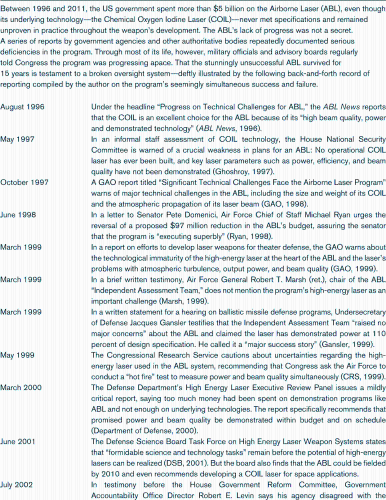
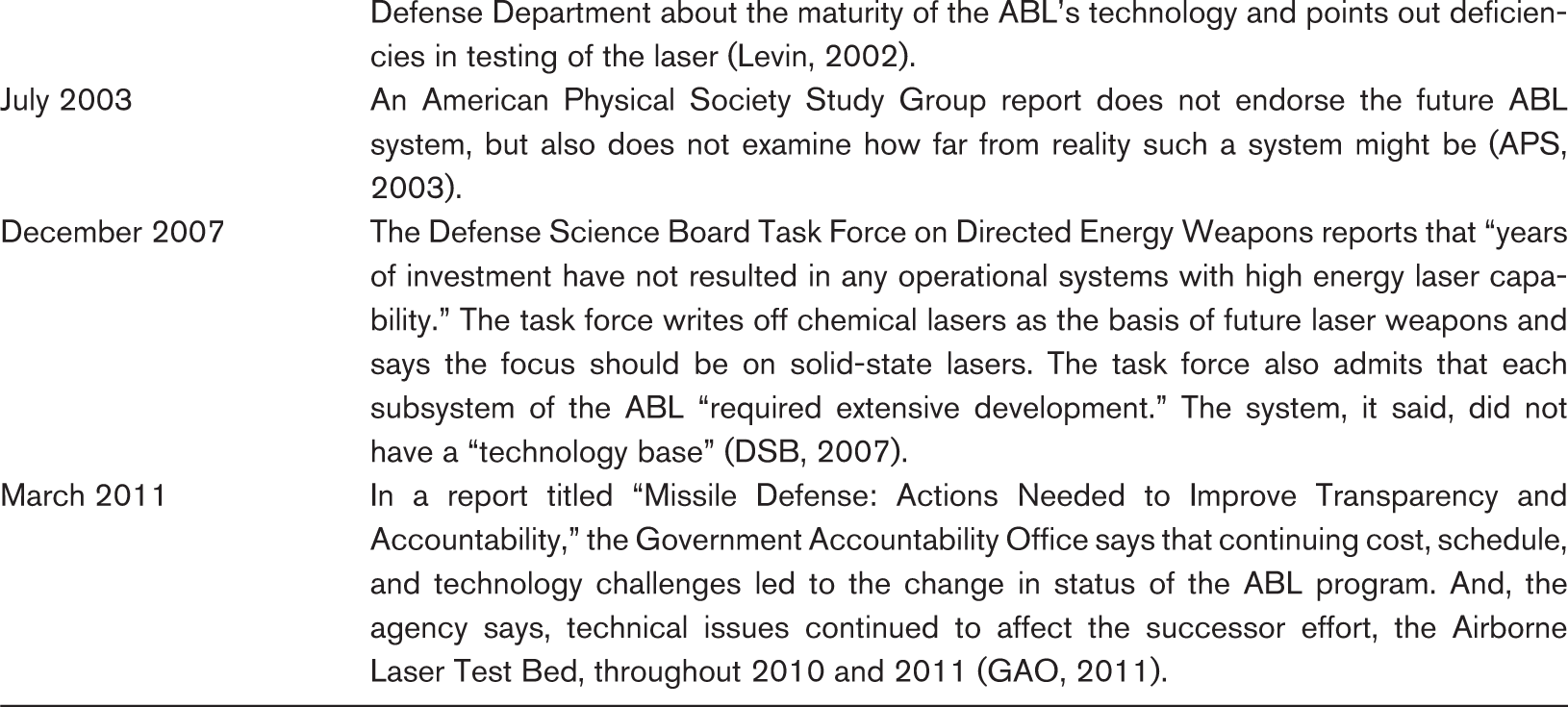
A common theme ran through the numerous briefings the ABL office gave for congressional staff and a variety of review panels: The technology was mature. There were, it was said, no showstoppers. Actually, though, the ABL show never got much past Act I of the missile defense show, in large part because the laser at its center could not do what proponents insisted it had already done.
As the name implies, the Chemical Oxygen Iodine Laser produces its laser beam from a chemical reaction between oxygen and iodine atoms. The chemical reaction takes place as a mixture of gaseous oxygen and iodine flows at supersonic speeds through a wind tunnel inside a chamber. Energy from the oxygen atoms is transferred to the iodine atoms, in turn raising their energy levels. Some of the iodine atoms release their increased energy spontaneously, emitting light, which is then amplified by repeated reflections between mirrors at either end of the chamber or “resonator cavity.” One of the end mirrors is totally reflective; the other is only partially reflective. The high-energy laser beam exits through the latter mirror and is directed to the target by a beam delivery system.
A laboratory version of COIL has been in existence for years, and basic parameters of the laser had been measured. So, the conventional wisdom was that there were no physics issues with the laser. I was assigned to monitor the ABL project, initially as a congressional staffer. In my work, I found no evidence of a COIL prototype that had undergone a proper engineering design or testing for, as military specifications often put it, “form, fit, and function” inside the ABL system.
My concerns were later supported by reports from the Government Accountability Office, the Congressional Research Service (CRS, 1999), and others. Ironically, a Defense Science Board panel finally admitted in 2007 that the basic technology for the ABL did not exist; more than 10 years after the program started, the panel said that the power, efficiency, and beam quality of the laser all needed to be improved, and the various parts of the system had not shown they could operate simultaneously (DSB, 2007). These are almost exactly the same concerns I expressed in 1997 in an informal staff report for the House National Security Committee.
Why were the problems with the laser ignored?
There are many reasons—some of them quite obvious—why the basic technical problems of the ABL’s principal component, the COIL, were essentially ignored. First, test results reported by TRW (now Northrop) were often incomplete and misleading: In one report (APS, 2003), the American Physical Society pointed out that some crucial laser-performance parameters could not be verified because the numbers were classified as secret. Still, the test results generally claimed success.
Also, there was little outside oversight because there were few independent researchers with the technical training and access to the program to properly evaluate such a laser. The ABL program office depended almost entirely on contractor scientists for data and explanations. For example, one of the first independent assessments of the ABL program took place late in 1998. Responding to a congressional mandate, the Pentagon appointed an “Independent Assessment Team” to evaluate the ABL. Two Defense Science Board task forces also were assigned to examine the program. But how independent were these assessments, really? Former Air Force generals and other advocates of directed-energy weapons routinely filled out these panels. For example, retired Air Force Chief of Staff Larry Welch was a member of the Independent Assessment Team, which was chaired by Robert Marsh, another retired Air Force general. Marsh was also a member of the two Defense Science Board task forces that Welch chaired. Charles Primmerman, a former scientist at MIT Lincoln Laboratory, sat on two of the three panels. He later became the head of the High Energy Laser Joint Technology Office, which is run by the Air Force and is the current custodian of the ABL project. It is hard to retain objectivity when spinning through a revolving door.
Beyond these reporting and assessment problems, as the ABL program continued, supporters increasingly focused on getting something into the field—ironically, at almost any cost—to extend the program’s funding. Missile defense advocates were keenly aware that despite many promises over many years, no laser weapon had been shown to work in a real-life trial. Perhaps the thinking was that once some “capability” had been fielded, improvements would follow—and so would the money. Whatever the thinking, there was indeed big money in the ABL, which even by conservative estimates would cost $11 billion for a fleet of seven laser-carrying 747s or $30 billion for a fleet of 20.
The misleading contractor reports, poor-to-nonexistent oversight, and strong monetary motivations all existed inside what appeared to be a never-ending barrage of positive publicity orchestrated by the contractors, the ABL program office, and the defense community generally, including military trade publications, national security think tanks, and congressional supporters. Inside this publicity bubble, all seemed well with the ABL, even though it wasn’t well at all.
What now?
Now that the ABL is no longer an acquisition program, all future research and development on COIL itself should be open and unclassified, and a robust test program should be undertaken. Test results should be published and reviewed by laser experts outside of the defense laser community to minimize conflicts of interest. A postmortem should be carried out by truly independent scientists and engineers. A common refrain is that it is not possible to find independent scientists familiar with the technology because the area of research is so narrow. This is a self-defeating argument.
It is worthwhile to recall the role of the late Nobel Prize-winning physicist Richard Feynman in the Challenger Commission, which investigated the loss of NASA’s space shuttle Challenger in 1986. Feynman was a brilliant physicist, not a designer of space vehicles. Yet, his curious mind and scientific training led him to discover that the material used in an O-ring that was part of the main booster of the shuttle had no resilience at the near-zero temperature of the Challenger’s launch, a concept Feynman demonstrated in a dramatic yet simple high school science experiment he enacted before the commission. Feynman was a total outsider but had no hesitation in criticizing the NASA management about complacency and unrealistic risk estimates.
For the high-energy laser project, any postmortem should at a minimum include measurement of output power, beam quality, laser efficiency, and beam jitter. Such tests will not only provide the actual operational characteristics of the COIL, but also prove the stability and reliability of the system over the long run. The two other onboard lasers—for tracking and atmospheric compensation, respectively—also need to be thoroughly tested. They are kilowatt-class, solid-state lasers, which are not routinely available commercially. These tests should be considered essential before any technology can be labeled “mature”; they would also be much less expensive than the formal “operational tests” that a weapon system must pass before deployment.
But beyond determining just what the ABL project did and didn’t accomplish, the government faces a larger policy issue, which is the chronic lack of transparency and accountability in defense science and technology programs. One need only search the titles of Government Accountability Office reports in the last decade to see how many times the watchdog agency, which is overly cautious when criticizing the Pentagon, has recommended that transparency and accountability need to improve in missile defense programs. A recently issued report by JASON, an elite scientific advisory group that consults mostly in secret for the US government on defense science and technology, also lamented the quality of scientific research in the Defense Department (JASON, 2009): “The bureaucracy associated with DoD research has grown to consume ever more time and has diverted program managers into administrative formalities at the expense of scientific program oversight.”
The Obama administration has the expertise needed to address this challenge. Ashton Carter has been the undersecretary of defense for acquisition, technology, and logistics—a position that put him in direct control of research accountability—and he is now the Defense Department’s second-highest official, the deputy secretary of defense. Carter is an Oxford-trained physicist who certainly appreciates the crucial role of peer review in scientific research. John Holdren, the president’s science adviser and, until recently, a colleague of Carter’s at Harvard University, is also a well-regarded physicist.
The Office of Science and Technology Policy, which Holdren directs, has been pushing to establish guidelines for maintaining scientific integrity in the federal government. So far, that office has focused on political obstruction in determining the US policy on climate change, an appropriate target given the urgency of the matter and the revelations of interference at NASA by renowned climatologist James Hansen during the Bush administration. But the Defense Department—and especially the gee-whiz research programs at the far edge of the missile defense program—should not continue to enjoy immunity from scrutiny. It is time that a modicum of integrity is established in defense research programs that cost the American taxpayers nearly $80 billion a year.
At the very least, someone in Holdren’s shop might keep an eye on the ABL. It may look dead. But looks can be deceiving. Before leaving the Defense Department, Gates ordered a study to shape the future of the Airborne Laser Test Bed that was to be completed in June 2010. The Government Accountability Office stated that the report was not available as of February 2011 and has not yet been made public.
Snake oil salesmen never die
At high levels of the Pentagon, people like Gates may have soured on laser weapons. But, there are others who— with the help of true-believer scientists from the Lawrence Livermore National Laboratory—are now promoting the next laser that is to make airborne missile defense a reality. It is called the Diode-Pumped Alkali Laser (DPAL). DPAL is just now undergoing tests in the laboratory. DPAL promoters are saying that it can convert electrical energy to laser energy very efficiently. This claim is ironic; COIL was chosen for its high efficiency and also because its laser power comes from chemicals, rather than the limited electrical power available on an airplane. At present, it seems, DPAL needs a lot of power for the hundreds of diodes that frequently fail. The scientists touting it, however, promise that they can scale DPAL up from watts to kilowatts and even the megawatts needed for the ABL program—and quickly. All that is needed, they say, is “adequate funding.”
You may not soon see a DPAL-powered Airborne Laser at a theater near you (or, for that matter, at one far away). But you’ll know the script that all the actors will follow, because you’ve seen this movie once already.
Footnotes
Funding
This work was supported by a grant from the Ploughshares Fund.