




Abstract
The authors show that the United States has the ability to defend itself from long-range nuclear armed ballistic missiles if it builds the right systems—defenses based on stealthy drones that could shoot down ballistic missiles in powered flight after they have been launched from fixed known sites. This same system could defend Northern and Western Europe, and Northern Russia from large and cumbersome long-range ballistic missiles that Iran might build in the future. The defense system would have too few interceptors to pose any realistic operational threat to the strategic nuclear forces of Russia. Because of this, it would not create concerns that could cause Russia to withdraw from New START, or preclude the implementation of further arms reductions with Russia beyond those in New START. At the same time, the defense would be highly intimidating, robust, effective, and reliable against the adversaries of concern and would require no new technologies or science to build. It would replace the current Ground-Based Missile Defense (GMD) system and the future variants of the Standard Missile 3 (SM-3) designed to deal with long-range (not short-range) ballistic missiles, which do not have the capacity to work in real combat conditions. The situation is urgent, as Iran is already demonstrating countermeasures in flight tests that would render both the GMD and SM-3 long-range missile defense systems ineffective.
Keywords
The new nuclear strategy adopted by the United States in April 2010 assumes that missile defenses will reliably protect the United States, its allies, and friends in the extreme circumstances of nuclear-armed combat (US Department of Defense, 2010). The problem is that this strategy adopts an alarming technical myth that the untested Ground-Based Missile Defense (GMD) and Standard Missile 3 (SM-3) defense systems are “proven and effective” (Broad and Sanger, 2010). The strategy further assumes that these missile defenses will perform to near perfection, even when confronted by the overwhelming complexities and uncertainties of real combat against nuclear-armed ballistic missiles. 2 Even though the US Department of Defense has shown no evidence in testing that these defense systems can ever work in combat, the authors of the new nuclear strategy now claim that the continental United States is already being defended from missile attack (US Department of Defense, 2010). The strategy even asserts that these untested missile defenses will be sufficiently powerful to offset any weakening of the US nuclear deterrent from reductions in nuclear-strike forces. 3 These claims are fantastical, audacious, and dangerous. What this strategy therefore assumes—without testing or scientific evidence—is that the United States can depend on missile defenses to perform critical nuclear missions tied to the core survival of the nation.
In reality, and with the exception of only two failures, all of the dozens of missile defense test flights of the past 13 years have been conducted under artificial and unrealistic conditions. 4 The reaction of the Pentagon to the only two failed realistic proof-of-concept flight tests, flown in June 1997 and January 1998, was to change all subsequent planned flight tests so that the missile defenses would never again be tested under realistic conditions (Broad, 2000). Up to and including the most recent flight tests to date, the Pentagon continues to not test current missile defenses in cirumstances known and expected to occur in combat.
An effective strategic defense for the continental United States, Northern and Western Europe, and Northern Russia
There is a single incontrovertible scientific reason, based in fundamental physics, why the GMD and SM-3 ballistic missile defenses will never be able to function reliably in real combat conditions. Infrared and radio signals from targets in the near vacuum of space can be readily modified by an attacker to disguise, remove, or deny the critical information needed by the defense to find attacking warheads. Because the defense system is limited to the use of infrared and radar sensors, an adversary can easily make it impossible for radars and homing interceptors to reliably identify either the location of warheads attached to rocket bodies, or the separated warheads when they are surrounded by pieces of debris or decoys roughly the same size as the warheads. Improvements claimed by the Missile Defense Agency in “sensors” and “algorithms” do not address this problem—if there is no information in the infrared and radar signals to begin with, then no sensors and methods for analyzing these signals—no matter how improved—can find it. For this reason, the only way to build a reliable missile defense for the continental United States would be to build a missile defense that is not confronted by this insurmountable fact of physics.
The dramatically different approach to the strategic defense of the continental United States, Northern and Western Europe, and Northern Russia takes advantage of a technical fact: Missiles that use relatively simple rocket technologies with ranges of 3,500 km or more, which can eventually be built by North Korea, Iran, and other emerging ballistic missile-capable states, would be large, heavy, fragile, and cumbersome, and would also have long powered-flight times. The longest-range missiles—intercontinental ballistic missiles (ICBMs) with a range of about 10,000 kilometers—are so heavy and large that they could only be launched from well-known fixed launch sites. The shortest range missiles (3,000 to 3,500 kilometers) would be large, cumbersome, and difficult to move and could only reach parts of Northern and Western Europe from a confined, highly constrained and vulnerable area of Northwest Iran.
The limitations of the rocket technologies available to Iran and North Korea make it possible to build a robust and highly intimidating strategic defense against their long-range ballistic missiles—and because of the limited areas where the defense can operate and the small number of interceptors it uses, the defense would not be able to threaten the strategic nuclear forces of countries like Russia and China. Such unique characteristics would allow this defense to meet the primary US missile defense objective of defending the continental United States, Northern and Western Europe, and Northern Russia from nuclear-armed ballistic missiles (US Department of Defense, 2010). At the same time, this defense would pose no threat that might prompt Russia to withdraw from the current New START agreement or forego further arms reductions agreements beyond New START. Finally, although the US could build and operate this defense alone, both the US and Russia would benefit greatly by cooperating on it.
The defense would consist of relatively light (about 1 ton) fast-accelerating
interceptors carried by stealthy unmanned airborne vehicles that look like B-2
bombers but are smaller and carry much smaller, although still substantial,
payloads. Prototypes of such airborne vehicles already exist (see Figure 1).
5
The fast-accelerating interceptors launched from these drones would home in
on and destroy the large, slow, and fragile long-range missiles while they are still
in powered flight. In tens of seconds, the interceptors could achieve a top speed of
3 to 4 kilometers per second. With follow-on development, the initial system could
readily be improved with drones that can carry larger payloads and interceptors that
can achieve speeds of roughly 5 kilometers per second, which would have the benefit
of covering more airspace. Two views showing the shape of the Northrop X-47B stealthy pilotless
drone. Source: Northrup Grumman Aerospace Systems.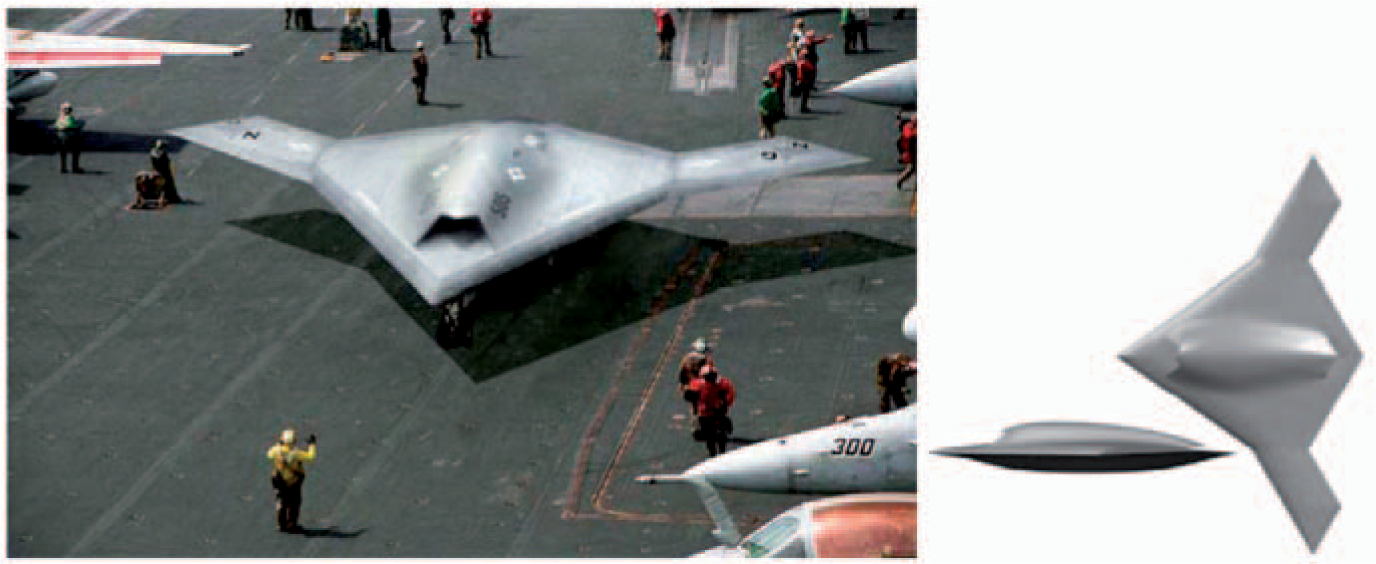
From its inception, the defense system would be designed to destroy ballistic missiles in powered flight. After decades of indifference to practical boost-phase defense concepts, 6 the Missile Defense Agency is presenting quasi boost-phase missile defense concepts aimed at hitting target missiles shortly after they end powered flight. However, these concepts are fundamentally flawed because it is simple to deploy highly effective countermeasures within seconds of the end of powered flight (Lewis and Postol, 2010).
The Missile Defense Agency also mistakenly expects that countermeasures like decoys would drift apart, making later attempts to shoot down warheads more feasible. However, decoys and other devices can easily be tethered together with strong and light strings to prevent them from drifting apart beyond any practical distance desired by the adversary. For this reason, the defense system must be designed from inception to destroy targets before they reach the end of powered flight.
As few as two antimissile armed drones, controlled by remote teams of operators, would be needed to shoot down an ICBM. A fleet of four to five drones would be needed to maintain two drones on continuous patrol for extended periods. The system would not have to operate continuously against ICBMs, as satellites and reconnaissance aircraft would be used to determine when an ICBM is being prepared at a known launch site.
The drones would patrol within 300 to 500 kilometers or more from a known launch site. At these ranges, it would be possible, while patrolling outside the borders of Iran and North Korea, to shoot down an ICBM with its nuclear warhead at existing launch sites anywhere in either country. If, at some future time, Iran were to build new launch sites deep in its interior, ICBMs could also be shot down by the system, but it might then need second-generation interceptors capable of achieving 5 kilometers per second. Since any site deep in the interior of Iran would not be an efficient choice for space launch, the site would have been chosen for military purposes; further, Iran would not know whether stealthy antimissile drones had been ordered across its borders when a potentially threatening missile is being assembled for launch.
Because the drone fleet would be small and would carry only a small number of interceptors, it would not be possible to redirect such a defense against either Russian or Chinese strategic nuclear forces. This means Russia could engage in strategic arms reductions with the United States without concern that an unpredicted future change in US policies could pose a threat to Russian strategic forces. For China, it would remove any perceived threat from US missile defenses along with any incentive to counter the defenses by expanding its nuclear-armed ICBM forces.
How it works
The performance of rocket propulsion and airframe technology in solid- and liquid-propellant ballistic missiles available to Iran and North Korea is roughly the same as that exhibited by the Russian SCUD-B missile—a missile based on Russian innovations in rocketry during the late 1940s and early 1950s. ICBMs that utilize this level of propulsion and airframe technologies are heavy, large, and carry only modest payloads. For example, a ballistic missile using SCUD technology and capable of carrying a roughly 1-ton payload from Iran to the United States would weigh about 120 tons. 7 By comparison, a ballistic missile that uses much more advanced 1960s US Titan II ICBM or Minuteman III propulsive and airframe technologies could achieve the same results while weighing only 30 tons. An Iranian ballistic missile based on SCUD technology that could carry a 1-ton payload to a 4,000 km-range would weigh 70 to 80 tons. And a three-stage solid-propellant ballistic missile that uses the same technology as the Iranian 2,000 km-range Sejjil ballistic missile would weigh more than 35 tons, and could carry a 1-ton payload to a range of 3,500 km.
Thus, every identifiable technological option that would allow Iran or North Korea to pose a long-range ballistic missile threat to the continental United States and Northern and Western Europe would involve liquid-propellant missiles that are so large they must be launched from fixed launch sites. If Iran chooses to build shorter-range (3,500 km) three-stage solid-propellant missiles, these missiles will not have sufficient range, payload, and mobility to reach Northern and Western Europe unless they are operated in the restricted northwest corner of Iran. Since this area is well within the reach of interceptors launched from antimissiles carrying drones that are operating outside Iran’s borders, these solid-propellant missiles could be shot down by the airborne missile defense. If these three-stage solid-propellant missiles were operated in the northern tier of Iran, they could reach northernmost Russian cities, like St. Petersburg, and could also be engaged by patrolling drones.
Since a hypothetical 3,500 kilometer-range three-stage Sejjil missile could operate deeper in Iran and still reach Moscow, it would be more difficult, though not entirely impossible, for a drone-based antimissile defense to defend Moscow. However, the existing Moscow antimissile defense uses nuclear-armed interceptors with vast kill-ranges against targets. 8 The large destruction range of these nuclear-armed interceptors would render ineffective countermeasures that easily defeat US hit-to-kill interceptors, as these must pick out and directly hit warhead targets accompanied by closely spaced decoys and other structures.
These technological facts have profound implications for the defense of the United States, Northern and Western Europe, and Russia from long-range nuclear-armed ballistic missiles from Iran and North Korea.
Figure 2 shows the direction
ICBMs would have to fly if launched from Iran to Washington, DC; Seattle,
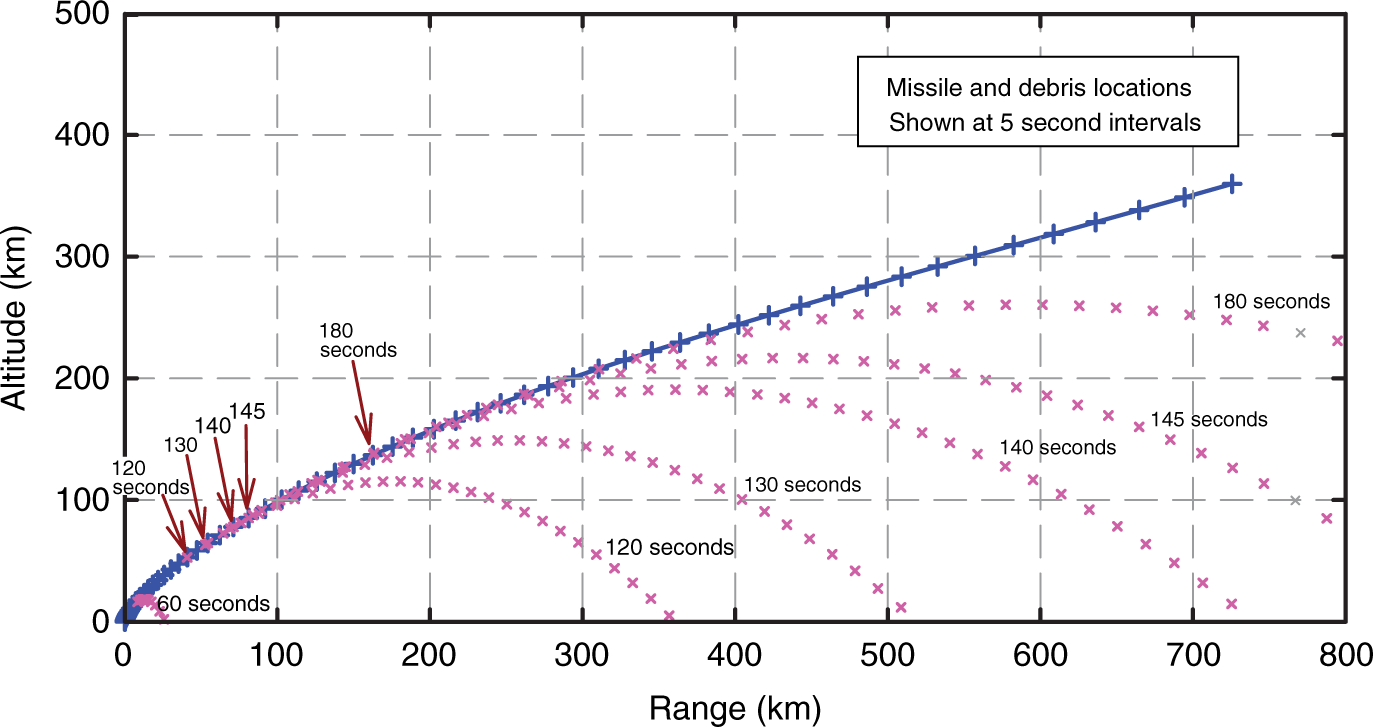
Washington; Hawaii; or Japan. Figure 3 shows a typical powered flight trajectory for a large
liquid-propellant ICBM. Due to engineering constraints, the variations in the
characteristics of the powered-flight trajectories are not large.
9
As Figure 3
demonstrates, if a 4 kilometer-per-second interceptor is directly downrange of a
launched ICBM and has roughly 200 seconds of flight time (i.e. if it is
launched 50 to 100 seconds after the ICBM ignites its rocket motors),
the interceptor would have time to travel 800 kilometers toward an intercept point
while the ICBM could travel 600 to 700 kilometers toward the same intercept point.
Under these conditions, an intercept of the ICBM could be achieved roughly 1,200 to
1,300 kilometers from the ICBM launch site. If the interceptor is launched from a
location perpendicular to the flight azimuth and final point where the ICBM could be
hit while in powered flight, the engagement range would be about 800 kilometers. If
a more advanced 5 kilometer-per-second interceptor is used, a careful and systematic
inspection of the possibilities indicates that essentially any potential fixed ICBM
launch site within Iran could be reached by proper choices in antimissile drone
patrol areas. The flight pattern of an ICBM if it were launched from Iran and headed
for Washington, DC; Seattle, Washington; Hawaii; or Hokkaido, Japan. The flight trajectory of a large liquid-propellant ICBM.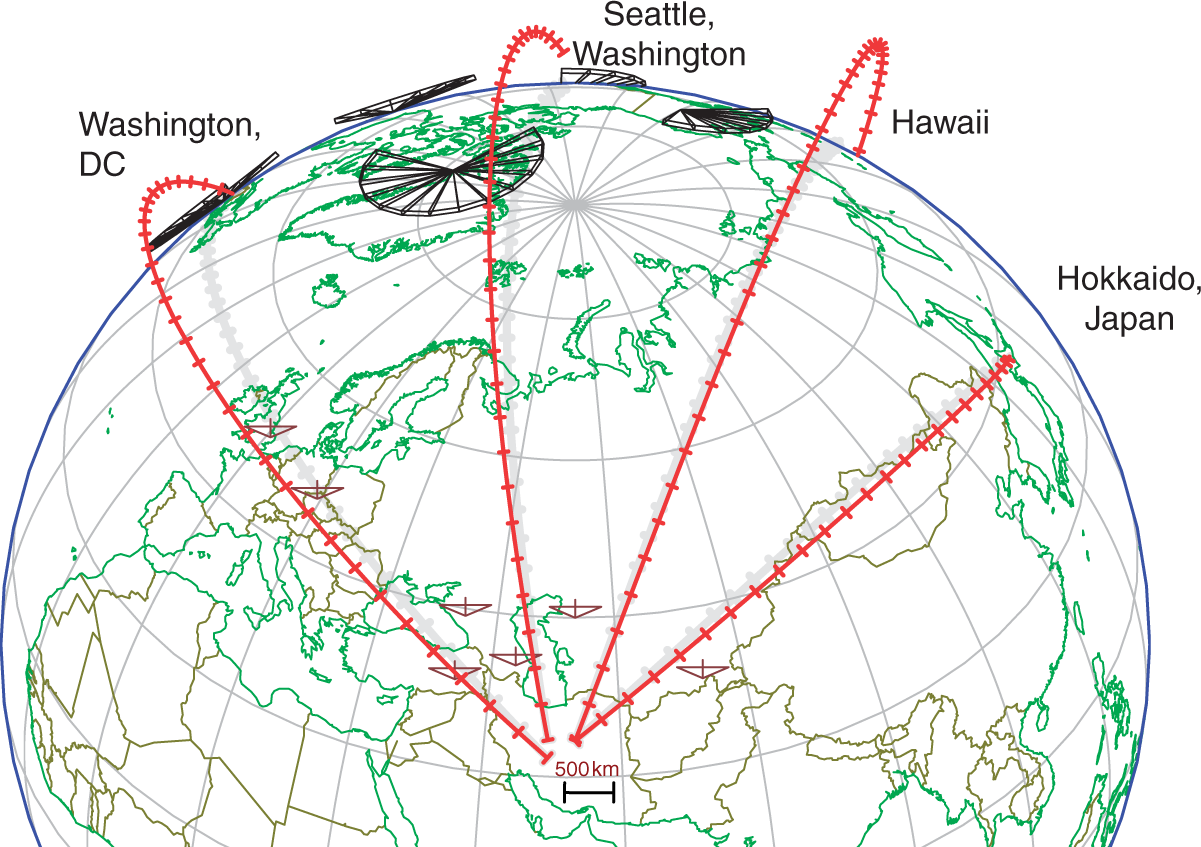
If operated from a restricted area of northwest Iran, a 3,500 kilometer-range three-stage ballistic missile based on Sejjil solid-propellant technology could reach Berlin with a roughly 1-ton payload. While at this time there is no evidence Iran is contemplating or developing such a missile, it would be possible to develop one from the rocket motors used in the Sejjil-2. As a result, such a future technical development cannot be ruled out.
A three-stage solid-propellant missile would use the rocket motors currently being developed and tested for use in the first stage of the 2,000 kilometer-range two-stage Sejjil missile. Since the existing first stage has enough thrust to lift the larger three-stage variant of the Sejjil, the resulting missile would be capable of carrying a roughly 1-ton payload to a range of 3,500 km.
The resulting missile would weigh about 35 tons, measure 27 to 28 meters long, and have a powered flight time of 120 to 140 seconds. It would weigh about the same as the US Minuteman III ICBM, but would be longer than the Minuteman III by 50 percent. Because of its unwieldy configuration, it would be moveable but not be mobile in the usual sense. It would likely require at least one extra vehicle to carry the additional 15-ton third-stage motor, and additional mobile vehicles with equipment to assemble the full three-stage missile prior to launch. Another possibility is that it would be carried on a single, exceptionally long and difficult-to-maneuver vehicle, greatly restricting its movements. Either case would result in a peculiar and unique presence that would greatly increase the ability of distant surveillance systems to identify and track these vehicles or movable missile complexes within the confines of this limited area. It cannot even be ruled out that the unique presence of such complexes, in combination with the confined area of operation, could make them subject to relatively reliable continuous tracking by US surveillance drones and satellites.
In the case of North Korea, operating such a defense would be easy. Stealthy drones
could shoot down North Korean long-range ballistic missiles in powered flight while
operating over the Sea of Japan, the Korea Bay, and/or over Russian territory north
of North Korea (see Figure
4). These stealthy drones would have the effect of making the operational
patterns of the defense unpredictable, a highly desirable operational goal for such
a system. Stealthy drones would also be able to penetrate an enemy’s
airspace if required. Perhaps of greater importance, stealthy drones would deny an
adversary any information about operational patterns or practices, making the
defense even more difficult for an adversary to understand and yet more
intimidating. If operating over the Sea of Japan, the Korea Bay, and/or over Russian
territory north of North Korea, stealthy drones could shoot down North
Korean long-range ballistic missiles in powered flight.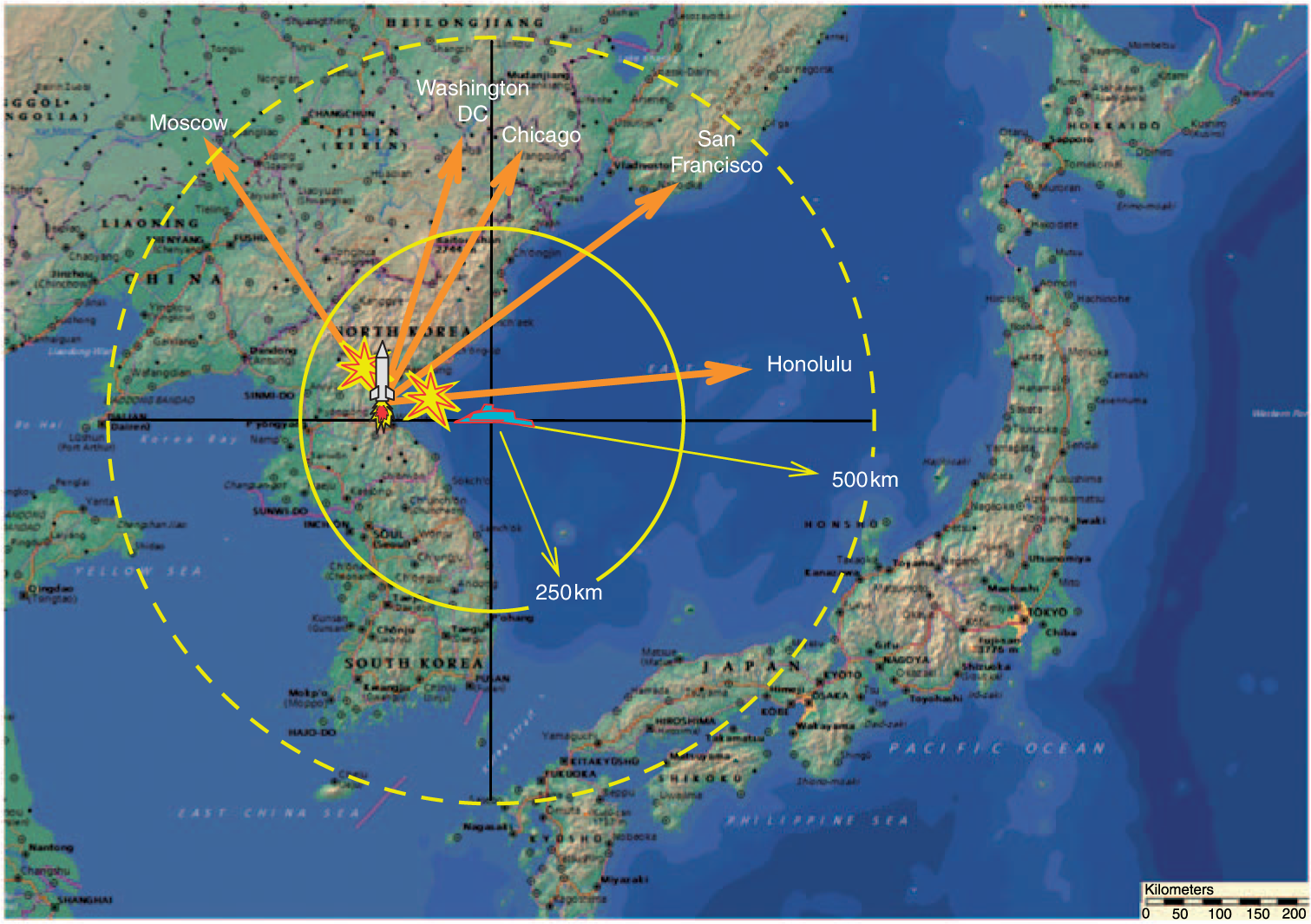
It must be emphasized that this proposed missile defense system will not address threats from shorter-range ballistic missiles. In general, the use of this highly robust but specialized defense against much shorter-range and relatively mobile missiles with short powered-flight times will drive the performance requirements and the size of the resulting systems to monstrous proportions and expense—and will result in systems with highly questionable workability.
Hence, the system we propose to replace the non-functional GMD system would consist of a small fleet of existing heavy-lift stealthy drones that would operate within hundreds of kilometers of known launch sites. Such drones would carry high-speed and fast-accelerating missiles that could shoot down long-range ballistic missiles shortly after they are launched and before they complete powered flight and begin deploying their countermeasures.
What needs to be done
What is needed now is a program to adapt or build stealthy drones that can carry interceptor payloads and associated electronics and tracking equipment. Because the strategic boost-phase missile defense would attempt to intercept accelerating missiles in powered flight, it will need a new kind of specialized kill vehicle capable of a maximum lateral acceleration equivalent to that of a car going from rest to 220 mph in 1 second (an acceleration of about 10 Gs) and a total divert velocity of about 4,500 mph (2 kilometers per second). 10 Although the task is technically demanding, such kill vehicles can certainly be built with existing technologies. In short, the specialized technologies needed to build this system are all available.
Boost-phase vs. high-altitude defense
Perhaps the simplest question to ask about the GMD and SM-3 missile defenses is: If they’re not broken, why replace them? The answer, of course, is that the current GMD and SM-3 system is easily fooled in space, and there is no way for the defense to know how to guide its interceptor to targets.
In the near vacuum of space, there is no aerodynamic drag slowing heavy objects relative to light ones. Because there is no air-drag in space, a 0.5 kilogram balloon in the shape of a warhead or basketball will travel along with a 1,000 kilogram warhead on exactly the same trajectory. This remarkable circumstance makes it possible to easily defeat the missile defense’s infrared and radar sensors, which consequently makes it impossible for the defense to know how to direct its interceptors against the right target. Making matters worse, the defense must hit the warhead directly to destroy it. If the package in which the warhead resides is much larger than the warhead, a hit in the section that does not contain the warhead will almost certainly not destroy it. Thus, the defense must not only find the warhead, it must locate it to within a fraction of a meter.
The problem is that infrared and radar sensors used by the defense can only see the surfaces of objects they are viewing. That is, the defense operates like customs inspectors who can merely visually inspect closed suitcases as they pass on a conveyer belt. Without being able to X-ray the contents or use chemical sensors to detect explosive vapors, the inspectors would have to trust what they saw. Under these conditions, the only way they would find explosives is if the appearance of suitcases with bombs were known in advance and if the suitcases appeared exactly as they were expected to appear. Similarly, infrared and radar sensors observing possible warheads from ranges up to thousands of kilometers can only find the warheads if they look like warheads—and if any surrounding decoys look identifiably different from warheads.
So, in the case of the inspectors looking for explosives in suitcases, if they are told in advance that the explosives are in a yellow suitcase, and the other suitcases are of identifiably different colors, then the visual capabilities of the inspectors will allow them to find the suitcase containing explosives with very high reliability. If the other suitcases are various shades of yellow, and the inspectors have very detailed color information, they could still find the right suitcase. But without sufficiently detailed information about the exact shade of yellow, the inspectors’ chance of making the right choice diminishes drastically.
Where a compact explosive is hidden in a single suitcase, and the inspectors are only able to shoot one or two bullets at the suitcase to prevent the bomb from detonating, they would have to know what section of the suitcase to target, as the bullets would otherwise pass through the suitcase leaving the bomb unharmed. This is the problem GMD and SM-3 interceptors can encounter when trying to hit a missile or rocket upper stage in which the exact location of the warhead is uncertain. In the case of the Russian missile defense surrounding Moscow, the long kill-range of the nuclear-armed interceptors allows the defense to destroy the entire suitcase instantly, ensuring the bomb within the suitcase is destroyed no matter where it was located.
The SM-3 system: The reality of unrealistic tests
The SM-3 system is afflicted with exactly the same fundamental flaws as the GMD. Although the SM-3 uses entirely different radars and interceptors, the sensors of both the GMD and SM-3 systems function according to the same laws of physics. The SM-3 interceptors home in on their targets using infrared signals identical to those used by the GMD interceptors; and like the GMD interceptors, they are vulnerable to the same problems. Both defense systems are also designed to intercept targets in the near vacuum of space, where the lack of air-drag makes it easy for an adversary to create highly credible false targets.
The last five SM-3 tests against rocket targets with warheads attached are a good
example of how not to test for real combat conditions. These five
tests appear to have been done repetitively under nearly identical flight conditions
and they form the basis of the Defense Department’s false claim to
President Obama in September 2009 that the SM-3 is “proven and
effective.” In each of the five repeated experiments, the upper stage of
a modified NASA sounding rocket was launched on a trajectory that probably had a
range of about 500 km (see Figures 5 and 6). On the left, the two-stage sounding rocket used as a target in the five
most recent tests of the SM-3 where the warhead remained attached to the
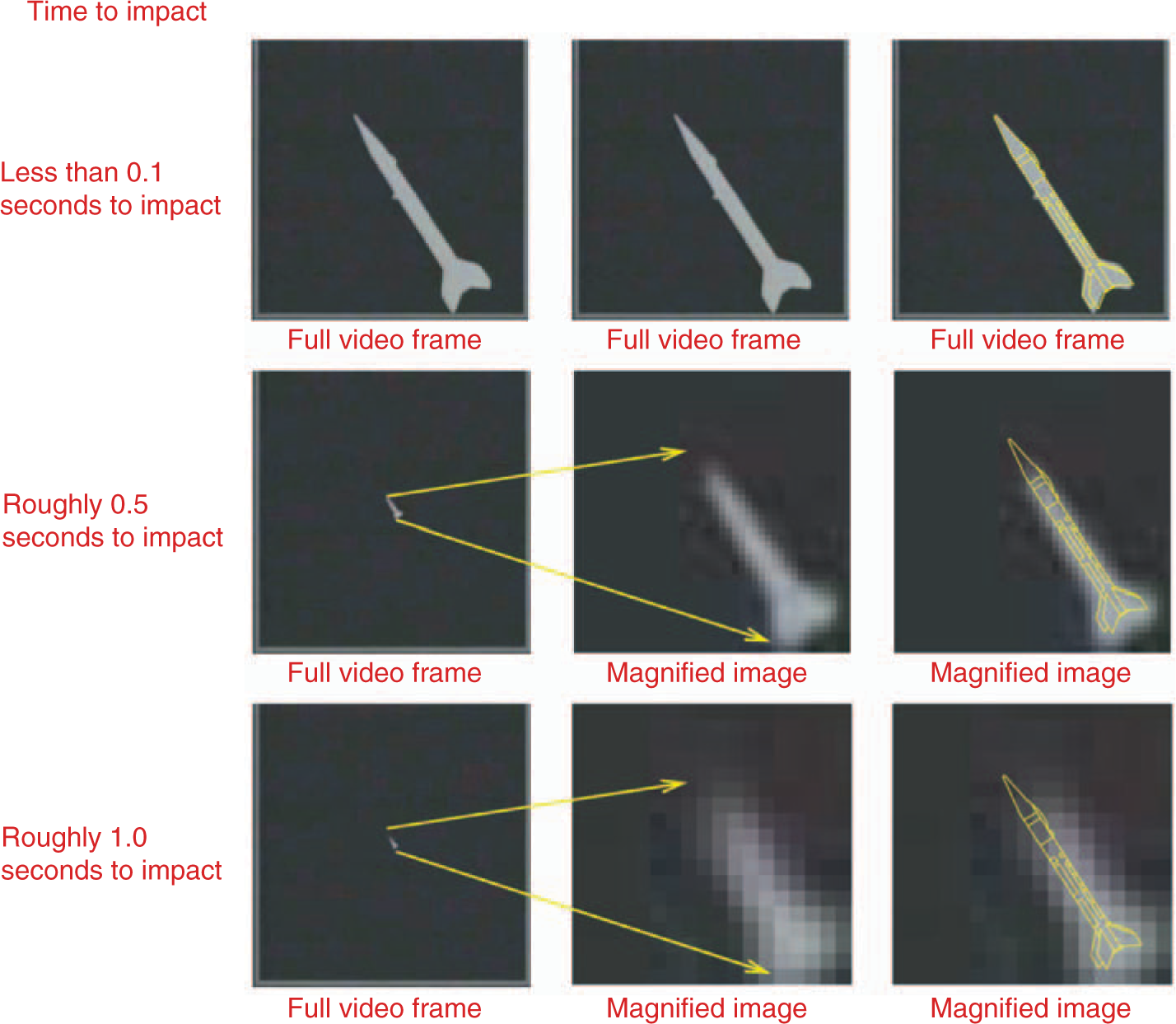
target. On the right, the second stage of the target missile. The second stage of the target missile as seen by the SM-3 interceptor at
0.1 seconds, 0.5 seconds, and one second before it hits the target. The
exact location of the front end of the target is not visible until there
is less than 0.5 seconds before the hit.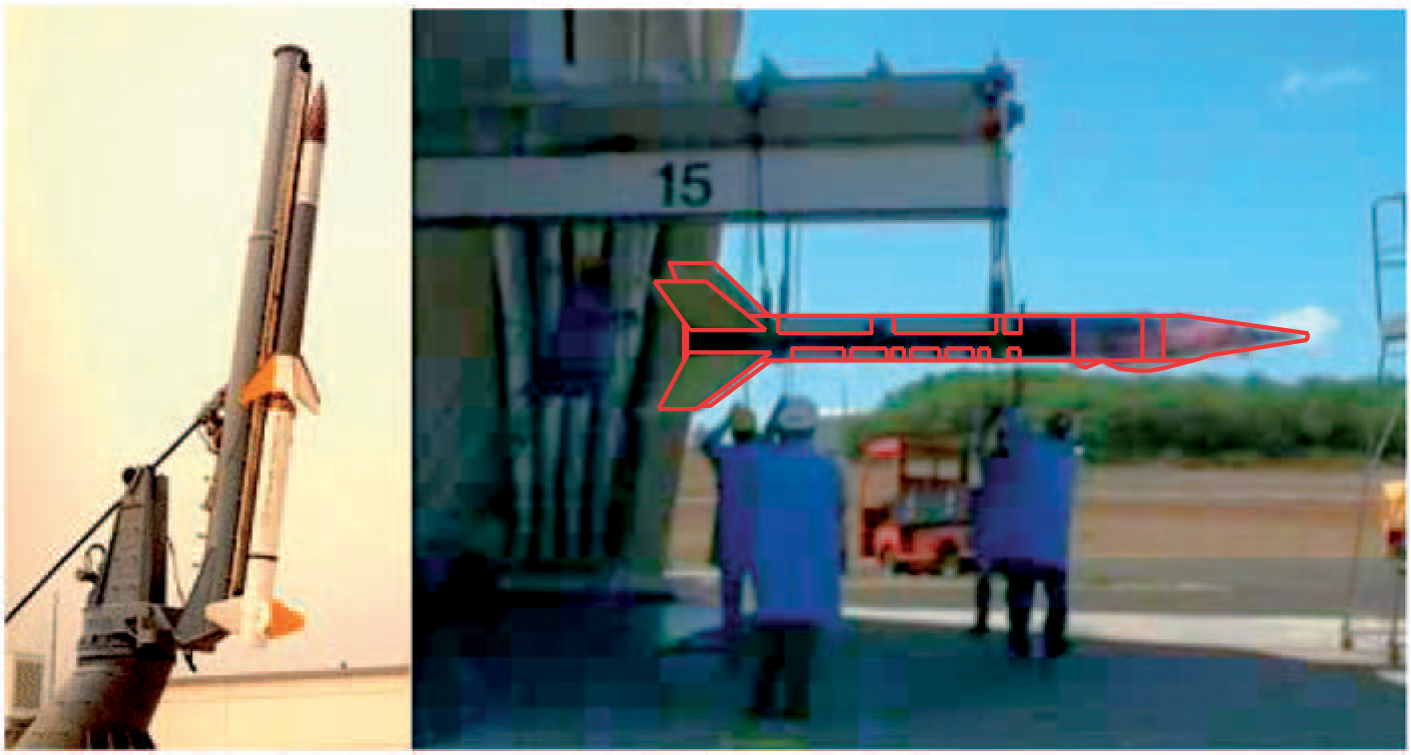
The target missiles were spin-stabilized, like a gyroscope, so they could not tumble end over end. Yet the Al-Husain missile used by Iraq in the Gulf War of 1991 traveled about the same range as these missile defense targets, and it tumbled end over end. This tumbling contributed in many ways to the catastrophic failure of the Patriot Missile Defense in the 1991 war. 11
The center and right-hand columns in Figure 6 show magnified versions of the tiny missile target images in the left-hand column. Line drawings of known missile targets have been superimposed over the images in the right-hand column.
What is immediately evident from the images is that the front end containing the warhead is not visible, even 0.5 seconds before impact, but the tail fins on the back end make it possible for the interceptor to determine which end of the missile contains the warhead. Even 0.5 seconds before impact, if the target missile were tumbling end over end and had no tail fins, the SM-3 interceptor would not be able to determine which end of the missile contained the warhead. If the tumbling missile were 10- to 12-meters long (the ubiquitous SCUD-B missile is about 11-meters long), the interceptor would have to achieve a lateral acceleration equal to that of a car going from 0 to 220 miles per hour within 1 second (that is, the acceleration rate would have to be about 10 Gs). Similar to the drone-based antimissile boost-phase defense, accelerations of this magnitude can be achieved by building a highly specialized boost-phase kill vehicle, but are many times beyond the capabilities of GMD or SM-3 interceptors.
Even if the homing interceptor kill vehicle were aimed at the center of the missile’s body-length and could identify the warhead within 0.5 seconds of impact, the interceptor would still have to accelerate at a rate beyond its capabilities. Making matters still more problematic, an adversary could intentionally add an extension to the front end of the target missile (like disguising the dimensions of a suitcase containing a compact bomb), making it impossible to know—or more accurately, to see—the exact location of the warhead, which must be hit within a fraction of a meter.
Hitting a tumbling target, without fins to identify its back end, makes for a
complicated job. If the target missile is tumbling in a plane perpendicular to the
interceptor’s line of approach, the target will tumble in an orientation
like that of a propeller relative to the fuselage of an airplane. In this situation,
the warhead will follow a circular path relative to the center of rotation of the
tumbling missile. If the interceptor instead approaches the tumbling target missile
in such a way that the front and back ends of the missile sometimes point at the
approaching interceptor, the tumbling target missile will appear to the interceptor
as an object undulating in length. If the target missile is instead tumbling in a
plane neither perpendicular nor horizontal to the interceptor’s line of
approach, the warhead will follow an elliptical path with changing lateral velocity
as the missile tumbles (see Figure
7). The pattern of warhead locations when a missile is tumbling in planes
perpendicular and inclined 30 degrees to the direction of an approaching
interceptor.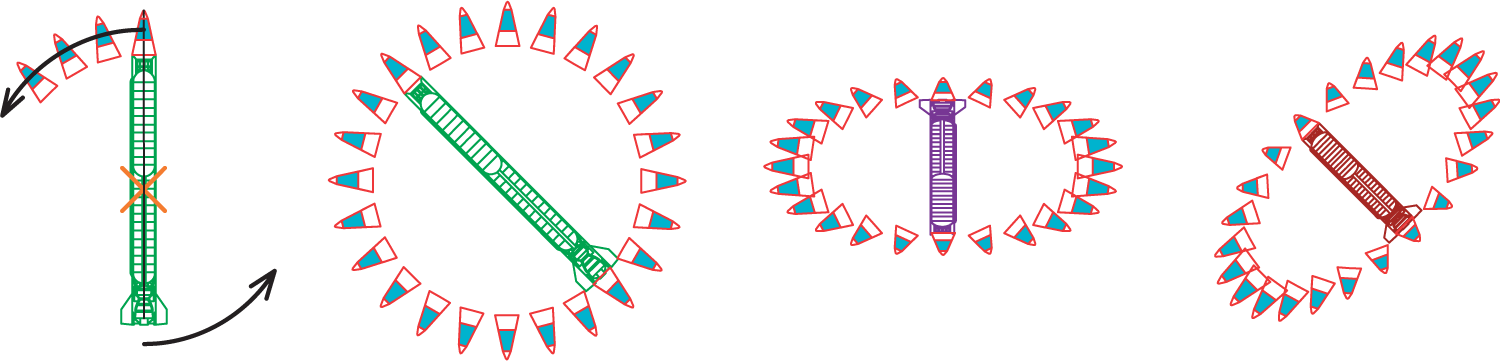
Since the interceptor can only see details of the motions within a few tenths of seconds of hitting the target, the kill vehicle would have almost no time both to find the warhead and adjust its trajectory to the warhead’s motions. Figure 8 shows the different locations of warheads after one second of tumbling for different rotation rates and where the target missile's plane of rotation is perpendicular to and tilted at 30 degrees to the direction of approach.
Thus, the speed and direction of a tumbling target missile confronts the kill vehicle
with a warhead target of unpredictable location and motion. This situation, which is
likely to be the case in real combat, is shown in Figure 8. The potential locations of warheads after a one second interval when a
missile is tumbling at different rates in planes perpendicular and
inclined 30 degrees to the direction of an approaching interceptor.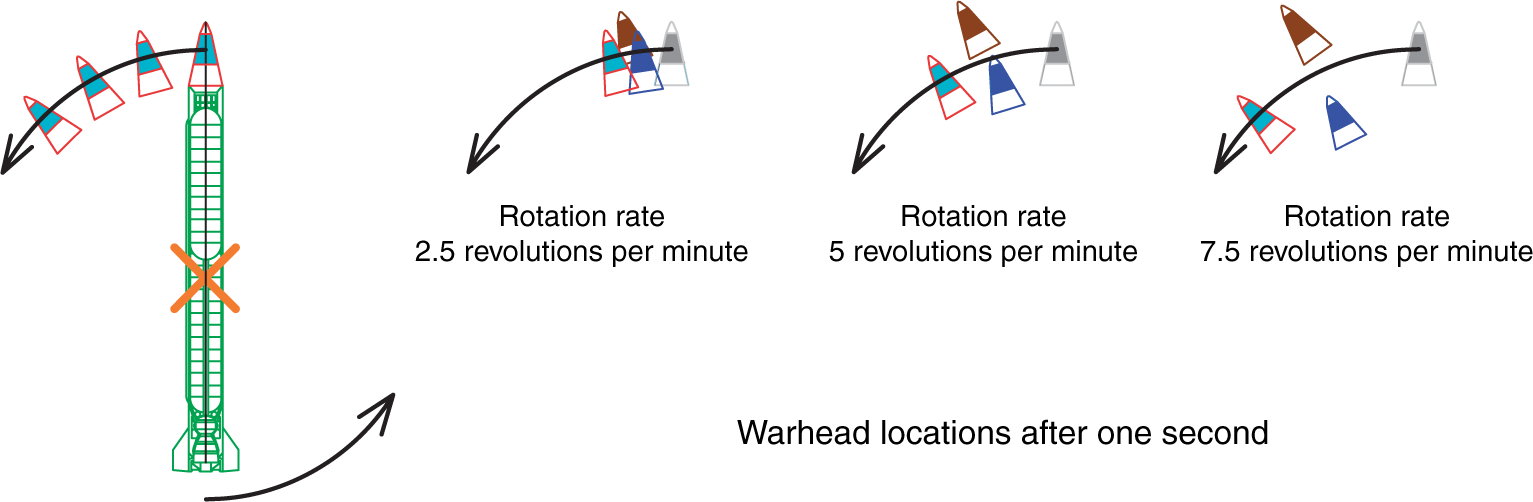
It is false and misleading to tell a president that the SM-3 system has been tested sufficiently to be described as proven and effective. To reach this conclusion, the testers would have to demonstrate that the kill vehicle can find the potentially disguised location of the warhead on a tumbling missile, and successfully maneuver to hit the warhead within fractions of a second. The proof of system reliability would require repeated demonstrations under widely varied conditions to show that warhead targets attached to missiles in multiple tests can be hit. These varied conditions would include target missiles of different lengths and geometries, and tumbling speeds and directions unknown to the testers. It is also worth emphasizing here that a realistically tumbling missile target is only one of innumerable real combat conditions the SM-3 has not been tested against.
In short, the tests to date of SM-3 (and GMD) interceptors have not even been close to “realistic,” as prescribed by Congress. In the case of the SM-3, all the tests against missile targets to date have been unrealistic and grossly simplified relative to real-world combat conditions. They have been done, instead, against the same simplified target missiles under the same simplified conditions. The target missiles were all the same length, they were prevented from tumbling, they had large highly visible tail fins, they were always positioned perpendicular to the line of sight of the interceptor, the warhead’s location was known in advance and not disguised, and the missiles were not cut into pieces that could not be identified by the homing interceptor. Hence, the Department of Defense’s test program is designed to ignore tactical measures any well-informed adversary could be expected to use against the GMD and SM-3 systems.
Figure 9 illustrates this
fundamental point well. It shows two photographs of Iran’s Qiam I
missile, which was first flown on August 20, 2010. The photograph on the left shows
the Qiam I being prepared for launch. The photograph on the right has a line drawing
of a SCUD-B ballistic missile, which illustrates how the wings were removed from the
body. It is clear from the photographs and videos of the launch released by Iran
that the Iranians are using the SCUD-B as a test bed for a modified guidance system,
the benefits of which are immediately evident. The removal of tail fins, which are
large reflectors of radar, drastically reduces the radar cross section of the
missile during the early phases of its flight, consequently reducing the range at
which missile-defense radars can detect a missile launch. The lack of tail fins also
means homing interceptors will not be able to determine which end of the missile
contains the warhead, if the Iranians choose to make the missile tumble at high
altitudes. The Iranian Qiam I ballistic missile. Because the Qiam I has no fins, the
SM-3 would not be able to tell which end of the missile has the warhead.
Source: Mehr News Agency.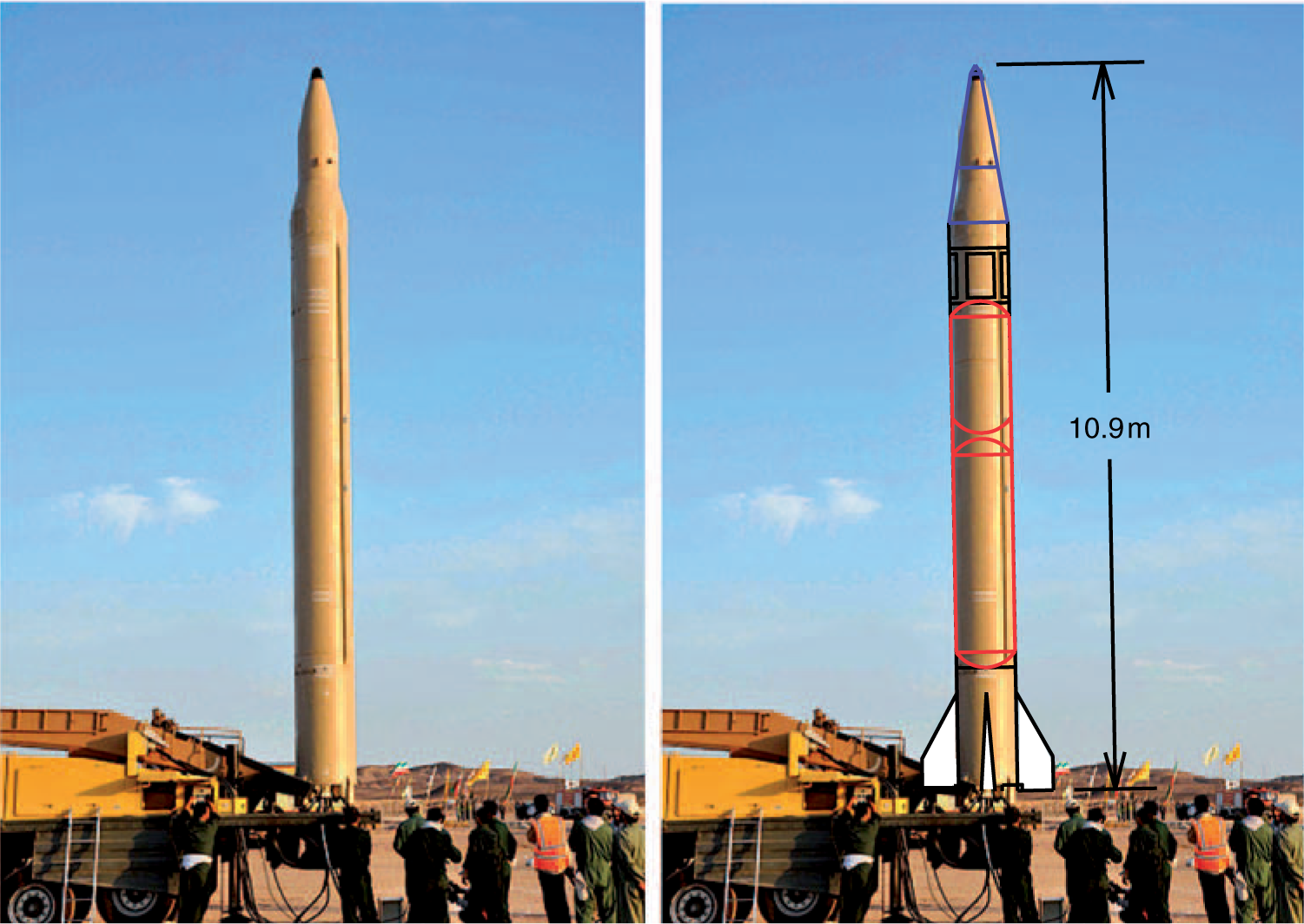
With these observations in mind, and correcting for the vagaries of language translation, it is interesting to note the comments of Iran’s defense minister, Ahmid Vahidi, following what appears to have been a successful launch of the Qiam I. Vahidi described the Qiam I as a “missile … [that] … is equipped with a … [guidance and control] … system, which decreases the possibility of it being … [hit by interceptors]” and that it has “enhanced agility due to the scrapping of its fins” (FARS News Agency, 2010). 12
Conclusion
The United States has the ability to defend itself from long-range nuclear armed ballistic missiles if it builds the right systems—defenses based on stealthy drones that could shoot down ballistic missiles in powered flight after they have been launched from fixed known sites. This same system could defend Northern and Western Europe, and Northern Russia, from the kinds of long-range missiles that Iran might build in the future. This defense system requires no new technologies or science to be effective, reliable, robust, and intimidating against the adversaries of concern.
In contrast, the United States is instead preoccupied with the development of two near-worthless defense systems, the GMD and SM-3, which have fundamental vulnerabilities determined by the laws of physics. Congress, which has called for “realistic” testing of missile defenses, could easily establish the vulnerabilities of these systems. Realistic testing would require GMD and SM-3 systems to demonstrate that they can successfully engage warhead targets when the warheads are surrounded by cone-shaped objects roughly the size of the warheads and balloons roughly twice the diameter of basketballs.
In the case of warheads attached to rocket bodies, Congress could also require realistic tests that would show that interceptors could hit warheads attached to rocket bodies that tumble end over end, like those that defeated the Patriot Missile Defense in the Gulf War of 1991. The tests would also need to show these defenses can cope with simple countermeasures aimed at disguising the exact location of the warhead on the front end of the missile, or situations where an enemy intentionally creates many false targets simply by breaking the rocket into many unidentifiable pieces. If Congress wants realistic testing, then these are the tests that must be done.
If we, as a nation, refuse to confront the fact that our chosen defense system is not reliable, and if we fail to build a robust and reliable alternative system using existing technology, we will have only ourselves to blame if the continental United States suffers a catastrophe as a result of the successful delivery of a nuclear weapon by long-range ballistic missile.
Footnotes
1
The authors wish to thank Mike Elleman, senior fellow for missile defense at the International Institute for Strategic Studies (IISS) for extensive discussions and for sharing detailed unpublished calculations with us. We also would like to thank several experts in missile defense who have provided us with extremely valuable criticism and suggestions that have greatly improved this paper. Unfortunately, these admirable individuals must remain anonymous.
2
See US Department of Defense (2010: 12) For reiterations of the administration’s key assumptions about the capabilities of ballistic missile defenses and its role in the strategy, see also pp. vi and 31.
3
See US Department of Defense (2010: 34). For a discussion of a version of this argument that is expanded to claims about expected improvements in regional stability from missile defense, see pp. 12 and 23.
4
For a discussion of how the Defense Department went about modifying all subsequent missile defense flight tests after the first two realistic tests failed, see Broad (2000).
5
6
During 1998 and 1999, one of the authors (Postol) and Richard L. Garwin of IBM
Watson Laboratory showed that a boost-phase missile defense based on
high–acceleration, ship-based missiles would be a very effective
defense against North Korean ICBMs. The capabilities of this particular defense
were uncertain with regard to Iran, since areas north of Iran, where it would
have to be based, would not be reliable places to site the system, and also
because Iran is large enough that the curvature of the earth and distances over
which the defense would have to operate raised questions about how well it could
work. Despite the heavy focus on North Korea at the time the proposal was made,
the Missile Defense Agency chose to emphasize the unproven Airborne Laser
System, which was known to have serious limitations due to beam quality and beam
propagation distortions from the atmosphere, as well as inadequate beam power.
Even recently, the Airborne Laser failed to shoot down a tactical missile target
at a range of roughly 100 miles. If the laser had proven up to this job, it
would still not have demonstrated it could be a viable boost-phase missile
defense. The laser is carried on a Boeing 747, which is extremely vulnerable to
short-range air defenses, and to long-range air defenses as well. For details
about the proposed sea-based boost-phase missile defense against North Korea,
see Postol (1999) For
details about the recent failure of the Airborne Laser, see  .
.
7
See the summary of information provided in the press release for Iran’s Ballistic Missile Capabilities: A Net Assessment from The International Institute for Strategic Studies and the Dossier referred to therein (IISS, 2010).
8
The long-range Galosh ABM interceptor used by the Moscow ABM system is generally believed to carry a warhead with a yield of about 5 megatons. Such a warhead could destroy an attacking nuclear warhead at a range of 10 to 20 kilometers or more. Thus, a single Russian Galosh interceptor could be used to destroy everything in a complex of objects that would effectively defeat a hit-to-kill defense that is hiding the warhead in the complex.
9
For example, an ICBM optimized to burn for 250 seconds, rather than 320 seconds, would complete its powered flight at about the same altitude and at roughly 600 kilometers downrange from launch, rather than 700 kilometers downrange from launch. The Russian SS-18 and US Titan II are large liquid-propellant ICBMs with powered flight times engineered and optimized to get the longest range and largest payload for their size. Both missiles have powered flight times of about 320 seconds.
10
As a homing kill vehicle travels toward a target it uses homing sensors to determine whether it will hit it. If the target is offset a small distance from the expected point of impact, the kill vehicle can add velocity in a direction perpendicular to its line of approach to adjust its trajectory so it will then hit the target. The time it takes for the kill vehicle to achieve the needed lateral velocity is determined by the rate of acceleration and the top speed that it can achieve. If the rocket motors on the kill vehicle are not sufficiently powerful, the kill vehicle will not be able to achieve the needed lateral velocity fast enough to hit the target. If the kill vehicle does not have enough fuel, it will also not be able to achieve the required lateral speed to hit the target. The amount of fuel and the size of the needed lateral acceleration strongly affect the weight of the kill vehicle, which, in turn, limits the burnout speed of the rocket that launches the kill vehicle. For these reasons, kill vehicles are designed to have the minimum acceleration and lateral speed needed to maneuver against the targets to be engaged. In the case of kill vehicles used by the SM-3 and GMD systems, the maximum speed and acceleration is designed to be able to hit a target that is coasting on a highly predictable trajectory in the near vacuum of space. In the case of an accelerating ballistic missile, where a kill vehicle might take minutes before hitting the target, the kill vehicle must maneuver to correct for the unpredictable direction and speed of the accelerating ballistic missile. Hence, because the target of a boost-phase missile defense is accelerating rather than coasting, the boost-phase kill vehicle must have a much higher acceleration and total divert velocity relative to kill vehicles designed to hit coasting targets.
11
The tumbling of the Iraqi Al Husain missile during the 1991 Gulf War caused extensive havoc with the Patriot missile defense. Since the Al Husain missile tumbled at a high altitude, the size of its radar cross section varied by a factor of about 50 to 100 depending on its orientation as it arrived at Patriot radars. This meant that arriving Al Husains were sometimes detected at 40 kilometers and sometimes at 140 kilometers range. The different detection ranges drastically changed the amount of time that the Patriots had to fly out to intercept points, and this, in turn, drastically changed the size of the area that could be defended from engagement to engagement. The tumbling also meant that some Al Husain missiles broke up at high altitudes (about 30 kilometers) when they entered the atmosphere side-on relative to their direction of motion; at other times they broke up at altitudes of 11 to 12 kilometers, when they reentered the atmosphere with their axis of symmetry lined up with the direction of motion. When they broke up at high altitudes, the warheads had reduced radar cross sections as they fell from the higher altitudes. When they broke up at lower altitudes, the Patriots that were homing on them became confused by the many targets that were suddenly created. In some cases, the Patriots flew into the cloud of breakup debris, and in other cases the Patriots first homed on the cloud of breakup debris and then dove to the ground chasing warheads that emerged from the debris clouds. The catastrophic failure of the Patriot during the 1991 Gulf War is denied even today in documents published by the Pentagon. This is so even though the failure of the Patriot in the 1991 Gulf War was confirmed in public by William Cohen when he was Defense Secretary. It may truly be said in the case of the Patriot that “those who ignore the errors of the past are destined to repeat them.”
12
The actual statements reportedly made by the Minister of Defense, as translated from Farsi to English were: “[The Qiam is] a new class of Iranian missile … [that] … has been equipped with new technical specifications and exceptional tactical powers.” “[It] is part of the new generation of the Islamic Republic's surface-to-surface missiles with liquid fuel and completely designed and built domestically.” According to the text in the article, the Defense Minister “explained that the missile is equipped with a smart navigation system, which decreases the possibility of it being targeted by other projectiles.” Vahidi is also quoted as saying “[The Qiam 1] enjoys enhanced agility due to the scrapping of its fins.” Our understanding of the actual content of the translation from Farsi to English is in the main text of this article.
Author biographies