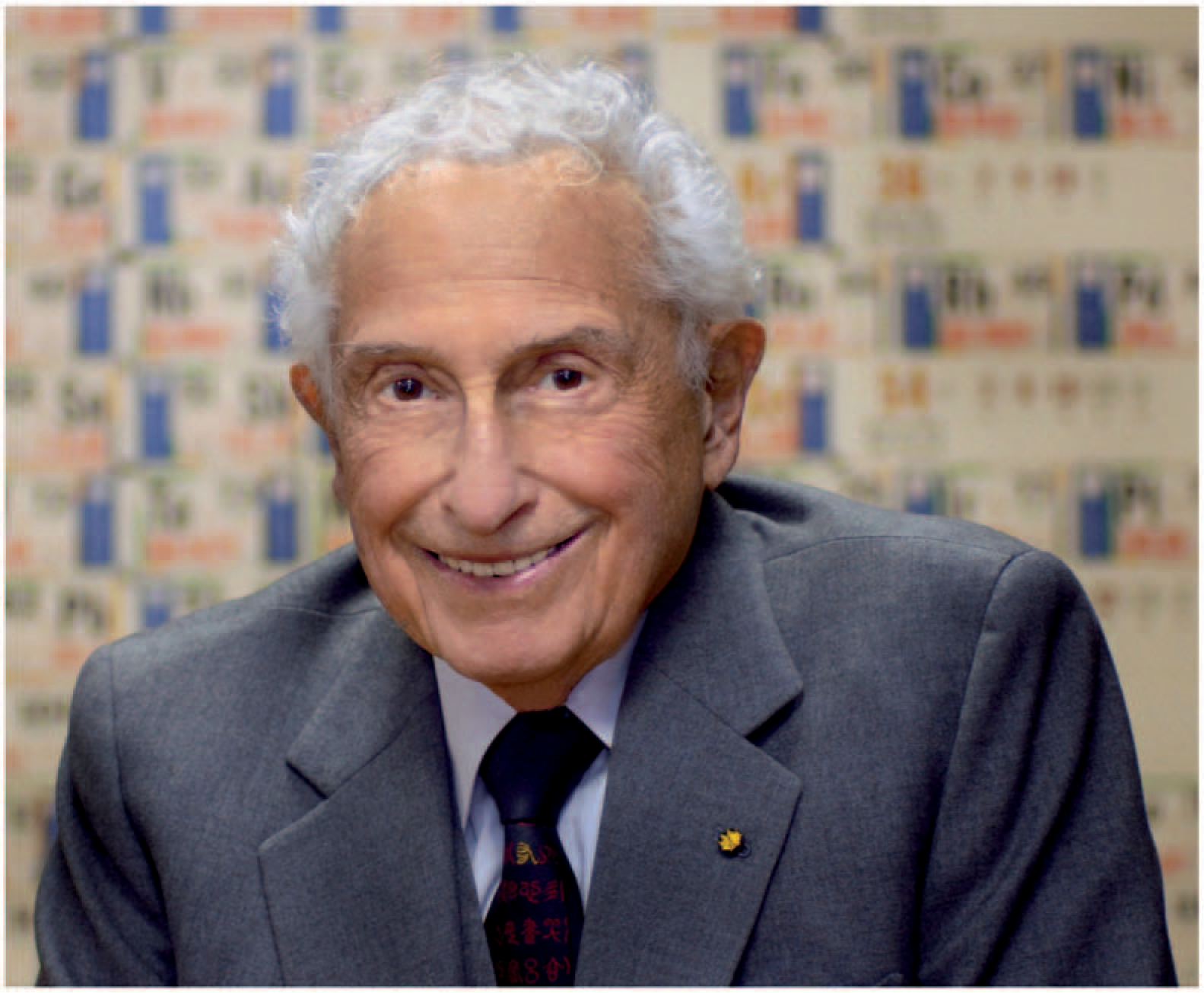
The inventor and industrialist—whose materials-science discoveries more than a half-century ago and subsequent inventions led to broad advances in photovoltaics, batteries, displays, and computer memory—describes his new efforts to develop cheaper and more efficient photovoltaic technology. Ovshinsky offers his perspective on institutional roadblocks to clean-energy technologies and characterizes the successful influence of the fossil-fuel lobby in Washington. He asserts that he has established proof of principle for a photovoltaic production plant—one that could be built now—that is capable of building enough panels in a year to generate a gigawatt rather than megawatts of solar electricity and thus allow solar to compete economically with electricity from fossil fuels. He says that in building photovoltaics and related renewable-energy infrastructure, America can again become the “machine shop for the world.”
Throughout the latter half of the twentieth century, the largely self-taught materials scientist Stanford Ovshinsky was a technological and industrial pioneer. In 1955, he transformed the then-obscure field of “amorphous materials”—materials lacking an ordered crystal structure—by discovering new kinds of semiconductors, including thin-film amorphous silicon for photovoltaic solar panels. (The field took on the moniker “Ovonics,” short for “Ovshinsky Electronics.”) Later, at his company, Energy Conversion Devices, he created a system for mass-manufacturing photovoltaic panels by depositing these silicon semiconductors on a thin metal sheet in a roll-to-roll process like newspaper printing, a major step forward. Other discoveries led to the nickel metal hydride battery, which enabled the electric and hybrid vehicle industry, as well as certain types of computer memory and liquid crystal displays (LCDs) that are in common usage, as in thin-film TVs.
Along the way, Ovshinsky acquired an appreciation of institutional roadblocks to advanced energy technologies. In 1992, a consortium consisting of the US government and the big three auto companies—General Motors, Ford, and Chrysler—selected his nickel-metal-hydride battery technology over 60 competitors to replace the heavier lead-acid batteries for future electric cars. The new battery technology, now a mainstay of hybrids from Toyota, Ford, Honda, and other automakers, first appeared in the second-generation EV1—GM’s electric car—and increased the EV1’s range to 140 miles. But although GM bought a majority stake in the company, Ovonic Battery, the tide soon changed. The oil lobby killed California’s zero-emissions vehicle requirement that would have helped create markets for electric and hybrid vehicles. And GM literally scrapped its EV1 fleet and sold its share of Ovonic Battery to Texaco (now part of Chevron), which was fighting the California mandate, resulting in Ovshinsky being kicked off the Ovonic board.
Now, at 88, Ovshinsky is gearing up again with visions of establishing a new era in photovoltaic industrialization at the scale needed to combat climate change. He left Energy Conversion Devices in 2007 and now says he has mapped a new approach to photovoltaic thin-film production that speeds up the manufacturing process by two orders of magnitude while significantly increasing the efficiency of the resulting materials. He asserts that these basic advances could allow factories to make enough solar panels in a year to produce at least one gigawatt of electricity annually—roughly the scale of a nuclear power plant—at the price of coal.
BAS: You founded Energy Conversion Devices a half-century ago to deploy “creative science to solve societal problems.” Did you imagine then that in 2011, solar power would satisfy barely one-tenth of one percent (0.1 percent) of total US electricity?
Ovshinsky: I couldn’t have given you a figure. But with my late wife, Iris—who started the company with me on January 1, 1960—we knew that there were forces that we had to face and struggles we had to go through to achieve change, and that we were in it for the long haul. A lot of people think that change is accomplished overnight. But a struggle is always going on prior to and after change. I knew that we had to be able to prove everything along the way to even get a chance to get to the table. That is the reason that we always made products to prove our suppositions.
BAS: Has the main roadblock been inadequate technology or a failure of policy to advance renewable electricity on a large scale?
Ovshinsky: Solving problems in science and technology is always part of the process. But the real problem is what happens after you overcome the technology barriers. The very biggest barrier in the United States is that there is no energy policy that allows for new approaches. Progress is blocked all the time by the oil, automobile, coal, and utility industries. These are special interests that feel very challenged and seek to postpone change as long as possible.
That is why I’ve sometimes had to go to Japan and Korea to achieve success, by licensing technologies to companies like Sharp and Samsung for making solar cells and thin-film LCD screens, which, of course, was a huge profit center for both countries. These countries knew they needed to change to become competitive. They understood that new science and technology was an absolute requirement, just as China does now. The United States says it doesn’t pick winners or losers, but it is quite evident from our fundamental lack of progress in the area in energy that they certainly pick losers because they do not understand how to have a culture where innovation can triumph.
BAS: What policy changes are needed, besides the big one: a tax or other price on carbon emissions, a version of which the House passed last year but the Senate killed?
Ovshinsky: A progressive energy policy has to be based on the reality of the need for success. This can only be accomplished by means of putting a price on carbon emissions and by investing in infrastructure. Infrastructure is not only roads and bridges, but we need high-speed rail and intelligent power grids that can flexibly accept the variable inputs of solar and wind power. Wind can be very helpful in providing electricity at night. Such infrastructure will accelerate the growth of renewable power and I believe very firmly that hydrogen—born in the Big Bang, the sun is made of it, giving us the photons that reach our photovoltaics and provide electricity—is the basic clean fuel for transportation. With solar and hydrogen, there are no wars over oil, minimizing the CO2 dramatically.
BAS: You don’t think President Obama can get these things done? He’s not going to bring about much change?
Ovshinsky: I’m so sad, because I like the guy. Last year we both got honorary degrees from the University of Michigan. He gave a great talk. And while he was going out, he said to me: “Keep at it. Thank you. Keep at it.” He has great potential to keep learning and certainly tries to get the best advice. He has an exceptional scientist in [Energy Secretary] Steven Chu, and I know that there are some great people working in the Department of Energy. Let’s hope that they will be able to succeed in this feverish time. The real problem is that the public seems not to believe in climate change or appreciate the need to escape from oil and the terrible problems associated with it, and part of the reason is the anti-scientific campaigns going on. In this respect, America is endangered and losing its leadership in the world. Because without an industrial base that is based on new science and technology, we can expect continuing problems that endanger our country and its future.
Does anyone really expect that Congress will ever support renewables? Current policy doesn’t really support anything new besides the possibility of fuel out of enzymes [to make ethanol from cellulosic plant waste]. It is what I would call the postponement of the future. So I don’t see any possibility in the present Congress, or any possibility of Obama having any kind of real energy policy that he can seriously institute.
BAS: Can new technology somehow succeed when policy is tilted toward the status quo?
Ovshinsky: Nothing changes without struggle. As a child, I believed in a “can-do” America. Today I believe that bringing about fundamental change that can help make the world a better place and re-industrialize America requires that we lead. We have to be able to show that there are fundamental answers, as in the past where invention and leadership showed that we can have telephones, telegraphs, railroads, automobiles, electricity, and aviation. We can again become the machine shop for the world, where our youth can have new kinds of jobs that new science can provide and so that the educational system can integrate new knowledge that will be helpful to our students for their future.
As for me, I would like to show that we are able to have a fundamental answer that would allow us to achieve a more peaceful, a less dangerous, and a better and more equitable world for everyone. For the sun provides energy for everyone on earth, but so far, only the advanced countries have made any kind of attempt to use it properly. Innovation is an absolute necessity for fundamental change and that is why I am doing what I’m doing.
BAS: Can you explain your new assertion about what you have achieved in terms of photovoltaic panel manufacturing?
Ovshinsky: I can show now that we can achieve solar energy, with good profit, at a cost less than that of burning of fossil fuel. That is a revolutionary statement, and it can’t be done overnight, but it can and will be done. The plant would be an ordinary-sized plant of 150,000 square feet which would put out a photovoltaic product of one gigawatt per year. Unless we start making a gigawatt in many plants, the cost of photovoltaics will never get down to the cost of coal— which is what global society needs.
This can be done with proper support in no more than several years. The cost of the production machine will be a few pennies per watt, $350 million at the most. I’ve proven in the past that the first machine always costs more than the subsequent ones. When you go into a high enough volume production, all costs come down in the steepest decline that you can think of. And you want to build as many machines as possible in every city in every country.
BAS: How does this approach differ from what you were actually producing in roll-to-roll production at Energy Conversion Devices? Are you planning to publish anything on the specifics? What’s the next step?
Ovshinsky: I have shown that I can speed the rate of deposition of the photovoltaic materials by a factor of 100, as well as increase the conversion efficiencies [of the finished product] to the levels required for gigawatt production. And this is all a start. Our platform permits you to go much higher with time. Take these together and you can have electricity at pennies per kilowatt hour, competitive with coal. Energy Conversion Devices produces wonderful products and has wonderfully talented people, but they cannot produce cheap enough to be competitive to burning coal.
BAS: Your new goals are quite ambitious.
Ovshinsky: Just like everybody laughed at my 30 megawatt machine at Energy Conversion Devices. Those machines were a great success at a time when people were only making several megawatts. Now people will have the same objections to the single-plant gigawatt approach. But I built many machines when I was head of the company, proving the principles of what I wanted to prove.
I came from the shop floor, I love science and technology and I am committed to building a gigawatt-plus in one single photovoltaic production plant. What I have done all my life is to actually show that what others think can’t be done can be done. I can be evaluated by what I’ve accomplished. We are ready to go to the next stage now, where the proof of principle we achieved becomes the basis of building the new plants all over the world. And therefore, answering the problems that our global economy and the future needs—to minimize CO2, build new industries, rebuild America so that it is the “can-do” country again, and take away oil as the major cause of war. The Japanese nuclear accident emphasizes the value of using solar energy.
So I am ready to go to the next step, of development of the product itself, and in parallel, doing the design and proof work for the manufacturing plant. In other words, accelerate to build plants as soon as possible.
BAS: Meanwhile, the utility-scale solar power plants moving forward in this country aren’t photovoltaic but “solar thermal,” capturing solar energy to boil water and drive turbines. Some 15 gigawatts of solar-thermal plants are proposed in California. That’s what the Energy Department has started supporting in terms of loan guarantees. What’s your take on these Energy Department investments?
Ovshinsky: I think [solar thermal] has a place in the energy strategy. What they are doing is very good, because nobody is doing anything else. It’s a way of addressing the problem right now. And I am all for it and for the people who are doing it. But it is not a universal solution. It is a solution for special areas. I think, obviously, that my approach is the way to go because it is very low cost, and you don’t need deserts and running water and other things that the solar-thermal companies don’t like to talk about. And you can place our thin-film products by the side of highways or railroad tracks, on houses and other buildings and, of course, in deserts. So I am all for what they are doing, but the complete solution is elsewhere.
BAS: The other main problem with solar power is, of course, the need to store power for when it’s cloudy, and at night.
Ovshinsky: Storage is very important. When you solve a very fundamental problem, it puts the pressure on the next problem. So then storage becomes really an instant problem. I came up with some approaches such as storing hydrogen safely and reversibly in a solid. Using hydrogen as a storage medium and energy carrier, we can drive automobiles without any pollution whatsoever and, at the same time, start utilizing hydrogen storage in a solid that could lead to a possible approach for power-grid storage. I also believe that wind is very important, in part because it performs at night and can be used in tandem with solar.
BAS: Hydrogen storage is a further-off solution. What near-term power-grid storage solution would most feasibly allow variable solar power to make up larger fractions of electricity in the near term? Is there another materials-science solution such as giant batteries, or an information-technology one—that is, allowing utilities to manage demand precisely—to match the variable outputs?
Ovshinsky: Energy and information are the twin pillars of our global economy. To me, information has always been encoded energy. A key approach to storage is to have flexible grid controls to adjust demand, or to direct excess power to distributed storage sites at homes and offices, possibly including the batteries in electric cars. Existing approaches such as hydro pumped storage and compressed air are very useful, but limited, and will continue to play a role in the future. But it is the unexpected giant steps that have provided our present science and technology and we must continue to seek more giant steps.
BAS: What countries do you consider advanced in this arena and what policies should the United States and others emulate?
Ovshinsky: It is obvious that there is much desire by China now to answer their societal needs by not only relying on old technology, but seeking to actually implement a well-thought-out scientific and technological planning policy that is based upon innovation.
As of now, China is the only major country in the world that has a well-thought-out plan in terms of renewables. Of course, the smaller countries like Denmark, and others, are also building new renewable industries and providing jobs for young people. But planning in the United States is considered socialist. For example, we cancel high-speed trains. China builds high-speed trains. In the United States, Obama is trying to do that, but the governor of Florida says, “No, I won’t even take the money.” In China’s case, they have many equivalents of a free-enterprise system by virtue of the fact that they do have competition, between provinces, between cities, but most importantly, they intelligently plan and implement to build their country! This is a very important point, for they are very proud to be able to do that. I asked one person who spoke perfect English why he gave up a very good job in Silicon Valley to come back to China, and he said something that we must all say: “I wanted to build my country.”
I’ve always said such things when asked. But I would also add that we must consider what is happening in the entire globe and it is part of our responsibilities to assure that science and technology benefit the entire globe so that people can live together in peace. And I would like to produce what our country and the entire global society needs to live the kind of life that humanity requires.
BAS: China is already shipping half of the world’s photovoltaics. Will they soon be shipping the latest Ovshinsky product?
Ovshinsky: China has a big problem, as does the rest of the world. They presently do not have a culture of innovation. But China can offer very much in manufacturing and can lower the cost so that it is difficult for others to compete. They know that that isn’t enough; they need innovation. As Chinese Premier Wen Jiabao recently said, he was “sad” that China remains primarily a “manufacturing country” rather than a “strong creative or innovation country.”
Since I’ve been an inventor and scientist and technologist all my life, I owe it to any country in need to uphold the principles that I started out with to serve society, and that means not only your own country, but the world. It works out this way: One goes where he is wanted; it’s not enough that he is needed. So our problem, and the world’s problem, is that we need to develop a culture that grows innovation. I am still a journeyman looking for work that gives life meaning and value. I believe all countries have the possibility for innovation, but unfortunately, there must be a culture that nurtures it.
BAS: While we wait for coal-priced solar, why not follow the German example and force utilities to buy renewable power at high rates, creating markets for solar and thereby driving economies of scale?
Ovshinsky: What I’m saying is that we don’t need that if we do gigawatt-scale solar. Save the [subsidy] money, use it where it’s needed more. Germany did what was right under the circumstances. The Germans know that the government has to step in to show that it represents the people and not just the utilities. Isn’t that what governments are supposed to be for? But you have to have a technology that you have thought through and a society that understands its needs.
BAS: What steps can be taken so that construction of zero-emissions buildings—such as the new National Renewable Energy Laboratory research support facility in Colorado—is more common, rather than so exceptional?
Ovshinsky: I’m afraid that it is exceptional, knowing what the forces are, and the initial costs to do that, even though it’s obvious that one should be doing it. I applaud the NREL leadership and its committed, talented scientists and technologists for taking the lead in this, showing what can and should be done.
BAS: You are 88 years old. Thinking about retirement?
Ovshinsky: I know this is contrary to what you read in the books: that mathematicians can’t go beyond their 31st birthday, and scientists are done by about the time they are 40. Hell, I have more than 400 patents and 15 pending out there right now, and going for more. As long as I know I can do it, it is my civic responsibility to do it because of the character of the problems. Somebody has got to do it.