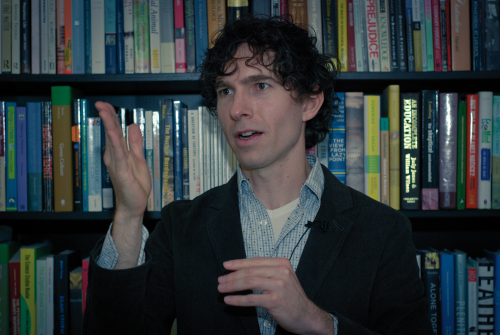
In this interview, Green Illusions author Ozzie Zehner says that alternative energy technologies such as solar cells and wind turbines have become fetishes and spectacles that do nothing to offset coal use. Instead, he says, these technologies serve mostly as symbols that distract Americans and prevent them from considering cleaner and more affordable solutions to climate change and other environmental problems. He argues that subsidizing alternative energy technologies actually has a boomerang effect: By making energy cheaper for consumers, it increases the demand for energy. Zehner criticizes electric cars as inventions that are no better for the environment than gasoline-powered vehicles and that simply perpetuate a vehicle-centered culture. He describes how media coverage of energy-producing technologies such as solar cells and biofuels soars along with gas prices, while coverage of energy-saving technologies such as insulation stagnates. In Zehner’s view, Americans don’t have an energy crisis; they have a consumption crisis. He recommends that, instead of concentrating so much effort on developing alternative technologies, each of which comes with an unavoidable downside, environmentalists should focus on social and political programs—he cites youth cycling programs as one example—that are good for public health as well as the planet. Zehner suggests that such programs need to provide immediate personal benefits and long-term climate stabilization.
A visiting scholar at the Center for Science, Technology, Medicine and Society at the University of California in Berkeley, Ozzie Zehner studies the public understanding of alternative energy technologies and assesses the social, cultural, political, and economic conditions that influence energy policies and projects.
Zehner grew up in Michigan, where he spent a summer during college scraping soot from the bowels of an industrial power plant. He graduated from Kettering University with an engineering degree and then worked for General Motors for five years, including three years in Europe doing advanced vehicle development. He received a master’s degree from the University of Amsterdam, where he studied the sociology of science and technology.
In a CNN segment two decades ago, when Zehner was only 17 years old, he showed off a small hybrid car that he had designed and built; it ran on electricity and natural gas. “I thought it was an especially beneficial solution to our environmental challenges. I was wrong,” he writes in his recently published book Green Illusions: The Dirty Secrets of Clean Energy and the Future of Environmentalism (University of Nebraska Press, 2012). The virtuousness of electric vehicles is just one of many cherished assumptions that Zehner tackles in his book, which he describes as “part investigative journalism, part cultural critique, and part academic scholarship.”
Green Illusions analyzes the limitations and unintended consequences of energy technologies, ranging from solar cells to nuclear power, and concludes that the United States can’t solve its environmental problems by producing more energy. Instead, Zehner recommends fundamental changes to social and political systems, such as bolstering women’s rights, promoting bicycling and walkable communities, and creating a Department of Efficiency to develop big-picture priority recommendations and fill the gap left by a Department of Energy with only a small budget for civilian energy. The Bulletin spoke with Zehner about his new book and the prospects for alternative energy.
BAS: What made you decide to write the book Green Illusions?
Zehner: I once had an architectural firm and one of my first clients wanted to put solar cells on his roof. I didn’t know much about solar power at the time. The more research I did, the more I realized the limitations of the solar cells. I determined that we would have to cut down two large oak trees that were creating a lot of passive solar benefits for the house, and that the solar cells were going to cost a lot of money and not improve the energy performance of the house at all. When I presented that to my client, he nevertheless decided to cut down the trees to keep the solar cells in the plan because he had very strong associations with the technology. That intrigued me. Today, I see alternative energy technologies being fetishized in the national dialogue. They’re becoming spectacles, which rely on a certain degree of fantasy. Daydreaming can spur creative ideas, but these alternative energy fantasies have come to define the options that are available to us, and to limit or forestall better solutions. That’s why I felt it was critical to write a provocative book, looking at all the negative consequences of alternative energy technologies, and then return to say that, if we want them to be relevant in the future, we’ll have to change the social, economic, and political contexts first. That undertaking will be more enjoyable than people might think.
BAS: What part of your book has provoked the strongest reaction?
Zehner: It was unexpected. I thought that it might be the chapters on solar cells or wind power, but it was actually the electric vehicle critique that prompted the largest backlash. That’s probably because cars have such a strong symbolic value for Americans. They are a central cultural feature. A lot of people take for granted that an electric vehicle is slightly better for the environment than a gas vehicle and therefore a step in the right direction. But there’s no evidence that’s actually the case when you consider the entire lifecycle.
BAS: In Green Illusions you write that driving an electric vehicle is like switching to a low-tar cigarette. Why?
Zehner: It’s more like a switch from smoking cloves to smoking menthols, because I really see no environmental difference between the technologies. The Union of Concerned Scientists looked at the fueling cycle—the energy used to charge the vehicle—and they found that the greenhouse gas benefit of driving an electric vehicle depends on where you live and what power plants are fueling your grid. The National Academy of Sciences looked at the whole life cycle, and, when they took into account manufacturing impacts, refining, and other factors, the illusory benefit disappeared. The total impacts from an electric car are greater than the damage from a gasoline car—even if its gasoline comes from the Canadian tar sands. It’s not really acceptable for doctors to promote menthol cigarettes, and I don’t see a reason for environmentalists to promote electric vehicles—especially when there are genuine solutions that are being ignored. The Academies found that smarter land-use planning would keep people out of traffic. So would bike and pedestrian infrastructure.
BAS: You call solar cells a “fairy tale,” but a lot of smart people are convinced that solar power is the solution to our energy problems. Does that have something to do with the fact that this is a technology that individuals can personally own—is it literally about empowerment?
Zehner: The idea of moving off the grid to independently live off the land is a bucolic dream that has been prominent in environmental discourse. Solar cells also have a certain magic surrounding them. Solar momentum accumulated through a combination of environmentalists who are technologically hopeful, industry people who are profiting from solar cells, and government legislators who have found it convenient to draw off solar’s symbolic power. When all of those interests are aligned, they end up pushing a technology forward. But solar cells are encountering limitations. Cost is probably going to be the largest. There’s an idea that solar cell costs are dropping—that’s true for the technical components, but the majority of the cost is boring stuff like the cases that hold the solar cells, transportation costs, installation, insurance, and maintenance. Those costs have not been dropping. If the economy recovers, there’s going to be more competition for those low-tech materials. If the economy doesn’t get better, government subsidies for solar may dry up.
BAS: Are there other serious limitations besides cost?
Zehner: We’ll have to deal with the heavy-metal contamination and the virulent greenhouse gases from solar fabrication. Sulfur hexafluoride, for instance, has a global warming potential 23,000 times greater than carbon dioxide, according to the Intergovernmental Panel on Climate Change. Numerous organizations and governments assume that alternative energies such as solar and wind will offset coal use, but there’s no evidence that they do in practice. In March of this year, Richard York of the University of Oregon published an article in Nature Climate Change, and what both of us found—using two different methodologies—was that there’s no offset. It’s what I call a boomerang effect: When we subsidize an alternative energy technology, that exerts a downward pressure on energy prices, and demand for that cheaper energy increases, and so we return to where we started—with high demand and so-called insufficient supply.
BAS: The Energy Department’s 2008 report 20% Wind Energy by 2030 has been widely cited as evidence that major changes to the US energy infrastructure are within easy reach. Why did you write that the report is based on unrealistic projections of how much electricity turbines can generate under real-world conditions?
Zehner: When I was working on the wind chapter, it seemed like I couldn’t go anywhere without encountering citations from this report, so I thought I’d better go back and look at it closely. I discovered discrepancies between Energy Department data and the historical data in the report. There are capacity factors—the percentage of maximum capacity that you get out of a turbine in the real world—estimated in this report that are far above any capacity factors found elsewhere. I couldn’t figure out where they were getting such high numbers. They were even higher than the industry says are plausible. Just a percent or two can make or break a wind farm. So I decided to do some interviews at the Department of Energy and also with the firm that was hired to create the data sets. I found that, when they ran up against figures unfavorable to the wind industry, they crafted different numbers—by extrapolating from a period of rapid advancement and drawing a straight line up into the future, without acknowledging the maturation of the industry that had already occurred. That’s like extrapolating the growth of high school freshmen to show that, by college, they will stand taller than giraffes.
BAS: Why did the Energy Department go along with industry projections instead of government data? This report was written during the Bush administration, which was not known as an advocate of renewable energy.
Zehner: I don’t know what was going on in their minds when they created it, but there was clearly interest in producing a report that was favorable to the wind industry. It appears that the Department of Energy’s existing field data and its previous estimates on cost and capacity factors were too realistic to be used in a report that was going to pump up the prospects for the wind industry.
BAS: You have a chapter in your book on the alternative energy “fetish.” What makes solar cells and wind turbines so sexy?
Zehner: That’s one of the big questions that I have, and I don’t know if I’ll ever really answer it. These shiny, spinning objects rely on expectations that are unlikely to be achieved in reality, and they smother discourse on better options that are available to us. The clean energy spectacle has come to define what it means to be an environmentalist, but we have to stop taking for granted that alternative energy is always a good thing. It’s not the free ticket that it’s being made out to be. Biofuels are a good example of a technology for which public perception turned: The food price shocks of 2008 came in, and we started to see side effects from certain types of biofuels. The same thing could happen with solar and wind, although these technologies do have very strong symbolic values. And their seductive power should not be underestimated.
BAS: What are the “symbolic roles,” as you call them, that energy technologies play within political and environmental movements?
Zehner: Consider media representations of energy technologies. For example, solar cells versus LEDs: One produces energy; one saves energy. I studied a time period from 2003 to 2008, when energy costs were rapidly increasing, and I found that media coverage of solar, wind, and biofuels increased by roughly 400 percent. Meanwhile, coverage of energy-saving devices—things like public transit, LED lights, and insulation—remained relatively flat. I also analyzed the language that researchers and journalists used to describe these technologies. When journalists spoke about solar cells, they used words that related to the future, climate change, and energy independence. When they wrote about LEDs, they used more technical language, spoke about the past, and didn’t mention energy independence.
BAS: In researching your book, you persuaded organizations to release confidential reports and asked Energy Department employees to explain some of their internal decision making to you. What has been their reaction to the book?
Zehner: I’ve had mixed reactions. On the balance, they have been positive. Most practitioners in the energy world are not especially shocked by what I wrote. I actually give voice to a lot of people working on the ground who are familiar with green technologies. Many have reservations—often expressed only in private—about ramping up these technologies, especially solar power. I’m coming from a constructive standpoint and exploring how can we move forward. I am also generally in support of research and development.
BAS: In your book, you write that you’re neither for nor against alternative energy, but most of the publicity you’ve received has been about the downside of renewable power and electric vehicles. Do you worry that you may be giving aid and comfort to the fossil fuel industry?
Zehner: I’m highly critical of the fossil fuel industry as well. I have interviewed people in that industry, and they’re not concerned about electric cars or wind turbines or solar cells at all. They remind me that it takes a lot of fossil fuel to make a battery. The subsidies to electric cars ultimately work to the fossil fuel industry’s advantage because they’re a subsidy to car culture. People in the fossil fuel industry are afraid of regulations and of losing their own subsidies, but solar energy production isn’t keeping them up at night. They really just don’t care. The threat is something that is made up in the public imagination.
BAS: Renewable energy proponents would argue that technologies such as solar and wind power aren’t perfect, but that we can’t let the perfect be the enemy of the good. Aren’t some of these technologies good enough to make a difference for climate change, given the urgency of the problem?
Zehner: First, when we look at the numbers from researchers like Severin Bornstein and Gregory Nemet, they’ve found that, if we want to advance solar technology, building fabrication plants is an enormously expensive way to move the technology forward. It would be better to simply spend the money on R&D. And second, there’s only so much room on the stage. We should focus our spending on strategies that would have the largest impact, and in my mind that’s on the demand-reduction side. There’s plenty of low-hanging fruit there. Third, in the United States, because of this boomerang effect, pursuing production and reduction at the same time might make the problems we’re confronting worse. Until some backstops are in place, we cannot assume that an increase in alternative energy capacity will offset conventional energy production or yield positive environmental impacts.
BAS: You report that the Energy Policy Act of 2005 gave more financial incentives to the nuclear industry than to wind, biomass, solar, geothermal, hydroelectric, conservation, and efficiency initiatives combined. Why was nuclear such a big winner in 2005, and why didn’t those incentives produce the promised nuclear renaissance?
Zehner: It’s difficult to imagine what would have happened without Fukushima. In 2005, the nuclear industry was certainly getting a lot more love than it had been getting for a long time. My guess is that it was largely due to political donations and influence, as well as to the success of the nuclear industry in creating an image of clean energy. There is a lot of fissile material on the planet; that can be seen as a blessing and a curse. It means that, as fossil fuels get more and more expensive, those fissile materials will look more attractive. In the rush to create clean energy, the nuclear power industry might be well positioned to present itself as the solution when fossil fuel prices rise.
BAS: In your view, “an exclusively peacetime atom is as inconceivable as a coin with just one side.” What about the Japanese experience? Or the more recent venture by the United Arab Emirates, which has pledged to develop nuclear power exclusively for peaceful use?
Zehner: I think that it is an impossible dream. There are three reasons why we have to be suspicious of this often-cited division between nuclear energy and weaponry. Historically, we know that the two have often been a package deal. Political intentions rarely congeal into exclusively one form or the other. And even if they do, the nuclear industry is global, so we can’t think of intentions and risks only at the national level. The second hesitation I have is that the technologies are intermingled. I use the analogy of a downhill ski resort: Once you’ve built it, you could easily convert it into a snowboarding resort. Third, nation-states are always in flux. Today’s peaceful pursuit cannot necessarily be assumed to hold in the future. With such long time frames for nuclear activities, that’s something we have to acknowledge.
BAS: A lot of environmental leaders believe it’s easier to change technology than to change lifestyle or behavior. Are they wrong?
Zehner: Alternative energy technologies are inappropriate tools to address the social, political, and economic conditions from which our environmental troubles arise. Meanwhile, the environmental movement has couched conservation solutions in terms of sacrifice, but people don’t like to have less. We have to think about solutions in terms of creating up-front benefits as well as long-term benefits. There is no correlation between increased energy use and life satisfaction among rich nations. In fact, in places like Denmark, people report being happier than in places like Texas—where residents use far more energy. This opens up an opportunity to think about solutions that are congruent with people’s interests.
BAS: There are lots of ideas in your book for actions and policies that decrease energy consumption. Which is your top pick?
Zehner: One of my favorites is bicycling for youth. This is endangered in the United States right now. The new transportation bill weakens support for youth cycling programs. That’s sad. Children are disproportionately affected by suburban infrastructure because they can’t drive, and currently roads are not set up for cycling or walking. Children represent 12 percent of pedestrian fatalities, yet the federal Safe Routes to School program receives less than half a percent of the transportation safety budget.
BAS: You don’t have children. Do you think you’d see our climate and energy challenges differently if you did?
Zehner: I’m actually not that pessimistic about the future. I do think that we’ll be able to figure things out. My biggest concern, which probably would not change whether I have kids or not, is for those people who are going to be most impacted by fuel prices in the future—people in developing countries. They don’t have as much access to power and to the global economy as the rest of us do. As fossil fuel prices go up, that’s going to increase food prices, and I see that as one of the major threats in the future.