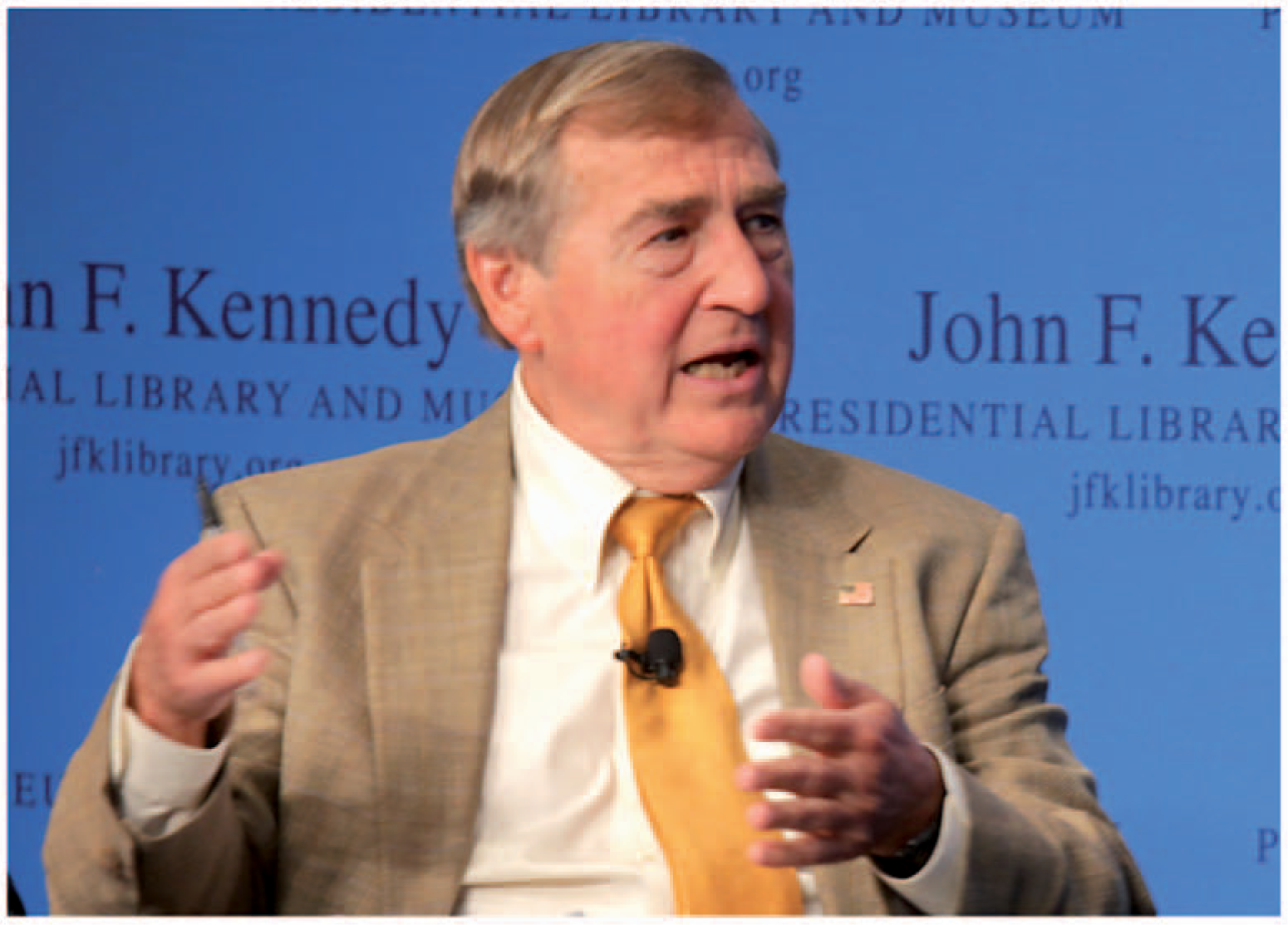
The Harvard professor and former Pentagon assistant defense secretary recognizes
that progress has been made in nuclear security but considers the day-to-day
focus on securing weapons and materials inadequate—and he perceives
a real risk that today’s global nuclear order could rapidly
unravel.
Since the collapse of the Soviet Union, Graham Allison—director of the Belfer
Center for Science and International Affairs at Harvard’s Kennedy School of
Government—has consistently warned policy makers about the dangers of a
nuclear weapon falling into the hands of terrorist groups such as Al Qaeda. In his 2004
book, Nuclear Terrorism: The Ultimate Preventable Catastrophe, he put
forward an arresting thesis: A nuclear terrorist attack on America was inevitable if no
improvements were made in securing the world’s nuclear bombs and fissile
materials, but preventable if the threat were met with swift and comprehensive action.
This clarion call followed three decades in which Allison served as one of the leading
U.S. analysts of security and defense policy, with an emphasis on nuclear weapons and
terrorism. He served as a special adviser to the defense secretary under President
Ronald Reagan and as the assistant defense secretary in the first Clinton
administration. He twice received the Defense Department’s highest civilian
award, the Defense Medal for Distinguished Public Service. The second time, the honor
recognized his efforts after the breakup of the Soviet Union in securing the return of
more than 12,000 tactical nuclear weapons from the former Soviet republics as well as
the elimination of more than 4,000 strategic nuclear warheads that once targeted the
United States and had been stationed in Ukraine, Kazakhstan, and Belarus.
President Barack Obama declared last April: “The single biggest threat to
U.S. security, short term, medium term and long term, is the possibility of a terrorist
organization obtaining a nuclear weapon.” In the last year, the
administration has led a surge of initiatives that included signing the New START arms
reduction agreement between Russia and the United States and convening the Nuclear
Security Summit at which leaders from around the world focused solely on the threat of
nuclear terrorism. But all of this is just a start. Allison spoke with the
Bulletin about recent events and what needs to be done today to
turn rhetoric about tightening nuclear security into stronger action.
BAS: Is it possible that the global nuclear order today is as fragile as the
Wall Street–centered global financial order was two years ago, when we were
assured that it was sound, stable, and resilient?
ALLISON: Yes. The starting point is modesty about our ability to assess
systemic risk. If you imagine, let’s just say six months ago, someone had
said, “The euro is at risk, given a fatal flaw in its
design—namely that it puts the cart of monetary unity before the horse of
fiscal discipline,” people would have said: “Yeah, but the euro
has been rising against the dollar for a decade.”
Consider the state of the global nuclear order today. One of the smallest, poorest, most
isolated states on Earth, namely North Korea, has over the past decade successfully
violated the rules of the order and defied the direct demands of the
regime-keepers—the great powers, namely the United States and China.
Similarly, four rounds of U.N. demands and sanctions have not prevented
Iran’s mastering the technology of enrichment and accumulating a stockpile
of low-enriched uranium sufficient, after further enrichment, for its first two bombs.
If, God forbid, the nonproliferation regime were to unravel or collapse in the next six
months or a year, in the way the financial meltdown occurred after the collapse of
Lehman Brothers, it would be easier to write the book on why this has happened, than it
was in the case of the financial crash.
BAS: What would that book say? How would it say things rapidly broke down?
ALLISON: There are several scenarios, as there were in the financial crisis.
In this case, North Korea has violated the regime that says: “No new nuclear
states.” North Korea has emerged as a self-declared, unrecognized state that
has 10 nuclear bombs’ worth of plutonium and has conducted two nuclear
weapons tests. The United States and its allies continue to say, “This will
not stand.” But if it does, it’s hard to imagine the next decade
in Northeast Asia without Japan and South Korea following suit. The United States will
attempt to prevent that from happening, but in both Tokyo and Seoul experts have likely
dusted off Plan B. In Japan’s case, since they have thousands of
bombs’ worth of plutonium already, and they have tested satellite-launching
missiles, which would be adopted as delivery vehicles, I have no doubt that if they make
a political decision, they could have an impressive arsenal of bombs within a few
months. In the South Korean case, it’s less clear. But they were pursuing a
nuclear weapons program before the United States confronted them in the 1980s. The South
Koreans stopped the program but haven’t forgotten what they learned.
Clearly, if the structure of the nuclear order didn’t stop North Korea, and
if North Korea continues to provoke South Korea through such actions as, for example,
the recent sinking of a South Korean ship, many South Koreans will be thinking:
“How do we provide for our own defense?”
BAS: What about the Middle East?
ALLISON: In the Middle East you have a similar dynamic. If Iran gets a
nuclear bomb, as they are on a course to do in the next couple of years, then you will
see a more rapid cascade of proliferation. Saudi Arabia will likely be the
first—as a buyer, rather than a maker—buying from Pakistan,
where it would be surprising to me if some arrangements haven’t already been
made. Then there is Syria, which is pursuing its nuclear ambitions, had bought a
plutonium-producing reactor from North Korea, and almost completed it before the
Israelis bombed it in September of 2007. Turkey has been looking. And it’s
impossible to imagine a Shiite Iranian bomb without Egypt, the putative leader of the
Sunni Arab world, responding in kind. It is quite difficult to imagine a volatile region
like this experiencing such a process without some nuclear weapons being used by
somebody along the way. Israel has made it clear that if they find a target that they
can attack to delay nuclear developments, they will do so.
BAS: What arrangements between Saudi Arabia and Pakistan are you referring
to?
ALLISON: A. Q. Khan, the father of the Pakistani bomb, developed his nuclear
bomb program with money from two major sources—Libya and Saudi
Arabia—when he was building what Pakistanis call their “Islamic
nuclear bomb.” The Saudis have very thick relationships with Pakistan. We
know what the Libyans bought from Pakistan and A. Q. Khan: centrifuges, starter fuel for
their first nuclear bomb, and designs for a nuclear warhead from China. All of this came
to light after the Libyans were “outed” and decided to come
clean. All of that material has now been fully examined by the United States and the
rest of the international community. In the Saudi case, the story is less clear, but we
know that the Saudis bought from the Chinese a number of medium-range missiles that
would be useless without a nuclear warhead, and could carry a warhead of the kind that
is made by Pakistan. You can imagine different possibilities.
BAS: What’s your take on events in the last year—the
Nuclear Non-Proliferation Treaty Review Conference, the Nuclear Security Summit, New
START—and on U.S. Russian relations in general?
ALLISON: The Obama administration—and President Obama
himself—has put nuclear danger at the top of the agenda, with specific
attention to the ways in which some of these weapons come loose, could end up in the
hands of Al Qaeda, and be used to destroy one of the great cities of the world
somewhere—maybe in the United States. He has initiated an effort to bend
trend-lines that are otherwise undermining the global nuclear order. There have been a
series of actions you referred to, which he called a “nuclear
spring.” That included the New START treaty with Russia, a Nuclear Posture
Review that shifts from the old focus on deterrence to a focus of preventing nuclear
terrorism, the NPT Review Conference that just finished in May, and the Nuclear Security
Summit in April.
BAS: How hopeful are you that progress will be made?
ALLISON: I would say this is a very strong start from the administration.
With the array of challenges he faced when entering office—from the
financial crisis that risked a second Great Depression, to climate change, health care
reform, and two wars in the Middle East—for the president to give this issue
the time and priority he has is breathtaking. Consider the Nuclear Security Summit: It
was the largest gathering of heads of state at the invitation of an American president
since F.D.R. invited people to San Francisco for the meeting that created the United
Nations. The Nuclear Security Summit succeeded in persuading the states to affirm the
objective that Obama stated, namely that within four years all nuclear weapons, all
nuclear materials, everywhere will be locked up to a gold standard, out of the reach of
terrorists. In terms of the agenda, the coordinates, and objectives, it’s
all on the mark.
BAS: But how realistic are these goals, especially in light of your thoughts
about the ease with which the nuclear order can rapidly unravel?
ALLISON: The question is: Does the Obama administration have a strategy and
operational plan to actually achieve this? Since I’m an optimist,
I’m hopeful. But I still don’t see a strategy driving the
day-to-day behavior that is required to achieve these ambitious objectives.
BAS: What needs to happen to continue with the necessary day-to-day effort?
ALLISON: Given how many things are on the president’s
agenda—oil spills, Afghanistan, jobs—keeping this in focus,
since it is more abstract and less immediate, is extremely hard. That requires a
strategy and plan of action on which people are working every day, and making sure that
when the secretary of state meets with her counterpart in South Africa, to pick an
example, that getting the 30-plus nuclear bombs’ worth of material in South
Africa secured “as good as gold” is a high priority on the
agenda. Given the number of priorities that the United States has in dealing with each
country, and the complexity of the U.S. government, I would say this has proved to be
severely challenging so far.
BAS: Doesn’t the United States itself have a problem keeping its
nuclear materials locked up as good as gold? In 2007 the U.S. Air Force flew six nuclear
warheads from the Minot base in North Dakota to Barksdale in Louisiana without realizing
it.
ALLISON: The Minot incident reminds us how demanding a zero-error system is.
There are hardly any successful zero-error systems that involve lots of people and lots
of technology. The fact is that nuclear security, even in the Unites States, had become
somewhat lax since the Cold War. That was a problem I tried to raise consciousness
about. Only after the Minot incident did it become clear that, “My goodness,
this is really a problem.” I think Defense Secretary Robert Gates deserves
high marks for his response, which was to fire the secretary of the Air Force and chief
of staff of the Air Force. Since then, a very serious effort has been made.
It’s a good reminder as we think of other countries, to look at our own
situation. Eternal vigilance and strict accountability are required.
BAS: Has Russia been eternally vigilant over the former Soviet arsenal?
ALLISON: The case of Russia is more complicated than you would gather from
the press. Recall, in 1991, a nuclear superpower collapsed. In the confusion and chaos
that ensued, the guardians of that nuclear arsenal demonstrated an almost superhuman
ethic in managing control. Here we are, 19 years after the collapse of the Soviet Union,
and not one single nuclear weapon has come loose from that arsenal. That is nothing
short of miraculous. There are many factors that contributed to that success. I would
give highest and heaviest weight to the professionalism of the former Soviet custodians.
The United States has also provided essential assistance spending more than
$1 billion a year to help secure weapons and materials.
BAS: Despite the efforts for which you have been well recognized, today the
United States still has about 200 tactical weapons in Europe, and Russia is believed to
have about 2,000. Is it just a matter of time before some of these weapons fall into the
hands of terrorists and are used to destroy New York City or Washington, D.C.? How
should Russia and the United States move forward to remove these remaining weapons?
ALLISON: When thinking about nuclear terrorism, people have various
responses. One is denial: “This can’t happen, because if it
could, it would have already of happened.” Another is despair:
“This is going to happen, whatever we do, so screw it.” I think
both of these reactions are off base. The fact is that we faced a huge nuclear threat
for decades of the Cold War. When I worked for President Reagan, the problem was not one
of a single nuclear bomb exploding in one city—you would
have thought that was a bargain—it was all cities being destroyed. All.
Maybe all Americans would die in a nuclear Armageddon. The risks were real, and they
were palpable. The United States spent $4 trillion focusing on this danger
over two generations. Lo and behold, fortunately, all things considered, it
didn’t happen. And the likelihood of general nuclear war happening today is
mercifully smaller. That’s Chapter One. Chapter Two: The Soviet Union
collapses, as we were discussing, leaving 3,620 nuclear weapons in Ukraine, Kazakhstan,
and Belarus—all pointed at us. And there were 12,000 tactical nuclear
weapons scattered over what’s now 14 newly independent states. When this
happened, Dick Cheney, of all people, was secretary of defense under [the first]
President George Bush. Cheney was on Meet the Press in December of 1991
and was asked the question, “If the Soviet Union collapses,
what’s going to happen to all these nuclear weapons?” He
answered, “If the Soviets do an excellent job of retaining control over
their stockpile of nuclear weapons—let’s assume
they’ve got 25,000, that’s the ballpark figure—and
they are 99 percent successful, that would mean you could still have as many as 250 that
they were not able to control.”
It’s not over yet—but so far, so good. Going forward, the United
States and Russia should take heart that they’ve already done some pretty
unbelievable things. Finding ways to secure and eliminate the additional weapons,
including the tactical nuclear weapons that the United States and Russia deployed, will
be very hard because the Russians have come to rely more on their nuclear weapons. The
New START calls for reducing the U.S. and Russian active arsenals to 1,550 weapons
apiece, but both nations will still have additional warheads—classified as
reserves and tactical nuclear weapons—that are not included in this number.
The New START lays the groundwork for deeper cuts in tactical and non-deployed weapons.
Any follow-on treaty will have to take into account these weapons.
BAS: How does the high launch-readiness of U.S. and Russian nuclear forces
contribute to the danger that nuclear weapons might be used by accident?
ALLISON: Increasing the time for authorities to make decisions would
certainly decrease the risk of an accidental or unauthorized launch. Despite overlapping
safety measures designed over decades to avoid such a scenario, we can never discount
the fact that fallible human beings and faulty mechanical systems might trigger nuclear
use.
BAS: Let’s talk about Pakistan. After the A. Q. Khan case
unfolded, you wrote an article in 2004 arguing that “Pakistan is a nuclear
time bomb.” How has this threat evolved?
ALLISON: The time bomb is still ticking, and if anything it is more
dangerous than it was in 2004. There are positives and negatives. The positives are that
since the alarm was raised, Pakistan has taken a number of measures to make their
arsenal more secure. The Pakistani government doesn’t like any discussion of
the notion that they might not be 100 percent secure. But there have been quite good
stories in the New York Times describing in some detail this program in
which the Bush administration provided $100 million in technical assistance
to securing these weapons and material. The negative is that Pakistan is a state at
risk. It is fighting two counterinsurgencies: one against the Afghani Taliban, and one
against the Pakistani Taliban. Its ungoverned territories house the Al Qaeda leadership.
And it is the principal target of “secret” but regularly
reported strikes by U.S. drones against targets in ungoverned Pakistan. It has a
political system that is nearly paralyzed. And there are terrorist incidents in Pakistan
every day. So it is an extremely unstable state.
BAS: Are these risks and instabilities adequately acknowledged by the
Pakistani government?
ALLISON: I have discussed this issue several times with Pervez Musharraf,
when he was president and after he was president. The second or third time we had this
discussion, he repeated the standard Pakistani line, which is: “Everything
is 100 percent secure; absolutely nothing to worry about. Nothing has ever been at
risk.” This, mind you, from the president of a country whose father of its
nuclear bomb, A. Q. Khan, was simultaneously engaged in black-market profiteering, where
he was selling nuclear technologies to all buyers for his personal benefit, as well as
trading nuclear materials to North Korea. Nevertheless, that was his line. On that
occasion, I said to him, “Mr. President, just two weeks ago, you survived an
assassination attempt that blew up the car that was just ahead of yours. You missed
assassination by a second and a half. So why should I believe that nuclear weapons in
Pakistan are more secure than the president himself?”
BAS: What did he say?
ALLISON: He said: “Well, that’s a very good
question.”
And it has gotten worse. Pakistan’s nuclear arsenal has tripled over the last
10 years. Its reliance on this nuclear arsenal as its shield against Indian conventional
attacks has increased. Both the number of weapons and the role of these weapons in
Pakistan’s strategy and confrontation with India create additional risks.
BAS: Nuclear power plants are again popping up on the international
landscape in large numbers. The United Arab Emirates recently signed a $40
billion contract with South Korea to build four new reactors. Do you see
this—and other such moves around the world—as a proliferation
threat?
ALLISON: The spread of nuclear power—given concerns about
greenhouse gases—is in the cards. The main point is that a nuclear power
plant in itself is essentially zero-risk of nuclear weapons proliferation. The plant
itself does not make it possible to build a bomb, and the plant itself can’t
explode. The danger is associated with the nuclear fuel cycle. The Abu Dhabi case is a
poster child for what we should want: The four reactors will be built by South Korea and
operated by them. Abu Dhabi has committed to never build an enrichment facility or
reprocessing plant. Instead, they will lease the fuel.
The risk in the nuclear renaissance is that other countries will think, “Why
don’t I go into the business of enrichment?” And the risk is
similar for fast breeder reactors that take plutonium that has been reprocessed from
spent fuel. Moving around the fuel will create significant additional risks.
BAS: At the Nuclear Suppliers Group's annual meeting held in June, the hot
topic was whether China actually intended to sell two nuclear reactors to Pakistan. What
is at stake in this deal?
ALLISON: This spells further trouble for the nonproliferation regime. As a
member of the NSG, China committed not to export nuclear related materials and
technologies to a state that is not under International Atomic Energy Agency safeguards,
which Pakistan has not agreed to allow. So what we see here is a further erosion of the
international nuclear rules of the road.
BAS: On the biological threat: In its concluding report in January, the U.S.
Commission on the Prevention of WMD Proliferation and Terrorism—on which you
served—gave the United States an “F” grade on
preparing for the bio threat.
ALLISON: In the case of the nuclear threat, the good news is that this is a
preventable catastrophe—preventable by an identified plan of action that is
feasible and affordable: Lock up all nuclear bombs and materials as good as gold. If we
can deny terrorists the means to make a mushroom cloud, we can deny them nuclear
terrorism. Doing this is extremely difficult, but still, conceptually, you can get your
head around the task. In the case of bioterrorism, since the capacity to make biological
pathogens is so widely dispersed and becoming ever more so, as knowledge diffuses, and
as the biotech revolution advances, the prospect of denying terrorists the means seems
impossible. The good news, so far, is that the damage from a bio attack will be much
smaller than a nuclear attack, for most bio agents that we know of today; secondly, that
dispersal mechanisms prove more challenging to build than you might think; and finally,
that we can develop vaccines and therapeutics that can limit the damage.