




Abstract
The debate over the removal of tactical weapons is not a simple one; linked with it are the debates over the utility of NATO and how to reach a global consensus on nuclear disarmament. Advocates of withdrawal view inaction regarding tactical nuclear weapons as just one example of general inertia within the alliance; the lack of a serious political discussion inside NATO, they argue, is a cause of concern for the true value of NATO. Belgian author Tom Sauer writes that such a debate has only stalled action, resulting in missed opportunities to remove the weapons from Europe. Looking at the arguments for and against the removal of tactical nuclear weapons in Europe, the author writes that the answers to this debate are to be found in the capitals of NATO member states. The time is ripe to withdraw all U.S. nuclear weapons from Europe; the arguments of the few opponents do not outweigh the benefits of withdrawal. The political climate—with a U.S. president who is personally committed to the nuclear weapons threat—is also ideal. The question is not if but rather how NATO will change its policy.
Keywords
Through bilateral agreements made in the 1950s and 1960s, Germany, the Netherlands, Belgium, Italy, Turkey, Britain, and Greece accepted U.S. tactical nuclear weapons on their territories. It was part of what was known as burden-sharing: dividing the costs and responsibilities of NATO. The number of U.S. tactical nuclear weapons in Europe increased from 3,000 in 1960 to 7,000 in 1970. But even then, during the Cold War, the theory and practice of extended nuclear deterrence was criticized because of its perceived lack of credibility. Once the Soviet Union introduced its first intercontinental ballistic missile (ICBM) in 1960—a development that many perceived to be a nuclear war endgame—Europeans viewed U.S. tactical weapons as even more futile than before. This perception of uselessness became more severe with time. In 1984, American political scientist Samuel Huntington, former security coordinator for the National Security Council in the Carter administration, wrote on the “virtual certainty … that no American president [would] authorize the use of nuclear weapons in response to a conventional attack on Europe” (Huntington, 1984: 212).
The raison d’être of U.S. tactical nuclear weapons in Europe disappeared with the fall of the Berlin Wall, the implosion of the Soviet Union, and the abolition of the Warsaw Pact. Since 1989, however, the United States has missed various opportunities to withdraw all tactical nuclear weapons from Europe; small strides, instead, have pacified governments. The Presidential Nuclear Initiatives between George H.W. Bush and Mikhail Gorbachev in 1991 led Russia to eliminate 50 percent of its warheads for tactical aircraft, and the United States reduced its tactical nuclear weapons arsenal from 1,500 to 700. But while Russia removed its tactical weapons in Eastern Europe, the United States kept nuclear weapons in Western Europe. In 1993 and 1994, President Bill Clinton sidestepped the withdrawal of U.S. tactical weapons when he released his Nuclear Posture Review; in the late 1990s, he moved forward with very limited reductions by consolidating the arsenal across fewer bases in Turkey and Germany.
Despite the end of the Cold War—and the biggest overhaul in the international political system in half a century—U.S. nuclear weapons remained in Europe as part of NATO’s nuclear policy. But the public opinion in host nations showed increased impatience, which grew during the George W. Bush administration, when much of Europe viewed the U.S. president and his foreign policy as too unilateralist. In fact, some of the host nations responded by sending back the U.S. nuclear weapons: Greece in 2001 and Britain in 2004 (leaving, of course, its own nuclear arsenal).
In February 2010, Germany, Norway, Belgium, Luxembourg, and the Netherlands together demanded that the United States remove its tactical nuclear weapons from Europe. Despite this public appeal, Washington has still not responded clearly. Though President Barack Obama considers nuclear disarmament to be one of his foreign policy priorities and has even succeeded in changing U.S. nuclear weapons policy, the topic of tactical nuclear weapons has conspicuously been avoided. Obama’s April 2010 Nuclear Posture Review made no decision on the matter. The Obama administration justified this oversight by reasoning it was an issue to be discussed with U.S. allies in the framework of the NATO Strategic Concept Review in November 2010 and that the United States did not want to endanger the ratification of New START in the U.S. Senate. This explanation is justifiable; however, the end result is still the same: After waiting 20 years for withdrawal, host nations are aggravated and growing more agitated.
Today, the debate over the removal of tactical weapons is not a simple one; linked to it are the debates over the utility of NATO and how to reach a global consensus on nuclear disarmament. Advocates of withdrawal regard inaction in the field of tactical nuclear weapons as just one example of general inertia within the alliance; the lack of a serious political discussion inside NATO, they argue, is a cause of concern for the true value of NATO. The debate has stalled action, resulting in more missed opportunities to remove the weapons from Europe. What will it take for this matter to be taken seriously? And how many more missed opportunities will there be?
This time, the catalyst for change will not be found in Moscow, but in the capitals of the NATO member states. If NATO is unable to hold a fundamental debate about the future role of nuclear weapons inside the alliance and to alter its nuclear policy, one can question the extent to which NATO is the political organization that it frames itself as being. If NATO is only able to acquire more weapon systems (like missile defense) without withdrawing old ones, and if NATO’s chief function is to engage in wars, resulting in thousands of deaths and millions of displacements (Kosovo and Afghanistan), it deserves to be categorized as a military organization. The Harmel Doctrine—which aimed to combine strong defense with good diplomacy—has never been further away.
Tactical weapons: Facts and figures
U.S. tactical nuclear weapons deployed in Europe, 2010
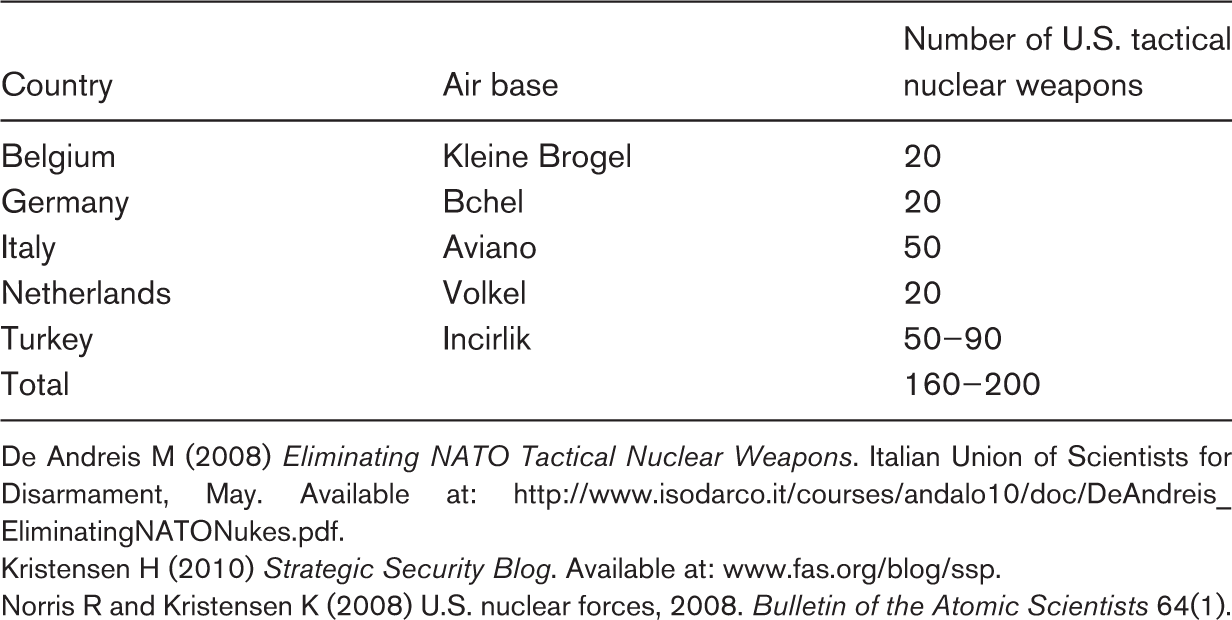
De Andreis M (2008) Eliminating NATO Tactical Nuclear Weapons. Italian Union of Scientists for Disarmament, May. Available at: http://www.isodarco.it/courses/andalo10/doc/DeAndreis_EliminatingNATONukes.pdf.
Kristensen H (2010) Strategic Security Blog. Available at: www.fas.org/blog/ssp.
Norris R and Kristensen K (2008) U.S. nuclear forces, 2008. Bulletin of the Atomic Scientists 64(1).
Of these five countries, only three—Belgium, Germany, and the Netherlands—are in charge of nuclear strike missions for their national air forces, through so-called dual-key arrangements. This means that in times of peace, the weapons remain under U.S. custody in the host nations. In times of war, the weapons can be transferred to the host nations, which then are supposed to use them. The other two states, Italy and Turkey—which together possess two-thirds of the U.S. nuclear weapons based in Europe—host airplanes and their respective nuclear weapons as part of the NATO nuclear burden-sharing program. The strike mission of the Turkish Air Force may be expired (Kristensen, 2005).
The overall size of the U.S. arsenal of operational tactical nuclear weapons is thought to be approximately 500, with another 800 presumed to be in the inactive stockpile. Russia possesses an estimated 2,500–5,500 tactical nuclear weapons. This number is gradually shrinking because of weapons attrition. These short-range systems do not have a well-defined role in Russian defense policy and can in principle rather easily be taken away without undermining Russian national interests (Pomper et al., 2009).
The debate on the withdrawal of American nuclear weapons in Europe
More experts and politicians—both active and retired—have joined the general public to voice their opinions on nuclear disarmament, nuclear deterrence, solidarity within NATO, security risks, and budgetary constraints.
Moving toward global zero
A fundamental shift in how nations view nuclear weapons is taking place, particularly in the United States. The underlying reason is that nuclear weapons are victim of their own perceived success. That is, more states want to imitate the nuclear weapon states, the result of which is a nuclear proliferated world. If Iran were to go nuclear, the Middle East would become a nuclear weapon zone instead of a much desired nuclear-weapon-free zone, as was articulated in an essential part of the final document at the May 2010 Nuclear Non-Proliferation Treaty (NPT) Review Conference. Other dominoes would fall as well: Saudi Arabia, Syria, and Egypt would likely acquire nuclear weapons. This process would make it easier for non-state actors, such as Al Qaeda, to acquire nuclear weapons. The only sustainable way to prevent proliferation is to delegitimize nuclear weapons, and finally to abolish them. Nuclear proliferation will be much harder in a nuclear-weapon-free world.
This refreshed abolitionism has reached the foreign policy establishment, and was echoed in Obama’s speech in Prague in April 2009, when he said, “So today, I state clearly and with conviction America’s commitment to seek the peace and security of a world without nuclear weapons” (White House, 2009). For the United States to truly follow through on this commitment, however, it would need to push for NATO’s new Strategic Concept (scheduled to be signed at the Lisbon Summit at the end of November 2010) to support the denuclearization of the alliance, starting with the immediate withdrawal of all U.S. nuclear weapons from Europe.
In their acclaimed Wall Street Journal op-ed published in 2007, former secretaries of state Henry Kissinger and George Shultz, former defense secretary William Perry, and former U.S. senator Sam Nunn (Democrat of Georgia) explicitly included the elimination of “short-range nuclear weapons designed to be forward-deployed” as a concrete step toward a nuclear-weapon-free world (Shultz et al., 2007). The withdrawal would constitute a symbolically meaningful act vis-à-vis the non-nuclear weapon states. These states argue that the practice of hosting foreign nuclear weapons conflicts with the spirit of the NPT, which forbids nuclear weapon states to transfer, directly or indirectly, nuclear weapons to other states, as well as forbids non-nuclear weapon states from receiving nuclear weapons from other states.
The United States is the only nuclear weapon state that deploys tactical nuclear weapons in other nations. If anything, continuing this practice could lead to imitation and increase the world’s nuclear dangers.
No justification for U.S. deterrence in Europe
By definition, atomic arms are weapons of mass destruction, and their use contradicts modern international humanitarian law. The effectiveness (and therefore credibility) of nuclear deterrence has always been questioned because of its disproportionate nature. Each day that nuclear weapons are not used, it becomes more difficult to imagine a day when they will be—and this only strengthens the nuclear taboo, the norm that says that it is immoral and illegitimate to use such destructive devices that do not discriminate between military and civilian targets (Tannenwald, 2007). Further, there is an alternative to nuclear weapons: deterrence with modern conventional weapons (MccGwire, 1994; Nitze, 1994).
As long as nuclear weapons in general are not outlawed, the NATO-extended nuclear deterrent will probably remain, at least temporarily, even if the U.S. nuclear weapons in Europe are removed. U.S. strategic nuclear weapons located in the United States can keep fulfilling this deterrent role. This is how the United States has “secured” its allies in Asia since U.S. tactical nuclear weapons were withdrawn from South Korea in the early 1990s. As former State Department and Pentagon official Wayne Merry asks: “If Japan and South Korea, in a much more challenging security environment, accept so-called ‘over the horizon’ American nuclear guarantees as sufficient for their security, why cannot Europeans?” (Merry, 2009).
With the enemy gone after the Cold War, the need for U.S. tactical nuclear weapons in Europe became obsolete. Today, Russia has neither the intention nor the capabilities to attack Europe. Though politics and history do little to assuage the insecurity felt by NATO member states in Eastern Europe, particularly in Poland and the Baltics, these states should be reassured by modern conventional means, including contingency plans and regular military exercises (Asmus et al., 2010). Even better would be to work toward improving relations with Russia, as NATO Secretary-General Anders Fogh Rasmussen has suggested. In the unlikely case that Russia would become an enemy again, the military use of the dual-capable aircraft (those that can be used for both conventional and nuclear tasks) is doubtful. These aircraft are not able to reach Russia or the Middle East, except if refueled. Even Gen. James Cartwright, the current U.S. vice-chairman of the Joint Chiefs of Staff, recently admitted that the U.S. tactical weapons don’t serve a military function not already addressed by other U.S. military assets (Council on Foreign Relations, 2010). Also, the U.S. European Command “no longer recognizes the political imperative of U.S. nuclear weapons within the alliance” (emphasis added) (Secretary of Defense Task Force on DoD Nuclear Weapons Management, 2008: 59). In 2009, German Foreign Minister Walter Steinmeier was less diplomatic, stating that these weapons “are absolutely senseless today” (Global Security Newswire, 2009a).
Some pundits claim that thanks to U.S. nuclear weapons in Europe, some of the host nations have agreed not to develop nuclear weapons themselves (Perry and Schlesinger, 2009). The most-cited states in this regard are Turkey and to a lesser extent Germany.
This argument is flawed. Despite U.S. extended deterrence, proliferation in Europe did happen. The U.S. nuclear umbrella did not prevent France from acquiring its own force de frappe. Germany, in contrast, is not allowed to go nuclear because of its constitution, which is grounded by the fact that German public opinion has always been very antinuclear. According to Harald Müller, director of the Peace Research Institute Frankfurt, “Any German government that sought to effect a change in the country’s nuclear status would risk public protest ranging all the way up to civil-war-style conditions compared to which the events surrounding the shifting of [civilian nuclear] containers would probably appear trivial” (Müller, 2000: 10).
It is also doubtful whether Turkey would go nuclear if the United States withdrew its nuclear weapons. The reason for Turkey to build nuclear weapons would be to counter Iran. The current Turkish government, however, seems to have better relations with Iran than with Israel (Kibaroglu, 2010). Turkey is, for instance, willing to host Iranian uranium as part of the May 2010 Brazilian-Turkish-Iranian deal. If Turkey really believes that possessing nuclear weapons is a vital national interest, it is extremely doubtful whether the presence of the remaining—and dwindling in number—U.S. nuclear weapons would make a difference in its calculation.
NATO solidarity and burden-sharing
Some proponents of tactical nuclear weapons still think the weapons are necessary for deterrence purposes; their argument is that U.S. nuclear weapons should stay in Europe because they are the link between the United States and Europe. An unnamed NATO diplomat warned: “The weapons are the foundation of that solidarity. Take them away and what have we left?” (Global Security Newswire, 2009b).
A few qualifications can be made. First, it’s hard to believe that the U.S.-European relationship depends more on the presence of U.S. nuclear weapons on European territory than it does on social, economic, financial, and historical ties. If the strength of NATO depends on the presence of the remaining U.S. nuclear weapons in Europe, it says a lot about the vitality of NATO. Second, other kinds of burden-sharing are imaginable. Even during the Cold War, not all NATO member states accepted tactical nuclear weapons within their borders—Spain and Norway are examples. Third, with limited defense budgets, NATO will make increased use of pooling and task specialization in the future. Would it not be logical if the United States, Britain, and France (NATO’s nuclear states) were to specialize in nuclear weapons inside NATO, and that the current host nations were to spend money on other tasks?
Security risks
Tactical nuclear weapons are more vulnerable to theft than strategic nuclear weapons. According to a blue ribbon review set up by the U.S. Air Force in 2008, most U.S. nuclear weapon storage sites in Europe did not meet Defense Department security standards (U.S. Air Force Blue Ribbon Review, 2008).
This is particularly worrisome in view of the existing terrorist threat. For example, in 2001 Belgium’s Kleine Brogel Air Base was on the target list of Nizar Trabelsi, a Belgium-based Tunisian Muslim extremist with ties to Al Qaeda (Sageman, 2009). In an effort to showcase the security vulnerability, in January 2010 peace activists climbed over the fence at Kleine Brogel and walked for more than one hour inside the base without meeting a soldier; they reached the bunkers and even visited the entrance of the base. Not only did they walk in, around, and out of the base with a video camera, but they also posted their video online (Global Security Newswire, 2010a; Sauer, 2010). 3 If peace activists are able to do that, there is no reason to believe that terrorists could not.
Costly to maintain
The United States spends $200 million a year per European air base to maintain its tactical nuclear weapons (Rabaey, 2008). An unnamed U.S. military official stated, “We pay a king’s ransom for these things and … they have no military value” (Secretary of Defense Task Force on DoD Nuclear Weapons Management, 2008: 59). In February 2004, the Defense Science Board, a team of appointed civilian experts who advise the Defense Department, recommended that the defense secretary “consider eliminating the nuclear role for Tomahawk cruise missiles and for forward-based, tactical, dual-capable aircraft” because “there is no obvious need for these systems, and eliminating the nuclear role would free resources that could be used to fund strategic strike programs of higher priority” (Meier, 2006).
The budgetary aspects are even more important for the European host nations that pay for owning and operating the dual-capable aircraft. This applies especially in these times of economic and financial crisis. Because of aging aircraft, many of the host nations must make decisions about buying a new fighter plane in the foreseeable future. The question is whether these new planes should be nuclear capable as well. This aging problem is most urgent in Germany, which recently opted for the Euro Fighter—which is not dual-capable—as the successor to the nuclear-capable Tornado (instead of the more expensive and dual-capable U.S. Joint Strike Fighter). In other words, when its Tornados are gone, Germany will have no planes that can deliver nuclear weapons in time of conflict. This is an additional reason for Berlin to ask for the withdrawal of the U.S. tactical nuclear weapons.
Political feasibility of withdrawal
Withdrawal is not only desirable for Europe, the United States, and the international community, but also politically feasible for both the United States and Europe. In principle, Washington is not against the withdrawal, and U.S. officials apparently have articulated this view to their European counterparts (Pomper et al., 2009). In Europe—both with the general public and the elite—there is a clear demand to withdraw U.S. tactical nuclear weapons. In Belgium, for instance, a 2007 poll showed that more than three-quarters of the population favor the withdrawal (Flemish Peace Institute, 2007). Protests are regular events at Kleine Brogel Air Base and often include Belgian members of parliament (including those from ruling parties); in 1999 even acting Flemish Minister for Culture Bert Anciaux made an appearance. As of July 2010, 352 mayors out of 589 in Belgium are active in the Mayors for Peace Movement; this includes Mayor Theo Kelchtermans of Peer, the town that hosts Kleine Brogel.
In July 2005, the Belgian senate adopted a resolution asking the Belgian government for the gradual withdrawal of the U.S. nuclear weapons. Imitating the bipartisan op-ed style used by Kissinger, Shultz, Perry, and Nunn, high-level former politicians from Germany, the Netherlands, Belgium, and Italy have written opinion articles in favor of nuclear elimination, including the withdrawal of tactical nuclear weapons from Europe (D’Alema et al., 2008; Claes et al., 2010; Lubbers et al., 2009; Schmidt et al., 2009).
Though the governments of the host nations have been much less active than their activists and parliaments, in October 2009 the German foreign minister, Guido Westerwelle, convinced Chancellor Angela Merkel to agree to the withdrawal. Westerwelle included a paragraph in the government agreement: “in the context of the talks on a new Strategic Concept for NATO we will advocate within NATO and towards our U.S. allies a withdrawal of remaining nuclear weapons from Germany.” This is the first time that a government of one of the host nations so clearly spoke out in favor of withdrawal. Westerwelle’s Belgian and Dutch counterparts reacted positively though cautiously, stating that a decision on withdrawal should be made by consensus within NATO.
Political practicalities of withdrawal
The desirability and feasibility of withdrawing U.S. tactical nuclear weapons from Europe notwithstanding, various practical questions must first be answered.
Negotiate agreement with Russia, or pursue unilaterally?
It might seem logical to include tactical weapons in formal negotiations with Russia. A major stumbling block, however, is the asymmetry of the stockpiles: In total, the U.S. arsenal of operational tactical nuclear weapons is thought to be approximately 1,300; Russia possesses an estimated 2,500–5,500 tactical nuclear weapons. Russia will therefore link the issue of tactical nuclear weapons to U.S. strategic nuclear weapons in reserve to a revision of the Treaty on Conventional Armed Forces in Europe, or to missile defense. Because of these linkages, negotiations for a treaty on tactical nuclear weapons will not be easy and may take a long time. 4 There is another asymmetry: The United States has nuclear weapons in other states, which is no longer the case for Russia. State Duma Committee on Foreign Affairs Chairman Konstantin Kosachev and Gen. Staff Chief Nikolai Makarov have already posited that the U.S. nuclear weapons should be withdrawn before talks about tactical nuclear weapons can be held (Global Security Newswire, 2010b, 2010c).
This leaves the option of a unilateral withdrawal of the U.S. nuclear weapons in Europe, with perhaps an attendant reciprocal Russian gesture shortly thereafter, for instance, moving its tactical nuclear weapons deeper into Russian territory. A unilateral withdrawal has the additional advantage that it does not need to be approved by the U.S. Senate, something that is not obvious since arms control became much more politicized in the United States after the mid-1990s. Even the U.S. European Command concluded, “There is no military downside to the unilateral withdrawal of nuclear weapons from Europe” (Secretary of Defense Task Force on DoD Nuclear Weapons Management, 2008: 59).
Complete removal, or interim steps?
Instead of removing all of the weapons, the United States could consolidate its tactical weapons at one or two of the existing bases, most likely in Italy or Turkey, as was proposed in a 2006 report (Larsen, 2006). But as an April 2010 paper published by the Royal United Services Institute in Britain argues, “If the three northern European countries [Germany, the Netherlands, and Belgium] were to withdraw from deploying nuclear-capable aircraft, the retention of Italy as the only [dual-capable aircraft] country would make little political or operational sense” (Chalmers and Lunn, 2010: 4). The paper therefore recommends that the weapons be withdrawn in one fell swoop.
Another interim step would be to keep the nuclear infrastructure—without the bombs—in Europe, as long as Russia has not reciprocated.
Symbolic compensation?
Politically, some argue that tactical weapons should be replaced with another symbol of what NATO’s Strategic Concept refers to as an “essential political and military link between the European and American members of the Alliance.” Missile defense is mentioned sometimes as a possible replacement symbol. Offensive weapons would be replaced by defensive weapons, something that would in principle be easier to sell to a skeptical public in Europe, although the Czech public was not happy about the idea of a shield in their country. The United States would need to co-finance the venture with the European NATO member states. The withdrawal of the U.S. nuclear weapons from Europe may be a quid pro quo. Obama’s Nuclear Posture Review (as well as NATO’s Expert Group) followed this line: “Contributions by non-nuclear systems to U.S. regional deterrence and reassurance goals will be preserved by avoiding limitations on missile defenses in New START” (Davis, 2010).
From a strategic point of view, however, missile defense is not a valid option. Current missile defense systems, apart from short-range systems like the Patriot, are technologically unable to perform as they should; they have, for instance, not been successfully tested under war-like conditions. This also applies to the missile defense interceptors that the Obama administration wants to install on Aegis ships around Europe and in states like Bulgaria and Romania (Lewis and Postol, 2010). Such a missile defense may further upset Russia. Because of these reasons, the withdrawal of U.S. nuclear weapons should not be compensated for with the introduction of U.S. missile defense in or around Europe.
NATO decision making—unilateral, or by consensus?
For 20 years, decision making by consensus was a recipe for inertia. If a consensus on the Strategic Concept cannot be reached during NATO’s Lisbon summit in November 2010, the European host nations can and should take unilateral measures. For example, the host nations can unilaterally de-certify the dual-capable aircraft by “the removal of all mechanical and electronic equipment” and “the denuclearization of facilities on national air bases intended for storage and maintenance of nuclear weapons” (Kristensen, 2005: 6–7).
The time is ripe to withdraw all U.S. tactical nuclear weapons from Europe. The political climate—with a U.S. president who is personally committed to reducing the nuclear weapons threat—is also ideal. The question is not if but rather how NATO is going to change its policy. If NATO is unable to have a serious internal debate on this issue, and if it is unable to adapt to a changing world and new nuclear norms, one can only wonder to what extent the Atlantic Alliance is a political—instead of purely military—organization.
Footnotes
1
Compare with the 14-kiloton Hiroshima bomb.
2
The number for Italy assumes that the 40 gravity bombs previously located in Ghedi-Torre have been moved out of the country.
3
The video is available at: www.youtube.com/watch?v=VHrZXMa7e3A&feature=related.
4
Even the final version of the report of the NATO Expert Group did not talk about “negotiations” (see NATO, 2010).
Author biography