



Abstract
This study interrogates the impacts of two major administrative control mechanisms—centralization and performance management—on the use of coping strategies and policy alienation among street-level bureaucrats. Using multiple imputed datasets from a survey distributed to homecare workers in Quebec, Canada, we build models that account for control mechanisms and resource constraints. Results suggest both that administrative centralization and performance management are strong predictors of the use of coping strategies and policy alienation and that the use of coping strategies also predicts policy alienation. This study contributes to better understanding the effects of control mechanisms on frontline workers.
Keywords
Introduction
Tensions between governments and public administrations are often discussed through the prism of discretion. Mainstream approaches to discretionary power build on the principal-agent model, where a person or a group vested with authority delegates power to agents that act on its behalf (Miller, 2005; Moe, 1984; Williamson, 1975). A common illustration of this model considers that bureaucrats’ (agents) interest is in maximizing their budgets whereas governments (principals) wish to contain public spending (Brouard, 2014, p. 524; Niskanen, 1971). Bureaucrats’ use of discretion is thereby seen as opportunistic, noncompliant, and disloyal (Döhler, 2018; Sobol, 2016). The street-level bureaucracy literature offers an alternative view. Street-level bureaucrats’ (SLBs’) work is paradoxical, as it involves both scripted procedures derived from policy and adaptations that emerge on a case-by-case basis (Lipsky, 2010, p. xii [1980]). In this context, discretion allows SLBs to determine the sort, quantity, and quality of sanctions and rewards to users during policy implementation (Jilke & Tummers, 2018, p. 227). Discretionary power granted to SLBs sometimes provides opportunities for discretion that extend beyond what is lawfully authorized (Brodkin, 2012, p. 942; Brodkin & Majmundar, 2010).
From the principals’ perspective, discretion is perceived as a threat rather than a prerequisite for achieving policy objectives (Jacobsson et al., 2020, p. 317). Public sector managers often suspect that without appropriate controls, agents will behave opportunistically and pursue their own priorities (Andrews, 2010, pp. 95–96). To secure organizational loyalty, principals use control mechanisms that are established prior to the act of delegation and that pertain to institutional design and administrative procedures (McCubbins et al., 1987; Sobol, 2016). One of these mechanisms is centralization, which is typical of “old” public administration. Centralization operates as a control mechanism by concentrating authority and restricting decision-making in the hands of a few upper-level managers (Jiang et al., 2022, p. 462). By “[p]roviding firm direction and goals and establishing clear lines of hierarchical authority,” centralization may circumvent the potential for SLBs to use discretion as a tool to make independent decisions (R. Andrews et al., 2007, pp. 59–60). Agents’ choices are thus constrained by procedural accountability.
Under “new” public management (NPM), a doctrine that reforms public administration using private sector approaches and methods to increase productivity, effectiveness, and efficiency (Bezes, 2009), performance accountability has emerged as another means for control (Wanna, 2015, p. 8). The NPM turn promised broader agency to frontline workers by shifting management focus away from procedural compliance to target-based management, with less oversight over the means to achieve those targets (Osborne & Gaebler, 1993). In practice, SLBs usually do not benefit from greater agency because they often are constrained by performance monitoring tools (Diefenbach, 2009). Performance management is indeed one of the predominant features of NPM, and is claimed to be indispensable to modernizing public sector organizations (Bouckaert & Peters, 2002, p. 359; Siverbo et al., 2019, p. 1801). Performance is evaluated with regards to outputs, outcomes, efficiency, and effectiveness at various levels of organizations, typically based on quantitative measures. Workloads are fragmented into a series of discrete tasks, thereby applying precepts of Taylorism to service delivery (Johnson et al., 2012). Governments’ performance measures are translated into micro performance indicators “on the lower levels of organizations, departments, and individual workers” (Trappenburg et al., 2022, p. 2024). Overall, performance management reduces SLBs’ discretion by increasing their accountability to managers, peers, and users (Hupe & Hill, 2007) and by monitoring selected tasks rather than broader public service goals.
Extant literature suggests that these control mechanisms have adverse effects on agents’ behavior by increasing the use of coping mechanisms; that is, strategies that agents develop to deal with stress and difficulties and to control, reduce, or tolerate contradictory demands or demands that exceed the resources available to meet them (Brodkin, 2011; Potipiroon, 2022; Riccucci, 2005). These control mechanisms are also detrimental to agents’ morale by fueling policy alienation (Tammelin & Mänttäri-van der Kuip, 2022; L. Tummers et al., 2009). Agents experience policy alienation, a feeling of disconnect from the policy that is being implemented, when they perceive they have limited influence over implementation (powerlessness) or believe that the policy fails to contribute to societal goals or individual well-being (meaninglessness; Tucker et al., 2022; L. Tummers et al., 2009). This has significant impacts on policy, since the use of coping strategies can lead to policy distortions (Brodkin, 2011; Jacobsson et al., 2020, p. 318; Prior & Barnes, 2011) policy alienation, conflicts over roles, and moral distress, in turn curtailing loyalty (Pauly et al., 2012; L. Tummers et al., 2009).
Here, we investigate the relationship between ex-ante control mechanisms and the outcomes of powerless and meaninglessness. In doing so, we engage in debates about the “third phase” of frontline policy implementation. The first phase corresponds to Lipsky’s view that SLBs work toward broadly defined tasks with ample discretion (Trappenburg et al., 2022, pp. 2023–2024). The second phase was a significant departure from these principles, as the shift toward NPM brought about increasing specialization and dwindling discretion for SLBs. The more recent third phase combines the broader tasks and discretion associated with the first phase and the tighter budgets and governmental control over expenditures typical of the second phase (Trappenburg et al., 2022). In this context, principals may use both centralization and performance targets to constrain the actions of agents, which in turn may drive the use of coping mechanisms and policy alienation. This study contributes to SLB scholarship by reflecting on alternative accountability regimes that address the tension between externally imposed goals and professional autonomy (Jakobsen et al., 2018).
The analysis focuses on the “old” public administration control mechanism of centralization and the “new” public management mechanism of performance targets and examines their effects on the use of coping strategies and policy alienation. Based on a case study of the 2015 healthcare reform in Quebec, Canada, we answer the following research questions: Do centralization and performance targets drive the use of coping strategies? Do they generate policy alienation among SLBs? Relying on an original survey of homecare workers, we also measure the impact of other plausible variables, such as caseload, resource insufficiency, and organizational instability (structural variables), professional field and educational level (professional variables), and experience in homecare and geographical area (sociodemographic variables). Results from statistical analyses suggest that variables related to control mechanisms are the strongest predictors of the use of coping strategies and policy alienation. We observe that coping strategies also act as key predictors of policy alienation.
Discussion proceeds as follows. We first review the literature on the relationships among control mechanisms, the use of coping strategies, and policy alienation. Next, we discuss the 2015 healthcare reform in Quebec, this study’s data, how variables were operationalized, and our empirical strategy. We then present models predicting coping strategies and policy alienation. We end by exploring what our results mean for the study of SLBs and policy implementation.
Coping and Policy Alienation under Centralization and Performance Management
The use of coping strategies is constitutive of SLBs’ work, as they regularly face inadequacies between resources and users’ needs as well as contradictory demands from the government, managers, and users (Lipsky, 2010). Coping refers to “behavioral efforts frontline workers employ when interacting with clients, in order to master, tolerate, or reduce external and internal demands and conflicts they face on an everyday basis” (L. Tummers, Bekkers, Van Thiel, & Steijn, 2015, p. 1100). Beyond this behavioral definition, coping in services delivery also has a policy dimension, as SLBs use these strategies to ensure that policies work in practice for beneficiaries despite their inadequacies in design (Brodkin, 2011; Riccucci, 2005).
At least since 2010, scholars refined the concept of coping strategies and broke it down into different categories. L. Tummers, Bekkers, Van Thiel, and Steijn (2015) distinguish between three families of coping: (1) “moving toward clients,” in which coping is used to users’ benefit through rule bending, instrumental action, and prioritizing; (2) “moving away from clients,” in which coping is employed to artificially reduce demands by routinizing or rationing access to SLBs’ time and support; and (3) “moving against clients,” in which coping involves “being inflexible, or even hostile, [and] rigidly administering and enforcing rules” (Bell & Smith, 2022, pp. 172–173). These categories of coping focus on the relationship between SLBs and users, while others emphasize SLBs themselves or their organization. Lavee (2021), for instance, points to (4) informal personal resources used by SLBs to cope with the “doing more with less” doctrine of NPM. SLBs provide resources that “are not part of their formal duties, or formal resources provided in informal ways. These resources include the investment of workers’ own energy, time, money, and the like to help clients” (Lavee, 2021, p. 6). A final form of coping involves (5) gaming and manipulation strategies, where SLBs navigate control mechanisms to gain advantages and rewards (Siverbo et al., 2019, p. 1804). Gaming and manipulation strategies are more likely to be used when SLBs do not identify with externally imposed objectives (L. G. Tummers & Van de Walle, 2012) or when the incentives to perform are strong (Jakobsen et al., 2018, p. 130; Kerpershoek et al., 2016). In this study, we examine all five families of coping.
Previous research suggests that top-down efforts to control SLBs’ discretion can paradoxically lead to increased frontline reliance on coping strategies. This would especially be the case when control mechanisms seek to require SLBs to do more with less or to impose unrealistic or unfair targets rather than reprioritizing responsibilities when goals change (Blackman et al., 2015, p. 98). This can fuel a perpetual state where SLBs face “too many accountabilities” and “too many masters” (Lavee, 2021, p. 16), and in which they have poor control over resources while bearing the responsibility of making policies work (Brodkin, 2011, p. 254). In a work environment characterized by concurrent objectives, insufficient resources, and lack of time, centralized bureaucratic controls may lead SLBs to “devote disproportionate time to finding ways to by-pass established decision-making procedures, thereby damaging internal and external accountability” (R. Andrews et al., 2007, pp. 59–60). Coping strategies can indeed be used by SLBs as a way to reconcile the demand for loyalty to the principals’ objectives, the users’ needs, and their professional ethic. Several studies underline that professional SLBs are particularly reticent about control mechanisms that overlook the complexity of their tasks, their professional knowledge, and their autonomy (Cecchini & Harrits, 2022; Jacobsson et al., 2020; Jakobsen et al., 2018). Here, professional SLBs refer to what Mintzberg (1979) calls “professional bureaucrats”; that is, to public servants with strong professional socialization and identity, acquired through an educational and “on-the-job training, the possession of standardized and complex skills and knowledge and a high level of control over their own work” (Mavrot, 2023, p. 489). We expect SLBs to use coping strategies to a greater extent when they perceive centralization and performance management control mechanisms as stronger.
Professional SLBs would be particularly prone to policy alienation under control mechanisms that deny their professional skills and the autonomy necessary to carry out implementation and service delivery. Operating under increasing centralization of control over resources and strict performance monitoring leads to reduced worker autonomy (Dahl et al., 2012; Trappenburg et al., 2022, p. 2024) and to tensions both with what they perceive as “good” work (Jacobsson et al., 2020) and with their professional standards (L. Tummers et al., 2009, p. 686). This can lead SLBs to feeling constrained and disempowered (Moynihan & Soss, 2014). In healthcare, education, or social services, performance control focusing on standardized and quantifiable tasks can seem antagonistic to the essence of care work (Timmermans & Almening, 2009) as caregiver-patient relationships, contextualized interventions, and service responsiveness all constitute central elements of the meaning healthcare professionals attribute to their work (Fitzgerald, 2004; Gonin et al., 2013). In that context, performance indicators can be viewed as dehumanizing and may generate ethical suffering and loss of professional belonging (Barbe & Bourque, 2019; Benoit et al., 2022). Even partisans of NPM recognize the downfalls of performance management, which has “the possibility of demoralizing personnel and having organizations focus on minutiae rather than the fundamental goals of their organizations” (Bouckaert & Peters, 2002, pp. 361–362). The same goes for centralization and inflexible rules that limit SLBs’ initiative and may lead to absenteeism, turnover, lower productivity, and job dissatisfaction more broadly (Andrews, 2010, pp. 95–96).
These phenomena are identified with various concepts such as moral distress (Weinberg, 2009), performance anxiety (Blackman et al., 2015, p. 79) and negative attitudes related to job tension, conflict, frustration, and resistance (Merchant & Van der Stede, 2017, cited in Siverbo et al., 2019, p. 1804). In this article, we prefer the concept of policy alienation, which refers to a “general cognitive state of psychological disconnection from the policy program being implemented, here by a public professional who regularly interacts directly with clients” (L. Tummers et al., 2009, p. 686). The ep concept focuses on professionals in the public sector whose tasks are related to policy implementation and public service norms (Tammelin & Mänttäri-van der Kuip, 2022, p. 23). Policy alienation is operationalized around two main dimensions. First, powerlessness refers to just how much influence professionals have on the overall unfolding of programs. Second, meaninglessness refers to the SLBs’ perception concerning the added value of the policy to socially relevant goals or to the individual users in front of them (L. Tummers, 2012, p. 518). Both dimensions are reflected in our survey, and we expect SLBs to experience more policy alienation when they perceive the control mechanisms, centralization and performance targets, to be stronger.
Finally, although coping strategies are usually analyzed as outcomes, we explore their role as predictors of policy alienation. We argue that SLBs’ use of coping is not necessarily interpreted as a means to maximize their personal interests in an opportunistic way. Rather, workers use coping to deal with their tasks, either because they face heavy workloads or because they need to balance conflicting pressures from managers, users, policies as well as professional ethics (Lavee, 2021; Lipsky, 2010; Maynard-Moody & Musheno, 2003; Potipiroon, 2022; Tammelin & Mänttäri-van der Kuip, 2022; L. Tummers, Bekkers, Vink, & Musheno, 2015; Vedung, 2015). The use of coping in no way guarantees that challenges in implementation will be overcome (powerlessness); nor does it ensure that public goods will be effectively delivered to citizens (meaninglessness). We thus hypothesize that the use of coping strategies results in greater policy alienation, as both the powerlessness and meaninglessness dimensions of alienation can be fueled by coping strategies.
Research Setting and Methods
This study focuses on homecare workers in Quebec, Canada, in the context of the 2015 reform. This reform embodies the third phase of public service by combining elements of “old” and “new” public administration, especially centralization and performance management. Canada is typically classified as a liberal welfare regime, but Quebec historically relied more strongly on public institutions for welfare provision (Gagnon, 2013). Even so, the province did not escape NPM-driven restructuring of its public services. Since the 1990s, budgetary restrictions and reforms have been frequent, and healthcare has been a primary target (Bourque, 2007). The objectives of the 2015 healthcare reform were to increase efficiency and limit waste (Larivière, 2018), and led to a reduction in resources and to regionalization. Many local service delivery points were closed in favor of large, integrated regional hospitals, and mid-level manager positions were abolished in favor of administrative centralization (Quesnel-Vallée & Carter, 2018). It also led to substantial reorganization of work within the system (Grenier & Bourque, 2016; Grenier et al., 2018). In many services such as homecare, new methods of performance management were implemented (Perron, 2019).
Data
This research builds on original data from an online survey administered to homecare workers in Quebec from November 19th, 2019, to February 28th, 2020; that is, before the COVID-19 pandemic. Survey questions were informed by 25 semi-structured interviews with homecare workers in three different administrative regions of Quebec conducted in 2018 to 2019. These interviews allowed us to develop questions that built on SLBs’ own language and work context, thus contributing to the internal validity of the study. All participants in the survey are professional homecare workers and thus hold a postsecondary degree and act in conformity with their field (i.e., social work, nursing, occupational therapy). These professionals are SLBs, since they directly face users and have a high degree of discretion in service provision. Local health and community service centers (CLSC) require that these professionals act as case managers, by assessing users’ needs and determining which services they are entitled to.
The questionnaire was hosted on Lime Survey and distributed by two professional associations associated with homecare workers. 1 It comprised 54 questions and took an average of 26 minutes to complete. A total of 1,586 responses were recorded. We set a completion threshold of 50%, or 5 out of 10 sections of the survey. After having applied thiscriterion, the final sample had 697 responses. Table 1 summarizes the responses to five mandatory questions, which are used as sociodemographic variables in this study.
Sample Characteristics.
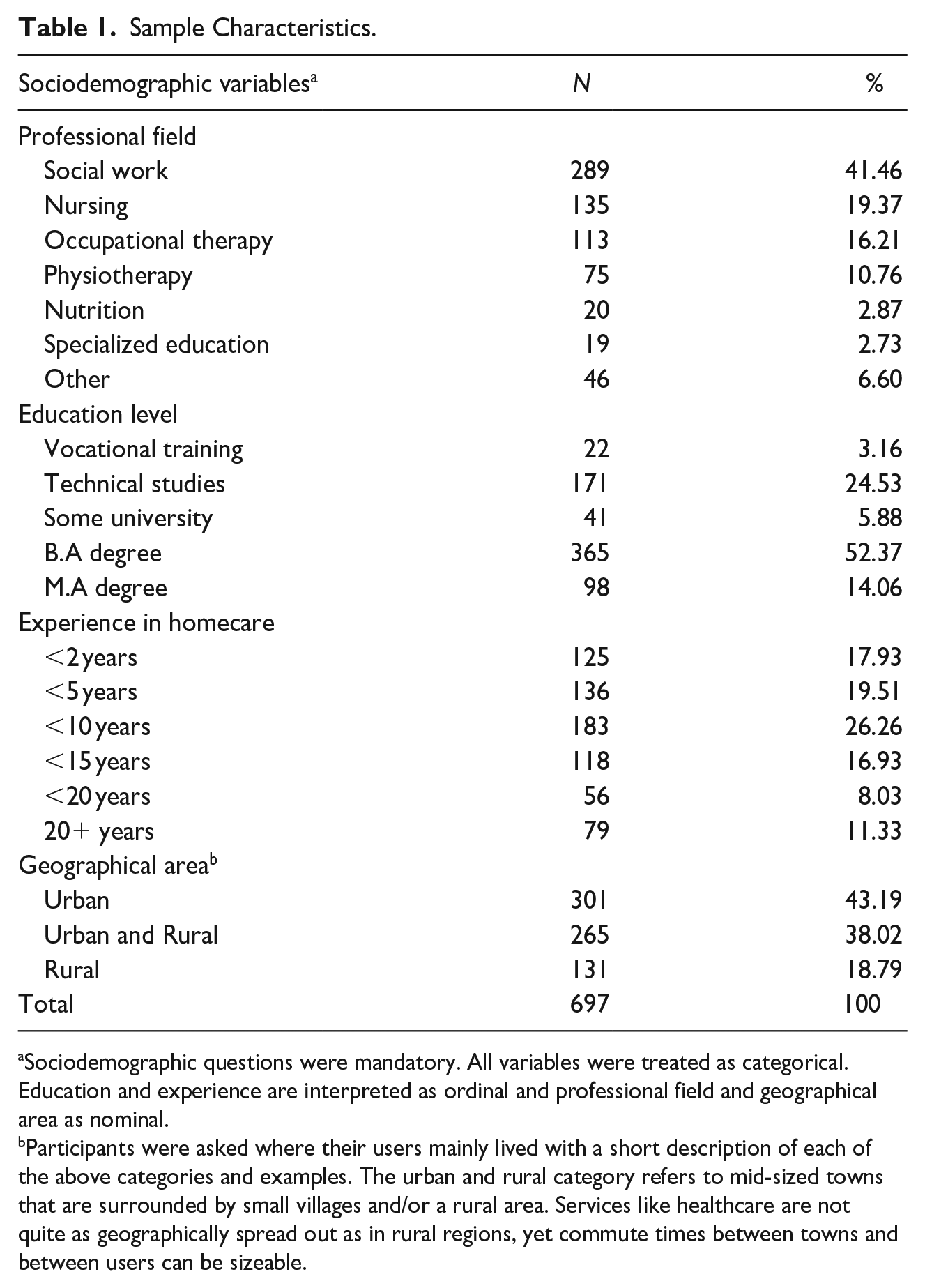
Sociodemographic questions were mandatory. All variables were treated as categorical. Education and experience are interpreted as ordinal and professional field and geographical area as nominal.
Participants were asked where their users mainly lived with a short description of each of the above categories and examples. The urban and rural category refers to mid-sized towns that are surrounded by small villages and/or a rural area. Services like healthcare are not quite as geographically spread out as in rural regions, yet commute times between towns and between users can be sizeable.
Outcomes
The use of coping strategies and policy alienation are the outcome variables. To measure coping, respondents were asked to report their use of a series of coping strategies. A 5-point categorical scale was used, where “never” was the lower bound (=1) and “everyday” was the upper bound (=5). The coping strategies in the survey were drawn from semi-structured interview data, allowing us to capture strategies that may be case-specific. These strategies reflect the distinct coping types documented in previous literature: moving toward clients (strategy 1); moving away from clients (strategies 2–6); moving against clients (strategies 7–8); informal personal resources use (strategies 9–11); and gaming and manipulation strategies (strategies 12–13). The strategies of interest appear in Table 2. 2
Use of Coping Strategies by Surveyed Homecare Workers.
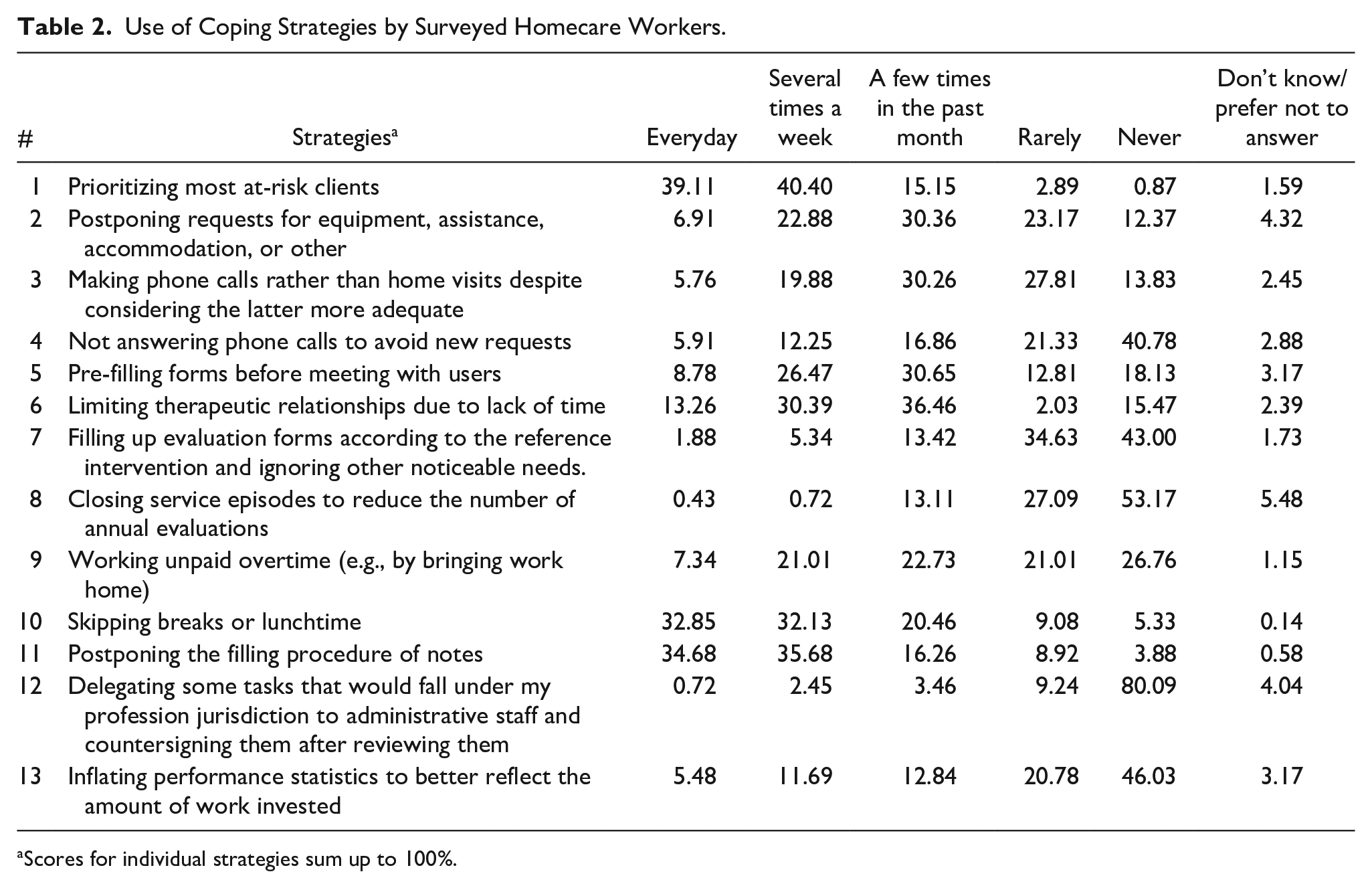
Scores for individual strategies sum up to 100%.
To measure coping beyond the use of each individual strategy, all 13 variables were scaled into one outcome variable, ranging from 13 to 65. The mean of this scale is 34.98 (standard deviation = 7.11). To assess its internal reliability, a Cronbach’s alpha was computed with the original dataset. Although Cronbach’s alpha is not a perfect measure of scale reliability, it remains a valuable tool for testing the statistical reliability of indicators that are believed to be linked to each other (see De Sante, 2011). Values above .7 are generally indicative of good internal reliability. For the scale of use of coping strategies, the Cronbach’s alpha is .75. To facilitate interpretation of statistical analyses, this variable was standardized around the mean (mean = 0, s.d. = 1).
Five prompts in the survey were used to measure policy alienation, encompassing both dimensions of the concept (L. Tummers, 2012): policy meaninglessness (prompts 1–3) and policy powerlessness (prompts 4–5). The prompts are as follows:
“I feel more like an administrative technician than a nurse, social worker, etc.”
“What is measured [with performance evaluation tools] does not reflect what I do.”
“I feel like we are now more accountable to the government than to the needs of the elderly.”
“[User evaluation] tools are more and more designed to think for us.”
“We have to fight constantly to defend the cause of users. All that for services that existed before.”
For each prompt, respondents indicated whether it corresponds to their work reality on a scale from 1 (“does not correspond”) to 5 (“absolutely corresponds”). Furthermore, respondents were asked the following: “Overall, are you satisfied with your job?”. They indicated their level of satisfaction on a scale from 1 (“very satisfied”) to 5 (“not satisfied at all”). These six questions were scaled into one outcome variable ranging from 6 to 30 (mean= 22.36, s.d. = 4.83). The Cronbach’s alpha for the scale of perceived policy alienation is .81. The policy alienation variable was standardized around the mean.
Predictors
Administrative centralization, reaching performance targets, and resource-based factors are the study’s predictors. First, an indicator of administrative centralization was constructed using responses to the three following prompts that specifically address the impacts of the 2015 reform:
Since the merger of 2015, there is increased organizational hierarchy and increased difficulty to access to managers
Since the merger of 2015, increased policies and procedures are adding to the workload and access to services
Since the merger of 2015, centralization of material resources and waiting lists management no longer allow an adaptation to local realities
Participants were asked to indicate the degree to which the descriptions in those prompts were present in their work (with responses from 1 [“does not correspond”)] to 5 [“absolutely corresponds”]. This scale ranged from 3 to 15, and its mean value is 12.72 (s.d. = 2.38). The Cronbach’s alpha of the scale is .71. As is the case for the outcome variables, the administrative centralization variable was standardized around the mean.
Second, to measure the extent to which participants reach their performance targets, the following question was asked: Usually, do you reach [your] performance targets? Participants were asked to answer to one of the following: (1) I never or nearly never do, (2) I rarely do, (3) I do on a regular basis, (4) I do most of the time. The mean is 2.41 (s.d. = .98).
Third, we measured the impact of resource-based factors. Participants were asked to estimate their caseload (i.e., the number of users under their responsibility). The mean caseload is 45 users (σ = 21.93). Participants also were asked to estimate the share of their time they dedicated to direct intervention (%). The mean time for intervention is 25.80% of total work time (s.d.= 13.78%). Caseload and time for intervention were both standardized in analyses. Moreover, two prompts about budgets tapped their perceived sense of resource insufficiency and instability: (1) Budget are insufficient to meet needs; (2) Budget are unstable, as hours are at times added but cut at others. Participants were asked to indicate their degree to which these situations were present in their organization from 1 (“not present at all”) to 5 (“very present”). Descriptive statistics appear in Table 3.
Descriptive Statistics.
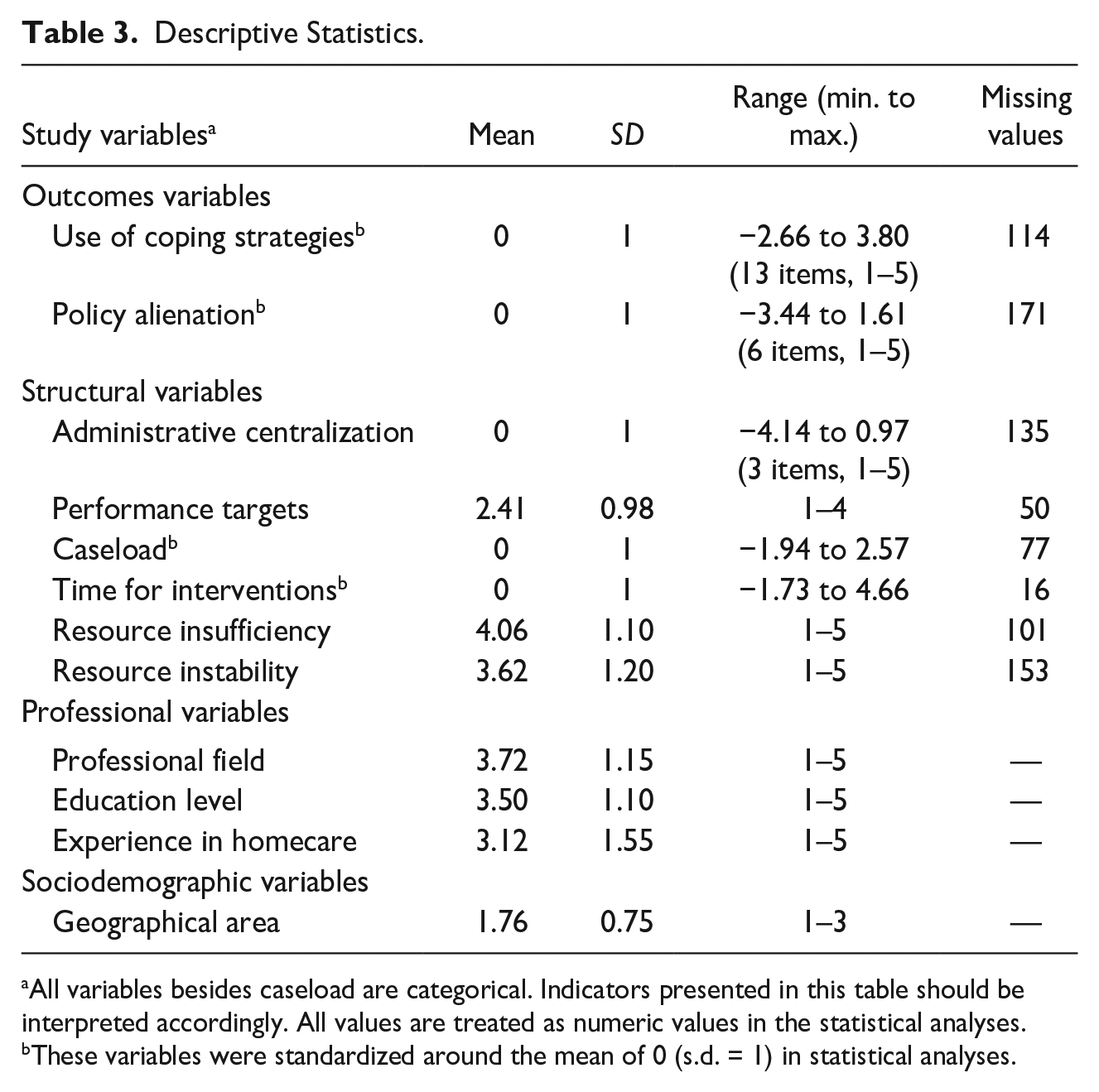
All variables besides caseload are categorical. Indicators presented in this table should be interpreted accordingly. All values are treated as numeric values in the statistical analyses.
These variables were standardized around the mean of 0 (s.d. = 1) in statistical analyses.
Empirical Strategy
To predict the use of coping strategies and policy alienation, the analysis estimates Gaussian models within a Bayesian framework. The model for the coping strategies used is specified as follows:
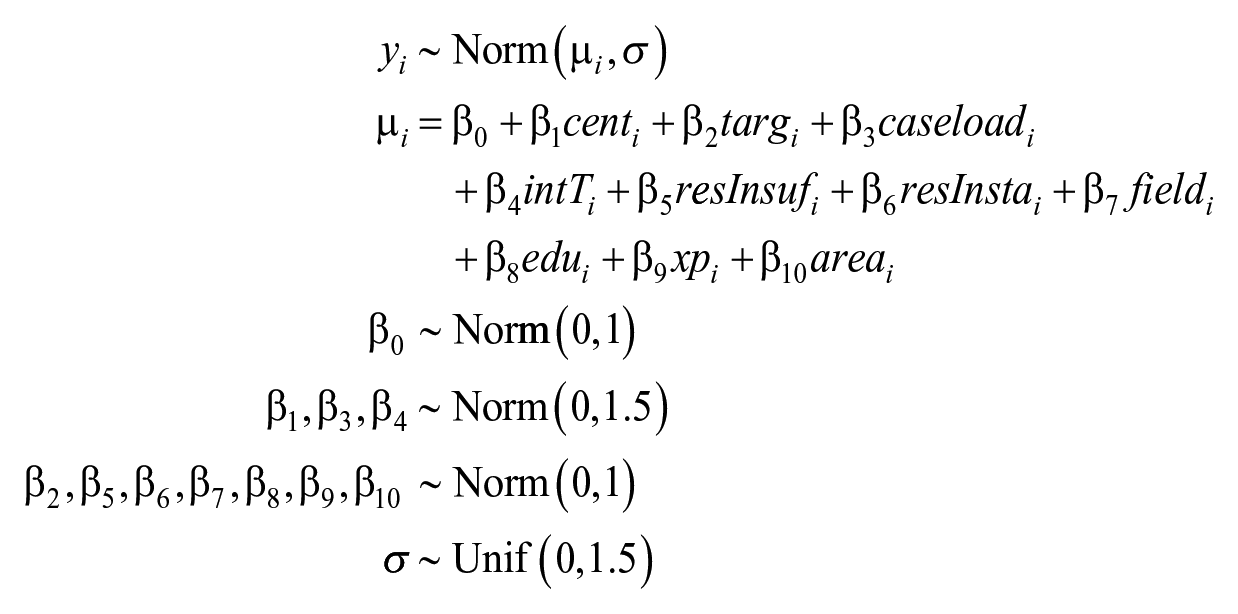
Where administrative centralization is cent, reaching of performance targets is targ, number of users under responsibility is caseload, time spent on intervention with users is intT, perceived resource insufficiency is resInsuf, perceived resource instability is resInsta, field of work is field, education level is edu, professional experience in homecare is xp, and geographical area of work is area. The linear model for policy alienation is specified as follows:
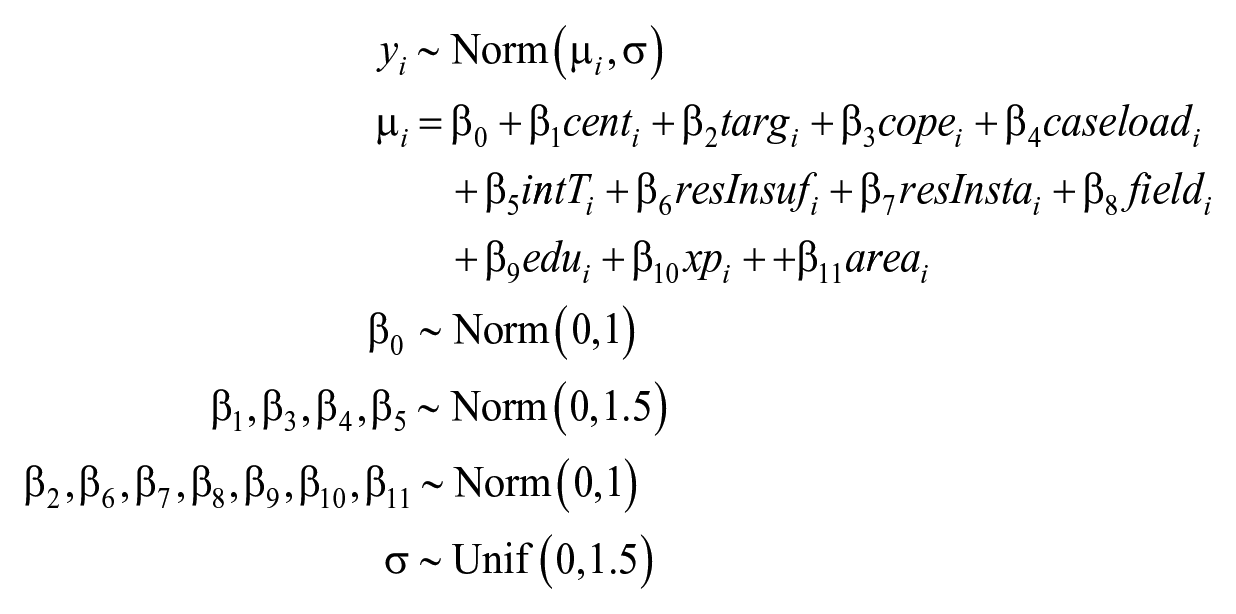
Where administrative centralization is cent, reaching of performance targets is targ, use of coping strategies is cope, number of users under responsibility is caseload, time spent on intervention with users is intT, perceived resource insufficiency is resInsuf, perceived resource instability is resInsta, field of work is field, education level is edu, professional experience in homecare is xp, and geographical area of work is area. In both specified models, unrestrictive priors were used to allow variation in the outcome of the analyses. Models were estimated using the “brms” package in R (Bürkner, 2017, 2018, 2021).
The original dataset included many missing values (see Table 3). To treat missing values, we produced twenty imputed datasets with multiple imputations by chained equations (mice) using the “mice” package in R (van Buuren & Groothuis-Oudshoorn, 2011). 3 These imputed datasets were used in the main statistical analyses. For every model, robustness tests were performed with the non-imputed dataset. After comparing estimates with and without imputations, the effect on coefficients was negligeable, ranging from –.07 to .03. In only three occurrences—all for models predicting coping strategies—was there a change in direction between the estimate with mice and the estimate with the original dataset. Results of the robustness tests are in the Supplement.
Results
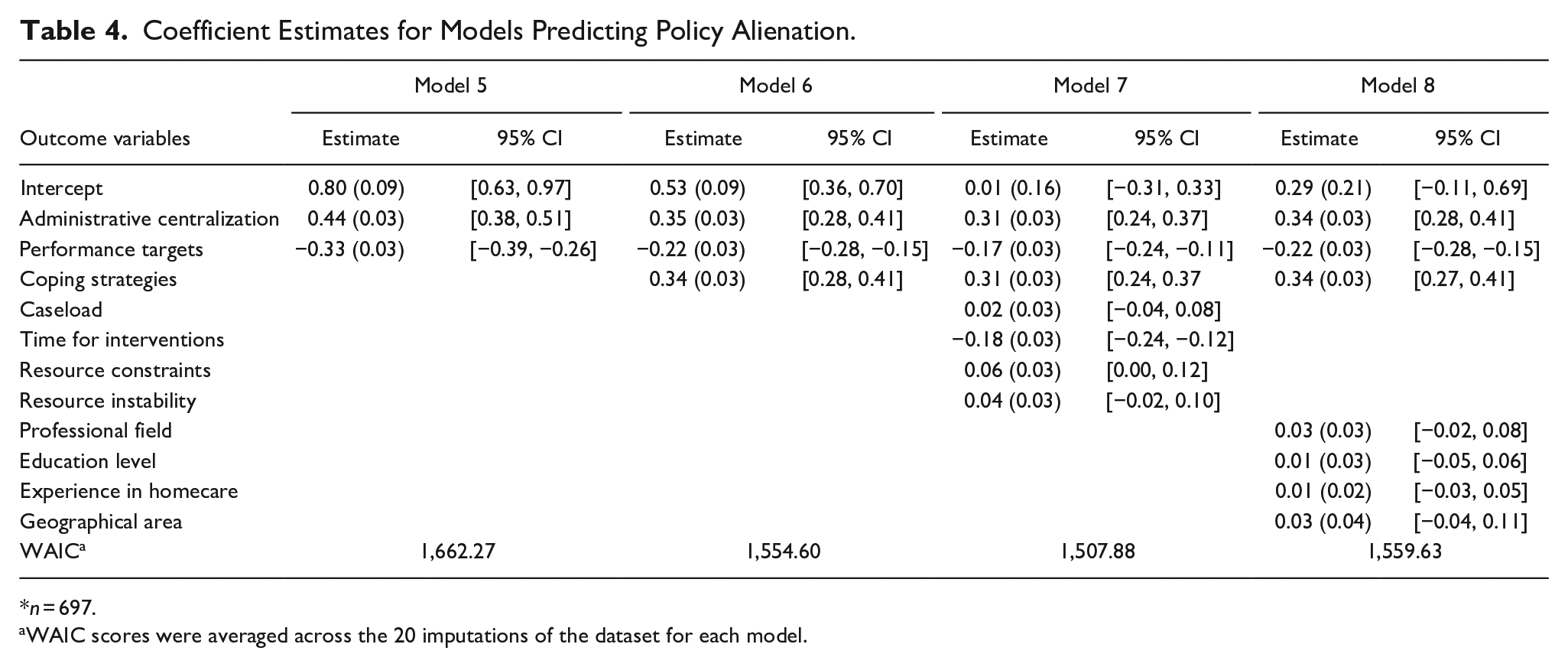
The results of the models used to predict the use of coping strategies and policy alienation appear in Tables 3 and 4. Estimates, estimation errors (in parentheses), and credible intervals (CI) at the 95th percentile (in brackets) are reported. To compare model fit, the Widely Applicable Information Criterion (WAIC) score is an indicator of model deviance. 4
Coefficient Estimates for Models Predicting Policy Alienation.
n = 697.
WAIC scores were averaged across the 20 imputations of the dataset for each model.
Use of Coping Strategies
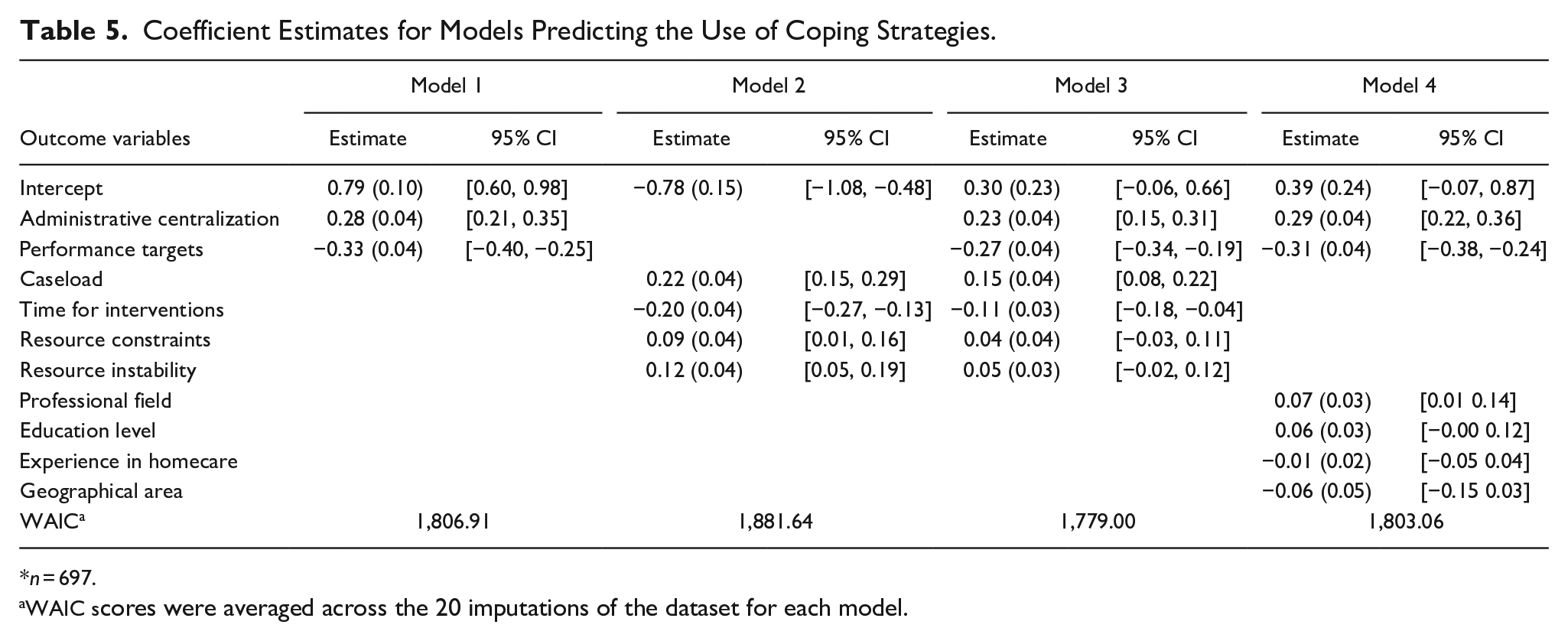
Coefficient estimates for models predicting the use of coping strategies are displayed in Table 5. In Model 1, administrative centralization and reaching performance targets are the predictors. In Model 2, caseload, time spent on interventions, resource insufficiency, and resource instability are used. In Model 3, predictors from Models 1 and 2 are combined. Model 4 adds sociodemographic variables to Model 1.
Coefficient Estimates for Models Predicting the Use of Coping Strategies.
n = 697.
WAIC scores were averaged across the 20 imputations of the dataset for each model.
WAIC scores suggest that the best fit is found in Model 3, which combines all explanatory variables. Yet, this gain in fit is made at the expense of parsimony. If parsimony is a key criterion, Model 1—which uses only two predictors instead of seven— is more appropriate. In Model 4, predictors from Model 1 are paired with sociodemographic variables, which are used as controls. As the WAIC scores suggest, this leads to a marginal gain in model fit and only slightly alters estimates from the predictor variables. Overall, this strengthens confidence in the explanatory power of Model 1.
Across models, there is a positive association between administrative centralization and the use of coping strategies, and a negative association between reaching performance targets and the use of coping strategies. In Model 1, for every standard deviation increment, use of coping strategies shifts from a fourth to a third of a standard deviation (0.28, 95% CI [0.21, 0.35]). Nominally, this corresponds to a 0.85 increase on the 52-item coping strategies scale for every 1-point increase on the administrative centralization scale. 5 Moreover, a 1-point categorical increase in the answer to the question on reaching performance targets (1 = never or almost never reaches performance targets, 4 = does most of the time) yields an approximate 0.33 (95% CI [0.40, 0.25]) standard deviation decrease in coping strategies, or around a one point decrease on the scale. In Models 3 and 4, which respectively control these predictors for other explanatory variables and sociodemographic variables, their effect remains strong. In Model 3, a 1-SD shift in administrative centralization is related to an approximate 0.23 (95% CI [0.15, 0.31]) SD increase in use of coping strategies, and a parallel increase in performance targets yields an approximate 0.27 (95% CI [0.34, 0.19]) decrease in coping strategies. In Model 4, a 1-SD increase in administrative centralization leads to an approximate 0.29 (95% CI [0.22, 0.36]) SD increase in use of coping strategies, and an equal increase in performance targets yields an approximate 0.31 (95% CI [0.38, 0.24]) SD decrease in coping strategies. The moderating effect of other variables on administrative centralization and reaching performance target thus appears to be narrow.
Policy Alienation
Coefficient estimates for models predicting policy alienation are displayed in Table 4. In Model 5, administrative centralization and reaching performance targets are the predictors. In Model 6, use of coping strategies is added as a predictor. In Model 7, caseload, time spent on interventions, resource insufficiency, and resource instability are added. In Model 8, sociodemographic variables are added to Model 6.
The gain in fit realized from Models 5 to 6 is sizeable, suggesting that the use of coping strategies is a key predictor of policy alienation. WAIC scores indicate that Model 7 is the best fit to the data. Then again, the gain in fit realized compared to Model 6—which uses four fewer parameters—is marginal. That is even truer of Model 8, which yields a weaker fit despite including four more predictors. With parsimony in mind, Model 6 provides the best overall fit.
Every model has positive associations between policy alienation and both administrative centralization and use of coping strategies. Meanwhile, a negative association appears between policy alienation and reaching performance targets. In Model 6, for every 1-SD increment in administrative centralization, policy alienation increases by an approximately a third of a SD (0.35 95% CI [0.28, 0.41]). Nominally, this corresponds to a ratio of around 0.70 point for every point increase on the administrative centralization scale. For every 1-SD increase in reaching performance targets, there is a fifth to a fourth SD decrease in policy alienation (0.22 95% CI [0.28, 0.15], or about a 1-point increment). Finally, for every 1-SD increase on the scale of coping strategies, policy alienation increases by about a third of a SD (0.34 95% CI [0.28, 0.41]), which roughly corresponds to a 0.23-point increase for every increment on the coping strategies scale. Given its large range (13–65, i.e., 52 possible values), the latter predictor is especially crucial.
Figures 1 and 2 display visualizations of the presented models presented using the “bayesplot” package in R (Gabry et al., 2019). In all models where they are accounted for, the CIs for the estimates of administrative centralization and performance targets clearly are different from zero. In models 6 and 8 predicting policy alienation, the CIs of the estimates for the use of coping strategies also clearly differ from zero. For other predictors, results are mixed.
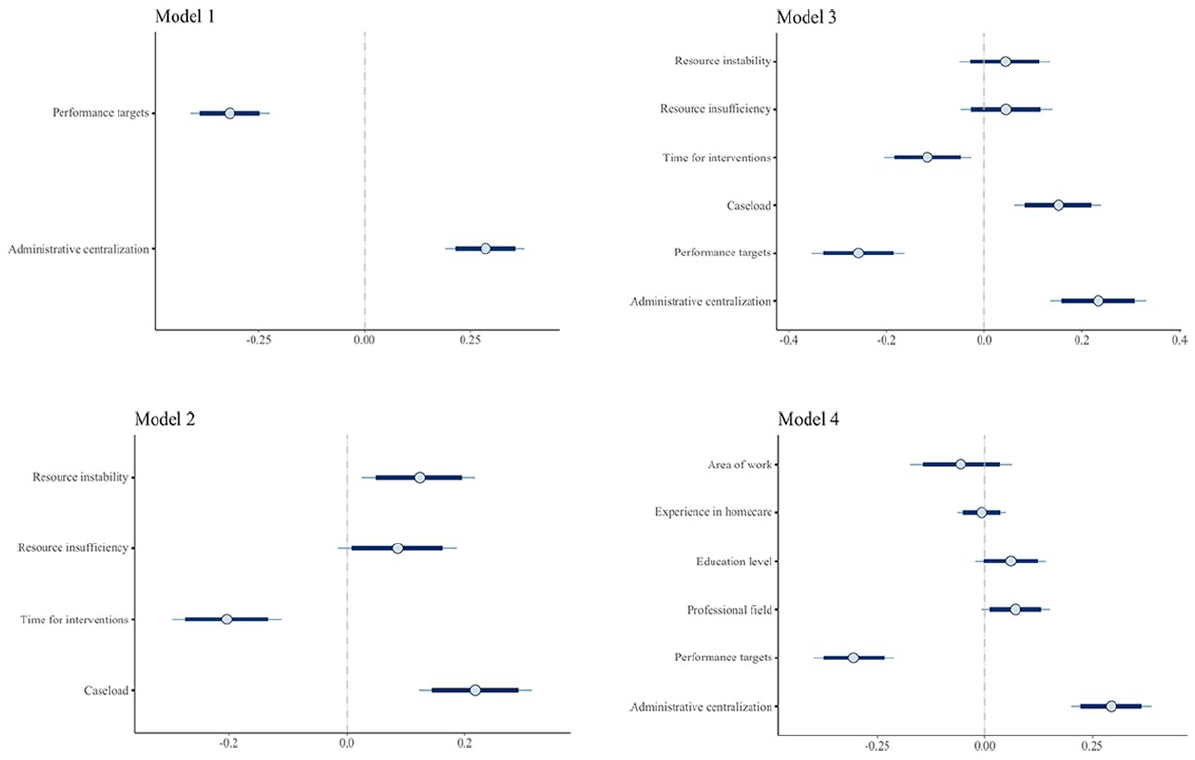
Visualization of models predicting the use of coping strategies.
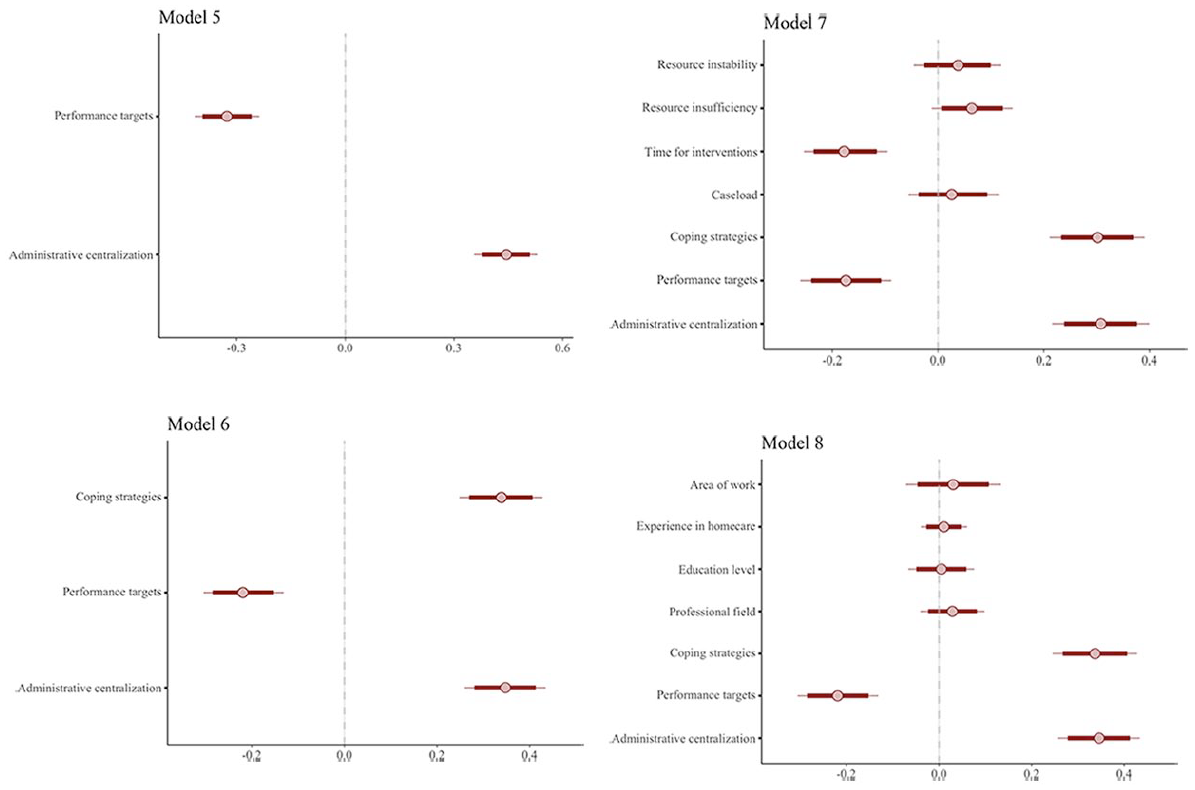
Visualization of models predicting policy alienation.
In models with competing covariates, caseload, time for interventions, resource insufficiency, and resource instability often overlap with zero, suggesting considerable uncertainty over posited effects. The same is true of sociodemographic variables in all but one case (see professional field, model 4).
Discussion and Conclusion
This study examined what drives the use of coping strategies and policy alienation among SLBs. Our analyses suggest that performance management and administrative centralization are strongly associated with those outcomes. Increases in perceived administrative centralization were related to increases in the use of coping strategies. This association testifies to a decreasing ability to adapt to needs or a growing inability to recognize problems to be solved at the local level. In turn, this may lead to an increasing implementation gap to be borne by workers. In Quebec, administrative centralization following the 2015 reform indeed is thought to have hindered the ability of healthcare to meet evolving demand (Grenier & Bourque, 2016; Larivière, 2018). At the same time, administrative centralization was positively associated with policy alienation. A potential mechanism underlying this relationship is that greater centralization may foster an overall decrease in worker agency. In more decentralized settings, workers may have more voice over their work conditions or greater autonomy over means for delivering healthcare. In contrast, greater centralization of service administration may lead to feelings that their professional judgement is being challenged by central administrators who are not necessarily aware of the realities of frontline work. The 2015 healthcare reform in Quebec led to a stricter division of labor between the administrative dimensions of homecare and its delivery on the frontline. Combined with more stringent performance targets and a new systematized tool for assessing user needs (Perron, 2019), the 2015 reform may well have contributed to the introduction of Taylorist principles in homecare. Meanwhile, frontline workers are qualified professionals, with both prior training and relevant field experience. In our sample, more than two-thirds of participants had college degrees, and all had job-specific training. The discrepancy between what they know and what they can act upon following administrative centralization may contribute to policy alienation.
The more a respondent reached their performance targets, the less they were inclined to report using coping strategies. One potential mechanism related to this association is that among the impetuses for turning to coping strategies is the necessity to reach performance targets in the first place. Respondents struggling to reach performance targets would be more likely to use coping strategies. One indicator that such an explanation is reasonable is that the association holds in Model 3, where we control for resource-based factors (caseload, time spent on intervention, resource insufficiency, and instability). This could mean that coping strategies are used to meet performance expectations just as much as to meet beneficiaries’ needs. Reaching performance targets also was negatively correlated with policy alienation. That is, respondents who reached their targets were less likely to feel devalued than those who did not. Given their organizations’ emphasis on performance targets, reaching them may have become an end in itself. Overall, performance targets may pressureSLBs and negatively impact their work and well-being. As Blackman et al. (2015, p. 98) show in their study of Australian public service, performance management is largely perceived as a pejorative term, focusing on underperformance and creating anxiety among bureaucrats that may emerge “from measuring or focusing on the wrong things; overfocusing on what can be measured rather than developing alternative metrics to encourage desired outcomes.” In this context, performance management can create an incentive for workers to direct efforts toward measured dimensions of their work over users’ needs (Brodkin, 2011).
The use of coping strategies was an important predictor of policy alienation. This should come as no surprise given that many coping strategies are means through which workers circumvent procedures (e.g., pre-filling forms before meeting users), restrain time-consuming tasks (e.g., limiting therapeutic relationships due to lack of time), or impede their well-being (e.g., skipping breaks or lunchtime). Many coping strategies contravene norms of professional integrity and others may conflict with expectations and aspirations that homecare workers had prior to starting their job. Overall, coping strategies negatively affect frontline workers’ well-being. The puzzling matter is that none of the coping strategies are overt management expectations. Rather, they are workers’ voluntary commitments that contribute to policy alienation. The micro-level pathways through which SLBs may use their agency to act against their well-being should be investigated further.
For both outcome variables, the resource-based factors were mixed. When used as the only predictors (Model 2), the direction of their effect differed from zero: increases in caseload, perceived resource insufficiency and instability were all associated with an increase in the use of coping strategies, while increases in the time spent on intervention was associated with decreased use. For models that included other parameters (Models 3 and 7), however, the effect of these predictors often weakened, and their CI most often overlapped with zero. It should not be understood that these parameters do not affect workers’ reality. Data from the 25 semi-structured interviews conducted prior to the survey suggested that unmanageable caseloads create significant pressure on SLBs. Interview data also indicated that resource instability brought uncertainty and made long-term goal setting difficult for homecare organizations. The results of this study should be appraised accordingly: rather than discarding these predictors, one should consider the mediating effect of the 2015 reform and its consequences in increasing caseload, decreasing intervention time, and increasing resource insufficiency and instability. For instance, administrative centralization may have hampered the ability of homecare services to adapt to local needs. In turn, this may have contributed to frontline workers’ greater perceived resource insufficiency and instability.
For both outcomes, the inclusion of sociodemographic variables produced minimal gain in explanatory power. The narrow effect of professional field, education, experience, and geographic area may suggest that the associations are distributed uniformly across the homecare worker population in Quebec. This is an important finding, for despite important variation in these characteristics, this study suggests that the weight of adverse outcomes of reforms is borne relatively equally by workers. This in turn reiterates the structural nature of the pressures of NPM reforms.
Limitations
There are several limitations to this study. First, the main limit of our data stems from common source bias (CSB), in which the measurement of both independent and dependent variables in the same perception-based survey may lead to overestimating model effects (George & Pandey, 2017) . Although the use of internally validated scales as both predictors and outcomes limits the impact of any individual item on results, this bias cannot completely be avoided in a mono-methodological work. Second, the dataset is limited to a small sample (n = 697), which also contained a relatively high amount of missing data. Despite careful model design and appropriate statistical tests, the limitations inherent to the dataset prevents from one from deriving definitive conclusions about the study population, let alone for other contexts. Third, the survey included a built-in desirability bias. In the hope of investigating tacit work realities in homecare, many questions explicitly referred to unethical practices. For example, participants were asked if “Inflating statistics to better reflect the amount of work invested” was a coping strategy that they used. This is habit would without a doubt be sanctioned by management. For many questions such as this one, its undesirable character could have led to underestimate the importance of some predictors. Fourth, there may be an induced selection bias in the data, although its direction is unclear. On the one hand, homecare workers who are the most dissatisfied with their work may be the most likely to answer the survey as a means of voicing their grievances. On the other hand, workers who are the most overwhelmed at work may have been less likely to have time to answer the survey. Both scenarios are plausible, and both may have influenced the composition of the sample and the nature of the responses. Last, this study is based on self-reported and subjective data. Data on indicators of structural or organizational realities, such as administrative centralization or resource constraints, are influenced by perceptions that may be inaccurate. The results of this study are likely influenced by the position of SLBs in the healthcare system in Quebec. Objective or official measures at the organizational level could enhance the reliability of future studies using this type of data.
Beyond Control Mechanisms: A Professional Accountability Regime
SLBs’ discretion remains a source of tensions between governments and administrations. Contemporary governments seek to shrink welfare budgets in the name of fiscal responsibility (Wanna, 2015) and to increase public sector performance through a “doing more with less” doctrine. According to the principal-agent model, SLBs will be unwilling to follow these objectives, considering they entail reducing the quantity and quality of services to users. In this context, principals seek to impose external control mechanisms to constrain bureaucrats’ loyalty.
This study’s results contribute to questioning the relevance of these controls. As the use of coping strategies increase under stronger controls, there is a risk of having the illusion of control while monitoring systems are “becoming dysfunctional, technically weak (with low validity and reliability), and having low legitimacy” (Bouckaert & Peters, 2002, p. 361). At the same time, as control mechanisms can fuel policy alienation, there is a risk of policy feedback effects. Once policies are enacted, they may reshape state organization and the interests and resources of actors involved in policy processes, thereby affecting subsequent policymaking (Béland & Schlager, 2019; Pierson, 1993). Since the use of control mechanisms can drive policy alienation, they thus may have crucial effects on subsequent public service delivery. Indeed, policy alienation may lead to less effort by workers, a decrease in their psychological wellbeing, enhanced feelings of working “a bullshit job,” greater reluctance to implement policies, and more widespread desire to quit (Belanger et al., 2024; Tucker et al., 2022; L. Tummers, Bekkers, Van Thiel, & Steijn, 2015; Usman et al., 2020). As the demand for health and social workers is projected to increase sharply, job attractiveness, recruitment, and labor retention become priorities to avoid worker shortages and increasing unmet needs (Organisation for Economic Co-operation and Development, 2023, p. 174). This highlights the potential negative feedback effect of control mechanisms in welfare states. Widespread burnout, use of sick leave, and the exodus of care workers (from the public sector or even their profession) can lead to a hollowing out of the welfare state from within (Benoit & Marier, 2024). This observation aligns with Jacobs and Weaver’s (2015) concept of self-undermining forms of policy feedback, which gradually alter state ability to conduct and implement public policy. In sum, costs associated with imposing tighter control mechanisms on motivated yet potentially resentful bureaucrats may outweigh those of letting them adapt to changing political and managerial objectives through discretion (Andrews, 2010, pp. 95–96).
Considering the unintended and sometimes dysfunctional effects of control mechanisms (Kerpershoek et al., 2016) as well as the strong political demand for monitoring bureaucrats (Jakobsen et al., 2018), it is necessary to examine alternative accountability regimes that go beyond “old” and “new” control mechanisms. Jakobsen et al. (2018) suggest a professional accountability regime that acknowledges the judgment and expertise of professionals. Shifting from externally imposed controls to a regime based on internally derived learning performance would allow bureaucrats to formulate goals and set targets that reflect their professional norms. It would likely increase both SLBs’ identification with policy objectives—and hence their loyalty toward them—and their substantive autonomy in day-to-day public services delivery (Jakobsen et al., 2018, p. 137). Acknowledging and building on the professional ethos and expertise of SLBs instead of trying to control them could serve as a leadership tool for frontline managers (Cecchini & Harrits, 2022, p. 13). In this context, performance management could play a role in organizational learning and motivation by setting goals, delineating needs, and highlighting successes (Blackman et al., 2015, p. 79; Siverbo et al., 2019, p. 1801).
Supplemental Material
sj-docx-1-aas-10.1177_00953997251317523 – Supplemental material for Coping Strategies and Policy Alienation Under Centralization and Performance Management: Evidence From a Survey of Quebec Homecare Workers
Supplemental material, sj-docx-1-aas-10.1177_00953997251317523 for Coping Strategies and Policy Alienation Under Centralization and Performance Management: Evidence From a Survey of Quebec Homecare Workers by Gabriel V. Lévesque and Maude Benoit in Administration & Society
Footnotes
Acknowledgements
The authors would like to thank Léonie Perron for her great contribution to earlier steps of this project. They would also like to thank all Quebec homecare workers who, by participating in this study, contributed to a better understanding of their work realities.
Data Availability Statement
Data sharing not applicable to this article as no datasets were generated or analyzed during the current study.
Declaration of Conflicting Interests
The author(s) declared no potential conflicts of interest with respect to the research, authorship, and/or publication of this article.
Funding
The author(s) disclosed receipt of the following financial support for the research, authorship, and/or publication of this article: This research was funded by the Fonds de recherche du Québec—Société et culture (FRQSC), Grant #2019-NP-254013.
Ethical Approval
This research has been approved by the Université du Québec à Montréal’s Research Ethics Board, #1281_e_2019.

Supplemental Material
Supplemental material for this article is available online.
Notes
Author Biographies
References
Supplementary Material
Please find the following supplemental material available below.
For Open Access articles published under a Creative Commons License, all supplemental material carries the same license as the article it is associated with.
For non-Open Access articles published, all supplemental material carries a non-exclusive license, and permission requests for re-use of supplemental material or any part of supplemental material shall be sent directly to the copyright owner as specified in the copyright notice associated with the article.
