



Abstract
More than 400 publicly funded schools in Ontario, Canada, permanently closed between 2011 and 2017. This study examines the impact of highly criticized closure decisions on trust, guided by the OECD competence-values framework for citizens’ trust in public institutions. Interviews with key informants reveal factors affecting trust, including timing and format of public consultations, reliability of data informing closure recommendations, silencing of community concerns, timeliness of government coordination, asset management horizons, and system-wide approaches to planning. This study underscores the need for an alternative school-closure decision-making model for Ontario.
Introduction
To maintain public trust and confidence, government and its ministries need to show that they are transparent in decision-making, and that they act fairly in the interests of all Ontarians. Not only do the people of Ontario care about what is done, they equally care about how things are done (Office of the Auditor General of Ontario, 2023)
Overview
Between 2011 and 2017, over 400 publicly funded schools were permanently closed in Ontario, Canada (Collins et al., 2023). The decisions surrounding these closures were often highly contested and divisive (Irwin & Seasons, 2012; Leger et al., 2023), despite provisions for public consultation in the decision-making process guidelines (Ontario Ministry of Education, 2006, 2009, 2015, 2018). Critics argued that the decisions were pre-determined, sought to advance hidden (often political) agendas, and lacked authentic participation (Basu, 2004; Irwin & Seasons, 2012; Johns & MacLellan, 2020; Ontario Ministry of Education, 2018). In response to the public’s frustration and resentment, the Government of Ontario declared a moratorium on school closures in order to amend the decision-making guidelines; the pause has remained in effect since June 2017 (Aguilar, 2024).
Public institutions, like public school systems, establish their legitimacy by fostering confidence and trust among the public. Institutional trust — “a judgement that, even in the absence of ongoing scrutiny or enforcement by citizens, a [public] institution will act in a way that is broadly consistent with those citizens’ interests” (Seyd, 2015) — has fluctuated over time in North America (Dalton, 2017). Recently, however, Canada has experienced a period of relatively low institutional trust, a trend that has coincided with rising levels of income inequality and political polarization in North America (Dalton, 2017; Kumagai & Iorio, 2020; Levack, 2022). For instance, a national public opinion survey conducted in 2023 found that only 45% of Canadians reported high confidence in the public education system (Statistics Canada, 2024). Against this backdrop, this study critically examines the trust implications of the Government of Ontario’s public school closure decision-making process. Drawing from institutional theory (Newton & Norris, 2000) and the OECD competence-values framework for citizens’ trust in public institutions (OECD, 2017), this article reports on a diverse group of key informants’ first-hand experiences with the school closure decision-making process in Ontario. The findings of this research provide critical insights into how public trust can be enhanced through changes to the school closure decision-making processes at the local level and policies at the provincial level.
Public Schools as Community Assets
Public schools are multidimensional assets to the communities they serve. Above and beyond providing essential education to children and youth, schools affect social, cultural, health, and economic outcomes in communities (Diamond & Freudenberg, 2016; Leger et al., 2023; Mishra & Close, 2020; Vincent, 2006). They support community cohesion by offering a regular meeting place for socialization and recreation (Klinenberg, 2018). Their presence in neighborhoods and proximity to homes has been associated with reduced loneliness (Marquez et al., 2023) and greater social connection (Freeman, 2010), while serving as sites of meaningful encounters among diverse populations (Piekut & Valentine, 2017). Outside of school hours, they enhance opportunities for all nearby residents to engage in physical activity by providing access to greenspace and play equipment (Hunter et al., 2022). School grounds and gardens cultivate a sense of place, interconnectedness, and inclusivity (Hauk et al., 2018), while also serving as sites for important social service delivery such as healthy breakfast programs and nutritional counseling (Critch, 2020; Home and Community Care Support Services, 2023). Accessibility to other critical health services like nursing and referrals is facilitated through schools, in addition to social amenities like childcare and libraries (Diamond & Freudenberg, 2016; Home and Community Care Support Services, 2023). Finally, the presence of schools in communities stimulates business that promotes community growth (Gollom, 2017), and their existence signifies to residents that their community is worthy of investment (Garnett, 2014). The enduring presence of local public schools, often over multiple generations, fosters trust and faith in the public institutions that bear responsibility for these assets.
Over the past few decades, hundreds of public schools in Ontario—Canada’s most populated province—have closed due to declining enrolments, aging infrastructure, and pressure to balance budgets (Collins et al., 2023; Johns & MacLellan, 2020). Research by Collins et al. (2023) found that a disproportionate number of public school closures have occurred in small and mid-sized cities, rural communities, and in communities facing higher levels of social and material deprivation (see [INSPQ, 2024] for more details about the deprivation index). Since school closures have material implications for students and the communities that the schools previously served (Barber et al., 2024; Collins et al., 2019; Leger et al., 2023), the current process runs the risk of perpetuating inequities in education, health, and wellbeing. More insidiously, school boards’ decisions to close schools can signal to residents that their community does not warrant public investment, thereby violating the public’s trust in the institutions responsible for managing these assets (Bierbaum et al., 2023).
Public School Boards as Asset Managers
An important factor when considering school closures is the structure of governance over these assets. Education in Ontario is a provincial responsibility, regulated by the Education Act (Ontario Ministry of Education, 2022). Resources for Ontario’s public schools are administered through regionally based school boards that are responsible for managing school assets and the personnel who deliver education (Ontario Ministry of Education, 2022). A single school board may need to collaborate with several municipal governments because municipal and school board district boundaries often are not contiguous and because school board boundaries typically are larger than those of counties and townships (Global Genealogy, 2023; Ontario Public School Boards’ Association, 2021). School boards are governed by democratically elected trustees, who are responsible for representing the interests of their constituents in decision-making and maintaining the school board’s accountability to the public. Trustees base their decisions on advice provided by school board staff on all matters, including the management of school assets. According to the Act, however, only trustees have the power to vote on decisions (Ontario Ministry of Education, 2022). In other words, school board administrators and trustees have distinct yet interrelated roles and responsibilities to meet the educational needs of communities (Payler et al., 2023). This can lead to tension as trustees are simultaneously expected to represent the interests of their locally elected constituents, while implementing the directives of school board staff (Hill et al., 2002; Payler et al., 2023). The relationship between politics and administration has long been debated not only in the education sector, but across government and is a central theme in public administration writing (Demir, 1993; Overeem, 2021). To the authors’ knowledge, research in this area has not considered the implications of this complex and dynamic relationship in the context of school closure decision-making.
Decisions by board trustees to close schools in Ontario have been guided by the Pupil Accommodation Review (PAR) guidelines developed by the Ministry of Education (Ontario Ministry of Education, 2006, 2009, 2015, 2018). The PAR guidelines “provide a framework of minimum standards for school boards to undertake pupil accommodation reviews to determine the future of a school” (Ontario Ministry of Education, 2015). The guidelines stipulate key considerations for school boards when producing staff reports for closure recommendations; the role, membership, and terms of reference for accommodation review committees; requirements for consultation with local governments and members of the public; and the role of school board trustees in final school closure decisions. Detailed timelines also are provided for the accommodation review process, including a minimum of 40 business days between the first and final public meetings (Ontario Ministry of Education, 2015).
The guiding principles and values underpinning school closure guidelines have changed between iterations. Previously, guidelines emphasized the value of schools to student wellbeing and academic success as well as the importance of schools to the financial viability of school boards (Ontario Ministry of Education, 2006, 2009, 2015, 2018). However, in 2015, there was a notable shift in the principles applied to decisions when, in an attempt to speed up the process, considerations of schools as valuable assets to the local community and local economy were omitted from decision-making guidelines. These omissions led to considerable public outcry about the decision-making process, particularly from rural communities across the province (Gollom, 2017; Thompson, 2016, 2018), which triggered the provincial government’s moratorium on any new PAR processes. The PAR guidelines were revised in 2018 with provisions for additional public meetings, extended timeframes, and consideration of elementary student input (Naidoo-Harris et al., 2018). Not long after the publication of these updated guidelines, however, a new government took power in Ontario and has since signaled little interest in revisiting the school closures issue. As of 2024, the moratorium on school closures remains in place while the Ministry of Education works to develop templates and guidelines to assist boards in conducting clear and consistent PAR processes (Jones, 2023; Naidoo-Harris et al., 2018).
Knowledge Gaps, Conceptual Framework, and Study Objective
Existing research on school closures in Canada has focused both on shortcomings of the decision-making process and on the material consequences of closures for students and residents (Butler et al., 2019; Fredua-Kwarteng, 2005; Irwin & Seasons, 2012; Leger et al., 2023). One study reported high levels of distrust toward public institutions following school closures (Leger et al., 2023), but the mechanisms that compromised the closure decision-making process were not analyzed.
This research was conducted through the lens of institutional trust theory, which focuses on the performance of institutions, both in terms of processes and outcomes, as viewed by citizens (Brezzi et al., 2021; Newton & Norris, 2000). This theory views trust as evolving through life experiences (e.g., interactions with public figures and institutions) and contrasts with cultural trust theory, which suggests that trust is established early in life and remains stable (Fairbrother et al., 2022; Inglehart, 2020). Research in Canada by Boulianne (2019) and in Finland by Grönlund et al (2010) found that deliberative events contribute to institutional trust by increasing citizens’ knowledge of political issues and empathy for the need to compromise in order to reach a democratic consensus. Further institutional trust theorists have acknowledged that key determinants of trust include governments’ capacity to deliver on their mandates (i.e., competencies) as well as the principles by which they govern (i.e., values) (Bouckaert, 2012; OECD, 2017; Seyd, 2015). Our research on public trust and school closures provides evidence that stakeholders’ involvement in the PAR process indeed impacts citizens’ trust in public institutions, and thus aligns more with institutional theory rather than cultural.
In analyzing institutional trust, we adopted the OECD competence-values framework for citizens’ trust in public institutions (Table 1) because it incorporates many constructs that scholarship recognizes as important drivers of trust in public institutions (Devos et al., 2002; Mangion & Frendo, 2022; OECD, 2017). In particular, the framework highlights competencies such as responsiveness and reliability, and values such as openness, integrity, and fairness (OECD, 2017). However, there has been debate in the literature about which competencies and values are most relevant to the conceptual framework (Mangion & Frendo, 2022). For example, in their recent literature review Mangion and Frendo (2022) noted that responsiveness, integrity, and openness were less influential drivers of citizens’ trust than fairness and reliability. Their review found that the most influential drivers of trust were consistency, transparency, and competence (Mangion & Frendo, 2022). Similarly, the Devos et al. (2002) definition of institutional trust also included competence, responsibility, and reliability but added benevolence. Although the concept of benevolence implies goodwill, it can also refer to the performance of an institution in terms of good process (e.g., openness, integrity, and fairness). Given the overlap and similarities between the literature and the OECD framework, we have adopted the latter to help illuminate how and why public trust was affected by the institutional PAR process.
OECD Competence-Values Framework for Citizens’ Trust in Public Institutions.
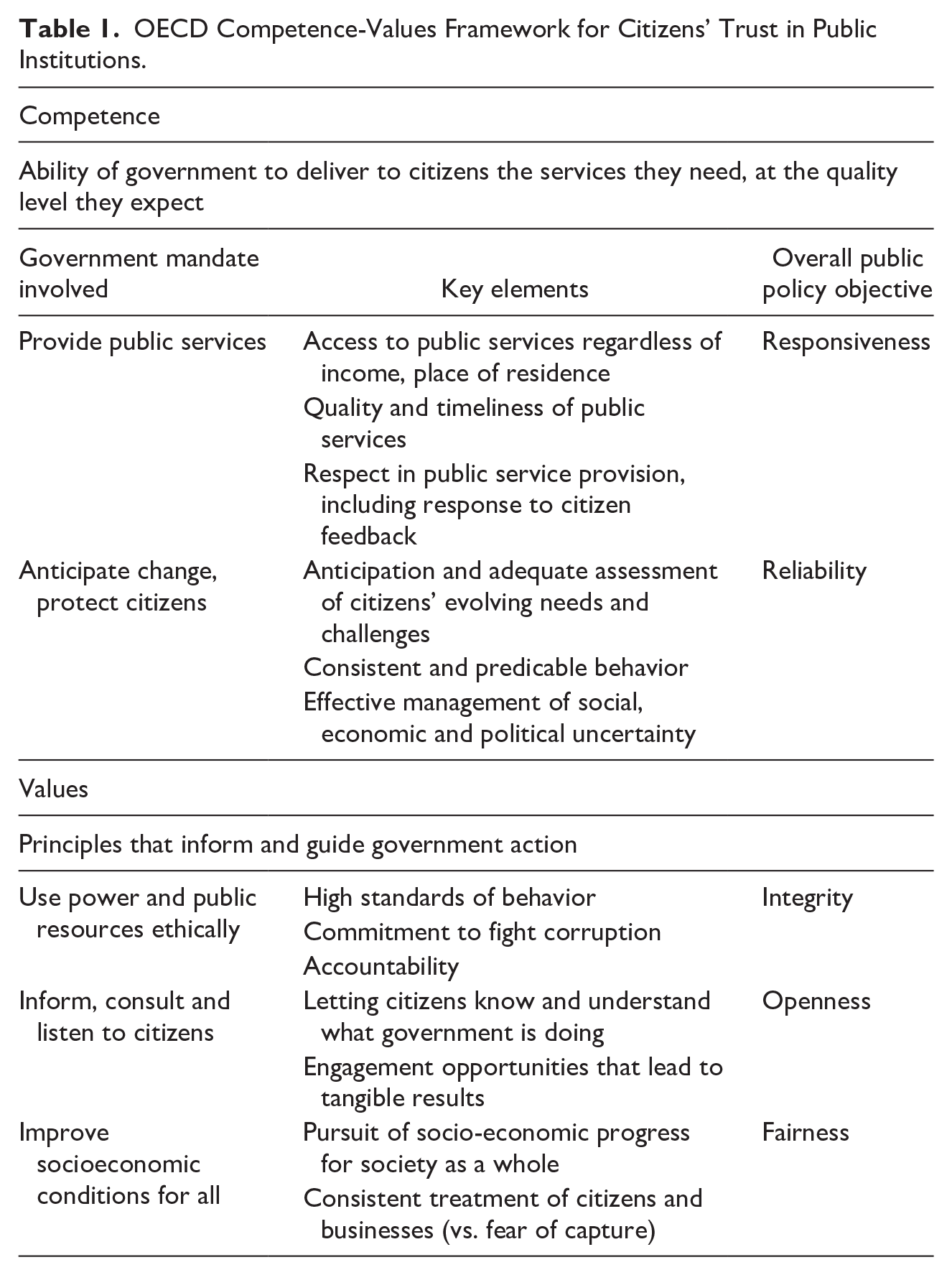
Although the OECD framework has been similarly applied to predict the main determinants of people’s trust in public institutions in times of crisis (e.g., during the COVID-19 pandemic) (Brezzi et al., 2021), to our knowledge, it has not been applied to study issues of trust in school closure decision-making processes. Moreover, the Ontario government faces pressure from fiscally-constrained school boards to lift the moratorium that has been in place since 2017 (Crawley, 2023). Thus, a study of the implications of school closures on trust in public institutions comes at a critical time, as the Ontario government may be considering reinstating PARs.
Data and Methods
Study Design
This research was part of a larger project focused on the community impacts of school closures in Ontario. The project employed a comparative case study design (Yin, 2018), drawing insights from four communities across two school board districts in Ontario where school closures occurred between 2016 and 2019 (see [Leger et al., 2023] for more details on these cases). As part of the larger study, key informant interviews were conducted with stakeholders closely acquainted with the school closure process in each of the four communities to understand the circumstances leading up to the closure and the impacts afterwards. Analysis of interview data across the four sites revealed considerable similarities and overlap in key informants’ perspectives. Accordingly, this article presents the combined analysis of all key informant interviews that generated a more fulsome examination of institutional trust in the context of school closure decision-making. Ethics approval was obtained from Queen’s University General Research Ethics Board in July 2018.
Recruitment and Data Collection
Using purposive and snowball sampling, key informants were recruited based on their (i) direct involvement in the school closure decision in one or more of the four study communities; (ii) familiarity with the decision-making processes and/or outcomes in one or more of the four study communities; or (iii) affiliation with a municipal government located within one of the two school board districts. News media searches were also used to identify potential key informants who were then invited via email to participate. Invitations were sent to current and former school board staff and trustees, municipal government staff and elected representatives, parent representatives, business sector representatives, and school advocates. Of the forty-five people invited to participate, four declined, nine did not respond to the email invitation, and two suggested others who could not be recruited. Those who declined to participate or did not respond to the email invitation held the following roles: member of provincial parliament, school board trustee, business improvement association board chair, municipal councillor, and parent involvement committee member. No incentives were offered for participation. Beyond informants’ occupations and/or role in the school closure decision making process, demographic information was not collected to preserve participants’ confidentiality.
Informed written consent was obtained from all research participants prior to data collection. All interviews were held in-person between May and September 2019 and lasted between 30 and 90 minutes. The interview guide included the following topics: (1) whom the accommodation review consulted and whom it excluded; (2) the information used in the final decision; (3) whether and why stakeholders desire other decision-making models; (4) how the school site has been used since the closure and the plans for the site; (5) how the closure decision influenced the demands on other school boards, the viability of local businesses, demands for social services, and value of local real estate; and (6) how the community is expected to change in terms of demographics, the local economy, civic engagement, and other domains. All interviews were audio recorded and transcribed. Transcripts were de-identified, and all files were securely stored using OneDrive encryption.
Data Analysis
A content analysis was conducted using a directed approach, in which the OECD’s drivers of trust (i.e., responsiveness, reliability, openness, integrity, and fairness) served as an initial framework to identify codes (Hsieh & Shannon, 2005; OECD, 2017). The drivers of trust were operationalized using OECD definitions (OECD, 2017). In cases where none of the pre-determined codes fit the text, new codes were created and applied. An inter-rater reliability test was conducted between the primary author (CT) and a research associate (RB) to ensure reliability of the codes used. This involved two rounds of coding; the first round included independent coding of one transcript by the two coders. Following this first round, the coders reviewed the coding decisions, discussed discrepancies, and reviewed the code definitions; then each coded a second transcript. Following the second round of coding, most of the major themes were identified by both coders despite slight discrepancies in coding styles. All authors were satisfied with the convergence, and the first author subsequently coded the rest of the transcripts. Data collection proceeded until reaching a priori thematic saturation, whereby data were collected to exemplify theory (Saunders et al., 2018). Case classifications were created for each participant to record descriptive information like district/school board and credentials/position, and matrix coding queries were performed to make comparisons based on participant attributes. All data were analyzed using NVivo 12.
Results
A total of 30 key informants participated in interviews, with a mix of current and former municipal councillors (n = 4); municipal staff (n = 7); school board trustees (n = 7); school administrators and teachers (n = 4); parent council members (n = 4); local business owners/business improvement association members (n = 3); and school advocates (n = 5). Some participants held multiple roles in their communities and thus are counted in multiple categories. The roles denoted in parentheses following quotations refer to the roles participants held when the decision to close the school was made; many participants are likely no longer in those positions given how much time has passed since the interviews were conducted. The results are organized according to the OECD framework, beginning with the competencies driving public governance, followed by values.
Competencies
The first overarching condition for trust is “competence,” or the capacity to deliver on a given mandate (OECD, 2017). Competence is further broken down in into two dimensions of trustworthiness: (i) responsiveness; and (ii) reliability. In this section we also report on a third competency that we inductively identified as “harmony.”
Responsiveness
According to the OECD framework, “responsiveness” refers to the ability of government institutions to provide efficient, quality, affordable, timely and citizen-centered public services that are coordinated across levels of government and satisfy users (OECD, 2017). School board staff, trustees, and teachers who participated in this study discussed the Ministry of Education’s responsibility to provide quality educational opportunities for all students as well as the challenges associated with providing high quality and affordable educational services when faced with declining enrollment: The reality is because the high schools are so small, they can’t offer the programs. Sometimes they can’t offer all the courses necessary to graduate with a high school diploma . . . it’s more challenging for students to get the courses needed to graduate and they certainly don’t have an expanse of optional courses that larger secondary schools have because of consolidation. (KI 21, School board staff)
In both regions, key informants reported a lack of coordination across levels of government during the early stages of the decision-making process. Consultations between municipal stakeholders and the school board were limited, mostly consisting of the municipality sharing relevant study results with the school board. Although municipal councillors attended community consultations, the PAR timelines did not allow sufficient time for councillors to relay information back to the municipal council before responding to the school board. Municipal staff from both regions attributed the siloed departments and isolated processes to the trickle-down effect of the culture of autonomy at the provincial and federal levels.
In the time that I’ve been here, I haven’t had a conversation with the school board where they sat down and talked to me about what their grand plan is for their community relative to schools and school closures. It’s more so we’re dealing with it on a site-specific basis. (KI 12, Municipal staff)
It was also clear from the interviews that each public entity pursued different priorities and goals. For example, a common goal for both urban municipalities was to re-establish the economic stability of communities facing PARs, while school boards were focused on enhancing the quality of the learning experience for students and balancing their budgets. Often priorities contradicted each other, for instance with municipal planning emphasizing sustainability and active school travel, while school boards were recommending school closures that would necessitate increased bussing. Discussions also tended to be site-specific as opposed to taking a comprehensive view of municipal goals and plans. For example, school closure decisions seemed to reflect a lack of awareness of where new residential subdivisions were being built, thereby ignoring needs and utilization projections in the near future: We’re trying to coordinate where growth is occurring in the [township] and it seems that there’s been a disconnect between sometimes where growth occurs and where school board decides to build a school. (KI 29, Municipal staff)
Municipal informants from both regions, however, also discussed their attempts to work more collaboratively with school boards. One municipal planner discussed the ways in which the city planning department was already working to foster a more collaborative relationship with school board planners. This included holding joint meetings with school boards and presenting development plans. Similarly, one city councillor described a positive example of collaboration as the creation of a working group to prioritize the redevelopment of closed school properties: And we initiated a committee, early on, . . . around these school issues, because councillors were hearing so much about them. And you know, you can’t exactly say “It’s not my jurisdiction.” But I have no power to influence the school board. They know, they hear from the parents too, and then parents get frustrated and come to city councillors. So we tried to find a way, by establishing a working group on schools, working with the school boards, all the various school boards, and I honestly don’t even know if that lasted more than a year, and don’t know what happened and how they met or how they dealt with anything. But that was the vision, I think, at the time. And I think whatever the obstacles were there, we haven’t overcome them yet. (KI 11, Municipal councillor)
Attempts to work collaboratively with the municipality was also discussed by school board administration. For example, one school board staff described their efforts to work with a range of stakeholders in order to repurpose underutilized classroom space for community use: And I worked with [the trustees] at the time for that area. I worked with the Business Improvement Association. I worked with School Council. I worked with City Hall and all of those were lining up. (KI 21, School board staff)
In sum, attempts at collaboration were discussed by a few informants, but most noted barriers to collaboration between the school boards and municipalities.
2. Reliability
“Reliability,” according to the framework, is the ability of government institutions to anticipate and provide an adequate assessment of evolving challenges and to protect citizens (OECD, 2017). This includes effective management of social, economic, and political uncertainty (OECD, 2017). Some key informants frequently questioned the reliability of the parameters used to evaluate schools under review. The contested parameters mostly related to the fiscal and operational factors used when considering the value of these schools, including utilization rate, population projections, facility condition index, transportation costs, and operating costs. Key informants from both regions believed that the data the school board used often did not reflect local circumstances.
One informant, who had been a member of an accommodation review committee, claimed that the reports that formed the basis of the closure decision contained factual errors (e.g., facility condition index calculation) and failed to address critical issues (e.g., utilization rate calculation). They noted that the utilization rate parameter in particular lacked flexibility to include community utilization of the school, even when the school was being rented out. Another informant felt deceived by the inconsistency of the evidence used: Our school in [town name], Watson reported as having a facility condition index of 74%. The government inspection said it was 43%. And the Ameresco puts it at 100.5%. This pattern continues throughout every school in [township]. And it became apparent that the facility condition index for these school buildings fluctuate from a high in the Watson report, to a low in the government’s report, and back to a high in the Ameresco report. How can this pattern be explained? These variations in the facility condition index alone should have merited further investigation by the [name] school board. (KI 2, School advocate)
Participants discussed the consequences of relying on these controversial data: closing some schools while opting to add portables to others within the same catchment area; building new, larger school buildings that fail to improve the utilization rate and instead require additional existing schools to be closed; and closing one school only to result in the surrounding schools being over-capacity. These undesirable outcomes of closures led some informants to question the integrity of the data used to justify the decision.
Similarly, participants criticized the school boards’ abilities to reliably anticipate needs and future challenges. With regards to the urban schools specifically, key informants questioned whether school assets would be needed in the future with rising immigration rates and neighborhood revitalization plans. Their comments revealed skepticism and concern that the boards’ decisions were not delivering on long-term expectations to mitigate future challenges beyond election cycles: I think that there needs to be . . . a longer-term plan by the school boards, by the province . . . in their asset management. They’re managing these assets based on current demographics, current growth patterns. They’re giving away assets that they’re going to need in the future . . . . And . . . if we’re going to grow inward and upward, which is our city’s plan to survive and grow sustainably . . . for that we’re going to need schools. (KI 25, Municipal staff)
Some key informants also thought that the school boards lacked commitment to future-oriented policies. They discussed sustainability being an important issue that school boards did not take into consideration in school closure decisions, mostly with regards to climate change mitigation. According to these informants, the climate-related ramifications of school boards’ decisions left community members feeling confused, frustrated, with increased social and economic uncertainty.
3. Harmony
One theme that was not part of the OECD framework, but emerged inductively from the data analysis was promoting harmony, the ability of government institutions to implement processes that develop peace and minimize divisiveness. In both regions, key informants criticized the tendency of the PAR process to promote divisiveness within communities rather than harmony. For instance, the structure of PAR meetings, which allowed for public delegations to present alternative solutions to school closures, often led to stakeholders advocating for the closure of one school while defending the need to keep another school open. This divisive atmosphere explains why some key informants described their experiences of these meetings as hostile. They noted that the existing PAR process does not acknowledge the ongoing tensions between groups within communities, and implementing a process in which these groups are pitted against each other only decreases community cohesion.
So basically it tore the heart out of the community, it put them into a fight that went on far too long. It pitted neighbour against neighbour, community against community, because one school was going to stay open and this one was going to be closed. So it was actually a gruesome time . . . (KI 22, School board trustee)
Values
The second set of overarching conditions for trust are values, or the underlying intentions and principles that guide actions and behaviors (OECD, 2017). In this section, we report on three critical dimensions the OECD framework outlines: (i) openness; (ii) integrity; and (iii) fairness.
Openness
The value of “openness” is described as the mandate to inform, consult and listen to citizens, including citizen participation through engagement opportunities that lead to tangible results (OECD, 2017). When asked to discuss their perspectives on how the decisions were made to close the schools in question, key informants predominantly valued “openness” in the process. Participants discussed the opportunities for community consultation and the authenticity of those opportunities, the accessibility of information, the format and timing of meetings, and the transparency of the PAR process.
In general, the key informants believed that opportunities were present for community members to participate in the decision-making process. Multiple informants spoke about parents and other community members serving on accommodation review committees, delivering presentations, and asking questions during public meetings. However, one informant, who was a former school board trustee, admitted that opportunities for community input were notably diminished following revisions to the PAR guidelines. This sentiment was echoed by other key informants who reported that parents and community stakeholders were largely ignored and even spoken over by board staff at public consultations. In both regions, multiple informants thought the process was predetermined, with community stakeholders in particular feeling unheard and frustrated.
I think it was a very prescribed process, very predetermined. You know, my own experience at the time is that things were laid out in such a way as to draw only one conclusion. Trustees were discouraged—publicly, in a public meeting, discouraged from speaking with members of the community. You go to the meetings and you listen. So, in that sense, it wasn’t an open process. To me, it wasn’t a collaborative process with the community. The community was not approached with a view to, “How can we keep your school open?” They were approached with, “Oh, we have to close your school.” You know, and to me, that’s a big part of where the process fails. So, it’s, “We did a consult, the consultant says this, so now we will prepare reports that will support this conclusion.” (KI 16 School advocate)
Some school board staff had different views of the consultations. One described a situation where the school board worked closely with community members to consider alternative solutions, but those solutions were turned down by the community.
. . . we worked with the community in terms of trying to establish a family centre there . . . And we were looking at different scenarios that would bring in . . . [adult learning programs for] residents, . . . providing social services and . . ., well the community articulated a desire not to have services in there that reinforced the concept of poverty.[. . .] So I understood that. But at the same time, it was an opportunity to save the building and a school and that turn down, to be honest with you, was the death nail for the school. (KI 21, School board staff)
Interviewees perceived that open and accessible information was not always provided to the public during the PAR process. Community members had to submit freedom of information requests to get information from the school board, and responses to these requests were seldom provided in a timely manner. This was frustrating for community stakeholders, who saw this information as critical to forming a solution.
According to one informant, the culture of their school board generally discouraged open discussion and did not make parents feel heard, a culture they felt was cultivated by the policies of the provincial government: I think [the feeling that parents do not have a voice in the process] is a provincial issue and I think it stems from just the way the system is structured. It’s very top-down, it’s very elitist, it’s very much “We are the experts and we know better than you.” (KI 16, School advocate)
Although the PAR guidelines emphasized the need to engage community stakeholders, the design and timing of meetings did not reflect this purpose. Specifically, public consultation meetings were structured in a way that isolated board members from the public, fostering an “us versus them” perception. Some individuals also expressed confusion about the clarity of PAR objectives and related responsibilities, despite the procedures being available on school board websites. For example, one councilor attended a preliminary community engagement session that was formatted as an information session, only to learn later that this was the councilor’s only opportunity to provide input. One school board staff (KI 26) summarized: “I think it’s important to be open and transparent and I don’t think our board was necessarily.” Overall, most key informants felt there was a disconnect between the intention of the public consultation meetings— to serve as an opportunity for school boards to include stakeholders in decision-making—and the outcome of those consultations, which appeared to have little to no impact on the final decision.
2. Integrity
“Integrity” is defined as the government mandate to use power and public resources ethically; it involves setting high standards of behavior, a commitment to fight corruption, and accountability (OECD, 2017). The interview data revealed that participants perceived integrity as being compromised, both in terms of prioritizing the public’s interests and within the power structure of the school board governing how decisions were made. Trustees expressed that the dual burden of providing high quality educational facilities and using public resources ethically put significant pressure on them to uphold integrity in their role: It’s too expensive, we need that money for other schools. But at the same time, you know, this is the great conundrum. The school was at the top of the performance list . . . kids were doing extremely well . . . I knew that by voting not to close it, that’s not good financial stewardship– I knew that—but I couldn’t, in conscience—my conscience—sort of rip that school out of the community. (KI 1, School board trustee)
School board staff voiced their concerns about the substantial allocation of tax dollars to maintain aging schools with low utilization rates once the moratorium was put in place. In one instance an addition was built on an old school that was closed four years later, leading to a range of emotions among the informants including confusion, frustration, and suspicion. One informant noted the lack of foresight this addition represented: The taxpayers of Ontario, for the next twenty-five years, are going to fork out a million dollars for that addition, to a school that they knew they were going to close down. It just galls me, as a taxpayer. (KI 3, School advocate)
The perceived silencing of community concerns was another theme that emerged. One trustee revealed that the power dynamic in their school board shifted from trustees to senior school board staff, as meetings about closure decisions were held in-camera without members of the public present. The informant believed that this dynamic compromised the neutrality of the civil service, which is tasked with prioritizing the public’s interest.
Our school board sort of works like this: the director is supposed to be hired by and directly accountable to the trustees. There’s no doubt they did hire the [prior] director. However, the balance of power should be that the director serves at the pleasure of the board. And currently, it’s that the board serves at the pleasure of the director. So whatever the director or senior staff . . . whatever their wishes are, they control the agenda at that board meeting, despite the fact there’s an agenda setting committee made up of two long-term trustees, who have worked with this director and side with this director, most of the time. So, things hit the agenda that the director wants and other things that are contradictory to [their] intended aims and goals, don’t. When trustees hear something from a public source, and they think “You know what? That has validity. We should really consider this.” Whether it hits the agenda or not is driven by very few people. And it is an impenetrable and not public process. It happens behind closed doors. So right there is where the issue is. (KI 4, School advocate)
One teacher added: You have to understand, this is a . . . completely top-down system. Trustees get elected thinking that they legally have the trust in terms of the physical assets and the wellbeing of the children - those are their two responsibilities . . . But they cannot do anything about the wellbeing of the child . . . they have to have unanimity on the board to do anything, even to ask senior staff to explore something or collect information. (KI 18, Teacher)
The integrity of the process also was questioned by a trustee (KI 13) who explained that in board meetings where all senior staff and trustees are in attendance, “trustees are cautioned not to ask questions, you’re only there to receive input.” This trustee elaborated that they were sent a code of conduct letter if they asked questions during a public meeting, were cautioned not to attend PAR working committee meetings, and were not allowed to discuss urban-rural issues.
3. Fairness
The “fairness” value is characterized as the government’s mandate to improve living conditions for all by providing consistent treatment of citizens (OECD, 2017). Fairness in the PAR process was undermined by the perception among councillors, trustees, and parent council representatives that school closures were happening disproportionately in rural communities and that such closures led to worse economic and social outcomes for rural communities compared to urban communities.
I’m more concerned with defending sort of the rural lifestyle that we have here, which is, in my view, is just being eroded away . . . You know, we’re losing farms; the stores are closing because they can’t get enough business. Services are drying up. The rural area is turning into a retirement centre for burned out urbanites. And we’re losing the young people in our community. And that all starts with the closing of the schools. Once the school’s closed, the kids grow up in an urban environment. (KI 3, School advocate)
Some key informants argued that the system-wide approach taken by school boards has undermined successful educational outcomes because it fails to recognize the uniqueness of communities. According to these participants, the guiding principles used by senior administration employed a cookie-cutter, urban-centric approach to planning, and these principles have guided which schools were considered for closure (e.g., schools that did not fit the junior kindergarten to grade 8 and grade 9 to grade 12 model). This approach risks perpetuating inequities by failing to consider the varying levels of access to resources and opportunities that different communities have.
What we are faced with is a provincial policy that does not recognize the uniqueness of all of our communities. Cities included. And we have a one size fits all approach that I don’t believe achieves success for urban centres, nor does it achieve success in our rural centres. (KI 20, School board trustee)
Meanwhile, other key informants argued that the one size fits all approach was employed to improve, rather than compromise, fairness: -because we don’t want to build schools in rich neighbourhoods that look like palaces and schools in poor neighbourhoods that look like dumps. We want all the schools to look the same so that everyone is treated equally. (KI 1, School board trustee)
Other key informants contended that closing small, underutilized schools often resulted in better educational outcomes for all.
“Oh well my kids are graduating they’re all Ontario Scholars.” Well, of course they are, you have 14 kids in your school. There are 315 in one school with like seven portables—that’s not fair. So that’s, again, where the funding issue comes in. Of course, I would’ve loved to save [school name], but when I sat through that whole meeting, I’m looking at them like, “You know that we’re also negotiating putting on another portapack?” (KI 13, School board trustee)
The informants claimed that educational opportunities are compromised at schools with low enrollment because of limited course offerings; meanwhile these schools lack efficiency of scale and thus tend to use more resources.
Discussion & Conclusion
Key Findings
This research provides an in-depth examination of institutional trust manifested by two Ontario school boards during their school closure decision-making processes. The study found evidence that the way the PAR process was enacted in multiple jurisdictions in Ontario compromised each of the competencies and values of the OECD’s framework of trust in public institutions. Like Mangion and Frendo (2022), we identified responsiveness, reliability, openness, integrity, and fairness as important drivers of citizens’ trust in public institutions. Openness was compromised by many aspects of the public consultations that failed to meaningfully engage with community stakeholders to collectively form a solution. Responsiveness was compromised by a predominantly reactive approach to handling the consequences of the closed school. Reliability was compromised when accommodation reviews and closure decisions proceeded based on what some stakeholders saw as flawed or contradictory data, which also decreased stakeholders’ faith in the school boards’ ability to reliably anticipate needs and future challenges. De-prioritizing the public’s interests and changing the power structure within the school board jeopardized the perceived integrity of the process. Further, although some stakeholders perceived the Ministry of Education to be working to improve equitable educational outcomes for all students, this study revealed aspects of the province’s approach that others perceived to be reinforcing rural-urban inequities. This qualitative finding is corroborated by quantitative research that revealed a disproportionate number of school closures occurred in small to mid-sized cities and rural communities as well as mixed methods research indicating that rural residents were more concerned with the impact of school closures on their communities than urban residents (Barber et al., 2024; Collins et al., 2023; Leger et al., 2023).
Theoretically, this study enhances the existing OECD framework on drivers of trust with the identification of a third competency: the ability of public institutions to promote harmony. This study revealed that the community consultations, which were part of the PAR process, pitted residents against each other. The theme of harmony is not unique to school closures’ community engagement processes, and its recurrence across sectors suggests it is important for understanding the phenomenon of trust (MacKenzie & Krogman, 2005). This extension emphasizes the value of peace in democratic processes.
Our results corroborate findings of Payler et al. (2023) and Constantinou (2017), revealing tensions between politics and administration at the local government level in Ontario. This study finds that the tension that exists between school board staff (emphasizing standardization and a systems-wide perspective) and trustees (advocating for the distinctive needs of their constituents) has notable implications for fairness and integrity. In this case, instead of working harmoniously together, the conflicting roles and responsibilities of school board leadership led to an altered power dynamic with one set of objectives dominating the other.
Although government institutions often use participatory processes to increase inclusion, legitimacy, and public acceptance (Kronsell et al., 2010), this study reveals that shortcomings in Ontario’s PAR processes, including the requirement for community engagement, threaten public trust. In theory, participatory processes can allow community members and stakeholders to voice their concerns, reconcile opposing perspectives, and have agency in decision-making that affects their livelihood (Healey, 1997). The expectation is that this will lead to better decision-making and more equitable outcomes for all stakeholders. Evidence from this study sugests that this is not always the way these processes play out. In both regions, a lack of openness in public consultations became a source of distrust when communities believed their input was ignored. By unpacking the trust implications, these findings support and extend previous research showing that authentic engagement has been difficult for school boards to achieve in practice (Irwin & Seasons, 2012; Johns & MacLellan, 2020; Leger et al., 2023) and in the Canadian education, farming, and environmental sectors (MacKenzie & Krogman, 2005; Office of the Auditor General of Ontario, 2023). For example, a recent investigation by the Auditor General of Ontario of controversial decisions affecting the Province’s Greenbelt illuminates similarities in the ineffective way that the public and municipalities were consulted (Office of the Auditor General of Ontario, 2023). In particular, the consultation processes were undermined by incomplete and inaccurate notices, which limited the public’s ability to understand the proposed implications; moreover, the brevity of the consultation timeline did not allow for a comprehensive municipal response or for a thorough analysis of public feedback (Office of the Auditor General of Ontario, 2023). In this case, the public backlash ultimately led to a reversal of the decision by the provincial government, the long-term trust implications of which are yet unknown.
Concerns are growing that we are entering a new era of public distrust, exacerbated by the Covid-19 pandemic (Edelman, 2023; United Nations DESA, 2021). Although it is too early to fully understand the unintended consequences of pandemic-driven stay-at-home orders and workplace vaccine requirements on public trust, there is evidence of lower levels of trust in government and increasing polarization in Canada (Edelman, 2023; Statistics Canada, 2024), North America (Dalton, 2017), and beyond (Kumagai & Iorio, 2020). These trends are concerning since distrust has been associated with the growth of far-right ideology (Allen, 2017). Brezzi et al. (2021) highlight the challenges in rebuilding trust in public institutions following crises, including a rise in voting for anti-establishment parties, persistent negative effects on young people’s confidence in public institutions, and decreased political participation. In the post-pandemic landscape, decision-makers face important considerations about the role of participatory processes. As demonstrated here, participatory processes can lead to violations of trust when governments push forward with decisions without due consultation or consideration of feedback generated through engagement processes. Alternatively, governments have the potential to build and help restore faith in public institutions when stakeholders are meaningfully engaged. As the provincial government revisits school closures post-pandemic, decision-makers need to think carefully about the trust implications of these decisions.
Policy Implications
To strengthen trust in Ontario’s public education system, we outline several recommendations to directed at promoting greater responsiveness, reliability, openness, integrity, fairness, and harmony in the existing decision-making model. First, there is a need to clarify the purpose of public consultations and to ensure that the design, timing, and format of meetings support the specified purpose. In addition to public consultations, more proactive collaboration between school boards and municipal stakeholders, both in sharing information and in promoting ongoing conversation, would help to mitigate some of the impacts on communities. Further clarification also is needed about the roles and responsibilities of school board members, given the influence of the director of education and senior staff on elected school trustees, besides limiting the frequency of in-camera meetings. Equally important is the need for the development and transparent disclosure of a long-term asset management plan, outlining the provincial government’s commitment to addressing future challenges and promoting equity. To complement this long-term plan, a formal framework should be developed to track the effects of school closure decisions on indicators of student success and performance. To further improve fairness and reliability, School Information Profiles (SIPs) (which are developed by school board staff to orient accommodation review committees to the context of a proposed school closure) should include sufficient detail on the equity implications of each proposed school closure by including a preliminary assessment of the social, economic, and health consequences on affected communities. Finally, SIPs should be approved by independent, third-party auditors to ensure reliability of included data and assessment.
Study Limitations
This study focuses on local level perspectives and does not incorporate the views of provincial stakeholders on the decision-making process involving school closures. Expanding the scope of the stakeholders consulted would encourage greater collaboration and bring more attention to the issues identified here. Helpful, for example, would be future research to better understand the position of provincial policymakers and deputy ministers on the barriers they face in implementing a more open and harmonious process (i.e., through an examination of their trust in citizens and in scientific evidence). Accordingly, a second limitation of this research is it examined only one one of the three dynamics of trust outlined by Bouckaert (2012). This study focused on citizens’ trust in governments and did not examine governments’ trust in citizens or policymakers’ trust in scientific evidence (Bouckaert, 2012; Cairney & Wellstead, 2021). Moreover, trust was explored solely through the lens of institutional theory; economic factors, for instance, were not considered. In addition, although this study provided a deep understanding of how trust was affected within the PAR process, future research is needed to systematically evaluate the implications of trust (for, e.g., disenfranchisement, organized resistance). The lapse in time between data collection and analysis could be seen as an additional limitation of this study. Despite this time lapse, the findings remain salient as Ontario public school boards have recently begun lobbying the provincial government in Ontario to lift the moratorium to relieve boards’ budgetary pressures (Jones, 2023).
Conclusions
This comparative case study exposed the trust implications of the school closure decision-making process in Ontario, prior to the moratorium in 2018. The findings make clear that reinstating pupil accommodation reviews without fundamental changes to the guidelines and processes will be fraught with conflict and will further compromise the public’s trust and faith in Ontario’s education system specifically and in other public institutions more broadly. Furthermore, the absence of community voices in democratic decision-making calls into question whether schools are indeed public assets of the community, or purely financial assets of school boards. In this post-pandemic era, it is more important than ever to conceive of a more collaborative decision-making model for managing public school assets. This study highlights aspects of the process where trust can be improved.
Footnotes
Acknowledgements
The authors want to thank Bill Irwin and Sarah Hennessy for their assistance and critical reflections early on in the data analysis phase of this project.
Data Availability Statement
The data that support the findings of this study are available on request from the corresponding author. The data are not publicly available due to privacy or ethical restrictions.
Declaration of Conflicting Interests
The author(s) declared no potential conflicts of interest with respect to the research, authorship, and/or publication of this article.
Funding
The author(s) disclosed receipt of the following financial support for the research, authorship, and/or publication of this article: This research was funded by an Insight Grant from the Social Sciences and Humanities Research Council of Canada, grant number 435-2018-0852 (2018-03-15) to PC.
Ethics Approval and Consent to Participate
Ethics approval for this study was obtained from the Queen’s General Research Ethics Board and the Huron University College Research Ethics Board. All key informants provided informed written consent. All participants consented to their data being used in publications. All methods were carried out in accordance with relevant guidelines and regulations.
