




Abstract
Public Value (PV) is a notion and an approach to the governance and management of public services that has gained traction over the past three decades. However, there seems to be a major gap in PV theory: the influence that institutionalized religions have on public life in countries around the world and hence on the ways in which PV notions become acceptable across different countries. This article seeks to address this gap by developing an analytical framework to understand the influence of religions on PV. The nature of the religious regime in a given country—whether liberal or non-liberal—is a key mediating factor.
Introduction
Public Value (PV) is a notion and an approach to the governance and management of public services that has gained traction over the past three decades. This approach aims to provide a framework for public sector managers to create value for society and improve public services (Alford & O’Flynn, 2009). First introduced by Moore (1995), the notion of PV has been widely discussed, debated, and applied in different contexts, and it has evolved into a major stream of research in the public governance and public administration and management literatures, and has informed the practice of innumerable public managers around the globe. Currently, PV scholarship interconnects with various streams of inquiry, from transparency and accountability to collaborative governance and co-production, from co-creation to public innovation and innovation for public purpose (e.g., Bryson et al., 2014; Chatfield & Reddick, 2018; Cruz Dallagnol et al., 2023; Douglas & Meijer, 2016; Hartley et al., 2017; Kattel et al., 2022; Mazzucato, 2013; O’Flynn, 2021; Rønning et al., 2022; Torfing et al., 2021).
Yet a major omission in PV theory evidently is religion. There apparently has been little explicit consideration of the influence that institutionalized religions may have on public life in countries around the world, and hence on some of the very premises of the ways in which notions of PV become acceptable in different countries. Indeed adhering to religious beliefs and thereby accepting certain religious teachings may in fact shape what is or is not acceptable to believers, thereby also informing notions of PV. (One major exception to this gap in the literature is the project and research agenda delineated by Drechsler et al., 2023, which focuse on PV within the framework of the Islamic religion and institutions.) This concern is reinforced by the observation that two recent literature reviews, delving into the ways in which religion affects areas of scholarly inquiry in public administration, identify some eighteen areas of active research, but no published paper on the theme of religion and PV (Ongaro & Tantardini, 2023b; Tantardini & Ongaro, forthcoming). This article aims to fill this gap, probing theoretically how religion may be incorporated into PV theorizing and practice and exploring possible implications.
We define religion following Bell (1980, pp. 333–334):
a set of coherent answers to the core existential questions that confront every human group, the codification of these answers into a creedal form that has significance for its adherents, the celebration of rites which provide an emotional bond to bring into congregation those who share the creed and celebration, and provide for the continuity of these rites from generation to generation.
In our view, religion is influential on public administration due to ideational basis: as such, religion affects potentially all key social actors in the public administrative space, from public decision-makers and professionals to street-level bureaucrats and users of public services, potentially at all levels and in all capacities (see two recent works—Ongaro & Tantardini, 2023a, 2023c—offer an extensive discussion of how to connect religion to public administration). We also should note our emphasis is on religions in the plural: different religious traditions infuse distinct doctrines and teachings that permeate the ideational basis of believers and (political) communities at large, which in turn may have differential influences on the acceptability of key notions of PV.
To attain the goal of incorporating the religious factor into the analysis of PV, we examine—at a theoretical-speculative level—if and how different religious traditions may affect certain profiles of PV. We have two main research questions. First, what do religions teach that influences the acceptability of key notions of PV? Second, What are the doctrines—understood as forms of normatively infused knowledge about the ultimate reality of human life informing the existential response of individuals and communities to the questions about how one ought to live together with other human beings—that may shape the very content of what PV is about for a given public and its acceptability?
Our basic argument is that different religious traditions affect PV in varying ways, notably depending on the specific teachings of each religion and on whether a deliberative or an objectivist conception of PV is adopted. In a deliberative conception, PV is defined via a process of deliberation in the public sphere; in an objectivist conception, PV is associated with objective states of the world that can be measured (see below). The analytical framework also suggests that the religious regime of a given country—notably whether the religious regime is liberal or non-liberal—has a key mediating influence on whether and how religion affects the dynamics of PV acceptability. A liberal religious regime refers to a country where freedom of religion is guaranteed to all religious groups, regardless of whether they constitute a majority or a minority; a non-liberal religious regime is one in which freedom of religion is limited.
The article unfolds as follows: first, we introduce our analytical framework and the design of the research. Then, we discuss two different perspectives that may underpin the way in which PV is understood and conceptualized: the deliberative and the objectivist conceptions of PV. We turn next to analyzing how the teachings of different religions may affect the ways in which PV is defined, created, and ultimately accepted by its adherents: we do this by examining the teachings of six institutionalized religions. We then consider the role of the religious regime as a key mediating influence on how religion shapes the acceptability of key notions of PV in a given country. The presentation concludes by discussing prospects for advancing PV theorizing by more systematically including—theoretically and empirically—religion into the explanatory framework of PV governance and management.
Framework of Analysis and Research Design
We aim to explain how religious teachings shape the acceptability of key notions of PV, notably the deliberative and the objectivist conceptions of PV, as a precondition for the actual process of creation of PV to occur in the given country or other kind of jurisdiction of analysis. Religious teachings (which differ for each religion) are the explanans (“independent variable,” to use the variable language); acceptability of either PV notion is the explanandum (“dependent variable”). The nature of the religious regime in a given country, which can be liberal or non-liberal, is key mediating factor (“mediating variable”) in shaping the influence of religious teaching on the acceptability of PV notions. Our framework of analysis is visualized in Figure 1. Notably, the portion of Figure 1 not included in the dashed rectangle is outside the scope of this contribution.
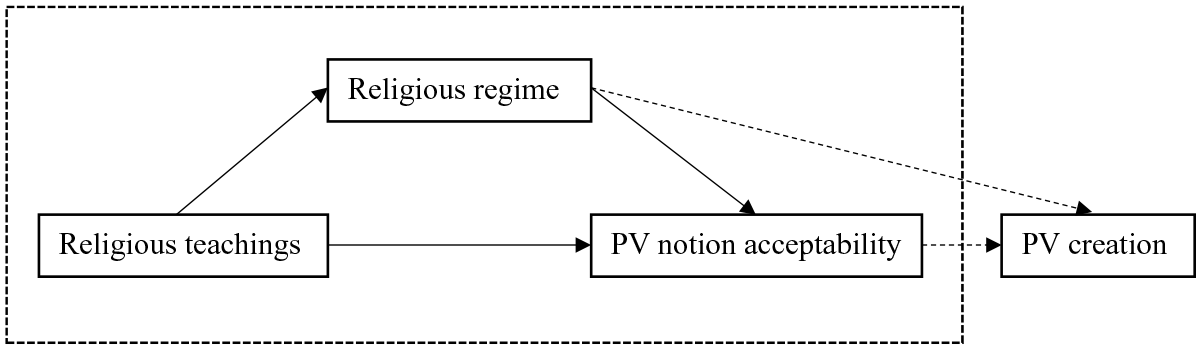
Framework of analysis.
The (independent) variable “religious teachings” refers to the doctrines, dogmas, and (ethical) principles that often are derived from sacred texts, theological interpretations, or even rituals of a specific religion. The “PV notion acceptability” (dependent) variable primarily pertains to the effects of religious teachings on making acceptable certain notions of PV to public sector managers who aim to create value for society and enhance public services; it also encompasses the public sphere and society as a whole, which participate in processes of co-creation of PV. Finally, the mediating variable “religious regime” concerns a country’s religious liberty, level of tolerance of different creeds, and degree of secularization.
We selected six institutional religions and report on their teachings below. Included are both Abrahamic religions/faiths—namely Judaism, Christianity, and Islam—and the (so-called) “Asian” religions, focusing on Hinduism, Buddhism, and Confucianism. Scholars of religious studies claim that these two “branches” of world religions display important differences. In broad terms, Abrahamic religions place emphasis on correct belief over ritual practice and community, and strictly speaking are the only religions in which notions such as “conversion” and “apostasy” make sense. Conversely, Asian religions tend to be seen as bodies of wisdom, practices, and rituals that bind communities in their quest for the divine and the spiritual. So, for example, Hinduism can be viewed as the wisdom-spirituality-culture of Southern Asia, and Confucianism as the wisdom-spirituality-culture of China and Eastern Asia (Ongaro & Tantardini, 2023c). By examining both branches of religions for analysis of their influence on public administration, we therefore consider the religious phenomenon in its broader span. Moreover, these six religions are probably the most influential today on governments and public sectors across the globe (Ongaro & Tantardini, 2023c): this adds to the relevance of selecting these religions for the purposes of our study.
We developed a framework for comparison that outlines the key elements we analyzed for each of the selected religions. We considered two major areas in the religious teachings of the six religions: first, the existence and interpretation of the notions of “revealed” and/or “eternal” and/or “divine” and/or “natural” law; and second, the existence and interpretation of the notions of free will and individual liberty. Additionally, and particularly for Abrahamic religions, the eschatology doctrine was analyzed. We collected data from three main sources: sacred texts, interpretations from theologians, and scholarly articles. Regarding sacred texts, we considered the Torah 1 for Judaism; the Bible for Christianity; the Qur’an for Islam; the Vedas, 2 the Upanishads, 3 the Puranas, 4 and the Bhagavad Gita 5 for Hinduism. We supplemented this source of data with interpretations from theologians. It is the case of Thomas Aquinas 6 for Christianity, the Mu’tazilites 7 and the Ash’arite 8 for Islam, and Confucius’s grandson Zisi 9 for Confucianism. Finally, we integrated our analysis with academic articles and other studies we deemed relevant, appropriate, and complementary to the other sources.
Two Perspectives on Public Value
Before investigating how religion affects PV, we outline and briefly discuss different perspectives that may underpin the way in which PV is understood and conceptualized. Aware that this is a mature field of academic inquiry and policy debate, the perspectives we introduce on PV are mainly intended to highlight loop key features of PV theory that inform our subsequent discussion of how religion may be incorporated into PV theorizing.
Scholars like John Benington have contributed significantly to the development of a deliberative conception of PV. According to this conception, any answer to the crucial question of “what is PV?” can only be the outcome of a process of deliberation, by which “what constitutes value is established dialectically, [. . . thus allowing] for contest, and for diversities of values and identities, within a negotiated understanding of what it means to be part of the wider ‘public’ sphere, at that time and place” (Benington, 2011, p. 43). Deliberation is premised on a democratic process, one in which contestation is not only allowed but of the essence, hence an understanding of PV as contested democratic practice (Benington, 2015).
Of special import here is Benington’s elaboration of the notion of public sphere for application to PV theorizing. PV revolves around addressing the question, “what does the public most value in this particular context?”, alongside the question, “What adds (the most) value to the public sphere?”, thereby presupposing the notion of public sphere, which underpins Benington’s conception of PV. Benington (2011, pp. 233–237 in particular) addresses the three questions: (i) what is the public sphere? (ii) what is the public? and (iii) what is value? As to the notion of public sphere, Benington adopts a notion of public sphere as:
the web of values, places, organizations, rules, knowledge and other cultural resources held in common by people through their everyday commitments and behaviors, and held in trust by government and public institutions. It is what provides society with some sense of belonging, meaning, purpose and continuity, and which enable people to thrive and strive amid uncertainty. (p. 235)
The “public” is seen as made, not given—continuously created and constructed. In a similar vein, Hartley, Sancino, et al. (2019) emphasize the plurality of publics and their interactions—and the function a public service and its leadership may perform in convening those publics and getting them to engage with each other—as key to understanding the public in PV theory and practice. For the notion of value, Benington first reviews three alternative notions drawn from economics: “exchange value” (an item’s price on the open market), labor value (the amount of human effort invested in its production), and use value (how useful an item is to a given person or situation). He then links PV chiefly to the notion of use value. This idea is understood multi-dimensionally in its economic value (adding value to the public realm through the generation of economic activity, enterprise, and employment), social and cultural value (adding value by contributing to social capital, social cohesion, social relationship, social meaning and cultural identity, individual and community wellbeing), political value (adding value to by stimulating and supporting democratic dialogue and active public participation and citizen engagement), and ecological value (adding value by actively promoting sustainable development).
This line of thought is but one in delineating the conception of PV. Hartley et al. (2017, p. 671) observe:
There are at least three, sometimes disparate, components of public value in contemporary public management thought: the notion of public value as a contribution to the public sphere; the notion of public value as the addition of value through actions in an organizational or partnership setting; and the heuristic framework of the strategic triangle.
It is therefore possible to detect another approach to conceiving of PV of special significance for this article’s argument, one that is more in line with the second notion Hartley et al. outline, which points to public value as the addition of value through actions in an organizational or partnership setting. This second approach can be labeled as “objectivist” (for reasons that we delineate below), and it is grounded in the assumption that PV can be associated to some objective states of the world—or at least of the human psyche—that can be measured.
Work by Meynhardt (2009, 2015; see also Meynhardt, 2022) provides an important contribution to outline this approach. The author argues that basic needs theory in psychology, described by Epstein (1993, 2016), is a promising candidate for underpinning a notion of PV. Epstein’s theory of needs centers on the individual. Basic needs of the individual—for positive self-evaluation, for maximizing pleasure and avoiding pain, for gaining control over one’s conceptional system, for developing positive relationships—then can be related to basic values (although values may also arise from other sources, and not all values can or should be traced back to basic needs). By relying on Heyde’s notion of “value” as “a result of a relationship between a subject that is valuing an object and the valued object,” Meynhardt then provides some grounding for an “objective” understanding of PV: value attributions can be shared by subjects and held in common, becoming inter-subjective. It is in this sense that they may be deemed to be “objective” (Meynhardt, 2009, p. 199).
Meynhardt (2009) then turns to defining the notion of “public,” arguing that “the public is a necessary fiction [because] [t]he public is inside” (p. 204). The public—psychologically speaking—is “an individually formed abstraction.” Continuing along this line of reasoning, a definition of PV follows in terms of what impacts on values about the “public,” values that are “held about the relationship between an individual and a social entity (constructs like group, community, state, nation) that characterize the quality of this relationship” (Meynhardt, 2009, p. 206). Meynhardt sees PV as “situated in relationships between the individual and society; founded in individuals; constituted by subjective evaluations against basic needs; activated by and realized in emotional-motivational states; and produced and reproduced in experience-intense practices” (Meynhardt, 2009, p. 212). It should be noticed that according to Meynhardt, value attributions are subjective, even subjectivist, and that they can challenge normative notions of common good or common interest. Although on one hand they originate from basic needs that are common to all individuals, on the other hand they are measurable (Meynhardt, 2015); at least in this narrow sense, they can be seen as “objective.” There are various publicly reproducible ways of measuring, or at least detecting and gauging, what the public is and wants, by combining a variety of sources for evidence of what the public is, wants, or deems to be good for itself. Such sources include, for example, declarations of public policy goals and priorities; legislation, rules, and regulations; and opinion polls.
This is a route taken also by Mark Moore, who originally introduced the notion of PV and who has developed and revisited the connpception of PV. In his path-making work, he aimed at laying out a structure of practical reasoning to guide public managers, based on setting out a “philosophy” (which we may see as an objective conception) of public management (Moore, 1995, p. 1ff). In a later work, Moore works out approaches to gauge and measure PV creation (Moore, 2013). Thus, Meynhardt and Moore point to an objective notion of PV (in the sense qualified above). As aptly Bryson et al. (2014, p. 449) aptly state: “For Moore, like Bozeman, public value generally refers to objective states of the world that can be measured” and “like Bozeman and Moore, Meynhardt also sees public value as measurable, in his case against the dimensions he outlines” (Bryson et al., 2014, p. 450).
In sum, we have outlined two key perspectives on PV, one rooted in deliberation and process and the notion of the public sphere and the other that points to more of an objectivist notion of PV. For the purposes of the present analysis about the influence of religion on PV, we consider the distinction between the deliberative and the objective conceptions of PV—albeit necessarily schematic—to be very useful in shedding light on key traits of how the consideration of religion may affect the theorization of PV.
Interestingly, Meynhardt outlines his reasoning by considering that one resorts to a psychological approach “if [one] cannot assume the derivation of values from some objective basis (for example some objective natural right) and further do not restrict values to a normative constitution or the like (such as a religious text)” (Meynhardt, 2009, p. 201, emphasis added). This passage reveals that for him PV is inherently concerned with issues of ontology of human nature and its relationship with reality as well as with theological issues about what religious commands may have to say about what is to be valued.
Before exploring religions and PV theory, we briefly return to the strategic triangle, the third line of approaching PV Hartley et al. (2017) mention and that a number of works explore (including a sophisticated analysis of the role of public managers’ “political astuteness” in creating PV; Hartley et al., 2015, Hartley, Parker & Beashel, 2019). The strategic triangle is a heuristic introduced by Moore (1995) that highlights the creation of PV through the combination of three elements: an understanding of what PV is (we focus here on this side of the triangle); the legitimacy by public managers to act (authorizing environment); and the operational capacity to deliver PV. Religion affects all three dimensions of PV creation; that is, it affects all sides of the triangle. Our primary interest is in the first side of the triangle, analyzing how religion (religious teachings as ideational bases for people to act) may affect the contents and acceptability of what PV is. Religion also may shape the legitimacy dimension (second side of the triangle) as well as the capacity to deliver (third side). Indeed, religion as ideational basis influences the legitimacy of public administration (see Ongaro & Tantardini, 2023b), and religion as a personality system may shape the motivations to act in public service (see Ongaro & Tantardini, 2023c).
Religion as Ideational Basis: Revisiting Public Value Doctrines
We ask what do religions teach that influences the acceptability of key notions of PV? What are the doctrines that may shape the very content of what PV is about for a given public and its acceptability? In trying to answer these questions, we considered the teachings of both Abrahamic religions/faiths (Judaism, Christianity, and Islam) and selected (so-called) “Asian” religions (Hinduism, Buddhism, and Confucianism).
We commence our analysis of how religious teachings may affect PV doctrines with Abrahamic religions and then discuss Asian religions. In our comparative framework, we focus first on the existence and interpretation of the notions of “revealed” and/or “eternal” and/or “divine” and/or “natural” law; and second, on the existence and interpretation of the notions of free will and individual liberty. Additionally, and particularly for Abrahamic religions, we consider the eschatology doctrine.
Judaism, Christianity, Islam
Notions of Laws
To address the question of how the teachings of different religious traditions can inform how PV is interpreted, a good starting point is to look at how organized religions understand and consider the notions of “revealed” and/or “eternal” and/or “divine” law and of “natural” law, and infer possible interpretations of the conception of PV. We commence our discussion with Abrahamic religions and with the oldest among the three: Judaism. As Novak (2014) points out, one of the key doctrines in Judaism, if not the foundation of Judaism itself, is that the Torah is the most complete and sufficient form of the law of God provided to humans to answer and interpret any questions of human praxis and thought. In Judaism, revealed, divine, and natural law are all distinct yet interrelated: divine law can be both revealed (the Torah) and natural. Natural law in Judaism, whose existence is contested by many, “is what God the Creator has commanded His human creatures to actively and authentically be” (Novak, 2014, p. 15). According to Novak, natural law is itself divine law, but, differently from revealed law, humans learn about natural law when they use human reason to discover what the authentic requirements of the created nature are and how these requirements are translated into actual norms. For Novak (2014, p. 19) the “affirmation of natural law is required in order for the normative claim of revealed law to be intelligible.” Based on this very succinct discussion of the notions of “revealed” and/or “eternal” and/or “divine” law and of “natural” law, it can be inferred that any human law as well as any human behavior or any human thought must be in line with the divine law whether in its revealed or natural forms. Therefore, it is plausible to state that any conceptualization of PV ought to be in line with divine law, with God’s revealed law in the Torah and with the reasoned discovery of natural law by humans. In all these respects, Judaism seems to presuppose an objective conception of PV.
In the Christian and even more in the Catholic 10 tradition, a good starting point are the four types of law outlined by Thomas Aquinas. First, the eternal law, which is God’s rational plan or order for the world and which can be defined (following Augustine of Hippo, 2007, p. 317) as the “will of God, commands that the natural order be preserved and forbids that it be disturbed”; this also means that “in human beings, this order requires that we love God above created things” (Levering, 2014, p. 100). The second type of law is divine law, discovered through revelation (as revealed law in Judaism). The third is natural law, which refers to the participation of rational creatures in this divine plan and, through reason, humans can contemplate the divine creation and discern how God intends for us to act, as well as identify the factors that contribute to personal well-being and happiness, for Aquinas the ultimate end of human beings (Curran, 2002). For Aquinas, natural law does not create an explicit set of external rules; instead, it generates general principles that any rational person can recognize simply because they possess reason; these general principles are what the Aquinas defines as “primary precepts.” Human laws—the fourth type—are the specification and articulation of these primary precepts into “secondary precepts.” These secondary precepts must be in accordance with natural law (primary precepts) and thence in accordance with eternal law. Similar to Judaism and based on this very succinct discussion of the notions of “eternal,” “divine,” and “natural” laws, it can be inferred that any human law, as well as any human behavior or any human thought, must be in line with the divine law whether in its eternal, divine as well as natural forms. It is plausible to claim that for the Christian, and more specifically the Catholic tradition, any conceptualization of PV ought to be in line with the eternal law, whether in its divine/revealed or in its natural forms.
Islam has divine/revealed law in the Qur’an, the sacred scripture of Islam—like Judaism in the Torah and Christianity in the Bible. As in Judaism, most Muslim theologians and philosophers contest the existence of natural law. Yet, as Emon (2010, p. 153) points out, Muslims may interpret (although with many limitations) the concept of Maslaha – a “term of art [refering] to any interest that upholds and preserves the purposes of the divine law (al-muhafiza ‘ala maqsud al-shar’)” – as natural law. The purposes of the divine law that must be preserved through Maslaha are religion (din), life (nafs), reason (‘aql), lineage (nasl), and property (mal) (Emon, 2010). Similar to both Judaism and Christianity, any human law or any human actions must be in line with the divine law revealed in the Qur’an and with Maslaha. It thus is plausible to state that any conceptualization of PV must be in line with the divine/revealed law in the Qur’an and with Maslaha.
Religions are about individual and collective salvation, which also involves addressing the question of “how to live together with other human beings.” In Abrahamic religions, believers are provided with a transcendent source of guidance on how to think and act in life, notably also in respect to others, an anchor for what to hope for, a perspective from which to appreciate reality from the viewpoint of the transcendent God. This transcendent anchor—in the perspective of Abrahamic religions—is common to the whole of humanity. Within it, believers shape the earthly world as an act of co-creation with God inspired by the heavenly world (the Kingdom of Heaven, in Christian terminology). This perspective engenders interesting elements of reflection for how the notion of PV may be understood. A first consideration is that this perspective points to privileging an objective (objectivist) notion of PV, since what is good and to be done in this world ultimately can only be rooted in (eternal and) divine, revealed law, and complemented by natural law in the Judaic and especially Christian theology, which is universal and universally applicable: an “objective,” unavoidable term of reference for believers.
At the same time, a crucial element of Abrahamic religions, although with substantial differences in emphasis, is that of eschatology or the doctrine of last things: the world will come to an end, and the creation and humanity will return in full communion with God after the final judgment for every human being, the dead will resurrect in their flesh, and creation will be liberated from evil. This entails that, for believers in the God of Abraham, this world and what human beings do in this world is in continuity with the heavenly world to come. In this perspective, believers in the God of Abraham conceive of encounters with any other human being that occur in this world during our lifetime to be but a preliminary part of the full encounter with each and every other human being that will be accomplished in the life to come. According to this perspective, whatever good is done on earth is part of a(n) (eternally) longer perspective of continual encounter with every other human being for eternity. In this sense, faith in the God of Abraham may set on a profoundly different footing the foundational motivation and the drive of social behavior of believers engaged with the earthly world (this world). Creating PV in this perspective may come to be seen as a way of promoting what is good and serving the will of God by partaking in a process together with other human beings whose ultimate prospect is the endless continuation of such process in the communion of all the believers (the “saints” in the Christian wording). This may affect the way in which believers in the God of Abraham approach the deliberative process of PV creation.
Notions of Free Will and Individual Liberty
Turning to the notion of free will in these religions, key elements that may affect the way in which believers in the God of Abraham approach the deliberative process of PV creation are the idea and interpretation of individual freedom. Tamer and Thörner (2019) explain that Judaism, despite the initial appearance of being opposed to freedom due to its emphasis on the concept of law, embraces a unique understanding of freedom through the notion of covenant. Rather than a religion of mere obedience, Judaism views the laws of God as a means to structure individual and social life in a beneficial way. In this perspective, God does not simply issue orders to be blindly obeyed but invites human beings to enter a cooperative relationship with Him (Tamer & Thörner, 2019). This can be observed in the narratives of the Torah, where figures such as Abraham 11 and Moses 12 questioned and challenged God’s commandments, demonstrating their independence. In Judaism, the idea that God demands consent is not a mere rhetorical statement; individuals are expected to engage in thoughtful deliberation and willingly follow God’s Law with inner agreement (Tamer & Thörner, 2019).
Tamer and Thörner (2019) also explain that in Christianity freedom is a central aspect that stems from the recognition of human liberation from sin through the incarnation, crucifixion, and resurrection of Jesus Christ. 13 Christianity is primarily characterized as a salvific religion, where the crucifixion, when viewed in conjunction with Christ’s resurrection, represents the triumph over death and sin. Within this framework, freedom is perceived as a bestowed gift from God’s mercy, which consequently calls for a response of gratitude. In Christianity, the belief is that human beings possess the inherent capacity for free agency and responsibility, a perspective that has been present from the early stages of the faith, and the notion of obedience to God’s Law has been transformed into the idea of an internal tribunal of conscience (Tamer & Thörner, 2019).
Moving to Islam, Tamer and Thörner (2019) point out that the term for freedom in Arabic, hurriyya, is not explicitly mentioned in the Qur’an. The concept of God as an all-powerful ruler has given rise to a contentious debate within different schools of Islamic theology about the conflict between predestination and free will (Tamer & Thörner, 2019). During the formative period of Islam, the theological stream of the Mu’tazilites emphasized the free will of human beings. On the other hand, the Ash’arite school maintained the belief that God controls every event in the world, thus rendering free will an illusory notion (Tamer & Thörner, 2019). The emphasis on the freedom and deliberative nature of human action is always tied to the obligation of adhering to God’s Law. Both the Mu’tazilites and Muslim philosophers conceive of God as pure goodness, and thus obedience to God’s Law is seen as a path to inner liberation (Tamer & Thörner, 2019).
In sum, we have discussed (in a necessarily very brief way) how Judaism, Christianity (and in particular Catholicism), and Islam understand the notions of eternal, divine, and revealed law (and complemented by natural law in the Judaic and especially Christian theology), as well as how they consider free will and liberty. Based on this examination, we conclude that the Abrahamic religions seem to privilege an objective (objectivist) notion of PV. However, by complementing our discussion with the consideration of the doctrine of last things, eschatology, and the examination of the notion of individual freedom, we notice that these perspectives open up (albeit with great variance among these three religions) the possibility and the option that a more deliberative approach to PV creation may be contemplated. From the above discussion, this possibility may be more pronounced in the Christian faith than in the Judaic and Muslim faiths, pointing to differential approaches among these three religions in relation to PV, especially when combined with different religious regimes.
Hinduism, Buddhism, Confucianism
By comparison, Asian religions, especially Hinduism and Buddhism, emphasize the importance of multiple paths or ways of life that are each valuable in their own right, a consideration which may lead one to initially conclude that any conceptualization of PV for believers in Asian religions may have a deliberative aspect, in a way that cannot be found in Abrahamic religions. However, taking a closer and deeper look at some of the concepts in the doctrine of these religions may suggest the contrary. Based on our framework of analysis, for each religion we first discuss the notion of eternal, revealed, and natural law and then consider the conception of free will.
Notions of Laws
Our discussion starts with Hinduism as it is the oldest of the three Asian religions we examine. Sundaram writes (1953, p. 70):
To the Hindu, the Universe is based on Law [. . .] The God of the Universe is represented as a divine dancer personified as Shiva [. . .] engaged in a non-stop performance, and should he stop, even for an infinitesimal moment, chaos and annihilation will follow. [. . .] Origin, Existence [and] Extinction follow according to His will. The Supreme Being does not have to administer the Law, because, HE is the Law.
According to Sundaram (1953), in the Hindu tradition eternal law and natural law have been passed down by the teachings of the innumerable “sons of God” and are preserved in the Vedas, the Upanishads, the Puranas, and the Bhagavad Gita. It is in these texts that the concept of Dharma—“the keynote to the understanding of the Hindu ideal of life”—takes form. Dharma is immensely rich and difficult to translate into English; Sundaram (1953), and more recently, Ganeri (2013) both associate the word Dharma with the concept of Natural Law as it is the law bestowed by God upon human beings for the common good of society and any transgression from Dharma will result in serious consequences to the transgressor. Dharma therefore becomes the “right action,” a notion distinct from Karma, which encompasses “all kinds of actions.” Every form of life has its “Dharma, which is the law of its being. It is conformity with the truth of things” (Sundaram, 1953, p. 75). Dharma then becomes relevant in attaining the divine purpose of life or the supreme goal: Moksha or self-realization or self-emancipation (Ganeri, 2013; Sundaram, 1953). The Bhagavad Gita or book of divine Revelation, read and recited by millions of Hindus, becomes the book for ordinary citizens living in society who are seeking to know their duties in everyday life.
In the Hindu faith, the concepts of Dharma and Moksha are relevant to how PV may be conceptualized from this religious perspective. Ultimately, any conceptualization of PV must be in line with Dharma. Societies that conceptualize PV deviating from the Dharma are subjected to the Karma (law of causality). This description of the notions of Dharma and Karma may point ultimately to an objective way of conceiving and conceptualizing of PV.
In Buddhism, the concept of Dhamma—the Pali Middle Indic 14 form of the Sanskrit Dharma—has many similar features to the Hindu concept of Dharma and also picks up distinct ones. According to Gethin (2004), the word Dhamma can assume a range of different meanings, and, among the others, also the one of Natural Law as in the case of the word Dharma in the Hindu tradition. Although there is a different conception of Dhamma between Theravada Buddhism and Mahayana Buddhism, most scholars seem to agree to a definition of Dhamma as natural law (see e.g., Balasubrahmanyam, 1991; French, 2013; Gethin, 2004). From Dhamma, “the Buddha deduced the human conduct in order that men might acquire better Rebirth” (Balasubrahmanyam, 1991, p. 109). Similar to the Hindu concept of Moksha, Buddhism encompasses as the divine purpose of life or the supreme goal the Nirvana. Although Moksha and Nirvana are diametrically opposed—there is no consciousness in Nirvana, whether everything is consciousness in Moksha (Loy, 1982)—the same considerations made above within the perspective of the Hindu faith may be developed within the perspective of the Buddhist faith: in the sense that here too these considerations seem to point to an objective way of conceiving and conceptualizing of PV.
In order to address the question of the implications of a religion’s teachings for PV, our starting point with Confucianism 15 is not with the probably more famous Confucius Analects, but instead —out of the “Four Books” widely considered together with the “Five Classics” as the foundations of Confucianism—with the writings of his grandson Zisi (circa 300 B.C.E.), the Zhongyong (translated as The Doctrine of the Mean by James Legge). The reason why we utilize Zisi’s work is because Confucius “lack[ed] a conception of human beings as rational beings and the divine whose providence directs [human beings] to being virtuous” (Sim, 2013, p. 162) and because Confucius had a negative attitude toward the concept of law (Sim, 2013). However, his grandson, Zisi, in the Zhongyong, introduces the concept of Zhong, which can be translated as the “equilibrium or the mean.” Zhong “is not only the source but also the norm or the way for the flourishing and harmony of all things in the whole cosmos” (Sim, 2013, p. 163). Sim (2013) adds that Zhong is the basis of everything under tian, a notion which, literally translated as “sky,” in Confucianism, assumes a more cosmological meaning, given that fact that “the four seasons are put in motion by it [tian], and the myriad creatures receive their life from it [tian]” (Analects, 17.19). Therefore, Zhong “is not only prior to, but also the source of all things, not only of feelings but also of everything in the cosmic world” (Sim, 2013, p. 163). Furthermore, the assertions that Zhong governs the regulation of all things and emotions, known as harmony, and that harmony is the way (Dao) of all things, suggest that Zhong is the standard for the appropriate functioning of everything (Sim, 2013). A further passage in the Zhongyong states that “human nature is a mandate or law of tian, and the way (Dao) is for human beings to act in accordance with human nature (xing) governed by tian’s law” (Sim, 2013, p. 164). Therefore, the Confucian way is “to act in accord with our human nature, which is to regulate our actions, feelings and dealings with everything in the world” by Zhong (Sim, 2013, p. 164). We may argue that in the Confucian tradition and faith, all human social action, and also those that involve any form of creation of PV, must conform to human nature governed by the law of tian; this will create and maintain harmony. Conceptualizations of PV that deviate from the law of tian may destroy harmony and create chaos. Such an overview of the notions of Zhong and tian evidently provides grounding for an objective definition and conceptualization of PV.
Notions of Free Will and Individual Liberty
We turn now to the notion of free will and individual liberty in these religions. According to the Hindu tradition, Lord Krishna 16 said in the Bhagavad Gita (II, p. 47): “Thy business is with the action only, never with its fruits. So, let not the fruit of any action be thy motive; nor be thou to inaction attached.” This means that, according to the Hindu tradition, one does not have the freedom to determine the result of action (Bhoga-Svatantrya), but one possesses the freedom to determine the course of action (Karma-Svatantrya) (Sivananda, 1993). The latter form of freedom, which is bestowed upon everyone according to the Hindu faith, may open up the possibility of a more deliberative approach to PV creation.
Unlikely Hinduism, the Buddha rejects the concept of self and the concept of “the ultimate or absolute free will [. . .], but not the minimal power of free will, because the practice of the eightfold path requires a sort of freedom of the will to becoming a taint-free monk who is freed (vimuttaṃ) of delusion and unwholesome states of mind” (Das & Sahu, 2018, p. 122). This may signify that the conceptualization of PV creation may only be objective in the Buddhist faith.
Finally, although the concept of freedom is not per se part of the pure Confucianist discourse, it entered via Daoism. The concept of ze “is sometimes used to mean the act of choosing from available options” (Li, 2014, p. 908). Choosing, therefore, “implies freedom. Obviously, no one can choose without freedom. Any discussion of choosing therefore presupposes freedom. Such an implied notion of freedom is a rather thin notion, however; it is purely formal and abstract in nature, only standing as potentiality for doing something” (Li, 2014, p. 908). This act of choosing from available options (ze) only standing for doing something therefore may imply that a more deliberative approach to PV creation might be contemplated within Confucianism.
In summary, the key notions of Dharma in Hinduism, Dhamma in Buddhism, and Tian in Confucianism seem to privilege an objective (objectivist) notion of PV, although with notable variation among these religions. However, a discussion of various interpretations of individual freedom opens up the possibility and the option that a more deliberative approach to PV creation may be contemplated within the ideational frame of these religions. This possibility may be more pronounced in the Hindu and possibly the Confucian traditions than in the Buddhist tradition.
Religion as Ideational Basis: Findings
Based on this necessarily brief overview, there seem to be grounds for drawing the conclusion that the influence of religion as an ideational basis points to privileging objectivist conceptions of PV. Objectivist should not be intended to mean that religious teachings “dictate” the contents of what is, and what is not, “value” and what is (or is not) “public”: these are discerned and construed by whomever partakes in a (specific and contingent, circumstantial) process of PV creation in a given place and time. But any deliberative process that takes place with the participation of religiously-informed consciences is, from a religious perspective, anchored in a transcendent source (albeit with significant variations notably between Abrahamic and Asian religions, as well as for each religion) which provides an objective basis and a normative constitution for the derivation of values.
Such normative constitution is common to all individuals, and it provides in this sense an “objective” term of reference for those bound by it, given the nature of the religious regime in a given country (this crucial point is discussed in the following section). Such a transcendent and objective source does not provide a blueprint dictating what is (and what is not) PV. Indeed there are centuries—indeed millennia—of theological and political-philosophical reflection on the relative autonomy of the political from the religious, and the creative and free intellectual work of religiously-informed consciences together with non-religiously-informed consciences will determine what PV looks like at a given place and time. Such creative and free intellectual work may well give rise to a deliberative process—but one in which a normative constitution provides an unavoidable term of reference: “objective,” in the sense specified above.
Moreover, the objectivist conception of PV that emerged from our analysis must be understood as dynamic over time, not as static and never-changing, in line with an understanding of the influence of religion on politics (and PA) in terms of assets and liabilities, or perhaps better, in terms of possibilities and constraints, which change over time in different historical contexts and which can be mobilized for political purposes (Cook, 2014). We describe two examples. The first is change that took place in the Roman Catholic Church’s ecclesiology and how the Church positions itself in the world and in relation to other Christian denominations and non-Christians before and after the Second Ecumenical Council of the Vatican (1962–1965) (hereafter: Vatican II). From a Church that openly contested modernity, secularism, and liberalism in the nineteenth century and that considered itself “a true, perfect, spiritual, and supernatural society [. . .] distinct from all other human societies [that] far surpasses them” (Supremi Pastori Schema of the Vatican I Council as reported by Granfield, 1979, p. 436) to a Church that is part of and contributes to the modern world (see Vatican II Apostolic Constitution Gaudium et Spes). From a conception that extra ecclesiam nulla salus (outside of the [Catholic] Church, there is no salvation) to a conception that takes into account non-Catholics and non-Christians’ “wider affiliations to a religious community and hence developed an inchoate understanding of other religions per se as well as recognized for the first time the positive values inherent within them” (Tan, 2014, p. 303). These shifts also may have implications for the acceptability of a more deliberative notion of PV.
Moving to Asian religions, the second example focuses on the several paths of salvation contemplated by Hinduism. As reported by Basharat (2010) and specifically referencing the Bhagavad Gita (which implies that in other Hindu religious texts other paths to salvation may exist), there are three paths to salvation: the way of works or Karma marga, the way of knowledge or Janana marga, or the way of devotion or Bhakti marga. Lord Krishna teaches that through selfless action (Karma Yoga) or self-transcending knowledge (Janana Yoga) or devotion (Bhakti Yoga), salvation is possible. These dynamic and diverse ways to reach salvation, Moksha, can be chosen by individuals seeking liberation from samsara, the cycle of birth, death, and rebirth referred to as reincarnation (Basharat, 2010). These paths to salvation, so rooted in the Hindu culture and traditions, also may translate to and have implications for the acceptability of a more deliberative notion of PV.
This reflection should not be interpreted as asserting that a necessary implication is that a country in which the majority of the population adheres to any of these religions would become amenable to accept only objectivist conceptions of PV. Religion is an ideational basis that shapes social agency and social structure, but it is not the exclusive or necessarily the most important shaper of societal behavior. Crucially, the influence of religion in its public and social dimension is mediated by the nature of the religious regime, which we examine and discuss in the next section. Nonetheless, a key finding of this section’s speculative inquiry into the influence of religion on PV is that it may point toward upholding objectivist conceptions of PV, albeit with qualifications.
Religious Regimes—Liberal and Non-Liberal: Influence on Public Value Theory and Practice
The influence of religion’s public and social dimension on public administration at large and PV governance and management more specifically is mediated by the nature of the religious regime. The religious regime “is a feature combining whether there is a majority religion in the country [. . .], the nature of the religious composition of the country [. . .], and the degree of freedom in professing privately and publicly one’s beliefs” (Ongaro & Tantardini, 2023c, p. 18; see also Bax, 1987). Although four types of religious regimes—Liberalism, Caesarism, 17 Identification of state and religion, and Theocracy—can be identified, for the purposes of the present discussion, the differences in religious regime across countries may be narrowed to the dichotomy between liberal and non-liberal religious regimes.
Our first proposition is that deliberative conceptions of PV are predicated on a liberal regime being in place: in fact, this regime not only guarantees freedom to all religious groups but also guarantees the right to not profess any faith or to belong to any religious groups (i.e., it guarantees the rights of agnostics or atheists). A liberal religious regime is in place in societies in which believing in God “is understood to be one option among the others, and frequently not the easiest to embrace” (Taylor, 2007, p. 3). More specifically, we argue that for a deliberative conception of PV to fully unfold and thrive, the conception of the Liberal State that the philosopher Rawls (1993) has elaborated over decades of tireless intellectual work is a pre-requisite, a requirement. A deliberative notion of PV is premised upon—or at least can fully unfold and flourish in—a liberal political-religious regime à la Rawls. This is consistent with the statement by Crouch (2011)—in the chapter of a major book devoted to theorizing PV—that “in all liberal democracies religion has been required not to challenge the claim of the democratic state to interpret the values that will predominate within it” (p. 66).
What then happens to PV in outright non-liberal religious regimes? What happens when the liberal state is replaced by a theocratic state that premised on religious beliefs as the primary source of authority; by a state that identifies a state and (a specific, institutional) religion; or by a Caesaristic state that regulates the public dimension of both majority and minority religions within its borders? Our direct answer is that in such contexts deliberative conceptions of PV need to be profoundly revised—if they can at all survive in such regulatory regimes. Indeed, the very premises on which the regimes are based regarding the notion of public sphere and the conception of the public may disappear or be altered to the point of being unrecognizable. Deliberative conceptions of PV are not compatible with non-liberal religious regimes. Therefore, the remit of the deliberative theory of PV is limited in the countries in which it can be applied and practiced; a map of religious regimes of countries around the world is reported in Ongaro & Tantardini, 2023c, chapter 2.
How do objectivist conceptions of PV relate to variation in religious regime? They apparently are less influential in liberal regimes, since objectivist conceptions of PV emphasize “states” or “outcomes” and seeking to detect value attributions and states of the world. There may be a major difficulties over how to integrate such value attributions if they become irreconcilable because of the “crumbling” of the liberal state when religious and non-religious citizens (as well as religious citizens of different denominations) cannot find any common ground through public reason. Still, the focus on “objective states of the world that can be measured” may provide at least a heuristic for guiding public managers through processes of PV creation.
In non-liberal religious regimes, notably in theocratic regimes and in regimes that link the identification of state and religion, it may be hypothesized—almost tautologically—that religion as ideational basis is the source of derivation of values. These values shape the notion and the very contents of PV in a top-down fashion, along the lines of religions as an ideational basis as discussed earlier. This notion and substantive contents of PV may become the only option left in a non-liberal religious regime, most notably in a theocratic regime, where religious doctrines, institutions, and religious law have primacy over state law, and religious law may be the state’s sole legitimizing source. It may be further argued that theologically-derived values do not straightforwardly translate into prescriptions that guide public management in specific circumstances. As a result, religious doctrines may need to be integrated or supplemented by empirical approaches to the detection of needs/values/preferences of the public, based in social sciences and psychology, like those employed in objectivist conceptions of PV outlined. These empirical “findings” may then enter into a dialogue with theological doctrines and contribute to shape the actual form of PV definition and creation processes in a given country at a particular time.
Discussion
This article contends that PV theory and practice can and should develop by encompassing the influence of religion. Institutionalized religions and religious regimes are key parts of “context,” and such “contextual differences” must be taken into account to assess the applicability of PV theory and to examine its remit.
A key finding involves the intimate connection between the deliberative theory of PV and the presence of a “pure” liberal religious regime, à la Rawls, as one of its underpinnings. The deliberative conception of PV is intertwined with liberal democracy as informed by political liberalism, in terms of both the political system and the religious regime: the liberal religious regime is a pre-condition, both normatively and analytically, for a deliberative conception of PV to unfold and flourish.
The other key theoretical finding points to religious teachings potentially being significant for PV theory and practice. They may shape, directly or indirectly, some objective contents of the values attribution process that is core to processes of PV creation. Religion, as an ideational basis, points to objectivist conceptions of PV. This does not mean that religious teachings provide a “dictamen” of the contents of what ought and ought not to be a “value” and what should (or should not be) “public.” Instead, social actors discern and construe these values in specific and contingent processes of PV creation. From a religious perspective, however, any deliberative process that takes place with the participation of religiously-informed consciences is anchored in a transcendent source that provides an objective basis and a normative constitution for the derivation of values. This serves as an objective term of reference for those who are bound by it, which affects the deliberative process in ways crucially informed by the nature of the religious regime in the given country. Religion is an ideational basis that shapes social agency and social structure: it is part and parcel of context, albeit in a non-exclusive way and without necessarily overwhelming influence over societal behavior.
We consider these findings to be important for the development of the theory and practice of PV, notably for its potential to become “global” and to be permit examiniation of its applicability across contexts. In our view, religion, religious majorities, and religious regimes frequently are critical parts of the context within which public governance and public management unfold.
Conclusion: Limitations and Directions for Future Research
Religion is an important factor for PV theory and practice. Religion can both shape the contents and the very social acceptability of how PV comes to be defined. Religion as ideational basis shapes the acceptability of notions of PV and religion as both an ideational basis and a personality system may affect the legitimacy of the processes of PV creation as well as the drivers for people to act and engage in creating PV. The relationship of religion to PV, then, is an important and promising area for further inquiry, in order both to shed light on the theory and practice of PV and to enhance our understanding of how the religious factor into public administration studies at large. Doing so highlights studying public administration in the broader context of society.
This study does have important limitations. First, it is a theoretical-speculative piece: empirical research designs stemming from the analytical framework we propose may develop this area of inquiry. Second, we have considered six main institutional religions in a necessarily brief way. Further work might examine a broader range of religons as well as probe the traditions outlined here in greater depth. More attention also might be paid to analyzing of the influence of each religion on PV and public administration at large. Third, significant ontological-epistemological issues are at play when studying the religious from a social science standpoint. As Kay cautions, using the concepts and methods of the social sciences to explore religious beliefs and the religious experience entails the risk of:
levelling-down religious belief to one among many views of the world and failing to understand the true nature of religious experience [which] is an example of the problems that may arise when researchers have significantly different notions of the world from the people being studied. There are always risks in translating terms from those used by the people being studied into those used by researchers, without diluting explanatory power or becoming unnecessarily reductive by squeezing phenomena into a desiccated schema. It is important to acknowledge such risks. (Kay, 2024, p. 2)
We sought to manage this risk area when considering the influence of religious teachings on PV, but the underlying ontological-epistemological problem is inherent to researching religion and is inextricably part of research on the mutual influence of religion and public administration.
This article is also a call for future research. As we have noted, promising research might expand the range of religions considered as well as refine the level of granularity within each religion (differentiating, e.g., within Judaism among Orthodox, Reform [also known as liberal or progressive], and Conservative; within Christianity among Catholicism, Protestantism, 18 and Orthodox; within Islam between Sunni and Shia Islam; within Buddhism among Mahayana, Theravada and Vajrayana Buddhism). These endeavors would contribute to further indentifying potential influences on processes of creation of PV. Another, complementary line of future research would shift from theoretical-speculative inquiry to empirical investigation. Empirical work could explore, along with notions of PV, the possible influence of religion on legitimacy to act and on the capacity to deliver; this would direct attention to the other two sides of the PV strategic triangle.
We conclude by calling for the development of a research agenda on the complex interconnections between religion and PV (religious teachings and religious regimes, and PV). Such research would have to tackle major theoretical-speculative issues, about, for example, philosophical understandings of reality, human nature, theological issues. It also would have to foreground religion, an uncomfortable step in parts of the Western world and elsewhere. Yet we would argue that pursuing such a research agenda is ultimately unavoidable if PV governance and management (Bryson et al., 2014) is to be explored for application worldwide (Alford & O’Flynn, 2009; O’Flynn, 2021). If PV aspires to be a more universal-global theory and approach informing public governance and management, then at both the conceptual and the practical levels, it has to engage with the issue of how to consider religion in its public dimension, as this shapes the public sphere. Such efforts may be very fruitful for deepening our understanding of what is “valuable” for the public(s), and therefore for improving human life worldwide.
Finally, we deem it our deontological duty to underscore some inherent risks in any research agenda aimed at bringing religion more systematically into the theory and practice of public administration. As van Putten (2024, p. 2) observes:
[..] religion easily can become an instrument for state activity. Given that PA [Public Administration] already is driven by instrumental rationality, there is a real risk that religion could be used as a tool to further the state’s agenda. This instrumentalization of religion can undermine the authenticity and true essence of religious beliefs and practices. Advocates of research in religion and PA must constantly emphasize the intrinsic and noninstrumental dimension of religion in public life.
We share both the thrust of this argument—that research on religion and PA is worthwhile and indeed long overdue in the field—and the caveat—that religion can be used instrumentally in public administration and in politics more widely. Although this is contrary to the very spirit of religion, the risk is real, and scholars in public administration should be aware of and cautious about exacerbating such moral-ethical risks. Indeed, research that combines the insights of theology and religious studies with ample contemporary knowledge about the functioning of government and public administration to advance understanding of how religion affects public administration can be beneficial; at the same time, such work can provide conceptual tools to tackle the risks by highlighting the differences between these two dimensions of human life as well as their deep—albeit understudied—interconnections. We hope this analysis of the influence of religion on the theory and practice of PV is a step in that direction.
Footnotes
Data Availability Statement
Data sharing not applicable to this article as no datasets were generated or analyzed during the current study.
Declaration of Conflicting Interests
The author(s) declared no potential conflicts of interest with respect to the research, authorship, and/or publication of this article.
Funding
The author(s) received no financial support for the research, authorship, and/or publication of this article.
