




Abstract
Market stewardship of social care quasi-markets has been an important area of inquiry. While most focus has been on central government stewardship, local level actors can also play a role. Using a case study of the Australian National Disability Insurance scheme, this article focuses on both how service providers can be market stewards and whether they should be. Findings suggest that while some aspects of market stewardship are appropriate for service providers to perform, others may be better done by different actors. We propose a preliminary framework for distributed stewardship to help join up the work of local level actors with central agencies.
Keywords
Introduction
Since the advent of the New Public Management paradigm in the 1980s, governments across western welfare states have implemented market-based approaches to provision of social care services and supports (Dickinson et al., 2021; Le Grand & Bartlett, 1993; Rhodes, 2007). Often this involves the use of quasi-markets, especially in areas such as aged and disability care. Interest has grown both in scholarship and in practice in quasi-market governance, implementation and stewardship (Carey et al., 2018; Carey, Malbon, et al. (2020); Gash et al., 2014). Due to the distinctive governing rules of quasi-markets and the fact they serve important social needs (e.g., provision of health or disability care), some have argued that they require more careful management and stewarding than conventional markets (Gash et al., 2014; Meagher & Goodwin, 2015). To date much of the scholarship on quasi-market stewardship has focused on the role of government as the main market steward (Carey et al., 2018; Dickinson et al., 2021; Gash et al., 2014; Malbon, Carey, et al., 2019). Yet theories of complex governance, such as that required in personalisation markets, as well as related literatures like work on joined-up government (Carey & Crammond, 2015; Emerson et al., 2012) and polycentric governance (Ostrom, 2010) have found that central control of these types of systems can be ineffective.
In response some scholars have started to examine the stewardship role of non-governmental and local actors within quasi-markets, especially in the context of the Australian National Disability Insurance Scheme (NDIS), one of the largest and more complex quasi-markets in the world (see e.g., Carey & Malbon, 2020; Green et al., 2022a, 2022b; Kelk, 2020; Malbon & Carey, 2021). As Malbon and Carey (2021) point out, national markets are complex and may be better thought of as comprised of many interconnected local markets. Thus actors who hold knowledge of local market dynamics should be considered an essential component of quasi-market stewardship alongside any central government oversight.
This study expands on previous work in quasi-market stewardship (Green et al., 2022b, 2022a) by examining how disability service providers in a large social care quasi market, the Australian NDIS, are playing a stewardship role as local actors within the system. We find that due to some systemic challenges that have arisen during the implementation of the NDIS, there is a lack of accountability over whose role it is to steward the market, a finding supported by a recent comprehensive review of the grey literature on NDIS implementation (Gilchrist & Perks, 2023). This has resulted in providers conducting a number of stewardship activities, some of which may be better carried out by other local actors.
Based on our findings, we suggest that stewardship in the NDIS currently takes place as a distributed activity rather than being solely the role of central agencies as it was designed, and government does not appropriately acknowledge or seek to integrate much of this distributed work. This has implications for what the stewardship role of government and central agencies looks like. For example, rather than taking a hands-off approach by stepping in only to “intervene” when significant market issues are brought to its attention, government instead takes on a greater supporting and partnership role by working with local level actors to develop stewardship actions that support the needs of local markets. We thus suggest the development of a preliminary framework for distributed stewardship that defines and connects the stewardship actions of local level actors with that of central agencies. Theories and principles from the “joined-up government” literature (e.g. Carey & Crammond, 2015; Keast, 2011; O’Flynn et al., 2011) that focus on connecting non-government and government actors can help suggest elements that this type of framework should include and how it could work in practice.
Background
Social Care Quasi-Market Stewardship
Advocates of New Public Management have long argued that market systems are able to deliver more efficient services, improve service quality, and allow citizens greater choice and control while also reducing costs to government (Le Grand & Bartlett, 1993; Miranda & Lerner, 1995). Although a large literature questions whether these outcomes are realized in practice, market systems have become the choice of governments across industrialized nations for the provision of social services. Unlike traditional markets, public service markets are considered “quasi” markets in the sense that market-based competition is introduced using contracting and/or individual budgets that are underwritten by government funding (Le Grand, 2011; Le Grand & Bartlett, 1993). In this system public (rather than individual) monies fund citizens to make choices in purchasing the services and/or supports that best fit their needs based on a set of formal, and in some cases informal, rules (Malbon & Carey, 2021). Further, unlike conventional markets, governments often act as the price-setter for services in quasi-markets and thus prices do not reflect service quality or changes in supply and demand. This requires information about market conditions and supply to come from elsewhere (Dickinson et al., 2021). Quasi-markets also must meet a different set of standards than traditional “free” markets and have different goals, as governments have a responsibility for ensuring citizens can access services in an equitable way. Proper monitoring and stewardship are thus essential to prevent market failures (Kelk, 2020), given such failures can have dire consequences when people are unable to access needed services or supports (Dickinson et al., 2021).
Even though care quasi-markets are no longer novel, the directive that they be “shaped” is a relatively new and under-studied area (Needham et al., 2022). As the introduction noted, most literature to date has focused on actions governments should take to successfully steward quasi-markets. This work argues that central governments have an important role in stewarding these markets such as setting the “rules of the game” for market operation in areas like pricing, eligibility, regulatory requirements on providers, and quality and safeguarding issues (Gash & et al., 2014; Malbon, Carey, et al., 2019; Needham & Dickinson, 2018). Centralized approaches to market stewardship, however, can lead to problems such as information asymmetries where there are reduced information flows between local and central actors (Carey & Malbon, 2020; Hayek, 1945; Ostrom, 2010) and a lack of control over informal rules developed at a local level (Malbon & Carey, 2021).
In response to concerns that can arise when central governments steward social care quasi-markets, a growing body of work has begun to explore the stewardship role of local level actors. Malbon and Carey (2021) examined the role of Local Area Co-ordinators in the NDIS and found that although their role originally was conceptualized to include important stewardship functions, due to administrative and political difficulties, this now takes place only at the periphery of their work. The same authors also conducted a case study of information provision in the NDIS by an independent organization that illustrated how information sharing on the availability of services fulfills an important market stewardship role in care quasi-markets (Carey & Malbon, 2020). Kelk (2020) reported similar findings in her exploration of consumer information preferences. She highlighted that, although government may be positioned as the main market steward, local actors often undertake a variety of stewardship actions that may not be perceived as formal market stewardship. In examining the market shaping role of local authorities in the UK, Needham et al. (2022) contended that a market shaping strategy is primarily revealed in the way authorities engage with service providers; they noted, though, that this may be a simplistic assumption given the likelihood of roles for families, communities, and other stakeholders. More recently, two papers by Green et al. (2022b, 2022a) add weight to this argument, showing that in the NDIS many local actors–including advocacy organizations, independent information services and private consultancy and online platform businesses– play important roles in market stewardship although the central government has not formally recognized these activities.
Increasing work has focused on the development of theories and frameworks that look at governance outside of central structures and across different levels, including the local and community levels (Sovacool, 2011). These include “joined up government,” polycentric governance, and collaborative governance (Carey & Crammond, 2015; Christensen & Lægreid, 2007; Emerson et al., 2012; Keast, 2011). A key emphasis of this work is how to achieve “joined up” collaboration and integration between local and central levels. Carey and Crammond (2015) developed a framework for joined-up government that underlines the importance of increasing capabilities for collaborative and partnership work between local actors and central governance. This includes the need for local level activities such as information sharing and networking between government and non-government actors as well as development of higher level change such as a strategic focus on collaboration and a mandate for change. This is important to consider for quasi-market stewardship that may be emerging at different levels and between different actors across the system. For effective stewardship to occur, there will need to be consideration of how actions at different levels can be integrated and how collaboration between and among different actors can best be facilitated. This study adds to the growing body of research on the stewardship of social care quasi-markets by examining the role of service providers in stewardship of a large and complex disability care quasi-market. Through this investigation we contribute to discussions of how quasi-markets can best be stewarded so they can achieve their policy aims.
Case Study: Market Stewardship in the National Disability Insurance Scheme
The Australian National Disability Insurance Scheme (NDIS) is one of the nation’s most ambitious social policy reforms and among the largest and more complex social care quasi-markets in the world (Olney & Dickinson, 2019). In Australia, state and territory governments traditionally have been responsible for disability services, which were block funded and operated differently depending on jurisdiction (Fisher et al., 2010). This resulted in a fragmented and complicated system, with people with disabilities often reported as marginalized from society with fewer life opportunities (Dickinson, 2017). In 2010, as part of a commitment to developing a National Disability Strategy, the Federal Government commissioned the Productivity Commission (PC, Australia’s premier policy advisory body) to undertake an inquiry into a National Disability Long-term Care and Support Scheme. The PC found organization and funding of disability services “underfunded, unfair, fragmented, and inefficient, and gives people with disability little choice and no certainty of access to appropriate supports” (Productivity Commission, 2011, p. 2). All governments agreed with the recommendation in the inquiry report to establish a National Disability Insurance Scheme.
The central aim of the NDIS, underpinned by a human rights logic, is to give participants choice and control over their service needs. The NDIS was designed as a market system from the ground up rather than adding a competitive environment to already existing funding models. Rather than being one market, the NDIS is better conceptualized as a complex system of markets across a wide range of geographies that provide a diverse array of supports (Malbon, Carey, et al., 2019). The scheme commenced implementation in 2013 at a number of trial sites and then was progressively rolled out, with almost full roll-out in July 2020 when 432,649 participants accessed the scheme across the country (the Western Australian roll out began later and is at an earlier implementation stage) (NDIS, 2020). The number of participants has grown since 2020, with 631,529 participants accessing the NDIS in 1st July 2023 (NDIA, 2023).
The complexity of NDIS markets has already produced some market weaknesses such as market insufficiency (not enough providers for competition to emerge) and markets with low diversity (a lack of meaningful alternatives) (Dickinson et al., 2021), which have been compounded by the geographical spread of the scheme. This has presented challenges in responding to the distinctive needs of participants in remote and regional areas as well as more marginalized groups such as Culturally and Linguistically diverse communities (Malbon, Carey, et al., 2019). The NDIS has also faced a significant number of implementation challenges (Carey et al., 2018; Malbon et al., 2017; Nevile et al., 2019; Olney & Dickinson, 2019). Cost “blowout” difficulties have been an ongoing concern for the scheme, resulting in a number of cost-cutting actions such as staffing caps imposed on the NDIA (Commonwealth of Australia, 2018), reductions in participant care packages (Morton, 2017), and changing the role of Local Area Co-ordinators based on key performance indicators that leave them little time for market information and market shaping activities (Malbon & Carey, 2021). Despite numerous implementation challenges, however, an independent evaluation of the NDIS in 2018 (Mavromaras et al., 2018) found “the Scheme has been designed and built on sound fundamentals. This is an important confirmation of the policy” (p. xiii). It also found that the NDIS has been delivering the outcomes it was designed to deliver. as outlined above. Nonetheless, the implementation challenges continue, and areas for significant improvement remain—as we explore in the context of market stewardship.
In the original blueprint for the NDIS developed by the Australian Productivity Commission (Productivity Commission, 2011), service providers were not positioned to be responsible for information provision or administrative support for participants. This was seen to be a role for the National Disability Insurance Agency, independent advocacy and Local Area Coordinators. However, service providers report a turbulent and confusing operating environment, with high administrative burdens including having to help participants navigate the scheme and difficulties communicating with central agencies (Carey et al., 2021).
The administration of the NDIS is overseen by the National Disability Insurance Agency (NDIA), an independent statutory agency with the role of implementing the scheme. Although a growing range of accountability dilemmas in the scheme have emerged, including those over who is or should be accountable for market stewardship (Malbon et al., 2017), in terms of ensuring the existence of effective, sufficient and diverse disability markets (Commonwealth of Australia, 2018; Dickinson et al., 2021), official documentation suggests it is the NDIA that holds prime responsibility. The NDIA Market Enablement Framework states the agency’s stewardship role is “monitoring, evaluation, oversight and, where necessary, intervention” (NDIA, 2018). Yet, in practice the NDIA has been reluctant to fully perform this role, with state governments and the federal Department of Social Services increasingly taking on market stewardship (Commonwealth of Australia (Department of Social Services), 2021). Since 2018 the NDIS Quality and Safeguards Commission also has played a stewardship role through its power to suspend or ban service providers. As we explore here, other local level actors in the system such as service providers also engage in market stewardship activities. Such shared or distributed stewardship is not necessarily problematic, but it requires recognition, planning and support. Using insights from joined-up government approaches, we suggest how a framework or supportive architecture for distributed stewardship could be developed to help link the actions of local level actors and central agencies in the NDIS. This also could help inform how stewardship should be conceptualized and implemented in other social care quasi-markets.
Research Design
This study is part of a larger research program examining the implementation of the NDIS. Ethics approval was obtained from the University Human Ethics Committee, UNSW (Ethics number HC200396). The aim of the research is to investigate the market stewardship activities being undertaken by NDIS service providers. Participants were those identified to be highly knowledgeable about market issues and strategies at their business and included those working at chief executive officer and management levels. To recruit participants a representative from National Disability Services (NDS), the peak body for the disability provider sector, provided a list of participants who were willing to be interviewed. Service provider organizations were also identified through an online search and emailed an invitation to participate in the research. Twenty-three individuals employed by 20 different service providers across Australia agreed to participate (see Supplemental Appendix A for organizational demographic of service providers in the study).
Interviews were conducted over the phone using semi-structured questions that focused on challenges of working in the NDIS market and interactions with other actors in the system including central agencies. Interviews were recorded and transcribed verbatim by a third party transcription service. Coding was completed using an interpretivist approach with “like” data grouped in categories using NVivo qualitative data analysis software. Focused coding was then completed on the initial categories, which allowed more refined codes to be distilled (Strauss, 1987). The main codes identified were activities contributing to market stewardship including assisting participants, supporting rural and remote markets and channeling information flows to central agencies. These are explored in more detail in the following sections.
Results
The interviews reveal service providers in the NDIS playing a number of market stewardship roles. Despite the NDIA being positioned as holding main responsibility for market stewardship, many service providers did not perceive this to be the case; they often felt they had little support from central agencies around market issues, and in some cases administrative systems and pricing rules made it harder for them to operate. One provider went so far as to state that they believe almost all aspects of market stewardship are being taken on by providers, although we know that in practice this is not the case with many other local level actors and government agencies having important stewardship roles (Green et al., 2022b, 2022a).
The cost of good public outcomes, choice and control of services, development of thin markets, understanding of the scheme, development and growth of the workforce and problem solving and trouble shooting the system is being borne by private and not for profit providers. [P7]
Not all providers viewed themselves as carrying out such a wide range of stewardship roles. The interview data, however, identified a number of key themes relating to market stewardship. These include information provision and administrative support, support for rural and remote markets, and generation of broader information flows. We discuss each in the sections below.
Information Provision and Administrative Support for Participants
In social care quasi-markets consumers need information to ensure they can use their funds successfully and exercise choice and control (Baxter & Glendinning, 2011; Carey & Malbon, 2020). As such information sharing has been identified as a crucial part of market functioning in the NDIS (Reeders et al., 2020). This is in part because quasi-market administrative systems are often complex, with research showing “bureaucratic accessibility” or citizens’ understanding and knowledge of the system is a significant factor in how well choice and control can be exercised in social care quasi markets (Carey et al., 2021; Fleming et al., 2019; Malbon, Carey, et al., 2019). The NDIS already has been identified as being extremely difficult for participants to navigate, with many experiencing high administrative burdens (Carey et al., 2021). Providing participants with support to navigate and understand the NDIS thus is an essential market stewardship activity that acts to support the demand or consumer side of the market (Kelk, 2020).
Our interviews show providers playing a significant role in helping participants navigate various aspects of the scheme and taking on some of their administrative burdens: . . . there’s a lot of translation we need to provide, because the funding models have changed from block funding to what we have today. And, we need to adapt our service provision model to that. So there’s a lot of information our teams have to provide in order to help explain why changes are going. And that’s certainly one area where I would like to invest in more in having better quality information for clients and families to give them more clarity about where we fit in, into that broad ecosystem of service and support. [P11]
As one provider described, assuming administrative burdens for participants takes up a lot of time and resources that providers are not funded for: We hold a lot of collateral for existing customers that is relevant to their decisions the NDIA make around their plan . . . so our teams, who are intended to provide direct care, spend a significant amount of their time—and I hear complaints from customers and families about this—“how come my care team is doing paperwork? How come my care team is spending all their time doing administration?” Well, part of the administration they’re doing—and I can think of some of our more complex customers where there are months and months and months of back and forth with the NDIA, and providing lengthy reports, gathering materials to answer questions the agency has relevant to people’s plan reviews. So the complexity of scheme also diverts direct care, resources, into essentially overheads of operating in a market environment. [P21]
Although some NDIS participants have funded support co-ordinators to assist with navigating the scheme, those without this support often receive information and administrative support from the same providers that they purchase services from, or providers help to arrange care from other providers, which would be considered an odd arrangement in market competition: We find where people don’t have a coordinator of support, then there are quite a lot of additional non-billed supports that we provide for them in understanding their plan, understanding the funds that are remaining. Even assisting them in coordinating discussion with other providers; that often falls back onto us as well. [P23]
This raises the question of a potential conflict of interest occurring when the same provider both supports participants in understanding their plan and available funds and offers or provides them with services.
Consistent with the original conceptualization of how the NDIS was to work, some providers acknowledged that their role should not be to support participants in understanding the scheme:
Do you think it should be the role of providers to have to explain all the complexities of the system to people?
Probably not, but we’ve got the relationship with participants, and we’ve built that trust, and we know how to best support and understand and communicate with each participant. So, it probably should be more in line with the other services that have been funded to provide that support. But it ends up falling on providers because of the relationship. [P22]
The National Disability Insurance Scheme Act (NDIS Act, 2013) stipulates an independent advocate cannot be a registered or unregistered service provider, recognizing the conflict of interest that can arise when a provider also serves as an advocate. It is clear from our interviews, however, that providers indeed play a significant role in supporting participants in understanding and navigating the NDIS. Whether this is considered advocacy is a matter for debate, a point the respondent makes in the quote above that acknowledges this supportive role should probably fall to other (i.e. advocacy) services. Yet as the quote also highlights, participants have built trust and long term relationships with providers who best know how to support and communicate with them and who may have provided them with services prior to the implementation of the NDIS. This means such providers are well positioned to offer information and administrative support, an important stewardship activity. Even so, potential conflicts of interest could arise if providers were to suggest or promote their own services while helping participants navigate the scheme (Joint Standing Committee on the National Disability Insurance Scheme, 2019). Currently, no systems are in place to prevent this. How this would impact the market requires further investigation.
Supporting Rural and Remote Markets
A major challenge in the context of market stewardship of the NDIS is its geographic scope. For example, compared with the UK where market-based social care provision first emerged, Australia has a far greater geographic area, with some remote communities being over 1300 km or a 15-hour drive away from the nearest large city. Thus rather than the NDIS being seen as one national market, it is better viewed as consisting of many different local markets and sub-markets, each with its own needs and challenges (Carey et al., 2018). Key challenges include markets with low sufficiency (only a few providers) or low diversity (many providers offering the same service, thus curtailing choice) (Dickinson et al., 2021). These issues may be more pronounced in rural and remote areas where it is more difficult to attract service providers and to offer a range of services that meet the needs of specific groups such as Indigenous Australians (NACCHO, 2018).
The NDIA Market Enablement framework identifies that in the case of insufficient or “thin” markets, it will work to understand the market for each community and determine how to intervene to support market development (NDIA, 2018). However, the providers we interviewed who are operating in remote areas feel pressure to take on a stewardship role of ensuring there are appropriate services for Indigenous communities. They discussed how they believe this conflicts with how the NDIA sees market stewardship, where as long as there are enough providers the market takes care of itself: In an area like [name of remote area] where obviously like [name of provider] we’re the largest provider, so financially sustainable but what comes with that is that added pressure or responsibility that we feel—maybe that’s not right and we shouldn’t, but it makes us want to continue . . . market stewardship . . . which I think the NDIA would possibly view as not being our role and see it as being that the market should determine that. [P9]
Providers working in rural and remote locations discussed the reality on the ground where partnerships between different parts of the system, such as between disability and health systems, are key to good market stewardship. As this provider explains, this is important for remote communities that want services provided by those already integrated into the community: . . . what’s needed is a partnership, because I think in a very remote area, that’s key. You can’t turn up to somewhere like [name of town] and think that the community’s going to just embrace you and accept services from you . . . they want somebody that lives in their community. So organisations locally, we do I think tend to naturally take on some of that market stewardship. [P9]
As they discussed, providers are working together with other services and areas of the system at a local level: I think a lot of that happens more at the local level. And so we’ve done some things like in the [region name] there’s been [name of health services], two or three different disability service providers, support coordinators, individual funded services, we’ve all got together and had our own forum to say what do we need—what’s needed locally and how do we work together. [P9]
These type of actions help make the NDIS market work more effectively for people living in remote communities by ensuring services are tailored to meet participants’ needs.
Yet providers, especially those working with Indigenous communities, noted a tension between how the NDIA conceptualizes market stewardship in remote regions and what providers think needs to happen. In particular, it was noted that the NDIA conceptualizes market stewardship in economic terms rather than with a focus on ensuring services are culturally appropriate: We’ve had that experience with the market stewardship team of the NDIA coming out onto the [name of Indigenous lands] and some of the things they’ve done, and some of the assumptions . . . it’s like they think that the kind of economic arguments are going to override all of the complexities, and that is not the case. You cannot bring strangers and new people out to remote communities to engage with families. There needs to be heaps and heaps of work done to make that work. Somebody has got to be funded to do that. It’s really complex . . . Their total focus in looking at building markets is on cost, and I think there’s been a real shift in the NDIA over the years I’ve worked with them is that that’s become glaringly obvious in the last two years as the scheme is blowing out more and more . . . that the whole concept of choice and control is very strongly bounded by cost now. [P10]
In a remote community one provider who was involved in trying to get new services in the area described how because they knew the local community they were ideally situated to know which providers would be more successful. Yet the support they received from the NDIA undermined this local market knowledge: . . . we were involved in the process in terms of choosing which of the quotes, or tenders was the one that was going to succeed . . . they started out saying to us, the NDIA, we would get the final decision because we know the kids and we know the area . . . They’d help us with the process, but their help was absolutely shocking. Tried to influence us just based on pricing, whereas we’re looking at a bigger picture of whether these service providers are culturally appropriate, whether they’ve had experience in the region before. We’re looking at it very very differently, whereas NDIA were just completely focused on price. [P10]
This is important to note from a stewardship perspective. Local level knowledge holders have unique insights into particular markets or sub-markets and thus can play an important stewardship role in providing information on needed services or supports or those that would work best. Central agencies may not hold this knowledge. Although it is encouraging that the NDIA seeks to work with local providers in remote regions, political concerns about costs in the scheme may hamper the development of culturally appropriate markets in remote regions and affect collaborative stewardship efforts (Carey et al., 2021). This is especially concerning if it leads to inappropriate services being established: You can’t just make anyone into a disability provider. There’s a whole philosophy and ethics behind being a disability provider that you can’t assume that someone coming into the market because they want to make money has got all that in place, and that really worries me, because I think that there is the possibility of totally inappropriate organisations ending up being the providers in areas where there are very few choices. [P10]
Prior to the NDIS when block funding was in place, service providers often took on the role of co-ordinating peoples’ care; however, with the advent of the NDIS they no longer are funded for this activity (Green et al., 2018). Yet in rural areas providers reported continuing to take on this role because they could see the serious outcomes that could take place if care was not coordinated: We’ve had some very, very serious incidents of discharge from hospital where it wasn’t clear who’s actually coordinating the care and the responsibilities. And when does it switch from hospital care to NDIS care in this package model. And then the carers and other agencies providing care—and we thought they were and they weren’t . . . it was very negative outcomes. [P17]
As they explained, this has significant consequences for the market, with providers taking on unfunded activities to try and keep the market working: I say to our organisation, why don’t we get out? And they go, “Oh no, we have to do it. There’s nobody else. What would our clients do?” And we’re just propping up the market. In a failed market system, we’re propping it up. We’re doing a lot of it unfunded . . . A lot of that care coordination . . .[P17]
This is especially an issue in rural areas where services such as allied health may be provided on a fly-in basis, and there is no-one to check if what has been prescribed can be carried out appropriately. Providers, who have long standing and trusted relationships with participants, then take on the role of co-ordinating care and checking if participants are having their care needs met: . . . it goes back to these ones who fly in or phone in, they’ll do an assessment—this is often an OT will do an assessment with the client, and then refer to us as an NDIS provider to sort of go out and do the visits . . . but they haven’t spoken to us. They just leave it to the client to somehow—because there’s a prescription that has to be done. So they do all that paper-based, and then nobody’s actually gone out and looked at the site to see whether it’s relevant. And then when they client comes and sees us for the equipment, we’ll go out and then . . . the prescription’s wrong. [P17]
Research on policy layering and institutional legacies in the implementation of the NDIS suggests that policy layering (where new policy goals are added or “layered” onto existing policies) is a tool policy makers use to deal with implementation challenges (Carey et al., 2019). Thus although providers carrying out care coordination activities (which they used to perform in the old block funded system) could be seen as market stewardship in the sense that this type of assistance tries to prevent market failures, whose role it is to carry out these functions needs to be determined to prevent layering or “stickiness” of old policies in a new system. Further, as interview responses illustrate, providers are not being funded or acknowledged for such stewardship activities by government or central agencies. As Carey et al. (2019) point out, while government recognizes the success of the NDIS lies in the development of a mature market for disability services, consensus is lacking over what sort of governance model would best facilitate market management. This brings into question how market stewardship in the NDIS should work and where responsibility lies at different levels of the system.
Information Flows
In quasi-markets good information flows between central authorities and local level actors is important for effective market stewardship (Carey & Malbon, 2020). In their seminal work on stewardship for public service markets Gash et al. (2014) argue that governments and central agencies must engage closely with providers to understand market issues. This is because local actors hold timely and useful information about local markets that often takes central agencies far more time to become aware of, frequently only after failures have occurred.
Many providers we interviewed believe they had good insights into markets problems such as market gaps and pricing, but they faced challenges in communicating these to central agencies. First was an adversarial or cautious relationship between providers and the NDIA, a point raised frequently at the start of the scheme (Joint Standing Committee on the National Disability Insurance Scheme, 2014). Recent research has revealed tension in the NDIS over different institutional logics at play whereby a pro-market or consumer driven ideology abuts a more human rights-focused stance in which governments have a responsibility to “care” for citizens while still allowing them choice in choosing services that best meet their needs (Carey et al., 2020). Providers clearly articulated this tension when discussing their communication with the NDIA. Providers discussed how they believed they had useful market information to impart but were reluctant to do so for fear of being perceived as only interested in making money, when in fact their core goal was to support inclusion and a better life for people with disability: . . . it’s a complicated system and it’s sitting in-between the concept of a market and a government program and it makes it a little bit confusing. There’s a lot of really good providers that have really good perspective on how things could work better and I think if that was incorporated in a constructive way that would be useful. I’m not saying that market providers are the market stewards, but, ultimately . . . there has been a hesitancy for provider input or provider perspective because it’s seen as money grabbing. And I think there’s a real danger in painting providers like this—even providers that have grown significantly as we have we haven’t done it to make money. We’ve done it to have impact because we believe that we can support people and deliver a service to them so there’s their own development inclusion in society. [P12]
The shift from block funding to the NDIS has marketized a largely mission -based sector with the institutional logic of a consumer driven market system, re-positioning service providers as businesses having to compete for customers. However, as the NDIS is a quasi-market there also is a plural institutional logic of providers having to be accountable to government through rules and regulations stemming from traditional notions of the welfare state (Carey, Weier, et al., 2020). In this context profit almost becomes a “dirty word” for providers who are caught between the different institutional logics at play. Although providers want to give feedback and impart information to central agencies, they are wary of creating the perception that this information is motivated by profit rather than stemming from a genuine desire to improve the working of NDIS markets, which also has benefits for participants. This is likely to be unhelpful for effective market stewardship where better outcomes could be achieved with a more partnership-focused model: We would normally be much more judicious in how we would share these comments directly with the agency for there is a continuing sensitivity about wanting to maintain positive relationships with our, really one significant funding partner. So, we do have a regular contact with the agency . . . So whilst we have those opportunities, and we are really committed, if we’re given a seat at the table we will take that . . . [but] my observation and there is a somewhat adversarial climate between providers and the agency—I don’t think it’s a frictionless relationship . . . and that is unfortunate because there may be other models to consider where there’s better partnership between service providers and the main funding agencies, so that we can all work on a common goal. [P11]
The NDIA has received ongoing scrutiny over poor communication (Carey, Weier, et al., 2020; Joint Standing Committee on the et al., 2018; Tune, 2019). Recent research also portrays providers describing inadequate communication from the NDIA, with a lack of clarity and inconsistent advice to the sector generating a difficult operating environment (Carey et al., 2022). Through our interviews we also have found providers reporting communication difficulties with the NDIA over information sharing on market issues. As previously mentioned, information flows from the local level to central agencies is an important market stewardship activity. Yet although providers are keen to participate in information sharing with the NDIA, they find the agency is often is not responsive to receiving feedback or there are communication problems: You'll hear this probably from a lot of providers that you speak to, I think it’s really disenchanting trying to talk to . . . anyone in NDIA, because every time we call we get a different answer. There doesn’t seem to be a lot of strict communication or consistent communication whenever we call them. So, we've almost given up on that. [P1]
This is consistent with prior research on the NDIS that reported providers found it difficult to communicate with the NDIA, with smaller organizations concluding it “not worth the hassle” of contacting the NDIA (Cortis et al., 2017, p. 50). One of the main problems identified was the absence of consistent and effective processes or mechanisms in place that allow providers to share information on market issues with the NDIA in a meaningful and timely way. Providers then have to try different communication channels to have their voices heard; even then they report a lack of responsiveness from the agency: I think the other challenge . . . where you do get to try to communicate up, is I end up trying via the normal, traditional channel for a number of times and seeing what we can get from it, and then I end up going, I’m not being heard so I’ll go through Ministerial sort of contact . . . Or I’ll go via our peak body, the NDS, and promote that. I guess the challenge isn’t that they don’t have mechanisms there, it’s that it’s not effective and it’s not quick enough in the response . . . The responsiveness piece is critical, and that’s what I find is not effective. [P8]
Even though the NDIA does have a consultation process that seeks to gather information from the sector on things like proposed changes to the scheme, many providers were disillusioned with the process, feeling it was not an effective way to provide feedback. They also shared the belief that feedback was not being listened to, with the NDIA implementing changes irrespective of provider views: I’ve stopped attending some formal consultations because I’m time poor and I don’t think that’s the best mechanisms for our feedback to actually be heard or there to be any action. So yeah, I would agree with that and I think yeah, I feel like we’re ticking a box for the NDIA rather than what we say will actually really influence. So sometimes I just choose not to—I don’t put my energy into something that’s going to make a difference locally. [P9] They’ve already made their mind up, they do lip service consultation with people and then they just ram something through anyway. [P8] Sometimes I think consultation they do with the sector, particularly providers, they do so it looks like they’ve consulted rather because they genuinely they feel they can work together and act on things that you work on . . . But they can say they’ve had a workshop and problem solved together but nothing came of it and no follow-up happened. [P2]
Further, though providers have local level market knowledge, such as that about thin markets, they report difficultly in communicating this back to a central level if the information being provided does not meet criteria the NDIA have developed. This means providers end up trying to work through more informal channels at a local level: Even if we raise things there isn’t really a pathway to resolve them very easily. I use the example of the thin markets . . . there’s a whole team around that and you can give them information but it has to meet a certain threshold of criteria based on their data in order to qualify as a thin market. So a lot of it is anecdotal. I think on the ground a lot of it then is probably a result of my teams working locally with their relevant contacts . . . that information would be at a much more local level with the planner and the person on our end saying, “Look they’ve got this gap,” or, “We need to find this,” There isn’t this channel because it’s just a local response to a situation. There’s more formal mechanisms you can contribute to . . . consultation papers or sessions you can participate in but I would suggest not a lot comes back out of that—It’s not really at a marketing mapping where the real market issues are . . . I don’t know in terms of addressing the issues around the market how effective that always is. [P12]
One of the recurring difficulties with market stewardship in the NDIS revolves around who holds accountability for market function. Background documents for the development of the scheme (Productivity Commission, 2011) strongly promoted the idea that over time markets would eventually self-regulate and self-manage, with the inference that there would be little need for organizations or actors in the system to be accountable for effective market functioning (Malbon et al., 2017). Reflecting on how the NDIA views its stewardship role, one provider highlighted that a strong philosophy that the NDIS needs to function in a similar way to a conventional market means the agency is less likely to want to intervene in the market: The NDIA, I think, has drunk the competition Kool-Aid and feel like if they get active in the sector and try and lift performance . . . I don’t know whether they feel compromised in that—they don’t feel like an active player in that sense. Their job is more being an umpire rather than being a coach . . . the NDIA might feel that if they try to fix performance issues, they would be influencing a market outcome, and so therefore compromising their role. So I think there’s a philosophical—there’s something to work through for them about the stewardship role. [P21]
This may be one reason providers perceive an adversarial relationship with the NDIA and a contributing factor to reduced information flows between providers and the agency. There are then implications for how overall stewardship of the NDIS is conceptualized and managed. Research shows that while quasi-markets like the NDIS can be difficult to manage, good management is essential if they are to flourish (Considine, 2003; Considine et al., 2011). Providers are keen to work with the NDIA in partnership to help steward the market, but as this provider articulated, when there is a lack of responsiveness from central agencies it is often more local level responses that eventuate: I don’t work for the NDIA—but someone forgot to tell on the ground here. I know I sound very cynical, but I do think finding good local champions and local people and working together does seem to bring about more positive change than trying to influence this massive bureaucracy. [P9]
Providers conveyed a genuine sense that in order for the market to work as effectively as possible and fulfill its policy aims of choice and control for people with disability, all actors in the system need to work together constructively: There’s things we can and must do better. We employ thousands of imperfect human beings and we’re not saying we’re white and they’re black. We’re saying for heaven’s sake let’s work constructively together and problem solve better for the people with disability rather than just play the game, do the spin and then hopefully the next person will fix it up. [P2]
Discussion
In this study, we have sought to understand whether service providers are playing a market stewardship role in the NDIS, and to ask if they are, should they be? Most quasi-market stewardship scholarship has focused on the role governments and central agencies need to play to successfully steward these markets. In this context service providers are usually positioned as an end point in the system—entities that requiremanaging and regulating, rather than providers being seen as active players in ensuring the market is working effectively for both themselves (the supply side of the market) and for participants (the demand side of the market). However, our research shows many providers view themselves as having an important role to play in market stewardship and wanting to work in collaboration with other actors in the system to improve NDIS markets. As discussed earlier, since its roll out the NDIS has faced a range of implementation challenges and accountability dilemmas. A lack of accountability or definition of whose job it is to carry out different stewardship actions has resulted in fragmented and at times adversarial stewardship of the scheme, with resultant market problems on both the demand and supply sides. It is in this context that we find providers stepping in to conduct stewardship actions as a result of broader system challenges, actions they may not have been expected to undertake as part of how the market would operate.
In particular we identify three areas in which providers are performing important stewardship roles:
Providing information and support for participants to help them navigate the NDIS
Performing care coordination and oversight roles
Contributing to information flows and information sharing
These activities, however, are not always recognized or supported by central agencies. Although some of these activities may make positive contributions to market stewardship, others such as helping participants navigate the scheme raise concerns about whether providers are best placed to take on such roles. Supporting participants to understand how to access and utilize the NDIS was not a role originally envisaged for service providers in part due to conflicts of interest that may arise when providers give participants information about their own services, a point also made by interviewees in this research. Recent NDIS Senate Joint Standing Committee hearings have re-enforced the view that providers should not advocate for participants in areas like attending planning meetings where it is decided what services are necessary for each participant or even in providing information to participants on how their plans work if the same provider will be providing them services (Commonwealth of Australia, 2019). Yet research also shows that for the demand side of a market to function well, consumers need information from sources they trust (Kelk, 2020), and many providers have long standing trusted relationships with participants who have used their services prior to the roll out of the NDIS. Thus although there may be a stewardship role for providers in providing information to participants, this needs to be carefully balanced against any potential conflict of interest.
The second area where we find providers playing a stewardship role because of actual or threatening market and system failure is in care-coordination and oversight. Research suggests that when public service markets are introduced fragmentation in care co-ordination often follows (Ahgren, 2010; Baicker & Levy, 2013; Hood, 1995) with the potential for accountability dilemmas to emerge over who is responsible for care outcomes (Dickinson et al., 2014)–a finding replicated here. Providers, particularly in rural settings, are intervening when care outcomes are at risk by performing unfunded care co-ordination activities, thus assuming an accountability role government is not fulfilling. Malbon et al. (2017) identified accountability dilemmas in the NDIS over care outcomes, between allowing participants freedom in decision making and risking providers not delivering promised care. Government actors also expressed concern about the ability of market mechanisms to mitigate against risks associated with care outcomes, and some participants and carers called for government to take on more accountability than originally envisaged at the start of the scheme. Thus, while providers` care-coordination activities could be considered stewardship in the sense they help the market work or even guard against market failure, it is important to question whether providers should be taking on these roles. Lack of clarity over stewardship roles in the NDIS and over which actors are best positioned to assume these roles risks ineffective market function and in a worse case scenario market failure (Dickinson et al., 2021).
Third, providers playing an important stewardship role in sharing information and supporting information flows. Good information flows between local actors and central agencies is essential for robust market stewardship. For example, provision of data on supply and demand issues is integral to ensuring public service markets are operating effectively (Gash & et al., 2014; Malbon, Reeders, et al., 2019). This is especially the case for nationwide systems like the NDIS that operates as many local markets and submarkets across diverse geographies, participant groups, and service needs. Local markets have varied cultural norms and values that require different types of service, a point emphasized in this study by providers working in remote communities. Effective stewardship of the NDIS thus would require the NDIA to have information on a great variety of markets and market challenges across the country. These kinds of information flows are extremely difficult, if not impossible, for a centralized system to manage (Davies, 2009; Hood, 1982; Keast, 2011). Providers are uniquely situated to have insight into local market conditions and can be a critical component in helping steward the market by communication information to central agencies. Currently, however, few mechanisms allow for timely information flows and responses, with no accountability over whose role it is to monitor market issues. Information flows are also constrained by a perceived adversarial relationship between providers and the NDIA, something Carey et al. (2021) found in their examination of turbulence in the disability care sector where providers reported a growing culture of distrust in interactions with the NDIA. This has the potential to put stewardship of the NDIS at risk: scholarship on joined up government has consistently shown that reforms with top-down governance that lack efforts to connect with local actions are characterized by ongoing problems of distrust and in many cases failure (Carey & Crammond, 2015). This in turn raises questions about both how market stewardship in the NDIS should be conceptualized and managed and how the stewardship actions of different actors across the system can be integrated and “joined-up” to best support emerging markets. Work on joined-up government approaches can provide some insights on how a framework for distributed stewardship in the NDIS could be developed where the actions of central agencies are joined up with those of local level actors.
A Preliminary Framework for Distributed Stewardship
In theory and on paper, market stewardship in the NDIS takes on a top down approach with centralized control, with the NDIA as the main market steward and supporting roles for the NDIS Quality and Safeguards Commission and Department of Social Services. Yet as we demonstrate stewardship also takes place in a decentralized way as other actors such as service providers assume stewardship roles. This finding has been replicated in research showing that other non-government actors such as advocacy organizations also perform stewardship activities in the NDIS (Green et al., 2022a, 2022b). Yet, this local level stewardship occurs mostly without formal structures, processes or accountability mechanisms in place, and it often is not recognized by central agencies.
Central control has been shown to be problematic both for creating joined up working of central agencies and for impelling change through to a local level (Hood, 1982). The joined-up government literature suggests that enabling top-down and bottom-up strategies to work together simultaneously requires decentralized control (Carey & Crammond, 2015). Although stewardship of the NDIS need not be fully decentralized (and indeed important stewardship roles exist for government), some way must exist to join or link up stewardship actions of non-government local level actors with those of central agencies. In examining joined-up governance in Australia, Keast (2011) draws attention to a range of tools and models that can be utilized to achieve joined up working; not everything needs to be fully joined up to ensure success. Nonetheless, work on joined up government does provide guidance on some necessary core elements for creating successful initiatives (Carey & Crammond, 2015; Keast, 2011). These include both “hard” (structural) and “soft” ( institutional and cultural) elements. Based on Keast (2011), we identify four key “pillars” or elements that would help in the development of a system of distributed stewardship (see Figure 1).
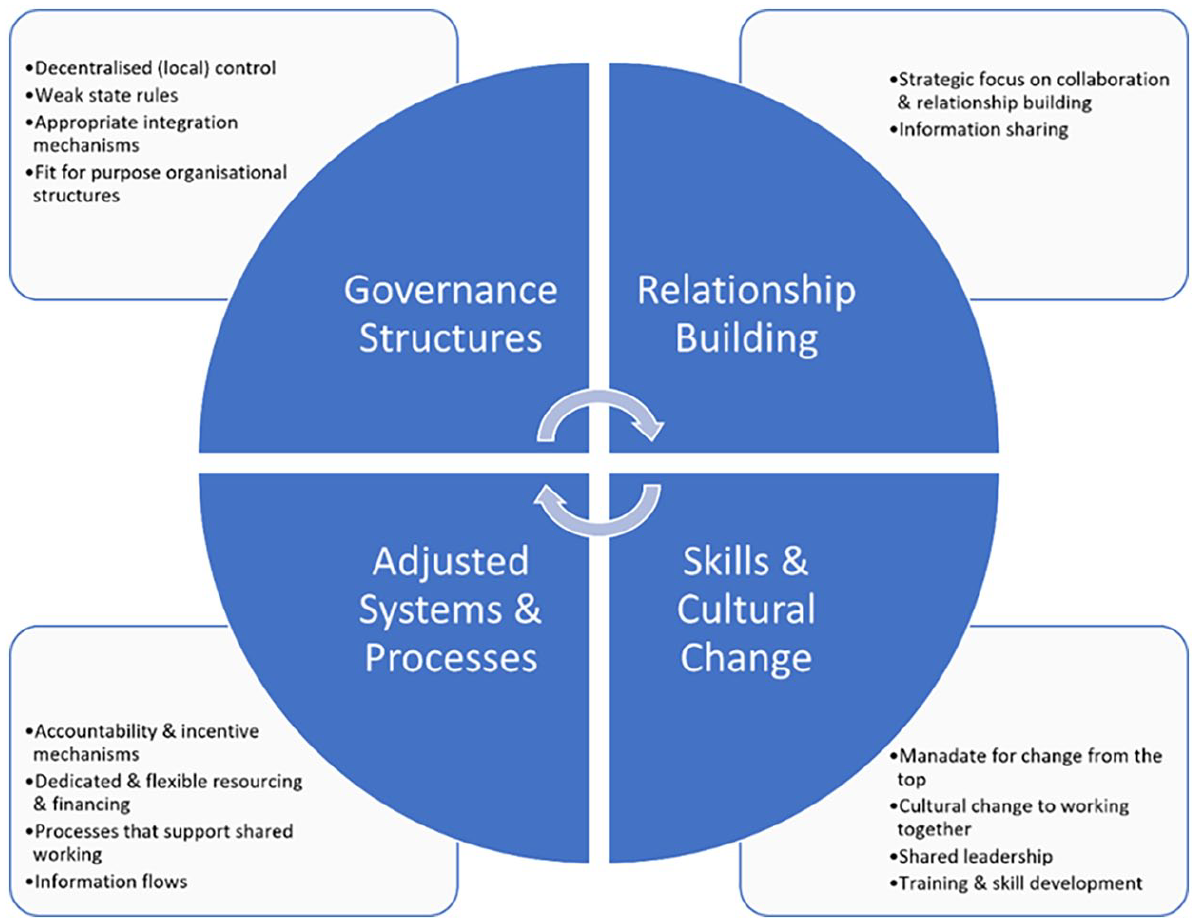
Key elements for distributed stewardship.
Although there is no single way to achieve joined-up work, the literature suggests a focus on ensuring that any initiatives are “fit for purpose,” where alignment of the intent and context of the initiative with the mechanisms and approach used for achieving joining up is important for successful outcomes. For example, a framework for distributed stewardship in the NDIS could include three levels: central government/government agencies, local market partnerships, and service providers. Local market partnerships could include local non-government actors involved in the NDIS such as advocacy organizations and independent information services as well as local level government (or government-commissioned) actors like Local Area Co-ordinators. Joining up the work of the three levels would require both horizontal (links at the same level) and vertical (links between levels) integration (Carey & Crammond, 2015) (see Figure 2) as well as incorporation of ing the key elements in Figure 1.
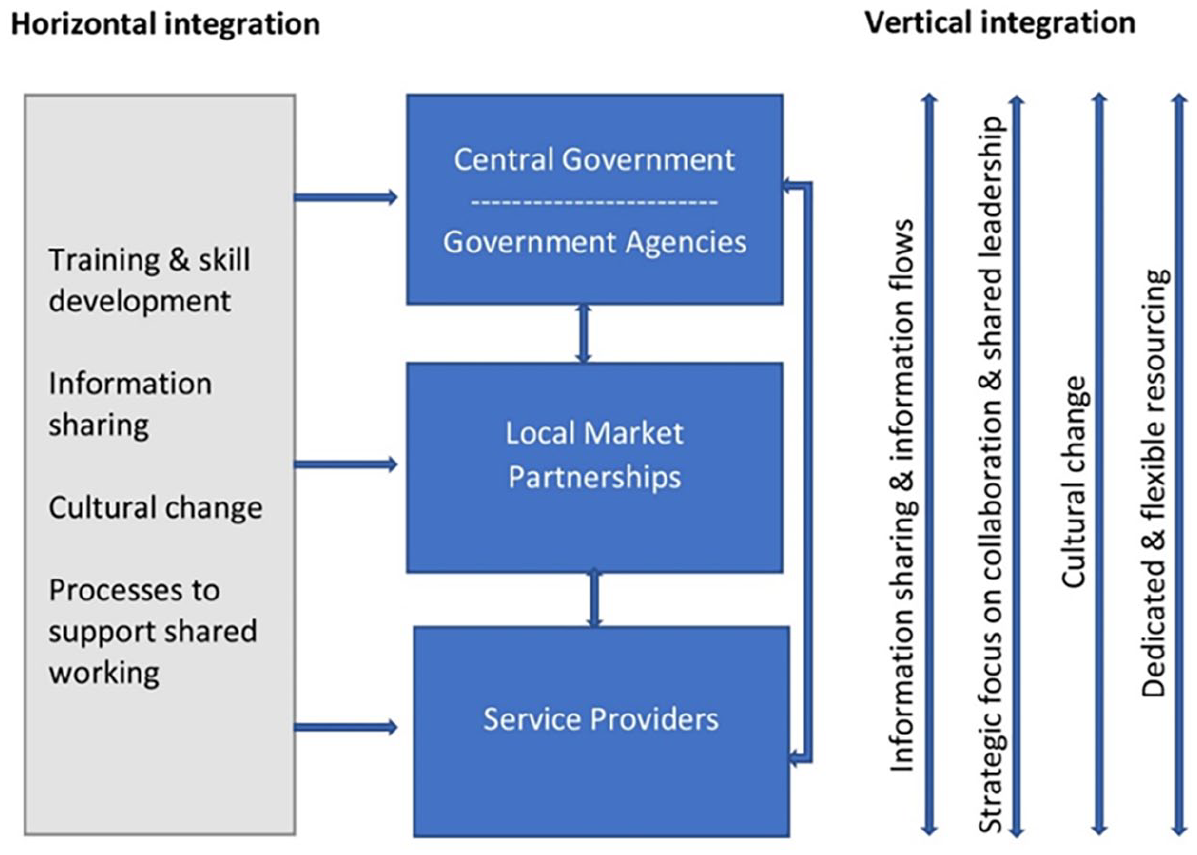
Horizontal and vertical links in a framework for distributed stewardship.
Such a framework would help define the stewardship roles of various actors and how they could be integrated in the system as well as provide flexibility for different local contexts such as rural and remote areas. For instance, as we identify in this study, service providers have an important role to play in sharing information about local market conditions. A framework for distributed stewardship would provide formal structures and processes to allow this information to be shared with both government agencies and other local actors such as advocacy organizations that are part of the stewardship system. Such as framework also would help indicate where appropriate roles for different stewardship actions lie, including whose responsibility it should be to offer advice and assistance to participants in navigating the scheme or to coordinate care. This could help avoid issues such as conflict of interest when service providers take on this role and reduce or eliminate the need for some providers (particularly in rural areas) to perform un-funded care coordination activities.
Further Research
Research shows that factors such as provider type (profit or not-for-profit), mission (the value of the organization), length of time in the market, and size (economies of scale and scope) can influence how different providers behave in quasi-markets (Defourny et al., 2010; Green et al., 2018). For example, Defourny et al. (2010) suggested that utilizing not-for-profit providers and promoting local services are more likely to result in locally responsive markets. These factors are also likely to impact service providers’ capacity and/or willingness to perform market stewardship activities. As we have shown, geographical location (e.g., being in a rural or remote area) also influences the types of stewardship functions providers carry out. Thus local market eco-systems may be an important factor in how willing or able service providers are to participate if a distributed stewardship framework is implemented. Further research could examine whether differences in provider type (not-for-profit vs. for profit, size, location) act as barriers or enablers to providers performing market stewardship activities and taking on market stewardship roles. This could provide useful information about the stewardship role of service providers in quasi-market contexts beyond the NDIS, where there are likely to be a range of provider types in operation. In addition, it could provide greater clarity on which (if any) stewardship roles are appropriate for providers to take on, whether these roles may be context dependent, and what types of support different providers may need if they assume a stewardship function.
As this study shows, providers also perform regulatory-type activities (such as care-coordination) that help ensure safety of participants. In 2018 the NDIS Quality and Safeguards Commission was established to regulate registered NDIS providers to guard against safeguarding failures and ensure quality services. However, literature on co-regulation suggests that in social care quasi-markets, non-government actors can play a role in helping regulate and improve quasi-market functioning. For example, van Toorn and Cortis (2022) showed how frontline disability workers mitigate potential risks and threats to service quality (in addition to their usual care work), thereby taking on “regulatory labour.” This occurs as a consequence of devolved responsibility, where a central regulatory agency sets the broad rules and regulations for a social care scheme and then those regulated (such as service providers) have the responsibility of translating them into particular actions. Alford and O’Flynn (2012) argue this contribution to outcomes by regulatees, via the devolution of regulatory responsibility to the local level, is what is usually meant by the term “co-regulation.” In the context of market stewardship, co-regulation can have an important stewardship function in ensuring safe and quality services. Yet, as we have discussed, in the NDIS these functions often are performed without government resources, and central agencies may not see them as stewardship functions. Further research might examine the benefits and downsides of co-regulation by service providers as non-government actors in quasi-markets in the context of their market stewardship role.
Conclusion
Without effective market stewardship the NDIS market risks not being able to deliver its policy aims; in a worse case scenario this could yield market failure. Our research shows a multitude of market challenges in the scheme that have resulted in service providers performing some stewardship roles for which they may not be best positioned. We suggest moving to a system of distributed stewardship in the NDIS that would help define and join up the work of local level and central government actors. Using principles of what works for achieving joined-up governance, we show how a preliminary framework for distributed stewardship could be developed. A limitation of this study is that it only examines stewardship from the perspective and actions of service providers. We suggest further research might examine how central agencies view their stewardship role and their awareness of the stewardship activities of service providers and other local level actors. This would help refine the development of a framework for distributed stewardship.
Supplemental Material
sj-docx-1-aas-10.1177_00953997241240070 – Supplemental material for Do Service Providers Play a Market Stewardship Role in Social Care Quasi-Markets, and Should They?
Supplemental material, sj-docx-1-aas-10.1177_00953997241240070 for Do Service Providers Play a Market Stewardship Role in Social Care Quasi-Markets, and Should They? by Celia Green, Gemma Carey and Eleanor Malbon in Administration & Society
Footnotes
Data Availability Statement
The datasets generated during and/or analyzed for the current study are not publicly available due to anonymity and data sharing conditions under the ethical guidelines on which this study was conducted. They are available from the corresponding author on reasonable request.
Declaration of Conflicting Interests
The author(s) declared no potential conflicts of interest with respect to the research, authorship, and/or publication of this article.
Funding
The author(s) received no financial support for the research, authorship, and/or publication of this article.

Supplemental Material
Supplemental material for this article is available online.
Author Biographies
References
Supplementary Material
Please find the following supplemental material available below.
For Open Access articles published under a Creative Commons License, all supplemental material carries the same license as the article it is associated with.
For non-Open Access articles published, all supplemental material carries a non-exclusive license, and permission requests for re-use of supplemental material or any part of supplemental material shall be sent directly to the copyright owner as specified in the copyright notice associated with the article.
