



Abstract
Which types of clients increase or decrease the trust of street-level bureaucrats (SLBs)? Using interviews and focus groups with two groups of Israeli social service providers—teachers and social workers—and comparing them, —we develop a theoretical framework for determining the types of clients who evoke and reduce the trust of SLBs. Our findings indicate that there are seven types of clients who inspire or diminish this trust: —cooperative, honest, familiar, benevolent, aggressive, open, and manipulative. We discuss the significance of our findings for the implementation and outcome of public policy and suggest several avenues for future research.
Introduction
The significance of street-level bureaucrats’ (SLBs’) relationships with their clients in shaping their discretion when delivering services is well known (Lipsky, 1980; Maynard-Moody & Musheno, 2003). However, in the literature little attention has been paid to the importance of trust between the players, specifically, the characteristics of the clients that influence the development of SLBs’ trust in them.
Trust is crucial in the process of delivering public services (Van de Walle & Lahat, 2017; Yang & Holzer, 2006). Trustworthiness has been found to be a driver of trust (Colquitt et al., 2007; Rotter, 1980;). Trust has also been linked to a willingness to risk vulnerability (Hoy & Tschannen-Moran, 1999; Lewis & Weigert, 1985), as well as to loyalty (Butler, 1991), cooperation (Deutsch, 1958), benevolence, and integrity (Mayer et al., 1995). However, for SLBs who have daily face-to-face interactions with their clients (Keiser, 2010), some elements of trust seem more relevant than others.
This distinction is especially important, because trust is a critical element of any social interaction between two parties (Kramer, 1999) and any exchange relationship. It is particularly important in the context of SLBs and their clients because the former base their decisions on the information that the latter give them (Lipsky, 1980). SLBs formulate expectations about the future conduct of their clients and on this basis decide how to allocate their limited resources (Davidovitz & Cohen, 2021a). Moreover, they are invested emotionally in their clients (Lavee & Strier, 2019). They may define their work through their interactions with them and may be willing to go far beyond the demands and restrictions of their jobs to improve their clients’ well-being (Maynard-Moody & Musheno, 2000). In contrast, and somewhat paradoxically, they may give priority to and even bend and break rules for clients whom they distrust to avoid being harmed by them. This tendency is particularly strong when SLBs work in situations where they believe their organizations will not support them in confrontations (Davidovitz & Cohen, 2020). It is therefore important to identify what types of clients evoke and reduce the trust of SLBs.
To date, there is no systematic theoretical framework that categorizes clients based on these criteria. We aim to provide such a theoretical framework by researching how SLBs evaluate their clients as the basis for trusting them and the impact on the decisions they make when providing them with public services. This study makes an important contribution to the public administration literature because the phenomenon may have a strong effect on the implementation and, as a result, the outcome of policy. We propose our theoretical framework based on empirical data collected from Israeli teachers and social workers.
Literature Review
Trust and Its Implications
Trust refers to the willingness of an individual to be vulnerable to the actions of the other, or a group or institution that has the capacity to harm or betray the trustor (Levi & Stoker, 2000; Mayer et al., 1995). Luhmann (1979) maintained that people have expectations about others’ behavior, and if they are confident these expectations will be met, trust emerges. Mayer et al. (1995) showed how vulnerability is particularly significant in this context. When one party puts itself in a vulnerable position, it takes a risk. Trust entails the willingness to take such a risk.
Trust is a significant element in social interactions (Kramer, 1999) and has major implications for behavior (McKnight & Chervany, 2001). Research relates trust to information sharing and cooperative behavior in negotiations (Dirks & Ferrin, 2001; Lewicki et al., 1998). Trust enhances cooperation; when party A believes party B is reliable, the former is more willing to take risks to help the latter (Mayer et al., 1995). Finally, trust results in a stronger commitment to a relationship (Campbell et al., 2010) and satisfaction with it (Cho & Park, 2011).
In contrast, distrust has often been linked to suspicion (e.g., Deutsch, 1958) and to information distortion (McKnight & Chervany, 2001). Distrust prompts defensive behavior that translates into non-cooperation (Brann & Foddy, 1987) and makes it extremely difficult to maintain effective relationships over time (Lewicki et al., 1998) or cooperate in accomplishing common goals (Goddard et al., 2001).
The public administration literature identifies trust as a key factor in the relationships of officials with the public (Bouckaert & Van de Walle, 2001; Yang, 2005). Van de Walle and Bouckaert (2007) found that public administration performance affects trust in government. Additionally, Grönlund and Setälä (2012) reported that the strongest determinant of citizens’ institutional trust is their satisfaction with policy outputs.
Research also emphasizes the importance of public servants’ trust in citizens (Lee & Yu, 2013; Van de Walle & Lahat, 2017; Yang, 2005; Yang & Holzer, 2006). Trust plays a crucial role in the delivery of public services, as public sector workers interact daily with citizens (Davidovitz & Cohen, 2021b; Vigoda-Gadot et al., 2012) and constantly risk the possibility that citizens will not do what is expected of them (Moyson et al., 2016). Thus, trust is important because of its possible effect on the actions of SLBs toward their clients when implementing policy (Davidovitz & Cohen, 2020). However, it should be noted that the impact of trust should not be exaggerated at the expense of the effects of quality or accountability of public services.
The literature has identified various elements antecedent to trust. Examples include honesty, openness, competence, benevolence, and reliability (Hoy & Tschannen-Moran, 1999), as well as cooperation (Deutsch, 1958), ability, integrity, and predictability (Wu et al., 2010). Studies have also identified the determinants of public officials’ trust in citizens: for example, their trustworthiness (Lee & Yu, 2013; Vigoda-Gadot et al., 2012), as well as their competence, honesty, benevolence (Yang, 2005), and integrity (Lee & Yu, 2013). As we will demonstrate below, similar elements that promote trust have been identified in the literature dealing with SLBs.
Street-Level Bureaucrats’ Evaluation of Clients and Its Relationship to Trust
SLBs have a strong influence on policy outcomes, mainly due to their considerable discretion (Döring, 2021; Jensen, 2018; Lipsky, 1980; Raaphorst & Loyens, 2020). They use this discretion to bridge the gap between the policy as designed and the real needs of citizens (Gofen, 2014). One factor influencing their discretion is their evaluation of clients (Lu et al., 2021; Raaphorst et al., 2018). This assessment underscores the need for trust, especially given the pressures under which SLBs function and the limited resources available to them (Lipsky, 1980).
These challenging organizational conditions lead SLBs to adopt practices categorizing clients in order to decide to whom and in what way to allocate resources (Davidovitz & Cohen, 2020). They determine which of their clients “deserve” favored service and to whom they should allot their time and energy (Lu et al., 2021). Signals they receive from them help SLBs label their clients as honest (Maynard-Moody & Musheno, 2003), trustworthy (Raaphorst & Van de Walle, 2018), or aggressive (Nguyen & Velayutham, 2018). These labels have a direct connection with the degree of trust they accord them. The labels also justify their investment in these clients, the expectations they have of them, and their resulting feelings of frustration and disappointment when their clients fail to fulfill them.
Studies have highlighted the characteristics and behaviors of clients which generate trust by public servants. Raaphorst and Van de Walle (2018) have shown how SLBs evaluate their clients’ trustworthiness by focusing on signals and cues. Moyson et al. (2016) examined existing literature on the determinants of public officials and found that they base their trust on citizens’ ability, integrity, and benevolence as expressed during interactions with them. A study by Sabbe (2020) found that probation officers assess the trustworthiness of offenders according to their own tendency to trust and the way they perceive their role. After evaluating offenders, probation officers are more likely to target their benevolence toward those they perceive as more deserving because they are trustworthy, and those in immediate need of help and care who do not pose a risk to the community.
While studies have dealt with the issue of trust between different groups of frontline workers and their clients in varied disciplines, there is still no theoretical framework identifying the attributes of clients that prompt SLBs to trust or distrust them. Given the unique relationship between them, a specific theoretical perspective regarding SLBs’ trust in clients is called for. Our goal is to create such a framework.
Research Design
This study is part of a larger project examining the importance of trust in street-level work. It explores the role of trust in the relationship of SLBs with their managers as well as clients and its impact on the public policies they are required to implement. The present study focuses on categorizing clients based on the degree to which they inspire trust or distrust in SLBs.
We found the qualitative constructivist method most applicable, as it allowed us to learn about respondents’ feelings, attitudes, perceptions, and experiences from an individual perspective, while taking into account the broad context of the organizational and political environment in which they operate. It also helped us learn about phenomena in their natural setting and interpret them according to the meaning individuals attribute to them (Denzin & Lincoln, 2008). We constructed our theory abductively based on the empirical data we collected.
Tools and Procedure
We collected our data through in-depth semi-structured interviews and focus groups. The focus groups helped us complete the picture we obtained from the interviews. We selected two groups (teachers and social workers) because both are considered classic examples of SLBs with a great deal of discretion in their daily interactions with policy clients (Lipsky, 1980). These groups are also often characterized by long-term relationships with policy clients, which help establish trust between the parties (Davidovitz & Cohen, 2020). Since trust is a dynamic, reciprocal element that evolves over time during a relationship (Serva et al., 2005), these cases were useful for examining our research questions.
In-depth interviews
Between July 2019 and January 2020, we conducted 61 interviews with social service providers in Israel: 32 social workers and 29 teachers. Given the sensitivity of our research topic for some of the participating populations, we used convenience sampling. We were successful in obtaining a sample that represented all the different geographical and social sectors of our research population. Furthermore, the social workers who participated in the study came from diverse professional fields. They worked with people with special needs, the mentally handicapped, young children, adolescents at risk, victims of domestic violence, toddlers with autism, toddlers at risk, the elderly, and young people who were orphaned. The teachers who participated in the study came from elementary, middle, and high schools. They taught a variety of subjects including physical education, geography, mathematics, history, citizenship, literature, art, and biology.
We first recruited participants by professional position and type of relationship with policy clients. The first contact with all respondents was by phone. During the initial conversation, we described the research as dealing with how public administration employees cope with their clients and managers, as well as their attitudes toward the policies they are required to implement. To avoid bias in the respondents’ answers and to maintain objectivity in the data collection process, we did not indicate to our interviewees that the study dealt with the issue of trust. Most potential participants agreed to take part in the study. All interviews were conducted face-to-face, recorded, and transcribed by the authors.
We asked interviewees open-ended questions to avoid bias in their answers. The questions were designed to elicit the role of trust in their relationships with clients. We asked them to describe and give the reasons for the factors that lead them to trust their clients and to characterize those clients in whom they have a great deal of trust and those in whom they have little trust. An example of a typical interview and the questions that guided us can be found in in Supplemental Appendix 1. Since trust is a vague term (McKnight & Chervany, 2001), to clarify our definition of trust, we explained to each participant that it referred to the willingness of one individual to be vulnerable to the actions of another party who has the capacity to harm or betray them (Levi & Stoker, 2000; Mayer et al., 1995).
Focus groups
We conducted two focus groups, one with 12 social workers and one with 10 teachers. The aim of the focus groups was to cross-reference and validate the information gathered in the interviews with that obtained through a group discussion examining the same phenomena. Adopting this approach helped us examine the conclusions from the analysis of the interviews and obtain answers from a relatively wide range of participants in a relatively short period of time (Morgan, 1996). To build the focus groups, we contacted two potential participants over the phone (one social worker and one teacher) and asked them to help us organize a group in their professional organization. We then drafted an email explaining the research goals and the need for participants. Most potential participants responded positively to our request. All participants were in direct contact with policy clients as part of their work as public officials. The discussion focused on describing relationships with clients, how they evaluate their clients, and the various factors they see as promoting or impeding their trust in clients. We leveraged the group framework to raise issues for discussion, so that the participants brainstormed the most critical client characteristics identified with inspiring trust.
Analytical procedure
We applied the theory-based open-coding approach (Strauss, 1987) using ATLAS.ti software (eighth edition). We first identified several key elements our respondents described as characterizing the clients in whom they had a great deal of trust or little trust. Next, we consolidated similar responses using second-level coding (Miles & Huberman, 1994) to identify the frequency of emerging themes. By consolidating our findings into combined categories, we were able to identify which clients increased or reduced the trust of SLBs in them.
Considering the challenges of validity and reliability associated with the qualitative research paradigm (Noble & Smith, 2015), we took several steps to address the issue. First, we dealt with each interview immediately after conducting it. In addition, to increase the reliability of the analysis, the two researchers were both involved in the coding process. We also considered the researcher’s position in order to deal with the issue of reflexivity (Srivastava & Hopwood, 2009). Although we conducted the interviews and focus groups while interacting directly with the research informants, we nevertheless maintained a reasonable distance from the participants in order to avoid bias in the interpretation of the data. During the data collection process, we documented field notes to facilitate transferability (Guba, 1981). We also recruited a research assistant to examine the research data to critically identify possible biases. Finally, we recorded a methodological diary detailing any relevant reference which might be linked to possible bias on the part of the researchers or participants.
There is an overlap between some concepts that are identified with trust such as honesty and openness. In addition, it is difficult to create a clear empirical distinction between them (Romero & Mitchell, 2018). However, we followed the distinctions in the literature in the analysis of our data. By doing so we were able to emphasize that trust, honesty, and openness although indeed similar are distinguishable elements.
Findings
Our findings afforded us several key insights. First, we were able to categorize clients into seven categories with regard to the trust or distrust they inspired in SLBs: (1) the cooperative client; (2) the honest client; (3) the familiar client; (4) the benevolent client; (5) the aggressive client; (6) the open client; and (7) the manipulative client.
Second, our findings demonstrated that while some client characteristics appeared to increase trust and some appeared to reduce trust, there were characteristics with the potential to both increase and decrease trust. Honesty, cooperation, benevolence, openness, and familiarity usually increased trust. On the other hand, manipulation and aggression mainly proved to decrease trust. The absence of honesty, cooperation, and benevolence usually led to distrust.
Third, our findings also illustrated that there is a connection between the categories of the honest and the open client.
Fourth, a comparison between the groups revealed similarities and differences between teachers and social workers in the prevalence of each trust-related category.
The Cooperative Client
Thirty interviewees (49%) mentioned that clients who cooperate with them inspire their trust. Studies have highlighted the relationship between clients’ cooperation and SLBs’ perceptions of them (Belabas & Gerrits, 2017). Mead (1937) defined cooperation as working toward a common goal. Deutsch (1949) expanded this definition, claiming a situation is cooperative when goals are mutually shared and positively related to one another. Our participants defined cooperation in a variety of ways. For instance, they regarded clients as cooperative if they arrived on time, visited the office regularly, and expressed willingness to accept the service offered. They interpreted these actions as signals that justified their investment of resources in them. These actions also gave the SLBs confidence that their clients’ future behavior could be anticipated, thereby creating their trust. In the words of several social workers: My trust is high in clients when I see they arrive regularly, arrive on time. Actually, when I see that they really want to accept the service. (interviewee 6) I trust clients who come here regularly, who take this place seriously, when I feel they take me and the process seriously too. (interviewee 22)
Clients who cooperate by accepting services are considered “hard working” clients who make considerable efforts to help themselves (Anagnostopoulos, 2003). Maynard-Moody and Leland (2000, pp. 117–118) described these motivated clients as “examples of strength and dignity” despite the difficulties they face. SLBs regard them as “good” clients who are morally “worthy” of the service offered. Hoy (2002) found that teachers trust students and parents when they cooperate with them to achieve common goals. Our interviewees also defined cooperation as the willingness to work together to achieve goals. They interpreted this willingness as compliance with an unwritten contract between two parties according to which both are partners in the success of the joint endeavor. Cooperation signaled to SLBs that they could assume that these clients would do what was asked of them, and this likelihood increased their trust. Asked to describe clients she trusted, one social worker said: “They are families that I feel are really cooperative, that we work mutually for the child’s benefit and that we all see it together. That there is mutual appreciation, and we all do everything to advance the cause” (interviewee 16).
Our participants mentioned that the clients’ cooperation is also reflected in their actions. Those who engage with and take responsibility for the success of the service indicate their cooperation with their deeds. In the words of one social worker: If I see parents’ interest, that they report, update, contact me for consultation, do the right thing [then they are trusted clients]. For example, parents of boarding school teenagers who make sure to give me the required reports on time. Parents who come to visit their children in boarding school are serious. Parents I recognize as responsible, persistent, and proactive. (interviewee 9)
A social worker in the focus group elaborated: My degree of trust depends on the cooperation of the client, when there is a goal to build a plan together, at eye level. It is also an expression of the client’s credibility. It is the resonance of the trust that the client gives us back and it is the basis of the relationship.
Our participants also described how, on the other hand, the absence of cooperation on the part of clients led to distrust. For example, two social workers described clients in whom they professed to have little trust: Some clients did not cooperate or on the face of it said yes to everything but acted differently. (interviewee 28) There are patients who disparage, who are late, who do not update [when they do not come]. (interviewee 6)
The Honest Client
Forty interviewees (66%) indicated that honest clients who kept their word increased their trust in them. According to Hoy and Tarter (2004), “Honesty is the truthfulness, integrity, and authenticity of a person or group” (p. 254). It “refers to the extent to which the other is perceived to tell the truth and keep commitments” (Grimmelikhuijsen et al., 2013, p. 577). Honesty is a significant element in creating trust (Dinc & Gastmans, 2013). Dishonesty and corruption in institutions involved in implementing policy lead to a decline in trust in these institutions (Grönlund & Setälä, 2012). When public officials demonstrate honesty, public trust in them increases (Wang & Van Wart, 2007). Our findings revealed that when clients were honest, they conveyed a message to SLBs about their integrity and authenticity. SLBs believed the information provided by these clients, felt less suspicious about their motives when interacting with them and therefore, trusted them. A teacher explained: “I have trust in the students who have proven my trust in them. Honest, truth-telling students who cling to truths and do not seek to tell stories, those who stand behind their words” (interviewee 20).
Maynard-Moody and Musheno (2003, p. 120) reported that to determine if clients are “worthy,” street-level bureaucrats conduct an “honesty test” when they first meet them. Similarly, asked to describe what might lead her to trust clients, a teacher stated: When I get to know new clients [students], I try to see if the other party can be trusted, if the client [student] proves it in his actions. When I realize there is a partner who’s honest, I can trust him. It’s different with clients [students] who say “yes” about things and do nothing. (interviewee 3)
The SLBs indicated that they knew how to identify clients who were not honest. Based on their experience, they could tell whether clients were distorting information in order to get what they wanted or whether they were telling the truth. Attempts to distort the truth affected the degree of trust they had in their clients. A social worker explained: “Some patients are untrustworthy. They do not tell the truth, they say things we want to hear, and we can tell. We can feel when someone is not authentic” (interviewee 6).
Similar statements were made by social workers in the focus group. As one participant described: “There are those [clients] that I initially think are very honest and genuine. But experience makes me put those thoughts aside. I have already learned to notice if there is honesty on the other side [on the part of the client].”
Respondents indicated that they began by trusting their clients and continued to do so only provided that trust remained unviolated, the clients stood by what they said, and took responsibility for their actions. As one teacher described: “I discovered that one student lied to me once, and then his parent lied to me once. The second time you check [the information provided by them] and you completely lose your trust in them” (interviewee 7).
Respondents tended to regard clients who seek assistance and share their vulnerability as authentic and honest, raising the level of their trust in them. As two social workers stated: I feel I have trust when there’s honesty. This week, for example, a mother came to me asking for help. She said: “I want to be a good mother for my child. I’m scared and I need help.” I can say that her ability to say that with such honesty and authenticity engages me. (interviewee 18) I trust clients who admit their vulnerability, clients who have a degree of reflexivity, that something in the dialogue. . . (interviewee 7)
The Familiar Client
Familiarity with the client was also a factor in promoting trust. Twenty-four SLBs (39%) explained that a longer acquaintance with clients allowed them to develop closer personal relationships, which, in turn, increased their level of trust in them. Familiarity is defined as understanding, often based on previous interactions, learning and experiences (Gefen, 2000). Gulati and Sytch (2008) argued that prior interaction based on familiarity enables people to develop confidence in each other’s trustworthiness. Although familiarity with a person’s past behavior cannot guarantee that that person will act as expected, previous interactions in which the other party has acted as expected do increase trust (Gefen, 2000). Interactions between certain types of SLBs and clients are prolonged. As Maynard-Moody and Musheno (2003) suggested, in these relationships workers and citizens are more likely to understand each other. Our participants’ statements emphasized that trust is indeed a dynamic element that develops throughout the progress of a relationship. As the acquaintance deepens, the feeling of vulnerability and suspicion of one party toward the other decreases, allowing for the possibility of trust.
I trust clients when I have a long acquaintance with that person. There’s a student whose brother was my student, so I’ve known the family a long time; I feel differently about him. [teacher] (interviewee 1)
In both focus groups similar observations were made. One teacher said: “Thanks to the long-term relationship with the students, they feel committed [to us].”
Respondents indicated that their personal, long-term relationships helped them determine whether a client’s behavior was consistent. Their long-term relationship also helped them anticipate their clients’ future behavior, which increased trust in them. In the words of one social worker: Trust rises when it’s mutual, a long acquaintance. If adhered to in a therapeutic relationship and the patient is constant, consistent, then trust in him will be maintained. (interviewee 14)
The length of the acquaintance with clients also makes the interaction with them more productive, increasing trust in them. One social worker stated: I trust clients who over time I have come to know more. There are people here who have moved with me from previous work, I’ve known them five years, my trust in them is higher, it gives me more confidence working with them. (interviewee 22)
The degree of familiarity with a client does not necessarily lead to greater trust. For example, some clients may have a poor reputation that is self-reinforcing over time. In such cases, familiarity leads SLBs to be wary of them rather than trust them.
My trust in the client depends on my experience with this person over time. If that person has threatened me, or raised his voice in the past, I ask the guard and my colleagues in advance to back me up. (social worker, focus group)
The Benevolent Client
SLBs also trust benevolent clients. Often, benevolence is accompanied by other trust-related elements, such as honesty and perceptions of non-manipulative behavior. Thirty-nine interviewees (64%) indicated that perceptions of their client’s benevolence were associated with their trust in them. The literature points to benevolence as a significant element in achieving trust (Huff et al., 2002). According to Mayer and Gavin (2005), “Benevolence is the trustor’s (i.e., the trusting party’s) perception that the trustee cares about the trustor” (p. 874). Benevolence refers to the extent to which one party wants to do good for the other (Colquitt et al., 2007), rather than acting opportunistically (McKnight & Chervany, 2001). Research claims that loyalty, openness, supportiveness, and caring are often regarded as synonymous with benevolence (Mayer et al., 1995).
When the participants regarded their clients as lacking benevolence, they reported a decreased level of trust in them.
There are parents of students of whom I can really feel the intentions behind their behavior. They don’t give credit; they blame the system. Our trust in them is low because they are against us. [teacher] (interviewee 11)
Raaphorst et al. (2018) reported a relationship between clients’ signals of good intentions and SLBs perceptions of them as trustworthy. Trustworthiness, in turn, is significant in how SLBs see the behavior of their clients (Raaphorst & Van de Walle, 2018). Respondents described signals from clients that allowed them to infer their intentions. Certain actions, such as clients’ recording their phone calls, aroused the suspicion of the participants. Such actions made the SLBs feel vulnerable when interacting with these clients. Thus, suspicions of clients’ intentions also have implications for trust in them. As two social workers, the first a participant in the focus group, and the second an interviewee explained: There’s a small group of clients in whom my trust is low. I have to be very careful with them. I feel they’re looking to get me, to record me, to quote me if I say something wrong. Some people are more suspicious. I know they record me; they do it many times because of their survival motive. (interviewee 15)
Participants also referred to the potential of harm from these clients. They described some whose motivations or intentions were not necessarily pure. The potential for harm intensified when clients were regarded as influential enough to upset the balance of power between the parties, which immediately affected trust in them.
There are parents with whom I am more careful. I keep my cards close to my vest. Something [in the interaction with them] feels that it will come against me later, that they might go and report to the administration or the Ministry of Education something specific [negative] about me. [teacher] (interviewee 12)
The Aggressive Client
Thirty-one interviewees (51%) reported a lack of trust in aggressive clients. Bushman and Anderson (2001) defined aggressiveness as any human behavior occurring with the immediate intention of causing harm to another. In this category, too, are behaviors that the participants believe will harm the person who is the target and that the target wants to avoid. Perceptions of behavior as aggressive depend on subjective judgments about causality and intent (Bandura, 1973). Aggression can be expressed physically, verbally, and non-verbally (Buss, 1961). Such behavior signaled to SLBs that they must be careful and avoid taking risks in interactions with these clients, in whom they naturally have little trust: “I don’t trust aggressive clients who constantly blame the educators and the system” [teacher] (interviewee 3).
Aggressive client behavior has implications for the functioning of frontline workers (Davidovitz & Cohen, 2021c). For example, in their systematic review of literature on nurses, Needham et al. (2005) found that clients’ aggressive behavior toward them had many non-physical consequences such as fear, anxiety, post-traumatic stress disorder, guilt, and self-blame. One of the issues involved in dealing with these clients was the nurses’ vulnerability. The broad context of trust concerns the issue of vulnerability. In fact, when there is no vulnerability, no trust is needed (Tschannen-Moran & Hoy, 1998). It is not surprising that aggressive clients are considered particularly challenging to SLBs.
Respondents described situations where their clients cursed, bullied, and harassed them. Such actions highlighted how the power relations between the parties could be reversed. When SLBs met with aggressive clients, they were put at a disadvantage and felt insecure in their interactions with them. Such behavior immediately put SLBs in a defensive position, fearing possible harm.
There are many students who treat me badly, who curse me, say nasty things, threaten me and behave violently towards me. I don’t trust them. I had a student who traumatized me. It was really personal. I couldn’t see her anymore. I felt so much pressure when I saw her. I realized that I couldn’t take it anymore. She brought me to the brink. [teacher] (interviewee 9) My trust is low in clients for whom I can feel in advance that their response will be harsh, aggressive, that [their actions] are unexpected. I know in such situations to organize the environment; accordingly, I even inform the guard in advance. [social worker] (focus group)
SLBs repeatedly described being faced with threats, shouting, and intimidation. These aggressive clients made them feel that they needed to be careful, consider their words and walk on eggshells to avoid a confrontation. In such situations, there was a built-in suspicion in the relationship between the parties, which led to an immediate lack of trust: I have a case of a mother of one of the boys I’m responsible for. She’s very aggressive, screaming, threatening, denigrating the social workers, degrading the municipality. [social worker describing client in whom she had little trust] (interviewee 9) [My trust is low] based on past experience. If a person threatens, raises his voice, I will ask colleagues to be available [to help me]. [social worker] (focus group)
The Open Client
Twenty interviewees (33%) claimed that clients who seemed open inspired their trust. Openness involves people making themselves vulnerable to others by sharing personal information about themselves (Mishra, 1996). Openness is considered to be associated with benevolence (Mayer et al., 1995). As Goddard et al. (2001) highlighted, the openness of one party signals a kind of mutual trust that the information provided will not be used against them. In return, confidence in the other party increases. SLBs regarded such openness as beneficial to mutual interaction, as an expression of trust and a greater willingness to accept the service. The result of their clients’ openness was the increase of their trust in these clients: I feel more trust in clients who are more open, who share things. I feel they trust me. When they share with me the change they want to make, it boosts my trust. [social worker] (interviewee 18) My trust is greater in clients who have a sense of openness; conversations flow with them and they are deeper. [social worker] (interviewee 5)
Open revelations from clients seemed to make SLBs feel more comfortable interacting with them. The deeper level of personal connection confirmed their trust. The active exchange increased the reciprocity in the trust between the parties. When clients express openness, they signal to the SLBs that they are willing to accept the service and trust that the SLBs will do the best they can for them. Such signals increase the SLBs’ trust in them: As client openness increases, intimacy deepens, and then I feel much more comfortable with my clients and trust them. [teacher] (interviewee 19) Clients whose trust is greater are more open clients, more sociable, we talk a lot more on the phone. It creates a positive feeling in both directions and then it also leads to trust. [social worker] (interviewee 4)
The Manipulative Client
Twenty-six interviewees (46%) mentioned that manipulative clients inspired a lack of trust. Gunderson (1984) defined manipulation as “those efforts by which covert means are used to control or gain support from significant others. Typical ways include somatic complaints, provocative actions, or misleading messages, as well as self-destructive acts” (p. 5). Bowers (2003) claimed that manipulation is an activity undertaken “to achieve a desired goal (perverse or normal, symbolic or real) using deception, coercion, and trickery, without regard for the interests or needs of those used in the process” (p. 325). SLBs have less trust in clients whom they feel want to advance their personal goals, even at the expense of hurting the service provider: If this is someone who I feel is manipulative, saying things to get things, I don’t trust him. [social worker] (interviewee 15) I’m very suspicious of parents. They’ll be fine with you when their child is fine, but when you do something they don’t like, they’ll go to the administration behind your back. There are many instances of parents who were fine with you face-to-face and when something dissatisfied them, they gossiped about me behind my back in the parents’ WhatsApp [social media platform] group. [teacher] (interviewee 12)
Maynard-Moody and Leland (2000) argued that bureaucrats find it difficult and unpleasant to work with manipulative clients. They label them as “troublemakers” (Maynard-Moody & Musheno, 2003). They are suspicious of these clients because their motives are sometimes hidden, so they regard them as untrustworthy (Raaphorst & Van de Walle, 2018). Our participants regarded those who intentionally sought to mislead and hurt them as manipulative. It made them feel suspicious, doubt their motives and exercise caution in the interactions they had with them. Therefore, they had little trust in such clients: - I don’t trust clients who have a tendency flip over in a second, which is manipulative, [it’s] very sensitive. I’m very careful when interacting with them. [social worker] (interviewee 14)
Our participants also regarded those who resort to intimidation as manipulative. The SLBs viewed attempts at manipulation as attempts to make them vulnerable. As a result, they feared being harmed by such clients. Certain clients had the power to undermine the authority of SLBs to their faces. According to a teacher: A child or adult tells me something and eventually I realize this is a very manipulative way to take me to his comfort zone, and I know from experience it’s manipulative, so I don’t buy it. I have a gifted student [as a client]. Everything I say, she cries and gets melodramatic. (interviewee 3)
Relations Between Categories
Our findings revealed that some of the categories we identified are interrelated, and described in conjunction with each other by our participants. Thus, we recognize that there is a connection between clients’ openness and their honesty. Public servants must rely on the information they receive from citizens (Moyson et al., 2016). Greater openness from clients may convey a message to SLBs that clients are being honest with them. Our participants emphasized the relationship between the openness and honesty of their clients, regarding clients who were more open as also more honest. The combination of factors increased their trust in them. Openness indicated the willingness to share information and the honesty of the communication, underscoring the strong connection between these elements.
My trust is high in clients who show honesty and openness. When they openly share with me what they are going through. [social worker] (interviewee 2) When students are open and honest, I feel they can be trusted. [teacher] (interviewee 10)
A Comparison of Teachers and Social Workers
Given the lack of literature comparing SLBs from different professions (Gofen et al., 2019), our empirical data gave us a unique opportunity to compare SLBs from two different groups (teachers and social workers) operating in the same cultural and institutional context. The comparison provided us with interesting insights into the similarities and differences in the elements affecting trust in clients in each of the groups.
Table 1 indicates the number and frequency of repetition of trust-related elements for teachers and social workers. Our analysis reveals that the two groups of SLBs exhibit certain commonalities. Both indicate that their perceptions of clients’ willingness to cooperate, honesty, benevolence, openness, and tendency to engage in manipulative behavior as well as their degree of familiarity with the client are important factors related to their trust in them. Furthermore, the emphasis they place on these factors is fairly similar. However, they differ with regard to the issue of clients’ aggressiveness. Twenty (65%) of the social workers referred to this issue as important in affecting the trust they had in their clients. In comparison, only 11 teachers (35%) talked about this factor.
Comparative Frequency Between Teachers and Social Workers Characterizing Types of Clients Inspiring Trust/Distrust.
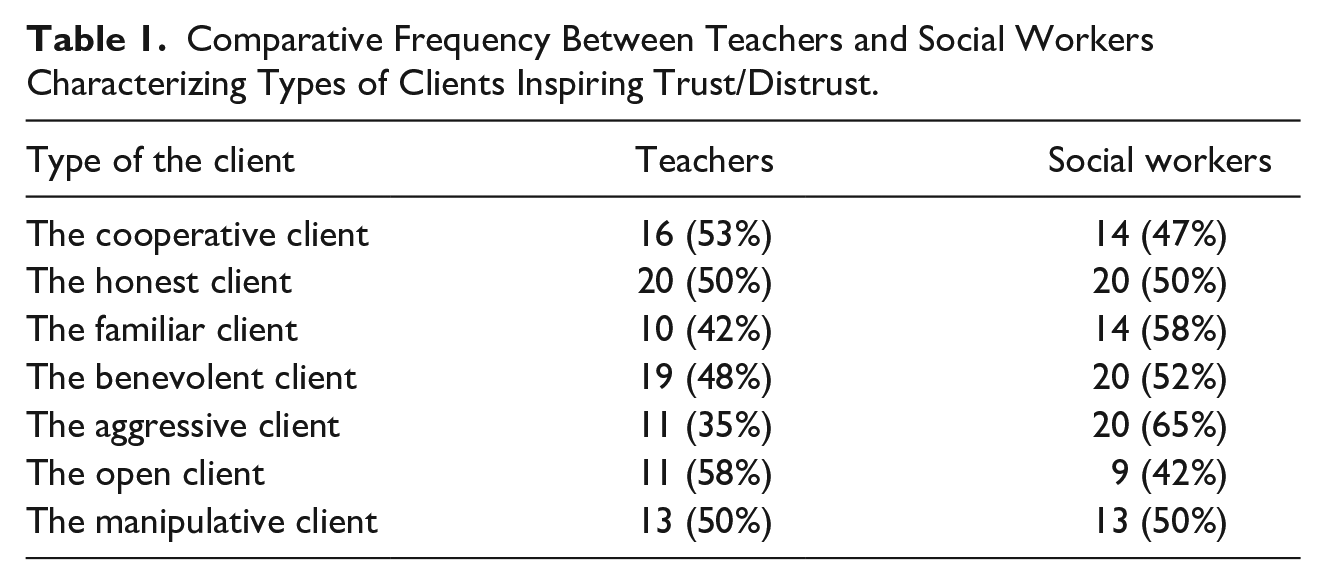
Given the work environment of social workers, who routinely interact with aggressive and violent clients, this result is not surprising (Enosh et al., 2013). These frontline employees are required to serve clients from marginalized populations, such as people living in poverty and domestic violence (Keeling & van Wormer, 2012; Weiss-Gal et al., 2009). Such potentially threatening situations underscore the importance of trust in clients. As our social workers explained: We have parents and children at risk here. There are parents who I feel quite clearly are doing problematic things [for their children]. I think these are clients who want a lot of financial help, who have reports from the various systems, especially from schools – clients who hurt their children and clients who do not work. Many of them are aggressive and violent; they greatly undermine the trust of social workers. (interviewee 7) We have clients here with a high level of violence. Both towards me and towards their family members. I’m not talking about one-time anger or frustration. You can feel it is dangerous. I have little trust in them and work with them very carefully. (interviewee 20)
Discussion and Conclusions
In line with numerous studies dealing with how SLBs see their clients (Maynard-Moody & Musheno, 2003; Raaphorst & Van de Walle, 2018), we categorized these clients based on whether they inspire trust or lack of trust in SLBs. While an extensive body of literature has analyzed the factors influencing trust in the relationship between public officials and the citizens they serve (Van de Walle & Lahat, 2017; Yang & Holzer, 2006), there has been no theoretical framework classifying clients based on the level of trust they inspire. Such a framework is of consequence for public administration, because the phenomenon may have a major impact on policy implementation process and outcomes (Davidovitz & Cohen, 2020).
In general, our findings reveal seven types of clients: (1) the cooperative client; (2) the honest client; (3) the familiar client; (4) the benevolent client; (5) the aggressive client; (6) the open client; and (7) the manipulative client. Like Raaphorst and Van de Walle (2018) who showed how SLBs evaluate their clients’ trustworthiness by focusing on signals and cues, our findings also highlight how SLBs derive their trust in clients from the signals they receive from them. Similar to the findings of Moyson et al. (2016), our research reveals that the benevolence that clients exhibit in interactions with them increases SLBs’ trust. Since honesty is directly related to integrity, our findings also reinforce their research on the importance of client integrity as a factor that inspires the trust of public officials.
Our study provides three main theoretical insights in this regard. First, we propose a theoretical framework for distinguishing among the specific types of clients who inspire SLBs’ trust or distrust. This framework is likely to be applicable to additional types of SLBs such as nurses and physicians whose relationships with clients have similar generic characteristics. They are also frontline employees who often have long-term relationships with their clients, giving them time to determine their level of trust in them. Second, while studies have highlighted the impact of SLBs’ evaluations of their clients on their discretion in implementing policy (Davidovitz & Cohen, 2021c; Sabbe et al., 2020) this research explores the implications of various categories of clients, some of whom increase SLBs’ sense of vulnerability, risk, and hesitation in their work. Our investigation reveals that the expectations they form about their clients create the basis for how they evaluate them. In so doing, we provide theoretical insights into the elements important for SLBs to trust their clients and create a theoretical platform for understanding the consequences of that trust for their discretion. They may regard clients in whom they have greater trust as more “worthy” (Maynard-Moody & Musheno, 2003) and therefore invest in them, giving them more time, attention, and resources. Third, by studying both teachers and social workers our study addresses need for empirical comparative investigations of different groups of SLBs (Gofen et al., 2019).
Our research has practical implications. First, it should improve managers and decision makers’ understanding of which types of clients increase and decrease the trust of SLBs and train the latter how best to deal with them. Second, since we know that SLBs’ classification of clients may lead to biases in treatment and the degree of trust they inspire may be influenced by cultural, racial, and gender stereotypes, it is worthwhile to promote training that will increase SLBs awareness of factors affecting their client assessments. This should promote social equity.
The study has some limitations. First, our conclusions relate only to social workers and teachers who usually have long-term relationships with clients. It is questionable whether we can generalize our findings to SLBs, such as police officers or firefighters, who have short-term relationships or even single encounters with clients. For these types of SLBs some of the categories we have identified (such as the degree of familiarity with the client) may be irrelevant in creating trust. The insights presented here are specific to time, place, and policy content. Thus, we do not claim that precisely the same mechanism will operate in all circumstances. Nevertheless, although additional factors may influence particular groups of SLBs differently in other contexts, the theoretical insights presented here underscore the important role of trust in SLBs’ interactions with clients.
Second, our findings are based on our subjective analysis, so there may be biases in drawing conclusions from them, especially between overlapping and related elements. For example, when our participants referred to a client’s openness, it may be perceived as cooperation or honesty. It should be noted that a single clients may fit into several categories (such as open, benevolent, and honest) and it is conceivable that a client exhibit combination of all the characteristics we have described. However, our goal in this article is to create a distinction between the various elements that we have empirically identified that increase and diminish trust in clients. Third, as in other studies that are based on similar research designs, our independent and dependent variables were measured using the same data source. Doing so could raise the issue of common source bias that is often discussed in relation to quantitative studies, but seldom raised for qualitative studies such as this one. Therefore, we should limit drawing any conclusions about a causal relationship between the clients’ attributes and trust. Fourth, since trust between public servants and citizens is based on broader social factors (Rothstein & Stolle, 2008; Van de Walle et al., 2008), our research may also have limitations regarding drawing conclusions about SLBs in other countries. In such cultures, they may have a different level of social capital. There might also be differences between policy areas in the level of trust in clients, and national differences in social capital. We are aware that it may be problematic to generalize findings from one case study to other contexts (Flyvbjerg, 2006). However, since SLBs in countries worldwide have similar characteristics, our research findings can be generalized with caution.
Future studies might further illuminate the elements identified with SLBs’ trust in their clients by using additional methods, such as experimental research sets. In addition, studies might address the implications of trust for the discretion of SLBs and improve our understanding of how trust influences policy implementation. Replicating the study with other frontline workers, such as physicians and nurses, whose interactions with clients are often long-term and ongoing, and also with police officers and firefighters who may have only a single encounter with citizens, would be useful. In the latter context, SLBs may be more likely to base their trust/distrust in clients on racial, ethnic, or gender characteristics because they are recognizable at first meeting. Future studies should address this issue.
Supplemental Material
sj-docx-1-aas-10.1177_00953997211061686 – Supplemental material for Which Clients Inspire or Reduce the Trust of Street-Level Bureaucrats?
Supplemental material, sj-docx-1-aas-10.1177_00953997211061686 for Which Clients Inspire or Reduce the Trust of Street-Level Bureaucrats? by Maayan Davidovitz and Nissim Cohen in Administration & Society
Footnotes
Declaration of Conflicting Interests
The author(s) declared no potential conflicts of interest with respect to the research, authorship, and/or publication of this article.
Funding
The author(s) received no financial support for the research, authorship, and/or publication of this article.

Supplemental Material
Supplemental material for this article is available online.
Author Biographies
References
Supplementary Material
Please find the following supplemental material available below.
For Open Access articles published under a Creative Commons License, all supplemental material carries the same license as the article it is associated with.
For non-Open Access articles published, all supplemental material carries a non-exclusive license, and permission requests for re-use of supplemental material or any part of supplemental material shall be sent directly to the copyright owner as specified in the copyright notice associated with the article.
