



Abstract
While deliberative citizens’ assemblies and plebiscitary referendums have long been perceived as antithetical, the idea of combining the two democratic instruments for better connecting administration and society has come to the fore in both theory and practice in more recent years. In this article, three ways of linking citizens’ assemblies to the referendum process are distinguished, exemplified, institutionally compared, and reflectively discussed. The three—the referendum-preparing, referendum-scrutinizing, and referendum-elaborating citizens’ assembly—come with their distinctive features, potential merits, scope limits, and related design questions. Fitting the “square peg of deliberative democracy” into the “round hole of direct democracy” and embedding hybrid design in diverging political systems are overarching challenges of institutional design. The article concludes that considering recent developments in theory and practice, the idea of a deliberative referendum linking citizens’ assemblies to direct voting on issues, seems an idea whose time has come, but also comes with challenges and questions that design thinkers and practitioners have only begun to tackle and answer.
Keywords
Small-Group Deliberation and Mass Voting: From Antithetical to Synergistic?
In discussions about democratic innovations—instruments intended to forge effective connections between administration and society in democratic systems—much attention is paid to two specific types of citizen participation and collective will formation: referendums, in which the whole electorate, the “maxi-public,” can vote directly on a policy issue, and citizens’ assemblies, in which an—ideally representative—sample of the population, a “mini-public” deliberates on a policy issue (e.g., Elstub & Escobar, 2019; Gastil & Richards, 2013; LeDuc, 2015). Neither innovations focused on direct voting in referendums nor those focused on extensive deliberations in mini-publics are ideal on their own (Geissel & Gherghina, 2016, p.88: Hendriks, 2019, p.448). By connecting such innovations, we might be able to create synergies between their relative merits, the benefits of which are potentially greater than the benefits of each separate innovation (McKay, 2019; Saward, 2001, p. 363; Tierney, 2013). A referendum proposal may for instance receive more support and policy impact when a citizens’ assembly has been involved in designing, reviewing, or interpreting the proposition (Fishkin et al., 2015; Gastil et al., 2014, 2018; Suiter & Reidy, 2020). Vice versa, the addition of a referendum to a citizens’ assembly process may add focus to deliberations, and may help to prevent the deliberations of the citizens’ assembly’s disappear into thin air (e.g., Farrell et al., 2019, 2020; Fournier et al., 2011).
The idea of linking citizens’ assemblies and referendums may seem an idea whose time has come, but it also comes with questions and reservations. The referendum and the citizens’ s assembly emanate from two very different strands of democratic theory and practice, and have long been perceived as antithetical (LeDuc, 2015, p. 139; El-Wakil, 2017, p. 59; Landemore, 2018, p. 320; Parkinson, 2020, p. 485); with the mini-public founded on a belief in patient small-scale deliberation, and the referendum geared at swift aggregation of mass votes. 1 The domain of referendums and other plebiscitary formats seems one of “thinking fast”—reflexively, quickly translating individual inclinations to a collective signal—whereas the domain of citizen’s assemblies and other deliberative formats seems one of “thinking slow”—reflectively, patiently weaving a rug of shared meaning (Kahneman, 2011). “The twin objectives of voice and votes too often pull in opposite directions,” as LeDuc (2015: 147) explains. And then the question is indeed, as he nicely put it: “Can the square peg of deliberative democratic theory be pounded into the round hole of direct democracy?” In trying to answer this question constructively, Leduc is among a slowly but surely growing group of theorists who explore the scope for integrating deliberation in direct voting, either through investments in public reflection in general (e.g., via information brochures for prospective voters), or through more integrative views on the sequencing of direct voting and reflective deliberation (Altman, 2014; Fishkin et al., 2015; Landemore, 2018; LeDuc, 2015; Levy, 2013; McKay, 2018, 2019; Parkinson, 2020; Saward, 2001; Setälä, 2017; Tierney, 2013).
In thinking about democratic innovation, two opposite tendencies can be discerned: mixophobia (fear of institutional pollution and a related preference for pure models) on the one hand, and heterophilia (care for the institutionally different and a related interest in hybrid innovations) on the other hand (Hendriks, 2021; Saward, 2021). In this article, we pick up on the latter, exploring more integrative views on the linking of referendums and deliberative mini-publics specifically. Other hybrids of small-group deliberation and large-group voting are feasible and emerging in democratic governance, such as hybrids of participatory budgeting that start with deliberations in small-group settings and are completed with digital voting among the wider involved public that did not participate in the deliberative stage (e.g., Laruelle, 2021; Miller et al., 2019). However, these other democratic hybrids are beyond the scope of this article, which focuses on what can be called “deliberative referendums.” 2 The referendum component in the hybrid can be of all common varieties: bottom-up, top-down, or mandatory; proactive or reactive; binding or advisory (Altman, 2011; Morel & Qvortrup, 2017). It always involves secret and direct voting of a maxi-public, a general electorate, on issues of public concern (e.g., open voting in town meetings or direct voting on politicians in recalls are not included here). The hybrid’s deliberative component can be a mini-public of all customary sizes (20–350 random participants) and numbers of meetings (1–20 days) (Bächtiger et al., 2018; OECD, 2020). It always concerns randomly selected, demographically stratified, samples of wider populations deliberating on issues of public concern. Denominators for this have proliferated, commonly starting with “deliberative” or ‘citizens,” and then adding a term such as “assembly,” “council,” “jury,” “poll,” “conference,” “dialog.” As a cover-all concept on this side of the hybrid we opt for the citizen’s assembly, which is both recognizable and often used in this context. 3
In this article, we distinguish three broad types of combining and sequencing citizens’ assemblies and referendums. We employ two criteria regarding the link between the citizens’ assembly and the referendum in these models: (1) the deliberative efforts of the assembly relate directly to the ballot proposal(s) in the referendum and (2) the combination of citizens’ assembly and referendum is not merely hypothetical but has actually been applied in practice. This means that purely hypothetical combinations, never taken to practice are excluded; as are citizens’ assemblies that broadly define priorities or topics of interest without a direct link to referendum voting. 4
Even though interest in hybrid models of democratic innovation is growing, systematic research on them has thus far been limited, focused on single case studies (e.g., Farrell et al., 2020) or other subsets of hybridization (Sørensen & Torfing, 2019). More research is needed, conceptually as well as empirically, to improve our theoretical and practical understanding of how linking elements of deliberation and aggregation could be achieved, what could be expected from this, and which challenges and questions are bound to arise. With this article, we contribute to the research endeavor by elaborating on an empirically-grounded categorization of key variants, in full realization that we are closer to the start than to the end of it. Following this introduction, in the second section of the article we introduce and discuss three models which directly link referendums to deliberative citizens’ assemblies, providing a brief example of an actual case for each. In section three, we further reflect on the comparative characteristics, merits, and vulnerabilities of the three types, as well as on related institutional design questions. Section four wraps up with closing reflections.
Linking Citizens’ Assemblies to Referendums: Three Variants and Sequences
As indicated, we focus on purposive deliberative additions to referendum processes of a specific type: deliberative mini-publics, or in common parlance citizen’s assemblies. The purpose of the deliberative addition can be to prepare a referendum proposal, to scrutinize a referendum proposal or to elaborate a referendum result. In each variant, it is conceivable that the proposal (or proposition) is multiple rather than singular (Wagenaar, 2021)—although the latter, singular, is far more common. We distinguish the following three types of citizens’ assemblies combined with referendums:
Preparatory citizens’ assemblies Example: Irish Citizens’ Assembly (2016–2018)
Scrutinizing citizens’ assemblies Example: Oregon Citizens’ Initiative Review (since 2010)
Elaborating citizens’ assemblies Example: British Citizens’ Assembly on Brexit (2017)
Each of these deliberative assemblies fulfils a role in a different stage of the referendum process (see Figure 1). Preparatory assemblies prepare a referendum proposal prior to the establishment of the referendum ballot. Ideally, political commitment to put the prepared proposal to voters in a referendum is established prior to the commencement of the assembly’s work. Scrutinizing assemblies are established after a referendum question has been decided for the ballot. A scrutinizing assembly’s core task is to dissect the referendum question and ballot alternatives, and to provide voters with objective information, considerations and, optionally, voting advice. Elaborating assemblies are established after the referendum vote has taken place and the results have been announced. The purpose of an elaborating assembly is to interpret the referendum result and to provide input for follow-up steps or policies in view of the referendum outcome. In the following three sub-sections, we discuss each of these three types in more detail and we look at various empirical manifestations.
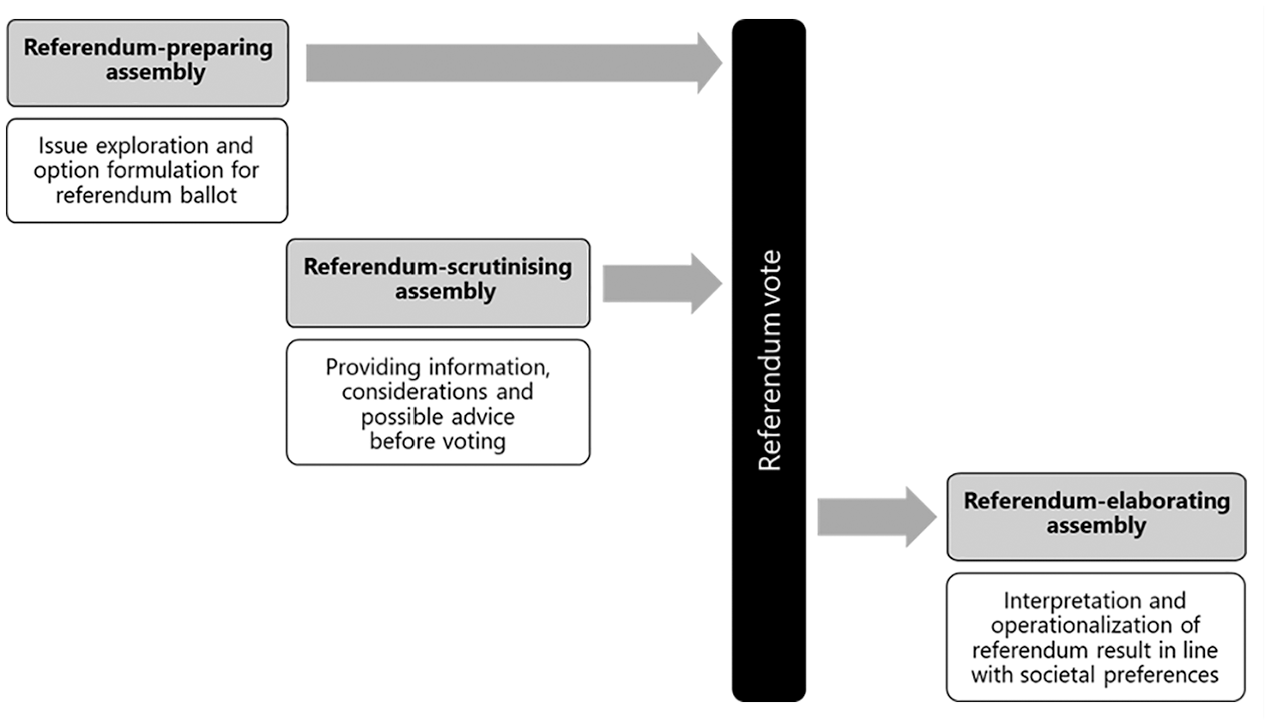
Three variants of citizens’ assemblies linked to the referendum process.
Our classification builds on and extends the three-stage distinction—Initiation stage, Campaign stage, Implementation stage—that McKay (2019) proposed. We add the systematic comparison of the resulting hybrids in terms of characteristics, merits and related design questions. The classification partially builds on and partially deviates from Gastil and Richards (2013), who distinguished five deliberative designs—Priority Conference, Design Panel, Citizen’s Assembly, Citizens’ Initiative Review, Policy Jury—that can contribute to successive stages of the direct-democracy process. Their fifth and most downstream model—the autonomous Policy Jury, that develops direct legislation, dispensing with conventional legislative and electoral processes—is purely hypothetical and thus missing from our categorization of applied models. Our most downstream variant—the elaborating assembly that follows after the referendum vote—is missing in the classification of Gastil and Richards, which is more than ours focused on the real and specific problems of the bottom-up referendum and initiative process in parts of the US. Their three upstream models are collapsed into one variant in our classification: the preparatory assembly, which can perform different tasks in mandatory, top-down, and bottom-up referendums (including the specific tasks of the Priority Conference and the Design Panel in bottom-up, petitioned processes). The Priority Conference only relates to our first model insofar as it leads to a concrete proposal for mass voting in a referendum; if it leads to another, more specialized deliberative forum taking over the baton, without the prospect of a follow-up referendum, the practice concerned falls outside the scope of this overview of the deliberative referendum. 5 Their fourth model, the Citizens’ Initiative Review, overlaps with our second variant, the Scrutinizing Assembly.
The Referendum-Preparing Citizens’ Assembly
The referendum-preparing assembly brings together a statistically representative group of citizens in a controlled environment to discuss a policy issue, and to prepare a referendum proposal which thereafter can be presented to the wider electorate. In all events, assembly members are informed about the policy issue by experts after which they deliberate on conceivable policy options among themselves. Deliberating as a mini-public, the preparatory assembly paves the way for a referendum vote by the “maxi-public,” resulting in either an advisory or binding public decision. 6
The eventual formal trigger of the referendum may be governmental or parliamentary, but the proposition in this variant clearly comes from the citizens’ assembly. In cases where a referendum is not immediately foreseen, the recommendation to delegate—to “refer”—the outcome of the deliberations to a referendum vote can also form part of the deliberations. Approval by the maxi-public in a referendum may further legitimize the findings of the deliberative mini-public in the public eye (Farrell & Suiter, 2019; Farrell et al., 2020; Parkinson, 2020; Suiter & Reuchamps, 2016: 9).
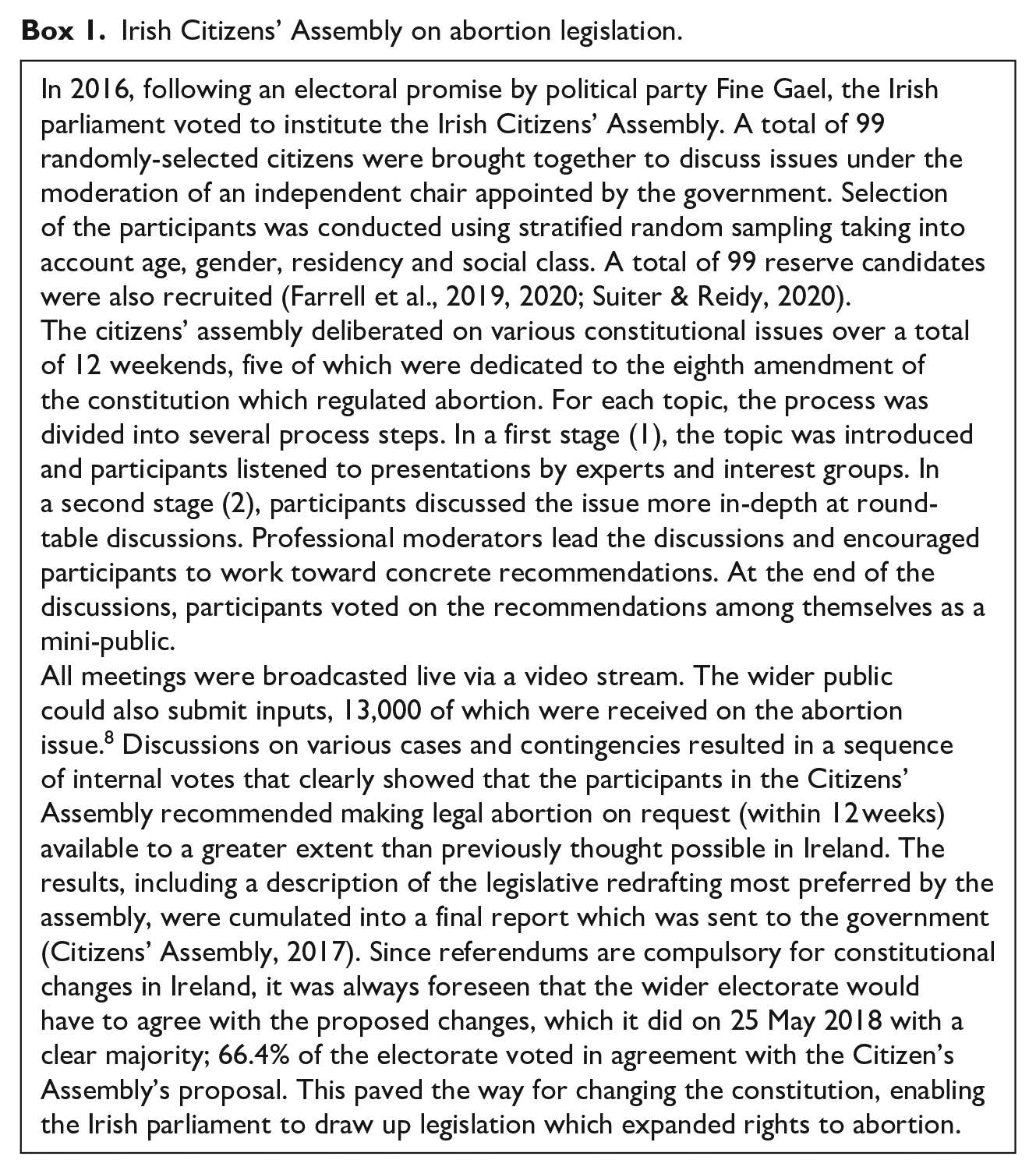
A well-known example of a preparatory citizens’ assembly is the Irish Citizens’ Assembly, which was instituted in 2016 with the intention to deliberate on a set of topics (abortion, the challenges and opportunities of an aging population, fixed-term parliaments, the manner in which referenda are held, and how the state can make Ireland a leader in tackling climate change). 7 The Irish process that led to an authoritative decision on abortion—deliberated by the Citizens’ Assembly in 2016, Citizens’ Assembly in 2017, and ultimately approved per referendum in May 2018, is discussed in box 1. An earlier example is the British Columbia Citizens’ Assembly on Electoral Reform in Canada, which was instituted in 2004 to debate whether a new electoral system for the province was desirable and if so, which system would be recommendable. The assembly’s proposal was presented to voters in a referendum in May 2005, receiving 57.5% majority support, but failing to meet the 60% support threshold (Warren & Pearse, 2008). Another example is the 2011 Icelandic Constitutional Assembly, which drafted a new constitution. The broader electorate voted in a referendum in October 2012 on six elements of the new constitution, all of which were approved per referendum, although parliament has stalled further decisions on the new constitution ever since (Landemore, 2020).
The Irish case diverts from the Icelandic and British Columbia cases in its institutional and political embedding. In Iceland the political realm was largely detached from the process by a Constitutional Council consisting of citizens that “refused, in a self-defeating way, to cooperate with parties and other political elites (. . .) losing the good will of the political class” (Landemore, 2020, pp.120, 181). In British Columbia, the Citizens’ Assembly recommendation did not pass the referendum’s supermajority requirement, elevated high by weary politicians (Tierney, 2013; Warren & Pearse, 2008). In the Irish attempt at “systematizing constitutional deliberation” (Farrell et al., 2019) a more productive division of responsibilities between citizens’ assembly, representative politics and electorate has come to fruition. It is no coincidence that it is considered a “world leader in the linking of deliberative democracy (mini-publics) and direct democracy (referendums),” a paragon of “how deliberation can be inserted into the referendum process in a meaningful way” (Farrell et al., 2019, pp. 113, 119–120; also Farrell et al., 2020).
Irish Citizens’ Assembly on abortion legislation.
The Referendum-Scrutinizing Citizens’ Assembly
The referendum-scrutinizing citizens’ assembly embarks on its task after a referendum has been triggered and the referendum question has been decided, but before the vote takes place. The function of the scrutinizing assembly is to reflect on the content and consequences of the ballot options and to inform and enlighten the wider public on the matter before voting takes place. The integration and diffusion of arguments as prepared by the assembly can encourage more meaningful societal debate on the issue by the wider public (Jacquet & van der Does, 2021). A statement by the assembly is distributed to all eligible voters, including arguments for both sides. Deliberations need not, but may, culminate in a voting advice, which does not have to be unanimously supported within the assembly. The distribution of assembly participants backing either side is commonly reported.
While scrutinizing citizens’ assemblies could take various forms, the most developed example is the citizens’ initiative review (CIR), originating in the US state of Oregon in 2010 (Gastil et al., 2014, 2018; Knobloch et al., 2014). In the CIR-model, after a referendum on a popular initiative has been announced, a representative group of 24 citizens is elected to take part in the deliberations. The first stage is an orientation stage to get acquainted with the topic of the initiative. In the next stage, participants hear experts on the topic as well as representatives of the pro and con sides. After these informative stages, the deliberation stage starts, in which participants discuss the information and arguments in moderated discussion groups. The assembly then draws up its citizens’ statement in which it highlights the most important findings and considerations. The statement is distributed to the electorate as a voter information pamphlet.
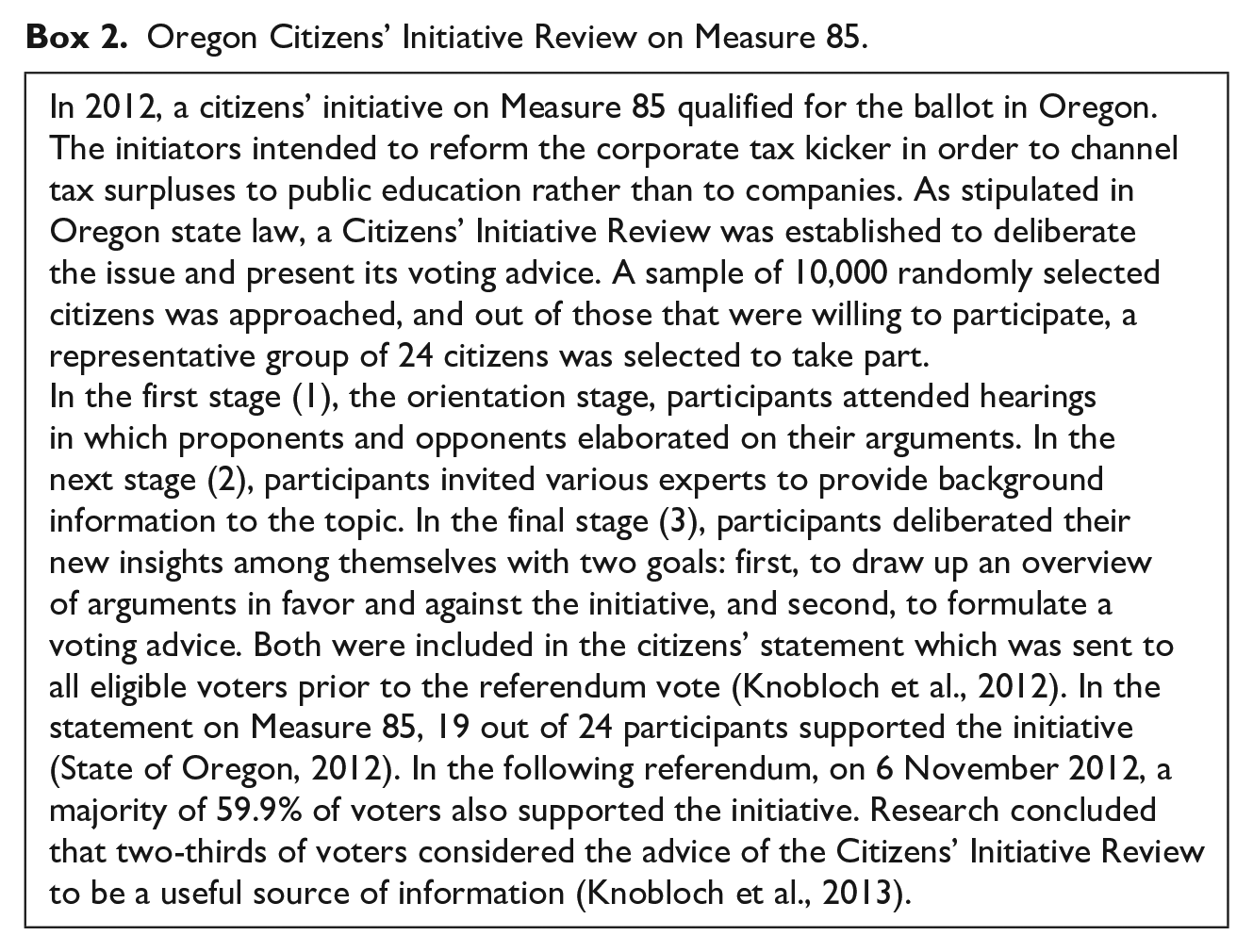
Citizens’ initiative reviews have been used for state-wide citizen initiatives in Oregon since 2010, following a pilot. Since 2011 they are a legally formalized element of each citizen initiative trajectory. Box 2 describes an example case of an Oregon CIR in 2012. In the case of multiple citizens’ initiatives subjected to a referendum vote on the same day, parallel assemblies can be organized. Extensive research on the CIR process concludes that participants obtain issue-specific knowledge and are open to revising their options after reasoning with each other. Moreover, the information pamphlet helps the wider public to overcome information deficiencies and to base their vote on the same information and argumentation as established by the assembly participants (Gastil & Knobloch, 2020). In more recent years, the citizens’ initiative review has been experimented with in various other locations, such as the US states of Massachusetts, Colorado, California and Arizona, the Swiss cantons of Sion and Geneva, and the municipality of Korsholm in Finland (Setälä et al., 2020). The Finnish experiment concluded that voters considered the assembly’s advice to be trustworthy and useful, and that the advice improved their factual knowledge, issue efficacy, and perspective-taking.
Oregon Citizens’ Initiative Review on Measure 85.
The Referendum-Elaborating Citizens’ Assembly
The elaborating citizens’ assembly is instituted after a referendum has taken place and follow-up steps must be decided on. Its goal is neither to prepare and propose a referendum question nor to inform voters, but rather to make sense of the referendum result and its implications in terms of operationalization prior to the start of the implementation process by policymakers. 9 For reactive (“veto”) referendums, more specifically, a follow-up citizens’ assembly could shed further light on the reasons behind a majority rejection of new legislation and on amendments or alterations that might solve resistance. For proactive (“advancing”) referendums, it could help to fine-tune the operationalization of newly accepted legislation from a citizens’ perspective.
To some observers, a citizens’ assembly coming after the fact of a referendum may seem illogical, as the wider electorate has decided on an issue, which then seems to be delegated back to a smaller subset of the population. Yet, an elaborating assembly could fulfill a relatively modest but useful support function in the stage directly following the referendum vote. Representative politics is commonly and overall responsible here, but might very well use citizens’ support for hammering out the best possible operationalization strategy, especially when a referendum result is open to different ways of following up or when it is prone to politically strategic interpretations of the referendum outcome which may run counter to the preferences of the societal majority. Investing in a citizens’ assembly the task of indicating the most-supported operationalization in line with the referendum outcome could serve to do justice to the underlying intentions of referendum voters.
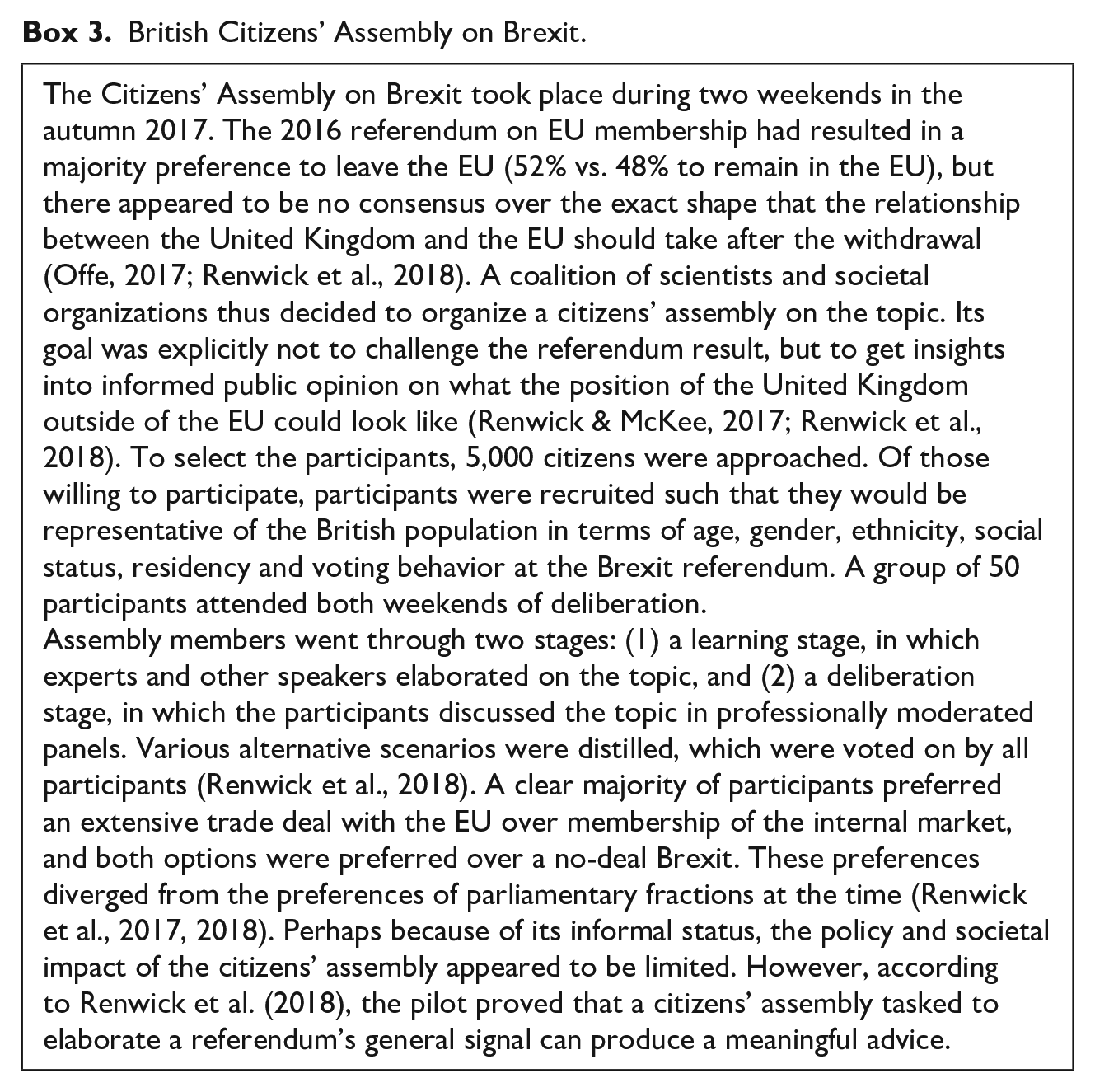
There are few practical examples of referendum-elaborating citizens’ assemblies. The best-known is the Citizens’ Assembly on Brexit, a pilot project held in the autumn of 2017. This case does not carry the weight of the previous two exemplary cases, but nevertheless provides an empirical operationalization of linking deliberation to referendum voting. Box 3 describes the process of this assembly.
British Citizens’ Assembly on Brexit.
Discussion: Distinctive Features, Institutional Implications and Design Questions
In the previous section, we outlined three hybrid models that connect a deliberative citizen’s assembly to a referendum vote. In Table 1, we summarize the main characteristics of the three. In case of the preparatory assembly, working ahead of the referendum, the citizen’s assembly itself can be considered the leading instrument of democratic innovation. Deliberation serves to shape the proposal(s) of the mini-public and the subsequent referendum serves to further legitimize a proposal by submitting it to “market testing” among the maxi-public. For the other two types of hybrids, the referendum is the leading instrument, and the assembly serves to improve specific parts of the referendum process. The scrutinizing assembly serves to inform referendum voters prior to making their vote choice. The elaborating assembly is designed to alleviate the sometimes difficult task of understanding and translating the referendum outcome in terms of follow-up courses of action.
Three types of linking deliberative citizens’ assemblies to referendums: central characteristics, potential (dis)advantages and related design questions.
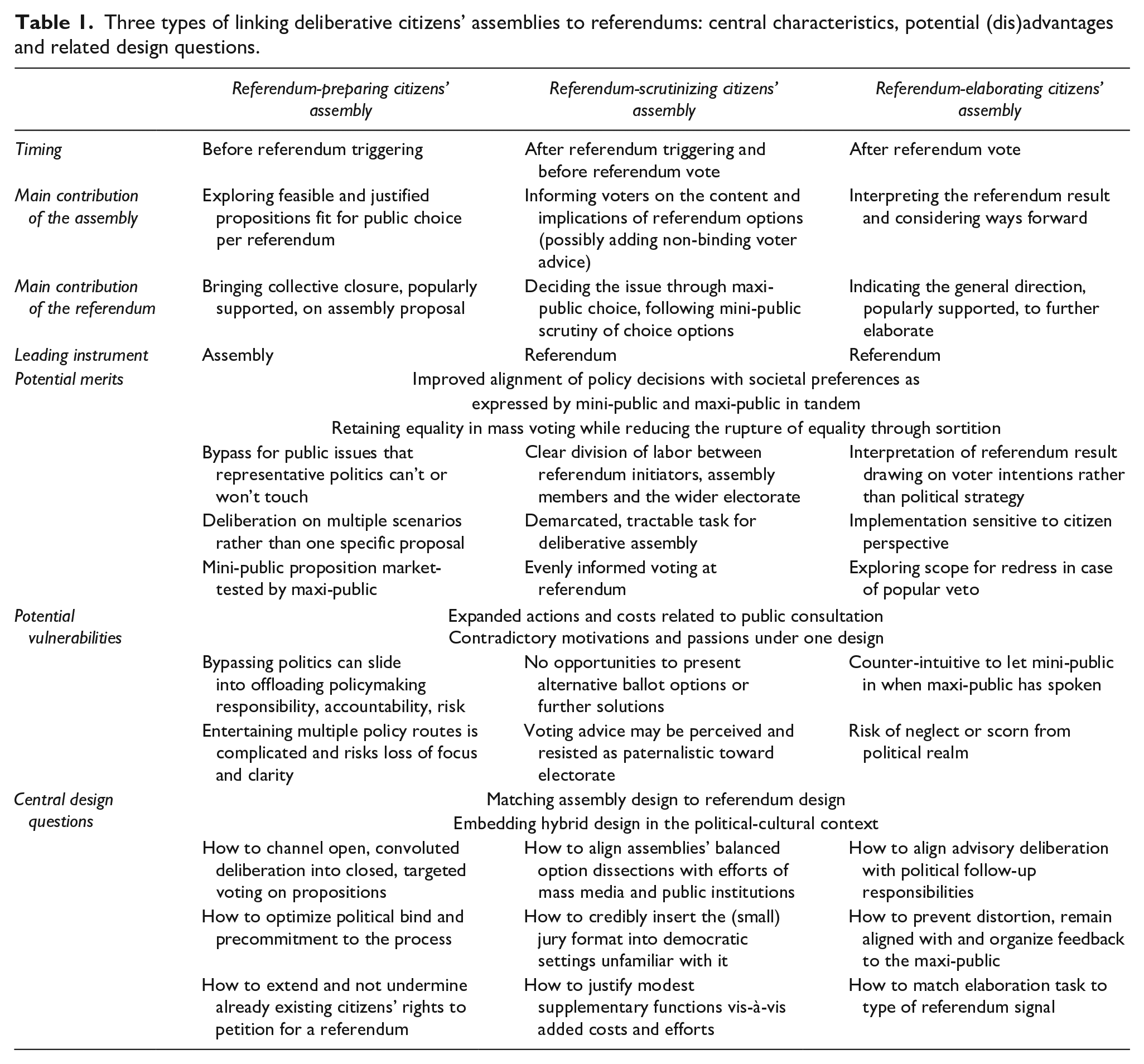
The three ways of linking deliberation in citizens’ assemblies to voting in popular referendums each have their specific merits and limitations, as summarized in Table 1. For all three types, the desired effect is that deliberation improves the alignment of policies with societal preferences, either through designing a suitable referendum proposition, stimulating informed debate or bringing the follow-up of referendum results in line with public intentions (Farrell et al., 2020; Gastil & Richards, 2013; Renwick et al., 2018). Furthermore, by involving a representative subset of the voting population, particularly when sortition procedures are applied, citizens’ assemblies can theoretically reduce the rupture of equality compared to propositions initiated by citizens with unequal financial and political resources (Fishkin et al., 2015). Nonetheless, the participation of usual suspects can still be an issue in the recruitment of assembly members (Jacquet, 2017).
The referendum-preparing citizens’ assembly provides the strongest case for sequencing democratic innovations, as it has proved fruitful for legislating on contentious issues (Farrell & Suiter, 2019; Farrell et al., 2019, 2020). The scrutinizing assembly, however, has also proven to be effective as an addition to the initiative process, particularly in, but not necessarily limited to, the US context (Gastil et al., 2014, 2018). The elaborating assembly following referendum voting is the least battle-tested of the three types, although Renwick et al. (2017, 2018) have shown that a meaningful procedure and process result can be achieved. An elaborating assembly could have proven fruitful in other post-referendum situations, like the one resulting from an advisory corrective referendum in the Netherlands in 2018 in which a majority of voters vetoed stricter regulation of the secret services, without providing sufficient guidance for necessary follow-up choices (Jacobs, 2018; Wagenaar, 2019).
In terms of vulnerabilities, the elaborating assembly risks being seen as too late in the day; the referendum campaign and vote have already passed, and the results are in. Relatedly this variant risks being scorned or outright neglected by the political actors that have a role to play in the aftermath of a referendum—particularly when the assembly can be perceived or framed as a complicating factor rather than a helping hand in the process. Hence, one of the key design questions here is how to align a credible, advisory role of an elaborating assembly with a legitimate, broader responsibility of representative politics to act on referendum results. A second obvious design question here is how to prevent the deliberative mini-public from distorting rather than elaborating the popular signal received per referendum; some form of public reporting in line with and in terms of the maxi-public’s revealed preference seems desirable and also feasible in combination with advisory reporting to parliament. A third design question follows from the fact that different referendums result in different public signals—advisory versus binding, proactive versus reactive—which demand diverging elaboration efforts that need to be designed accordingly.
The scrutinizing citizens’ assembly is comparatively handicapped in that it can only dissect the given choice options, and not present alternative options or further solutions. In case of supplementary voting advice, this variant is vulnerable to the criticism of, and resistance to, paternalism, with a small group (the Oregon CIR e.g., assembles 24 citizens) presenting guidance to a full electorate of citizens which is seemingly not fully trusted. The latter has been parried in the design of the Oregon CIR, which stresses the relatively modest, supplementary, non-committal, service-to-the-voter character of the assembly recommendation. As indicated, it is possible to refrain from giving voter advice and focus solely on dissecting choice options. In this baseline scenario it is imperative to clarify how the role of the citizens’ assembly in providing balanced information is different from and supplementary to the role of mass media and public institutions that inform the public. Another design question is if and how the (small) jury format, familiar to the American state context, can be inserted credibly into democratic settings not familiar with this format. When a referendum-scrutinizing assembly was discussed in the Netherlands, in the province of Limburg, a small scrutinizing jury was perceived as lacking legitimacy, and a larger scrutinizing assembly as potentially more trustworthy—but also more costly.
The referendum-preparing assembly may be introduced as an effective bypass for political stalemate, but it can also turn into a way of offloading policymaking responsibility, accountability and risk—a political strategy of non-decision-making. This danger has been noted for the Irish case. 10 Another vulnerability follows from the fact that preparatory assemblies not seldom receive relatively open, ill-structured assignments, which are not only hard to grasp in a relatively short timeframe but also difficult to turn into voting propositions with focus and clarity. Hence, a first design question here is how to maintain a level of openness that fits the preparatory stage of assemblies working toward proposals, while also maintaining a degree of focus that fits the need for clearly targeted propositions in the stage of referendum voting. A second design question here is how to organize enough political bind and precommitment to the process, in order to motivate the efforts and costs of participation. Thirdly, a specific design question for the referendum-preparing citizens’ assembly is how to extend—and not undermine—already existing rights of (groups of) citizen’s to self-organize, and petition in a procedure for bottom-up referendums.
How to match assembly choices (type of sortition, organization and duration of deliberation) to referendum variants (bottom-up versus top-down and mandatory, proactive versus reactive, binding versus advisory) and how to make this work in a political-cultural context are overarching questions of hybrid design. They pertain to referendum-preparing, -scrutinizing and -elaborating assemblies, which also have their own design questions. What we have done here is tease out central design questions, but we have not answered or solved them. This is not only because of space limitations and focusing choices, but also and more fundamentally because our collective knowledge on this is still very much fledgling—growing for particular cases of hybrid design, but largely lacking when it comes to overarching insights. Further developing comparative, cross-case knowledge about the nuts and bolts of hybrid design is an important next step to take if the general idea of hybrids connecting the best, while preventing the worst, characteristics of deliberative assemblies and plebiscitary referendums is indeed an idea whose time has come.
From Occasional Nod to Systemic Attention? Closing Reflections
Not so long ago, integrative views of voting and deliberation received only occasional nods in theories of deliberative democracy interested in connecting administration and society in more reflective ways (Levy, 2013, p. 573). This has changed under the influence of the systemic turn in deliberative democracy, which has encouraged theorizing about deliberative interventions working in tandem with non-deliberative, including plebiscitary, institutions (El-Wakil, 2017; Landemore, 2018; Parkinson, 2020; Parkinson & Mansbridge, 2012; Suiter & Reidy, 2020). Approaching the matter from the side of referendums, theorists such as LeDuc (2015), Setälä (2018), and McKay (2019) have shown a vivid interest in the addition of deliberative reflection to referendum voting. Prominently, Tierney (2013) has argued that a deliberative referendum could further the involvement of citizens in question formulation, while addressing some of the shortcomings of the referendum process, notably the barrier to meaningful deliberation resulting from the focus on aggregating established opinions, but also the issues of elite manipulation and majority tyranny. Slowly but surely, deliberative assemblies linked to referendums have also sprung up in practice, motivated by the urge to forge more versatile connections between administration and society. In this article, we have further examined the idea of the deliberative referendum, its emerging functional variants, their potential merits, vulnerabilities, and related design questions in particular. The result speaks to debates in public administration and related disciplines concerned with democratic instruments and innovations that are meant to forge more effective connections between administration and society in democratic systems.
Considering developments in both theory and practice, as we have done here, the deliberative referendum seems an idea whose time has come; it comes, however, also with challenges and questions that theorists and practitioners of democratic innovation have only begun to tackle and answer. The common idea behind the three general, empirically grounded, models distinguished in this article is that combining the use of referendum voting and deliberative citizens’ assemblies can bolster the merit and correct the vulnerability of both instruments of democratic innovation. In a single instrument, either deliberative or plebiscitary, the associated vulnerabilities may prevail, while in a hybrid construction the combined forces may lead to an overall more advantageous situation. Variations in empirical reality denote that this is not easily accomplished. A hybrid design that may work comparatively well in one democratic setting does not automatically fit another context with different structural and cultural features. Each hybrid design involving a deliberative assembly and a plebiscitary referendum comes with particular design questions, explored in this article and distinguished as items for more specific design thinking, experimentation, and research-for-design.
An intrinsic difficulty of hybrid design harks back to the discussion that we started with. Deliberative mini-publics and plebiscitary referendums are associated with separate discourses and practices with divergent motivational bases (Knight & Johnson, 1994; LeDuc, 2015; Parkinson, 2020). People who are passionate about deliberative mini-publics are not seldom suspicious of plebiscitary referendums, and the other way around; reaching out to the other side does not come naturally in this field. The challenge of hybrid design may thus get more than twice as tough. It is not only that two components need to be fitted; it is also that at least one of two tends to be approached with reserve and suspicion; “Why add an unruly referendum process, if you can have a safely embedded mini-public?”; “Why add a mini-public, can we not just trust the encompassing demos?” From diverging vantage points in, respectively, deliberative and plebiscitary democratic thought such questions are comprehensible. Such reservations are bracketed in emerging experiments with hybrid designs like the ones that we explored, and in more recent scholarly theorizing that approaches the assembly-plus-referendum as at least a promising hypothesis worthy of testing. Further development and testing of the proposition is work to be done.
Footnotes
Declaration of Conflicting Interests
The author(s) declared no potential conflicts of interest with respect to the research, authorship, and/or publication of this article.
Funding
The author(s) disclosed receipt of the following financial support for the research, authorship, and/or publication of this article: The research for this article was partly financed by the Dutch National Science Agenda, NWO file number NWA.1292.19.048.
