




Abstract
In the context of net zero targets, the Bloomington School raises vital questions for public administration about the suitability and inter-relationships between different scales of governance for addressing this complex challenge. The extant empirically orientated literature exploring different examples of polycentric climate governance can gain from a closer focus on Elinor Ostrom’s conjecture that large scale externality problems can be most effectively addressed through decentralised governance processes. There is significant need and scope for applying Ostrom’s Institutional Analysis and Development (IAD) framework to urban governance contexts. This paper applies the IAD framework to a case study of urban governance in London, focusing on sustainable transport targets and the task of delivering active travel infrastructure. The case confirms the pertinence of Bloomington insights into the importance of local knowledge and collaborative and entrepreneurial approaches to governance. The study also demonstrates that the Bloomington case for decentralised processes of institutional adaptation needs to be qualified where externalities cut across multiple jurisdictions, and in the case of reducing CO2 emissions are global in scale. Enabling active travel is found to require national and city-level governance initiating policy coordination across multiple local jurisdictions.
Introduction
The global nature of climate change raises the question of the role and inter-relationships between public authorities across different scales in fostering transitions towards net zero targets. Of vital importance for addressing this question across various governance contexts is the work of Elinor and Vincent Ostrom and the Bloomington School of political economy that they founded. Their conception of ‘polycentric’ governance is widely cited in literature on environmental governance (Amaruzaman et al., 2022). This refers to multi-scale, multi-centred systems of governance in which authority is distributed across various, often overlapping jurisdictions. When first introducing the concept in the 1960s, the Ostroms challenged a dominant assumption at the time in suggesting that polycentricity can be more effective than the centralised, ‘consolidated’ model of public administration 1 . Recent scholarship assessing Bloomington School contributions has stressed the significant need for this tradition, and the Institutional Analysis and Development (IAD) framework developed by Elinor Ostrom, to be brought more fully into the field of public administration (Aligica, 2015). While the IAD framework and the concept of polycentricity have been widely deployed in research on environmental governance, they have been applied relatively little to urban governance, a context where the Bloomington perspective was first developed and resonates strongly. This paper applies the IAD framework to a case study of urban governance in London, UK. In light of our analysis, we assess the Bloomington School hypothesis that decentralised polycentric governance can be the most effective way of addressing complex policy challenges involving externalities across multiple scales.
Our case study is of a large urban regeneration project in Old Oak and Park Royal (OP), in West London, where we assess governance and policy for the attainment of sustainable transport targets. The Greater London Authority, led by the mayor, has set a London-wide target that by 2041 80% of all journeys should be via sustainable travel modes, defined to include walking, cycling and public transport (GLA, 2018). In the first quarter of 2022, the estimated sustainable mode share in London was 60%. 2 Given dangerous levels of air pollution and the climate emergency, the mayor has set a strong commitment to this target, which entails a need for policy delivery that will promote wider behavioural change. We particularly focus on enabling ‘active travel,’ a vital part of this wider goal. Active transport modes are defined as those where the physical exertion of the traveller directly contributes to their motion (Cook et al., 2022). Our focus is on walking and cycling, given their importance for London. This is an interesting policy area because it is largely local authorities and other sub-national bodies in England who co-ordinate planning and delivery of walking and cycling infrastructure. National government generally takes a relatively hands-off approach. This policy challenge involves public goods delivery and addressing externality problems across multiple scales, from local to global. While the academic literature suggests potentially substantial, multi-scale benefits of new active travel infrastructure, this has been contested politically in the UK as elsewhere, both locally and nationally (Bosetti et al., 2022).
The governance arrangements in OP can be considered polycentric, involving multiple overlapping authorities, including a mayoral development corporation, city and local authorities. We assess the suitability of these polycentric arrangements in terms of delivering policy objectives for active travel. The paper is structured as follows. The next section introduces the Bloomington School analytical approach, their conception of polycentricity and its significance for contemporary public administration. Our case study and methodology are then introduced. This is followed by presentation of the governance context, or ‘action situation,’ shaping the opportunities and challenges facing local authorities and OPDC for enabling active travel. The outcomes achieved so far within OP in terms of active travel infrastructure delivery are then assessed. We evaluate the work of OPDC in light of these outcomes, using the Bloomington criteria of accountability, collaboration and entrepreneurship. Regarding further key areas of governance in OP, we include a focus on the accessibility of the major new High Speed (HS2) railway station at Old Oak Common. Our analysis here illustrates the insights yielded by the kind of granular analysis that is a strength of the IAD framework. A subsequent section considers the wider governance challenge for London of delivering cross-borough cycle lanes, before we conclude. Our findings provide some support for Bloomington scholarship about the significance of geography and local knowledge for evaluating governance and policy, while also showing important grounds for qualifying their scepticism about centralised forms of coordination.
The Bloomington school and polycentricity
The significance of the Bloomington School for public administration has been the subject of much recent comment (Aligica, 2017; Aligica et al., 2019; Pennington, 2013). Bloomington scholarship engages directly with questions of the most suitable scales of governance for tackling social and environmental problems in different social, geographical and policy contexts. The concept of polycentricity is central to their treatment of these questions. They define polycentric governance as a system of “many centers of decision making that are formally independent of each other” (Ostrom et al., 1961:831). In polycentric systems, these multiple jurisdictions can often overlap, having varying powers. While polycentric systems can superficially appear ‘messy,’ they adapt in a decentralised way to emerging problems. This robustness was highlighted by the findings of an extensive study led by Elinor Ostrom of metropolitan policing in Indianapolis. Bloomington School studies also point to the potential for competition between local authorities, driven by public entrepreneurship, to spur more effective delivery of public goods and services (Ostrom, 1972). Vincent Ostrom’s work in particular expresses the importance of democratic processes as drivers of governance effectiveness in polycentric systems (Ostrom, 1997).
Elinor Ostrom went on to carry out an extensive, Nobel-prize winning range of international case studies, with a focus on decentralised institutions for managing ecological resources. With Bloomington School colleagues, she developed and applied the IAD methodological framework for assessing the robustness of governance arrangements in different contexts. This framework involves identifying the circumstances, or ‘action situation’ in which individuals address choices and jointly produce actions (Ostrom, 2009:32). The ways that physical and material conditions shape this action situation are examined. There is a focus on how decision processes are shaped by formal rules, working practices, individuals’ values and motives, as well as institutional capacities. Concepts including collaboration, entrepreneurship and accountability are central to their approach.
Elinor’s deployment of the IAD framework centred upon how governance arrangements address externality problems, of various types. Her empirical work found that decentralised institutional processes often established robust collective solutions to locally situated externality problems, by fostering shared norms, trust and collaboration. However, while this work on ‘common pool resources’ was the focus of much attention, the importance of the Ostroms’ work for public administration more generally, including for urban governance, has been somewhat overlooked.
Bloomington School scholarship yields vital questions, of wide relevance, concerning the capacities of contemporary governance arrangements in the face of multi-scale and cross-cutting externality problems. This is highlighted by recent analyses aligned with classical liberal political economy (Aligica, 2017; Lemke and Vlad, 2021; Pennington, 2013). This body of work, which questions the effectiveness of centralised, state-led public administration, highlights Bloomington insights into the effectiveness of decentralised, fragmented governance structures, often involving jurisdictional competition. This classical liberal literature does acknowledge a role for centralised coordination in some contexts. Though such centralisation, it is argued, is best established through a decentralised process in which authorities ‘contract up’ into larger scale institutional arrangements (Pennington, 2013).
Beyond this field of political economy, Bloomington questions about governance scales have inevitably arisen in the wider literature on polycentric environmental governance. Here, some contributions question whether the Bloomington case for polycentricity might be overstated. Agrawul and Ostrom (2001) recognise that wider regional and national institutions shape the capacity and resources available to local authorities and organisations. Another criticism is that the Ostroms leave open the need for further exploration of power imbalances and vested interests that shape local governance (Morrison et al., 2017). These contributions highlight the need for public administration research to assess more closely, across various governance contexts, what the suitable role of central and regional governance might be in shaping polycentric arrangements in the face of multi-scale externality problems. Our case study, focusing on urban governance, is presented as a contribution to such assessment of the wider applicability of the Bloomington approach.
Case study: The regeneration of Old Oak and Park Royal
The OP area in West London is strategically important, being where a new High Speed Rail (HS2) station at Old Oak Common meets the Elizabeth Line that runs across London from east to west. For over 30 years, economic development in Park Royal, a predominantly industrial area, has been a strategic priority within London, with the Park Royal Partnership having previously been established (1992-2016) (Bailey, 1997). In 2016, the London Mayor set up the Old Oak and Park Royal Development Corporation (OPDC) to oversee delivery of ambitious targets of 20,000 new homes and 36,000 new jobs by 2038 (OPDC, 2022). As further set out in Section 5a, current governance arrangements in OP can be viewed as an example of polycentricity, given the presence of multiple overlapping authorities operating at different scales in the area. The regeneration of OP is an important case for assessing governance arrangements for attaining the London-wide 80% sustainable transport target, to which OPDC have stated their commitment.
There is an important international context for assessing the role of development corporations in coordinating regeneration projects (Dodman, 2008). Often straddling different local authorities, falling ‘in between’ formal political jurisdictions (Haughton et al., 2013: 220), the plans and activities of development corporations, it has been suggested, tend to lack democratic accountability (Swyngedouw, 2009). They are often expected to develop partnerships with private developers, taking an “entrepreneurial” approach that is contrasted with earlier, “managerial” forms of governance (Hall and Hubbard, 1996). Urban development corporations of the kind introduced in the U.K. during the 1980s and 1990s have, in some contributions, been associated with promotion of a ‘Neoliberal’ agenda in which markets and private developer interests take priority (Raco, 2005). However, the remit and organisational structure of such organisations has varied across different national contexts (Pinson and Morel Journel, 2016). As a form of governance, they can offer potential for navigating sustainable development challenges and promoting urban competitiveness (Book et al., 2010).
Our analysis below offers some comment on these wider debates about the role of development corporations, for which there is some historical precedent in London and indeed the OP area. However, our main purpose is to analyse the recent work of OPDC in terms of the IAD framework. As an application of this approach, our focus is on outcomes of polycentric governance in OP in relation to the multi-scale externality issue of enabling active travel.
Methodology
Following the IAD framework, we examine the ‘action situation’ for governmental authorities in OP, in relation to enabling active travel. The focus is on how decision making by governance organisations addresses the multi-scale externalities involved in delivering active travel infrastructure. We consider how the action situation was shaped by a range of ‘exogenous’ economic, social and geographical factors. We also assess both the formal powers and informal rules and practices of the different governance authorities and how these influenced outcomes. Our analysis draws from key Bloomington School concepts: entrepreneurship, collaboration and accountability.
When our research was completed in May 2024, the regeneration of OP was still at a relatively early stage. Outcomes in infrastructure delivery were therefore a more tangible measure of progress than using the latest transport mode share statistics for the area. To factually review progress, we compared levels of infrastructure delivery to the infrastructure plans for the area set out by OPDC soon after they were established (5th Studio, Alan Baxter Integrated Design, and Wedderburn, 2017). However, assessment of outcomes cannot be reduced to quantitative measurement. We also consider stakeholder views in qualitative terms about these outcomes, exploring their perspectives on issues such as the timing of infrastructure delivery so far.
The methods used to understand the action situation in OP included analysis of relevant policy and planning documents published by public authorities and stakeholder organisations, combined with a series of interviews with 34 stakeholders, and two stakeholder workshops. Interviewees were from a range of organisations, including: OPDC and OP local authority officers and councillors (n = 12), London-level organisations including GLA and Transport for London (n = 7), private sector stakeholders (n = 6), community and cycling campaign groups (n = 3). To gain further insights into different policy mechanisms for financing infrastructure investment, we also interviewed London and southeast local authority officers and other experts outside of OP (n = 6).
Our interviews were semi-structured, with the overall aim of gaining insights into how stakeholders view the strengths, weaknesses, opportunities and challenges of current governance arrangements in terms of planning and delivering measures for enabling active travel. The focus was on understanding the impacts of governance structures and policy frameworks taking account of the levels of available funding. As in the IAD framework, the analysis considers actors’ perspectives towards actual and expected policy outcomes, as well as stakeholders’ views about the process of policy formation and delivery. Where insights are gained into decisions having actual or anticipated shortcomings in terms of outcomes, this can prompt exploration of the reasons behind those decisions, thus enabling evaluation of the policy process (Greenwood, 2023:Chapter 7). OP governance arrangements. Cross-borough cycle routes in West London.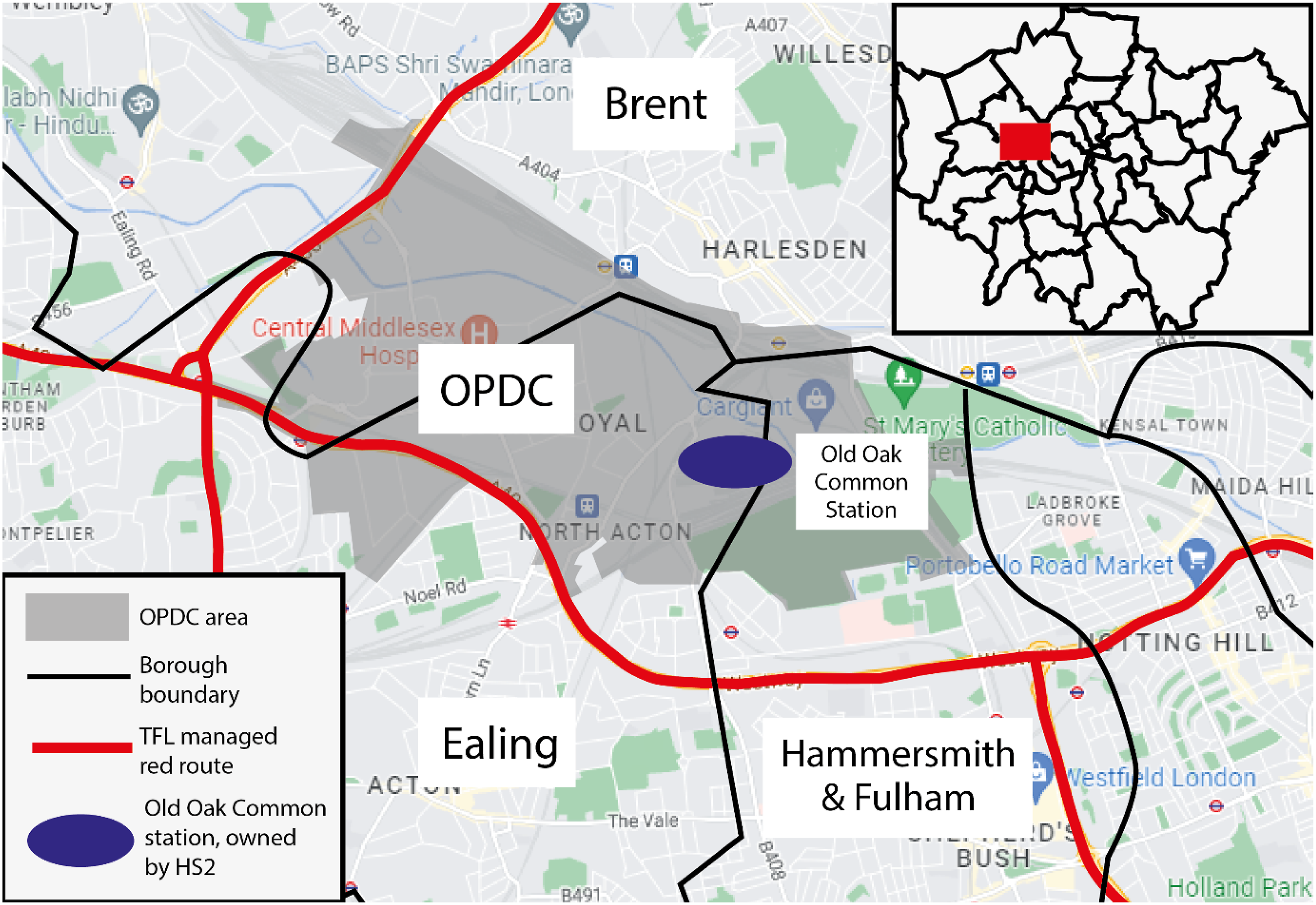
The action situation in Old Oak and Park Royal
Governance arrangements in OP
As is typically the case for urban development corporations, OPDC’s remit and formal powers gave them a significant opportunity to develop a strategic vision for OP. To set out the action situation within which OPDC were operating, here we firstly introduce the powers and resources of the different governmental authorities with a role in the OP area. The OPDC boundary is depicted in Figure 1. • OPDC were granted ‘development control’ powers in relation to planning applications and securing developers’ financial contributions for public infrastructure through Section 106 and the Community Infrastructure Levy.
3
• The three local authorities straddling the OP area are the boroughs of Brent, Ealing, Hammersmith and Fulham. Their previous powers as planning authorities were passed to OPDC when the development corporation was established. Though OPDC then delegated these planning powers to Ealing regarding most major planning applications in North Acton, and other more minor ones in that Borough.
4
Importantly for active travel, these local authorities retained their powers as highway authorities (i.e. responsible for highway construction, maintenance and traffic management) for most streets
5
. • Transport for London (TfL) manages public transport networks across London and is highway authority for some key roads across London, including two roads in OP
6
. • Greater London Authority (GLA) oversees the governance of TfL and in principle can grant funding to local planning authorities for specific schemes. • HS2 was established as a non-governmental public body working in partnership with private firms to deliver the major new high speed rail station at Old Oak Common, under construction for the early 2030s. The station plans were set out in national legislation – the HS2 Act 2017. • UK government defines national planning policy and can in principle provide project-specific infrastructure funding, as they have for HS2.
With planning and highway powers split between different authorities and organisations, this raised the question of whether these authorities and organisations would collaborate effectively to deliver the active travel infrastructure required to meet the mayor’s 80% target.
Externalities and the case of active travel
Following the Bloomington School approach, careful attention is needed to the public good characteristics of transport infrastructure, including the positive and negative externalities generated both by roads for private motor vehicles and space available for active travel. New active travel infrastructure is a public good, in making active travel safer and more convenient and improving access to relevant services (Longo et al., 2015). The resultant emissions reductions would generate some positive externalities for the wider London population, both in terms of local air quality, and climate change mitigation (Brand et al., 2021). In crowded urban environments, active travel infrastructure means that space must frequently be taken from private motor traffic, leading potentially to reduced amenities for those travelling by car (e.g. fewer car parking spaces). While this represents a disbenefit to motorists, private motor vehicle use also gives rise to negative externalities such as road injuries, carbon emissions and air pollution (Macmillan et al., 2021), a key motivation for the London Mayor’s sustainable travel targets. The Bloomington approach, with its focus on governance and the commons, demands close attention to these multiple types of externalities across varying scales. This should include a recognition of possible conflicts between different potential public goods functions of road space. For instance, when designing roads, trade-offs often exist between the range of positive externalities of improved cycling opportunities compared with the negative externality of a loss of road space for private motorists.
Exogenous factors
As the IAD framework recognises, use of the formal powers granted to an authority such as OPDC can be expected to also be shaped by a range of exogenous factors: geographic, economic, social and political.
Geographical
Our interviewees generally agree that the OP area has been a poor walking and cycling environment, with major roads lacking sufficiently wide, dedicated cycle lanes. Park Royal is largely industrial in character, with many heavy goods vehicles passing through. This makes key junctions especially difficult for cycling, 7 as do physical barriers including railway tracks, railway bridges, the Grand Union Canal, and large main roads to the west and south. There are few high-quality cycling routes extending beyond OPDC’s boundaries. The current main cycle route into central London is a canal towpath with limited capacity and safety issues (especially deterring women from using it at night).
National and city level funding constraints
As has generally been the case across English local authorities, there have been significant constraints on the public funding available to OPDC since its establishment in 2016. In contrast with Urban Development Corporations established in England in the 1980s, which were given land and capital grants, OPDC currently has little capital funding. 8 After the loss of a major development site, owned by the company Cargiant, OPDC’s application for a £250m government infrastructure grant, dependent on the original local plan, also fell through. Financial support for TfL from government has reduced over recent years, with TfL then experiencing a loss of income caused by the Covid pandemic, reducing funds available for public transport and TfL priority cycle routes. Government subsidies of approximately £5bn between the start of the pandemic and mid-2022 failed to cover the shortfall (Government, 2022).
Social
The challenges facing OPDC in achieving active travel objectives are also shaped by demographic and cultural factors. Hammersmith and Fulham is a relatively wealthy inner London borough (GLA, 2022). Although car ownership is generally associated with higher incomes, H&F has higher rates of cycling and lower rates of car ownership than the less wealthy, more car-dependent outer London boroughs of Ealing and Brent (GLA, 2021) 9 . As a reflection of patterns in these latter boroughs, stakeholders report high levels of congestion and car parking around the Park Royal industrial area caused by employees commuting into the area. This is indicative of an earlier study which found that roads in OP were already at capacity for motor traffic (OPDC, 2016).
Political context
Proposals for active travel infrastructure require the support of local councillors. Here, significant political opposition can arise, with vociferous local campaign groups active in some areas of London. Of the two largest UK parties, the Labour Party are generally more supportive than the Conservatives of active travel related measures. In these terms, OPDC started from a relatively strong position as all three OP boroughs have Labour Party majorities.
OPDC and funding mechanisms for active travel infrastructure
The multi-scale positive externalities of active travel infrastructure raise the question of the source of funding. With the general lack of national or GLA grants, contributions from developers have been the primary source of potential funding for OP since this regeneration project was first envisaged (Robinson and Attuyer, 2021). National policy allows planning authorities to stipulate such contributions through a S106 agreement with developers, as a condition of granting planning consent. Such S106 contributions can either be financial or ‘in kind’ delivery of infrastructure, negotiated with developers on a case-by-case basis. Alternatively, planning authorities have powers to establish a more consistent, generally defined CIL. Both mechanisms allow the planning authority significant scope for discretion in terms of the expected level of contributions and can potentially be combined. 10
Active travel infrastructure delivery outcomes
In the context of very little national and GLA funding being available, OPDC has not yet secured the funding required for delivering the active travel infrastructure set out in their 2018 plans. The funding attained so far has been through S106 financial contributions. OPDC have only very recently introduced a CIL regime, which is to apply to all developments granted planning consent from April 2024. There remains a significant gap in available funding, as was evident in the breakdown provided by OPDC in 2021. A shortfall of approximately £153m was identified for road, pedestrian and cycle infrastructure, needing to be covered by “developer contributions or other sources” (OPDC 2021) 11 . OPDC staff anticipated that projects such as the creation of protected cycle tracks will be carried out gradually, over a 20-year period, as developer contributions are made. The two key cycle routes that have been completed so far, along the edge of the OPDC area, were both funded by TfL 12 .
OPDC has exercised its development control powers in relation to some key residential developments, to the northwest of Old Oak Common station
13
and in Acton. Some interviewees were very critical of developments having gone ahead without prior upgrades to associated cycle routes. This risked causing opportunities to be missed for enabling new residents to establish sustainable travel habits as they move in (Clark et al., 2014). In the case of Acton, it was pointed out that upgrades to active travel infrastructure are being carried out retrospectively, after the decisions shaping the urban environment, such as the shape and layout of roads, have already been taken. “It may be a phasing issue, but obviously if you want to inform behaviour change, you have to provide that infrastructure from when people occupy the development. Otherwise, what they're doing is occupying the development with cars. … What we're seeing is development with informal car parking, inappropriate car parking in places they shouldn't because they feel the only way they can travel from that development is by owning a car.” (Interviewee 12)
Evaluation of governance in OP
The development goals set for OPDC raised the question of the level of priority they would assign to financing and delivering active travel infrastructure and the positive externalities this would generate. Although they have stated a commitment to the mayor’s 2041 target (OPDC, 2018), this is generally less prominent in their website and key policy documents. As explained in Section 5, national policy leaves planning authorities such as OPDC significant scope for discretion in terms of both the amount and timing of developer contributions. In this respect, policy can be viewed as allowing for the kind of local entrepreneurial public goods delivery, the potential significance of which is highlighted by Bloomington scholarship.
Feedback from some local stakeholders within OP, alongside evidence from some officials from local authorities outside of the OP area, suggests that a more pro-active approach from OPDC could have achieved more. This kind of criticism is indicative of a more general concern from participants in local neighbourhood and campaign groups that OPDC as a planning authority does not give sufficient priority to the public realm. OPDC could have established a CIL earlier. Some infrastructure financing experts stated the greater predictability of CIL revenues would have been conducive to securing more infrastructure financing prior to developments being completed. OPDC’s approach of securing staged financial contributions from developers does reflect typical practice across London and indeed English local planning authorities generally, as suggested by prior research in OP (Robinson and Attuyer, 2021). Some planning professionals point to a more entrepreneurial approach taken by some English local authorities. This is to stipulate the early delivery of active travel infrastructure delivery in local planning policies. Rather than accepting financial contributions through Section 106 or CIL, this requires, as a condition of planning permission being granted, delivery of active travel schemes at an early stage of the development, through ‘in kind’ contributions.
Local stakeholders also questioned the role of OPDC as a development corporation in terms of local accountability. Firstly, it was pointed out, the key role of councillors means that local authorities will tend to be relatively responsive to local concerns, compared with OPDC as a development corporation that is viewed as more remote. While some local authority officers are members of the OPDC planning committee, the majority are appointed by the OPDC board without election 14 . Furthermore, local citizens and neighbourhood groups in the OP area were felt to have more established channels of communication with local authorities than with OPDC. For example, a local authority officer commented that the new residential apartments at Oaklands included no new car parking spaces. They had been made aware of numerous complaints from residents about inappropriate car parking in the vicinity, highlighting that residents communicated these complaints to them rather than OPDC.
The view of some local citizens who have attended OPDC Planning Committee meetings is that appointed committee members tend to represent the interests of property developers 15 . OPDC do fulfil their statutory obligation to run public consultations in relation to all planning applications. However, local stakeholders with interests in active travel have felt there has been a lack of opportunity for their case to be acted upon at the final committee hearings of key planning applications.
One interviewee, in relation to an HS2 application, commented: “They will listen, but they have their pre meetings beforehand and they make very sure that they've got sufficient votes. We've had some decisions which have been very close to a four- four equality of vote, in which case the chair has a casting vote, so there's been no substantive planning application that has been refused in the history of OPDC.” (Interviewee 17)
Some interviewees commented that OPDC has established constructive working relationships with borough councils, with whom they meet regularly. They formed partnerships such as with Harlesden Neighbourhood Forum, developing plans for the edge of Harlesden encompassing transport, business, and housing and with Park Royal businesses to address issues including mobility, broadband and power. However, there are significant limitations to how far OPDC have fulfilled such a collaborative role with the three local authorities in OP. The need for such collaboration is heightened by some planned developments and associated infrastructure needs being situated near or across local authority boundaries 16 . The split between highways and planning powers is a significant factor in shaping this challenge, as further discussed below.
The question of the vital importance of communication and working relationships between different experts has, in general, been less of a focus for the Ostroms in their empirical work. An important limitation of OPDC as a development corporation is their separation from the powers and expertise of highways authorities. Generally, borough officers include various specialists, including cycling experts and engineers. In interviews, it was expressed that they have little opportunity to engage with OPDC about their plans. Both OPDC and the boroughs have responsibility to ensure effective collaboration. The latter lack single points of contact for OPDC, which makes it more difficult to ensure their experts’ involvement with active travel-related plans for the area. Moreover, within local authorities, transport experts are sometimes based in different departments (such as highways and planning), hence may not work together closely on projects. Relationships between OPDC and local authorities are more individual and circumstantial, rather than ensuring that the correct transport experts are always engaged in discussions, and that there is wider awareness of any such discussions taking place. Reflecting such concerns, a borough cycling officer commented on OPDC as follows: “I think it's great… I just think what you end up with though is …this huge beast that … you know it's a bit like an octopus with so many different tentacles that they're not always totally connected. … I think we've … over the last few years … probably seen and spoken to 7-8 different people. You’re never quite sure who you're talking to… there’s this transition of staff…I do feel it gets really complicated to coordinate. The master plan isn’t absolutely clear and signed up to by everybody. You could end up with lots of different areas that have gone ahead and been built and … the area is completely separate from what the bigger picture should be.” (Interviewee 15)
Access to Old Oak common station
The need for an entrepreneurial, collaborative approach from multiple stakeholders is evident in the important example of plans for access to the new Old Oak Common (OOC) HS2 station. In this case, with HS2 and other stakeholders involved in planning the station layout, there are a distinctive set of governance arrangements, which in Bloomington School terms, are ‘nested’ within the wider OPDC jurisdiction. Here, we illustrate the kind of detailed, micro level analysis of such ‘nested’ governance arrangements that the IAD framework can yield. This analysis highlights some serious deficiencies in terms of public goods delivery and the need to ensure station accessibility for active travel.
The large passenger numbers expected at the station, not least with this likely to be the HS2 terminus for at least a decade, make designs for the station access especially important. There is still significant uncertainty about expected passenger numbers, with plans for HS2 having been scaled back in October 2023 17 . Sustainable transport targets, as well as the geography of the area, mean that private motor vehicle access should and will be highly limited. Active travel will be vital as a means of accessing the station and nearby local public transport connections. Here, we discuss plans for station access by active travel modes from the east and west.
Western access
Plans for access to OOC station from Old Oak Common Lane (OOCL) became determined in 2020 when HS2 gained approval for plans for a single two-way cycle lane running along the eastern side of a section of OOCL that they owned. HS2 continued to build the station forecourt according to the plans approved by the 2017 HS2 Act. However, this meant that cyclists on OOCL from the south would enter the station on a path overlapping with pedestrian walkways. In this respect, access to OOC station from OOCL will not be compliant with the 2020 Local Transport Note (LTN 1/20) standard for cycle lanes. The planned two-way cycle lane on OOCL also meant that cyclists travelling northwards or southwards along OOCL would have to cross the road to continue their journey. As well as creating some inconvenience for cyclists, these plans were criticised by H&F Council (LBHF, 2022) and Ealing Cycling Campaign (2022) for being insufficiently integrated with the road network and causing conflicts between cyclists and pedestrians. 18 However, with the forecourt plans having been set in legislation in 2017, there was no legal obligation for HS2 to change them to align better with their plans for cycle access to the station from OOCL.
HS2 proposed the single, two-way cycle lane on OOCL because any further widening of the road would have involved significant modification to the railway bridges over OOCL, hence additional costs. Given that they had originally proposed no separate cycle lane, their approved plans were a compromise after Ealing Council objected to their original plans. As one interviewee explained: “(OOCL is) a narrow lane, it's just one lane in both directions. There’s pavement on either side going under these bridges and really, ideally, they would make the bridges wider, so you get more traffic of all sorts through, but I think HS2 didn't want to do this, because obviously it would cost a fortune. And we said, well, what about cycle access to the station? Because there isn't room for segregated cycle lanes and pedestrians on both sides of the road, and the motor traffic. And we did actually force HS2 to go away and do a study, and they came back and said, well, look, there is room for a two-way cycle lane on the east side of Old Oak Common Lane, the pedestrians can use the west side. So, it meant pedestrians having to sort of cross the road and then cross it back to get to the station.” (Interviewee 5)
This problem of conflict between pedestrian and cycle access might have been avoided if stakeholders had agreed on the layout for OOCL before the forecourt design was finalised. This shows the importance of an early, collaborative focus on highways, and the valuable aspirations and expertise that borough officers and campaigners can bring. This accessibility issue, cutting across jurisdictional boundaries, highlights how national decisions can, in important respects, condition the scope for decentralised coordination of the kind highlighted by Bloomington scholarship. There is a case for national level policy change so that the formulation of legislation for national infrastructure allowed local authorities to exercise more discretion in requiring ‘reasonable adjustments’ to approved schemes affected by such nationally approved projects. This could have enabled OPDC and the boroughs as planning and highways authorities respectively to incorporate the new standards and best practice for walking and cycling and public transport accessibility that were developed after the 2017 Act.
Eastern access from Scrubs Lane
There are also plans for access into the eastern side of OOC station, via a pedestrian and cycle bridge from the southern side of the canal towpath. 19 The plans have not yet been finalised in detail. Concerns from a range of stakeholders arose recently when OPDC approved HS2’s planning application to build a new staff catering facility at the very location on the towpath where this bridge had been expected to be built. Aside from this issue, the plans depend upon use of the towpath, viewed by OPDC as integral to active travel access to Old Oak Common station from the east (OPDC 2021). However, rather than being a dedicated cycle path, this is a shared walking and cycling leisure route with limited capacity that does not meet the LTN 1/20 standard. 20
Cross-borough cycle routes
A further key part of the challenge of enabling active travel in an area such as OP concerns coordinating the delivery of cross-borough cycle routes. The positive externalities generated by such cross- borough routes, namely a reduction in motor traffic, will arise across boroughs. As explained above, the Ostroms envisaged that larger, multi-jurisdictional forms of coordination are most effectively achieved by the local authorities involved agreeing to ‘contract up’ into processes of decision-making that could apply across multiple jurisdictional scales. However, in the case of cross-borough London cycle routes, there are significant grounds for questioning the feasibility of inter-jurisdictional coordination being achieved through such a process.
The extent of the positive externalities generated by cross-borough cycle lanes, as explained above, is contested. As further explained below, significant political factors, together with current governance structures in London, can limit the possibility for such coordination. With each local authority being required to consult on plans, there is the possibility of such routes not being delivered due to local opposition and political dynamics in specific boroughs.
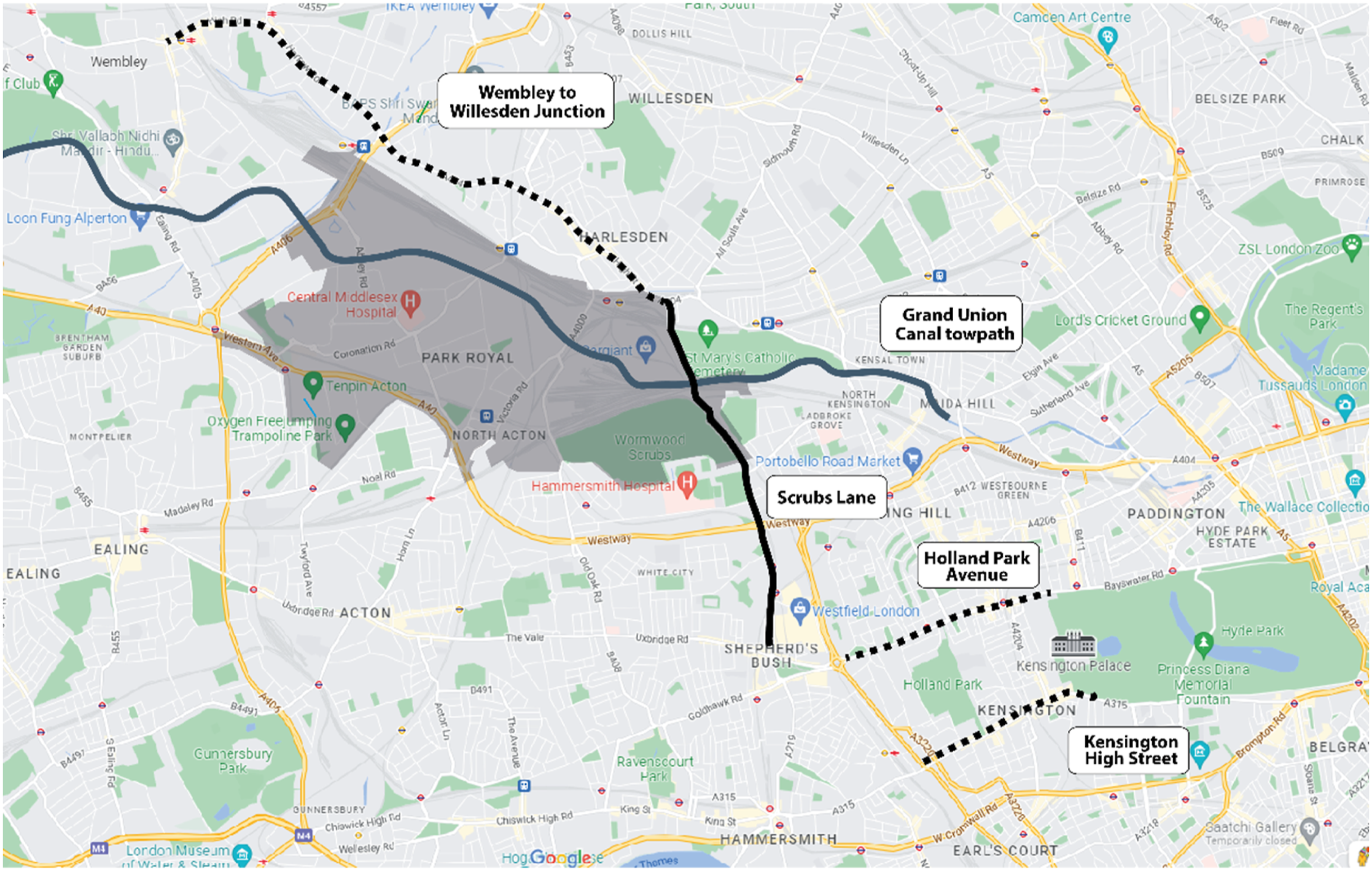
The main example of such a route was proposed by TfL, to run from Wembley into central London, which would require delivery from at least three local councils as highways authorities. This is shown in Figure 2 below.
There were varying levels of political motivation, with Labour Party councillors tending to be more supportive of proposed cycle lanes. The demographic factors discussed above also influenced significant variation in how far planned routes were supported within Labour-led boroughs. Due to some local opposition, combined with a difficult funding situation, the Wembley to Willesden Junction section in Brent is being redesigned and likely to involve less ambitious measures. Part of the route in Kensington and Chelsea was not implemented due to local opposition. Such local contestation, combined with the general lack of precedents for cross-borough collaboration in the delivery of cycle lanes, limits how far we might expect boroughs to ‘contract up’ into larger scale forms of coordination. It remains to be seen whether a cross-borough route will run from OP to central London that avoids reliance on the canal towpath.
In this context, there is potential for TfL to have established a framework for more strongly promoting and developing public support for the cross-borough delivery of such schemes. One way this might be achieved would be to strongly propose best practice in public consultations. The nature of consultation processes can make a significant difference to public opinion. One interviewee put this as follows: “When we proposed the scheme, we wanted to do some pre-consultation engagement…. We had a whole campaign on that front ready to go. So, what we were going to do is sort of, in an informal way, go and have qualitative conversations with shopkeepers and retailers along the proposed line of route, which was Holland Park Avenue in Notting Hill Gate. Kensington and Chelsea got a bit nervous about that and they asked us not to go ahead with pre-engagement, so the first that these stakeholders heard of this scheme was when the consultation launched, or just before. … And then there was such a groundswell of opposition to the scheme in that area, specifically Holland Park Avenue led by these retailers, that the elected members of the council at the time must have felt an obligation to be seen on the side of the residents […] councillors leapt on this campaign and naturally campaigned with them against the scheme that we were consulting on, really, together.” (Interviewee 9)
To pre-empt some of the potential political pitfalls for such infrastructure development, Cohen et al. (2021) recommend local authorities establishing, through dialogue, a mandate for new routes, based on agreed principles, which can then be applied to specific interventions. Achieving such a mandate could potentially be aided by the GLA establishing a cross-borough agreement in principle. This might, for example, include agreement on connections to identified nodes of importance. Relatedly, such a London-wide plan could also assess the relative merits of different radial cross-borough routes, compared with orbital journeys. Notably, some of our interviewees commented that TfL’s Strategic Cycling Analysis is biased towards radial travel
21
. “So any radial travel that goes into the centre of London, ‘or that goes from outer London to inner London,' scores higher on route selection or route identification than orbital roots…. But that's not helping kids cycle to school. That's not helping local people cycle to jobs. That’s purely providing an arterial cycle route into central London. That's copying the bus routes, copying the train routes. If the cycling analysis were fairer, it could promote more local routes.” (Interviewee 10)
The need to address these questions about the relative priority of cross-borough routes lends further strength to the case for some city-scale coordination to provide a clear framework for local authority decision-making.
Conclusion
Since their early research on policing in Indianapolis, the Bloomington School approach to institutional analysis, including their assessment of polycentric systems, has been applied relatively little to urban governance contexts. Our case study of the OPDC regeneration project in West London highlights the potential for further such deployment. Prior commentaries suggested that Bloomington scholars under-explore questions of the distribution of power and resources in shaping governance outcomes. Our case study, focusing on active travel infrastructure, highlights the vital significance of these factors.
There has been a shortage of funding from central government for infrastructure investment classed by OPDC as ‘necessary,’ albeit sometimes relatively expensive where bridges and major road junctions require modification. Aside from funding constraints, some key stakeholders share a perception of OPDC as generally prioritising developers’ interests ahead of the wider public benefits of active travel infrastructure. In our case study, as is so common, multi-scale externality problems are shaped by political contestation. In the case of sustainable transport, with multiple possible transport modes and limited road space available, various types of public good are at stake.
Within this context, Bloomington School interests in the responsiveness of governance processes to local concerns and the related question of the most suitable scales of governance and jurisdictional authority for policy delivery are pertinent. As a planning body, OPDC is not considered as accountable as local authorities, with the latter having more established channels of communication with residents. In line with the Bloomington emphasis on the potential to establish new jurisdictions as an adaptive response to multi-scale governance challenges, creation of this development corporation was widely agreed to offer an important opportunity. The need for a strategy for this important, long-recognised cross-borough regeneration site is widely agreed. However, regarding key potential active travel routes, it is widely felt that OPDC could have been more proactive, in Bloomington terms more ‘entrepreneurial’, in promoting infrastructure delivery as a vital part of the public realm. The need to secure the funding and development of this infrastructure before residents moved into new developments and formed their new travel patterns was a key concern. There was also need for OPDC’s approach to be more open to joint working and responsive to feedback from planners and transport specialists in the three OP boroughs.
Bloomington scholarship emphasises the potential robustness of apparently fragmented governance arrangements, questioning the necessity and effectiveness of centralised forms of coordination. Resonating with this Bloomington perspective, our case study provides insights into the significance of local knowledge, cross-boundary collaboration, and the potential for jurisdictional boundaries to adapt in response to emerging governance challenges. However, in applying the IAD framework to this case, the importance of national and city scales of governance in setting the context for these local authority interactions is also evident.
Although OPDC and local authorities have stated their commitment to the 80% sustainable transport target, there are no financial incentives or mechanisms for securing delivery of the target. There remains significant scope for OPDC as the planning authority to externalise sustainable transport objectives, especially given the urgency of their development and job creation targets. Some further, centralised forms of coordination or ‘steering’ could have made a significant difference in the OPDC case. National level legislation and plans for HS2 needed to have been framed differently to allow more scope for local discretion. City-wide coordination, initiated by the GLA, could also have facilitated the process of planning new, cross-borough cycle routes. There is a strong case for such larger scale forms of coordination being initiated at national or city level. Hence, important Bloomington School insights into the potential for decentralised forms of coordination and institutional adaptation need to be supplemented by a recognition of the need for some ‘top down’ forms of governance to shape the context within which polycentric arrangements operate.
Footnotes
Acknowledgments
We acknowledge receipt of funding (£20,000) from Research England - Policy Support and Regional Innovation Funds which contributed to the costs of this research.
Declaration of conflicting interests
The author(s) declared no potential conflicts of interest with respect to the research, authorship, and/or publication of this article.
Funding
The author(s) disclosed receipt of the following financial support for the research, authorship, and/or publication of this article: this work was supported by the Research England.
