




Abstract
Over the last decade, scholars have debated the nature of military heroism. On one hand, some have argued that a new “post-heroic” culture has emerged; the U.S. military no longer awards gallantry medals for traditional heroism on the battlefield. The Medal of Honor, typically awarded for killing the enemy, now recognizes lifesaving acts. On the other hand, several scholars have argued that gallantry medals are still awarded for traditional acts of heroism; that a heroic culture endures. This article analyses contemporary military heroism. It compares U.S. Army Medal of Honor awards in the twenty-first century with those of the Second World War to interrogate the heroic/post-heroic debates. Instead, it claims that heroism has become professionalized, reflecting the values and self-identity of the all-volunteer force U.S. Army.
Introduction: Heroism and Post-Heroism
Heroism on the battlefield is a remarkable social fact; both Emile Durkheim and Max Weber were impressed that soldiers were willing to fight and die for their comrades (Durkheim, 1964: 251–252; Weber, 2005: 225). Sociologists have continued to be fascinated by military heroism. In the last decade, reflecting the scale of American military campaigns in Iraq and Afghanistan, sociologists have examined the question of military heroism (Ase & Wendt, 2017; Ben-Ari, 2005; Ben-Shalom, 2018; Ben-Shalom et al., 2024; Cavender & Prior, 2013; Mann, 2018; Shamir, 2018; Soeters, 2024). In particular, gallantry medals, as symbols of heroism, have become an object of dedicated sociological attention (Bury, 2016; Frisk, 2017, 2018, 2019; King & Bury, 2024). However, scholars have been divided about contemporary heroism—and the meaning of the medals which signify it. In the 1970s, Joseph Blake wrote two papers on gallantry medals, which investigated American military heroism (Blake, 1973; Blake & Butler, 1976). Blake claimed that medals were principally awarded for two kinds of action, “lifesaving” or “war-winning.” The current debate about heroism is essentially divided about whether heroism is now understood as “lifesaving,” or whether it has remained focused on “war-winning.” Scholars dispute whether “post-heroism” has appeared, reflecting a more humane culture which celebrates lifesaving, or whether traditional military heroism, sanctifying aggression, violence, and victory, remains dominant.
For instance, in 2016, Richard Lachmann and Abby Stivers analyzed the Medal of Honor (MoH). They claimed that the MoH has become post-heroic. In the First and Second World Wars, they claimed, the MoH was awarded to soldiers who engaged in acts of traditional heroism; the recipients fought and killed the enemy to attain victory on the battlefield. However, beginning in Vietnam in the late 1960s, Lachmann and Stivers noted a change. At that point, the U.S. military began to award soldiers not for killing the enemy, but for saving their comrades. Soldiers were decorated for “defensive,” rather than “offensive,” heroism. Lachmann and Stivers suggested that the U.S. armed forces wanted to recognize the bravery and sacrifices of their personnel, even when they were losing an unpopular war. Most significantly, in the twenty-first century, this trend toward post-heroic gallantry has been reinforced. In Iraq and Afghanistan, lifesaving, humanitarian heroism—not killing—has become an American ideal: “Judging from the actions rewarded with Medals of Honor, both commanders and troops in the field now give priority to preserving soldiers’ lives over defeating the enemy” (Lachmann & Stivers, 2016: 352). Lachmann and Stivers claim that “post-heroism” has appeared. Scheipers (2014), Coker (2013), Ben-Shalom (2018), Mann (2018), Nassim (2018), Shamir (2018), Mathers (2018), Ouellet (2024), Bar-Gil (2024), and Phillips and Connelly (2024) have all explored the post-heroic thesis. In each case, they have argued that gallantry has become post-heroic. Soldiers are no longer honored for killing the enemy, but for risking their lives to save others. Rather than warriors, military heroes embody the ideals of a pacific, liberal society. Traditional norms of military masculinity have been displaced and, for some scholars, feminized (Lachmann & Stivers, 2016; Mathers, 2018).
Other scholars have rejected the post-heroic thesis. For instance, in his work on the Medal of Honor and Victoria Cross, Brieg Powel accepts that warfare has become post-heroic; western powers, in particular, have tried to fight wars remotely at a distance to minimize casualties (Shaw 2005; Levy 2012; Coker 2013). Yet, even given this fact, he argues that the post-heroic thesis does not hold. For Powel, “recent [twenty-first century] Anglophone warfare is no more ‘post-’ or ‘un-heroic’ than that practiced in most post-1918 conflicts” (Powel, 2018: 28). The highest bravery awards are still principally awarded for aggressive actions by infantry soldiers in close combat. For instance, Powel observes that of the four British Army recipients of the Victoria Cross in Iraq and Afghanistan, two were posthumous, while in the third case the soldier was “so badly injured he was not expected to survive” (Powel, 2018: 25). For Powel, then, medals celebrate conventional heroism. There has been no revision, nor any re-gendering of the award.
In her recent work on medal awards, Torunn Haalund (2024a, 2024b) has made a similar argument. She compares the distribution of gallantry medals in Norway to the U.S. MoH and the British Victoria Cross. She notes that the Norwegian armed forces have been very generous in their awards, relative to their tiny casualty figures, in comparison with the United States and the United Kingdom. Nevertheless, the medals have primarily gone to officers in the Norwegian Special Operations Forces for traditional acts of gallantry, and above all, leadership in combat (Haaland, 2024a; also Haaland, 2024b). In Norway, gallantry medals have been awarded only for acts which involve self-sacrifice, or the risk of it. For Haaland, there can be nothing post-heroic about heroism as the essence of valor has remained the same.
This article interrogates the heroic/post-heroic debate to offer an alternative explanation of contemporary military heroism. Against Lachman and Stivers, it argues that the MoH is still, in fact, overwhelmingly awarded for acts which the military define as “heroic”; many decorated soldiers have attacked and killed the enemy in close combat. Nevertheless, it claims that the work of scholars, like Haaland and Powel, who profess a traditional heroic thesis, also needs revision. Killing has become less prominent, and individualistic acts of valor, idealized in the twentieth century, have been displaced by the celebration of professional expertise. The heroism of the twenty-first century is, therefore, neither post-heroic nor heroic, but has been professionalized. Professionalism here refers to the individual and collective military skill of the U.S. soldiers, their expertise, their training, their teamwork on the battlefield, and their total commitment to each other, to the mission, and to the United States (Freidson, 2001: 17–35; Huntington, 1957: 10; Janowitz, 1960: 8–10; King, 2013: 338–375). We argue that a professionalized heroic regime has appeared, which incarnates the ethos of an all-volunteer U.S. Army (see Freidson, 2001; Frisk, 2017, 2018, 2019). The MoH thus extols the individual as an expert member of a professional combat team. In this way, the MoH may revise American heroism, as Mathers and Lachmann and Stivers have claimed, but it does not make it post-heroic, still less feminize it. Rather the new ideal of heroism is one of professionalism.
The Medal of Honor
To analyze the MoH, it is of course necessary to have some awareness of the history of the award. The MoH is the highest American gallantry award reserved only for personnel “who distinguish themselves through conspicuous gallantry and intrepidity at the risk of life above and beyond the call of duty.” It is the most famous and revered gallantry award in the United States, recognized by both military personnel and civilians as the embodiment of valor. It has a sacred status in U.S. public culture and is therefore an excellent artifact for analyzing military heroism.
Although the MoH is now venerated, the United States was late in instituting its gallantry award system in comparison with European powers; it did not award any medals in the War of the Independence or the 1812 War. The Congressional Medal of Honour was itself instituted only in 1862 in response to the mass casualties of the Civil War. However, there was no formal system of regulation about how it should be awarded until 1897. For instance, in 1862, President Abraham Lincoln presented the MoH to the entire 27th Maine Volunteer Infantry: 864 men, even though only 309 volunteered (Burrelli, 2013; Lachmann & Stivers, 2016: 327). Egregious awards were common throughout the nineteenth century. During the Indian Wars, there was little regulation, and many Medals were awarded arbitrarily; the connection between the MoH and battlefield gallantry was oblique—often non-existent.
However, in 1897, the U.S. War Department recognized that it needed to validate the awards. It specified that the Medal of Honor was “not for ordinarily good conduct, but for conspicuous acts of gallantry” (Mear, 2018: 28). In July 1918, the Army affirmed that the MoH could be awarded only for combat heroism, “gallantry and intrepidity” in the face of the enemy (Mear, 2018: 66) and that recommendations in writing, which “cite a specific action,” had to be submitted to the Board of Awards at the American Expeditionary Headquarters (Mear, 2018: 69). From the First World War, it became increasingly difficult to earn gallantry medals. Only 91 citations from 700 recommendations were accepted for recognition (Mear, 2018: 69). The MoH became particularly difficult to earn, and it was increasingly common for the awards to be made posthumously. This was a pattern which endured throughout the twentieth century. In the Second World War, for instance, the Army, including the Army Air Corps, awarded 331 MoH of which 60% were posthumous (Mear, 2018: 103).
Consequently, as a result of this regulation, since 1918, the U.S. Army has awarded the MoH only when soldiers are deployed into dangerous, life-threatening situations. Soldiers must be at risk to be able to earn the MoH. Indeed, the MoH has only been awarded on operations when soldiers have been killed or wounded. Indeed, when 23,000 U.S. Army field grade officers were surveyed in Afghanistan, 67% reported that they “believed there was an unwritten requirement of serious wounds or death for the Medal of Honor” (Mear, 2018: 129). There is then an intimate connection between risk and the MoH, and, by extension, heroism, and danger.
Method
To explore the contemporary construction of heroism, this article examines U.S. Army MoH awards in the wars in Iraq and Afghanistan. The MoH is, of course, open to all U.S. military personnel. In the last 25 years, U.S. Marines and U.S. Navy SEALs have won the MoH. Nevertheless, in this article, we examine U.S. Army awards alone. There are two methodological reasons for this selection. First, the U.S. Army had the most troops in combat in Iraq and Afghanistan and the most awards as a result; it provides the most evidence. Second, focusing on the U.S. Army, has also facilitated comparative historical analysis between the twentieth and twenty-first centuries. That historical comparison becomes very complex if the U.S. Navy and U.S. Air Force are included; the operational conditions in which air-crew or sailors in planes and on ships were awarded the MoH were radically different from U.S. Army soldiers fighting in ground combat. It is true that U.S. Marines have been involved in ground combat like the U.S. Army and Marines have won MoH for very similar actions to U.S. soldiers, both in the twentieth and twenty-first centuries. However, although Marine MoH are potentially comparable, the U.S. Marine Corps has operated a different policy on the MoH to the U.S. Army, especially in the past. Consequently, their exclusion from this analysis facilitates historical comparison. The article compares the quantitative data on the distribution of U.S. Army MoH from the twenty-first century with the Second World War and Vietnam to identify how many have been awarded and who received them.
Because risk and danger are so central to the MoH, we gathered standardized data on all casualties, killed and wounded in action, for the U.S. Army (excluding the Army Air Corps) in the Second World War, Vietnam, Iraq (2003–2024), and Afghanistan (2001–2021). Total killed includes killed in action and died of wounds shortly after, as well as missing in action, declared dead, and captured in action-killed. Excluded are missing in action presumed dead, prisoner of war, died of illness, and accident or suicide. Wounded in action (WIA) is total non-mortal battlefield injured, excluding injured or sick not in action. To collate and triangulate this data, we used multiple official primary sources, including numerous national archives, the U.S. Department of Defense’s Defense Casualty Analysis System (DCAS) database, official government reports, including the Congressional Research Service, and multiple citations. The Congressional Medal of Honor Society generously shared their excellent database of medal recipients. Aside from those covered in the literature review, we also used numerous secondary sources on medal recipients.
This article draws heavily on quantitative comparative data between the twentieth century (The Second World War and Vietnam) and the twenty-first century (Iraq and Afghanistan). That quantitative data provides an essential empirical framework. It is very difficult to understand the significance of medals without recognizing their distribution in any era. The distribution of medals reveals much about the Army’s definition of heroism. However, a quantitative analysis is not enough.
As specified by U.S. Army policy, the MoH requires a detailed written description of the action, based on at least two eye-witness interviews, and usually complemented by more evidence, for an award to be made. The citation is normally written by the candidate’s immediate officer and along with its supporting evidential package, then passed up through the chain of command, to be approved at each level, until it is adjudicated upon by very senior generals and civilians including the Secretary of Defense, and, finally, signed off by the President. As they are such an important part of the Medal award, a close textual analysis of medal citations is required, therefore, and it is noticeable that Lachmann and Stivers (2016), Mathers, Powel, and Haaland all draw heavily—and very successfully—on this method. It is important to conduct this close hermeneutic work because the tone, lexicon, and focus of citations are very important. They are not empty rhetoric. They are, in fact, technical dissections of a military action to highlight its distinguishing features and to justify the award. The citations have to convince a professional military panel of senior officers of the merits of the case; the candidates have to endorse the values which those generals want to communicate to the U.S. Army, the U.S. state, and the American public. Consequently, the citations draw on the shared expertise, values, and understandings of the writer and the adjudicators. Citations may not be an accurate depiction of what actually occurred on the battlefield. Regrettably, in a small minority of cases, citations have proved to be false (King & Bury, 2024). However, even when they do not reflect battlefield realities, citations are an objective representation of the values of reporting officers, the chain of command, and the U.S. Army, which approves the citations. The citations consciously reflect what those officers believe to be an appropriate ideal of heroism for the U.S. Army.
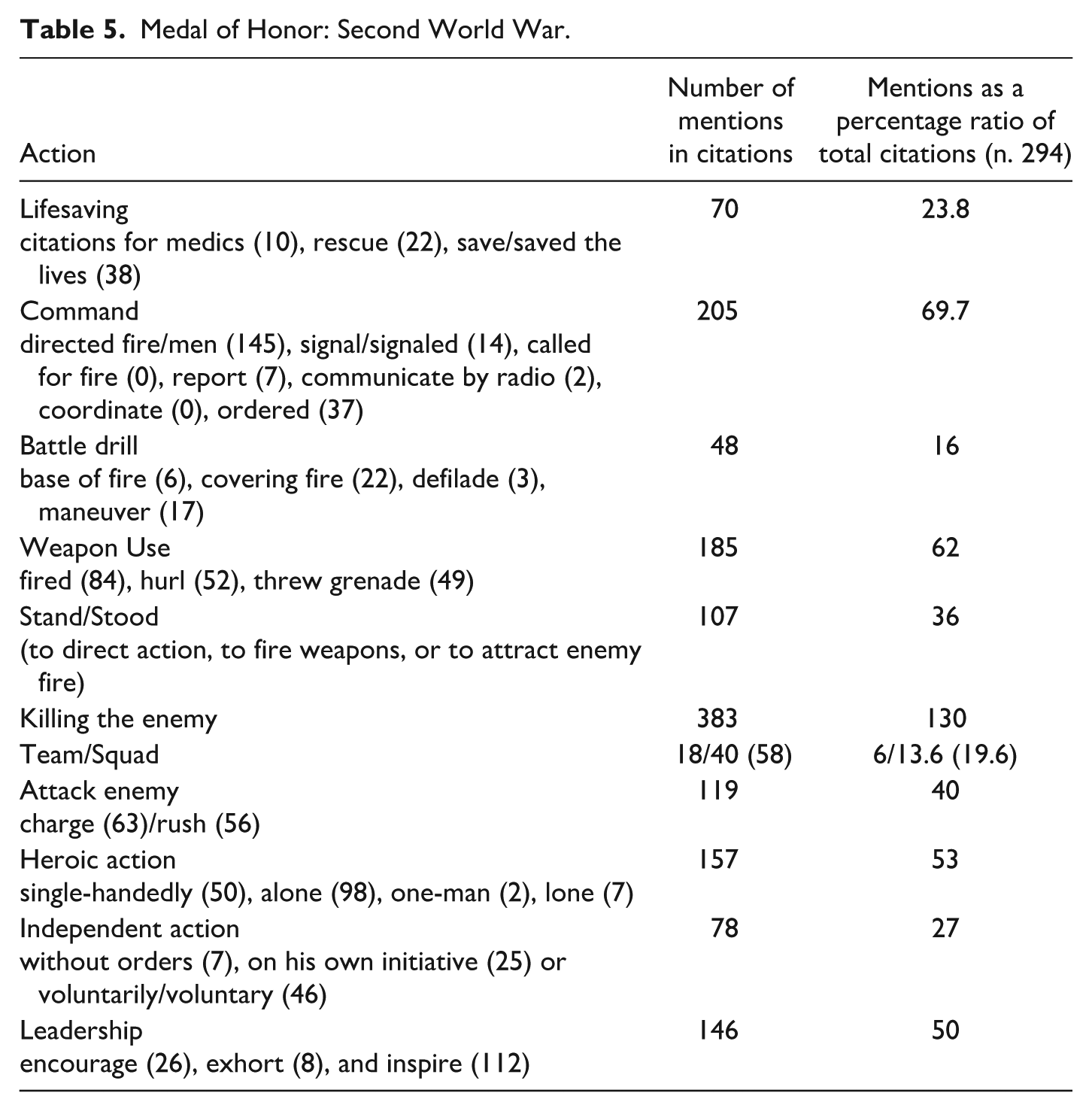
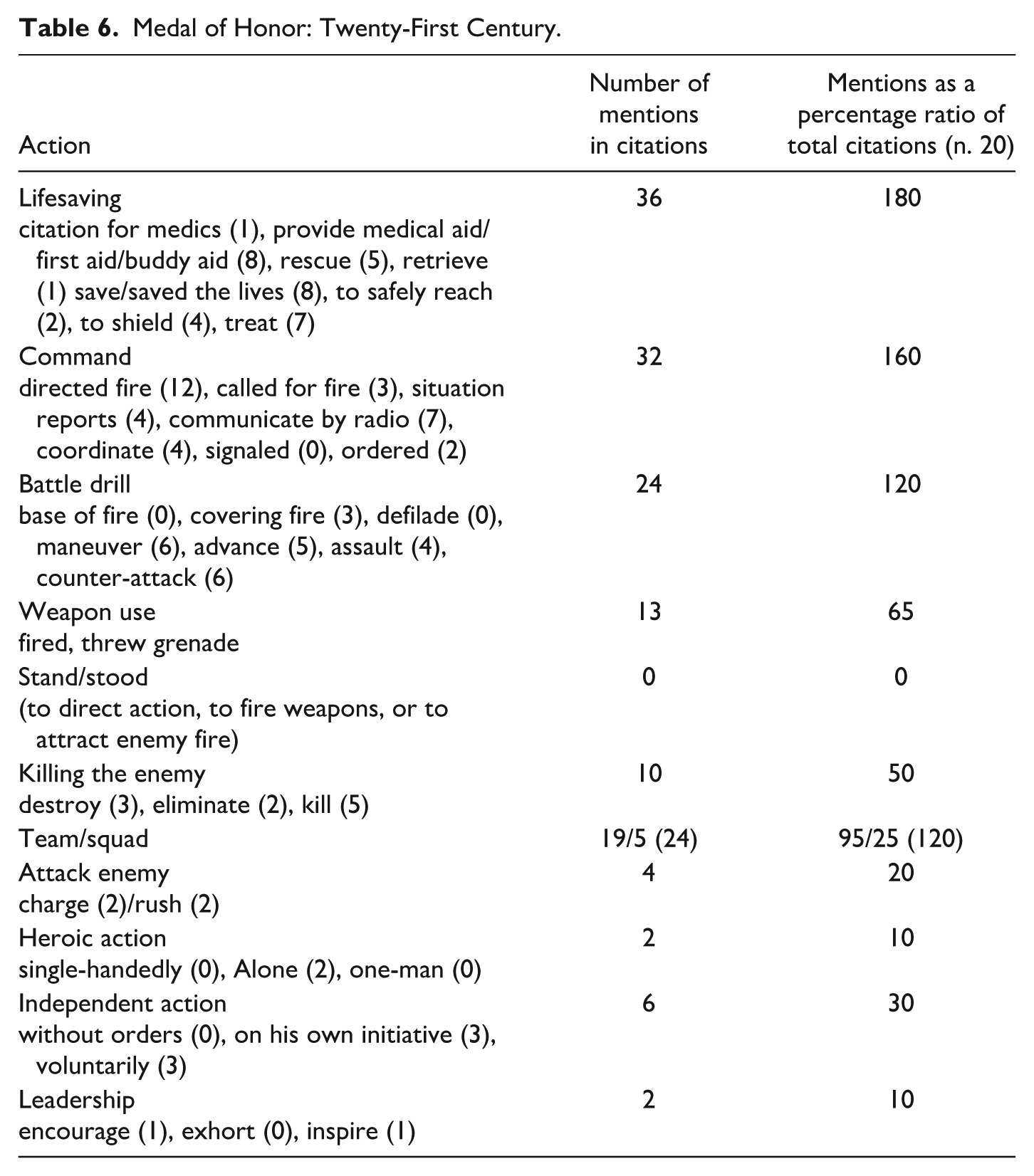
To complete the analysis, we then compared the twenty-first century citations with the 294 Army citations from the Second World War. We chose the Second World War because, in the twentieth and twenty-first centuries, most Medals were awarded during this conflict; it is the largest unified sample. In addition, the Second World War represents the classic, even an iconic, twentieth century war, fought by the Greatest Generation—in stark contrast to the contested Vietnam War and its problematic medallic awards. Consequently, we read and analyzed all 294 citations to develop a detailed interpretation of them. 1 This comparison was vital; it highlighted the easily-missed distinctiveness of the contemporary citation. To demonstrate this difference most clearly, we then identified key words or phrases in both sets of citations. On the basis of a word search, we tabulated (Tables 5 and 6) the number of times a word or phrase appeared in the citations in the two eras to enable us to plot how the lexicon of citations—and the definition of heroism—have evolved.
Distribution of Medals
In his articles in the 1970s, Joseph Blake began his analysis with numbers (Blake 1973; Blake and Butler 1976). He documented the quantitative distribution of awards. He showed that in three wars, the officer class was overrepresented among MoH recipients relative to their overall numbers, and that enlisted and NCOs were correspondingly underrepresented. In addition, he demonstrated that enlisted and NCO MoH recipients were far more likely to receive the MoH posthumously than their counterpart officer recipients. On the basis of this quantitative analysis, he was able to develop a sociological thesis about the U.S. Army’s medallic policy. For instance, he argued that during the Vietnam War, heroism had been corrupted as gallantry medals were awarded only to further the careers of professional officers.
We follow Blake’s method. To analyze heroism sociologically and to resolve the heroic/post-heroic debate, it is necessary to begin with a quantitative analysis of the MoH’s distribution. Just like Blake, it is important to recognize how many Medals were awarded, and who received them. Only then is it possible to develop a sociological analysis of how the U.S. Army defines heroism. In the first instance, it is necessary to begin by analyzing the relationship between the numbers of Medals awarded and casualties. We have already noted that since the First World War, there has been an intimate relationship between risk and the MoH. Consequently, the ratio between MoH awards and casualties is a useful metric of how heroism is defined by the U.S. Army.
Some care needs to be taken with casualties, however. Casualties vary historically; they are not immediately equivalent. Since the Second World War, U.S. military medical care has drastically improved. In Iraq and Afghanistan, many U.S. soldiers survived wounds which would certainly have killed their predecessors. Consequently, to understand the gallantry medal-risk ratio—the heroic economy—it is more accurate to compare, not the number of medals awarded with the numbers of soldiers killed as per all previous works on gallantry medals, but with the number of soldiers killed and wounded; total casualties, not just killed in action, are a better comparative indicator. 2
In the Second World War, the U.S. Army awarded a total of 294 MoH to its soldiers. 3 This includes the 42 medals currently awarded after the conflict ended due to lost paperwork or, more frequently due to restorative action to address historic racial discrimination. The figure of 294 also does not include the 38 MoH awarded to the U.S. Army Air Corps in the Second World War; after the war the U.S. Army Air Corps would become the U.S. Air Force and its personnel, some of whom certainly performed heroically, were not usually engaged in ground combat. In the Second World War, the U.S. Army (minus USAAC) incurred approximately 740,565 casualties (Blanchard, 2019; Congressional Research Service [CRS], 2020, 7). Consequently, for those medals awarded for actions between 1941 and 1945, the U.S. Army operated with a ratio of one MOH per 2,519 casualties. In Vietnam, the Medal: casualty ratio fell dramatically. For actions between 1965 and 1973, the Army suffered 127,765 casualties (CRS, 2020, 7), but awarded 182 MoH. The heroic economy had inflated, so one MoH was awarded for every 702 casualties. The MoH was much easier to earn in Vietnam.
The heroic economy of the campaigns in Iraq and Afghanistan was quite different. It became exceptionally difficult to earn a MoH. During the Iraq campaign, MoH awards were especially rare. There, the award-casualty ratio increased to 1:4,131. The MoH was almost 6 times harder to earn than in Vietnam. In Afghanistan, the MoH-casualty ratio decreased to 1:1,111. This inflation was possibly an attempt to rebalance the extreme parsimony in Iraq and the concerns it engendered. Proportionally, more MoH were awarded in Afghanistan than in the Second World War, but they were still far harder to earn than in Vietnam. Overall, in the twenty-first century, it was harder to earn a MoH than in the Second World War. For instance, from the First World War to Vietnam, just over two Medals were awarded per 100,000 soldiers on operations. By contrast in Iraq and Afghanistan, 0.1 Medals was awarded per 100,000 personnel deployed; there was a “one in a million” chance of receiving a MoH during these campaigns (Mear, 2018: 127). These concerns eventually found a hearing in Congress, where in 2006, the House Military Personnel Subcommittee conducted an inquiry on award frequency (Mear, 2018: 128). In 2010 the House Committee on the Armed Services reported that “the committee is concerned with the minimal amount of Medal of Honors [sic] awarded for acts of gallantry during Operation Enduring Freedom and Operation Iraqi Freedom” (Mear, 2018: 129) (Table 1).
U.S. Army MOH Ratios.
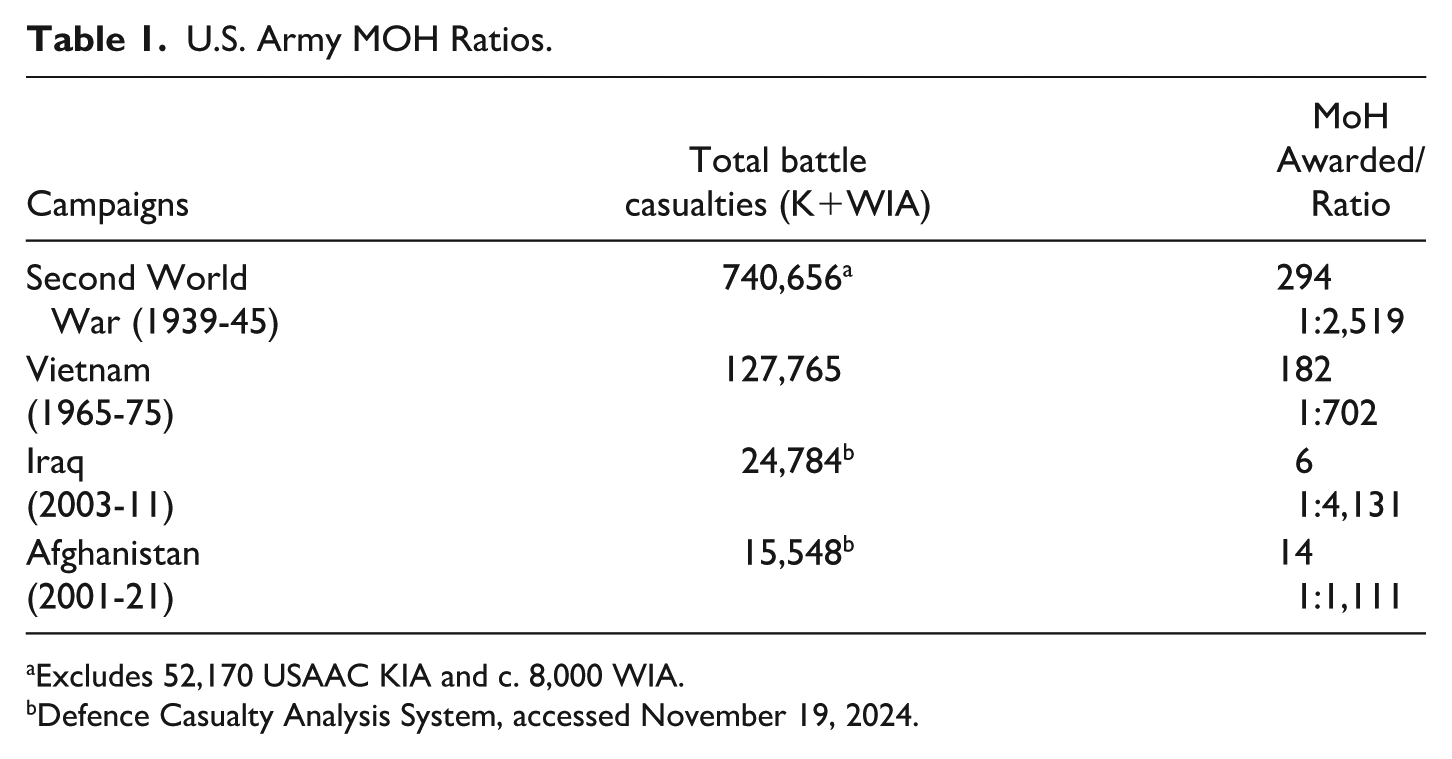
Excludes 52,170 USAAC KIA and c. 8,000 WIA.
Defence Casualty Analysis System, accessed November 19, 2024.
The U.S. Army seems to have been consciously trying to redress the profligacy of Vietnam. A common criticism of the U.S. Army in Vietnam was that while citizen soldiers did the fighting, professional officers used the campaign to further their careers, using their brief command tours to earn awards (Blake, 1973; Savage & Gabriel, 1976; King, 1972). The awarding process had been corrupted. The Silver Star, for instance, became an end of tour award for battalion commanders (Mear, 2018: 109). In the twenty-first century, the U.S. Army seems to have wanted to eliminate any suggestion that gallantry awards are determined by nepotism, rank privilege, or careerism. Consequently, they have awarded only very few gallantry medals. In this way, the U.S. Army has reaffirmed that heroism is rare and precious. The twenty-first-century MoH awards have been parsimonious. Only the highest acts of heroism have been recognized.
There is a second notable feature of the current heroic economy. Medal awards are now far more egalitarian than they were in the twentieth century. In the Second World War, almost 27% of U.S. Army MoH recipients were officers, even though officers constituted less than 10% of the Army, and even less of small combat units. In 1973, Blake found that although U.S. officers from all four services comprised 11% of military personnel at that point, they received 28% of the medals (Blake, 1973; Blake & Butler, 1976). Blake asserted that in Korea and Vietnam, MoH were awarded to officers to advance their careers, and that senior officers were especially overrepresented. Tables 2 and 3 confirm Blake’s point. Throughout the twentieth century, officers were favored for the MoH.
Second World War: U.S. Army Medal of Honor Recipients by Rank. a
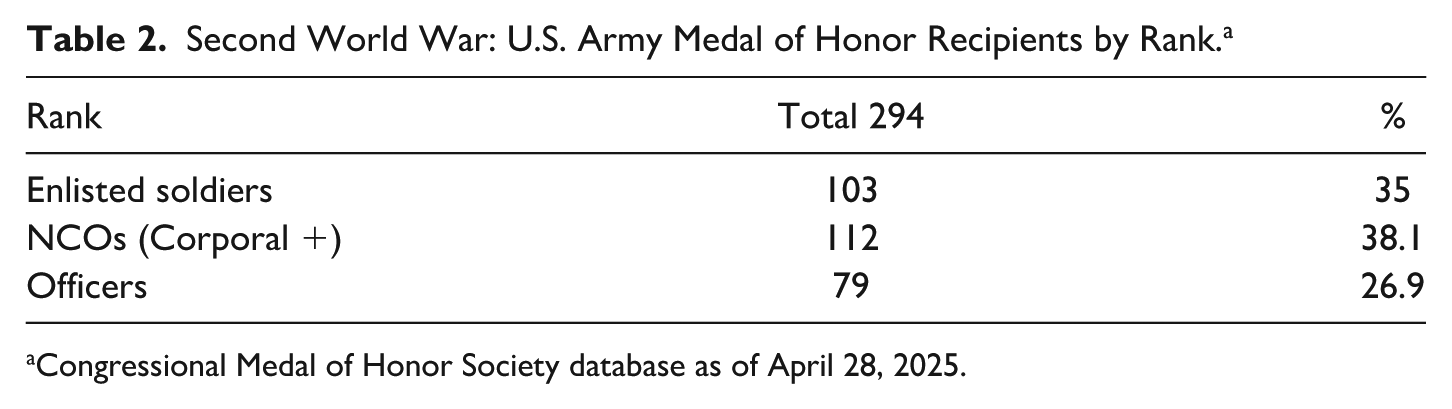
Congressional Medal of Honor Society database as of April 28, 2025.
Vietnam: U.S. Army Medal of Honor Recipients by Rank. a
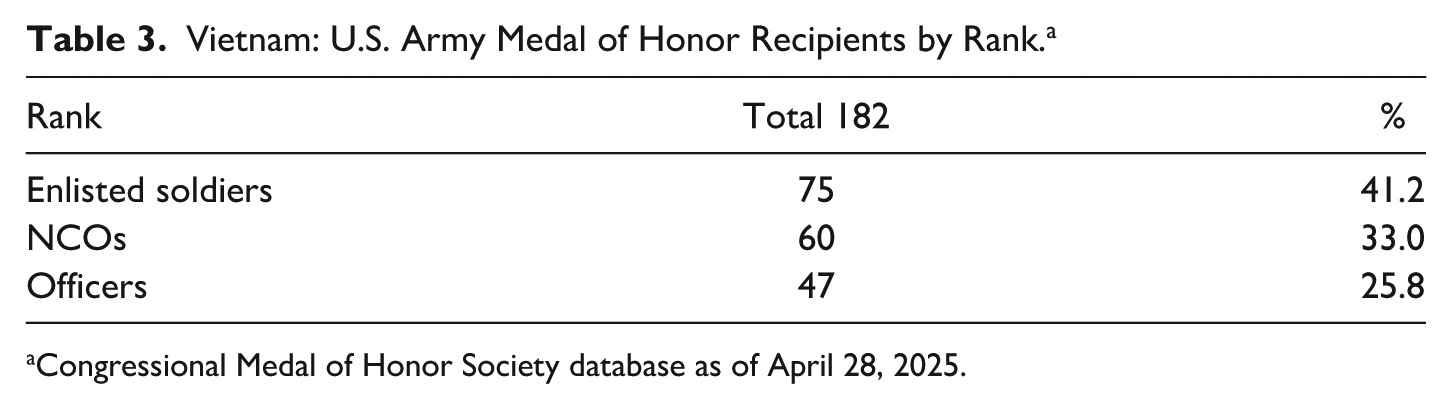
Congressional Medal of Honor Society database as of April 28, 2025.
It is striking to compare the twentieth-century data, and especially the Vietnam figures, with the Army MoH awards from Iraq and Afghanistan. It is clear from Table 4 that Army MoH awards have democratized. In Iraq and Afghanistan, officers received relatively fewer medals than they did in Vietnam. MoH awards were broadly proportionate to officer numbers; about 10% of the force. By contrast, NCOs were now fully represented in MoH awards. In the U.S. Army, soldiers are promoted relatively quickly, so there is a large non-commissioned cohort. However, experienced NCOs, so critical to close combat, were also more likely to be identified as the “model” service members now favoured by the awarding system (Mear 2018: 128). Seventy percent of MoH were awarded to NCOs in Iraq and Afghanistan. This is a reversal of the distribution which typified the twentieth century.
Iraq and Afghanistan: U.S. Army Medal of Honor Recipients by Rank. a
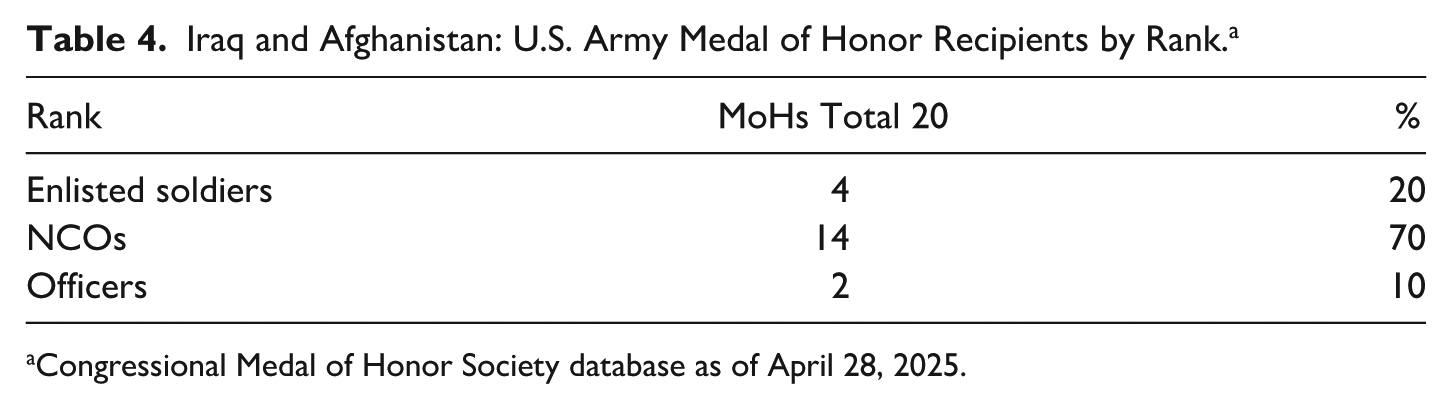
Congressional Medal of Honor Society database as of April 28, 2025.
The medallic economy of the twenty-first century is distinctive. The U.S. Army has severely restricted the awarded; the MoH has become very hard to earn. At the same time, enlisted personnel have been as likely to receive it as officers. Heroism has been rationed; but it has also democratized. Any U.S. soldier might be a MoH recipient under this regime; but only a very few ever are. There are many controversies about MoH awards and other gallantry medals. Captain William Swenson was initially denied the MoH, when he should have been awarded it; Patrick Tillman was awarded a Silver Star on false testimony. But MoH awards are no longer infected with the rank privilege which typified the twentieth century, though. In this way, the U.S. Army seems to be trying to demonstrate that, in contrast to the Vietnam era, it has become a meritocratic, professional organization.
The Twenty-First-Century Citation
The distribution of medals in the last 20 years suggests that the U.S. Army has tried to align the MoH with the principles of an all-volunteer professional force. This is a useful starting point. However, to establish any change in the ideal of heroism, it is necessary to examine the citations, where contemporary military definitions of heroism are articulated, much more closely. The U.S. Army has awarded 20 MoH in the conflicts since 9/11. It is a small sample in comparison with the Second World War, but it is a very rich archive, on which all other scholars have necessarily relied. Although few, the citations are detailed and it is possible to draw out some important themes in them. Lachmann and Stivers, for instance, claim to have discovered the defining motif in these citations. They suggest that whereas traditional MoH citations focused only on aggressive acts of killing the enemy, lifesaving acts—when soldiers have rescued their comrades under fire—have now become key: “Defensive heroism offers a way of reconciling the value of the autonomous individual with military service, and in its emphasis on saving lives rather than killing speaks to new norms of masculinity” (Lachmann & Stivers, 2016: 350).
At one level, Lachmann and Stivers are correct. For instance, the word “kill” was common in the twentieth century citation. Of the 294 U.S. Army’s Second World War citations, 188 citations, or 64%, describe the recipients killing the enemy. The word “kill” is used 383 times in this sense. Indeed, many citations record how many German or Japanese soldiers the recipient killed. By contrast, MoH citations in the twenty-first century use the word “kill” more rarely; it features in four citations (in 20% of the total), appearing five times in all. Instead of the word “kill,” in the twenty-first century, doctrinal terms are preferred; the words “engage” appears 36 times, “destroy” three times, and “eliminate” twice. Lachmann and Stivers are right, the word “killing” is now eschewed. Moreover, lifesaving is central to MoH citations in the twenty-first century. Of the 20 citations, every single one describes at least one lifesaving act; soldiers shield their comrades from grenades or IEDs, rescue or evacuate the wounded, cover their comrades’ retreat, protect them from being killed (as bases are overrun), allow comrades or the wounded to return safely, or prevent the bodies of fallen soldiers being taken. For instance, “Staff Sergeant Atkins saved the lives of the three other soldiers who were with him and gallantly gave his life for his country.” 4
It is clear that lifesaving is a central part of the contemporary citation. To be awarded a MoH, soldiers must save their comrades. Yet, to argue that these citations prioritize lifesaving alone mis-interprets the citations. If lifesaving were the sole constitutive element of the contemporary heroism, it might have been thought it would be enough merely to extol the act of rescue. Yet, the citations are now longer; the contemporary citation is an average of 411 words long, as opposed to 312 words in the Second World War. As a result, the citations contain many elements; they go far beyond lifesaving alone. The citations are very detailed; soldiers engage in many other minutely described military practices, including fighting and killing—or “destroying”—the enemy. This additional detail is mandated in U.S. Army contemporary professional regulations and, in particular, the regularly revised AR 600-8-22, the U.S. Army’s policy of medal awards. These regulations delineate what must be covered and how.
In the citations, recipients do not just save lives, then. In many cases, the recipients used their personal weapons to engage and kill the enemy. Command, directing the action of others, is especially prominent. Recipients took control of the situation, communicating and giving orders. They coordinated their teams. The act of command appears 32 times in the 20 citations. For instance, in Afghanistan in November 2007, Specialist Kyle White “provided information and updates to friendly forces, allowing precision airstrikes to stifle the enemy’s attack” when his platoon was ambushed. Wounded while clearing a compound in Patya in 2008, “Staff Sergeant Petry continued to maintain the presence of mind to place a tourniquet on his right wrist before communicating the situation by radio in order to coordinate support for himself and his fellow wounded Rangers.” When Wanat Patrol Base in Kunar was attacked in July 2008, Sergeant Ryan Pitts “took control of the observation post,” despite his wounds: “With the enemy close enough for him to hear their voices and with total disregard for his own life, Sergeant Pitts whispered in radio situation reports and conveyed information that the Command Post used to provide indirect fire support.” References to battle drills are also common, appearing 24 times.
If we take all 20 citations together, it is possible to identify the critical elements of the contemporary citation (Table 6). Lifesaving is important but it is always situated in a framework that includes other actions. These actions include command, battle drills, weapon use, killing the enemy, teamwork, attacking the enemy, heroic action, individual action, and leadership (see Table 6). Below, we will compare the findings from Table 6 with those from the Second World War (Table 5) to demonstrate the distinctive character of contemporary heroism more fully. Yet, even without that comparison, it is possible to see that the citations communicate a distinctive ideal of heroism.
Medal of Honor: Second World War.
Medal of Honor: Twenty-First Century.
For instance, while Lachmann and Stivers prioritize lifesaving, even where citations described how MoH recipients sacrificed themselves by jumping on a grenade or absorbing the blast of IEDs (Atkins, Groberg, McGinnis), they describe other actions which led up to that sacrificial act. For instance, Private First Class Ross McGinnis received a MoH for saving his comrades from a grenade. He was mounting a heavy machine gun on a Humvee in Baghdad in 2006, when a grenade was thrown into the gunner’s hatch. He blocked the grenade with his body, shouting “Grenade” as he did so. His communication—a formal military drill he had been taught in training—allowed his comrades to take cover. It is useful to compare this account with Second World War citations. There are 11 cases of self-immolation in the Second War World citations. In only two (Mann and Wetzch), did the soldier sacrificing himself warn his colleagues; in the other nine, the act of self-sacrifice itself was enough to win a MoH. Twenty-first-century citations never describe lifesaving alone (unlike the Second World War). There are always other tactical references in the text. If the citation writers were interested only in lifesaving, it seems unlikely that they would invest so much effort in describing actions whose merits were irrelevant to post-heroic definitions of heroism. On the basis of this evidence, it is necessary to conclude that lifesaving is a necessary, but not sufficient, element of contemporary heroism.
To show that there is more to the twenty-first-century heroism, it is useful, to focus on a few specific citations, and one in detail. Precisely because all 20 are so similar it would be possible to select any of them. However, three stand out as especially remarkable and have been the focus of much discussion and analysis: Salvatore Giunta, David Bellavia, and Clinton Romesha. Specialist Giunta’s citation when he was serving in 2nd Battalion, 503rd Parachute Infantry Regiment, in the Korengal Valley Kunar Province, Eastern Afghanistan, is very powerful. Giunta led his squad out of a Taliban ambush, recovering the body of a fallen comrade. It has been discussed at length elsewhere (King, 2013: 231–232; 302–303; King, 2016). Staff Sergeant David Bellavia was awarded a MoH for clearing insurgents from a house in Fallujah in 2004, more or less single-handedly; he personally “destroyed four insurgents, and badly wounded a fifth.” It, too, has been the subject of analysis (King, 2013: 234–236).
Consequently, we examine the case of Staff Sergeant Clinton Romesha. In 2009, at the Battle of Kamdesh, U.S. troops defended the remote Combat Outpost Keating, in eastern Afghanistan against a vastly superior Taliban force which had mounted a surprise attack. The combat was desperate, and the defense of the outpost has become legendary. Staff Sergeant Clinton Romesha received a MoH for his actions that day. His citation is remarkable and very instructive for understanding contemporary heroism. The Romesha case is also methodologically useful because the Battle of Kamdesh was the subject of a best-selling book by the journalist, Jake Tapper. It is, therefore, possible to corroborate Romesha’s official citation with Tapper’s account which was based on interviews with U.S. soldiers, who were present, and on official U.S. Army situation reports and transcripts (Tapper, 2013). Tapper describes Romesha’s actions in Combat Outpost Keating at length and, while written in a visceral journalistic style, his account confirms the citation (Tapper, 2013: 509–563). Romesha’s citation reads as follows, with significant actions highlighted: Staff Sergeant Clinton L. Romesha distinguished himself by acts of gallantry and intrepidity at the risk of his life above and beyond the call of duty while serving as a Section Leader with Bravo Troop, 3d Squadron, 61st Cavalry Regiment, 4th Brigade Combat Team, 4th Infantry Division, during combat operations against an armed enemy at Combat Outpost Keating, Kamdesh District, Nuristan Province, Afghanistan on October 3, 2009. On that morning, Staff Sergeant Romesha and his comrades awakened to an attack by an estimated 300 enemy fighters occupying the high ground on all four sides of the complex, employing concentrated fire from recoilless rifles, rocket propelled grenades, anti-aircraft machine guns, mortars and small arms fire. Staff Sergeant Romesha moved uncovered under intense enemy fire to conduct a reconnaissance of the battlefield and seek reinforcements from the barracks before returning to action with the support of an assistant gunner. Staff Sergeant Romesha took out an enemy machine gun team and, while engaging a second, the generator he was using for cover was struck by a rocket-propelled grenade, inflicting him with shrapnel wounds. Undeterred by his injuries, Staff Sergeant Romesha continued to fight and upon the arrival of another soldier to aid him and the assistant gunner, he again rushed through the exposed avenue to assemble additional soldiers. Staff Sergeant Romesha then mobilized a five-man team and returned to the fight equipped with a sniper rifle. With complete disregard for his own safety, Staff Sergeant Romesha continually exposed himself to heavy enemy fire, as he moved confidently about the battlefield engaging and destroying multiple enemy targets, including three Taliban fighters who had breached the combat outpost’s perimeter. While orchestrating a successful plan to secure and reinforce key points of the battlefield, Staff Sergeant Romesha maintained radio communication with the tactical operations center. As the enemy forces attacked with even greater ferocity, unleashing a barrage of rocket-propelled grenades and recoilless rifle rounds, Staff Sergeant Romesha identified the point of attack and directed air support to destroy over 30 enemy fighters. After receiving reports that seriously injured Soldiers were at a distant battle position, Staff Sergeant Romesha and his team provided covering fire to allow the injured Soldiers to safely reach the aid station. Upon receipt of orders to proceed to the next objective, his team pushed forward 100 meters under overwhelming enemy fire to recover and prevent the enemy fighters from taking the bodies of their fallen comrades. Staff Sergeant Romesha’s heroic actions throughout the day-long battle were critical in suppressing an enemy that had far greater numbers. His extraordinary efforts gave Bravo Troop the opportunity to regroup, reorganize and prepare for the counterattack that allowed the Troop to account for its personnel and secure Combat Outpost Keating. Staff Sergeant Romesha’s discipline and extraordinary heroism above and beyond the call of duty reflect great credit upon himself, Bravo Troop, 3d Squadron, 61st Cavalry Regiment, 4th Brigade Combat Team, 4th Infantry Division and the United States Army.
Lifesaving is very obvious in this citation. Romesha’s action prevented the base from being overrun, and his colleagues being killed. He explicitly helped wounded comrades to escape by providing covering fire. He also prevented the bodies of his comrades (who may still have been alive) being taken by the Taliban. If lifesaving were enough to earn a MoH, then his citation would presumably have focused only on these acts. It does not.
The citation is also careful to record Romesha’s individual military skill. In the course of the action, he employed two different weapons, a machine gun and a sniper rifle, to engage and kill the enemy. In addition to his personal skill, Romesha also executed coordinated tactical maneuvers with his teammates; the citation records he and his comrades moved to, and from, cover. Finally, the citation records Romesha’s command skills. Recognizing the threat, he “assembled” and then “mobilized” a five-man team to resist the attacks. He coordinated air strikes, while maintaining communications with the operations center and receiving orders from them. Throughout the action, he observed, assessed, and decided what to do; he commanded the action. Romesha made astute military judgments that he was able to communicate to his soldiers. The wording of the citation is significant. It draws direction on official U.S. Army doctrine. Romesha performed recognizable tactical drills which U.S. Army soldiers are trained to perform.
The implication is clear. Romesha actions were indeed exceptional; they were above and beyond the call of duty, but not because they were utterly individualistic. Rather, even in the worst possible situation, Romesha was able to maintain his military professionalism use the skills, and to execute the drills he had been trained to perform to repel the enemy, in order to protect his comrades. Above all, he led and always fought as part of a team. As the citation pointedly notes as the counter-attack begins, “Sergeant Romesha and his team provided covering fire”—not Romesha alone. Romesha acted as part of a team.
Romesha’s citation is elaborate, but the concept of professional teamwork is an important motif in many of the other citations. For instance, Specialist Salvatore Giunta saved a wounded colleague being dragged off by the Taliban after an ambush. However, it is noticeable that Giunta always acted as part of a squad in this action; he successfully led an anti-ambush drill with his squad. At one point, his citation describes how “the team continued forward.” In Fallujah in 2004, Sergeant David Bellavia acted almost entirely alone. He cleared a house of insurgents on his own. It was an almost pure case of individual heroism. Yet, his citation references the team of which he was part. He provided “covering fire that allowed the squad to break contact and exit the house.” He executed a drill with his team and then continued to fight.
In support of these citations, it is notable that the U.S. Army has constructed an elaborate, official website dedicated to its Medal of Honor recipients. These pages involve a long description of the action and additional biographical information about the recipients, including personal photographs (e.g., www//army.mil/medalofhonor/romesha). The website includes a section on the battlescape, with maps and simulated reconstructions, so that the reader can understand the actions more fully. Significantly, this section also often includes an introduction to the unit, recording its history and, sometimes, even its individual personnel. On several pages, the reader is invited to “meet the team,” of which the MoH recipient was a member. The motif of professional teamwork is prominent in every account.
The MoH, of course, celebrates individual soldiers as heroes. However, on the basis of the evidence of the citations, heroism is not understood individualistically by the U.S. Army. Even when they sacrifice themselves, recipients are constructed as professional experts, executing official U.S. Army tactics and techniques. They are trained and skilled soldiers. Moreover, they do not act alone. The concept of teamwork is constitutive in the twenty-first-century citation. Descriptions of teams or teammates actively working together appear 19 times in the 20 citations; that is, a ratio of 95% for the citations. That figures goes up to a 120% ratio, if the five references to squads working together are added. MoH recipients are heroic because they are outstanding members of teams. Medal recipients, therefore, consciously embody the shared institutional values of the U.S. Army; the recipients are exceptional because they share these skills with their fellow soldiers. Medal recipients go above and beyond the call of duty, not by acting in previously inconceivable ways, but, on the contrary, by executing the drills they have learnt in training at the most difficult and dangerous moments, and are able to lead their colleagues in executing those drills in combat. They are professional heroes.
In the light of the constitutive role of professionalism in contemporary heroism, it is possible to re-consider the post-heroic thesis. Rather than defining heroism as lifesaving, as post-heroic theorists do, it is more plausible to understand the reference to lifesaving as a way of showing that the medal recipient acted as part of a team. Medal recipients were so deeply integrated into their squads, that they were willing to risk and, in some cases, to sacrifice their lives for their fellow soldiers. Here, lifesaving was not so much evidence of personal valor, but rather it was constructed in the citations as a categoric example of professionalism. It was the ultimate sign of teamwork in the U.S. Army.
The U.S. Army itself seems to define lifesaving consciously in this way. In the 1990s, the U.S. Army developed an oath which it called the Warriors’ Creed. It now features prominently in U.S. Army doctrine. The Creed is a professional oath, committing U.S. soldiers to the highest standards of combat performance. It declares: “I am a Warrior and a member of team . . . I am an expert and a professional.” 5 Significantly it also includes the line: “I will never leave a fallen comrade.” 6 For the U.S. Army, lifesaving is a professional duty; it is intrinsic to its heroic warrior ethos, not a post-heroic subversion of it. The MoH citations all reflect this principle of U.S. military professionalism. At this point, the meaning of the citations begins to shift; their dual focus on aggressive action and lifesaving become more understandable. Medal of Honor citations might be better understood as venerations, not of humanitarian lifesaving per se, but of military expertise and skilled teamwork on the battlefield. Heroism has become professional.
Heroism in the Second World War
Post-heroic theorists believe that heroism—and MoH citations—have changed; heroic theorists assert continuity. In both cases, historical comparison is essential to sustaining any argument about heroism and its possible transformation or continuity. Consequently, to affirm the argument for professional heroism in the twenty-first century, proposed above, it is necessary to compare twenty-first century citations—and their definition of heroism—with MoH citations from past. The Second World War is a fertile resource here and we focus on MoH from this war. It is certainly important to recognize certain continuities in the U.S. Army’s definitions of heroism. Notwithstanding advances in urban combat, the squad and platoon battle tactics of the U.S. Army remain similar to those of the Second World War (see King, 2013, 2014, 2025). Consequently, the Second World War citations include actions which would be recognizable today; they feature individual weapon use, leadership, command, and battle drills. That continuity may have confused heroic theorists, like Powel, but it is important to recognize significant changes.
Second World War citations have a different tone and content. The citations are much more graphic and visceral than contemporary ones. They describe the genuinely extraordinary actions of individual soldiers, most of whom were citizen soldiers; some of their gallantry borders on the incredible. They evoke the violence and terror of the battlefield. U.S. soldiers are subjected to “withering hostile fire”; they run across “bullet-whipped terrain” or “fire swept ground”; they are “splattered” or “showered” “with dirt and rock splinters from the impact of bullets.” Recipients kill the enemy graphically. They hurl grenades, spray, or “pour fire at,” “cut down,” or “wipe out” the enemy. The citations praise the copious expenditure of ammunition; Private Kuroda “fired clip after clip,” Lopez “fired until his ammunition was exhausted.” In Italy on February 1, 1944, Private First Class Knappenberger ran out of ammunition and “crawled 15 yards forward through steady machine-gun fire, removed rifle clips from the belt of a casualty, returned to his position and resumed firing to repel an assaulting German platoon armed with automatic weapons.” Brutality is common. For instance, even though he was a battalion commander, Lieutenant Colonel George Mabry, stormed an enemy bunker in the Hurtgen Forest on November 20, 1944; “Using the butt of his rifle he felled one adversary and bayoneted a second.” Corporal Edward Bennett “clubbed [a German soldier] to death with the butt of his gun” during the combat in Heckhuscheid.
Although the citations are diverse, documenting every theater and a multitude of tactical situations, there is one recurring motif which frames many of the accounts. In response to a crisis, MoH recipients attacked the enemy alone. In attack, after their comrades have been killed or wounded, or incapacitated through terror, they charged hostile positions, firing their weapons, and throwing grenades. The MoH recipients killed or captured many enemy soldiers single-handedly—or, sometimes, with the minimal assistance of some comrades. The verb “charge” appears 63 times, “rush” 56 times in the citations; the word “single-handed” appears 50 times, “alone” 98 times, “one man” 10 times. For instance, “against odds that appeared suicidal, Private First Class Craft launched a remarkable one man attack” against the Japanese on Okinawa. Near Lohe, Germany, on April 18, 1945, Private Merrell mounted a “gallant one-man attack,” followed by a “spectacular one-man attack.” In eleven laudatory cases, the citations detail how recipients attacked “firing from the hip.”
Alternatively, in defense, when an American position was about to be overrun, recipients fired their weapons from exposed positions, with no concern for their safety, to repel enemy assaults. The citations, therefore, refer to the recipients standing up in exposed positions, firing their weapons or drawing fire to themselves. The verb “stand” appears 64 times; “stood” 43 times. On July 17, 1943, in Sicily, First Lieutenant Waybur, of the 3rd Division, “seized his .45 caliber Thompson sub-machine gun and standing in the moonlight directly in the line of fire, alone engaged the leading tank.” In France in August 1944, Sergeant Hawk “became a human aiming stake for the destroyers,” which concentrated all their fire on him.
Tactical drills, of the type which define the contemporary citation, sometimes appear in the Second World War citation. For instance, near Lure in France on September 17, 1944, First Lieutenant Donald Schwab “quickly extracted his men from the attempted ambush and led them back to a defiladed position.” The word defilade appears twice in Schwab’s citations and in one other citation in the Second World War. On April 17, 1945, in Italy, Staff Sergeant McCall, “skilfully...guided his men through a barbed-wire entanglement.” However, for the most part, recipients demonstrated moral leadership, not military command; they did not command their colleagues to execute drills, but rather they exhorted them to fight. Leadership is important and the number of words associated with it appear in 50% of the total citations (146/294). Recipients “encourage” (26 times), “exhort” (8 times), and “inspire” (112 times) their men by their example. For instance, at Rechicourt in France on September 27, “the zeal and fervor of his [First Lieutenant James Fields’] leadership was such as to inspire his small force to accomplish their mission in the face of overwhelming enemy opposition.” Medal of Honor recipients in the Second World War were bold and aggressive virtuosos—they were brilliant individual soldiers—who acted alone to motivate their reluctant comrades. In this way, they reflected a pattern of individual action and collective inertia, typical of citizen armies in the twentieth century. At that time, and despite myths about the combat performance of the Greatest Generation and the Wehrmacht, in particular, poorly trained citizen soldiers often froze in combat, while the action was prosecuted by individual combat leaders. The pattern was originally (and controversially) noted by SLA Marshall in the 1940s, and has been corroborated more recently by one of the authors (King, 2013; Marshall, 1968, 40–61).
To illustrate this individualist construction of heroism, it is useful to examine a specific citation and to compare it with Romesha’s citation from the previous section. Lieutenant Audie Murphy was the most decorated U.S. soldier in the Second World War. His 1945 MoH citation for actions in Holtzwihr, France, is one of the most famous in the archive, although it is similar to several of the most striking ones (e.g., Baker, Bell, Bolden, Colalillo, Cole, Daly, and Meagher). It, therefore, offers a good comparison with the twenty-first century, and especially those of Giunta, Bellavia, and Romesha, which have become similarly renowned today. There are useful similarities between Murphy’s citation and these three contemporary ones. In each, all engaged the enemy at close quarters, driving them from their positions with the use of various weapons in defense of their comrades. The citations therefore document the “intrepid” actions of all these U.S. soldiers, firing rifles, machine guns and throwing grenades. They performed similar acts. Yet, there is marked a difference between the accounts: 2d Lt. Murphy commanded Company B, which was attacked by 6 tanks and waves of infantry. 2d Lt. Murphy ordered his men to withdraw to prepared positions in a wood, while he remained forward at his command post and continued to give fire directions to the artillery by telephone. Behind him, to his right, 1 of our tank destroyers received a direct hit and began to burn. Its crew withdrew to the woods. 2d Lt. Murphy continued to direct artillery fire which killed large numbers of the advancing enemy infantry. With the enemy tanks abreast of his position, 2d Lt. Murphy climbed on the burning tank destroyer, which was in danger of blowing up at any moment, and employed its .50 caliber machine-gun against the enemy. He was alone and exposed to German fire from 3 sides, but his deadly fire killed dozens of Germans and caused their infantry attack to waver. The enemy tanks, losing infantry support, began to fall back. For an hour the Germans tried every available weapon to eliminate 2d Lt. Murphy, but he continued to hold his position and wiped out a squad which was trying to creep up unnoticed on his right flank. Germans reached as close as 10 yards, only to be mowed down by his fire. He received a leg wound, but ignored it and continued the single-handed fight until his ammunition was exhausted. He then made his way to his company, refused medical attention, and organized the company in a counterattack which forced the Germans to withdraw. His directing of artillery fire wiped out many of the enemy; he killed or wounded about 50.
7
There are obvious references to Murphy coordinating action; he called in artillery fire. He organized a counter-attack at the end of the action. Murphy exercised command—like Romesha and Giunta. However, the citation prioritizes Murphy’s individual performance; above all, it highlights his personal actions on the burning tank destroyer. The citation describes Murphy firing its 0.5 Caliber machine gun, emphasizing throughout that he acted entirely alone; he acted for his company, not with them. Indeed, Murphy commanded his company to retreat to safety in the woods so that he could act. “His fire” then repelled the enemy, many of whom he killed. In contrast to the twenty-first-century citation, the description of Murphy occludes drills and teamwork. Rather, Murphy’s citation is a testimony to his remarkable individual heroism. Murphy’s citation is typical of the Second World War citation. Individual acts of virtuosic heroism are the focus, rather than professional training, tactics, and teamwork.
Comparing Twentieth- and Twenty-First-Century Citations
It is possible to demonstrate this shift from individual heroism to the professional heroism of the team more systematically, by comparing quantitative word use in citations from the twenty-first century and from the Second World War (see Tables 5 and 6). We identified key words and phrases from citations in both periods and, through a simple word search function, were able to enumerate and tabulate word use. Because there are almost 15 times as many Second World War citations, it was useful to calculate the ratio between the use of a specific word or phrase and the total number of citations. Thus, in the Second World War lifesaving appears 70 times in 294 citations; that is a ratio of 1:4.2. This ratio can be expressed as a percentage figure of 23.8. This percentage ratio is an arbitrary absolute figure but, as a relative metric of comparison between the two samples, it denotes the overall content of the citations. In this way, it was possible to put a figure on the dominant themes in the two periods.
There are obvious continuities; independent action remains constant across both sets. In both periods, recipients acted on their own initiative. However, if we look at these tables, there is clear evidence of a shift. In Second World War citations, there are 157 descriptions of heroic individual actions when a recipient charged or fired on the enemy alone (54% of the total number of citations), and the killing of the enemy appears 383 times or 130% of the total citations.
By contrast, teamwork appears much less frequently. The word “team” is rarely mentioned: 18 times in the 294 citation (6%). Of course, the infrequent use of the word “team” might be a reflection of a mere linguistic change, implying no material military change. This is especially the case since U.S. Army squads now consist of formally designated fire-teams, which was not the case in the 1940s, so it is very likely that the term team (referring to these tactical groupings) will appear more frequently now. Consequently, we must search for possible analogues for the words team or teamwork. The obvious word here is “squad” which refers to a small combat team. Significantly, squad appears frequently. It is used 166 times in the 294 citations for the Second World War; that is, 56% of the total citations. However, the word “squad” is frequently used as a descriptor, referring to the smallest military unit of about a dozen soldiers, but implying no coordinated action on its part. For instance, 34 citations refer to squad leaders; many others describe mortar, machine-gun, or enemy squads. Some citations record simply that the members of a squad were killed or wounded. We define teamwork as an action in which squads worked together to perform a battle drill. Teamwork would include any citation in which a squad was able to provide covering fire, to maneuver, to work up to an enemy position, to pass grenades, to fire, to assault, to withdraw, to occupy a building, to drive back or to overwhelm the enemy, or when squads were organized or re-organized, posted, directed to fire, or shifted. For instance, on September 8, 1944, at Les Coates in Brittany, “Private First Class Prussman maneuvered his squad to assault the enemy fortifications.” Near Goville, Normandy, on June 8–9, 1944, Sergeant Ehlers “squad had covered the withdrawal of the remainder of the platoon.” On these criteria, there are 40 occasions when squads executed a collective drill together; that is, a 13.6 percentage ratio of the total citations, a 19.7 percentage ratio if the words team and squad are aggregated. So teamwork is not irrelevant to the Second World War citation, but it is a subordinate theme in comparison with the twenty-first-century citation, when it is mentioned 25 times in 20 citations (i.e., a 120 percentage ratio). When Second World War citations describe squads, they are more typically led by an individual who takes charge and engages in heroic action personally, while the squad plays a passive supporting role. The dynamic is not so much of teamwork, but of individual heroism and collective passivity.
In the twenty-first century, the lexicon is almost inverted. As Lachmann and Stivers noted, lifesaving becomes much more important; words which refer to lifesaving increase from a ratio of 23.8% in Second World War citations (70/294), to a ratio of 180% (36/20). That is the biggest proportional shift in vocabulary. There are other important changes, though. Heroic individual attacks decline from 53% (157/294) to 10% of the citations (2/20); the killing of the enemy falls from 130% (383/294) to 50% of the citations (10/20). Leadership diminishes to 10% of the total (2/20). By contrast, command mentions increase from 69.7% (205/294) to 160% of the citations (32/20); and battle drills increase from 16% (48/294) to 120% (24/20).
Together with the close textual analysis of the citations, the evidence seems to be conclusive. It shows a shift in the ideal of heroism. While lifesaving is certainly central to the contemporary citation, command, coordination, battle drills, and teamwork are also critical, in stark contrast to the Second World War. The conclusion from this is that the contemporary ideal of heroism is not so much post-heroic—it does not idealize humanitarian lifesaving in and of itself—but rather it venerates military professionalism.
Conclusion: The Profession of Arms
Some scholars have claimed that today heroism has become post-heroic. Lifesaving has become more important than defeating the enemy. Other scholars profess a heroic thesis; medals are still awarded for traditional acts of bravery, attacking and killing the enemy. This article offers an alternative perspective. In the twenty-first century, the U.S. Army has defined a new kind of heroism through the MoH. Awards are now very difficult to win, but they are distributed across the ranks, especially to enlisted personnel, while the citations highlight not individual heroism, but military expertise and, above all, teamwork. U.S. Army heroism has professionalized. The MoH now extols calculated, professional expertise and teamwork in combat, over instinctive, individual valor which was the ideal in the twentieth century, and especially for the Second World War. As a result, the MoH projects an ideal of heroic military professionalism.
How are we to explain this shift in heroism? Clearly, it is impossible to do more than suggest an answer to this question in a short conclusion, but some thesis might be offered. During the Vietnam War, the U.S. Army used the MoH to try to promote officers, and to curry popular support (Blake, 1973). In the twenty-first century, by contrast, the U.S. Army seems to have used the Medal of Honor to promote itself as a meritocratic, and highly professional organization. Some scholars have noted the political significance of the professional reputation of the Army (Bacevich, 2013; Krebs et al., 2021). For instance, Krebs et al. (2021) have shown that the American public’s support for the U.S. Army over the last two decades is predicated on whether it is seen as a professional force, whose personnel enlist as a vocational duty, not for money or out of desperation. On this account, it is in the interests of the U.S. Army to present itself as professional with highly competent, dedicated soldiers. It seems likely that the concept of professional heroism, articulated so powerfully through the Medal of Honor and its citations, has been useful to the U.S. Army here. The U.S. Army seems to have consciously curated the MoH to project an idealized version of itself to the public. The awards have been used as an act of professional self-promotion.
The U.S. Army’s ideal of professionalized heroism may, indeed, be politically motivated. Yet, this construct of heroism seems to be especially potent precisely because it reflects some important attributes of the modern U.S. Army today—not because it is fantastical. Whatever the strategic wisdom of Iraq and Afghanistan, the U.S. Army retained its discipline, and its soldiers overwhelmingly served honorably and with skill. The contrast with the U.S. Army in Vietnam, or the Russian army in Ukraine, is marked. On operations in Iraq and Afghanistan, American squads and platoons routinely demonstrated very high levels of cohesion in combat. The recipients of the MoH in the last 25 years have, indeed, gone above and beyond the call of duty, precisely because they typically performed with extraordinary professionalism in desperate combat situations. They are fertile symbols of heroism, precisely because they did act heroically, under the modern, professionalized definition of that term.
Footnotes
Acknowledgements
We are grateful to Ori Swed and Donald Travis for the help on this paper and to the comments and criticisms of three anonymous reviewers, Ron Krebs, and Philip Smith.
Databases
The Congressional Medal of Honor Society Database, accurate as of April 2025.
Declaration of Conflicting Interests
The authors declared no potential conflicts of interest with respect to the research, authorship, and/or publication of this article.
Funding
The authors disclosed receipt of the following financial support for the research, authorship, and/or publication of this article: The authors wish to acknowledge the support of UK Research and Innovation Future Leaders Fellowship MR/Y003950/1.
