




Abstract
Since war is back in Europe, societal perceptions are shifting. Terms such as “warfighting,” “whole of society,” and “total defence force” are becoming more prevalent. There is a growing recognition of the military’s importance and heightened appreciation for soldiers, while taboos on weapon manufacturing and warfighting are disappearing. To what extent, how and with what implication have societal attitudes surrounding the armed forces changed in recent years? This article examines this question through exploratory empirical research of military, political, and public communication items, including media accounts and speeches. This reveals both change and continuity in what had been called post-heroic Europe: both a more pro-military stance and the persistence of one-dimensional narratives of conflict, military intervention and soldiers. This is strategically and ethically problematic. While fairy tale narratives dehumanize both opponents and “our” soldiers, demanding them to be superhuman, a tragic narrative better captures the human reality of war.
“Today, war is back in Europe,” declared the President of the European Commission a year into Russia’s full-scale invasion of Ukraine (Von der Leyen, 2023). While Eastern European countries have been concerned about the return of war for some time, the specter of conflict looms once again in the collective imagination of Europeans and Americans alike. The highest military officer of North Atlantic Treaty Organization (NATO) emphasizes the necessity for a “warfighting transformation” (Bauer, 2023). Newspaper headlines pose pressing questions such as “Is world war looming?” and “Are we heading towards World War Three?” (Smith-Meyer, 2024; The Week, 2024).
What seems to concern citizens, military commanders, and political leaders alike is not just the physical proximity of war, but the fear of its threat reaching their own homes. The Russian invasion of Ukraine has reignited discussions about the potential for escalation. Military leaders stress the need for societies to “prepare for war” and advocate for a “whole-of-society approach” (Brouwers, 2024). Simultaneously, Dutch society, along with others in Europe, is reevaluating its armed forces, viewing them as more essential and increasing military spending, the taboo on combat and arms production is disappearing (Giesen & Frijters, 2024; NOS, 2024).
To what extent, how and with what implication have societal attitudes surrounding the armed forces changed in the Netherlands and neighboring countries in recent years, since the specter of war has re-emerged in Europe following the full-scale invasion of Ukraine? This article examines this question through exploratory empirical research. It begins by grounding itself in existing theories on military violence and society. The subsequent sections explore recent military, political and public reorientations, drawing on 60 communication items, including media accounts and political and military speeches, and then contextualizes these reorientations in broader analyses of societal attitudes and resulting practices in the past decades. The final sections discuss several strategic and ethical dangers of black-and-white “fairytales,” proposing a tragic narrative as an alternative.
The Armed Forces and Society
The Threat and Attraction of Violence
Through history, many Western societies have increasingly viewed violence as deviant and uncivilized (De Swaan, 2015). During the 19th century, public executions were still widespread in Europe, drawing crowds to marketplaces to witness hangings. However, the 19th and early 20th centuries witnessed a shift, coinciding with a broader trend to prevent death and shield suffering from public view (Chambliss, 2011). Over time, military violence became monopolized, professionalized, and thus “civilized,” with accompanying declarations and treaties, stringent civilian control of the armed forces, and military restraint (Lone, 1994; Pepperell, 2016).
Today, violence evokes strong ambivalence (Molendijk, 2021). Like sex, it fascinates us, for instance in action movies and pornography, but also repels us. Specifically, the idea notion of making them one’s job is unsettling, even if we do not inherently see these professions as wrong. Sex workers and soldiers perform “dirty work,” which simultaneously intrigues and disturbs us. As the violence-sex analogy illustrates, the discomfort not just from the physical threat of violence but also from its symbolic danger as a taboo.
Adding to the societal ambivalence, military force is violence carried out in the name of society. Soldiers operate in the margins of society, where violence is to take place, while military action is suspiciously monitored (De Swaan, 2015; von Bredow, 2006). At the level of representation, too, the gore of military violence tends to be kept out of frame. What is in the frame must either be condemned as immoral, or, to accept it back into the realm of the normal and justifiable, it must be “cleansed.” Military actions are portrayed as humanitarian efforts or instead as heroic sacrifice, with the most disturbing actions attributed to “a few bad apples” (Liebes, 1992; Molendijk, 2018; Ryan, 2004).
Europe as Post-Heroic, the Netherlands as Armed Forces-Averse
Contemporary military practice has been characterized as “post-heroic,” referring to a decreased tolerance for war casualties in many Western societies (Ben-Ari et al., 2024). While heroic deeds are still valued, humanitarian acts rather than patriotic sacrifice are now seen as heroic (Frisk, 2018). In the Netherlands, this sentiment is particularly pronounced. Unlike the United States, where warriorship is highly revered, with phrases like “the land of the free because of the brave,” in the Netherlands, pro-military sentiments are often viewed as peculiar and even inappropriate, especially when linked to national identity (Klinkert, 2008).
While Dutch opinion polls have consistently shown majority support for the armed forces over the decades, they also reveal a persistent ambivalence toward them (Blauw Research, 2012; CHOICE Insights + Strategy, 2023; Schoeman, 2008). Between 20% and 35% consider the armed forces a “necessary evil,” and before the invasion of Ukraine, between 10% and 20% believed the military was “unnecessary” or “hardly necessary” (Blauw Research, 2012; CHOICE Insights + Strategy, 2023; Schoeman, 2008). Generally, the Dutch public does not perceive their military as “serving our country” (Molendijk, 2021). Rather, they tend to identify as a “civilized nation,” actively rejecting military elements and embracing a nonmartial, conflict-averse, and tolerant self-image (Klinkert, 2008; Zaalberg, 2013).
Since the 1960s, there have been deliberate efforts toward the “civilianization” (“vermaatschappelijking”) of the military, with the combat-reluctant adage that the modern Dutch soldier should be “as civilian as possible, as military as necessary” (van den Doel, 2022). Many seem to prefer their armed forces to operate as a humanitarian organization such as Médecins Sans Frontières. Today, Dutch society generally views its armed forces as relatively nonmartial, favoring peaceful solutions over violent ones and typically acting in morally responsible ways (Klep, 2019; Sion, 2006; Zaalberg, 2013).
Notably, this self-image is partly inaccurate. Over the past centuries, the Dutch have been involved in forceful military campaigns, wherein ‘the nation’s belligerence and the military’s martial reflexes clearly prevailed (Zaalberg, 2013, p. 872). Especially during periods of crisis, such as the World War I and the early years of the Cold War, the Netherlands exhibited a side resembling “the way major belligerent powers acted,” where “the desired self-image” of a neutral, peace-loving nation “could be temporarily set aside, only to be professed again with as much, or even more, enthusiasm after the crisis” (Klinkert, 2008, p. 7, translation TM). The last decades, the Dutch have joined robust NATO missions such as in Afghanistan, where despite domestic humanitarian framing, Dutch soldiers fought and died (Klep, 2019; Molendijk, 2021).
Closer to reality, then, is another well-known Dutch self-image: that of a nation embodying the archetypes of pragmatic merchants and steadfast vicars (“de koopman en de dominee”). What lies ahead now that European societies are once again confronted with proximate war?
Practices and Narratives in Times of Crisis
In general, human beings have a natural inclination to organize the complexities of the world by mentally dividing things into clear and distinct categories (van den Bos et al., 2005). When faced with the unsettling complexity of reality, they may respond by either expanding their understanding, accommodating nuances, or by retreating further into rigid categorizations to alleviate their unease (Festinger et al., 1956; van den Bos et al., 2005).
In the face of crisis, it is particularly common for people to resort to a rigid mindset including us/them classifications. In addition to anxiety, anger increases pro-militaristic, “hawkish” attitudes (Lambert et al., 2011). Terror-management theory, for instance, builds on the idea that when faced with the prospect of death, people seek ways to alleviate the anxiety caused by this existential terror (Lambert et al., 2011). Uncertainty-reduction theory posits that individuals are uneasy with uncertainty and strive to mitigate the discomfort it brings (van den Bos et al., 2005). Both theories underscore that perceived threats to people’s perceptions of the world as secure and predictable—an actual threat in the case of Terror-management theory and a symbolic threat in the case of Uncertainty-reduction theory—prompt individuals to gravitate toward groups, institutions and beliefs that offer physical and symbolic protection.
Proximate wars generate narratives that emphasize “a bipolar divide of some kind: a dichotomous representation of the international scene, a global clash between two antagonistic forces that invariably carry with them a moral identity” (Vinson & McDonnell, 2007, p. 5). Moreover, crises often trigger a “rally-‘round-the-flag” effect: a surge in popular support for a country’s leaders, which incidentally is usually of a fleeting nature (Lambert et al., 2011).
These effects come with both advantages and disadvantages. Clear and cohesive narratives, along with unified support for leaders, are paramount during times of crisis to ensure robust, coordinated and effective action, as well as to foster societal solidarity, morale, and courage (Dimitriu, 2012; Truchlewski et al., 2023). They decrease internal polarization between societal groups and empower societies to take a resolute stance in conflicts, and in doing so, offer support to invaded nations and potentially deter further escalation of hostilities (Steiner et al., 2023; Truchlewski et al., 2023). However, there is a flip side to this coin. Rally effects may breed unquestioning support for leaders or governments, escalate conflicts, and undermine democratic norms by concentrating power in the hands of a few and by suppressing dissenting voices (Lambert et al., 2011). Also, as will become clear, us/them war narratives may have detrimental effects on both enemy soldiers, the own troops and society at large.
Methods
This article is based on exploratory research, commonly employed when researchers seek to investigate unfolding processes (Stebbins, 2001). While exploratory research does not provide definitive answers due to its preliminary nature, its flexible and open-minded approach can reveal indications of particular patterns—moreover, multiple patterns exist at the same time. In this study’s case, it uncovered both changes and continuations in societal attitudes surrounding the armed forces and military intervention.
Social science exploration is defined as “a broad-ranging, purposive, systematic, prearranged undertaking designed to maximize the discovery of generalizations leading to description and understanding of an area of social or psychological life” (Stebbins, 2001, p. 3). Accordingly, exploratory research often relies on a grounded theory approach, which involves the development of analytical insights grounded in empirical material. Unlike testing predetermined hypotheses, this approach has an inductive tenet. This does not imply that researchers begin with a completely empty mind, but rather that existing theories serve primarily as “sensitizing concepts” (Stebbins, 2001). Grounded theory entails an iterative process where collected data are compared with these sensitizing concepts, new literature is sought based on empirical findings, and emerging understandings are scrutinized through further analysis. Thus, data and theory continuously inform one another, leading to “abductive inference”—the identification of regularities in the empirical material that can be explained by theoretically sound explanations (Richardson & Kramer, 2006).
Table 1 presents an overview of the grounded theory journey of this exploratory study. First, sensitizing concepts were identified concerning societal attitudes toward violence, recent developments in the relationship between society and the armed forces, and threat and crisis responses. These concepts, discussed in the previous theoretical section, served as guiding ideas for the empirical research.
Schematic Presentation of the Analytical Results.
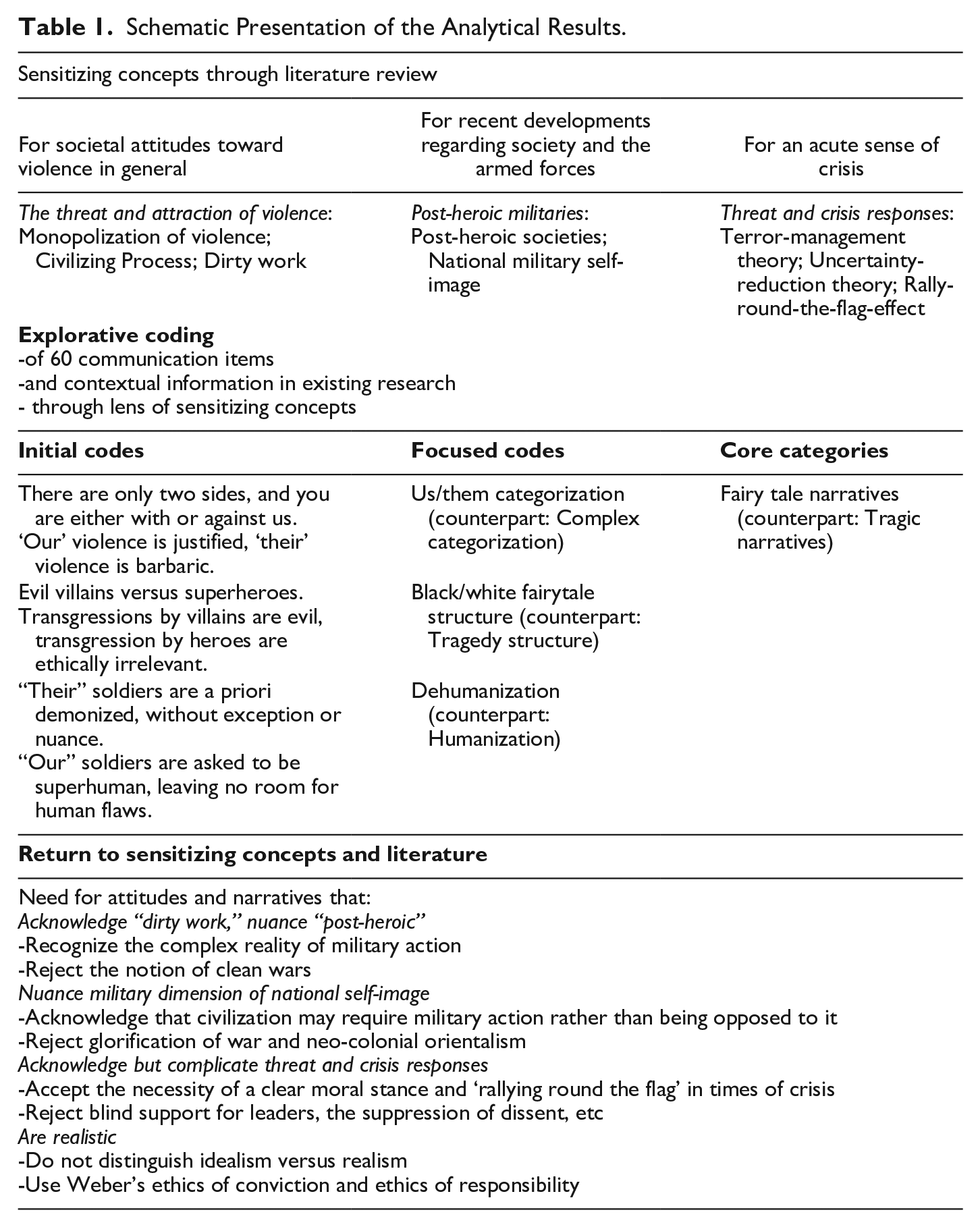
The empirical exploration revolved around scouting evolving narratives and narrative shifts regarding war and the armed forces over the past years, primarily in the Netherlands and its neighboring countries. The initial phase involved an exploratory search to gauge the frequency of media coverage concerning the Dutch armed forces. Using the newspaper database of Nexis, Boolean operators were employed to search for relevant newspaper articles. Given the limitation of the database to search beyond 2023, searches spanned from January 1, 2020, to December 31, 2021, and from January 1, 2022, to December 31, 2023, thus encompassing two 24-month periods. The search terms “defence” (“defensie”) OR “soldier!” (“militair!”) OR “armed forces!” (“krijgsmacht!”) were applied, with the Boolean expression “!” capturing various variants such as “soldiers” (“militairen”) and “military branch” (“krijgsmachtsdeel”).
Subsequently, following Nexis’s sort order by relevance, one media item per month was selected from January 2020 to December 2023, totaling 48 items. Adhering to the grounded theory principle that “all is data,” further exploration was undertaken to broaden the picture. Through the 48 identified items, additional manual searches were conducted to identify relevant media items from 2022, 2023, and 2024. In addition, searches were performed for speeches delivered within this timeframe by political and military leaders on the armed forces in European countries, NATO, and the UN. Finally, statistical data, such as defense spending figures and opinion poll results, were used to provide facts and figures to substantiate observations that might otherwise have been more impressionistic.
The communication items identified through purposive sampling and additional manual searches, in total 60 accounts, were examined as narratives. Narrative research posits that we all make sense of our events and experiences by telling stories about them, and in doing so, about ourselves and each other. Narratives enable people to interpret events, assess conduct, and guide their behavior (Charmaz, 2006; Riessman, 2008). The analysis focused on distilling the why-what-and-how of accounts, including the portrayal of different events and characters, such as perceived threats, the armed forces and soldiers.
The final step involved returning to the literature to contextualize these findings with available information and theory on previous military interventions. This revealed insight into persistent and changing trends in the relationship between society and the armed forces in the Netherlands in the past decades. This information, likewise, was analyzed through the lens of narratives.
The following sections are structured according to the grounded theory journey. The first section explores recent military, political and societal reorientations, based on the analysis of 60 communication items. The subsequent section contextualizes these findings, drawing on available information that offers insight into the evolving relationship between armed forces and society over the past decades. The final section returns to the research question.
Recent Military, Political, and Societal Reorientations
In recent years, there has been a substantial increase in media coverage of the Dutch armed forces. The aforementioned newspaper analysis revealed that in 2020 and 2021, a total of 73,422 newspaper articles addressed this topic. However, in 2022 and 2023, this number rose to 107,172, marking nearly a 1.5-fold increase. The newspaper Algemeen Dagblad, known for its accessible style and wide readership, sustained prominence in discussed the armed forces, with the number of articles rising from 7,482 to 9,264. Meanwhile, NRC, regarded as a quality newspaper with a liberal perspective, had a precise doubling in coverage, from 3,006 to 6,012 articles. In comparison, searches for topics such as “football” showed no such differences.
In 2020 and 2021, many Dutch news articles discussing the armed forces focused on scandals, such as soldier misconduct in military bases or a Dutch bombing in Iraq with civilian casualties, labeled as murder by a member of parliament (Berkhout, 2021; Boere, 2020; Harmsen, 2021). Coverage of military shortages existed but was relatively scant, matter-of-factly reporting frustrated commanders expressing concerns about the lack of political and societal interest (Boersema & Zuidervaart, 2021; De Telegraaf, 2020; du Pré, 2020; Oldenbeuving & Boef, 2021).
In 2022 and 2023, media coverage took on both an alarmist and armed forces-sympathetic tone. Articles appeared describing the importance of grenades in the Russia-Ukraine war with statements such as “If the West wants to prevent that war from spreading, it had better prepare itself to be able to fight such a war as well” (Schoof, 2024). Also, headlines were written such as “The Netherlands can be proud that the way is now clear for the delivery of F-16s to Ukraine” (Persson, 2023). Further exploration revealed specific military, political, and societal reorientations.
“Prepare for War”: Military and Political Calls for War Readiness
With commanders’ concerns over military shortages gaining momentum, there was a sudden push for swift action to rectify the unpreparedness of the military for potential conflicts. Experts echoed the iconic words of a former Belgian minister: “Europe is an economic giant, a political dwarf, and a military worm” (Stoop, 2022). They reported warnings that many European militaries would only be able to withstand a few days of war if faced with aggression on their soil (Aries et al., 2023; Heimbach, 2022; Rademaker, 2022). The Dutch Prime Minister—now head of NATO—declared that European leaders should refocus on “our primary task: keeping our countries and our continent safe,” emphasizing this should happen within “the framework of the European Union and NATO” and “free of old taboos” (Rutte, 2022).
European defense spending rose by 4.5% in 2023 (Giesen & Frijters, 2024). In 2024, NATO urged allies to collectively create a €100 billion fund for Ukraine, no longer cautious about provoking Russia by providing direct support (NATO, 2024). Instead, the NATO Military Committee warned of a potential all-out war with Russia within the next 20 years, advocating “a warfighting transformation of NATO,” where “the responsibility for freedom does not lie on the shoulders of those in uniform alone” but rather, “a whole of society approach” is needed to strengthen NATO’s collective defense (Posaner, 2024). Concurrently, European armed forces are shifting focus back from peacekeeping to prioritizing the protection of national and allied territory, with a renewed emphasis on traditional “warfighting” (Dutch Ministry of Defence, 2019).
Beyond military preparedness, leaders stress the imperative of societal readiness for war as a whole. The Swedish government and military have explicitly warned of conflict within their borders, urging all Swedes to “prepare for war” (Dalmia, 2024). Germany’s defense minister called for Germany to become “war ready” and openly discussed the return of conscription (Connolly, 2024). In the Netherlands, political and military leaders have done the same, asserting that Dutch society, “from kitchen table to boardroom table,” must be “ready for action” (Baas, 2024; van Defensie, 2024; Van Joolen & Schoonhoven, 2023). The recent years have seen a shift away from viewing defense as solely the responsibility of professional armed forces, toward a “whole-of-society approach” and the notion of a ‘total defence force’—terms that have quickly become mantras in military circles (Brouwers, 2024).
“It Is a Wake-Up Call”: Societal Appreciation of the Armed Forces
Political and military leaders are not the only ones discussing the potential for war and societal readiness; citizens are too. Since the 1980s, there has been a global decline in citizens’ willingness to fight for their country. However, recent trends indicate a slowdown and even a reversal of this decline in several countries, despite the persistence of wealth and individualism (Onderco et al., 2024). Research among Dutch citizens shows a growing belief in the importance of a robust military, rising from 63% in 2021 to 75% in 2023, and a heightened perception of the military’s necessity in protecting the Netherlands, increasing from 76% to 83% (CHOICE Insights + Strategy, 2023). Moreover, there has been a substantial increase in societal pride in Dutch military personnel and admiration for their dutifulness, rising from 62% to 70% and from 58% to 69%, respectively (CHOICE Insights + Strategy, 2023).
Numerous media reports feature Dutch commentators, scholars and citizens speaking of a “wake-up call.” Renowned writer Geert Mak, for instance, expressed shock over Ukraine’s invasion on Dutch television, stating: “I am a pacifist,” and ‘actually hate the military’—while also acknowledging that “I have never been very interested in military matters”—"but I am completely shocked by what is happening now” (Talkshow, 2022, translation TM). Roel van Duijn (2024, translation TM), formerly a prominent advocate for pacifism, similarly changed his stance, declaring in an op-ed: “although I used to be a pacifist, I am now convinced that Europe must rearm itself, and conscription must be reintroduced.”
Overall, once-controversial terms such as “war,” “fighting,” and “combat” have become increasingly normalized, as have discussions around arms trade and weapon manufacturing (Brouwers, 2024; Giesen & Frijters, 2024; Keukenkamp, 2024; NOS, 2024; Van Joolen & Schoonhoven, 2023). Military, political and societal accounts surrounding the war in Ukraine show a clear narrative motif: “we can’t lose” and “we must win” (Ash, 2024; Kuijpers, 2023; Mascaro, 2023). The losing/winning motif expresses a zero-sum formula and suggests a binary “either with us or against us” logic. Meanwhile, on social media, the language of winning and losing takes on the guise of sports commentary, with videos of dying Russian soldiers being openly shared and even celebrated (Roussinos, 2023). Indeed, the discussions on war sometimes even seem tinged with excitement.
This shift has surprised some observers. As a journalist signaled, herself critical of pacifism, the fervent pro-military positioning “is particularly pronounced among—usually peace-loving—progressives.” Drawing parallels to the pro-establishment wartime rhetoric of the New York Times during the Iraq conflict, she observed that segments of the political left, “who previously often led the charge for the years-long dismantling of the armed force” are now “behaving like a bunch of cheerleaders for whom the fight cannot be tough and firm enough” (Kuijpers, 2023, translation TM; see also Peterson, 2024).
Has the Unthinkable Truly Become Thinkable Again?
Considering the developments discussed above, we might say that the “unthinkable” has become “thinkable” again, as many think tank reports and media outlets phrase it (Brady, 2024; Jakes & Anderson, 2024). Yet, has war truly become something European societies are now genuinely considering again?
Current trends bring to mind the so-called “war enthusiasm” of World War I. It is commonly believed that as war approached in 1914, Europeans reacted with strong public support, even war enthusiasm, but the reality was more nuanced. It is true that World War I triggered alarm and awareness of the need to strengthen military capabilities, resulting in initiatives toward militarization (Klinkert, 2008). Also, a significant number of artists, writers, and intellectuals, previously staunch pacifists, now embraced a fervor for war (Verhey, 2006). However, sentiments among the broader population were more contradictory. Particularly the working class, expected to bear the brunt of the fighting, lacked the enthusiasm of the urban elite who enthusiastically welcomed the war, encouraged by authorities through parades and flag displays, which received the most media attention (Verhey, 2006). Also, efforts toward militarization soon waned postcrisis in several countries (Klinkert, 2008).
Today, a similar duality, although not entirely analogous, could be unfolding in European countries such as the Netherlands. Despite emerging war-focused rhetoric and calls for national militarization, there persists a reluctance to enlist in the military and a noticeable absence of patriotic ideals (CHOICE Insights + Strategy, 2023; The Economist, 2024). Also, as stated, phenomena like the “rally-’round-the-flag effect” are typically short-lived (Lambert et al., 2011).
More broadly, it cannot be readily assumed that current promilitary conceptions entail a more realistic understanding of war and military service, or even demonstrate greater acknowledgment of soldiers, than anti-military attitudes. This becomes clear in the following sections.
From Anti- to Promilitary Narratives as Both Change and Continuity
These sections further contextualize the recent developments discussed above by drawing on available information offering insight into the relationship between armed forces and society over the past decades, focusing on the experiences of soldiers. This exploration will reveal not only a societal shift from anti-military to pro-military sentiments but also the persistence of a rather binary societal perspective on warfare.
Societal War Stories of “Villains” and “Heroes”
Soldiers’ stories are typically raw accounts that reveal a spectrum of mixed emotions (Mogstad, 2024; Molendijk, 2021). Their stories are, for instance, about the normalcy of cheering and laughing when seeing a blast of fire, the piercing cries of soldiers at the loss of a buddy, the black humour used to cope with this loss, the easy acceptance of “collateral damage” resulting from combat and, at the same time, about profound feelings of guilt at being unable to save a child from abuse (Molendijk, 2021, p. 135).
At the same time, research among soldiers consistently shows they avoid discussing their deployment experiences with civilians. European soldiers, in particular, have been proposed to be reluctant due to their irritation with what they perceive as “naïve” antimilitaristic humanitarian ideals, as illustrated by a veteran’s observation that civilians wished to see soldiers “go forward strewing teddy bears” (Molendijk, 2018, p. 318).
Soldiers from various European countries report that many civilians simultaneously exhibit a craving for and aversion to their war stories (Molendijk, 2018, 2023; Pedersen, 2021; Sørensen, 2015). For instance, Dutch soldiers are commonly asked the following set of questions: “Have you ever been deployed?”; “Have you killed anyone?”; “Do you have any problems now?” (Molendijk, 2018). In the soldiers’ experience, people anticipate specific responses when asking them about fighting and its emotional impact: they often seek sensational war stories, yet they also expect to hear that the soldier is still burdened by having taken lives, although to a degree that does not become too uncomfortable (Molendijk, 2018; Sørensen, 2015).
Notably, soldiers report feeling misrecognized not only in response to public criticism, but also in relation to overly positive appraisal. It is noteworthy that the WOII resistance members who established the Dutch Resistance Museum purposefully refrained from using the term “hero” in the museum as they “did not want to be called ‘heroes’” (van der Horst, 2023, p. 35, translation TM). Yet, the discomfort with heroic imagery is also shared, for instance, by US soldiers (Farnsworth, 2014; Lifton, 1973; Morris, 2013). Much like negative caricatures, soldiers experience heroism as a distorting of their deployment experiences (Farnsworth, 2014; Molendijk, 2021). Heroic tales romanticize and sanitize bloodshed and violence, portraying soldiers as sacrifices made by morally exemplary superhumans. Moreover, heroization denies soldiers their agency. It denies them the possibility of their making mistakes and to withhold the possibility of remorse (Farnsworth, 2014; Molendijk, 2021).
So, the societal issue here lies not just in pacifist aversion to military intervention but rather in simplistic perceptions. Societal war imaginaries have clear-cut distinctions between perpetrator versus victim, normal versus abnormal, and good versus evil, where soldiers become one-dimensional caricatures: villains, heroes or victims (Galtung, 2003; Leudar et al., 2004; Molendijk, 2018; Sørensen, 2015). Soldiers are portrayed as either bad or commendable or pitiful—not all at once, and not anything in between. War stories that do not fit these categories are shunned, along with the soldiers telling them. Thus, as simplistic narratives protect society from the disturbing complexity of war’s reality, they alienate soldiers. It is for this reason that one-dimensional caricatures of villain, hero and victim can create a sense of misrecognition among soldiers: they do injustice to their actual experiences while rendering these experiences “unspeakable” (Molendijk, 2018).
Political Decision-Making: “If Men Define Situations as Real. . .”
Accurate or not, narratives impact reality, especially when alternative accounts have become unspeakable. As the famous sociological theorem goes: “If men define situations as real, they are real in their consequences” (Thomas & Thomas, 1928, p. 572). And societal perceptions not only have real consequences for soldiers upon their return from their mission, but already for the mission itself.
Dutch societal black-and-white narratives have not prevented military intervention from occurring; rather, they have shaped how such interventions were carried out, framed and perceived. A Dutch soldier put it as follows: ‘It‘s like we want to eat meat, but don’t want to know how the cows were butchered’ (Molendijk, 2023). Accordingly, as discussed, Dutch societal perceptions and political practices blends a moralist self-image where military elements are marginalized, with mercantile, at time belligerent pragmatism. Recurrently, this duality has contributed to the creation of overly ambitious humanitarian mandates, where Dutch troops were expected to “do good,” but with insufficient resources and impractical constraints (Dimitriu & Graaf, 2016; Grandia, 2015; Klep, 2019; Klinkert, 2008; Molendijk, 2021). Repeatedly, compromises were made to achieve consensus and public support, only to result in practically unfeasible missions (Molendijk, 2021).
An infamous instance is the tragic failure in Srebrenica in the 1990s. The Dutch public insisted on deploying soldiers, driven by a strong sense that “something had to be done” to address the humanitarian emergency in the former Yugoslavia (Honig & Both, 1996; Klep & Winslow, 1999; NIOD, 2002). At the UN level, this resulted in the design of an intentionally highly ambiguous mandate (Honig & Both, 1996; Molendijk, 2021; NIOD, 2002). At the Dutch level, the decision was made to deploy only a few hundred peacekeepers armed with what Dutchbat soldiers dubbed “water pistols” to a volatile war zone (Honig & Both, 1996; Klep & Winslow, 1999; NIOD, 2002). Involved officials later referred to the declaration of Srebrenica as a Safe Area as “a fake solution” primarily intended “pour la galerie,” and “not linked to operational realities on the ground” (Rapporteur Report, 2015, pp. 13–14). Consequently, the declaration of Srebrenica as a demilitarized Safe Area was not just violated during Srebrenica’s attack of July 1995 but on a daily basis from the outset (NIOD, 2002; Rapp, 2015).
The 2006–2010 Dutch deployment to Uruzgan, South Afghanistan, is another example of societal perceptions shaping military intervention. Decision-making regarding troop size, budget and time line were influenced more by the socio-political landscape in the Netherlands than by the mission’s objectives and the situation in Afghanistan (Grandia, 2015). Dutch soldiers were sent to Afghanistan a counterinsurgency mission, which purposefully combined humanitarian and combat elements (Zaalberg, 2013). However, in the Netherlands, the combat element was downplayed in response to parliamentary objections that “the Netherlands cannot hold a gun in one hand while extending the other hand for help and support” (Karimi, 2006). This false dilemma reflected assumptions that “you can only do either humanitarian activities or fighting” and that “fighting is wrong.”
Initially, the dichotomy of combat versus reconstruction existed only in Dutch debates, but because it had become political and public reality, it affected the military reality (Dimitriu & Graaf, 2016; Grandia, 2015; Klep, 2011). This had both formal and informal repercussions, including noncooperation between Dutch and US-led troops, and a constant fear of political fallout from military actions (Klep, 2011). This fear was generally not explicitly stated “but felt at all levels,” as several soldiers later related, with tangible consequences (Molendijk, 2021). For instance, it led to lengthy verification processes before air and fire support could be provided, leaving several Dutch soldiers traumatized by their inability to assist their colleagues in need. Moreover, it prompted commanders to withhold information from the Netherlands about the true nature of the fighting in Afghanistan (Molendijk, 2021).
Thus, simplistic self-perceptions and conceptions of war have recurrently resulted in problematic mandates and practices, and harsh criticism of soldiers in the aftermath of missions. For instance, the failed mission in Srebrenica led to Dutch soldiers being called “too sweet for war,” even “cowardly” (Van der Meulen, 1998). In contrast, the Dutch troops in Afghanistan faced reproach for actively engaging in combat (Molendijk, 2021). Conversely, the capture of Kabul by the Taliban, a decade after Dutch forces withdrew from South Afghanistan, sparked outrage, with parliamentarians asking the Ministry of Defense, ‘Aren’t you ashamed?,’ referencing the memory of Srebrenica, “where western troops ran off” (Kraak, 2021).
Fairytale and Tragic Narratives of War
Returning to the present day, what many in Western Europe had consigned to history has now resurfaced: the specter of war. To what extent, how and with what implication have societal attitudes surrounding the armed forces changed since then?
Persistent Fairytale Narratives
The military is increasingly seen as indispensable, and soldiers are receiving greater appreciation. Even more so, there is a newfound boldness in societal debates regarding militaristic solutions. Yet, as became clear, just as the current “war enthusiasm” should not be overstated, neither should the notion that Western Europe’s “wake-up call” led to increased war realism. Juxtaposing previous military-averse sentiments with current pro-military attitudes reveals not only an obvious shift, but also the persistence of one-dimensional, caricatural perceptions of war, military intervention and soldiers. This combination of change and continuity is more logical than it may seem at first glance. When war and violence remain distant and abstract affairs, dovish and hawkish stances are both sides of the same coin of black-and-white narratives. Such narratives, with clear-cut distinctions between good and evil, where soldiers are either villains, heroes or victims, are only accurate in fairytales or Hollywood movies.
In sum, the kind of societal narrative of war that takes on a fairytale-like structure is characterized by the following elements (Figure 1). First, an us/them categorization, involving a binary division where individuals are either “with us or against us.” In this framework, “our” violence is justified, and perhaps even deemed virtuous, while that of the other side is depicted as barbaric. Second, fairytale narratives have a black-and-white fairytale structure, with a clear dichotomy of evil villains versus noble superheroes. The misdeeds of the villains are viewed as inherently evil, whereas wrongdoings by the heroes are overlooked or considered ethically irrelevant. Third, there is the element of dehumanization. “Their” soldiers are a priori demonized, without exception or nuance. At the same time, “our” soldiers are also dehumanized, as they are held to superhuman standards, with no allowance for human flaws or errors.
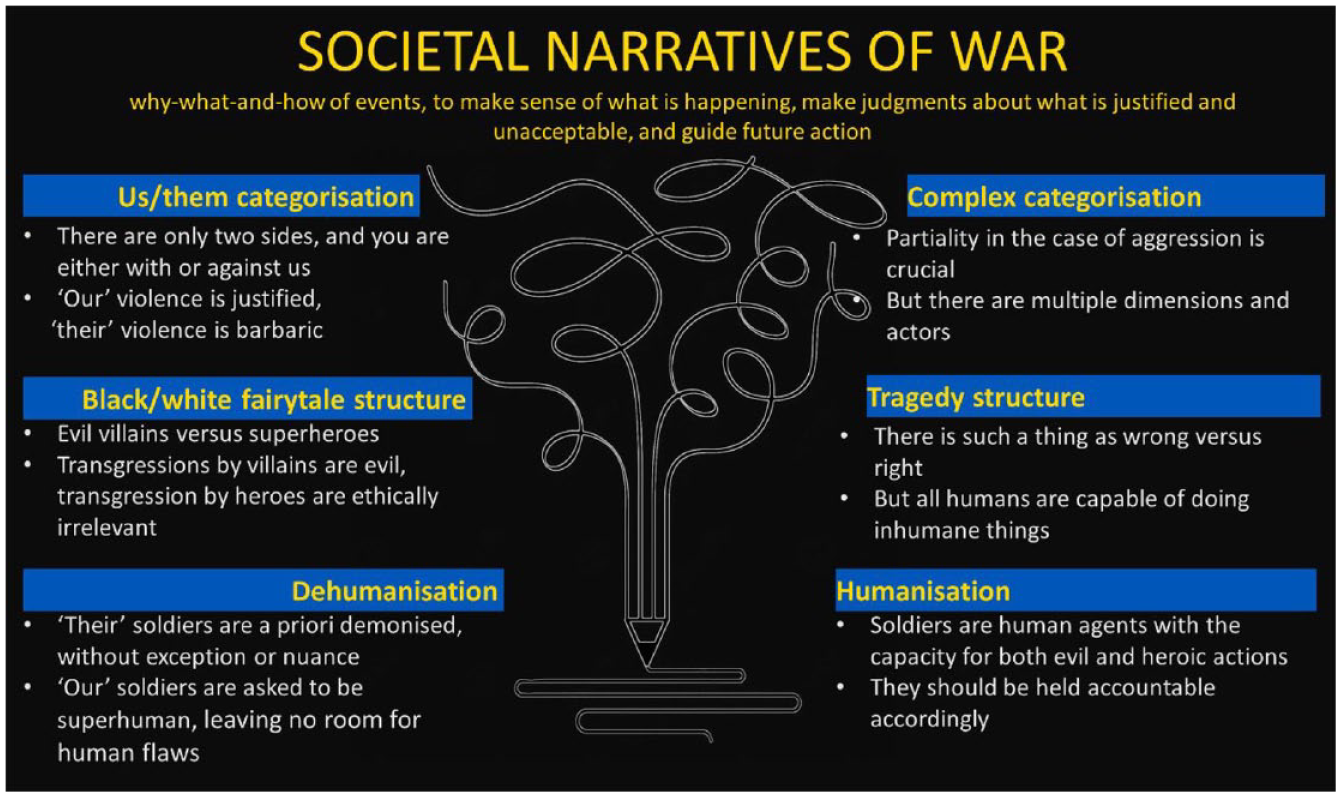
Societal narratives of war.
Implications of Fairytale Narratives
As demonstrated, societal perceptions and narratives, inaccurate or not, have very real implications. They shape political decision-making. While well thought-out radical positions can be valuable, fairytale narratives are dangerous. They contribute to the “reflexive threat inflation” (Walt, 2024) and “alarmism” (Bijkerk & Klep, 2024) currently observed in Europe. For instance, while prudent distrust of Putin and addressing military shortcomings are evidently warranted, the notion that “Russia is not going to stop” remains uncertain. Yet, those expressing such views are often labeled as “naïve, a pro-Russian stooge, or both” (Walt, 2024). Therefore, military experts caution that “political-military pragmatism consistently proves a superior guide compared to loud alarmism” (Bijkerk & Klep, 2024, translation TM).
Fairy tales are at odds with basic principles of military strategy, which dictates that enemies should always be offered a honorable way out to prevent resentment and new wars (Collins, 2002). Therefore, experts in political psychology express concern over officials labeling Russia as “weak” and Putin as “unimpressive” and suggesting that Russia must be “humiliated” and “destroyed” (Alieva, 2023; Mamedov, 2024; Yarhi-Milo, 2023). Drawing on insights into the role of resentment in warfare, as well as the propensity of individuals facing setbacks to take undue risks, they caution that robust economic and military assistance should be separated from personal attacks, because such conflations may further inflame tensions and hinder resolutions (Alieva, 2023; Yarhi-Milo, 2023).
In addition to strategic risks, fairytale narratives contravene core principles of the ethics of war (Molendijk, 2021). They fuel generalizing demonization, leading to actions such as the “cancellation” of an entire population and its history. Take, for example, the boycotting of Russian figures such as Tchaikovsky and the prohibition of Russian attendees from participating in events (Duin & van Gelder, 2022; Riemersma, 2022), and the online celebration of videos showing dying Russian conscripts forced into battle (Roussinos, 2023). Simultaneously, fairytales foster the denial of war crimes by friendly forces, or their dismissal as ethically and legally irrelevant, as seen in reactions to reports of judicial transgressions by Ukrainian forces (Hulshof, 2022). When society and its media approach the military as an institution of which the “righteousness” is not to be questioned, it fosters a thirst for war while creating more war and suffering (Peterson, 2024; see also Travis, 2024). While the notion of “clean wars” is incorrect, sayings like “all is fair in love and war” and “in times of war, the law falls silent” are equally wrong. In fact, the historical lesson that clean wars do not exist and humans can commit inhumane acts is precisely what led to the establishment of international laws and regulations for war (Falk, 2004). As such, fairytale narratives fly in the face of the Just War tradition, both the principles for jus ad bellum (going to war), in bello (in war) and post bellum (after war).
Consequently, a fairytale narrative also harms the own troops. It imagines them fighting clean wars, avoiding bloodshed and keeping their hands clean. Even more so, it asks them to do so while, due to this imagination, it creates missions impossible, placing soldiers in tragic dilemmas—such as peacekeeping in a wars where there is no peace keep—and thus forces them to make dirty hands (Molendijk, 2021). So, a fairytale narrative ends up dehumanizing not only the enemy but also “our soldiers,” by demanding that they be superhuman (Molendijk, 2024).
A Tragic Narrative as Alternative
An alternative perspective on war views it, not as a fairytale, but as a tragic human endeavor, which better captures the human reality of war (Figure 1). A tragic narrative of war is characterized, first, by complexity rather than simple us/them divisions. It recognizes that while partiality in cases of aggression is crucial, there are always multiple dimensions and actors involved. Second, tragedy is central to this narrative. While the existence of right and wrong is acknowledged, it is also recognized that all humans are capable of committing inhumane acts. Third, this narrative emphasizes the humanity of all parties and their capacity for both evil and heroic actions.
Thus, a tragedy narrative recognizes the humanity of all involved, including the opponent, as well as the fallibility of all humans, including “our” soldiers. Strategic approaches stemming from this perspective would not conflate military strength with humiliating the enemy. Instead, they would concentrate on supporting allied forces to bolster their battlefield position while underscoring the adversary’s accountability for their violations of international norms (e.g., Alieva, 2023). Moreover, in this narrative, the ethical standards of the Just War tradition are not seen as naïve but rather as essential minimalist baselines. This perspective acknowledges that expecting clean wars is unrealistic, while also recognizing that dismissing transgressions by “heroes” as ethically irrelevant is equally unrealistic. When Just War criteria are deemed irrelevant in difficult circumstances, they lose their significance. They are established precisely because difficult situations can push anyone to cross moral boundaries and, therefore, should be safeguarded against their own actions.
Finally, whereas a fairytale narrative of war fails to protect soldiers from their own actions—thereby subjecting them to postwar societal vilification—a tragedy narrative recognizes soldiers as human beings. Acknowledging war as a tragic human endeavor allows for actual recognition of soldiers, including those who cross moral boundaries in the fog of war and must live with the consequences.
Conclusion and Reflection
Clearly, not only soldiers may struggle with military intervention but society as well. Historically, in many Western societies, suffering, illness, violence, and death have increasingly been surrounded with taboo. In the absence of proximate conflicts for decades, this has led to a spiral of increasingly less exposure to it and further estrangement. Unrealistic beliefs have developed about “clean” wars and neatly packaged “right” and “wrong” narratives, complete with roles like hero, victim, and villain. Although such categories may resolve societal discomfort with military intervention, they do so by denying the existence of human fragility, complexity, and conflict. As a result, they set unrealistic expectations for soldiers, expecting them to be superhuman saviors capable of liberating or rebuilding a country without any bloodshed, resulting in societal indignation when the mission inevitably fails. Hence, while it is essential to take a clear stance during wartime, as passive neutrality in asymmetric conflicts inevitably enables the aggressor to continue, fairytale narratives are dangerous, both strategically and ethically.
Notably, this issue cannot be understood in terms of idealism versus realism. While realists often accuse idealists of being naive, this article shows that realism is not necessarily less susceptible to fairytale-like thinking than idealism. While the alleged “wake-up call” of Ukraine’s full-scale invasion prompted a shift toward Realpolitik-like rhetoric, prioritizing concerns of power and self-preservation over humanitarian ideals, it became clear that this did not necessarily imply less moralism nor did it entail a more accurate view of war. Instead, it indicated the continued presence of fairytale-structured narratives, aligning with Terror Management Theory and Uncertainty Reduction Theory.
A tragic narrative, instead, does offer realistic nuance. Unlike the recent “post-heroic” and military-averse tendencies prevalent in many Western societies, it rejects the idea that civilization is the opposite of military action (and the notion that civilization can be maintained simply by despising military action) as well as the notion of clean wars. It even allows for statements like “the land of the free because of the brave.” At the same time, it rejects the glorification of war and neo-colonial orientalism towards “enemies.” It recognizes that those who fight for their family and nation are not flawless superheroes but imperfect humans, just as the “Others” are not pure evil but human as well. Also, a tragic narrative acknowledges the necessity of “rallying round the flag” in times of crisis while remaining vigilant against the risks of unquestioning support for leaders or governments and the suppression of dissenting voices. By acknowledging the “dirty work” of conducting war, a tragic narrative recognizes its inevitable human complexity.
The attitude that fits this narrative is neither one of idealism that rejects realism nor the reverse. A more useful—and indeed more realistic—framework than the simplistic distinction between idealism and realism, is Weber’s (1946) distinction between the ethics of conviction and the ethics of responsibility. The ethics of conviction is driven by principles (“we must always act when people are in need”; “we can never harm others”), while the ethics of responsibility focuses on consequences (“we undertake actions where the good outweighs the harm”). Those accused of “naïve” idealism are typically guided by principles, whereas those labeled as “immorally” realist are often more concerned with outcomes. Weber argues that one cannot disregard either approach, as doing so would mean ignoring either foreseeable consequences of one’s (in)action, or the morality of the means used to achieve one’s goals. According to Weber, one should always remain concerned about both fundamental moral principles and the outcomes of one’s actions. This tension, he contends, constitutes the essence of moral responsibility: trying to force the two ethics together while acknowledging the inherent paradoxes. Or as the writer Arnon Grünberg aptly observed: “Hypocrisy is inevitable, but one may strive to be a conscious, well-informed hypocrite” (Grunberg, 2022, translation TM).
Footnotes
Declaration of Conflicting Interests
The author declared no potential conflicts of interest with respect to the research, authorship, and/or publication of this article.
Funding
The author received no financial support for the research, authorship, and/or publication of this article.
