




Abstract
The purpose of this study was to explore the perceptions toward gender and sexual identities in the Portuguese armed and police forces, emphasizing on mental health implications. A qualitative research methodology was followed, using an electronic inquiry answered by 64 participants who are members of the Portuguese armed or police forces. Data were examined using thematic analysis, and the recurrent themes identified were the following: general characteristics of the military/police environment and culture, sexist attitudes and behaviors, positive attitudes and behaviors related to sexuality, homophobic/heterosexist attitudes and behaviors, influence of military and police culture on the expression of sexuality and coping of sexual minorities, negative impact of military and police culture on the mental health of gender and sexual minorities, and personal opinion regarding how sexual and gender diversity should be addressed in the armed and police forces. Analysis of these themes provides insight into the perceptions and experiences of our participants and suggests that the impact of stigma and discrimination toward gender and sexual minorities in this context was relevant for the individuals within this sample.
Introduction
The armed and police forces are institutions grounded on strong ethic norms where a culture of patriotism, obedience, and self-sacrifice prevails (Bennett, 2018; Gibbs, 2020). This culture is also largely based on hypermasculine ideals—that is, an emphasis on stereotypically masculine behavior such as physical strength, aggression, and male sexuality (Mosher & Serkin, 1984)—and is deeply intertwined with conservative and sexist values (which are associated with prejudice, stereotyping, or discrimination, typically against women, on the basis of sex [Stevenson & Lindberg, 2010]), as well as heteronormative ideologies (i.e., the assumption of heterosexuality as the preferred or normal mode of sexual orientation [Harris & White, 2018]) that historically have marginalized gender and sexual minorities (GSM) (Bulmer, 2017; Taber, 2018; Van Gilder, 2018). On a possibly related note, it has been broadly reported in the literature that a minority status tends to be associated with health risks in this environment (Castro & Goldbach, 2018).
In a broader context, Meyer (2003) proposes the minority stress theory to explain the prevalence of poorer health and well-being among sexual minorities, stating that GSM are exposed to specific stressors related to their gender identity and sexual orientation such as stigma, prejudice, and discrimination, which create a hostile environment, resulting in significant distress for LGBT people, negatively affecting their physical and mental health. This can be observed in several existing studies with the general population, in which health disparities have been found between LGBT civilians and non-LGBT civilians (Mongelli et al., 2019; Scheer et al., 2020; Timmins et al., 2020). Whether minority stress theory can be applied to the armed and police forces is unknown, as there are unique aspects inherent to this environment, but its conceptual framework seems to provide a reasonable start (Goldbach & Castro, 2016).
Adding to this, as explained by Castro and Goldbach (2018), the Perpetrator Hypothesis essentially posits that the poorer health status, attitudes, beliefs, and job performance indicators of sexual minority service members are the result of deliberate and malicious perpetrator behaviors that target LGBT people, and that the responsibility for LGBT victimization can be attributed to the perpetrator and organizational climate, policies, programs, and culture that enable such victimization to occur. Despite this, in recent decades, policy on GSM service members has undergone changes in various countries, with the institution of more inclusive policies (Sundevall & Persson, 2016). The Netherlands, Norway, Denmark, Sweden, and Canada stand out historically as some of the most tolerant nations in this regard (Carreiras, 2004), while in other countries the topic has inspired more controversy, such as the case of the United States, for example, with the “Don’t Ask Don’t Tell” (DADT) policy first instituted in 1993 and later repealed in 2010 (Alford & Lee, 2016). Carreiras (2004) also notes that the degree of integration of women in the armed forces appears to be associated with the degree of integration of non-heterosexual individuals, as a greater tolerance toward gender diversity tends to go together with a greater tolerance toward sexual minorities.
Portugal, which is where the present study was conducted, stands as the eleventh most accepting nation toward the LGBT community in the European context according to the European Region of the International Lesbian, Gay, Bisexual, Trans and Intersex Association (ILGA-Europe, 2023b). This ranking is based on how the laws and policies of each country impact the lives of LGBT individuals, using indicators such as equality and non-discrimination on diverse matters (e.g., employment, education, and health), family issues (e.g., same-sex marriage and joint adoption), hate crime and hate speech, freedom of expression and asylum rights, to name a few (ILGA-Europe, 2023a). Despite being well positioned in this ranking, and although there is growing acceptance of LGBT individuals in Portugal, it’s worth noting that, culturally speaking, there exists a strong tradition of Catholicism and family values (Bayrakdar & King, 2023; Roseneil et al., 2013) which are still likely to affect the general population’s attitudes toward GSM (Bayrakdar & King, 2023). Nonetheless, policies that aim to promote the inclusion of both women and sexual minorities are indeed currently in place. At the national level, the promotion of equality and non-discrimination are duties of the Portuguese State which are set out in the terms of the Constitution of the Portuguese Republic, and, specifically in the context of the armed forces, the National Defense Sectoral Plan for Equality 2022 to 2025 aims to ensure that all persons serving in National Defense “do so in a healthy, safe and respectful environment for human rights” (Ministério da Defesa Nacional [MDN], 2022). This plan is aligned with the main national instruments in this domain, highlighting the National Strategy for Equality and Non-Discrimination 2018 to 2030—Portugal + Igual (ENIND), approved in 2018 and supported by three Action Plans: for equality between women and men (PAIMH); preventing and combating violence against women and domestic violence (PAVMVD); and combating discrimination based on sexual orientation, gender identity and expression, and sexual characteristics (PAOIEC) (MDN, 2022). At the international level, Portugal is bound by the main instruments in the field of equality and non-discrimination, assuming several commitments in these areas, particularly within the framework of the United Nations (UN), the Council of Europe (CoE), the European Union (EU), and the Community of Portuguese Language Countries (CPLP) (MDN, 2022). However, inclusive policy does not necessarily guarantee an inclusive and non-discriminatory environment in everyday life in the armed forces (Carreiras, 2004; Sundevall & Persson, 2016).
A study conducted in Sweden indicates that exclusionary practices (e.g., homophobic jargon) continue to happen in the military to this day (Sundevall & Persson, 2016). Hence, despite policy changes that have allowed GSM to serve (openly), Van Gilder (2018) argues that these types of discriminatory practices continue to hinder some of these individuals from properly integrating their personal and military identities. Furthermore, the aforementioned author conceptualizes identity repudiation of sexual minorities as a collective process of stigmatization consisting of behaviors that are used to delegitimize or reject LGBT people in the military, while positing that this may happen through dehumanization (such as being described and/or treated as subhuman through physical or linguistic violence), discrimination (at the organizational, collective, and interpersonal levels), and stereotype proliferation (through which sexual minorities are portrayed as perverted or inept, resulting in their rejection). In Van Gilder’s study, the identity repudiation described earlier influenced sexual minorities’ feelings of belonging within the military, as the vast majority of participants reported feelings of identity incongruity, describing an inability to self-identify as an LGBT individual and be in the military, simultaneously, which negatively affected many of these individuals.
The most reported strategies to deal with these circumstances were identity suppression, through which the participants suppressed their sexual identities in favor of military role identities, and segmentation when they attempted to separate their personal and professional identities, essentially leading two different lives. Both of these strategies would result in what Goffman (1963, p. 42) defines as “passing,” that is, “the management of undisclosed discrediting information” (DeJordy, 2008), which happens when an individual presents themselves or is perceived by other people as belonging to a certain social group that they are not actually part of (DeJordy, 2008; Renfrow, 2004). When done deliberately, passing is usually used to increase social acceptance (Renfrow, 2004), as would be the case for sexual minority service members who actively try to “pass” as heterosexual in the military context.
Moreover, Sundevall and Persson (2016) mention an additional challenge for non-heterosexual service members that occurs associated with the transition toward an increasingly international military, as regardless of the policy of their origin country, all sexual minority service members risk being sent on missions in countries where same-sex relations are considered a crime, as well as working alongside other service members from nations where it is not possible to serve openly, meaning that their sexual identity may have to be concealed, therefore originating or reinforcing the need to pass as heterosexual.
These circumstances have negative implications for sexual minorities that have been documented in the literature. Particularly, victimization (e.g., open and/or overt physical aggression, stalking, sexual harassment and assault, and limited career opportunities) (Carey, LeardMann, et al., 2022; Schuyler et al., 2020) based on sexual orientation and gender identity is commonly reported in the literature regarding the civilian population and exists within the armed forces as well (Goldbach & Castro, 2016). Previous research indicates that service members belonging to sexual minorities are at high risk for experiencing discrimination and some of the aforementioned forms of victimization, such as stalking, sexual harassment, and sexual assault while serving in the military (Gurung et al., 2018; Lehavot & Simpson, 2013; Schuyler et al., 2020; Shrader et al., 2017), and victimization during military service has been linked to increased risk of depression, anxiety, posttraumatic stress disorder (PTSD), substance abuse, and suicide risk, with reported rates often higher among sexual minorities (Beckman et al., 2018; Carey, LeardMann, et al., 2022; Cochran et al., 2013; Lehavot & Simpson, 2013; Mark et al., 2019; Sexton et al., 2018). Furthermore, research clearly suggests that there is an association between social support/acceptance of sexual identity and better mental health among sexual minorities in the general population (Evans et al., 2019; Shrader et al., 2017), and that unit cohesion is related with service members’ well-being (Evans et al., 2019). Thus, it makes sense that serving in a non-accepting environment, regardless of the degree of victimization one is subjected to, would have adverse effects on the mental health of service members belonging to sexual minorities.
This was observed in a study by Evans et al. (2019) in which the LGB participants that reported serving in non-accepting units also reported greater psychological distress. A study by Cochran et al. (2013) also indicated that anxiety due to concealment of one’s sexual orientation while in the service was related to the experience of depression and PTSD symptoms. All these findings are in accordance with other studies, which show that, compared to their heterosexual counterparts, GSM active duty and veteran members showed poorer mental health and well-being outcomes (Beymer et al., 2022; Carey, Jacobson, et al., 2022; Carey, LeardMann, et al., 2022; Eichler et al., 2021; Mark at al., 2019; McDonald et al., 2020; Moody et al., 2020; Oblea & Siaki, 2023; Shrader et al., 2017; Thompson et al., 2021), which might be partially attributed to the experiences of stigma, discrimination, victimization, increased stress, and decreased social support (Carey, Jacobson, et al., 2022; Carey, LeardMann, et al., 2022; Schuyler et al., 2020). Nevertheless, similarly to GSM in the general population (Schuller & Crawford, 2020), in addition to such stressors, the health disparities reported by GSM in the armed forces may be related to barriers to care, such as scarcity of health care services and medical staff that are culturally competent, non-discriminatory, and trained in LGBT health issues (Carey, LeardMann, et al., 2022). This reduces the uptake of accessed health care services by sexual minority service members (Mark et al., 2019), which in turn may exacerbate the adverse mental health symptoms already disproportionately experienced by this group, by leaving them unattended (Oblea et al., 2023).
Considering this and given the scarcity of studies on this topic in Portugal, the present qualitative study was conducted with the purpose of describing the perceptions of service members about gender and sexual identities within the Portuguese armed and police forces, emphasizing the implications for the mental health of GSM, as well as offering information that will help guide future interventions, including prevention, promotion, and education for mental health adapted to this context.
Methods
Participants
A total of 64 members of the Portuguese armed and police forces (40 participants from the armed forces [59.7%] and 24 participants from police forces [37.5%]) responded to the two questionnaire sections and comprise the sample for the data analyses. Participants had an average age of 43.81 years (SD = 11.64), ranging from 24 to 64 years, and reported a moderate degree of satisfaction with their military functions (Mean = 4.44; SD = 1.26; min = 1/max = 6), as accessed by the last question of the first part of the questionnaire. The majority of participants self-identified as heterosexual (84.13%), while 7.93% self-identified as gay or lesbian and 6.35 as bisexual. All sociodemographic information of the participants is described in greater detail in Table 1.
Sociodemographic Data of the Participants.
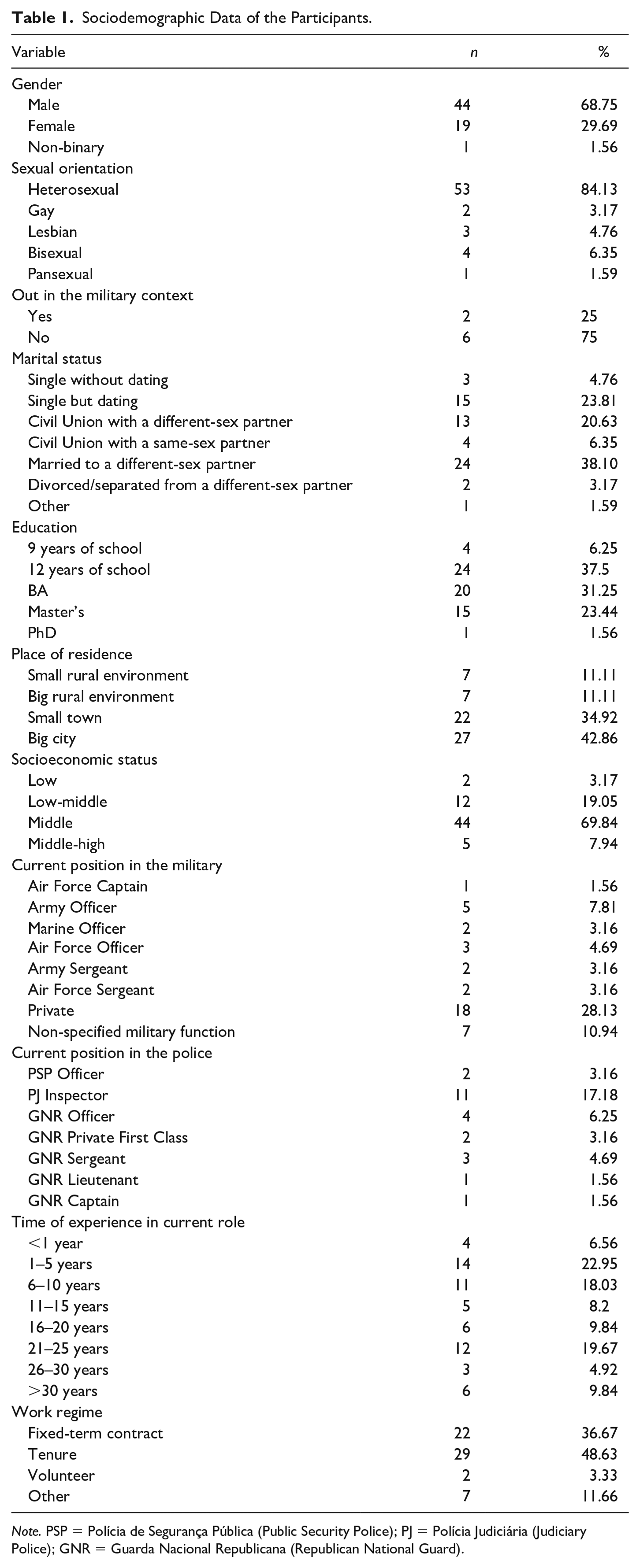
Note. PSP = Polícia de Segurança Pública (Public Security Police); PJ = Polícia Judiciária (Judiciary Police); GNR = Guarda Nacional Republicana (Republican National Guard).
Design and Procedures
As qualitative research, this study aims to gain an in-depth understanding of the phenomenon in question by exploring the perceptions of people directly involved, without intending to generalize results.
Information about the study was disseminated on the websites of the Portuguese armed forces (Army, Air Force, and Navy) and Portuguese police (PSP, GNR, and PJ), and later through mailing lists. The site created for this purpose remained online between October 7 and November 4, 2022. Thus, the data were collected online through convenience sampling, with a total of 64 participants.
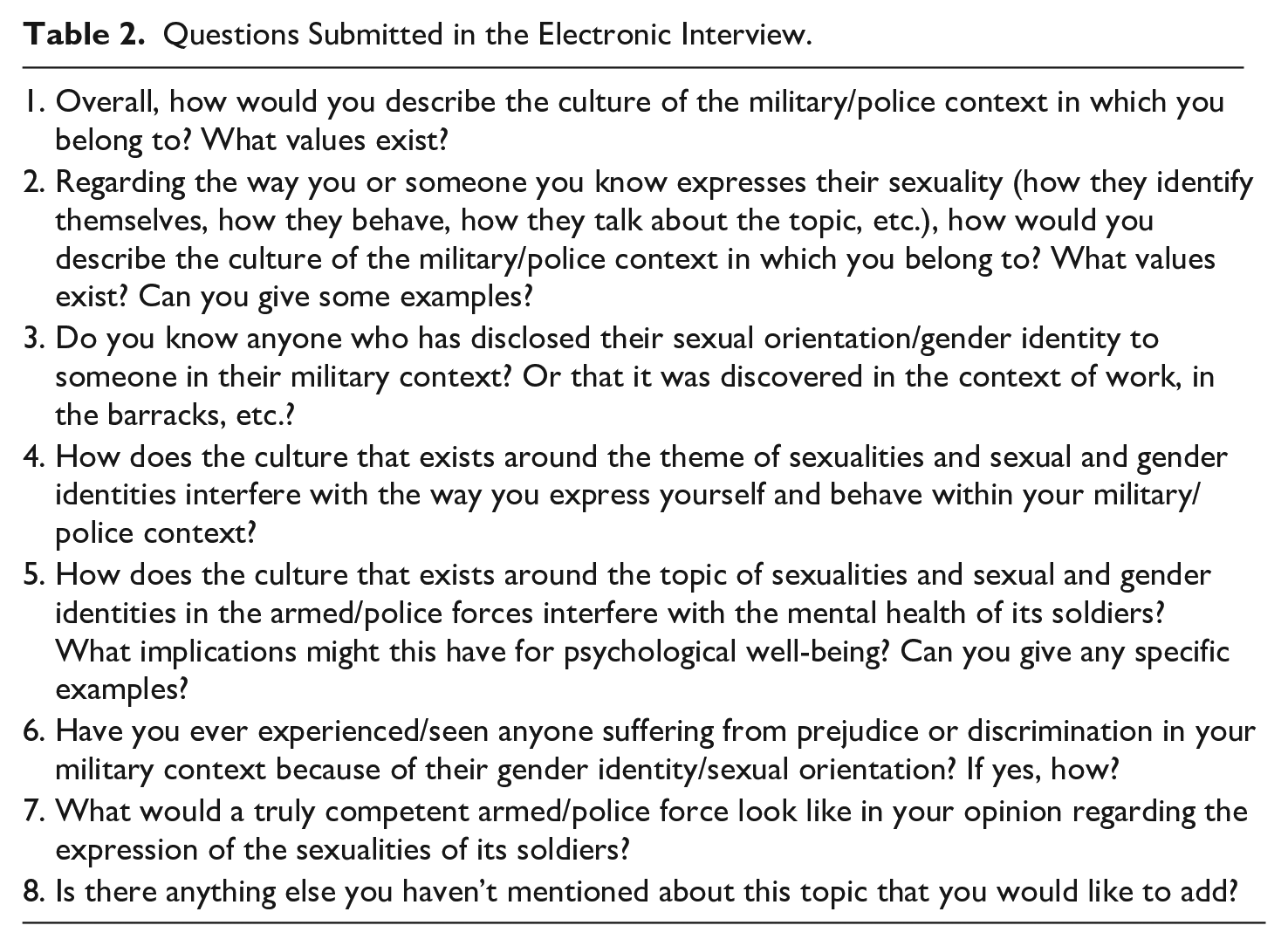
All respondents were invited to complete a structured inquiry that included a section of sociodemographic questions (e.g., age, education, marital status, place of residence, and professional status) and another section with eight open-ended questions designed according to the study’s main topics and objectives to guide the data collection process (Table 2).
Questions Submitted in the Electronic Interview.
All ethical principles were respected throughout the study. Participation was voluntary, and informed consent was offered and obtained, as all participants were aware of the research objectives and agreed to provide personal data for this purpose. Confidentiality and anonymity were provided as well, with the guarantee of protection of personal data, including IP address encryption and confidentiality of the database.
Data Analysis and Tools
The data consisted of direct transcriptions imported from the information provided by participants in the electronic questionnaires. We used thematic analysis to identify through the data repeated patterns of meaning, that is, sets of information that express similar ideas. Thematic analysis is not tied to any specific theoretical framework, it can be applied to various theories and methodological approaches (Joffe, 2011), it is assumed as inductive, and data were obtained from the semantic content and latent constructs inherent to the texts of the participants (Braun & Clarke, 2006). Data analyses consisted of the following steps: familiarizing with the data, generating initial codes, searching for themes, reviewing themes, defining and naming themes, and producing the report. During this process, the Consolidated Criteria for Reporting Qualitative Research (COREQ) criteria (Tong et al., 2007) were considered, as codifications were carried out by two authors independently and trustworthiness criteria assured credibility, dependability, confirmability, and transferability. Throughout the presentation of results supporting quotations by different participants are also provided to add transparency to the findings and interpretations of the data. Translations from the original Portuguese language interview content were carried out by one professional experienced and fluent in both English and Portuguese languages.
Results and Theme Discussion
The content analysis of 64 participants’ responses revealed recurring themes encompassing seven categories, as represented in Table 3. The following are descriptions and discussion of these themes, providing illustrative quotes from the participants.
Themes and Categories.
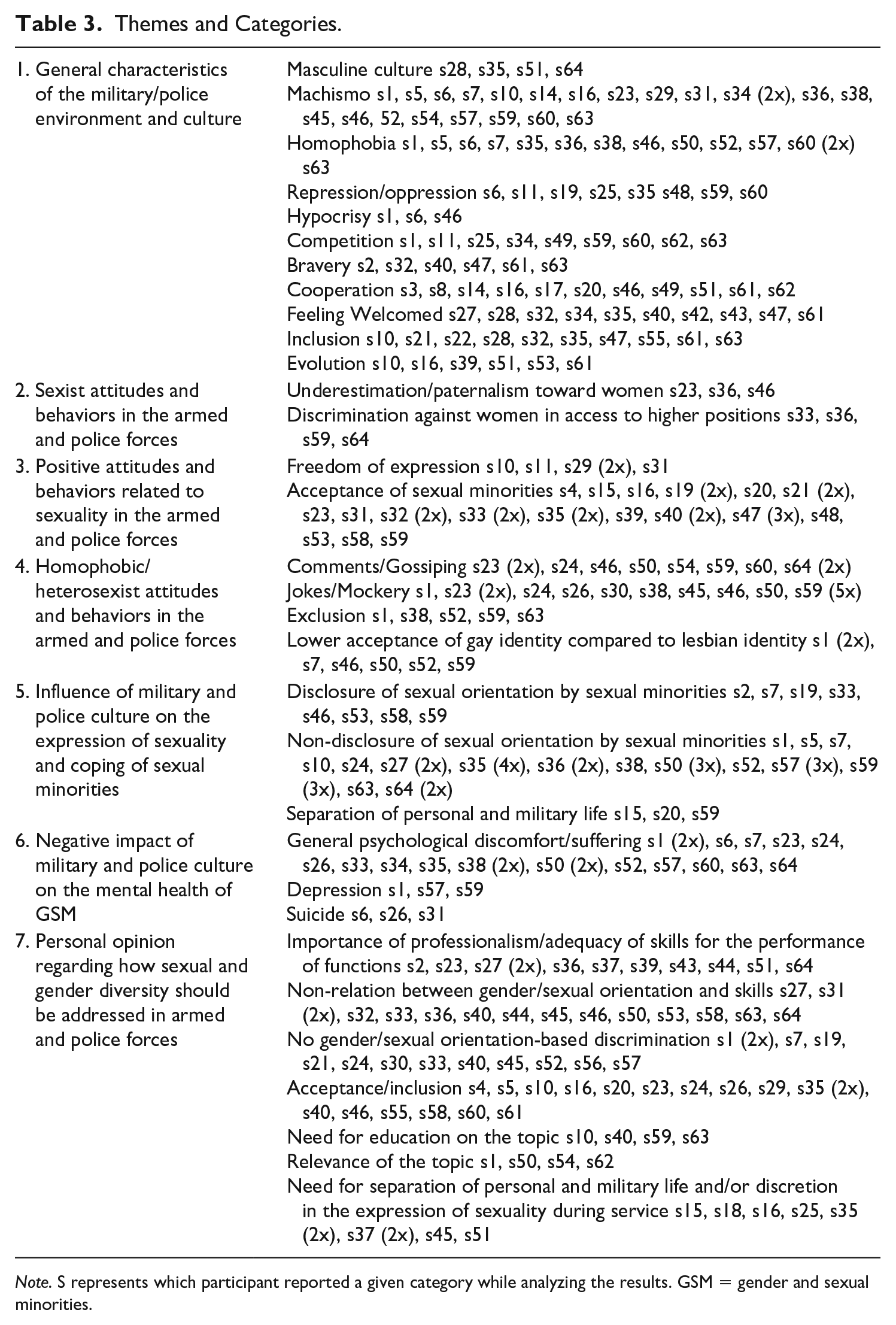
Note. S represents which participant reported a given category while analyzing the results. GSM = gender and sexual minorities.
General Characteristics of the Military/Police Environment and Culture
Many participants described the environment in the armed and police forces as cooperative, welcoming, and inclusive, expressing a sense of union and team spirit: Military culture itself is very much about camaraderie and mutual aid among service members. The environment is quite welcoming and encouraging, but I don’t rule out the possibility that some elements might have an opposite position/behavior. (GNR Captain, 36 years old, heterosexual woman)
The latter also appears to be true, as a few participants used the term “hypocritical” due to considering that the inclusive nature of these institutions is conditional. That is, one is less likely to experience true acceptance in the group if they don’t fit the stereotypical notion of what a service member is supposed to be like and behave—a hypermasculine, “warrior identity.” This is often the case for gender and sexual minorities (Taber, 2018), which explains why some participants expressed viewing these contexts as sexist and homophobic: Personally, I think military culture is homophobic and sexist without a doubt. I think considering the times we are in, the army is still very outdated. There should be less prejudice, more acceptance. And not putting a label on a person just because of their gender or sexual orientation. (Private, 26 years old, heterosexual woman)
In turn, the use of adjectives such as “repressive” or “oppressive” points to the pressure that service members are under to perform the dominant identity and to conceal any traits or refrain from any behaviors that aren’t compatible with it, to avoid exclusion: A homosexual service member tends to “imitate” heterosexual service members, because they don’t want to show who they really are, nor to be put aside or made fun of by their comrades, so they usually adopt “heterosexual behaviors” to be accepted into the “little groups” that are created in the army. (Private, 24 years old, gay man)
Sexist Attitudes and Behaviors in the Armed and Police Forces
One of the constructs most frequently mentioned by our participants was machismo, which was defined by Gilmore (1987) as “a masculine display complex involving culturally sanctioned demonstrations of hypermasculinity both in the sense of erotic and physical aggression” (Mosher, 1991). This concept is essentially a hypermasculine variant of traditional gender ideology—which deems “masculinity” as synonymous with strength, aggression, and superiority, and “femininity” as synonymous with passivity and inferiority (Hallagan, 2012; Mosher, 1991). In civil society, machismo and consequently sexism are intimately associated with homophobia as tools to uphold the patriarchy (Pharr, 1993)—a term originally coined by feminism theory, to describe a social system of male domination and privilege and female subordination and oppression (Hallagan, 2012; Hunnicutt, 2009). In the specific context of the armed forces, it’s clear that some of the stereotypes used to exclude LGB people from the military (e.g., being weak/fragile) allied to the exemplary masculine ideals intimately associated with this (patriarchal) institution (Dvorak, 2018) are related with machismo. These same stereotypes have historically been used to exclude women as well (Van Gilder, 2018), which can explain why the attitude toward women in the military tends to mirror the attitude toward sexual minorities. As such, the aspects of military culture discussed above pose similar challenges to women regardless of sexual orientation, especially considering that all women challenge gender roles and traditional notions of femininity by simply being admitted into a male-dominated institution. Due to this, service women frequently must contend with attitudes that challenge their capabilities as military members (Waruszynski et al., 2022) and other forms of prejudice and discrimination, as stated by one of our participants: The current culture in the PJ, although in clear improvement, is still predominantly sexist. Some sexism is consciously and ostensibly demonstrated (for example, one still hears from some colleagues, especially older ones, comments such as “there are too many women in the last courses,” or comments about the presentation of female colleagues), and there is also a more “unconscious” sexism, which is noticeable, for example, when there are tasks that involve greater exposure to danger, or greater physical load—in a somewhat “paternalistic” way, female colleagues are not considered, or are treated very delicately. (PJ Inspector, 29 years old, heterosexual man)
Even when service women do manage to successfully prove themselves “worthy” of inclusion in the in-group (usually while adopting elements of the dominant masculinity identity), their male peers’ bias often stops them from seeing them as equals (Pendlebury, 2018), which suggests that despite being allowed to serve, service women might not necessarily experience true inclusion and acceptance (Eichler, 2017). This is shown by the demonstrations of sexism reported in the previous quote, which seem to mirror the concepts that Young and Nauta (2013) have described, namely “old-fashioned sexism” which holds that women are inferior and have no place in the military (or, in more extreme forms, any role outside of the home in general), and could be behind the dissatisfaction expressed in relation to the presence of “too many” women in this context; as well as “benevolent sexism,” which is demonstrated by ostensibly prosocial behaviors that become sexist as a result of problematic perceptions of women as innocent and needing protection, such as the paternalism described in the previous quote. “Benevolent sexism,” experienced by being underestimated or treated condescendingly by their peers and/or superiors, was also reported by some of the service women who participated in this study: There are many areas where women are exactly the same as men in terms of responsiveness to function and there is still a sexist mindset that they don’t fit. (PJ Inspector, 27 years old, lesbian) In my case there is a tendency to be helped and treated more delicately than the men around me. This conditions my behavior in the sense that sometimes I avoid asking for help even when I need it. (Marine Officer, 42 years old, heterosexual woman)
Among our participants, gender discrimination when accessing certain positions, which could also be interpreted as “old-fashioned sexism,” was also frequently mentioned: In some areas of criminality, the leadership does not want to recruit women and openly expresses this restriction on females. (PJ Inspector, 27 years old, lesbian) Young women are often overlooked for certain positions because “soon they’ll be thinking of getting pregnant.” (PJ Inspector, 29 years old, heterosexual man)
Overall, a growing body of evidence has documented high rates of trauma across the lifespan as well as adverse health outcomes for service women (Lehavot & Simpson, 2013). This may be related to the challenges inherent to gender discrimination in the workplace which appears to be a particularly relevant issue in the context of the armed and police forces and that can manifest in the ways described earlier, as well as in other common forms of gender discrimination not mentioned by our participants but that also exist, such as sexual harassment and abuse (Gurung et al., 2018; Taber, 2018), and which would be more aligned with what Young and Nauta (2013) describe as “hostile sexism,” that is, outright antipathy and anger toward women, particularly in relation to sexual access.
Positive Attitudes and Behaviors Related to Sexuality in the Armed and Police Forces
Some participants reported considering these institutions as mostly accepting toward sexual minorities: In general, people respect each other’s options, although there may be exceptions, which cannot be generalized. (GNR Officer, 50 years old, heterosexual man) I think that nowadays both the armed and police forces are more open to sexual minorities and do not see people only for their sexual orientation! (GNR Officer, 64 years old, heterosexual man)
This mostly corresponded to the perspective of heterosexual participants, but a couple of LGB participants reported this as well: I know many military personnel who have come out and the reaction has been positive. There is still prejudice, but not very relevant. (Army Officer, 35 years old, lesbian)
These perceptions of acceptance were expressed essentially by participants who came out during service and received what they interpreted as positive/neutral reactions to the disclosure of their non-heterosexual sexual orientation as well as equal treatment in everyday interactions, or by heterosexual participants who witnessed what they reported being positive/neutral reactions and equal treatment toward sexual minorities who they have encountered and were open about their sexual orientation in this context.
It’s also worth noting that over a third of the participants who reported perceiving the context of the armed/police forces as accepting toward sexual minorities were officers, despite only making up a rather small percentage (around 20%) of our sample. This suggests that there might exist differences in how distinct hierarchies experience this reality, with individuals in lower ranks witnessing or directly dealing with discriminatory behaviors that their superiors are not aware of/subjected to, or might even partake in, as described in some of the participant quotes in the following section.
Homophobic/Heterosexist Attitudes and Behaviors in the Armed and Police Forces
Despite the aforementioned perceptions of acceptance, participants referred to experiences of prejudice and discrimination toward sexual minorities as well.
Gossip and offensive jokes behind the back of (out or suspected) sexual minority members were some of the most mentioned behaviors, suggesting hypocrisy and a false sense of inclusion: If a colleague comes out as gay he will not be openly harassed, but comments on the matter will be made behind his back. Comments like “Did “Carlos” let the suspect escape? Oh well, you know he’s . . ., he probably didn’t want to hit on him.” (PJ Inspector, 29 years old, heterosexual man)
These patterns of behavior seem to be rooted in structural homophobia, which is still accepted and perpetuated by the people in positions of power and by the institution itself: Those who came out are the target of constant mockery, and the bosses are the first to use this for repression or simply to be part of the group (majority) that perpetuates these jokes. (GNR Sergeant, 40 years old, bisexual woman) There are certain types of comments for rival specialties that turn out to be homophobic. For example, normally when the infantry specialty wants to rival even more with Artillery, it is customary to say: “Antes Paneleiro que Artilheiro” (better to be queer than an artilleryman). (Private, 24 years old, gay man)
More explicit forms of exclusion were also mentioned, such as the following: I’ve witnessed a situation where a higher up refused to accept an element in his barrack, forcing him to sleep in a separate compartment. (Private, 32 years old, heterosexual man)
Another participant emphasizes depersonalization of sexual minorities as another form of discrimination: Whenever something doesn’t go very well professionally for a non-heterosexual colleague, their sexual orientation is what is picked on. The person is depersonalized and treated as “the gay, the fag, the dyke,” and it is commented everywhere they go. As I never came out to my work group, I hear comments about other people, and everything they do, good or bad, personal, or professional, is a topic of conversation for the pure enjoyment of others. As I said, they depersonify the person and mock them. These people are never recognized for their professional skills and are always a target of discrimination. (GNR Sergeant, 40 years old, bisexual woman)
An additional aspect of discrimination toward sexual minorities worth noting is the perception of less acceptance regarding male homosexuality/bisexuality in comparison with female homosexuality/bisexuality: Military culture is still not prepared for social contexts beyond the traditional ones. There is greater acceptance of lesbian soldiers though, gay men are not so naturally accepted. (Private, 32 years old, heterosexual man)
This might make sense, as the armed and police forces are made up mostly of heterosexual men and studies have shown that this group tends to hold more negative attitudes toward gay men than toward lesbians (Louderback & Whitley, 1997). Nevertheless, it’s likely that the discrimination of lesbian identities might just take a different form, as expressed in the following statement of one of our participants: The colleague in question was often “approached” by male colleagues, for being quite good-looking, and, after she came out as gay, even though the others aren’t hostile, from time to time they’ll say “jokes” such as “Oh when are you going to let us in?” and the like. Behind her back, they’ll say comments such as “It’s a shame.” (PJ Inspector, 29 years old, heterosexual man)
Comments such as these hint at the eroticization of lesbianism by heterosexual men, which is what tends to ameliorate their attitudes toward non-heterosexual women (Louderback & Whitley, 1997; Whitley et al., 1999). This thus suggests that while LB women in the armed and police forces may be met with less hostility, they are prone to being sexualized by their male counterparts.
Influence of Military and Police Culture on the Expression of Sexuality and Coping of Sexual Minorities
Some participants stated knowing non-heterosexual service members who are open about their sexual orientation in the armed/police forces, indicating that they felt comfortable enough to come out: I know some people who came out as gay in a military context. Honestly, the reaction was natural, it’s a matter of respect. (GNR Captain, 36 years old, heterosexual woman)
While some participants stated that they seemed to face no negative repercussions, such as quoted above, this was not always the case: I met a girl who was openly lesbian, she didn’t have any problem coming out to a large number of military members of the barracks. Most male soldiers reacted well, but always with some jokes which the person sometimes went along with, and other comments that demeaned her and made her feel bad. (Private, 24 years old, gay man)
The majority of LGB participants in this study reported not being out in the context of the armed or police forces, and several heterosexual participants perceived non-disclosure of sexual orientation as the norm for sexual minorities in these institutions: Personally, I hide my homosexuality and try to take sexist comments lightly. (PJ Inspector, 27 years old, lesbian) I remember a comrade who I and some comrades knew for sure liked women, and there was nothing wrong with that, but she insisted that she didn’t. She ended up “coming out” when she got out of the army, maybe she didn’t do it before for fear of rejection. I know that she was already dating this girl that she is with today, but she said that she was just a childhood friend. Today, they are openly girlfriends. (Private, 26 years old, heterosexual woman) There is still a great deal of stigma, some people in high military ranks hide their sexual orientation for fear of reprisals or of not having their command taken seriously. (Private, 32 years old, heterosexual man) I feel that people who are not heterosexual protect themselves and don’t openly talk about their sexuality, most likely because they hear negative comments about others in the same situation. (PJ Inspector, 40 years old, heterosexual woman)
Furthermore, being reserved about one’s personal life in the military context appeared to be a common practice for this group: Gay people who are not out always tend to hide their life, and this is particularly noticeable in the military context. (Private, 24 years old, gay man) Since the military environment is intolerant, I totally separate my personal life from my professional life, even during casual conversations and while joking around. Whenever a conversation about it arises, which happens constantly, my reaction is to not allow it to develop, leading to instances where people will try to meddle in my private life and end up disliking me if I don’t allow it. Because the police department is still sexist, even for heterosexual women it’s not easy to have leadership positions, let alone if they come out as lesbian, bisexual, or whatever else. The group simply does not accept difference, and those who think differently don’t want to be excluded by everyone else. (GNR Sergeant, 40 years old, bisexual woman)
This separation of personal and military life mirrors what Van Gilder (2018) named “segmentation,” as previously discussed, and points to the struggle of integrating one’s sexual and military identities likely experienced by these participants, leading them to “pass” as heterosexual.
Negative Impact of Military and Police Culture on the Mental Health of GSM
Many participants believed that military culture might negatively affect the mental health of gender and sexual minorities (Eichler et al., 2021; Mark et al., 2019; McDonald et al., 2020; Moody et al., 2020; Thompson et al., 2021), with some emphasizing the risk of depression and suicide (Beymer et al., 2022): I think mental health issues tend to be an additional stress factor for anyone who is a woman or a member of the LGBTQ+ community. Precisely because they have to see something that should not be relevant, be the subject of comment or discussion by their colleagues. (PJ Inspector, 29 years old, heterosexual man) I believe that in most cases, military personnel who are not heterosexual must suffer for not being able to speak openly about the subject and permanently living “in the closet.” (Army Sergeant, 53 years old, heterosexual man) GSM often deal with low self-esteem and a feeling of exclusion, which undoubtedly leads to depression due to fear, in fact, due to the certainty of non-acceptance and of being the target of mockery. (GNR Sergeant, 40 years old, bisexual woman)
Given this, some participants mentioned the need for adequate support at this level: I imagine military culture must have a negative impact on the mental health of GSM, but I’ve never met anyone who was followed up by a military psychologist or something like that, I don’t even think there is adequate psychological follow-up in the army. I think it would definitely be important. (Private, 26 years old, heterosexual woman) The military environment will certainly influence mental health, which is why I think that psychological support in the armed forces should be mandatory annually to provide support and identify risk situations. (PJ Inspector, 40 years old, heterosexual woman)
Personal Opinion Regarding How Sexual and Gender Diversity Should Be Addressed in the Armed and Police Forces
Several participants emphasized the importance of being professional and able to perform one’s duties properly, with the majority expressing the idea that competence to do so is not related to gender or sexual orientation, and that these characteristics should not be used as motive to discriminate against service members: I don’t see any need for discrimination. If it is a job we are talking about, competence has nothing to do with gender or sexual orientation. (Army Officer, 35 years old, lesbian) There are more physically demanding areas in which priority should be given to those who have specific skills, and if men have them, it should be for them, but a woman who can also reach the required levels for the functions must have the same opportunity and be treated equally. (PJ Inspector, 27 years old, lesbian)
However, some participants emphasized that discretion regarding sexual orientation should be maintained during service, advocating for separation between personal and military life: The sphere of private life is sacred. These matters are to be respected, but they are not to be transposed into professional life. Whatever the sexual orientation, political or cultural expression must be maintained beyond service hours. (Air Force Officer, 55 years old, heterosexual man)
This is a common take (Bulmer, 2013) that suggests that despite the possibility of openness regarding the topic, these institutions may rely on the implicit understanding that sexual orientation should not be addressed during service.
Some participants also mentioned that they considered the topic of this study to be relevant, as well as a need for more education in this area adapted to the context of the armed forces and police.
Discussion
Despite the perceptions of progressive acceptance of GSM in the Portuguese armed and police forces, which our participants believed to reflect the evolution of the society they serve, these study’s findings indicate that members of these institutions continue to be affected by the hypermasculine, sexist, and heteronormative culture (Bulmer, 2017; Taber, 2018; Van Gilder, 2018) that remains.
This does, however, largely mirror civil society. The reported discrimination that women face in the armed and police forces regarding access to higher positions is shared by women in other working environments, along with plenty of other limitations. Women in Portugal have fewer career opportunities (Commission for Citizenship and Gender Equality [CIG], 2017), are paid 16.2% less than men for equal work (Eurostat, 2020), and continue to have a higher rate of unpaid work with household chores and care work (CIG, 2017), which recently increased during the pandemic period (Power, 2020). A study by Gomes and colleagues (2021), which explored differences in sexism across a 10-year gap in a Portuguese adult sample between 2009 and 2019, also suggests that although 2019 respondents are less likely to hold sexist beliefs, these beliefs are changing to accommodate subtler and modernized forms of sexism, that deny the existence of discrimination against women (similar to what Young and Nauta [2013] describe as “modern sexism”) and maintain a paternalistic view of women (similar to what Young and Nauta [2013] describe as “benevolent sexism”). This is consistent with our study’s findings, as paternalism toward women, which ambivalently flatters women while simultaneously implicitly suggesting their inferiority by treating them condescendingly (Dardenne et al., 2007) was the form of sexism most reported by our participants, while a significant amount seemed to ignore the existence of gender inequality in the armed and police forces altogether. More hostile forms of sexism were also mentioned in our study, which reflects the conservative nature of traditional military culture and, according to our participants, were mostly perpetuated by older male service members. All of these forms of discrimination have negative consequences for women, and it must be noted that, despite the existence of policies aimed to fight it, sexism is deeply rooted and far from being overcome, in both civil society and military institutions.
Literature regarding the experiences of sexual minorities in Portugal also demonstrates the shortcomings and challenges of the transition from legal rights to lived experience (Saleiro, 2021), suggesting that discrimination based on sexual orientation continues to exist in Portuguese workplaces and organizations beyond the armed and police forces. Specifically, some of the experiences reported by our participants were similar to those described in a study by the author, such as repetitive jokes and comments with homophobic undertones from coworkers and supervisors, social exclusion, and pressure to hide sexual orientation at work due to fear of negative repercussions. In the previously mentioned study, it was also noted that even when participants didn’t believe their coworkers would necessarily exclude them if they did come out, sexual minorities still felt compelled to not disclose their sexual orientation, as the heteronormative nature of the workplace environment alone was enough to discourage them from doing so. Given the characteristics of the military environment that have been discussed throughout this paper, it is likely that the same might also apply to many of the sexual minority service members who choose to keep their sexual orientation private, even when their specific working environment appears to be generally accepting.
Our study’s findings suggest that using the inclusion of GSM in the military as evidence that these institutions offer equal opportunities and uphold progressive values offers a rather simplistic narrative that doesn’t necessarily portray an accurate depiction of everyday life in this environment. GSM in the Portuguese armed and police forces remain vulnerable to the negative psychological consequences associated with prejudice and discrimination, as, despite an increasingly more favorable attitude toward this group, there continues to exist stigma, institutionalized (hetero)sexism, and barriers in career promotion and advancement within the ranks in these institutions.
Since these traumatic experiences go beyond typical occupational stressors experienced by service members (e.g., deployment or combat), current military programs that intend to address and prevent the traumatic experiences unique to service members with a minority status may need to be customized to accommodate the needs of these specific subpopulations (Carey, LeardMann, et al., 2022). In this regard, it would be important to invest in culturally comprehensive training for health care professionals in the fields of medicine, nursing, and psychology who work in military contexts by providing opportunities to increase their awareness, knowledge, and skills to work with GSM military and veterans—for example, allow direct contact with GSM patients by developing internship opportunities where these populations are regularly seen, create seminars where these patients share with professionals and pre-professionals how they experience the quality and level of health care they have received, or develop topic issues related to GSM health care issues within scholarly journals (Stebnicki et al., 2015). It would also be useful to create educational resources for service members encouraging the adoption of healthy behaviors, enhance military workplaces to improve safety and facilitate building of interpersonal relationships, and continue to invest in the implementation of policies and regulations to decrease gender and sexual orientation-based inequities in these institutions (Trego & Wilson, 2021).
Although in varying degrees across different nations, the armed forces largely remain relevant institutions that impose, reproduce, and reinforce social norms and hierarchies around gender, race, and sexuality (Bulmer, 2017; Dvorak, 2018). Therefore, it is important to continue to analyze these contexts, particularly how individuals with a minority status navigate an environment that is structured upon and so heavily reliant on patriarchal ideology. This would contribute to a better understanding of the complexity inherent to the presence of minority identities within these contexts, which in turn could aid in working toward truly transforming the power structures that oppress these individuals.
Limitations and Recommendations
This study is not without limitations. The fact that participation was completely voluntary implies that we do not have access to the perceptions of other people who, for one reason or another, did not want to participate and whose perceptions could differ from those obtained—for example, individuals who hold particularly sexist or homophobic views or who perpetuate discriminatory behaviors such as those reported by our participants may have been less likely to respond, or if they did, they might have concealed certain prejudiced views or behaviors. This leads us to another limitation, which is the potential occurrence of social desirability bias, as some participants might have tended to underreport socially undesirable attitudes and behaviors and to over report more desirable attributes.
Moreover, the qualitative nature of this study precludes the generalization of the results. This approach allowed, nevertheless, a deeper and richer understanding of the phenomenon in question, and ultimately this investigation contributes to filling a gap in the literature regarding this topic.
It would be pertinent for future studies to invest in different methods to complement these findings, such as face-to-face interviews, focus groups, and case studies, which would allow further exploration of comments made by participants, as well as quantitative studies, which could obtain generalizable results.
Implications
The present study informs about the perceptions of members of the armed and police forces regarding the experience of gender and sexual minorities in these institutions and its impact on these individuals’ mental health in the Portuguese context, a topic that was yet to be explored.
It thus serves to provide valuable insight for all parties involved, from service members to higher ranks in the armed and police forces hierarchy, as well as volunteers in the recruitment process, about the reality experienced in these institutions, while alerting to the impact that non-inclusion can have on the mental health of minority service members. In this way, it offers grounded information to guide future interventions, such as prevention, promotion, and education for mental health adapted to this context.
Hopefully, these findings can aid in the design of defense policies where these issues are taken into account, contribute to eventual changes toward greater inclusion of gender and sexual minorities, and overall improve conditions for these groups.
Footnotes
Acknowledgements
The authors would like to thank all participants in this study for their precious contribution.
Declaration of Conflicting Interests
The authors declared no potential conflicts of interest with respect to the research, authorship, and/or publication of this article.
Funding
The authors received no financial support for the research, authorship, and/or publication of this article.
