




Abstract
In postconflict settings, peace agreements often include power-sharing provisions that integrate formerly warring parties into the state. The aim of such provisions is to prevent conflict from resuming. At the same time, however, they can inadvertently increase the risk of coups d’état. Existing research identifies a correlation between peace agreements and coups, but the causal mechanisms underlying this association remain underexplored. This article argues that power sharing affects the motives of incumbent elites to intervene in politics via a coup and the opportunity for former rebels to do so successfully. Evidence from coup attempts in Burundi and Guinea-Bissau illustrates the plausibility of these arguments and suggests ways to extend them in future work. While debate remains over whether power sharing prevents civil war recurrence, this article shows how it can create incentives for other forms of political violence.
Efforts to negotiate and implement settlements to civil wars can create deep tensions in civil–military relations that result in coups d’état. In Sierra Leone, for instance, a 1997 coup attempt derailed the peace process between the government and the Revolutionary United Front rebel group (Dupuy & Binningsbø, 2007). Similarly, in the Democratic Republic of Congo, rebel forces integrated into the state following the 2001 peace agreement went on to launch a coup against the regime (Berg, 2022). These are not isolated events. Indeed, while coup risk is elevated during civil wars (Bell & Sudduth, 2015), it more than doubles in the year following the signing of a peace agreement (White, 2020, p. 111). What causes coup attempts in postconflict settings?
This question is important because coup attempts can undermine political reforms, serve as a pretext for state repression, and trigger renewed fighting (e.g., Bell, 2016; Curtice & Arnon, 2019; Ryckman & Braithwaite, 2017). Recent work has examined how coup attempts (and efforts to prevent them) can affect the onset, duration, or recurrence of civil war (e.g., Braithwaite & Sudduth, 2016; De Bruin, 2020; Powell, 2014; Roessler, 2011, 2016; Thyne, 2017), as well as how coup attempts might serve as a “peace-inducing shock” that facilitates bargaining between the government and the rebels (Thyne, 2017). Other work examines how civil–military relations affect the risk of civil war recurring (Berg, 2020). For the most part, however, existing research does not explore incentives for coups in postconflict settings. One recent and important exception is White’s (2020) article, which emphasizes the threats that peace agreements can pose to military interests and documents a statistical association between peace agreements and coups.
The central contributions of this article are to spell out multiple causal mechanisms through which peace agreement provisions might shape incentives for coups in postconflict settings and to probe their plausibility in two cases. As such, its aims are primarily in theory development. I focus on the role of power-sharing provisions in particular. In postconflict settings, many peace agreements include provisions that seek to integrate formerly warring parties, or the populations they represent, into the state. Such provisions are intended to prevent conflict from resuming by enabling the government to make more credible commitments to upholding the terms of peace and by giving former rebels a stake in the political system (Walter, 2002). A large literature has investigated whether power sharing works to prevent conflict from resuming (e.g., Bormann et al., 2019; Hartzell & Hoddie, 2003, 2007, 2003; Jarstad & Nilsson, 2008; Ottmann, 2020; Roeder & Rothchild, 2005) and the conditions under which it occurs (e.g., Nomikos, 2020; Walter, 2002), but its effects on civil–military relations remain poorly understood.
I argue that power-sharing provisions in peace agreements lead to two distinct types of coup attempts. First, power sharing can result in coups by incumbent elites, including members of the government and others privileged in the existing political, economic, or social order, which are intended to prevent a decline in status. Second, once implemented, power-sharing provisions can create new opportunities for coups by former rebels. In other words, power sharing affects the motives or disposition incumbents to stage coups and the opportunity or ability of former rebels to do so successfully (Feaver, 1999; Finer, 2002).
After developing these arguments deductively, the article probes their plausibility in two cases of coup attempts following peace agreements in ethnically divided states: Burundi and Guinea-Bissau. Of course, selecting a small number of cases for study involves important trade-offs. My approach in this article is based on a “most likely” research design that involves the examination of typical or “on-the-line” cases, which exemplify an established cross-national relationship. This approach is particularly well suited to the task of identifying “alternative causal paths to similar outcomes when equifinality is present,” as is the case here (George & Bennett, 2006, p. 76). It shares with other small-N methods the ability to pay close attention to concept validity and sensitivity to case-specific factors. The cases illustrate and establish the plausibility of the proposed causal mechanisms linking power sharing to coups (Eckstein, 1975; Levy, 2008). In the case analysis, I find support for both proposed causal mechanisms. In Burundi, incumbent elites opposed to power sharing staged two coup attempts in 2001 to prevent its implementation. In Guinea-Bissau, former rebels drew upon the resources that power sharing provided to stage a successful coup in 1999. The cases also serve a heuristic function, helping to refine hypotheses generated deductively and suggesting new hypotheses for future testing (Levy, 2008; Lieberman, 2005; Searwright & Gerring, 2008).
While existing work has documented an association between peace agreements and coups, as well as emphasized the extent to which militaries are likely to resist changes to their composition (e.g., Harkness, 2018; White, 2020), this article thus makes two theoretical advances. First, it sheds new light on the identity of coup plotters in postconflict settings, explaining how peace agreement provisions affect the incentives facing nonmilitary elites and rebels, in addition to those facing military officers. Second, it develops theoretical expectations about the timing of coups by different coup agents in relation to the peace agreement, emphasizing that the risk that power sharing triggers coups does not end when provisions are fully implemented.
In doing so, this article joins a growing body of research that emphasizes the limitations of power sharing as a solution to enduring conflict (e.g., Bormann et al., 2019; Harkness, 2011; Roeder & Rothchild, 2005). It also contributes to recent efforts within scholarship on civil–military relations to distinguish between different types of coup agents, which may stage coups for different reasons. Existing work has emphasized the different resources available to those at different positions within the military hierarchy (e.g., Albrecht & Eibl, 2018; Albrecht et al., 2021; De Bruin, 2019, 2020; Singh, 2014). This article illustrates that in postconflict settings, incumbency status is a salient distinction as well: Incumbents and former rebels stage coups at different times and for different reasons. While debate remains over whether power sharing prevents civil war from recurring, this article illustrates that it can result in coup attempts through at least two distinct causal mechanisms.
Power-Sharing Provisions and Coups
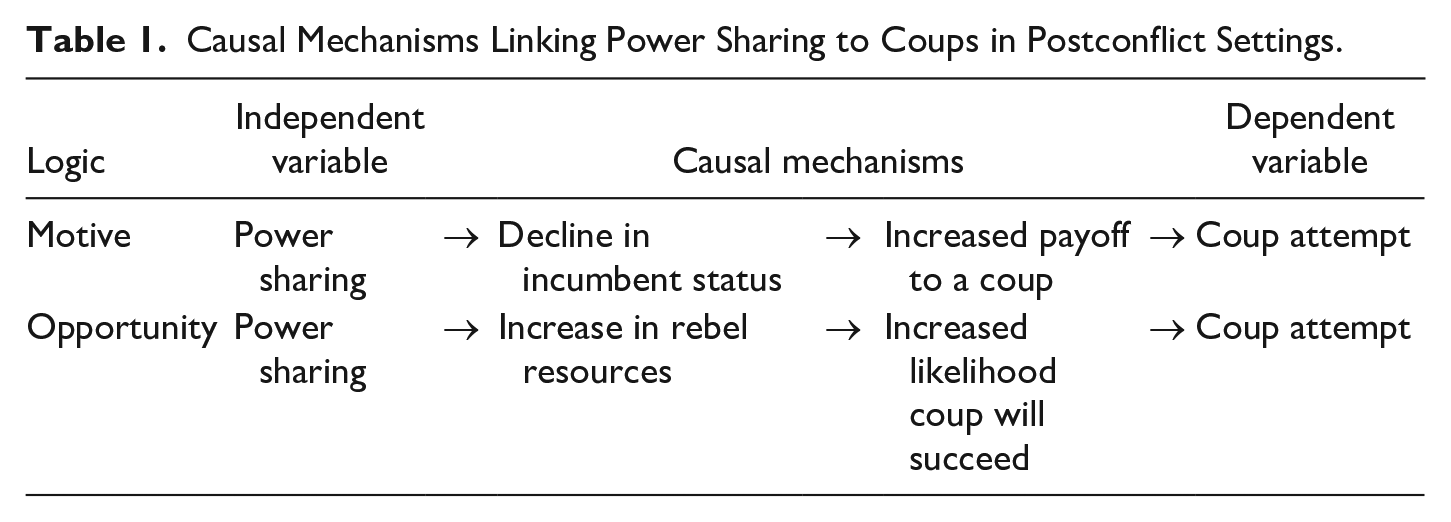
Power sharing is thought to mitigate commitment problems that can arise after civil wars. Peace agreements that require rebels to disarm leave them in a precarious position, as the government may have incentives to renegotiate the peace treaty or resume the conflict (Glassmyer & Sambanis, 2008; Walter, 1997). In this context, power sharing formalizes the role of former rebels in the new regime in a way that ensures them a stake in the political system (Walter, 2002). In doing so, however, it can also create incentives for coups. In line with a large body of scholarship on the causes of coups (c.f., Feaver, 1999; Finer, 2002), I assume that the decision to seize power is shaped by both motive and opportunity. I argue that power-sharing provisions in peace agreements affect the motives of incumbent elites to stage a coup, and the opportunity for former rebels to do so successfully (see Table 1).
Causal Mechanisms Linking Power Sharing to Coups in Postconflict Settings.
Power Sharing and Incumbent Motives
First, power sharing can trigger fears about a decline in status among incumbents that increases the expected payoff to a coup relative to the status quo. While power-sharing provisions take several forms, those that divide executive or military power provide all parties the ability to veto state policy (Nomikos, 2020). Because such resources are typically finite, the allocation of some to former rebels reduces those available to incumbents. Fears about a decline in status are likely to be particularly acute in the context of ethnically divided states, where dominant groups often react violently to dismantling existing systems of privilege. As Cederman et al. (2013, p. 62) put it, “the shock of demotion is likely to trigger strong emotional reactions that spill over into violence to ‘reverse a reversal’” in status. While incumbents thus may agree, in principle, to share power, they regularly work to prevent power-sharing provisions from being implemented (Hoddie & Hartzell, 2003). 1 In this context, a successful coup enables incumbents to forestall an anticipated reduction in their own power and resources.
Because the military serves as a particularly important source of employment and patronage (Harkness, 2018; Horowitz, 1985), incumbent soldiers throughout the ranks of the military may seek to block the entry of former rebels. Unless the size of the military is to be expanded, integrating rebels requires the demobilization of some government soldiers (White, 2020). Demobilization can result in a loss of income for individual soldiers as well as have broader economic consequences for the communities that soldiers help support (Harkness, 2018). Integrating rebels at higher ranks can also curtail promotions and generate resentment among existing soldiers forced to watch former enemies “leapfrog” them through the ranks (White, 2020). Yet power sharing within the executive branch can also result in a loss of status among incumbent elites. As Ottmann (2020, p. 618) describes, both executive and military power sharing provide elites “direct access to resources in order to maintain their armed forces and reward their constituents.” The division of ministerial portfolios and other positions in the executive branch reduces access to these resources. Of course, power sharing will not always trigger coup attempts from incumbents. Even where grievances are widespread, coup attempts remain risky—roughly half of coup attempts fail (Powell & Thyne, 2011). However, power sharing can create new grievances among incumbent elites that can make this risk seem worth it.
Power Sharing and Rebel Opportunity
Power sharing also creates new opportunities for coups by former rebels. To see why this is the case, it is important to understand how coup attempts unfold. In some cases, high-ranking military or civilian elites may be able to stage a coup without the use of force or visible movement of troops. Most of the time, however, coup plotters attempt to capture the executive and other high-ranking members of the regime; symbolic centers of political power, such as the presidential place or legislature; and broadcasting facilities needed to publicize their actions (De Bruin, 2019, 2020; Luttwak, 1979; Singh, 2014). In doing so, the goal is to convince others that victory has, in fact, already occurred, and thereby head off potential resistance (Geddes, 1999; Singh, 2014). To succeed, coup plotters must have information about the location of key coup targets, physical access to them, and coercive power to secure them. Coup plotters must also be able to anticipate and head off potential resistance to the coup.
Power sharing provides former rebels with the information, access, and—in some cases—additional coercive resources that facilitate the seizure of coup targets. Former rebels integrated into the executive branch typically live and work in the capital, providing them information about and access to symbolic centers of political power. Positions within the state also provide crucial information about sources of potential resistance to the coup and how to head them off. In the case of military power sharing, former rebels with the information and access to the regime acquire coercive power as well; as Harkness (2011, p. 7) describes, military integration “creates (at least temporarily) a dangerous spoiler problem by doing exactly that which it is designed to do: grant significant military capabilities to former combatants and their leaders.” Such integration is not a prerequisite for staging a coup; after all, potential coup plotters without positions within the state apparatus can recruit co-conspirators within it. However, integration into the state increases the resources available.
The idea that power sharing facilitates coups by former rebels is perhaps an obvious one to many rulers. After all, in many cases, rulers excluded rebels or the populations they represent from the state precisely because their inclusion was seen as constituting a coup threat. As Roessler (2011, 2016) has shown, a common coup-prevention strategy in Africa has been to use ethnicity as a shortcut to identify who might be disloyal—and to then to exclude non-coethnics from the military and other state institutions to limit the threat of a coup. Where power-sharing provisions are implemented, the risk of a coup from those previously excluded thus returns.
Addressing Counterarguments
It is possible that power sharing affects former rebels and incumbent elites in additional ways. For example, where fewer rebels are integrated into the state than initially anticipated, or where power sharing locks some rebels out of power, it may generate new grievances among rebels, in addition to those among incumbents, which motivate coups. However, as the large literature on power sharing emphasizes (e.g., Gent, 2011; Jarstad & Nilsson, 2008; Nomikos, 2020), power sharing is designed as a substantial concession to rebels previously excluded from power—one that should reduce grievances overall. Moreover, to the extent rebel grievances stem from exclusion from the state, those rebels that are dissatisfied would also face much greater obstacles to coordinating a coup than those that are not. It is also possible that where power sharing proceeds, it also influences the ability of incumbents to stage a coup. For example, where rebels have been integrated into the state, they may be better positioned to intercept incumbent coups. While plausible, this argument would suggest fewer coups occur once power sharing has been implemented—an expectation at odds with the empirical record. 2 For these reasons, I expect power sharing primarily to affect rebel opportunity and incumbent motive.
While I have argued that power sharing creates new incentives for coups, another potential counterargument posits that power sharing instead reduces the salience of political and ethnic divisions—and thus the impetus for coups as well. However, integration into the state does not guarantee that former combatants are reconciled. Examining 11 cases of military integration, for instance, Krebs and Licklider (2016) find power sharing often further entrenched divisions. Alternatively, it could be that where rebel victory appears imminent, incumbent elites may welcome power sharing as a means to preserve some of their status. Yet even in these circumstances, the expected payoff to a coup is likely to remain larger than that of the power-sharing status quo. As Bell and Sudduth (2015) find in their analysis of coup attempts during the civil war, the prospect of a rebel victory tends to prompt incumbent elites to stage riskier coups rather than to refrain from them. A final possibility worth considering is that both power-sharing provisions and rebel coups are driven by another factor, such as rebel strength; some research, for instance, has found that power sharing is more likely as the relative strength of the rebel group increases (Gent, 2011). While this possibility cannot be ruled out, it is one that can be examined in the case studies that follow.
Summary of Expectations
In sum, I expect power-sharing provisions to provoke at least two different types of coup attempts. The first are perpetrated by incumbent elites, for whom power-sharing agreements create fears about a decline in status that provides new motives for coups. The second are perpetrated by former rebels, for whom power sharing provides resources that increase their ability to stage coups successfully. The different causal mechanisms linking power sharing to coups need not be conceived of as competing ones; indeed, it is quite plausible that power sharing represents a compromise that neither side is fully satisfied with. However, the discussion above does suggest that coups by incumbents will be most likely to occur prior to or during the implementation of agreement provisions, to prevent full implementation and a resulting loss of status, while coups by former rebels are more likely to occur after power-sharing provisions have been implemented, when former rebels have access to new resources. It also suggests that coups by former rebels will be rarer in part because incumbent elites frequently succeed in blocking the implementation of power-sharing provisions that would bring rebels into the state. 3
Peace Agreements and Coups in Burundi and Guinea-Bissau
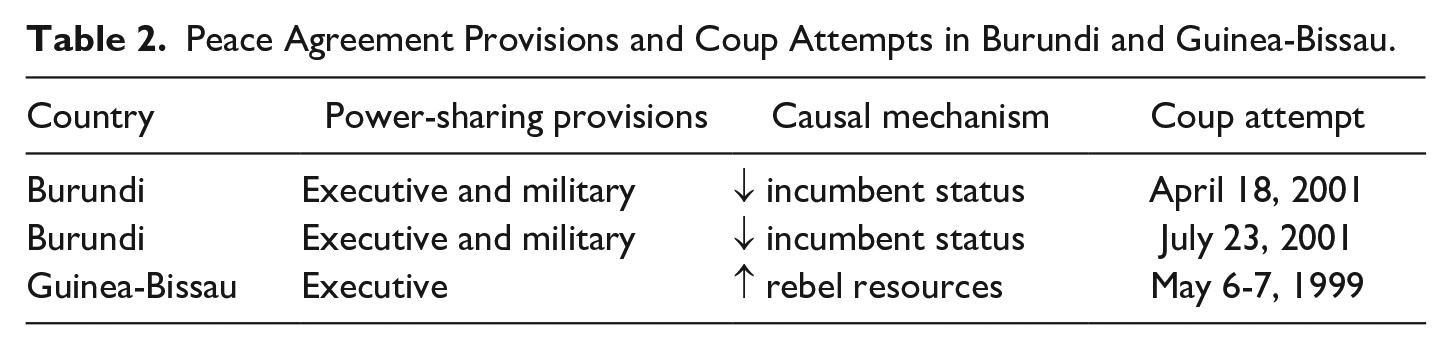
I now examine two cases of coups in postconflict settings: the 2001 coup attempts in Burundi and the 1999 coup in Guinea-Bissau. The cases illustrate the plausibility of the arguments developed above and suggest new hypotheses for future testing. Because these cases were selected on the logic of a “most likely” research design, I should be able to tell a compelling narrative linking power sharing to coups. In the case of the incumbent coups in Burundi, this involves evaluating whether the power-sharing provisions that were adopted generated concern about a decline in status among incumbent political elites and soldiers and, if so, whether these concerns were central motives for the coup attempts that occurred. In the case of the coup by former rebels in Guinea-Bissau, the task involves establishing that power-sharing provisions were implemented in a way that gave former rebels new resources with which a coup could be staged and that those resources were used in the plotting and/or execution of the coup attempt. Table 2 provides a summary of case outcomes.
Peace Agreement Provisions and Coup Attempts in Burundi and Guinea-Bissau.
The 2001 Coup Attempts in Burundi
The ethnic composition of the government has been a source of conflict in Burundi since its independence in 1962. Although in the minority, Tutsis had effectively ruled Burundi for all but 4 months since then. With political power also came a disproportionate share of economic resources. At independence, Burundi’s army was largely Tutsi, although there were also some Hutu officers. After a failed coup by Hutu officers in 1965, Hutu military and political leaders were executed and purged from the military. This, in turn, provoked an uprising in central and northern Burundi. Growing divisions between the king and army led to another coup attempt in 1966, by Tutsi-Hima officers, which brought Michel Micombero to power (Harkness, 2011; Lemarchand, 1996; Loft & Loft, 1988).
Military governments in the 1970s and 1980s maintained Tutsi political and economic dominance. Micombero established a single-party state, abolished the monarchy, and purged remaining Hutu officers from the military, replacing them with Tutsis. A successful coup ousted Micombero from power in 1987 (Loft & Loft, 1988). In the decade that followed, Burundi’s economy grew, but Tutsis continued to hold positions of political, social, and economic privilege. The instability of global prices for coffee and tea, combined with a balance of payment deficit, threatened the country’s modest economic progress. In the 1980s, the International Monetary Fund imposed a structural adjustment program that led the government to cut spending (Watt, 2008). In 1987, Major Pierre Buyoya seized power in a coup. Under increasing international pressure, he began a series of democratic reforms. Another rebellion broke out in 1988 (Loft & Loft, 1988).
That same year, Burundi began to experiment with power sharing. In the face of increasing domestic unrest and international pressure, “Buyoya believed that a gradual extension of patrimonial privileges and access to the state was a way to maintain control” (Curtis, 2013, p. 82). He reshuffled his cabinet, appointing an equal number of Hutu and Tutsi ministers. Burundi’s first multiparty elections, in June 1993, brought Melchior Ndadaye, the Hutu founder of the newly formed Front for Democracy in Burundi (FRODEBU), to power (Reyntjens, 1993). Yet many Hutus were concerned that the military and other government posts remained dominated by Tutsis. Soldiers from the army’s second commando battalion staged an abortive coup attempt, but it failed. Under competing pressures, Ndadaye appears to have believed that “limited power sharing was a pragmatic response to his vulnerable position vis-à-vis the dominant Tutsi elite and military, on the one hand, and the new FRODEBU politicians and supporters with their high expectations on the other” (Curtis, 2013, p. 82). He announced plans to reform the Tutsi-dominated military and called for the rapid promotion of Hutus through the military ranks.
Power-sharing proposals were not well received among Tutsis inside or outside the government. As Samii (2014, p. 215) describes, many portrayed “Tutsi control over the armed forces as a necessary protection against ‘genocidal’ or ‘revolutionary’ tendencies among the Hutu masses.” Power sharing also threatened to undermine their privileged economic positions. In 1993, Tutsi officers staged another coup that killed Ndadaye—a “watershed event,” which undid Burundi’s brief period of interethnic consensus (Lemarchand, 1996, p. xiii). In response, Hutu militias perpetrated massacres of Tutsis, which were followed closely by indiscriminate killings of Hutus by Tutsi army units (Des Forges, 1994, pp. 206–207).
In the civil war that followed, which ran from 1993 to 2000, some members of the FRODEBU government split off to form a National Council for the Defense of Democracy (CNDD), along with its military wing, the Forces for the Defense of Democracy (FDD). As Samii (2014) describes, the dismantling of the Tutsi-dominated army was a central aim of the rebellion. International efforts to mediate began almost as soon as the conflict itself did. In April 1994, the UN Special Representative to the Secretary-General for Burundi spearheaded an effort to broker a power-sharing agreement between FRODEBU and the opposition. A series of agreements were reached in 1994 that called for executive power sharing. However, ethnic militia, including Tutsi militia in the capital, repeatedly spoiled the peace process (Curtis, 2013). Violence between opposing ethnic groups occurred frequently between 1994 and 1996 (Salehyan et al., 2012). In July 1996, Buyoya seized power again. During his second tenure, he brought Tutsi militia under control, in part by incorporating them into the national army. However, the economic situation deteriorated. In 1998, economic pressures propelled Buyoya to return to the negotiating table, and another peace process began in Arusha, Tanzania (Watt, 2008).
The Arusha Accords, signed in 2000, provided for a rotating presidency and multiparty elections, along with integration of the military to bring it to a 50–50 Hutu–Tutsi split. The agreement explicitly described power sharing as necessary “to prevent acts of genocide and coups d’état” (Arusha Accords (2000), Protocol II, chapter 1, article 11). War criminals and prior coup plotters would be excluded, but remaining members of the rebel factions participating in the Arusha process could join the military. At the same time, some portion of both the army and the rebel forces were also to be demobilized (Samii, 2014; Watt, 2008).
Tutsi political and social leaders remained staunchly opposed to efforts to share power. While the FDD had important successes on the battlefield, several prominent Tutsi politicians believed that a military that had not been more thoroughly defeated should not have to reform. In February, Tutsi extremist parties organized a rally against peace talks (Salehyan et al., 2012). At the same time, the two largest Hutu-led rebel groups thought the reforms did not go far enough and refused to sign. There was widespread concern that the allocation of government positions was a result of “elite office trading” rather than a reflection of popular grievances and concerns (Curtis, 2013, p. 85). Rumors of a coup circulated during negotiations and in the run-up to implementation of the power-sharing provisions. While some former rebels were successfully integrated into lower ranks of the military, there was strong opposition to integrating them at higher ranks (Daley, 2006, p. 675).
Eventually, Tutsi officers staged two coup attempts with the aim of blocking integration into the officer coups. Concerns that implementing power-sharing provisions would result in a decline in status were a central motivation for both coup attempts (Africa Confidential, 2001; Chin et al., 2021; Harkness, 2011). During the agreement negotiations, Buyoya had worked to “actively reassure the Tutsi community, indicating that, under no circumstances, will the Arusha accord be implemented, or the reform of the army or judicial system be initiated” (International Crisis Group [ICG], 2001a, p. 17). Despite these reassurances, however, the accord was being implemented. Within the army, one army officer voiced what were widespread concerns that the government was working to demobilize Tutsis within the military, “throwing them out into the street” to be replaced by “genocidal” rebels (ICG, 2001a, p. 16). Junior officers and enlisted men in particular were concerned about a loss of status (Watt, 2008).
The first failed coup attempt occurred on April 18. Tutsi officers in Burundi, led by Lieutenant Pasteur Ntakarutimana, staged a coup attempt to halt the integration of Hutu rebels into the armed forces. As Chin et al. (2021, p. 368) summarize in their narrative of the coup attempt, “the Tutsi mutineers sought to strengthen and Tutsi-dominated regime and prevent the incorporation of rebel Hutu elites into the regime.” Ntakarutimana’s troops seized control of the national radio and television station in downtown Bujumbura. Coup plotters announced the removal of President Pierre Buyoya, the dissolution of the National Assembly, and the closure of the airport. Some 200 officers from the Higher Institute of Military Cadre moved to join the coup (ICG, 2001a, pp. 13–14). Forces loyal to Buyoya—including the gendarmerie, presidential guard, and 12th parachute regiment of the army—eventually suppressed the coup (Africa Confidential, 2001; Watt, 2008).
In the wake of the failed coup, negotiations continued. Buyoya announced a new agreement for the formation of a protection force for exiled political leaders who were meant to return and join the transitional government—an agreement that angered many Tutsi elites and soldiers who could not understand why concessions were made without a seize-fire commitment from the rebels. Concern about potential job losses was also rampant. As the ICG (2001b, p. 14) summarized: the privates cannot understand that they are asked to mobilize against the rebels while at the same time plans are being made to demobilize them and to give jobs to those whom they are fighting. They see themselves as the victims of the reform of the army, while their officers would remain in their posts.
In response to the continued implementation of power-sharing provisions, Tutsi officers in battalions responsible for security in the capital thus staged a second coup on July 23 (Harkness, 2011; ICG, 2001b; Lacey, 2001). This time, coup plotters kidnapped the army chief of staff, while supporters attacked army headquarters and the homes of senior officers. The coup failed when broader support for the failed to materialize. As Chin et al. (2021, p. 368) describe, the July coup was “an attempt to prevent a new transitional government from forming and thus blocking entry of Hutus into the regime.” This is also the interpretation reached by Harkness (2011, p. 23) about both coup; she writes, initially, the existing government forces allow [sic] integration to move forward—recruiting Hutus into the rank-and-file. Officer integration, however, proved far stickier: initially, army officers blocked the recruitment of Hutus into their ranks and then staged coup failed coup attempts in 2001.
In sum, military power-sharing provisions triggered two coup attempts in Burundi in 2001, as junior officers and enlisted men concerned with protecting their status attempted to block rebel integration into the higher ranks of the military.
The 1999 Coup in Guinea-Bissau
While the 2001 coup attempts in Burundi were staged by incumbents seeking to prevent a decline in their status, the 1999 coup attempt in Guinea-Bissau was staged by former rebels exploiting the resources power sharing provided them. It represented the latest iteration of an intraelite conflict to control the state that began when the country gained independence from Portugal in 1974. Under colonial rule, Cape Verdeans, who were a minority in Guinea-Bissau, were given educational advantages and employed at higher rates. The struggle for independence, led by the African Party for the Independence of Guinea and Cape Verde (PAIGC), was dominated by Guineans; some 80% of those who fought were Balanta in particular. 4 In the first years following independence, however, Cape Verdeans continued to dominate top government and party positions. After the death of Amílcar Cabral, the charismatic founder of the PAIGC, his half-brother, Luis Cabral, became Guinea-Bissau’s first president, leading a one-party regime (Ferreira, 2004; Forrest, 1987).
Despite the prominent role that Balanta members of PAIGC played in the country’s independence, few were promoted to higher office. Cabral instead focused on elevating those he perceived as personally loyal (Forrest, 1987). His administration was politically fragile and disconnected from social formations in rural areas (Forrest, 2002). Over time, Cabral became locked into a struggle for political power with the chief of army staff, João Bernardo Vieira, a member of the small Papel ethnic group. In 1980, Cabral proposed a new constitution in which Vieira’s position would be abolished and the president would become the head of the armed forces. In response, Vieira deposed Cabral in a successful coup (Forrest, 1987). Vieira blamed Cabral for the country’s economic weakness and dependence on foreign aid, but these problems did not disappear when he took power (Munslow, 1981).
Once in office, Vieira purged Cape Verdeans from the government and formed a new Revolutionary Council dominated by Balanta and Papel officers (Embalo, 2012). Vieira also promoted Balanta men rapidly through the ranks in the military. At the same time, however, he sought to prevent subsequent coups by restricting military resources. By June 1983, shortages of supplies in the army were rampant and junior officers were threatening a coup attempt. Vieira responded by ordering loyal soldiers to create checkpoints around the capital and granting the armed forces “first call” on food and supplies. Vieira also tried to reduce the role of the military in politics by strengthening the PAIGC as a civilian counterweight (ICG, 2008). Vieira’s efforts provoked a series of coup attempts in 1982, 1983, 1985, and 1987—all of which failed. After each, Vieira purged political opponents, increasingly targeting Balanta officers and government officials. By 1985, most Balanta officers had been arrested, expelled, or executed. In their places, Vieira primarily promoted Papel officers, as well as some Fula and Mandinga (Embalo, 2012).
By the mid-1980s, an increasingly dire economic situation in the county prompted economic reforms, including efforts to abolish state monopolies, cut public spending, liberalize trade, and establish a market-oriented price system. The first structural adjustment program began in 1987. However, it failed to improve welfare for many, and resulted in disillusionment with the regime (Rudebeck, 1990). The second, launched in 1989, was put on hold due to poor performance. There was widespread public opposition to efforts to reduce public service employment and cut defense spending (Zejan & Kokko, 1998).
In 1991, Vieira bent to increasing international and domestic pressure to democratize. A new constitution marked the end of one-party rule. However, the PAIGC remained the only party with sufficient infrastructure and organization to win the country’s first elections in 1994. The military, which had become an important source of resources and status, fought to maintain a central political role (ICG, 2008, p. 10). The size of the army was reduced by nearly half between 1991 and 1997, generating a great deal of resentment within the military (Africa Confidential, 1998; Embalo, 2012).
The civil war in Guinea-Bissau, which lasted from 1998 to 1999, was precipitated by a personal falling out between Vieira and Ansumame Mané, who was army chief-of-staff at the time. In February 1998, Vieira suspended Mané, a member of the Mandinga ethnic group, from his post for allegedly selling arms to separatist rebels in Senegal. While Mané had fought with Vieira against Portuguese rule and helped engineer the coup that originally brought him to power, he had subsequently come out against Vieira’s economic reforms as undermining the socialist tradition of Amílcar Cabral (Forrest, 1987; ICG, 2008). When Vieira moved to appoint a new chief-of-staff in June 1998, troops loyal to Mané seized control of army barracks in Bissau. Two days later, Mané announced the formation of a rebel “military junta” (Herbert, 2003; Levitt, 2012).
In the ensuing civil war, which involved 11 months of fighting, primarily in and around the capital of Bissau, Vieira retained the loyalty of his presidential guard and some army battalions comprised of Papels (Dias, 2013). Most other soldiers, however—an estimated 2,000 out of 3,500 total in the armed forces—defected to Mané (Forrest, 2002). Vieira was forced to call in reinforcements from abroad; within 2 days, 1,300 troops arrived from Senegal, then another 500 from Guinea. Despite these reinforcements, Mané’s forces controlled an estimated 80% of the country by October (Herbert, 2003; Kovsted & Tarp, 1999).
A peace accord, the Abuja Agreement, signed on November 1, 1998, called for political power sharing in the form of a national unity government that would take office the following February. Reflecting the military balance of power, Vieira’s government relinquished half its ministerial posts—including the powerful ministries of defense, economy and finance, and internal administration—to Mané’s rebels. The agreement also called for the freezing of military positions, withdrawal of all foreign troops, and deployment of peacekeepers from the Economic Community of West African States (ECOWAS). It did not include the demobilization of Mané’s forces or a broader military restructuring (Abuja Agreement, 1998). ECOWAS peacekeeping troops were deployed, and a timetable for elections was set. In February 1999, a new interim national unity government was sworn in. The rebels held ministerial posts in the ministries of defense and internal administration; Francisco Fadul, who had been an advisor to Mané, led the government as Prime Minister.
In May 1999, however, the peace agreement broke down. Early that month, several donor countries convened in Geneva, where the government secured US$200 million to support rebuilding. But tensions remained over Vieira’s resistance to dismantling his 600-person presidential guard. As Embalo (2012, p. 266) describes, “instead of disarming his guard as required in the Abuja Peace Agreement, the president had reinforced it with Papel men and his allies,” who also were forming new ethnic militias. When a Guinean warship arrived off the coast of Bissau during the Geneva meeting, rebels were concerned it was delivering additional weapons for the presidential guard and militias (Africa Research Bulletin [ARB], 1999).
On May 6, former rebels that had been reintegrated into the unity government opted to attempt a coup to force Vieira from office rather than reopen the civil war. Under the direction of Mané, the coup plotters seized weapons that had been stockpiled at the airport (Herbert, 2003). Mané reportedly insisted to the ECOMOG commander guarding them that if the presidential guard was not going to be disbanded as agreed, his own troops should have access to an equal number of weapons (Amnesty International, 1999). With weapons in hand, the former rebels surrounded the Presidential Palace and attacked the homes of other senior government officials loyal to Vieira. The presidential guard resisted but was eventually overpowered. Several hundred soldiers and civilians were killed in the fighting. On May 7, Vieira surrendered (ICG, 2008). “Power sharing under the Abuja Agreement,” Levitt (2012, p. 190) concludes, “seems to have reinforced the belief of would-be coup plotters in the Bissauan armed force that violence was the most expedient way too effectuate change.” 5 It also provided former rebels with resources in the form of access to centers of political power and information about the whereabouts of weaponry and coup targets.
Discussion of Case Evidence
These two cases provide support for the argument that power-sharing provisions can lead to coup attempts through the two mechanisms proposed here. In Burundi, where unequal representation within the armed forces was a central grievance underlying the civil war, peace agreement provisions calling for even an ethnic split within the armed forces generated anger and resentment among Tutsi political elites and members of the armed forces. While military officers allowed former rebels to be integrated into the lower ranks of the army, soldiers staged two coup attempts in 2001 to prevent their integration into the officer corps. In Guinea-Bissau, former rebels took advantage of the access and information afforded them under executive power-sharing provisions to seize power in a successful coup in 1999. The timing of the coups was also as anticipated: In Burundi, the incumbent coup occurred during the implementation of agreement provisions, while in Guinea-Bissau, the coup by former rebels occurred after their implementation.
The case narratives also suggest potential refinements and extensions to the arguments developed deductively. First, the extent to which power-sharing provisions generate grievances among incumbents may depend on the balance of power between combatants. While power sharing in Guinea-Bissau reflected the strength of combatants at the time the peace agreement was signed, that was not the case in Burundi—suggesting that, in these cases at least, rebel strength cannot account for both the adoption of power-sharing provision and the coups that followed. Indeed, in Burundi, perceptions among Tutsi elites that power sharing was not warranted by the balance of power between combatants appear to have exacerbated grievances that motived the 2001 coups.
Second, the cases suggest that the form of power sharing adopted may affect not just whether a coup attempt occurs but also how successful it will be. In Burundi, integrating former rebels into more senior ranks within the military (“vertical integration”) provoked coups by those that would be most affected—rank-and-file soldiers. Because those at different ranks within the military have different resources with which to shape expectations during the coup (Singh, 2014), this also suggests that coups provoked by provisions for vertical integration will have a high likelihood of failure than coups that might result from other forms of integration. Meanwhile, where rebels are integrated at higher ranks, this should give them more resources with which to shape the outcome of a coup, resulting in a higher success rate. This suggests two potential new hypotheses that would extend the arguments developed in this article: First, provisions for vertical power sharing within the military are likely to prompt coups with a lower success rate; and second, where former rebels are integrated into higher level positions, coup attempts will be more likely to succeed.
Conclusion
The aims of this article have been in theory development and illustration. The cases of coups in Burundi and Guinea-Bissau suggest that the causal mechanisms identified here are plausible explanations for the association between peace agreements and coups. In Burundi, peace agreement provisions for executive and military power sharing created fears about a decline in status that prompted two failed coup attempts. In Guinea-Bissau, executive power sharing provided former rebels with access and coercive resources needed to stage a successful coup. The cases analyzed here thus suggest that power-sharing provisions in peace agreements can affect the motives of incumbent elites to intervene in politics via a coup, and the opportunity for former rebels to do so successfully. The timing of coup attempts in the cases was also as anticipated: the coup attempts by incumbent elites occurred prior to or during the implementation of power sharing, while the attempt by former rebels occurred after.
There are several ways in which future research could deepen our understanding of coups in postconflicting settings. First, while this article has demonstrated the plausibility of two distinct causal mechanisms linking power-sharing provisions to coups, it does not develop or systematically test arguments about the conditions under which one mechanism will be more likely to result in a coup than the other. To allow scholars to develop and test such arguments, future research could collect data on the identity and aims of coup plotters in a larger set of cases. Second, future research could test the new hypotheses suggested by the case analysis about the connections between forms of power sharing and the outcomes of coup attempts as well as the extent to which the relationship between power-sharing provisions and incumbent coups depends on the balance of military power between combatants during negotiations. Third, we need to better understand the microfoundations of the incumbent and rebel decisions to rebel against the postwar order. For this, microlevel data on the design and implementation of power-sharing provisions, as well as the dynamics of individual coup attempts, in selected cases would be useful. Finally, it is worth noting that the three coups examined here occurred in the context of countries with deep ethnic divisions and histories of ethnic favoritism in state institutions; the extent to which similar dynamics would operate in the context of power sharing in less divided societies should also be the subject of future work.
Meanwhile, this article has contributed to recent efforts to deepen our understanding of coups through a disaggregation of coup agents. While existing research suggests that senior and junior officers face different incentives and opportunities for coups (e.g., Albrecht & Eibl, 2018; Albrecht et al., 2021; De Bruin, 2019; Singh, 2014), this article emphasizes in addition the distinction between incumbent elites and former rebels. The article also speaks more broadly to the utility of power sharing as a tool for conflict resolution. It joins a growing literature on the potential costs of power sharing (e.g., Bormann et al., 2019; Roeder & Rothchild, 2005; Tull & Mehler, 2005) and suggests that considerable caution is warranted in adopting such provisions in the aftermath of civil war. In particular, this article emphasizes that the risks of adopting power-sharing provisions do not end with implementation. External actors advocating power sharing should pay close attention to sources of civil–military tension and, to the extent possible, support postconflict governments in insulating their regimes from coups in ways that do not undermine democratization and security sector reform efforts.
Footnotes
Acknowledgements
I thank Caroline Brandt, Sabine Carey, Adam Casey, Thad Dunning, Håvard Hegre, Susan Hyde, Roy Licklider, Aila Matanock, Michaela Mattes, Jonathan Powell, Robert Powell, Emily Ritter, Andrea Ruggeri, Jun Koga Sudduth, Peter White, and other participants in the Monday International Relations Thoughts Series (MIRTH) Colloquium at the University of California, Berkeley, as well as the Postconflict Intrastate Peace and Security Workshop at the University of Mannheim, Germany, for feedback on earlier drafts. I also thank Caroline Zuchold for excellent research assistance.
Declaration of Conflicting Interests
The author declared no potential conflicts of interest with respect to the research, authorship, and/or publication of this article.
Funding
The author received no financial support for the research, authorship, and/or publication of this article.