




Abstract
Evidence suggests that UK veterans are seen as victims with concern for their perceived mental health needs. This study examined sociodemographic factors that contribute to victimizing conceptualizations of British Army Iraq and Afghanistan veterans. UK participants (N = 234) provided three word associations to “British Army Iraq Veteran” and “British Army Afghanistan Veteran” and answered sociodemographic questions. A multiple linear regression outlines that low national pride, mission opposition and higher levels of education predict elevated victimizing word associations. Narrative accounts from UK interviews (N = 21) suggest that participants who perceived the recent conflicts as illegitimate conceptualize veterans as passive, naïve actors who had to submit to the agency of the anthropomorphic described government. This allowed holding overtly appreciative though belittling attitudes toward veterans, while opposing the missions. To dissociate veterans from victimizing perceptions, better knowledge about service and justifications for deployments need to be provided. Study limitations, including over sampling of young adult females, are discussed.
An important aspect of UK Armed Forces leavers post-service life is the smooth reintegration into civilian life. However, many members of the public in the UK, when polled, respond that they are concerned that serving members of the UK Armed Forces become damaged from their experience in the armed forces and that mental health problems are typical of the majority of veterans (Latter et al., 2018). Polls also report that the public believe a majority of veterans experience symptoms of PTSD caused by service-related trauma, as well as a perception that many are economically inactive and homeless (i.e., Ashcroft, 2012; Ashcroft & KCMG, 2017; British Social Attitudes (BSA), 2012; Latter et al., 2018). The public, when asked, consider that potential employers of veterans may be unsure of a veterans’ mental state and ability to cope outside service life (Latter et al., 2018).
While there has been debate over whether the British veteran population is either more or less likely than members of the civilian population to suffer from mental health issues (Hoge & Castro, 2006; Hunt et al., 2014; Rhead et al., 2020), physical health problems, suicide, suicidal thoughts or self harm (Bergman et al., 2021; Holmes et al., 2013; Jones et al., 2019; Kapur et al., 2009; MOD, 2021), unemployment (MOD Career Transition Report, 2018; MOD, 2020a), or homelessness (Fleuty et al., 2021; Jones et al., 2014; Quilgars et al., 2018; University of York, 2008; Wilding, 2020), even the most concerning of available statistics do not involve the majority of service leavers having these difficulties. While solutions need to be found for veterans who do experience difficulties and it is important to help every single veteran who experiences health or social issues, the predominance of the British public’s beliefs linking the majority of veterans to compromised states of health and social problems is concerning. Specifically, societal preconceptions regarding veterans may lead to economical disadvantages and implicit stereotyping and therefore be harmful to veterans. A recent study in the US demonstrated that stereotypical information about veterans was used by hiring managers to the potential detriment of veterans (Stone et al., 2018) and labeling of veterans with PTSD led to negative perceptions from members of the public (Hipes & Gemoets, 2019). However, to date, there is a surprising lack of wider research exploring which factors may contribute to victimizing perceptions of veterans in the UK, especially of the more recent and publicly controversial operations in Iraq and Afghanistan.
Instead, research has mainly focused on understanding how sociodemographic factors may influence appreciative perceptions of the UK Armed Forces and its personnel. Studies suggest that most people in the UK hold the Armed Forces and its members in high regard (Hines et al., 2015; Latter et al., 2018) and that these supportive attitudes were also outlined to remain relatively stable over time (Krueger & Pedraza, 2012). While rates of support are high, the studies do also suggest social ties to service personnel, age, ethnicity, social class, political affiliation, and gender influence appreciative attitudes toward service personnel (BMG, 2017; BSA, 2012; Hines et al., 2015; Krueger & Pedraza, 2012). Generally, those who do not know anybody in the Armed Forces and those who identify as conservatives, older people, Caucasian and men were found to be more supportive of service personnel and their missions (BMG, 2017; BSA, 2012; Krueger & Pedraza, 2012).
While researchers point out that the UK public may be able to make a distinction between the politics of missions and the individuals serving on those missions (Hines et al., 2015; Berndtsson et al., 2015), it is not unreasonable to suspect that long running lack of public support of specific missions may also influence the perceptions of veterans. Public support of military interventions was already outlined to play a key role in defense and foreign policy (Canan-Sokullu, 2012). Besides justifying appropriate financial resources for the military, sustaining troop morale and military effectiveness (Szayna et al., 2007; Dixon, 2000; Edmunds, 2012), public support also affects perceptions of mission-success and military fatalities (Myers & Hayes, 2010). For example, public aversion against military interventions was found to be associated with higher estimates of military casualties and mission-failure (Myers & Hayes, 2010). Yet, despite this evidence, it remains unclear whether public perceptions of military interventions may also taint perceptions of veterans who participated in these interventions. Prolonged formal education, for example, was found to have a negative effect on the public willingness to support and participate in war (Thyne, 2006). If individuals are not willing to participate in a war, then they may also hold less appreciative attitudes toward those who did. Therefore, prolonged formal education may have a negative impact on individual perceptions of veterans. Such a possible spillover effect may be particularly evident in British public perceptions of British veterans who returned from the deployments in Iraq and Afghanistan.
The British operations TELIC (deployment to Iraq) and HERRICK (deployment to Afghanistan) have received not only public attention but have also been widely scrutinized in media, politics and the British social life (Gribble et al., 2012, 2015; De Waal, 2013). Increasing expressions of the British public dissent and large-scale protests at the commencement of both missions are reflected in low levels of support for the missions in nationally representative opinion polls and surveys (YouGov, 2015; YouGov, 2019a; Gribble et al., 2015; BSA, 2012). Specifically, a recent YouGov (2019a) survey indicated that the British public’s support for the UK Armed Forces’ missions in Iraq (19%) and Afghanistan (25%) is comparable to the low historical levels of United States public support for the US military engagement in Vietnam (22%; YouGov, 2019b). This may be problematic as the Vietnam veteran’s image is based upon readily accessible social narratives describing illegitimate, callous and unjust warfare. This context provides a socially accepted justification for constructing Vietnam veterans in terms of fragility and suffering (Thomson, 1998). As a consequence, increasing public attention is being placed on the perceived emotional costs and legitimacy of deployments perhaps reflected in views of veterans as victims of their experience (cf. Brewer, 2006). Specifically, “civilians and soldiers in a war” (Kauzlarich et al., 2001; p. 175) can be considered victims of a “state crime” in a victimological context. Obliged by the military contract, the soldier is perceived to be forced to violate international and/or domestic laws in addition to human rights standards. In this sense, “soldiers […] while ‘doing their unpleasant, ennobling duty,’ are being victimised by the State and corporate actors” (Ruggiero, 2005, p. 251). Here, criminological analyses of the British deployments in Iraq and Afghanistan may be noteworthy as these claimed to unveil aspects of inherent criminal traits that cannot be considered as legal due to “legitimate” perceptions of the Jus ad Bellum of war (McGarry, 2012; Ruggiero, 2005; Kauzlarich et al., 2001). For example, analyses presented these deployments in terms of questionable legitimacy at the outset (cf. Zolo, 2020), of failings to protect civilian lives (cf. Iraq Body Count, 2011), or the countries’ socio-economic structures (cf. Fisk, 2008). Particularly, profiteering from billions of US dollars through the requisition of Iraqi oil is a commonly used argument among social scientists to draw comparisons between the British military intervention in Iraq and a state crime as socially amoral acts were committed by and in the interest of state power (Kauzlarich et al., 2001; cf. Whyte, 2007, 2010). British Armed Forces’ veterans who returned from these missions may therefore indeed be contextualized within of the realms of victimological definitions in a theoretical sense. This resonates with McGarry and Ferguson’s (2012) qualitative interview study outlining that UK Armed Forces veterans who returned from the mission in Iraq commonly use the framework of “deserving” or “undeserving” victims to conceptualize themselves and their actions in Iraq. Here, “deserving victims” responds to the idea that “some people are victims through no fault of their own” (Walklate, 2007, p. 496). A minority of veterans perceived themselves and other veterans as “deserving victims”—as having been involved in a conflict without choice and injured as a result. The majority of veterans framed themselves and other veterans rather as “undeserving victims,” having had the choice to join the UK Armed Forces and were an equal match to those they fought. This also negates the veteran being legitimately ascribed an ideal or deserving victim status (McGarry & Ferguson, 2012). These notions are mirrored by representative survey and polls that suggest that the majority of the UK public frames veterans as a suffering and needy population that requires public sentiment and attention (Ashcroft & KCMG, 2017; BSA, 2012; Ashcroft, 2012; Ashcroft, 2014)
UK Army veterans who returned from deployments in Iraq or Afghanistan may be particularly prone to stigmatization. The Army is commonly associated with face-to-face fighting that compares to the culturally perpetuated horrors of historical warfare (i.e., WW1 and WW2), trauma, and PTSD (cf. Heffernan, 1995; Fussell, 2009; Woodward & Jenkings, 2013). Victimizing beliefs about army veterans have proven to be persistent over time (Authors, 2013) and mirrored by self-reports of veterans (McGarry & Ferguson, 2012).
Negative perceptions of the mission and views of veterans as victims may have real world implications as previous research indicates that veterans who perceived a lack of respect and pride for homecoming were more likely to have problems with the adaption to civilian life, to develop PTSD and to have suicidal thoughts (e.g., Boscarino et al., 2018; Bolton et al., 2002; Fontana & Rosenheck, 1994; Solomon et al., 1990; Butler et al., 1988). In fact, some studies suggest that homecoming support was a stronger predictor of PTSD and suicidal thoughts than theater or combat exposure itself (Boscarino et al., 2018; Johnson et al., 1997). In addition, erroneous attributions of mental illnesses such as PTSD or depression may result in discrimination and stereotyping (cf. Hipes et al., 2015; Hipes & Gemoets, 2019). For example, research on public understanding of mental health suggests that individuals tend to express a preference for a greater social distance from those with mental illnesses (Martin et al., 2000; Rose et al., 2007). Thus, if many members of the public hold victimizing, less supportive sentiments toward veterans of recent conflicts, then this may impact on a successful homecoming experience transition and post-military life.
To understand why victimizing sentiments are related to veterans, particularly to British Army veterans who returned from Iraq and Afghanistan, remains an open issue. The present study addresses this gap in knowledge by examining sociodemographic factors that may underlie and contribute to any victimizing sentiments. Therefore, two main research questions will be examined: 1. Which sociodemographic characteristics may predict the evocation of victimizing sentiments for British Army Iraq and Afghanistan veterans? 2. How can it be explained that specific sociodemographic factors, outlined in the quantitative study, influence the victimization of British Army Iraq and Afghanistan veterans?
The present study used two primary means of data collection: surveys and follow-up interviews. All procedures were approved by Oxford Brookes University.
Survey Method
The survey data utilized for the present paper was part of a larger project that examined public perceptions of different types of veterans (Ex-Service Personnel, Veteran, British Army Iraq Veteran, and British Army Afghanistan Veteran), soldiers, and recruits (cf. Authors, 2020). The data presented here was not previously reported as it was subsidiary to the primary research questions for the larger project.
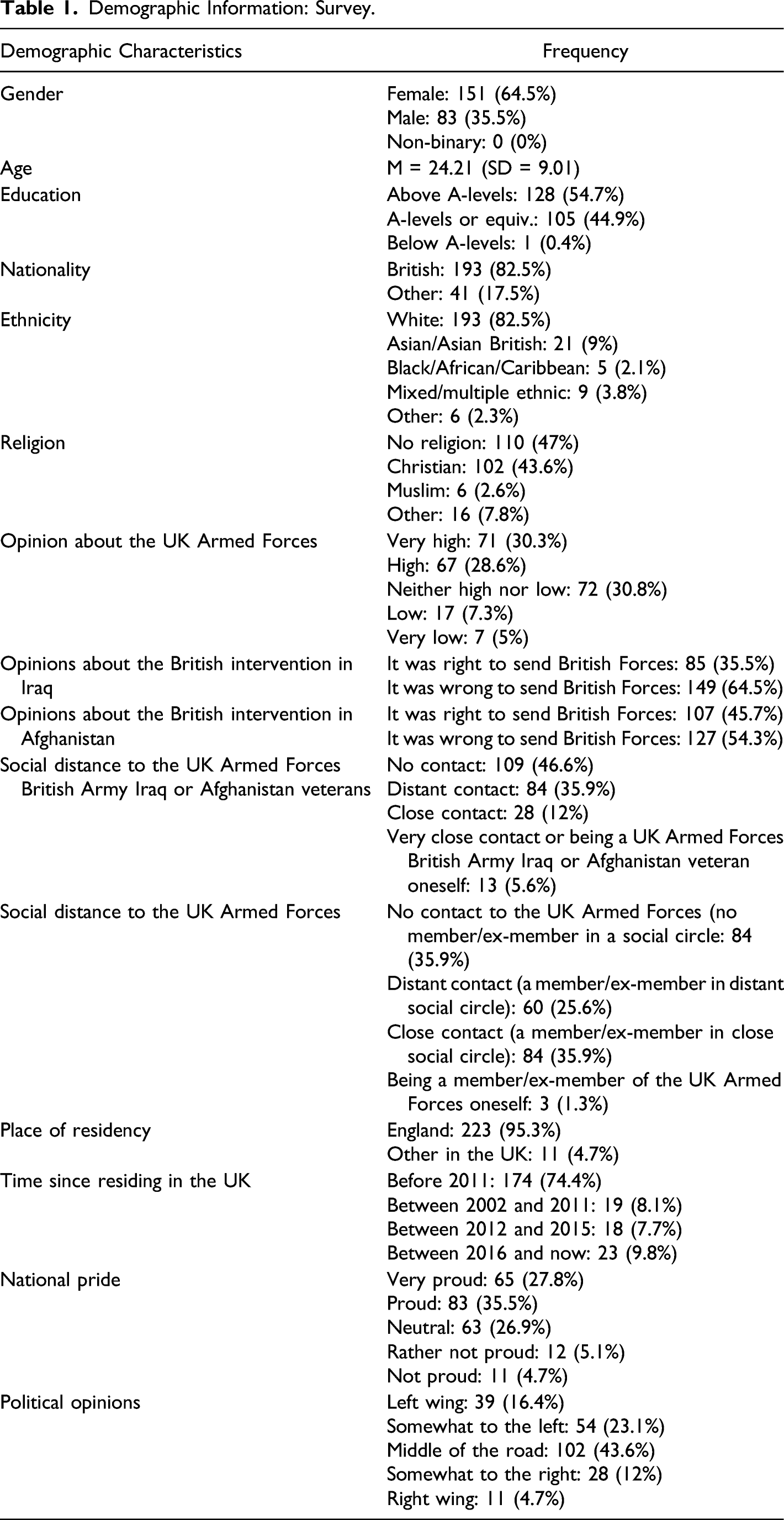
Participants
Demographic Information: Survey.
Materials and Procedure
The participants provided the following responses to an online task: (1) The participants were asked to produce, as fast as possible, the first three words that came to their mind when thinking of the stimuli term “British Army Iraq Veterans” and then again, as fast as possible, the first three words that came to their mind for the term “British Army Afghanistan Veteran” (Sarrica & Contarello, 2004; Lorenzi-Cioldi, 1988; Clemence et al., 2014). The presentation of these stimuli terms was counterbalanced to enhance the study’s internal validity by controlling the potential confounds created by sequence and order effects. (2) After the three words for the two stimuli terms were provided, the participants were asked to rank the importance of each of their chosen three words on a 5-point Likert-type scale (extremely important, very important, moderately important, slightly important, and not at all important (cf. Abric, 2003; Dany et al., 2015; Lelaurain et al., 2016). (3) The participants were asked to complete a brief sociodemographic survey. An overview of the online task, as presented to the participants, can be found in supplemental Figure 1, which is located online in Supplementary Materials.
Data Analyses
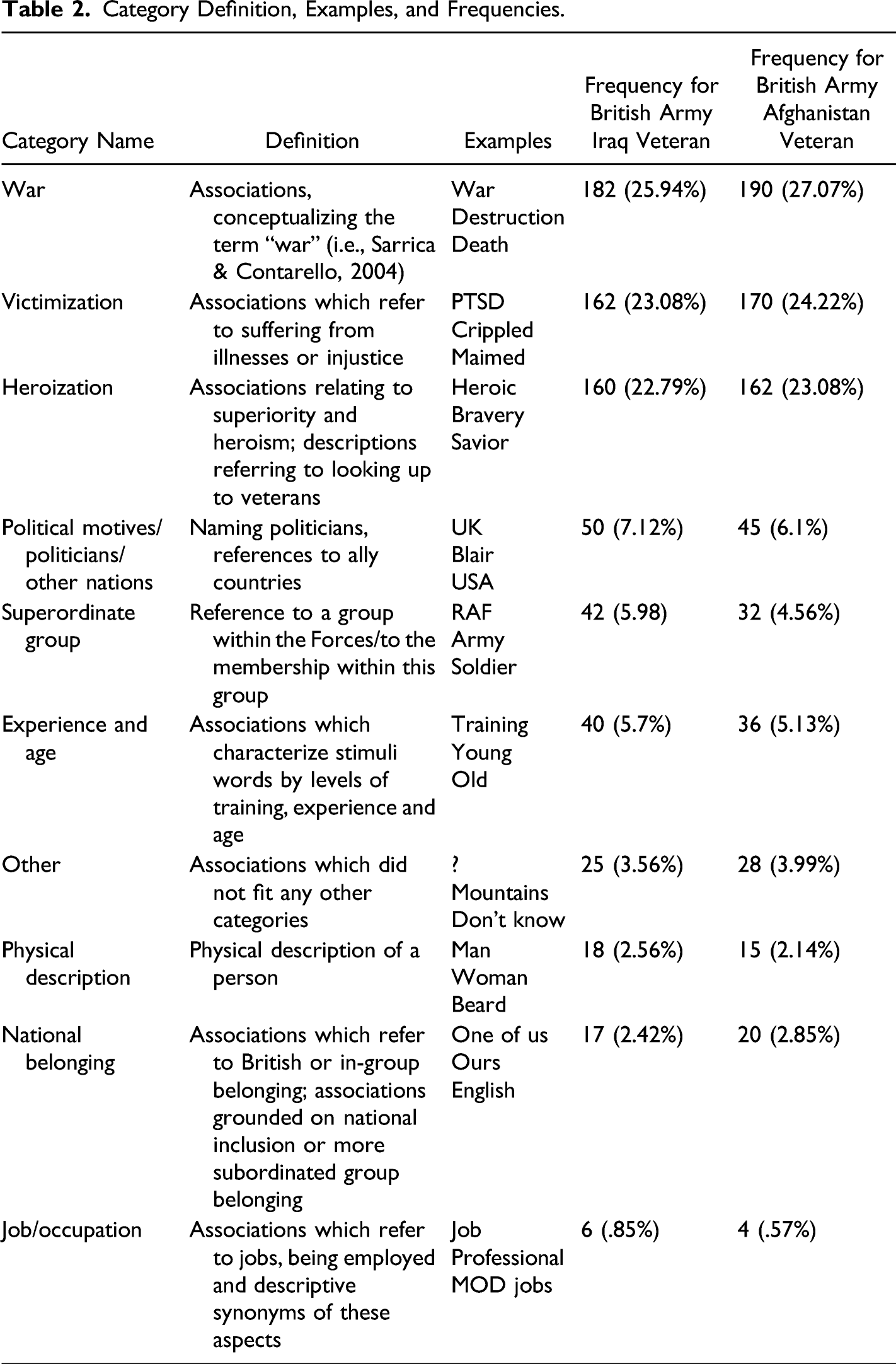
A theme-based content analysis (CA; Bardin, 1977) of the free-word associations was conducted to facilitate further descriptive and parametric analyses. A process of grouping together semantically similar answers assisted with data aggregation to reduce ambiguity (i.e., Sarrica & Contarello, 2004). Semantically similar answers which expressed the same semantic content but differed in grammatical form, expression, spelling, etc. were put together (i.e., Honor—honour, Bravery—brave). The evaluation of saliences, frequencies, and characteristics of associations, informed by relevant literature (i.e., Joffe, 2007; McCulloch, 1995; Sarrica & Contarello, 2004), guided the subsequent construction of the theme-based categories. Interrater reliability was validated by concordance in category ratings with one undergraduate psychology student and one postgraduate non-psychology student for 20% of the associations (87.65% and 83.85% interrater concordance). The raters were drawn from the researchers’ University network, were not involved in any other capacity and had no prior knowledge about the present study. Therefore, the data was found to be coherently categorized into autonomous and distinctive categories. The data was then transposed to SPSS and analyzed with a multiple linear regression to examine which sociodemographic characteristics may predict the evocation of victimizing word associations. Multiple linear regression analysis (MRA) is a commonly used method in exploratory word association research (Clemence et al., 2014; Doise & Papastamou, 1987). It is a technique for explaining the variation in a dependent variable by observing the relationship with independent variables. Therefore, MRA allows to examine the interplay of sociodemographic characteristics and category evocation by apprehending the organization of inter-individual differences.
Results
Category Definition, Examples, and Frequencies.
List of Dependent and Independent Variables Entered into the Regression Model with Classification.
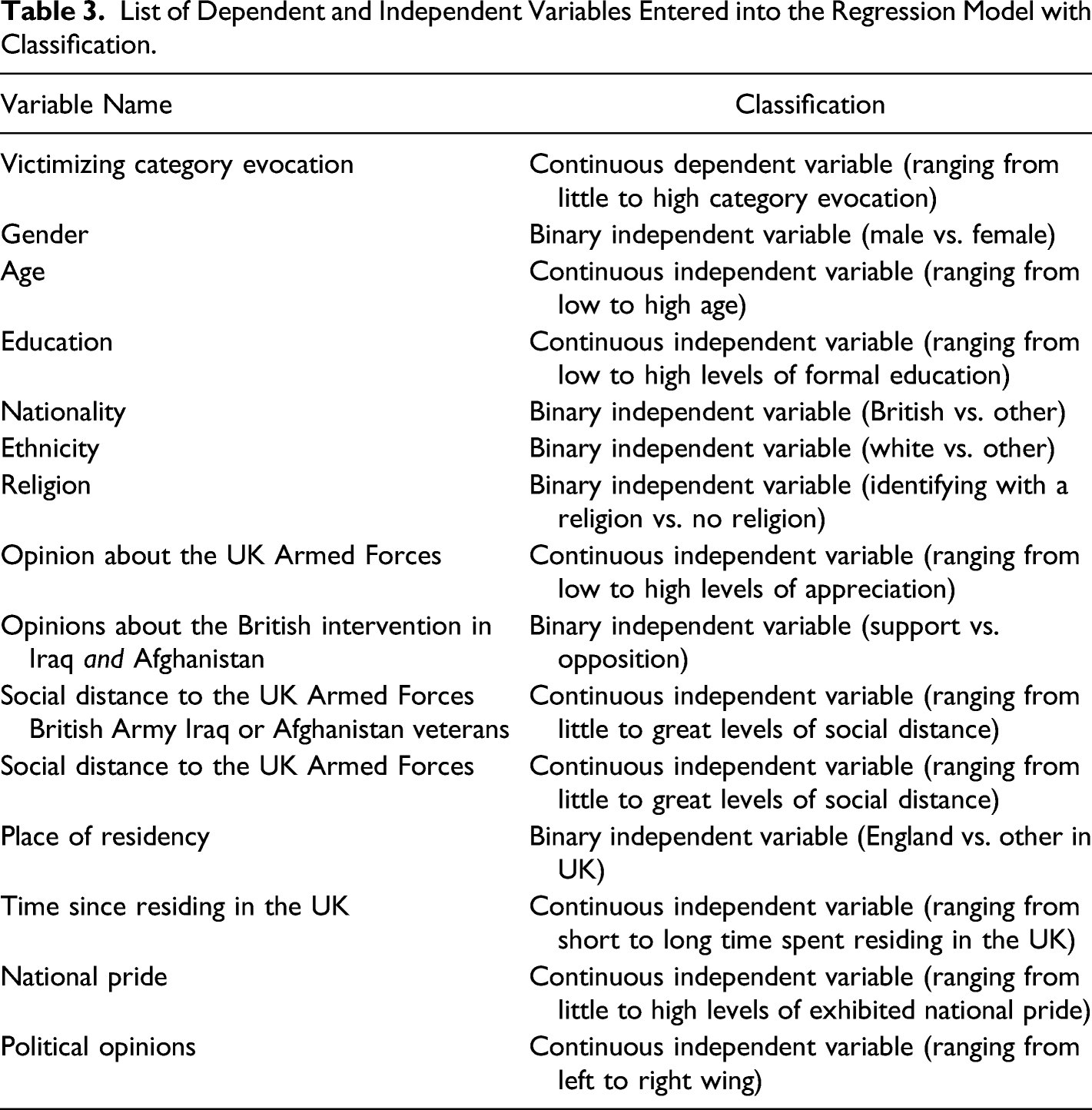
A preliminary G* Power Analysis (Faul et al., 2009) indicated a sample size of 74 participants. This suggests that the recruited cohort of 234 participants is sufficient to derive statistically valid and concise regression models with the 10 sociodemographic predictors. After checking the assumptions of linearity, absence of multivariate outliers, absence of multicollinearity and equality of covariance matrices, a multiple linear regression model was computed.
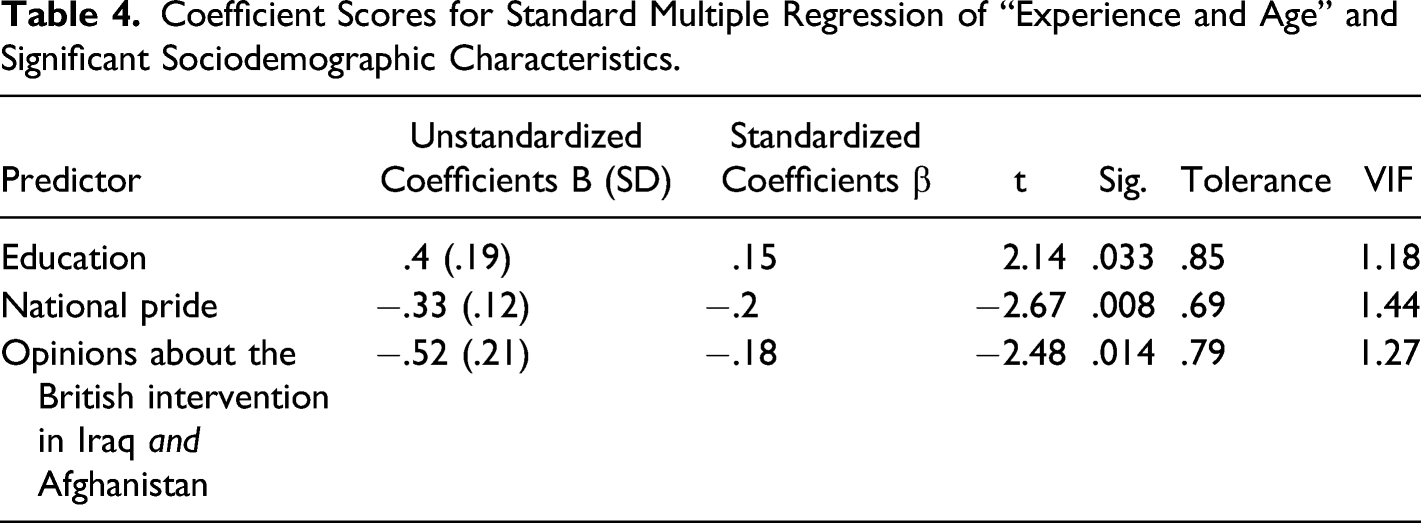
The multiple linear regression suggests that sociodemographic factors are significantly related to “Victimization” category evocation (F (14, 233) = 2.4, p =.003) with acceptable measures of autocorrelation (Durbin Watson = 2.07). The variance explained by sociodemographic characteristics in “Victimization” category evocation was, with 13.2%, medium (Cohen, 1988). With acceptable tolerance levels and VIF (Tabachnick et al., 2007; Pan & Jackson, 2008), “National Pride,” “Education,” and “Opinions about the British intervention in Iraq and Afghanistan” significantly predicted the “Victimization” category evocation.
Coefficient Scores for Standard Multiple Regression of “Experience and Age” and Significant Sociodemographic Characteristics.
Follow-up Interview Study
The results from the word association study indicated that victimizing sentiments are associated with a specific set of sociodemographic factors. However, it remains unclear, why this is the case. The aim of the follow-up interview study is to establish an understanding of underlying reasoning processes in relation to the significant predictors of the victimization of veterans “National Pride,” “Education,” and “Opinions about the British intervention in Iraq and Afghanistan.”
Participants
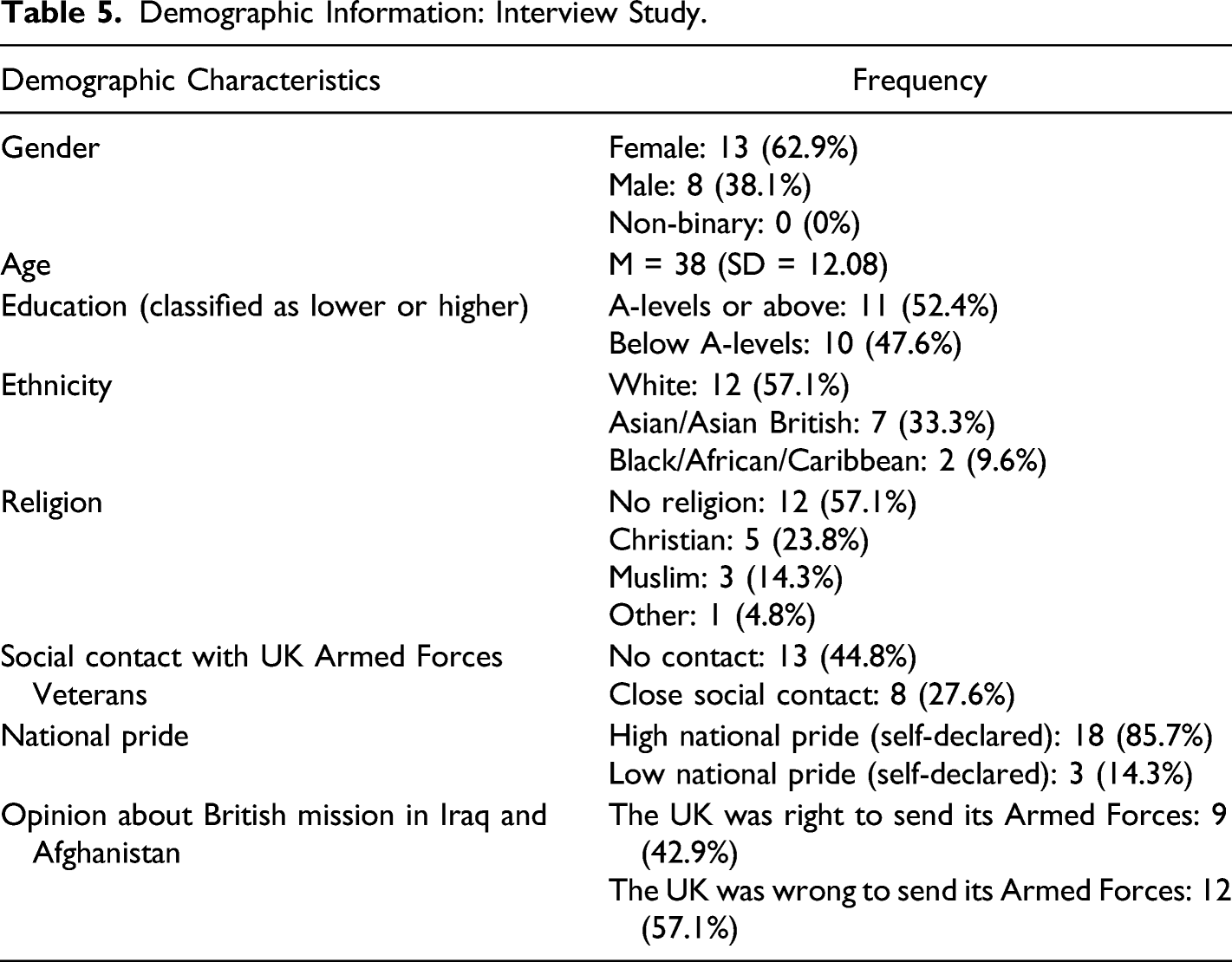
Demographic Information: Interview Study.
Materials and Procedure
The participation in this study was completely voluntarily and no financial compensation was made. After the participants received a participant information sheet and had the opportunity to ask question, they signed a sheet declaring informed consent. Then, the interview commenced. The semi-structured interview schedule consisted of three subsections in order to examine latent drives and reasoning processes in individual thinking. The first section encouraged participants to speak freely about their perceptions of Iraq and/or Afghanistan Army veterans (“When you think of British Army veterans who were deployed to Iraq or Afghanistan, which thoughts come to your mind?”). The second section of the interview consisted of follow-up probes that encouraged the participant to elaborate on the information that was previously given (i.e., “You mentioned ‘brave… What do you mean with that?”). In the third section, specific questions that attempted to probe into how participants developed their opinions about veterans were asked (i.e., “How did you come to your understanding of British Army veterans who were deployed to Iraq or Afghanistan?”). The interview schedule was piloted. The audio-taped interviews, lasting between 43 to 98 minutes, were transcribed verbatim and analyzed with thematic analysis.
Data Analysis
Following the transcription of the qualitative data, the transcripts were repeatedly read to become as intimate as possible with the accounts. Initial ideas about key topics and potential themes were noted, using Nvivo 12. The data was then reread and reviewed to identify potential key ideas that emerged repeatedly, and which may form themes. At this stage, the data was coded by categorizing interview extracts. This allowed the identification of connected thematic properties that, drawn together, helped highlight the way sociodemographic characteristics may impact on perceptions of veterans.
In-Depth Interview Results
The following analysis is structured in accordance with the sociodemographic characteristics, found to impact on the victimization of British Army Iraq and Afghanistan veterans. The three themes “Victimization in Relation to National Pride,” “Victimization in Relation to Education,” and “Victimization in Relation to Opinions about the British Missions in Iraq and Afghanistan” will juxtapose and interpret contrasting quotes.
Perceptions of Veterans in Relation to the Participants’ Opinions about the Missions
In all the narrative accounts, opinions about the missions that veterans fought had a spillover effect on the characterization of veterans. Support for the missions in Iraq and Afghanistan created a context in that a veteran’s supreme moral values were discussed. For example: Veterans went to Iraq and Afghanistan to help people, help with water and food supplies and showing people what human rights are…. That women have human right too. […] I think some people are just like that [being helpful] – while others are not bothered. So, the veterans, I think they are just born that way, it’s their personality. […] To stand up and be willing to sacrifice your life for other countries, other people – for humanity. (P23, supporting the missions)
As this quote exemplifies, the British interventions in Iraq and Afghanistan were supported when they were conceptualized as altruistically motived (or protected Britain from terrorist threats). In these instances, also veterans were conceptualized as altruistically motivated, and selfless, and lauded for superior values. “Veteran” therefore turned into an expression of the veteran-individual rather than seeing the individual as a veteran. More concretely, participants did not consider external factors such as training to elevate specific innate dispositions. Instead, being a veteran was something a person was considered to be born into rather than trained to be. Heroic missions therefore contributed to making up veterans as inherently different, heroic people, set apart from a civilian society.
In contrast, if individuals opposed the missions in Iraq and Afghanistan, then veterans became “pawns in political power games (P2, opposing the missions).” Veterans were conceptualized as a damaged individual who suffers from the experience of futile violence. For example: Iraq and Afghanistan were wars for profit, politically motivated oil wars. […] I think it must have been very difficult to focus the people, to legitimise the killing in these unjustified missions. […] The veteran might try to stop thinking about things like killing – it is still there – and suddenly it will all burst out. They might get depressed, anxiety – depending on the type of person you are, and it all comes out and affects them in a bad way [….] Alcoholism, suicide, depression, PTSD. They can’t get a job, become homeless, their life is over. (P3, opposing the missions)
As outlined in this quote, the British government was considered to have acted out of self-interests and not for altruistic mission goals and protection from terrorist threat. This had a spillover effect on conceptualizations of veterans who were considered to suffer from the consequences of unfaithful and deceitful superiors who made veterans do their “dirty work” (P8, opposing the missions). Here, attributions of mental health problems were justified by conceptualizations of veterans as non-agentic marionettes, endangering their lives in unjustified wars and suffering moral injury on their return to civilian society. In this sense, the victimization of veterans did create a symbolic distance between perceptions of the missions and perceptions of veterans and provided a rationale for holding the veteran in high regard, while opposing the missions in Iraq and Afghanistan (Berndtsson et al., 2015).
Victimization in Relation to Participant’s Education Level
In 83% (18/21) of the narrative accounts, participants justified their opinions of British Army Iraq and Afghanistan veterans by linking it to their own upbringing and education. Those 52% (11/21) participants with higher levels of formal education often reflected opinions that demonstrated that their educational background had helped inform their levels of empathy, tolerance and opposition toward violence. There was strong link made between mental health problems being the “normal” consequence of acting violently and so negative mental health characteristics were frequently used to describe veterans who returned from Iraq and Afghanistan. For example: I know how to tell right from wrong because of my parents and teachers in school. They have taught me empathy… how to treat others. […] To come back [from Iraq or Afghanistan], knowing that you have injured, have killed people. It has to be horrendous. PTSD, drugs and alcohol, suicide…. That are the consequences, I presume. […] It’s just… His conscience will convict him at some point. (P07, high education)
As demonstrated in this quote, perceptions of being well educated were commonly associated with having been raised to pursue peaceful and tolerant ways of living and readily identifying that perpetrating violence would have a negative moral impact on the individual. The veteran, who has violated a fundamentally civic principle among human beings (Liu & László, 2007), was understood to then consequently have difficulties rejoining civilian society. The veteran was also perceived to find it difficult to respond empathically and was deemed to experience moral injury as a result of deployment. Thus, damage became part of the core beliefs in the participants’ understandings of what it means to be a veteran. Veterans became constructed in terms of fragility and lability—they became “unstable” (P11, high education), “damaged (P17, high education),” “poor individuals (P15, high education).” In contrast, those with little formal education drew on the notion that war is necessary and has always been part of human societies. However, this notion also justified the rationale that exposure to violence may, though not always, have negative consequences on the veteran’s mental health. For example: I don’t know much about the war in Iraq and Afghanistan. I don’t know much about its politics, about its history…. Didn’t do too well at school, you know. […] I think war is part of mankind…of our genetics. Maybe there are consequences, I don’t know – I’ve heard of PTSD but that’s not the first thing that’s on my mind when I think of veterans. (P21, low education)
This quote exemplifies how participants who identified with having a lower level of formal education understood the veteran in relation to war experience. Essentially, war was conceptualized as possibly, but not necessarily, invoking mental health problems but with little of the discussions surrounding empathy and tolerance that were markers of those with higher levels of education. Instead, experiences of war were considered to be engrained within the human DNA. Here, WW1 and WW2 served as an example for horrific warfare experiences that may cause mental health problems, but which can be overcome by the individual. In this way, educational levels contributed to a shift in focus in characterizations of veterans. Those participants with lower levels of education tend to conceptualize war as an inevitable human fight for survival of the fittest, which may or may not impact on the mental health of veterans. In contrast, those with higher levels of education tend to focus on the moral-ethical perspectives of warfare. Here, mental health problems were considered to be very likely due to the consequences on the individual of taking part in the unjust and illegitimate actions of violence that are necessarily committed during war.
Victimization in Relation to National Pride
19 of 21 participants justified the appreciation or victimization of veterans in relation to national pride. If national pride was high, the superiority of British moral values was extensively discussed and links with previous seemingly less morally ambiguous conflicts, such as the second world war, were drawn. As part of this rationale, victimizing sentiments were not the focal point of interest. Instead, heroizing sentiments were recalled that were based on discussions surrounding the superiority of Western values above others. This is exemplified in the following quote: I am very proud to be British. I think we, as part of a British… of a well-developed society, we have the obligation to help others… other less developed societies. And this is what the veteran has done – he has defended human values… in Afghanistan, in Iraq, just like in the two world wars. This is why veterans are heroes… Iraq veterans, Afghanistan veterans, WW1 or WW2 veterans – all the same to me! (P17, high national pride)
In contrast, if national pride was low, then lengthy discussions of societal issues were interspersed with the discussion of veterans. These addressed predominantly issues surrounding social injustice and social policy making. Here, those who self-identified with low national pride discussed injustices in the benefits system, differences in incomes of rich and poor, and difficulties in accessing health treatment. The veteran, however, became the bona-fide image of being in need of social services, substantiating the relevance of social change. For example: No, I am not proud to be British. We have some serious problems… like the underfunded NHS [National Health Services]. […] And the veterans, they are sent to a faraway country, come back with all sorts of struggles, and can’t get the help they need because of budget cuts. And it’s the same for job seeker allowance or homelessness. We need to do something about these issues, why has nothing been done? (P09, low national pride)
Both of these quotes exemplify how veterans became concrete objectifications of symbolic and intangible constructs that the country stands for. High levels of national pride impacted individual perceptions of veterans by making veterans symbolic representations of economic perspectives, values and morality. Low levels of national pride had similar effects, casting veterans as those who suffer exactly from those societal issues that underpinned justifications of exhibiting little national pride. In this way, the individual self-positioning toward their country impacted on the context in which veterans were discussed.
Discussion
The present study examined outlined how and why sociodemographic factors impact on the victimization of British Army Iraq and Afghanistan veterans. Qualitative and quantitative data suggest that opinions about the British interventions in Iraq and Afghanistan impacted upon the extent to which veterans were associated with victimizing sentiments. If the missions in Iraq and Afghanistan were appreciatively conceptualized as a humanitarian or counter-terrorism mission, then veterans were lauded for their inherently different and altruistically superior personality. In contrast, if the missions were considered to be politically motivated “oil wars,” then the veteran was viewed as passive actor, not in control of their own fate, through naïve submission to the anthropomorphic agency of the government which held ultimate culpability. This allowed participants to maintain an appreciative, though victimizing sentiment, for veterans, while still opposing the missions that the veteran took part in. This also explains why others have found this same tendency to support the troops but oppose the war in larger representative samples (Berndtsson et al., 2015). It would confirm that parts of the population directly link their doubts about the mission with the fate of the Armed Forces personnel who took part in the missions (Hines et al., 2015).
The results confirm that public perceptions of military conflicts play not only a role in defense and foreign policy, for troop morale and military effectiveness and in estimates of mission-success and military fatalities (Canan-Sokullu, 2012; Myers & Hayes, 2010; Szayna et al., 2007; Dixon, 2000; Edmunds, 2012), but also in conceptualizations of the veterans of those conflicts. Here, similarities with American conceptualizations of Vietnam veterans who are constructed in terms of fragility and trauma-induced suffering (Thomson, 1998) were evident. Without a formal mission goal that veterans achieved, the British deployments in Iraq and Afghanistan provided a context for warfare that was conceptualized as illegitimate by many. This provided a socially accepted justification for placing an emphasis on the emotional costs of warfare (cf. Brewer, 2006). In this sense, mental health problems were implicitly related to moral injury, “transgressions [that] arise from […] bearing witness to intense human suffering or the grotesque aftermath of battle (Litz, 2012, p. 1).” Attributions of damaged mental health were therefore rarely based on reflections of critically evaluated, objective information about deployment and war experiences. On the contrary, understanding the veteran as a damaged individual was rooted in highly emotional responses to individual conceptualizations of warfare. In conclusion, publicly pertinent overestimations of mental health problems among veterans (i.e., Ashcroft & KCMG, 2017; Ashcroft, 2012; BSA, 2012) may be explained by anticipations of an illusionary battlefield that undermines the moral-ethical values of those who were deployed. The veteran, who returned from Iraq and Afghanistan, was therefore conceptualized as a “deserving victim,” a victim without choice (Walklate, 2007). This attitude allowed them to maintain overtly appreciative, though victimizing descriptions of veterans, while condemning the British deployments to Iraq and Afghanistan.
A similar trend could be observed in relation to those with higher and lower levels of self-reported formal education. Essentially, those with prolonged formal education reflected their self-perceptions of greater levels of tolerance and empathy. With these greater levels of empathy and tolerance, violence and violent actions were conceptualized as unhealthy. Mental health problems, and in particular moral injury, were therefore deemed to be the “normal” consequence of violent actions. However, individuals with lower self-reported levels of formal education did not dwell on empathy and tolerance. Instead, inferences from history were made to justify the claim that war is part of the human makeup. Therefore, mental health problems were considered to be a possible outcome of war exposure, however, not a necessary one. Therefore, the present results mirror previous research that suggests levels of education can impact upon self-beliefs around social cohesion, perceptions of war and the understandings of those who fought in conflicts as a consequence (Amamio, 2004; Lipset, 1969; Thyne, 2006). The results suggest that increased levels of empathy and tolerance toward other cultures and lifestyles are generates as a by-product of prolonged formal education, making individuals less ready to accept the deployment of troops. The interpersonal, political, social, and legal principles that individuals are exposed to in the UK may therefore place a particular emphasis on empathy as a fundamentally civic orientation among human beings (Amamio, 2004; Liu & László, 2007).
However, social ties to service personnel, age, ethnicity, political affiliation, and gender were not found to significantly impact the evocation of victimizing associations. This may give evidence for the unidirectionality of these sociodemographic factors. While social ties to service personnel, age, ethnicity, political affiliation, and gender may be related to appreciative understandings of veterans (BMG, 2017; BSA, 2012; Hines et al., 2015; Krueger & Pedraza, 2012), they may not have the same predictive power for victimizing sentiments. An additional possibility to explain why social ties to service personnel, age, ethnicity, political affiliation, and gender may impact the appreciation of veterans but not their victimization may relate to our methods of data generation and analysis. An example is the classification of the sociodemographic variables in the statistical analyses of previous studies. While the present study classified the sociodemographic variable age as a continuous independent variable, ranging from low to high (18–99 years of age), previous studies commonly classified age as categorical independent variable (age groups: 18–34, 35–54, 55–64, and 64+). The categorization of age as a categorical independent variable, in contrast to a continuous independent variable, has advantages as simplifying the statistical analysis and facilitating an easy interpretation of the results. However, treating age as a continuous independent variable in the present study was adequate and necessary as continuous variables have a higher sensitivity which allows to gain relevant results with smaller sample sizes. Similarly, social ties to the UK Armed Forces its (ex)members as well as political affiliation was measured through the continuous independent variables “Social Distance to the UK Armed Forces British Army Iraq or Afghanistan veterans” (ranging from little to great levels of social distance), “Social Distance to the UK Armed Force” (ranging from little to great levels of social distance) and “Political Opinions” (ranging from left to right wing). In contrast, ethnicity was coded as binary independent variable (white vs. other) as the present study did not recruit sufficient individuals with Asian, Black/African/Caribbean, other or mixed/multiple ethnic background to form meaningful categories. Also, gender was coded as binary independent variables (male vs. female) as members who identified as other or non-binary did not participate in the present study. Therefore, differences in data generation, coding, and analysis may explain why the present study yielded different results when compared to previous studies.
Although the results have provided a detailed examination of how sociodemographic factors relate to the victimization of British Army Iraq or Afghanistan veterans, a number of caveats need to be taken into consideration. One limitation addresses the homogeneity of the quantitative study’s sample. The sample comprised a high proportion of white, well-educated females in their mid-twenties. Thus, unlike previous research with representative samples (i.e., BSA, 2012), the present findings may not be considered as representative of the British general public. It is likely that the sample had very little knowledge or exposure to the work of the Armed Forces and little contact with those serving in the Armed Forces. In comparison, the overall British population is more balanced in age (M = 40.5; Statista, 2021), gender (female: 50.6%; male: 49.4%; ONS, 2021), and education (A-levels or above: 63%; ONS, 2017). Also, a lower proportion of the recruited cohort identified with belonging or having belonged to the UK Armed Forces when compared with representative samples from the UK (British Legion, 2014; MOD, 2020b). In this sense, many of the individuals were still children when the conflicts in Iraq and Afghanistan began and so they may not have been familiar with the arguments for and against interventions at the start of the conflicts. It may be interesting to compare an older group who were adults at the start of the conflict to see how they may differ from this sample in their beliefs. In accordance with previous literature, it could be expected that women and older people may have less favorable attitudes toward deployments—and therefore possibly may also be more likely to hold victimizing perceptions of veterans (Berndtsson et al., 2015). In addition, while a predominance of associations were utilized for the analysis, other prevalent categories, such as the war and heroization category, were left aside for the purposes of this paper. This is an important limitation as particularly the heroizing associations were nearly as frequently recalled as victimizing associations. Therefore, individuals may not utilize exclusively victimizing or heroizing associations, but possibly a combination of both. This would be aligned with the theoretical notion of cognitive polypahsia, suggesting that individuals may hold different—even contradictory—understandings of as long as each understanding is locally consistent. Therefore, “it is in the context of different life worlds that holding on to ‘contradictory’ representations makes sense”. However, to which extent cognitive polyphasia and the presence of both, victimizing and heroizing understandings, may apply to veterans would have gone beyond the scope of this paper. Instead, the present paper focused exclusively on explaining victimizing perceptions of veterans as these may have particularly important consequences on the veteran’s transition to civilian society.
Another limitation relates to the content analysis of associations. Although concordance in interrater reliability was high (87.65% and 83.85% interrater concordance), only 20% of the associations were rated by two externals. Therefore, it may be possible that the categorization of the words is subject to methodological flaws. Future research could to try and utilize more automated procedures for grouping and categorizing words (i.e. T.Lab, EVOC, and ALCESTE). However, these methods could not be utilized for the present study as they did not offer the necessary statistical features to answer the present research questions. A second limitation concerns the qualitative study. Essentially, the method of analysis would have allowed a range of analytic options. By constructing the themes that evolved from answering patterns, it may be possible that other, more implicit themes have been overlooked. This may be particularly the case for the present study as the focus was placed on victimizing sentiments in relation to sociodemographic characteristics. In this sense, the complexity of interactions between the underlying constructs of national pride, education, and opinions about the missions in Iraq and Afghanistan may have been presented in a very simplified fashion rather a balance between in-depth, explanative and in-breadth, explorative information is presented. While qualitative and quantitative aspects could be elaborated upon, the present publication gives a first overview of a, to date, under-researched area. In addition, it would be interesting to examine how and to which extent the present results could be replicated with veterans from other, publicly more supported wars. For example, it remains questionable whether individuals may have similar rationalities to justify their perceptions of veterans from WW1 or WW2. As the majority of the British public perceives these missions to be legitimate (YouGov, 2019a), individuals may hold fewer victimizing perceptions of this veteran population. However, due to this paper’s focus on British veterans who returned from Iraq and Afghanistan, the generalizability of the present findings remains limited. Future research may want to take this into consideration and examine and compare public perceptions of veterans from different missions.
In conclusion, the extent to which veterans were characterized in victimizing ways depended on the context in which the participants discussed their understanding of veterans and the conflicts in which they served. This may have problematic consequences for veterans of these unpopular conflicts. While veterans are seen as separate from the political decisions to go to war, the public perception of them is influenced by the legitimacy of the conflict which then likely influences their anticipation of poor veteran mental health. One way to overcome this issue may be to improve the public knowledge of the Armed Forces to demonstrate how veterans were not simply passive victims. However, the risk here would be that Armed Forces veterans could be perceived as active agents of illegitimate wars. How to explain and educate the public about institutions, such as the Armed Forces, who operate in a complex and contested moral space is an important area of public discourse that deserves more attention and ultimately has an impact on the perception of the humans who have been a part of such institutions.
Supplemental Material
sj-pdf-1-afs-10.1177_0095327X211070321 – Supplemental Material for How do Sociodemographic Characteristics Influence UK Civilian Opinions of UK Armed Forces Iraq and Afghanistan Veterans? A Mixed-Method Approach
Supplemental Material, sj-pdf-1-afs-10.1177_0095327X211070321 for How do Sociodemographic Characteristics Influence UK Civilian Opinions of UK Armed Forces Iraq and Afghanistan Veterans? A Mixed-Method Approach by Rita H. Phillips, Vincent Connelly and Mark Burgess in Armed Forces & Society
Footnotes
Declaration of Conflicting Interests
The author(s) declared no potential conflicts of interest with respect to the research, authorship, and/or publication of this article.
Funding
The author(s) received no financial support for the research, authorship, and/or publication of this article.

Supplemental Material
Supplemental material for this article is available online.
Author Biographies
References
Supplementary Material
Please find the following supplemental material available below.
For Open Access articles published under a Creative Commons License, all supplemental material carries the same license as the article it is associated with.
For non-Open Access articles published, all supplemental material carries a non-exclusive license, and permission requests for re-use of supplemental material or any part of supplemental material shall be sent directly to the copyright owner as specified in the copyright notice associated with the article.
