




Abstract
Why do people think that soldiers and officers join the military? In this article, we report and explain unique survey results of nationally representative populations in five democracies—France, Germany, Israel, the United Kingdom, and the United States. Beliefs about motivations for military service vary significantly by nation. In Israel and France, large majorities endorse intrinsic accounts of service motivations—that is, those centering on patriotism and good citizenship. The U.S. population is nearly evenly split between extrinsic accounts—ascribing service to the pay and benefits received or to the desire to escape desperate circumstances—and intrinsic ones. A large majority of U.K. and Germany-based respondents hew to extrinsic service accounts. We argue that the most plausible explanation lies with prevailing national citizenship discourses, in combination with the military’s operational tempo. This research has implications for public support for military recruitment, the use of force, and democratic civil–military relations.
Over the last 60 years, many countries—and especially the world’s wealthy countries—gradually abandoned the military draft. Today, most armed forces around the globe recruit soldiers on the open labor market. A recent survey concludes, “conscription is rarely institutionalized, in favor of long-service professionals, but even where institutionalized conscription exists, it is largely supplemental and limited to homeland defense training” (Toronto & Cohn, 2022). Many believed that this transformation in military recruitment would have larger, normatively undesirable ramifications. Universal male military service, in their view, had taught young men that, as citizens, they were not just holders of rights entitled to levy claims on the state, but also objects of the state’s rights claims—and thus the holders of duties (Janowitz, 1976). These scholars and pundits therefore feared that replacing conscripts with paid professionals would kill off “the mythic tradition of the citizen-soldier” and thereby create a political culture dominated by rights alone (Abrams & Bacevich, 2001; also Burk, 2007, p. 444; Moskos, 1977).
With the passage of time, we can now ask whether they were right: Did the turn from conscription in fact kill off “the mythic tradition of the citizen-soldier”? The answer is important in its own right, but it is particularly important in light of recent events. Russia’s 2022 invasion of Ukraine has revived debates, especially in Europe, about whether wealthy nations, whose citizens’ value orientations tilt individualistic, can adequately staff armies with volunteer recruits alone. The renewed Russian threat has even led a handful of European countries—notably, Lithuania, Latvia, and Denmark—to reintroduce conscription or to expand selective conscription to fill recruitment gaps. 1 Past research has shown that the myth of the patriotic, self-sacrificing citizen-soldier survived the end of the draft in the United States (Krebs, 2009). A survey of U.S.-based respondents found that a majority of Americans resist thinking of military service as a “job” and of soldiers as “employees” (Krebs & Ralston, 2022). However, we do not know what consequences the end of mass conscription had in other countries for “the mythic tradition of the citizen-soldier” and what citizens in other countries think today about the nature of military service and soldiers’ motivations. .
This article reports the results of surveys about soldiering conducted in four countries—the United States, the United Kingdom, France, and Germany—and about officers in a fifth country—Israel. As expected, these beliefs vary significantly by nation. In Israel and France, large majorities endorse intrinsic accounts of service motivations—that is, those centering on patriotism and good citizenship. The U.S. population is nearly evenly split between extrinsic accounts—ascribing service to the pay and benefits received or to the desire to escape desperate circumstances—and intrinsic ones. A large majority of U.K. and Germany-based respondents hew to extrinsic service accounts. To explain this variation across countries, we develop and explore the plausibility of several alternative explanations—size of military, recruitment format, and operational tempo—and find them wanting as sole explanations of the cross-national pattern.
We instead argue that the most plausible explanation lies in the combination of dominant national citizenship ideals and the military’s operational tempo. In general, the more a political culture embraces republican citizenship ideals, the more citizens see soldiers as intrinsically motivated. However, in republican nations whose militaries do not have an especially high operational tempo, few citizens can demonstrate the highest form of civic virtue. Citizens of such countries can be expected to temper their republicanism and more often endorse extrinsic narratives of military service. In general, the more a political culture embraces liberal citizenship ideals, the more citizens see soldiers as extrinsically motivated. However, liberal nations will find it hard to maintain an elevated operational tempo, given the costs of military service. Citizens of such countries may feel compelled to depart from the liberal ideal-type, venerate soldiers’ patriotism and sacrifice, and more often endorse intrinsic narratives of military service. This framework, we show, plausibly explains why respondents in France and Israel tilted toward intrinsic accounts, why respondents in the United States were fairly evenly divided, and why respondents in the United Kingdom and Germany were more comfortable with extrinsic service accounts.
These findings have important implications for diverse areas of scholarship. They provide further evidence, from a novel arena, that, despite growing superficial similarity, practices and discourses of national citizenship remain distinct and that national citizenship traditions are enduring. 2 In addition, assumptions about soldiers’ motivations for military service affect public support for military operations, and they may therefore help account for cross-national variation in the propensity to use force in international affairs (Krebs et al., 2021). These assumptions may also shape public attitudes toward granting additional benefits to soldiers and veterans, shedding light on cross-national divergence in the scope and generosity of the military welfare state. Similarly, these assumptions may partly underpin public beliefs about the appropriate roles of military officers and civilians in policymaking, helping account for cross-national variation in adherence to the norms of democratic civil–military relations. From a normative and policy standpoint, this research points to the consequences—sometimes arguably deleterious, sometimes arguably beneficial—of elite rhetoric and public rituals that cultivate and propagate idealized and romanticized images of contemporary soldiers.
The rest of the article proceeds as follows. First, we briefly outline the existing literature on motivations for service and explain how this project builds on that literature but also differs from it. Second, we introduce the original survey data and methods. Third, we present the basic findings, from which an overall pattern emerges that constitutes the article’s core empirical puzzle. Fourth, we present and explore three candidate mono-causal explanations for this puzzle. We first develop each mid-range theoretical argument, and we then evaluate its empirical plausibility. We show how all three are inadequate on their own as explanations for the observed pattern. Fifth, we present our preferred alternative, centering on national cultures of citizenship and military service, in combination with the armed forces’ operational tempo. Sixth, we present five brief national case studies, which together show that our explanatory typology, combining prevailing national citizenship discourses with the military’s operational tempo, seems to make adequate sense of the observed empirical pattern. These case studies substantiate the potential value of our preferred theoretical explanation, though they are, as plausibility probes, necessarily more suggestive than determinative. Finally, we explore avenues for future research and the implications for policy.
Literature Review: Motivations for Military Service
Militaries—as well as scholars—seek to understand the reasons that people join the armed forces. It can be a pressing question, especially when militaries face recruitment problems. The literature does not use consistent conceptual categories, but much research is implicitly or explicitly rooted in Moskos’s (1977) famous distinction between “institutional” and “occupational” models of military service. Consistent with that framework, existing research has found that soldiers’ reasons for volunteering for military service are varied. “Occupational” reasons—pay and material benefits, especially educational benefits—are one major motivation for joining the military in the United States, but people also join the armed forces to advance less material personal goals, such as “seeing the world” or fulfilling their “lust for adventure.” At the same time, “institutional” reasons, such as individuals’ patriotic devotion to country or their sense of familial duty, remain relevant as drivers of enlistment. Motivations for military service are diverse across people, but they are also often mixed within people: there is typically no one reason that people enlist (Asch et al., 2010; Eighmey, 2006; Gorman & Thomas, 1991; Griffith, 2008; Helmus et al., 2018; Hosek et al., 1986; Hosek & Peterson, 1985; T. Woodruff et al., 2006). Scholars have productively extended this analysis of enlistment motivations to militaries beyond the United States (see, among others, Aydiner et al., 2020; Cancian, 2023; Graf & Kuemmel, 2022; Singh, 2017; Talibova, 2022).
More recent literature has embraced a modified typology derived from extensive psychological research into individual motives for costly action. These scholars organize motivations for military service into the categories of “extrinsic”—any motivation external to the self, including but not limited to the pay and benefits associated with military service—and “intrinsic”—any motivation derived from one’s identity and normative commitments, including but not limited to patriotism and duty (Krebs & Ralston, 2022; T. D. Woodruff, 2017). These categories are better grounded in broad approaches to human psychology, and we therefore use this language throughout this article. However, we also acknowledge that both extrinsic and intrinsic forces underpin actual human behavior. The precise mix or balance among these forces varies across domains of human action, and, within a given domain, it may well vary across human collectives.
The existing scholarship, however, is focused on soldiers’ self-reported motivations for joining the armed forces, not on the mass public’s perceptions of why service members enlist. Recent research builds on the literature on soldier motivations to shed light on what people—civilians as well as active-duty military and veterans—believe about soldiers’ reasons for joining (Krebs & Ralston, 2022). This typology combines (a) intrinsic versus extrinsic attributed service motivations and (b) the degree of attributed choice in joining. These two dimensions produce four motivations that people may ascribe to military service members: the duties of citizenship (intrinsic, low choice), patriotism (intrinsic, high choice), the pay and benefits associated with service (extrinsic, high choice), and the desperate need to escape adverse circumstances (extrinsic, low choice) (Krebs & Ralston, 2022, p. 29). This line of research has further established that these public beliefs about reasons for military service matter, affecting other important variables, such as public opinion on military missions and casualties (Krebs et al., 2021) as well as civil–military relations (Krebs et al., 2023). The cited research has examined public beliefs about military service only in the United States. The present study utilizes this framework and methodology, extends it to four other democracies (France, Israel, Germany, and the United Kingdom), and explains the resulting cross-national empirical pattern of public beliefs about service members’ reasons for joining the military.
Surveys and Methods
The surveys were conducted between 2018 and 2021. 3 In the United States, 2,451 respondents were supplied in 2018 by Lucid. In the United Kingdom, Dynata recruited 2,448 respondents in 2019, and it also provided 1,089 respondents in France in 2021. In Israel, iPanel supplied 1,528 respondents in 2019. These samples were largely comparable to existing national benchmarks. 4 In Germany, the Bundeswehr Centre of Military History and Social Sciences added relevant questions to its 2020 annual survey of German public opinion, which interviewed 2,277 respondents. 5
The surveys deployed in the United States, the United Kingdom, and France were identical for the purposes of this article. Respondents were presented with four reasons people might join the military, corresponding to common service narratives revolving around patriotism, good citizenship, pay and benefits, and desperation (drawn from Krebs and Ralston (2022)). They were first asked to select the primary reason that people join the military. Given that motivations for service are surely mixed, respondents were then asked to estimate what percentage of people join the military for each of those reasons. In the United States, United Kingdom, and France surveys, respondents were then presented with an open text box inviting them to write in an alternative, if they found these four options inadequate. The vast majority of respondents either did not complete this open-ended question or indicated that the options covered the full range of motivations. A very small number of respondents—between 1% and 3% of the total—suggested alternative motivations, which were predominately family or adventure/travel-based.
The survey in Germany differed in three respects. First, whereas Lucid, Dynata, and iPanel drew samples from existing pools of previously recruited respondents online, the Bundeswehr Centre survey recruited its sample via IPSOS and collected the survey data using face-to-face Computer-Assisted Personal Interviews. Second, the German survey presented respondents with the same four choices, but also allowed them to indicate “don’t know.” Around 7.5% of respondents selected this option. We cannot know whether, if forced to choose, as in the other surveys, those responding “don’t know” would fall evenly across the categories. Third, the German survey included control variables that were measured differently.
The Israel survey was significantly different in that it focused on the motivation of officers. Enlisted soldiers in the Israel Defense Forces are overwhelmingly Jewish conscripts, with the exception of Druze and Circassian draftees and of occasional Arab volunteers, who typically hail from Bedouin tribes. A first pilot survey found that Jewish Israeli respondents overwhelmingly thought of conscripts as “patriots” and “good citizens,” and a second pilot survey experiment revolving around a volunteer for a commando unit similarly found little variation in attributed motivation for service. We therefore asked respondents about the motivations of officers. In addition, a pilot survey—as well as interviews with Israeli experts—confirmed that respondents found it implausible that an officer would serve because he had “no other options.” To preserve the survey’s external validity, respondents therefore selected from three, not four, alternatives. These differences complicate efforts to compare the data collected in Britain, France, and the United States to that collected in Germany and Israel. However, because the latter two nations represent the extremes on ascribed service motivation, a clear pattern nevertheless emerges.
Respondents were asked to report their political ideology, gender, age, race (in France, the United Kingdom, and United States), level of education, and income. In Israel, race was replaced with Jewish ethnicity (Ashkenazi [European] or Mizrahi [North African and Middle Eastern] descent) and with religious observance/sect. The surveys also inquired whether respondents had personally served in the armed forces, whether they had served before or after the end of the draft (when relevant), and whether a member of their household had served. The surveys estimated respondents’ hawkishness and asked respondents to rate the warmth of their feelings toward members of various institutions, including the military. 6
What People in Five Countries Think About Why Soldiers Serve
Figure 1 presents the percentage of respondents in each country endorsing each of the soldiering accounts. 7 Put differently, Figure 1 displays the distinctive mix of motivations that respondents in given countries attributed to their nation’s military service members. “Pay and benefits” was by far the most common response in Germany, accounting for more than half of respondents (53.6%) and more than double the next most common answer, “no other options” (22.3%). 8 Half the respondents in Britain also answered “pay and benefits” (49.7%), nearly double the percentage responding “patriotism” (25.8%). While the “pay and benefits” account was also popular in the United States, securing a plurality of responses (43.1%), many also said that patriotism was the primary motivation behind soldiers’ enlistment (33.3%). The contrast to France and Israel is striking. In France, a plurality of respondents (32.9%) credited soldiers’ joining chiefly to patriotism, with significant numbers also endorsing both the good citizenship (26.5%) and the pay-and-benefits (25.7%) narratives. Nearly half of respondents in Israel (46.4%) said that officers signed up primarily out of patriotism, though many (38.0%) also attributed their decision to the provided pay-and-benefits.
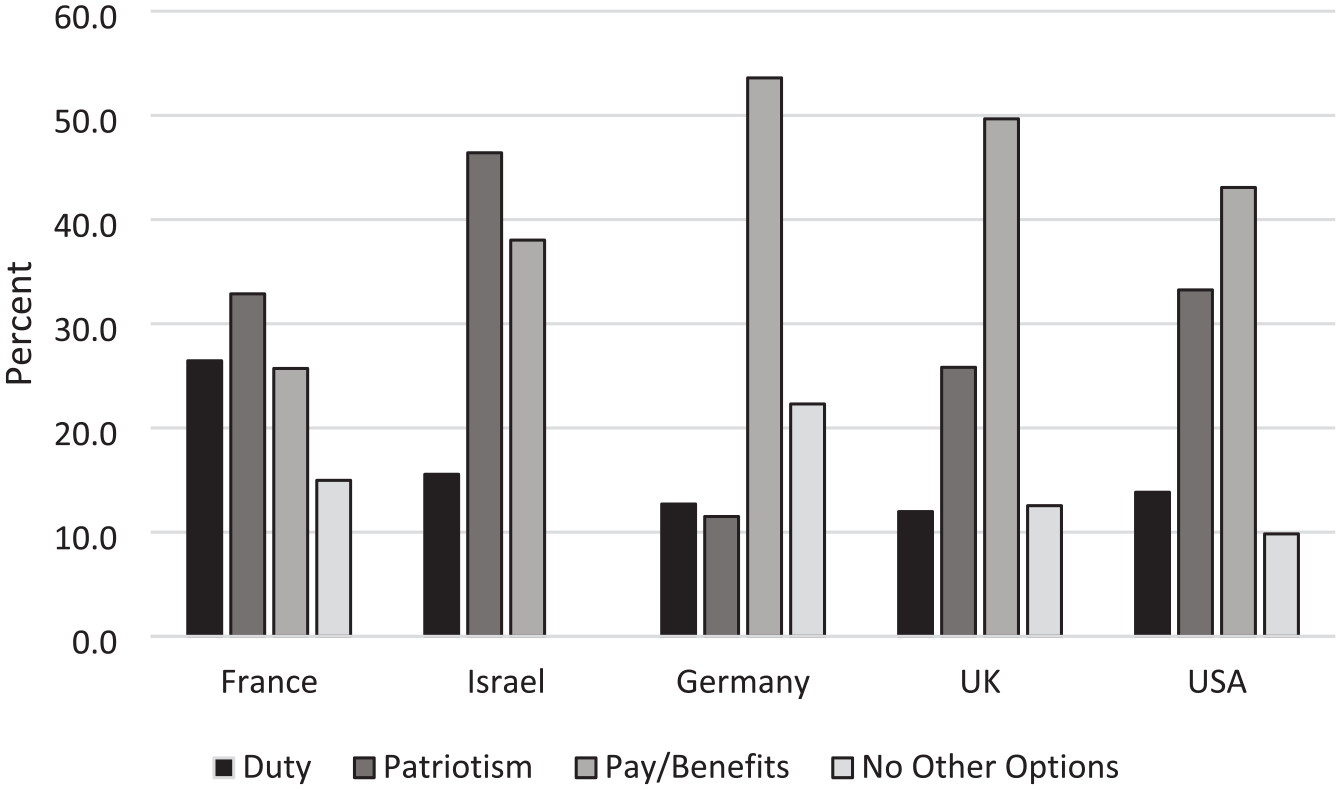
Perceptions of Soldier/Officer Motivation.
The pattern is represented more clearly in Figure 2, which groups the ascribed service motivations according to whether they are intrinsic or extrinsic. Intrinsically motivated people are driven to enlist in the armed forces by their values, while extrinsically motivated people are driven by material or social factors. Those who enlist chiefly out of patriotic conviction or to fulfill their duties as citizens are intrinsically motivated. Those who enlist chiefly to secure the financial rewards of service, whether lured by the attractiveness of the package or whether impelled by their desperate circumstances, are extrinsically motivated. Per Figure 2, large majorities of respondents in Germany and Britain attribute extrinsic motivations to soldiers (75.9% and 62.2%, respectively), U.S.-based respondents are roughly equally divided, and significant majorities of respondents in France and Israel credit soldiers (in Israel, officers) with being chiefly intrinsically motivated (59.3% and 62.0%, respectively). The rest of this article seeks to explain why respondent populations in different nations reflect different balances in attributing intrinsic and extrinsic motivations for military service.
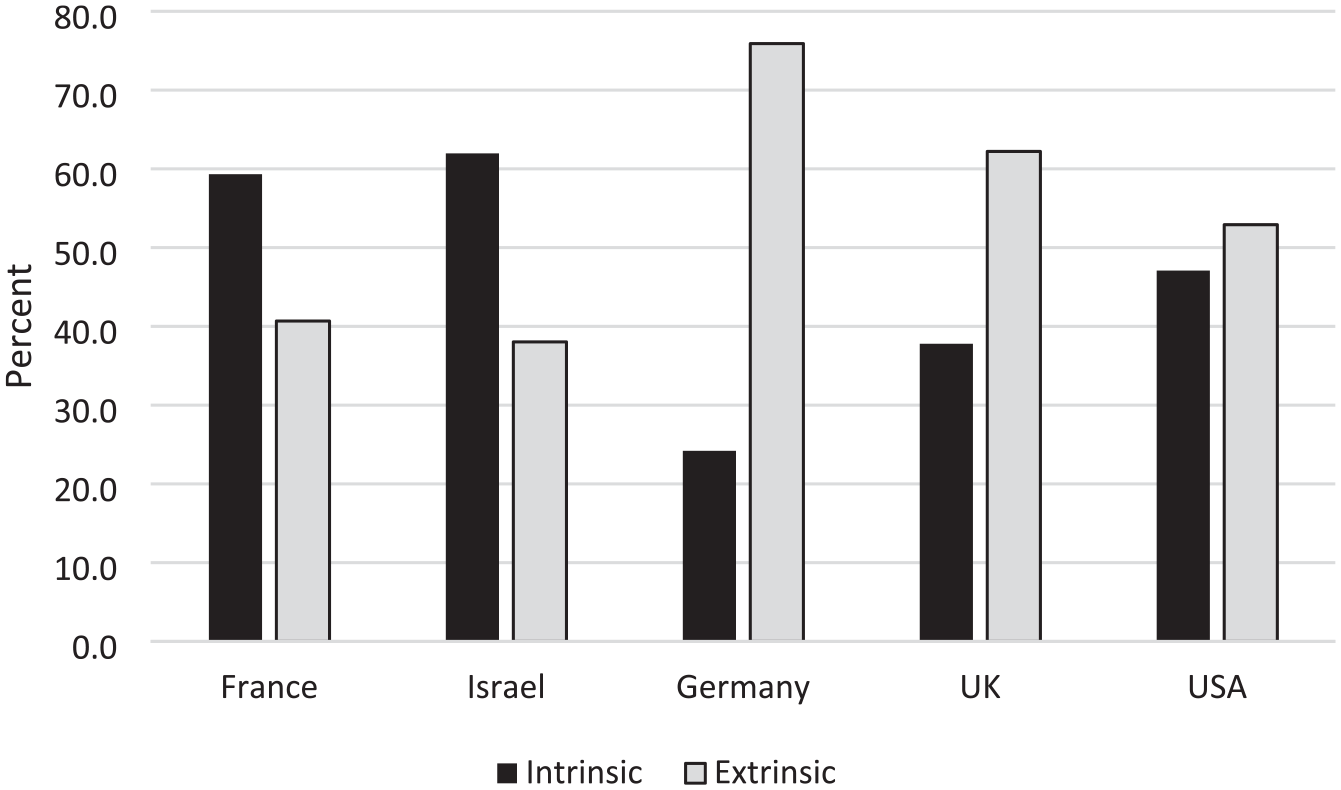
Perceptions of Soldier/Officer Motivation—Extrinsic and Intrinsic.
Explaining Country-Level Variation: Three Alternatives
To our knowledge, no scholarship addresses cross-national variation in how the mass public perceives military service. We therefore draw on existing, somewhat tangential literatures—the substantial literature exploring the varied self-reported reasons that soldiers say they join and remain in the armed forces; a study, rooted in U.S. data, examining individual-level variation in why members of the mass public think soldiers enlist (Krebs & Ralston, 2022); and the small literature on why and when some states make military service mandatory (Asal et al., 2017; Levi, 1997; Margulies, 2021)—to develop three conceivable explanations for divergent national cultures of military service. We evaluate these accounts, and we find all three insufficient as explanations for the observed cross-national empirical pattern.
Size of Military
Perhaps the size of the armed forces—the number of people under arms—is connected to the military’s social standing and therefore to different accounts of military service. On the one hand, one might hypothesize that a larger volunteer military would be conducive to intrinsic narratives of military service. This hypothesis derives from complementary political-economic and psychological logics. From a political-economy standpoint, when the demand for soldiers and officers is especially high relative to supply, filling billets becomes expensive (Horowitz & Levendusky, 2011). Governments then have incentives to boost the social prestige of military service, in the hopes of thereby increasing the supply and lowering the price of this scarce labor (Bacevich, 2005). All else equal, then, the larger the military is as a percentage of the work force, the less favorable is the supply–demand ratio, and the greater are the military and government’s incentives to promote a romanticized image of the volunteer soldier. From a psychological point of view, when the armed forces are relatively large, more citizens have friends and family in military service, and thus more people have reason—per the logic of social identity theory and motivated bias, along with the imperative to reduce cognitive dissonance—to give meaning to their loved ones’ potential sacrifice by idealizing their motivations for service. 9 This social-psychological logic is, moreover, consistent with survey evidence that relatives of soldiers are more likely to hew to intrinsic accounts of service motivations (Krebs & Ralston, 2022, p. 41).
On the other hand, though, one might conversely hypothesize that a larger military would be associated with service narratives highlighting extrinsic reasons for military enlistment. From a political economy perspective, when competition with civilian employers for qualified labor is intense, military recruiters have reason to emphasize the financial benefits of service, and extrinsic service narratives will therefore be more prominent. When soldiers are recruited on the open market, military advertising places greater emphasis on the benefits of military service, whether to personal prospects or to self-actualization (Bailey, 2009; Park et al., 2017; Strand & Berndtsson, 2015). From a social standpoint, when the armed forces are large relative to the population, citizens have more direct connections to the world of soldiering and presumably greater insight into the real reasons that soldiers and officers sign up. Fewer people are likely to fall prey to the mythic image called up in movies and in politicians’ speeches. These complementary logics suggest that, when soldiers and officers are recruited on a market basis, the larger the military, the more people endorse extrinsic accounts of service motivation.
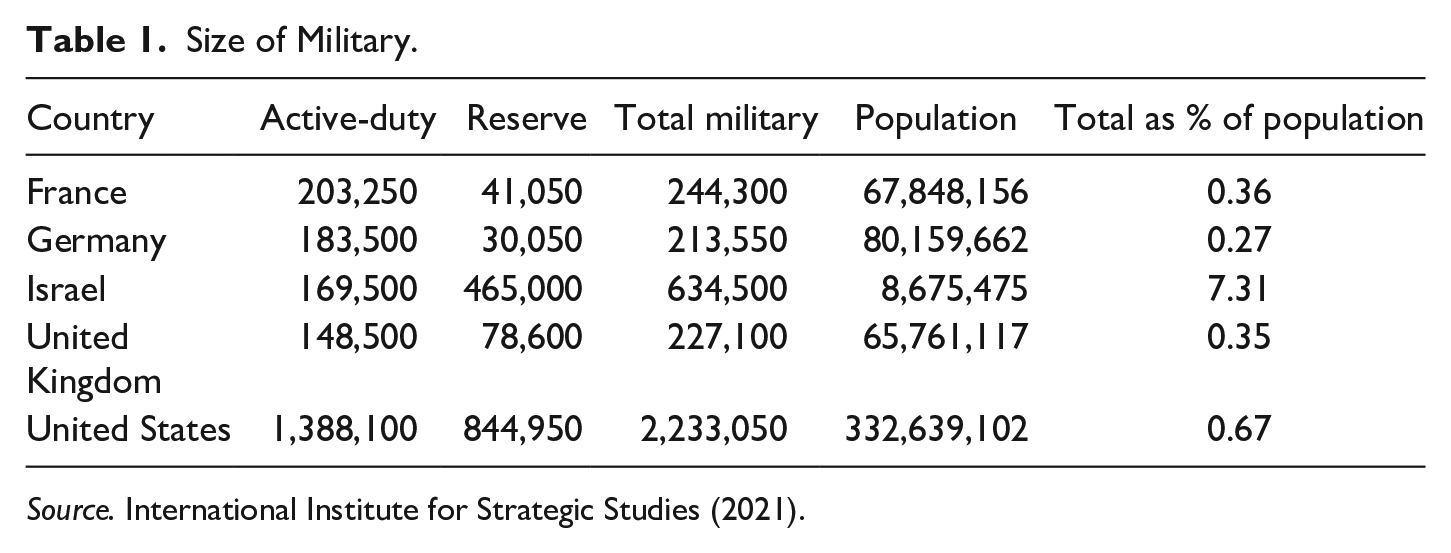
Regardless of which theoretical logic holds, the size of the military cannot explain the cross-national pattern presented earlier. Table 1 displays the number of men and women in the active-duty military and reserves, relative to population, in 2020—that is, around the time these data were collected. Germany, Britain, and France have the smallest militaries as a percentage of total population, with the latter two being roughly equal. However, British respondents were extrinsically inclined, whereas French respondents were much more likely to endorse an intrinsic account. Israel, which has, far and away, the largest total military manpower relative to population—thanks in large part to its extremely large reserve component—should be at one extreme or the other. And so they were: Israelis were the most intrinsically inclined respondents, even though we asked about officers. The U.S. military is twice as large, relative to population, as the European military powers, but U.S.-based respondents were very much in the middle of the cross-national pack, much less attracted to intrinsic service accounts than were French respondents and much more attracted to such accounts than were British or German respondents.
Size of Military.
In addition, if these theoretical logics had merit, having a soldier in one’s family would be associated with either an intrinsic account—if military families were inclined to idealize their loved ones’ service—or an extrinsic account—if military families were more likely to recognize the truth about why people serve. But the respondent-level data presented in Supplemental Appendix 1 do not support either of these propositions. 10 In France and the United Kingdom, having someone in your household serve in the military was not associated with any particular account, nor was having served in the armed forces oneself. Perhaps this was an artifact of a mixed respondent population, some of whose household members had entered service because of the draft and some who had volunteered for military service. However, when we segmented respondents around the draft, we found no significant differences in France: respondents whose soldiers in their household had served before 2001—that is, in the time of conscription—were no different in ascribed service motivation from those whose family members had served after 2001, when the draft came to an end. 11 In the United Kingdom, respondents whose soldiers in their household had served since 1960, when the draft ended, were less likely to ascribe service to “no other options” and perhaps more likely to ascribe service to “pay and benefits”—but the pre-1960 respondent group was very small (just 200 respondents). 12 In Germany, those who have had soldiers in their household (as well as current and former soldiers themselves) were more likely to endorse a good citizen (sense of duty) soldiering narrative, but they were not more likely to ascribe military service to patriotism, and they were not less likely to ascribe it to any extrinsic motivation. 13 The results were strong only in the United States —where those whose family members have served in the military were more likely to see soldiers as intrinsically motivated patriots and good citizens and less likely to see them as extrinsically motivated. 14 Overall, the cross-national, respondent-level evidence was not consistent with the implications of either psychological theory.
In sum, neither the cross-national nor the respondent-level empirics support any systematic association between the size of the armed forces and the public’s perception of service motivation.
Recruitment Format: Conscripted Versus Voluntary Systems
Perhaps how soldiers are recruited affects how people think about their reasons for joining the armed forces. On the one hand, one might associate both recruitment formats with extrinsic motivations for service. Conscripted soldiers are often compelled to serve, or they are thrown in jail. Volunteer soldiers are lured in part by financial packages. Although the recruitment formats differ in whether they use carrots (incentives) or sticks (punishment) to mobilize soldiers, at least some service members’ motivations for enlistment are extrinsic in either case. On the other hand, it is possible that either recruitment format could promote the view that soldiers are intrinsically motivated. Coercive conscription systems are rife with draft evasion. Preventing evasion is expensive, and it can require politically unpalatable measures. As a result, universal conscription has gone hand in hand with nationalism (Posen, 1993). Nationalism not only makes conscription more efficient, by reducing evasion and the corresponding need for enforcement, but it also implies that soldiers serve willingly, impelled by their sense of duty and their love of country. Meanwhile, when soldiers are recruited on open labor markets, it can be hard to fill the ranks when the economy is booming. Governments then have incentives to advance the veneration of soldiers as paragons of patriotism and good citizenship.
Regardless, recruitment format cannot account for the observed variation across these five cases. At the time the surveys were deployed, these militaries had a common recruitment format: Britain, France, Germany, and the United States had all jettisoned the draft over the decades. While Israel has mass conscription for Jewish males (with exceptions for Arab citizens, ultraorthodox Jewish men, and religious Jewish women), Israeli officers—the subject of the survey—are volunteers. An invariant voluntary recruitment format cannot explain a highly varied set of beliefs about motivations for military service. Nor can we salvage the hypothesis by leveraging when conscription came to an end. France abandoned compulsory military service in 2001—a quarter-century after the United States and nearly 40 years after Britain—and perhaps that is why respondents in France were more likely to see their soldiers as intrinsically motivated. But the case of Germany strikingly does not fit this pattern: it did not suspend its draft until 2011—a decade after France—yet it occupied the other extreme end of the motivational spectrum.
In addition, respondent-level data are not in line with the recruitment-format hypothesis. If conscription, nationalism, and intrinsic ascribed service motivations go together, respondents who were in their late teens or older when conscription came to an end should be more likely to endorse an intrinsic account, and younger respondents should be more likely to endorse an extrinsic account. 15 Yet bivariate data from Britain, France, and the United States show just the opposite. Respondents who were of conscript age or older when the draft ended were more likely to endorse an extrinsic pay-and-benefits account than were those who never knew the draft in those countries. 16 Perhaps respondents who were of conscript age or older when the draft ended compare today’s soldiers, whom they see as driven more by pay and careerism, unfavorably to their more virtuous contemporaries. However, why then would France—a country that recently abandoned the draft—be more inclined to an intrinsic account than Britain, which long ago abandoned the draft? Nor does either logic explain why, in all three countries, those who reached their late teen years after compulsory service came to an end were more likely to see today’s soldiers as moved by patriotism. In Germany, older respondents who were of conscript age or older when the draft ended were not more likely to endorse any particular service account. 17
Operational Tempo
Perhaps countries with more active militaries—more often engaged in kinetic operations, with higher casualty rates—are more likely to venerate their soldiers. As the expected costs of military service rise relative to the existing compensation package, the cost–benefit calculus becomes increasingly tilted against joining the military, which in turn makes recruitment more challenging. Governments may then have good reason to put soldiers on a pedestal, with greater social prestige compensating, to some degree, for the greater risks entailed in military service. “Pedestalizing” may therefore, as the prospects of death and serious injury rise, allow militaries to maintain adequate levels of manpower.
A complementary psychological logic also supports this hypothesis. Almost all humans have some capacity for empathy. They intuitively grasp the “golden rule”—to do unto others only as you would have them do unto you. Sending soldiers to battle can therefore generate significant cognitive dissonance. Assuming people generally prefer to minimize their own risks of death and injury, approving of a military operation requires violating the golden rule: dispatching soldiers into harm’s way when you would rather not be sent into such circumstances yourself. Narrating soldiers as intrinsically motivated mitigates this problem. Soldiers who are civic-minded patriots are likely to favor their own deployment, and thus an empathetic individual can support the operation with little cognitive dissonance. In sum, the more active a military, the greater the possibility that soldiers will become seriously injured or die, the greater the psychological incentive supporters of kinetic operations have to see soldiers as willingly running these risks, and thus the greater their incentive to see soldiers as intrinsically motivated. Politicians then also have reason to promote this image of the soldier.
To evaluate this hypothesis, we first need to collect data on these five militaries’ respective operational tempos. One way to measure operational tempo is in terms of the number of militarized interstate disputes in which a country has been involved since the end of the Cold War. As Figure 3 shows, the U.S. military is, not surprisingly, the most active by this measure. France and Britain both rank significantly behind the United States, as does even Israel. Germany—in line with its postwar strategic culture (Berger, 1998)—has the least active military. This measure, however, understates the Israel Defence Force’s (IDF) operational tempo, since it often engages with violent nonstate actors, who by definition are not party to a militarized interstate dispute. The Armed Conflict Location & Event Data Project (ACLED) records conflict events, including “violent interactions between two organized armed groups.” The ACLED data, per Figure 4, shows that, between 1997 and 2023, Israel’s armed forces, by a large margin, had the highest operational tempo, followed by the United States, with Britain, France, and Germany much less active.
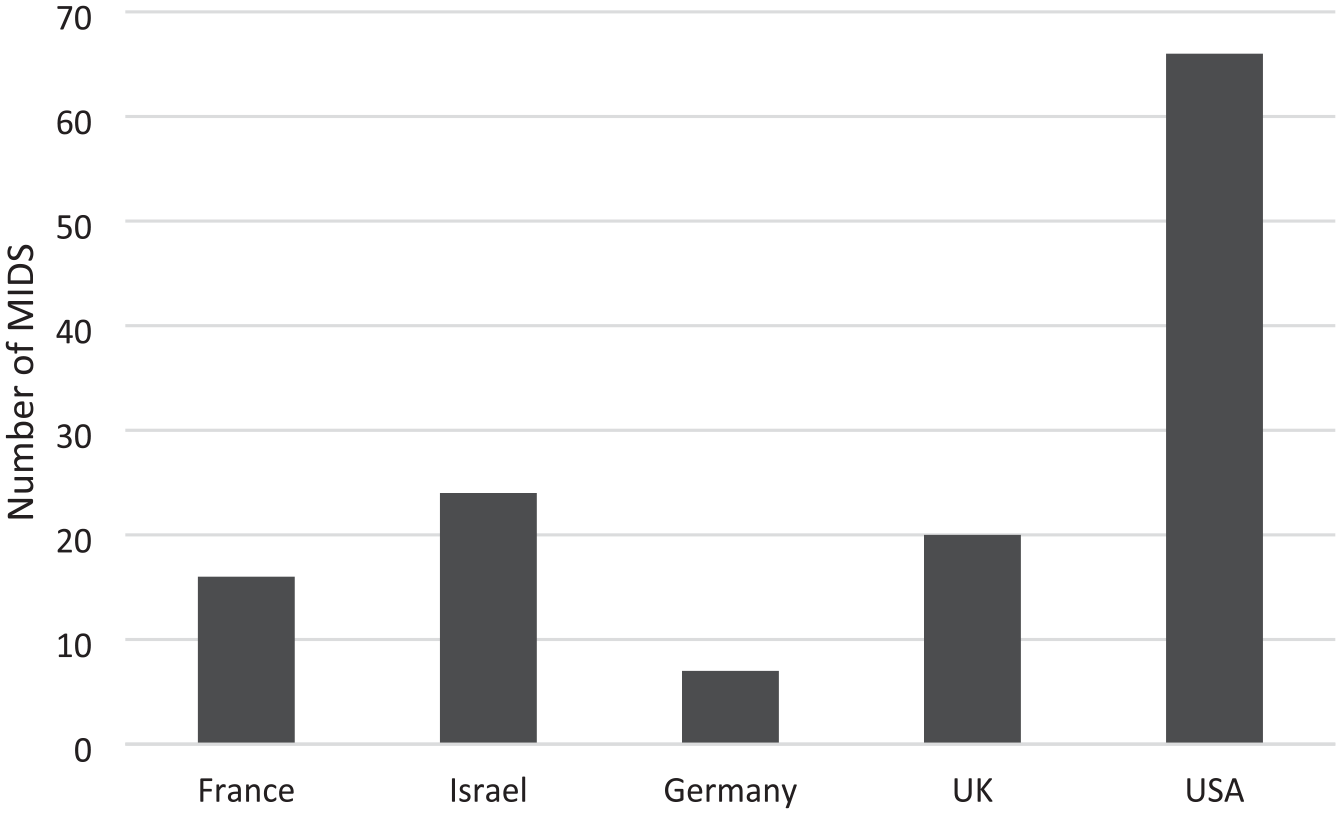
Number of Militarized Interstate Disputes (1991–2014).
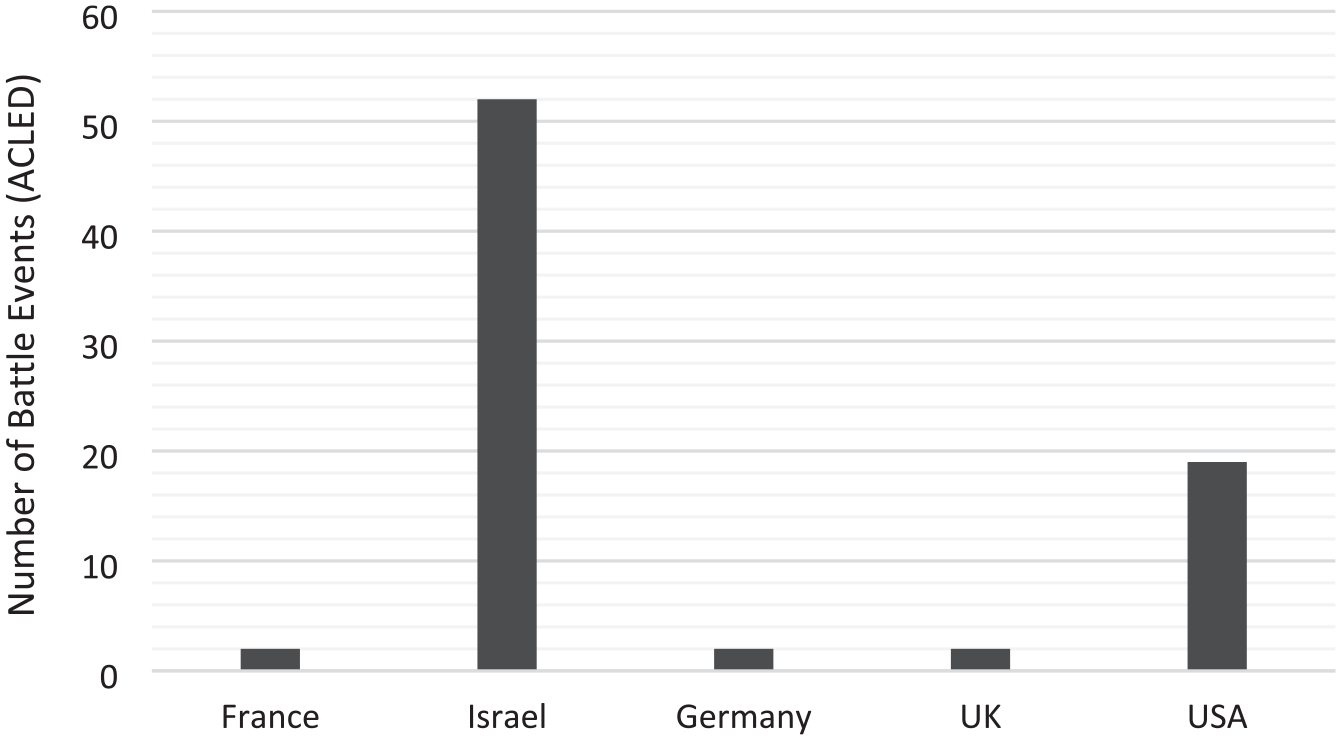
Number of Battles (1997–2023).
Given these measures of operational tempo, if the above hypothesis has merit, Israel and the United States should be dominated by beliefs in officers’ and soldiers’ intrinsic motivation, France and Britain should reside in the middle, and Germany should bring up the rear. The cross-national empirical pattern is not in line with these expectations. The IDF’s high operational tempo matches Israelis’ confidence in officers’ intrinsic motivations. But French respondents were significantly more inclined to intrinsic motivational accounts than this theoretical logic would expect, whereas U.S. respondents were significantly more inclined to extrinsic accounts. U.K. respondents were unexpectedly closer, in their service motivation attribution, to Germans than to their military peers—the French.
Some respondent-level data, however, may support the operational tempo hypothesis. All surveys measured individuals’ hawkishness, their basic predilection for using military force. In all five countries, hawkishness was always significantly and positively associated with belief in soldiers’ intrinsic service motivation, especially patriotism, and negatively associated with belief in soldiers’ extrinsic service motivation, especially pay-and-benefits. Hawkish individuals were more inclined to see soldiers as patriots and good citizens, and dovish respondents were more prone to see soldiers as having “no other options” or as driven by pay and benefits. 18 This robust finding is broadly consistent with the operational tempo hypothesis. That said, individual hawkishness and national military operational tempo are not neatly correlated. Respondents in Israel are more hawkish on average (.52 on a normalized 0–1 scale). But respondents in Britain (.39), the United States (.43), France (.44), and Germany (.45) were all in same narrow range of baseline hawkishness—despite significant differences in their militaries’ operational tempo and in their respondents’ views of military service. Overall, support for the operational tempo hypothesis is weak.
Explaining Cross-National Variation: Citizenship Discourse and Operational Tempo
We have so far explored three potential explanations—the military’s size, its recruitment format, and its operational tempo—and all three have proved wanting as sole explanations for the cross-national pattern of public beliefs about soldier motivations for service. A general reason that all three candidate explanations fall short is that they treat the organizational features of the military (size, recruitment format) and the nation’s strategic choices (operational tempo) as independent causal forces. Outside the most extreme circumstances, however, how states respond to international stimuli is filtered through domestic political lenses. How large a military the state can support, whether society tolerates compulsory service, and how sensitive society is to casualties, among other matters, are all a product in part of enduring cultural norms regarding citizenship. Those norms are, in turn, directly related to this article’s core analytical question: how people think and talk about military service.
We therefore propose that a more persuasive explanation for cross-national country-level mass beliefs about military service must be rooted in citizenship traditions. We further argue, however, that the military’s operational tempo can subject dominant citizenship discourses to tensions and even contradictions, which in turn affect public beliefs about military service. The prevailing citizenship discourse, in combination with the military’s operational tempo, provides a more plausible explanation for the observed cross-national pattern.
Scholars of citizenship distinguish broadly between two ideal-typical forms of civic citizenship discourse. Republican citizenship ideals emphasize the importance of individuals’ civic virtue in sustaining a polity protective of liberty and hostile to domination. Republican citizens prove their virtue by actively contributing to the common good. Such regimes are therefore relatively comfortable imposing obligations on citizens and hailing them for performing burdensome duties. Historically, civic virtue has often taken a militarized form: exemplary citizens demonstrate their commitment to the political community by obeying the call to the colors, taking up arms in its defense, and dying in its name. 19 Consequently, countries dominated by republican citizenship traditions have been more open to universal (male) conscription. In these countries, although populations may still be casualty sensitive, death in battle is treated as proof of the fallen soldier’s unimpeachable devotion to the political community. Battlefield sacrifice is then a resonant rhetorical trope, constituting an enduring and powerful basis for claims-making (Krebs, 2006). Republican citizenship discourses imagine the ideal soldier as intrinsically motivated, as so deeply loving their country that they freely embrace even its most onerous duties. Even when military service is voluntary, and recruits are partly responsive to the financial terms and professional opportunity costs of service, republican discourses presume that soldiers are paragons of patriotism and good citizenship.
In contrast, in countries that are heir to liberal citizenship traditions, citizens are primarily holders of rights. According to liberal ideals, citizens are entitled to rights based on their status as citizens, and those rights come with few corresponding duties. The ideal liberal citizen pursues their self-interest and avoids trespassing on others’ liberties. In so doing, they necessarily contribute to the common good—which is nothing more, or less, than the sum of those interests. Consequently, liberal citizenship discourses lack a persuasive theoretical and discursive basis for imposing civic obligations beyond obedience to the law, which protects individuals’ capacity to pursue their self-interest and to which all have consented via representative government (Galston, 2002; Walzer, 1970). Liberal nations have historically been allergic to a strong central state that extracts significant resources from its citizens via taxation. The most offensive tax is “the blood tax,” and thus these countries have imposed a military draft only in extremis (Levi, 1997). Although liberal regimes eschew imposing obligations on citizens, they vary in their attitudes toward voluntary civic participation. Active liberal regimes prize grassroots participation because it cultivates more responsive politics. Passive or constitutional liberal regimes do not attach great importance to bottom-up civic participation, and they instead conceive of the exemplary citizen as primarily law-abiding. When liberal citizenship discourses are dominant, it is expected and desirable for people to pursue their self-interest, and therefore soldiers are more likely to be imagined as extrinsically motivated professionals responding to market incentives. However, respondents from passive or constitutional liberal regimes should be especially inclined to see soldiers as extrinsically motivated.
Dominant citizenship ideals, we argue, undergird public beliefs about why people serve in the armed forces. The more a political culture gives voice to republican citizenship ideals, the more it sees soldiers as intrinsically motivated patriots and good citizens. The more a political culture embraces liberal citizenship ideals, and especially the more it tilts toward passive liberalism, the more it sees soldiers as extrinsically motivated, serving in exchange for the associated pay and benefits or because they are desperate to escape adverse circumstances.
However, the military’s operational tempo can put pressure on these dominant citizenship ideals. Liberal nations whose militaries suffer significant casualties will find it hard to maintain an elevated operational tempo, as soldiers demand higher pay to compensate for the higher risks. Such countries, even as they maintain a broader liberal culture of rights, may feel compelled to venerate soldiers’ patriotism and sacrifice. In “republicanized liberal” political cultures, citizens endorse intrinsic narratives of military service more often—even more often than do the citizens of active liberal regimes. Republican nations may confront a different contradiction: if they recruit soldiers on a market basis and if their militaries do not have a high operational tempo, few citizens have the opportunity to demonstrate the highest form of civic virtue, and republican ideals run the risk of seeming either unattainable or irrelevant. Such countries, even as they uphold republican citizenship ideals in general, may commonly hail soldiers’ professionalism. In “liberalized republican” political cultures, citizens endorse extrinsic narratives of military service more often.
We combine these two dimensions—prevailing citizenship discourses and the military’s operational tempo—to create the explanatory typology in Figure 5. The upper-left and lower-right cells reflect the ideal-types, where the two dimensions are well-matched, and the upper-right and lower-left cells represent deviations from the ideal. In reality, these are continuous dimensions, and countries can be located anywhere within, and at the dividing line between, cells. The figure also includes our theoretical expectations regarding which attributed service motivation should be most common in each cell. Finally, we place the five countries in the figure, showing how the theoretical framework accounts for their national publics’ particular belief structures. The next section seeks to substantiate these placements and to establish the empirical plausibility of our theoretical framework.
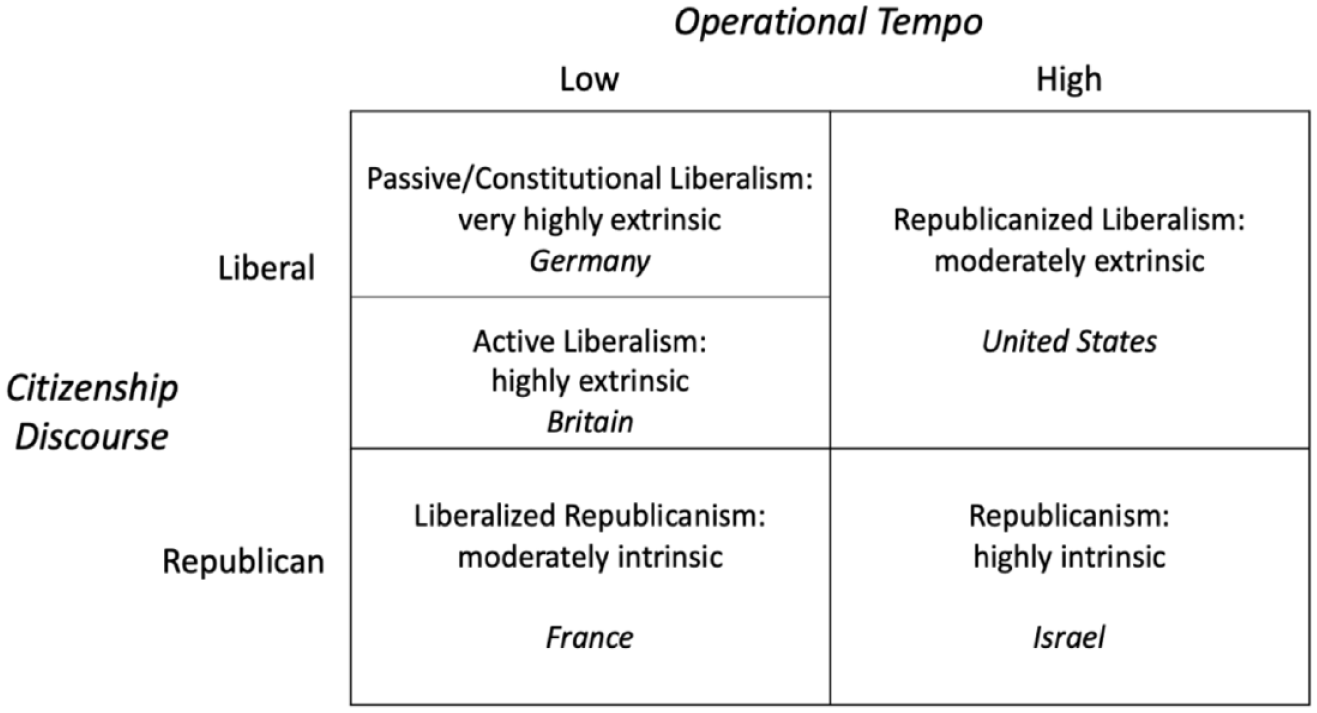
Theoretical Expectations and Cases.
Probing the Plausibility of the Theoretical Framework: Five Brief Case Studies
As Figure 5 shows, the theoretical framework does an excellent job accounting for the observed pattern in the survey data. Republican tropes remain prominent features of French and Israeli citizenship discourse, and, as expected, French and Israeli respondents were significantly more likely to endorse intrinsic accounts of soldier and officer motivations for service. In contrast, the postwar United States, Britain, and Germany epitomize liberal cultures of rights. However, the United Kingdom and United States associate the virtuous citizen with active voluntary participation, while the ideal German citizen is a passive, obedient law-abider. As expected, respondents in Germany were significantly more inclined to extrinsic accounts of soldier motivation than were their counterparts in the United Kingdom and United States. Within these categories, the militaries’ operational tempo varies significantly, which in turn affects how political and cultural elites speak about the armed forces. Consequently, Israeli respondents more strongly hewed to intrinsic accounts than did their French counterparts, as did Americans compared with respondents in Britain and Germany. In this section, we substantiate the cases’ placement with necessarily brief sketches of citizenship discourse in all five countries.
Israel
Israeli citizenship discourse contains multiple strands, ranging from an exclusive ethnoreligious strain, centered on Israel’s definition as a “Jewish state,” to a maximally inclusive liberal one, rooted in the civic language of its Declaration of Independence and its 1992 Basic Law: Human Dignity and Liberty (Shafir & Peled, 2002). Nevertheless, the dominant discourse of citizenship in Israel has long been both republican and militarist. It is still true that, in Israel, “civic virtue has been constructed in terms of and identified with military virtue” (Helman, 2000, p. 320).
Israel’s republican citizenship ideals first came to the fore in the pre-state Jewish community, the Yishuv. Atop its social hierarchy were those most devoted to the public good, defined in Zionist terms as the historical mission of the Jewish people to rebuild the Land of Israel (Liebman & Don-Yehiya, 1983). When Israel declared independence in 1948, it continued to prize the sacrifice of individual wants to communal needs, grafted to a statist ideology (Liebman & Don-Yehiya, 1983, chap. 4; Medding, 1990, chap. 7). Israel’s first prime minister, David Ben Gurion, bluntly articulated the new state’s values, in an early Knesset debate over a written Constitution: in Israel, he declared, “there is no need for a bill of rights . . . We need a bill of duties . . . duties to the homeland, to the people, to immigration, to building the land, to the security of others, of the weak” (Lahav, 1993, quote at pp. 130–131).
The new state’s republican ideals were given most concrete expression in universal military service. As Ezrahi (1997) observes, because the creation of Israel symbolized for Jews a revolutionary change from a condition of powerlessness and vulnerability to one of empowerment and armed force, the state and its army came to embody the idea of Jewish national freedom and independence. (p. 11)
Yigael Yadin, the IDF’s second chief of the general staff, famously said that the Israeli civilian was “a soldier on eleven months’ annual leave” (Ben-Porat et al., 2008, quote at p. 117). Military service became “the single most important test . . . for individual and group acceptance in[to] the mainstream of Israeli society governed by [the] Zionist civil religion” (Aronoff, 1989, p. 132). 20 In practice, Israel’s draft was hardly universal. Arab citizens were excluded, and ultraorthodox (haredi) Jews were also exempt as long as they attended an institution of higher Jewish education (yeshiva). But the selectivity of Israel’s draft did not undermine this hegemonic discourse, which became the explicit basis for rejecting these populations’ rights claims: shaveh hovot, shaveh zekhuyot—equal obligations (deserve) equal rights—went the Hebrew expression denying first-class citizenship to those, especially Arab citizens, who did not bear arms in the nation’s defense. Yet, despite Israel’s ethnoreligious priorities, the few Arabs who did serve in the military—mostly Druze—could exploit the tension between Israel’s formal republicanism and its ethnonational discourse and practice to make meaningful headway toward first-class citizenship (Krebs, 2006).
Over the last half-century, other citizenship discourses have failed to displace militarized republicanism. The ethnoreligious strand’s defenders have become ever more strident and aggressive, succeeding in 2018 in passing a new “Basic Law: Israel as the Nation-State of the Jewish People.” In other ways, the citizenship equation has tilted more liberal—as Israel’s socialist legacy has eroded, tax burdens have fallen, and rates of military service among Jewish males have declined. Nevertheless, militarized republicanism remains Israel’s touchstone. Group exemptions from military service, especially among the growing ultra-orthodox Jewish sector, can still exercise the Israeli public and bring down coalition governments. Political parties compete to recruit newly retired generals to their ranks, and political protest movements tout the prestigious military cohorts in their ranks. Israel’s vaunted start-up tech sector is rooted in the IDF’s acclaimed cyber units. Dissenters who expose soldiers’ misdeeds are treated as beyond the Zionist pale. The “security network” occupies a prominent, if not dominant, position in Israeli politics, culture, and business (Cohen & Cohen, 2022; Sheffer & Barak, 2013). In short, Israel is still the militarized republican state par excellence—and it is therefore hardly surprising that even volunteer officers, who often reap riches in the security sector after retirement, are generally seen by fellow Israelis as motivated primarily by patriotism.
France
France’s approach to citizenship is a blend of liberal and republican philosophical lineages (Duchesne, 1997; Schnapper, 1994), but it is the republican strand that constitutes the basis for France’s claims to exceptionalism (Kriegel, 1998). Since the Third Republic, founded in 1870, French citizenship discourse imagines the citizen’s identification with La patrie as a voluntary choice reenacted daily through quotidian practices. French citizenship does not express a “biological but a political fact: one is French through the practice of a language, through the learning of culture, through the wish to participate in an economic and political life” (Schnapper, 1991, p. 63, emphasis added). Its republican citizenship ideal “demands an intransigent rationalism” in the public sphere, purged of particularistic beliefs and practices (Rosanvallon, 1997, p. 62). Insulating the public sphere from individuals’ private commitments, chiefly religion, facilitates individuals’ active and equal participation in producing the common good, cultivates the production of “rational” citizens, and yields government policies shielded from “irrational,” private influences (Gauchet, 1998).
Nurturing a rational, participatory public, and countering centrifugal proclivities that threaten to disrupt the republic, thus became a central task of the French educational system (Chanet, 1996). The other principal site, for over a century, for the production of Frenchness was the army. Mandatory military service institutionalized, expressed, and preserved the constitutive relationship between citizen and nation. Militarized citizenship, in the republican model, was juridically and politically justified: the state was entitled to levy the “blood tax,” citizens were duty bound to protect the political community, and universal military service would instill lifelong values consonant with republican morality. In 1789, Edmond Dubois de Crancé put it forcefully before the Constituent Assembly: It is now the duty of all French to serve the country; it is an honor to be a soldier when that title refers to the guardian of one’s own country’s constitution . . . Every citizen must be a soldier and every soldier a citizen.
21
Military conscription came to an end in 1997, but French citizenship discourse has remained centered on the republican model (Long, 1988, p. 28). The resulting disconnect between republican ideals and the reality of everyday French life has fed anxiety about a fraying national fabric. As a result, the government established in 2011 a National Day for Defense and Citizenship, which seeks to familiarize young adults with the role of the army in protecting the nation and defending liberty. In 2019, it announced the creation of a National Universal Service program to provide “cohesion aimed at recreating the base of a Republican melting pot and transmitting the taste for commitment.” 22 Republican ideals, with the military as their beacon, continue to lie at the heart of French citizenship discourse. It is no surprise then that respondents in France are second only to Israelis in attributing intrinsic service motivations to soldiers.
United States
Democratic revolutions demand sacrifice for uncertain gain, and early American citizenship culture was therefore profoundly republican. The mobilization of the Civil War—America’s Second Founding—revived that republican spirit. Mass immigration over the next half century renewed interest in citizenship ideals that drew upon and cultivated a spirit of devotion to the political community. Through the early 20th century, U.S. citizenship discourse was predominantly republican, informed by both gendered and racialist presuppositions (Bodnar, 1996; Kerber, 1998). The signal events of the 1930s and 1940s reshaped U.S. citizenship culture into one centered on individual rights, rather than responsibilities. The Great Depression and World War II combined to legitimize a vast expansion of federal government power and to forge a postwar politics that was “increasingly state-centered, executive-centered, and president-centered” (Plotke, 1996, p. 3). As a result, citizenship became centrally associated with claims-making from, or against, the government in the name of individual rights. Meanwhile, the legitimating rhetoric of World War II leaned heavily into individual rights to distinguish the Allies from their Axis adversaries who seemed to epitomize the evils of erasing the individual, celebrating the collective, and imposing racial hierarchies (Gerstle, 2001, pp. 192–201). The Cold War reinforced this trend. Although communists and fascists were bitter enemies, in the postwar American narrative they occupied the same totalitarian pole, trampling on the individual (Primus, 1999). In this discursive milieu, U.S. politicians had to embrace human rights, whose central idea is “that the individual counts—independent of and in addition to his or her part in the common good[,] . . . as a matter of entitlement, not grace or discretion” (Henkin, 1990, pp. 4–5).
Liberal postwar U.S. citizenship discourse sat awkwardly alongside a peacetime military draft—and eventually killed it off (Krebs, 2009). By the early 1960s, conscription’s days were numbered, until the manpower needs of the Vietnam War temporarily prolonged the draft (Rostker, 2006, chapters 2–4). In the half-century since the installation of the All-Volunteer Force in 1973, there has been one notable exception to liberal citizenship discourse’s stranglehold: how Americans talk about military service. Contrary to the view that, with the end of the draft, military service in the United States had become just a “job,” one would be hard-pressed to find leading politicians or cultural figures who speaks about service in those terms—even though military recruiting advertisements often do and even though soldiers themselves often admit as much (Krebs & Ralston, 2022). Rather than high-performing employees (or, when operations go badly, poor-performing incompetents), American soldiers are treated as paragons of patriotism, taking on unusual risks for the nation and sacrificing income they could have earned in the private sector. The fallen are spoken of not as consenting casualties, who signed up aware of the risks, or even as unfortunate victims of bad luck, but as republican heroes who valiantly spilled their blood for their country. In this sense, in the 21st-century United States, “the citizen-soldier lives” (Krebs, 2009). The United States thus epitomizes “republicanized liberalism,” and Americans’ views of soldier motivations follow accordingly—roughly equally divided between intrinsic and extrinsic service attributions.
United Kingdom
Historically, ordinary Britons were subjects, who owed obedience to local nobles and the monarch. The same went for the inhabitants of places the British colonized. Citizenship emerged incrementally over the centuries. Magna Carta birthed English constitutionalism. Parliament codified the principle of habeas corpus in 1679. The United Kingdom as an integrated nation-state came into being via successive, often bloody steps, granting representation in the once-solely-English parliament to Wales and later Ireland, punctuated by unification with Scotland. The franchise gradually expanded from the early 19th century onwards. Nevertheless, Britons remained formally subjects of the crown until the 1948 British Nationality Act declared anyone born or naturalized in either the United Kingdom or its remaining imperial possessions an equal “Citizen of the United Kingdom and its Colonies.”
As Britain’s emergent citizens acquired rights claims against the state, they also acquired obligations, notably military service. In the late eighteenth and early nineteenth centuries, under the shadow of the threat of French invasion, a pan-British civic national identity took shape, through and alongside widespread recruitment into and valorization of the armed forces (Colley, 1992). The Great War of 1914–1918 further centered civic worth in military service and battlefield sacrifice (Gullace, 2002, p. 3). Through World War II, republicanism—as a citizenship ideal-type, not a rejection of monarchy—dominated British civic discourse.
Although remnants of the republican citizenship tradition have retained currency, a liberal strand has generally prevailed since World War II, reflecting constitutional norms, historical trajectories, and (geo)political circumstances (Marquand, 1991). The decline of solidarist politics in the 1980s further bolstered liberal citizenship’s dominant status (Faulks, 1998, pp. 1, 9, 77–97). Those seeking U.K. citizenship must, since 2005, simply pass a “Life in the United Kingdom” test that assesses knowledge of and affinity for the country, but does not require any meaningful demonstrated devotion to the political community (Gray & Griffin, 2014). A recent survey of Western European citizenship policy concludes that “by maintaining a minimal role for the state in directing or facilitating integration, in contrast to the contracts and courses used by other European countries, British integration remains largely self-directed and liberal in both senses of the word” (Goodman, 2014, pp. 50–51, quote at p. 140). Recent U.K. governments have sought to emphasize the active participatory dimensions of citizenship, consistent with long-standing British traditions that valorized “the active, altruistic, private person who freely donated his or her services to the community . . . rather than political action” (Harris, 2004, p. 86). Postwar British citizenship discourse falls into the category of “active liberalism,” and respondents in Britain tilt correspondingly toward extrinsic narratives of soldiers’ motivations for enlistment.
Germany
German citizenship discourse has fluctuated over the decades. Before World War I, Germany evinced a strong militaristic and collectivist bent. The military was “the school of the nation,” and military service was both constitutive of good citizenship and essential to one’s career prospects (Bergem, 1993). Replacing loyalty to the Kaiser with loyalty to the Reich and Hitler, the Nazi regime constructed an extreme collectivist culture that placed minimal value on the individual. It is impossible to square these citizenship ideals with Republican principles, which prize non-domination of the individual by arbitrary authority, but German citizenship discourse shared republicanism’s emphasis on the good citizen’s performance of civic duty.
The postwar Federal Republic of Germany deliberately suppressed nationalistic, militaristic, and antidemocratic traditions (Sontheimer, 1990). It nevertheless established the Bundeswehr against public opposition in 1955, and the Federal Republic, and later unified Germany, maintained conscription as an obligation of male citizenship (Werkner, 2023, pp. 57–61). However, universal male conscription was not legitimated chiefly on republican grounds. It rather served the polity’s priority of “Politische Bildung” (political education) and the specific Bundeswehr mission of “Innere Führung” (Inner Leadership): service in the armed forces would cultivate norms of democratic citizenship in male German citizens, who would in turn serve as a bulwark against the return of Nazism and militaristic foreign policy (Abenheim, 1988, pp. 44–45 and passim; Meyer, 2008). Militarized republican citizenship is often at odds with conscientious objection, which asserts that good citizenship can be expressed in the refusal of duty. However, West Germany revealingly anchored conscientious objection as a basic constitutional right, and national service was a legitimate alternative for (male) citizens who did not want to serve in the Bundeswehr (Kuhlmann & Lippert, 1993).
More generally, postwar West German citizenship discourse revolved around “patriotism to the constitution” (Habermas, 1992). The ideal German citizen was loyal to the law and Germany’s democratic constitution. Active grassroots citizenship, even of a voluntary nature, was not prized (Mouritsen, 2012, p. 92). Democratic political order depended neither on citizens’ performance of civic obligations (republicanism) nor on their participatory spirit (active liberalism). It rested rather on top-down efforts at “Politische Bildung,” which envisioned citizens as the objects of state-led socialization (Roberts, 2002). Out of this soil arose Germany’s distinctive corporatist arrangements involving the state, unions, and employer associations in the management of social and economic affairs (Esping-Andersen, 1990).
Alongside passive/constitutional liberalism, German citizenship law embodied an older communitarian or ethnic strain, reflected in ethnic Germans’ distinctive claims and in severe legal impediments to naturalized citizenship (Brubaker, 1992). This strain remained prevalent despite the more liberal German citizenship regime that took shape at the end of the 1990s. Germany’s requirements for naturalization are still among the strictest in Europe (Goodman, 2014), and its insistence on demonstrated “civic integration” may, as critics charge, reflect the old imperative to preserve a community bound “by blood” (Howard, 2012). However, contemporary German residency and citizenship requirements—language proficiency, a civics test, and so on—derive less from a republican conception of bottom-up civic virtue than from the postwar Federal Republic’s top-down program of political acculturation.
This passive liberal German political culture may explain why universal male conscription came to a surprisingly uncontested end in 2011. The cited reasons were pragmatic (budget cuts), programmatic (the need for well-trained experts in stabilizing war-torn societies), and principled (an inequitable draft). An institution that had, for over half a century, structured young Germans’ lives fell with barely a whimper—even though “citizen in uniform” discourse had remained ubiquitous (Fiebig, 2010, pp. 19–27). Germany’s passive liberalism also explains why Germans are especially inclined to ascribe military service to extrinsic motivations.
Conclusion
Voluntary military service is today by far the most common recruitment format across the West. Yet national publics’ beliefs about soldiers’ motivations for service are highly variable. Respondents in Israel and France are much more likely to adhere to intrinsic (patriotic and good-citizen) narratives of service. U.S.-based respondents are roughly equally divided between intrinsic and extrinsic (pay-and-benefits and desperation/”no other options”) accounts. Respondents in the United Kingdom tilt more toward extrinsic narratives, and respondents in Germany even more so. Neither the size of the military nor its operational tempo nor the recency of the draft can explain this pattern. The most persuasive explanation, we argue, lies in the dominant citizenship discourse in these nations in combination with their militaries’ operational tempo. This article’s findings provide more evidence that, contra an influential strain of scholarship, citizenship models across the West are not converging. 23
National cultures of soldiering, from which public beliefs about military service derive, may help explain whether people support prospective and ongoing military operations, how sensitive they are to casualties, the benefits and privileges they are prepared to dispense to soldiers and veterans, and even their views of appropriate civil-military relations. Future research could further pin down the sources of these public beliefs, their relationship to other variables of interest, as well as the causal mechanisms mediating between these beliefs and their consequences.
Public opinion has deep structural foundations, but political and cultural elites are a critical transmission belt connecting those foundations to mass beliefs. A large literature has theorized and documented how elite cues shape the political views of often ignorant and inattentive publics (Page & Shapiro, 1992; Zaller, 1992). Consequently elites, rather than the mass public, often are the primary target of political initiatives (Saunders, 2024). Within those broad structural parameters, elites have significant scope for choice—including about how they represent soldiers. Even within republicanized liberal settings, elites choose how avidly, thoroughly, and regularly to reproduce militarist myths venerating, idealizing, and romanticizing soldiers and soldiering. Within republican discursive environments, elites choose how much to leaven their praise of soldiers as good citizens with acknowledgment of their professionalism.
Cultural and political elites’ rhetorical choices with respect to military service may have significant consequences over the long haul. Their choices may ease or complicate the path to deploying military force abroad. They may render ongoing military operations more sustainable or more fragile. They may support or undermine more generous veterans’ benefits. They may bolster or undercut democratic civil–military relations. Cultural and political elites should be more thoughtful about and attentive to how they represent military service—because the rest of us must live with their choices.
Supplemental Material
sj-docx-1-afs-10.1177_0095327X241275635 – Supplemental material for Citizenship Traditions and Cultures of Military Service: Patriotism and Paychecks in Five Democracies
Supplemental material, sj-docx-1-afs-10.1177_0095327X241275635 for Citizenship Traditions and Cultures of Military Service: Patriotism and Paychecks in Five Democracies by Ronald R. Krebs, Robert Ralston, Thierry Balzacq, David Blagden, Shaul R. Shenhav and Markus Steinbrecher in Armed Forces & Society
Footnotes
Acknowledgements
This article is dedicated to the memory of our late colleague Aaron Rapport, formerly of the University of Cambridge, whose incisive comments profoundly shaped the project. The authors thank Charlotte Galpin and Julian Hoerner for their comments on previous iterations of this article.
Declaration of Conflicting Interests
The authors declared no potential conflicts of interest with respect to the research, authorship, and/or publication of this article.
Funding
The authors disclosed receipt of the following financial support for the research, authorship, and/or publication of this article: the University of Minnesota, through its Grant-in-Aid of Research, Artistry, and Scholarship program; the Levi Eshkol Institute for Social, Economic, and Political Research in Israel at the Hebrew University of Jerusalem; and the Israel Institute.

Supplemental Material
Notes
Author Biographies
References
Supplementary Material
Please find the following supplemental material available below.
For Open Access articles published under a Creative Commons License, all supplemental material carries the same license as the article it is associated with.
For non-Open Access articles published, all supplemental material carries a non-exclusive license, and permission requests for re-use of supplemental material or any part of supplemental material shall be sent directly to the copyright owner as specified in the copyright notice associated with the article.
