




Abstract
The analysis of this paper is focused on economic development and environmental surpluses. It emphasizes the importance of agrarian space as well as the state’s role in organizing society to favor capitalist development. The paper employs a Marxist theoretical framework to define the difference between the state and the government. It uses this framework to examine some of the main features of the PT government and its role in promoting rural financialization in Brazil. The paper examines major subsidized financial products as well as their public cost. It concludes that the state’s role in the financialization process was not just a choice on the part of the Brazilian government but also a reflection of the economic power exerted by financial and agrarian capital.
The aim of the paper is to examine the ways in which the Brazilian state - given the dependent nature inherited from its colonial past (Osório, 2012; Prado Jr,. 1965) – has followed a policy in which agrarian space serves the interests of financial capital. The strategy is to facilitate the financialization of this sector, in accordance with the neo-extractivist economic model, which degrades the natural conditions that it reorganizes in the interests of capitalist accumulation at the global level.
The essay will examine the emergence of new financial products tied to rural production that were created in Brazil after 2000. We will analyze these products based on the perspective that financialization constitutes a stage of capitalism in which the monetary/financial sphere assumes a greater role in decision-making and the allocation of resources (Lapavitsas, 2009; Aglietta, 1998, 2000; Chesnais, 1996). Neoextrativism is not only the direct manifestation of the Brazilian government’s development program in this new millennium but is also an economic model that is based on the production and exportation of mineral and agricultural commodities (Gudynas, 2015; Acosta, 2016) and involves land grabbing. A good example of this is a new legal form of property that was created in 2021: investment funds for agribusinesses or Fiagros. It is through these funds that investors within institutions are authorized to appropriate resources within Brazilian agrarian space.
If land grabbing in its basic linguistic meaning is the simple appropriation of land, it is worth noting that the term has been used as an analytical concept in order to distinguish between the appropriation of land during past stages of capitalism and the current process of financialization that is present in the appropriation of land in Brazil today. The financialization is seen in the number of facets of agricultural production that became financial assets (Borras, et al., 2016; Frederico and Almeida, 2019). These facets include the ownership and control of land, risks, price fluctuations, and climate variations.
The article’s main argument is based on the thesis that the Brazilian state acted and continues to act as a catalyst for the financialization of agrarian space through the creation of financial products. These products contain grants and subsidies that were awarded to commercial and credit operations linked to agribusinesses. Virtually all of the new financial instruments linked to the neoextractivist sector came into existence during the governments led by the Partido dos Trabalhadores (Workers’ Party or PT). It is through an empirical study of the laws and the evolution of financial assets tied to rural land (in number and volume) that the essay demonstrates the importance the PT period (2003-2015) had in promoting the financialization of agrarian space in Brazil. In terms of political relations, Singer (2012) and Loureiro (2016) argue that there existed an important relationship between the PT governments and agribusinesses. This relationship was based on a weak reformism that was characterized by a non-confrontational stance vis-à-vis oligarchical interest. According to Pompeia (2020), these groups took advantage of this relationship in order to concentrate their power and become active political actors. Ironically, their role was decisive during the impeachment of President Dilma Roussef in 2016.
This essay will also argue that there was a direct correlation between the process of capitalist accumulation in Brazil and the presence of an environmental surplus. According to Moore (2015), an environmental surplus is essential for encouraging waves of accumulation. It is tied to a mass of capital within the entire system with relation to the appropriation of unpaid work/energy. The appropriation is especially evident in the case of the four “cheap” sources: work, food, energy, and raw materials. To demonstrate this hypothesis, we used the Ibovespa index and Goldman Sachs Commodities Index (GSCI) as proxies. The former represents the average profit margin in the long term and the latter represents the environmental surplus.
Capitalist Space-Time from a Political Perspective
According to Moore (2015), capitalism constitutes a reordering of nature as well as a social form of organizing flows (or, rather, natural flows) that not only relate to materials and energy but also to power. The current stage of capitalist development (within which financial capital assumes the role is fundamental in the process of capitalist accumulation) is nothing more than a pillar of nature (both within and outside the human sphere) that is the result of an established configuration of power. Capital in its monetary/financial form currently assumes the role of being a dynamic within a broader process of capitalist development. As the current process of the complexification of capitalism becomes more entrenched, we need to recognize the role financial capital plays within the reordering of flows.
Marx, in the third volume of Das Kapital, analyzes the concrete forms of capital in his day that included those that existed beyond general, abstract categories. In his book, we see a conversation centered around a “really active capitalist” who is “nothing more than a manager, an administrator of capital” given the fact that “owners of capital” tended to turn into “mere monetary capitalists” (Marx, 2016: 494). It is based on this observation concerning the complexification of this process that Hilferding (2006) later argues that the fusion of interest-bearing capital with industrial capital is at the essence of financial capital. Lenin (2012) contends that there exists a functional logical structure within this new form assumed by capital. On the one hand, this structure constitutes a fusion between two different forms of capital as an amalgam. On the other hand, the fusion occurs when the decision-making capacity (relating to how and where to produce) is shifted from one form of capital (industrial capital) to another (interest-bearing capital). This phase of financial capitalism is marked primarily by a decision-making process that is based on the monetary/financial sphere and no longer stems from the production/manufacturing sphere. As Lapavitsas (2009), Aglietta (1998; 2000), and Chesnais (1996; 2016) illustrate, the displacement of the decision-making process affects the time frame for investments. As this time frame becomes smaller and smaller, short-term measures are geared towards quarterly statements that are published by publicly traded companies.
Marx (2016) points out that capitalist agricultural production tends to become included in the category of industrial capital. Therefore, Moore’s (2015) argument is based on an observation made by the German thinker himself. That is: despite the mystification of the industrial process, it is, like agricultural production, the result of the reorganization of nature. We need only look at how the production of a machine depends on steel and how its fabrication, in turn, depends on a mode of production that is highly intensive in nature. Assuming that one needs to extract iron ore from the subsoil in order to produce sheet steel, then it stands to reason that this production process is intensive in its use of oxygen (an indispensable natural element used to remove impurities within pig iron). This is not only obtained through the use of high-temperature ovens and heated by hard coal, but it is also a product that is stripped from the bowels of geographical space through productive work or, rather, through a social form ascribed to the human capacity to reorganize nature according to its own needs. According to Marx (2016), processes that are connected to industrial, extractive, and agricultural forms of production are stages within the same phenomenon.
If financial capital is the main driver of the current phase of capitalist development that currently maintains its hegemony over industrial capital, then it is simply through decisions regarding production made in the financial sector that the reorganization of natural flows takes place in our daily lives. In the long run, we can argue that the current form of reorganizing nature was a response to the increasing demands of financial capital that instrumentalized industrial capital for its own purposes. Financial capital ascribes to industrial capital not only its logic but also its obsession with accelerated valuation. Furthermore, this system is expanding and accelerating. Given the fact that the accumulation of capital lies at the heart of this system (where capital that turns more rapidly tends to gain more value with greater velocity), the competition between different forms of capital requires introducing innovations that reduce the cycle within the reproduction of capital itself. With regard to material reproduction, this movement consists of technologies that are capable of producing and reproducing commodities within shorter and shorter periods of time. However, these commodities contain less unit value. This is because, in general, maintaining large masses of profit demands more and more volumes relating to production, sale, and consumption. It is in this way that the growing and accelerating logics inherent in the system tend to feed on each other. The greater the scale, the greater the need for acceleration, which in turn leads to greater negative repercussions on ecosystems (Jeziorny, 2020).
It is from this logic that the idea of a growing metabolic fracture originates (Foster, 2004). This fracture constitutes a radical disjuncture between the parts that compose the social metabolism established between nature and humanity. The disjuncture reorganizes nature according to a social and historical framework that is used to define the working process. As Taibo (2019) argues, the levels of CO2 that accumulated in the atmosphere reached close to 150% since the Industrial Revolution and the acidification of the oceans is at its highest within the last 26,000 years. In addition, according to Costa (2019), the amount of plastic that was dumped into different ecosystems grew 1,000% since 1950. Therefore, we can say that the climate emergency that we find ourselves in now is a manifestation of a form of capitalism that reorganizes flows with regards to materials, energy, and power.
As Moore (2015) demonstrates, the rates of expansion for capitalist accumulation depend on an environmental surplus, When the ecological surplus is very high, as it was after World War II, productivity revolutions occur and long expansions commence. Naturally, this is not merely a story of appropriation, but also of capitalization and socio-technical innovation. The ecological surplus emerges as new accumulation regimes combine plunder and productivity, joining the enclosure of new geographical frontiers (including subterranean resources) and new scientific-technological revolutions in labor productivity. Great advances in labor productivity, expressing the rising material throughput of an average hour of work, have been possible through great expansions of the ecological surplus (Moore, 2015: 110).
Harvey (2005) calls this symbiosis between the process of accumulation and the humanization of nature the “space-time adjustment.” He argues that this is a reordering that does not eliminate the role of the state. It can be interpreted as an “accumulation by dispossession” that replicates the logic of primitive accumulation within a “capitalist construction of space.” Nonetheless, such a reordering of natural flows is a far cry from being a process free of friction and contradictions. Contrary to what is discussed in a homogenizing discourse, in many cases space is not “empty.” In fact, space contains various forms of human life that are determined to function according to the logics that are currently at odds, the logics of capital. These forms of life have socioeconomic populations that have the capacity to offer various alternatives with regards to interpreting space as well as all of reality. Therefore, according to Santos (2008), recalcitrant territories are spaces that are constructed, lived in, and shared. They appear as substrata that resist change by maintaining the vigor of their cultural and material heritage. They do this within another temporality with a different logic than that of accumulation. This logic also differs from that of financialization that serves to promote and accelerate the process of accumulation.
Phases of financial expansion fostered a process known as accumulation by dispossession (Harvey, 2005) where capitalists and states sought to reestablish the conditions necessary for the construction of long waves of accumulation. These waves of accumulation occur as the rate of accumulation expands and the costs of production shrink. This process generally occurs through a reorganization of natural flows that is known as “cheap nature” in reference to certain forms of raw materials, food, labor, and energy. The state becomes an essential component within this reordering as well as an integral part of the current form that financial capital bestows to the web of life (Moore, 2015). Along these lines, Harvey (2005) comments that capitalist development is related to two logics: that of the very essence of capital, in other words, the perpetual movement of valorization on a global scale; and that of local political power, where this movement is articulated geographically through the state apparatus.
According to Osório (2020), the state is a condensation of political power that centralizes social forces in order to generate solidarity within our shared existence. The state contains a production aspect in the form of a sense of community. The state is not a mere container or an empty, transparent bottle that gains the color of the liquid of whosoever wins the next election. Since it contains capitalist, social relationships within its structure, it also has class interests. These interests serve as “labyrinths and traps [that are] ready to hinder the projects of social and political forces that reject or question the existing order” (Osório, 2020: 48). Therefore, it is not political power that is at stake in every election but, rather, it is who will run the state apparatus. In the eyes of the ruling classes, allowing other classes to govern the administration of this apparatus can provide them with an opportune way of reifying the state itself. In other words, it constitutes a form of feeding the illusion that there exists a neutrality with regards to the apparatus within this condensation of political power. It is in this way that the rise of a government that has appeal with the lower classes can be of great help to classes whose power is decisive in a certain social formation. It is through an aura of common interests that gives their projects the appearance of being national projects or, rather, a sense of community.
A Brief Overview of the Workers’ Party Governments in Brazil
In his analysis of what he calls “Lula da Silva’s way of regulating social conflict” within the recent “progressive wave” in Brazil, Santos (2018) argues that the bond of trust between the PT governments and social organizations was used in conjunction with Lula da Silva’s personal charisma in order to create a neutralizing mechanism. This mechanism was used to obstruct potential actions stemming from social forces that sought to change the status quo. This is how a “neoliberal knife” was able to slice through the Brazilian economy under the guise of a neodevelopmentalist rhetoric. According to Santos (2018), ever since Lula won his first election as Brazil’s president, the PT has ruled out building a balance of power with the goal of changing the structures of the Brazilian state. On the contrary, the PT “consciously embraced the practices of professional politics” (Santos, 2018: 115). This movement can be understood as a clear manifestation of what Osório (2020) refers to when he contends that there are certain moments when the state adopts the position of subaltern classes.
Such an observation is also defended by authors such as Leite (2018) and Castelo (2013). According to the former, the PT did not break with the structures of power inherent in the New Republic, in that it “dove into an institutional labyrinth of an oligarchic, federal republic [which] became neoliberal” (Leite, 2018: 86). According to the latter, the social/liberal socioeconomic model adopted by the PT government did not represent an attempt to move beyond the neoliberal order. On the contrary, it merely showed neoliberalism’s supremacy given the fact that it had an ability to maintain and adjust the conditions necessary to sustain an accumulation of capital, An axis that unites social liberals is the acritical criticism of the market as a social system for distributing wealth. Everyone agrees that the market should be the best structure for producing wealth and that its foundations (competition and private property) should remain untouched. However, when the topic of distribution is concerned, they recognize the flaws and limits of market mechanisms with regards to the efficient and equal allocation of resources among different actors (Castelo, 2013: 259-260).
In a similar vein, Oliveira (2003) contends that Lula’s government radicalized the program adopted by his predecessor Fernando Henrique Cardoso. This manifested as a symbiosis between technicians, economists that doubled as bankers (led by the PSDB), and workers who became the administrators of pension funds (led by the PT). Oliveira denounces the symmetry displayed between the ruling circles that dominate these two parties within the realm of Brazilian politics.
According to Singer (2016), if it is possible to identity trends between the Lula and Dilma Rousseff governments from a political perspective, then we need to recognize that, while Lula was a mediator, Dilma chose to challenge powerful class factions by reducing interest rates and forcing spreads down. This signified a point of no return between her government and the financial sector. Loureiro (2016) agrees that in abandoning the articles of the Brazilian constitution with regards to the societal role of land ownership, the PT governments kowtowed to the interests of agribusinesses to the detriment of rural workers, biodiversity, and ecological balance. In this way the PT governments sought to fight poverty in the countryside through the use of a “weak reformism” without openly confronting the interests of capital.
This strategy appears as the PT government abandoned land reform as a tool for structural change. Instead, it was used as an instrument of social compensation as well as a method for softening tensions in the Brazilian countryside. Furthermore, authors such as Carvalho Filho (2007) and Pereira and Alentejano (2015), contend that thousands of families were expected to be included in the II Programa Nacional de Reforma Agrária (Second National Program for Land Reform). Instead, they ended up being absorbed into the Programa Bolsa-Família (Family Stipend Program — a conditional cash transfer program for families). Several social movements denounced this measure as a ploy to co-opt workers and dissolve camps in rural areas (Pereira and Alentejano, 2015). These movements included the Movimento dos Trabalhadores Rurais Sem Terra (Landless Workers’ Movement or MST), the Movimento dos Pequenos Agricultores (Small Farmers’ Movement or MPA), the Movimento de Mulheres Camponesas (Rural Womens’ Movement or MMC), the Comissão Pastoral da Terra (the Pastoral Land Commission or CPT), and the Associação Brasileira de Reforma Agrária (Brazilian Association for Land Reform or ABRA).
The agrarian policy of the Lula and Dilma governments failed to set annual land settlement targets. Both presidents opted for a National Agrarian Reform Program with substantially more modest targets than those proposed in the study commissioned by the Lula government itself from experts and headed by Plínio de Arruda Sampaio Jr. The commission attempted to overcome the fragmentation of self-consumption units by promoting integration between the pre-existing settlements and the new ones, as well as between family farmers and squatters, in order to integrate production into a territorial development plan. The plan was seen as essential to make agrarian reform an instrument for real socio-economic transformation in rural areas (Pereira and Alentejano, 2015; Ferreira et al, 2007).
Land policies during the Lula and Dilma governments ceased to consider expropriation as the main tool for promoting land reform. This coincided with two other phenomena that occurred during these periods: the growing importance of rural credits 1 and the virtual elimination of indexes. The indexes were essential in strategies centered around bolstering productivity rates as a way to enlarge land funds geared towards land reform. In other words, the idea of dispossession (that included unproductive lands) ceased being one of the main tools used to obtain land (Pereira and Alentejano, 2015).
The first Lula government settled 381.4 thousand families compared to 232.7 thousand during his second government. During the Dilma governments, 133.7 thousand families were settled. As was argued by Cattelan et al. (2020), even though the first Lula government settled more families than any other government between the years 1994-2018, it was during his second government that figures began to decline. This meant less areas of reform, less settlement projects as well as less families living in these projects. The decline continued into the Dilma years at the governmental level. Between the years 2006 and 2015, the number of families that were settled fell from 136.4 thousand to 26.3 thousand.
At the root of the systematic undermining of the agrarian reform policy is the political power of agribusiness. This power has been strengthened as the performance of the Brazilian economy - as well as the process of the inclusion of low-income groups in consumption - has become increasingly dependent on neo-extractivism. This has led to what Svampa (2019; 2020) calls the "commodity consensus." 2
In general, South American governments during the recent "progressive wave" (1998-2016) made agrarian policy part of a kind of "inclusive agrarian neoliberalism," which saw agribusiness as a strategic ally in generating surpluses to finance the social agenda, in which conditional cash transfer programs predominated. This process only served to reinforce the rural oligarchical matrix of the states and hinder efforts to promote structural change. That is key to understanding how progressive development became regressive in nature as land reform turned into a mere method to mitigate poverty. The alliance between progressives and agribusinesses ruled out land reform as a means to lessen the concentration of property in the hands of a few. It became nothing more than a rhetorical tool used in reference to the regulation and management of land (Santos and Vasconcelos, 2020).
As was seen with other South American governments during the “progressive wave,” the model of development created by the PT was established as a means to incorporate the Brazilian economy within the global movement of capitalism. It formed part of a strategy that only exposed how limited this model was as it was subsumed more and more into the same macroeconomic policies that were inherited from the previous government (as well as the goals that this government prioritized). In its attempt to find a balance between a floating exchange rate, fiscal surpluses, and inflation targets, neodevelopmentalist policies took the form not of a project to achieve structural change but one that sought to change Brazil’s national economy in order to accommodate the flow of global capital. According to Santos (2018), the Brazilian economy’s traditional role within the international division of labor as well as its dependent status, inherited from its colonial past, within the global economy was reinforced during this period.
Since 2010, Pompeia (2020) points out that the concentration 3 of political power within Brazil’s agricultural sector expanded. This was a period when fights over the Código Florestal (Forestry Code) became a way for agribusinesses to express and consolidate their interests. Various interests converged around a common cause in order to establish an agenda that sought to change how agribusinesses were seen in Brazil. This image makeover consisted of shifting the debate away from topics such as distribution, sustainability, and rights and placing it on the theme of enabling the agricultural sector to contribute to the Gross National Product. Agencies that represented employers in Brazil’s agricultural sector gathered around the Instituto Pensar Agro (Think Agriculture Institute or IPA) and placed themselves in opposition to the Rousseff government (2015-2016). Rousseff’s impeachment was decisive in expanding the political power of this sector and allowing it to obtain greater benefits particularly with regard to finances and regulations.
Financial Capital and the Financialization of Agrarian Space in Brazil
In order to fully understand the phenomenon surrounding the financialization of agrarian space in Brazil, we need to review certain elements that were essential in the transformation of Brazil’s national economy during the 1990s. Economists linked to Unicamp and others argue that Brazil did not possess any type of classic financial capital even during the height of its industrialization process (1950-1980). According to the “Campinas School” of economic thought (see Rocha, 2013), the behavior of the Brazilian financial system always closely matched the definition of interest-bearing capital. However, Prado Jr. (1965) claims that international financial capital was prominent in Brazil even during the period when coffee production dominated the Brazilian economy. Prado Jr.’s argument is corroborated by the fact that during the period when the Brazilian government attracted foreign capital for the manufacturing sector, large production and financial conglomerates established themselves in Brazil (Ford, Volkswagen, etc.).
Share by Company from Chosen Sectors in Ibovespa Composition
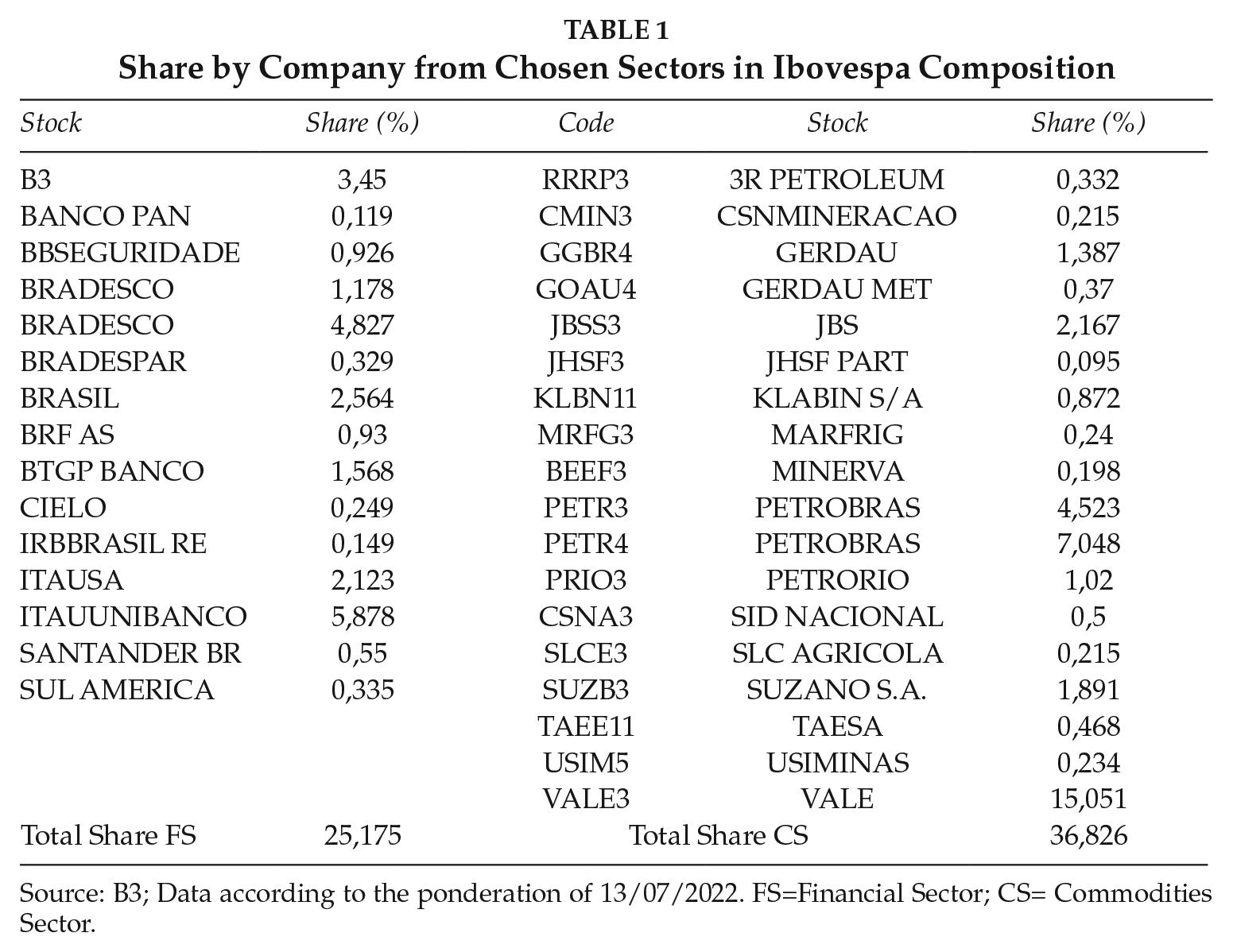
Source: B3; Data according to the ponderation of 13/07/2022. FS=Financial Sector; CS= Commodities Sector.
Despite these arguments apparently being at odds with each other, we can see certain similarities between them. As Brettas (2020: 574) contends, there is “a difference between identifying an activity that originates outside [the country] and comes here [Brazil] already formed and that which forms endogenously within the country [itself].” According to Brettas, a relationship was established between interest-bearing capital and industrial capital that was both organic and domestic in nature only from the 2000s. This time period coincides with the rise of the PT governments. This argument is supported by the data that will be presented later in this section with regards to the rise of financialization within Brazilian agrarian space. We argue that all financial products that were tied to Brazil’s agricultural sector and subsidized by the Brazilian state were created after the year 2004.
When Lula took power in 2003, the surplus that was produced at that time in Brazil and appropriated in the form of profit and revenue was concentrated almost exclusively (approximately 80%) in the hands of agribusinesses, including industries with ties to the financial sector. According to a study by Teixeira and Pinto (2012), this scenario is maintained during Lula’s government. 4 Based on this observation with regards to how the surplus was distributed between different factions of capital, we contend that new financial products created after 2004 put in evidence the consolidation of the economic power of the Brazilian financial and commodities sectors dating back to the previous decade. This hypothesis is supported by the data presented in Rech (2022).
The dominance exerted by Brazil’s primary and finance sectors began during Fernando Henrique Cardoso’s (FHC) second government (1999-2002) and was consolidated during Lula’s first government (2003-2006). This dominance is seen in the current composition of Ibovespa within which the shares owned by the financial and primary sectors amounts to 62%. The other companies that form part of this index are, for the most part, linked to sectors with a low productivity in terms of work. This includes the retail sector or privatized public sectors such as sanitation and electrical energy.
Since the 2000s, there has been an important correlation between the Goldman Sachs Commodity Index (GSCI), which measures the international commodities cycle, and the behavior of the Ibovespa, which is dollarized and traded in the form of the Exchange-Traded Fund (ETF) code EWZ-MSCI-Brazil on the New York Stock Exchange.
In the language of Moore (2015), Figure 1 illustrates that the average Brazilian rate of profit, from the 2000s onwards 5 , has been intrinsically linked to the ecological surplus, or, in short, to the export of cheap nature. After all, the lower the profits appropriated directly from nature through neo-extractivist activities, the worse the aggregate performance of the national average profit rate. Since the Ibovespa reflects the average profit rate of large national companies over the long term, the movement confirms the national economy’s dependence on the export of cheap nature in the form of surpluses of values, matter and energy.
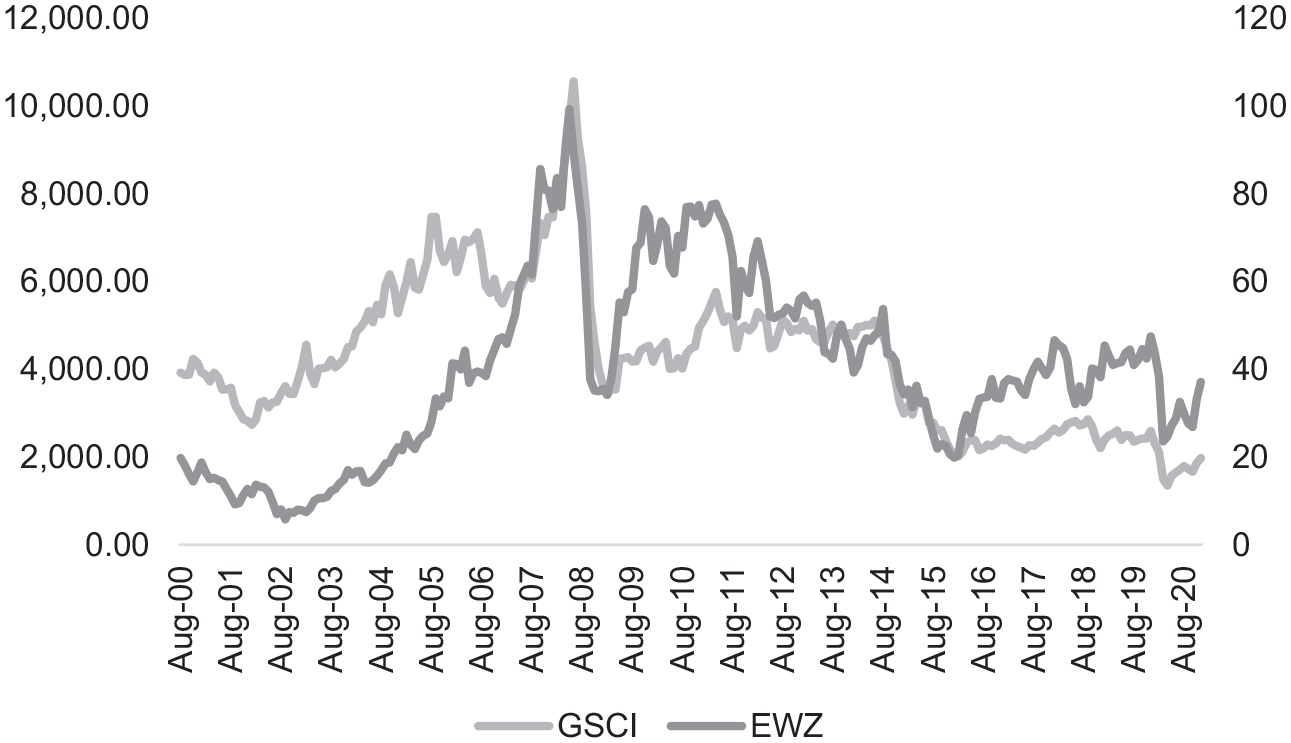
Evolution of GSCI and EWZ-MSCI-Brazil Indexes (2000-2020).
Flexor and Leite (2017) demonstrate the link between the price of commodities and the price of Brazilian land. They point to a correlation between the price of soy, meat and Ibovespa with the price of land. This correlation experienced staggering growth during the 2000s (especially after the 2008 financial crisis). The authors instead of using the SPGSCI, they present the IMF’s commodity index as a suitable proxy, although they do not correlate it with the price of land and/or the Ibovespa. In other words, while our work points out the correlation between the performance of the financial assets of the main Brazilian companies and the price of commodities (an element not emphasized in Flexor and Leite (2017)), the authors’ work also correlated the price of land with commodities. In fact, combining the data in Flexor and Leite (2017) with the data presented in this paper provides substantial empirical proof of a dependence, especially since the 2000s, of the dynamics of the Brazilian economy on international commodity prices
In her discussion of “land grabbing” in Brazilian rural areas during the 2000s, Fairbairn (2015) argues that there were some important financial/institutional actors that wielded a decisive influence in this process, The rush for Brazilian land is primarily motivated by profit and most of the leading actors are not easily identified by any single national origin. International finance capital figures prominently among the protagonists. For instance, Vision Brazil Investments, a São Paulo–based asset management company created in 2006 by former Bank of America executives to serve foreign institutional investors, sponsored a fund called TIBA Agro, which quickly amassed over 300,000 hectares of Brazilian farmland (Agrolink 2010). In other cases, international investors have teamed up with Brazilian operating companies that already own vast tracts of land, to create new ventures focused on the strategic purchase and resale of farmland. The US-based pension fund TIAA-CREF, for instance, entered into a joint venture with Brazilian sugar-alcohol sector giant COSAN in 2008 to create the rural real estate company Radar Propriedades (TIAA-CREF 2014) (Fairbairn, 2015: 584).
Against this backdrop, it is evident that it was from the 2000s onwards - when a favorable situation was created based on international commodity prices in combination with the regulatory frameworks established by the PT governments - that the road to consolidating financial capital in the Brazilian agrarian space was paved. Moreover, given the favorable conditions created, it should be pointed out - through the data presented in this work and those present in Flexor and Leite (2017) and Fairbairn (2015) - that there was a migration of capital from other sectors to the Brazilian agrarian space.
Some heterodox approaches start out with a principle regarding the relationship between financial capital and financialization, found in the works of Smith, Ricardo and other classical economists, in which savings appear as a “necessary and sufficient” condition for long-term investment. Certain 20th century development thinkers follow this approach: some because they believed that a high surplus would stimulate investment; others, like Furtado, Prebisch and Nurske, because they posited that the excessive consumption of the peripheral elites hindered the accumulation process and reduced the potential savings of these economies. Still others, like Rosenstein-Rodan, argued that low savings were mainly the result of the low productivity of capital and the small size of the domestic market, which contributed to low productivity. Despite the differences, there is a certain consensus among these economists that there is a correlation between the rate of profit and the rates of accumulation of fixed capital. This is because, according to the theory, the surplus extracted by capitalists would return, at least in part, in the form of new capital goods and expand the possibilities of future production.
As the phenomenon of financialization became more and more consolidated (Lapavitsas, 2009; Aglietta, 1998; 2000; Chesnais, 1996; 2016), a negative correlation began to take place between the profit stemming from interest and the profit that is invested in fixed capital or GFCF (gross fixed capital formation) (Bruno and Caffe, 2018). This relationship is well represented in the statistics. Investments in the GFCF require longer maturity dates as they are usually left behind when the goal is immediate return on investments, as speculative investments generally are. This obsession with short-term profit partly explains why there has been a migration of capital towards Brazil’s rural sector. The process was facilitated by the new conditions favorable to liquid funds that were established by the Brazilian state through subsidized financial products.
The Financialization of Agrarian Space in Brazil
On February 10, 2021, the Federal Senate approved a law that created the Investment Funds for Agribusinesses (Fiagro). The goal was to extend the rules that regulated the Real Estate Investment Funds (FII) to agrarian spaces in Brazil. FII are made up of two main asset categories: the real estate itself, which includes commercial premises, industrial pavilions, logistics centers and the like; and private debt securities, such as Real Estate Credit Bills (LCI) and Real Estate Receivables Certificates (CRI), instituted in 2004 in the form of Law 10.931/2004. The new law passed by the Senate, the most important for the financialization of the sector after the demise of the PT administrations, allows Fiagro to be made up of assets similar to those of the FII. On the real estate side, Fiagro will be able to count on land, grain storage structures and logistics centers linked to agribusiness; on the securities side, the debt securities that will be able to make up Fiagro are the Agricultural Credit Bills (LCA) and the Agricultural Receivables Certificates (CRA) established by Law 11.076/2004. Like FII, Fiagro does not necessarily have to be made up of one type of asset or another, but can combine both categories of assets, i.e. real estate and securities.
These Bills and Certificates linked to agribusiness, created in 2004, already gave the sector a tax advantage over other sectors of the economy. This is because, to the extent that the owners of these securities do not pay tax on their income, the interest rates for financing agricultural activity tend to be lower, for example, than those for financing industrial activity. This tax exemption for the aforementioned bonds and bills, created during the first Lula administration, has deprived the state of an increasing amount of revenue, estimated by the Federal Revenue Service at R$6.8 ($2.7 6 )) billion for the year 2022. The trading of LCs and CRs takes place in two stages: the primary offering, when the bank raises the amounts needed for productive capital from individual and institutional clients; and the secondary market, when these securities are traded freely on the stock market, allowing them to be the object not only of tax-free income, but also of speculation until their maturity date. If, for example, an LCA is issued primarily at a pre-fixed interest rate, as the basic interest rate changes, so does the unit price. In this way, rather than being an income security at a pre-fixed rate, the bill becomes, due to the possibility of secondary trading, a speculative security. After the primary issue, when the amounts raised from investors are passed on to productive capital, there is no longer any change in the immediate conditions of production based on the daily pricing of the securities. The sphere of negotiation becomes exclusively financial and the appreciation or devaluation of the LCA affects its holder alone.
Despite the recent legalization of Fiagro that occurred just within the third year of the Bolsonaro government, there is already a considerable amount of these funds) that are directly linked to agribusinesses. There are 19 investments funds in total that have an equity value of R$5.3 billion or $2.1 billion. Most of these funds (15 in all) are composed exclusively of securities or CRs and LCs. Two funds were created for direct investment in lands and two were geared towards property containing logistical devices. Usually in such cases the funds have real estate assets such as large plantations, distribution centers, storage silos, etc. that are leased by third parties. Here we clearly see a manifestation of how flows and fixes are rearranged by financial capital. Strictum sensu, we also see how there is a stronger interest in the income that can be generated from owning land or real estate instead of in their potential for production. It is for this reason that this phenomenon can be considered an example of land grabbing in Brazil.
Investment Funds Relating to Agribusinesses
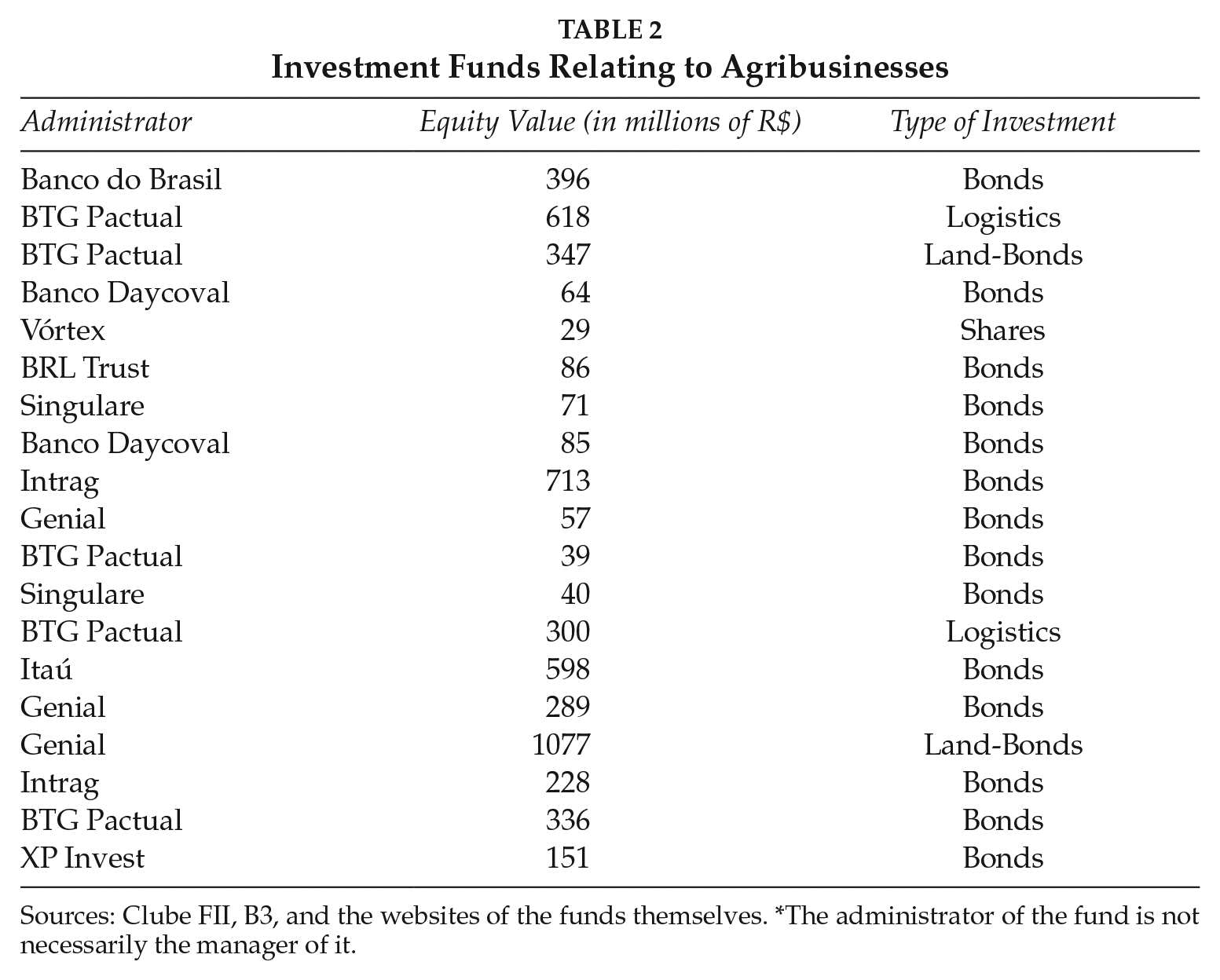
Sources: Clube FII, B3, and the websites of the funds themselves. *The administrator of the fund is not necessarily the manager of it.
Based on an analysis of two Fiagros that were geared towards the purchasing and leasing of land (administered by BTG Pactual and Genial), we argue that there exists a large concentration of land within proprietary funds in the state of Mato Grosso (Figure 2). This state was the most affected by wildfires in the period between 2019-2022. Despite the variety among them, the owners of the shares for these investment funds were not necessarily connected with the regions that were impacted by the same funds within which they themselves have a stake. Far from showing concern for preserving the environment around “their lands,” they were interested in maintaining the percentage of yield that is paid at the end of each fiscal year. This behavior is typical of land grabbing.
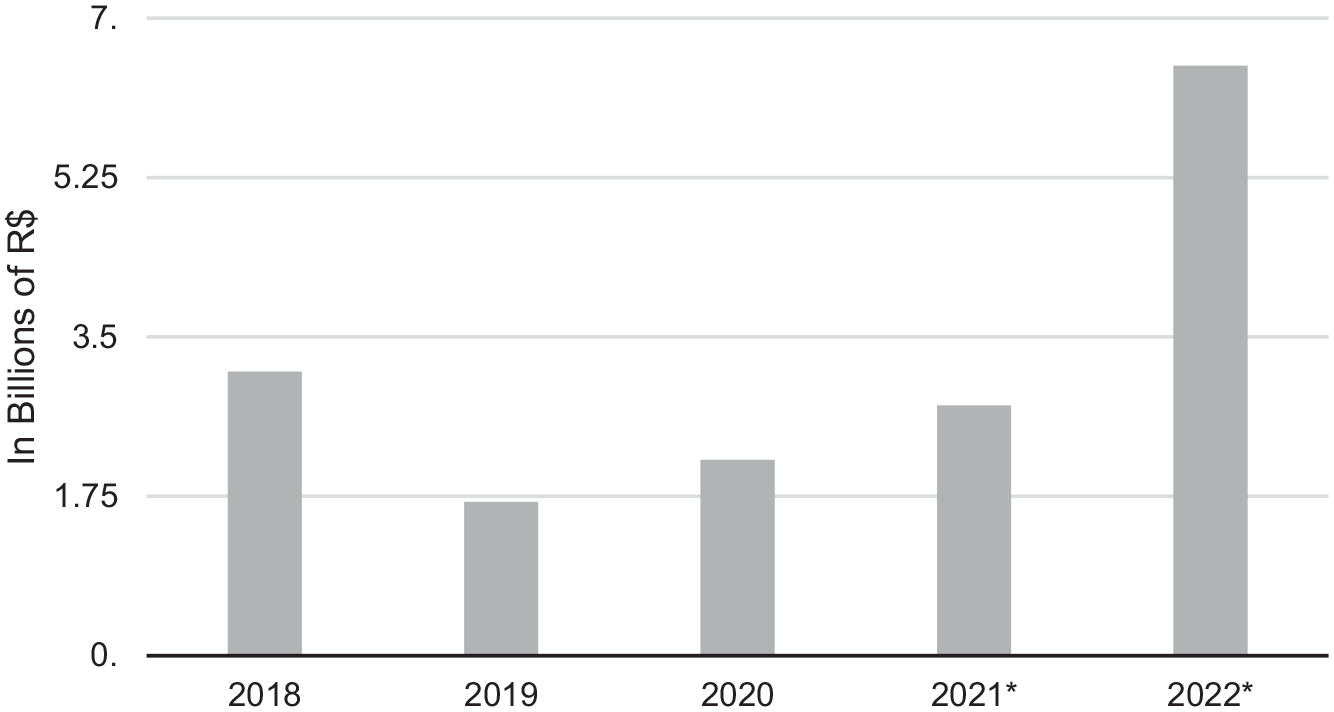
The Growth of Tax Expenditure (Fiscal Waiver) Through the Use of Credit Bills and Receivable Certificates.
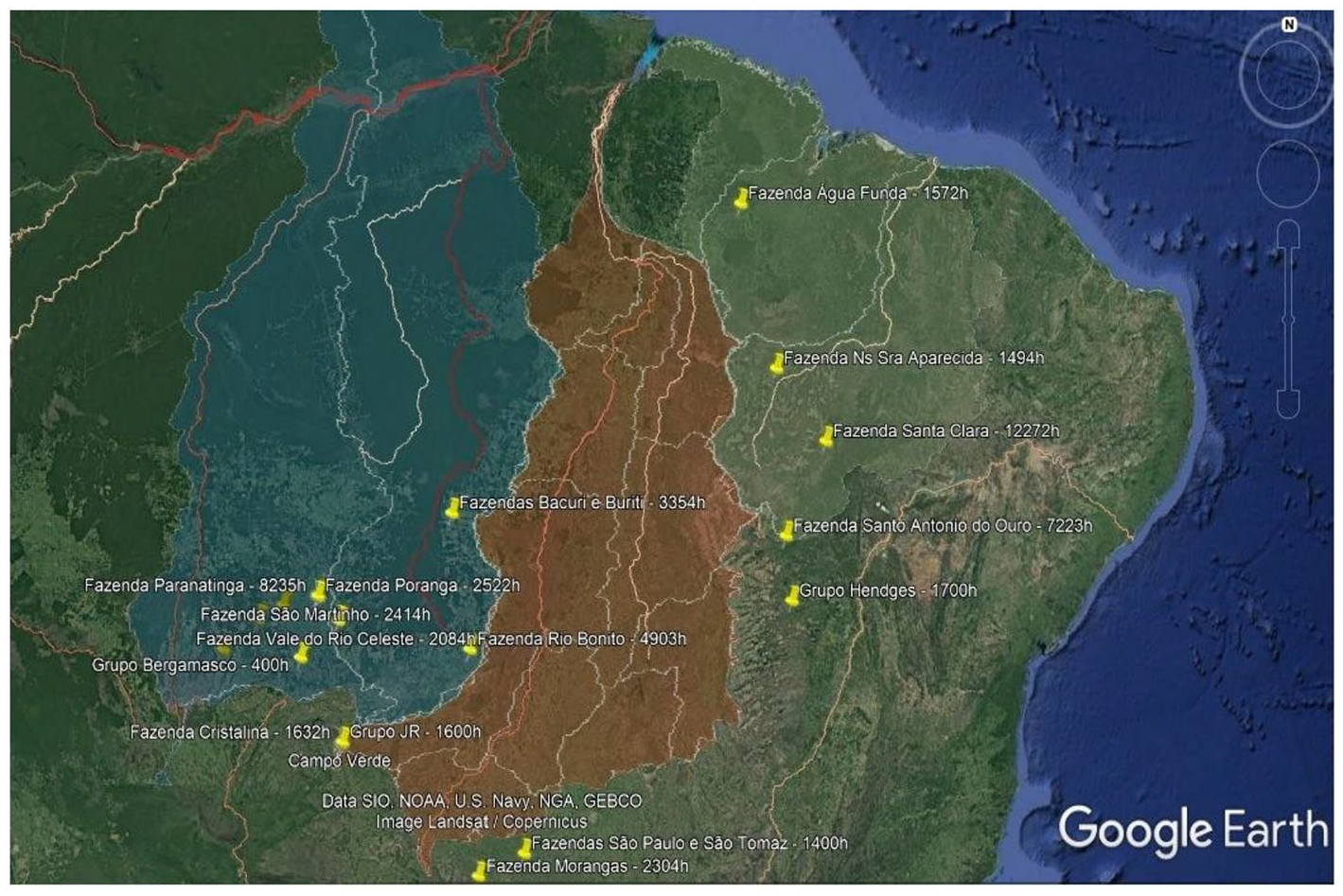
Map Showing the Geolocation of Lands Owned by BTG Pactual and Genial Funds.
Pompeia (2020) argues the following with relation to the strategies for promoting agricultural development in indigenous lands, During the Rousseff government (2011-2016), the demarcation of Tis (terras indígenas or indigenous lands) virtually ground to a halt. [This] occurred at the same time as the creation and consolidation of the IPA (founded in 2010) (Pompeia, 2018). Under the Michel Temer (2016-2018) and especially the Bolsonaro (2019-[2023]) governments, dominant groups cooperated to insert themselves in the national political process. They came to direct their efforts towards the indigenous question in the sense of legitimizing the use of TI areas [that were] demarcated for the purposes of producing agricultural commodities (Pompeia, 2020: 5).
It is no mere coincidence that this concentration of land within the Fiagro is located to the north of Mato Grosso. The Rio Bonito and Bacuri plantations were located to the east of the Parque Indígena do Xingu (Xingu Indigenous Park) with the Poranga, São Martinho, Vale do Rio Celeste, Bergamasco, and Paranatinga plantations located further west. The Cristalina and Grupo JR plantations are even located south of the reservation. As shown on the map, these plantations are located along the boundaries of the Amazon River Basin in a region that is surrounded primarily by the waters of the Xingu and Tapajós rivers, the River of Life for the Munduruku, one of the 34 indigenous peoples of the Tapajós region
The flow of the Xingu River was heavily affected by the construction of the Usina Hidoelétrica de Belo Monte (Belo Monte Hydroelectric Power Plant) during the Rousseff administration. A governing consortium, Norte Energia, capitalized on this construction through the use of incentivized debentures. 7 This is a financial product that is exempt from taxes (something that was also created during the Rousseff government). The area surrounding the Xingu basin was then heavily deforested and illegally grabbed (griladas) during the Temer and Bolsonaro governments. 8 Indeed, the images taken from Sirad demonstrate that an area of approximately 5,000 km around the Xingu basin was deforested during the years 2018-2020. 9 Between the years 2019-2020, wildfires increased by 530% in Mato Grosso. They occurred at such a high rate that the state itself became a national headline. 10
Even though this type of direct financial investment in arable land is something recent in Brazilian history, land grabbing was already present through companies that produced animal proteins (such as JBS and Brazil Foods) and commodities. This process included companies that managed arable land such as SLC Agrícola and Brasil Agro. The main companies linked to the production of commodities and land management are shown in Table 3. (The table does not show Cosan that owned the Raízen property jointly with Shell. This property is one of the largest producers of sugarcane in Brazil.)
Companies Listed in the Brazilian Stock Exchange as Producers of Agricultural Commodities and Managers of Arable Land
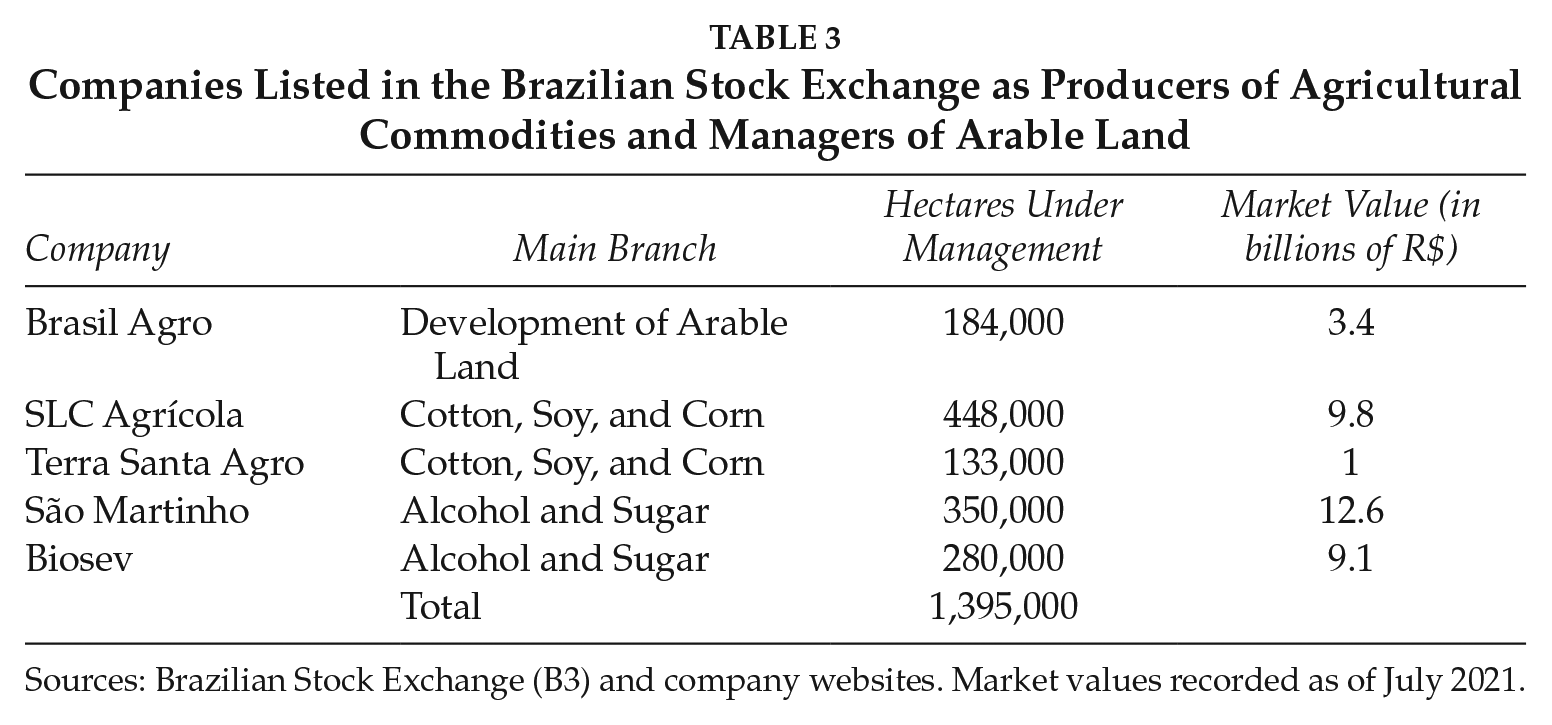
Sources: Brazilian Stock Exchange (B3) and company websites. Market values recorded as of July 2021.
As can be seen in the table, the companies that are listed as being part of the agricultural sector in the Brazilian Stock Exchange (B3) are heavily linked to monoculture. The link between financialization and monoculture was analyzed by Clapp (2019) who examined the financialization of agribusiness on a global scale. Benbrook (2016) and Garnet (2013) are exhaustive in their examination of the link between monoculture and destructive processes, which include the increased use of fossil fuels, the loss of biodiversity, the shortage of water, and the use of pesticides.
The oligopolization of sectors tied to agribusinesses has intensified globally (especially since the beginning of the commodity boom in 2005). After a series of mergers between Bayer and Monsanto, Dow and Dupont, and ChemChina and Sygenta during the last decade, the market for seeds and pesticides came to be dominated by the “big three” which together had an average 60% of the market share. In the seed sector, the three companies that emerged from these mergers gained 62% of the global market. In the pesticide sector, with BASF in the place of Dow-Dupont, the big three possessed 59% of the market. These transnational companies act as oligopolists in the seed market and benefit from the subsidies given to them by the Brazilian state. In terms of the sale of seeds and agricultural defensive agents (pesticides), shareholders received tax exemptions for PIS (Social Integration Program) and Cofins (Social Security Financial Contribution) created in 2004 as part of Law 10.925/2004 that regulates the taxes on imports and exports of seed and pesticides in Brazil. The concentration in the production of this specific seed impacts prices. Even though the price for corn, cotton, and soy seeds (the latter being heavily concentrated) has risen dramatically, the price of wheat seeds (which had a more diffuse production) was not subject to the same tendency.
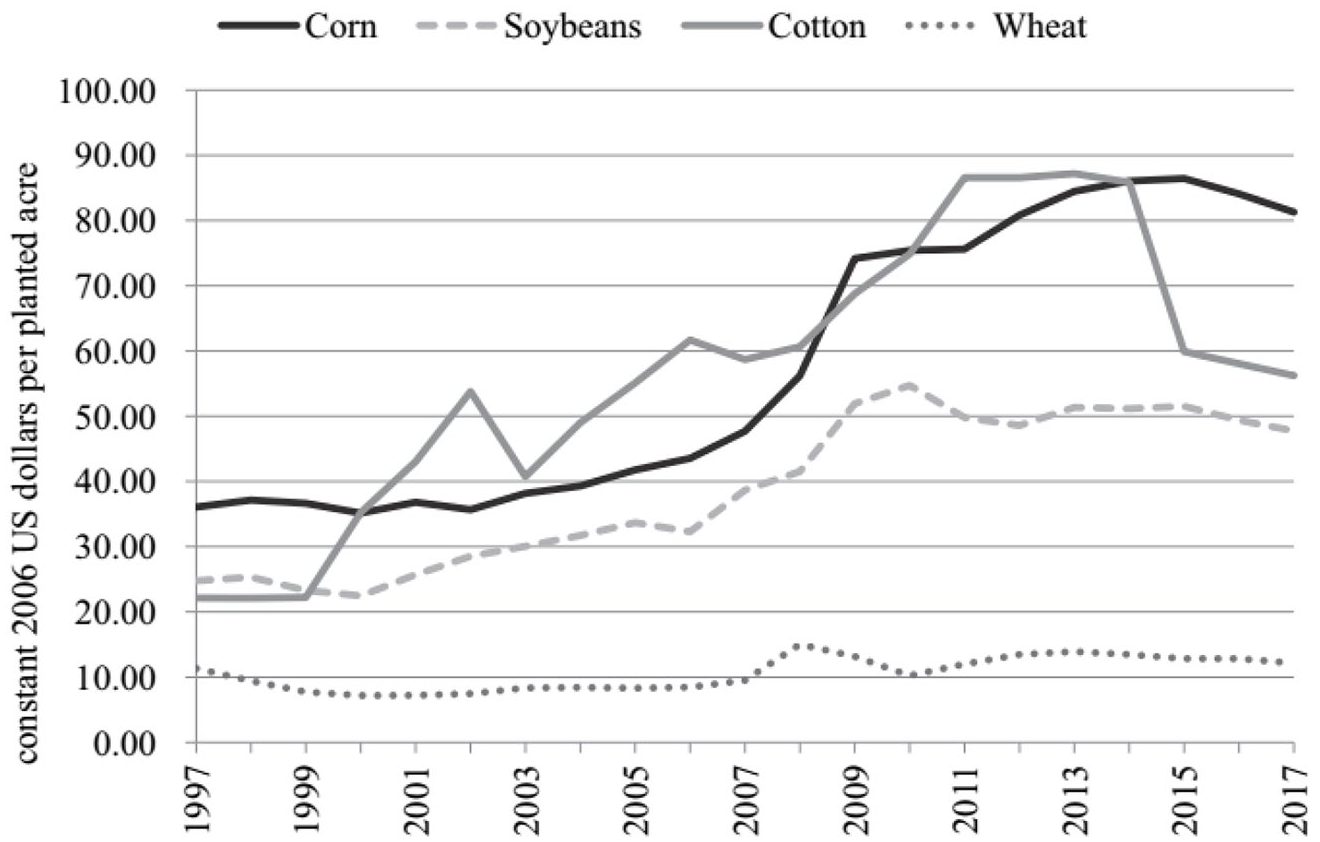
The Cost of Seeds in Dollars Taking into Account Inflation.
The Brazilian state encouraged the expansion of the financial sector in agribusiness through the use of tax subsidies. They, in turn, allowed transnational companies to consolidate their control over the sale of seeds produced in Brazil. The large trading companies, such as the ABCD (ADM, Bunge, Cargil, and Louis Dreyfus) and COFCO (China National Cereals, Oils and Foodstuff Corporation), control approximately 70% of all sales of seeds in Brazil (Wesz Junior et al., 2021). If in 2006 the ABCD were dominant in this market with close to 62% of the market share, this changed in 2015 when Asian trading companies (especially COFCO) received 45% of all seeds exported from Brazil compared to 37% for the ABCD. This participation coincided with a concentration that took place within the seeds market. In a similar way that transnational financial capital with ties to the manufacturing industry became established in the Brazilian market during the 1950s and 1960s thanks to incentives provided by the Brazilian state. The same state helped transnational financial capital linked to agriculture gain a foothold starting in the 2000s.
Rech (2022) and Rech and Couto (2022) analyze the role of the Brazilian state in the creation and consolidation of financial products including those discussed in this article. The same authors point to the growth of tax benefits that were given to agribusinesses starting in the 2010s. Based on the current values seen in the forecast provided by the Federal Revenue Service and the compelling categorization made by Rech (2022), we estimate that state subsidies to this sector reached R$24.4 ($9.6) billion in the year 2022. This is a figure in which subsidies given to the Fiagro, LCA, and CRA are not included (notwithstanding the subsidies that were awarded with relation to seeds and pesticides). The values for these two categories appear at the heart of proceeds together with subsidies awarded to bolster the food basket. Exemptions for seeds and pesticides are included within the law regulating tax exemptions for the production of these basic goods (Cesta Básica). 11 According to the forecast from the Federal Revenue Service regarding the year 2022, the subsidies that were awarded based on Law 10.925/04 were to reach R$31.9 ($12.6) billion. If this amount is added to the subsidies categorized by Rech (2022) within the agribusiness sector, the figure would total R$56.3 ($22.2) billion.
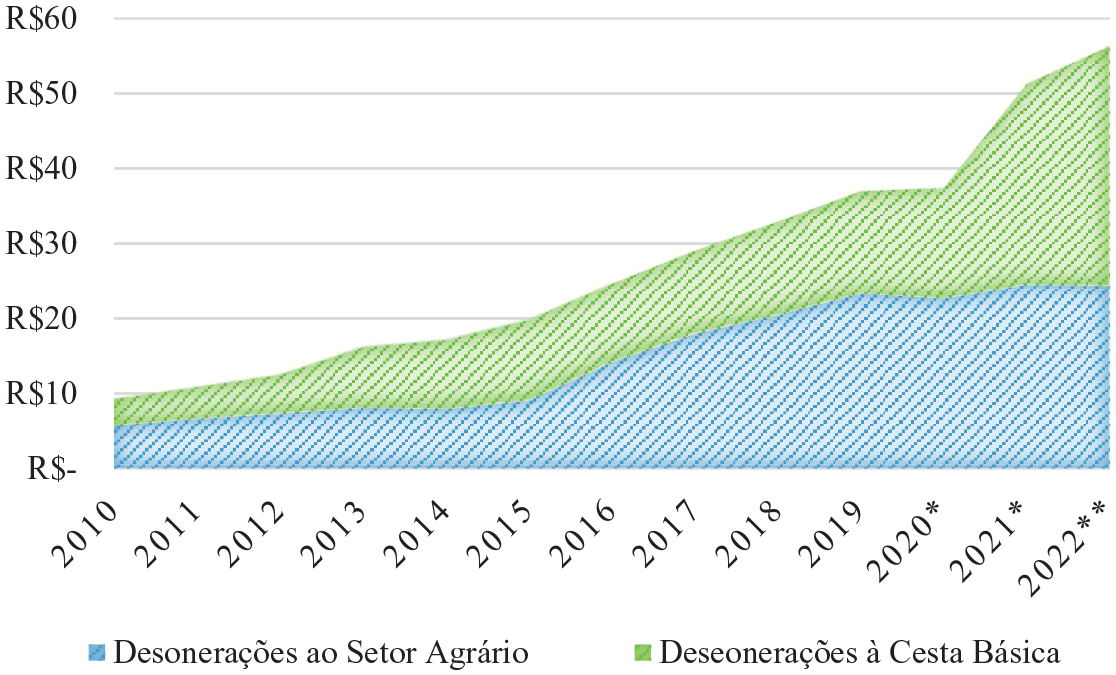
Tax Exemptions in the Agribusiness Sector (2010-2022) (Reais in billions).
Conclusion
At the dawn of capitalism, capital penetrated the sphere of production and revolutionized the working process. By contrast, the current stage of development within the capitalist mode of production is driven by financial capital. This type of capital directs how the flows of material, energy, and power that are used to meet the needs of our daily existence are reorganized. This form of capital seeks to reorganize flows in order to weave a web of interconnected spaces that are hierarchized according to the logic of accumulation. The state plays a decisive role in this process, by providing large sums of capital.
The Fiagro that were recently legalized are manifestations of this movement of capital into Brazil’s agrarian space, which create a new legal form of land ownership. This development not only reflects the dependent nature of the Brazilian state but also reaffirms the role that it has played throughout the process of capitalist development in Brazil. This continuity/functionality persists even when the government is supposedly run by the dominated classes. For example, without the securities that were tax-free and instituted in 2004, a large part of the Fiagro would currently not have been converted into assets free from income taxes. The Brazilian state has promoted the consolidation of the neoextractivist model in Brazil as it has awarded numerous and bulky tax subsidies to enterprises dedicated to the production and export of commodities.
This phenomenon has more to do with the state and less to do with political parties that are in power. Moreover, the state functions as an apparatus for the condensation of political power (Osório, 2020) and acts as the central cog of a movement that began during the Cardoso government (1995-2002). This movement continued and materialized in the form of new legislation during the Lula (2003-2010) and Rousseff (2011-2015) governments. It accelerated during the Temer (2016-2018) and Bolsonaro (2019-2023) governments. It appears that the Bolsonaro government did not allocate a single hectare in the framework of land reform or the demarcation of indigenous lands.
The Fiagro must be understood as a clear manifestation of the financialization that is taking place in Brazilian agrarian space. If it is possible to identify a separation between the function of interest-bearing capital and that of industrial capital through the existence of the LCA and CRA, this separation seems impossible given this new legal form of land ownership. The link between the two is central to the reorganization of nature within Brazilian agrarian space. This reorganization is driven by the frenzied rhythm of finance, which, in turn, accelerates the neoextractivist framework through the use of new forms of appropriation with relation to land revenue. Therefore, the extraction of an environmental surplus tends to follow the lead of destructive consensuses with regard to commodities and glyphosate. This model exacerbates not only environmental contradictions (such as the loss of biodiversity and the poisoning of the soil, water, and people) but also social tensions. The resultant resistance in rural areas is in opposition to the logics based on accumulation by dispossession and land grabbing. Indeed, land reform constitutes an effective tool to change Brazil’s current socioeconomic and political structure that not only generates inequality but also the predatory exploitation of nature.
Footnotes
Notes
Lucas Trentin Rech is a professor at the Department of Economics at the Universidade Federal da Bahia (Federal University of Bahia or UFBA). Daniel Lemos Jeziorny is a professor at the Department of Economic Science at the Universidade Federal do Rio Grande do Sul (Federal University of Rio Grande do Sul or UFRGS). Nick Ortiz is a writer, researcher, linguist, and translator specializing in Latin American history and politics.