




Abstract
Argentina’s neoconservative backlash (2015–2019) has rather paradoxically been marked by an unprecedented entanglement of ongoing memory struggles and a recent feminist awakening. A critical reading of this entwining traces the queer reworking of dictatorship trauma during the Kirchnerist administrations (2003–2015) and explores the way the post-2015 cycle nurtured a feminist irruption that contested long-standing forms of patriarchy. The feminist movement Ni Una Menos has transitioned from victimization to joy. Albertina Carri’s lesbian-porn fictional film Las hijas del fuego (2018) can be read as an expression of a novel amalgam of disappearance, sexuality, and politics. The spirit of contagion radiated by the film sheds light on the “revolution of the daughters” now taking place in the streets.
La reacción neoconservadora de Argentina (2015-2019) se ha visto paradójicamente marcada por una vinculación sin precedentes entre las luchas de memoria en curso y un reciente despertar feminista. Una lectura critica entrelaza una reelaboración queer del trauma de la dictadura durante las administraciones kirchneristas (2003-2015) a la vez que explora la forma en que el ciclo post-2015 alimentó una irrupción feminista impugnó viejas formas del patriarcado. El movimiento feminista Ni Una Menos ha pasado de la victimización a la alegría. La ficción pornográfica lésbica Las hijas del fuego (2018), de Albertina Carri, se puede leer como la expresión de una nueva amalgama de desaparición, sexualidad y política. El espíritu de contagio irradiado por la película arroja luz sobre la “revolución de las hijas” que tiene lugar en las calles.
On October 19, 2016, during the so-called first International Women’s Strike, more than 250,000 women took to the streets of Buenos Aires in Argentina (Figure 1). Ignoring the torrential rain, they demanded the “end of patriarchy.” As the demonstrations multiplied in the interior of the country and across Latin America, recognized local theorists and intellectuals announced the end of “CEOs feminism” (a reference to the hierarchical nature of the women’s movements). They predicted, instead, a festive spilling over of “feminisms of all colors” (Peker, 2016).
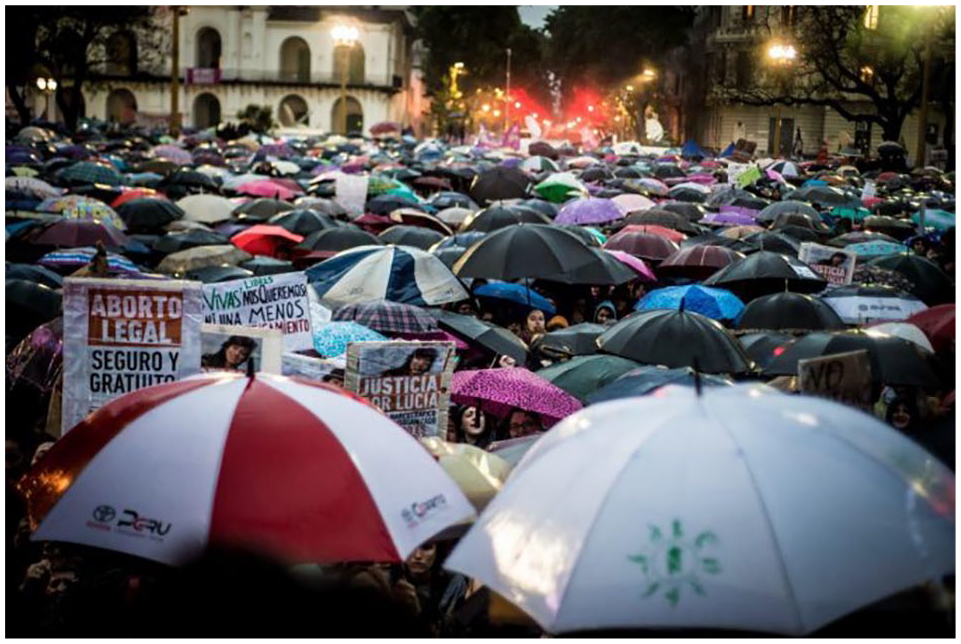
Umbrellas in Plaza de Mayo: the first International Women’s Strike, October 19, 2016. Photo © Mariana Leder Kremer Hernández
The episode was greeted in local media outlets as a reverberation of the first national icons of women and mourning, the Mothers of Plaza de Mayo, with their famous rounds in the square that is the political heart of Buenos Aires. As the Argentine journalist Horacio Verbitsky (2016), president of the human rights nongovernmental organization the Center for Legal and Social Studies, argued, “It was possible to witness the birth of a phenomenon that, like the Mothers of Plaza de Mayo or October 17, would transform the entire political system.” 1 Some months later, on May 10, 2017, the Plaza de Mayo was covered in white: 50,000 anonymous protesters, followed by human rights and political organizations, adopted the Mothers of Plaza de Mayo’s traditional headscarves and waved them in unison in the crowded square. The spontaneous demonstration evoked the 1983 Siluetazo, the artistic intervention that signposted the final stages of the military dictatorship, in which thousands of ad-hoc activists lay down in the Plaza de Mayo so that their bodies could be traced and transformed into full-size posters that evoked the haunting presence of the disappeared. The silhouettes were left out overnight as a dramatic reenactment of loss, confronting viewers with the “voiceless screams” of those disappeared by the military (Longoni, 2007). But the adoption of the Mothers’ scarves in 2017 was also a specific response to an extreme provocation: the Supreme Court’s attempt to reduce the sentence of Luis Muiño, a military perpetrator convicted of crimes against humanity. 2 With the ruling threatening to benefit other oppressors, the public took to the streets.
Only six months separated the two demonstrations. Against the backdrop of the businessman Mauricio Macri’s new conservative administration, which began in December 2015, an unprecedented encounter was beginning to emerge: two experiences of mourning were enhancing and strengthening each other. In these pages I set out a reading of this entanglement. I argue that, far from being a “local exception,” as suggested by Verbitsky (2016), the cross-fertilization of these different experiences was part of a dense history in which local and global tensions became intertwined in a moment of failure. I examine how contemporary resonances of the military dictatorship (1976–1983) challenged biological narratives, modifying ways of being together in the wake of mourning. I explore how the conditions of constraint and coercion inaugurated by the neoconservatism that began in December 2015 nurtured and sedimented a feminist irruption, mostly associated with the growing influence of the collective Ni Una Menos, a tide that challenged the hidden patriarchal nature of the political sphere as never before. Moreover, I show how, through this process of cross-fertilization, memory, disappearance, and femicide became entangled in a new stage of mourning.
In the final sections of the article, I analyze Albertina Carri’s film Las hijas del fuego (2018), a pornographic fictional piece directed by a leading figure of the new Argentine cinema who is the daughter of a disappeared couple. The film, which has been described as an “intense, poetic, pornographic, and militant work” (Keslassy, 2018), offers a depiction of gender and sexuality that, I suggest, is expressive of the wider affective rearrangements of kinship taking place in Argentina. Ultimately, I argue that it proposes an exceptional amalgam of disappearance and mourning, pleasure, and extended affiliation.
The Cross-Fertilization of Mourning
The cross-fertilization of dissimilar mourning experiences currently under way in Argentina requires further investigation, particularly in terms of the way certain affective affairs became visible during the Kirchner administrations (2003–2015). Without underestimating the pain of those directly affected by state terrorism, a particular, perhaps paradoxical transformation occurred during that period. Mourning allowed the envisioning of new ideas of community (see Sosa, 2014). Witnesses not directly affected by loss managed to participate in—and in some sense adopt—the experience of grief. Suggesting that they have the potential to generate alternative forms of “being with others,” I have conceived these affiliations as “queer” (Sosa, 2014). Now I am interested in rethinking the affiliations that emerged in the shadow of grief in the post-2015 period because, as I see it, the dissemination of mourning across large sectors of civil society ultimately nurtured the seeds of the current feminist irruptions.
The period 2003–2015 has often been associated with a narrative of hatred in which society split into irreconcilable sectors. These political-affective disagreements were identified and fostered by the media as a “crack” (grieta), but the period also allowed the emergence of a new fiction of the common largely shaped around the alternative modes of affiliation that were a response to the experience of mourning. During the Kirchner era the question of sovereignty over the Malvinas/Falkland Islands, the trials of the perpetrators of crimes committed during the dictatorship, and the legal framework related to social equality (including a universal child allowance) all occupied privileged places on the political agenda (Blejmar and Sosa, 2017: 11). The governments also extended rights to LGBTQ communities: laws on same-sex marriage, assisted fertilization, and gender identity were passed, challenging long-standing patriarchal and heteronormative political structures. The conservative government that came to power in December 2015 tried to overturn what I suggest calling a “queer fissure,” but the latter’s force escaped traditional memory politics in nonnormative feminist spillovers.
In fact, the unexpected power of Ni Una Menos, a feminist collective denouncing gender violence that emerged at the end of the Kirchnerist period, is indicative of this trend. The inaugural event of the group took place on March 26, 2015, when a group of journalists, artists, and writers gathered at the Museo de la Lengua for what they called a “poetry marathon.” 3 The crossovers and displacements between the mourning narratives associated with the dictatorial past and an emerging antipatriarchal feminist movement brought new urgencies and intensities to the post-2015 cycle. The feminist tide had become the most powerful social actor in the region, managing to overcome the so-called austerity coveted by conservative retraction (Palmeiro, 2018).
An Expanded Feeling of Kinship
The violence of the military dictatorship prompted, paradoxically, an expanded feeling of kinship. In the wake of loss, mothers, grandmothers, children, siblings, and other relatives of the disappeared initially invoked their biological ties to the missing as part of their demand for justice. However, these same kin organizations unfolded in interior forms of union and affection that distanced them from classical family models. This constellation of nonnormative intimacies emerged as a response to the conditions of disappearance, torture, and death imposed by state violence. While for decades the network of associations of relatives of victims, which I have characterized as the lineage of the “wounded family” (Sosa, 2014), had managed to keep the experience of mourning in the hands of the directly affected, during the Kirchner administrations this confinement of mourning to the classical family configurations began to be displaced. The rhetoric of these administrations contributed to this displacement. In his inaugural speech Kirchner said, “We are the sons of the Mothers and Grandmothers of Plaza de Mayo” (Tiempo Argentino, 2016). He showed that the lineage of loss involved not only the direct victims but also those who adopted mourning as a personal commitment. In suggesting a queer family in mourning, this rhetoric divorced the performance of grief from its biological basis. Later, the conservative backlash also witnessed the emergence of a new group, Historias Desobedientes, a collective made up of sons, daughters, and other relatives of military oppressors who ostensibly wanted to dissociate themselves from their fathers. This new branch of the “wounded family” not only enlarged the queer family in mourning but also showed unprecedented ways in which blood could be subverted.
During the 2003–2015 period, contemporaries of the descendants of the disappeared had found fertile ground for recreating their own traumatic legacies. Their often audacious narratives deployed humor and irony that sometimes came into tension with the traditional “privileges” of blood. These narratives also envisioned a more fluid arrangement among gender, politics, and sexuality. At the beginning of the period, for instance, the blond wigs that dominated the screen at the end of Los rubios (2003), the watershed documentary film directed by Albertina Carri, gave life to a nonblood community that endorsed an extended family in mourning. The piece, which was extremely inspirational both for the filmmaker’s contemporaries and for the new generations, staged a provocative memory as a way of recognizing traces of her disappeared parents. 4 Los topos, the groundbreaking autobiographical fiction of Félix Bruzzone (2008), introduced the transvestite as a main inheritor of the dictatorship period. In the fictional memoir Cómo enterrar a un padre desaparecido, Sebastián Hacher (2012), a writer seemingly not directly affected by the violence, adopted the voice of a woman tracing the footprints of a disappeared father. Conversely, in Una muchacha muy bella, a first-person novella, Julián López (2013) made up the mysterious nuances of a love story between a child and his later-to-be-disappeared mother.
Throughout this cultural field, women’s literary production has been particularly strong, a point noted by Maria Moreno (2018) in Oración. In it she crafts the term “HIJAS sin puntito” (daughters, without period) as a feminist version of “H.I.J.O.S.,” the organization created by children of the disappeared in the 1990s. In doing so, she identifies the increasing pleasure underlying a wave of female artists not necessarily related by blood to the missing but nevertheless trying to recognize traces of them through appealing twists and diversions. Indeed, in her 2009 play Mi vida después, Lola Arias, who has no disappeared relatives in her family, invited six actors born during the dictatorship to put on the clothes that their parents wore in the 1970s to rewrite and perhaps also cross-dress their own inheritance. In Diario de una princesa montonera: 110% verdad, Mariana Eva Perez (2012), daughter of disappeared parents, reveals the unconfessed pleasures of the world of the “hijis” (children of the disappeared)—the privilege of belonging to the lineage of victims. At the end of the cycle, the writer and journalist Marta Dillon (2015), also a founding member of Ni Una Menos, portrayed the anxieties of finding the remains of her mother 35 years after her abduction in 1977. In her novel–open-letter–poetic essay Aparecida she wrote of the possibility of organizing “a postponed funeral as if it were a party” (153). Perhaps foreshadowing the post-2015 period, the book sketched the affective tone of a network of women possessed of a “crazy fairy” sense of humor that was a novel turn in the entanglement of feminism and mourning.
The use of black humor, a recurring trope in the imaginaries of children of the disappeared, was intertwined with a radical queer/feminist vector that enhanced mourning and pleasure. Aparecida made that encounter poignantly visible. When Dillon finally recovered the remains of her mother, she was just about to marry Albertina Carri, her partner until 2015. 5 The conflicting energies found the brides adopting unconventional wedding outfits: they both dressed in black, “like dominatrices of black rubber bras. . . . That was more like us, more lascivious, aiming to use mourning to dance and nail high heels into the pain, forcing it to howl with joy” (Dillon, 2015: 96). This extreme image anticipated the feminist/queer turn of the time, when loss was transformed into a lascivious dance.
The Conservative Restoration and Ni Una Menos’s Sisterhood
The political shift inaugurated in December 2015 ambushed the expanded affiliation that had grown up under the previous administration. Driven by an ideology of privatization and the shrinking of the state, the regressive government led by the businessman Mauricio Macri sought to circumscribe and discipline all glimpses of a politics based on the common. Nevertheless, the transfer of the experience of grief continued to produce unforeseen affective configurations and displacements. In particular, the recent feminist tide, enhanced by the expansion of the Ni Una Menos collective, managed to recreate antipatriarchal momentum on the local scene. On the international level, since 2014 the feminist movement had gained new power, especially on social media. As Mendes, Ringrose, and Keller (2018: 236) point out, “feminists have increasingly turned to digital technologies and social media platforms to dialogue, network, and organize against contemporary sexism, misogyny, and rape culture.” In October 2017, the #MeToo hashtag was a trending tool for showcasing sexual violence worldwide. It went viral on Twitter in response to the allegations of sexual assault by the Hollywood producer Harvey Weinstein. 6 Thousands of women across the world shared and replicated #MeToo to tell their own personal experiences of abuse.
Yet how did the feminist irruption, which has been called a “molecular revolution,” come about in post-2015 Argentina? The local feminist movement was not new. Every year since 1986 it has gathered in a national women’s meeting involving more than 350 organizations. The meeting followed a federal model with a horizontal scheme and expanded throughout the country, increasing not only in coverage and numbers but also in perspectives; lesbo-feminist sectors have gained particular force in recent years. And since 2003, the National Campaign for the Right to Legal, Safe, and Free Abortion had been demanding the legalization of abortion in public hospitals. 7 The feminist movement would, however, experience a major sea change in the post-December 2015 period. Although the local feminist movement had already been, by definition, highly heterogeneous, after the conservative backlash it gained unprecedented momentum. On the one hand, the women’s meeting became increasingly popular. On the other, the interventions of Ni Una Menos became a new form of pedagogy for the young people in the streets. While the collective had identified itself from the beginning as “a collective cry against machista violence,” eventually this cry, rather than a painful lament, revealed a horizontal, radical and dissident vector. Thus, Ni Una Menos helped to create a novel atmosphere that spread across the country, Latin America, and beyond (Figure 2). 8
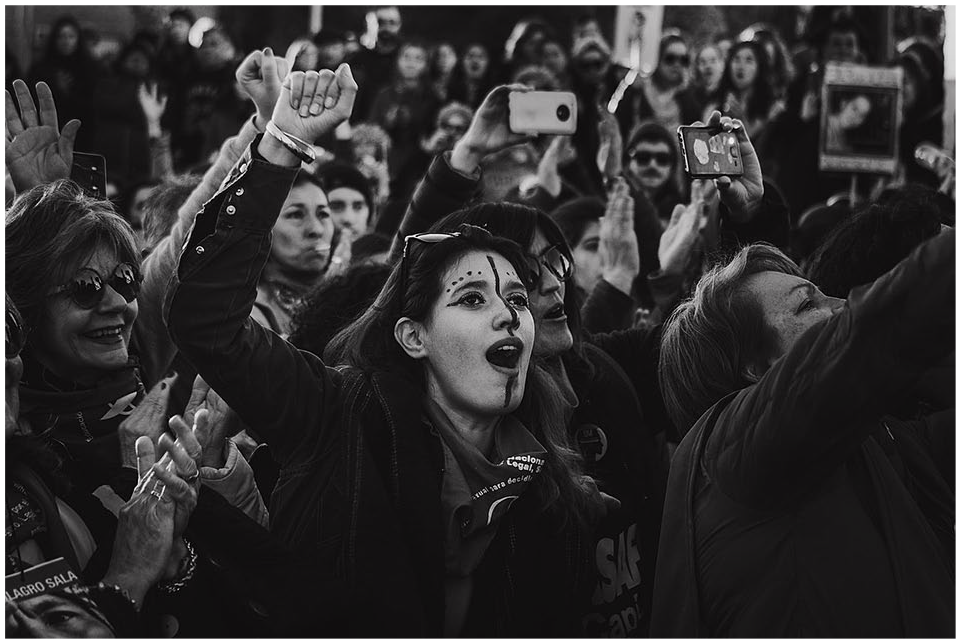
Anniversary march of Ni Una Menos in Santa Fe, June 3, 2018. Photo © Agustina Girardo
Ni Una Menos’s first massive action took place on June 3, 2015, in the Plaza de los Dos Congresos. Despite its having been sparked by the femicide of Daiana García, a 19-year-old woman murdered by her partner, the event had as a major governing idea rejecting victimizing strategies. With the support of unions and political and social organizations, the march assembled more than 300,000 women and concluded with the presentation of demands with regard to long-standing and widespread patriarchal structures. The following year, with the new right-wing government in place, the anniversary march of June 3, 2016, had an even more massive and surprisingly unified character. The Plaza de Mayo overflowed with women bringing an expanded agenda including strong LGBT claims. By then the slogans had become “Vivas nos queremos” (We Want to Be Alive) and “Nos mueve el deseo” (Desire Moves Us). Highly heterogeneous personal and social memories inundated the public space, stimulating for the first time a willingness to gather in the streets. The younger generations were able to embrace a seasoned feminism without guilt. It was the emergence of a new collective force, a local sisterhood—a scandalous political kinship that Las hijas del fuego would take to the screen.
The first International Women’s Strike made this force explicit. A week after the women’s conference in Rosario in 2016, the brutal rape and murder of a 16-year-old girl in Mar del Plata precipitated an unprecedented mobilization. Under the hashtags #paronacionaldemujeres and #vivasnosqueremos, Ni Una Menos launched a virtual campaign calling for the “the first women’s strike in the history of Latin America.” The campaign went viral in a week. Social networks showed their exceptional power to foment cross-generational anger. On October 19, about 150,000 women demonstrators marched from the Obelisco to the Plaza de Mayo. Dressed in black, women of all ages (though mostly young) paraded together through torrential rain and made grief and vulnerability the conditions of a new empowerment. Demonstrators perceived themselves not as victims but as social actors eager to be heard. “We marched screaming, not crying,” said the local feminist Eva Giberti (Peker, 2016).
The desire to avoid victimizing strategies ran throughout the feminist tide. While at first glance the demonstrations appeared defensive (“We are marching because they are killing us”), the movement eventually managed to privilege the joy of encounter. In so doing it radiated a collective desire that went beyond individual members. The spirit belonged to the multitude, likely to spread like a virus. Reluctance to assume any sense of ownership was accompanied by a widespread sense of belonging and spirit of companionship that shaped the affective tone that was circulating in the streets.
The debates on legal abortion that took place during the winter of 2018 moved public opinion in a new direction. On June 18, 2018, the lower house of Congress passed the bill. During an epic night, thousands of teenagers awaited the vote in the streets and celebrated the results with shouts of joy and hugs (Figure 3).
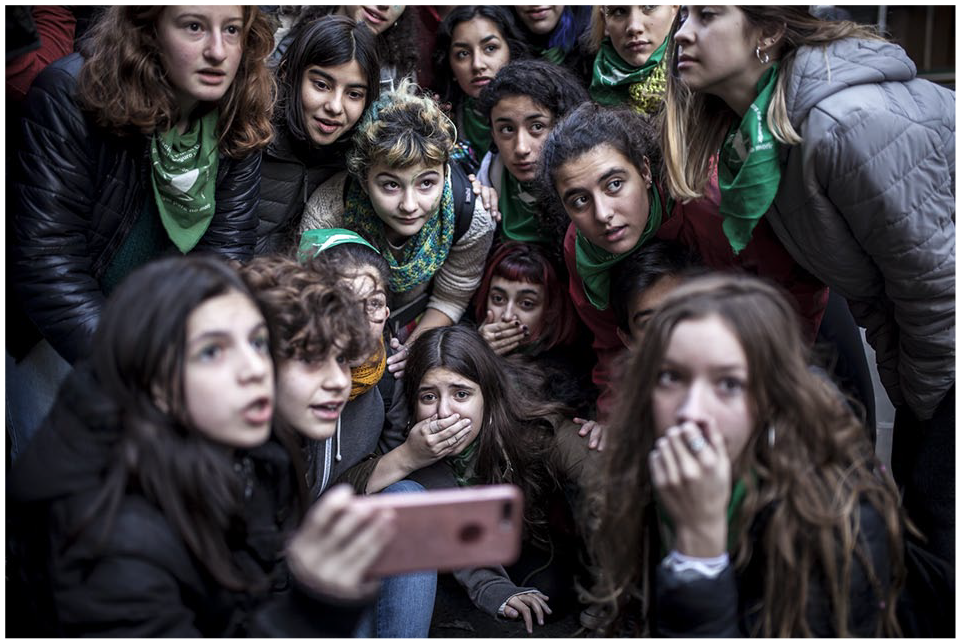
Schoolgirls waiting for the vote on the abortion bill, June 18, 2018. Photo © Lina Etchesuri/Cooperative la Vaca
However, on August 8 the Senate, after more than 15 hours of debate, rejected the bill 38–31. The feminist movement had to wait until the very end of 2020 for the bill to be passed in another exhausting night at the Senate, making Argentina the first major Latin American country to legalize abortion: “We will paint Latin America green”, celebrated (Goñi, 2021). By 2018 the green neckerchief had already become a new collective symbol. The presence of young women and teenagers at every demonstration was so huge that the movement came to be described as the “revolution of the daughters” (Peker, 2018). With an extraordinary combination of ferocity and joy, Las hijas del fuego drove the “revolution of the daughters” into another dimension.
A Military Femicide
To acknowledge the particular way in which the new feminist movement became entangled with the long tradition of memory struggles, I would like to return to an earlier, seminal reading of both fields. In Acts of Disappearance, the renowned feminist and specialist in performance studies Diana Taylor (1997) defined the Argentine dictatorial experiment as a form of “percepticide,” a period governed by terror in which the population was forced not to see in order to survive. For Taylor, percepticide also served as a form of femicide, a moment of repression and invisibility in which the very idea of the patria became feminized. This deeply gendered character of military terror was something that, according to Taylor, had not been seen previously and that surreptitiously deepened a misogynist version of the nation. In her reading of the Mothers of Plaza de Mayo’s activism around their missing children, Taylor argued that by calling attention to motherhood as a social, not just a biological construct the Mothers had destabilized the military but “left a restrictive patriarchal system basically unchallenged” (119). By assuming the role of “defenseless mothers looking for their children,” the group was caught in a “bad script” (203).
Opposing Taylor’s argument, I have contended that a univocal association of military terror with femicide tended to restrict the nonnormative projections of the local experience of dictatorship, which to my mind was far more than a gender issue (Sosa, 2011; 2014). I have argued that the motto of the Mothers, “Nuestros hijos nos dieron la vida” (Our children gave us life) could be read as a radical questioning of a simply reproductive motherhood. By exaggerating their biological function, the Mothers managed to dismantle the maternal pose. More than operating within the frame of biological motherhood, the “excess” of their obsession disrupted patriarchal conceptions of motherhood, conspiring against the logic of the biological script and ultimately any regime based on blood (Sosa, 2011: 67). Thus, by reversing the biological cycles, the Mothers managed to inaugurate the alternative lineage of mourning that I have identified as queer.
In the light of the regressive culture displayed in the post-2015 cycle, however, I believe that Taylor’s argument is worth considering from an alternative perspective. Her denunciation of the survival of a sexist and misogynist structure has acquired unexpected nuances. The capacity of the rising feminist tide to call into question the seeds of military terror infused it with a surprising dynamism. In fact, it is precisely this deep, viscerally patriarchal tone embedded in the matrix of the social that has become visible and been questioned by the recent feminist irruptions. Apart from resilient mothers, the streets were surprisingly full of daughters, sisters, cousins—an expanded and expansive green tide of women of all ages. The demand for missing children had turned into a demand for the right to decide when and if they wanted to have children in the first place. “Power, power, power. Now that we are together, now that they see us [my emphasis], patriarchy will fall.” As this frequent chant reveals, the refurbished conservatism had shed light on something that had been impossible to see before. The revolution of the daughters was around the corner.
A Festive Excess
The administration of Cambiemos, the official party led by Macri’s right-wing coalition, imposed a form of economic austerity and a political discipline that tended to focus on social areas that in the past had managed to assemble powerful community forces. The official attack was especially bloody in the areas of public administration associated with so-called human rights policies. Tensions became visible around a numerical issue—that “the disappeared did not total 30,000” (Perfil, 2016). The widespread rejection of this statement brought about the resignation of its author, Buenos Aires Minister of Culture Darío Lopérfido, but only months later President Macri joined the dispute: “I have no idea [if there were 30,000]. It is a debate whether there were 9,000 or 30,000. I don’t want to get involved” (Rosemberg, 2016). By questioning the figure claimed by human rights organizations for over three decades, the new administration made explicit its hesitation to repudiate a de facto military regime that clandestinely assassinated citizens and still hides information about the whereabouts of its victims. The “Lopérfido affair” was not a debate about numbers but a profound attack on a community built on the reverberant affections of grief, which had expanded beyond blood barriers.
While at the end of the 1970s the Mothers of Plaza de Mayo were using their bodies to make visible the absence of their children, in the 1990s the piqueteros used the sheer physical materiality of their bodies to oppose the neoliberal policies that had left them unemployed and literally on the streets. Correspondingly, in the post–December 2015 period the irruption of the women’s movement in the public arena denounced another mode of abuse that was perhaps more subtle and complex. During the conservative retreat, the massive presence of young people in the street signaled the persistence of femicide in the country. Combining disparate social and personal narratives, the new feminist wave fostered by the expansion of rights of the previous period denounced the persistence of a misogynist-patriarchal structure inherited from predictatorship times, and it did so with unprecedented effervescence, vitality, and even joy. By recovering some of the energy of the first escraches (H.I.J.O.S.’s demonstrations at the homes of the military benefiting from impunity in the mid-1990s), a distinctive mix of vibrant, colorful, and queer vibrations marked the feminist tide. It became the best weapon against conservatism. Slogans became radical, and nothing seemed impossible. The group managed to avoid any vindictive response: “I don’t want to be a victim, I want to be free.” During the first International Women’s Strike on October 19, 2016, and the anniversary march in 2017, it seemed to radiate a festive excess. Precariousness and vulnerability inspired an incipient recklessness, and invisibility seemed to be reversed. A restored public space vibrated. It was the daughters’ time. The resistance wanted to be happy.
Las Hijas Del Fuego
Albertina Carri’s latest film provides significant insight into this cycle of resistance. Released during the 2018 Buenos Aires International Festival of Independent Cinema and exhibited in independent international militant circles, Las hijas del fuego was a scandal not only because it was pornographic and lesbian but also because it managed to reinvent a polyamorous fiction well-suited to the present period of neoconservative backlash. 9 In its endeavor to reinvent feminist porn, the film managed to launch a new system of kinship based on a powerful (and joyful) female network that was already circulating in Argentina’s streets. It proposed a fiction of nonblood origins and ultimately new ways of being together.
Los rubios, Carri’s first documentary, is still a cult object 16 years after its release. In 2016 the artist returned to it as the inspiration for another documentary, Cuatreros (2016), a favorite at both the Berlin and the Mar del Plata film festival. Drawing upon her father’s first book, the film follows the tracks of Isidro Velázquez, the country’s last cuatrero (rustler), shot dead in 1967. Less explored, however, has been Barbie también puede estar triste (2001), a short animated film from the beginning of Carri’s career that was judged Best Foreign Film at the New York Mix. In it she had already explored feminist porn by subverting the conventions of animation (putatively a childish genre) to launch a critique of heteronormative and patriarchal strategies—an impulse that her latest piece would carry to a joyful extreme.
In Las hijas del fuego, the action begins with a couple reunited in the very South of the country after a month of being apart. To celebrate their reunion, the two girls make their way to a bar and end up in a fight when the local men react violently to their embracing and kissing. A local girl steps in to defend them, and the three women run away joyfully. Eventually the festive three steal a van to start a new, longer journey, and viewers witness the blissful formation of an expanded female network. Bodies, territory, and landscape are secretly entangled in the film. While the question of how to make a documentary was at the core of Los rubios and, to some extent, also in Cuatreros, Las hijas del fuego is searching for a new genre and even a new beginning. And while in her previous documentaries the director was still reacting to the figure of her father, a well-known intellectual, in her latest fiction there are no fathers. Rather, at the beginning of Las hijas del fuego there are mythical mothers who travel to the Antarctic—perhaps the purest space of fiction—to conduct scientific experiments, and now some of their descendants are back on the mainland and freely traveling north.
One of the girls is researching porn, and this performative endeavor captures the film as a whole. A sense of contagion underlies the team’s journey, which is a sexual colonization, a poetic and political orgy. Sex is literally the connective vector, the affective “glue” that builds the network of women, reproducing like a virus. As is typical of porn films, plot is not particularly important. The journey develops with a kind of organic rhythm, an agitated sequence of sexual encounters that become increasingly intense and narcotic. The film is subtly playful, elusive, and sophisticated. There are many poetic passages that both celebrate the beauty of all types of bodies and women’s genitalia and ironically suggest a higher and more complex stage of social development. Besides the film’s tantalizing excitement, it suggests an alternative form of haptic knowledge radiating from the screen. Las hijas del fuego is governed by the pleasure of bodies (and their attunement) in being together. In that sense, it is rebellious: it draws upon and calls for new forms of affective agency and insubordination. By portraying this sense of orgiastic contagion, Las hijas del fuego beautifully intertwines with Argentina’s political context: it brings onto the screen the revolution of the daughters taking place in the streets. Moreover, Carri’s pornographic fiction seems to work through the local tradition of a radical female lineage that extends from the Mothers of Plaza de Mayo to their youngest feminist descendants.
Guerrilla Girls
Carri’s film is reminiscent of Monique Wittig’s Les guérrillères (2007 [1969]), the seminal feminist novel written in the wake of the May 1968 student-worker revolution in France. Almost five decades later, Las hijas del fuego echoes Wittig’s radical lesbian impulse by reconstructing the figure of a porn team of female guerrilla fighters contesting the misogynist traditions still present in a marginal Latin American country. While in Les guérrillères it is possible to observe the tribal activities of a large number of women “who live in a beautiful and colourful setting, never completely described, that is sometimes a Greek island, sometimes, perhaps, a seaside resort, sometimes a futuristic city” (Durand, 1974: 71), here too Carri creates a contemporary road movie that takes the Patagonian countryside as its affective landscape. Similarly to the guérrillères, her female team might be thought of as a mythical tribe that aims at disseminating an alternative form of justice. Although there are multiple characters, it is mainly the tribe, the female network, that embodies the collective protagonist and eventually becomes a deity in itself.
In one exceptional sequence, the rage of the tribe is directed at an abusive husband. He becomes the center of the group’s anger and finally the source of mockery and ridicule before he is expelled. In some sense, the scene seems to be embedded in the impulse of Les guérrillères. Arguably, the members of the group could easily be accused of being “feminazis,” a term that has been used locally to attack and mock feminists who reject misogynist behaviors. 10 Carri’s film playfully dialogues with this tradition. In fact, the female network manages to turn hate into collective energy. While the local “guérrillères” also torture their tormentors, rather than a literal promise of physical vengeance, as Durand (1974: 76) argues in relation to Wittig’s novel, it is “the language of feminism speaking out its rages and frustration.” In Carri’s film the use of violence seems a strategy for shocking viewers into a new awareness. It reveals the center of the anger of these “guérrillères,” a sense of emotional and physical violence for which “feminism provides a sane and constructive outlet” (Durand, 1974: 76). In fact, the sequence could be thought of as the end of gender abuse as a contemporary form of slavery while staging the conquest of a brand-new female country. To some extent, the scene humorously stages the mythical expulsion from the South of the last machirulo. 11
The exultant crew of women grows. One of these recruitments is particularly revealing. A member of the group crosses paths with a middle-aged woman cycling along a deserted path. The skin of the stranger is dark, her lips generous. The women exchange a couple of words. The foreigner seems to speak with the accent associated with the often stigmatized population of the North of the country. Rather than dismissing the stranger, Carri’s “guérrillère” addresses her with a surprising request: “Say something with an ‘r’ in it.” The request is satisfied, and the women embrace and kiss. The group has a new member. This sequence is as unexpected as it is hilarious. More than that, however, the Northern accent, usually stigmatized, becomes an eroticizing path. As Judith Butler (1997: 40) reminds us, just as words have the power to wound us, that performative power can also be overturned. In other words, in the scene the naming of trauma, in this case a particular way of pronouncing an “r,” opens up new forms of agency and insubordination. This particular line in the script—“Say something with an ‘r’ in it”— signals the moment when injurious speech is reversed to serve as the means for novel desires. There is an alternative form of agency emerging from this operation, one that involves speaking out in a way that has been largely dismissed. By reworking hate speech, Las hijas del fuego opens up playful worlds of recognition that, in Butler’s words, might create new forms of future legitimation. As the infuriated green tide shouted after the senators rejected the bill ensuring abortion rights, “It is only a matter of time.”
Although it is possible to read Las hijas del fuego as a sort of radical feminist fable taking place in a suspended time, it does coalesce with the current Argentine political landscape. In that sense, the line analyzed above is expressive of a particular feminist activation. The incorporation of the newcomer bears witness to the sense of transversal colonization that the local movement has gained. As Cecilia Palmeiro (2018: 4) comments, “This transversality means that we connect our struggles with those of other women, that we mirror ourselves and multiply . . . as a global micro-capillary network and fabric.” Echoing that expansive will, in Carri’s fiction the female network aims at embracing trans, marginal, and often neglected members of the population. And this happens literally in the film, mirroring a sense of contagion, a sort of fluidity of bodies in tune with each other beyond all differences of class, race, weight, or sexual preference (Figure 4).

Screenshot from Las hijas del fuego (Albertina Carri, 2018), cinematography by Inés Duacastella and Soledad Rodríguez
Also, territorially speaking, Las hijas del fuego sheds light on the eagerness of a colonization that goes beyond national borders. In fact, Ni Una Menos’s international strikes have become increasingly transnational. Whereas the main problem of feminist movements has historically been the difficulty of overcoming the isolation of intense but fleeting impulses, in the case of Argentina there has been an explicit attempt to transpose normative boundaries and engage with the construction of a transnational queer and feminist matria.
Our Body, Our Territory
Las hijas del fuego’s last scene is potentially puzzling. The journey has reached its final stage, and a party is taking place. The big house, which belongs to the mother of a member of the tribe, is buzzing. Some are dancing, others engaging in various sexual practices. The pool is open. The camera shows all sorts of female bodies hanging out, drinking, laughing, kissing, engaging in sadomasochism. It is an epic, utopian landscape that also fleshes out the hedonism that Wittig describes. In this joyful context, a young woman sits by herself in the garden. She wears big headphones. She is alone, immersed in a silent bubble. She listens to her music, which we cannot hear. At some point, she starts masturbating. The scene is long, unspeakably tense, uncomfortable, ending only when she climaxes. Far from effusive, it is a quiet, internal, even self-conscious moment, one that contrasts starkly with the party taking place around her.
I suggest that this final sequence of the film might be read alongside one of the main taglines of the feminist movement in the post–December 2015 period: “Our body, our territory.” Feminist ruminations have long refused to identify the body with the sphere of the private, speaking instead of a “body politics” (Federici, 2004: 16). This empowering call has also spread within the local movement, transforming women’s desire into a territorial weapon on various levels. In the wake of the 2018 International Women’s Strike, Ni Una Menos promoted a parallel activity against patriarchy called the “Orgasmarathon.” At midnight on the day of the strike, the collective launched a “global and massive orgasm” that called for a new politics of desire for the LGTB and feminist communities. The manifesto that Ni Una Menos circulated on social media prior to the event read as follows: All of us and each of us, alone or together, wherever we are and with whatever we have in hand, in the way we like best, in the way that we can, and if we cannot we still have fun trying: everything counts, all pleasures and all bodies count for this sexual revolution. We are turning the orgasm into an arm of rebellion, a source of energy to resensualize the struggle [my emphasis].
The scene that concludes Carri’s film seems to embody that spirit. It approaches individual orgasms as an arm of collective rebellion.
Albertina Carri’s film is a provocation. The incitement should be taken seriously but probably not too literally. Ultimately, the film could be read as a poem of empowerment. It manages to stage the conflicting emotions that emerged in the post-2015 era. Las hijas del fuego is thinkable only alongside the impact of the Ni Una Menos collective and the feminist tide that took over the country in this period. In those terms, the film also counts as a marker of resistance. It pushes back against neoconservatism while postulating a fully emancipated feminist movement. The film is playful, festive, and probably also ironic. If the local feminist movement has been identified as the main (and potentially the most feared) actor in the post-2015 era, Las hijas del fuego is fully immersed in this counterpower. Thus it becomes an artifact ready to enchant new audiences, bringing together a passionate, orgiastic sisterhood. Ultimately, it stages the revolution of the daughters—not just that of those directly affected by loss but also, as Maria Moreno would say, that of those with or without puntito.
Epilogue: Toward A Feminist Matria
The post–December 2015 scenario allows us to rethink the argument of invisibility put forward by Diana Taylor in 1997. The current conservative reaction has activated a nonblood performance of disappearance that has revealed a dissident, even queer vein. Forty years after the military coup, two different experiences of mourning potentiate each other. Slogans such as “Nunca más” (Never Again) and “Ni una menos” (Not One Less) link and feed off each other. The coexistence of the two slogans and ultimately the two movements delineates the affective cartography of the current moment. Together, they subvert normative traditions by showing that affiliations are fundamentally political. In this assembly of nonnormative affections, the reverberations of the traumatic past are processed in a novel way. During the conservative retraction (2015–2019), which combined religious and New Age components, social protest was brutally repressed. Yet the emerging tide of young feminists has freed itself of biologists and victimizing traditions. The appeal for enjoyment radiated by the movement has given the resistance an unusual celebratory and even festive wake.
While in the face of the first International Women’s Strike in 2016, Estela Carlotto, the president of the Grandmothers of Plaza de Mayo, distinguished the traumatic events that brought the Mothers and Grandmothers into being in the 1970s from the current feminist demonstrations, the following months accentuated the imbrications of those disparate ways of confronting disappearance and mourning. In 2018, Nora Cortiñas, one of the Mothers, was a main speaker at a Ni Una Menos demonstration and showed up wearing the green neckerchief associated with the campaign to legalize abortion (Figure 5). 12

Nora Cortiñas at a Ni Una Menos demonstration wearing both the Mothers of Plaza de Mayo traditional white headscarf and the green neckerchief associated with the campaign for legal abortion. Photo taken by Graciela Manzo.
Far from trivializing the struggle of traditional memory groups, the provocations and denials over the dictatorship’s legacies set out by the Cambiemos administration encouraged these affective entanglements. Conversely, the image of the Plaza de Mayo covered with white headscarves during the demonstration on May 10, 2017, showed that the “Never Again” slogan had managed to retain its power to reinscribe complex processes in the collective imagination. It revealed that, beyond age and gender, communities have an expansive capacity for renewal and contagion.
In the post-2015 cycle, the rejection of terror included, for the first time, the denunciation of a misogynistic and sexist component that had previously been ignored. As the sociologist María Pía López (2016), a founding member of Ni Una Menos, argued in the wake of Carla Vallejos’s murder, “The author of a femicide continues to walk throughout the neighborhood, unpunished.” The personification of a perpetrator of gender violence as a public figure freely circulating through the streets revealed a curious amalgam of traumatic memories. While in the mid-1990s the children of the disappeared held escraches to bring shame upon unpunished perpetrators of crimes, now public shaming has experienced a queer/feminist turn. The two figures shared a suspicion that was already implicit in Taylor’s hypothesis: that every military oppressor is a perpetrator of gender abuse. Yet, during the current conservative backlash these traumatic memories seemed to inspire and complement each other. Disparate traumatic memories became intertwined in the public scene, contributing to the formation of other publics and collectives. The recent feminist tide showed an unexpected ability to synergize that collective energy. As Carri’s polyamorous piece also suggests, the feminist movement has made room for unconventional forms of pleasure arising from different forms of vulnerability and loss.
The long tradition associated with memory struggles and the recent feminist awakening have nourished areas of transmission and contagion for wider audiences. It is precisely their adverse circumstances that underline their affective potential for a reinvention of the political, serving as an inspiration for transnational and transgenerational communities. As suggested by Carri’s film, the knotting together of memory struggles and expanded feminisms not only challenges Taylor’s argument in relation to a feminized idea of the patria but sheds light on an enhanced matria. This reloaded, nonnormative figure is capable of protecting multidirectional memories, sheltering both recovered grandchildren and a new feminist sisterhood. Upon this multicolored matria, guerrilla deities pursue a dance of empowerment driven by subversive desires that link past and present, pleasure and loss.
Footnotes
Notes
Cecilia Sosa is an Argentine sociologist and cultural journalist. She holds a Ph.D. in drama (Queen Mary, University of London) and works as a postdoctoral researcher at Goldsmiths, University of London, on the British Academy–funded project “Documentality and Display: Archiving and Curating Past Violence in Argentina, Chile and Colombia” (Grant: SDP2\100242)