




Abstract
The study examines the effectiveness of community courts in reducing recidivism, aiming to address methodological limitations of previous research. Using a quasi-experimental design with propensity score matching, the research compared 686 program participants (393 completers and 293 noncompleters) referred to community courts with a matched group of 1,797 individuals adjudicated in mainstream magistrate courts for similar offenses. Recidivism was measured using reconviction data at 1, 3, and 5 years following case completion or release from incarceration. Research findings suggest that although participants in the community courts program exhibited fewer reconvictions compared with those adjudicated in mainstream courts, no significant differences were identified between the treatment and control groups. However, upon separating between those who successfully completed the community court program and those who failed to complete it among the treatment group, program completers had significantly lower recidivism rates compared with the matched comparison group.
Keywords
Since the 1990s, problem-solving courts have developed in the United States to provide comprehensive solutions for individuals who have committed or been harmed by crime and communities affected by high crime levels (Berman & Feinblatt, 2001). The concept underlying this model is that many criminal offenses are committed against a backdrop of socio-economic issues. These problems often lead to recidivism and the phenomenon of the “revolving door,” where many individuals charged with offenses commit additional crimes after their release from prison (Winick, 2003) due to their difficulty in breaking free from the cycle of criminal behavior (Berman et al., 2005). This phenomenon leads to the imposition of harsher criminal sanctions, which in turn deepen the criminal patterns of individuals involved in the criminal justice system and increasingly detach them from normative community support networks (Tonry, 1995). Simultaneously, this phenomenon creates an increasing burden on the already overloaded enforcement and incarceration systems (Gal & Dancig-Rosenberg, 2020). To address the revolving-door phenomenon and reduce the use of incarceration, problem-solving courts aim to tackle the root problems that lead to criminal behavior rather than just their symptoms. Starting in 1989 with the first drug court established in Miami, Florida, thousands of problem-solving courts have been operating in recent decades in the United States and elsewhere. In addition to drug courts, they include mental health courts, veteran treatment courts, domestic violence courts, prostitution courts, and human trafficking courts (Holbrook & Dhondt, 2025).
Community courts, which are the focus of this study, are another variant of problem-solving courts. Similar to other problem-solving courts, community courts are based on collaborative teams of prosecutors, defense attorneys, probation officers, social workers and case managers. Together, these teams create an individualized treatment plan for each individual who is referred to them (often called “court participant”), addressing their criminogenic needs. Regular court hearings are used to provide continuous monitoring of each participant’s progress in their treatment plan. Community courts additionally strive to rehabilitate the community suffering from high crime rates, strengthen residents’ sense of security, and improve their trust in law enforcement systems (Casey & Rottman, 2005; Malkin, 2003). Unlike other problem-solving courts, community courts do not specialize in dealing with a specific issue but focus on a range of offenses that impact the residents’ quality of life and daily security, such as property crimes, drug use, and violence, according to the needs of the community in which they are located (Lee et al., 2013).
As an integral part of the community court model, measurable success criteria for the process have been established to assess its effectiveness and encourage continuous improvement (Lang, 2011; Lee et al., 2013). Measured criteria include the reduction in repeat offending (recidivism) among program participants, an overall decrease in crime rates in specific neighborhoods, cost savings (program costs vs. incarceration costs), procedural justice perceptions among participants and other stakeholders, compliance with court orders, and the extent of use of noncarceral sanctions (Fagan & Malkin, 2003; Lee et al., 2013).
Two central theoretical explanations for the effectiveness of community courts in reducing reoffending are therapeutic jurisprudence (Wexler & Winick, 1991) and procedural justice (Tyler, 2006). Therapeutic jurisprudence (TJ) is the study of the positive and negative effects of the law on individuals’ well-being. The study of TJ was intertwined with the development of problem-solving courts and highlighted the importance of adopting and implementing evidence-based therapeutic practices in the courtroom. Examples of such practices include speaking directly with the person charged, engaging family members in the process, and using strength-based courtroom discussions (Winick & Wexler, 2003). The common assumption underlying the use of these practices is that they act as motivators for participants to comply with the program requirements and consequently complete it successfully, thus increasing the chances of long-term rehabilitation. The theory of procedural justice identifies the importance of a fair process on legitimacy and trust perceptions, which in turn affect compliance, and subsequently, reduced offending. Components of the fair process include neutrality, transparency, voice, and information (Tyler & Huo, 2002). A common feature of these two theories is their emphasis on the process itself as a potentially constitutive experience which can be leveraged to promote desistance and rehabilitation. Recent scholarship provided initial integration of these two frameworks in the context of problem-solving courts. For example, Kaiser and Holtfreter (2016) proposed an integrated TJ and procedural justice model to explain the success of problem-solving courts. This integrated model was supported by semi-structured interviews conducted by Kruse and Bakken (2023) with drug court participants. The combination of therapeutic jurisprudence and procedural justice emerged as salient also in observations and interviews with participants and professionals involved in two drug courts in Scotland (McIvor, 2009).
Among all success measures, community court effects on recidivism are of particular interest to policymakers, given the centrality of the “revolving door” problem in public discourse (MacKenzie, 2006). Although several studies have examined whether community courts reduce recidivism, researchers have highlighted challenges in utilizing rigorous investigative methods, such as lacking appropriate control groups and longitudinal perspective (Frazer, 2006). The current study addresses these methodological limitations by examining whether, and to what extent, community courts effectively reduce repeat offending among referred individuals, including “completers” who successfully graduate and “non-completers” who fail and return to mainstream sentencing processes.
Using a quasi-experimental design with propensity score matching, the study compared individuals referred to community courts established gradually in three Israeli cities during 2014-2020 with a matched group having similar criminogenic and demographic characteristics referred to mainstream magistrate courts. To measure reoffending, we used police and court reconviction data for both groups at 1, 3, and 5 years following legal process completion or, when penalties included incarceration, following release.
Community Courts
Community courts create a holistic judicial framework for rehabilitating individuals charged with offenses under close judicial supervision, collaborating with enforcement authorities, welfare services, educational institutions, and community organizations (Berman & Fox, 2005). The rehabilitation process is tailored to each participant’s unique needs and circumstances (Berman & Feinblatt, 2015). The judicial process differs significantly from classic adversarial proceedings and resembles other problem-solving courts. The community court consists of a multidisciplinary team led by the judge, including social workers, probation officers, coordinators, facilitators, and prosecution and defense representatives, who work collaboratively in a nonadversarial manner to support participant rehabilitation (Casey & Rottman, 2005). Practices inspired by therapeutic jurisprudence and procedural justice principles are used regularly by court personnel and judges. Entry requires participant consent and admission of guilt, serving as an alternative to standard criminal procedure. Program completion serves as an alternative to incarceration that would have been imposed under standard procedures (Casey & Rottman, 2005).
Despite the differences arising from the characteristics and needs of each community, several components are common to all community courts (Casey & Rottman, 2005; Lang, 2011; Lee et al., 2013:): cooperation with community resources; community involvement; tailoring of therapeutic tools at the individual level; use of alternatives to incarceration and expansion of existing rehabilitative measures; emphasizing the accountability of program participants; and setting success metrics (Fagan & Malkin, 2003; Lee et al., 2013).
Alongside the growing interest in community courts, critics have raised several concerns about problem-solving courts. These include potential due process violations (Lane, 2003), net-widening effects that draw individuals into intensive interventions who might otherwise avoid criminal processing (Hoffman, 2000), and risks of coercion when courts assume therapeutic roles that blur care-control boundaries (Miller, 2004).
Approximately 60 community courts operate in the United States and a few dozen in other countries, including Canada, the United Kingdom, Australia, Israel, and New Zealand. The Israeli model, which was established in 2014, was inspired by the Red Hook Community Justice Center in Brooklyn, New York, and was locally adapted to suit Israel’s unique social and cultural context. The first community court was launched in the Southern city of Be’er Sheva in 2014, followed by a second in Ramla in 2015. These cities were selected by the Court Administration due to their heterogeneous demographic profile and population, and their low socio-economic status. A formal government decision in 2016 supported the expansion of the initiative, leading to the establishment of additional courts in Tel Aviv, Nazareth, Haifa, and Jerusalem between 2017 and 2020. Over the next 5 years more community courts were established and today nineteen community courts operate across the country. The community courts were formally codified in 2022 under the Criminal Procedure Act (Amendment 92–Temporary Provision).
The Israeli pilot introduced several modifications to the Red Hook model to better address the specific needs of the local population. Notably, the Israeli model includes people charged with more severe crimes and who struggle with more complex personal and social challenges. Eligible individuals are those indicted in magistrate courts where a community court is operational, for offenses with an expected penalty of up to 3 years’ incarceration. Only sexual, national security, organized crime, and homicide offenses are excluded from the program. In addition to the offense type, eligible participants struggle with one or more problems such as addictions, mental health issues, and poverty. Prior to referral to the community court, potential participants must express their willingness to enter a plea.
The process also differs in length and intensity from the process in most American community courts. It is structured as a comprehensive, five-stage intervention that spans roughly 15 months and guides participants through a series of gradual milestones, called stages: (a) Building mutual understanding and developing a personalized treatment plan; (b) Efforts to stabilize the participant and coordinate with various service providers; (c) Participants start meeting the goals outlined in their plan; (d) Sustaining progress independently; and (e) Preparations for reintegration and graduation from the program. Rehabilitation efforts focus on five key domains: health, welfare, employment, social support, and adopting a law-abiding lifestyle. Each community court handles between 100 and 150 cases per year, with a program completion rate of about 50% (Gal & Dancig-Rosenberg, 2024).
A preliminary check conducted by a social worker assesses whether the eligibility criteria are met and whether there are any safety issues preventing an individual from referral to the community court. If these conditions are met, and upon the consent of the defense and prosecution, the magistrate court judge orders a community court referral, and the person charged begins the program.
Court hearings take place regularly, every week, 2 weeks, or a month, depending on the stage. Between court hearings, participants follow their individual treatment program, which includes several elements such as individual and family therapeutic interventions, drug treatment, vocational training and employment, debts absolvent, and regular meetings with the probation officer. Similar to other community courts and problem-solving courts, personnel in the Israeli community courts are trained to utilize practices inspired by therapeutic jurisprudence and procedural justice principles, such as engagement in respectful dialog with participants, provision of clear and detailed explanations, inclusion of family members in the discussions, and focusing on accomplishments and strengths. Most of the rehabilitative components of the treatment plan rely on existing public services, but community court personnel help participants gain access to them. Community court participants who complete the program are convicted and sentenced, typically to probation supervision. Although their criminal record is not expunged, they do not face incarceration. Participants who fail to meet the treatment plan requirements repeatedly may be expelled from the program, in which case they are sentenced in a mainstream court and may expect a prison term. In the present study, these individuals are titled “non-completers.”
Studies Examining the Effectiveness of Community Courts in Reducing Recidivism
Empirical studies examining the effectiveness of community courts in reducing recidivism have yielded mixed results, with methodological limitations affecting the robustness of findings across various jurisdictions. A significant challenge in comparing between community courts and drawing general conclusions about their desirability results from differences among them. Community courts differ in multiple characteristics, including in their eligibility criteria, treatment plans, program length, and court outcomes.
Several studies have reported positive outcomes, such as reductions in re-arrests and reconvictions. For example, The Red Hook Community Justice Center (RHCJC) in Brooklyn demonstrated a 10% reduction in re-arrest rates over a 2-year follow-up period compared with traditional courts (Lee et al., 2013). In Australia, the Melbourne Neighbourhood Justice Centre (NJC) showed a 25% reduction in recidivism rates over 2 years (Ross, 2015), although the comparison between different cities raises concerns about confounding variables relating to law enforcement policies and practices.
Similarly, the East of the River Community Court in Washington DC reported a 42% lower chance of new criminal cases within 1 year (Westat, 2012), but the study did not account for incarceration periods. The San Francisco Community Justice Center (CJC) found an 8.9% to 10.3% decrease in re-arrest probability in the CJC catchment area after its establishment, using a differences-in-differences methodology (Kilmer & Sussell, 2014), though it relied on re-arrest rather than conviction data. In Canada, the Vancouver Downtown Community Court (DCC) demonstrated reduced reoffending among high-risk individuals assigned to a Case Management Team after being charged, particularly for property crimes (Somers et al., 2014). However, the study was limited by its 1-year follow-up period and use of a comparison group from a different area. The Spokane Municipal Community Court (SMCC) in Washington State reported significantly lower recidivism rates among participants compared with historical and contemporary comparison groups (Hamilton et al., 2019). Using Mahalanobis Distance Matching and weighted analyses, the study found that within 12 months, 30% of SMCC participants experienced recidivism compared with 46% in comparison groups. However, the small sample size and short follow-up period limit the generalizability of these findings.
Conversely, other studies have found no significant effects on recidivism. Research on the North Liverpool Community Justice Centre in England (Booth et al., 2012; Jolliffe & Farrington, 2009) and the Seattle Municipal Community Court (Nugent-Borakove, 2009) found no statistically significant differences in recidivism rates between community court participants and individuals who opted out of the program and were consequently adjudicated in traditional courts. In this vein, a study of the Indianapolis Community Court (ICC) in Indiana employed a quasi-experimental design with propensity score adjustments (Grommon et al., 2017). Over a 36-month follow-up, no statistically significant differences in recidivism risk were observed between ICC participants and those who declined participation, suggesting limited effectiveness in reducing recidivism among individuals charged with low-level, nonviolent offenses.
These mixed findings highlight the complexity of evaluating community court effectiveness and may hint to methodological challenges of previous studies, including selection bias, varying definitions of recidivism, differing follow-up periods, and complicated cross-study comparisons. Considering these mixed findings and the unique characteristics of each specific community court program, there is a need for more robust studies to reach more conclusive insights about the desirability of, and conditions for, scaling the use of community courts.
Method
Study Design and Dataset
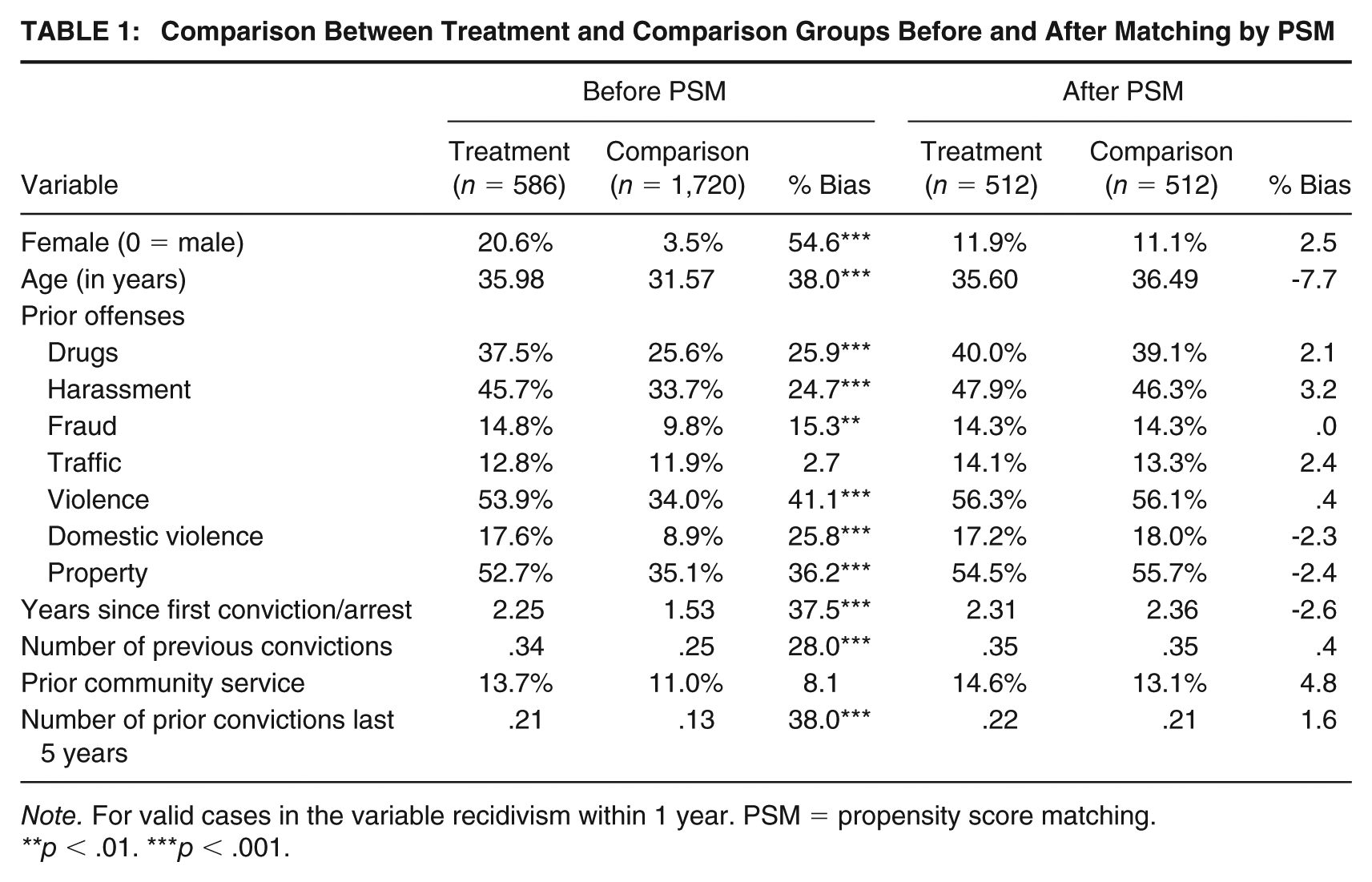
The study was structured as a quasi-experiment, incorporating both treatment and comparison groups. The treatment group comprised a total of 686 individuals who had their cases adjudicated in three Israeli community courts—Be’er Sheva, Ramla, and Tel-Aviv—between 2014 and 2020, which were the first to be operational during this period. Participants in the treatment group had a criminal history reflecting multiple criminogenic problems. For example, 53.9% of the participants have a history of violent offenses, 52.7% of property crimes, and domestic violence appeared in the records of 17.6% of community court participants (see Table 1).
Comparison Between Treatment and Comparison Groups Before and After Matching by PSM
Note. For valid cases in the variable recidivism within 1 year. PSM = propensity score matching.
**p < .01. ***p < .001.
In contrast, the comparison group consisted of 1,797 individuals who were charged in four Magistrate’s Courts—Be’er Sheva, Rishon LeTsiyon, Ramla, and Tel-Aviv—during the same timeframe. For the comparison group, all offenses handled in the Magistrate’s Courts, except for national security, sexual, and manslaughter offenses, which were not eligible for treatment in the community courts, were included. An additional inclusion criterion for the comparison group was the involvement of the Probation Service in the case, serving as a proxy for detected underlying social problems such as addictions, mental health issues, and poverty, which are prominent in the community courts. To allow for adequate comparison and minimize the impact of outliers, the comparison group consisted of individuals who were sentenced to up to 29 months in prison (representing the 95th percentile of prison sentences within the comparison group). To minimize the risk of including in the comparison group individuals who are categorically different from community court participants, the comparison group encompassed only cases handled in each court (city) before the community court in that city was established. This is because, once a community court program began its operation, those who were not referred to it are suspected of having some characteristics that deemed them unsuitable for the program; otherwise, they would have been referred to it. Focusing only on individuals for whom the community court option was categorically unavailable increases the likelihood that they are similar in their characteristics to the treatment group. Consequently, the Be’er Sheva Magistrate’s Court included only cases submitted before August 2014; in Ramla, before August 2015; and in Tel Aviv, before March 2017. In Rishon LeTsiyon, a city similar in many ways to the other three, there was no community court at the time of the study, and therefore data from all relevant cases between 2014 and 2020 were collected. Cases adjudicated in this city were included in the sample to increase its size.
Regarding the temporal aspect, “time zero” for the treatment group was defined as the date of indictment for the offense which led to referral to the community court. For the comparison group, “time zero” was established as the date of the first indictment at the Magistrate’s Court during the relevant timeframe in each court.
Variables
The study incorporated three binary outcome variables to gauge recidivism. Each variable determined whether the individual faced re-conviction within 1 year (recidivism 1 year), 3 years (recidivism 3 years), and 5 years (recidivism 5 years) following the completion of a prison sentence following the indictment at time zero or the completion/noncompletion of the treatment provided in the community court. Instances that could not be traced for the specified period (e.g., 1, 3, or 5 years) were classified as missing within the respective variable. For example, cases in the treatment group that concluded in 2019 were designated as missing in the “recidivism five years” variable due to the follow-up period being less than 5 years. We used a binary variable to measure recidivism due to the highly skewed distribution of reconvictions, with only a small number of individuals experiencing multiple reconvictions. Supplementary analyses employing count variables (i.e., the number of reconvictions) as outcomes produced results consistent with those obtained using the binary measure.
Our primary independent variable represents the treatment group as a binary variable (0 = comparison group). In addition, our analysis included the following variables: female (0 = male); age; years since the first (ever) conviction or arrest (i.e., the “criminal career” length); seven dummy variables for prior offenses before time zero (0 = no, 1 = yes): drugs, harassment, fraud, traffic violations, violence, domestic violence, and property offenses; the average number of previous convictions before time zero; prior community service before time zero (0 = no, 1 = yes); and the average number of convictions up to 5 years before time zero (number of prior convictions last 5 years).
Research Method
We utilized the propensity score matching (PSM) method (Assaraf & Factor, 2025; Campbell & Labrecque, 2024; Rosenbaum & Rubin, 1985; Weisburd et al., 2022) using Stata statistical software (StataCorp, 2023) to establish comparable comparison groups. 1 Initially, we calculated the propensity scores predicting the likelihood of entering the treatment group based on criminal history and demographic variables, serving as potential confounders for recidivism (Campbell & Labrecque, 2024; Nagin et al., 2009; Wermink et al., 2010). The variables considered included offenses before time zero, years from the first conviction or arrest, average number of previous convictions, previous community service, average number of convictions up to 5 years before time zero, and demographic factors. Each person was assigned a propensity value between 0 (indicating zero probability of entering treatment) and 1 (representing a full chance of being in one of the segments in the treatment group).
Next, we matched participants of the treatment group enrolled in the community court program with “twin” individuals whose cases were handled using standard procedures in the Magistrate’s Courts, possessing similar propensity scores. This matching process employed the “nearest neighbor” single-match method, pairing participants in the treatment group with a single person from the comparison group, and discarding observations outside the range of common support (i.e., overlap in the range of propensity score across both groups). In addition, a caliper of 0.01 was applied, allowing a match only if the difference in propensity scores was less than or equal to 1% (Campbell & Labrecque, 2024; Garrido et al., 2014; Hasisi et al., 2016; Haviv et al., 2020; Sorensen et al., 2024; Weisburd et al., 2022).
Subsequently, upon forming the matched groups, we assessed whether the groups were balanced, aiming to eliminate differences between the groups. For instance, prior to matching, a significant difference (p < .001) in propensity scores existed between the treatment group and the comparison group with valid recidivism data within 1 year. The treatment group included 586 participants with an average propensity score of .366 (SD = .200), whereas the corresponding comparison group comprised 1,720 individuals adjudicated in the Magistrate’s Courts with an average propensity score of .216 (SD = .139). However, post-matching, these differences were no longer significant (p = .883). The treatment group now had 512 individuals with an average propensity score of .326 (SD = .176), while the comparison group consisted of 512 individuals with an average score of .325 (SD = .174).
Comparisons between the treatment and comparison groups before and after the matching procedure are presented in Table 1. The table clearly illustrates substantial differences between the treatment and comparison groups before matching, indicated by the standard absolute bias exceeding 25% in most variables and significant differences between the groups (Campbell & Labrecque, 2024; Garrido et al., 2014). However, post-matching, no substantial differences persisted between the treatment and comparison groups. It is noteworthy that similar trends were observed for the other outcomes, specifically recidivism within 3 and 5 years (results can be obtained from the authors upon request).
After achieving balanced groups, we proceeded to compare the treatment group and its corresponding comparison group across our three dependent variables: recidivism (re-conviction) within 1, 3, and 5 years after serving the prison sentence or the completion/noncompletion of the treatment in the community court. We conducted chi-square tests and Cohen’s d to assess the differences in recidivism rates between the groups (Cohen, 1988; Hasisi et al., 2016).
Results
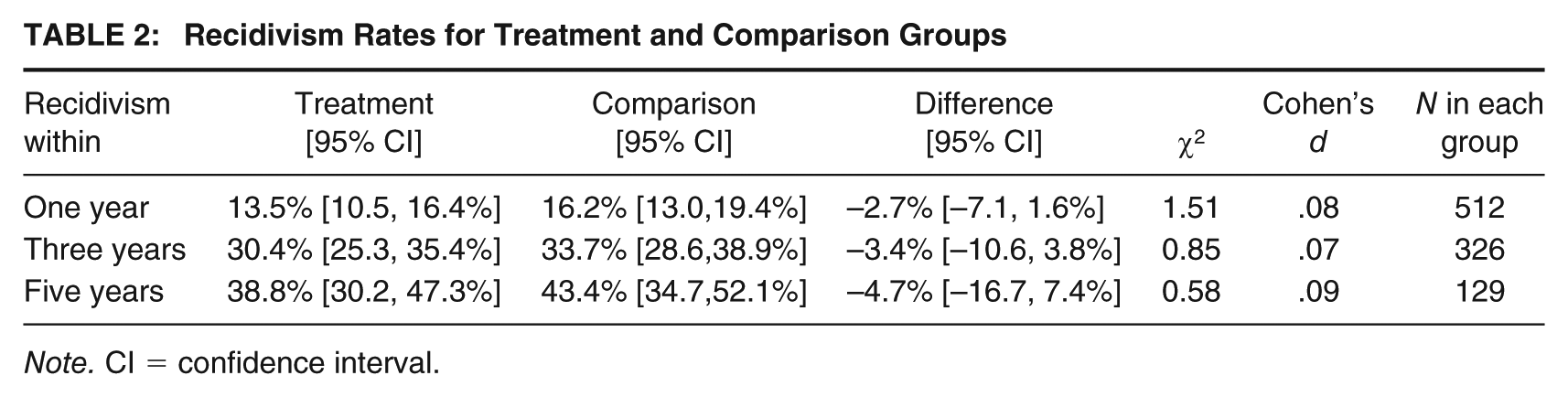
Table 2 presents the recidivism rates for the treatment and comparison groups 1 to 5 years after serving their prison sentences or completing treatment in the community court. The data indicate that, although participants in the treatment group generally exhibit lower recidivism rates compared with the comparison group, no statistically significant differences were found between the two groups.
Recidivism Rates for Treatment and Comparison Groups
Note. CI = confidence interval.
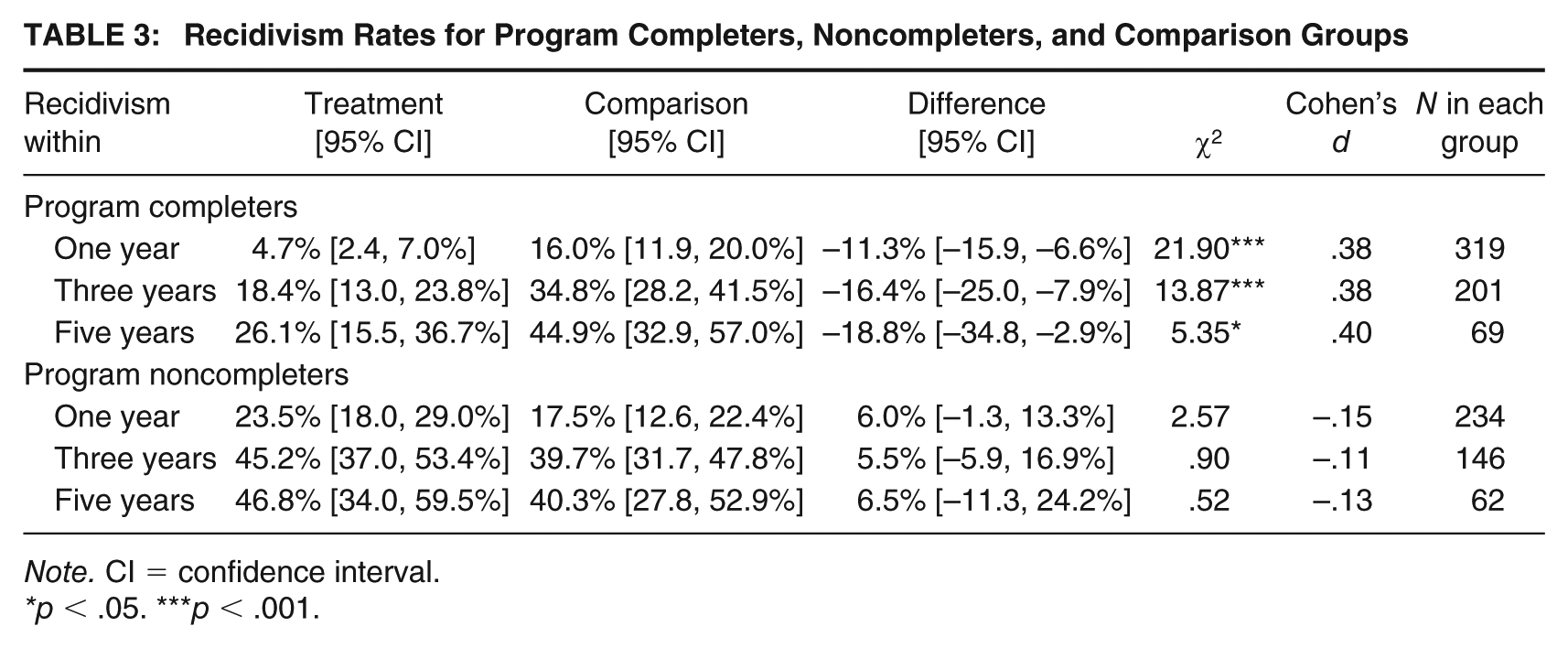
To further investigate these findings, we conducted an additional analysis that divided the treatment group into two segments: individuals from the community court who successfully completed the treatment program (program completers, n = 393) and those who discontinued participation before completing the program (program noncompleters, n = 293). It is unknown at what stage of the program noncompleters in the sample left it or how long they participated before leaving it (due to anonymity requirements by the police and court administration we were unable to receive some of the personal information relating to individual community court participants.). Nevertheless, aggregated data suggest that approximately 80% of noncompleters leave the program during the first or second stages of their treatment plan and only 6% leave it in the fourth or fifth stages. For each of these segments, we created matching comparison groups using the same procedures described previously, allowing us to compare the recidivism rates of program completers and noncompleters against their corresponding comparison groups (see Table 3).
Recidivism Rates for Program Completers, Noncompleters, and Comparison Groups
Note. CI = confidence interval.
*p < .05. ***p < .001.
Table 3 presents notable differences between the program completers and the comparison group concerning recidivism rates within one to five years after either serving the relevant prison sentence or completing the treatment in the community court. Individuals who completed the program successfully exhibited an 11.3% lower re-conviction rate within 1 year compared with the comparison group. Within 3 years, this difference increased to 16.4%, and within 5 years, it reached an 18.8% reduction in the likelihood of being re-convicted. Conversely, no significant effects were observed for the program noncompleters.
The effect of the program on completers is visually evident in Figure 1. Across all three time periods studied, the percentage of re-convictions consistently remained lower for program completers in comparison with the comparison group. Furthermore, these differences between the groups progressively widened with the duration of the follow-up period.
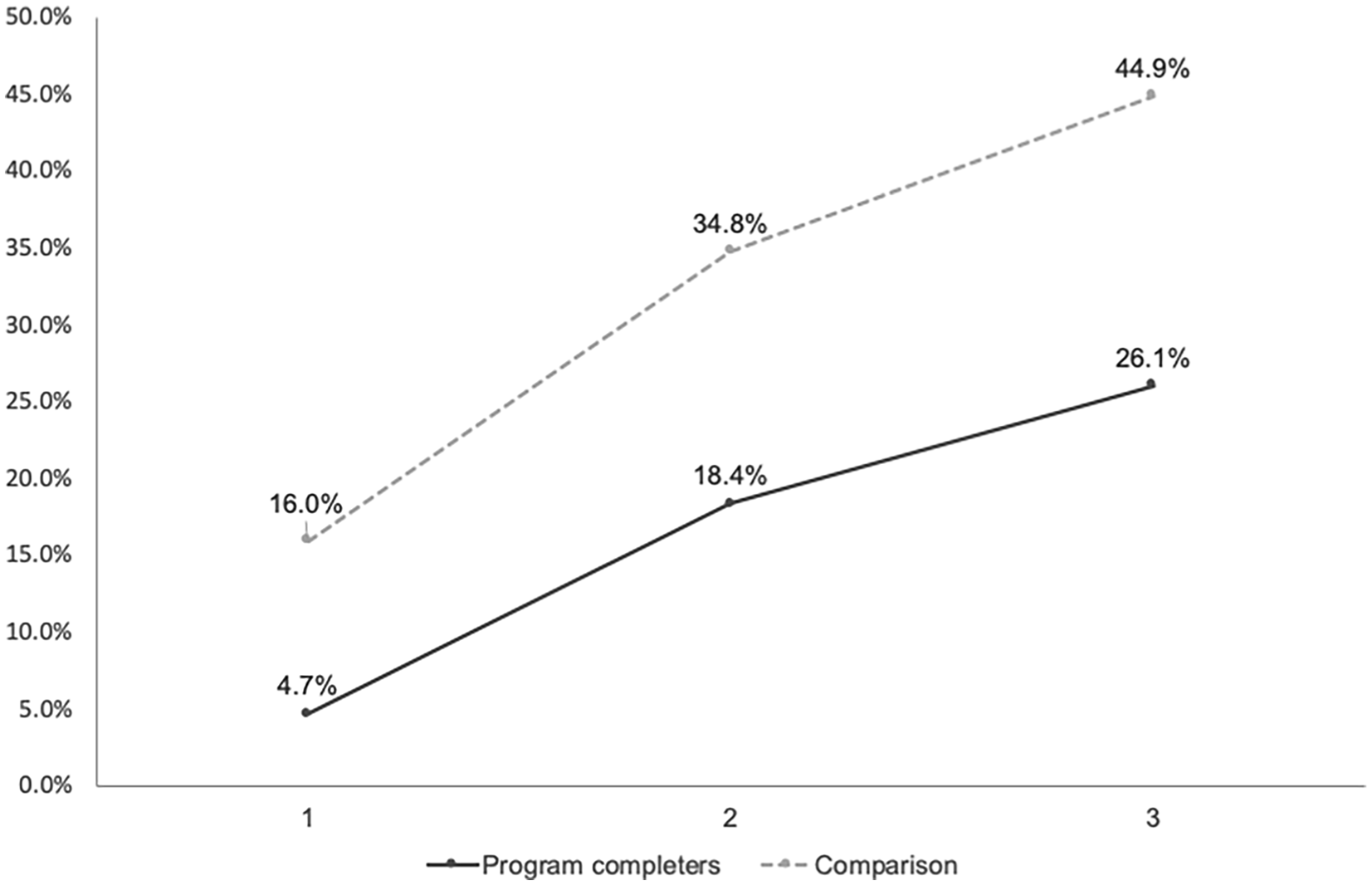
Recidivism Rate Within 1, 3, and 5 Years of Program Completers and Comparison Groups
Despite employing an extensive array of potential confounding variables and employing PSM to mitigate hidden bias (Shadish, 2013), concerns linger regarding unobserved variables not included in our analysis that might impact the outcomes. To assess the robustness of our results against potential biases stemming from these unobserved variables, we conducted the Mantel and Haenszel bounds (MHbounds) test (Aakvik, 2001; Becker & Caliendo, 2007; Kirk & Hardy, 2014; Rosenbaum, 2002). A Gamma value of 1 suggests the absence of hidden bias, whereas a value exceeding 1 indicates possible influence from unobserved variables. If Gamma becomes insignificant at lower levels, it may suggest reduced tolerance to unobserved variables in the analysis. It is important to note that the MHbounds test serves as an indicator of the study’s sensitivity to unobserved variables but does not confirm the existence or actual influence of such biases. As no significant effect was found for the treatment group in the first analysis and for the program noncompleters in the second analysis, this analysis of hidden biases was restricted to program completers.
The sensitivity analysis for program completers revealed that the MHbounds test becomes insignificant at the 0.05 alpha level for Gamma = 2.25 within 1 year, Gamma = 1.60 within 3 years, and Gamma = 1.20 within 5 years (which is the analysis that contains the smallest sample of 69 individuals in each group). These results suggest that concerns about bias arise only when an unobserved variable increases the odds of entering the treatment group by about 50% to 125% or decreases the likelihood of re-conviction in the treatment group by about 50% to 125% within the first 3 years and by 20% within 5 years. While no clear threshold exists for required Gamma values in the literature, these findings align with criminology studies indicating the robustness of results to potential violations of PSM assumptions (Hasisi et al., 2016; Haviv et al., 2020; Kirk & Hardy, 2014; Kirk & Sampson, 2013; Schaefer & Little, 2020; Wermink et al., 2010). 2
Discussion
Community courts, designed to address the specific needs of neighborhoods and communities plagued by high crime rates, have garnered attention for their potential to reduce recidivism among individuals involved in repeated offending. Inspired by therapeutic jurisprudence and procedural justice insights, these courts operate on the principles of problem-solving courts, emphasizing rehabilitation not only of the individual participant but also of the community affected by crime (Berman et al., 2005). Studies indicate that community courts can lead to lower recidivism rates by providing comprehensive, individualized support to program participants, and integrating services such as drug treatment, mental health care, and job training (Lee et al., 2013). However, many of the studies suffer from methodological limitations due to the difficulty in reaching a valid comparison group. The present study aimed at filling this gap by using PSM to match those referred to community courts in Israel and their similar counterparts adjudicated in magistrate courts in similar cities, but in a time prior to the establishment of each court.
Our findings suggest that referral to the community court does not increase recidivism. In fact, some levels of reduced reoffending were exhibited by community courts participants, but the difference did not reach statistical significance. With regards to noncompleters, no significant effects were observed as well, a notable finding in itself because they are the group most likely to demonstrate multiple encounters with law enforcement. This finding is important because one of the critiques against community courts and problem-solving courts in general is that, due to the high failure rate, they paradoxically increase the number of individuals being incarcerated, resulting in a “net-widening” effect (Hoffman, 2002). When considering the other benefits of community courts, such as an increased sense of procedural justice and legitimacy, strengthened relationships, and, above all, lower use of incarceration at the systemic level, it becomes clear that community courts are a desirable justice mechanism even when considering a high withdrawal rate.
When looking only at the completers of the community court program, the findings are conclusive: program completers are less likely to be reconvicted of a crime 1, 3, and 5 years after completing the program than people with similar demographic and criminogenic characteristics who were indicted in mainstream magistrate courts. The gap in recidivism measured through reconviction between the comparison and treatment groups, reaching almost 19% five years after completion and 15.5% on average across the three timepoints, is greater than the reduction in recidivism identified in most other studies among program completers, which suggests an average of 10% (Collins, 2021).
While we are unable to determine the reasons for such differences, we can offer some speculative explanations. First, the Israeli context presents a distinctive feature: its comprehensive public health and social security infrastructure, which ensures continued support such as free mental health and medical treatment for participants regardless of program completion status. Second, unlike most community courts, which focus on individuals committing low-level and nonviolent crimes, the Israeli ones specifically seek to include people with criminal records, who were indicted for crimes whose sanctions were up to 3 years, including violent offenses. By focusing on people who are deeply involved in criminal behavior, the community courts can be seen as high-risk–high-gain mechanisms. Successful participants evade incarceration, a likely outcome should their case be referred to a mainstream process, which in turn is a strong predictor of future criminality, but, because participants have a myriad of criminogenic challenges, the completion rate of approximately 50% is lower than in other models implemented with individuals with less complex backgrounds. Community courts that produced a statistically significant reduction in recidivism are those that, similar to the Israeli model, focused on the more serious offenses and individuals with more serious criminogenic needs (Hamilton et al., 2019; Ross, 2015; Somers et al., 2014; Westat, 2012).
The theories of therapeutic jurisprudence (Wexler & Winick, 1991) and procedural justice (Tyler, 2006) provide potential explanations for why problem-solving courts work (Kaiser & Holtfreter, 2016; Winick & Wexler, 2003). In the present study, it is reasonable to assume that the intensive treatment program and the implementation of therapeutic jurisprudence and procedural justice principles by court professionals contributed to the participants’ adherence to the treatment program and rehabilitation prospects. A recent qualitative study with participants in the Israeli community courts revealed that they had experienced procedural justice and therapeutic jurisprudence manifestations to a high degree. Echoing therapeutic jurisprudence knowledge, research participants described court personnel as expressing an ethic of care, to the point that they used words like family, parents, and love when speaking about the court personnel (Gal & Dancig-Rosenberg, 2024). Furthermore, quantitative data drawn from questionnaires filled by Israeli community court participants showed that experiencing the process as fair and having the opportunity to repair the harm done to the community were linked with increased willingness to obey the law in the future among program participants (Gal et al., 2022). Outside of the Israeli context, fairness perceptions have been linked with higher perceptions of legitimacy, which in turn are linked with reduced reoffending (Tyler, 2006). Research in this area suggests that a sense of belonging and the existence of interpersonal ties act as buffers against criminality, defiance, and social resistance (Factor et al., 2013; Langley et al., 2021; Sherman, 1993).
Notably, the gap between program completers and individuals in the control group increased with time. It is possible to speculate that over time, while program completers were motivated to maintain a normative lifestyle following their fair and benevolent treatment at the community court, individuals from the control group continued with their criminal behaviors and thus accumulated a growing number of recorded offenses, which is why the differences between the groups grew over time. Future qualitative studies with program graduates can provide further insights into their life trajectories, and long-term influences of the program.
What is the public policy significance of these findings? We speculate that, in addition to the societal and individual benefits associated with the reductions in reoffending among program completers, the benefits of the community courts associated with program noncompleters, their families and communities outgrow their cost. Most withdrawals take place in the first and second phases of the program, so it is possible to assume that the resources invested in them are relatively low. Court participants, whether or not reaching the graduation ceremony, experience an ethic of care and fairness, according to the unreported evaluation study (Gal et al., 2022).
Taken together, this study indicates that by prioritizing noncarceral sentences for individuals with repeated involvement in criminal behavior, community courts do not jeopardize public safety. In fact, they are associated with significantly lower recidivism rates among those who complete the program and possibly offer other benefits for both completers and noncompleters and their families.
Our findings may also offer some directions as to how to operate community courts. Despite the extensive theoretical writing about the common elements of community courts and other problem-solving courts contributing to their success (Kaiser & Holtfreter, 2016), empirical studies have demonstrated that the effectiveness of these courts can be inconsistent, often depending on the specific implementation and resources available within a community (Frazer, 2006). It is therefore important to understand how the Israeli community courts differ from other community courts operating elsewhere.
First, the Israeli model relies heavily on existing public mental health and physical health services. Policymakers considering the establishment of community courts should recognize the symbiotic relationship between these courts and public health care infrastructure. Community courts that accept people with chronic and significant criminogenic needs necessarily rely heavily on health, mental health, and social services (Somers et al., 2014); without such infrastructure, court operations may become both more costly and less effective. Simultaneously, the combination of judicial monitoring and potential incarceration can motivate participants to accept assistance they might otherwise have rejected outside the criminal justice process.
In addition, the Israeli model accepts individuals charged with relatively severe offenses and with substantive criminal records, compared with most other community courts worldwide. This focus addresses the concern against the net-widening effect, where individuals who might otherwise avoid formal legal intervention are drawn into the criminal justice system (Hoffman, 2000). For individuals facing serious charges and carrying significant criminal histories, the assumption that they could avoid adjudication by refusing the community court option is unfounded. The findings of this study suggest that by accepting people involved in repeat and often violent offending, community courts reduce the overall use of incarceration without increasing recidivism rates. Therefore, policymakers responding to public demands for decarceration should consider community courts as a viable alternative to traditional punitive approaches. Ideally, future studies should test and compare the effect of community courts with diverse eligibility criteria on recidivism. Furthermore, implementation studies can examine how different community court practices are linked with their success and with completion rates, for example, differences in length and composition of the treatment program, the participation of specific roles in the court personnel and so forth.
The present findings should be interpreted in light of the study’s limitations. First, due to practical constraints, similar to other studies, we were unable to conduct a fully randomized controlled experimental trial, which may introduce selection bias. However, we employed PSM to minimize differences between the groups and create comparable groups based on known and available characteristics. Second, our research design, relying on official data, precluded access to several important measures, such as levels of inner motivation and strength of support networks—variables known to impact rehabilitation prospects and successful completion of court programs (Maruna, 2001). We were also unable to include in the analysis further details about the nature of recidivism, including the type of offenses. Third, due to confidentiality restrictions we could not gain access to exact dates of program departure relating to noncompleters. Future research endeavors may consider incorporating these measures into their analyses and explore factors that may influence the successful completion of the program, by interviewing program completers and noncompleters and a sample from a comparison group. Additional studies should also strive to examine the recidivism effects of community courts by type of offense and other, more nuanced outcomes. Finally, although we conducted a 5-year follow-up, the participant count during the final period was relatively small. To enhance the robustness of our results, it is desirable to achieve validation through a longer follow-up period with a larger sample size.
In conclusion, by using an appropriate control group, longitudinal data, and rigorous matching techniques, this study aimed to overcome some of the methodological challenges faced by previous studies in measuring recidivism rates in the context of community courts. In doing so, the present study offers results that validate the efficacy of these courts and identify best practices that can be replicated across different settings to combat the revolving door phenomenon (MacKenzie, 2006). By offering recidivism data a year, 3 years, and 5 years after completion of the legal process or the resulting incarceration sentence, the study offers a longitudinal perspective that other evaluation studies were unable to provide. Our findings suggest that the effect of the community court on recidivism rates among program completers may in fact be even more significant as time passes. While community courts hold promise for reducing recidivism and improving community outcomes, policymakers should rely on rigorous, methodologically sound research to fully understand which practices and eligibility criteria are likely to produce maximum effectiveness.
Footnotes
Authors’ Note:
This study was funded by Joint-Ashalim (Grant No. 205085).
