




Abstract
Existing literature rebutting the “African gangs” construct in Australia has mostly been dominated by Western knowledge, with little attention paid to African ways of knowing. This construct harms many Australians marginalized by media-perpetuated preconceived notions. This study aimed to address this gap by incorporating African epistemology and ontology into the discussion based on semi-structured interviews with 13 African Australians. Findings revealed that the term gang is not a recognized word or concept in many African Australian languages. This linguistic disparity can lead to cross-cultural misunderstandings. Young African Australians are vulnerable to exploitation by organized crime groups, who recruit disengaged youth to commit offenses for financial gain, thereby exposing them to debt and violence. Focusing on the “African gangs” narrative conceals young people’s vulnerability to victimization. The findings contribute to a deeper understanding of African Australians and can strengthen the capacity for stakeholders to work jointly to address these problems.
Melbourne, Australia’s second-largest city with over 5 million residents, is renowned for its rich cultural and linguistic diversity and large foreign-born population (Australian Bureau of Statistics, 2022–2023). As a significant multicultural hub, Melbourne provides a compelling case for examining the complex interplay between migration, crime, and community dynamics in urban settings. Although national censuses do not provide exact statistics, Melbourne’s African Australian community is estimated to be proportionally higher compared to other Australian cities. This demographic landscape highlights Melbourne’s status as a multicultural metropolis, both within Australia and globally, providing a rich backdrop for exploring the associated societal challenges and opportunities. The city’s complex social fabric exemplifies the necessity for nuanced, empirically grounded research and targeted interventions to address emerging issues and enhance community safety.
Melbourne’s African Australian population is culturally diverse but socially, economically, and politically marginalized, leading to youth criminal involvement (Maher et al., 2022). In March 2016, the Australian media extensively covered the Moomba riots, framing African Australian youth as out-of-control criminals (Benier et al., 2018). In 2018, several crimes committed in Melbourne by young African Australians were well publicized (Shepherd & Spivak, 2020), prompting politicians to assert that Melbourne was threatened by “African gangs,” amplifying public fear and misconceptions about the African Australian community (Benier et al., 2021). Community members have been stereotyped and racialized with hate-filled terms such as “Apex” or “African gangs” (Majavu, 2020). However, the media has decreasingly used the term “African gangs” likely due to the realization that politicians’ tough-on-crime policies have shown limited effectiveness. Nonetheless, its impact remains.
African Australians challenged these negative stereotypes by sharing personal stories online, using #AfricanGangs to showcase their achievements and societal contributions (Moran & Gatwiri, 2022). This movement aimed to foster pride, resilience, and identity among African Australians, emphasizing the importance of education, cultural heritage, and positive role models. Arguably, the #AfricanGangs movement could have inadvertently reinforced stereotypes by emphasizing the “gang” label. However, reclaiming and reshaping the narrative is necessary for empowerment and social change.
Several studies have addressed the issue of “African gangs.” Windle (2008) and Benier et al. (2018) investigated the media’s tendency to racialize, politicize, and criminalize young African Australians. However, they did not link this knowledge to the African paradigm and lacked a contextual approach incorporating African perspectives on crime. Majavu (2020) notes this approach’s importance but does not offer insight into African ways of knowing. Maher et al. (2022) noted that youth offending can intensify intercultural and intergenerational tensions; however, the role of the African view of crime in exacerbating these tensions remains unexplored. Thus, Western epistemologies have dominated the extant literature, rebutting the “African gangs” construct with little consideration to African ways of knowing.
This study aims to complement those efforts and bridge the gap between these approaches, responding to Afrocentric scholars’ call to value all available ways of knowing to comprehensively understand the issue, in the African context, acknowledging that such involvement is not always feasible or practical (Chimakonam & Ogbonnaya, 2021). This approach should not be considered territorial, xenophobic, or anti-intellectualistic. The study’s unique contribution is two-fold. First, the primary contribution lies in its incorporation of African epistemologies into the study design and data interpretation, infusing distinct African perspectives into the discourse surrounding gangs in Australia. This approach highlights the values of African knowledge systems and avoids reinforcing Western-centric perspectives. It extends traditional frameworks by enriching the topic with insights rooted in African thought, expanding the understanding beyond past empirical findings. This methodological rigor is showcased in section “Methodology,” where this article details the steps taken in this study to mitigate the dominance of Western knowledge paradigms. This sets a precedent for future studies to adopt similar practices. Such methodological components are crucial for enhancing the reliability of research findings, which in turn fosters improved research design. Future studies can replicate these methodological strategies to validate and expand upon the current findings, uncover errors, or biases present in previous studies, leading to more accurate and nuanced understandings of the subject matter.
Another important merit of this article is its use of a participatory methodology, where individuals directly affected by the topic are involved as co-researchers, and a phenomenological method suitable for investigating cross-cultural lived experiences in various social contexts, acknowledging both researcher and participant subjectivity. These methodologies not only highlight the value of African ways of knowing but also underscore the importance of engaging activists and affected individuals in the knowledge co-production process. Subsequent research can benefit from adopting both approaches with diverse samples and cultural contexts. Such replication will help determine the generalizability of the findings and assess their consistency across different settings, contributing to a more comprehensive understanding of the subject. Both strengths—the methodological rigor in integrating African knowledge systems, phenomenological and the participatory approach—can greatly advance the discourse on African ways of knowing and stakeholder involvement in research. These components not only enrich the current study but also provide a robust framework for future research endeavors.
This article is organized as follows. The next section provides a definition of “Australian” and an overview of “African gangs” in Australia and Africa. The African ways of knowing and data collection methodology are described. The findings section presents an analysis of the empirical results. The conclusions, practical implications, and future directions are presented. This research seeks to examine the “African gangs” through African epistemologies.
Definition of “Australian”
For this article, I approach the concept of “Australian” through the lens of passport nationality. This is because an Australian passport signifies that the holder is an Australian citizen, regardless of their place of birth. Nationality (or citizenship) implies that one is a citizen of a country, enjoying the rights and protections that come with it. This perspective is inclusive, suggesting that being “Australian” refers to anyone who is a citizen of Australia, irrespective of ethnic, religious, or cultural background. Australia’s diversity encompasses Indigenous Australians (Aboriginal and Torres Strait Islander peoples) and immigrants from European, Asian, Middle Eastern, and African backgrounds. This definition highlights a range of identities shaped by Australia’s multicultural society. These are what makes someone Australian as they are officially recognized by the Australian passport.
However, as explained below, what makes someone Australian is sometimes defined by the values and experiences of Whiteness. Historically, the “White Australia” policy restricted non-European immigration to maintain a predominantly White population. The Immigration Restriction Act of 1901 exemplifies this exclusion. This perspective aligns with conservative politicians and media narratives, where being White was considered more significant than one’s birthplace, citizenship, or holding Australian passport. From this approach, there has been a clear public discourse creating a racialized connection between being African and being criminal. For example, in 2018, the Australia’s former ministry of Home Affairs, Peter Dutton (as cited in Cunneen, 2020, p. 6) argued that people avoid going out at night due to fear of “African gang violence,” claiming that such individuals “don’t belong in Australian society.” When Dutton made such statements, he was not just describing a social phenomenon—he was actively participating in the criminalization of African Australian youth sociality. This demonstrates how racial othering becomes institutionalized. Hopkins (2020) asserts that such labeling and categorizing contribute to law enforcement’s normalization of Whiteness while criminalizing and devaluing non-Whiteness.
While the 1901 Immigration Restriction Act formally ended with the dismantling of the White Australia Policy in 1973, its legacy persists in contemporary immigration practices. For example, Section 501 of the Migration Act 1958 gives the Minister broad discretionary powers to cancel visas on “character grounds.” Like the notorious dictation test of the White Australia Policy, which could be administered in any European language to exclude non-White immigrants, today’s character test can be applied selectively. The continuity between historical exclusion and contemporary practice is evident in cases where many young South Sudanese people are currently in immigration detention for serious offending comparable to those of White Australian youth.
An additional complication lies in how non-White Australians perceive their identity. Many former immigrants, including myself, may feel insecure about their Australian-ness. Although I identify as Australian, I recognize that others may not perceive me as such purely due to the “racialized” nature of my Black skin in a predominantly White society where Whiteness is normalized, and non-Whiteness is systematically racialized (Hopkins, 2020). My sense of being Australian is tied to my citizenship documents; without them, I risk denaturalization or revocation, which would sever my legal identity and my connection to Australia. This subjective experience underscores the complexities of national identity in a diverse society. From the first and third perspectives, this research sample is Australian.
Theoretical Implications
This analysis reveals how the “gang” label functions as what Essed (2008) terms an “everyday racism”—seemingly neutral language that carries and reinforces racial hierarchies. The selective application of the term “gang” to African Australian youth gatherings, while similar gatherings of White youth are described as “groups” or “social circles,” demonstrates how language serves as a tool of racial othering. This selective application of criminalized labels to African Australian community activities demonstrates what Goldberg (2002) identifies as the “racial state” in action, where administrative and discursive practices combine to maintain racial hierarchies.
“African Gangs” in Australia
This study aims to challenge the existence of “African gangs” and this term’s use in Australia. To do so, a definition of “youth street gang” is first required. The connection between “African gangs” and “youth street gangs” lies in their shared marginalization, collective identity, high public visibility, and association with public disorder.
There is no specific Australian definition of a “gang.” This is important in determining whether the “African gangs” phenomenon should be primarily perceived as a matter of juvenile delinquency or regarded as “organized crime” akin to Australian ganglands and other organized criminal groups. Australian literature disagrees on what constitutes a “gang” owing to variations in the gangs’ structures, geographical locations, ages, ethnic origins, migrant status, and social classes (White, 2013). In addition, other jurisdictions (e.g., the United States and the United Kingdom) have their own definitions and applications regarding the term “gang” (Hallsworth & Brotherton, 2011). To start, this research adopted Hallsworth and Young’s (2005, p. 66) definition of a “youth street gang”: “A relatively durable, predominately street-based group of young people who see themselves (and are seen by others) as a discernible group for whom crime and violence is integral to the group’s identity.”
Accordingly, an African gang is labeled as a group of young African Australians, particularly those of South Sudanese heritage, who are perceived as engaging in criminal activity as part of their group identity in Melbourne. This label originates from a broader social process of “othering,” which contributes to the stigmatization of these groups—not solely for criminal behavior, but because they are perceived as outsiders based on their ethnicity, class, or immigration status. These “African gangs” do not, in fact, exist, as will be shown.
The “African gangs” narrative is geographical and race-specific. It has a geographical indication with a political agenda identifying young people as originating from Africa while associating any negative characteristics as attributable to that geographical origin (Majavu, 2020). The term “African gangs” has three important characteristics: African (as in non-White Australian), Black (in appearance), and foreigner (outsider) through which Black African Australians are ostracized, excluded, and criminalized. The primary purpose of assigning a geographical indication within “African gangs” is an attempt to redefine, restrict, and betray the Australian identity’s inclusive nature by refusing to accept the African Australian community as an integral part of Australia.
Since these “gangs” are seen as outsiders, they are more susceptible to being accused of crimes and are, therefore, perceived as a threat to White Australian definitions of Australian society (Majavu, 2020). This perception elicits racism and intergroup violence, as was observed during the 2005 Cronulla race riots in Sydney, where Anglo-Australian people violently attacked Australians of Middle Eastern origin. However, the White offenders were not assigned the label of “European gangs”; their Australian identity was unquestioned. This is because society takes a more optimistic view of White offenders’ characters while not affording the same privilege to non-Whites, as exemplified by the 2016 Moomba incident.
“African Gangs” in Africa
How society views crime is interconnected with its values, beliefs, and cultural norms, which collectively influence its response to criminal behavior and attitudes toward rehabilitation and punishment. While traditional African justice systems vary culturally, historically, and politically, they share commonalities. When managing juvenile offenses, traditional African justice systems tend to focus more on restorative justice, rehabilitation, and integration rather than seeking vengeance against delinquent youth (Duany, 1992).
This approach sharply contrasts with the colonial-style methods observed in the United States, where police gang enforcement often adopts a more punitive stance toward youths (Hallsworth & Brotherton, 2011). Australian authorities have implemented various strategies to address gang-related issues, including law enforcement actions, focusing on both punitive measures and preventive strategies (Benier et al., 2021). This contrasts with some approaches in Africa, where treating young offenders as individuals needing support and rehabilitation (Duany, 1992) is more strongly emphasized. This comparison highlights the cultural and systemic differences in managing youth involved in delinquency and how these differences impact reparation and punishment practices.
In the author’s Nuer culture, disciplinary measures for children are characterized by leniency. Incarceration is not used as punishment, representing a novel concept within the cultural framework (Duany, 1992). Traditionally, a young person may be physically punished immediately; there would be neither a criminal record ruining the child’s future nor a juvenile prison separating young people from their families, communities, and culture. This approach prevailed because traditional justice structures were designed so that “. . . the needs of children are the concerns of neighbours and relatives [and even strangers], and not of the parents alone” (Evans-Pritchard, 1940, p. 21). This is illustrated with the well-known African proverb, “it takes a village to raise a child,” demonstrating African society’s long-standing “best interest of the child” principle. Many such practices are changing due to modernization, leading to the gradual erosion of traditional African child-rearing frameworks, which may increase the likelihood of juvenile delinquency. Thus, African Australian parents face challenges in recreating these support systems in new cultural and legal contexts.
Historically, in the Nuer culture, offenses are not criminally codified in the Western legal sense but in terms of right and wrong, and legal responsibility is acknowledged through restoration, tort, and moral responsibility (Evans-Pritchard, 1940). Hence, payment of compensation rather than incapacitation or incarceration is a consequence of transgressions (Evans-Pritchard, 1940). This ensures the victim’s compensation, the perpetrator’s integration into society and, ultimately, the maintenance of societal peace. Some South Sudanese Australian parents may not understand why they cannot pay compensation for stolen goods rather than the child being arrested. Giving children a criminal record constitutes child abuse and neglect of their futures, as it can affect all aspects of their lives, from limiting future employment opportunities to restricting access to education and housing. Labeling young people “criminals” can affect mothering and “parental efficacy . . . and exacerbate intercultural and intergenerational tensions,” increasing family stress (Maher et al., 2022, p. 1).
In African societies, elders play a central role in administering justice (Duany, 1992). For instance, if a child is caught stealing, the victim may discipline the child, inform the child’s parents, and ask for compensation. If the parents refuse to pay, the victim may ask the elders—who are considered neutral and well-informed individuals regarding the people and context, unlike “impartial” strangers, such as judges in the Western justice system—to discuss the matter and arrive at a consensus. Generally, disputants accept the elders’ verdicts by virtue of their seniority and wisdom. Every elder decision is made through consultation and consensus. However, true consent may not be achieved due to pressure from leaders or the community.
Consistent with previous literature (Fitzgerald et al., 2023), traditional African justice principles recognize that longer custody stays can turn infrequent young offenders into repeat and hardened criminals through the influence of experienced offenders, institutionalization, entrenchment, and stigma, hindering community reintegration. It can exacerbate and prolong issues, inducing rather than preventing criminal activities. Bail leading to multiple short custody stays results in young offenders circulating in and out of custody with high recidivism rates, accumulating many charges.
African Ways of Knowing
Previous studies (Maher et al., 2022) have examined the factors responsible for African Australian youth offenses and the role of social and cultural dynamics. While these studies utilized co-design principles and focused on participants’ experiences, their research methods and theoretical frameworks were mostly based on Western academic traditions. This finding does not discount the significance of previous research. Instead, this article extends previous work and contributes to the emerging literature on the “African gangs” debate by presenting “an African culture-inspired perspective to knowledge” (Chimakonam & Ogbonnaya, 2021, p. 135). This qualitative research encompasses African ontology (way of being) and epistemology (way of knowing)—holistic approaches that include subjective, lived experiences—recognizing that facts can be subjective to observers.
African ways of knowing refer to distinct and diverse cultural and educational practices rooted in African philosophical worldviews (Ngara, 2007). While African societies enjoy cultural diversity, African ways of knowing, being, and doing share certain commonalities, as follows. African epistemology emphasizes diverse knowledge systems’ value, recognizing various ways people acquire, transmit, and utilize knowledge. African beings, cultural context, and experiences are linked by the African epistemology, similar to how the neck connects the head and body—remove the neck, and both become extinct. Thus, African knowledge systems’ distinct approach to delinquency deserves to be fully and fairly evaluated for its merits and should never require Western knowledge for validation (Chimakonam & Ogbonnaya, 2021).
The existence of various juvenile delinquency theories demonstrates that no single theoretical orientation can adequately explain crime or its causes. These problems can be addressed by combining African ways of knowing with other knowledge systems to provide a comprehensive explanation of crime. This is what Harambee, a Kiswahili word that means “all pull together,” represents in this research context. By viewing crime prevention as a shared responsibility, Harambee stresses that it takes a village to reduce crime.
African societies are collectivist and kinship-oriented based on an accountability reciprocity system (Duany, 1992). Mutual social responsibility prevails such that a person is not just an individual but part of a system or community with community duties. In turn, the community has responsibilities toward this person, as one’s actions and decisions impact the broader community, as exemplified by Ubuntu (“I am because we are”). This principle calls for research methodologies reflecting culturally sensitive knowledge production, including academically appreciating the subjectivity of the lived experiences of the researched community. Using Ubuntu and Harambee, African Australians engaged in the #AfricanGangs initiative are likely strengthening their sense of community, empathy, and understanding.
African epistemology recognizes that intellectual reasoning is insufficient for acquiring knowledge, valuing lived experiences and emotions, which aligns with restorative justice principles, and accepting that different knowledge forms complement each other (Chimakonam & Ogbonnaya, 2021). The negation of other ways of knowing “perpetuate[s] a belief in the superiority of Western knowledge systems,” fostering “racialized inferiority of Indigenous peoples and their knowledge” (Cunneen & Rowe, 2014, p. 54).
Methodology
Research Design
This study employed a qualitative phenomenological approach to investigate the lived experiences of African Australians in Melbourne regarding the “African gangs” narrative. The research design was structured to elicit rich, descriptive data that captured the participants’ nuanced perspectives, although it faced unexpected challenges due to the coronavirus disease 2019 (COVID-19) pandemic. To answer the research questions, I conducted interviews with 13 African Australians; analyzed the data qualitatively; and situated the responses within the larger field of criminology.
Participant Recruitment and Sampling
The initial recruitment targeted participants over 18 who had lived in Melbourne for more than 2 years, based on two key considerations. This age range eliminated the need for parental consent while ensuring participants had sufficient exposure to Australian media and politics. The decision to conduct in-depth interviews with these participants was driven by their unique positioning as cultural navigators who straddle multiple worlds. Their professional achievements and community engagement make them valuable informants on both the challenges faced by African Australian youth and the strategies developed to overcome these challenges. While their educational and professional accomplishments might suggest “successful integration” by mainstream standards, their experiences reveal persistent patterns of racial othering that transcend class and educational boundaries. Through their narratives, we can gain insight into how racial profiling and criminalization affect even the most “successful” members of the African Australian community, challenging simplistic narratives about integration and belonging.
This study initially used purposive and snowball sampling via community organizations and cultural groups; however, the COVID-19 pandemic forced a shift to virtual recruitment due to lockdown restrictions. The researcher adapted to this shift by using social media and emails to connect with participants. This shift impacted sample diversity and recruitment numbers. Although the target was 30–40 participants, only 13 were recruited owing to the challenges posed by virtual methods. Despite this smaller sample size, it was qualitatively sufficient for identifying key themes and drawing insights into perceptions of the “African gangs” narrative. The adaptations made under these constraints allowed the study to proceed and provide valuable findings.
Participants, known to the researcher in professional and community contexts, were selected for their expertise, leadership, and knowledge of issues affecting African Australian youth. Previous studies have provided insight into South Sudanese Australians’ experiences. However, better understanding the “African gangs” phenomenon’s impact (if any) on other African Australians is important. Recognizing that the labels and “othering” extend beyond South Sudanese Australian populations and affect broader African Australian populations is essential for serving the entire African Australian community. Assuming the generalizability of South Sudanese Australians’ experiences for all African Australians may overlook factors unique to different groups; assuming generalizability is not necessarily an error but rather a potential limitation of previous research.
Interview Structure and Demographic Overview
To comprehensively understand the topic, I interviewed 13 Australians from various backgrounds (Ethiopian, Ugandan, Kenyan, Zimbabwean, and South Sudanese), reflecting a broad spectrum of cultural backgrounds within the African Australian community. Recent immigrants and long-term residents were represented in the sample. Socioeconomically, the sample included students, working professionals, and individuals from lower-income backgrounds. This sample diversity is a strength, as it allows the exploration of varied subjective experiences, shared perspectives, and responses to the phenomenon.
Respondents (six females and seven males) were aged 24–49 years. Approximately 20% were in their 20s and 30% were in their 30s and 40s. The selection of age groups was not pre-determined. It emerged naturally during the interviews. This approach allowed for an organic understanding of the age demographics relevant to the study. During the interviews, participants were asked about their country of origin and place of birth: only one participant was born in Australia; the rest were born in their respective countries of origin. All participants were actively engaged with the African Australian community. The participant characteristics are listed in Table 1. Each respondent was given pseudonym to protect their anonymity.
Data Coding and Analysis
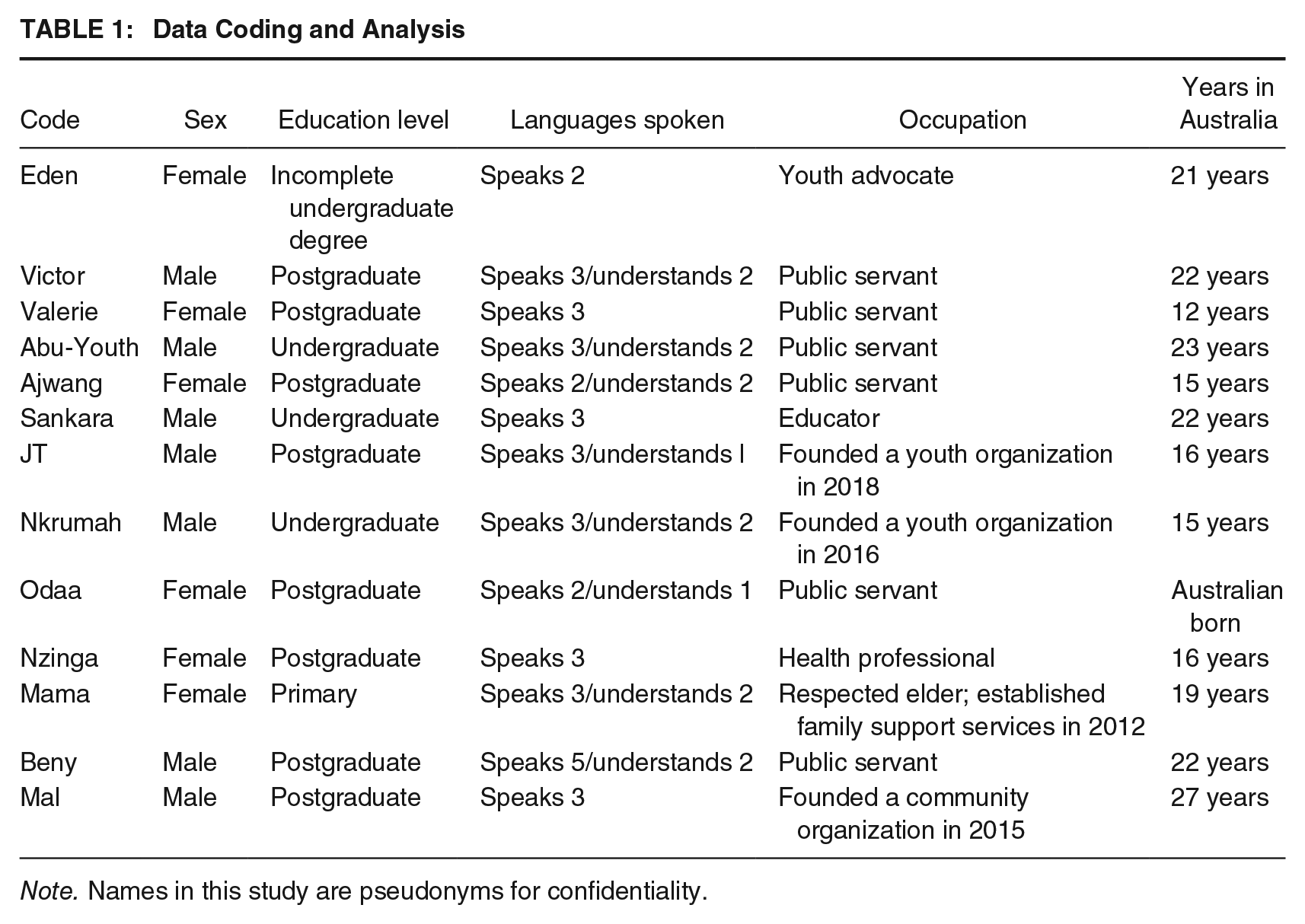
Note. Names in this study are pseudonyms for confidentiality.
Culturally sensitive methods were used to create a safe and inclusive environment for participants to express their perspectives. For example, during individual interviews, elders were given priority to be the first to speak, allowing them to share their perspectives and insights before the interviewer posed questions. This protocol respected their eldership status. In addition, the author showed deference to older participants by refraining from making direct eye contact where appropriate. Participants were asked to choose their own pseudonyms. This approach respects their identities and enhances anonymity while reflecting how they wish to be perceived. These practices established trust and created a supportive atmosphere that encouraged open and honest expression of perspectives.
Interviews revealed that all participants were fluent in two to five languages including Arabic, Nuer, Dinka, Shilluk, Kiswahili, Luganda, Amharic, Afaan Oromoo, Shona, and English. Their multilingual proficiency enhances their ability to interpret the term “gang” across various linguistic and cultural contexts. Therefore, despite the study’s limited sample size of 13 participants, their diverse language skills significantly augment the depth and breadth of insights gathered. For instance, a participant fluent in five languages potentially offers perspectives equivalent to those of five monolingual individuals, each representing a distinct linguistic background. This linguistic diversity compensates for the small sample size and provides a richer, more nuanced understanding of the term’s cross-cultural implications.
Owing to the COVID-19 pandemic, interviews conducted via Zoom were recorded (with consent) and transcribed. An interview with one participant was conducted over the phone in their native language, recorded using Voice Memos on a MacBook computer, and translated into English. Although the COVID-19 pandemic may have influenced participants’ narratives, their professional experiences and community leadership roles likely enabled them to convey original accounts that went beyond the crisis. Some participants founded community organizations before the 2018 #AfricanGangs narrative, suggesting that their experiences helped them understand pre-COVID-19 inequalities, racism, and the way the pandemic exacerbated these issues. Their expertise and engagement in various domains added depth, authenticity, and authority to the collected data, allowing a comprehensive understanding of the “African gangs” discourse and its community impact.
Data Analysis
Audio recordings were transcribed verbatim and analyzed through iterative readings to grasp context and meaning. Following Alase’s (2017) interpretative phenomenological approach, the researcher identified and coded recurring concepts through line-by-line analysis. These codes were then categorized into themes aligned with the research objectives about media representation of South Sudanese Australians. The analysis progressed from descriptive to interpretive coding, with broad topics refined into specific themes. Through member checking, participants reviewed their transcripts and edited their statements for accuracy and relevance to the “African gangs” narrative. This collaborative approach enhanced the credibility and authenticity of the findings.
Theoretical and Ethical Considerations
Reflexivity
This article is dedicated to the memory of a valued participant in this research, dear friend, colleague, and mentor who passed away before publication. Their invaluable contributions were crucial to this work, with a lasting impact on both the research and my personal journey. The author is a social worker, criminologist, and strategist with extensive experience in youth justice and a member of the African Australian community with close ties to affected communities; thus, I reflected on my positionality, biases, and cultural assumptions, which enabled me to identify my knowledge gap. I worked to fill this gap by seeking participants’ feedback on the findings to ensure that the data interpretations aligned with the participants’ lived experiences. Because of my professional experiences, I recognize the delicate balance required in conducting interviews and analyzing data. I acknowledge that my insider perspective inevitably influenced my approach to this research. While I strive for objectivity, aspects of my background shape my research process and interpretations and may lead me to focus on certain issues more intensively or interpret data in ways that align with my personal and professional values. Regular consultations with peers from various backgrounds helped me to manage these biases, challenge and refine my interpretations, and ensure a more comprehensive view of the issues and a balanced analysis.
The decision to conduct in-depth qualitative interviews was driven by the understanding that personal stories and experiences provide crucial insights that are often not captured through other methods. This approach allowed me to gain a deeper understanding of participants’ lived experiences and the systemic challenges they face. Phenomenology was used as a guiding philosophy, and the focus on personal narratives aimed to reveal the affected communities’ nuanced realities. To enhance this approach’s rigor, I carefully considered the design of interview questions and maintained a consistent approach in data analysis.
Participants provided deeper insights into the systemic challenges these communities face. They highlighted critical issues such as unsafe school environments marred by racial discrimination and profiling. The conversations underscored the urgent need to address these problems to break the cycle of violence and create a positive future for upcoming generations.
Ethical Considerations
The ethical application for this study was approved by the University of Melbourne. Participants were provided with a plain-language statement with information on their right to withdraw, and each of them provided informed consent. The researcher shared some linguistic and cultural backgrounds with the study population, facilitating a transparent dialogue. The author was conscious of potential power imbalances, including cultural factors, gender, and educational differences between themself and some study participants, working to promote an equal transmission of ideas and knowledge.
Ethically, Ubuntu calls for researchers to approach their work with empathy and genuine concern for the target communities’ well-being. In the early research stages, four young African Australians died in a car accident, and two ended up in critical condition; thus, the author was grieving. A co-worker comforted the author, reflecting, “It is just so sad . . . young people have gone in their prime, the false promise of the ‘lucky country,’ frustration and anger at young men who get caught up in risky situations, overwhelming community grief and sadness.” The author underestimated the communitarian values and interdependence of the researched community. Ubuntu explains how African epistemology relates to African ontology. As Chimakonam and Ogbonnaya (2021, pp. 169–170) noted, “there is an ontological interconnectedness of persons to persons since they are inextricably bound to one another.”
African ways of knowing were examined to further demonstrate their merits and usefulness in the hopes of encouraging others to incorporate them in their research. The potential influence of researcher biases in the analysis must be acknowledged. However, pure impartiality is unlikely as knowledge is influenced by background, perceptions, experiences, reasons, interpretations, societal stereotypes, and cultural contexts (Smyth & Holian, 2008).
Analysis and Findings
African Australian Community Perspectives on the “African Gangs” Discourse
Leading up to the 2018 Victorian state election, the questions, “Who are the ‘African gangs’” and “Do they exist in Melbourne?” were debated within and beyond the African Australian community. Professor Rob White and colleagues asked a similar question in 1999 in their study titled “Ethnic Youth Gangs in Australia. Do They Exist?” concluding that young people’s “ethnic background and identity were often equated with gang membership” because racism influences how Australian society perceives ethnic groups’ delinquent behavior (White et al., 1999, p. 39). This involves measuring Australian ethnic cultures against White characteristics and values as the gold standard, which can lead to “the adaptation of pre-existing institutional racism and racializing narrative frames to a new target in Australia” (Windle, 2008, p. 554). Thus, the “African gangs” crisis was precipitated by recurring ethnic youth targeting; the African Australian community was a new scapegoat for long-standing racism.
Against this backdrop, participants were asked to define the term “gang” in their native languages. Their comments confirmed that this term does not exist in their native languages. As Eden, a 24-year-old antiracism activist, who speaks Nuer, Arabic, and English, noted: “I can’t define the term gang in Nuer because I don’t think that it exists in Nuer.” Valerie, a director in State government who speaks Swahili and English, remarked; “Labeling people with this negative connotation, such as ‘African gangs,’ is a foreign concept to us. It is not even reflected in our languages.”
It could be argued that young people raised in Australia have adopted Australian attitudes and behaviors; thus, African terminology might be irrelevant. Therefore, the Australian terminology (poorly directed or otherwise) is appropriate. If one accepts this argument as valid, one must accept the conclusion that “African gangs” do not exist in Melbourne because the participants were raised in Australia. They have “held Australian citizenship in many cases and received education within the Australian school system” (Victor, a law postgraduate and community leader who works as a public servant) and have adopted Australian attitudes and behaviors. It would be a misnomer to label such individuals as members of “African gangs”—they are Australians.
Participants were asked whether they believed in the existence of “African gangs” in Melbourne. Eden explained, “I don’t think there are ‘African gangs’ but [rather] a group of youth trying to find a place to belong . . . a sense of belonging and identity influencing the formation of youth-offending networks.” Victor, commented on othering as follows: “We are Australian; if gangs exist, they should be [called] Australian or Victorian gangs.” Since the participants are Australians, the existence of “African gangs” in Melbourne is a logical contradiction. Government ministers do not refer to individuals of African descent serving in the Australian Defence Force as the “African Defence Force”; White immigrants from England who engage in crime are not referred to as “European gangs.”
Participants rejected the “Apex/African gangs” stories as myths ascribed to young African Australians by the media. Abu-Youth, a youth worker with a background in Legal Studies who supports young people in the juvenile system and the community, explained: Apex [was the name of] a musical group that included young South Sudanese Australians. They chose the Latin term “Apex” because it means “the highest point.” They believed that they were [lyrically] at the top of their music careers. This is how the name was coined in 2013–2014. They do not have any organizational leadership or power structure of any kind. They did not have any uniforms other than their skin color.
The participants worried about racial bias in reporting and “extremes of otherness” in the media (Greer & Jewkes, 2005, p. 20). The media has been accused of historically stereotyping other young minorities, including Greeks, Italian, Vietnamese, and Lebanese Australians, as criminal and dangerous (Perrone & White, 2000). While this is true, this study contends that young African Australians experience a “double jeopardy” of visibility and invisibility: They are highly visible for systemic discrimination, racial profiling, criminalization, negative stereotypes, and racism; simultaneously, their Blackness renders them invisible for equal opportunities and positive characteristics in mainstream media outlets. The argument that other ethnic minorities have been targeted in the past as a response to the marginalization of young African Australian individuals encourages accepting and maintaining racism as the norm, reinforcing the criminalization of Blackness. Not challenging this status quo perpetuates the hidden problem of invisible racism.
Previously, “Greeks, Italians, [and] Turks were not considered to be White” but were eventually regarded as White based on racial classifications and social conditions (Johnson, 2001, p. 8). However, unlike these populations, who became homogenized into the White ethnic group and toward whom hostility dissolved, Black Australians will never have White privilege making their Black problems disappear (Johnson, 2001). Consider a Greek, Italian, or White person arriving in Australia, seated next to a Black African Australian while people ask which of the two is Australian. Almost certainly, people will assume that the White person is Australian because of their complexion. In case this example seems controversial, in fact, non-Black Australian migrants are eventually considered unequivocally “Australian.” For example, former Australian Prime Ministers Tony Abbott and Julia Gillard were both born overseas and migrated to Australia; however, they are not regarded as migrants because they are White. Thus, a perceptive observer can discern that the term “African gangs” is used to communicate that African immigrants are not considered “Australian,” but they are outsiders, even if they have been naturalized.
While confirming previous research findings about descriptions of young African Australians as “Apex/African gangs,” the present study found that the media typically uses the term “African gangs” without providing adequate context, leading to distorted views, default assumptions, and misinformed conclusions. Omitting this information is central to framing young African Australians as gang members. Gang member designation significantly amplifies a youth’s risk of perpetrating and experiencing violence, while also increasing their susceptibility to being targeted by law enforcement, facing criminal charges, incarceration, and acquiring a criminal record. This finding is supported by participants, who revealed an impact of media representation on their communities. For instance, Valerie stated, “The media always talks about ‘African gangs’ as if they are all the same, without explaining these groups’ different backgrounds and experiences.” Beny, a manager overseeing culturally responsive programs, offered a critique of the media’s selective focus: “Whenever there is news about ‘African gangs,’ they show only the worst incidents, without providing context on why these gangs formed or what their underlying issues are,” which can skew public perception. The danger of a single othering story is that misinformation and false claims can become accepted facts, which “robs people of dignity” (Adichie, 2009, pp. 13–37). Sankara, a youth worker, remarked, “The media’s portrayal of African gangs is very superficial. They never delve into the complexities of the issues or the diversity within these groups.” This observation aligns with research on the simplification of complex social issues in news reporting (Majavu, 2020).
While this critical view of media representation dominated, some participants offered more nuanced perspectives. For example, Odaa, a postgraduate team leader, acknowledged occasional balanced reporting: “Sometimes you do see more in-depth stories that try to explain our community’s challenges, but they’re rare.” These quotes illustrate how community members are aware of how they are portrayed and the potential ramifications of these portrayals.
Misrepresentation in media can exacerbate feelings of marginalization, influencing how young people from these communities view their place in society and interact with authorities. This underscores the need for more responsible, context-rich reporting and greater diversity in newsrooms to ensure fairer representation of minority communities. Participants gave examples of routinely used labels they encounter (Figure 1).
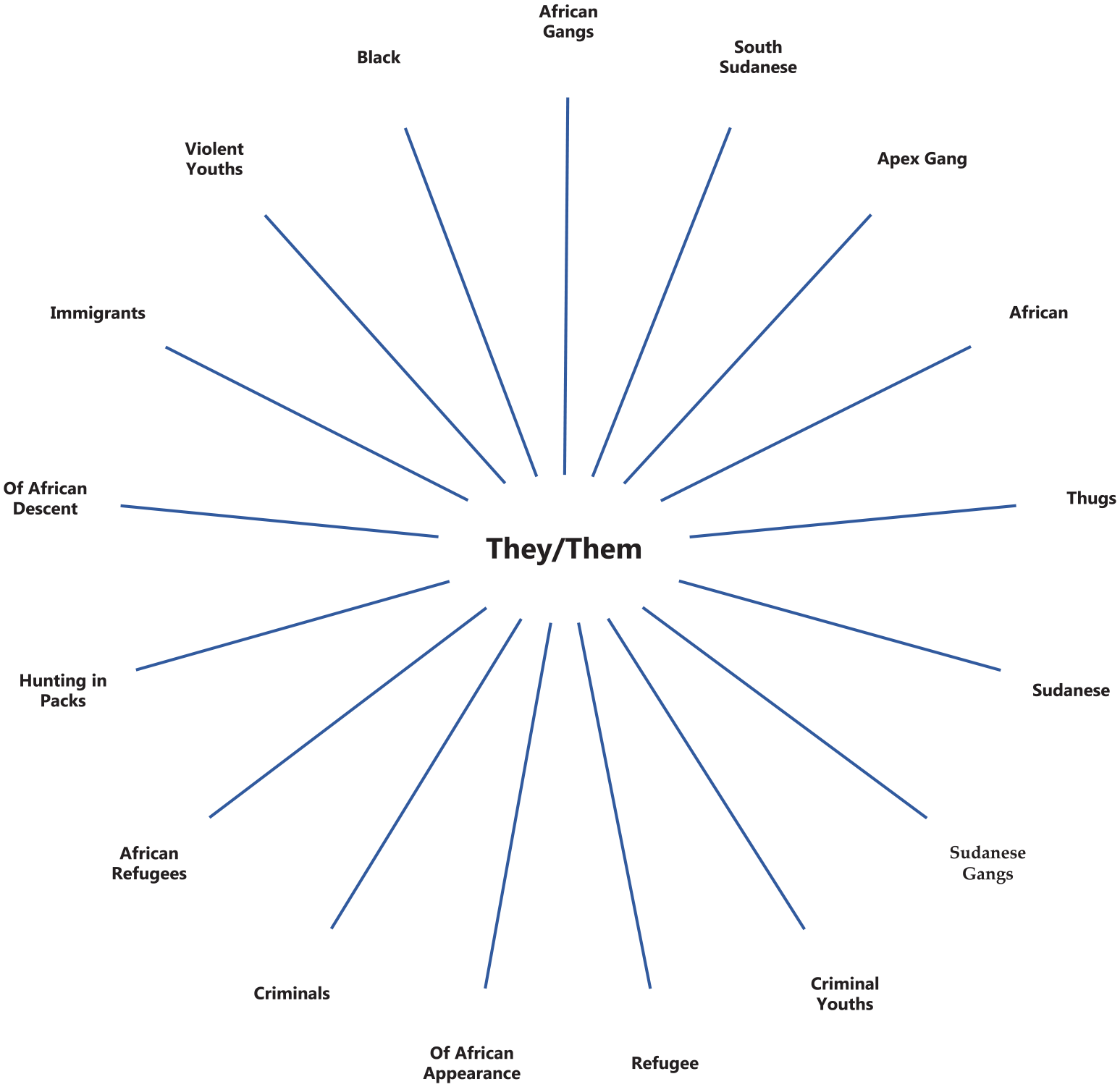
The Process of Othering African Australians
Figure 1 shows that the media’s process of othering young African Australians occurs by (1) categorizing, that is, identifying African Australians by their ethnicity, race, skin color, refugee status, and national origin to single them out as fundamentally different and (2) creating a single story, that is, using the above-mentioned perceived differences and labels to construct an “us versus them” narrative and treat them as inferior.
Situating the “African Gangs” Narrative in the Australian Colonial/Neo-Colonial Context
According to Mal, a postgraduate, community leader, and youth advocate, “The 2018 Victoria State election’s ‘African gangs’ campaign had a lasting impact on African Australians’ lives, contributing to stigmatization, marginalization, fear, anxiety, discrimination, racial profiling, and erosion of trust.” It depicts African Australians as an inherent threat to Australian society (Majavu, 2020). As Valerie stated, “When I watch the news about an issue with a White person, it’s put down to mental illness, and when it is an African/Sudanese [Australian] person, it’s a gang issue.” Criminalizing African Australians involves emphasizing their “Africanness,” Blackness, or refugee status and stereotyping, targeting, labeling, and stigmatizing these characteristics (Majavu, 2020). This reduces the causes of crime to race, skin color, and ethnicity, treating African Australians as criminals or making their activities illegal owing to these characteristics. According to Sankara, “The term ‘African gangs’ is derogatory, as it associates criminality with people’s skin color, leading to discrimination.” Odaa added, “The label ‘African gangs’ has been used as a political tactic to sow discord and fuel prejudice, resulting in racism.” JT, a postgraduate social worker, stressed: “Being identified as a refugee often feels like a label that precedes who I am. It’s like the system sees my refugee status before they see me as a person.” Victor noted: “They always mention that we come from war-torn countries, but they don’t consider how this affects us here. It’s like our past is used against us, making it harder to break free from those stereotypes.”
Mainstream media and politicians often refer to young African Australians using outdated racist terms that liken Blacks to animals or refer to Black people as savage (Smiley & Fakunle, 2016). A prime example is when the Victorian Liberal party used a 2012 photo of a hooded Black youth from the United Kingdom in its 2018 campaign flyer with a statement that read, “only the Liberals will stop gangs hunting in packs” (cited in Willingham, 2018). This racial stereotype implies that young African Australians are monstrous, animal-like, and predatory, to be feared and locked up; otherwise, White lives are at risk. Such racism parallels Indigenous Australians’ mistreatment; thus, Australia’s racist tropes are consistent and persist with new migrant groups (White, 2013).
Although the media has a proven propensity to exploit pre-existing stereotypes to provide false portrayals of Black people, this dangerization of Blackness, defined as “the tendency to perceive and analyze the world through categories of menace” (Lianos & Douglas, 2000, p. 267), is not confined to the media. This is unsurprising because racial microaggressions have long portrayed Black people as genetically inferior and enemies or outsiders using descriptive language and images that associate Blackness with negative connotations. Terms such as black market, blackmail, or blacklist fall into this association—simply inserting “black” before any word implies that something is bad or illegal. This type of linguistic connotation has been shown to be derived from racist thought (Boroditsky, 2011); more importantly, for our purposes, the use of “black” to mean inherently bad has subtle, pervasive effects on systemic racism (Jordan, 1968). These terms present the image of Blacks as undesirable, dangerous, and criminal without directly using racist speech. These subtle influences are rampant in everyday language; the term “African gangs” exacerbates these impacts and intensifies negative societal beliefs about Black people. As explained previously, the imagined “African gangs” are characterized by non-White Australians, intensifying negative societal beliefs about Black people.
Throughout Australia’s history, different ethnic and racial groups have been marginalized and stigmatized—known as “othering.” This cycle of “gang” narratives, such as “Middle Eastern gangs” and “South East Asian gangs,” is not unique to African Australian youth but reflects broader societal biases and prejudices (Higginson & Benier, 2015). Historically, the African Australian diaspora has been represented as criminals and a threat to Australia’s law and order since its arrival on the First Fleet in January 1788 (Cunneen & Gillen, 2005). Moreover, 18th-century ideas of racist othering can be found in contemporary narratives about African Australian youths’ involvement in gang activity, as seen in the “African gang” narrative. In the 1990s, social group affiliations formed by young Somalian Australians for identity and belonging were perceived as gangs (White et al., 1999).
In early 2005, Sudanese Australians were ostracized after a scholar wrongfully accused them of committing several crimes in Sydney (Colic-Peisker & Tilbury, 2008). They became the object of a pseudoscientific intellectual argument; one academic speculated that the “Sudanese were inherently more criminogenic and possessed a lower IQ than other Australians” (cited in Coventry et al., 2014, p. 1). The above statement is misleading, even irresponsible, and illustrates that scientific racism continues to justify White supremacy, racial inequality, racism, and the oppression of Black Australian people. Such claims about IQ differences, based on “scientific research,” alongside practices rooted in racist beliefs, have been used to justify systemic racism and discrimination (Saini, 2019). As a matter of historical fact, these inaccurate claims could be used to deny bail applications for African Australians through implicit bias. After all, eugenics, supposedly based on scientific studies, was the basis of institutionalized racial segregation (Tucker, 2007), where some groups were systematically and violently excluded and persecuted during the Holocaust and South Africa’s Apartheid era.
In Australia, scientific racism was weaponized against the Australian Aboriginal people to cultivate ideas of “Whiteness” and White supremacy. Australian scientists at Adelaide University conducted pseudoscientific intelligence experiments on Aboriginal people in the 1920s and the 1930s (Anderson, 2003). These unjust practices provided the so-called objective scientific evidence needed to “breed” out the Aborigines’ black skin color and “inferior” genes to perpetuate the White race (Anderson, 2003). This flawed and biased scientific “knowledge” failed to consider the impacts of colonization, racial oppression, systemic racism, trauma, and loss on the Aboriginal people (Behrendt, 2012).
In September 2007, Black Australians’ ostracization escalated following the racially motivated murder of Liep Gony, a young South Sudanese Australian, by two White males in Melbourne (Windle, 2008). Liep’s family—whom the author considers family having known them since 1994—watched as the media and politicians blamed their son’s death on him for “failing to integrate” into Australian society (Jakubowicz, 2016) rather than condemning his murder’s racist brutality. If lack of integration fueled the crime, those who murdered Liep would not have killed him because, by virtue of their Whiteness, they would have had no problems with integration and living the “Australian way of life” that Liep was accused of failing to achieve. Arguably, truth and justice for African Australian citizens have become secondary considerations for the Australian media and politicians.
The Victorian Supreme Court detracted itself from the gruesome killing by attributing substantial weight to the offenders’ kindness. In the sentencing remarks transcript, the Supreme Court claimed that the killing was not racially motivated because the offender was kind to a homeless Sudanese Australian 1 week prior to killing Liep. Although this approach may have been legally sanctioned, it is misguided and simplified inherently complex issues.
Politicians’ argument that South Sudanese Australian citizens have failed to integrate is simplistic (Jakubowicz, 2016). Similar to other ethnic minorities, South Sudanese Australians are socially, economically, and politically marginalized, making societal participation more difficult, which can be misconceived as an integration failure (Benier et al., 2018). Their underrepresentation in Australian politics and lack of diversity in mainstream newsrooms (Nolan et al., 2011) intersect with structural racism (Cunneen, 2020), increasing their vulnerability to political scapegoating (Windle, 2008), as evidenced by recent media coverage of South Sudanese Australian youth (Majavu, 2020). These stigmatizing narratives have knock-on effects. Potential employers likely have reservations regarding hiring applicants with this background. Such economic marginalization means that South Sudanese Australian citizens have limited opportunities to contribute to and benefit from the Australian economy, increasing the chances of young people’s offending behavior.
Participants argued that the “African gangs” narrative had created self-fulfilling prophecies among impressionable youth. Victor explained, “‘African gangs’ coverage instilled in them a belief that the stereotypes are accurate, resulting in increased antisocial activities among the youth who internalized negative stereotypes about themselves and their peers.” This may lead young people to struggle with cultural pride and experience feelings of inferiority and worthlessness, which has been associated with “the drive to inflict harm on others” due to this “experience of not mattering” (Billingham & Irwin-Rogers, 2021, p. 7). This feeling of insignificance is closely related to shame and humiliation, which can lead to violent behavior (Billingham & Irwin-Rogers, 2021). Therefore, ensuring that young people feel worthy is important; this can be achieved by providing a culturally safe and inclusive environment.
Participants noted a conflation of issues regarding African Australian youth delinquency with African culture. JT claimed that “crimes committed by young African Australians are often attributed to African culture rather than being recognized as social factors that are common in most societies.” Mama, a community elder, family, and youth advocate, raised concerns regarding cultural differences and intercultural misunderstandings as follows: I have repeatedly told the Victoria Police that we have disadvantaged our children because we have taught them that avoiding eye contact is a sign of respect in our culture. The police assume that our children inadvertently admit guilt or [are] blameworthy for not making eye contact with them. I think that this has led to incorrect assumptions and inappropriate decisions by the police and others. People listen to and hear with their ears and hearts and not with their eyes.
This suggests that even when police are culturally aware, the systems are discriminatory as institutional racism remains unaddressed, leaving little hope for improvement. These findings echo previous research on similar dynamics in the relationship between African American/Korean American and African American/Latino populations and the police in the United States (Weide, 2022).
The media’s portrayal of “African gangs” has led to intercommunal strain. As Abu-Youth reported, “Some African Australians hold South Sudanese Australian youth accountable for criminal activity, which has given Africa a bad name.” Ubuntu and Harambee can be applied to promote understanding, empathy, and greater union among African Australians.
Participants described how their community’s legitimate social structures are misinterpreted through a criminalized lens, leading to overregulation in their communities. As Eden explains: We could be trying to do something good for the youth [and] . . . our community, and they will call in the police because they think that a fight is going to break out. It affects how we enjoy ourselves [at] community events and how we celebrate our culture and ourselves as people.
The presence of groups in African societies is a norm rather than a risk. For example, suppose “eight siblings decide to go to the park and invite their cousins, another eight siblings. Such a big family in the park can be misconstrued as a gang” (Nzinga, a postgraduate public health professional). Thus, as with Indigenous Australians (White, 2013), an African Australian family can be considered a gang by default due to its size. Harambee concerns community unity and working together to address challenges in building community relations and cohesion. By implementing this collective effort involving law enforcement, community leaders, and various stakeholders, Harambee can create a supportive environment that reduces stereotypes, fosters mutual respect, tolerance, opens communication channels, and promotes a genuine listening culture.
Mental Health Consequences of Racism and the “African Gangs” Narrative
The “African gangs” narrative is associated with racial discrimination, which is linked to mental illness (stress, anxiety, and depression) and trauma. Eden argued that “Schools do not provide enough trigger [content] warnings when discussing ‘African gangs.’ This [reliving the trauma of the ‘African gang’ story] can be emotionally, socially, and mentally traumatic for children. . . it is heavy, real, and extremely traumatic.”
Root Causes and Contributing Factors
Participants primarily attributed African Australian youth delinquency to educational and socioeconomic challenges and intergenerational cultural dissonance, revealing that criminals recruited young African Australians by luring them with easy cash. Victor stated: A young boy who unfortunately died of suicide [in August 2021] said, “Some [criminal] dealers approach us saying, ‘Since you cannot get jobs. . .if you engage in car hijacking, motor vehicle theft and jewelry robbery, we will buy [the stolen items] from you.’”
This sentiment may give the impression that young people make rational choices when engaging in criminal activities because they are aware that penalties for juvenile crimes are often less severe than those for adult crimes. However, it highlights that young people’s immaturity fuels delinquency as they underestimate risks and focus on rewards, resulting in irrational decisions. Research confirms that the brain fully matures at the age of 25 years, making delinquency and other risky behaviors more prevalent during adolescence; as the brain develops, youth tend to outgrow offending (Berg & Stewart, 2009). Widespread and persistent structural poverty and deprivation make African Australian (and Indigenous Australian) communities more vulnerable, open, and susceptible to exploitation (White, 2013). Participants highlighted that this type of exploitation contributes to current offending patterns and possibly affects future generations. The more a person associates with criminals, the higher their risk of committing crimes (Berg & Stewart, 2009). Conversely, this explanation indicates that youth can unlearn crime and improve their prosocial behavior.
Older siblings manipulate younger siblings to engage in illegal activities and younger individuals comply, seeking validation and respect. Abu-Youth divulged that, “A young person confided in me about how his older brother pressures him to experiment with drugs.” Many youths engage in delinquent behavior to emulate their older counterparts owing to misguided idealization. A possible explanation is this: After South Sudan’s independence in 2011, several South Sudanese Australian males returned to South Sudan because their skills and qualifications were unrecognized and underappreciated in Australia, creating a significant barrier to securing employment. Consequently, mothers were left alone with their children, working to support themselves and send income to their home country. Thus, young people lacked interaction with their fathers and adult male family members. When these bonds are weak or absent, individuals are more likely to engage in delinquent behavior (Berg & Stewart, 2009).
In these circumstances, children must raise themselves and “take on the roles and responsibilities of absent fathers to support their families” (Sankara). In turn, “many young people turn to crime to make a living with disastrous results” (JT). Importantly, “for many of these young people, the older youths in the community, even if they are engaging in criminal activities, are the only family” (Mal). For them, “their peers are not just a group of young people committing crimes together but are often brothers, sisters, and cousins who have been there for each other when no one else was” (Beny). Participants acknowledged that “criminal peer groups can provide a sense of belonging, but it always leads to violence” (Nkrumah, a clinical pharmacist and third-year postgraduate medical student). This suggests that, while affiliation with such groups may offer emotional support, it does not mitigate the inherent risks associated with criminal involvement. Hallsworth and Brotherton (2011) found that marginalized youth in the United Kingdom join gangs to gain belonging and identity, with gangs providing community and security amid socioeconomic challenges, linking crime to the need for belonging.
These findings suggest that interventions should provide feasible lifestyles to meet the youth’s needs, focusing on their entire ecosystem, including extended families, vocational training, culturally sensitive cognitive therapies, apprenticeships, and positive role models. While this is recognized in some government funding programs, Ajwang, a postgraduate social justice advocate, works in public policy for the State Government, observed that: The funding goes to the mainstream organizations [but] . . . the impact of the work in the community is scarce or nothing at all, and they continue to do the same thing. The government seems not to have learned from this.
The Harambee concept emphasizes that crime reduction and overrepresentation in the justice system require community involvement beyond the police and government. It encourages resource mobilization within the community through initiatives such as community-driven projects to tackle shared concerns like youth offending. Communalism underscores each person’s collective responsibility in the community to contribute skills, knowledge, and resources toward addressing youth offending for the greater good.
In the introduction, the term “African gangs” was shown to be geographically based with a discriminatory bias used to establish and reinforce its existence. Accordingly, when the media refers to young African Australians as “African gangs” or government officials call the Victorian Public Service (VPS) staff of African heritage as “African staff,” racism and othering are promoted linguistically. It would be inconceivable for VPS staff of European descent to be called “European staff.” This can lead to affinity or similarity bias—individuals’ tendency to favor or be more comfortable with people who share similar characteristics or experiences—and “can lead to favoritism or discrimination in hiring or promotions,” shared Victor.
Participants observed that national-origin and race-based exclusionary language (e.g., “African young people”) alienating African Australians is rather common, hampering inclusion within and beyond academic writing. This subtle reminder that African Australians are outsiders can reduce feelings of belonging by tapping into pre-existing otherness, exclusion, and intolerance, which inhibit meaningful advocacy, scholarship, and potential alliances.
Participants stressed that when Australians of Sudanese or African heritage are referred to as “Sudanese” or “African” (without the word Australian), African Australians are robbed of their identity as Australians, paving the way for toxic prejudices around race and culture. This collision with the mainstream media and politicians is the reason the “African gangs” narrative is a constructed identity that aims to disown African Australians. This does not imply that we should not mention people’s heritage; these cultural identities make Australia diverse. Nonetheless, when cultural differences are used to divide, diversity is threatened. Unconsciously, this places community members as invisible judges, juries, and arbiters of Australianism in determining who is an acceptable Australian citizen. These structural barriers, community attitudes, and practices are critical impediments that must be addressed to eliminate inequality, discrimination, and racism.
Conclusions and Implications
Previous research on “African gangs” in Australia has primarily relied on Western epidemiology, neglecting African knowledge. The present study fills this gap by incorporating African ways of knowing into research on youth-offending and crime-prevention strategies for African Australian youth. When their crimes are racialized, the African Australian community is rendered criminal and morally suspect. If young African Australians were considered entirely Australian, the “African gangs” crisis and “African crimes” would not exist.
Study findings suggest that the term “gang” is not a recognized concept in African Australians’ native languages and that “African gangs” do not exist in Melbourne. Participants admitted that organized criminals may be recruiting young African Australian individuals to commit offenses for financial gain. Further research should confirm these findings.
The African Australian community’s voice as partners and “co-researchers” is vital for identifying problems and solutions. Some practical policy recommendations are as follows. (1) Establish a Victorian Multicultural court, similar to the Children’s Koori Court, to reduce the overrepresentation of multicultural children in the criminal system. This includes mandatory restorative justice conferences for young people in culturally appropriate justice processes involving respected multicultural elders. (2) Stop the racial profiling of African Australians. (3) Engage with and work to address the realities of systemic racism and othering faced by African Australians through inclusive, holistic, social, and economic empowerment and culturally appropriate trauma-responsive approaches without othering.
This study has limitations. First, the sample comprised individuals aged 24 years and older; it was not representative of the target population. Second, it did not explore the lived experiences of justice-involved youth. Despite these shortcomings, the use of African epidemiology, through interacting with research participants in their own language, allows for a holistic cultural understanding of the phenomena under investigation, which provides the richest and most suitable information for the study aims.
Ultimately, this study critically contributes to criminology, culture, race/ethnicity, and media studies by providing valuable insights into African perspectives on crime and criminality. Future research can further explore the lived experiences of youth in the criminal justice system and analyze the role of absent father figures in delinquency among South Sudanese Australian children. The African Australian community has a voice—it simply needs a platform and resources to contribute toward reducing offenses.
Based on past empirical findings and the present study, the author maintains that the criminalization, politicization, racialization, and othering of young Black Australians intersect, reinforce, and shape each other. Therefore, the interplay between these issues’ political and social stigma should not be considered separate from the “African gangs” narrative; they influence one another in precipitating racism.
Footnotes
Authors’ Note:
This article is based on the master’s thesis conducted under the supervision of Associate Professor Diana Johns at the University of Melbourne. Thanks to A/Professor Johns, Dr. Alison Asche, Ana Radovic, Steve Rakic, Nhial Kuon, Tut Puot, Professor Stephane Shepherd, Professor Yin Paradies, Dr. Susan Carland, Dr. Sara Maher, African Australian participants, and the anonymous reviewers for invaluable feedback during the review process. The author has no conflicts of interest to disclose. This research is supported by an Australian Government Research Training Program Scholarship.
