




Abstract
Procedural justice is linked to several outcomes such as conformity. We examine whether the relationship between procedural justice and gang membership can be explained by how much youth believe gangs can protect them. Using data from the Gang Resistance Education and Training evaluation (G.R.E.A.T. II), we use path analysis to examine the effect of procedural justice on gang membership and the mediating role of the perceived protection of gangs. Our results indicate there is no direct effect of procedural justice on subsequent gang membership, but there are indirect effects through the perceived protection of gangs. These perceptions fully mediate the relationship between procedural justice and gang membership. Youth with lower procedural justice may not believe police can protect them and are more likely to join a gang for protection. As suggested by the literature on self-help, youth look to gangs for personal safety when law enforcement is unavailable.
The way youth view the police matters. Perceptions of police have been associated with a wide range of outcomes, including a sense of obligation to obey the police (Alward et al., 2021) and attitudes toward violence (McLean & Wolfe, 2016). One framework for understanding perceptions of police comes from Tom Tyler’s theory of procedural justice, wherein the perceived fairness, respectfulness, and courtesy of police were utilized to measure procedural justice (Tyler, 1990). Individuals who trust and respect police are more likely to engage in prosocial behaviors such as crime reporting (Murphy & Barkworth, 2014). Furthermore, Black (1983) argues that those unable to obtain protection and security from conventional means are more likely to engage in self-help for protection. This suggests that individuals lower in procedural justice, for example, lack faith in the police, may turn to other avenues to protect themselves (Black, 1983). 1 One such method for gaining protection and security may be gang membership.
Prior research suggests that one of the strongest motivators for gang membership is protection, both from rival gangs and from law enforcement (Decker & Van Winkle, 1996; A. Peterson, 2008; Vigil, 1988). 2 Compared to their non-gang counterparts, gang members are more likely to view the police as illegitimate (Papachristos et al., 2009), less likely to conform to traditional prosocial norms (Vigil, 1988), and more likely to endorse violence (Scott, 2014). Gau and Brunson (2010) found that individuals with lower levels of procedural justice feel safer with their established neighborhood networks and that police are at times a threat to overall safety and well-being. This is especially salient for racial/ethnic minorities and those from disadvantaged neighborhoods as they are regularly overpoliced and mistreated (e.g., Schneiderman, 2013). It is not clear, however, whether the perceived unavailability of law (e.g., procedural justice) is associated with subsequent gang membership.
In this study, we examine the relationship between procedural justice and subsequent gang membership, and whether this relationship can be explained by perceptions of the protectiveness of gangs. We draw from Black’s (1983) argument that when individuals are unable to rely on law enforcement, they are more likely to go beyond the law to fend for themselves. We use data from the Gang Resistance Education and Training (G.R.E.A.T. II) program, a sample of youth in 31 schools across seven cities. Studies have found that gang membership is associated with lower procedural justice (e.g., Alward et al., 2021; Ariza et al., 2014; Tostlebe & Pyrooz, 2022). Studies have not, however, examined the reverse relationship–the influence of procedural justice on gang membership. If procedural justice is both a risk factor and a consequence of gang membership, increasing individuals’ procedural justice may be particularly beneficial. This may be especially true for adolescents because their perceptions of the police are still developing and therefore malleable (Taylor et al., 2001).
Procedural Justice
Procedural justice taps into the perceptions of authority figures. Tom Tyler (1990) coined the term “procedural justice” as part of his dual-process model and describes it as the perceived fairness and respectfulness of authority figures by members of society. Others, notably Mazerolle et al. (2014), have described procedural justice as the combination of perceived dignity and respect, trust, neutrality, and voice of authority figures. Tyler (1990, 2006) also finds that those who do not perceive police actions to be fair or respectful are less likely to conform to laws and social norms. Because these individuals do not believe the police are “on their side,” they begin to develop their own sense of normative behavior. For example, lower levels of procedural justice have been linked to higher levels of civil disobedience (Snipes et al., 2021). Procedural justice has also been linked to police legitimacy (Bradford et al., 2014; Gau et al., 2012; Mazerolle, Antrobus, et al., 2013; Mazerolle, Bennett, et al., 2013; Tyler & Wakslak, 2004), obligations to obey police (Alward et al., 2021; Antrobus et al., 2015), and compliance (Maguire et al., 2021). There is strong evidence suggesting the perceptions of police affect various outcomes, but how these perceptions influence gang joining motivations is yet to be examined.
Previous research has found that a neighborhood’s ability to self-regulate is partly dependent on social controls such as the police (Carr, 2003; Velez, 2001; Warner, 2007). For example, Velez (2001) found that individuals in neighborhoods with higher levels of social control were less likely to be victimized. 3 Conversely, higher levels of mistrust in the police may lead to an “everybody for themselves” mentality, encouraging individuals to look outside the scope of these social controls for protection. These issues are particularly salient in disadvantaged neighborhoods where there is a desire for a strong police force, but there is little faith in the police (Carr et al., 2007). Furthermore, neighborhood perceptions of police have been found to affect individual level perceptions of conformity to laws, social norms, and police directives (Antrobus et al., 2015)— like how an overarching honor culture leads to aggression above and beyond individuals’ personal honor attitudes (Krajewski et al., 2025).
Self-Help and Gang Membership
Procedural justice may be associated with violence, and potentially gang membership, as individuals with low procedural justice do not feel as though they are protected by law enforcement. Black (1983) argues that when the law is (or is perceived to be) unavailable, individuals are more likely to rely on self-help as a means of conflict management. Self-help is a type of social control where individuals may pursue justice outside the scope of the law. It is often violent and in response to some real or imagined grievance. It can be thought of, as Black (1983) described, as individuals being “prepared to protect themselves” (p. 40). Qualitative accounts, for example, describe how those who commit street crime respond to affronts with retaliatory violence (Jacobs, 2004) and how those who commit drug crime retaliate to maintain their reputation, mitigate losses, and seek vengeance (Topalli et al., 2002). Because of their offenses, these individuals are often unable to depend on the police or the legal system for protection. By engaging in self-help, those who commit crime not only obtain justice for themselves, but may also protect themselves from future victimization, especially in areas with high honor culture (Anderson, 1999). Tedeschi and Felson (1994) discuss how individuals may engage in violence as a form of self-help proactively to avoid victimization in the future. While self-help is often viewed as a response to an affront, those who engage in proactive self-help behaviors may be qualitatively different.
Negative perceptions of police are connected to higher levels of violent self-help endorsement (Gau & Brunson, 2010; Jackson et al., 2013; Wilkinson et al., 2009). Haas et al. (2014) found that respondents supported violent vigilantism more when police were undependable. Moreover, police biases strengthen the relationship between community violence and gun carrying (Sokol et al., 2022). Similarly, Cunningham et al. (2022) found that attitudes toward police are related to gun carrying, especially for Black youth who are routinely overpoliced and discriminated against by police. Findings from Jackson et al. (2013) showed that higher perceived procedural justice was related to a greater distaste for violence among respondents. This implies that, if one has low procedural justice, they may believe violence is more acceptable as a form of self-help to obtain protection. These findings align with Black’s (1983) claim that crime, specifically violence, in the form of self-help is more prevalent in areas of perceived lawlessness.
Overpolicing and discrimination in communities may also encourage self-help behaviors. Ethnic stereotypes (Estrada et al., 2017) and the legal/perceived categorizations of gangs (Klein & Maxson, 1996) have often led to negative perceptions and discriminatory policing of minorities and those in disadvantaged neighborhoods (Alexander, 2012). When individuals do not feel valued or respected by the police, they may feel ostracized and isolated from society (Tyler, 1997). Perceived fairness of authority figures affects individuals’ perception of how well they fit in (Lind & Tyler, 1988; Tyler & Lind, 1992). Oppositional cultures of defiance then may begin to form and be salient in low socioeconomic, disadvantaged neighborhoods where aggressive crime prevention strategies are utilized the most (Anderson, 1999). These strategies disproportionately target youth (Schneiderman, 2013) and often result in enhanced feelings of distrust, criminalization, and feelings of disrespect which encourage a negative outlook of law enforcement (Brunson, 2007; Gau & Brunson, 2007). Thus, youth may turn to gang membership as a mode of self-help, because police cannot be trusted to provide adequate protection. Self-help often takes the form of violence or conforming to groups that are more accepting of violence to navigate dangerous environments when police are procedurally unfair (Anderson, 1999; Kubrin & Weitzer, 2003). What is yet to be explored is what explanatory mechanisms might be responsible for why procedural justice may lead to self-help. Given previous findings and discussions, our research anticipates that lower procedural justice will be associated with higher perceived protection of gangs.
Youth are also often marginalized by authority figures. Some research has found that youth minority gang members (Novich & Hunt, 2017) and disadvantaged youth (T. T. Allen, 2024; Ray et al., 2024) are regularly disrespected by the police, rendering many minority youth reluctant to call the police for help (Wu & Miethe, 2024). Thus, many youth view police brutality on social media as racially driven (McLeroy & Wang, 2024). In addition, Urban youth feel strongly betrayed by adult authority figures (Fine et al., 2003), and these senses of betrayal often originate from lived, negative experiences with law enforcement (Carr et al., 2007). Moreover, Brunson and Miller (2006) found that youth are symbolic assailants of police due unfair police treatment and discrimination because of their mannerisms and behavior. 4 Finally, in a study of youth violence in neighborhoods, Nijboer and de Haan (2005) conclude that there are three necessary conditions for youth violence: institutionalized mistrust, a neighborhood subculture with strong elements of territoriality, and an environment that harbors a continuous threat of violence. Consistent with Black’s (1983) discussion on how crime as social control often festers in environments where individuals have been aggrieved by those with high social status, such as police, these conditions may also encourage gang membership for protection in the same way.
Procedural justice and the desire for protection through self-help behaviors may also affect motivations for gang membership. Maxwell (2013) describes joining a gang as a process. There is a developing body of research that explores the risk factors for joining gangs such as poverty (Esbensen & Winfree, 1998) and race (Pyrooz, 2014). However, it is important to make a distinction between risk factors and motivations, because motivations speak to the rationale for gang joining, meanwhile risk factors explain who is most vulnerable to gang joining (Densley, 2015). Motivations for joining a gang are regularly examined as push and pull factors (Decker & Van Winkle, 1996). 5 Push factors such as cultural pride (Vigil, 1988) and excitement (Decker & Curry, 2000) have been associated with a higher likelihood of gang membership. While risk factors and push factors are important to understanding gang joining, they do not address the desire for protection of gangs.
Other studies have examined the most common pull factor of gang membership, protection (Decker et al., 2022). Individuals may join a gang to seek protection from rival gangs (Leovy, 2015). In addition, Jacobs and Wright (2006) find that individuals may join a gang to engage in street justice when the police cannot be relied upon, which is consistent with Black’s (1983) discussion on crime as a mode of retaliation against assailants. D. Peterson et al. (2004) found that gang members are victimized at higher rates than non-gang members, even before joining the gang; these findings suggest that future gang members are presently at higher risk for victimization which may encourage them to seek gang membership for protection. Moreover, a qualitative study of 23 “colored adolescent South African males” found that survival was an attractor of gang membership (Owen & Greeff, 2015). 6 Another qualitative study of 14 former gang members found that some felt like they had no other choice but to join for protection (De Vito, 2020). Merrin et al. (2015) found that perceived neighborhood safety is negatively associated with gang membership. This effect is likely even stronger when an individual does not trust in the police. These findings support previous arguments that individuals may seek other modes of protection, such as family (Merry, 1981) or gangs when police are perceived to be unreliable or unavailable. Considering previous research, we also anticipate that individuals who believe gangs will provide adequate protection will be more likely to join. Although there is a strong foundation of literature suggesting that protection is a strong motivator of gang joining, there has been no study—to our knowledge—that examines how procedural justice impacts the perceptions of gang protection, potentially leading to gang membership.
Current Study
The study expands on the procedural justice literature by exploring how procedural justice affects gang membership through self-help among a broad sample of youth, using a longitudinal dataset. Specifically, we aim to extend Black’s (1983) discussion on how crime as a mode of social control may develop in situations where law is perceived to be unavailable or unwilling to address grievances. Previous studies have found that procedural justice affects outcomes such as conformity to norms and laws (Bradford, 2014; Fagan & Tyler, 2005) and violent attitudes (Gau & Brunson, 2010). In this research, we argue that youth who perceive the police as less fair, respectful, and courteous, do not believe the police will provide protection. In turn, youth then further consider how gangs can provide protection, subsequently pulling youth into joining a gang to fend for themselves. The current study explores two main research questions:
Method
Data and Sample
We used data from Waves 1 to 3 of the (G.R.E.A.T, II; Esbensen et al., 2016) evaluation dataset. The G.R.E.A.T. program is a school-based, cognitive gang and violence prevention program. G.R.E.A.T. was implemented in middle schools to reduce gang involvement, delinquent behaviors, and improve attitudes toward the police among students. The evaluation data were collected from 195 classrooms within 31 schools in Portland, Oregon; Nashville, Tennessee; Chicago, Illinois; Albuquerque, New Mexico; Greeley, Colorado; Philadelphia, Pennsylvania; and a Dallas-Fort Worth area district. Classrooms were randomly assigned to either the G.R.E.A.T intervention or to be part of the control groups. About 50% of the initial sample was selected to be included in the treatment groups. The program has been found to have beneficial effects on gang membership and other outcomes (Esbensen et al., 2011, 2012). Wave 2 data were collected 6 months after the first wave of data collection and Wave 3 was collected 1 year after Wave 2. The initial sample in G.R.E.A.T. consisted of 3,820 students (for the full design and description, see Esbensen et al., 2013; Esbensen et al., 2012). After deleting cases with missing data on our key variables, the final sample contained 2,659 students who participated in Waves 1 to 3 in our analysis. 7 Each follow-up survey after Wave 1 was administered annually. We used Waves 1 to 3 in the analysis to (a) establish temporal order and (b) to retain as many current gang members in the sample as possible.
Dependent Variable
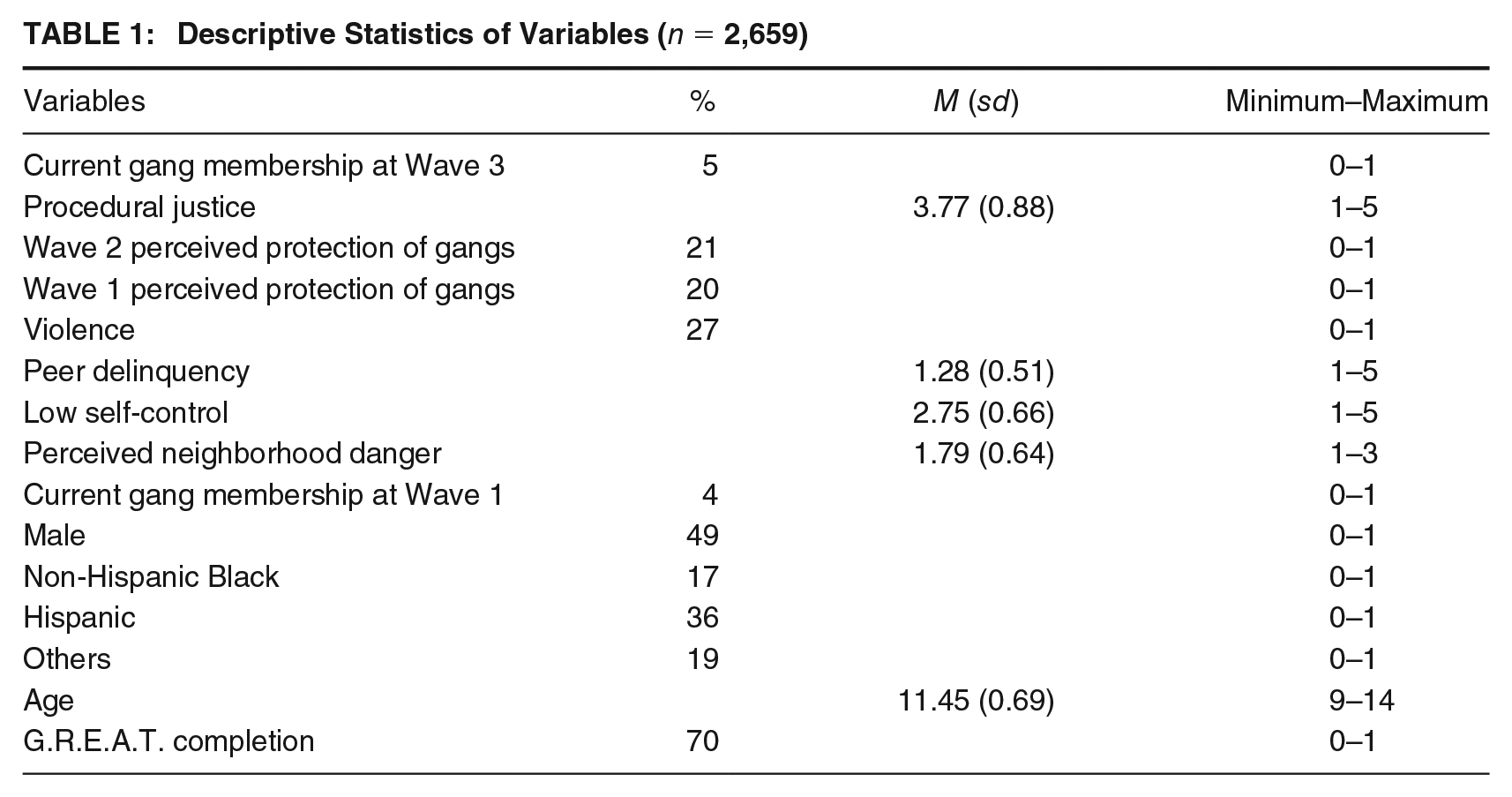
The dependent variable is current gang membership at Wave 3. It is measured as one item, asking “Are you now in a gang?” (0 = no; 1 = yes). Allowing youth to self-nominate as gang members is found to be a valid way to identify gang membership and distinguish between gang members and non-gang members on attitudes and delinquent behaviors (Matsuda et al., 2013). In total, there were 133 (5%) self-identified current gang members in the current sample (see Table 1).
Descriptive Statistics of Variables (n = 2,659)
Independent Variable
The key independent variable is procedural justice at Wave 1. It is measured by three attitudinal items, including “police officers are honest,” “police officers are usually courteous,” and “police officers are respectful toward people like me” (1 = strongly disagree, 2 = disagree, 3 = neither agree nor disagree, 4 = agree, 5 = strongly agree). Procedural justice was computed as the mean of the three items, where a higher value indicates a favorable attitude toward the police (alpha = .78). This measurement of procedural justice is consistent with the literature and used in Slocum et al. (2016). 8 Overall, the average level of procedural justice was 3.77 with a standard deviation of .88. A bivariate analysis was conducted on procedural justice between those who commit crime and those who do not. The group of those who commit crime displayed a significantly lower procedural justice relative to the other group. 9
Mediating Variable
The mediator in our analyses is the perceived protection of gangs at Wave 2. Respondents were asked “What good things do you think would happen to you as a gang member?” Respondents could select as many options as they wanted and “I would be protected” was one of the response categories. About 21% of the respondents thought protection was a benefit of joining a gang.
Control Variables
Several Wave 1 theoretical and demographic covariates were also included in the current analyses. Theoretical covariates include violence, peer delinquency, low self-control, perceived neighborhood danger, Wave 1 perceived protection of gangs, and Wave 1 current gang membership. Violence was measured based on four questions asking the respondents about the frequency of attacking someone, attacking someone with a weapon, robbing someone, or being involved in gang fights in the prior 6 months. 10 A dichotomized item was computed, 11 and it was found that 27% of the respondents had reported violently offending at least once in the past 6 months.
Peer delinquency was measured by seven items at Wave 1, ranging from minor delinquency such as skipping class to violent behavior such as attacking someone with a weapon (1 = none of them, 2 = few of them, 3 = half of them, 4 = most of them, 5 = all of them). The scale was computed as the mean of the seven items (alpha = .86), and a higher value indicates a higher level of peer delinquency. The mean level of peer delinquency was 1.28 with a standard deviation of .51.
Low self-control was measured by 16 items at Wave 1. For instance, “I often act without stopping to think,” “I don’t devote much thought and effort to preparing for the future,” and “I will try to get the things I want even when I know it’s causing problems for other people.” The low self-control scale was computed as the mean of the 16 items, and a higher value indicates lower self-control (alpha = .85). The mean level of self-control of the sample was 2.75 with a standard deviation of .66.
Perceived neighborhood danger was measured by four items at Wave 1. Respondents were asked how much of a problem each of the following is in their school and neighborhood: “run down or poorly kept buildings in your neighborhood,” “groups of people hanging out in public places causing trouble,” “graffiti on buildings and fences in the neighborhood,” and “hearing gunshots in the neighborhood” (1 = not a problem, 2 = somewhat a problem, 3 = big problem). The perceived neighborhood danger was computed as the mean of the four items above (alpha = .81), where a higher value indicates a greater perceived neighborhood danger. The average perceived neighborhood danger of the sample was 1.79 with a standard deviation of .64.
Wave 1 current gang membership was measured as one item, asking “Are you now in a gang?” (0 = no; 1 = yes). About 4% of the sample self-identified as a gang member at Wave 1. Wave 1 perceived protection of gangs was measured the same way as the mediating variable, and about 20% of the Wave 1 respondents believed that protection was a benefit of joining a gang.
Demographic characteristics include sex (female [reference], male), race (White [reference], Black, Hispanic, Others), age (continuous), and G.R.E.A.T. program completion (no [reference], yes). Approximately 49% of the sample were male, 17% were Black, 36% were Hispanic, 19% were other racial groups, and 70% completed the G.R.E.A.T. program by Wave 2 data collection. The mean age of respondents was 11.45 with a standard deviation of .69.
Several bivariate analyses were conducted to see whether there is a significant difference between gang status on all other variables (see Table 2). Gang members reported a significantly higher level of perceived protection of gangs compared with non-gang member students. Furthermore, gang members had a higher rate of violence, reported higher levels of peer delinquency, lower levels of self-control, and higher perceived neighborhood danger, and were more likely to be a gang member at Wave 1, be male, Black, Hispanic, and older. However, there was no significant difference in other racial groups and G.R.E.A.T. program completion between gang and non-gang member students.
Descriptive Statistics of Variables by Gang Status at Wave 3 (n = 2,659)
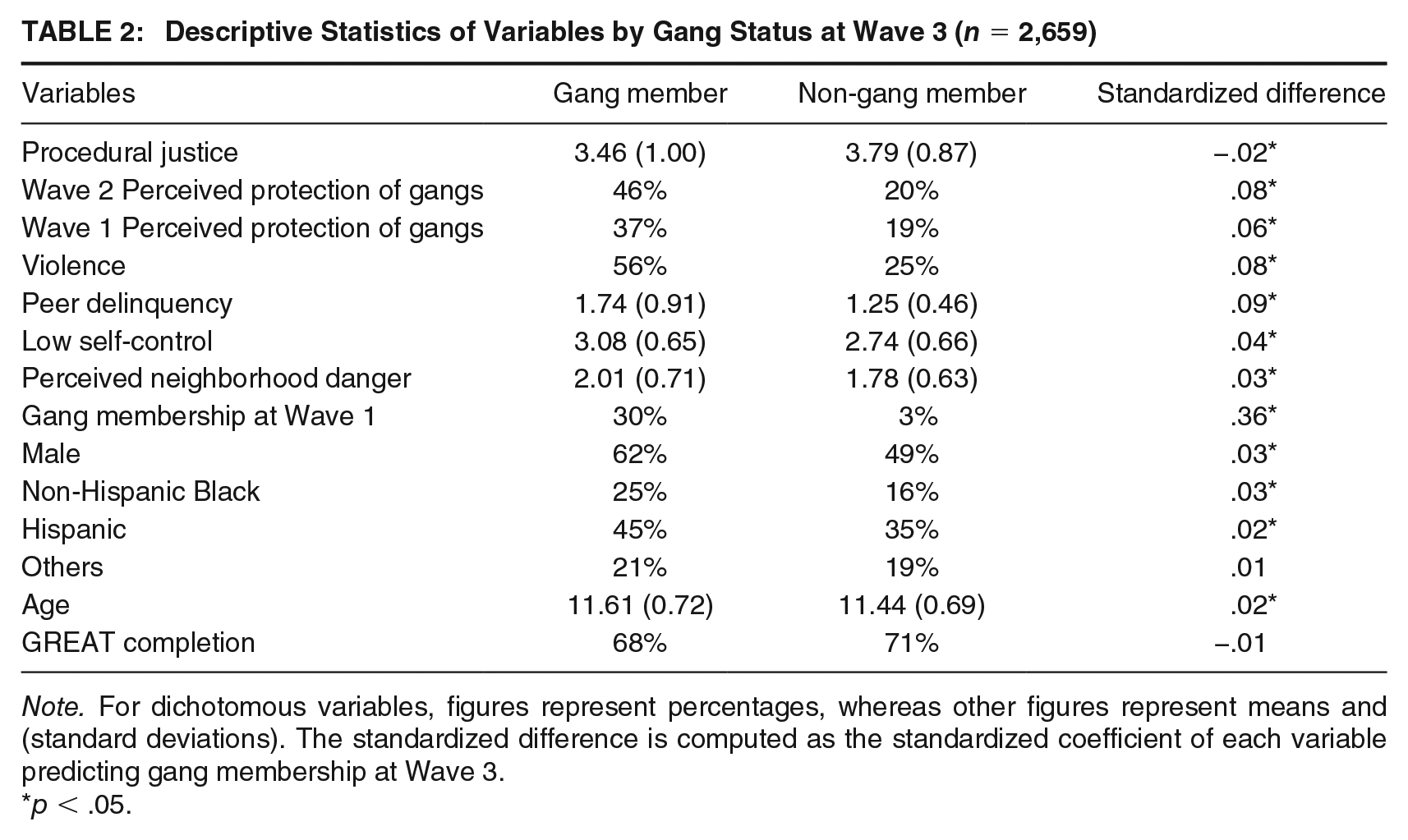
Note. For dichotomous variables, figures represent percentages, whereas other figures represent means and (standard deviations). The standardized difference is computed as the standardized coefficient of each variable predicting gang membership at Wave 3.
p < .05.
Analytical Strategies
The current study aims to detect the direct and indirect effect of procedural justice on gang membership through the perceived protection of gangs using a path analysis with a bootstrap of 200 times. Path analysis offered an appropriate and single framework for mediation analysis of longitudinal data by estimating direct and indirect effects simultaneously (Gunzler et al., 2013). Besides the standardized coefficient and bootstrap standard error of each variable, the direct, indirect, and total effect of procedural justice on gang membership will be presented in the following section.
Results
We conducted a path analysis with the mediator to test the total, direct, and indirect effect of procedural justice on current gang membership through the perceived protection of gangs (See Table 3). 12 Model A shows the results of the effect of procedural justice on perceived protection of gangs. Procedural justice did display a negative relationship with perceived protection of gangs (B = −.05, p = .01) after controlling for theoretical and demographic covariates, indicating that students with lower procedural justice perceive more protection of gangs. Wave 1 perceived protection of gangs (B = .25, p = .00), violence (B = .06, p = .00), low self-control (B = .08, p = .00), Wave 1 gang membership (B = .08, p = .00), male (B = .04, p = .04), Hispanic (B = .04, p = .04), and other racial groups (B = .06, p = .01) were found to have a positive relationship with perceived protection of gangs, whereas G.R.E.A.T. completion (B = −.09, p = .00) had a negative relationship with perceived protection of gangs. Model B presents the results of the effect of procedural justice on gang membership with the mediator. Procedural justice (B = .03, p = .17) had no statistically significant effect on gang membership after accounting for the perceived protection of gangs as the mediator. However, Wave 2 perceived protection of gangs (B = .07, p = .00) displayed a significant relationship with Wave 3 gang membership. These findings are consistent with the prior studies stating that gangs are seen by their members as a social institution to provide protection for them (e.g., Decker & Curry, 2000; Ruble & Turner, 2000; Vigil, 1988). Among covariates, students with violent offending in the prior 6 months (B = .06, p = .01), with higher levels of peer delinquency (B = .08, p = .04), and who were a gang member at Wave 1 (B = .26, p = .00) were more likely to be a gang member at Wave 3, and Hispanic (B = .07, p = .00) and other racial group students (B = .04, p = .01) students were more likely to be a gang member at wave three.
The Results From Path Analysis Predicting Gang Membership at Wave 3
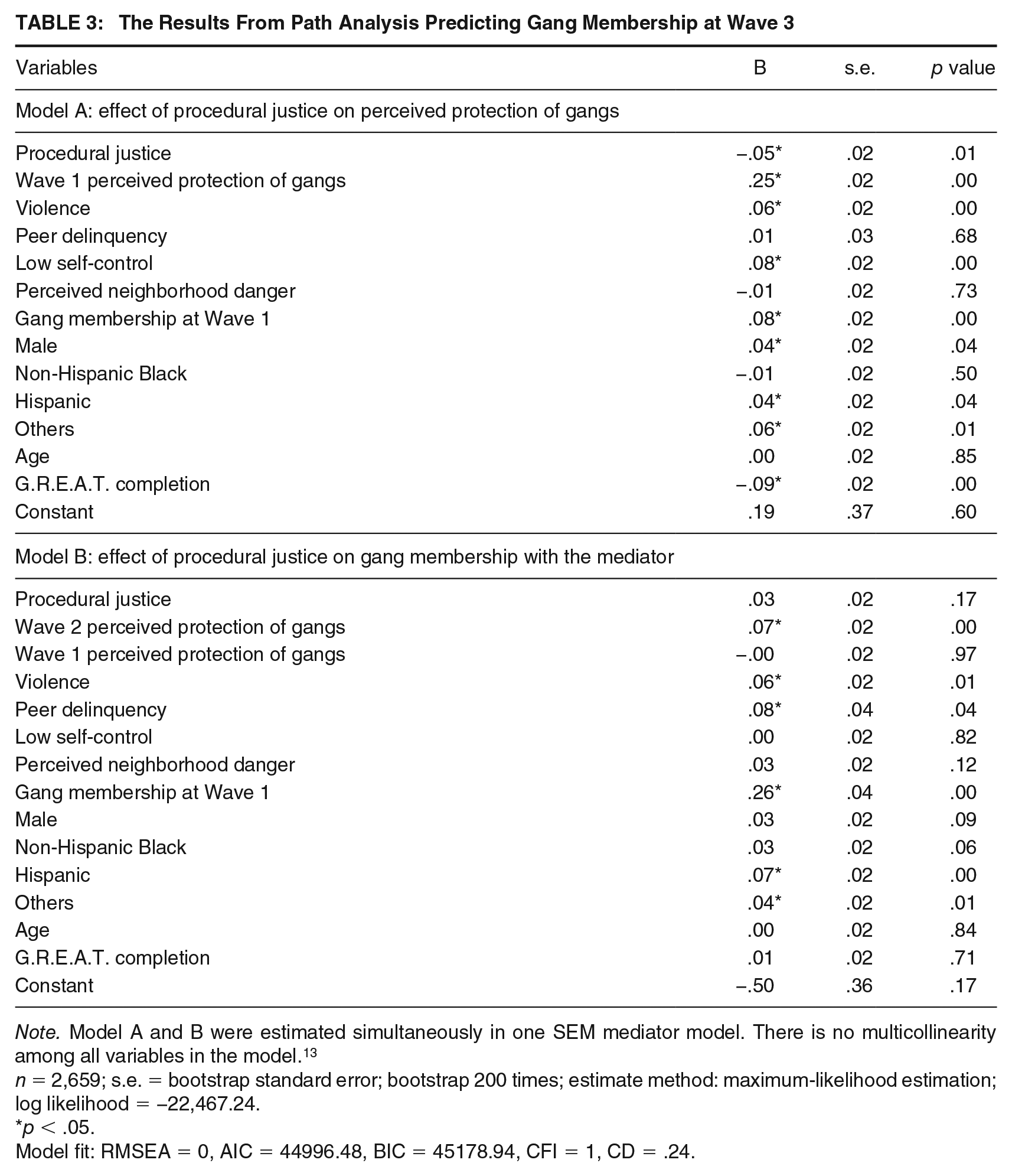
Note. Model A and B were estimated simultaneously in one SEM mediator model. There is no multicollinearity among all variables in the model. 13
n = 2,659; s.e. = bootstrap standard error; bootstrap 200 times; estimate method: maximum-likelihood estimation; log likelihood = −22,467.24.
p < .05.
Model fit: RMSEA = 0, AIC = 44996.48, BIC = 45178.94, CFI = 1, CD = .24.
Table 4 shows the total, direct, and indirect effect standardized coefficients of procedural justice on gang membership through perceived protection of gangs. There was no statistically significant total effect (B = .01, p = .27) and no statistically significant direct effect (B = −.01, p = .21) of procedural justice on gang membership. However, there was a statistically significant indirect effect of procedural justice on gang membership through perceived protection of gangs (B = .00, p = .04). Therefore, the effect of procedural justice on gang membership was fully mediated by perceived protection of gangs (see Figure 1). This finding suggests that although procedural justice did not influence gang membership directly, it did affect the gang joining decision indirectly through affecting one’s perceived protection of gangs.
The Total, Direct, and Indirect Effect of Procedural Justice on Gang Membership
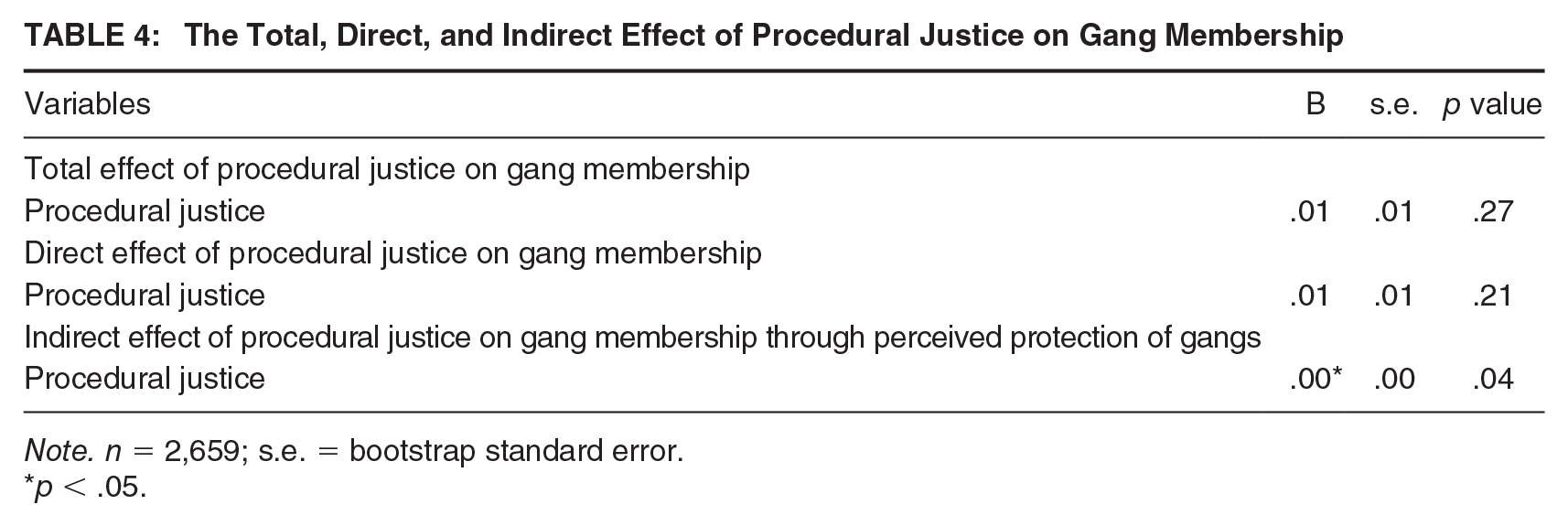
Note. n = 2,659; s.e. = bootstrap standard error.
p < .05.
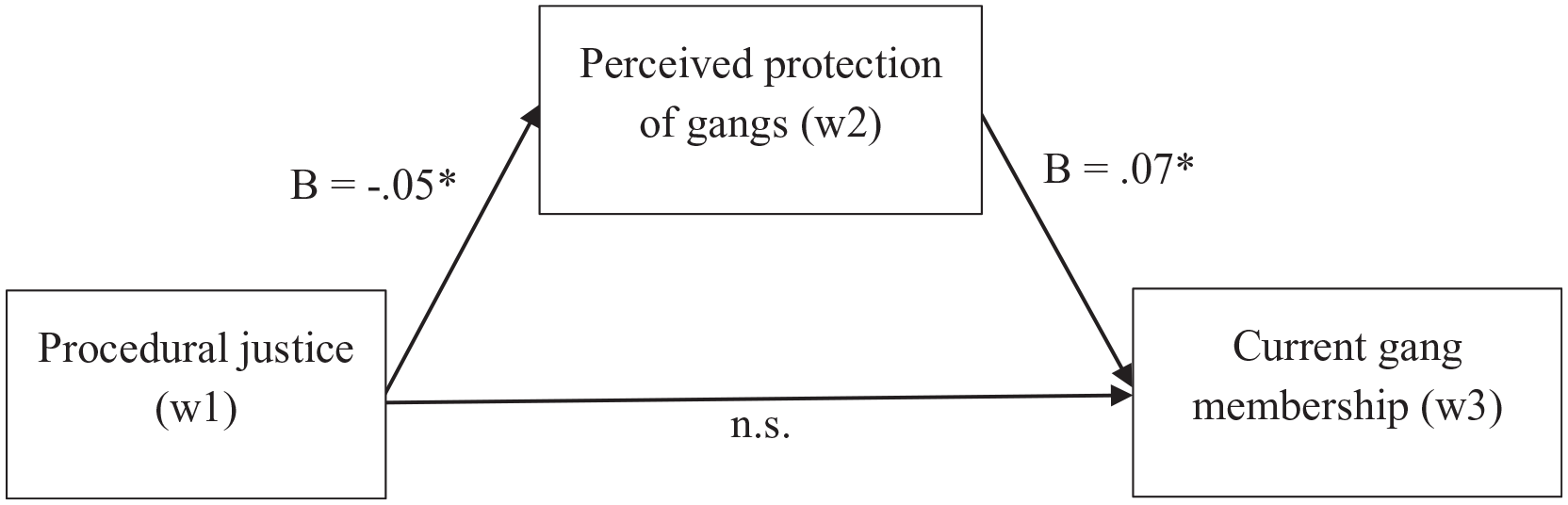
Direct and Indirect Effect of Procedural Justice on Gang Membership
Discussion
Much of the prior research examining procedural justice has focused on outcomes such as police legitimacy (Bradford et al., 2014; Gau et al., 2012; Mazerolle, Antrobus, et al., 2013; Mazerolle, Bennett, et al., 2013; Tyler & Wakslak, 2004) and obligations to obey the police (Alward et al., 2021; Antrobus et al., 2015). Other studies identify a relationship between procedural justice and perceived need for protection (Haas et al., 2014; Wilkinson et al., 2009). While there are studies suggesting that gang members have lower levels of police legitimacy and procedural justice (Papachristos et al., 2009; Tostlebe & Pyrooz, 2022), there has yet to be an empirical study examining how procedural justice precedes gang membership and the theoretical mechanisms explaining this relationship. In this study, we use path analysis to examine the relationship between procedural justice and gang membership among a general sample of youth. We situate our analysis in Donald Black’s (1983) theory of self-help and the broader self-help literature.
Overall, our hypotheses are supported by the findings. First, we find a significant indirect effect in that youth with lower levels of procedural justice recognize higher perceived protection of gang membership. This finding is consistent with prior research that has connected perceived neighborhood safety to gang membership (Merrin et al., 2015) and distaste for police to self-help behaviors (Wilkinson et al., 2009). Next, we also find a significant indirect effect in that when youth believe gangs can protect them, youth are pulled into joining a gang (see Note 12). The effect of perceived protection of gangs on gang membership in our analyses is consistent with previous work (Decker et al., 2022; De Vito, 2020; Owen & Greeff, 2015) who also find that protection is a common pull factor of gang membership. Finally, we find that the perceived protection of gangs fully mediates the procedural justice and gang membership relationship.
The current study has several theoretical implications. Consistent with Black (1983)’s and J. Allen (1977)’s discussions on how many underworld businesses maintain their own police presence for social control in states of perceived lawlessness, our findings suggest that procedural justice predicts gang membership through self-help furthers the conversation in that gang members may view fellow gang members as an internal police presence. Since individuals have been found to resent the intrusion of the justice system in their own respective grievances (Matza, 2018), it’s likely that this is even more salient in those whose grievances stem from justice system actors. So, youth with grievances against police may be more willing to turn against law and to gangs as a means of social control or self-help, especially among racial/ethnic minorities and those from disadvantaged neighborhoods who are routinely overpoliced and discriminated against. Our findings also align with prior research that has previously linked procedural justice to civil disobedience (Snipes et al., 2021) and compliance (Maguire et al., 2021). We make a novel contribution to the procedural justice literature suggesting that when individuals do not perceive police to be fair, courteous, and respectful, their perceptions of gang safety increase, pulling them into gang membership.
Our findings also align with Thomas’ (2024) rational choice perspective of what motivates individuals to join a gang. Specifically, Thomas et al. (2022) discusses how social structure factors may affect an individual’s perception of the risks, costs, and rewards of gang membership. Therefore, if youth do not believe in the ability or capacity of law enforcement, their perceptions of the reward of gang protectability might increase, pulling them into gang membership. We suggest that the procedural justice and gang joining relationship is self-help driven through mechanisms of rational choice.
There are also practical implications for our findings. Approximately 30,000 active violent gangs exist in the United States (Federal Bureau of Investigations [FBI], 2012). Moreover, gang-related crimes account for nearly 49% of all violent crimes in the United States, with many of these being committed by youth gang members (National Gang Center, 2024). Thus, gang prevention programs have been implemented to address these concerns. These programs have often addressed adolescents’ attitudes toward law enforcement or toward gangs (see Smith-Moncrieffe, 2013). In fact, one of the primary goals of the G.R.E.A.T. II intervention programs were to improve adolescents’ relationship with law enforcement (Esbensen, 2015; Esbensen et al., 2011; Pyrooz, 2013). However, many of these programs have had mixed success, (see Wong et al., 2016 for a meta-analysis). Although G.R.E.A.T. I improved adolescents’ attitudes toward both police and gang membership, the effect was only observed several years after the intervention, and it did not reduce gang membership (Esbensen et al., 2011). G.R.E.A.T. II was more successful (e.g., improving attitudes and reducing membership) but did not ultimately reduce offending behavior (Esbensen et al., 2013; Pyrooz, 2013). In addition, a review of Canadian gang prevention programs reported mixed findings for both attitudes toward police and attitudes toward gangs (Smith-Moncrieffe, 2013).
While G.R.E.A.T II is a gang-prevention program that meets strict guidelines to determine program effectiveness (Gravel et al., 2013), few others have been found to be effective, and even fewer have been rigorously evaluated. Klein and Maxson (2006) argue this may be due to an over focus on gang membership reduction instead of delinquency/crime reduction in addition to too broad of a focus on youth who may not even be at considerable risk of gang membership in the first place. It is important for future researchers and stakeholders to develop well-intentioned programming that addresses delinquency and crime reduction for youth who are at a higher risk of gang membership. Our results suggest how youth perceive police matters regarding the amount of perceived protection gangs can offer, so any programming addressing youth delinquency should consider including components that strengthen the relationship between youth and law enforcement, in addition to strategies such as restorative justice circles between youth and police. Future programming should focus on relationships between racial/ethnic youth, youth from disadvantaged communities, and police as these youth are regularly overpoliced and discriminated against.
Limitations
Our study has three main limitations. First, the G.R.E.A.T. II dataset comes from youth self-reports and is subject to various response biases, including recall error, social desirability bias, and misinterpretation of the survey items (National Research Council, 2003; Ong & Weiss, 2000). Youth may be reluctant to admit that they are in a gang, because they might feel they may be in trouble. Alternatively, youth may claim gang membership when they are not a member to appear cool or tough. Social desirability may be particularly the case with these data, because the G.R.E.A.T. II intervention was designed to reduce gang membership. Respondents may have changed their responses to the extent that they were aware of the intervention’s overall purpose. Therefore, the number of current gang members in the sample may be understated or overstated, but it is not clear whether such biases would be systematic or correlated with respondent characteristics.
Second, G.R.E.A.T. II is a general sample of youth across the United States, so the findings may not apply to youth most at risk of gang membership. It is possible that few youths in our sample would ever consider joining a gang, regardless of the perceived protectability of gangs, or that the youth were unable to fully comprehend the potential costs and benefits of gang membership. Some have claimed that general population surveys are inappropriate for examining decision-making among those who commit crime as the average person is a committed law abider and would never seriously consider committing crime (e.g., Apel, 2013; Apel & Nagin, 2011; Pickett & Roche, 2016). As a result, our results may not clearly translate to an at-risk or justice-involved sample of youth. Scott and Maxson (2016) pointed out that the G.R.E.A.T. II intervention did not likely reach the target group of youth as those in the sample were unlikely to be involved with gangs in the seventh grade. Future research should collect data with a sampling frame of at-risk or justice-involved youth as opposed to a general sample.
Third, our study has imperfect measures. For instance, our main dependent variable measures if a youth was in a gang at Wave 3. Ideally, we would measure if an individual joined a gang since the last survey at Wave 3. Since G.R.E.A.T II is a general sample of youth, there were very few individuals who joined a gang between Wave 2 and Wave 3. However, we do control gang membership at Wave 1 to account for earlier gang membership and to establish temporal ordering between Wave 1 procedural justice and Wave 3 gang membership. Gang membership has also historically been challenging to define (Esbensen et al., 2001), and the youth in the sample may not be fully aware of what constitutes it. G.R.E.A.T. II does not define what a gang member is in the survey. However, asking youth to self-nominate as a gang member to distinguish gang members from non-gang members has been found to be a valid method (Matsuda et al., 2013). Future research and data collection should seek to clarify the parameters of gang membership. Moreover, the data did not allow us to disentangle modes of victimization. Thus, we acknowledge that it is possible that individuals who commit crime who are victimized in a way that relates to their active offending processes, may not consider calling the police as a resource for protection (Jacobs & Wright, 2006). In addition, although we control for Wave 1 gang membership and Wave 1 perceptions of gang protection, we acknowledge potential endogeneity in the current study considering that youth who are normalized toward self-sufficiency and distrust in the police may have violent tendencies and diminished views of procedural justice. Finally, we were unable to control for factors such as peer delinquency and perceived neighborhood danger across multiple waves due to the risk of overcontrolling in the models. More rigorous longitudinal panel data analysis should be used in future studies to capture the potential dynamic change in these other variables that may also account for some of the variation in joining a gang.
Conclusion
With nearly half of all violent crime in the United States being gang-involved (National Gang Center, 2024), examinations of why youth join gangs is important, especially due to the early onset of gang membership in adolescence (Lahey et al., 1999). Understanding the mechanisms driving youth to gang membership is helpful to inform theory, practice, and policy. Although there is some evidence suggesting that procedural justice is lower among gang members (e.g., Tostlebe & Pyrooz, 2022), examinations as to why these perceptions of law enforcement matter are crucial. In addition, there is a limited, but growing body of research linking procedural justice to self-help behaviors (e.g., Gau & Brunson, 2010; Wilkinson et al., 2009), albeit through largely disadvantaged samples (see Slocum et al., 2016 for an exception), so there is still much to uncover regarding what drives youth into gang membership, especially among more general samples.
In this study, we examined the effect of procedural justice on gang membership through self-help. Our findings further the understanding of why procedural justice affects joining a gang as a form of self-help. However, further explorations into how procedural justice may inform other modes of self-help are needed. Future research should also look to incorporate other measures of authority figure perceptions such as police legitimacy and attitudes toward school authority figures to predict youth gang membership. In addition, researchers can also look to explore how perceptions of procedural justice change over time by youth who are gang-involved or exit gang membership. If researchers continue to examine the vital relationship between procedural justice, self-help, and gang joining, we will be able to fully understand the underlying mechanisms.
Supplemental Material
sj-docx-1-cjb-10.1177_00938548251343819 – Supplemental material for If the Cops Won’t, Maybe a Gang Will: How Self-Help Explains Procedural Justice as a Predictor of Gang Membership
Supplemental material, sj-docx-1-cjb-10.1177_00938548251343819 for If the Cops Won’t, Maybe a Gang Will: How Self-Help Explains Procedural Justice as a Predictor of Gang Membership by Robert H. Geibler, Jun Wu, Arthur Vasquez and Andrew T. Krajewski in Criminal Justice and Behavior
Footnotes
Authors’ Note:
We thank the editors and the reviewers for their comments and recommendations. We also wish to thank Allison Escobedo and Thomas Baker for their feedback on an earlier draft. The authors have no funding or conflicts of interest to disclose.

Notes
References
Supplementary Material
Please find the following supplemental material available below.
For Open Access articles published under a Creative Commons License, all supplemental material carries the same license as the article it is associated with.
For non-Open Access articles published, all supplemental material carries a non-exclusive license, and permission requests for re-use of supplemental material or any part of supplemental material shall be sent directly to the copyright owner as specified in the copyright notice associated with the article.
