




Abstract
Recent years have seen a significant increase in cyber sexual offenses (CSO) conducted through the creation and distribution of intimate images and videos of others without their knowledge or consent, oftentimes among minors. Restorative justice (RJ) offers a platform to conduct an open, direct, and safe dialogue between responsible persons (RP) and survivors. This explorative study aimed to identify the central characteristics of RJ processes conducted following CSO between youths and to explore their potential benefits and challenges. The study involved in-depth interviews with 10 RJ facilitators and mediators in Israel and Belgium, who led RJ processes following CSO among minors. In addition, content analysis of documents describing these processes was conducted. Four themes emerged: The uniqueness of youth CSO; features of direct encounter; intergenerational aspects; and the need to manage expectations of the process among youth, parents, and facilitators.
Cyber sexual offending (CSO) is a social phenomenon with growing prevalence among adolescents. It includes nonconsensual pornography, cybersexual harassment, sextortion, image-based sexual abuse, and sexting. In the context of the present paper, the complexity of youth-related CSO is three-folded: First, the involvement of minors as wrongdoers, survivors, or both generates unique developmental, social, and psychological challenges. Second, the sexual context evokes increased feelings of shame, violation of privacy, and self-blame (Hansen Mandaou, 2020), which may inhibit their inclination to seek help. Third, the involvement of technology leads to widespread uncontrolled distribution of the offending materials (e.g., sexual images, videos, and text messages), increasing shame, vulnerability, and hurt still more.
With the increased occurrence of CSO, doubts about the desirability of the criminal justice process as a response mechanism for these behaviors have emerged (Rackley et al., 2021; Williams, 2012). Concurrently, juvenile justice systems around the globe have expanded the use of diversions and alternatives to the formal criminal justice process based on the understanding that the formal criminal process is highly limited in addressing the needs and interests of both wrongdoers and those harmed by them (Elliott et al., 2020).
Restorative justice (RJ) is one such alternative, which can be implemented as an alternative or a complementary mechanism to the criminal justice system (Kimbrell et al., 2023). A common definition of RJ is “a process whereby parties with a stake in a specific offense collectively resolve how to deal with the aftermath of the offense and its implications for the future” (Marshall, 1999, p. 5). Israel and Belgium, the two jurisdictions in which the present study took place, have legislated the routine use of RJ in juvenile justice cases. Nevertheless, in both countries, the number of cases referred to RJ processes is still relatively small, despite the high prevalence of CSO, particularly by and against minors (e.g., Van den Eynde et al., 2023 and the Israeli Child Online Protection Bureau, 2022 respectively). The number of processes that have ended in a direct encounter is even smaller. While in Belgium, according to the data collected for this study, several hundred such processes took place until 2019, the number in Israel is much smaller, with less than 50 cases involving CSO. Still, there is no formal information in either country about the use of RJ in CSO cases. Given these small numbers, it is essential to explore the barriers against the referral of such cases to RJ processes and, simultaneously, the lessons that can be learned from completed RJ processes in such cases.
Aiming to contribute to the limited knowledge in the field, the study presents facilitators’ perspectives of RJ processes following CSOs among minors. Based on 10 in-depth interviews with experienced RJ professionals, this exploratory study captures their views and insights based on 15 such cases they had facilitated regarding the potential benefits and challenges of RJ.
Theoretical Background
Cyber Sexual Offending: Terminology, Characteristics, and Prevalence
The fast-paced development of technology has changed our lives profoundly during the last few decades (Bailey et al., 2021). This rapid development is, however, a double-edged sword. Human communication has undoubtedly become more accessible, faster, and efficient on the one hand but has presented many challenges on the other. In the palm of their hand, adults and adolescents are exposed to various dangers and harms. PCs, laptops, tablets, cellular phones, and smart watches serve as a hub for exchanging messages through social media platforms that enable and facilitate cybercrime, including CSO (Bailey et al., 2021; Hansen Mandaou, 2020).
As reviewed in the following section, an abundance of research has been accumulated regarding the prevalence of different forms of CSO. Concurrently, extensive research is being conducted about the manifold negative consequences of cyber sexual victimization (CSV), mainly those concerning mental health and social impacts.
As opposed to in-person assaults, two distinct characteristics of CSV are its permanency, as it is almost impossible to remove it from the web (Cecil, 2014), and its wide distribution. In this sense, the harm to the victim is continuous, widespread, and long-lasting (Cecil, 2014).
Types of CSO
The literature in the field of CSO involves a variety of terminologies and categorizations, with some terms overlapping each other. Some scholars focus on specific behaviors and actions, while others use broader umbrella terms encompassing various activities. Common terms include nonconsensual pornography, cybersexual harassment, sextortion, image-based sexual abuse, and sexting, as detailed below.
Nonconsensual pornography, often referred to as “revenge porn,” describes the dissemination of sexually explicit images or videos without the receiver’s consent, usually by an ex-romantic partner (Branch et al., 2017; Gassó et al., 2021). In these cases, both the individual appearing in the images and the person receiving them can be considered victims. Expanding beyond “revenge porn,” the term nonconsensual pornography may also include all forms of distribution of explicit images perpetuated by anyone, not only ex-partners (Gassó et al., 2021).
Other scholars have used the term cybersexual harassment to describe similar actions as nonconsensual pornography as well as other additional actions such as receiving unwanted sexually explicit messages, asking receivers to engage in sexual activity, and being pressured to share sexual photos (Reed et al., 2019). Thus, while there is an overlap with nonconsensual pornography, cybersexual harassment covers a wider array of detrimental behaviors. Another form of CSO is sextortion, threatening to disseminate sexually explicit images of the victim with the goal of gaining sexual benefits, money, or other forms of personal gain from the victim (Patchin & Hinduja, 2020; Wolak et al., 2018).
Yet other scholars define CSO as “image-based sexual abuse,” a broader umbrella term covering all nonconsensual production, dissemination, or threat of disseminating private sexual images (Hansen Mandaou, 2020; McGlynn & Rackley, 2017a). This terminology suggests that nonconsensual sexually explicit image-sharing involves motivations other than revenge and serves purposes other than pornography, such as in the case of sextortion.
Finally, some scholars extend the boundaries of CSO even more by asserting that sexting should be considered a form of CSO even when it is consensual, because of its potentially harmful consequences once consent is revoked (Gassó et al., 2021). For instance, explicit images of the victim, which were sent consensually by the victim for private use, may later be distributed to others (i.e., revenge porn) or the perpetrator can threaten to do so (i.e., sextortion) (Gassó et al., 2021). In this article, when discussing sexting, we focus on instances of unsolicited sexting only. Other behaviors that fall under the umbrella of CSO include sexual cyberstalking (Henry & Powell, 2018) and threats of rape and violence (Bailey et al., 2021).
Youth, CSO, and CSV
According to Gassó et al. (2019), adolescents are a particularly vulnerable group at high risk of falling victim to CSO. This is due to their limited self-regulation ability and growing sexual curiosity, high susceptibility to peer pressure, and being technophiles (Gassó et al., 2019). Parents are often unaware of their children’s online activities (Livingstone et al., 2011). Hence, limited parental surveillance, combined with adolescents’ easy access to the internet, puts adolescents at severe risk of falling victim to CSO. According to Tsitsika and colleagues (2015), cyber victimization is more frequent among adolescents using the internet and social networking sites for two or more hours daily compared with other adolescents. Another study found that parents of children who reported being at risk of CSV were unaware of their children’s experience (Livingstone et al., 2011). However, caution must be exercised to avoid over-pathologizing parental behaviors, first, because even the most involved parents cannot monitor every image passing through their children’s electronic devices, and second, because social expectations of parental attention impose unrealistic demands on single- and low-income parents.
Indeed, all forms of adolescent CSV described earlier have become concerningly prevalent in recent years. A recent study of 5,568 U.S. middle and high school adolescents found that approximately 5% reported falling victim to sextortion (Patchin & Hinduja, 2020). In Europe, a large-scale online survey of E.U. adolescent internet users (N = 25,142) aged 9 to 16 revealed that 15% had digitally received various forms of sexual content from peers (Livingstone et al., 2011). In addition, a meta-analysis on adolescent sexting found that the mean prevalence of sending and receiving sexual text messages in the age range of 11.9 to 17 years was 14.8% and 27.4%, respectively (Madigan et al., 2018).
Finally, CSV is a rather gendered phenomenon, as research indicates that victims are predominantly female (McGlynn & Rackley, 2017a; O’Malley & Holt, 2022) and most perpetrators are male (Patchin & Hinduja, 2020). For instance, a study among U.S. college students found that victims of revenge porn were predominantly women and that most perpetrators were the victims’ boyfriends (Branch et al., 2017). Similarly, U.S. university students reported that the most common type of revenge porn they had heard about on campus involved male students who victimized female students (O’Connor et al., 2018). In addition, a study that explored the crimes of 152 cyber sextortionists, revealed that all of their victims were women (O’Malley & Holt, 2022). Another U.S. study found that adolescent males were more likely to be victimized by sextortion than females and also that males were more likely than females to perpetrate sextortion (Patchin & Hinduja, 2020).
The Consequences of Youth CSV
Research from recent years reveals that adolescents who have fallen victim to CSV may suffer a range of adverse psychological, emotional, behavioral, educational, and social consequences. Adverse outcomes of sexting are prevalent not only in victims of nonconsensual sexting but also in adolescents who consensually participate in sexting.
For instance, a survey of 9th to 12th graders (N = 6,021) revealed that consensual sexting was significantly more likely in students who reported depressive symptoms, electronic bullying, self-harm, suicide attempts, tobacco, and alcohol use (Frankel et al., 2018). Nonconsensual sexting was more prevalent among students who reported severe depressive symptoms, attempted suicide, and self-harm. Also, high percentages of students who reported nonconsensual sexting reported being victims of sexual dating violence, electronic bullying, and not feeling safe in their neighborhood (Frankel et al., 2018). In another study, adolescents who participated in sexting reported sensing negative feelings after sending and receiving explicit images (Englander, 2015). Similarly, a study sampling 12th-grade students (N = 8,660) revealed a significant relationship between having one’s image shared and feelings of sadness, hopelessness, and suicidal ideations or attempts (Pampati et al., 2020). Victims of sextortion report various negative mental health and social consequences including compromising relationships with friends or family, seeking mental health or medical practitioners, leaving or changing schools, having school-related problems, and moving to a new community (Wolak et al., 2018).
A gender gap is pervasive in CSV, as research shows that females experience these negative consequences more than males (Hansen Mandaou, 2020; McGlynn & Rackley, 2017a). In a study of adolescent females from San Diego aged 15 to 19, most respondents reported at least one form of CSV (Reed et al., 2019). Their victimization was found to be associated with alcohol and drug use, feeling depressed and anxious, having suicidal ideation, and being diagnosed with sexually transmitted infections (Reed et al., 2019). Studies from Sweden and Norway have both found that compared with non-victimized girls, adolescent females who had suffered from CSV exhibited increased depression (Ståhl & Dennhag, 2021; Zetterström Dahlqvist & Gillander Gådin, 2018) and anxiety symptoms (Ståhl & Dennhag, 2021).
Qualitative research has yielded similar results. For example, a Danish study analyzing anonymous posts in an online counseling hotline of female adolescents about their victimization experiences found that most posts included negative emotions—fear, worry, sadness, thoughts of self-harm, and suicidal ideation (Hansen Mandaou, 2020). In addition, more than half of the sample blamed themselves for their victimization, explaining in the posts that it resulted from their stupidity, naivety, and poor judgment (Hansen Mandaou, 2020). In sum, it is apparent that the different forms of CSV have various adverse consequences on adolescents’ physical and mental health and well-being, with girls being more severely affected than boys.
Youth CSO, the Criminal Justice Process, and Victims’ Justice Needs
In contrast with the growing body of knowledge about the etiology of CSO, research regarding the criminal justice system’s responses to it is scant and revolves mainly around legislative issues (Gassó et al., 2021; McGlynn & Rackley, 2017b). While according to this scholarship, CSO is criminalized in most countries, it seems that the mainstream criminal justice system falls short of responding to victims’ needs.
As with survivors of other forms of sexual violence (SV), the “justice needs” of CSO victims change over time and can be complex and conflicting, resembling a kaleidoscope (McGlynn & Westmarland, 2019). Some of the most common needs are an acknowledgment of the harm, validation of its consequences, prevention of future harm, respect, voice, and community support as they rebuild their lives (McGlynn & Westmarland, 2019). Studies focusing on the needs of adult victims of CSV identified a desire for their images to be removed, recognition of the harm, broader educational responses, and emotional and psychological support (Rackley et al., 2021). Lately, Xiao and colleagues (2022) identified five significant needs that adolescents prioritize when it comes to addressing online CSV harm: sensemaking, support, validation, safety, and transformation. Interestingly, while needs for retribution and transformation were acknowledged, they were found to be of lower priority in the participants’ rankings. Meeting the needs of those harmed online usually requires efforts from multiple stakeholders, and the criminal procedure often fails to adequately respond to those needs. This article extends the knowledge of the characteristics of the RJ mechanism in CSO cases in the context of youth, and their potential in addressing the justice needs of these youths.
Restorative Justice Following CSO
Offering an alternative worldview to punitive justice, RJ considers crime as a violation of people and relationships and focuses on the primary stakeholders to repair the harm (Zehr, 2015). These primary stakeholders are the survivors and wrongdoers, the ones most directly affected by the crime, and their communities of care, such as family members, friends, teachers, or co-workers (McCold & Wachtel, 2003). Through their involvement in the RJ process, members of the community of care provide emotional support for the survivor and wrongdoer, express their views and opinions, and actively participate in the shared responsibility for repairing the harm and condemning the criminal act (Dandurand & Griffiths, 2020).
For RJ processes to take place the wrongdoer must admit to committing the crime, and both parties must consent to the process (Zehr, 2015). Any RJ process is preceded by thorough preparation of the participants, in which the facilitators ensure that these threshold conditions are met. At the meeting, a respectful and participatory dialogue occurs between the stakeholders about the harm and its consequences (Umbreit & Armour, 2011). The direct encounter promotes emotional, cognitive, and behavioral changes among the participants about themselves and the others involved in it (Nascimento et al., 2022). These changes make it possible to find ways to achieve healing and reparation for the parties (Zehr, 2015).
The last few decades have seen a proliferation of RJ programs across the globe (Dandurand & Griffiths, 2020). Most programs involve face-to-face meetings between the survivor and the offender, although many allow for indirect encounters when the parties prefer this (Dünkel et al., 2015). Several such programs have been operating in Israel and Belgium, predominantly Family Group Conferences (FGC) in Israel following youth offending cases, and Victim-Offender Mediation (VOM) processes for youth and adult offenders in Belgium. These national schemes usually offer an alternative to the criminal procedure or supplement it. In Israel and Belgium, youth-related RJ programs operate under the criminal procedure or juvenile justice code. Although FGCs and VOMs exist in both countries, in Belgium, VOM has become widespread, while FGCs are more common in cases of juvenile offending in Israel. However, referrals to RJ in specific jurisdictions depend on their existing legislation and the attitudes toward RJ by authorized gatekeepers such as police prosecutors and defense attorneys (Weinrath & Broschuk, 2022). Therefore, referrals can vary immensely from one jurisdiction to another. Thus, while in some jurisdictions almost all defendants may receive referrals to RJ, in others, receiving a referral may depend upon the vigorousness of one’s defense attorney.
Alongside the flourishing of RJ programs worldwide, empirical studies have been conducted to evaluate their success. Most empirical knowledge assesses recidivism rates and the participants’ level of satisfaction (Sherman et al., 2015; Weatherburn & Macadam, 2013). In general, studies have found that survivors of RJ processes benefited from and were satisfied with the process (Nascimento et al., 2022). Satisfaction stems from the acknowledgment and validation of the harm, the wrongdoer’s apology, being heard and the opportunity to ask questions, emotional healing, and a sense of closure (Umbreit & Armour, 2011). Furthermore, survivors reported reduced fear, anger, and anxiety (Strang, 2002), and a reduction in post-traumatic symptoms following the process (Angel et al., 2014).
Focusing on SV, a scoping review (Burns & Sinko, 2021) identified only four empirical studies of actual experiences of adult SV survivors following RJ processes. Of them, two focus on the Arizona RESTORE program, the first to provide restorative encounters between survivors and perpetrators of SV, and two focus on general perceptions about the desirability of RJ following SV. Other studies focused on juvenile offending (Daly, 2006; Daly et al., 2013), and few examined child sexual abuse and RJ (e.g., Bolitho & Freeman, 2016).
Duncan and Brandeis’ (2015) illustration from the United States National Institute of Justice argues that FGC, often implemented in cases of youth crime, “would work the best for resolving cyberbullying incidents” (p. 246). However, the research on RJ following cybercrime, particularly CSO, is an under-investigated topic. Button and colleagues (2015) examined victims’ perspectives on RJ following cyber fraud and found that they considered it particularly appropriate. According to their interviewees, RJ is well suited for cases of online fraud exactly because it could put a face to the victim of what is typically a faceless crime.
In the educational context, a prevalent approach involves adapting RJ principles into restorative practices tailored for addressing cybercrime in schools. Within schools, restorative practices typically follow student’s discipline misbehaviors in the offline sphere (Acosta et al., 2019; Darling-Hammond et al., 2020). Acosta and colleagues (2019) collected data from 2,771 students in 13 middle schools that implemented restorative practices and found a reduction in cyberbullying victimization. Adorjan and colleagues (2022) interviewed 77 Canadian educators about the effectiveness of restorative practices in response to online harm. They described the implementation of restorative practices as challenging but desirable. The interviewees raised issues regarding educator emotional burnout, differences in training in restorative practices, and the need for organizational support in restorative practices or an external mediator.
Back to the criminal justice context, Langos and Sarre (2015) explored the option of family conferences following juvenile cyberbullying. They suggested that RJ can benefit both the survivor and the responsible person (RP) in these cases. The former can tell the latter about the harm they have suffered, obtain information about the incident, receive symbolic and material reparation, and have an opportunity to begin a process of forgiveness. RPs, on the contrary, can avoid criminal prosecution, apologize and take reparative actions, understand the impact of the harm on the victim, and explain their viewpoint without justifying the offense.
Despite these potential benefits, RJ also presents concerns in the context of youth-to youth CSO, and should not be implemented universally without specific adjustments. These concerns include the inherent power imbalance in cyberbullying (Langos & Sarre, 2015), which increases the risk of re-victimization, pressure on the survivors to participate (or not), and possible manipulation by RP, which could endanger the survivor’s safety.
Lately, Keenan and Zinsstag (2022) conducted a survey among 74 practitioners across the globe and found that 45.6% of them conducted an RJ process in cases of SV via communication technologies. However, empirical studies remain scarce about the occurrence, value, and experience in RJ processes following CSO alongside its benefits and risks. Aiming to contribute to the slim knowledge in the field, this exploratory study sought the perspectives of RJ practitioners in Israel and Belgium about the characteristics of RJ processes conducted following CSO by and against youths, and their potential benefits and pitfalls.
Method
The desire to examine the phenomenon of RJ processes following CSO from the perspective of those who facilitate them guided the choice of the phenomenological paradigm and qualitative methodology (Corbin & Strauss, 2015).
Data collection included several sources. First, semi-structured interviews were conducted with 10 facilitators of RJ in Israel (five women) and Belgium (four women and one man). Together, they handled a total of 15 cases of CSO. All the survivors in these cases were adolescent females, except for one case involving a female (adult) teacher. The perpetrators were almost exclusively adolescent males, with the exception of three cases where the perpetrators were adolescent females. A key criterion for inclusion in this study was the facilitators’ experience in conducting RJ with minors. Specifically, all ten facilitators had caseloads that included minors charged with CSOs, ensuring their expertise aligned with the study’s focus. Second, content analysis of documents describing these processes was conducted.
The accessibility of one of the authors to facilitators in Israel and Belgium guided the choice of these two countries, which share some common characteristics: In both countries, the law requires the consideration of RJ in juvenile offending cases, and consequently, both have accumulated significant experience in conducting RJ in juvenile justice. Both countries are relatively small in their population—11,697,557 in Belgium (Statbel, 2022) and 9,656,000 in Israel (Central Bureau of Statistics, Israel, 2022). In Israel, the interviews were conducted by one of the authors with RJ facilitators working for an organization authorized to conduct RJ processes in juvenile offending cases on behalf of the Israeli Youth Probation Service and under its supervision. Facilitators’ experience ranged from 4 to 12 years (an average of 8.8 years). In Belgium, a Dutch academic, knowledgeable about RJ, conducted interviews with mediators at VOM programs in Belgium-Flanders (Dutch-speaking part of Belgium). Mediators’ experience ranged from 2 to 15 years (with an average of 8.6 years of experience working in the field). All interviews took place during 2019. Each interview lasted about an hour on average and yielded rich information, focusing on specific cases which involved violations of the criminal codes or privacy laws in Israel or Belgium, by youths, leading to CSV of other youths and the consequent RJ process. The interviews were tape-recorded and then transcribed; the Dutch-language transcriptions and documents were translated into Hebrew by one of the authors.
An identical Dutch-Hebrew interview guide provided the basis for the interviews in both locations, enabling the interviewees to reflect on the issues in ways that were meaningful for them (Spradley, 1979). The interview guide included open-ended questions relating to four subjects: a general examination of what happens in RJ processes following CSO; the needs, interests, and risks involved in RJ processes from the perspective of the RP and survivors; the benefits inherent in RJ processes in such cases for all involved and society in general and the potential for expanding their use in the future; and finally, barriers, difficulties, and challenges in implementing RJ in cases of CSO by and against minors. The interviewees were invited to share their knowledge, experiences, and views regarding these four subjects and to focus, while addressing the various questions, on concrete examples of full RJ processes that they had facilitated following CSO committed by and against minors. Each participant signed a written consent form, which included maintaining the participants’ and all mentioned stakeholders’ anonymity. The study received ethical approval from the University IRB.
Data analysis followed the qualitative paradigm and the grounded theory approach. Coding was conducted manually, beginning with specific units of meaning in each transcribed interview and moving up in the level of abstraction until the identification of four overarching themes. One of the authors conducted an initial analysis of the data and offered codes, categories, and themes. Then, the other authors reread the analyzed material and examined the applicability of each theme to the units of text. Cases of disagreement were either removed or discussed until a consensus was achieved (Richards & Hemphill, 2018). The authors presented the emerging themes at various academic workshops and conferences, and comments from colleagues contributed to the theoretical conceptualization. According to Corbin and Strauss (2015), this process can contribute to the theoretical modelization of findings in qualitative studies.
Findings
Four themes capture the potential and the challenges of RJ following CSO: the uniqueness of youth-against-youth CSO; features of direct encounter; intergenerational aspects in the CSO context; and finally, the need to manage stakeholders’ expectations regarding the process outcomes. The paragraphs below present each of these themes, using quotes from the interviews and documents as illustrations.
First Theme: The Uniqueness of Youth CSO
The unique characteristics of CSO among adolescents lead to particularly harmful effects on survivors and to particularly emotional intensity of the RJ encounter. The interviewees echoed the scientific knowledge about the detrimental psychological effects of CSV on minor survivors, and enriched it with vivid elaborations: It can appear like something very small, but I have seen a lot of misery come from this, girls who need psychological help, and who are severely affected by sending something to someone they trust, and then see it appear on the internet. Some pictures go through the whole school, appear in the classroom . . . there are far-reaching consequences (Daphna).
The young RPs have difficulty understanding the seriousness of CSO: “Juveniles that forward pictures . . . they have no clue that . . . forwarding one or two photos to one or two friends, can have immense consequences . . . (Hilda).
Because of the unique type of offense, the RJ encounter was described as more intense than in other cases: “It is so different . . . the cases. . . are still in my head, because they had a different intensity . . . they are loaded in a different way . . . if they occur, you remember them.” (Benjamin).
The complexity of CSO and CSV among adolescents penetrates the RJ processes and makes them particularly challenging. Three main challenges were identified as appearing in these processes. First, because of the sensitivity of such cases resulting from the sexual and intimate context, facilitators described enhanced difficulties in bringing people to the process: “Because it is often so sensitive. . . People are more easily tended not to do it.” (Benjamin).
Second, even when the parties are willing to participate in an RJ process, the young survivors often find it exceptionally challenging to discuss the incident, even when compared to the difficulties faced by other young survivors when talking about their victimization in other types of offenses. Again, the embarrassment attached to these types of crimes is a significant barrier: Some of the mediators don’t want to do sexual offenses, because they find them too difficult. I like to do them, but the start is often complex. I always tell the parties: if you don’t want to, you do not have to talk about what happened. We are sitting here now, and we focus on what you need as a victim right now (Daphna).
Furthermore, due to the infinite dissemination of images or text on the internet, it becomes particularly arduous to determine the suitable means of reparation. Completely eradicating the harmful content is impossible, and any additional references to it may exacerbate the harm rather than rectify it: “You can’t clean the web. These things will remain forever” (Leah). It is also difficult to quantitate the damage into tangible reparation as described by Benjamin: “It is very hard . . . the victim had gone to a psychiatrist . . . but there has also been a lot of suffering . . . emotional damage, which is very hard for people . . . to put a number to it.”
Second Theme: Features of Direct Encounter
One of the first decisions to be made during the preparation phase is who will participate in the encounter—whether the survivors or parents or both will meet the RP, and whether or not there will be a direct encounter at all. In the context of CSO among youth, the dilemma of whether to hold a direct or an indirect encounter is particularly challenging. On the one hand, youths are highly reluctant to engage in face-to-face encounters in such cases, because of the excessive feelings of shame toward each other, their parents, and the counterparty’s parents. On the contrary, these are exactly the cases where a face-to-face encounter can have a highly positive effect because it can address those very feelings and allow teenagers to move on with their lives. Since youth-against-youth CSO occurs predominantly in adolescent years, intergenerational tensions are common and add complexities to direct meetings.
Ruth recalled the dilemma faced by a young female survivor: “The girl didn’t want to attend. She said that if she came, she would have lost the little pride she still had.” In some cases, the decision is to hold a parents-only encounter without the survivor. Although this may be a missed opportunity for the young participants, it is nonetheless highly valuable for the parents, who also experience the shame, confusion, and tension following the occurrence of the offense: “. . . Although the minor does not want to mediate, it can also be valuable if the parents partly take over this process . . . the parents are also victims . . . (Hilda).”
Despite these difficulties, interviewees agreed that, when possible, a direct encounter is desirable and that therefore they make special efforts to bring the parties together: In this kind of cases, it is about a very emotional experience of the facts and consequences. And that remains difficult to transfer in all its nuances to the other party. So if you can put the parties together, it gives an extra dimension, a connective aspect. It also works on the empathy of the other party (Susan).
In addition, Hilda illustrates how a direct encounter can help the survivors and RP to understand each other: “I think that if you put people together, they start to understand each other.” Edna gave an example of a powerful process in which the survivor and her mother, and the RP and his parents agreed to meet together following a case in which rumors were spread that the RP had distributed intimate images of the survivor in the public pool shower. The active involvement of the parents helped deliver a clear message of the severity of the harm: “So we reserved a venue on a neutral ground . . . the facts were discussed and the juvenile and his parents apologized, the mother of the victim explained very clearly . . . what the reason for us was to file that complaint.” With the encouragement of the mediator, “The victim herself was able to express her anger, and the worries she had.” In another case involving hacking to a girl’s private computer, the direct encounter and the reparation that followed was helpful in repairing the trust between the RP and his own parents: I think that . . . it really gave him the chance to show his parents that he had made a mistake, but that in the following year he did everything he could to make up for this mistake. And then . . . the distrust that had been growing between the parents and children, a form of restoration can occur. So I think that . . . can be an added value. (Edna)
Third Theme: Intergenerational Aspects
Youth-against-youth CSO occurs predominantly in adolescent years, and accordingly, intergenerational tensions are common and add complexities to the RJ process. The multiple layers of complexity involving children and youth as perpetrators and victims, the issue of sexual offenses, and the occurrence of the offenses in the virtual realm—all result in increased tensions and sensitivities among children and their parents. The heightened sensitivity emerges during the preparation phase. Facilitators noted that it is not always a good idea to have parents and their children sitting together at the preparatory meetings because, in these situations, the youths are less likely to talk freely about their offending or victimization experiences. Daphna demonstrated the importance of separate preparation when needed: “One of the kids spoke much more freely with me because his mother always started crying. So he felt he could not say everything . . .”
Issues of privacy and intergenerational gaps may also arise during the RJ meeting itself when the involved youth might want to share information they don’t want their parents to know. In the case mentioned by Edna, after all parties expressed what they wanted to say in the group, the survivor and the RP wanted to speak in private:
At a certain point, we let the juveniles speak to each other in private.
I think it was mainly about which role the boyfriend played in what happened. I am not sure if her mother knew that she was already in the phase of having boyfriends and such things. So I think it was about that but of course I do not know for sure. (Edna)
In addition to the challenge of discussing sensitive issues jointly, speaking with parents and youth together raises other difficulties. Parents might be more elaborate and easier to communicate with, but this may often come at the expense of the youth themselves addressing their own needs, interests and expectations. Daphna illustrates the question: “Who are our partners?”: “I had the feeling I was mainly mediating with the father and that I had ‘lost’ the daughter.” When parents volunteer to speak on behalf of their children, the youths, who are the target of the process, are sometimes left behind. Susan said: “You often have parents that step in front of their kid and take over the conversation.” At the same time, parents tended to minimize the severity of the actions and sometimes even suggested that the survivor was to be condemned for her actions, and the interviewees emphasized the importance of addressing these problematic narratives. Abigale describes a survivor’s mother minimizing the offense and blaming her daughter: “The mother continued to blame the survivor: ‘What girl takes a photo of herself like that?’” Benjamin mentioned the minimization by the wrongdoer’s parents: “There was a certain undertone that the girl forwarded it . . . minimizing what happened”; and Daphna similarly described a case where “the parents also say, well, but she sent him the picture.”
Prudent preparation with the parents may be very fruitful. Ruth described a case in which the parents were initially dominating, protective, and at the same time tended to minimize the need for RJ. Gradually, they began to understand their daughter’s separate needs: “the parents went through a very meaningful process. They lent the focus onto her, gave space for the harm she had suffered, and encouraged her to say what was on her mind.”
It seems, then, that one of the challenges is addressing the often separate interests and needs of the young RP, his parents, the survivor, and her parents, to ensure that each of the parties acknowledges the harm and dissolves the survivor from blame. In some cases, flexible and creative formats appeared. For example, Benjamin recalled a case in which a boy distributed a sexual video and pictures of a girl who had a crush on him. Despite the refusal of the survivor to attend the meeting, and after obtaining her consent to that encounter, her mother attended a direct mediation with the boy and his parents. Apparently, even without the girl’s presence, the meeting was extremely meaningful: She told what it had meant for her, for her daughter. The parents were just listening at the beginning, in a very friendly and respectful way. And then also showed a lot of understanding . . . The mother could tell it in a beautiful way . . . the right words . . . They were also crying at a certain point, and explaining . . . if we can do anything, anything for your daughter . . . it will have an effect on her daughter as well (Benjamin).
These experiences suggest that, although parents had very different views, needs, and participatory capabilities than the young people involved, their involvement in the process is key in promoting acknowledgment of the harm, support for the survivor, and healing for all. Creativity and flexibility are necessary to ensure that the parents’ participation does not overshadow that of the young people.
Fourth Theme: Helping Stakeholders to Have Realistic Expectations of the Process
According to the interviewees, because the distributed images are “out there” for good and because people have already seen them, one cannot expect to repair the damage entirely: “You have to be humble with your goals. RJ cannot fix everything” (Michelle). Generally, the success of the RJ process in this context is more modest and can take several directions, and the facilitators emphasized that part of their job is to help stakeholders manage their expectations. Interviewees identified three possible ways for participants to consider their RJ process successful. First, some facilitators thought that when survivors experience decreased negative emotions toward the RP and others involved in the wrongdoing this can be considered a success: “It’s how better off the survivor feels” (Michelle). At the same time, encounters that fail to alleviate the negative emotions might be considered unsuccessful: “Sometimes, when there is still a lot of anger and hate . . . we need to work with that . . . If they are still angry, the process has not been fully completed yet” (Daphna). Second, some facilitators highlighted the importance of the youths being able to interpret the events in more constructive ways, referring to the cognitive changes that RJ can generate. Leah said: “Parents call and say their kids are in a different place following the encounter.”
A third avenue for perceiving a process as successful is when as a result, the relationships are normalized and the parties can meet each other in social occasions without having their routine disrupted, which can be considered as a behavioral outcome. As Daphna described: “A successful mediation is when parties can go through one door again.” It seems that, for facilitators, the RJ process may be considered as successful even if the benefits for young people who victimized or were victimized by CSO are visible only in a single realm (cognitive, behavioral, or emotional).
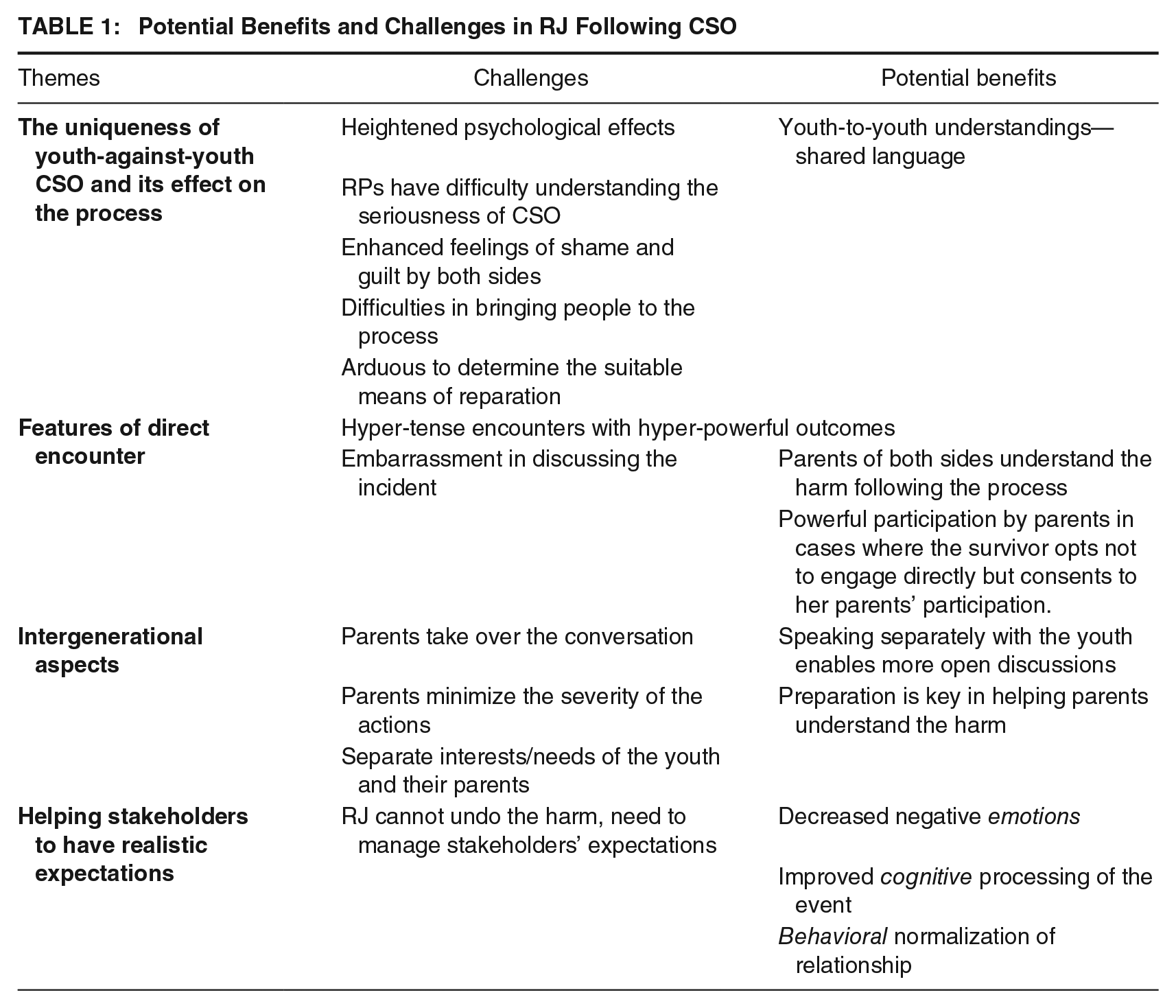
We summarized the potential benefits and challenges in RJ following CSO (Table 1)
Potential Benefits and Challenges in RJ Following CSO
Discussion
The present explorative study identifies the unique challenges, potential benefits, and characteristics of RJ processes following youth-related CSO, as portrayed by facilitators who conducted such processes. By doing so, the study contributes to the scant knowledge in the area. Cyber-sexual assaults by and against youth are rarely reported, generate detrimental consequences on victims, and are difficult to address through mainstream criminal justice systems. The gender characteristics of the current sample reflect existing research, suggesting that survivors of CSV are predominantly female (McGlynn & Rackley, 2017a; O’Malley & Holt, 2022), and perpetrators are predominantly male (Patchin & Hinduja, 2020).
CSO typically takes place when the person committing the offense and the person victimized by it are distant from each other. The screen that separates them (figuratively and literally) prevents the wrongdoer from realizing the harm and its consequences on the victim. The infinitive nature of CSO in terms of time, audience, and geography amplifies the impact of the offense and its consequences. What adds to the complexity of these crimes is the fact that, when conducted by youth, they are developmentally unable to grasp the full magnitude of their actions and their irreversibility. Male offenders during adolescence display increased levels of externalizing behaviors primarily during this developmental stage. The maturity gap (different levels of maturity in the mental, physical, moral, and behavioral domains) defines adolescence, contributing to heightened risk-taking and susceptibility to peer influence compared with childhood or adulthood, and concluding when social adulthood is achieved (Moffitt, 2018). Similarly, youth survivors of CSO find it difficult to communicate their needs to their parents, given the sensitive issues at stake and the communication barriers characterizing adolescent years.
As a relational, humanistic justice-making mechanism, RJ can be attractive for survivors of CSO. Meeting in a safe, equal environment, supported by family members and backed by authorities who establish that a crime was committed against them, provides an opportunity for them to be heard, acknowledged, and compensated outside the criminal justice process—instead of the process or as an addition to it. The same safe, equal, and non-judgmental environment of RJ processes can also help RPs to see the damage they have done and the consequences of their actions (Langos & Sarre, 2015). The adaptability of the process enables the parties to determine the boundaries of the discussion and the identity of the participants prior to the meeting, in accordance with their individual preferences. Topics that are too intimate to share in a group discussion can be left outside the agreed-upon encounter. Parties that prefer not to be directly involved may opt out of the process and use indirect forms of participation.
RJ processes following youth CSO present their own risks and challenges as well. A direct encounter between the parties may be stressful, hostile, and even traumatizing, especially when conducted without adequate preparation and proper facilitation. Accordingly, it is important to learn from the experiences of facilitators and programs who have conducted RJ processes in such cases.
One of the dilemmas in CSO cases is whether to hold indirect “shuttle communication” between survivors (or survivors’ supporters) and RPs (or their supporters), through a facilitator or a mediator acting as the middle-person. Keenan and Zinsstag (2022) claimed that face-to-face encounters have the potential for the best outcome for survivors and RPs in RJ following SV. However, the shuttle option is also always available if desired. This flexibility of the process offers safety for the survivor as well as the RP. Indirect, shuttle mediation, may seem attractive in CSO cases due to their special sensitivity and increased emotions of shame among the parties. However, the present study indicates that when survivors meet the person who harmed them face to face, the benefits for their mental health can be substantial. The emotional intensity characterizing face-to-face meetings fosters emotional transformation, resulting from the revelation of the shared humanity of the participants.
Accordingly, despite the inclination to involve only parents in some RJ processes following CSO, it seems that similar to findings in the context of other crimes, the most fully restorative processes involve the active participation of all primary stakeholders (McCold & Wachtel, 2003). Moreover, the study revealed that direct encounters between the wrongdoer, the survivor, and the supporters promote emotional, cognitive, and behavioral changes among the participants about themselves and the others involved.
Parents are essential stakeholders in the RJ process following youth-related CSO because they too would often need to experience cognitive, emotional, and behavioral transformation. But parental involvement requires intensive preparation and cautious facilitation because it can backfire. Parents of adolescents who committed CSO might justify, minimize, or deny altogether their child’s responsibility for the offense. Keenan and Zinsstag (2022) mention the potential risk of manipulation or coercion of survivors by the families involved to participate in RJ meetings. Gal and Moyal (2011) found that, in cases of child victimization in property and violence offenses, survivors’ parents sometimes dominated the processes, and suggested this is one of the explanations for the children’s relatively low satisfaction with RJ. Parents of CSO survivors might blame their child for sharing private images or behaving in other indecent ways.
Herman (2005) recognized that SV survivors need validation from their parents as bystanders. When parents are present at the RJ encounter, assuming they were properly prepared, they may experience such transformation and can support both parties while engaging in a dialogue leading to a joint acknowledgment of the wrongfulness of the RP’s deeds. Despite these benefits, parental involvement needs to be seriously considered by the survivor, RP, and the facilitators, and the specific parent-youth dynamics should be addressed before and during the encounter to prevent victim-blaming and disintegrative shaming.
The study’s findings also indicate the various realms in which the RJ process may affect the youths involved and their parents. Some will be able to interpret the events, their actions, or the meaning of the process in a more constructive and reintegrative way than before. Others will be able to affect future interactions with each other in a constructive way. Others yet will be able to significantly reduce negative emotions such as shame, anger, fear, guilt, and hate and enjoy the relief of being freed from such emotions. At the same time, the findings demonstrate that RJ cannot undo the harm or return the parties to where they were before the offense took place. Facilitators reflected a realistic approach to RJ, and it seems that it would be advisable to manage the participants’ expectations before the beginning of the process.
Research Limitations
The small sample size presented a potential limitation, even for an exploratory study. However, because interviewees were from two different jurisdictions and the topic was relatively narrow it was possible to identify shared themes and ideas across the different interviewees and the two countries they operate in. The documents describing the RJ processes discussed in the interviews provide a significant addition to understanding the phenomena.
Implications for Practice, Policy, and Research
An essential next step in studying the phenomenon of RJ processes following youth-related CSO would involve examining the perspectives of survivors, RPs, and their supporters. Despite repeated attempts, the authors were unable to obtain permission to interview the direct stakeholders, due to enhanced protections on young people involved in the criminal justice system, but hopefully, this will be possible elsewhere. It would be particularly important to explore the perspectives regarding RJ following CSV among underrepresented populations such as ethnic minority groups, younger children, children and youth with disabilities, and LGBTQ and transgender children and youth.
In terms of policy, the present study does not aim to provide proof for the effectiveness of RJ in addressing the needs of youth involved in CSO. Nevertheless, the study does provide anecdotal indications that RJ may provide a positive and even transformative experience for all involved. At the same time, the study highlights the importance of child and youth development and CSO-specific training, guidelines, and facilitation to prevent secondary victimization by survivors and family members (Gal & Moyal, 2011).
In terms of practice, the lessons learned from the experiences described in the study indicate that RJ facilitators should be trained in child and adolescent development. They should be aware of the increased emotional intensity of RJ following CSO, which is both an opportunity for healing and a barrier to such meetings taking place. Creativity may be needed to enable the parties to overcome their hesitation to participate as well as gradual and patient preparation. Indeed, the importance of thorough preparation is an additional lesson, not only for the young people involved but also for their parents. During preparation, it is crucial to allow private and separate space for each party to ensure a safe and effective encounter.
Footnotes
Authors’ note:
We have no known conflict of interest to disclose. We are indebted to Marit de Haan, Human Rights Centre of Ghent University, and Heidi Defever, Leuven, Flanders, Belgium for their outstanding contribution to the study. We are also thankful to the anonymous reviewers for their valuable suggestions and comments on earlier drafts of this article. We extend our heartfelt gratitude to the scholars and attendees at the World Victimology Conference (2022) and the Third Haruv International Conference (2023) for insightful remarks and constructive feedback on our research. Finally, we are extremely grateful to the mediators and facilitators in Belgium and Israel, for their generosity in sharing their experience and wisdom with us.
