




Abstract
Restorative justice was initially used for minor crimes, but it has been increasingly used to address the aftermath of violent crimes. Previous studies have indicated that restorative justice can be effective in reducing the harmful effects of violent victimization. However, there is limited research on how restorative justice can support victim recovery. This article presents a theoretical framework to better understand the relationship between victim recovery and restorative justice. The framework identifies core recovery factors that are common to victims of different types of violence, as well as those that are relevant to the restorative justice process. In addition, the framework highlights enabling factors that can facilitate the victim recovery process when present in restorative justice as well as inhibiting factors that can impede the victim recovery process if they are present in restorative justice.
Violence is a pervasive problem in our society (Dworkin et al., 2021). The prevalence of violent crimes is concerning because violent victimization is a risk factor for future criminal offending (Papalia et al., 2018), revictimization (Walsh et al., 2020), and substance abuse (Stuart et al., 2013). Moreover, violent victimization can cause enduring psychological trauma. Existing research has demonstrated that violent crimes, including intimate partner violence (Miles-McLean et al., 2021), sexual assault (Hansen et al., 2017), and child abuse (Powers et al., 2016), can lead to severe trauma for victims.
Since violent victimization has significant consequences, caring for victims in the justice system is of paramount importance. Numerous interventions and treatments, such as cognitive therapy, have been developed for victims of violence (Amstadter et al., 2007). Restorative justice can be considered one such intervention, as it originated in response to the critiques of the neglect of victims in the justice procedure (Zehr, 1990). While there is no universally agreed-upon definition of restorative justice (Wood & Suzuki, 2016), restorative justice is commonly regarded as “a meeting . . . of affected individuals, facilitated by one or more impartial people” (Daly, 2016, p. 21, emphasis in the original). In this context, it is noteworthy that the rate of victim engagement in restorative justice processes is not invariably substantial (e.g., Hoyle & Rosenblatt, 2016). Given the primary focus of this article on the victim recovery process, this article presupposes the victims’ involvement in restorative justice.
Restorative justice is currently implemented globally (Gavrielides, 2021), but there exists variability in its operational characteristics, particularly concerning its integration within existing criminal justice systems or its independent implementation (Dignan, 2007), eligibility criteria for justice-involved persons (Miers, 2001), and its placement within the legal process (Umbreit et al., 2004). Notwithstanding these variations, a restorative justice meeting typically encompasses two distinct phases: (a) a storytelling phase, where participants engage in discussions regarding the circumstances and repercussions of the crime, and (b) an outcome discussion phase, where participants explore appropriate measures to redress the harm caused to those affected by the crime (Rossner & Bruce, 2018). Restorative justice has been used to address the aftermath of serious crime (Umbreit et al., 2006), including domestic violence (Pennell et al., 2021), sexual assault (Burns & Sinko, 2023), and child abuse (Klar-Chalamish & Peleg-Koriat, 2021).
Despite the increasing use of restorative justice for violent crimes, little is known about how restorative justice can support recovery from victimization and trauma. This lack of knowledge is partly because early scholars were primarily interested in evaluating the effectiveness of restorative justice, particularly concerning participant satisfaction, perceived fairness, and recidivism reduction (Kimbrell et al., 2023). Among these outcomes, satisfaction has been a dominant measure of “success” for victims in restorative justice (Daly, 2017). As a result, there is a lack of a systematic understanding of the victim recovery process in restorative justice (Bolitho, 2017). This knowledge gap undermines the use of restorative justice for violent crimes because there are ongoing doubts and controversies over the appropriateness of restorative justice for violent crimes (Herman, 2003), particularly domestic violence (Gavrielides, 2015) and sexual assault (Armstrong, 2021).
This article aims to address the gap in the literature regarding how restorative justice can facilitate the victim recovery process. To achieve this goal, the article offers a theoretical framework drawing on the literature on victim recovery from violent victimization. This article aims to enhance comprehension regarding the facilitation of victim recovery through restorative justice, thereby providing guidance for future research in terms of data collection and analysis. As existing literature has mainly focused on the outcomes of restorative justice, examining whether it is effective, there is a need to shift the research focus from “what works” to “how it works” (Suzuki, 2020). Responding to this call, this article contributes to the literature by establishing a theoretical link between restorative justice and victim recovery.
This study commences with a comprehensive review of the existing research on victim recovery and restorative justice. This article then examines the core and enabling factors for victims to recuperate from violent victimization and discusses how these elements relate to restorative justice. Drawing on the identified connection between these factors, this article offers a theoretical framework for the victim recovery process in restorative justice. This article concludes by presenting the implications for research on restorative justice and victim recovery from violent victimization.
Before moving forward, this article outlines the scope of this research. First, while some scholars emphasized the importance of analyzing the victim recovery process separately according to the offense type due to the differing impacts of victimization (e.g., Domhardt et al., 2015), this article reviews a broad range of literature on victim recovery regardless of the type of violence, research location, and publication timeframe. Therefore, this article draws upon the wealth of knowledge found in the existing English-language literature regarding victim recovery in the aftermath of physical violence, sexual violence, intimate partner violence, and child abuse. This approach is because, as discussed below, the review of the existing literature has highlighted commonalities in the recovery process among victims of various types of violence. As restorative justice is used for a variety of violence, identifying common factors for the victim recovery process is required to better understand how restorative justice can support the victim recovery process. Second, while there is no single agreed-upon definition of recovery (Flasch, 2020), this article defines recovery as “symptom remission . . . and the [victims’] personal process and experience over time to reach a meaningful sense of life” postvictimization (Chouliara et al., 2014, p. 69). This definition implies that recovery is different from healing because victims of violence often suffer from the lingering effect of victimization, and it is impossible to undo the harm caused to them (Evans & Lindsay, 2008). Rather than an endpoint, victim recovery is viewed as an ongoing and evolving process (Flasch, 2020), in which victims struggle to overcome trauma from violent victimization (Smith, 2003) and utilize internal and external support as a turning point to rebuild their postvictimization lives (Easton et al., 2015).
Existing Research on Victim Recovery and Restorative Justice
The available, albeit limited, literature on victim recovery and restorative justice can be categorized into two research streams. The first can be classified as “outcome-focused research,” which seeks to assess the effectiveness of restorative justice in mitigating the effects of victimization, particularly when compared with traditional criminal justice methods. The second research stream, referred to as “process-oriented research,” aims to investigate the ways in which restorative justice can aid in the victim recovery process.
Outcome-Focused Studies on Victim Recovery and Restorative Justice
The first rigorous evidence of the short-term impact of restorative justice on victim recovery was presented by Strang (2002), who conducted the Reintegrative Shaming Experiment (RISE) in Australia. This experiment randomly assigned victims of property and violent crimes to either restorative justice conferencing or traditional criminal courts. According to Strang (2002), more violent crime victims in the control group reported that restorative justice conferencing helped restore their sense of security compared with those who attended criminal courts. In addition, when asked about the feelings of anger, fear, and anxiety, while court victims still exhibited high levels of fear of revictimization, victims in restorative justice conferencing demonstrated emotional restoration because their feelings of anger, fear, and anxiety decreased after they attended restorative justice conferencing. Similar findings were reported by Angel et al. (2014) based on an experiment conducted in the United Kingdom. According to their study, when post-traumatic stress symptoms (PTSS) were measured 1 month after the restorative justice interventions, both the prevalence and severity of PTSS scores were significantly lower among victims who participated in restorative justice conferencing than among those who attended criminal courts.
These findings are consistent with the reviews on victim recovery and restorative justice. Focusing on victims’ post-traumatic stress, Lloyd and Borrill (2020) systematically surveyed the literature. They found that restorative justice was moderately effective in reducing post-traumatic stress in victims. While there were mixed findings on whether restorative justice could mitigate the symptoms, such as adverse modifications in mood and cognition, as well as heightened arousal and reactivity, it was found to improve the symptoms of avoidance and intrusion (Lloyd and Borrill, 2020). In a systematic review conducted by Nascimento et al. (2023), a broader range of psychological impacts of restorative justice, including emotional restoration, were examined. Their finding indicated that restorative justice was promising with regard to the psychological impacts on victims because it was helpful in reducing not only PTSS but also anxiety, distress, and fear.
The literature suggests that restorative justice has a positive influence on victim recovery that extends into the long term. A study by Sherman and Strang (2015) followed up with victims from the RISE experiment and found that victims who underwent restorative justice conferencing were less angry and fearful of crime even a decade after the experiment. More recently, Sliva (2020) conducted an experiment in the United States to investigate the long-term impacts of restorative justice on victims of serious crime. Although there was no significant difference between the control and treatment groups in terms of the reduction of post-traumatic stress disorder (PTSD) symptoms and depression, victims who participated in victim–offender mediation showed better mental well-being outcomes and lower levels of anger, shame, and self-blame.
Process-Focused Studies on Victim Recovery in Restorative Justice
To date, there are only two process-focused studies on victim recovery and restorative justice. The first is Daly (2008a), who developed the concept of victim journeys toward recovery based on the South Australia Juvenile Justice (SAJJ) project. Daly (2008a) classified victims into “high” and “low” distress groups based on their responses to questions about the impact of the crime on their fear of being alone, sleeplessness or nightmares, general health problems such as headache or physical pain, security concerns about their property, increased suspicion or distrust, sensitivity to particular sounds or noises, loss of self-confidence, loss of self-esteem, or other problems. This classification suggested that the degree of distress was related to victim recovery. While 63% to 95% of low-distress victims reported recovering from the impact of crime 1 year after conferencing, 71% of high-distress victims stated otherwise. Focusing on these distinctions and adding the measure of victim emotional harm 1 year after conferencing, Daly (2008a) proposed that victims experience different pathways toward recovery after restorative justice conferencing. There are three victim journeys toward recovery through restorative justice conferencing: (a) easy journeys, where victims with low/no distress were “not bothered emotionally and had fully recovered,” (b) change journeys, where victims with moderate/high distress “were not bothered emotionally and had fully recovered,” and (c) difficult journeys, where victims “were not bothered, but had not recovered; or they were still bothered, but had recovered” regardless of their distress level, or where victims with low to high distress were “still bothered and had not recovered” (Daly, 2008a, p. 20–21).
More recent process-oriented research on victim recovery and restorative justice was conducted by Bolitho (2017). Bolitho (2017) drew on the concept of memory reconsolidation, which refers to “an inherent (possibly adaptive) process whereby it is possible for significant emotional learnings to be disrupted and updated with new learnings that then provide an immediate and long-lasting emotional closure” (Bolitho, 2015, p. 274). According to Bolitho (2017), restorative justice can help with emotional restoration because the process of narrating the crime incident during the restorative justice process can facilitate the revision and reconfiguration of negative emotions linked to victimization, thereby engendering an emotional transformation and liberation from the adverse state (Bolitho, 2017). Bolitho (2017) observed restorative justice conferencing in Australia and found that restorative justice could facilitate such emotional transformation of victims.
A Theoretical Framework for the Victim Recovery Process in Restorative Justice
After reviewing the available literature on victim recovery and restorative justice, it has become clear that there is a lack of process-oriented research in this area. To fill this gap in the literature, this section provides a review of existing literature on recovery from violent victimization and restorative justice to develop a theoretical framework that can enhance our understanding of the victim recovery process in the context of restorative justice. This review has identified three key components: (a) core recovery factors that are shared among victims of different types of violence and relevant to the restorative justice process, (b) enabling factors that facilitate the victim recovery process if they are present in restorative justice, and (c) inhibiting factors that can impede the victim recovery process if they are present in restorative justice.
Core Recovery Factors
While victims may experience violence differently (Pemberton & Vanfraechem, 2015), the experience of violent victimization often leaves victims questioning, “why me?” (Why Me?, 2021). This question is due to the fact that victimization can cause a disruption in one’s life narrative, resulting in a profound loss of control and a sense of disconnection from one’s social surroundings (Pemberton, 2019). Prior to violent victimization, individuals exercise authority over their bodies and the trajectory of their life stories. However, after experiencing violence, victims often lose that sense of control and begin to feel insecure while blaming themselves for the circumstances that led to the victimization (Pemberton, 2019). Hence, one of the most critical issues for victims of violence is to regain control of their life narrative by comprehending the harm caused to them and making sense of it (Cha & Lee, 2022; Jeong & Cha, 2019).
Aligned with the scholarly discourse surrounding cognitive behavioral therapy (CBT), which seeks to amend maladaptive cognitions stemming from a traumatic incident through cognitive restructuring (Bourdon et al., 2019), extant research on recovery from violent victimization suggested that making meaning of violent victimization is a crucial step toward recovery. Examining the personal accounts of older women who were sexually abused in their childhood, Graham et al. (2022) found that constructing a coherent narrative of their experiences was an essential aspect of their recovery process. This was because those who were successful in doing so were able to reframe the traumatic memories of their childhood into something meaningful in their present-day lives postvictimization. Similarly, other research showed that account-making, which refers to “people’s story-like constructions of [traumatic] events that include explanations, descriptions, predictions about relevant future events, and affective reaction,” was linked to successful coping and better mental health among victims of sexual assault (Orbuch et al., 1994, p. 250) and survivors of child sexual abuse (Easton, 2013). Thus, making sense of the harm caused can assist victims of violence in “escaping the dungeon” (Draucker & Petrovic, 1996, p. 326) of the enduring impact of violent victimization and “learning to live with the experience” (Ranjbar & Speer, 2013, p. 278) by regaining control over their body and narratives of their life.
The shattered assumptions theory put forward by Janoff-Bulman (1992) posits that individuals usually view themselves as being intrinsically valuable. However, as a result of violent victimization, the self of victims may become severely impaired because violence has both physical and ontological consequences, such as a threat to one’s existence and a loss of personal autonomy (Pemberton, 2019). Therefore, what is needed for recovery from violent victimization is to restore the damaged self by reclaiming one’s sense of self, as it can help victims regain faith in themselves and the ability to manage traumatic experiences (Benight & Bandura, 2004).
Research demonstrated that recovery from violent victimization necessitates a reconstruction of the self-identity. For victims of violence, transforming their self-concept may be essential to revive “the buried self” that has resulted from violent victimization (Godbey & Hutchinson, 1996, p. 306) and to construct “a new residence” for the recovered self (Draucker, 1992, p. 5). During this transformative process, victims of violence may undergo a cognitive shift (Allen & Wozniak, 2010), where they begin to reassert their sense of self-worth (Song & Shih, 2010) and assume responsibility for their lives once again (Reynolds & Shepherd, 2011). Taken together, by reclaiming their self-identity, victims of violent crime may start to experience a sense of control over their future (Hou et al., 2013).
Restorative justice can facilitate the development of the aforementioned core recovery factors because it prioritizes dialogue rather than settlement (Hansen & Umbreit, 2018). First, restorative justice can aid victims in creating meaning out of violent victimization through validation. In the restorative justice process, victims are given an opportunity to ask their justice-involved person the “why me” question and receive an answer explaining why the offending has happened as well as why they are chosen as a victim (Kirkwood, 2021). The direct engagement with the perpetrator as a catalyst for trauma (Angel et al., 2014) and acquiring comprehension of their lack of culpability in the traumatic occurrence (Strang et al., 2006) represent shared components of restorative justice and CBT, the latter of which has demonstrated efficacy in mitigating PTSD symptoms in victims of violence (Billette et al., 2008). In addition, restorative justice encourages justice-involved persons to actively take responsibility for their actions and fosters repentance in them (Braithwaite & Roche, 2001). Acknowledging victimization experiences and recognizing that violent victimization is not the victim’s fault may help victims validate their experiences and make sense of the harm inflicted upon them. The association between the validation of victimization and mean-making was suggested by Elliott et al. (2014). Drawing on procedural justice, Elliott et al. (2014) examined the impact of the interaction between victims and police on trauma reduction. They found that validation of victimization experiences by police eased the adverse psychological effects of victimization by providing the victims with a sense of closure, empowerment, and safety.
In addition, restorative justice can facilitate the process of self-reclamation in victims of violent crime by providing a space for them to share their traumatic experiences (Kaminer, 2006). In the restorative justice process, victims have the opportunity to not only ask questions about the offense but also express their emotions related to the offending and victimization (Kirkwood, 2021). This feature of restorative justice is similar to “talk therapy” (Miller, 2011) and can promote recovery by allowing victims to discharge negative emotions associated with violent victimization (Zech & Rimé, 2005). Batchelor (2023) partially confirmed this therapeutic effect of talking in restorative justice, reporting that victims of serious crime who participated in restorative justice had a reduced desire for punishment after engaging in a dialogue with their justice-involved person.
Enabling Factors
In addition to the aforementioned core factors, enabling factors, if present in restorative justice, may also promote the victim recovery process through restorative justice. One such factor is resilience. According to Chouliara et al. (2014), resilience is a protective factor that can shield victims of violence from the deleterious consequences of violent victimization. Research has shown that possessing resilience is helpful in overcoming the traumatic adversity of violent victimization (Crann & Barata, 2016). As pointed out by Suzuki (2020), through the concept of readiness, victims who attend restorative justice may have a different level of emotional capacity. Hence, a high level of resilience among victims of violence can support the recovery process in restorative justice.
Direct compensation to victims by justice-involved persons may also support the victim recovery process. Receiving material restoration from justice-involved persons is one of the essential needs for victims (Strang, 2002). Therefore, failing to do so may hinder victims’ ability to cope with the aftermath of violent victimization. By examining the effects of various sentencing options on the psychological well-being of victims of serious crime, Laxminarayan (2013) found that restitution from justice-involved persons was associated with victims’ emotional restoration. In restorative justice, it is typical to produce a reparative agreement at the end of the process, although it is crucial to acknowledge the potential scenario where direct reparation to victims is not integrated within the restorative agreement (c.f., Rossner et al., 2013). The meta-analysis by Latimer et al. (2005) showed that justice-involved persons who participated in restorative justice were more likely to adhere to the terms of this agreement than those who are sent to the criminal justice system. Direct restitution to victims by perpetrators can therefore be viewed as an enabling factor for victim recovery in restorative justice.
The third enabling factor for victim recovery in restorative justice may be what Suzuki and Yuan (2021, p. 1361) called “support networks,” which refers to “emotional and substantive assistance.” Because a yearning for connection with others is a fundamental human need (Banks, 2006), research on recovery from violent victimization has suggested that victims of violence need to reestablish connections not only with themselves but also with others (Kerlin & Sosin, 2017; Sinko & Saint Arnault, 2020). Establishing support networks during the recovery process is advantageous because, whether informal or formal, support networks can offer material, emotional, and social support for the recovery process (Arias & Johnson, 2013; Lewis et al., 2015). Victims are permitted to bring their families, relatives, and friends as a support person in restorative justice (Kirkwood, 2021), and their presence during restorative justice can serve as support networks for their recovery process (Suzuki & Yuan, 2021).
Last but not least, forgiveness may also serve as an enabling factor for victim recovery in restorative justice. Although forgiveness is not frequently discussed in the restorative justice literature due to its perception as a secondary goal that should be offered by victims out of their generosity (Armour & Umbreit, 2018; Suzuki & Jenkins, 2023), forgiveness may be offered more often in restorative justice than previously recognized (e.g., see the review by Suzuki & Jenkins, 2022). This prevalence may be because even victims of violence sometimes participate in the restorative justice process with a pro-social motive to support the rehabilitation of justice-involved persons (Van Camp & Wemmers, 2013). The presence of forgiveness in restorative justice may facilitate the victim recovery process by enabling victims of violence to let go of their experiences of violent victimization (Flasch et al., 2017; Smith, 2003) and declare a personal victory over the negative emotions attributed to traumatic violence (Kerlin & Sosin, 2017; Taylor, 2004).
Inhibiting Factors
Although the victim recovery process itself is predominantly one sided, the key characteristic of restorative justice lies in its inherent relational nature, specifically manifested through the dynamic interaction between victims and justice-involved persons (Suzuki & Yuan, 2021). When scrutinizing this relational facet of restorative justice, it becomes evident that certain inhibiting factors, linked to the attributes of justice-involved persons, have the potential to impede victims from attaining the core recovery factors for recovery from violent victimization in restorative justice. These inhibiting factors, associated with the characteristics of justice-involved persons, include neutralization and insincere apology.
While victims necessitate the validation of their experiences of violent victimization through the acknowledgment of culpability on the part of justice-involved persons, such validation is not always forthcoming in restorative justice. Instead, there are instances of denial or downplaying of responsibility by justice-involved persons in restorative justice (Suzuki & Jenkins, 2022). Furthermore, some justice-involved persons demonstrate an inability or unwillingness to provide a comprehensive account of the events during the restorative justice process (Bolitho, 2012). When neutralization manifests within restorative justice, victims are unable to substantiate their encounters of violent victimization (Daly, 2008b), thus impeding their capacity to derive meaning from the experience and embark on a trajectory of recovery.
An apology may play an important role in the victim recovery process in restorative justice not only by fostering forgiveness among victims (Allan et al., 2022) 1 as an enabling factor but also by exerting a remedial influence (Suzuki, 2022). However, empirical studies have indicated instances where victims perceive apologies from justice-involved persons in restorative justice as disingenuous (Choi & Severson, 2009; Daly, 2005). The perceived lack of sincerity in apologies proves deleterious to the efficacy of restorative justice, as receiving an apology constitutes a vital need for victims (Strang, 2002). As Walgrave (2011) argued, when victims interpret apologies not as genuine expressions of remorse and admission of guilt but as strategic maneuvers to secure lenient consequences, victims may experience a retraumatization rather than a process of rewriting their traumatic experience to restore their fractured sense of self by discharging the negative emotions stemming from violent victimization.
Synthesizing the Factors Related to the Victim Recovery Process in Restorative Justice
The previous section has highlighted an association between the victim recovery process and restorative justice through core recovery factors, enabling factors, and inhibiting factors. To gain a better understanding of how restorative justice can facilitate the victim recovery process, Table 1 summarizes these factors.
Summary Table for the Factors Related to the Victim Recovery Process in Restorative Justice
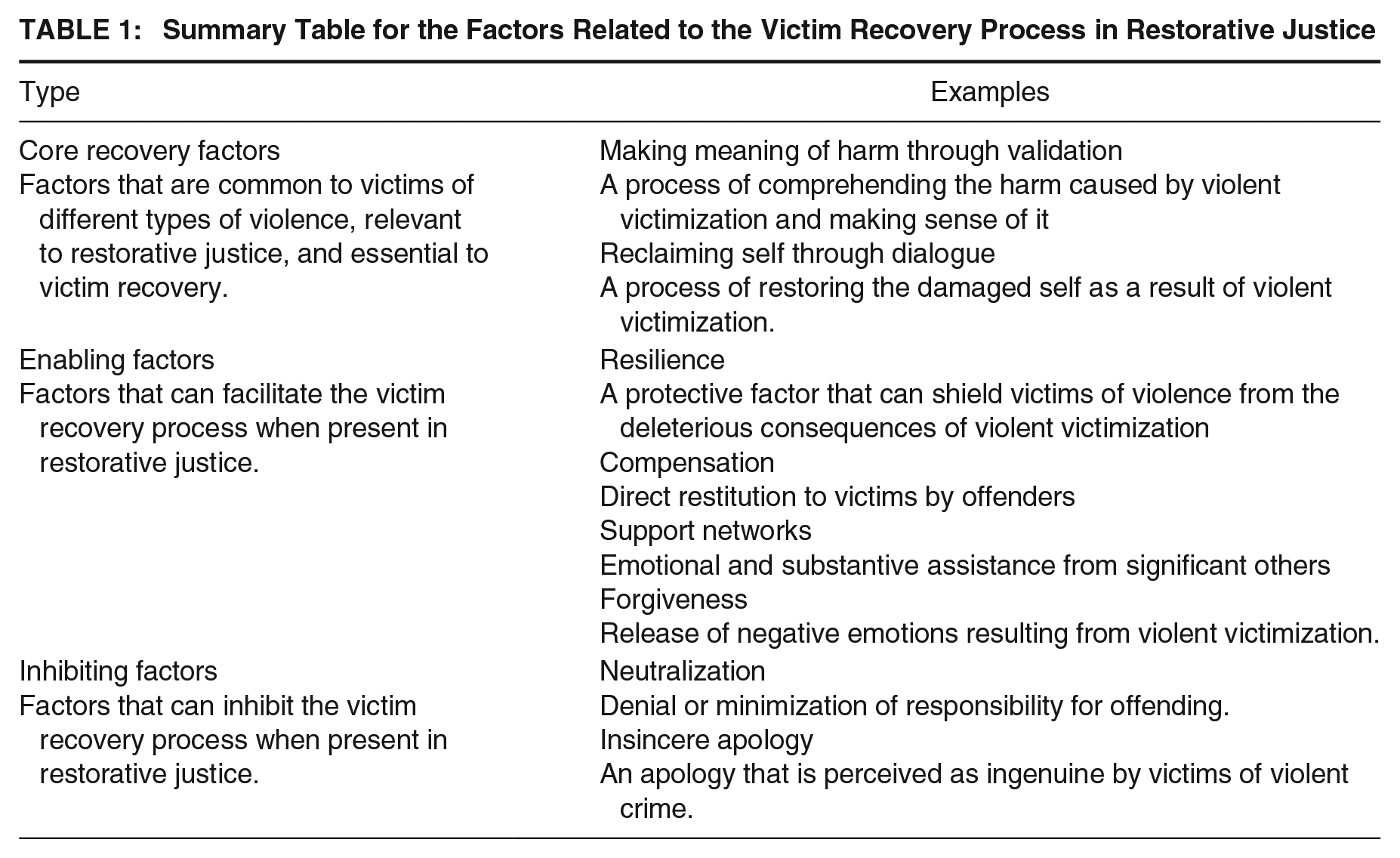
Core recovery factors encompass elements that are shared among victims of various forms of violence, pertinent to restorative justice, and indispensable to the process of victim recovery. These factors encompass (a) the construction of meaning through validation, involving the comprehension and contextualization of the harm inflicted by violent victimization, and (b) the reclamation of one’s sense of self through dialogues, encompassing the restoration of a fractured self-arising from violent victimization. Enabling factors comprise aspects that, when present within restorative justice, can facilitate the victim recovery process. These factors include (a) resilience, serving as a protective mechanism shielding victims of violence from the detrimental aftermath of violent victimization, (b) compensation, entailing direct restitution provided by justice-involved persons to victims, (c) support networks, encompassing emotional and tangible support from significant others, and (d) forgiveness, involving the liberation from negative emotions resulting from violent victimization. Inhibiting factors encompass elements that, when present within restorative justice, can impede the victim recovery process. These factors comprise (b) neutralization, denoting the denial or belittlement of responsibility for the offense, and (b) insincere apology, referring to an apology perceived as lacking authenticity by victims of violent crime.
Given the interdependent nature of these factors within the victim recovery process in restorative justice and the established linkages between them, this article now introduces a theoretical framework that consolidates the intricate dynamics among these factors and the restorative justice process itself. Although certain factors may be perceived as immediate or intermediate outcomes of restorative justice, they are regarded here as factors contributing to victim recovery. This viewpoint stems from the assertion made at the inception of this article, highlighting the protracted and enduring nature of the victim recovery process. Figure 1 illustrates such a theoretical framework.
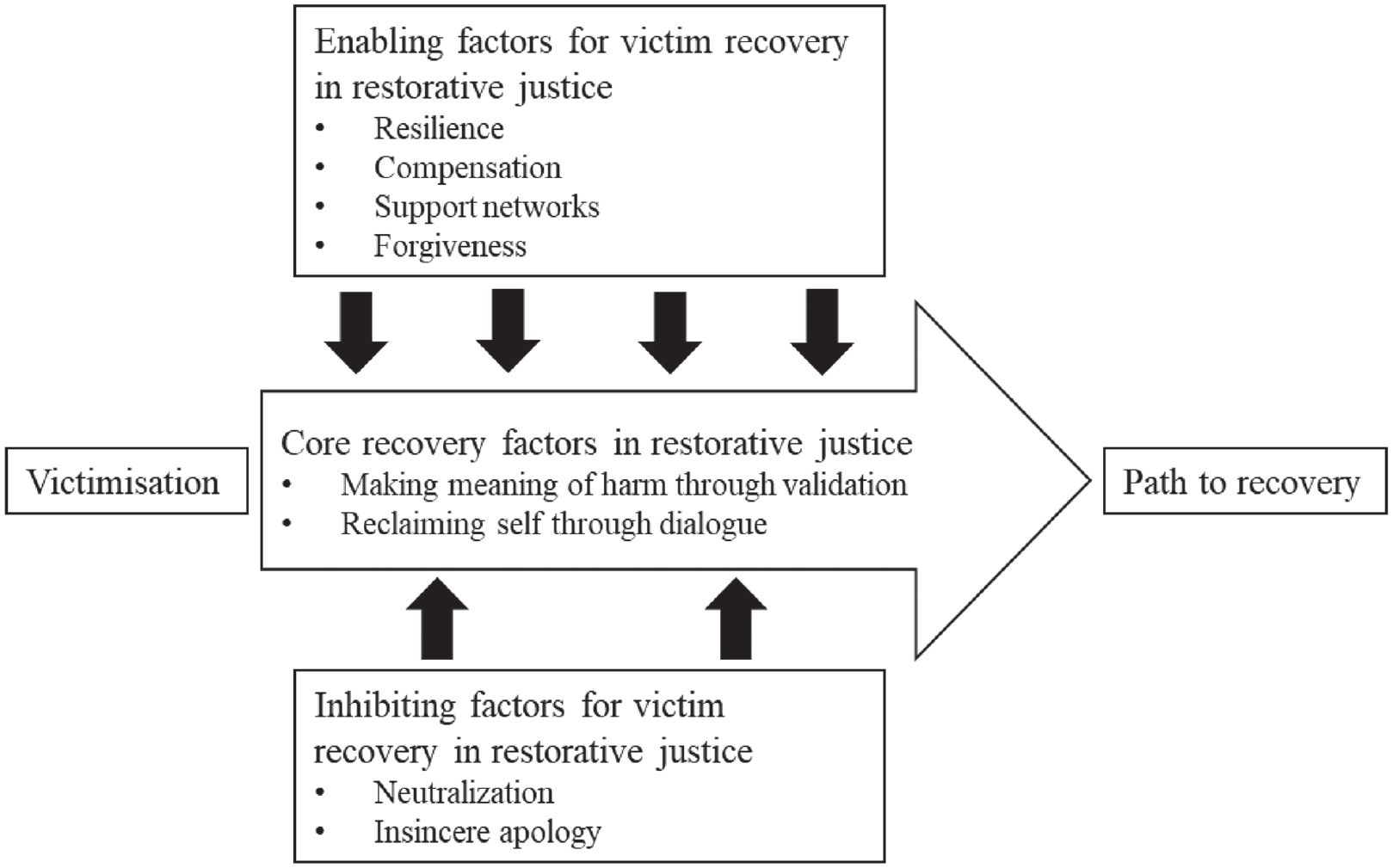
Theoretical Framework for the Victim Recovery Process in Restorative Justice
Following violent victimization, victims may be referred to the restorative justice process. Once victims agree to participate in restorative justice, the path to recovery from violent victimization may commence. In restorative justice, the recovery process may be facilitated mainly by the core recovery factors. This core recovery process in restorative justice involves victims making meaning of harm through validating their violent victimization to experience the acknowledgment of harm and responsibility-taking, as well as reclaiming self through dialogue to express feelings about their violent victimization. The victim recovery process in restorative justice is further facilitated if any enabling factors are present in restorative justice. These enabling factors for the victim recovery process in restorative justice include victims’ resilience, compensation from justice-involved persons, victims’ support networks, and forgiveness. However, the victim recovery process in restorative justice may encounter obstacles when inhibiting factors, namely neutralization and insincere apology, are present in restorative justice.
This theoretical framework captures the important characteristic of recovery from violent victimization, namely its multidimensionality (Draucker et al., 2009). The recovery process can take place not only at an intrapersonal level but also at an interpersonal level (Flasch et al., 2017). Because the restorative justice process is interactional (Kirkwood, 2021), this theoretical framework accounts for the multidimensionality of the victim recovery process by encompassing both the intrapersonal dimensions through mean-making and identity transformation and the interpersonal dimensions through reparation between victims and justice-involved persons and support networks between victims and their community of care (e.g., family members and close friends). Thus, this theoretical framework aligns with the extensive literature on both victim recovery and restorative justice.
Concluding Discussion
Based on an extensive review of existing literature on the topic, this article has presented a novel theoretical framework that sheds light on the complex interplay between the victim recovery process and restorative justice. To the best of my knowledge, this article represents the first comprehensive attempt to investigate the theoretical underpinnings of the connection between victim recovery and restorative justice. By offering a theoretical framework that incorporates both intrapersonal and interpersonal dimensions of victim recovery, this article contributes to the existing body of knowledge on the topic.
Limitations
While this theoretical framework is valuable in analyzing the victim recovery process in restorative justice, it has a limited scope. This framework heavily relies on the literature on recovery from violent victimization, such as domestic violence, sexual assault, and child abuse, and may not be applicable to other types of offenses, especially minor crimes. This limitation may be detrimental because, while restorative justice is increasingly being implemented to address the aftermath of serious crimes, it is still primarily utilized for the “shallow end” of offending (Hoyle & Rosenblatt, 2016), which may have a lower impact on the victim (Pemberton & Vanfraechem, 2015). However, it is important to note that the severity of the offense may not be the only factor influencing victim recovery, as the context of the crime may also be significant (Daly, 2008b). For example, Komiya et al. (2018) demonstrated that compensation for irreplaceable losses was less likely to lead to forgiveness than compensation for replaceable losses. Therefore, to apply this theoretical framework, it may be necessary to examine the impact of victimization both narrowly and broadly, with consideration given to the unique circumstances of each case.
Implications for Research
When restorative justice researchers utilize the theoretical framework presented in this article, they may find a mixed-method approach most effective. Because the victim recovery process is not inherently linear and predetermined, but rather intricately interwoven and characterized by recurring stages over time (Flasch et al., 2017), the complexity of the recovery process may best be explored through subjective accounts and narratives of victims’ experiences (Hall, 2011). In this regard, researchers may find the clinical ethnographic narrative interview particularly useful in exploring the recovery process from victimization because it is specifically designed to examine trauma recovery (Sinko & Saint Arnault, 2020). In combination with PTSD assessment instruments such as the PTSD Symptom Scale (PSS-I) (Foa et al., 1993), which can serve as a baseline for understanding the impact of victimization prior to the restorative justice process, researchers can utilize the theoretical framework presented in this article to explore the trajectories and challenges victims of violent crime experience in their recovery process through restorative justice. In doing so, the theoretical framework presented in this article may shed light on how restorative justice may support the victim recovery process.
When researchers employ the theoretical framework presented in this article to investigate the victim recovery process in restorative justice, they must also consider potential influences on the variability of this process. The first influential factor may be gender. It is not part of the theoretical framework in this article because the existing literature on the subjective accounts of victims of violence about their recovery process did not include such perspectives. However, research on cognitive processing therapy has shown gender differences in post-treatment recovery (Craig & Sprang, 2014). Age may also be a factor in the victim recovery process in restorative justice. By using the RISE data set, Gal and Moyal (2011) found that child victims were less satisfied with restorative justice than adult victims. Given that the majority of the samples in the literature this article has drawn on are adult victims, scholars may need to carefully analyze the recovery process among younger victims using the theoretical framework presented in this article. Finally, culture may also be influential in the victim recovery process. Examining the trauma recovery process among Irish and American female survivors of gender-based violence, Sinko et al. (2021) found that the values important to victims during their recovery process differed between Irish (e.g., unconditional devotion to children) and American (e.g., personal growth) survivors. This finding suggests that trauma recovery may be a cultural process, and that differences in the vital components of the recovery process likely exist outside of industrialized Western countries (c.f., Suzuki & Pai, 2019). By accounting for this variability in the recovery process based on the theoretical framework in this article, we may better understand how restorative justice can support the victim recovery process.
Implications for Practice
This study has unveiled that restorative justice possesses the capacity to facilitate victim recovery if implemented in alignment with its principles. However, the findings also indicate that the victim recovery process may encounter hindrances when victims fail to validate their severe victimization due to neutralization and to rewrite their traumatic experience due to disingenuous apologies. These deficiencies can arise when justice-involved persons consent to participate in restorative justice without attaining a comprehensive understanding of its processes and objectives (Suzuki, 2020). To address these impediments in the victim recovery process in restorative justice, preparation may serve as a pivotal factor. The literature suggests that comprehensive preparation can foster comprehension of the aims of restorative justice (Bazemore & O’Brien, 2002) and their familiarity with the restorative justice process (Rypi, 2017). By offering extensive and thorough preparation, the likelihood of justice-involved persons neutralizing their transgressions and presenting insincere apologies can be minimized.
Footnotes
AUTHORS’ NOTE:
The author has no conflicts of interest to disclose. This research is not funded.
