




Abstract
Victim-offense mediation (VOM) is the process by which victims of crime meet the involved youth, in the presence of trained mediators, to process and address the emotional and practical ramifications of the crime. We aimed to qualitatively understand the experiences of victims and justice-involved youth during mediation sessions. Participants were recruited from one American and one Canadian mediation center, We combined field observations, semi-structured interviews, and multiple case study analyses with reflexive thematic analysis to explore nine cases of VOM participants’ experiences of the process and its potential link with various desired outcomes immediately following VOM. We generated five themes: Attempting to Satisfy Mediation Needs, Apologies, The Gravitational Pull of Victims, Finding a Healing Connection, and Corrective Emotional Experience & Challenged Expectations. We discuss these themes, the importance of relational processes, the importance and potential burden of the compelling victim, corrective emotional experiences, and the potential role of the mediators.
Victim-offense mediation (VOM) 1 is the process by which victims of crime meet the person(s) who has offended in the presence of trained mediators to process and address the emotional and practical ramifications of the crime (see Note 1). Since its initial use as a tool in the colonial justice system in 1974 (Johnson, 2003), VOM programs have expanded in number and scope and proliferated in many countries (Maryfield et al., 2020). By referring to the colonial justice system, we acknowledge that restorative justice, including VOM, has been utilized by Indigenous communities internationally since long before Western justice systems adopted it (Zehr, 2015). We recognize that the restorative justice literature needs to acknowledge these Indigenous roots and refer the reader to Daly (2002) for more information.
VOM aspires to achieve positive transformation of both victims and people who have offended (Sharpe, 1998). It stresses sensitivity to the needs of victims and their right to have a voice in the judicial process (Choi et al., 2013; Umbreit et al., 2000, 2004) and allows justice-involved youth (JIY) to express remorse. VOM aims for both parties to experience reconciliation in an environment where the guilt and loss of people who have offended and victims are not disputed (Umbreit et al., 2000). VOM has been successful in a range of cases, from property crime and theft to cases of more “personal” crime, such as assault, rape, and homicide (Umbreit et al., 2004; Umbreit & Vos, 2000). During VOM, the mediator guides the session by explaining how it works, reiterating the purpose of VOM, and making sure everyone receives a chance to speak.
Effectiveness of VOM
A large body of literature supports VOM’s effectiveness. Victims report experiencing less anxiety, fear, anger, and desire for revenge (Bolivar, 2010), a sense of closure and empowerment (Choi et al., 2010a, 2010b), and post-traumatic growth (Van Camp & Wemmers, 2013). Some of the positive effects of VOM last more than a decade post-mediation (Lloyd & Borrill, 2020). Meta-analysis and longitudinal literature reviews have reported high completed restitution compliance associated with VOM (Hansen & Umbreit, 2018; Latimer et al., 2005).
VOM decreases the risk of recidivism in adult and JIY samples (Correctional Service Canada [CSC], 2018; Umbreit et al., 2004), even when accounting for self-selection bias (Jonas-van Dijk et al., 2020). Latimer et al., (2005) found that compared with control groups who did not participate, VOM led to significantly reduced recidivism rates. Low recidivism rates following VOM (e.g., CSC, 2018) result in a lower long-term cost to the justice system (in terms of fewer returns to custody combined with the lower-cost option of VOM; Hansen & Umbreit, 2018). One of the most robust and commonly replicated VOM findings is that both victims and people who have offended report higher levels of satisfaction with the VOM process, outcome, and fairness than those who proceed through the traditional court system (Hansen & Umbreit, 2018; Latimer et al., 2005). Previous qualitative research has also demonstrated high satisfaction with VOM by victims (Armstrong, 2012) and JIY (Choi et al., 2011).
Benefits of VOM for JIY
Incarceration is especially problematic for JIY, who are at a critical developmental stage. They might be particularly vulnerable to peer pressure; incarceration presents a dangerous environment whereby first-time JIY might be influenced by their more prolifically offending peers (Goldbrum, 2017). Overcrowding, lack of purposeful activity, disconnection from social supports, and institutional racism have all been shown to contribute to the negative mental health effects of incarceration on young adults (Solomon, 2004). Incarceration also affects JIY by interrupting their education and exposing them to abuse by other incarcerated individuals or even staff members (Solomon, 2004). Furthermore, the retributive justice system has not proven effective—over half of JIY who served custodial sentences in the United Kingdom were found to re-offend within 1 year, and the number crept to two thirds by 2 years (Prison Reform Trust, 2012).
Many JIY “grow out” of their offending behavior by adulthood (McMahon & Jump, 2018). McMahon and Jump (2018) showed that engaging in prosocial activities and relationships, internalizing a shift in their identity, cutting ties with crime-related aspects of their life, and having confidence in their ability to live lawfully contributed to desistance. One of the most important themes was found to be a young person’s enthusiasm for a “hook for change” which could be employment, school, a prosocial interpersonal connection, community activity, or hobby. If these elements of lawful life are important antecedents to crime desistance, they seem unlikely to be provided by incarceration. By participating in restorative solutions, JIY can maintain community membership (Goldbrum, 2017).
Current Study
What Is Happening “In the Room?”
There are important gaps in the research on the mediation process for victims and JIY. For example, what contributes to their reported satisfaction (Maryfield et al., 2020; Suzuki & Yuan, 2021; Umbreit et al., 2004)? Research has yet to explain what constitutes “healing” in VOM (Bolivar, 2010). The restorative justice world also needs more information about what contributes to the effectiveness of programs—the first phase of research indicated that it does work. We must now know why and how (Suzuki, 2020). Our study moves into this second research phase by focusing on victim and JIY experiences of the mediation sessions themselves. We ask: What happens during the mediation process for both victims and JIY? That is, how do participants experience the process of VOM?
Benefits of Qualitative, Multi-Case Study Design
Research on VOM has thus far been overwhelmingly quantitative; researchers have called for more qualitative inquiry to understand the VOM experience (e.g., Tamarit & Luque, 2016). A qualitative approach is practical when exploring a topic about which little is known (Hancock & Algozzine, 2006) and can address the question of what is happening within a phenomenon (Morse & Richards, 2002). Qualitative research allows participants to have their voices heard—paralleling the exact principle on which restorative justice was created. Last, qualitative research is helpful as it leads to an appreciation of the social world from points of view less often experienced by others (i.e., victims and JIY; Noakes & Wincup, 2004).
Others have argued that each VOM case must be treated as unique to respect individual differences and must, therefore, be researched on a case-by-case basis (Bright, 2017). We used a multi-case study design appropriate when context is vital to understanding a phenomenon (Mason, 2002). That is, we organized our analysis using each mediation case as the unit of analysis instead of analyzing victims’ and JIY’s experiences separately. This allowed components of the larger context to remain unseparated and facilitated holistic analysis (Hancock & Algozzine, 2006). Most previous research on VOM focuses on victims (e.g., Armstrong, 2012) or JIY (Choi et al., 2011). If both are included in one study, they are analyzed separately. In contrast, we focused on the relationship between the victims and JIY and their shared experiences.
Method
Participants
Potential participants were recruited from two JIY mediation centers: the Conflict Resolution Centre in Minneapolis, MN, USA and Mediation Services in Winnipeg, MB, Canada. Nine cases were analyzed, each of which completed one mediation session. On average, JIY were 15.62 years old (SD = 2.36). The victims ranged from youth to adults (M = 39.22, SD = 15.64). Demographic information is shown in Table 1.
Participant Demographics
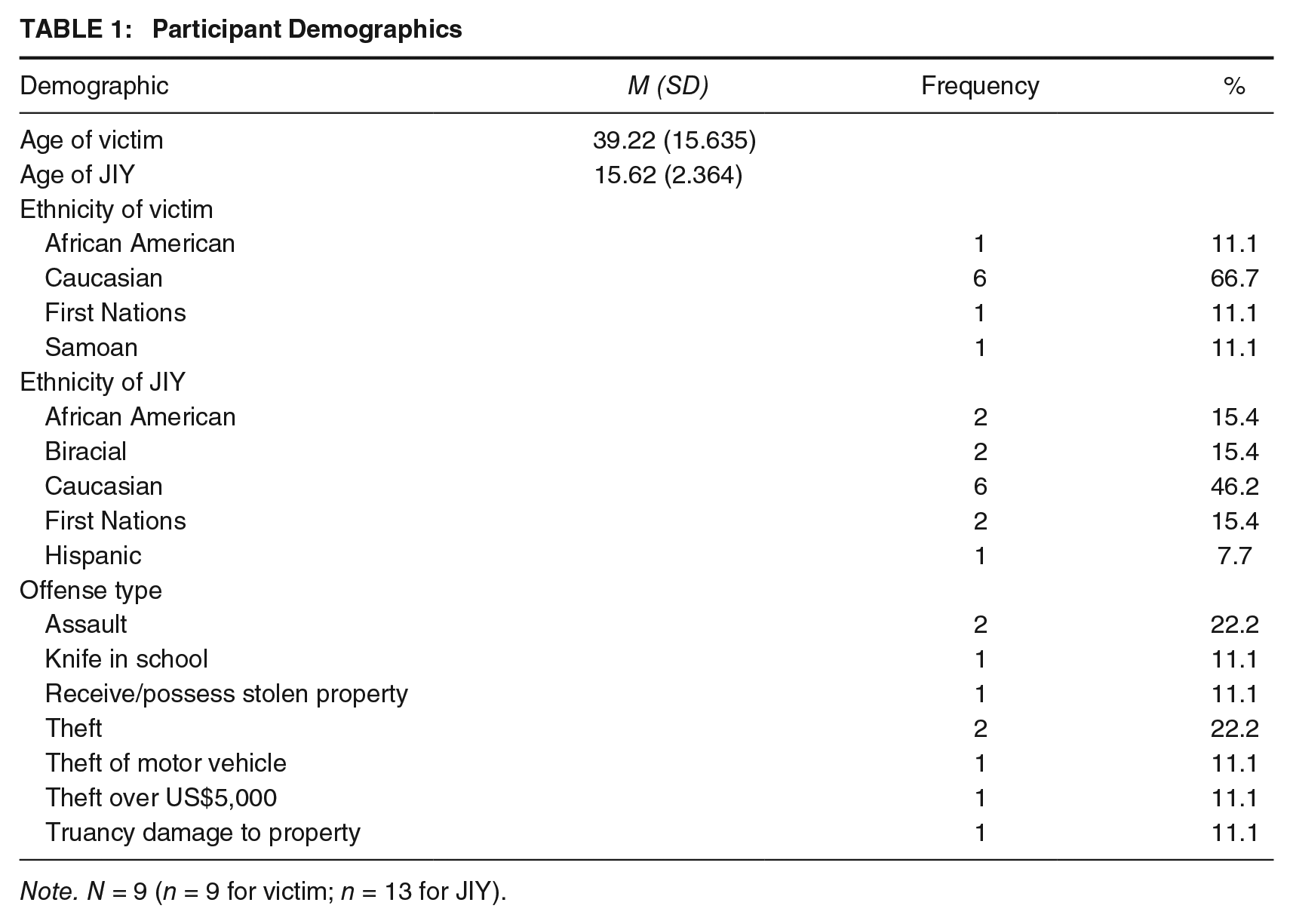
Note. N = 9 (n = 9 for victim; n = 13 for JIY).
Procedure
The Behavioral Research Ethics Board at the University of Saskatchewan approved this project. The first author provided both mediation centers with a copy of the research proposal and allowed each center to ask questions. Once permission to recruit was granted, potential cases were identified by the centers. To protect individuals’ privacy, the case manager contacted the victims and JIY involved in each potential case to inquire about participating. If all parties in each case agreed, permission to contact them was requested. Written consent was obtained from all participants before the first interview.
Victims and JIY participated in separate semi-structured interviews before and after their mediation session. Participants chose their pseudonyms to be used in research outputs. Each interview was audio-taped. Questions posed to the victims and JIY aimed to capture narrative information about their goals, thoughts, and feelings before mediation (see Supplemental Materials). Post-mediation (3-9 months later, depending on individual availability), victims and JIY were interviewed again. Participants were allowed to review their transcripts (i.e., member checking). All participants received a US$15 gift card to Walmart or Target as an honorarium. The first author transcribed interviews. Although her observations were not formally analyzed, the first author attended all mediation sessions in this study.
Cases and Data Analysis
Cases had various victim and JIY configurations; case information is in Table 2. In three cases, no victim was present (either by the nature of the crime or because the victim declined to participate). In these cases, an individual trained as a mediator agreed to participate as a “proxy victim” (Hobbs et al., 2021). A proxy victim serves as a “stand-in” for the victim so that the JIY can still participate in VOM. Because of our case-based analysis, if at least one party of the dyad was missing data, that case was discarded. This occurred in one instance. Using a multiple case study structure meant that we analyzed data (pre- and post-mediation session) from each mediation case (victim[ and JIY] as one unit.
Victim and JIY Case Pairings
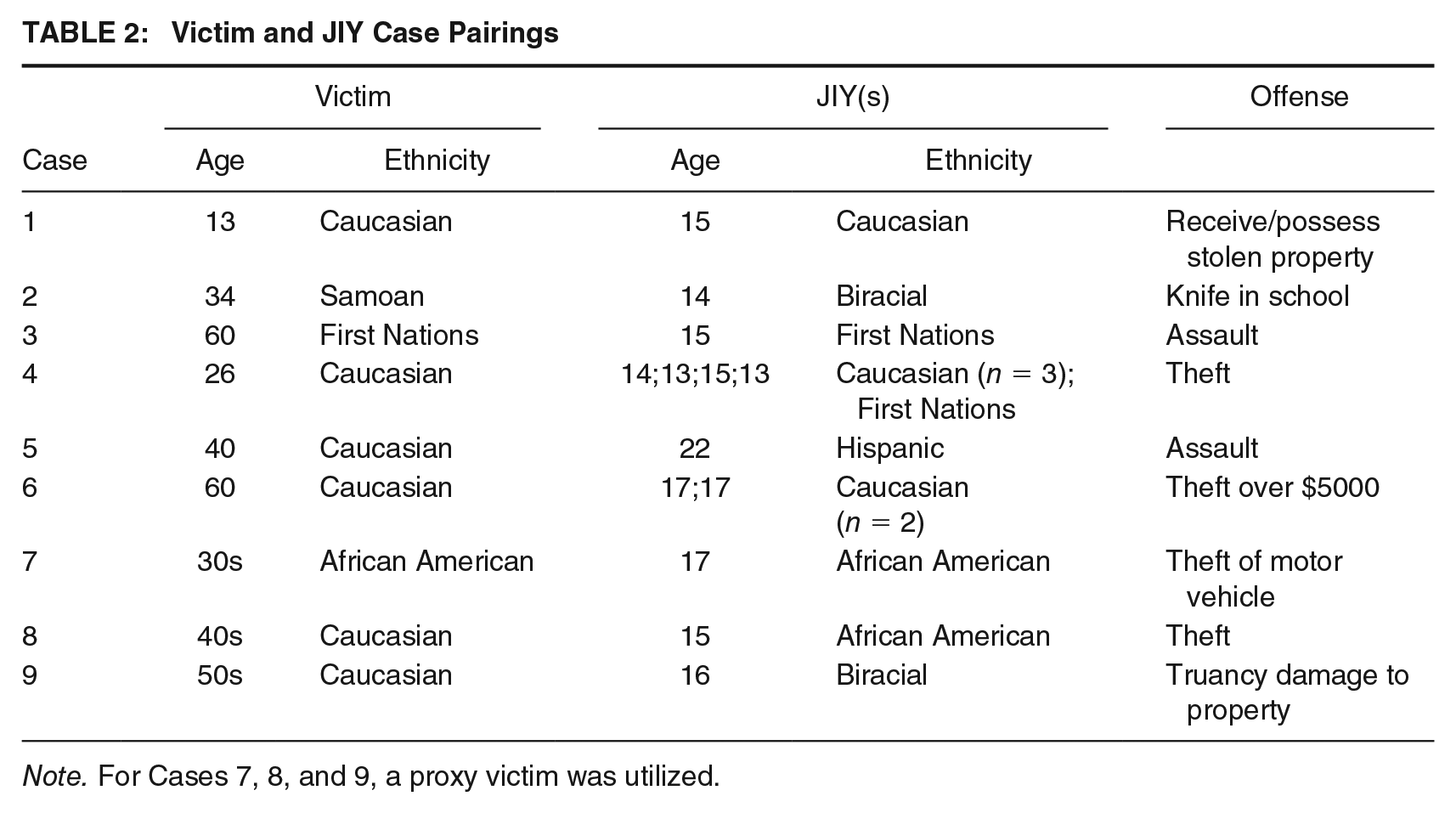
Note. For Cases 7, 8, and 9, a proxy victim was utilized.
We utilized Yin’s (1989) advice for allowing the research question to focus analysis, Noakes and Wincup’s (2004) suggestion to take the analysis further than simply coding the data and Braun and Clarke’s (2021) six-step reflexive thematic analysis. We adopted a social constructionist ontology and epistemology, prioritizing the participants’ experiences and acknowledging that no objective “truth” exists to be “uncovered.”
Phase 1 involved familiarization with the data via reading and re-reading transcripts and noting aspects of cases that stood out to us as coders. Phase 2 focused on generating codes. Initial candidate themes were constructed in Phase 3 by combining codes into aggregates based on similarity. Phase 4 focused on further theme construction, revision, and thematic mapping. In this phase, themes are altered, often combining or separating themes, always anchored in the research question. As outlined by Braun and Clarke (2021), this included writing memos about each theme. We used an inductive process that built themes from participants’ experiences rather than applying pre-determined expectations or coding systems to our analysis. In addition, we used a latent coding approach that centered participants’ meaning of their experience rather than a semantic approach. In Phases 5 and 6, these themes were finalized and defined. We engaged in reflexivity throughout via memo writing and conversations between the authors.
Results
Five themes captured victims’ and JIY’s experiences, each anchored in our research questions focused on understanding participants’ experiences of VOM. Consistent with our pre- and post-mediation design, these themes varied temporally across the VOM process. Whereas some processes occurred solely during the mediation (e.g., receiving an apology), others continued to unfold for participants after the session (e.g., corrective emotional experiences [CEEs]).
Theme 1: Attempting to Satisfy Mediation Needs
Both victims and JIY brought specific needs to the mediation session, with some explicitly stating what they needed from the experience to others in the room. One example was in Case 4 when Marie (victim) told the boys (JIY) that she wanted them to learn from the mediation so something positive could come from the situation. This example highlights the relational form of such needs. Other individuals who also expressed relationship-focused needs (i.e., wanting to connect with the other party) were observed making efforts to collaborate and, in some cases, heal their relationship with the other party.
The needs of victims and JIY varied. For example, some JIY’s needs were to avoid court (i.e., by choosing VOM instead). These JIY presented as focused on wrapping up the situation quickly and efficiently and often voiced these sentiments. For instance, Noelle, the JIY in Case 2, said, “Are we almost done?” multiple times during her mediation. Sean, the JIY in Case 5 made similar comments and mentioned that he was participating on his lunch break from work and needed to get back soon.
In other cases, needs were not satisfied in the mediation session, with some participants choosing to verbalize this. An example of this occurred in Case 2, when Ursula (victim) was underwhelmed by Noelle’s (JIY) apology. She told Noelle: “I was hoping I would be more confident that you understand consequences. What is the next person at risk for? I don’t think you genuinely understand what you’ve done.” Ursula sharing this concern directly with Noelle emphasizes the relational emphasis of VOM. Ursula further reflected on this in her post-mediation interview: Well I mean it was a lot of different things for me because I think I went into it expecting to make some kind of difference in Noelle’s life and about halfway through it became glaringly obvious that that wasn’t going to happen the way I wanted it to. So um I guess I had to sort of step back and be like okay, so if I can’t make a difference what I can do is just not stand in the way. So I decided that what I needed wasn’t that important in that moment and I just hoped that someday she would look back on it and be like oh that woman actually did help me a little.
Theme 2: Apologies
In almost every case, there was mention of an apology. This occurred either because one party felt that an apology was important or, in contrast because it felt unnecessary. Sometimes JIY stated before mediation that it was important for them to apologize to victims during the mediation session. Notably, to give and/or receive an apology is relational. For example, Josh (JIY) shared “I hope that when we apologize to her and tell her how sorry we really are it will maybe not take away the hurt for her but it will help her put it behind her.” Other times JIY said they did not feel they needed to apologize.
Some victims reported wanting to receive an apology, while others felt it was only important if the JIY really meant it, and others described it as unnecessary. For example, Petey (victim) stated, “Only insofar as it’s important to Jon Doe to apologize. Um, if it’s not important to him or he doesn’t think it’s necessary then there’s no point in him doing it. But for me, personally, he doesn’t owe me anything.” Whereas Lenny (victim) believed “Oh yeah. Apologies mean something I think because to like apologize you have to put your ego to the side and admit that like maybe you did something wrong.”
Regardless of how important the victims and JIY said it was, an apology happened in every case involving an actual victim (i.e., not a proxy). Interestingly, the apology sometimes occurred during the half-time break, when the mediators had left the room, and the two “sides” were left alone. Sometimes the words appeared to be more of a token apology that was given for the sake of satisfying a JIY’s motivation to avoid court (i.e., “I’m sorry, I’m sorry it happened. I know I fucked up. I’m a fuck up, okay?”). In other cases, the apology seemed heartfelt and poignant. There was a handshake or hug involved in several of the apologies, and in most cases where it appeared sincere, it was met with a statement of forgiveness by the victim. For example, this apology by Jorge (JIY): “I am so sorry. Can I shake your hand? I’m just so sorry. Now I have a better understanding of what you went through.”
In summary, although apologies were mentioned frequently, specific views on whether an apology was necessary varied. Apologies occurred in every mediation, except for those with proxy victims.
Theme 3: The Gravitational Pull of Victims
This theme captured the power of victims to “pull” JIY into a deeper interpersonal connection during the mediation session. That is, a victim’s emotionally open and empathetic presentation encouraged an initially minimally engaged JIY to commit to the process in the room. Unlike other themes, this effect was unidirectional—only victims held gravity to pull JIY. When this occurred, JIY became more engaged during the mediation session. For example, JIY who were initially detached and appeared bored with the process, sometimes started making eye contact, actively listening, and even contributing to the conversation. In one case, the JIY disclosed in the post-mediation interview that listening to the victim’s story had increased his level of empathy and, therefore, engagement. For example, in Case 4 Marie (victim) impacted all four JIY in this way: I didn’t expect that when I took the stuff from the car, it was going to mean anything to anybody but hearing Marie talk about her story and stuff, that was hard to sit through. [. . .] I was just like thinking to myself that it was sad that I had to see what she was going through. It was tough to listen to her story. It would have been easier not to listen but it was like, what she was saying was so sad that I had to listen and realize what she’d been through. (Marshall, JIY) I just felt the guilt piling on because of just the reality of it because it wasn’t as hard when I guess I just knew the circumstances it was just a lot more hard when I actually met the person. (Josh, JIY)
In summary, victims were able to pull some youth into a deep connection during the mediation process. This led youth to become more engaged in the process.
Theme 4: Finding a Healing Connection
As mediation is a relational process, it makes sense that many participants talked about their repaired or new relationships with the other parties arising from the mediation experience. A positive interaction in the mediation room catalyzed a newly formed or healed relationship. Victims and JIY who described themselves as building or repairing a relationship also talked about having positive interactions. Victims and JIY who had a relationship that existed prior to the crime sometimes mentioned that they were happy about the extent to which that relationship had been repaired: I have absolutely no ill will towards them. In fact I guess I like them a little better now because of how they handled themselves. I’ve actually run into Jorge a couple of times and it’s a hey how are you kind of a deal. Grudges only really hurt yourself, so why not just let it go. At least you can say hello. (Chad, victim)
They even sometimes shared that whereas they were acquaintances before the crime, they were able to consider themselves friends after living through the shared experience of mediation: Uh, well it was good that Kiwi and I, we can see each other and be cool now, and I didn’t expect that from such a short meeting because what I did was pretty mean. [. . .] Since then it hasn’t been on my mind. Except sometimes when I see him or we hang out at the skate park and I think hey I’m glad I did that meeting thing because now we get to be friends. [. . .] Like before we barely knew each other, but now we’ve done that meeting together so it’s like hey, we both did that. We’ve got history now. (Bobby, JIY)
In cases where there was no prior connection, victims and JIY sometimes found themselves in a position where they were willing to have ongoing contact. One such instance of this dynamic happened in Case 4, where one of the four JIY started to babysit for the victim on an ongoing basis even after his restitution had been completed. In summary, this theme included connections established between victims and youth.
Theme 5: Corrective Emotional Experience and Challenged Expectations
CEEs are those that allow us the opportunity to re-navigate wounds of the past (Alexander, 1946). It is a term that has typically been used to describe relational experiences in psychotherapy. Several participants instinctively understood the concept of a CEE before the mediation. For example, victims talked about wanting to provide JIY with a healing experience in which the JIY felt supported and cared about in a way that could challenge the negative messages they had been given up until that point. Several JIY talked about the experience significantly impacting them because it differed from how they are used to being treated. JIY sometimes talked about this very occurrence after mediation happened: It was uncomfortable um ‘cause like it’s hard to face someone like that you know you did something bad to, but I came away from it feeling like it was a good experience. I guess ‘cause she was so nice about it. [. . .] I thought she was going to be a lot more angry. I was like scared of what she was thinking but she ended up being really nice about it too. I actually couldn’t believe that as I was sitting there. Like this woman had been through so much and we just made a bad situation worse, and she was still able to sit there and smile and say she wants the best for us and she knows we didn’t mean to hurt anybody like that. [. . .] It made me feel like oh okay, this woman thinks I can do better. And you know I don’t hear that a lot from like my family and stuff, so that was cool. (Marshall, JIY)
An essential part of CEEs is violated expectations. Indeed, a participant’s experience in the mediation session was often contrary to what they expected. In many cases, the JIY expected the victim to be angry, spiteful, or confrontational. In their post-mediation interviews, JIY who experienced the violation of these expectations and a CEE talked about being surprised that the victim had been warm, welcoming, open, or receptive. This presentation challenged their expectations and views of themselves and others. They talked about being different because of the experience and it being something that they would remember: Like not getting yelled at was pretty cool. Because you know I get in trouble a lot or whatever and this was probably the first time that someone listened to me and didn’t like tell me I was a fuck up or something. That was cool. And it was cool to listen to her talk because when else is that going to happen where you do this shitty thing to somebody and they want to sit down with you and tell you how you affected their life? It was a cool thing to do. [. . .] I got into her story and she was I guess just easy to listen to because she wasn’t yelling or saying anything crazy. She was just like hey you guys did this and now this is what happened. (Dave, JIY)
Victims, too, had expectations of the JIY that were sometimes violated. For example, they sometimes expected the JIY to be unremorseful or oppositional, but instead, they found themselves interacting with an apologetic and empathetic individual. For example, Kiwi (victim) shared: “Um, I guess I was kinda surprised that Bobby was so nice. I mean I knew he wasn’t scary but I didn’t know he was actually gonna feel badly for what happened. That made me feel good.” This was echoed by Chad (victim) (i.e., “I was surprised at the level at which these guys took responsibility for what they did”).
Victims and JIY also had expectations about what the experience itself might be like. Both sometimes mentioned expecting the experience to be intimidating or awkward. They sometimes found themselves to be proven wrong once inside the room. Several participants stated that the other parties had been nicer than expected, the process had been more comfortable than expected, or they found mediation more helpful, valuable, or interesting than anticipated. These violated expectations were a pleasant surprise to some of the victims and JIY and contributed to a CEE. In summary, this theme encompassed how participants experienced challenges to the expectations they brought to mediation and the associated corrective experiences they had during the process.
Discussion
We aimed to understand the experiences of victims and JIY during mediation sessions. Our analysis resulted in five themes: Attempting to Satisfy Mediation Needs, Apologies, the Gravitational Pull of Victims, Finding a Healing Connection, and Corrective Emotional Experiences & Challenged Expectations. Notably, while all these themes begin within the mediation session, some are “completed” within the mediation room (i.e., Attempting to Satisfy Mediation Needs, Apologies, and the Gravitational Pull of Victims), whereas others continue to unfold and impact the participants after mediation is over (i.e., Finding a Healing Connection, and Corrective Emotional Experiences & Challenged Expectations).
The Importance of Relational Processes
Our themes highlight the importance of interpersonal processes within the mediation session. For example, many participant needs (Theme 1) were relational or expressed within the context of the victim-JIY relationship. Apologies (Theme 2) are an explicitly relational act. Themes 3 to 5 (Gravitational Pull of Victims, Finding a Healing Connection, Corrective Emotional Experiences) are all inherently relational acts that are impossible otherwise. The relational nature of our results makes sense, as VOM is an inherently relational process with origins in Indigenous approaches to justice. Our results lend further evidence to the idea that VOM is successful because of the relational experiences occurring within the mediation session. Moreover, and sadly, when victims and JIY are kept from interacting, as they often are in the retributive justice system, they cannot experience these potentially transformative interpersonal experiences—including the ones such as Finding a Healing Connection or Corrective Emotional Experiences & Challenged Expectations, which our participants indicated remained with, and continued to influence them, even months after their mediation session. Using multiple case study analyses uniquely positioned us to capture these relational processes. That is, relying on data that captures only one “side” of a mediation experience will be inherently limited in studying a relational experience. We therefore strongly recommend that researchers consider this approach when conducting similar research.
The Importance and Potential Burden of the Compelling Victim
Our theme Gravitational Pull of Victims highlighted the power of a compelling victim who can form a strong relational connection with JIY. Via their meaningful interactions with JIY, these victims could “pull” otherwise minimally engaged JIY into the mediation session, with potentially both parties obtaining more from this experience than they had initially intended or expected. It is conceivable that a fair number of JIY participate in VOM to avoid a criminal record, for example (Choi et al., 2010a). The possibility that a compelling victim could transform these JIY from merely being present to actively involved (and changed by the mediation process through forming a relationship with the victim or a CEE) is powerful. This is consistent with previous researchers who have observed that an individual’s perceptions can change as they progress through VOM (Urban et al., 2011). Urban and colleagues (2011) advise that it must be accepted (or even expected) that victims and JIYs may show heightened emotion, uncertain or changing motivation, or even withdraw consent to proceed with the mediation. However, they did not specifically mention that one can become more engaged in VOM, as we found.
This finding contradicts previous work by researchers like Suzuki and Yuan (2021) who assert that those who have offended cannot benefit from VOM if they only superficially “buy in” to the experience. Zehr (2015) and Cama (2019) similarly indicate that the engagement of all participants is a core requirement for restorative justice. Our results provide a message of potential: Even seemingly unengaged JIY can become “hooked in” to VOM, given a captivating connection with the victim. Understanding what makes some victims compelling (and some not) is a critical area for future research on VOM, given the impact these victims have on the mediation process. One possibility is that our theme represents an example of the identifiable victim effect, in which people react more strongly, with more emotion, and with deeper consideration to identifiable victims than non-identifiable victims (Small & Loewenstein, 2003). Jenni and Loewenstein (1997) note: “[i]dentifiable victims seem to produce a greater empathic response, accompanied by greater willingness to make personal sacrifices to provide aid” (p. 236). Being with one’s victim physically and in conversation, might be part of what makes victims compelling. It is also possible that JIY’s proximity to the victim during mediation and hearing the victim’s experience and impact fosters the youth’s empathy for that victim. Indeed, some see increasing empathy as a core purpose of restorative practices (e.g., Pranis, 2000). Choi and colleagues (2011) note that JIY described meeting their victims during VOM helped them “personalize” them (p. 335).
We must acknowledge, however, the potential burden this finding could place upon victims to be responsible for the change of JIY going through VOM. This would be a misuse of our results. It must be acknowledged and understood that there is no “right” or “wrong” way to be the victim of a crime. Instead, the finding that certain victim presentations interact with JIY experiences to produce a favorable outcome is simply a way to explain what has occurred in certain cases. There may be more than one way to pull a JIY into engagement, and victims should carry no responsibility for contributing to the solution.
Corrective Emotional Experiences
Our results regarding CEEs provide an important piece of missing information regarding what happens during the process of VOM. When one’s expectations are challenged, it can lead to a CEE whereby one is forced to amend one’s beliefs about self and others. Sometimes, during this process, healing and transformation can occur. Mediation might be a therapeutic process in addition to diverting individuals from the costly and sometimes harmful retributive justice system. Bolivar (2010) commented on this by stating that the process of VOM is a transformative experience that creates healing—it is not one specific moment. To that end, we note that participants’ experiences occurred with temporal variation. Whereas some processes began and were completed “in the room,” others unfolded over time and were still occurring.
Traditionally CEEs have been described as experiences occurring within the context of a therapist-client relationship, whereas a dyad, they work through difficult interpersonal experiences between them in a productive, respectful, and healing way. Likewise, VOM allows victims and JIY to work through a difficult situation in a new way. Indeed, several participants talked about the experience significantly impacting them because it differed from how they are used to being treated. Our results are the first to indicate that VOM might provide a space for CEE. Indeed, we could find no documentation of CEE occurring in settings other than psychotherapy. Choi and colleagues (2011) described JIY as learning from their experiences, but whether these were CEEs was unclear. Indeed, there is a body of literature that contends that the only way to heal relational trauma is through relational healing (e.g., Pearlman & Courtois, 2005).
Where Are the Mediators?
It is important to remark upon absences from what participants shared about their experiences of mediation sessions. One notable absence was the role of the professional mediators facilitating the VOM. In the mediator training provided at one of the centers (completed by the first author), mediators were described as integral to the VOM experience, responsible for maintaining a safe space, and directing the flow of interaction (Beer & Steif, 1997). In this way, mediators are regarded as “brokers of apology,” and a fulcrum on which the two sides can balance themselves.
We began this study assuming participants would discuss the mediators playing a key role in their VOM experience. However, mediators were rarely mentioned by participants and not in any substantial way (as indicated by our lack of themes related to the mediators). When participants did mention the mediator, it was either in passing or to state that they seemed superfluous to the experience. Moreover, several of our cases involved pivotal moments (such as apologies from JIY to victims) that occurred in the absence of the mediators (e.g., during a break, before mediators had returned to the room). Other researchers have emphasized the importance of mediators for VOM process and success (e.g., Umbreit et al., 2001, 2005; Umbreit & Vos, 2000). It is possible our finding challenges existing convictions about the importance of mediators to the VOM process.
According to Rypi (2017), there has already been debate in the literature about how involved a mediator should be in the mediation process. Wemmers and Canuto (2002) argued that the mediator is extremely important and must be perceived as “neutral” for mediation to be successful. Choi et al. (2010a) found that common mediator issues (according to VOM participants) included being too directive, insensitive, hurried, or biased. Despite these shortcomings, VOM participants reported finding “closure” and “empowerment” following mediation. In some of the cases in our study, the mediators were described as ineffective, inexperienced, or, in one case, disruptive by arriving late and continually interrupting the participants. However, participants reported being satisfied with the process, which suggests that the mediators were not integral to the result. In previous qualitative research, participants have reported mixed feelings about facilitators (Armstrong, 2012).
However, perhaps mediators were so skilled at providing a natural-seeming effect on the mediation environment and individuals within it that their role went unnoticed. Alternatively, maybe the real work is meant to be done by the victims and JIY themselves, and a mediator’s job is to set the stage and get out of the way. We can draw on the first author’s experience taking the mediator skills training. The mediator training handbook states, “The problem is their responsibility. The process is yours” (Beer & Steif, 1997, p. 89). Mediators are urged to remember that their responsibilities include maintaining the mediation’s direction, flow, and pace. They must establish their role, which includes maintaining “control of process decisions” even if certain individuals attempt to “take over” (p. 93).
This guidance seems incongruent with the finding that meaningful apologies and relational healing seemed to occur when the mediators were the least directive (and in some cases were out of the room entirely). If it is true that the real work of mediation is done by the victims and JIY regardless of the mediators’ input, it would parallel the values upon which restorative justice was created. Restorative justice aims to reposition victims and justice-involved folks as individuals with agency and control over their behavior and futures (Zehr, 2004), and thus it makes sense that they alone are responsible for any healing that occurs.
Implications
Our results have several implications for policy and the practice of VOM. First, our results indicate that JIY might experience long-lasting (e.g., CEE) positive effects. Notably, this is one of the first documented instances of CEE outside therapy. Ideally, VOM would be offered to all JIY as an option. Second, resources for facilitating CEEs within a group therapy setting (e.g., Brown, 2016) should be recommended reading for mediators and/or included in mediator training. Our results indicate that JIY’s engagement in mediation is a continuous process that can grow over time. Someone who initially seems minimally engaged has the potential to become more engaged during the process, especially if they are treated in ways that are more positive than how they have been treated in the past. Thus, seemingly disengaged JIY should not be written off, nor should it be assumed they will not benefit from VOM. These points provide compelling reasons to continue funding, delivering, and improving existing mediation programs for JIY. Mediation centers are plagued by a lack of resources, including time, finances, and staff—this leaves retributive justice as the only option offered to many.
To continue providing Indigenous communities with ongoing reparations and (re)conciliation, 2 we must also recognize that restorative justice has been appropriated. Furthermore, we hold an obligation to stop appropriating once we recognize we are engaging in it. A simple first step is ending the harmful practice of not acknowledging Indigenous origins of restorative justice in the research literature and information regarding VOM available to those involved in the justice system and lay persons (e.g., websites describing VOM). Training programs covering restorative justice must teach this appropriation as an important step in (re)conciliation.
Future Directions and Conclusion
Our qualitative, multi-case design with multiple interview time points and observations of the mediation themselves is a solid design to understand victims’ and JIY’s experiences of mediation sessions. Analyzing cases as our unit of analysis allowed us a lens through which to see the important relational processes occurring during these sessions. These relational components could have gone unnoticed with a different analysis choice. Qualitative research particularly respects an individual’s unique experience and right to agency.
Our work indicates multiple avenues for future research. Understanding the role of proxy victims is a critical next step. Our study raises questions regarding the role of the mediators; qualitative interviews with the mediators and asking victims and JIY directly about their experiences with the mediators could be useful for answering these questions. Understanding these processes with different samples and populations is critical. It will be important for future researchers to assess the potential social desirability of participants’ reports of their mediation experience. Moreover, future research must understand the nuances of VOM with JIY. For example, it is unclear if certain types of JIY might benefit more than others, the potential role of risk and protective factors in VOM outcomes, and whether VOM experiences like the ones described in our study can prevent recidivism in the long term. It is likewise important that diverse populations be studied, including how the diversity of victims, JIY, and mediators might influence the mediation process and outcomes.
We utilized reflexive thematic analysis to gain a more detailed understanding of victims’ and JIY’s experiences of mediation. We identified several processes that unfold within VOM. Participants attempt to satisfy their initial motivations, an apology may occur, and a healing connection may be repaired or newly forged. A victim may present in such a way that a previously minimally engaged JIY may increase their engagement in the mediation. If a participant’s expectations are challenged when reality differs (positively) from what they imagined, a corrective emotional experience may occur.
Supplemental Material
sj-docx-1-cjb-10.1177_00938548241237183 – Supplemental material for “We’ve Got History Now”: Victim and Justice-Involved Youth Experiences During Mediation Sessions
Supplemental material, sj-docx-1-cjb-10.1177_00938548241237183 for “We’ve Got History Now”: Victim and Justice-Involved Youth Experiences During Mediation Sessions by Cailey Strauss, Jorden A. Cummings and Kendall Deleurme in Criminal Justice and Behavior
Footnotes
Authors’ note:
We have no known conflict of interest to disclose. This manuscript is based on the dissertation of Cailey Strauss and received funding from the Forensic Behavioural Sciences and Justice Studies Initiative at the University of Saskatchewan. The authors wish to acknowledge and thank the participants, who allowed us to be part of what, for some of them, was the worst experience of their lives. They shared bravely, shared openly, and taught us as a result. We also thank Drs. Richard Katz, Mansfield Mela, and Gerald Farthing for their contributions to this project and the Conflict Resolution Centre in Minneapolis, MN, USA and Mediation Services in Winnipeg, MB, Canada.

Notes
References
Supplementary Material
Please find the following supplemental material available below.
For Open Access articles published under a Creative Commons License, all supplemental material carries the same license as the article it is associated with.
For non-Open Access articles published, all supplemental material carries a non-exclusive license, and permission requests for re-use of supplemental material or any part of supplemental material shall be sent directly to the copyright owner as specified in the copyright notice associated with the article.
