




Abstract
To perform their work effectively, correctional officers should feel safe. Yet, research explaining officers’ subjective safety is scarce and overlooked the context in which these feelings arise. This study explores the impact of shared perceptions of prison climate and work climate. Survey and administrative data of incarcerated individuals and staff from the Dutch Life in Custody Study were used. Multilevel analyses on 1,427 correctional officers (135 prison units) showed that (a) almost 20% of the variance in officers’ subjective safety was clustered at the prison unit level; (b) both prison climate (satisfaction with activities and visits, relations with peers, and meaningful activities) and work climate factors (organizational satisfaction and workload) contributed to officers’ safety; (c) the relative importance of work climate was high in comparison to prison climate. These findings indicate that officers’ subjective safety is to a substantial extent a matter of climate rather than an individual trait.
Introduction
Although working in a prison context inevitably comprises certain levels of risk (see Ferdik & Smith, 2017, for an overview), feeling safe at work is very important for correctional officers. Besides more objective aspects of safety—such as contraband presence, incident rates, or severity of prison population—correctional officers’ subjective safety, 1 that is, the degree to which they feel safe, has been found to affect prison life in multiple ways. Low levels of subjective safety among correctional officers have been related to mental health problems, such as stress and burn-out (Garcia, 2008; Lambert, Minor, et al., 2018), lower levels of job satisfaction (Garcia, 2008), higher levels of absenteeism (Lambert et al., 2010), and higher turnover rates (Ferdik et al., 2014). Moreover, feeling unsafe might lead to mismanagement of the prison population, given that fear of victimization has been linked to a more punitive professional orientation, an increased eagerness to use force (Griffin, 2002; Haynes et al., 2020), more hostile interactions, and less contact between incarcerated individuals and officers (Gordon et al., 2003, 2013). It, thus, seems of great importance for incarcerated individuals, correctional staff, and management to create a work environment in which correctional officers feel safe while performing their duties.
To be able to create a safe work environment, it is important to know what factors can undermine subjective safety of correctional officers. Given the apparent relevance of this topic for correctional facilities, surprisingly little research has been done in this area. A recent systematic and meta-analytic review of the literature on correctional officers showed that previous research has been dominated by studies that focused on job satisfaction, job stress, and organizational commitment (Butler et al., 2019). This has left other important issues, including the subjective safety of correctional officers, understudied. Moreover, the majority of studies that did address the safety of correctional officers focused on the consequences of feeling unsafe; few studies examined what exactly constitutes a safe work environment for correctional officers (Butler et al., 2019).
The small body of research that did address the determinants of subjective safety of correctional officers typically focused on individual characteristics of correctional officers (e.g., age, education level) and individual perceptions and objective characteristics of the workplace (e.g., relationship with supervisor, type of shift or security level, respectively). These studies show that perceptions and characteristics of the workplace seem more relevant than individual characteristics of employees in explaining differences in subjective safety (e.g., Lai et al., 2012; Lambert, Gordon, et al., 2018). However, due to the great variety in concepts and measures applied in this body of research, findings have not always been replicated across studies yet, which calls for a careful interpretation of previous findings. Furthermore, statistical models in these studies generally explain a modest amount of the variance, indicating that our knowledge of the determinants of subjective safety of correctional officers is still lacking.
To advance our understanding of the determinants of subjective safety among correctional officers, the current study builds on two recent findings in prison research: (a) the way correctional officers experience their work environment is interrelated with the way incarcerated individuals experience their living conditions (Van Ginneken et al., 2020), and (b) although large individual variations exist in perceptions of prison climate, there is also a significant portion of perceptual agreement about prison conditions among individuals who share the same environment (Van Ginneken & Nieuwbeerta, 2020). This means that individuals in the same unit and the same prison are more similar in terms of their perceptions of work conditions and living conditions than individuals in different units and prisons. As a consequence, a focus on shared perceptions of the environment is needed to best capture the prison climate and work climate. In sum, we aim to explore the relative contribution of prison climate and work climate in the prediction of correctional officers’ feelings of safety. In the following sections, we will clarify how we conceptualize the proposed concepts of prison climate and work climate, and by referring to previous research we illustrate how a focus on shared perceptions may lead to new insights for understanding the subjective safety of correctional officers.
Prison Climate
Prison climate refers to the perceptions of incarcerated individuals about the social, organizational, and material conditions of confinement (Moos, 1975). Prior work on prison climate dates back to the classic work of Clemmer (1940) and Sykes (1958) who described the prison community and the way individuals adapt to prison conditions. Although previous work on prison climate since then has been characterized by a variety of conceptualizations and assumptions (e.g., Liebling & Arnold; Moos, 1975; Saylor, 1984; Schalast et al., 2008; Van der Helm et al., 2011; Van Ginneken et al., 2018; Wright, 1985), recent work has proposed that the underlying theoretical frameworks in this body of research are rather similar, in that they all agree that prison climate is based on perceptions, is a multidimensional construct, is meaningful at the unit or prison level, and that it affects individual well-being and behavior, above and beyond effects of individual characteristics of incarcerated individuals (Van Ginneken & Nieuwbeerta, 2020). The specific operationalization of prison climate in the current study is based on a thorough literature review on determinants of prison climate (Boone et al., 2016), is in line with previous research (Liebling & Arnold, 2004; Van Ginneken et al., 2018), and meets all the assumptions of the above mentioned theoretical framework. It, therefore, includes incarcerated individuals’ shared perceptions of safety, quality of relationships with staff and peer relationships, perceived levels of autonomy, contacts with the outside world, and the availability of meaningful activities, all measured at the unit level.
To date, little is known about the potential relationship between prison climate for incarcerated individuals and staff experiences, including subjective safety. Nevertheless, based on previous literature, we may expect that prison climate is related to subjective staff safety. For instance, there is evidence that certain aspects of prison climate, such as relationships among and between incarcerated individuals and staff, are associated with lower misconduct rates (Bosma, Van Ginneken, Sentse, & Palmen, 2020; Van Ginneken & Nieuwbeerta, 2020). This means that staff are exposed to fewer incidents and likely also feel safer. The relationship between prison climate and misconduct may be bi-directional. On one hand, a positive prison climate (here referring to incarcerated individuals’ perceptions of prison climate indicators, and not referring to what research has established as being related to positive outcomes) may cause less frustration and be more supportive, therefore provoking fewer incidents. On the other hand, individuals on units with less misconduct are more likely to perceive the atmosphere as positive and safe. Given that a positive climate has been linked to fewer misconduct incidents, it can be reasonably expected that it is also associated with a safer working environment.
Another example of how prison climate can contribute to a safe environment for staff and incarcerated individuals is found when considering relationships between incarcerated individuals and staff as a key element of prison climate. If such relationships are supportive and professional, characterized by legitimate use of authority, and fair, consistent enforcement of rules (Crewe et al., 2011; Liebling, 2000; Liebling & Kant, 2018), staff can enforce rules without the over-use of force. There is ample evidence that incarcerated individuals’ perceptions of legitimacy and procedural justice are related to compliance in prisons (Beijersbergen et al., 2015; Reisig & Mesko, 2009; Sparks et al., 1996; Steiner & Wooldredge, 2018). Thus, relationships with staff can be instrumental and indeed essential to create a safe environment for staff and incarcerated individuals. In other words, a good prison climate supports relational safety (Liebling, 2000), which is likely to contribute to subjective safety of correctional officers. These examples show how elements of prison climate, as perceived by incarcerated individuals sharing a prison unit, may affect correctional officers’ subjective safety. We now turn to the concept of work climate, and how we define work climate based on previous findings on the determinants of subjective safety of correctional officers.
Work Climate
Work climate refers to the shared perceptions of work conditions of people who share the same work environment (Van Ginneken et al., 2020). In the current study, we exploratively apply the new theoretical insights about prison climate, described above, to the concept of work climate. This means that work climate should be a multidimensional construct at the unit or prison level and based on perceptions. In line with the concept of prison climate, work climate should affect individual well-being and behavior, such as subjective safety, above and beyond the effects of individual characteristics of correctional officers (Van Ginneken & Nieuwbeerta, 2020).
Despite this framework, the precise conceptualization of work climate is difficult for a number of reasons. First, work climate has received much less research attention than prison climate, and there is no consensus among scholars what exactly constitutes work climate in prisons (Crewe et al., 2011; Lugo, 2016; Worthington, 2012). Second, individual-level work factors that empirically have been shown to explain differences in subjective safety of correctional officers might not be relevant on the unit level, and vice versa: Individual-level work factors that were not related to subjective safety in previous research might become relevant when measured on a unit level. For instance, individual-level work experience does not necessarily affect subjective safety (for instance, in case a new staff member joins a very experienced team), but an entirely unexperienced team working in a prison unit may have a great impact on feelings of safety among the officers working on that particular unit. The main purpose of this study is to explore the use of unit-level predictors in the study of subjective safety, rather than to add to the conceptual discussion of what exactly constitutes work climate. We will explore a range of subjective and objective measures of the work environment regularly included in previous research on subjective safety of correctional officers (summarized below).
Previous Research on Determinants of Subjective Safety
The current body of research has examined several subjective predictors of subjective safety such as work experiences, subjective measures of professionalism, and perceptions of institutional support and coworker relationships. Studies that examined the relation between work experiences and subjective safety found little effect of stress and job satisfaction (Ferdik, 2016), but work overload was positively related to perceptions of dangerousness in a study among correctional staff (majority female) in a U.S. medium to maximum security prison (Haynes et al., 2020). In terms of subjective measures of professionalism, perceived adequacy of training generally has not been found to be related to subjective safety (Haynes et al., 2020; Steiner & Wooldredge, 2017), although Lai and colleagues (2012) did find that a positive perception of in-house training was related to feeling safer. Relatedly, Stichman and Gordon (2015) found that correctional officers experienced lower levels of fear when they felt that their own ability to resolve disruptive situations would help control behavior of incarcerated individuals (expert power) and when they believed that incarcerated individuals respected their position as a correctional officer (legitimate power). In terms of perceptions of institutional support, studies found that correctional officers who report higher levels of supervisor support, report higher subjective safety (Lai et al., 2012; Lambert, Gordon, et al., 2018; Steiner & Wooldredge, 2017). Finally, although other studies did not find a relation between perceptions of coworker relationships and levels of perceived safety (e.g., Gordon & Baker, 2017; Lambert, Gordon, et al., 2018), Steiner and Wooldredge (2017) found that better coworker relations, and a more positive perception of coworkers’ professionalism was related to higher levels of subjective safety.
In addition to subjective measures, objective characteristics of correctional officers and their work environment also received attention in previous work. These measures consisted of demographic characteristics of staff, objective measures of professionalism (e.g., years of experience), and characteristics of institution and prison population (e.g., security level, prison size, officially registered misconduct levels) or objective work characteristics (e.g., day vs. night shift, amount of contact with incarcerated individuals). Results from these studies showed little predictive value of objective measures of correctional officers and their work environment. That is, most studies found no gender differences in feelings of unsafety (Haynes et al., 2020; Lai et al., 2012; Steiner & Wooldredge, 2017), although some studies find that men report feeling safer compared with women (Gordon et al., 2003; Stichman & Gordon, 2015). Studies generally found no differences between younger versus older employees (Ferdik, 2016; Lambert, Minor, et al., 2018; Stichman & Gordon, 2015). With respect to ethnic and racial background, results are mixed, with some studies finding no differences between correctional officers from different ethnic or racial backgrounds (Ferdik, 2016; Lambert, Gordon, et al., 2018; Lambert, Minor et al., 2018) while other studies find that non-White officers report higher levels of fear of victimization (Gordon et al., 2013; Stichman & Gordon, 2015) and lower levels of subjective safety (Steiner & Wooldredge, 2017). Surprisingly, in terms of objective measures of professionalism, analyses of individual differences in work experience (years of employment) generally also generate non-significant findings (Gordon et al., 2003; Steiner & Wooldredge, 2017), indicating that correctional officers with more work experience feel equally (un)safe compared with their less experienced colleagues.
Characteristics of an institution and prison population were also related to subjective safety. That is, working in a higher security level prison was related to higher levels of fear and feelings of unsafety (Gordon et al., 2013; Stichman & Gordon, 2015). Although no effects of prison size (Gordon & Baker, 2017) on subjective safety were found, perceptions of overcrowding were shown to be related to lower levels of subjective safety (Steiner & Wooldredge, 2017). Regarding work characteristics, studies consistently found no differences in subjective safety between officers working in day versus night shifts (Ferdik, 2016; Gordon et al., 2003; Lai et al., 2012; Steiner & Wooldredge, 2017) but did find that employees with higher levels of average daily contact with incarcerated individuals reported lower levels of safety (Lambert, Minor, et al, 2018; Steiner & Wooldredge, 2017). In sum, previous studies have shown that subjective and, to a lesser extent, objective indicators of correctional officers and their workplace are significant predictors of correctional officers’ feelings of safety. Therefore, in the current study, we will include both subjective and objective indicators of the work environment, measured at the unit level.
Current Study and Study Context
This study advances prior literature in two important ways: (a) by simultaneously examining prison climate and work climate as predictors of subjective safety of correctional officers, while controlling for staff and unit characteristics and (b) by taking the prison unit as the level of analysis. The following research questions will be addressed:
Studying these factors simultaneously asks for a comprehensive multi-actor study design, including information from incarcerated individuals and correctional officers. Data from the Dutch Life in Custody Study are used in which a national survey among incarcerated individuals, a survey among correctional staff, and administrative data of 28 prisons and 135 prison units are combined.
To better understand the determinants of subjective safety among correctional officers in the Netherlands, it is important to outline the current work conditions in Dutch prisons. During the past decade, the policy of the Dutch Prison Service was influenced by two main developments: first, the prison population strongly decreased, due to a decrease in registered crime, an increase in alternative punishments for short-term prison sentences (e.g., for persons who failed to pay their fines, and alternatively were imprisoned for a few days), and the introduction of less severe sanctions for late adolescents (Boone et al., 2020; Dienst Justitiële Inrichtingen, 2018). The population of incarcerated individuals was 9,114 in 2019, which corresponds to an imprisonment rate of 51 per 100,000 inhabitants (Dienst Justitiële Inrichtingen, 2020). Second, the Prison Service has had to do deal with budget cuts, which led to the closure of correctional facilities, and an increased use of double cells.
Concurrent with these changes, there have been growing concerns about workload and safety in correctional facilities. This is, for instance, illustrated by a “Call for safety” of the Central Works Council (Centrale Ondernemingsraad Dienst Justitiële Inrichtingen, 2017), and a subsequent series of reports about safety and work climate (FNV Overheid, 2020; Raad voor Strafrechtstoepassing en Jeugdbescherming, 2019). In short, these reports outline a number of problems that relate directly to feelings of safety of prison staff. First, prison staff experience their workload as very high. In addition, 56% of the staff members report that this high workload “most of the time contributes to unsafety at work.” Staff members mention working with run-down or burnt-out co-workers or unexperienced and sometimes unqualified co-workers as important sources of feeling unsafe (FNV Overheid, 2020).
These issues relating to work climate and safety in The Netherlands are illustrative for current situations in other countries, which also deal with issues of under-staffing and incidents in correctional facilities. In England and Wales, for instance, the number of assaults in custody has been increasing ever since 2008, with only a slight decline in 2019 (Ministry of Justice, 2020). This has been attributed largely to a rise in the prison population alongside staff reductions and high staff turnover, which also means that staff are overall less experienced (Beard, 2019; Howard League for Penal Reform, 2016). Correctional officers in the United States similarly have to cope with workplace violence and high levels of stress, which contribute to mental health problems, absenteeism, and job dissatisfaction (Brower, 2013; Paoline et al., 2015; Steiner & Wooldredge, 2015, 2017; U.S. Department of Labor, 2016). Although the scale of incarceration in the Netherlands is much lower than in many other countries, this section has illustrated that many pressures faced by staff (and incarcerated individuals) are similar to other countries in the Global North. This makes an investigation of unit-level predictors of subjective safety relevant to other countries where correctional officers are assigned to work on a particular unit or wing for a substantial period of time.
Method
Data Sources and Participants
For the current study, three sources of data were combined: (a) self-reported data on the experienced work climate via a staff survey that was made available to us by the Dutch Custodial Institutions Agency (in Dutch: DJI), (b) self-reported data on the experienced prison climate via a survey among incarcerated individuals as part of the Dutch Life in Custody study, and (c) administrative data on unit characteristics, including composition of individuals incarcerated and staff assigned to work on the unit. All data were collected in the same time period (January-May 2017) which means that data from correctional officers and incarcerated individuals were meaningfully connected.
The staff survey data were digitally collected in the spring of 2017 by the Dutch Custodial Institutions Agency via the Internet Mirror (in Dutch: InternetSpiegel). The Internet Mirror is a validated instrument used by many Dutch governmental organizations to measure staff’s working conditions. Validity of the measurement scales within this survey has been established elsewhere (Molleman & Van der Broek, 2014). For the purpose of this article, we only used data from correctional officers who were in daily contact with incarcerated individuals. Of the 2,041 invited male and female correctional officers, 1,508 participated across 144 units in 23 prison facilities, yielding a response rate of 74%.
The data from incarcerated individuals were collected between January and March 2017, using the Prison Climate Questionnaire (Bosma, Van Ginneken, Palmen, et al., 2020). For this purpose, all individuals incarcerated at the time were approached (if possible, considering their mental health and ability to understand the study explanation) and invited to participate. In total, 4,938 out of 6,088 adult men and women participated, which resulted in a response rate of 81%. Additional permission to collect administrative data was given by 4,538 respondents. More details on participants, recruitment, and procedure of the Life in Custody Study can be found elsewhere (Van Ginneken et al., 2018). Data from the staff survey, Prison Climate Questionnaire, and administrative data were aggregated to the unit level, and subsequently merged. In the process of combining the data, a number of 1,427 correctional officers across 135 units remained. For some units, data from incarcerated individuals could not be matched with data from correctional officers, which prevented a merge of data.
Measures
Subjective Safety (Level 1, Correctional Officer Level)
The dependent variable Subjective Safety was measured by four items answered on a 5-point Likert-type scale, ranging from 1 (strongly disagree) to 5 (strongly agree), with higher scores indicating higher levels of subjective safety: “The working environment has been designed to make me feel safe,” “Everything possible is done here to guarantee my safety,” “The work is organized in such a way that nothing serious can happen to me,” and “I feel at ease when walking through the building.” The four items together formed a reliable scale (α = .87).
Work Climate (Level 2, Unit Level)
To assess the experienced work climate by correctional officers for each unit, several work climate indicators from the staff survey were included as independent variables. We included seven scales described below (see also the appendix) that consisted of items answered on a 5-point Likert-type scale, ranging from 1 (strongly disagree/not satisfied at all) to 5 (strongly agree/ very satisfied). Correctional officers’ scores on each of the seven scales were aggregated to the unit level to measure work climate. A confirmatory factor analysis of these seven work climate scales with a correlated factor structure confirmed a good fit to the data, χ2(758) = 7,671.38, root mean square error of approximation (RMSEA) = 0.078, comparative fit index (CFI) = 0.934.
Job satisfaction was captured with 14 items, of which nine items formed a subscale about Organizational Satisfaction (e.g., “To what extent are you satisfied with the communication within the organization?”) and five items on Job Satisfaction (e.g., “To what extent are you satisfied with the content of the job?”). Cronbach’s alphas were .88 and .78, respectively. Staff Cooperation (α = .87) was measured by five items (e.g., “My colleagues help me get the work done”). Satisfaction with Training was measured by nine items (α = .92) involving different aspects of work, by asking: “I’ve had an adequate amount of schooling/training in . . . (e.g., dealing with aggression, dealing with psychological problems of incarcerated individuals, conversation techniques) to do my job well.” Four items on Procedural Justice (α = .92) were included and asked to what extent staff felt that the team treated incarcerated individuals fairly and with respect (e.g., “Colleagues in my unit explain their decisions to the incarcerated individuals”). The Workload scale consisted of five items (α = .86) concerning work demands (e.g., “I regularly work overtime to finish my work”). Finally, Emotional Consequences of Work (α = .79) was measured by four items (“My job gets me in emotionally difficult situations”). Higher scores on the scales refer to more positive work climate perceptions with the exception of workload and emotional consequences of work, for which higher scores refer to more negative perceptions of work climate.
Prison Climate (Level 2, Unit Level)
To assess the experienced prison climate by individuals incarcerated in each unit, we used data measured by the Prison Climate Questionnaire (PCQ; Bosma, Van Ginneken, Palmen, et al., 2020). Prison climate was assessed by measuring constructs that are believed to represent the quality of prison life: autonomy, safety and order, relationships in prison, meaningful activities and prison facilities, and contact with the outside world (Boone et al., 2016; Van Ginneken et al., 2018). These indicators were measured using a number of subscales. Respondents rated all items on a 5-point scale ranging from 1 (strongly disagree) to 5 (strongly agree), with higher scores reflecting more positive experiences. For the current study, scores on each of the prison climate subscales described below were aggregated to the unit level.
The scale Autonomy consisted of five items (e.g., “I can decide for myself on matters that are important to me”). The scale Safety was measured by five items (e.g., “I feel unsafe in this institution”) that were reverse coded so that high scores reflected increased feelings of safety. Relationships in prisons were measured by two subscales: One subscale examining relationships with staff and experiences of procedural justice, and one subscale measuring relationships with peers. Relationships with Staff were measured by four items on experiences with staff members (e.g., “If I have problems, the staff members in this unit help me”) and four items on procedural justice (e.g., “Staff members in this unit treat me fairly”). The subscale on Peer Relationships contained five items (e.g., “Incarcerated individuals treat each other respectfully here”). Meaningful activities were measured by two subscales: a seven-item scale of Satisfaction with Activities (e.g., “I’m satisfied with recreation”) and a four-item scale of Availability of Meaningful Activities (e.g., “This facility delivers an interesting and varied program”). Contact with the outside world was measured by six items on Satisfaction with Visits (e.g., “I have sufficient privacy during visiting hours”). Analyses have shown that the internal consistency of each of the aforementioned scales was high, evidenced by Cronbach’s alpha statistics ranging from .78 to .92 (for a complete overview on the psychometric qualities of the PCQ, see Bosma, Van Ginneken, Palmen, et al., 2020).
Population Characteristics (Level 2, Unit Level)
To control for relevant characteristics of the individuals incarcerated in each unit we included the following characteristics: mean age (in years), male unit (female unit = 0), proportion of individuals born in the Netherlands, proportion of individuals who self-reported misconduct, proportion of individuals with a violent index offense, mean number of previous incarcerations (in the past 5 years), and the proportion of individuals in single cells (as opposed to shared cells). Except for the self-reported misconduct (which was obtained from the PCQ), these measures were based on administrative data provided by the Dutch Custodial Institutions Agency.
Unit Characteristics (Level 2, Unit Level)
Finally, the following relevant institutional unit characteristics were included: inmate-to-staff ratio (in full-time equivalent [FTE]), unit capacity (number of cells), occupancy rate (ratio occupied to free cells), male-to-female staff ratio (in FTE), mean staff work experience (in years), and regime. We distinguished between regular prison regime (reference category), pretrial detention, extra care (for incarcerated individuals considered vulnerable due to mental health or index offense), a regime for people who have frequently offended, and minimum security regimes. These unit characteristics were based on administrative data provided by the Dutch Custodial Institutions Agency.
Analytical Strategy
To account for the clustered nature of our data (correctional officers are nested within units) and to correct the estimated standard errors for a certain clustering of observations, multilevel methods were applied. Two levels of data were distinguished: the individual correctional officer level (Level 1) and the unit (Level 2). Correctional facility was not selected as a third level, because no facility-level variables were included in the multilevel models and because the particular shared influence of the facility over and above the unit level was also not expected. The first step was to run a null model with random intercept to see whether the dependent variable (subjective safety of correctional officers) significantly varied across units, as indicated by the intraclass correlation coefficient (ICC). Second, a full model with random intercept and fixed slopes was estimated using full information maximum likelihood with robust standard errors (MLR) estimation. All independent continuous variables were centered around their grand mean before they were included in the multilevel models to allow for easier interpretation of effects (i.e., scores of 0 now refer to the overall sample mean of these variables). All analyses were conducted in Mplus version 8.1 (Muthén & Muthén, 1998-2017).
Results
Descriptive Statistics
Table 1 summarizes the relevant descriptive statistics for our data. A few notable statistics will be highlighted here. First, it appears that average scores of subjective safety (range = 1–5) are lower for correctional officers (M = 3.05) than for incarcerated individuals (M = 3.95). Second, the average scores of work climate across units indicate quite positive perceptions of job satisfaction, staff cooperation, workload, and procedural justice, whereas the average score of organizational satisfaction was considerably lower. Third, average scores of prison climate indicate that incarcerated individuals reported relatively high scores for peer relationships and safety, whereas their perception of autonomy and availability of meaningful activities was relatively negative. Regarding unit characteristics, we see that most units are male units (95%), with the majority of individuals born in the Netherlands (66%) and most of them housed in single cells (86%). Most units run a regular prison regime (38%) or pretrial regime (34%). In comparison to other countries, it is also notable that unit occupancy rates are below 1 (M = 0.89) with average capacities of about 41 individuals.
Descriptive Statistics of the Study Variables
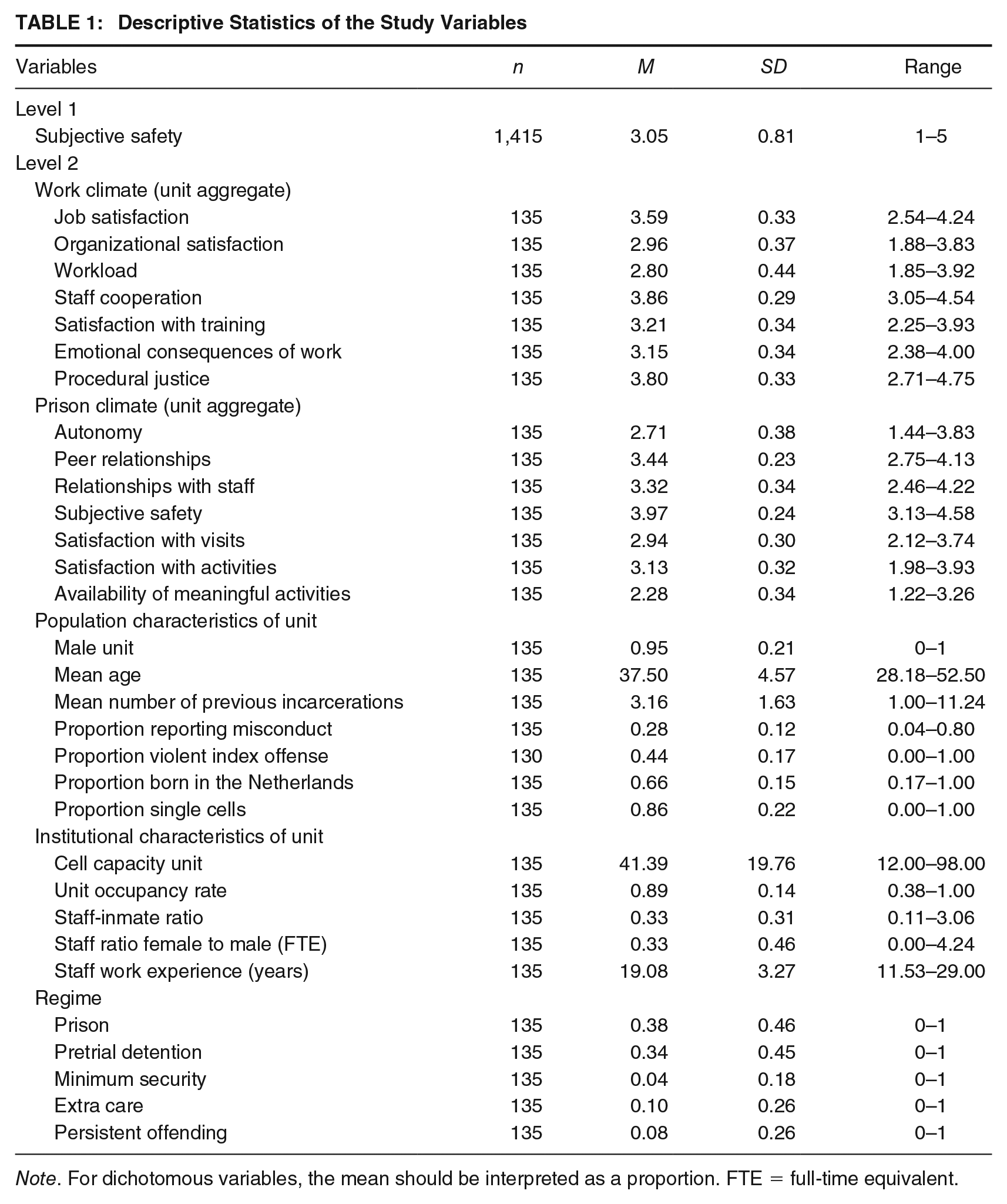
Note. For dichotomous variables, the mean should be interpreted as a proportion. FTE = full-time equivalent.
RQ1: Unit-Level Variance
The first step in the multilevel analysis was to determine whether any variance in subjective safety could be attributed to unit differences. The so-called null model with random intercept and no explanatory variables revealed that a significant amount of variance in correctional officers’ subjective safety pertained to the unit level. The ICC was .19, which indicates that 19% of the variance in safety is at the unit level and warrants the use of multilevel modeling with a focus on unit-level explanatory variables. In addition, we calculated the ICCs for the individual work climate variables to check if the aggregation of these variables to the unit level, that is, our construct of work climate is justified (see Van Ginneken & Nieuwbeerta, 2020 regarding prison climate). The ICCs reported in Table 2 indicate that all work climate variables have a significant amount of variance between units, with the majority of ICCs above .15, ranging from 5% (emotional consequences of work) to 21% (workload). These percentages indicate that there is a considerable amount of shared experiences between correctional officers from the same units, which is in line with the notion of work climate.
Variances and ICCs for Subjective Safety and Work Climate Variables
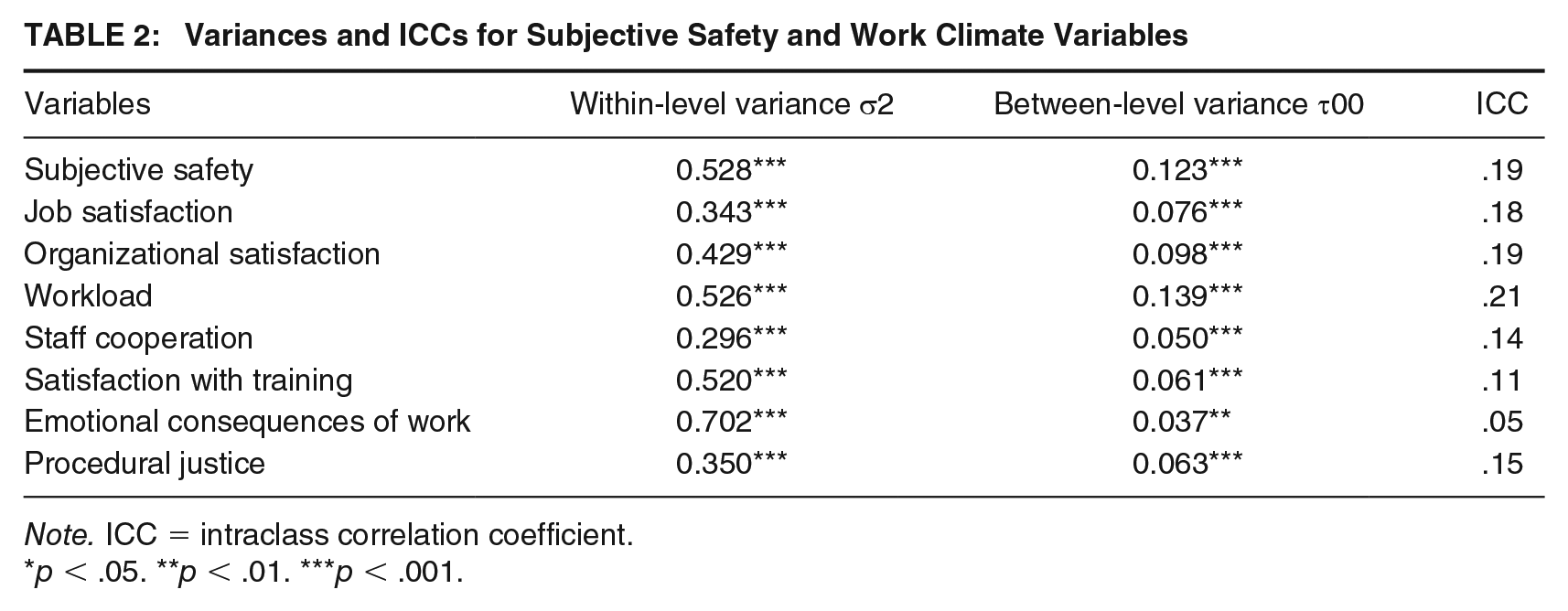
Note. ICC = intraclass correlation coefficient.
p < .05. **p < .01. ***p < .001.
RQ2: Work Climate
Results from the full multilevel model are reported in Table 3. We start with the work climate indicators, as perceived by correctional officers in each unit. The results show that subjective safety of correctional officers was higher in units where officers reported higher levels of organizational satisfaction. Subjective safety was lower in units where they experienced higher workload. The other work climate indicators (job satisfaction, staff cooperation, satisfaction with training, emotional consequences of work and procedural justice) were not significantly related to individual scores on subjective safety. This may be partly explained by correlations among the work climate variables; bivariate analyses revealed medium to large correlations between organizational satisfaction and job satisfaction (r = .697, p < .001), workload (r = −.552, p < .001), staff cooperation (r = .303, p < .001), satisfaction with training (r = .584, p < .001), emotional consequences of work (r = −.388, p < .001), and procedural justice (r = .327, p < .001).
Multilevel Regression of Subjective Safety of Prison Officers (N = 1,415)
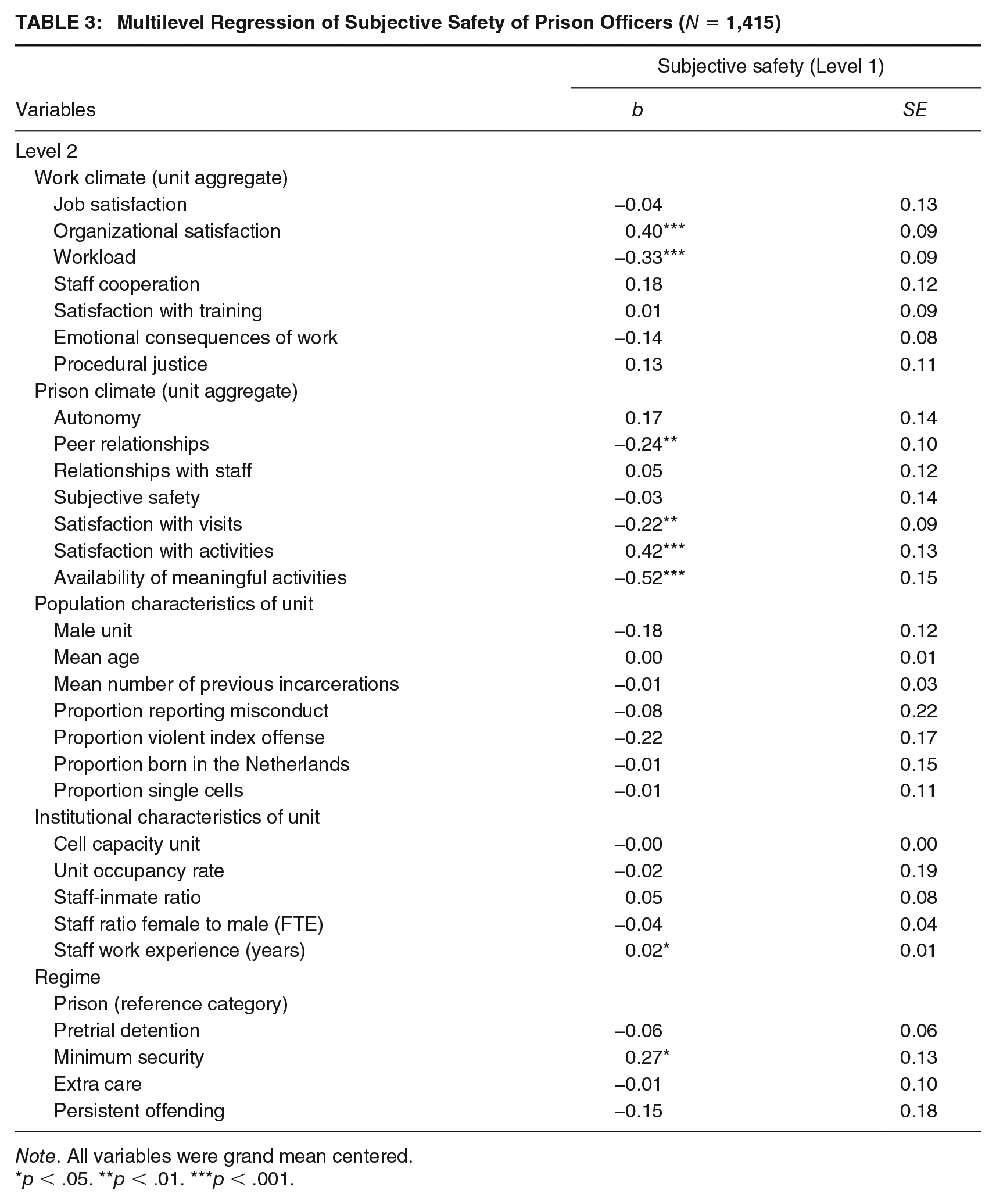
Note. All variables were grand mean centered.
p < .05. **p < .01. ***p < .001.
RQ3: Prison Climate
Next, we turn to the results of the prison climate indicators. Correctional officers experienced lower levels of safety in units in which incarcerated individuals reported better peer relationships, higher levels of satisfaction with visits, and higher scores on the availability of meaningful activities. In units in which incarcerated individuals reported higher levels of satisfaction with activities, on the other hand, correctional officers experienced higher levels of safety. Correctional officers’ subjective safety was not related to incarcerated individuals’ perceptions of autonomy, relationships with staff and subjective safety.
Furthermore, none of the population composition variables of a unit was significantly associated with subjective safety of correctional officers. That is, subjective safety was not related to working on a male versus female unit, the mean age, and the ethnic composition of incarcerated individuals on a unit. Other characteristics of the population (previous incarcerations, proportion with violent index offense) and self-reported misconduct of incarcerated individuals were also not related to levels of subjective safety. Finally, there was no significant effect of the proportion single cells on a unit.
Regarding staff composition and unit characteristics, results show that work experience and regime were associated with subjective safety. Correctional officers experienced higher levels of safety in units where staff on average had more years of work experience. Finally, correctional officers felt safer working in minimum security units compared with regular prison units. The size of a prison unit, the unit occupancy rate, staff-inmate ratio, and the ratio female to male staff members on a particular unit, were not related to subjective safety of correctional officers.
The variables in the reported regression model explained 99% of the unit-level variance in perceived safety; this leaves the residual variance at the unit level at 0.001 (p = .886) of the initial 0.123 (p < .001) in the null model. More specifically, a series of separate regression analyses conducted to establish the unique variance contributed by each group of variables, showed that 0.060 (48.78% of initial unit variance) was explained by work climate, 0.002 (1.63% of initial unit variance) was explained by prison climate, and 0.059 (47.97% of initial unit variance) was explained by control variables (institutional unit characteristics). Since no variables were added on the individual level, no variance was explained at Level 1.
Discussion
The central focus in this study was the contribution of unit-level factors to subjective safety of correctional officers. We examined the contribution of unit attributes from the perspective of correctional officers and incarcerated individuals, and with administrative data. This study importantly shows that it is meaningful to study unit attributes in relation to subjective safety, because 19% of variance in individual levels of subjective safety was clustered at the prison unit level. This high intraclass correlation (see James, 1982, regarding perceptual agreement on organizational climate) indicates that correctional officers feel more or less safe depending on the correctional unit to which they are assigned to work. We were able to explain nearly all variance at this level using the variables in our model. This is an important addition to previous studies on subjective safety, which focused primarily on individual-level characteristics. It also offers interesting new avenues for future studies in prison research.
Another important finding of this study was that aspects of work climate contributed much more to the prediction of subjective safety of correctional officers than aspects of prison climate or population characteristics of a prison unit. More specifically, correctional officers felt less safe on units where the average perceived workload was higher and organizational satisfaction was lower. In recent years, an effort has been made to improve prison climate in Dutch prisons to reduce misconduct, and subsequently increase safety for incarcerated individuals and prison staff. Our results, however, show that improving staff’s subjective safety might involve a shift in focus from improving prison climate to improving work climate.
Lowering staff members’ perceived workload seems key in improving subjective safety of staff members. Prior research already showed that individual perceptions of work overload were related to lower subjective safety (Haynes et al., 2020). Similarly, the current study found that collective perceptions of a high workload contributed to lower levels of subjective safety of correctional officers. These findings are in line with accounts of prison staff who report that high workload and, consequently, working with run-down or burnt-out colleagues are important sources of feeling unsafe (FNV Overheid, 2020). In the context of these findings, it is to be expected that in situations of crises (such as the current COVID19 pandemic), in which much extra effort is asked of prison staff and high levels of staff absences are inevitable, perceived workload and feelings of subjective safety of staff are affected greatly. In conclusion, governments and prison managers should examine how perceived workload can be effectively reduced to make correctional officers feel safer performing their duties.
In addition, in terms of organizational satisfaction, findings indicate that subjective safety is at stake in prison units with a high proportion of staff who are unsatisfied with the organization. Given that prior research did not find individual perceptions of organizational satisfaction to predict subjective safety (Gordon & Baker, 2017; Haynes et al., 2020; Lambert, Gordon, et al., 2018; Lambert, Minor, et al., 2018), interventions targeting work climate might be found in a careful composition of teams working on particular units. Our findings on institutional characteristics of units, for instance, suggest that correctional officers report higher subjective safety in units with a higher average of staff work experience. This may also partly reflect the average age of officers working on a unit, which was not measured, but it is also likely that more work experience installs a sense of confidence in colleagues and the ability to handle any incidents. Having such flexibility in allocation of staff asks for a large enough workforce with a balanced diversity in employees.
Finally, although the contribution of prison climate in predicting subjective safety was small (only 1.63% explained variance) compared with work climate and unit characteristics, a noteworthy finding here was that contrary to research that has established a range of positive outcomes of good-quality relationships between staff and incarcerated individuals (Beijersbergen et al., 2015), relationships with staff as perceived by incarcerated individuals were not related to subjective safety in our study. Correctional officers did report feeling less safe, however, on units where incarcerated individuals reported better peer relations. This shines an important new light on previous research, which found that positive perceptions of prison climate do not always align with (supportive) staff attitudes (Crewe et al., 2011).
Our findings suggest that safe and favorable working conditions for staff partly correspond to favorable prison climate perceptions of incarcerated individuals, apart from peer relations. In other words, good peer relations among incarcerated individuals may be seen as threatening to staff, even when controlling for actual misconduct and population composition. A similar result was found in relation to well-being of incarcerated individuals in a previous study with data from the Life in Custody Study: Individuals reported greater psychological distress in units with better peer relations (Van Ginneken et al., 2019). This identifies an important avenue for further research: What are the exact qualities of these peer relations that affect the well-being of correctional officers and incarcerated individuals, and how can this be addressed? It may be helpful to conduct interviews and observations on units, alongside survey research, and to utilize social network analysis to map the nature of social relations among incarcerated individuals in more detail (e.g., Schaefer et al., 2017; Sentse et al., 2019).
Strengths and Limitations
The strengths of this study are the unique and rich multi-actor data (from correctional officers and incarcerated individuals), supplemented with administrative data, and the large, nation-wide scale of the research. However, there are some limitations that should be borne in mind. First, the cross-sectional nature of the study means that it is not possible to establish the direction of effects. This makes it difficult to make strong suggestions for interventions that could improve work climate and subjective safety for correctional staff. Second, while we showed the importance of taking a unit-level perspective in studying subjective safety and work climate, we did not include any individual-level predictors or control variables. As a result, we were only able to explain the unit-level variance in subjective safety of correctional officers (19%). Including this information in future studies could give even more insight into how subjective safety and work climate could be optimized. A particularly worthwhile suggestion for future research would be a longitudinal study experimenting with the assignment of staff to different units, to see how this affects their individually experienced safety, as well as the work (and prison) climate on a unit.
The current study was based on data collected in the Netherlands, so it is important to reflect on the extent to which these findings may apply elsewhere. The problems facing Dutch correctional officers, including workplace violence and job stress, are universal, albeit at different levels. Yet, the organization of correctional facilities varies greatly across countries. For example, Dutch prisons are relatively small (mostly between 150 and 500 incarcerated individuals), and there is no overcrowding. Although correctional facilities have a mix of regimes and hold individuals awaiting trial and those convicted, these are held in separate units with a specialized daily program. Most people in the Netherlands have a single cell, with at most two people sharing a cell. These factors may contribute to relatively high average levels of reported safety among staff and incarcerated individuals. It is likely that national issues of overcrowding and staff shortages affect the baseline of subjective safety, while variation in organizational satisfaction and workload across units can help explain why subjective safety is higher in some places than others.
Finally, in this article, we showed that, besides individual differences in perceptions of living conditions, work conditions, or work attitudes, those living and working on prison units also share perceptions and attitudes, which we chose to call “prison climate” and “work climate.” It is important to keep in mind that, to date, there is no consensus in the criminological literature on how to conceptualize the complex concepts of prison and work “climate.” Although the instrument we used to measure prison climate was developed specifically for this purpose, the instrument we used to measure work climate was developed to measure “work satisfaction” for managerial purposes. Our analyses—the intraclass correlations and factor analyses—indicated that there was a degree of perceptual agreement on all selected measures and that they were correlated but measured separate constructs, which provided some support for the existence of a climate. We decided to operationalize climate in our analyses by aggregating individual-level perceptions to the unit level, while controlling for relevant unit characteristics. This way, we tried to account for differences in climate perceptions across fault lines within a unit, such as sex or work experience (Beus et al., 2012). However, there is still an unresolved debate in the literature in relation to the measurement of climate about whether the aggregation of individual perceptions and attitudes are an appropriate measure of climate (Kessler, 2019). Although we have attempted to address many of the issues raised in the literature, future research should seek to theoretically and methodologically advance research on the concept of climate in prisons, and consider, for example, whether objective indicators can complement the use of perception-based measures.
Conclusion
We can conclude from this study that the direct work environment (in this case, the correctional unit) matters. Some units are considered safer, with a more positive work climate, than other units. Improving subjective safety of correctional officers is, therefore, not only an individual matter (e.g., more training) but also a matter of climate. It appears worthwhile not only to invest in work climate but also to consider how staff assignment affects climate and concerns about safety. Given the strong effects of organizational satisfaction, it is recommended that management considers how they can better support staff and improve communication. They could also take into account preferences regarding unit assignments. From our findings, it appears that some regimes are associated with greater subjective safety, so it may be sensible to rotate staff across regimes with similar training requirements. Average work experience was also a significant predictor, which could also be taken into account in staff assignment to units. Finally, the strong correlations among the work climate factors suggest that relationships among colleagues could contribute to a better work climate, which could, in turn, affect subjective safety of correctional officers.
Footnotes
Appendix
Overview of Latent Constructs and Measured Items (All Measured With 5-Point Likert-Type Scales)
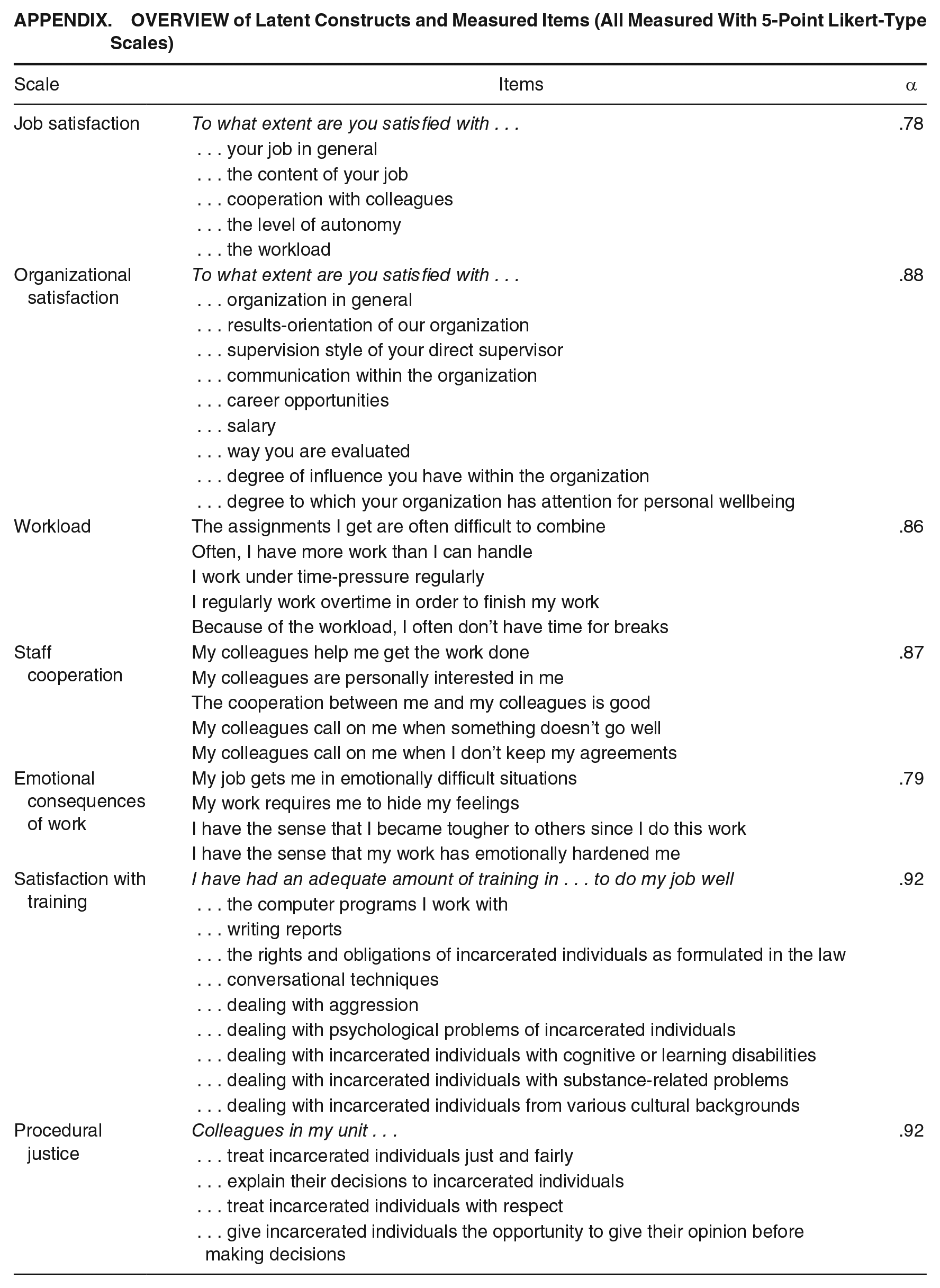
| Scale | Items | α |
|---|---|---|
| Job satisfaction | To what extent are you satisfied with . . . | .78 |
| . . . your job in general | ||
| . . . the content of your job | ||
| . . . cooperation with colleagues | ||
| . . . the level of autonomy | ||
| . . . the workload | ||
| Organizational satisfaction | To what extent are you satisfied with . . . | .88 |
| . . . organization in general | ||
| . . . results-orientation of our organization | ||
| . . . supervision style of your direct supervisor | ||
| . . . communication within the organization | ||
| . . . career opportunities | ||
| . . . salary | ||
| . . . way you are evaluated | ||
| . . . degree of influence you have within the organization | ||
| . . . degree to which your organization has attention for personal wellbeing | ||
| Workload | The assignments I get are often difficult to combine | .86 |
| Often, I have more work than I can handle | ||
| I work under time-pressure regularly | ||
| I regularly work overtime in order to finish my work | ||
| Because of the workload, I often don’t have time for breaks | ||
| Staff cooperation | My colleagues help me get the work done | .87 |
| My colleagues are personally interested in me | ||
| The cooperation between me and my colleagues is good | ||
| My colleagues call on me when something doesn’t go well | ||
| My colleagues call on me when I don’t keep my agreements | ||
| Emotional consequences of work | My job gets me in emotionally difficult situations | .79 |
| My work requires me to hide my feelings | ||
| I have the sense that I became tougher to others since I do this work | ||
| I have the sense that my work has emotionally hardened me | ||
| Satisfaction with training | I have had an adequate amount of training in . . . to do my job well | .92 |
| . . . the computer programs I work with | ||
| . . . writing reports | ||
| . . . the rights and obligations of incarcerated individuals as formulated in the law | ||
| . . . conversational techniques | ||
| . . . dealing with aggression | ||
| . . . dealing with psychological problems of incarcerated individuals | ||
| . . . dealing with incarcerated individuals with cognitive or learning disabilities | ||
| . . . dealing with incarcerated individuals with substance-related problems | ||
| . . . dealing with incarcerated individuals from various cultural backgrounds | ||
| Procedural justice | Colleagues in my unit . . . | .92 |
| . . . treat incarcerated individuals just and fairly | ||
| . . . explain their decisions to incarcerated individuals | ||
| . . . treat incarcerated individuals with respect | ||
| . . . give incarcerated individuals the opportunity to give their opinion before making decisions |
Authors’ Note:
The authors wish to thank the Dutch Custodial Institutions Agency (DJI) for their support with the administration of the survey. The opinions, findings, and conclusions expressed in this article are those of the authors and do not necessarily reflect those of the DJI. The Life in Custody study was funded by the DJI and Leiden University.
