



Abstract
One appealing explanation for the dismal state of digital politics in the U.S. is that social media offer abundant threats to users’ political identities. This paper provides a theoretical and empirical foundation for studying political identity threats on social media. A pilot study (N = 931) established that individuals can recognize both realistic and symbolic threats when they explicitly appear in TikTok videos, but that, (a) threat types are not as discrete as theory suggests and (b) sensitivity to symbolic threat depends on strength of partisan identity. A second, pre-registered experimental study (N = 1,279) found that the presence of explicit threats to political ingroups/outgroups influenced emotions and willingness to engage politically on social media. These effects were mediated by threat recognition and often larger for those with stronger partisan identities. This research sets an agenda for studying the presence and effects of explicitly identity-threatening social media content.
Introduction
Social media are popularly understood as “the bad place” for American politics (Gubbala et al., 2022). Not only do these technologies nurture hate speech and falsehoods, but they also promote the kind of intergroup conflict, outrage, and hostility corrosive to democratic life (Bor & Petersen, 2022; Brady et al., 2020). One appealing explanation for this dismal state of digital politics is that social media offer abundant threats to users’ political identities. These threats do not simply reflect differences in political opinions or ideologies, but rather dangers to the political groups people are psychologically attached to (Huddy, 2001). This implies that what makes social media so toxic is that they bring users into contact with threats to the power, values, or status of their political identities (Hiaeshutter-Rice et al., 2024). Increasingly, scholars in the American context have adopted the concept of identity threat from social psychology, to theorize how communication on social media affects the emotions, attitudes, and behaviors of users (Brady et al., 2020; Lane et al., 2023; Long et al., 2019). 1 Yet despite the promise of identity threat as a proposed explanation for political social media effects, there are three key theoretical and empirical questions that persist, motivating the present research.
First,
Second,
Third,
Without answering these questions, it is difficult to (a) assess the prevalence of explicit political identity threats on social media, (b) determine which users are likely to be affected by such threats, and (c) theorize the role of social media in shaping group politics. Accordingly, we provide a basic theoretical and empirical foundation for studying political identity threats on social media. A pilot study (N = 931) established that individuals can recognize both realistic and symbolic threats when they explicitly appear in TikTok videos, but that, (a) threat types are not as discrete as theory suggests and (b) sensitivity to symbolic threat depends on strength of partisan identity. A second, pre-registered experimental study (N = 1,279) found that the presence of explicit threats to political ingroups/outgroups influenced emotions and willingness to engage politically on social media. These effects were mediated by threat recognition and often larger for those with stronger partisan identities. We discuss these findings in relation to the future study of political identity threats on social media within and beyond the U.S. context.
Theoretical Framework
Our study is oriented around a theoretical framework that distinguishes between (a) the presence of explicit political identity threats, (b) individuals’ recognition of those threats, (c) factors that influence sensitivity to recognizing threats, and (d) effects of those threats on emotions and behavior (see Figure 1). To develop our framework, we turn to social psychological perspectives on identity threats. First, the widely used Social Identity Perspective (SIP) posits that individuals derive psychological benefits from their attachment to (i.e., identification with) groups (Hornsey, 2008). This motivates them to perceive the ingroup as positively distinct from other groups and behave in ways that protect or maximize their group’s positive image. In turn, any threat to the group is experienced as a threat to the self. 2 In the present study, we use the term political identity to refer to psychological attachment to partisan groups (e.g., Democrat or Republican), however our framework applies to any set of groups in political competition. 3 A vast body of research has examined how such political identities can lead people to think, feel, and act in ways that protect their group (Huddy, 2001; Mason, 2018). Our framework focuses on political identity specifically because politics is a clear intergroup contest that manifests on social media, producing explicit identity threats for multiple groups.

Conceptual model of recognition and effects of political identity threats on social media.
Early SIP work was vague regarding exactly what constitutes an identity threat. The concept has been used to refer to a wide range of general and specific negative experiences related to the ingroup’s power/status (Branscombe et al., 1999). Intergroup threat theory (ITT) offered an important improvement in this regard, providing a more comprehensive definition of “threats” and an explanation of how such threats shape perception, emotion, and behavior. The theory distinguishes between two types of intergroup threats: (1) realistic and (2) symbolic (Böhm et al., 2020; Stephan et al., 2015). Realistic threats include risks to the group’s material resources, including wealth, power, safety, or physical well-being. In contrast, symbolic threats refer to non-material resources, such as the group’s status, values, norms, and morality. While individuals may receive a variety of negative information about their groups, ITT argues that when information contains realistic or symbolic threat—as defined above—it triggers a unique set of cognitive, emotional, and behavioral responses that serve to restore the ingroup’s power or status. In this study, we adopt the realistic versus symbolic distinction outlined in ITT along with the broader definition of identity threats from SIP as targeting a groups’ power/status (not necessarily in relation to the outgroup).
American politics is an ideal context for studying both realistic and symbolic political identity threats. U.S. political competition is marked by highly salient partisan identities, intense intergroup polarization, and a history of recurring conflict over power, status, and values—all of which are conducive to the emergence of identity threats (Mason, 2018). These dynamics generate information suggesting potential losses of political influence, electoral defeat, declining resources, or even threats to the physical safety of leaders or supporters (i.e., realistic threat; e.g., Lin & Haridakis, 2022). At the same time, political groups in the U.S. have different values and beliefs which makes them particularly vulnerable to attacks related to their virtue, morality, or intelligence (i.e., symbolic threat; e.g., Amira et al., 2019). The U.S. is an ideal context for our theoretical questions, because potent forms of identity threats are plentiful in media environments, but differentially encountered and processed by audiences depending on their partisan identities (Lin & Haridakis, 2022).
While this study is situated in the United States, we note that the concept of identity threat is theoretically relevant for multiparty systems or other political group formations. ITT conceptualizes threat recognition as dynamic and varying over time and depending on the context (Stephan et al., 2015). Which outgroup becomes politically threatening will depend on situational cues, political developments, and the specific characteristics of the outgroup made salient, among other factors. Thus, explicit identity threats can target any salient outgroup whose actions, values, or influence are framed as consequential for the ingroup.
Both within and beyond the U.S. context, prior research shows that media are a key means through which political identity threats are conveyed (Haney-López, 2015; Lin & Haridakis, 2022). Yet this work reveals a theoretical ambiguity central to the present study. ITT primarily focuses on how individuals experience threat. However, a background assumption of the theory is that threats are communicated to group members, often explicitly. As a result, researchers sometimes infer identity threats by the psychological response to a threatening context, rather than by explicit presence of threat in messages (Branscombe et al., 1999; Ma et al., 2024). For example, Ma et al. (2024) developed a “Social Identity Threat Scale” which assesses how individuals feel in response to negative information about their group. Threat is considered present when individuals feel a personal sense of threat on one of the threat types in the scale. This suggests that identity threats can be elusive because they are “in the eye of the beholder” and dynamically experienced (Branscombe et al., 1999; Stephan et al., 2015).
Yet, for communication scholars, the distinction between message features and the effects of those features is crucial. To study identity threats in the context of social media, we need to be able to draw a conceptual distinction between threats as explicit message features and the cognitive, emotional, and behavioral responses they engender. This logic is exemplified by research on fear-appeals in health communication, where threats can be both objectively present in a message and subjectively identified and processed by a receiver (Myrick & Nabi, 2017).
This returns us to our core set of theoretical arguments (outlined in Figure 1). First, we focus on explicit threat presence in messages—specific mention of realistic or symbolic threat as defined by ITT (Stephan et al., 2015). Explicit political identity threats can be conceptualized as message characteristics that can be manifestly present (e.g., a group’s safety is threatened) or absent in media environments. Threats are considered explicit to the extent that they (a) explicitly identify the group/group members as a target and (b) clearly state a potential loss of a realistic or symbolic resource. Explicit-realistic political identity threats could include the loss of political power (i.e., election, or governing majority), loss of money, or loss of physical safety of group members or leaders. Explicit-symbolic threats could include loss of moral values (e.g., accusations of corruption or dishonesty), loss of competence (e.g., calling group members stupid), or loss of status (e.g., framing the group as inferior).
We must stress that the above capture our working operationalization of “realistic” and “symbolic” resources based on Böhm et al. (2020; see above). There are undoubtedly other forms of realistic or symbolic resources that could fit into this definition. We also duly note that threats likely exist on a continuum between explicit and implicit and ultimately involve some linguistic subjectivity. However, our ability to adjudicate long running debates about the nature of identity threats is limited. In the context of this specific study, our working definition of explicit threats remains as close as possible to established literature as a starting point. We acknowledge the many situations in which threat may be implicit or experienced by individuals in the absence of threatening information but consider these as outside the boundaries of our framework.
Second, even though identity threats can be explicitly present in media messages, individuals may or may not recognize the presence of these threats—we term this threat recognition. In this respect, we clarify ITT, separating information about the presence of identity threat (e.g., news that one party is going to lose an election) from the degree to which individuals recognize the presence of such threats in messages (e.g., an individual comprehends that this loss of an election will lead to a loss of power for that party). In this sense, threat recognition represents the identification of threat in information—that (a) a specific group is, (b) experiencing a loss of realistic or symbolic resources. Threat recognition is distinct from second-order psychological or behavior responses that threats engender (Stephan et al., 2015). Further, ITT implies that individuals vary in threat sensitivity, or how sensitive they are to recognizing a threat (e.g., highly identifying group members may be more likely to look for or interpret information as threatening; Stephan et al., 2015).
Third, the explicit presence of identity threats is distinct from their effects—termed in our framework as threat effects). As predicted by ITT, there is a causal link between messages containing explicit identity threats and resulting group-protective emotions, cognitions, and behaviors, which depends on people recognizing an identity threat in the content. Finally, we argue that social media serve as unique environments for experiencing and responding to explicit identity threats that target the ingroup and an outgroup. In what follows, we elaborate on each of these arguments to inform our hypotheses.
Threat Presence, Sensitivity, & Effects on Social Media
Despite speculation that social media further amplify political identity threats, previous research has not systematically assessed the supply or effects of such threats on social media sites. However, existing theory supports these speculations. Social media may be unique contexts for political identity threats due to (a) the visibility and richness of identity cues (Carr, 2017), (b) the ability of users to both encounter and respond to threats on social media (Brady et al., 2020), and (c) identity-driven algorithmic and social factors that emphasize political identity and conflict (Bor & Petersen, 2022; Brady et al., 2020; Hiaeshutter-Rice et al., 2024).
Given that social media are theoretically likely to expose users to ample threats to their political identities, we used the social media platform TikTok as a context for assessing our framework (Figure 1). TikTok is an increasingly popular social media platform that delivers algorithmically curated flows of short-form video content. The app has many of the affordances theorized to influence encounters with political identity threats (e.g., expressivity, interactivity, and visibility; Medina Serrano et al., 2020) and is used for political advertising, expression, and sensemaking (Kligler-Vilenchik & Literat, 2024). The short length of TikTok videos provides an ideal context for empirically studying explicit threats to political identities. More broadly, algorithmically driven platforms like TikTok are increasingly being used as sources of political information and discourse (Matsa, 2024). This makes understanding the causes and consequences of political identity threats on TikTok an important practical goal.
What is an Identity Threat?: Threat Presence and Recognition
Our first question addresses the link between threat presence and recognition. To reiterate, our framework focuses on explicit political identities threats that can be present in media content. This is in line with past research that has examined effects of messages containing explicit identity threats (e.g., threat of electoral defeat; DuBosar et al., 2025). Studies find that routine news coverage of politics can expose partisans to threatening information, while strategic political communication can induce threat more purposefully (Haney-López, 2015; Lin & Haridakis, 2022). Our framework asks whether the presence of explicit identity threats in social media content leads to the recognition of identity threat among users.
On the one hand, this may appear like a simple “manipulation check” question. However, past research suggests that this relationship is not a given. The Differential Susceptibility to Media Effects Model (DSMM) argues that media messages have their effects on attitudes and behaviors by first inducing cognitive, emotional, and excitative responses (Valkenburg & Peter, 2013). This suggests that when identity threats are explicitly present in content, viewers can have a cognitive response: they attend to, comprehend, and retain threatening information concerning a political group. For example, when a message calls the leader of a political party “stupid,” a cognitive response state should ensue in which the receiver recognizes that the intelligence of a political group has been questioned (i.e., symbolic threat is present). This connection between stimulus and response may seem obvious and is supported by a vast body of research in social psychology (see Rios et al., 2018). However, a central argument of the DSMM is that cognitive response to a message is not a given and its magnitude varies across individuals. We pose the below hypothesis in order to make more specific, conditional predictions in the next section:
Our next question is whether symbolic and realistic threat—two types of threat so distinct in ITT—are indeed identified distinctly in a message context. Specifically, we consider whether realistic political identity threats might be recognized as symbolic threats (and vice versa). As the DSMM and preceding media effects theories (e.g., Media Priming Theory) argue, cognitive states can also involve higher-level processing of messages, including connecting message features to related constructs in memory. In many cases, one manifest attribute of a message (e.g., the issue of Abortion) can prime a related concept (e.g., morality; Domke et al., 1998). While scholars have consistently made a distinction between realistic and symbolic threats (Long et al., 2019; Rios et al., 2018; Schmuck & Matthes, 2017), it is unclear whether these types of threats are identified as distinct in media content or whether the presence of one type of threat primes the other type of threat (i.e., a “spill-over” effect). This possibility is suggested by social psychological research, which argues symbolic and realistic threats share many common antecedents and trigger many of the same psychological responses (Branscombe et al., 1999; Stephan et al., 2015). The possibility of a “spill-over” effect is particularly relevant in social media, where diverse types of threatening information can be encountered. Accordingly, we ask:
Who is More Sensitive to Identity Threats?: Factors Affecting Threat Sensitivity
Our next question refers to who is more sensitive to recognizing identity threats when they are present in social media messages. Threat sensitivity refers to factors that make individuals more likely to cognitively recognize, attend to, and interpret the presence of political identity threats in media content. Both ITT and DSMM suggest that identity threats are not just perceived in a binary fashion, but rather individuals have stronger or weaker cognitive responses to their presence (Ma et al., 2024). This means that the very recognition and recall of manifest message characteristics may depend on the attitudes, emotions, and knowledge of the individual as well as the social/communicative context in which the message is received (Valkenburg & Peter, 2013). ITT suggests four more specific antecedents to identity threat that may affect differential-susceptibility to political identity threats; (a) partisan ingroup (vs. outgroup) membership, (b) partisan ingroup identification, (c) higher political interest, and (d) more frequent TikTok use (Stephan et al., 2015). Each of these factors should affect whether social media users recognize higher or lower degrees of explicit identity threats (i.e., threat sensitivity).
In terms of the first two antecedents, group members are inherently motivated to attend to threats to their ingroup (Montalan et al., 2011) and are likely to retain and process such threats (Zhu et al., 2015). In contrast, threats to outgroups may be less salient or consequential. ITT further argues that threat sensitivity should depend on how strongly individuals identify with their ingroup (Stephan et al., 2015). Strong partisans consider their group as central to who they are and therefore are motivated to detect and combat threats. Ingroup membership and identification are central moderators of identity threat effects in the existing literature (Rios et al., 2018) and foundational to the Hostile Media Effect which examines threat on a general level (Hartmann & Tanis, 2013). Given that identities profoundly shape information on social media (Hiaeshutter-Rice et al., 2024), ingroup membership—among other group-related attitudes—may be particularly consequential for identity threat sensitivity.
Second, people who are politically interested may be more sensitive to political identity threats on social media. The politically interested are more likely to carefully attend to political information in general and to have more knowledge about the contest between political groups. Scholars argue that those who have a deep interest in politics are likely to interpret even small elements of political messages as consequential and worthy of attention and engagement (Krupnikov & Ryan, 2022). As ITT suggests, knowledge of and attention to intergroup relations are key precursors to threat recognition (Stephan et al., 2015). Political interest may play an important role in threat sensitivity on social media, given that interest shapes exposure and attention to political information (Knoll et al., 2020).
Finally, individuals who use social media more frequently may develop contextual knowledge and expectations about specific platforms that might inform threat evaluation. As ITT argues, the situation in which intergroup contact occurs can shape the recognition of identity threats (Stephan et al., 2015). On social media, users interpret content in relation to the symbolic language, social norms, and ongoing discourses of particular platforms (Kligler-Vilenchik & Literat, 2024; Powers et al., 2019). Similar to partisans, frequent social media users may have a large set of contextual knowledge from which they can identify threats. Accordingly, heavy TikTok users may be on the lookout for identity threats, given the increasing prevalence of political conflict on the platform (Spring, 2024). We predict that:
How Do Identity Threats Influence Emotions & Behaviors?: Threat Effects
Ultimately, we argue that when users encounter and recognize threats to their political in and outgroups on social media, they will have cognitive and emotional reactions and use social media to respond to such threats. In terms of ingroup threats, ITT suggests that when people feel their group is threatened, they are likely to have negative cognitions and emotions and behave in ways that help them cope with the threat (Stephan et al., 2015). On a cognitive/emotional level, threats to the ingroup heighten group members’ psychological need for security as they seek to protect their ingroup identity. This can trigger negative appraisals and emotional responses such as fear, resentment, and hostility toward an outgroup (Chang et al., 2016). On a behavioral level, threats activate defensive mechanisms, such as aggression or aversion, as individuals attempt to combat the dangers posed by an outgroup (Jonas et al., 2014). When partisans perceive that media are biased against their group they are likely to pursue “corrective action”–communication intended to “correct” biased opinion environments (Barnidge & Rojas, 2014). Social media provide users with numerous opportunities to respond to identity threats in a similar manner, through features such as disliking, downvoting, commenting, blocking, or banning. While the link between negative information about one’s group and group-protective action is well established (Hornsey, 2008), we test whether exposure to identity threats has such effects in the social media context.
Social media also expose users to outgroup threats (i.e., recognizing an outgroup as threatened). In fact, posts insulting the opposite party are regularly shared by partisans on social media (Bor & Petersen, 2022). On the one hand, there is some evidence that when people see an outgroup threatened, dangers from that outgroup may be reassessed as diminished or manageable (Smits et al., 2012), thereby reducing protective emotions and behavior. On the other hand, people who encounter threats to a political outgroup may experience positive cognitions and emotions and use social media to amplify such threats. For example, fMRI research reveals that for avid sports fans, witnessing an opponent’s failure activates the same neurological regions associated with positive emotions as when their own team wins (Cikara et al., 2011). This experience is known as “Schadenfreude”—pleasure when observing the pain and misfortunes of competitive outgroups. Such intergroup experiences may be especially prominent in zero-sum settings (e.g., elections) where negative outcomes for outgroups naturally lead to positive outcomes for the ingroup. In turn, seeing an outgroup threatened, can prompt behavior that further amplifies the threat as one means of bolstering the ingroup’s status. In the context of social media, responses to outgroup threats could involve “liking” threatening content or sharing it so it is seen more widely (Ouwerkerk et al., 2018).
Overall, theory suggests that social media may amplify the responses to threats to political in and outgroups outlined above. On social media, ingroup-outgroup distinctions can be heightened, restraints against intergroup aggression can be diminished, and affordances can allow for immediate response to threats (Brady et al., 2020; Hiaeshutter-Rice et al., 2024; Rost et al., 2016). Accordingly, we predict the following:
Because we theorize that H3 and H4 occur out of a basic desire to defend a positive ingroup image (Hornsey, 2008), it follows that these effects should be stronger for those with stronger attachment to their partisan group. We offer the following moderation prediction:
Finally, we propose that threat recognition is one mechanism through which explicit identity threats have effects (see Figure 1). ITT implies that threats must be recognized as present in the environment to trigger responses (Stephan et al., 2015). The simple presence of ingroup or outgroup threats in media content may not be sufficient to elicit strong reactions; rather, the extent to which individuals recognize these threats to a target group will shape their responses. Thus, we further hypothesize that threat recognition serves as a mechanism that translates exposure to identity-threatening content into cognitive, emotional, and behavioral responses:
To assess our hypotheses and research questions we conducted two online studies. A pilot observational study used a within-person design to examine political identity threat recognition in real TikTok content. Our goal was to examine the extent to which respondents recognize different forms of threat in response to ecologically valid stimuli, containing manifest markers of threat. Study 1 was a pre-registered experiment, evaluating all of our predictions using more tightly controlled fictional social media content.
Pilot Study
Pilot Study Methods
Our pilot study utilized a sample of Americans collected by Qualtrics (N = 931), including Democrats (n = 383), Republicans (n = 285), and Independents/Another Party (n = 269). Full sample and method details are reported in the Supplemental Appendix. Each participant was assigned to watch three types of videos collected from TikTok, categorized as containing either: (1) explicit realistic threat, (2) explicit symbolic threat, and (3) no explicit threat. This categorization was based on expert coding by two authors and two research assistants, who identified videos that contained content that closely matched the definitions of these threat types in the literature (Böhm et al., 2020). Videos including more than one type of threat were excluded. Threat videos used a mix of images, sound, and text to make an explicit realistic or symbolic threat toward either Democrats or Republicans. For example, a realistic threat video described a threat to the physical safety of the family of a Democrat lawmaker, while a symbolic threat video decried the corruption of the Republican Governor of Iowa. “No threat” videos contained political information that would be counter-attitudinal to Democrats or Republicans (e.g., expansion/curtailing of abortion or immigrant rights) but contained no explicitly threatening information about partisan groups. 4 No threat videos were used as a control/reference condition. For each video type, we stimulus sampled from a set of eight realistic threat videos, eight symbolic threat videos, and four no-threat videos. Democrats and Republicans were assigned threat videos targeting their party, while Independents were randomly assigned one of the two parties.
After watching each video, participants answered questions assessing threat recognition. These consisted of an original 12-item battery based on the characteristics of identity threats as outlined by Böhm et al. (2020; see Table 1). Importantly, these items were intended to capture participants’ recognition of manifest characteristics of a message (i.e., characteristics objectively and explicitly present), rather than a secondary response to the message. Our research questions and hypotheses relate to participants’ recognition of explicit threats that the research team identified as present in videos a priori. Accordingly, we created indexes based on manifest characteristics that theorists have identified as comprising threat types (vs. based on factor analysis). This was further justified because not all videos contained all dimensions of a given threat type. Ultimately, our measures of threat recognition relied on the theoretical distinction between realistic and symbolic threat in Intergroup Threat Theory (ITT; see Discussion).
Measures of Threat Recognition.

Participants were asked, “based on the post you just watched, how well do the following statements apply? This post presents. . .” followed by different aspects of threat. Responses were measured on a 5-point scale from 1 (not at all) to 5 (completely). The first three items referred to elements of realistic threat (e.g., a risk to the safety of the ingroup, the ingroup as less likely to hold political power or win elections) and were averaged as an index of realistic threat recognition for each of the three videos participants watched (αs = .62–.87). The other nine items asked about elements of symbolic threat (e.g., the ingroup as corrupt or immoral, the ingroup as less respected in this country than the outgroup). Items were averaged as an index of symbolic threat recognition for each of the three videos participants watched (αs = .90–.93).
We also measured several variables that might affect threat sensitivity. Strength of Political Identification was measured by asking how important being [Democrat/Republican] was to participants’ identities on a 5-point scale from 1 (not at all important) to 5 (extremely important) (M = 3.26, SD = 1.24). Political Interest was measured by asking how interested they were in politics on a 5-point scale from 1 (not at all interested) to 5 (extremely interested) (M = 3.21, SD = 1.25). TikTok Use was measured by asking how frequently participants used the platform in the last 30 days on a scale from 1 (never) to 6 (daily) (M = 3.14, SD = 2.2).
Pilot Study Results
The goal of our pilot study was to test our basic predictions related to how individuals recognize explicit political identity threats in actual TikTok content (H1 & RQ1) and what factors might make them more sensitive to the presence of these identity threats (H2). Given that all respondents viewed a realistic threat, symbolic threat, and no threat video, our analyses primarily focus on within-person differences. All figures and tables with an “A” prefix are reported in the Supplemental Appendix.
We first descriptively examined H1, which predicted that the presence of a symbolic or realistic threat would be recognized as such by participants. To do so, we calculated mean values for threat recognition of each video threat type and conducted paired t-tests to compare them. Overall, videos were interpreted as intended: realistic threat videos were recognized as containing more realistic threat (M = 2.53, SD = 1.08) than either symbolic threat videos (M = 2.31, SD = 1.05) or no threat videos (M = 2.04, SD = 1.19; ts(936) = 7.09; 14.34, ps < 0.001, ds = 0.23; 0.47). Symbolic threat videos were recognized as containing more symbolic threat (M = 2.78, SD = 1.10) than realistic threat videos (M = 2.44, SD = 1.05) or no threat videos (M = 2.23, SD = 1.14; ts(936) = 11.13; 16.79, ps < 0.001, ds = 0.23; 0.55). However, we also found a “spill-over” effect: videos containing one type of threat were recognized as containing the other type of threat (vs. no threat videos). Table A1 (Supplemental Appendix) reports moderate to high correlation between these measures (see General Discussion). This offered an answer to RQ1, which asked whether the presence of one type of threat would be recognized as the other type of threat.
Next, we formally tested H1 and H2 from a within-person perspective. This involved a series of multilevel models in which different types of threat recognition were predicted by fixed factors of video threat type (i.e., explicit realistic/symbolic threat vs. no threat videos), the strength of political identification, political interest, and TikTok use while controlling for demographic characteristics. Participant ID and Video ID were specified as random factors to account for within-person differences and variations introduced by specific videos. Models were conducted separately for Democrats and Republicans because these respondents viewed different sets of videos. Independents were excluded because we had no measure of partisan identification for them, which was required to test H2. These models are reported in full in Table A2 (Supplemental Appendix) and plotted in Figure 2 for Democrats and Republicans separately. Positive coefficients can be interpreted as predicting higher recognition of a given type of threat.
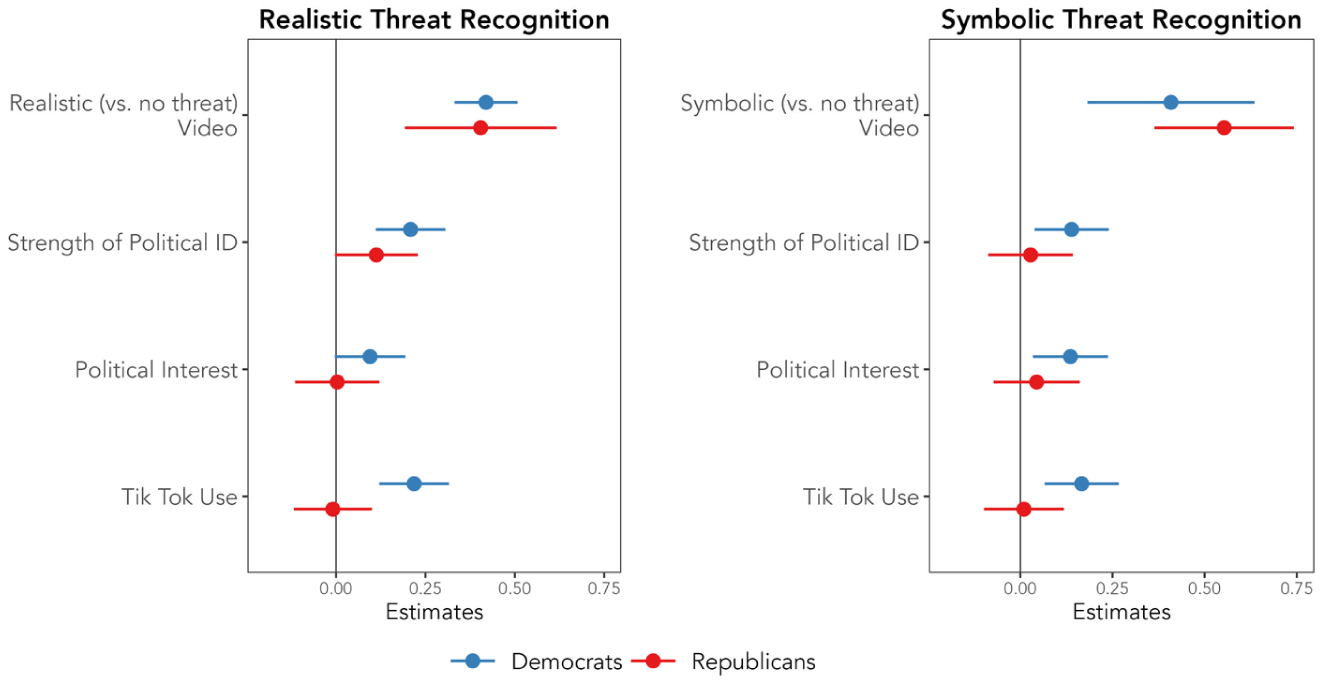
Pilot Study: multilevel models predicting threat recognition for democrats and republicans.
These within-persons analyses confirmed our initial test of H1. Compared to the no-threat video, participants recognized higher levels of realistic threat when evaluating a realistic threat video (bs = 0.52–0.46, SEs = 0.06–0.12, p < .001) and higher levels of symbolic threat when evaluating a symbolic threat video (bs = 0.50–0.64, SEs = 0.14–0.11, p < .001; Table A2). H1 was confirmed. 5 Next, we examined H2b to d, which predicted that respondents would recognize higher levels of threat if they had higher ingroup identification, political interest, or TikTok use. First, we examined the main relationships of these moderators in Figure 2. For Democrats, political identification, political interest, and TikTok use were positively related to threat recognition, regardless of the type of video they saw (Table A2, columns 1 and 3). For Republicans, none of these variables significantly predicted threat recognition (Table A2, columns 2 and 4). To see if these variables moderated threat recognition, per H2b to d, we conducted moderation models in which threat type was interacted with each moderating variable in turn (Tables A3–5). We found few significant interactions across parties. 6 One notable exception was the strength of partisan identification in models predicting symbolic threat recognition (ps < .05, Table A5, columns 3–4). Figure 3 plots recognition of symbolic threat after watching symbolic versus no threat videos, for individuals with different levels of identification with their political party (the plot combines Democrats and Republicans for ease of presentation). Examining the orange dashed line, we observe that symbolic threat videos were recognized as more symbolically threatening than no threat videos, regardless of how strongly someone identified with their political party (simple slope: b = 0.03, SE = 0.04, p = .48). However, the solid blue line shows that no threat videos are recognized as more symbolically threatening for individuals who had stronger partisan identities (simple slope: b = 0.16, SE = 0.04, p < .001). Put another way, those who viewed their political identity as “extremely important” (a 5 on the scale), viewed no threat videos just as symbolically threatening as videos that contained an explicit symbolic threat. A similar interaction pattern emerged when we compared responses to symbolic threat videos versus realistic threat videos (See Figure A1; mixed evidence for H2b–d).

Pilot Study: effect of symbolic threat (vs. no threat) video across strength of party identification.
Pilot Study Discussion
The goal of our pilot study was not simply to conduct a “manipulation check” of explicit identity threats in TikTok content, but to examine the variability in Americans’ recognition of both realistic and symbolic political identity threats in actual TikTok videos. First, we found individuals can recognize both realistic and symbolic threats when they explicitly appear in TikTok videos. At the same time, our findings suggest that these two types of threat recognition may be difficult to empirically distinguish from each other. Not only were our measures of threat recognition highly correlated, but we also observed spill-over: realistic and symbolic threat videos were recognized as the other type of threat. On the one hand, this could be because the realistic and symbolic threats are not as distinct as previously theorized (Branscombe et al., 1999). People may encounter one type of threat in their media environment and infer the presence of a different type of threat or make further inferences about what their group would think about the mediated threat (i.e., higher disagreement recognition). On the other hand, the strong relationship between these two types of threat recognition may reflect the fact that some individuals are more sensitive to identity threats. Indeed, in our data Democrats with strong partisan identities, high political interest and frequent platform use were all more likely to recognize higher levels of threat in general. For strong partisans in both parties, a no threat video was just as symbolically threatening as a video containing a symbolic threat. This demonstrates variable sensitivity to explicit identity threats on TikTok.
Study 1
Findings from our pilot study shaped our design of Study 1. First, although videos in our pilot study were selected through a rigorous process by experts in political identity threats, use of existing TikTok content limited our ability to control how threat was induced. Threats may not have been strong enough or may have cued a different type of threat inadvertently. Second, differences between Democrats and Republicans were difficult to interpret because these groups were shown a different set of TikTok videos which could have ranged in threat strength. The low variance in threat recognition among Republicans we found may reflect idiosyncrasies with the particular set of TikTok videos we used. Third, our pilot study did not measure emotional, and behavioral reactions to political identity threats (i.e., threat effects). Study 1 responded to these shortcomings through a pre-registered online experiment, 7 which tested all of our hypotheses in a more controlled experimental setting. We conducted a 3 × 2, between-participant study, in which participants viewed a fictional TikTok video that was manipulated in terms of threat type (explicit realistic threat, explicit symbolic threat, or no explicit threat) and threat target (respondents’ political ingroup or outgroup).
Study 1 Methods
Based on a priori power calculations, to achieve .80 power to detect our desired effect size (Cohen’s d = 0.35 or partial η2 = 0.02) we identified a target sample size of N = 636. We then doubled this sample size to test our hypotheses with both Democrats and Republicans. Data were collected in the week before the 2024 presidential election. Participants over the age of 18 residing in the U.S. were recruited on Prolific.co. Quotas were set for even numbers of Democrats and Republicans, yielding 1,351 responses. Sixty responses were excluded for failing a simple attention check, resulting in a final sample of N = 1,291. This sample had a mean age of 42.51 years (SD = 13.32) and 65.69% identified as women, 33.00% as men, and 1.30% as another gender. In terms of race/ethnicity, participants identified as white (70.64%), Hispanic (5.84%), Black/African-American (16.34%), Asian (5.50%), or another race/ethnicity (1.68%).
Procedures
To cue explicit realistic and symbolic identity threats in a more tightly controlled manner, we created fictional TikTok videos focusing on either the Democratic candidate for president (Kamala Harris) or the Republican candidate for president (Donald Trump). Our intent was to simulate the kind of independent political content that is created on TikTok, which includes voiceover, text, and exaggerated visuals. The creator of the video was fictional and non-partisan.
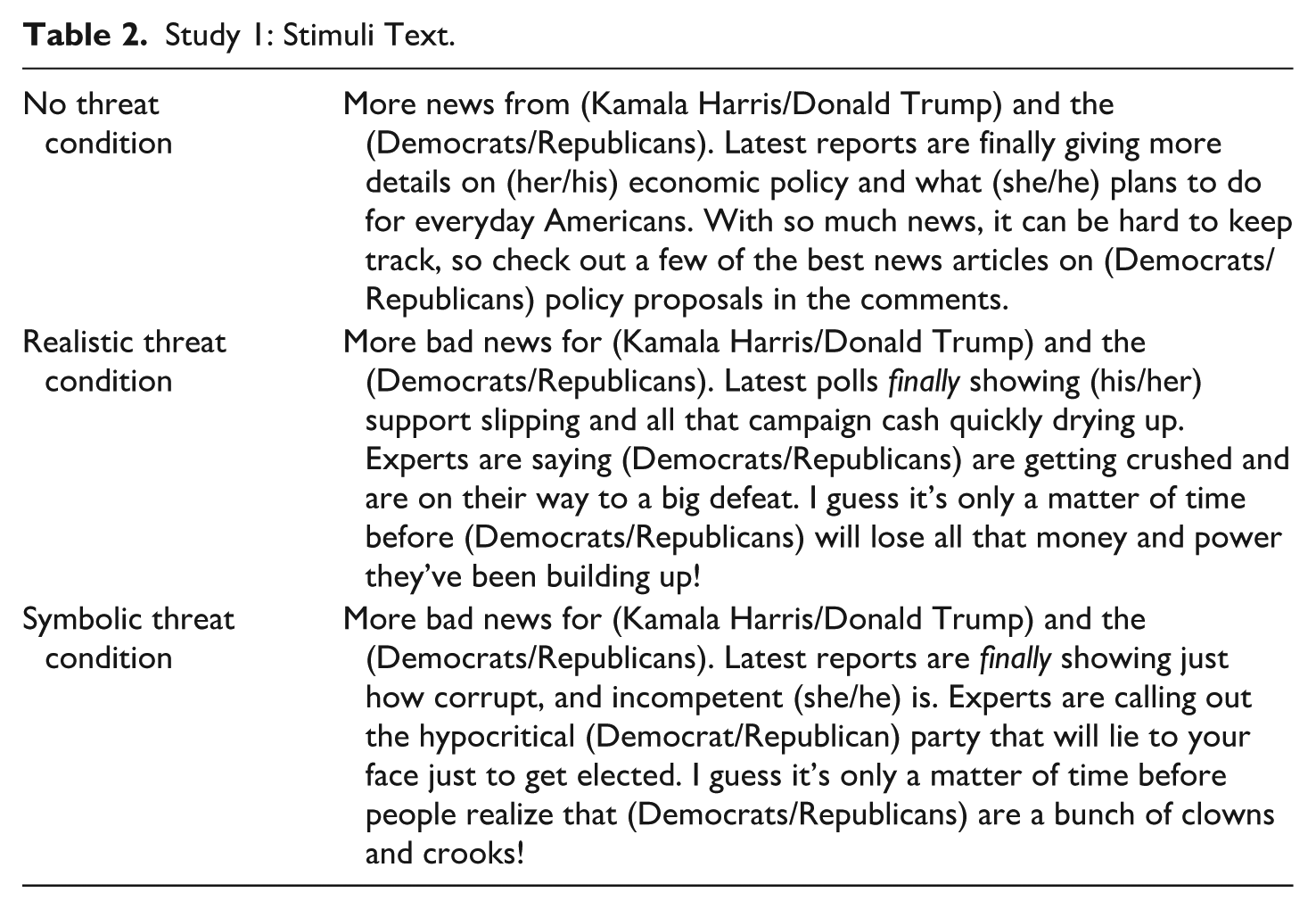
The realistic threat video emphasized the potential that a given candidate and party were losing money, resources, and the election. The symbolic threat video emphasized how immoral, corrupt, and stupid the candidate and party were. The no threat video referenced the candidate and election without any explicitly threatening references. The intent of the no threat video was to make political parties salient without explicitly cuing threat. Across videos, music and non-threat related visuals/text were kept constant, so only threatening information was manipulated (see Table 2). 8 After filling out a pre-treatment questionnaire, respondents were randomly assigned to watch one TikTok video and answer questions related to their perceptions, emotions, and willingness to engage in social media behaviors in response.
Study 1: Stimuli Text.
Measures
Identical measures were used from the Pilot Study, including realistic threat recognition (M = 2.12, SD = 1, α = .63) and symbolic threat recognition (M = 2.16, SD = 1.08, α = .92). Despite the high correlation between these two types of threat recognition, we decided to assess them separately in our tests of H1, RQ1, and H2 to remain consistent with the theoretical threat types in the literature. Our concerns about the distinction between these types of threats informed our interpretation. Strength of partisan identity (M = 3.15, SD = 1.18), political interest (M = 3.35, SD = 1.05), and frequency of TikTok use (M = 3.52, SD = 2.14) were also measured.
The video was evaluated by asking participants the extent to which different words described the stimuli on a 5-point scale from 1 (not at all) to 5 (extremely). We created mean indexes of negative video evaluations (M = 2.72, SD = 1.35, α = .89; “biased,” “hostile,” “deceitful,” and “toxic”) and positive video evaluations (M = 2.13, SD = 1.12, α = .91; “informative,” “accurate,” “fair,” and “useful”). We measured emotional responses by asking how much they felt different emotions after watching the video on the same 5-point scale. Mean indexes captured negative emotions (M = 1.68, SD = 0.97, r = .59; “angry” and “anxious”) and positive emotions (M = 1.80, SD = 1.17, r = .82; “enthusiastic” and “hopeful”).
Willingness to engage in social media behavior was measured on a 5-point scale 1 (not at all likely) to 5 (extremely likely). Behaviors including clicking “not interested,” reporting the video for breaking community guidelines, and leaving a negative comment were combined into a mean-index of negative SM behavior (M = 1.93, SD = 0.99, α = .59 9 ). Behaviors including clicking “heart” on the video, leaving a positive comment, and clicking “send” to share the video were combined into a mean-index of positive SM behavior (M = 1.47, SD = 0.91, α = .88).
Study 1 Results 10
Analyses in Study 1 tested all hypotheses related to our conceptual model (Figure 1).
Threat Recognition (H1 & RQ1)
We first tested H1, which predicted that the presence of a symbolic or realistic threat would be recognized as such by participants. We conducted ANCOVA models with video threat type (realistic, symbolic, no threat), video target (ingroup, outgroup), party (Democrat, Republican), and their interactions as predictors. Confirming Pilot Study findings, there was a main effect of video threat type on both realistic and symbolic threat recognition (Fs(2,1279) = 419.11; 548.643, ps < 0.001). Videos containing realistic and symbolic threat (vs. no threat) increased corresponding recognition of threat (ts(1279) = 28.81; 31.81, ps < 0.001, drealistic = 1.97, dsymbolic = 2.18). We also observed that realistic and symbolic threat (vs. no threat) increased recognition of the other type of threat (ts(1279) = 28.81; 31.81, ps < 0.001, drealistic = 1.03; dsymbolic = 0.61). To summarize, participants recognized explicit symbolic and realistic threats when present (H1a & H1b confirmed), but that there was also a “spill-over” effect between threat types (RQ1).
Threat Sensitivity (H2)
Next, we assessed H2, which predicted that respondents would recognize higher levels of threat when (a) the threat targeted the ingroup (vs. outgroup), (b) they had higher ingroup identification, (c) higher political interest, or (d) higher TikTok use. We conducted a series of ANCOVA models as specified above, with the addition of an interaction term between video threat type and each of the proposed moderators of threat sensitivity (see Tables A7–A13). First, there were significant interactions between video threat type and video target (ingroup vs. outgroup) for both types of threat recognition (F(2,1281) = 7.63; 15.42, p < .001; Tables A7 & A11). When the video explicitly threatened the ingroup (vs. outgroup) we observed larger effects of realistic threat videos (vs. no threat videos) on realistic threat recognition (t(1281) = 1.94, p = .05, M Diff = 0.20) and of symbolic threat videos (vs. no threat videos) on symbolic threat recognition (t(1281) = 5.20, p < .001, M Diff = 0.55). 11 Next, while there were main effects for some of the other moderators 12 there were no significant interactions between video threat type and (a) partisan identification, (b) political interest, or (c) frequency of TikTok use (ps > .05). To summarize, we found that individuals were more sensitive to the presence of identity threats targeting their ingroup (vs. outgroup), but that partisan identity, political interest, and TikTok use did not influence threat sensitivity (mixed evidence for H2).
Emotional/Behavioral Effects (H3–H4)
We assessed whether presence of explicit political identity threats would lead to negative and positive video evaluations, emotions, and social media behaviors (H3 & H4). Per pre-registration, we collapsed realistic and symbolic threat types by coding whether participants viewed a video containing any type of threat (vs. no threat). We did so because theory did not lead us to predict distinct emotional/behavioral effects for these two threat types and including both made pre-registered analyses unnecessarily complex. We conducted ANCOVA models predicting video evaluation, emotions, and social media behavior willingness (Tables A15–A20).
We found significant interactions between threat type and video target for all outcome measures (ps < .05) and visualized mean levels of each condition in Figure 4. Our hypotheses specifically predicted effects of threat (vs. no threat) on negative outcomes in cases where the ingroup was the target (H3) and positive outcomes when the outgroup was the target (H4). Therefore—and per pre-registration—we tested the simple effects of threat (vs. no threat) relevant to these combinations (summarized in Table A21). 13 When the target was the ingroup, video threat type (threat vs. no threat) led to higher levels of negative video evaluation (d = 2.46, p < .001), negative emotion (d = 0.88, p < .001), and willingness to engage in negative social media behavior (d = 1.06, p < .001). When the target was the outgroup, video threat type led to higher levels of positive emotion (d = 0.45, p < .001) and willingness to engage in positive social media behavior (d = 0.40, p < .001), but not positive video evaluation (p = .05, p = .45). To summarize, threats to the ingroup (vs. no threat) led to negative perceptions, emotions, behavioral willingness, while threats to the outgroup (vs. no threat) led to positive emotions and behavioral willingness. With the exception of H4b, H3, and H4 were confirmed.

Study 1: Video evaluations, emotions and SM behavior by condition.
Effects Across Strength of Party Identification (H5)
We further predicted that the emotional/behavioral effects of explicit identity threats would be stronger for those with stronger partisan identities (H5). To test this, we conducted a series of regression models predicting the emotional/behavioral outcomes referenced in H3 and H4. For models predicting negative outcomes, we only analyzed data for participants exposed to videos targeting their ingroup and for models predicting positive outcomes we only analyzed data for those exposed to videos targeting the outgroup (per pre-registration). 14 All interactions between video threat type (threat vs. no threat) and strength of political identification were significant (ps < .05), except when predicting negative evaluation (p = .28; Table A22).
To probe these interactions, we created Johnson Neyman plots, which visualize the conditional effect of threat (vs. no threat) on each outcome variable, across levels of strength of party identification (Figure 5). Looking at the first column of Figure 5, ingroup threats have stronger effects on negative emotions and behavioral willingness for people who more strongly identify with their party. The second column of Figure 5 displays a similar pattern: for outgroup threats, effects on positive evaluation, emotion, and SM behavioral willingness are larger for stronger partisans. Notably, for those with weak partisan identities, identity threats have no significant effect on positive emotions or behavioral willingness (see shaded red areas) and a negative effect on positive evaluations. To summarize, we find that the effects of explicit in and outgroup identity threats are stronger for those with stronger partisan identities (H4 confirmed).

Study 1: Johnson-Neyman plots visualizing effects of threat across levels of strength of partisan identification.
Mediation (H6)
Finally, we tested whether the effects of explicit identity threats on outcome measures were mediated by threat recognition (H6). Here, we again collapsed across realistic and symbolic threat videos, so videos were coded as threat versus no threat. Similarly, we used a measure of general threat recognition, which combined recognition of realistic and symbolic threat to simplify mediation analyses (per pre-registration). We conducted this mediation analysis with full awareness that our experimental design did not independently manipulate the mediator, thereby limiting our ability to make causal claims (Chan et al., 2022). Instead, we interpreted this analysis cautiously and as simply one means of fully assessing our framework (Figure 1).
Using regression models (see Table A24) and the R package mediation, we calculated direct and indirect effects with 10,000 sample bias-corrected bootstrapped confidence intervals (Tingley et al., 2014). These analyses, summarized in Table 3, indicated that the relationship between video threat type (threat vs. no threat) and all outcomes (except positive evaluation) was partially mediated by threat recognition (Indirect Effects = 0.16–0.71, 18.35%–63.57% of total effect mediated, confidence intervals do not contain 0). To summarize, this supported our prediction that threat recognition may be one mechanism through which identity threats affect attitudes, emotions, and behavioral willingness (H6 confirmed).
Study 1: Mediation Effects – Primary Contrasts.

General Discussion
Together, our studies offer several important theoretical insights related to the effects of explicit political identity threats on social media. First, drawing on Intergroup Threat Theory (ITT), both studies demonstrated that individuals tend to recognize political identity threats in social media content when they are explicitly present in messages. As expected, individuals are more sensitive to threats to their ingroup (Study 1) and, in some cases, stronger group members were particularly likely to recognize symbolic threats in real TikTok videos (Pilot Study). In both studies, strong group members, the politically interested, and heavy TikTok users recognized higher levels of threat regardless of its presence in content. Committed partisans may see threat wherever they look, regardless of whether it is explicitly present (Krupnikov & Ryan, 2022). Similarly, heavy users of platforms like TikTok develop expectations of political conflict, priming them to perceive threat in content (Literat & Kligler-Vilenchik, 2021).
Theoretically, this indicates that systematic perceptual biases are likely to arise on social media, in which some users recognize social media content as more threatening to their political group versus others. Future research should examine how such biases operate on a message processing level. For example, when encountering identity threats in messages, strongly identifying group members may experience group-specific emotions or engage in biased scanning, two mechanism that could account for the greater sensitivity to political identity threats we observe here. While we focus on identity threat as a receiver-based phenomenon, the intent of the message sender could plausibly condition how threatening content is perceived. Future studies should examine whether intentional versus unintentional explicit threat cues shape the strength or nature of threat effects.
Second, while our study initially adopted the distinction between realistic and symbolic threats, our findings suggest that these two types of threats are difficult to empirically distinguish in the context of media messages. A post-hoc confirmatory factor analysis of Study 1 suggested that our measures did not capture recognition of two underlying discrete threat types. 15 This may indicate measurement or contextual issues (see Limitations) and challenge the usefulness of the realistic/symbolic distinction. However, if identity threats can be explicitly present (as indicated by past research; Böhm et al., 2020), it may also be that people interpret threatening information in both realistic and symbolic terms. In the context of social media, this suggests that Americans may be routinely encountering threatening information that leads them to fear loss of both the resources/power of their group as well as the groups’ values/morals and status. This could help explain why more routine symbolic derogation of political groups on social media can be interpreted as serious threats to safety and resources. Conversely, information about electoral defeats may be experienced as threats to the values or morals of political groups. Broadly, our findings raise a conceptual challenge, suggesting that while symbolic and realistic threats might be easy for researchers to conceptually distinguish, they are deeply intertwined in the experiences of group members when they process social media messages.
Third, when users detect political identity threats, they are likely to have emotional and behavioral responses consistent with their group membership. We found that when the threat is directed at a political ingroup, individuals have negative evaluations and emotions and are more willing to exploit the affordances of social media to combat these threats. This provides empirical support for the contention that the presence of identity-threatening content is a driver of political behavior on social media (Lane et al., 2023). When the threat targets a political outgroup, some participants evaluate the content more positively. This suggests an incentive for users and algorithms to create a supply of outgroup-threatening content on social media. These outgroup threats lead to positive emotions and behavior intended to endorse or spread threatening content. Our findings suggest that social media may be ideal contexts for group members to use threats to their outgroup for the purposes of expressing hostility toward the outgroup (Bor & Petersen, 2022) or engaging in intergroup conflict. This suggests that responses to identity threats can go beyond “corrective action” (i.e., combating ingroup threats) to outgroup derogation (Bor & Petersen, 2022; Brady et al., 2020). Our findings are also consistent with research on trolling and online hate, which suggests that individuals threaten outgroups to bond with or support their ingroup (Walther, 2022). Our mediation analyses further support assertions made by past work that political communication has these effects on group members, in part, by threatening their identities (Lane et al., 2023; Lin & Haridakis, 2022; Long et al., 2019). As we have noted, the limitations of our experimental design make this a speculative observation.
Fourth, we demonstrate that the emotional and behavioral effects of identity threats are the strongest for those who identify strongly with their political group. This is consistent with ITT’s basic prediction that strength of identification is a key antecedent to threat recognition and effects (Stephan et al., 2015). Our findings point to a potential downward spiral in which strong partisans interpret social media content as threatening their political group and thus are more likely to engage in identity-protective strategies on social media. The algorithms and social networks enabled by social media are likely to further amplify this process. Notably, we found that strength of identification can work the other way: weak partisans were unaffected emotionally/behaviorally by threats to the outgroup and ultimately rated such content negatively. This may help explain why many Americans who lack strong partisan loyalties simply view threat-filled social media feeds as negative and counter-productive (Gubbala et al., 2022).
Finally, we theorize identity threat as a communicative process, in which features of messages can be classified as explicitly threatening a group identity and be differentially recognized by receivers (Valkenburg & Peter, 2013). The practical implication of this is that assessing the objective presence of identity threats on social media platforms (e.g., via content analysis) is likely to be challenging, given the variability in threat recognition we identify. Future efforts should embrace techniques to capture this variability and consider other factors that might influence threat sensitivity, including technological affordances (e.g., anonymity) and cultural differences. Here, work measuring morality in media content can provide a useful guide (see Hopp & Weber, 2021).
On a broader note, our findings should be interpreted in light of the specific electoral and media context in which they were produced. We examined political identity threats during a unique election period and in a country with high partisan polarization, and high levels of political content on TikTok. These conditions may make the effects of explicit political identity threats more pronounced than in other contexts. This may also help explain the high correlation between symbolic and realistic threat recognition we observe. It may be that during periods of heightened polarization, symbolic rhetoric is often interpreted as signaling material consequences, and realistic threats may be understood as moral or value-based threats. To assess the generalizability of our findings, future research should study multiparty political systems 16 and contexts where other identities (e.g., ethnic/religious) are more central to political conflict.
This study has some important limitations worth noting. We were only able to induce and measure threats explicitly, across realistic and symbolic dimensions. Future work should continue to develop measures that can discriminate between these symbolic and realistic threats and also assess when they appear implicitly. More conceptual work is also needed to better distinguish what makes an identity threat explicit versus implicit. While we combine both observational and experimental methods, future work should further examine political identity threats “in the wild.” This should include measurement of the supply of threatening content on social media and actual social media behavior. Our findings should be adapted to study how users are affected by identity threats within the social media environments they actually inhabit. While we examine threat sensitivity across partisan identification, there are other group-related factors that may influence threat sensitivity, including outgroup affect and perceptions of intergroup relationships.
Conclusion
As scholars begin to reckon with the group nature of political communication, more careful conceptualization and measurement of identity is vital (Coles et al., 2025; McGregor et al., 2025). We also need to recognize that perceptions and experiences of digital politics are profoundly different for those who are committed members of their political team or immersed in the world of social media. While some experience politics on social media as ambivalent noise, others may be awash in a sea of threats to their identities. Partisans may be more likely to recognize identity threats on social media and be motivated to use platform affordances to defend their group’s safety and values. Our framework can animate identity-related political communication research moving forward and inform public conversations about the types of politics that emerge in social media environments.
Supplemental Material
sj-docx-1-crx-10.1177_00936502261443863 – Supplemental material for Political Identity Threats on Social Media
Supplemental material, sj-docx-1-crx-10.1177_00936502261443863 for Political Identity Threats on Social Media by Daniel S. Lane, Yifei Wang and Alcides Velasquez in Communication Research
Footnotes
Acknowledgements
The authors would like acknowledge the essential contributions of undergraduate researchers Melody Chen, Ben Diaz, Shay Hawkes and Sydney Yamanishi. They would also like to thank other members of the UCSB Digital Political Inequality Lab for their helpful feedback throughout the development of this paper.
Funding
The authors received no financial support for the research, authorship, and/or publication of this article.
Declaration of Conflicting Interests
The authors declared no potential conflicts of interest with respect to the research, authorship, and/or publication of this article.
Data Availability Statement
All stimuli, data, and analysis used for this manuscript are available from the first author upon request.
Open Practices
Data and analysis scripts for this study are available from the first author upon request. Open materials and pre-regrestriation can be found on OSF at the following links: https://osf.io/kefx8/?view_only=05cd6b15c7364068a67a93fce1a39993  .
.
Supplemental Material
Supplemental material for this article is available online.
Notes
Author Biographies
References
Supplementary Material
Please find the following supplemental material available below.
For Open Access articles published under a Creative Commons License, all supplemental material carries the same license as the article it is associated with.
For non-Open Access articles published, all supplemental material carries a non-exclusive license, and permission requests for re-use of supplemental material or any part of supplemental material shall be sent directly to the copyright owner as specified in the copyright notice associated with the article.
