




Abstract
A recurring finding in communication studies is that political actors with formal-institutional power are highly visible in the media. The relationship between informal power and media visibility remains less understood. This study examines whether central roles in networks of political collaboration—as indicators of informal power—are associated with increased visibility in mainstream news media. We hypothesize that organizations with central roles are more visible in the media because informal power increases their newsworthiness. Using social network methods and Bayesian regressions on survey and media data on organizations involved in climate policy in Finland, we find that central organizations with many collaboration partners receive more media coverage. Other central roles, such as brokerage or coalition leadership, are not associated with media visibility. This study advances knowledge of media visibility by showing that informal power is associated with media visibility, and that some power positions are more important than others.
Introduction
Political actors use news media as an arena for political communication, contestation and promotion (Van Aelst & Walgrave, 2016). For political actors—such as political parties and interest groups—the news media are important for various reasons: to communicate their positions to voters, influence public opinion, and recruit members and supporters. By giving some actors more attention than others, the media can affect “who gets what, when, and how” in politics (Lasswell, 1936).
For this reason, numerous studies in communication research have sought to explain why some political actors receive more media attention than others. Perhaps the most robust finding has been that the news media follow political power (Bennett, 1990; Cook, 1986). For example, actors belonging to the official political system get to communicate their views through the news media more often than civil society actors (Massarani et al., 2024; Tiffen et al., 2014), and government parties appear in the media more often than opposition parties (Hopmann et al., 2011). Research on gatekeeping and journalistic sourcing practices has sought to explain these findings by highlighting the newsworthiness of power elites (e.g., Galtung & Ruge, 1965; Harcup & O’neill 2017; Tse & Spiezio, 2023) and journalists’ reliance on elites as legitimate sources of information (e.g., Barnoy & Reich, 2022, pp. 199–200; Wolfsfeld & Sheafer, 2006).
These findings have implications for the democratic process. On the one hand, the media’s focus on the powerful may inhibit pluralism of political communication (Brown et al., 1987; Harjuniemi, 2023) and lead to cumulative inequality, where “those who are most needy have least access to the media services they desire” (Gamson & Wolfsfeld, 1993, p. 117). On the other hand, a focus on the powerful may be an indication that the media are fulfilling their role as “watchdogs of the powerful” (Green-Pedersen et al., 2017).
Studies of the relationship between power and media visibility tend to focus on formal-institutional positions of political power, that is, those recognized and legitimized by the constitution of a polity. This focus on formal-institutional power positions has yielded many important findings. For example, it has been found that organizations that belong to the legislative or executive branches of government (e.g., leading political parties, ministries) are more visible in the media than organizations that do not belong to these branches (e.g., non-governmental organizations).
However, we have little understanding of the association between media visibility and the informal power of political actors. To fill this gap, we draw on insights from the field of policy network analysis. Political scientists have long emphasized the growing role of policy networks as sources of political power (Rhodes, 2007; Sørensen & Torfing, 2009). More specifically, research has shown that organizations can derive informal power from occupying central roles in networks of political collaboration (Henry, 2011; Ingold & Leifeld, 2016; Shumate & Contractor, 2013). These networks consist of relationships—including communication relationships, exchange of resources and joint advocacy—between actors that aim to influence political decisions and their implementation (Ingold et al., 2021). Importantly, research has documented that occupying central roles in policy networks is an important source of informal power (Fischer & Sciarini, 2016; Wagner et al., 2023)—power that is not derived from occupying positions of formal-institutional power but stems from asymmetric communication patterns between political actors.
In this paper, we thus contribute to the communication research literature on media visibility, journalistic gatekeeping, and source selection by incorporating insights from the political science literature on policy networks. Drawing on this literature, we argue that central roles in policy networks confer informal power on political actors, and we hypothesize that this power can increase their newsworthiness and access to information, leading to increased media visibility. In other words, we argue that horizontal communication relationships between political actors are related to vertical communication relationships between these actors and the news media. Thus, our approach is essentially about the relationship between two types of communication patterns.
Our research question is: How is a policy actor’s centrality in a policy network associated with its news media visibility, and which types of central roles are most important for media visibility? We hypothesize (see the theory section) about the association between media visibility and five different types of central roles in policy networks: those of a popular collaboration partner, a connector, an authority, a broker, and a coalition leader. Empirically, we rely on a combination of two policy network surveys (2014 and 2020) and mainstream news media and Twitter (currently X) data (2013–2020). The datasets focus on organizational actors involved in climate policy in Finland. We test the hypotheses using social network methods and Bayesian statistics. Namely, we first overcome the problem of missing relationship data among survey non-respondents by reconstructing the policy networks using Bayesian exponential random graph models. Then, we extract information about actors’ roles in these networks using a variety of network centrality measures. Finally, we fit Bayesian regression models to analyze the associations between central roles and media visibility.
The results confirm our expectation that informal power in the policy network is associated with media visibility. Specifically, organizations that are popular collaboration partners get to communicate their views through the news media more often than their peers. In contrast, the roles of connectors, authorities, brokers, and coalition leaders are not systematically associated with media visibility. In the concluding section, we discuss the theoretical and practical implications of these findings.
Formal-Institutional Power and Media Visibility
The positive correlation between formal-institutional positions of power and news media visibility is well established. At least three mechanisms contribute to the high media visibility of powerful actors. First, an actor’s elite status is an important news value in and of itself because it increases the actor’s attractiveness as a news source (Galtung & Ruge, 1965; Harcup & O’neill 2017; Tse & Spiezio, 2023). The media monitor the behavior of actors that hold dominant positions in society, because their actions have consequences for citizens. Journalists’ efforts to act as watchdogs of the powerful thus increase their media visibility (Green-Pedersen et al., 2017). Second, those with formal-institutional power have access to public relations resources that enable them to implement communication strategies that increase their chances of being covered (e.g., Van Dalen, 2012, pp. 34–35; Hopmann et al., 2011). Third, the “media pays special attention to governmental actors because they are a legitimate source of information” (Baumgartner & Chaqués Bonafont, 2015, p. 271), and therefore journalists tend to trust them as sources of information (Barnoy & Reich, 2022, pp. 199–200).
As a result, actors that occupy positions of formal-institutional power in political systems, such as government ministries and parliamentary parties, have higher media visibility than, for example, civil society actors that, by definition, lack such formal power (Massarani et al., 2024; Tiffen et al., 2014). In addition, government parties are more visible than opposition parties (Hopmann et al., 2011), and ministers are more visible than other members of parliament (Amsalem et al., 2020; Orchard & González-Bustamante, 2024; Vos, 2014). Moreover, the difference between government and opposition parties in terms of media visibility is more pronounced when power is concentrated in the executive (Hopmann et al., 2011).
Many scholars have noted that the relationship between media visibility and political power is reciprocal (e.g., Hopmann et al., 2011; Thrall, 2006; Vos, 2014). As Tresch (2009, p. 71) argues, “formal power in the policy-making process therefore easily translates into discursive power in the media, which can further strengthen the political power of an actor and ultimately lead to a self-perpetuating cycle of political influence and media coverage.” For example, politicians who receive media attention are more likely to become ministers (Van Remoortere et al., 2023), which further increases their media visibility.
Informal Power and Media Visibility: Central Network Roles
The association between political power and visibility in the news media is, thus, well documented. However, the literature has almost exclusively operationalized power as formal-institutional power. We add to this research by examining the relationship between informal power and media visibility. To do so, we combine the literature on media visibility with insights from the field of policy network analysis. The policy network literature is relevant because it enables researchers to identify political actors that have informal power and access to information because they occupy central roles in policy networks. As we argue below, we expect organizations in central network roles to be more visible in the media because of their informal power and their communication relationships that give them access to information. We also expect that their media visibility further increases their centrality in the network.
Policy networks are constituted by a set of actors (organizations) in a particular policy domain and the relationships among them. In these networks, actors pool resources by collaborating with others to gain influence, and the resulting collaboration ties give rise to a “complex pattern of interaction” (Ingold et al., 2021, p. 213), that is, a policy network. Because a policy network is composed of collaboration ties, it can be thought of primarily as an “affinity network” (Shumate & Contractor, 2013). Furthermore, although the primary function of relationships in policy networks may not be information flow, policy networks also contain elements of “flow networks” (Shumate & Contractor, 2013) because collaboration typically involves communication and information flows (Scott, 2016), and because actors tend to value the information provided by their collaboration partners (Wagner et al., 2021).
Organizations in a policy network can have formal-institutional power through “direct control over policy outcomes” (Ingold et al., 2021, p. 213), or informal power by drawing on the resources of the actors in their network of relationships. The former is most often held by government departments and parliamentary parties, while the latter can be acquired by any type of organization, including the interest groups, nongovernmental actors and scientific organizations (Beyers & Braun, 2014) that provide “formal policy-makers with information, expertise, or support in exchange for influence” (Ingold et al., 2021, p. 213).
Take the example of a small environmental NGO that wants to fight climate change by reducing deforestation and by preserving forests as carbon sinks. Alone, they have very little power to influence legislation on logging. So, they collaborate, offering their expertise in exchange for other resources. Collaborating with officials in the Ministry of Environment, who are likely to favor climate-friendly legislation and who are drafting legislation together with the Ministry of Agriculture and Forestry (which wants to increase logging), gives the NGO in question information about the drafting process and human resources to influence legislation. Collaborating with the Green Party gives them the opportunity to influence how the legislation is handled in parliamentary committees (e.g., by being invited to give testimony). And collaborating with a larger, well-funded NGO allows them to launch a public communications campaign to raise awareness of the links between deforestation and climate change. The more such relationships the NGO has—that is, the more central it is in the policy network—the more access it has to material and human resources, which increases its informal power and ability to influence the policy process. A relatively broad literature has established that centrality in policy networks increases the power of actors to influence policy processes (e.g., Fischer & Sciarini, 2016; Ingold & Leifeld, 2016; Wagner et al., 2023). In this paper, we test the hypothesis that informal power also makes them more interesting as sources for journalists and leads to higher media visibility.
It is worth noting that formal and informal power are not mutually exclusive, as actors with formal power can also gain informal power by assuming a prominent position in the policy network (Ingold & Leifeld, 2016). For example, political parties can demonstrate issue ownership (Petrocik, 1996) in a particular policy domain (as the green parties typically do in the case of climate policy), which can increase their centrality in the network by making them attractive collaboration partners for other actors with similar goals, such as NGOs (typically environmental NGOs in our case of climate policy). Furthermore, the role of public administration organizations goes beyond their formal position as assigned by laws and regulations, and they can increase their influence in the policy process by collaborating with other actors in the network (Alexander et al., 2011). Thus, actors in formal power positions (governmental organizations, parties in parliament), have formal-institutional power, by definition, but can also acquire informal power by gaining prominent positions in policy networks. In contrast, actors without formal power positions can gain informal power in policy networks, but not formal power.
In sum, the literature on media visibility has shown that actors with formal-institutional power are visible in the media, and the literature on policy networks has established that network positions are an informal power resource for political actors. However, the association between informal power positions and media visibility has not been systematically investigated. A handful of previous studies have found a positive association between network centrality and media visibility (Diani, 2003; Gonzalez-Bailon, 2009; Malinick et al., 2013; Pilny et al., 2014), but they have not examined the association in the context of policy networks in a way that allows for the distinction between formal and informal power. Our approach is novel in two major ways. First, by focusing on policy networks, we consider the networking behavior of a range of different types of actors unlike previous studies that have typically focused on only one type of actor, such as social movement organizations (Diani, 2003; Malinick et al., 2013; Pilny et al., 2014; for an exception, see Gonzalez-Bailon, 2009). Importantly, because policy networks include actors with both formal and informal power, focusing on the network as a whole allows us to compare the association between formal and informal power and media visibility. Second, while other studies have mostly focused on the number of ties that actors have in a network (i.e. degree centrality), we consider five different types of central network roles that take in to account the broader social network that conditions the importance of central roles. These roles are that of a popular partner, a connector, an authority, a broker, and a coalition leader.
In the sub-sections below, we argue that these different types of central roles can be related to media visibility through different mechanisms: First, and most importantly, we expect that actors’ network centrality increases their influence, which is an important news criterion, in different ways. Second, network relationships can also be communication relationships, and thus sources of information, making central actors valuable as news sources. Third, media visibility can increase the centrality of actors in the network. Finally, central roles can influence how public communication by different political actors fits into journalistic norms. Next, we describe these mechanisms in more detail and use them to formulate detailed hypotheses about the relationship between media visibility and different central network roles.
Popular Collaboration Partners (H1)
First, we expect that the organizations that are most often sought after as collaboration partners are likely to be more visible in the media. In line with the notion of preferential attachment (De Blasio et al., 2007; Saffer et al., 2022, p. 712), we expect some organizations to benefit from their initially larger base of collaboration partners. Initially popular actors are likely to become more popular over time as other organizations prefer to collaborate with those actors that already have many collaboration partners. 1
We expect popular organizations to be particularly visible in the news media for two reasons. First, and most importantly, collaboration relationships are sources of power, and centrality—such as being a popular collaboration partner—in a policy network tends to correlate with an actor’s influence in a policy process (e.g., Fischer & Sciarini, 2015; Heaney, 2014; Knoke, 1994). This is because “occupying a central position in a network gives an actor access to other actors’ resources” (Fischer & Sciarini, 2015, p. 62). Furthermore, influence can also increase centrality. Powerful actors are often seen as attractive collaboration partners by other actors, because powerful actors have resources that others want to access (Henry, 2011, p. 367; Fischer & Sciarini, 2016). These dynamics lead to the accumulation of both power and network centrality among the same actors. As Ingold et al. (2021, p. 214) point out, centrality is “often used as a synonym for network power or structural advantage.” Thus, because centrality translates into and reflects power, and power is an important news criterion (Galtung & Ruge, 1965; Harcup & O’neill, 2017), we expect that occupying a central network position—for example, in terms of being a popular collaboration partner—will lead to higher media visibility.
This argument is based on the assumption that journalists can perceive the positions of different actors in a policy network, even though the perception of informal power differs from the perception of formal-institutional power. Formal power positions are accompanied by clear signs that help to identify powerful actors. For example, parliamentary parties are powerful because they hold seats in the parliament, which is easily observable. In the case of informal power, the signals of power are not so easy to observe, but journalists can be expected to learn about the positions and influence of different actors by interviewing members of a policy network. In off-the-record discussions with political actors, journalists learn who initiated certain policy proposals, who supported and opposed them, and who got their way. In addition, journalists are likely to learn about the structure of the network by asking who they should talk to; informants are likely to mention the most well-connected actors, who, by definition, have many collaboration partners. Studies have shown that actors in the policy network can accurately perceive the influence of other actors (Fischer & Sciarini, 2015; Heaney, 2014). It is likely that journalists, who closely observe the policy network, can also correctly perceive influence. Indeed, journalists’ position as detached observers can make them particularly astute observers of power hierarchies in policy networks (Brands, 2013).
Second, in line with findings from the media visibility literature (e.g., Thrall, 2006; Tresch, 2009), we expect the relationship between media visibility and centrality to be reciprocal in that visibility can also increase an actor’s popularity in the network. Actors visible in the media are more likely to be sought out as potential collaboration partners because their media prominence makes their political goals visible to other actors (see Yanovitzky & Weber, 2019, p. 199). Their media visibility can also be seen as a proxy for influence. Moreover, media visibility is in and of itself a valuable resource (e.g., De Bruycker, 2019) that makes visible organizations valuable allies, further increasing their popularity as collaboration partners. This can lead to an accumulation of both types of resources—central network roles and media visibility—in the hands of a few actors, creating a cumulative advantage in which the resourceful few become even more resourceful. Cumulative advantage is often interpreted through the lens of the Matthew effect (Rigney, 2010), but this concept usually refers to the accumulation of advantage in a single domain. In our case, we contend that the formation of collaborative ties confers an advantage in another domain, that of media visibility, which can create a feedback loop of cumulative advantage. The concept of network autocatalysis captures such self-reinforcing “advantage loops” that emerge across multiple domains of power, sustaining and transforming political systems over time (Padgett & Powell, 2012).
In summary, we expect that popular collaboration partners are more visible in the news media because (a) they are influential and thus newsworthy actors, and because (b) their media visibility further increases their popularity in the network.
Connectors and Authorities (H2)
In addition to mere popularity, we expect that organizations occupying the roles of connectors and authorities in the policy network will be more visible in the media than others. These roles depend on an actor’s embeddedness in the network and not just on popularity (i.e., the number of collaboration ties). Connectors are organizations that are relatively close (i.e., have short paths of direct and indirect ties) to all other organizations in the policy network (Freeman, 1979). Because of their proximity to other organizations, connectors are well positioned to efficiently distribute and receive critical resources (Bonacich, 1987; Freeman, 1979; Pilny & Proulx, 2022). Therefore, we expect that actors that connect the network together by being close to all other actors are influential and therefore inherently newsworthy. Moreover, their close communication ties give them access to information from all sides of the network, making them potentially valuable news sources for journalists (see Malinick et al., 2013).
However, it may be that relative proximity to other organizations is not enough to secure the level of political power that typically generates the most media attention. As Bonacich (1987) argues, being linked with central actors may often be a better indicator of prestige and authority than mere closeness. Thus, we define authorities as organizations that collaborate with many well-connected organizations. In network science, being connected to well-connected nodes is referred to as eigenvector centrality (Bonacich, 1987). We use the label authority to refer to positions that are not necessarily close to all organizations, but to those that are popular, which puts these actors in a good position to access and use resources and to effectively spread ideas, influence, and information throughout the network. As the name of the role suggests, authorities are likely to be influential in shaping the opinions of other key organizations and, subsequently, in the policy process. For these reasons, we expect authorities to be visible in the media.
Brokers (H3)
Actors that occupy positions between actors not directly connected tend to exemplify broker roles (e.g., Freeman, 1979), which gives them the power to control communication between otherwise disconnected groups. In policy networks, brokers are often influential because they build compromises and connect opposing advocacy coalitions (Ingold & Varone, 2012; Smith et al., 2014). Because policy brokers are often influential, they are likely to have high media visibility. Brokers are also more knowledgeable than others about the policy positions of the actors whose connections they broker, making them valuable sources of information, including for journalists. However, policy brokers are often consensus-oriented, and this orientation does not necessarily fit with traditional news values, such as those of negativity and conflict (see De Bruycker & Beyers, 2015). Moreover, policy brokers may prefer to operate behind the scenes, as media attention can undermine their efforts to build compromise (Spörer-Wagner & Marcinkowski, 2010). Given these somewhat contradictory arguments that we formulated based on earlier relevant research, we test two alternative hypotheses:
Coalition Leaders (H4)
Finally, we expect leaders of political coalitions to be particularly visible in the media. The roles discussed above capture the centrality of organizations in the policy network without considering that organizations often cluster into assortative groups. Actors have an incentive to form coalitions to communicate and jointly develop common policy positions, accumulate resources, and advocate for these policy positions (Sabatier, 1988). Coalitions tend to have principal actors that occupy central leadership roles (Weible et al., 2020), and we expect that they are likely to gain media visibility. Because of norms of impartiality and balance, journalists seek to cover “both sides of the story” (see Boykoff & Boykoff, 2004; Wahl-Jorgensen et al., 2017), and because coalitions typically represent different sides of political struggles, the media are likely to seek to represent the voices of the leaders of different coalitions. An important task of a leader is to communicate the coalition’s policy positions to the public and to potential allies and opponents, similar to how leaders of political parties appear in the media much more than their less important party colleagues (e.g., Vos, 2014). Thus, the news media are likely to prioritize the views of coalition leaders.
Research Design
We test our hypotheses using data on the Finnish climate policy network. As we explain below, the network includes all major organizations involved in national climate policy in Finland—parliamentary parties, government ministries and agencies, interest groups, non-governmental organizations (NGOs), corporations, and research organizations. Our research design combined two surveys of these organizations and an analysis of their media visibility.
Case: The Climate Policy Network in Finland
We focus on the climate change policy network in Finland. Finland is a country with a strong democracy and relatively stable political institutions. It has a consensual political system with proportional representation, multiparty governments, a tradition of corporatism, and a high effective number of parties (Lijphart, 2012). Consensual systems are typically reflected in the structure of policy networks, where power is shared among a relatively large number of actors (Metz & Brandenberger, 2024). The relatively large number of influential actors in the Finnish climate policy network makes it suitable for comparing the association of formal-institutional and informal power with media visibility. Finland has traditionally had a democratic-corporatist media system (Hallin & Mancini, 2004) in which professional journalism has coexisted with media-party parallelism. However, political parallelism has been declining since the 1980s and currently Finland ranks very low in political parallelism (Van Kempen, 2007). As such, the major news outlets do not have clear partisan leanings.
Climate change policy is a suitable case for studying the relationship between media visibility and network centrality because of the salience of the issue in the media; thus, it is a policy area where media visibility is likely to play a role in the policy process and may be consequential for policy outcomes. We focus on the period from 2013 to 2020, which includes periods of both moderate and high issue salience, based on previous studies (Lyytimäki, 2020). In Finland, climate change moved from being a moderately salient issue in the media in 2013 to 2016 to a highly salient issue in 2017 to 2020 after the ratification of the Paris Agreement in 2016 and the publication of the IPCC 1.5°C report in 2018, only to be overshadowed by the COVID-19 pandemic in 2020 (e.g., Gronow & Malkamäki, 2024; Lyytimäki, 2020). The generalizability of our findings is enhanced by the data covering different levels of issue salience.
Survey Data
In 2014 and 2020, we surveyed organizations involved in national climate policy in Finland. Respondents were selected using a standardized sampling method developed in an international research project (Ylä-Anttila et al., 2018). First, we reviewed previous studies on climate change policy in Finland to identify organizational actors representing different sectors of society that are involved in climate policy (e.g., by trying to influence it). Then, we conducted a computer-assisted search for organizations that appeared in a sample of newspaper articles on climate change. Finally, our list of organizations was reviewed by climate policy experts representing different sectors. The purpose of these steps was to identify any important actors that had been missed in the initial phase. This procedure resulted in a list of 96 organizations that are the most important actors involved in climate policy in Finland. The survey included statements about climate policy and network questions about each organization’s collaboration ties with the other 95 organizations. The online survey was sent to the person responsible for climate change or environmental issues in each organization, or in the rare occasion where such a position did not exist, to a person who was as high up in the organization chart as possible (especially for small organizations). The response rate was 85%. The 2020 survey replicated the earlier survey, but with a slightly modified roster. First, ten organizations surveyed in 2014 had ceased to exist and were removed as respondents. Second, based on our analysis of media and consultations with climate policy experts, 18 new organizations were added. This resulted in 104 organizations, of which 88 responded to the survey (85% response rate).
Media Data
To analyze organizations’ visibility in the news media, we coded data from two mainstream news outlets, Helsingin Sanomat and Aamulehti between 2013 and 2020, the two most widely circulated quality newspapers in Finland with slightly different political leanings (Helsingin Sanomat is center-left and Aamulehti center-right). These newspapers play a central role in most political debates in Finland, especially Helsingin Sanomat, which has a weekly reach of over 1.5 million readers in a country with a population of 5.5 million, while Aamulehti typically reached over half a million readers during the period we studied (Media Audit Finland, 2024). These figures include both online and print readers.
The media data collection was carried out in two phases (2013–2017 and 2018–2020). For the first phase, we searched for articles published in the print versions of the newspapers. Using an extensive list of keywords related to climate change and climate policy, we found 3,931 articles, and a research assistant coded a systematic sample of 25% of the data. For 2018 to 2020, we collected news articles published on the newspapers’ online websites, because access to print news archives was temporarily restricted and a new service provided access to online news archives. We found 6,562 articles that included the word “climate” and then narrowed the sample down to 794 articles that contained the words “climate,” “coal,” or “emission” among the first 50 words. From these, we took a systematic sample by analyzing every other article in a chronological order. Although we used a mix of print and online news, we consider the datasets comparable because print and online news are similar in terms of which actors appear in the stories (Ghersetti, 2014).
Coding was based on statements made by political actors, that is, actors were either quoted or paraphrased in the text (see Tresch, 2009, p. 76, for a similar approach). A research assistant coded all statements about climate change or climate policy made by organizational actors, and two researchers checked the coding. These checks were facilitated by Regex queries based on the names of the organizations surveyed.
Dependent Variable: Media Visibility
Our dependent variable is a count of the number of articles in which each organization appeared in the media data (see Supplemental Figure A). We divided the dependent variable into two time slices that roughly correspond to the timing of the two surveys, 2013 to 2016 and 2017 to 2020. The two slices also correspond to the periods before and after the ratification of the 2015 Paris Agreement by the Finnish legislature, the development of the National Energy and Climate Strategy for 2030, and the introduction of the legally binding Energy and Climate Package by the European Union, all of which contributed to higher issue salience by shifting the focus of climate policy from the international to the national level (e.g., Gronow & Malkamäki, 2024; Lyytimäki, 2020).
Explanatory Variables: Central Roles
In this section, we describe the empirical operationalization of our theoretical arguments using standard network terminology, including edges (i.e., ties), vertices (i.e., nodes), and structure (i.e., patterns of edges among vertices). First, to operationalize the popularity of each actor (H1), we counted the number of times other organizations reported a given organization as a long-term, reciprocal collaboration partner in the context of climate policy. This measure is called indegree centrality.
Unlike indegree, our other measures of network centrality consider the embeddedness of a vertex in the broader network structure. Centrality measures typically account for “paths” through the network, and the extent to which each vertex is incident to such paths. Consequently, relatively small measurement errors can have a large impact on centrality measures (Kossinets, 2006). Therefore, a reliable measure of centrality requires that the network structure is not significantly affected by missing or spurious edges. We address the issue of missing data through the imputation of edges, which is achieved by fitting a Bayesian exponential random graph model (BERGM) to both collaboration networks (for an overview of the approach and its advantages over alternative imputation techniques, see Krause et al., 2020). Since collaboration in principle implies reciprocity, we disregarded the directionality of edges and defined an edge as being present even if only one member of a “dyad” reported its presence (which can have several reasons, including recall bias, see Brewer & Webster, 2000). To prevent organizations from becoming central due to excessive self-reporting, we dropped the edges of those respondents who reported more than half of the other actors in the network as collaboration partners. However, we retained all edges that respondents reported having with missing/spurious respondents and imputed edges only for the latter set of organizations. Our BERGMs built on previous modeling of collaboration networks (see Karimo et al., 2023), which included the governmental organizations and reputational influence (i.e., number of respondents naming an organization as particularly influential in national climate policy, see Fischer & Sciarini, 2016) as vertex-level terms, organization type homophily (i.e., similarity breeds connection) as a dyad-level term, and transitive triads (i.e., friend of a friend is likely to be a friend) and the geometrically weighted degree distribution (i.e., accounting for the influence of vertices with many edges on the overall network structure) as network-level effects. Both the pre-Paris and post-Paris models showed a satisfactory fit to the data (Supplemental Figure B), laying the groundwork for robust imputation, which added 27 edges to the pre-Paris (2013–2016) and 36 edges to the post-Paris (2017–2020) networks with 26% and 24% missing/spurious respondents, respectively. We consider the resulting networks (pre-Paris density 24%, post-Paris density 26%) as the most accurate representations of the collaboration networks possible.
Finally, we operationalized the other positions of power derived from our hypotheses through various centrality measures. First, we measured the degree to which an organization is a connector [H2a] by assigning each organization a closeness centrality score. Closeness captures how many “steps” away all other vertices in the network are from the target vertex and ranks the vertices according to their relative closeness to every other vertex (Freeman, 1979). Thus, central connectors relatively easily reach others in the network. Second, the degree to which an organization is an authority [H2b] in the policy network was captured by the eigenvector centrality score. Eigenvector centrality measures the centrality of a vertex by taking into account both the vertex’s own direct ties and the indirect ties of the vertices to which the vertex is connected (Bonacich, 2007). A high eigenvector score indicates that an organization has access to a large number of popular organizations whose centrality adds to its own power. Thus, being connected to central organizations makes the organization an authority.
Third, we used Burt’s (2004) constraint score to operationalize the degree to which an organization is central in the sense of being a broker [H3]. Burt’s constraint is the sum of the squared values for all vertices in the network, while considering the proportion of edges from vertex i to vertex j, and the influence of indirect edges through intermediary vertices. A low constraint indicates that the collaboration partners of an organization are not well connected to each other, meaning that an actor is connected to actors that are not directly connected with each other. A central broker with a low constraint is therefore likely to communicate with several subgroups of actors in the network that would otherwise be relatively isolated from one another, and thus has access to a wider variety of information circulating in the network than other actors. The measure effectively translates into an organization’s ability to bridge “structural holes” in the network. As alternative ways to operationalize H2b and H3, we also considered Bonacich’s (1987) power and betweenness centrality (Freeman, 1979), both of which had weaker effects on media visibility than eigenvector centrality and Burt’s constraint, respectively (Supplemental Table A).
Finally, to operationalize the degree to which an organization acts as a coalition leader [H4], we resorted to an innovative measure that captures the essence of this role. First, we delineated the emergent coalition lines resulting from interactions among actors by partitioning the two networks into assortative “communities”—groups of vertices that are more connected to each other than to vertices in other communities. Communities were inferred by fitting a degree-corrected planted partition (stochastic block) model to the data and by performing model selection according to statistical evidence (Zhang & Peixoto, 2020). To identify advocacy coalitions, which are based on both collaboration and shared policy positions (see Weible et al., 2020), we took the intersection of collaboration and belief homophily (i.e., proximity along our climate progressiveness scale, see control variables below) between each pair of actors. We removed all insignificant ties (p ≥ .05) according to Dianati’s (2016) marginal likelihood method. This method considers both the “strength” and structural complexity of an actor’s ties to assign a probability value to each tie. We chose a two-community solution for both the pre-Paris and the post-Paris networks (although a three-community solution would have provided a marginally better fit for the latter network). Since belonging to the same coalition does not necessarily imply complete agreement on policy positions, we used an algorithm by Kamvar et al. (2003) to assign each vertex within communities an eigentrust centrality score. The score is based on the idea of transitive trust (i.e., if i trusts j, i would also tend to trust those that j trusts), but in this case we replaced trust with belief homophily. Thus, the community eigentrust score captures the extent to which an organization has relatively many homophilous collaboration ties within a coalition. Organizations with high scores are best positioned to serve as coalition leaders because they collaborate with actors that represent viewpoints typical of a coalition (Supplemental Figure D).
Control Variables
To account for other possible explanations for media visibility, we included control variables to our regression models. First, we control for the formal-institutional power of actors by including a variable on organization type. We distinguish between six types of organizations: major political parties (with seats in the parliament), governmental organizations, corporations, interest groups, non-governmental organizations, and research organizations. Major political parties and governmental organizations are considered to have formal power.
Second, political actors’ efforts to gain media visibility tend to correlate with actual media visibility (e.g., Vos, 2014, p. 2451). We treat activity on the social media platform X (formerly Twitter) as a proxy for efforts to gain media visibility, because political actors use social media to “subsidize” the media with information and thus gain media visibility (e.g., Moon & Hadley, 2014). Studies show, for example, that NGOs’ social media activity is highly correlated with their other efforts to gain media visibility, such as holding press conferences (Scaramuzzino & Scaramuzzino, 2017). We measure activity on X by counting the number of climate-related tweets that were sent from each organization’s primary X account during our two study periods. In our models, we refer to this variable as “online activity.” Analyzing activity on X makes sense because most organizations in our data used X. 2 In the first period studied, 72% of the organizations in our data tweeted about climate change from an X account, and in the second period, 91% did so. However, because X activity may not capture the full range of media efforts by some organizations, we conducted robustness tests using self-reported use of media strategies as a measure of media efforts (including more traditional tactics such as issuing of press releases). As reported in Supplemental Table G, the use of the alternative measure does not affect our main results regarding the relationship between network positions and media visibility.
Third, we control for autocorrelation because actors’ media visibility may be correlated with the visibility of their collaboration partners (Leenders, 2002). Positive autocorrelation may result from learning, if actors learn effective media tactics from their collaborators (Hadden & Jasny, 2019), or from homophily, if actors with high media visibility tend to collaborate with each other and thus “flock together” (McPherson et al., 2001). Alternatively, negative associations may result from a division of labor, for example, if some actors have more responsibility over media work than others (Hadden & Jasny, 2019). To measure autocorrelation, we calculated the average media visibility of an actor’s self-reported collaboration partners (Leenders, 2002).
Fourth, we control for the “progressiveness” of organizations with respect to climate policy by measuring positions along a pro-anti climate action axis. Organizations that seek policy change or find themselves on the “losing side” may try to strengthen their position by attracting media attention to the issue in the hope of swaying public opinion (Jones & McBeth, 2010). Such organizations may fall on either side of average climate “progressiveness,” depending on the status quo. To operationalize climate progressiveness, we used item response theory factor modeling, using responses to statements with ordinal-categorical response categories (i.e., items) that were the same across our surveys (from strongly disagree to strongly agree). Missing responses were imputed either by taking the responses from the previous survey, if possible, or by taking the mean of the responses (on a scale of 1 to 5) of an organization’s collaborators. 3
Given that Finland’s climate change policy ambition increased after the Paris Agreement, we included an interaction between climate progressiveness and the two periods. The idea is that those organizations that oppose government action are likely to be more visible in the media (De Bruycker & Beyers 2015). Thus, since Finland became more ambitious in its climate policies after the Paris Agreement, we expect that organizations opposing climate action to be relatively quiet in the media in the pre-Paris period (see also Vesa et al., 2020), and more vocal in the post-Paris period.
Bayesian Inference
We use Bayesian inference for two reasons. First, Bayesian statistics has clear advantages over traditional “frequentist” methods. Key advantages include a coherent framework for careful hypothesis testing (amount of statistical evidence instead of a p-value) and estimation with uncertainty (posterior distribution with highest density interval instead of a maximum likelihood estimate with confidence interval) (see Kruschke & Liddell, 2018). Second, since our sample size is relatively small in terms of the number of organizations, another advantage of Bayesian methods in our case is the possibility to incorporate prior information, which facilitates the fitting of complex models to small data by guiding the model toward more reasonable parameter estimates. Given that such models provide a full probabilistic description of the uncertainty around parameter estimates and predictions, they allow for more cautious and informed decision making in the presence of small data.
To model media visibility, we fitted a negative binomial generalized linear mixed model with the log-link function. Because our research design is novel, and centrality measures are highly context-specific, meaningful prior information about the relationships between our predictors and media visibility was not available. However, even when prior information is not available, it makes sense to specify weakly informative priors that neither affect the posterior distribution nor give explanatory power to implausible values for the coefficients (Gabry et al., 2019). We used a wide normal distribution (mean 0, SD 30) for all predictors and a gamma distribution (shape 0.01, scale 0.001) for the overdispersion parameter. A comparison of the prior and posterior distributions of the fitted models confirmed that the priors worked well for our data.
Model-fitting under a Bayesian framework is based on Markov chain Monte Carlo simulations. To ensure model convergence, we checked that the effective sample size indicated adequate sampling efficiency and that the R̂ convergence diagnostic indicated good mixing of chains (Vehtari et al., 2021). To compare the fit of our models, we calculated Bayes factors to quantify the support for an effect (BF; with higher values indicating a better fit to the data), estimated leave-one-out cross-validations that yield expected log-pointwise predictive densities (ELPD; lower values, better predictive power), and performed posterior predictive checks to ensure that our models captured the zeroes in our dependent variable (Supplemental Figure E; Gabry et al., 2019).
To control for actor-specific variation over the two periods in our panel data, we added an actor-specific random effect to our model. Due to the log-link, we report the effect sizes as incidence rate ratios (IRR) according to the median of the posterior draws. Instead of frequentist confidence intervals, we report the highest density (i.e., credible) intervals, which capture the probability distributions representing the uncertainty of the predictor. In addition, we report notable effects (with a higher-than-95%-probability of being different from zero and very strong evidence supporting their presence) and the results of one-sided hypothesis testing for the fixed effects, which yields an evidence ratio and posterior probability of the hypothesis (H<>0) against its alternative.
Results
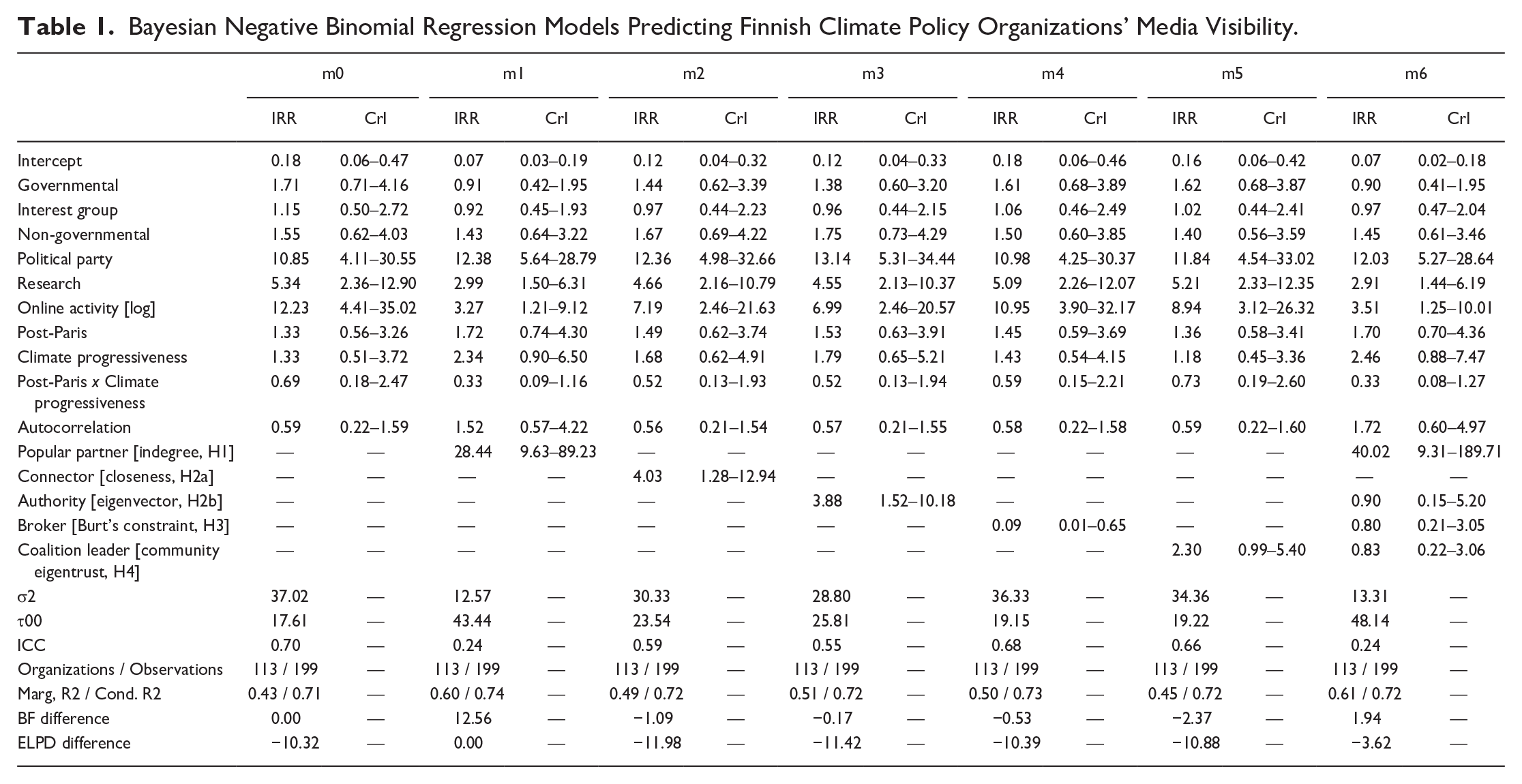
Table 1 reports the Bayesian negative binomial regression analyses and Figure 1 visualizes the estimated relationships between key predictors and media visibility. Model 0 is the baseline model that includes only the control variables. The results show that organization type has a strong positive association with media visibility, with political parties estimated to have a particularly high media visibility. In addition, the relationship between social media activity (on X platform) and media visibility is notable and strong: higher activity is associated with higher media visibility. As expected, climate progressiveness slightly increases visibility before Paris and decreases visibility after Paris (the effects are not notable in the baseline model but are in the best-fitting Model 1). The autocorrelation term is not associated with media visibility, meaning that organizations’ media visibility is not associated with the average media visibility of their collaboration partners.
Bayesian Negative Binomial Regression Models Predicting Finnish Climate Policy Organizations’ Media Visibility.
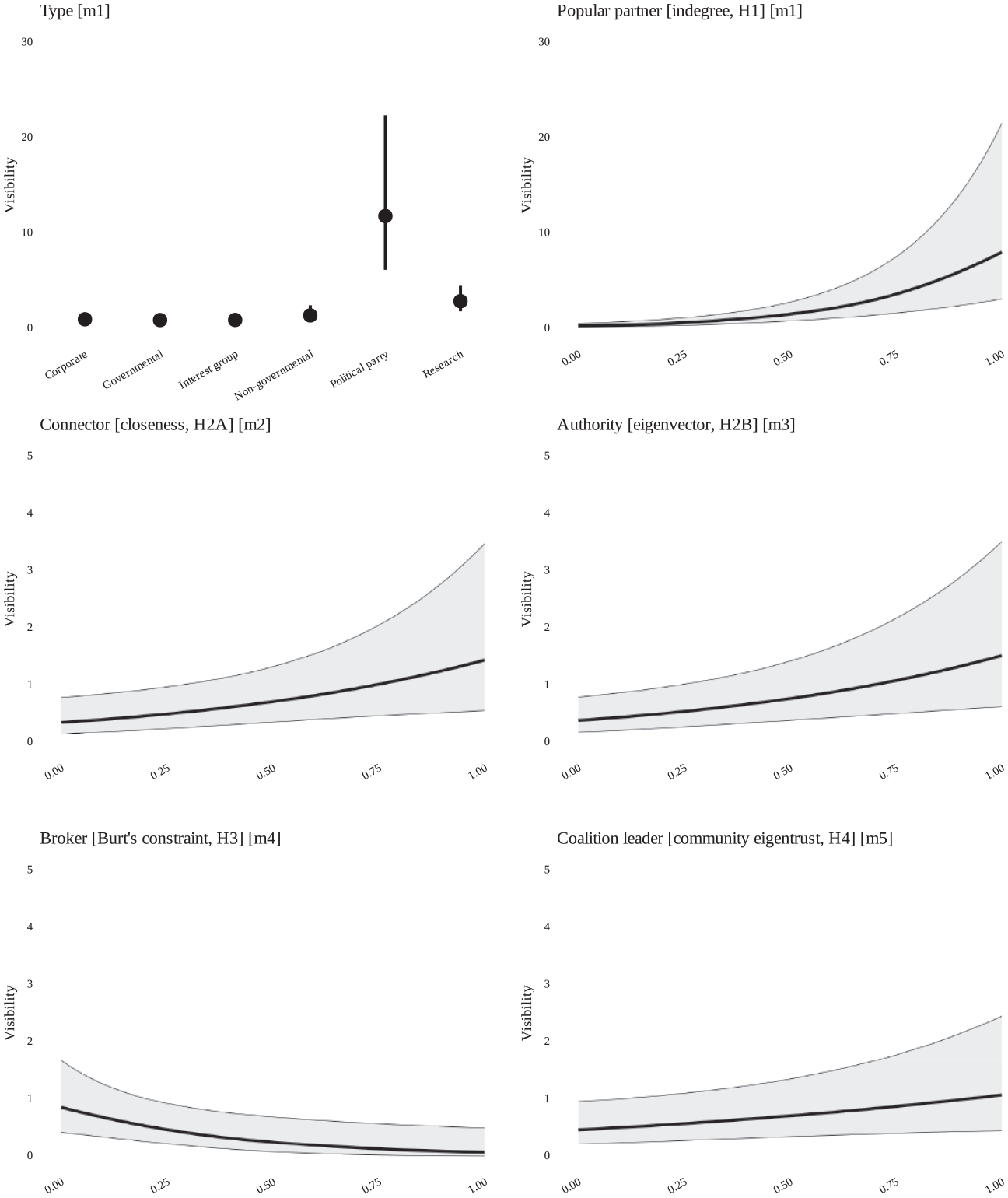
Predicted values of media visibility.
Since many centrality measures are typically intercorrelated (Supplemental Figure C), we first add each measure separately in Models 1–5 on top of the baseline. To test the popular partner hypothesis (H1), Model 1 adds the measure of popularity as a collaboration partner (indegree) on top of the baseline model, which, according to the ELPD, significantly improves model fit. This improvement, along with an IRR of 28.44 (credible interval [CrI] = 9.63–89.23), indicates that popularity is positively and strongly associated with media visibility. The evidence ratio is infinite (Supplemental Table C), which means that there is strong evidence to support H1. Thus, popularity as a collaboration partner is positively associated with media visibility.
To test H2a on connectors, in Model 2 closeness has an IRR of 4.03 ([CrI] = 1.28–12.94) and the effect is notable, but the model fit is worse than in the baseline model. This means that being a connector is not associated with media visibility, as H2a hypothesized. At first glance, H2b on authorities seems to receive some support: eigenvector centrality passes the conventional levels of statistical significance (Model 3). However, the IRR of eigenvector centrality (3.88 with CrI of 1.52–10.18) is clearly smaller than that of popularity, and the model does not add any information over Model 0. In other words, even if a notable effect implies that the term influences the outcome, the lower BF and ELPD scores compared to Model 0 suggest that it neither significantly improves the model’s fit to the data nor its ability to make better predictions, respectively.
Turning to H3a and H3b on brokers, Burt’s constraint—our measure of brokerage—is notable but model fit is worse than in the baseline model (Model 4). This implies that brokers are not more or less visible in the media than other organizations. Thus, neither of the competing hypotheses regarding brokers (H3) is supported. Furthermore, H4 on coalition leaders is also not supported: Model 5 shows that coalition leadership does not improve model fit compared to the baseline model, although the coefficient is positive (IRR = 2.30, CrI = 0.99–5.40) and notable (i.e., significant).
In Model 6, we add all centrality measures together (closeness is excluded due to its multicollinearity with eigenvector centrality). In this model, only popularity remains statistically significant and has a strong effect on media visibility. Thus, we only find support for H1.
Next, we compare the effects of formal-institutional power with the effects of informal power (the central network roles). Figure 1 shows the magnitude of the effect of formal power in the best-fitting Model 1: formal power is very important, as political parties with seats in parliament are estimated to have the highest media visibility (μ = 11.77, CrI = 6.13–22.33). On the other hand, the media visibility of ministries and government agencies is relatively low (μ = .87, CrI = 0.46–1.52). At a first glance, this seems to contradict the notion that formal power positions are associated with media visibility. However, it is important to note that the category of ministries and government agencies includes not only ministries, but also regional authorities and agencies, which are mainly involved in the administrative implementation of climate policy. Relatively few of the organizations in this category play a major role in climate change policymaking. For those that do, the association between formal power and media visibility holds. For example, the average media visibility of the two most powerful ministries, the Ministry of the Environment and the Ministry of Economic Affairs and Employment, is 16.5 (pre-Paris 12, post-Paris 21) and 7 (pre-Paris 9, post-Paris 5), respectively, well above the average of 3.5.
To understand the effect size of popularity, we first look at its IRR. The IRR of 28.44 (CrI = 9.63–89.23) indicates that as the measure of popularity increases from minimum to maximum, media visibility is estimated to increase by 2,744% (CrI = 863–8,823%). Although the credible intervals are wide, the effect of popularity thus seems substantial, even when compared to the IRR of political parties (IRR = 12.38, CrI = 5.64–28.79), which means that political parties are estimated to have about 1,140% higher media visibility than the reference category, corporations. However, comparing the effect of a continuous variable with that of a categorical variable can be challenging. In addition, the IRR for a min-max-rescaled [0, 1] continuous predictor can make the effect sizes appear exaggerated for changes near the mean (i.e., small changes in the rescaled predictor can represent larger relative shifts, especially if the original scale has a large range or skewed distribution). A more meaningful way to assess the magnitude of relationships is to compare the predicted values across quartiles of popularity. Holding other variables constant, the mean estimated media visibility for the highest quartile of popularity is 5.66 (CrI = 2.34–13.52), which is 12.58 times higher than the mean estimated value for the lowest quartile, 0.45 (CrI = 0.24–0.80). For political parties, the estimated value in the best-fitting model is 11.77 (CrI = 6.13–22.33), which is 12.40 times higher than the estimated value for the reference category, corporations, which is 0.95 (CrI = 0.52–1.65). These comparisons suggest that the effect of popularity is roughly similar in magnitude to that of formal-institutional power. However, Figure 1 shows that, holding other variables constant, even the most popular organizations, on average, do not reach the mean estimated media visibility of political parties. This finding likely points to the limits of informal power and suggests that formal power may still be more important.
Finally, we examined whether the effects of central roles varied depending on whether the organization had formal-institutional power (governmental organizations, parties) or not (other types of organizations). To do this, we ran additional models with interaction effects (Supplemental Table F and Figure G). We did not find any statistically significant interaction effects. This means that popularity is positively associated with media visibility for both categories of organizations, those with formal-institutional power and those without.
Discussion and Conclusions
We began with the notion that previous research has paid relatively little attention to how informal power positions in political networks are associated with political actors’ ability to engage in political communication through the news media. This research gap exists even though there is a large literature on the relationship between formal-institutional power positions and media visibility and even though scholars of political networks have demonstrated that network positions are an important, informal power resource for political actors. Based on this literature, we hypothesized that actors occupying central roles in a network of political collaboration are likely to have higher media visibility because network roles constitute a source of informal power. In other words, we expected that horizontal communication relationships between political actors would be related to vertical communication relationships between these actors and the news media.
We analyzed the relationship between five different central roles and the media visibility of organizations involved in climate policy in Finland. The main finding is that centrality—being a popular collaboration partner—in policy networks is positively associated with media visibility. This finding holds even when the formal-institutional power positions of organizations are held constant. Thus, the association between informal network positions and media visibility exists in addition to the well-established and understood association between occupying a formal-institutional role and being visible in the media. This finding adds to the large literature on how journalistic gatekeeping practices (Shoemaker & Reese, 1996) privilege powerful actors, so that powerful actors can leverage the media in their communication efforts more often than less powerful actors (e.g., Schoenbach et al., 2001; Tiffen et al., 2014). Thus, our findings support theories that argue that because of the inherent news value of elite actors (Galtung & Ruge, 1965; Harcup & O’neill, 2017), and because elites are seen as legitimate sources of information (e.g., Barnoy & Reich, 2022; Baumgartner & Chaqués Bonafont, 2015; Wolfsfeld & Sheafer, 2006), the news media follow powerful actors and frequently include them as sources, even when this power stems from their network position rather than their formal-institutional position. This finding implies that when communication scholars study biases in the extent that different political actors get to communicate their views in the news media, they should consider how asymmetrical patterns of communication between the actors may aggravate these biases.
In addition, we found that the roles of connectors, network authorities, brokers, and coalition leaders are not associated with media visibility. These results suggest that it is the relatively “simple” type of centrality (i.e., popularity as a collaboration partner) that is most important for media visibility in the context of policy networks which are based on collaboration relationships. Thus, those organizations that are popular collaboration partners have higher media visibility, but more complex measures of centrality that also account for indirect links between organizations, the coalition structure of the network, and brokerage positions in the networks, fail to explain media visibility.
We suggest that four reasons may explain why more complex centrality measures failed to explain media visibility. First, our findings may imply that journalists fail to perceive the more complex centrality positions. The sheer number of collaboration ties that an actor has is relatively easy to observe, but it may be more difficult for journalists to notice that an organization is, for example, acting as a broker between otherwise unrelated actors. A second possible explanation of our findings is that popularity is simply the best indicator of informal power in the context of policy networks. Influential actors are attractive as collaboration partners, and their large number of collaboration partners further increases their influence and subsequently their media visibility, which can then further increase their attractiveness as collaboration partners. This finding can be interpreted in the light of the concept of network autocatalysis: success in one domain (media/networks) breeds success in other domains (networks/media), leading to a cumulative advantage for some actors in both domains (Padgett & Powell, 2012). Such feedback loops of cumulative advantage may be less straightforward for more complex positions, such as those associated with brokerage, because these positions are more difficult for journalists and for the members of the policy network to observe.
Third, the null effects for the more complex network positions may also partly reflect the structure of the Finnish climate policy network. The finding that being a connector is not associated with media visibility may be related to the fact that the network we studied is relatively dense, as is typical for networks in consensual political systems (Metz & Brandenberger, 2024). This means that all actors are relatively close to other actors in the network, and therefore the measure of closeness does not significantly differentiate between the actors. Thus, it is possible that the result would be different in a less dense network. The low media visibility of coalition leaders may also be related to the structure of the network. In addition to being relatively dense, the network has a strong core-periphery structure, which is also typical of policy networks in consensual political systems, where central and important actors collaborate not only with their political allies but also with competitors (Gronow et al., 2019; Metz & Branderberger, 2024). This means that actors that are central because they mostly collaborate with like-minded allies (i.e., coalition leaders) may not be the most important in terms of newsworthiness in such consensual contexts. It would be interesting to replicate our study in a majoritarian political system, where it is more likely that there are coalitions that clearly represent competing political positions in a policy process. We would expect coalition leaders to be more visible in the media in such contexts.
Fourth, the null effects regarding brokerage, which echo the findings of a previous study (Diani, 2003), may indicate that the mechanisms behind our alternative hypotheses cancel each other out. For example, while central brokers are usually influential, and therefore likely sources of information for journalists, brokers may choose to remain in the shadows for tactical reasons. As we discussed earlier, brokers usually seek to build compromises in the policy process, and therefore they may either choose to operate behind the scenes or communicate only in a consensus-oriented manner to appear impartial, making them unattractive and unattainable as news sources for journalists.
From a normative perspective, the results support and extend the current wisdom that the media are biased toward powerful political actors, which may hinder the diversity of viewpoints presented in the media. Our findings suggest that the principle of cumulative inequality (Gamson & Wolfsfeld, 1993) is also relevant in the context of informal power derived from network positions. However, the media’s strong focus on powerful actors, even in the case of informal power, may be a sign that it is fulfilling its role as a watchdog of the powerful (Green-Pedersen et al., 2017). It is therefore reassuring that journalists are able to identify actors with informal power and to feature them in the news. However, it could also be argued that it is a troubling sign when, for example, the media fail to cover actors in the traditionally influential brokerage position.
The finding that only indegree centrality is associated with media visibility suggests that those interested in analyzing the role of network positions in media visibility could do so without considering the more complex centrality measures included in our models. This makes the use of network analysis to study media visibility more accessible to a broader range of researchers, including those without whole network data. However, our results do not imply that the other centrality measures that we include in our models do not have explanatory power in networks with different structures (e.g., sparse networks, segregated networks, those with a power-law degree distribution, or with a layered hierarchical structure etc.). Therefore, more comparative work on networks with different structures is needed before drawing firm conclusions on whether more complex network centrality measures are fruitful.
What are the practical implications of our findings for, say, NGOs that want to communicate their political message through the media? Based on our findings, they seem to have two main options. First, organizations can increase their media efforts, such as social media activity, to gain visibility also in traditional news media. Second, as our study highlights, NGOs or other non-state actors can seek alliances and engage in coalition-building among themselves, as well as strengthen their relationships with policymakers, which may help them to gain more visibility in the news media. However, in line with Castells’s (2011) notion of network power, gaining centrality in a network may require actors to moderate their policy positions, and some actors (such as environmental NGOs) may be unwilling to make such compromises.
An obvious limitation of our study is that we focused on only one issue, climate change, and one country, Finland. However, we have at least two important reasons to expect that the results regarding the relationship between popularity and media visibility would be similar in other contexts. First, the association between informal power and media visibility is likely to be driven by the same mechanisms as the association between formal power and media visibility: journalists seek to cover power holders, and powerful actors have information that others do not. It is well documented in the media visibility literature that the mechanisms linking formal-institutional power and mainstream news media visibility operate in a variety of contexts. Therefore, it is reasonable to assume that the finding about informal power would also hold in different contexts. This assumption is supported by previous research: studies in the US, Canada, and Italy have found that centrality in social movement networks is positively associated with media visibility (Diani, 2003; Malinick et al., 2013; Pilny et al., 2014). A second reason to believe that our findings are generalizable beyond the climate change policy domain is that climate change may be an issue where the association between informal power and media visibility is weaker than for most policy issues, making it a least likely case. The key finding that journalists cover those with informal power is probably less likely in the climate change policy context than in some other contexts because climate change is a complex, cross-sectoral policy issue and, therefore many kinds of actors are trying to influence climate policy (Rhodes, 2007). In such a complex context, it may be difficult for journalists to identify actors with informal power. Thus, the finding that informal power and visibility are related in the case of climate change policy suggests that they are likely to be related in other, less complex contexts.
Another limitation of our study is the theoretical and empirical focus on visibility in mainstream news media (both offline and online). While our focus makes sense because legacy media still play an important role, for example, in influencing political agendas (Langer & Gruber, 2021), this focus leaves out important forms of media visibility in the current media landscape. Although many news consumers around the world still get their news from mainstream news outlets—even if they often access them through social media platforms—other news sources, such as alternative news media and social media influencers, are increasingly important to them in the digital media landscape (Newman, 2024, p. 15). Future research could analyze whether similar mechanisms that generate a relationship between network centrality and visibility in traditional news media also affect the overall visibility of political actors in social media, which can be measured, for example, by counting retweets of political actors (Stier et al., 2018) or by analyzing the visibility of their social media messages in other ways. Furthermore, it should be emphasized that we only focused on one form of mainstream media, namely written news (online and offline), leaving out, for example, television coverage and online news videos. With regard to other forms of mainstream news media, such as television news, however, we would expect to find very similar results to those reported here, since their production involves gatekeeping by professional journalists.
We suggest that future studies could use the network perspective to understand a broader set of questions related to media power than the visibility of political actors, which was the focus of this paper. For example, does a central position in a network translate into power over the media framing and discourse around political issues (Guenther et al., 2024; Roslyng & Dindler, 2023)? Or are the most central actors able to develop communication strategies to “mobilize bias” (Lukes, 2005), that is, keep unwanted issues off the media agenda? Such questions could be answered from a network perspective.
Our study has shown that central network roles, although based on informal collaboration and communication relationships, can have a significant and independent effect on who gets to communicate their political positions through the media. We hope that this finding is a useful step forward in understanding the relationship between network positions, informal power and media visibility.
Supplemental Material
sj-docx-1-crx-10.1177_00936502251343986 – Supplemental material for Beyond Formal Power: How Central Roles in Political Networks are Related to Media Visibility
Supplemental material, sj-docx-1-crx-10.1177_00936502251343986 for Beyond Formal Power: How Central Roles in Political Networks are Related to Media Visibility by Juho Vesa, Arttu Malkamäki, Antti Gronow, Paul Wagner and Tuomas Ylä-Anttila in Communication Research
Footnotes
Data Availability Statement
Declaration of Conflicting Interests
The authors declared no potential conflicts of interest with respect to the research, authorship, and/or publication of this article.
Funding
The authors disclosed receipt of the following financial support for the research, authorship, and/or publication of this article: This work has been supported by the Research Council of Finland (projects no. 332916, 309934, 341137, and 352561) and the Kone Foundation (grants no. 201805496, 201804137, 202203761, and 201609129). We also thank Eva Gronow and Sonja Savolainen for their work on media data coding, Aasa Karimo for her work on the survey data, and Ted Chen for his work on the social media data. We also acknowledge the computational resources provided by the Aalto Science-IT project.
Ethics Statement
The research setting at the time of the surveys was and still is exempt from an ethical review by the Research Ethics Committee in the Humanities and Social and Behavioural Sciences at the home institution (University of Helsinki) of the authors who oversaw the survey design. Ethical self-assessment has been conducted by the authors and is available upon request.
Supplemental Material
Supplemental material for this article is available online.
Notes
Author Biographies
 ).
).
).
References
Supplementary Material
Please find the following supplemental material available below.
For Open Access articles published under a Creative Commons License, all supplemental material carries the same license as the article it is associated with.
For non-Open Access articles published, all supplemental material carries a non-exclusive license, and permission requests for re-use of supplemental material or any part of supplemental material shall be sent directly to the copyright owner as specified in the copyright notice associated with the article.
