




Abstract
Democratic systems need some degree of openness to new ideas and to new competitors. New parties depend on news media to survive. Which new parties receive news media coverage, and what kind of coverage do these parties receive? This article brings in the media into the literature of new parties. Based on two original datasets compiled for this study, the news media coverage of dozens of parties in a variety of offline and online news media sources since 1947 is analyzed to address the two research questions. In terms of visibility, new parties receive more attention when already represented in parliament and when mobilizing on the main axis of political contestation. In terms of framing, new parties are hardly ever trivialized, stigmatized, or criminalized. Compared to established parties, new parties are more trivialized, just as little criminalized, and even less stigmatized. Our findings put complaints about the media by new party leaders into perspective, and let political and media practitioners reflect on their practices, inform debates about interactions between news media and new voices. They may also open new lines of research about political transformations that we witness in Western democracies today.
Keywords
Many countries worldwide organize democratic elections. Elections typically see the participation of new political parties. For new parties, it is crucial to receive news media attention. Without such attention, new parties would not reach any substantial number of voters. With mere perfunctory attention, they would not receive many votes either. Either way, they would be prevented from entering the political scene – which would affect the functioning of democracy in various ways (cf. Tavits, 2006). This begs the questions of which new parties news media cover, and how they portray them.
These questions touch on the role of news media in a democratic society (e.g. Strömbäck, 2005): News media are supposed to inform the electorate about the available electoral options. The urgency of addressing the questions is underscored by new party leaders complaining about getting bad press, or no press at all, and by new parties’ recent rise to power. For example, La République En Marche has been dominating French politics since 2017, Podemos has been supporting Spain’s minority government since 2018, and Movimento Cinque Stelle has been Italy’s senior government party since that same year.
To address the questions, we collect new data and analyze them. Two datasets have been compiled especially for this study. Both databases contain information about the visibility of new parties and the framing of their emergence. Each of the datasets strikes a balance in a trade-off: Dataset 1 takes into account 183 new parties and 5 news media outlets, maximizing the number of new parties; Dataset 2 investigates 14 new parties and 17 outlets, maximizing the number of news outlets. In addition, Dataset 2 contains data on 11 established parties.
The two datasets are complementary, so that the analysis of each of them taken together provides a comprehensive answer to the question of to what extent new parties create media attention – and how this attention is framed. To keep all other relevant parameters constant, the data have been collected in just one political context: the Netherlands in recent decades.
Our findings reveal media portrayals of new parties, and how these portrayals vary. This is important, as the media can arguably play a major role in shaping a party’s public image. As Paletz and Entman (1981) write, ‘(m)edia depictions matter because they provide almost all the information the public possesses’ about political groups (p. 124). In doing so, this study goes beyond the existing literature in at least two ways. First, we ‘bring in the media’ by carefully investigating new parties’ visibility and framing in the news media. Notwithstanding the extensive literature on new parties in established democracies, their media visibility and framing has remained largely unexplored. Second, this study is truly pioneering in its methodology. Its data science approach permits it to handle substantially larger datasets than used before. This allows it to effectively deal with the well-known problem of survivorship bias in studying new parties. It does so by taking into consideration all new parties rather than only successful ones, and by taking into account all news media items about these parties in various media outlets. The study’s results may allow political and media practitioners to reflect on their practices, and inform debates about interactions between news media and new voices in contemporary democracies. It may also open new lines of research, revealing to what extent news media kill vulnerable parties early in their life cycle (Pedersen, 1982).
New political groups and the news media
Studying news media actors’ approach to new parties touches on the functions of news media in democratic systems. Besides their information, education, platform, and watchdog functions, media are widely expected to also offer space and time for the advocacy of political viewpoints (McNair, 2011). This includes the viewpoints of new, often dissenting, political groups. News media in established democracies have met with severe criticism on this point.
The US media, for instance, have been denounced as ‘agents of social control’ (Gans, 2004[1979]: 295). Indeed, Miliband (1973) writes that ‘the free expression of ideas and opinions mainly means the free expression of ideas and opinions which are helpful to the prevailing system of power and privilege’ (p. 197). On a more mundane level, news from (new) social and political movements is up against the routine publications and events organized by established bureaucracies. As Molotch (1979) argues with regard to social movements, they ‘must find a way to enter media that are, as a matter of routine operation, not suited to provide it with coverage’ (p. 77). Whereas news from established actors is, by default, fit to print, news from social movements is not ‘prima facie interesting, important, and defensible to work supervisors as worthy of publication’ (Molotch, 1979: 77). Thus, new political groups have a hard time getting their message across to the wider public (see also Bennett, 1990).
Other scholars have a different criticism of media treatment of new political groups. Shoemaker (1984), for example, argues that the problem is not that new groups are less prominent in the news but that they are treated less favorably (p. 66). In a similar vein, Cohen (1972) claims that ‘(t)he mass media, in fact, devote a great deal of space to deviance’ (p. 17). Paletz and Entman (1981) agree, saying that ‘marginal groups do not go entirely uncovered by the mass media’ (pp. 125–126). However, ‘media coverage of various groups is drastically and dramatically different. Certain groups are scorned as pariahs, some ignored, others indulged’ (p. 124). Likewise, several studies about news media framing of protest groups emphasize the tendency of mainstream media in various countries to support the status quo (e.g. McLeod and Hertog, 1992; Wolfsfeld et al., 2000). Ways in which new political groups are marginalized include silencing, stigmatizing, and ridiculing them (Ferree, 2005; Linden and Klandermans, 2006; Van Zoonen, 1992). Other scholars hold that, more generally, media tend to tarnish the image of protest movements (Gitlin, 1980; Wolfsfeld et al., 2000; Van Zoonen, 1992). This is partly because, once a political group has a negative image in the press, it has difficulties getting rid of that image (Gitlin, 1980; Van Zoonen, 1992).
New political parties and the news media
The previous section was about new political groups in general, or new social movements in particular. How about parties that are new? Writing about anti-immigration parties, Stewart et al. (2003) remark that the media do not seem to damage them as much as they generally damage protest movements (p. 235). There is only little empirical evidence on media and new parties, however. This is perhaps surprising, as new parties in established democracies have been extensively studied. This study builds on that new party literature, and ‘brings in’ the media.
The new party literature is relatively recent. Just as only few new parties existed half a century ago, also few studies of new parties existed. In 1978, a book chapter by Hauss and Rayside was the first in a series of new party studies. Since that time, we have counted 36 scientific publications on new parties. That is, new parties in general – there are many more case studies of a specific new party, such as the German greens (Schmitt-Beck, 1994) and there are many more studies of a specific new party family, such as anti-immigration parties (Van Der Brug et al., 2005).
Of these 36 studies, 14 are non-empirical. The scope of the 22 empirical studies varies considerably. In terms of time period, 2 studies start in the 1980s, 10 in the 1960s, 7 in the wake of WWII, and 3 even considerably earlier. In terms of space, half a dozen studies analyze one or two countries, and 16 encompass several ones, ranging between 9 and 53 countries. In terms of unit of analysis, about half of these studies use the party as a unit of analysis, and the other half, the election. In terms of dependent variable, some focus on the emergence of new parties, others on their electoral performance or durability. In sum, a wide variety of new party studies exists. Given the variety of independent and dependent variables, the findings are difficult to summarize. Several authors find evidence in support of modeling party entry as a result of rational calculation involving anticipated cost and benefits of entry (Hug, 2001; Tavits, 2006). Another important finding is that a more developed party organization helps new parties (Bolleyer, 2013; Bolleyer and Bytzek, 2013). The conclusions also often conflict, as for instance, Van De Wardt et al. (2017) find that institutional rules do not matter for party entry, while Ferris and Voia (2018) find that they do. See Supplemental Table A1 for an overview of the 36 studies mentioned.
Two aspects of this literature are suboptimal. First, the studies largely ignore survivorship bias. The new parties that are studied are commonly selected based on the dependent variable, applying a cut-off point below which no party is studied. Examples of cut-offs are holding 5 percent of seats in parliament for two election periods (Janda and Gillies, 1980), and having obtained a parliamentary seat at least once (e.g. Rochon, 1985). Obviously, survivorship bias casts doubts on some of the inferences made in this literature. Second, the new party literature largely ignores the role of news media. That is, to what extent new parties make the news has (except for a few studies, mostly about anti-immigration parties, see Schafraad et al., 2012; Vliegenthart et al., 2012) remained unexplored. This is remarkable, as it has been found for established parties that the more powerful they are, the more news media coverage they receive (Hopmann et al., 2011). However, only ‘relevant parties’ are successful in creating media attention at some time (Hopmann et al., 2012). Hopmann et al. (2012: 177) point out that this finding sits well with the notion of ‘indexing’ (Bennett, 1990), which implies that media give more attention to voices that are more powerful. In this study, we address both issues, avoiding survivorship bias and bringing in the media.
New parties typically are not (yet) ‘relevant’. For new parties, it is arguably more important but also more difficult to receive media attention. Various theoretical considerations point in the direction that established actors are privileged in terms of news media attention compared to new parties. For instance, the idea of media routines suggests that new actors fight an uphill battle (Molotch, 1979). News media tend to work according to organizational routines as a way to cope with scarce resources such as personnel, time, and space (Gans, 2004[1979]; Tuchman, 1978). As a result, they tend to more easily turn to established institutions rather than to new voices. Just as another example, the idea of the ‘protest paradigm’ (McLeod, 2007) brings along that new social movements are not always treated the way they would like to by news media. Reporting along the lines of this paradigm often means a focus on trivial, criminal, and stigmatizing elements of events the movement organizes while the movement’s core message gets lost. These theoretical claims have not been rigorously tested for new parties, however.
This article builds on the new party literature and brings in news media. News media may either ignore new parties or cover them. If they cover them, the coverage may vary from minimally neutral to maximally neutral. In case of less neutrality, they may apply particular news framing. Framing is defined as ‘the process by which people develop a particular conceptualization’ of, in this case, the surge of a new party (Chong and Druckman, 2007: 104). In this article, we proceed by following these two steps, first examining the visibility of new parties and then the framing of their emergence. Such emergence can be framed, for example, as ‘amateurish’ or as ‘rabble-rousing’. Framing research has hardly looked at media frames applied to party politics (see Schafraad et al., 2012, for an exception), although in other contexts exposure to news framing has been demonstrated to be quite consequential, even affecting voting behavior (Shah et al., 1996; Van Spanje and De Vreese, 2014).
Hypotheses
To what extent, and how, do news media cover new parties? The theoretical answers to these two questions that we test in this study are the following.
An answer to the first question is that a new party is theoretically expected to be covered more if it already holds seats in the national parliament (as some parties do when founded). This would be in line with news value theory. Both when election news coverage follows party logic and when it follows media logic, the focus will be on political parties with a particular power position (see, for example, Brants and Van Praag, 2006). In the words of Hopmann et al. (2011), the adage is that ‘(t)he more powerful you are, the more attention you receive’ (pp. 276–277). Hopmann et al. (2011) explain incumbency bonus in news coverage on the basis of this theory. Green-Pedersen et al. (2017) specify this argument and show that this incumbency bonus is smaller in election times and also varies according to policy issue as well as the government’s parliamentary strength. Analogous to the general incumbency bonus argument, we argue that obtaining the power associated with national parliamentary representation will increase a new party’s media visibility. After all, parliamentarians are generally more powerful than politicians without a parliamentary seat, and journalists are likely to extend scrutinizing government officials to also scrutinizing parliamentarians. Our argument dovetails with the findings by Hopmann et al. (2012) that ‘relevant’ parties are more successful in getting media access than ‘irrelevant’ ones. New parties can have parliamentary presence at birth either as a split-off of a party that is already in parliament or as a merger of parties with parliamentary representation. We do not make any distinction between these two options as we have no theoretical expectation that they would differ.
We cannot tell apart the news media giving some new parties more attention, on the one hand, from increasing news media coverage reflecting increasing popularity of these new parties, on the other. This said, quite some anecdotal evidence is consistent with our expectation. For instance, as Birenbaum and Villa (2003) mention, in France, ‘once the FN had got into the National Assembly (1986 and 1988), there was less conflict between the FN and the media’ (p. 52). Le Pen confirmed in an interview that his relations with the press were at their best when the FN was represented in parliament (p. 52). This was partly because it opened many doors to Le Pen, who visited several journalists to convince them that he was a respectable politician (p. 52). We formulate the following hypothesis:
H1. New parties that are already represented in parliament when founded are more visible in the news media than new parties that are not.
It would be naïve to think that media treat all new parties in the same way, however. Some parties pose difficulties to journalists and commentators in terms of how to classify them. Others are easy to categorize. This, we argue, makes it easier for media actors to position them in pre-existing political schemes and to write about them. The media will not devote much attention to parties that they cannot easily classify, regardless of their making it into parliament or not. After all, media actors chiefly work on the basis of organizational routines so as to deal with constraints in terms of deadlines as well as limited expertise and resources (e.g. Gans, 2004[1979]; Tuchman, 1978). This is consistent with the argument that the mass media, mostly unintentionally, tend to support the status quo (Miliband, 1973), by closing the gates to challenges to the political establishment (Bennett, 1990).
We use the concept of ‘challengers’, new parties that aim to mobilize on pre-existing political cleavages (Krouwel and Lucardie, 2008; Rochon, 1985). We contend that challengers may pose less difficulty to journalists and commentators in terms of how to classify them than other parties. Challengers have clear viewpoints in terms of the dominant axis of political contention. Taking the example of the Netherlands, this is obviously the case for the Socialist Party and for a neoliberal party such as Groep Otten. It also holds up for an environmentalist party such as Green Left and for an anti-immigration party such as the Freedom Party (PVV). 1 By contrast, the Non-Voters Party is more difficult to position vis-à-vis established political actors. The same goes, for instance, for the Party for Human Being and Spirit or for the Natural Law Party. More esoteric parties have to work harder to receive media attention than challenger parties, we claim, as a result of their profile being orthogonal to the main political division in a country.
Again, we cannot distinguish between the news media giving more attention to this particular type of new party because of the reasons just mentioned, on the one hand, and because of (anticipated) increased chances of survival of this particular new party type, on the other. We nonetheless posit a second hypothesis:
H2. New parties that are challengers are more visible in the news media than other new parties.
Turning to the second question, about how new parties are portrayed, we hypothesize that new parties are covered within a protest paradigm. This is in accordance with ideas of sociologists such as Gitlin (1980) about new social movements. Such movements are theoretically expected to receive less favorable attention, as they are generally considered ‘deviant’ (Paletz and Entman, 1981; Shoemaker, 1984). Movements often face silence, ridicule, or stigma (Ferree, 2005) or are caught in a ‘protest paradigm’, a framework ‘used to systematically understand the specific type of frames that news media often use to weaken legitimacy, obscure a protest’s social/political concerns, or both’ (Weaver and Scacco, 2013: 64). This said, the paradigm may not translate to coverage of new parties without systematic differences (see Lee, 2014).
The protest paradigm can be thought of as a set of news media frames. Within the paradigm, political actors are framed in terms of trivialization, criminalization, and stigmatization. Does the protest paradigm apply when describing news media coverage of new parties? We compare new parties to established parties, as we expect that, at the very least, the protest paradigm applies more to new parties than to established ones. When a party is trivialized, criminalized, and stigmatized, one can speak of reporting about that party from a protest paradigm. We thus formulate three additional hypotheses:
H3. In news media coverage, new parties are more often framed in terms of trivialization than established parties.
H4. In news media coverage, new parties are more often framed in terms of criminalization than established parties.
H5. In news media coverage, new parties are more often framed in terms of stigmatization than established parties.
Data
To address the two research questions, we analyze two databases that we have compiled in the Netherlands. Dataset 1 contains newspaper coverage of all the parties that participated for the first time in a Dutch general election (Tweede Kamerverkiezingen) since 1948. The five main national newspapers were all included. We had entire newspapers hand-searched for each new party in a period of 6 months before its first general election. As the corpus was too large to code by hand, we coded a sample of all these newspapers, after successfully applying an intricate randomization strategy (newspaper editions were randomized in terms of newspaper name, of publication date, and of coder). This has led to a data file of 2,159 instances that one of the 183 new parties was mentioned in the 6 months prior to contesting its first general election.
Dataset 2 contains news coverage of all 14 parties that contested a Dutch general election for the first time in 2017 and of the 11 parties that had held parliamentary seats since the previous elections. The number of sources used is 17, including online political news sites, and all main national newspapers (both offline and online versions). Just as in the first database, the data coding started 6 months before election day and ended right after that day, 15 March 2017. The database consists of 23,030 articles, with 11,550 instances (in 4,595 articles) that one of the 14 new parties was mentioned, and of 99,525 instances (in 20,541 articles) that one of 11 established parties was mentioned.
Both datasets facilitate the analysis of both visibility and framing of new parties. In both datasets, each new party is coded as a challenger party or as a non-challenger party in accordance with Krouwel and Lucardie (2008). This concept stems from work by Rochon (1985). We have used the coding from 1977 until 2006 by Krouwel and Lucardie (2008: 285) and extended it to the period from 1948 until 2017. We have been able to code 171 of 183 parties, 55 of which (32%) were coded ‘challenger’. In 2016–2017, four of the 14 new parties (29%) were coded ‘challenger’. In accordance with Krouwel and Lucardie (2008), the other parties were coded ‘prophet’ or ‘advocate’ or ‘reformer’ or ‘idiosyncratic’.
We have coded each party mentioning in terms of presence of three types of framing of the new party: trivialization, criminalization, and stigmatization. Each frame consisted of three items. If at least one of these three indicators was present, the frame was considered present. The trivialization frame consisted of framing the new party as inexperienced (yes/no), as incompetent (yes/no), or as a protest party (yes/no). The criminalization frame consisted of framing the party as extremist (yes/no), as dangerous (yes/no), or as associated with political violence (yes/no). The stigmatization frame consisted of framing the party as anti-democratic (yes/no), as populist (yes/no), or as deviant (yes/no).
The datasets contain skewed distributions in terms of visibility and framing alike. In Dataset 1, 82 of 183 parties failed to show up even once in our sample of newspaper items. Another 40 were mentioned only once, 20 only twice, 8 only thrice, and just 33 more than three times. Of these 33, 16 parties were mentioned in more than 10 articles, of which three in more than 50, one of which even in 110. With regard to framing, only 13 of 183 parties were ever trivialized, 8 of which actually obtained parliamentary seats. Criminalization was in the mix for 20 parties, 13 of which anti-immigration parties, whereas 17 parties – 9 of which anti-immigration parties – were stigmatized. Dataset 2 revealed similar patterns of widely diverging visibility (half the parties mentioned less than 70 times, and three more than 1,000, of which one 6,095 times) and little framing: about half of the new parties was never trivialized, criminalized, or stigmatized, and for those parties that were negatively framed, it was only in a limited number of instances (see Supplemental Tables A2 and A3 for the full descriptive statistics of both datasets). In sum, few were visible – yet these happy few were rarely negatively framed.
We proceed as follows. First, we test our two hypotheses about visibility on Dataset 1 (the 1947–2017 party variety data) using negative binomial regression analysis as our dependent variable represents a count variable, that is, is the number of times each of the 183 new parties is mentioned. As key independent variables, we include representation in parliament when founded (Hypothesis 1) and a challenger party dummy (Hypothesis 2). After this, we test our last three hypotheses based on Dataset 2 (the 2016–2017 media variety data). This means that we test whether or not new parties taken together are framed in terms of trivialization, criminalization, and stigmatization, respectively, to a greater extent than established parties taken together (Hypotheses 3–5).
Results
We start with the visibility of the new parties since 1947 (Dataset 1). Hypothesis 1 states that new parties that are already represented in parliament are more visible than parties that are not. We first simply model parties’ visibility by their presence in parliament.
Model 1 of Table 1 shows the negative binomial regression result when we predict our dependent variable using presence in parliament. We find a coefficient of 1.08 (se = .43, χ2df=1 = 6.24, p = .013). This positive coefficient indicates that parliamentary presence leads to more visibility in the media, which supports our first hypothesis. The exponentiated coefficient is 2.95, which indicates that new parties that already have a presence in parliament have an expected visibility of 2.95 times the visibility of new parties that are not already in parliament.
Predicting party visibility.
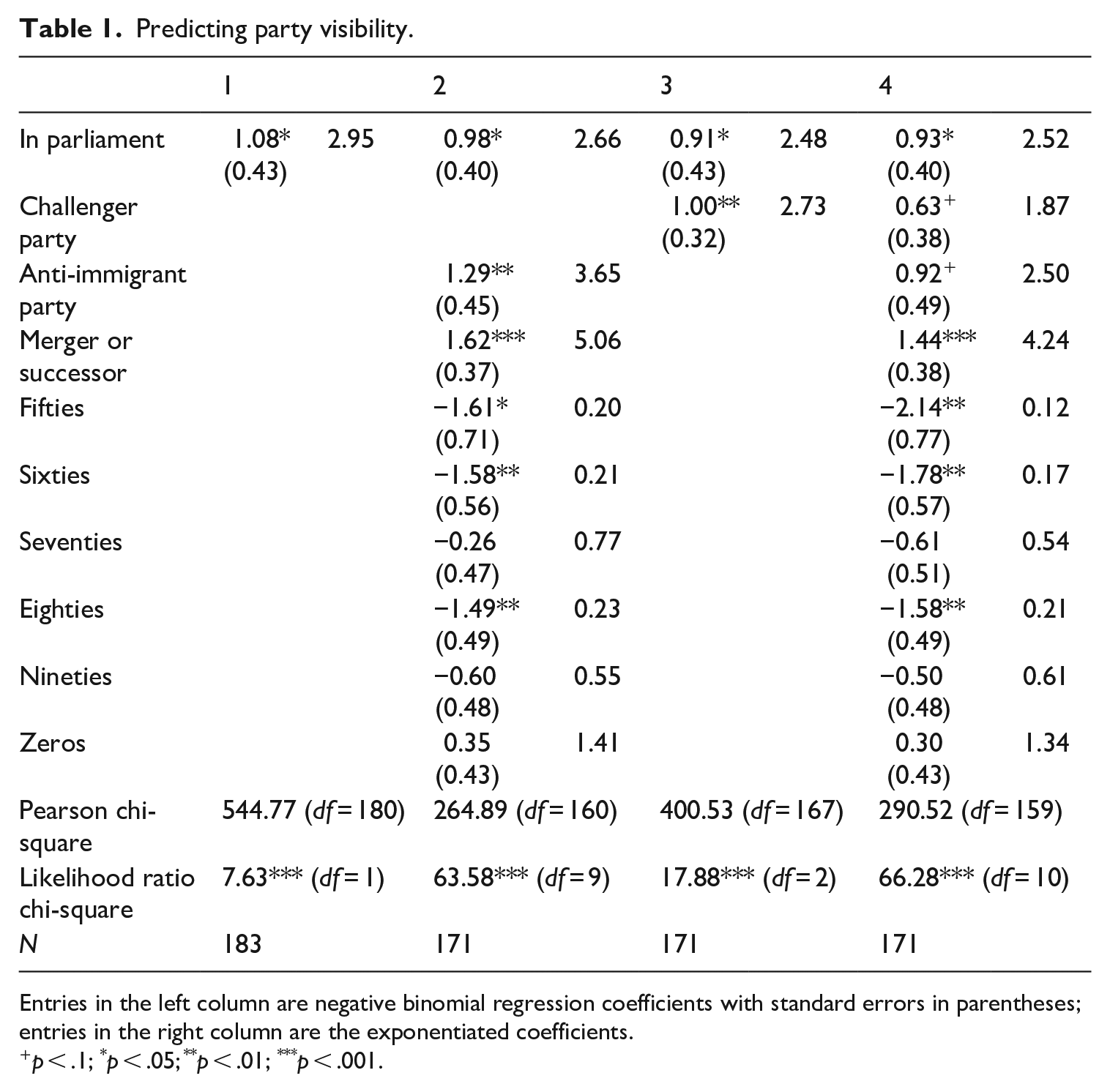
Entries in the left column are negative binomial regression coefficients with standard errors in parentheses; entries in the right column are the exponentiated coefficients.
p < .1; *p < .05; **p < .01; ***p < .001.
To test the robustness of our findings, we also test a model adding control variables (see Model 2 of Table 1). We add whether a party was a merger or a successor, 2 whether the party was an anti-immigration party, 3 and in what decade the party emerged. As we did not have all relevant information on the control variables, in particular, on several older and very marginal parties, the model with our controls has 12 observations less. Adding the control variables reduces the size of the coefficient (see Model 2 of Table 1) to 0.98 (se = .40, χ2df=1 = 5.87, p = .015, exp(b) = 2.66), which nonetheless still supports our hypothesis.
We also shortly assess what Dataset 2, the 2016–2017 automated content analysis, tells us about the first hypothesis. Given the very small N, these are merely descriptive. We find that parties that are in parliament are more visible (M = 2010.75, SD = 2784.90, SE = 1392.45) than parties that are not represented in parliament (M = 350.70, SD = 597.54, SE = 188.96). The small N leads to large standard errors. As a result, the differences in these means do not reach conventional levels of statistical significance. We should keep in mind that excluding even just a few parties from the analysis could substantially change this finding.
Next, we turn to our second hypothesis, in which we postulate that challenger parties are more visible than other parties. To test this on the basis of our 1947–2017 data (Dataset 1), we add a variable to the model which indicates whether a party is a challenger party, both to the model without controls (Model 3) and to the model with controls (Model 4). Without controls, we find a significant positive coefficient (b = 1.00, se = .32, χ2df=1 = 9.93, p = .002, exp(b) = 2.73); with controls, we find a similar pattern, yet the result is only marginally significant (b = 0.63, se = .38, χ2df=1 = 2.73, p = .098, exp(b) = 1.87). The positive coefficient is as the hypothesis predicts, with challenger parties having a higher visibility than other parties. But the marginal significance of the coefficient in the model with controls is only weak support for our hypothesis.
Based on the 2016–2017 data, we actually observe the reverse of what we would expect: challenger parties were mentioned less frequently (M = 682.00, SD = 652.59, SE = 326.29) than other parties (M = 882.20, SD = 1913.75, SE = 605.18). Due to the small N, this difference is not significant. This time, the evidence is not in line with the hypothesis either. However, omitting just one party (DENK) can flip the result so that it actually is in accordance with the hypothesis.
We now turn to Dataset 2 for tests of the third, fourth and fifth hypothesis. Here, we focus on the proportion of articles in which the party is framed in terms of trivialization (Hypothesis 3), criminalization (Hypothesis 4), and stigmatization (Hypothesis 5). We hypothesized that new parties are more often framed in these terms than established parties. We find low proportions of articles in which the frames are being used. For both established and new parties, criminalization occurs least often. Compared to established parties, new parties are more often trivialized (Mdiff = 0.50, SE = 0.17, p = .004; supporting Hypothesis 3) yet just as often criminalized (Mdiff = 0.0 0, SE = 0.11, p = .977; counter to Hypothesis 4) and even less often stigmatized (Mdiff = −0.88, SE = 0.18, p < .001; counter to Hypothesis 5). 4
Finally, we take a glance at Dataset 1 so as to double check the data on new parties. In the 1947–2017 dataset, we find similar proportions of trivialization (3.20% vs 3.26%) and stigmatization of new parties (3.99% vs 3.26%). Only for criminalization, the share is higher (in 7.86% of the articles since 1947 and in 1.39% of the articles in 2016–2017; see Table 2). This difference is due to the high levels of criminalization of new anti-immigration parties in the 1980s.
Proportions of articles in which trivialization, stigmatization, and criminalization frames are used for new parties.
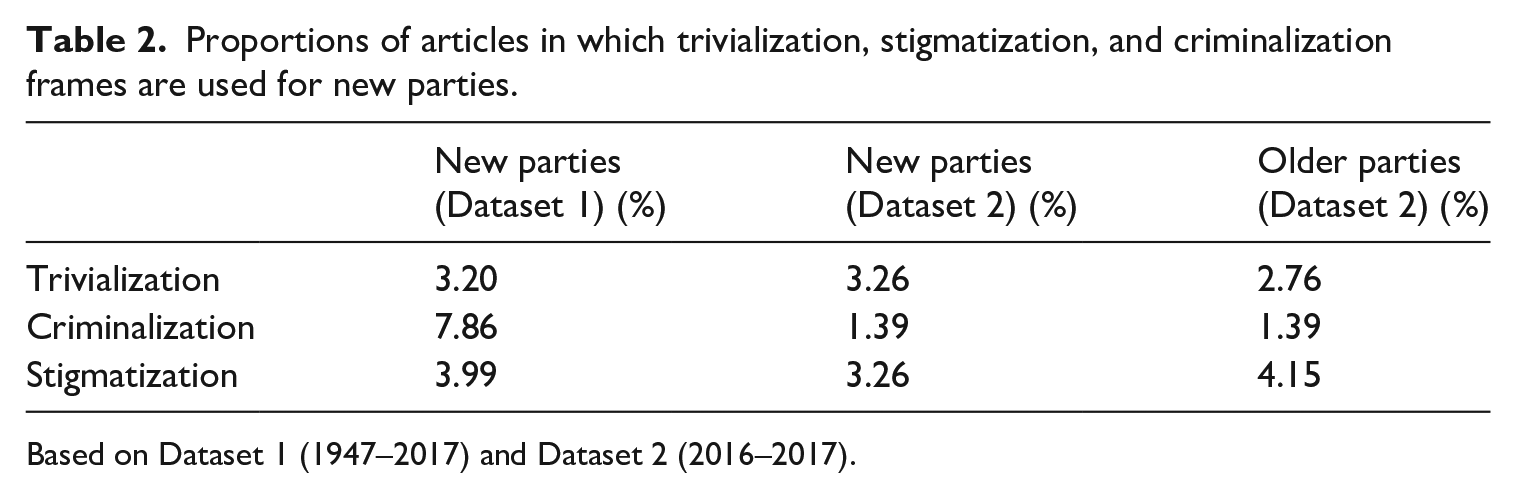
Based on Dataset 1 (1947–2017) and Dataset 2 (2016–2017).
In sum, we find mixed support for our protest paradigm hypotheses. We find some support for Hypothesis 3 (trivialization) but no support for Hypothesis 4 (criminalization) or Hypothesis 5 (stigmatization). If anything, established parties are more stigmatized than new parties. More generally, there is little evidence of protest paradigm reporting about any party category, although there are some notable exceptions – such as new anti-immigration parties in the 1980s.
Conclusion
Which new political parties do the news media cover? And do these parties receive bad press? In this study, we have taken a modest first step in answering these questions. Analyzing two datasets including dozens of new parties in a wide variety of news media sources since 1947, we find that the answer to the first question is unclear. New parties seem to be more visible in the news media when they are already in parliament when founded. At least, there is evidence on the basis of Dataset 1 for this. This is in line with studies on the well-known (similar) incumbency bonus (Green-Pedersen et al., 2017; Hopmann et al., 2011), and studies about more political power, or a better standing in the polls, leading to more news media attention. There is also some evidence based on that dataset that parties that mobilize on the dominant axis of political contestation are better off. However, this is only weak evidence. Thus, parliamentary presence seems to help them, whereas the jury is still out about effects of their ideological profile on media visibility.
The answer to the second question seems to be ‘no’. Just as established parties, the new parties in our datasets are hardly ever trivialized or stigmatized. Estimates vary between 2.76 percent and 4.15 percent of news items in which a new party was trivialized or stigmatized. Criminalization seems even less prevalent, with the notable exception of new anti-immigration parties in the 1980s. Yet, in over 92 percent of the news media items in both datasets, new parties are not criminalized. Furthermore, they may be more often trivialized than established parties but not more criminalized or stigmatized.
The findings concerning Hypotheses 3–5, however preliminary, put reproaches made by leaders of new parties into perspective. Leaders who have complained about bad or no press in the Netherlands in the last 25 years include Hans Janmaat (CD), Pim Fortuyn (LPF), Rita Verdonk (TROTS), Jan Nagel (50Plus), Tunahan Kuzu (DENK), and Thierry Baudet (FvD). Although it is possible that for particular new parties, the trivialization, stigmatization, and criminalization was higher (not for these six though), these complaints seem to have little empirical grounding. Most strikingly, in 2016–2017, new parties were hardly trivialized, no more criminalized than established parties, and even less stigmatized. Concerns about silencing and bad press, as expressed by scholars, are not warranted either – at least, for new parties. Regarding silencing, it is not so much that media do not pay attention to new parties. Rather, they pay lots of attention to some and little to most. Concerning bad press, it is not that new parties in general are heavily framed. Most of the time, when new parties are mentioned, no marginalizing framing is detected. Mostly anti-immigration parties are sometimes framed in terms of criminalization and stigmatization – but perhaps still less than one might expect given their controversial message.
In terms of theoretical contribution, this article adds to the literature in two ways. First, it ‘brings in the media’ into the literature on new parties. This allows us to address questions of what news media coverage new parties receive. Notwithstanding its obvious importance for new parties, hardly any study has delved into these questions. This article examines both visibility and framing in various online and offline outlets of the emergence of dozens of new parties since 1947. Second, the article remedies the problem of survivorship bias, which has plagued studies of new parties for over 40 years now. For this, it analyzes all news items about all new parties in a particular political context. This was made possible by taking a data science approach. This allows us to adequately address questions that are key to political science and political communication, including ones on bias against (or in favor of) new parties, important for the smooth functioning of democracy.
Admittedly, we have not addressed all aspects of bad press in general or the protest paradigm in particular. Most importantly, it is unclear how much attention news media devoted to new parties’ core policy proposals and concerns. Furthermore, this study has only been conducted in one particular context: the postwar Dutch situation. This context is quite permissive for new parties, including a particularly low electoral threshold for entering the national parliament. In that sense, it can be considered a least likely case for trivialization, criminalization, or stigmatization, as journalists may unexpectedly end up with a new party that clears the threshold and that they will thus have to repeatedly deal with over the next years (as actually happened to FvD, which even became the country’s largest party in the 2018 regional elections). Future studies should investigate to what extent the findings of Hypotheses 3–5 hold in other contexts as well. What we would expect to see is that in less permissive systems, such as France or Britain (Berrington, 1985), media practitioners are more inclined to marginalize new parties, and less inclined to give them media attention. Also because, in these contexts, more news consumers should consider a vote for a new party a wasted vote. Similarly, media practitioners in these contexts should consider developing personal ties with a new party less interesting and rewarding. Either way, this leads to news producers having less of an incentive to take new parties into consideration. Marginalizing new parties is in these contexts a less risky strategy by which media practitioners can score points with the establishment – which is all the more important given that that establishment is less at risk of being replaced by these new parties.
Another avenue for future research may be in the variation between new parties. This is because our analyses revealed quite a bit of variation between parties, with an anti-immigration party such as CP’86 being confronted with as much as 55 percent of criminalization, whereas 88 parties in the dataset that did receive attention in the media were not framed in terms of criminalization at all. With regard to stigmatization, we find a very similar skewed distribution with a large majority of the parties not stigmatized at all in our data. We do find that on the one hand, anti-immigration parties were often stigmatized in the 1980s, which was in 50 percent of the cases due to labeling the parties as anti-democratic. On the other hand, we find stigmatization relatively high in 21st-century new parties, often due to labeling the party deviant (40%) or populist (48%). Apparently, these terms have been more fashionable in recent years. Also with regard to trivialization, we find the very skewed distribution. Paradoxically, it seems to be relatively successful parties – that is, parties that actually obtain relatively many votes – that are trivialized, in both datasets. This may have to do with the viability of a new party (cf. Green-Pedersen et al., 2017). Future research should take into account new parties’ standing in public opinion polls and focus on why it is successful parties that are confronted with trivialization while most other parties are not. In any case, it appears that there is considerable variation in the way new parties are framed, depending on characteristics of the party as well as the context in which the new party operates. More research should be done to model relevant aspects of these contexts.
To conclude, our study suggests that the framing of new parties is not particularly damning for them. This is arguably important for the functioning of democracy more broadly. After all, having too many new parties is undesirable but having too few new parties is undesirable as well. News media do, at first sight, seem to take new parties seriously. That is, they are not often visible but when they are, they are not often framed: no press or good press. This ensures at least some degree of openness to new competitors, which is commonly seen as a necessary condition for democratic systems (cf. Dahl, 1970). At least, media do not kill all baby parties in the cradle.
Supplemental Material
Table_A1_plus_references – Supplemental material for Killing them softly? Two complementary studies on visibility and framing of new parties in the news
Supplemental material, Table_A1_plus_references for Killing them softly? Two complementary studies on visibility and framing of new parties in the news by Joost van Spanje and Rachid Azrout in Journalism
Supplemental Material
Table_A2 – Supplemental material for Killing them softly? Two complementary studies on visibility and framing of new parties in the news
Supplemental material, Table_A2 for Killing them softly? Two complementary studies on visibility and framing of new parties in the news by Joost van Spanje and Rachid Azrout in Journalism
Supplemental Material
Table_A3 – Supplemental material for Killing them softly? Two complementary studies on visibility and framing of new parties in the news
Supplemental material, Table_A3 for Killing them softly? Two complementary studies on visibility and framing of new parties in the news by Joost van Spanje and Rachid Azrout in Journalism
Footnotes
Acknowledgements
We thank our students, Milan Bor, Lieke Bos, Lisanne Droppers, Wiard Havenaar, Vivien Laros, Annabel Smit, Carlotte Teunissen, Janna Visser, Liselotte Vuijk and Jessica Westdijk for their diligent work in coding the historical material for our first dataset. We also would like to thank Damian Trilling for his valuable help with collecting all the material for our second dataset.
Funding
The author(s) received no financial support for the research, authorship, and/or publication of this article.

Supplemental material
Supplemental material for this article is available online.
Notes
Author biographies
References
Supplementary Material
Please find the following supplemental material available below.
For Open Access articles published under a Creative Commons License, all supplemental material carries the same license as the article it is associated with.
For non-Open Access articles published, all supplemental material carries a non-exclusive license, and permission requests for re-use of supplemental material or any part of supplemental material shall be sent directly to the copyright owner as specified in the copyright notice associated with the article.
