




Abstract
Tracing You is an artwork that presents a website's best attempt to see the world from its visitors’ viewpoints. By cross referencing visitor IP addresses with available online data sources, the work traces each visitor back through the network to its possible origin. The end of that trace is the closest available image that potentially shows the visitor’s physical environment. Sometimes what this image shows is eerily accurate; other times it is wildly dislocated. This computational surveillance system thus makes transparent the potential visibility of one’s present location on the Earth, while also giving each site visitor the ability to watch other visitor “traces” in real time. By making its surveillance capacity and intention overt, Tracing You provokes questions about the architecture of networks and how that architecture affects our own visibility both within and outside of the network. Further, reactions to the work reveal attitudes towards surveillance post-Snowden, including, in some cases, an angry desire for more visibility than Tracing You currently provides. This commentary describes how the artwork functions, presents and discusses visitor reactions, and briefly theorizes origins for these reactions within the contexts of surveillance, sousveillance, and transparency in the age of ubiquitous online social networks.
Introduction
While many Big Data sources are reserved for exclusive use by their corporate owners and partners, some are made available for public use. One such source is the data provided by Google’s Maps Service. Vector maps, street photographs, satellite imagery, and location metadata can all be obtained from their Maps API. The author’s online artwork
Tracing You
(Grosser, 2015) uses this and other data sources to present a website’s best attempt to see the world from its visitors’ viewpoints. This computational surveillance system thus makes transparent the potential visibility of one’s present location on the Earth, while also giving each site visitor the ability to watch other visitor “traces” in real time (Figure 1). By making its surveillance capacity and intention overt, Tracing You provokes questions about the architecture of networks and how that architecture affects our own visibility both within and outside of the network. Further, reactions to the work reveal attitudes towards surveillance post-Snowden, including, in some cases, an angry desire for more visibility than Tracing You currently provides. This commentary describes how the artwork functions, presents and discusses visitor reactions, and briefly theorizes origins for these reactions within the contexts of surveillance, veillance, and transparency in the age of ubiquitous online social networks.
Tracing You installed at the PLUNC Festival in Lisbon, Portugal, 2016.
Trying to see where you are right now
As mentioned above, Tracing You presents a website's best attempt to see the world from its visitors' viewpoints. By cross referencing visitor IP addresses with available online data sources, the system traces each visitor back through the network to its possible origin. The end of that trace is an image that potentially shows the visitor's physical environment.
To obtain the image of a visitor's location Tracing You asks for no special permissions; it simply references the same information every user leaves with every website they visit. One piece of that data is the visitor’s Internet Protocol (IP) address. Formatted as a numerical string (e.g. 172.217.5.78), the IP address uniquely identifies the device used to view the site, whether it points to one's phone, laptop, or tablet. Every IP address is registered with the Internet Assigned Numbers Authority, and thus has data associated with the IP addresses' registration.
Tracing You starts with this IP address and follows the trail. First it looks up the IP address using ipinfo
1
to obtain geolocation data. This query returns a latitude/longitude pair (e.g. 48.8631831,2.3629368) that identifies a precise location on the earth. The latitude/longitude is sent to Google in order to query their Street View, Static Maps, and Javascript Maps data services. Using these queries, Tracing You searches for the closest available match it can find, whether it is a street image in front of the location, an interior image inside the location, or, if nothing else, a satellite image from above. Once found, this image is combined with text information from ipinfo and shown on the Tracing You interface (Figure 2). The interface shows this image as one “tile” of six—the other tiles representing the five most recent visitors aside from the current user. As new users visit the site, tiles are updated to show the new locations. Others already watching the site see tiles update as new visitors arrive.
Tracing You (screenshot). To view the work, please visit http://tracingyou.bengrosser.com/.
How visible? The (in)accuracy of tracing location via IP address
The accuracy of the location shown in relation to a visitor's current location can vary widely. Sometimes this image is eerily accurate; other times it is wildly dislocated. For example, Tracing You might show a photograph taken inside the building the visitor sits within. Alternatively, the image shown may be a street photograph from down the block, a few blocks over, or, in some cases, much further away. When street view images aren't available, the system resorts to satellite imagery, showing a several block radius around the suspected location.
How close the system gets to a visitor's actual location depends on how networks are built, configured, operated, and distributed, which network the visitor's device uses, and the accuracy of the data associated with those networks. Further, the “trace” may be complicated by a visitor's use of network obfuscation techniques such as Virtual Private Networks (VPNs) or Tor, both of which hide the user's real location by encrypting their data and routing their traffic through proxy networks. Big Data sources such as Google Maps are regularly updated with new information; in this way, Big Data's “picture” of the world is continually refined. As that picture becomes more resolved, Tracing You will become more accurate. As new data sources are made available, the author intends to integrate them into the artwork.
"Creepy,” “Cool,” and “BIG FAT FAIL": Reactions to Tracing You reveal attitudes towards surveillance
As an artwork, Tracing You has been written about in a variety of publications such as Le Monde, The Creator's Project, and Kill Screen, has been exhibited internationally at shows and festivals in Paris, Lisbon, Chicago, New York, and London, and has been shared widely on social media sites such as Facebook and Twitter. The resulting public discussion of Tracing You has included observations of the work through comments, tweets, and posts. Examining these reactions can reveal current attitudes towards surveillance. 2
Some reactions to Tracing You are easy to predict. For example, many of those who wrote about the project expressed concern for what it can do. An emblematic example of this is a Tweet from user @paulcarvill: “this websites [sic] traces you and shows the closest available image of your current physical environment… BRRRR CREEPY” (Carvill, 2016) (Figure 3). In other words, one primary reaction to the artwork's ability to track and display visitor locations has been fear. This was expected by the author/artist.
Other reactions were less expected. For example, a number of visitors expressed happiness about Tracing You, often manifest as an appreciation of the work's technical ability to accurately find their location. Twitter user @jbj called the work “pretty cool” and included his own annotated screenshot showing how Tracing You had correctly found his location (Jones, 2016) (Figure 4).
Twitter user @paulcarvill calling Tracing You “CREEPY." Twitter user @jbj calling Tracing You “cool—and correct."

The least expected reactions were expressions of anger. However, these were not expressions of anger over the artwork's surveillance or intention of locating its visitors, but instead were expressions of anger over Tracing You's inability to be more accurate than it already is (Figure 5).
Facebook user Debbie Beele calling Tracing You a “BIG FAT FAIL."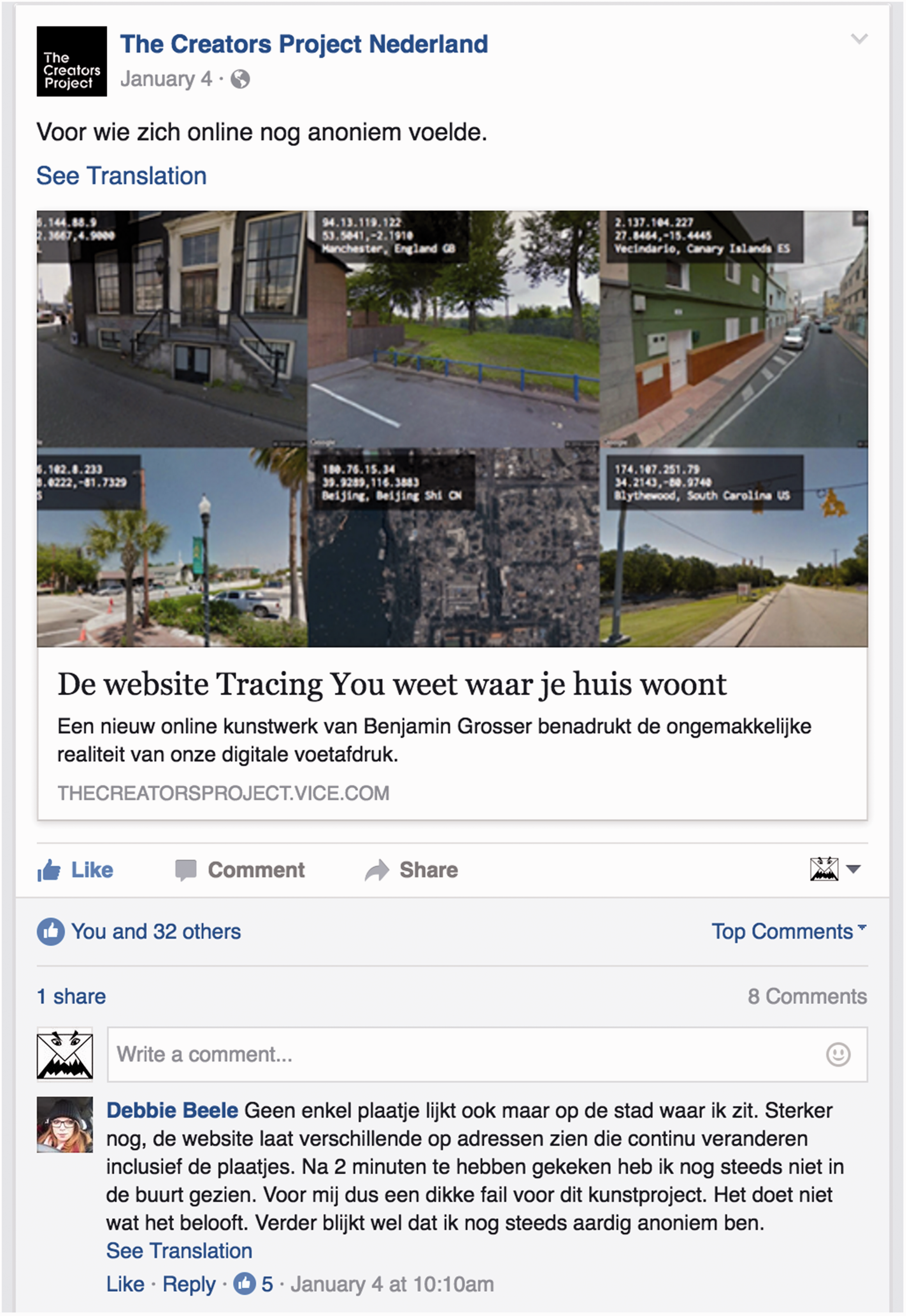
Facebook user Debbie Beele's comment about Tracing You, when translated to English by Facebook, includes the following: “For me, so a big fat fail for this art project. It does not do what it promises” (Beele, 2016). In other words, Beele feels let down by what she sees as a disparity between the project's promise to try and locate her and the results she sees. This kind of angry response about the work's varying (in)accuracy was expressed by a number of users across many sites.
Veillance, transparency, and the desire for visibility
These visitor reactions to Tracing You provide clues to understanding user attitudes of surveillance post-Snowden. Those whose location is most accurately detected express concern over how easily their current location can be visualized. One's positionality, based on race or gender for example, likely plays a role here, as the risks of being visible are higher for some. But others, especially those like Beele whose particular network configuration rendered her location less visible, have expressed anger over the perceived invisibility. Why might someone be angry about this, in effect expressing a desire for more accurate surveillance of themselves?
One answer lies in “Web 2.0's” (O'Reilly, 2005) insistence on radical transparency. 3 Social media in particular has conditioned many to not only accept high visibility, but to desire it (Bucher, 2012: 1175). This is because being as visible as possible on sites like Facebook and Twitter is the key that permits entry into and full participation within those site's systems of interaction and connection. Users can lurk or hide if they choose, but doing so severely limits user experience. When this desire for visibility intersects with ubiquitous transparent veillance, it contributes not only to an acceptance of being seen, but also helps to produce the negative emotions expressed by users less visible to surveillance systems. Being less visible within social networks means having less power; one's power (to influence opinion, to increase friend networks, etc.) is dependent on one's visibility. 4
As a result, many visitors to Tracing You have already been conditioned by social networks to equate visibility with power. Thus, by mirroring the veillant structures of sites like Facebook, Tracing You also produces—at least for some of its visitors—a similar desire for visibility. This happens despite the overt potentially negative surveillance implications proposed by Tracing You's ability to reveal one's physical location.
Summary
Tracing You investigates issues of veillance, transparency, and Big Data from a practice-based artistic research perspective. By showing website visitors what can be gleaned of their current physical environment based on nothing more than visiting a website, the artwork provokes its visitors to consider how networks are built, configured, operated, and distributed, and how those aspects affect their own visibility to the system. At the same time, the work puts the viewer into a sousveillant position (Mann, 2013: 3), as they are simultaneously viewing not only their own “traces” but also those of others around the world. In an age when various networks we engage with daily make us more or less visible to others, Tracing You models these systems in a way that lets users consider their personal relationship to the network. How susceptible are we to surveillance networks? How much surveillance do we accept, or even desire in this age of radical transparency? By helping visitors answer these questions, Tracing You reveals the emotional landscape that network visibility cultivates. As Big Data improves its understandings of the world, Tracing You will further test how veillance and transparency affects our willingness and desire to be seen by others.
Footnotes
Declaration of conflicting interests
The author(s) declared no potential conflicts of interest with respect to the research, authorship, and/or publication of this article.
Funding
The author(s) received no financial support for the research, authorship, and/or publication of this article.
Notes
This commentary is a part of special theme on Veillance and Transparency. To see a full list of all articles in this special theme, please click here: http://bds.sagepub.com/content/veillance-and-transparency.