




Abstract
Communication research has long explored the association between media trust and news consumption. However, the strength and direction of this relationship have remained elusive. This study suggests a new approach for investigating these complex relations, differentiating between usage and trust associated with different sources over time. Focusing on the 2022 French election and drawing on data from a four-wave panel survey (N = 1,294), we utilized Random Intercept Cross-Lagged Panel Model (RI-CLPM) analysis to uncover two key over time effects: a selection effect, wherein trust reinforces usage; and a media effect, wherein usage influences trust. While a selection effect driven by news trust was observed in a right-wing political alternative channel, a media effect leading to news trust was linked with more traditional television channels. By identifying these effects and their associations with various types of outlets, this study advances the ongoing scholarly debate around the role of trust in news consumption.
Introduction
Trust in the news media is crucial for citizens’ news repertoires and, subsequently, their ability to stay informed (Fawzi et al., 2021; Ognyanova, 2019). While numerous studies have explored the relationship between news use and trust (Strömbäck et al., 2020; Tsfati, 2010), they have yielded inconclusive findings regarding the strength and direction of this relationship over time (Kalogeropoulos et al., 2019; Shehata & Strömbäck, 2022). By adopting a cross-outlet perspective, this study takes a step forward in understanding the trust-usage relationship. Through an examination of both trust and usage at the nuanced level of specific news outlets, we unveil distinct dynamics in the interplay between trust and news exposure over time.
This study draws upon data from a four-wave panel survey conducted during the 2022 French presidential campaign. Our analysis of news trust and usage patterns concerning specific outlets reveals distinct over time effects. For the more traditional center-right channels TF1 and BFMTV, news trust evolved or decreased as a result of repeated exposure to these channels, in a media effect (Guo & Bai, 2023). Conversely, in the case of the far-right alternative channel CNews (Labarre, 2024), trust was found to reinforce usage over time, indicating a selection effect. For the remaining news outlets, we noted an insignificant connection between usage and trust, suggesting that in different contexts, these variables evolve independently over time.
Together, our findings challenge the conventional theoretical assumption that individuals use those media they trust, and trust those media they use (Strömbäck et al., 2020; Tsfati, 2010). By applying the framework of Reinforcing Spirals Model (Slater, 2015; Thomas et al., 2021), we demonstrate that the feedback loop between trust and usage is one-sided, operating either from trust to consumption or vice versa. Consequently, news trust serves as a predictor of consumption for some media sources, while being an outcome of media exposure in the case of other outlets. Our study thus contributes to the ongoing scholarly debate about the role of trust in media consumption (Fletcher & Park, 2017; Strömbäck et al., 2020) and enhances our understanding of how the political information environment, encompassing partisan and mainstream sources (Lelkes, 2016; Tsfati & Cappella, 2003), interacts with the evolving dynamics of news trust and usage over time.
Theoretical Framework
Conceptualization of News Media Trust
Trust is recognized as a cornerstone of social interactions (Mayo, 2015), commonly defined as the willingness of a trustor to vulnerably depend on a trustee (Fawzi et al., 2021; Mayer et al., 1995). News trust is established when audiences hold positive expectations about the news media, believing that interaction with it will be beneficial (Hanitzsch et al., 2018; Tsfati, 2010). However, negative perceptions of the news media and its potential implications erode trust and diminish the willingness to utilize it (Engelke et al., 2019; Strömbäck et al., 2020). Given that news consumers cannot fully verify news information or journalists’ intentions, this relationship inherently involves risk and uncertainty (Kohring & Matthes, 2007; also see: Mayer et al., 1995).
Trust and distrust are commonly perceived as antonyms, situated as opposite ends of the same conceptual spectrum (Mayo, 2015). However, growing evidence has revealed that these related concepts are only partially overlapping, each grounded in distinct antecedents (Engelke et al., 2019). In the realm of communication and journalism, discussions about trust often involve concepts like media credibility and reliability (Kohring & Matthes, 2007), whereas news distrust typically revolve around notions of media cynicism and skepticism, or perceptions of news as biased or hostile (Hansen & Kim, 2011). Nevertheless, these concepts only capture some facets of media trust and distrust, such as the willingness or reluctance to interact with the media as a whole (Engelke et al., 2019), overlooking their more nuanced aspects like specific evaluations toward news sources or topics (Strömbäck et al., 2020). Capturing both overall media engagement and specific evaluations of news sources is essential for understanding the relationship between news trust and usage, the focal point of this study.
The Evolution of News Trust and Usage Over Time
Considerable attention has been devoted to exploring the relationship between trust and news consumption (Ladd, 2012; Prochazka & Schweiger, 2019). Notably, a well-established finding in this area is a positive correlation between general trust in the news media and exposure to mainstream news sources (Fletcher & Park, 2017; Kalogeropoulos et al., 2019; Tsfati et al., 2023). However, due to limited research on the longitudinal relationship between news trust and usage, this correlation can be interpreted, following Hopmann et al. (2015), either as a selection effect—indicating that trust predicts news usage—or as a media effect—suggesting that trust is influenced by news usage.
As patterns of consumption of news sources and public trust in them have been changing over recent decades, there is a need to delve further into the interplay between them (Kalogeropoulos et al., 2019). However, several limitations have hindered the study of the connection between trust and media consumption. First, while it is crucial to examine media trust at various levels of analysis, encompassing perceptions toward journalists, media outlets, and news brands (Strömbäck et al., 2020), the majority of research in this field has concentrated on institutional trust in the news media as a whole (see, for instance: Kalogeropoulos et al., 2019; Shehata & Strömbäck, 2022). Additionally, there is a lack of research on news trust using longitudinal data and its relationship with individuals’ news repertoires over time (Kalogeropoulos et al., 2019). Finally, the majority of research in this area has been conducted in the US (Fawzi et al., 2021), which is an atypical case due to its unique media and political systems, along with its low levels of public trust in the news media (Hanitzsch et al., 2018).
Informed by these limitations, in this paper we draw upon data from the 2022 French presidential elections to investigate the role of trust in the consumption of specific media outlets and the evolving relationship between the two. Next, we review three approaches, each offering different assumptions about the connection between trust and news exposure over time. Following that, we discuss how this relationship may vary depending on various attributes of specific media outlets.
News Media Trust as a Predictor of News Use: Selection Effects
One theoretical possibility emerging from the correlation between news trust and usage (Kalogeropoulos et al., 2019) is that trust in the news media influence news consumption patterns. Indeed, news trust has long been theorized as a predictor of both the quantity and quality of people’s exposure to journalism (Strömbäck et al., 2020; Tsfati, 2010), potentially shaping the formation of their news media diets (Kalogeropoulos et al., 2019; Strömbäck et al., 2020).
The idea that trust in news predicts its usage underlies the very definition of both general trust and trust in the news media. Rooted in the definition of trust as a readiness for social engagement (Mayer et al., 1995), news trust signifies a willingness to interact with the news media (Engelke et al., 2019; Tsfati, 2010). This implies that trusting news leads to increased news consumption, while distrusting news leads to reduced consumption, highlighting deliberate selection of trusted news sources (Kalogeropoulos et al., 2019; Tsfati, 2010). The role of trust as an antecedent of news use is also evident in the empirical measurements of media trust. For instance, Prochazka and Schweiger (2019) suggest that a robust measure of news media trust should also be capable of predicting media usage (p. 31). This assumption that trust drives consumption, is supported by substantial evidence demonstrating the influence of general media trust on media usage (Shehata & Strömbäck, 2022; Strömbäck et al., 2020)
In addition to the impact of trust on general media consumption, trust may also influence ideologically motivated media diets. Drawing from long-standing theories of social identity (Tajfel & Turner, 2004) and selective exposure (Flaxman et al., 2024), a prominent theoretical assumption is that people are inclined to like-minded content they trust, while avoiding untrustworthy sources that contradict their beliefs (Prochazka & Schweiger, 2019; Tsfati, 2010; Zoizner et al., 2022). Indeed, studies consistently indicate a general tendency toward discerningly choosing attitude- and identity-consistent communication experiences (Mourão et al., 2018; Slater, 2015). Within these frameworks, news consumption can be understood as a selection effect (Hopmann et al., 2015), wherein trust guides individuals to choose attitude-congruent media sources.
Significantly, while most empirical research has centered on users’ institutional trust in the media overall (Fawzi et al., 2021), conceptually, selection effects primarily concern trust in specific media brands. Therefore, it is reasonable to expect that trust in specific news outlets would likewise lead to increased usage of those outlets.
News Media Trust as an Outcome of News Use: Media Effects
An alternative explanation for the correlation between trust and usage suggests a media effect, where trust is cultivated through specific media experiences (Hopmann et al., 2015). This reverse direction, where news trust is the outcome rather than the predictor of news usage, finds some support in the literature but has notably received less research attention compared to the premise of trust influencing usage.
Viewed through the lens of media effects, which stresses the capacity of media to shape consumers’ attitudes, beliefs, and behaviors (Slater, 2015), trust in the news media can be considered a cognitive effect resulting from direct or indirect media exposure (Guo & Bai, 2023). In this context, research has demonstrated a strong connection between familiarity with news brands and the level of trust placed in them (Bauer & Clemm von Hohenberg, 2021; Kiousis, 2001). This suggests that individuals are more likely to perceive news sources as trustworthy after repeated use. Indeed, habitual or ritualized news consumption has been identified as a significant contributor to news media trust (Kiousis, 2001), suggesting that trust gradually evolves though personal media experiences and pre-existing news repertoires (Hopmann et al., 2015).
Beyond its relation to media familiarity and habitual consumption, trust may also be influenced by media content. Public opinion theories have long emphasized the media’s ability to foster cynical and distrusting attitudes toward politics (Noelle-Neumann, 1974; Putnam, 2000), which can extend to the media itself (Hanitzsch et al., 2018). Recent experiments and surveys have further established that media coverage can impact public trust in it (Hopmann et al., 2015; Ladd, 2012). On the one hand, exposure to news coverage framing politics as a strategic game has been shown to diminish trust in the media, a phenomenon termed a “contagious effect” (Hopmann et al., 2015). Conversely, since news creators typically strive to build trust with their audiences and persuade them of the trustworthiness of their coverage (Aharoni et al., 2023), exposure to news could potentially enhance trust over time. Indeed, a longitudinal effect of personal news exposure on trust has been observed across various legacy media types, such as television, radio, and broadsheet newspapers (Hopmann et al., 2015).
Unlike research investigating selection effects, which primarily measure the relationship between trust and usage of the media in general, studies conceptualizing trust as a media effect have scrutinized specific media types and content (Hopmann et al., 2015; Ladd, 2012). Accordingly, we anticipate that when examining specific outlets, usage would similarly impact trust in the outlets consumed.
News Media Trust and News Use as Mutually Reinforcing: Spiral Effects
These two strands of literature, one depicting trust as a predictor of news use and the other demonstrating it as an effect of news use, can coexist, suggesting the possibility that both effects occur simultaneously. If trust serves both as a predictor of news consumption (i.e., a selection effect) and as an outcome of news consumption (i.e., a media effect), it is possible for these constructs not only to co-occur but also to mutually increase each other over time. Specifically, according to the Reinforcing Spirals Model (also known as RSM, Slater, 2015), media selectivity and effects can dynamically occur over time, potentially reinforcing one another in an ongoing cycle of influence (Slater, 2015; Thomas et al., 2021). This same reinforcing dynamic could also manifest in the case of news consumption and news trust. Accordingly, exposure to a specific news outlet can impact subsequent attitudes of trust toward it, which, in turn, may influence its subsequent use, thereby mutually reinforcing each other over time (for a similar application of the RSM model to the notion of selective exposure see: Schemer, 2012).
Previous studies implicitly suggest the existence of such a spiral effect between news trust and consumption, indicating that individuals tend to use the media they trust, and concurrently, trust the media they use (Strömbäck et al., 2020; Tsfati, 2010). Specifically, distrust in mainstream media and usage of alternative media have been suggested to mutually reinforce each other (Strömbäck, 2023). Building on evidence indicating a positive feedback loop between attitude-aligned information and extreme ideologies (Leonard et al., 2021), RSM can offer insights into how polarization evolves within fragmented media landscapes. However, much of the literature on the link between trust and usage relies on cross-sectional survey data, with a notable shortage of research utilizing experimental or longitudinal data to measure how trust relates to individuals’ news repertoires over time (Fawzi et al., 2021; Kalogeropoulos et al., 2019; Shehata & Strömbäck, 2022). This absence hinders the identification of a potential spiral effect, even if such an effect exists in practice.
Overall, previous correlational observations concerning news trust and news use cannot definitively determine the direction of their relationship, leaving ambiguity about the role of trust in news consumption (Shehata & Strömbäck, 2022; Strömbäck et al., 2020): does trust predict news media use, is it an effect of news consumption, do both occur in a reinforcing spiral, or neither? By applying the RSM framework (Slater, 2015) to the context of trust, our study aims to answer this question and unpack the role of news media trust in people’s news consumption. To the best of our knowledge, the existence of reinforcing spiral between media trust and news usage has not been empirically investigated. Given the ambiguous state of the literature on trust and usage over time, insufficient evidence exists to establish research hypotheses about the mutual effect between them. Additionally, statistically detecting reinforcing spirals can be challenging (Slater, 2015), so we may not necessarily observe them in all studied outlets. We therefore propose the following research question:
Examining the Interplay of News Trust and News Usage Across Diverse Media Outlets
Adding to the complexity around the relationship between trust and news consumption are the diverse attributes of both news consumers and the specific news outlets they utilize. Over the past few decades, a wealth of evidence has been underscoring the importance of considering specific attributes, such as news brands and news content (including specific framing styles), in the study of media effects (Hopmann et al., 2015; Shehata & Strömbäck, 2022). Concurrently, there is an increasing recognition of the importance of distinguishing between different trust levels, such as trust in media as an institution, in specific news outlets, and in news information (Strömbäck et al., 2020). However, most of what is known today about the connection between trust and media consumption, including both alternative and traditional sources (Kalogeropoulos et al., 2019; Tsfati, 2010), is based on a general examination of trust in the news media as a whole, rather than trust in specific news outlets, which can interact with consumption in various ways.
The complex relationship between trust and media use has grown even more intricate in the digital age (Fletcher & Park, 2017; Tsfati, 2010), with a high-choice environment potentially increasing audience selection and fragmentation (Fletcher & Nielsen, 2017; Zoizner et al., 2022). In such an environment, additional factors may drive source selection beyond trust (Strömbäck et al., 2020), as people may choose to consume non-trusted media sources to explore opposing viewpoints or for entertainment (Aharoni et al., 2024; Zoizner et al., 2022). Since individuals access a wide range of sources, including those they may distrust, the association between trust and news consumption over time may vary across different news outlets, particularly between trusted and distrusted sources. As consumption patterns and public trust in media sources vary, we anticipate that different outlets will demonstrate diverse trust-use dynamics over time.
There are several outlet characteristics that can underlie variations in the relationship between trust and usage over time. First, research suggests that the medium of news influences both trust and consumption (Kiousis, 2001; Tsfati, 2010). The specific medium used to access news has been found connected to trust, particularly differentiating between digital platforms and more traditional media like television, radio, and print news (Fletcher & Park, 2017; Kalogeropoulos et al., 2019; Kiousis, 2001). Among these, non-digital media tend to be more trusted overall (Fletcher & Park, 2017; Tsfati, 2010), with television news being highly trusted, a trust level strongly correlated with its usage in 35 countries (Kalogeropoulos et al., 2019). The difference between digital and non-digital news also alludes to the longevity of news brands as another significant factor in understanding the dynamics of trust and usage over time. Legacy media, which already have more established trust and loyal audience, may experience fewer changes over time compared to newer outlets, whose audience and their trust may be less stable.
Moreover, the political media landscape and its interaction with individual attitudes may be influential. Numerous studies have highlighted the processes of media fragmentation, which tailor political communication to match specific preferences, and identities (Fletcher & Nielsen, 2017; Mourão et al., 2018). Given individuals’ tendency to prefer information aligning with their pre-existing attitudes (Flaxman et al., 2016; Tajfel & Turner, 2004), political-ideological divisions among media outlets may shape audience trust. For instance, the hostile media effect suggests that partisans perceive mainstream media coverage as unfavorable to their political perspectives (Hansen & Kim, 2011; Mourão et al., 2018). These distinctions become particularly pronounced during election campaigns or crises (Aharoni et al., 2024; Pasitselska, 2022; Zoizner et al., 2022), when a heightened need for affirmation may lead audiences to preferentially rely on media sources consistent with their political views, even if they typically trust other sources more (Strömbäck et al., 2020).
Thus, alongside exploring the presence of a spiral effect between trust and usage (RQ1), our second aim is to identify the types of media outlets linked to distinct dynamics between news use and trust over time. Drawing upon the four potential types of such dynamics mentioned above (selection effect, media effect, spiral effect, or none), we pose the following research question:
In this study, we focus on the political characteristics of news outlets. This is supported by growing evidence on asymmetries in the relationship between media and audiences in different political camps (Lelkes, 2016; Tenenboim-Weinblatt et al., 2022) and the distinctive effects of partisan media, particularly those with right-wing orientation (Hansen & Kim, 2011; Mourão et al., 2018; also see: Tsfati et al., 2023). In hybrid information environments where ideological media prevail (Leonard et al., 2021; Mourão et al., 2018), selectivity and political self-affirmation can steer individuals’ media choices (Ladd, 2012; Pasitselska, 2022; Tsfati & Cappella, 2003).
Such an ideological selection is particularly evident for political alternative media (Strömbäck, 2023), which depart from mainstream journalism, openly endorsing specific political values or agendas while criticizing competing perspectives (Labarre, 2024; Levendusky, 2013). The motivations for regularly using such outlets often revolve around anti-system sentiment, general media distrust, and a preference for attitude-consistent information (Hansen & Kim, 2011; Leonard et al., 2021; Strömbäck, 2023). For these media outlets, we anticipate a selection effect, where trust drives consumption of political alternative media. This hypothesized selection does not discount the possibility of additional media or spiral effects, which may arise from exposure to politically congruent content in practice and its influence on trust over time. However, the motivation of alternative media audiences for political congruency (Leonard et al., 2021; Strömbäck, 2023) theoretically suggests that a selection effect should emerge as a prominent effect in this context. Accordingly, we hypothesize that:
Conversely, more pluralist media pose a challenge to selectivity. Upholding an ethos of objectivity and neutrality (Hanitzsch et al., 2019), traditional media often strive to present a balanced mix of different opinions to appeal to various sectors. Consequently, they are less explicitly affiliated with one political viewpoint, impeding users’ ability to pre-identify their political orientation and selectively use them based on that.
This challenge should hold particularly true in the case of public service media, which are pluralist by design, intended to serve the entire public (Newman et al., 2023). Indeed, trust and skepticism toward public service media often extend beyond political identity to encompass content-related concerns, such as the objectivity of coverage and its significance for individuals and society, as well as general trust in the media as an institution (Newman et al., 2023; Urbániková & Smejkal, 2023). Given the difficulty of pre-identifying the political orientation of public service media before exposure, a selection effect—where usage is driven by trust—is less likely to occur. Additionally, since audiences tend to rate the quality of public media service higher than that of most other media outlets (Urbániková & Smejkal, 2023), and this perceived quality is central to trust in media (Prochazka & Schweiger, 2019), we posit that exposure to public service media should build trust in it over time. This suggests that public service media may demonstrate a media effect. We therefore hypothesize that:
For the remaining media outlets, we maintain the open RQ2, which generally explores whether they demonstrate a selection effect, media effect, spiral effect, or none, as there is no strong basis for forming hypotheses in respect to them.
Method
Case Study
To examine the relationship between trust and usage of specific news outlets over time, we utilized data from the 2022 French presidential elections. 1 In these elections, incumbent president and center-right candidate Emmanuel Macron (“La République en Marche” party) faced off against the far-right contender Marine Le Pen (“Rassemblement National” party), amid a field of multiple less-supported candidates. On the first round held on April 10, neither Macron nor Le Pen secured a majority. Consequently, a second round occurred between these two primary contenders on April 24. In this runoff, Macron emerged victorious over Le Pen and was re-elected as the French President (Labarre, 2024).
In terms of its media landscape, France is considered a “polarized-pluralist” media system (Büchel et al., 2016), characterized by high press subsidies and relatively high political parallelism. Consistent with this system, France also upholds a tradition of robust public service broadcasting institutions (Hanitzsch et al., 2019; Ségur, 2020). However, this national context also displays characteristics of a “corporatist” system, notably its tightly regulated media market (for a comprehensive review of media systems typology and France’s classification within it, see: Büchel et al., 2016). Additionally, the French media landscape has undergone significant changes in recent years. While television news has maintained enduring popularity, there has been a sustained decline in the consumption of printed newspapers and a surge in the use of online news sources (Antheaume, 2023; Newman et al., 2023). Importantly, in France, much of the online news content on websites and social media is produced by both commercial and public service television channels (Antheaume, 2023).
France exhibits relatively low levels of public trust in the news media as an institution (Antheaume, 2023). Recent years have seen a substantial decline in self-declared trust and interest in news, alongside a high number of individuals reporting encounters with criticism of journalists or the news media (Newman et al., 2023). However, trust in specific news brands, especially those used by respondents, is higher (Antheaume, 2023). Additionally, French public trust in news has also experienced a modest increase between 2020 and 2021 during the COVID-19 pandemic (Newman et al., 2023).
Overall, the 2022 elections unfolded amid significant changes in both news trust and news consumption patterns, potentially impacting citizens’ beliefs and behaviors as they sought information about the elections. The diverse array of traditional and new outlets in France (Ségur, 2020), coupled with its two-round electoral system (Labarre, 2024), makes the 2022 French elections a rich setting for studying the dynamic relationship between trust in and usage of specific news outlets over time.
Panel Survey
The data were collected through a four-wave panel survey, with the aim of measuring voters’ expectations regarding the outcomes and implications of the 2022 French presidential elections. The survey was administered online by Ipsos to a representative sample of 2,502 French citizens of voting age during wave 1. Over the course of the survey, attrition reduced the sample size to 1,361 by the fourth wave. Three survey waves were conducted before the first election round (April 10, 2022), and a fourth wave occurred between this round and the second round (April 24, 2022; see Figure 1). For this study, we build on the data of the respondents who completed all four survey waves (N = 1,294, aged 18–94). The panel survey was conducted from mid-January to the beginning of May 2022, spanning a total period of three and a half months, with intervals ranging from 8 to 18 days between waves (see Table A2.1 in the Supplemental Material for the specific dates and respondent numbers of each wave). 2 While this timeframe is relatively short, it is plausible to detect changes in both news use and trust during the studied political campaign, especially given the dynamic and polarizing nature of the 2022 French presidential elections (for a similar timeframe and wave intervals during political campaign research, see Hopmann et al., 2015; Schemer, 2012).
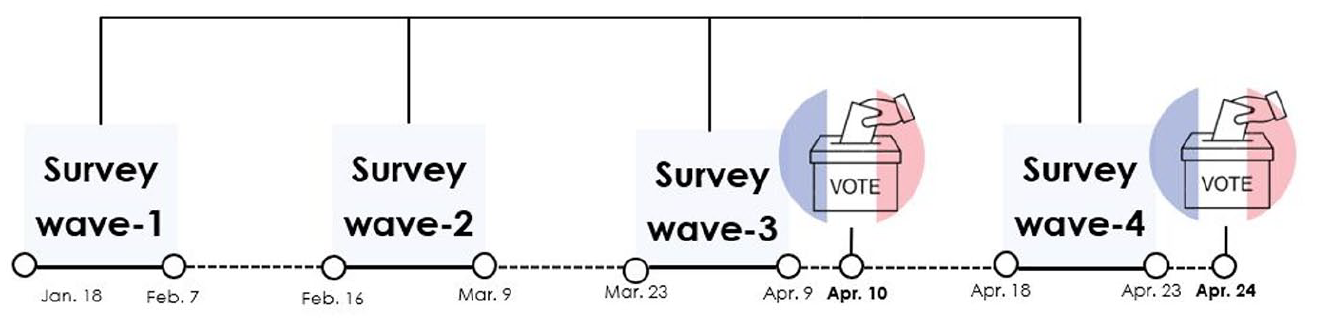
Timeline of data collection.
The survey provides an overall representative sample of the French voting population, with 50.5% female respondents. However, certain populations remain underrepresented in our sample: notably, younger participants aged 18 to 29 (11.0% of the initial sample in wave 1, 7.6% of wave 4), as well as those with lower levels of education (21.1% of wave 1, 21.0% of wave 4) (see Supplemental Material, Figures A3.2–A3.3). While the panel survey encountered a relatively high attrition rate of 45.6% over the additional three waves, those respondents who dropped out do not differ significantly from respondents who remained in the panel, in terms of their demographic characteristics, media usage patterns, or trust in different institutions, including the media (See Supplemental Material Section 3 for details on the characteristics of the initial and final respondents’ population).
Measures
Use of Specific News Media Outlets
To measure respondents’ use of specific news outlets we asked them to indicate which out of a list of nine news outlets they used at least once over the past week. This list comprised prominent French news outlets (see Table 1), including four newspapers (Le Figaro, Le Monde, Libération, and Ouest France), four television channels (BFMTV, CNews, France 2, and TF1), and one radio channel (France Inter). Two of the nine news outlets are public service channels (France 2 and France Inter), while the remaining seven outlets are commercial. This measurement also reflects public trust in news outlets with different political views (e.g., Le Figaro is considered a right-wing newspaper and Libération is considered left-wing). 3 Specifically, the outlet list includes CNews as a political alternative channel (see: Strömbäck, 2023). This television channel is often compared to Fox News in the US for its promotion of extremist far-right ideology and conspiracy theories (Cagé et al., 2022; Labarre, 2024). Challenging professional journalistic norms (Labarre, 2024), CNews has arguably emerged as a political alternative news outlet that stands in opposition to traditional mainstream news in France.
Characteristics of Studied French News Outlets.
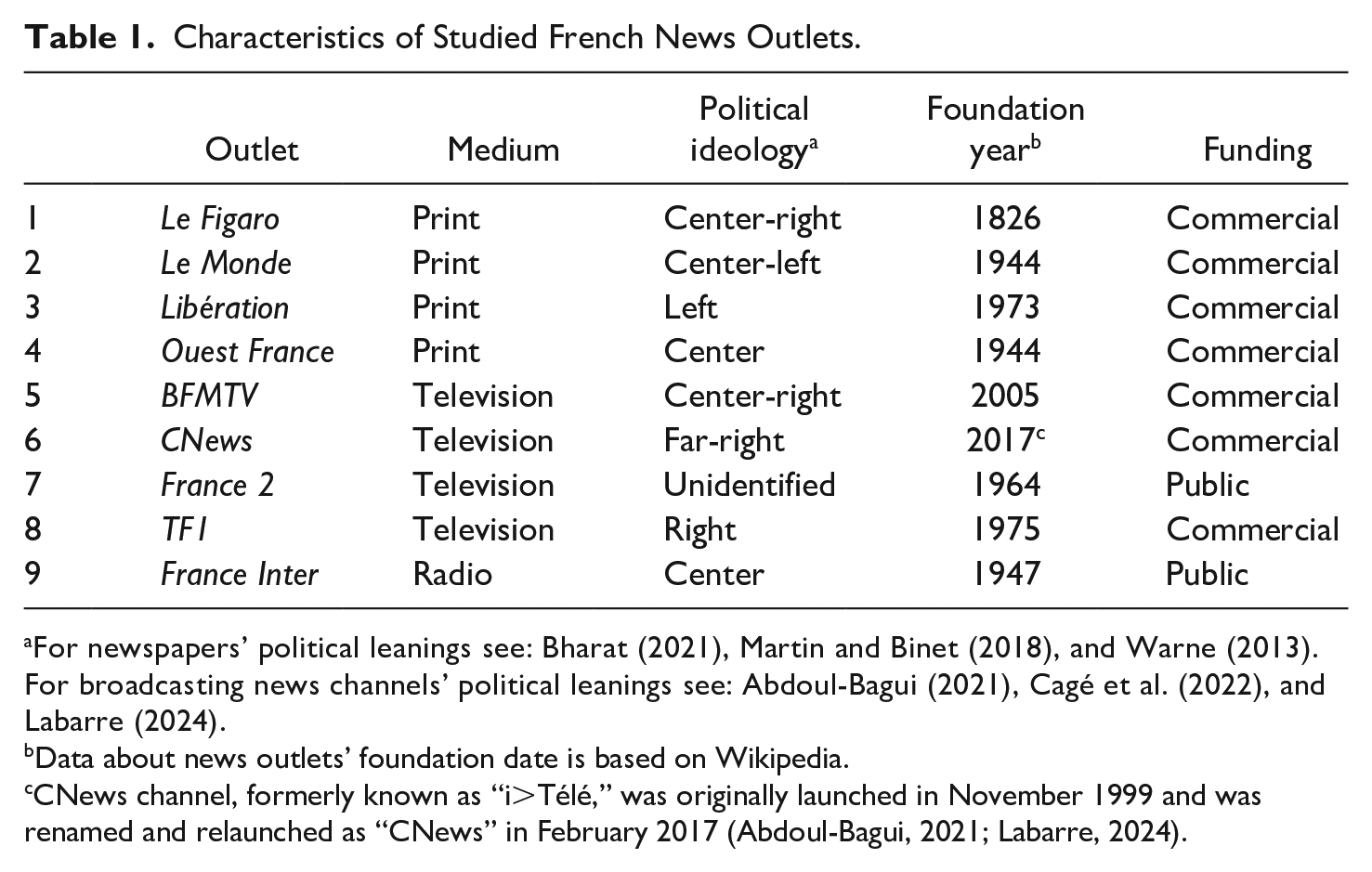
For newspapers’ political leanings see: Bharat (2021), Martin and Binet (2018), and Warne (2013). For broadcasting news channels’ political leanings see: Abdoul-Bagui (2021), Cagé et al. (2022), and Labarre (2024).
Data about news outlets’ foundation date is based on Wikipedia.
CNews channel, formerly known as “i>Télé,” was originally launched in November 1999 and was renamed and relaunched as “CNews” in February 2017 (Abdoul-Bagui, 2021; Labarre, 2024).
The list of news sources provided to respondents included both the names and logos of the nine news outlets to aid their identification. Additionally, respondents were requested: “Please check all that are relevant (even if you consumed them or accessed the content via websites, social media or apps).” Responses were recorded in binary scores of yes (1) and no (0).
This binary variable used to measure usage of each news outlet has limitations in capturing the nuanced intensity of news consumption. However, evidence suggests that respondents struggle to recall precise time spent with news devices or content (Groot Kormelink & Costera Meijer, 2020; Trilling, 2019), challenging the accuracy of detailed measurements in reflecting news consumption, especially for specific news outlets. In this study, we thus prioritize data on the likelihood of exposure to specific news outlets over its intensity 4 (for a similar binary measurement/recoding of news exposure see: Hopmann et al., 2015; Newman et al., 2023).
Throughout all four waves, the commercial television network TF1 emerged as the most widely used outlet in our survey (starting with a 47.5% of respondents indicating using it at least once in the previous week on wave 1, slightly reducing to 47.2% on wave 4, see Figure 2 and Supplemental Material, Figure A4.3a). This pattern is consistent with previous findings highlighting TF1’s top audience ratings in France (Ségur, 2020). Conversely, the Libération newspaper was the least popular (with only 5.8% of respondents reporting its use it in wave 1, slightly increasing to 6.0% in wave 4, see Figure 2 and Supplemental Material, Figure A4.8a).
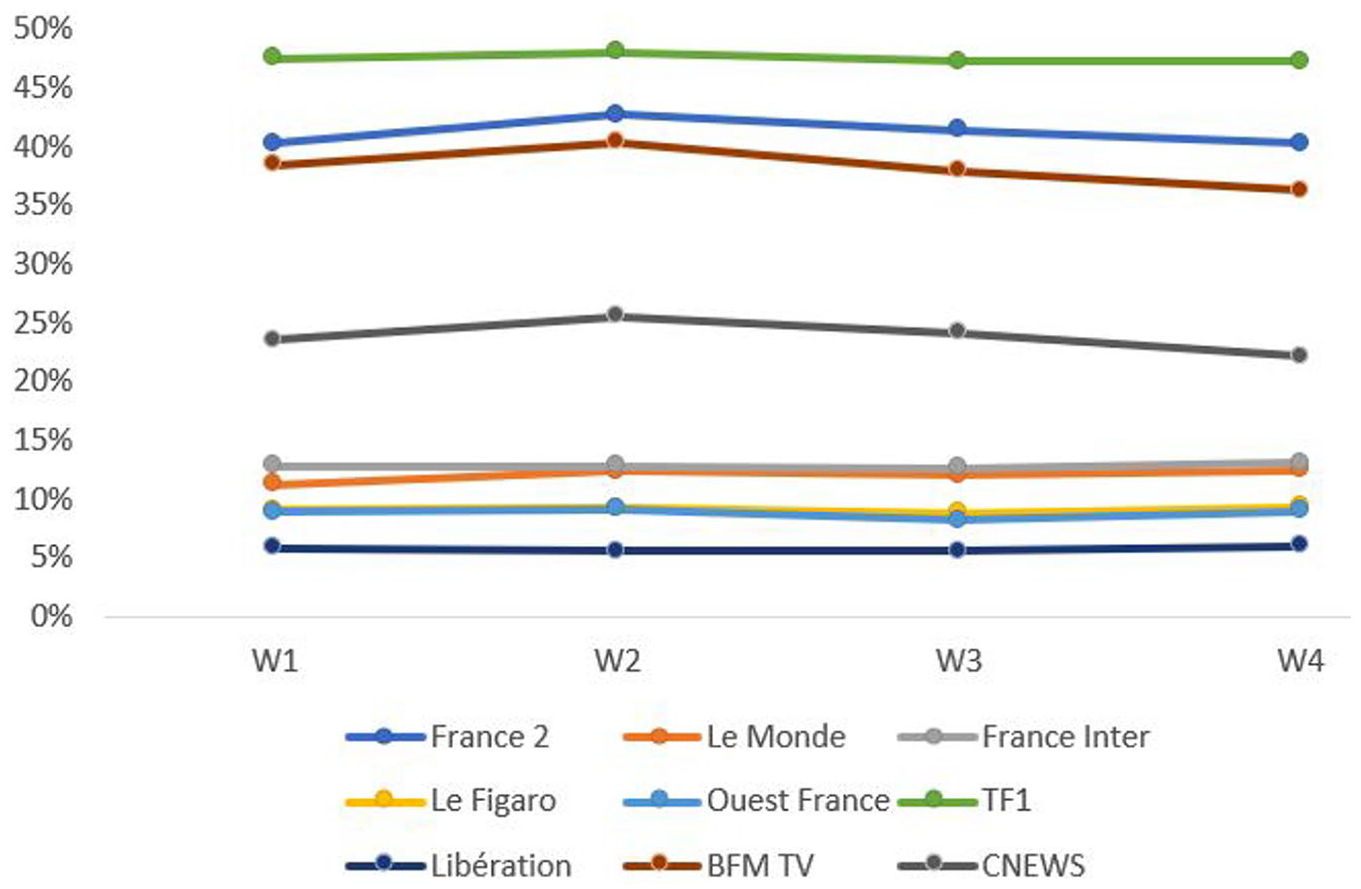
News use changes over time, across the four survey waves.
For many of the measured outlets, usage remained relatively stable throughout the four survey waves (see Figure 2). For example, the France Inter public radio channel remained consistently stable in usage, with approximately 12.8% of respondents indicating its usage at least once a week across all four waves. Similarly, Le Figaro and Ouest France maintained low, yet steady scores, each hovering around 9.0%. Conversely, both CNews and BFMTV, being relatively new cable channels (see Table 1), exhibit less stable viewership patterns over time and experienced more significant changes in popularity. BFMTV’s viewership increased from 38.5% of respondents in wave 1 to 40.3% in wave 2, gradually declining to 36.2% at wave 4. In the case of CNews we observed a similar increase, rising from 23.5% at wave 1 to 25.5% at wave 2, followed by a decrease to 22.1% in wave 4 (see Supplemental Material, Figures A4.1a–A4.9a, for a more detailed examination).
Trust in Specific News Media Outlets
To assess trust in specific news outlets, we asked participants: “how trustworthy would you say news from the following media is?” in relation to the same nine outlets we have asked about for the usage measurement (see Table 1). The response scale ranged from 1 (“not trustworthy at all”) and 4 (“very trustworthy”), with the option to select “I don’t know,” which was recoded as missing data. This approach of assessing individual media brands aligns with Strömbäck et al.’s (2020) call to adopt a more nuanced perspective on media trust levels (also see: Tsfati et al., 2023). The question formulation is adopted from the Reuters Digital News report’s brands trust measurement (Newman et al., 2023). The use of a four-point scale, in particular, has proven effective for measuring news trust. This structure encourages a decision between trust and lack of trust, and was therefore found more effective than a trust measurement with a midpoint (Toff et al., 2021).
The average level of trust in all nine studied outlets together remained relatively stable across waves, ranging from 3.53 in wave 1, to 3.5 in wave 4. Throughout all four waves, the public service channel France 2 consistently held the highest level of trust among our survey respondents, with 59.9% of them reported on perceiving this channel as quite or very trustworthy in wave 1, decreasing to 57.2% in wave 4 (see Figure 3 for wave 4 and Supplemental Material, Section 5 for the remaining waves). Conversely, in wave 1, the 24-hour news channel BFMTV was the least trusted, with only 39.1% of respondents ranking it as at least quite trustworthy. In the subsequent three waves, another 24-hour television channel, CNews, consistently ranked as the least trusted, with only 36.2% reporting it as at least quite trustworthy in wave 4 (Figure 3; Supplemental Material, Section 5). 5
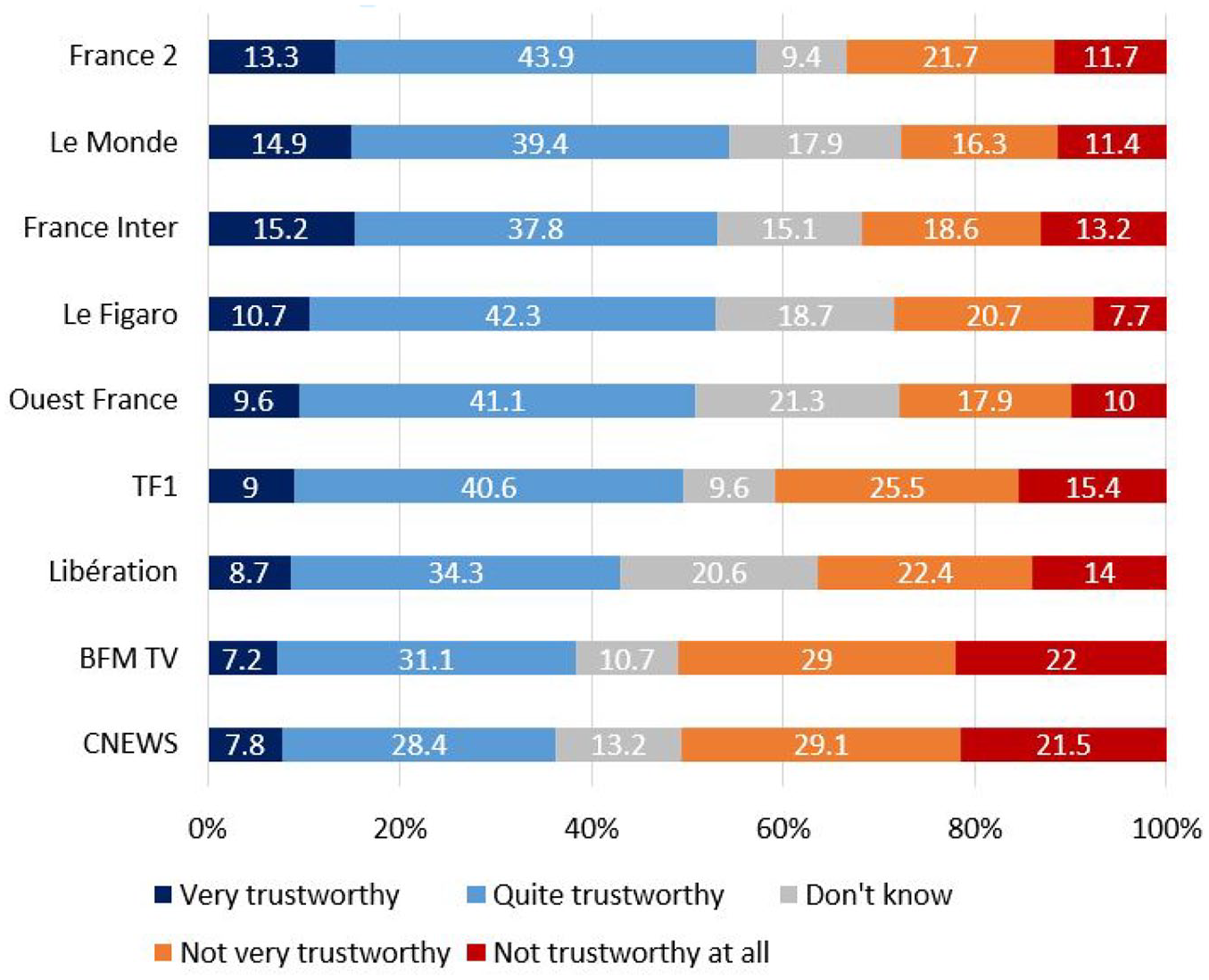
Distribution of trustworthiness scores (in percentages) across analyzed outlets (wave 4).
Data Analysis
To examine trust in and usage of specific outlets over time, investigating the presence of reinforcing spirals (RQ1), and the associations of this evolving relationship with various media outlets (RQ2), we selected Random Intercept Cross-Lagged Panel Model (RI-CLPM) as the most appropriate statistical framework. Cross-lagged panel models (CLPM) serve to capture the auto-regressive structure of repeated-measure large-N data, by considering participants’ responses in subsequent waves in relation to their previous responses (Hamaker et al., 2015). RI-CLPM models extend this approach by disentangling state-like within-person effects from trait-like between-person effects (Hamaker et al., 2015; Thomas et al., 2021). In our analysis, RI-CLPM allows for the examination of two types of within-person effects: autoregressive and cross-lagged. Autoregressive effects illustrate how use/trust at one time point predicts use/trust at the subsequent time point (Figure 4, paths a and b). Conversely, the cross-lagged effects capture the hypothesized mutual influences between use and trust, where trust at time t may be predicted by use at time t-1, and vice versa (paths c and d). Additionally, the random intercept component of the model (e and f) accounts for potential between-person variations in observed levels of use and trust and their link with exogenous variables (g).
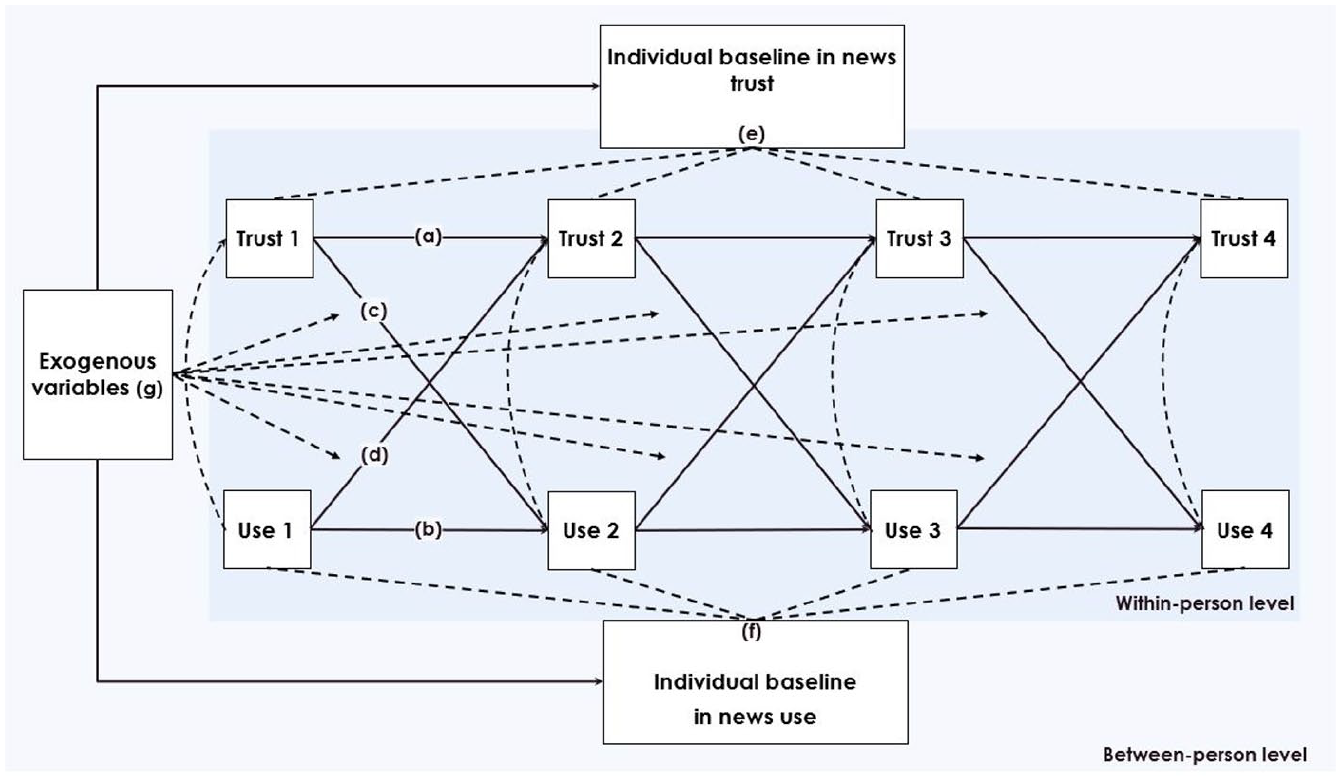
RI-CLPM model of the evolving relationship between news trust and use.
To test the longitudinal relationship between usage and trust, we employed two distinct RI-CLPM models. Typically, time-variant means are constrained to equality across different time points, optimizing the model’s ability to focus on individuals’ stable mean levels across different waves (Thomas et al., 2021). However, given the context of our case study within an election campaign, it is plausible that the effects over time are not uniform. For instance, individuals may exhibit stronger effects as election day approaches, a phenomenon observed in studies on media reinforcement of political attitudes over time (see for instance: Slater, 2015; Tenenboim-Weinblatt et al., 2022). Therefore, we employed two models—one partially constrained and one fully constrained—to accommodate various possibilities of variable maintenance or change (models are henceforth referred to as “Model 1” and “Model 2,” respectively). Each model was applied to each of the nine studied outlets, resulting in 18 analyses predicting longitudinal relationship between usage and trust. Data from all four waves were included in the analysis (N = 1,294).
In Model 1, we constrained only the crossed-lagged effects between news use and trust over time, while enabling flexibility in the autoregressive and simultaneous correlation effects. This approach was aimed to enhance the model’s explanatory power concerning the within-person changes in use and trust, which are the primary focus of our study, rather than identifying between-person differences. Model 2 was adapted from the statistical approach developed by Thomas et al. (2021), serving as a robustness test. In addition to constraining the crossed-lagged effects, this model also imposed constraints on the other types of autoregressive effects and simultaneous correlations, assuming a degree of within-person stability (see Thomas et al., 2021, p. 199). Both models yielded overall similar results. In the Findings Section we thus focus on the results derived from Model 1, which exhibited slightly higher scores of model fit (Model 1: mean χ2 = 17.322, df = 13, SD = 5.412; mean RMSEA = 0.014; mean Comparative Fit Index [CFI] = 0.999; Model 2: mean χ2 = 47.592, df = 25, SD = 11.751; mean RMSEA = 0.026; mean CFI = 0.996). In the findings presented, we also acknowledge and discuss the differences in results between these two models, which diverge specifically in relation to two news outlets (BFMTV and Libération). The models were tested using the R package lavaan version 0.6.16 (Rosseel, 2012). The codes for both models are provided in the Supplemental Material, Section 1.
Findings
First, we investigated the presence of a reinforcing spiral (Slater, 2015) between the usage of specific news outlets and trust placed in them (RQ1). We employed a series of RI-CLPM models to predict the usage of and trust in nine outlets. Table 2 presents the estimates for the relationship between trust in and usage of these outlets (see Supplemental File, Sections 6 and 7 for the full 18 models). Our analysis revealed three patterns of dynamics over time between news trust and consumption: (a) a selection effect where trust influences usage over time; (b) a media effect where usage influences trust over time; and (c) the absence of a significant effect between news usage and trust. The findings in Table 2 show that selection and media effects do not coincide. Across the nine outlets studied, only one consistent pattern of trust and usage emerged at most. These findings indicate that in the course of the election campaign, a self-reinforcing spiral between trust in and usage of specific outlets did not materialize.
RI-CLPM Models Predicting the Relationship Between Trust and Use Over Time (waves 1–4).*.
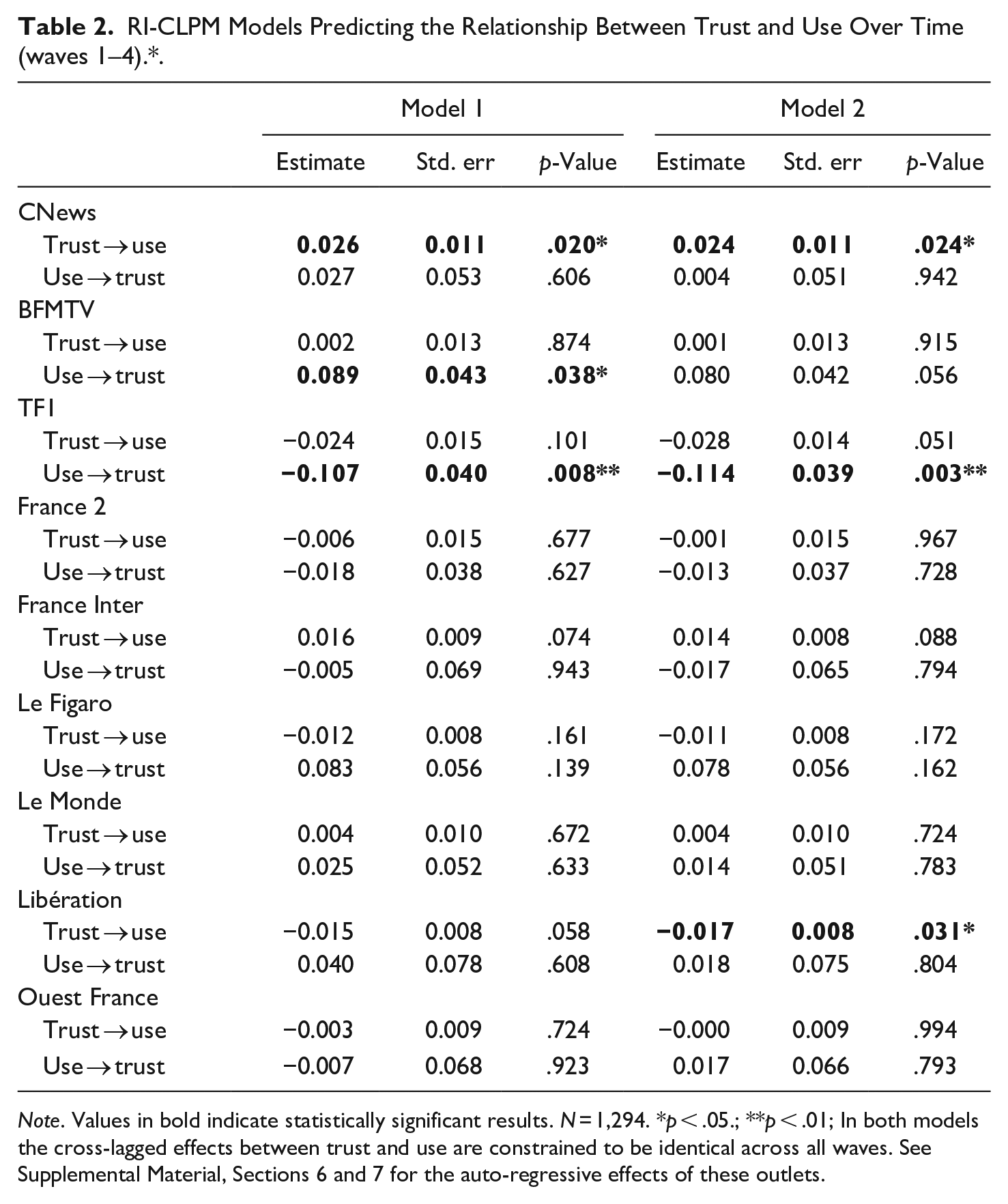
Note. Values in bold indicate statistically significant results. N = 1,294.
p < .05.; **p < .01; In both models the cross-lagged effects between trust and use are constrained to be identical across all waves. See Supplemental Material, Sections 6 and 7 for the auto-regressive effects of these outlets.
Turning to the specific news outlets, the evolution of trust and use was not uniform. In Model 1, the first pattern, in which trust leads to increased usage, was observed in the context of the far-right political alternative CNews television channel. The opposite pattern, where usage impacted trust, was associated with two center-right, traditional television channels: BFMTV (demonstrating a positive relationship between these two variables), and TF1 (showing a negative relationship). For the remaining news outlets, spanning right, center, and left-oriented outlets—France 2, France Inter, Le Figaro, Le Monde, Libération, and Ouest France—we did not find statistically significant cross-lagged influences. Under Model 2, results were largely consistent, except for two outlets. Libération displayed a significant selection effect alongside CNEWS, whereas the statistical significance of BFMTV’s media effect diminished, leaving only TF1 with a significant media effect (see Table 2). In what follows we report the findings regarding the three patterns of dynamics between the usage of and trust in specific news outlets over time.
Selection Effects: An Influence of News Trust on Use Over Time
Figure 5 illustrates the findings derived from the RI-CLPM Model 1 analysis, demonstrating the reciprocal relationship between usage of and trust in CNews over time. The model demonstrates a good fit to the data (χ2 = 21.003, df = 13; RMSEA = 0.022; Comparative Fit Index [CFI] = 0.999). In terms of simultaneous correlations, we observed that, during the initial three waves, higher trust in CNews significantly correlated with a greater likelihood of watching this channel (Estimate = 0.017, SE = 0.005, p = .001 for waves 1 and 2; Estimate = 0.012, SE = 0.005, p < .05 for wave 3). Shifting our focus to the longitudinal relationship between these variables, the model also indicates a positive correlation between initial trust in CNews, and its subsequent usage across all four waves (Estimate = 0.026, SE = 0.011, p < .05). We also identified a positive correlation between initial and later usage of CNews at two time points: between wave 1 and 2, and between wave 2 and 3 (see Supplemental Material, Table A6.1). Additionally, a positive correlation was observed between trust in CNews before and after the first election round (between wave 3 and 4). Importantly, however, the opposite influence of usage on trust over time did not attain statistical significance (Estimate = 0.027, SE = 0.053, p = .606). H1 is thus supported: political alternative media exhibits a selection effect, wherein trust reinforces viewership over time.
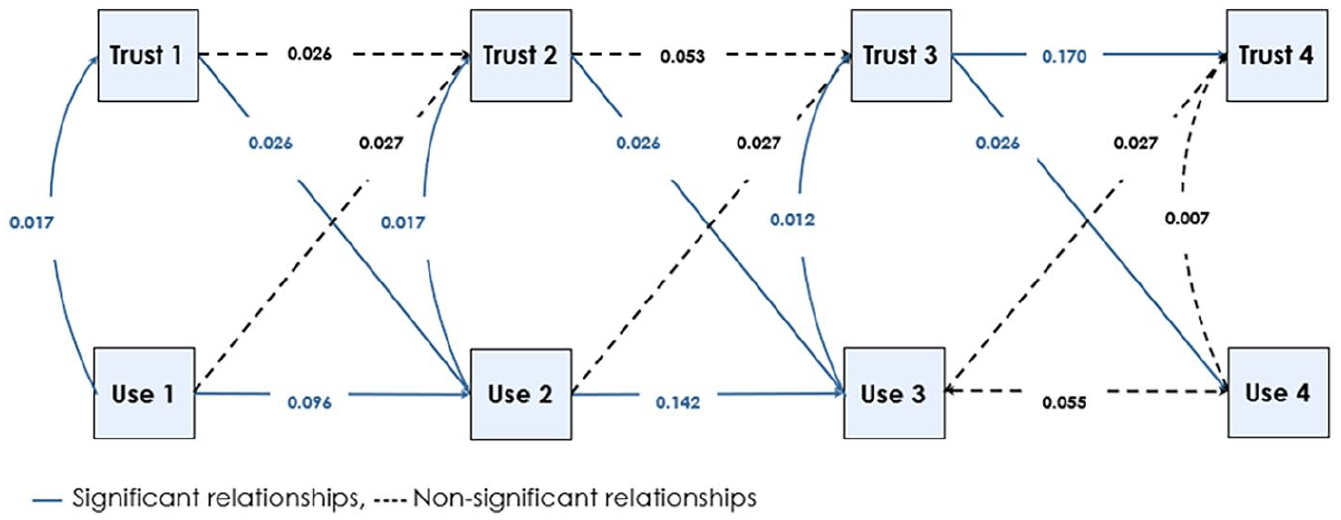
Cross-lagged effects between trust and usage of CNews.
A selection effect for CNews was replicated using the RI-CLPM Model 2, adapted from the framework by Thomas et al. (2021) (χ2 = 55.806, df = 25; RMSEA = 0.031; CFI = 0.995). Consistently across all waves, a positive correlation between initial trust in CNews and subsequent usage was evident (Estimate = 0.024, SE = 0.011, p < .05), whereas the opposite impact of usage on trust was insignificant (Estimate = 0.004, SE = 0.051, p = .942). These findings, consistent with those of Model 1, further establish the longitudinal effect of trust on usage within the context of CNews (see Supplemental Material, Table A7.1).
Notably, Model 2 also revealed a negative selection effect for the Libération newspaper (χ2 = 33.095, df = 25; RMSEA = 0.016; CFI = 0.998), which displayed only weak, nearly significant associations in Model 1 (see Supplemental Material, Tables A6.8, A7.8). Across all waves, initial trust levels in Libération demonstrated a negative impact on the subsequent consumption of this newspaper (Estimate = −0.017, SE = 0.008, p = .031). Importantly, however, earlier usage levels did not significantly predict later trust in Libération (Estimate = 0.018, SE = 0.075, p = .804). While this presents a mirror image to the positive effect observed for CNews, it highlights the longitudinal influence, whether positive or negative, of trust on news consumption.
Media Effects: An Influence of News Use on Trust Over Time
The second pattern, wherein usage influences trust, was found in BFMTV and TF1. Figure 6 presents a significant relationship between same time trust in and usage of BFMTV during three out of four survey waves (wave 2: Estimate = 0.021, SE = 0.006, p < .001; wave 3: Estimate = 0.018, SE = 0.006, p < .01; wave 4: Estimate = 0.013, SE = 0.005, p < .01). When we examined how these variables evolve over time, a distinct pattern emerged compared to the one observed in CNews. Watching BFMTV at one time point significantly predicted respondents’ trust in it for the subsequent time point in all waves (Estimate = 0.089, SE = 0.043, p < .05). Yet again, this pattern does not constitute a complete reinforcing spiral between usage and trust, as earlier trust levels did not predict later usage (Estimate = 0.002, SE = 0.013, p = .874). Consequently, a media effect is found, wherein usage reinforces trust. It should be noted that earlier viewership consistently predicted subsequent viewership in this channel, a connection that grew stronger toward wave 4, which preceded the second election round (see Supplemental Material, Table A6.2). Additionally, the trust levels in this channel before and after the first election round exhibited a significant and positive association (wave 4: Estimate = 0.197, SE = 0.048, p < .001). Notably, the model demonstrates a strong data fit (χ2 = 14.554, df = 13; RMSEA = 0.010; CFI = 1.000).
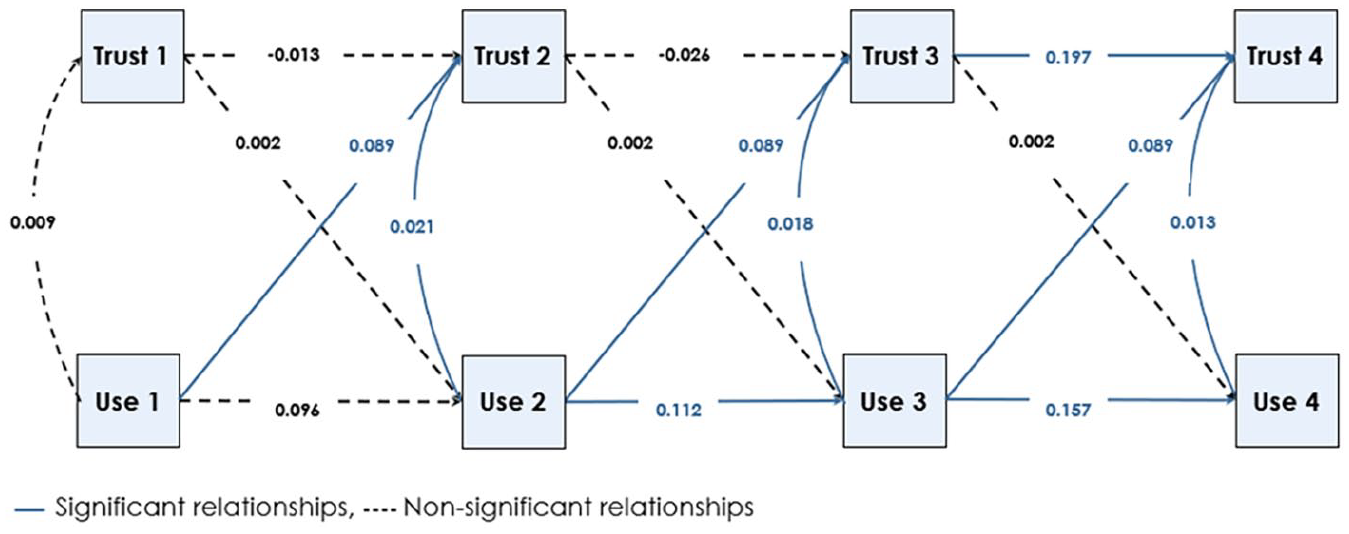
Cross-lagged effects between trust and usage of BFMTV.
Similar to BFMTV, TF1 also exhibited a media effect wherein usage affected trust. However, while usage over time increased trust in BFMTV, it decreased it in TF1 (see Supplemental Material, Table A6.3). The analysis revealed negative correlations between viewership at earlier stages and subsequent trust levels (Estimate = −0.107, SE = 0.040, p = .008, see Figure 7), suggesting that watching TF1 may have had a dampening effect on trust at later time points. Additionally, between waves 3 and 4, we observed a connection between earlier and later usage patterns (Estimate = 0.126, SE = 0.045, p = .005). Our analysis did not uncover any significant predictive relationship between earlier trust levels and subsequent viewership. However, the connection here was also negative (Estimate = −0.024, SE = 0.015, p = .101), further implying an inverse relationship between trust and usage in this channel. The overall model demonstrates a good data fit (χ2 = 25.796, df = 13; RMSEA = 0.028; CFI = 0.998).
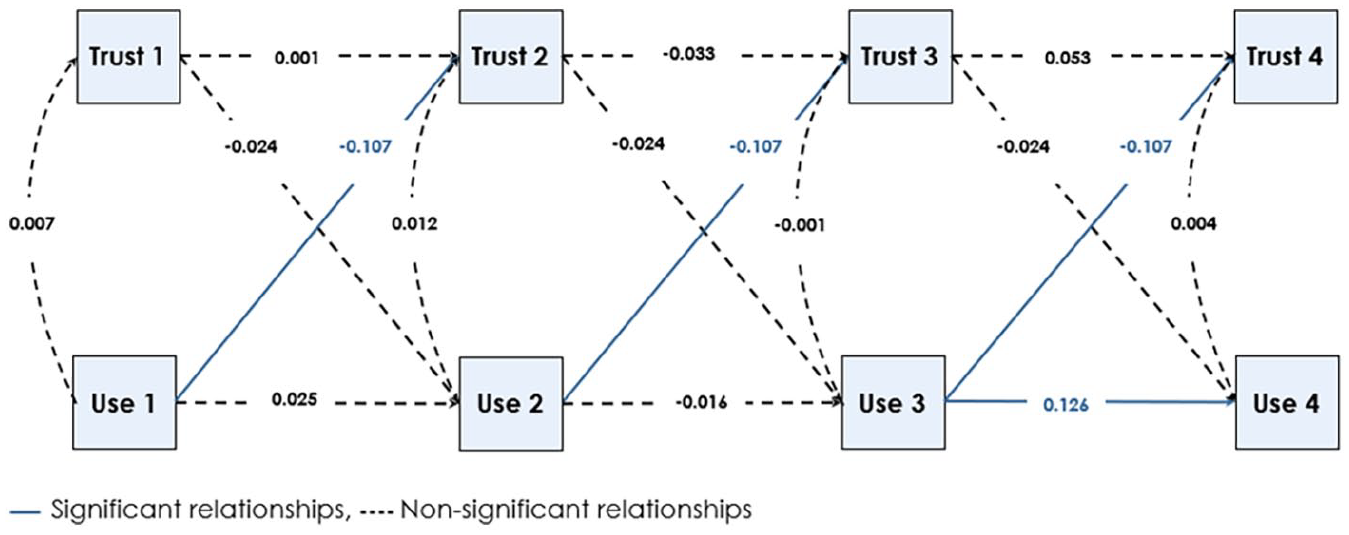
Cross-lagged effects between trust and usage of TF1.
Under Model 2, the significance of the findings regarding BFMTV slightly diminishes. The autoregressive effect of earlier trust on later trust, and of earlier use on later use, remained significant in this model (Estimate = 0.092, SE = 0.031, p = .003 for trust; Estimate = 0.124, SE = 0.029, p = .000 for use). However, with an estimate of 0.080 (SE = 0.042, p = .056), the effect of earlier BFMTV usage on subsequent trust in this channel remained positive in its direction but did not reach statistical significance (see Supplemental Material, Table A7.2). Conversely, the results for TF1 under the Model 2 remained consistent in terms of both significance and direction, indicating a negative influence of usage on trust (Estimate = −0.114, SE = 0.039, p = .003; see Supplemental Material, Table A7.3).
Disconnection Between News Usage and Trust Over Time
When examining the public service channels France 2 and France Inter, the impact of both trust on usage and usage on trust was found to be statistically insignificant. This held true for both channels across Model 1 and Model 2 (see Table 2 for the cross-lagged effects and Supplemental Material, Tables A6.4–A6.5, A7.4–A7.5 for the full models). Consequently, H2 is not supported: usage of public service media did not correlate with trust in it in a media effect. Additionally, the absence of a selection effect in both channels indicates that public service media exhibited no discernible relationship between trust and usage over time.
Similarly, under Model 1, the four remaining news outlets—Le Figaro, Le Monde, Libération, and Ouest France—showed no cross-lagged effects between usage and trust (see Supplemental Material, Tables A6.6–A6.9). Both the usage dynamics of these outlets, along with those of France 2 and France Inter and the levels of trust in them (see Supplemental Material, Figures A4.4a–A4.9b), remained relatively stable throughout the electoral campaign. This stability may potentially explain the absence of statistically significant reciprocal trust-usage dynamics over time, at least within the timeframe of the studied presidential election.
Running Model 2 also revealed limited interconnection between usage and trust for six outlets. However, as detailed above, the findings of this model differed regarding two outlets that showed opposite patterns—while BFMTV exhibited significant cross-lagged effects only in Model 1, cross-lagged effects in Libération were significant only in Model 2. Accordingly, under Model 2, the outlets that exhibit insignificant cross-lagged effects are: BFMTV, France 2, France Inter, Le Figaro, Le Monde, and Ouest France.
Post-hoc Validation
We conducted several post-hoc analyses to further examine the dynamics of news use and trust over time, aiming to uncover potential factors contributing to the observed differences between channels. In Model 1, where significant cross-lagged effects involved television channels, we introduced additional variables measuring television news consumption frequency, alongside a measure of institutional trust in the media. To dissect the data further, we ran separate analyses for high television news consumers (defined as those watching more than 3 days a week) and those with low consumption (3 days a week or less), across CNews, BFMTV, and TF1. For each channel, we, moreover, conducted separate analyses distinguishing between individuals with high and low levels of general media trust (scoring 3 or 4/ 1 or 2 on a general media trust question raging between 1 and 4).
The results from these group-based analyses show that the observed cross-lagged effects of usage on trust observed in BFMTV and TF1 are mainly influenced by high television news users. As such, the post-hoc analyses provide support for the theoretical mechanism of media effects as based on habitual news consumption. Moreover, for BFMTV, this cross-lagged effect was also found significant for individuals with high trust levels in the news, suggesting the role played by general news media trust in media effects. However, running these same group-based analyses on CNews led to insignificant cross-lagged effects in all group combinations. This suggests that the selection effect is not driven by individuals’ general media usage or by their general trust in the news media overall. This further distinguishes the selection effect from the media effect, portraying them as based on two distinct mechanisms (detailed results and additional information on the post-hoc validation can be found in the Supplemental Material, Section 8).
Discussion
Scholars have long emphasized the intricate relationship between trust and news consumption (Ognyanova, 2019; Tsfati et al., 2023). However, previous findings regarding the strength and direction of this interplay have often been inconclusive (Kalogeropoulos et al., 2019; Shehata & Strömbäck, 2022). Additionally, research has primarily concentrated on trust in the news media at a broad institutional level (Strömbäck et al., 2020) when examining both overall news consumption patterns and preferences for specific sources. The present study underscores the significance of investigating the relationship between trust and news use by delving into trust at a more nuanced level—of specific news outlets—which illuminates distinct use-trust dynamics. Consequently, our research highlights the importance of considering the political information environment for a deeper understanding of public trust and beliefs (Lelkes, 2016). Furthermore, it emphasizes that the predictors and effects of trust are not uniform, but can manifest differently with respect to trust in specific sources.
Specifically, we identified three dynamics in the relationship between news consumption and trust over time. For CNews, trust increased ongoing news consumption. Conversely, for TF1, repeated news exposure eroded trust over time, while for BFMTV, it had a trust building effect. These three outlets face a low level of public trust, evidenced by some of the lowest trust scores in our panel. 6 Notably, all three outlets are television channels, suggesting significance not only in the development of public trust placed in news brands, but also in the platform of consumption (Fletcher & Park, 2017; Kalogeropoulos et al., 2019; Kiousis, 2001). CNews and BFMTV, both 24-hour channels, share some similarities, being relatively new in the French news landscape (see Table 1), possibly still developing their viewership compared to established outlets like Le Figaro and Libération (Ségur, 2020).
However, these three channels differ significantly in audience reach and political ideologies. TF1 and BFMTV rank among the top three most consumed news outlets in our sample, whereas CNews is the least-watched among the four television channels examined (see Figure 2). BFMTV and TF1 are considered center-right, while CNews stands out as far-right extremist (Abdoul-Bagui, 2021; Cagé et al., 2022; Labarre, 2024). Although these differences may seem minor within the broader political spectrum, their significance becomes apparent in the French electoral competition, where center-right candidate Emmanuel Macron competed against far-right Marine Le Pen. These political orientations entail distinct journalistic norms and audience expectations. Unlike BFMTV and TF1, which adhere to a journalistic norm of objectivity (Hanitzsch et al., 2019; Ségur, 2020), CNews is often regarded as a French equivalent of Fox News, prioritizing partisan identity over journalistic quality in significant parts of its programing (Cagé et al., 2022; Labarre, 2024).
The different political orientations of CNews on the one hand, and BFMTV and TF1 on the other hand, illuminate the distinct patterns in our analysis: one where trust precedes use, and the other where use precedes trust. These complementary patterns underscore trust’s versatile role in news consumption. For more traditional outlets like BFMTV and TF1, news (dis)trust is an effect of media consumption (Bauer & Clemm von Hohenberg, 2021; Kiousis, 2001), built over repeated exposure to existing news preferences and routines (Guo & Bai, 2023). This echoes a prominent premise in news trust research, emphasizing content evaluations and information utility as primary factors guiding trust in a news source (Ognyanova, 2019; Strömbäck et al., 2020; Tsfati & Cappella, 2003). News content, including framing and political alignment effects (Bauer & Clemm von Hohenberg, 2021; Hopmann et al., 2015), influences whether trust is placed in a source, subsequently leading to further consumption.
In contrast to such a media effect, seen in traditional outlets, political alternative media exhibit a different pattern. In the case of CNews, trust precedes the development of news media consumption habits, aligning with perspectives treating trust as a predictor of news exposure (Fletcher & Park, 2017; Ladd, 2012; Tsfati, 2010). Consistent with social identity theory (Tajfel & Turner, 2004) and selective exposure (Flaxman et al., 2016), this selection effect reflects the assumption that individuals preferentially consume news from like-minded, trusted sources, avoiding untrustworthy sources that contradict their attitudes (Mourão et al., 2018; Prochazka & Schweiger, 2019; Zoizner et al., 2022). This trust may also be linked to brand familiarity (Bauer & Clemm von Hohenberg, 2021; Kiousis, 2001) and associated emotional factors, such as inter-party de-legitimization and enmity (Lelkes, 2016; Tenenboim-Weinblatt et al., 2022).
The absence of significant reciprocal dynamics concerning the remaining six outlets aligns with previous studies indicating weak connections between trust and usage (Fletcher & Park, 2017; Ladd, 2012). Interestingly, all three of the outlets showing significant effects have the lowest levels of trust. Two explanations may be suggested. First, the more trusted media outlets 7 exhibited greater stability in both usage and trust patterns. This stability might have hindered the detection of any causal relations, particularly within the relatively short timeframe of the present study. Second, our post-hoc analysis indicates that, for the less trusted outlets, the observed effects are driven by individuals with higher levels of news media trust. Accordingly, a statistical ceiling effect may exist for the more trusted outlets, challenging the detection of effects.
The two types of trust-usage effects identified in our study reflect broader asymmetries observed globally among people from different political camps (Lelkes, 2016; Tenenboim-Weinblatt et al., 2022). In the US, for example, both polarization and hostile media effect are more pronounced among Republicans than Democrats (Hansen & Kim, 2011; Leonard et al., 2021; Mourão et al., 2018), contributing to their increased distrust in mainstream media (Lelkes, 2016; Mourão et al., 2018). Political asymmetries also influence the formation of beliefs and trust perceptions in media and institutions. Such asymmetric perceptions often stem from the political information environment, particularly in politically partisan media (Lelkes, 2016; Leonard et al., 2021). In parallel, in France, political asymmetries may exist between more traditional center-right outlets, like TF1 and BFMTV, more closely associated Macron’s ideology; and far-right outlets supporting Le Pen, such as CNews (Abdoul-Bagui, 2021).
This study contributes to the literature on political asymmetries by extending beyond the traditional left versus right-wing or Democrats versus Republicans dichotomy, typically studied in the US. Instead, it unveils a different type of asymmetry concerning the use of and trust in mainstream and alternative media (Strömbäck, 2023; Tsfati & Cappella, 2003). In our findings, trust in traditional outlets appears to be gradually impacted over repeated usage, while trust in a political alternative outlet precedes usage, reinforcing it over time. This pattern may extend beyond the specific French context examined here. For example, similar selection effects might be observed in other alternative outlets, such as the American Fox News channel (Motta & Stecula, 2023; Mourão et al., 2018), or the Israeli Channel 14 (formerly Channel 20, see: Tenenboim-Weinblatt et al., 2022).
Limitations and Future Directions
While our study takes the important step of examining trust and usage of specific news outlets, it has several limitations. First, the binary measurement of news consumption we employed does not capture the intensity and time spent on outlets. Future studies should consider employing tracking data (Trilling, 2019) to explore more nuanced consumption patterns, crucial for understanding their evolution alongside trust. Future studies should also adopt multi-item measures for capturing different types of trust and media consumption, replacing our single-item measures (see: Engelke et al., 2019; Fawzi et al., 2021).
Another notable limitation is the relatively short timeframe of our study, which constrains the extent of changes in trust and usage observed over time. It is reasonable that some significant longitudinal patterns between news trust and consumption unfold gradually over a much longer period than the election campaign measured in our study. Factors like group membership and socialization may gradually build or decrease trust over time, contributing to changing consumption patterns (Slater, 2015). Specifically, the survey’s duration may have limited our ability to detect reinforcing spiral relationships models between news trust and consumption. Future research should thus examine similar selection, media, and spiral effects in other countries, beyond the context of elections. Replicating a similar multi-outlet analysis on longer time frames could provide valuable insights into the longitudinal dynamics between trust and news consumption.
Future studies employing the RSM (Slater, 2015) may be particularly useful for understanding political alternative media, given their potential susceptibility to identity related self-reinforcing dynamics (Leonard et al., 2021; Strömbäck, 2023). Expanding upon the assumption that political alternative media usage is driven by a preference for ideological congruence, consuming this same congruent content could presumably increase trust, thereby contributing to a reinforcing effect. Future RSM applications could also consider probing political identification rather than solely focusing on media trust, or examining trust as a mediator of political identification. This approach may help address another limitation of the current study, which only partially captures the effects of political identity, indirectly reflected as part of trust in different outlets.
Lastly, due to the scarcity of research on trust and usage over time, our study combines broad research questions and specific hypotheses. We primarily focus on hypothesizing regarding outlets’ political orientations, given the extensive research in this area. However, we could not sufficiently specify hypotheses regarding other criteria like the modalities, longevity, or specific content of outlets. We hope that our findings will guide future studies in addressing the directionality between news trust and consumption.
An important question arising from our study concerns the implications of the observed trust-usage dynamics. Whether serving as an effect or a predictor of news consumption, news trust can influence news reception (Shehata & Strömbäck, 2022) and impact political persuasion (Bauer & Clemm von Hohenberg, 2021). However, the interaction between trust in specific news sources and news reception remains unclear (Fawzi et al., 2021). Linkage designs, which connect survey responses with content analysis data (De Vreese et al., 2017) may also address a limitation of our study, namely, its reliance on self-report measurements. Although survey questions are common for studying general and news media trust (Strömbäck et al., 2020; Toff et al., 2021), investigating the connection between individuals’ self-reported responses and the actual content they encounter can enhance our understanding of the role of trust in information reception.
Moreover, it is important to acknowledge that people typically combine multiple news sources (Mourão et al., 2018). Consequently, the dynamic of trust and consumption we observed may vary among individuals with different news repertoires and consumption habits, such as “news junkies” who utilize multiple sources and consumers dedicated to specific sources. Understanding different media combinations is vital for grasping how trust interacts with news exposure over time.
Conclusion
Our findings challenge the common theoretical assumption that people use the media they trust and trust the media they use (Strömbäck et al., 2020; Tsfati, 2010). As evident in our analysis, the feedback loop between trust and use may often be one-sided, operating either form trust to consumption or vice versa. Our study demonstrates that news media trust can function as both a predictor and an outcome of news exposure, offering a possible explanation for the conflicting findings reported in the literature (Kalogeropoulos et al., 2019; Strömbäck et al., 2020). Importantly, our findings suggest that different dynamics between traditional and alternative news media: for the former, trust emerges as a consequence of news exposure, while for the latter, externally driven trust precedes usage. Overall, through our examination of the evolving dynamics of news usage and trust across various outlets, we have expanded the conventional exploration of generalized trust in the news media and its impact on news consumption habits (Shehata & Strömbäck, 2022). By doing that, we have taken a step forward in uncovering the role of trust in people’s news consumption behaviors.
Supplemental Material
sj-docx-1-crx-10.1177_00936502241273263 – Supplemental material for Re-assessing the Dynamics of News Use and Trust: A Multi-Outlet Perspective
Supplemental material, sj-docx-1-crx-10.1177_00936502241273263 for Re-assessing the Dynamics of News Use and Trust: A Multi-Outlet Perspective by Tali Aharoni, Christian Baden, Maximilian Overbeck and Keren Tenenboim-Weinblatt in Communication Research
Footnotes
Acknowledgements
This study is part of the PROFECI research project (“Mediating the Future: The Social Dynamics of Public Projections,”  ). We are indebted to Isabelle Guinaudeau, Naomie El Baz, and Jade Brunton for their valuable assistance in formulating the survey in French. We would also like to thank Dana Katsoty, Tal Orian Harel, Nathan Walter, CW Anderson, and the participants of the 2022 “Milan Summer School of Political Communication” for their insightful comments and suggestions at various stages of this study.
Declaration of Conflicting Interests
The authors declared no potential conflicts of interest with respect to the research, authorship, and/or publication of this article.
Funding
The authors disclosed receipt of the following financial support for the research, authorship, and/or publication of this article: This work was supported by the ERC Starting Grant [number 802990, PROFECI]. Ethical approval was granted by the Hebrew University in advance of data collection.
Supplemental Material
Supplemental material for this article is available online.
Notes
Author Biographies
References
Supplementary Material
Please find the following supplemental material available below.
For Open Access articles published under a Creative Commons License, all supplemental material carries the same license as the article it is associated with.
For non-Open Access articles published, all supplemental material carries a non-exclusive license, and permission requests for re-use of supplemental material or any part of supplemental material shall be sent directly to the copyright owner as specified in the copyright notice associated with the article.
