




Abstract
This study analyzes survey data from 206 trans workers to test the premises of crystallized self theory by exploring how perceived authenticity and identity communication (i.e., explicit outness, implicit outness, and covering) relate to job and life satisfaction. Perceived authenticity was positively related to explicit outness (overt communication sharing trans identity) and implicit outness (advocacy for trans issues), and negatively to covering (communication distancing from trans identity). Further, in the structural equation model, explicit outness was positively related to job and life satisfaction, covering was negatively related to job satisfaction, and implicit outness had a negative relationship with life satisfaction. Finally, indirect effects between perceived authenticity and life satisfaction via explicit outness and perceived authenticity and job satisfaction via covering reveal the nuance of crystallization. Findings support and reveal tension in the crystallized self, offer practical implications and demonstrate the importance of workplaces better supporting trans individuals.
Organizations reify discourses of the ideal worker, shaping conceptualizations of work and nonwork identities and circulating narratives of what is most desirable for the workplace (Ramarajan & Reid, 2013). Balancing competing discourses and self-presentation at work becomes even more complex for individuals who hold marginalized identities. For trans folks, hetero- and cis-normativity dominate workplace standards and norms, guiding notions of professionalism and shaping discrimination, exclusion, and “othering” in the work environment (McDonald & Kenney, 2021). The consequences of structural transphobia are seen in the lived reality of trans folks who face unprecedented levels of discrimination and violence in and outside of the workplace. Trans folks are “underrepresented, underemployed, and underpaid” in places of employment (Baboolall et al., 2021, p. 5), and 70% of trans folks reported experiencing discrimination or harassment in the workplace (Medina & Mahowald, 2023). The stigmatization of trans identity and fear of discrimination and employment loss creates an identity tension for trans folks as they navigate their trans identity and gender presentation within cisnormative organizational structures (Eger, 2018).
Identity communication in the workplace has been linked to (in)authenticity. Increased authenticity at work leads to better psychological well-being (Cha et al., 2019), with those who engage inauthentically having reduced motivation because of the emotional labor identity concealment requires (Reis et al., 2016). The crystallized self is a theoretical perspective that rejects the work-nonwork identity dichotomy and encourages holistic communication about the self (Tracy & Trethewey, 2005). We adopt the crystallized self metaphor and a survey approach to hypothesize connections between perceived authenticity and communication. Specifically, we explore how trans folks (i.e., people who do not identify as cisgender) communicate their identity at work and the key outcomes of job and life satisfaction. Analyzing survey results with a structural equation model (SEM) extends the crystallized self metaphor, revealing the nuance of identity crystallization, directly linking perceived authenticity to identity communication and life and job satisfaction outcomes.
Given the saliency of identity in the workplace and the challenges that trans folks face at work, this study contributes to the growing body of research on trans identities, authenticity, and identity disclosure. We answer calls for organizational communication scholarship to explore (a) how trans folks navigate challenges surrounding their trans identity and identity disclosure in the workplace and (b) the underrepresentation of queer and trans identities in organizational communication research (Eger, 2018; McDonald, 2017). We begin by presenting the metaphor of the crystallized self (Tracy & Trethewey, 2005), articulating the theory’s connection with self-perceptions and communication of work and nonwork identities. Then, we explore the theory’s applicability to this context and operationalize the metaphor of the crystallized self into constructs of perceived authenticity and identity communication relating to trans identity at work. We find that perceived authenticity is related to explicit, implicit, and concealing forms of identity communication, affecting life and job satisfaction. The findings offer support and extension of the metaphor of the crystallized self (Tracy & Trethewey, 2005), reiterating the privileged role of authenticity at work and yielding practical implications for improving workplaces for trans folks.
Competing Discourses and the Crystallized Self
Much of the work on identity in organizational contexts creates an artificial separation of the self at work and outside of work (Tracy & Town, 2020). Such a view produces and reifies the false real self ↔ fake self dichotomy, a normative power-laden discourse that upholds a narrative whereby individuals more wholesomely engage in one identity as real, separating themselves from their other identities or “fake selves” (Tracy & Town, 2020).
Tracy and Trethewey (2005) suggest that those who internalize the real-self ↔ fake-self discourse engage in practices like self-monitoring, deferring identities, and self-discipline in order to fit the expected managerial discourse, which can lead to adverse outcomes like identity suppression, burnout, and stress. Despite the negative implications, individuals may feel pressure to portray their identities in ways that do not represent their sense of self and instead fit the expectations of the work environment (Helens-Hart, 2017), leading them to embody aspects of the real-self ↔ fake-self discourse (Tracy & Trethewey, 2005). Preferences for work or nonwork identities also vary across people and their jobs. For example, individuals with high-status jobs and those engaging in care work often identify more with their work role, while those holding low-status jobs tend to identify with their non-work selves more (Tracy & Trethewey, 2005).
The metaphor of the crystallized self (Tracy & Trethewey, 2005) recognizes the limitations of the real-self ↔ fake-self discourse and offers an alternative through the practice of crystallization. Crystallization involves a new way to enact, discuss, and think of identity in the interplay between expectations to fit perceived norms and challenges to dominant discourses through dynamic and holistic identity communication (Tracy & Town, 2020). The multifaceted nature of identity crystallization represents the brilliance of an individual as the various facets of oneself work together like a crystal; yet, this brilliance or richness of identity can often be dulled or flattened by pressures to perform versions of self that align with what is perceived as acceptable in the workplace (McEwan & Mease, 2013). Because of the pressure to fit into the work environment, workers often strive to present a preferred organizational self—whereby one prioritizes the needs and expectations of the workplace over other aspects of their lives. As an example, Tracy and Trethewey (2005) highlight a typical organizational conversation: “What did you do over the weekend?” Simple questions like weekend activities can present challenges for LGBTQ+ folks who may choose to conceal their identity in the workplace for a variety of reasons. One way the organizationally preferred self can manifest in workers with nondominant identities is through identity concealment, and both theory and empirical work suggest trans employees may feel compelled to hide aspects of their identity (Jones, 2020; Tracy & Town, 2020).
In opposition to the real-self ↔ fake-self discourse, the crystallized self metaphor is both a descriptive and prescriptive framework encouraging individuals who occupy various organizational positions to conceptualize their work, home, and other aspects of life differently – to see themselves more holistically and less compartmentalized (Tracy & Trethewey, 2005). The metaphor of a crystal emphasizes the multifaceted “fragmented yet cohesive self,” which is guided by multiple senses of who one is and how the self is enacted across many situations and contexts (McEwan & Mease, 2013, p. 90).
While Tracy and Trethewey (2005) theorize a strong preference for identity merging through crystallization, they also acknowledge that challenging the real-self ↔ fake-self discourse is hard. The crystallized self metaphor also concedes that this process can be even more difficult for marginalized individuals; for example, the theorists argue that lesbian and gay people are constrained in their identity displays and disclosure by those with more privilege and their perceived expectations of the organization. Because the lived reality of disclosing or concealing one’s trans identity has advantages and disadvantages, exploring how trans folks enact a crystallized identity, or not, provides insight into how they conceptualize themselves and communicate their identity in the workplace and likely has implications for their satisfaction at and outside work.
The Crystallized Self and Perceived Authenticity
At the crux of Tracy and Trethewey’s (2005) argument is a “preferred’ sense of self” (p. 185) to reflect “the various edges” of one’s life and celebrate the “multifaceted ability [of a crystallized self] to refract life in a rainbow” (p. 191). Although Tracy and Trethewey push back against the term “authenticity,” we view authenticity and identity communication as entangled and mutually constitutive of identity crystallization. Thus, we argue that perceptions of self-authenticity and communication about the self together serve as indicators that signal some crystallization of the self through active enactment of the preferred self.
Indeed, the ability to be “authentic” in one’s identity also has important positive implications. For example, hiding one’s identity can limit the ability of trans folks to advocate for themselves, which contributes to trans employees having a “diminished voice at work” (Jones, 2020, p. 255). Meta-analytic evidence demonstrates a strong positive relationship between feeling authentic and both personal well-being and work engagement (Sutton, 2020). Increased authenticity and the anticipated outcomes of crystallization have been the focus of much research on workplace satisfaction and identity management. Facing an inauthentic, disjointed identity where one hides or downplays aspects of the self involves substantial emotional labor (Cha et al., 2019; Ferguson & Dougherty, 2022). Fletcher and Everly (2021) found that LGBTQ+ supportive workplace practices were related to identity disclosure and authenticity, and that authenticity was positively associated with life satisfaction. The authors found an indirect relationship between supportive work practices and life satisfaction via authenticity. While Fletcher and Everly provide novel insight into the relationships between authenticity, disclosure, and life satisfaction, their research looked at sexual orientation and trans identity collectively, so the results are not specific to the trans community.
Martinez et al. (2017) also explore the relationship between authenticity and well-being; however, their research focused only on trans folks from the perspective of transitioning. The extent of transition was related to job satisfaction via self-perceptions and enacted authenticity. Hennekam and Ladge (2023) position authenticity as an ongoing process involving both self-evaluation and interactions with others during the transition process, providing insight into how trans folks might manage their identity while transitioning, such as downplaying their gender identity to meet norms. Hennekem and Ladge contend that non-binary participants performing gender in non-stereotypical ways face more exclusion and less acceptance. A key insight from this work is the notion of being authentic enough, which represents a liminal space where trans folks feel they reach a manageable compromise between identity expression and the limitations of their environment. We see the metaphor of the crystallized self as providing a framework to enable individuals to engage in an idealized version of self that forefronts self-authenticity. Here, authenticity is not about a singular, fixed identity but a genuine expression of the various facets of oneself. We seek to extend the existing studies, which primarily focus on authenticity relative to sexual orientation or during a transition process, to explore the relationship between perceived self-authenticity, identity communication, and job and life satisfaction for trans folks in the workplace.
While research shows the positive effects of authenticity for queer and trans folks, attaining a crystallized version of self is complicated. Identity is dynamic and complex, as individuals must continuously navigate the social world against their own preferences and needs (Tracy & Trethewey, 2005). An authentic, preferred, or crystallized self at work implies that a person has a choice in this construction and presentation of identity. Nondominant and stigmatized social identities, such as being trans, may compound the repercussions of revealing or disclosing identities as individuals contend with how to manage identities in light of harmful social discourses (Eger, 2018; Kreiner et al., 2022). Thus, perceived self-authenticity in this context may reflect attempts to engage in crystallization as a person grapples with the organizationally preferred self. When individuals perceive themselves as more authentic, they are inclined to express their multifaceted identity and, thus, push back against a limited and prescribed identity to fit the organizational environment. The complexities of identity disclosure and strategies for disclosing are explored in the next section.
Trans Identity Management Strategies
Workers employ numerous strategies to meet an organization’s (perceived) expectations by negotiating nonwork identities to gain a sense of control over how they are perceived (Ramarajan & Reid, 2013). Individuals may negotiate identities viewed as irrelevant or adverse to work by engaging in nonwork identity states ranging from encompassing the nonwork identity as part of the work identity to disregarding, ignoring, or disparaging nonwork identities altogether (Ramarajan & Reid, 2013). Embedded in these complicated identity management techniques are strategies of passing and revealing, where one may hide or share information about themselves to better enact an expected work identity (Kreiner et al., 2022; Ramarajan & Reid, 2013). For instance, in interviews with female sexual minority participants, Helens-Hart (2017) found that “as a general rule of professionalism it was inappropriate to discuss too much personal information at work” (p. 620). Perceived norms surrounding professionalism and other organizational discourses embedded in hetero- and cisnormativity can lead to individuals suppressing their identities as they navigate complex and constraining organizational environments.
While identity disclosure often positively relates to wellbeing and engagement (Sutton, 2020), it can also have negative repercussions, such as increasing job anxiety or perceived discrimination (Law et al., 2011; Martinez et al., 2017). Additionally, not all trans folks have the choice of disclosure as they may be more visibly trans (Beauregard et al., 2018), or they may experience situations where disclosure is otherwise forced (Eger, 2018). Thus, the interplay between the positive associations of identity disclosure with authenticity and the complexity of disclosing trans identity at work emphasizes the paradox of visibility trans folks face when deciding whether to reveal their identity in the workplace as they weigh the benefits of sharing against the potential adverse outcomes. This study employs the metaphor of the crystallized self to explore the potential of engaging in the preferred version of self that the metaphor proposes while also exploring important well-being outcomes. This approach also enables an understanding of the barriers trans folks may face to openly communicating their identity.
The strategies that trans folks employ to navigate their identity exist on a continuum of outness ranging from distancing oneself from one’s identity to being completely open about being transgender (M. Z. Anderson et al., 2001; Brewster et al., 2012). Communication scholars have labeled this identity disclosure process “closeting” communication (Eger, 2018; McDonald et al., 2020). Individuals may separate their gender identity from their work by concealing their identity through strategies such as passing, only presenting as the gender they identify with outside of work, or remaining closeted (Nuru, 2014), and these behaviors can impact an individual’s ability to engage in the workplace, perform, and be promoted (Baboolall et al., 2021; Jones, 2020). However, much of this organizational literature relating to queer and trans identity in the workplace has focused on the act of disclosure but has given less attention to the different ways identity is communicated or vital outcomes like satisfaction.
Works such as Spradlin (1998) and Nuru (2014) analyze specific identity communication strategies. Spradlin analyzed passing strategies she engaged in navigating her queer identity in organizational settings, with the strategies including removing and hiding oneself in conversations, shifting topics, and denying one’s identity. Nuru’s (2014) study expands on these strategies by extending them to the context of trans identity. While Nuru identified one coming out strategy of labeling changing, which centers on changing names or pronouns, Nuru’s findings primarily focused on aspects of the disclosure process, particulary concealment strategies, thus overlooking the variability in identity disclosure highlighted in the closeting communication literature.
Communicating Trans Identity
We seek to extend the existing communication literature by focusing on three communication variables that represent the dynamic nature of identity communication: explicit outness, implicit outness, and covering. These constructs are useful because they have been operationalized (Brewster et al., 2012), and explicit and implicit forms of identity disclosure and concealment at work have been documented qualitatively (Helens-Hart, 2017). Explicit outness refers to communicative acts that affirm identity, including how one dresses, interacts with others, displays artifacts in the workplace (e.g., trans flags, buttons), and expresses their own identity (e.g., through pronouns; Brewster et al., 2012). In conjunction, implicit outness refers to communication that advocates for trans (and other LGBTQ+) identities. This includes discussing identities, developing connections with similar others, speaking out against unjust claims, and participating in inclusive community events either in addition to or in place of acknowledging one’s own trans identity (M. Z. Anderson et al., 2001). Lastly, covering refers to distancing from one’s trans identity and involves behaviors such as avoiding social events in order to avoid situations where one might feel pressured to disclose their identity.
Much work on trans identity, like Nuru’s (2014) analysis of trans identity communication and Jones’s (2020) interview and epistemological essay, as well as closeting communication (Eger, 2018; Helens-Hart, 2017; McDonald et al., 2020), employ (important) qualitative and critical methods. However, whether and how these ideas generalize across trans individuals’ work experiences is better answered through a larger sample using uniform measures. Therefore, we seek to draw connections across the differing ways that trans identity communication has been conceptualized and provide empirical data exploring engagement in these different identity communication strategies at work. This study explores the varied impact of enacting these strategies in the workplace by asking participants questions about whether they are openly communicating their identity in the workplace through explicit acts such as talking about their identity openly with coworkers or displaying trans pride items work, implicit acts like speaking out about anti-trans discrimination, or concealing acts which hide their identity (Brewster et al., 2012).
We conceptualize the relationships between perceived authenticity and enacted identity communication as a reflection of the preferred self, in this instance, through how individuals communicate about their trans identity in the workplace. Together, perceptions of self-authenticity and communication behaviors showcase how individuals engage in their identity in a way that is true to themselves, which is essential to crystallization. Because of this, we believe that when an individual feels they can act in ways that align with their sense of self, it will manifest in communicative behaviors that reflect the preferred self and positively influence job and life satisfaction. Given this relationship, we pose the following hypotheses:
Indirect Relationships Between Perceived Authenticity and Satisfaction
Given the existing literature showing that openness about LGBTQ+ identity is a positive predictor of job and life satisfaction and is related to authenticity (Fletcher & Everly, 2021; Martinez et al., 2017), we contend that how one communicates their identity to others stands in the gap between authenticity and job and life satisfaction. Recent evidence shows that the benefits of supportive work environments on life satisfaction among LGBTQ+ employees in the United Kingdom was mediated by the ability to perform one’s identity authentically (Fletcher & Everly, 2021). With an added layer capturing how people communicate, we predict an indirect effect on the relationships between authenticity and job and life satisfaction via the three forms of identity communication:
Method
Participants and Procedures
Data were collected in November 2022 as part of a larger project (see, also Baumler, 2024) following approval from the authors’ institutional review board. A convenience sample of 206 trans adults who were employed or had been in the past 2 years were recruited through the crowdsourcing site Prolific. Prolific provides access to a diverse pool of participants, is shown to have quality responses, and requires ethical pricing whereby participants are compensated at a minimum of $8.00/hr (Palan & Schitter, 2018; Pittman & Sheehan, 2016). Participants in this study were compensated $1.80 for their participation. The survey was made available to Prolific users who self-identified as trans via a platform-managed pre-screening question, and this was reaffirmed in a screening question at the beginning of the survey. Participants who did not identify as trans via this screening question were removed from the study.
The majority of the participants identified as white (76.2%, n = 157), and participants’ ages ranged from 18 to 71 (M = 27.19, SD = 7.30). Seventy-seven (37.4%) participants had no college degree, and 131 (63.6%) had an Associates or higher degree. Seventy-six participants reported working full time (36.7%), 42 (20.3%) of participants were students, 57 (27.5%) worked part-time, and 26 (12.6%) participants reported being unemployed. Forty-six participants (22.2%) made $10,000–$24,999, 48 (23.2%) made $25,000−$50,999, and 54 (26.1%) made $51,000–$100,999. Twenty-nine (14%) participants made less than $9,999, and 20 (9.7%) made between $101,000–$200,999. In terms of occupation, 98 (47.6%) participants were employed in management, professional, or related roles, 79 (38.3%) worked in service, sales, or office positions, 15 (7.3%) were engaged in production, transportation, or material handling work, two (1%) held government positions, and 12 (5.8%) were either unemployed, students, or did not disclose their occupations.
For succinctness, we carefully grouped self-descriptions together, similar to other work on gender identity (see, Reisner & Hughto, 2019). Many participants (n = 81, 39.7%) identified as nonbinary. Sixty-four (31.4%) identified as a masculine identity (responses included transmasc, male, man, transgender man), and 25 (12.3%) identified as a feminine identity (responses included trans woman, female, trans girl). Further, 13 participants (6.4%) identified as agender, 11 (5.4%) as genderqueer, five (2.5%) as genderfluid, four (2.0%) as gender nonconforming, and one (0.5%) identified as two-spirit.
Measures
Each item was measured using a 7-point Likert scale (1 = Strongly Disagree to 7 = Strongly Agree). We present McDonald’s Omega (ω) reliability measures for each, consistent with recommended best practices (Hayes & Coutts, 2020). Because the final version of many of the measures we use are composed of only three items (i.e., implicit outness, covering, perceived authenticity, and job satisfaction), they each represent a “just-identified” factor model with no free parameters to calculate model fit statistics (Kline, 2016). Given this limitation, and since our scales are all established, we conducted and report a combined confirmatory factor analysis (CFA) of all latent factors in the Results section below. The Supplemental Appendix presents all modified items and their loadings on the combined CFA model.
Perceived Authenticity
Authentic living is the extent to which individuals perceive themselves as “true to their selves in most situations and live in accordance with their own values and beliefs” (van Den Bosch & Taris, 2014, p. 3). We used the four-item scale reported by Van den Bosh and Taris. A sample item is, “I always stand by what I believe in in the workplace.” The loading for “I find it easier to get along with people when I’m being myself in the workplace” was r2 = .25, below the recommended threshold of r2 = .30 (DeVellis & Thorpe, 2021), so it was excluded. The scale was reliable (M = 5.26, SD = 1.30, McDonald’s ω = .85).
Identity Communication
Eleven items from the Transgender Form of the Workplace Sexual Identity Management Scale (Brewster et al., 2012) were used to measure identity communication at work across three dimensions. This scale captures specific communication actions that share about one’s trans identity in the workplace.
Explicit outness is being open about one’s trans identity and was measured with four items. A sample item is “I have told people that I am trans in the workplace.” Given the vague referent, we excluded “I have corrected others when they made comments.” The scale was coded so that higher scores indicate more openness about one’s trans identity and had an acceptable but low reliability (M = 3.99, SD = 1.41, McDonald’s ω = .72).
Implicit outness is when an individual does not directly label themselves as trans but does not try to hide their identity. The scale includes three items about advocating for trans identity, such as “I have spoken out against anti-trans discrimination,” and was reliable (M = 4.87, SD = 1.48, McDonald’s ω = .79).
Lastly, covering involves distancing oneself from one’s trans identity and avoiding sharing information that may indicate they are trans and was measured with four items. A sample item is, “I avoid associating myself with issues pertaining to gender identity.” One item was reverse coded: “I have regular contact with people known by others to be trans.” This item loaded poorly with the latent construct, r2 = .17. Revisiting Brewster et al. (2012) reveals this item was initially intended to capture implicit outness and later moved to covering, thus we dropped this indicator. The scale was coded so that higher scores indicated more covering, and the scale had a marginally acceptable reliability as in the original study (M = 3.08, SD = 1.44, McDonald’s ω = .68).
Life Satisfaction
The Satisfaction with Life Scale (SWLS) is a well-known scale measuring life satisfaction (Diener et al., 1985). The five-item measure included statements such as “In most ways my life is close to my ideal” and “I am satisfied with my life” and captured participants’ present state of mind regarding life satisfaction. The scale was reliable and coded so that higher ratings represent greater life satisfaction (M = 3.66, SD = 1.58, McDonald’s ω = .91).
Job Satisfaction
A widely adopted scale developed by Cammann et al. (1983) was used to measure job satisfaction. The measure included three items: “In general, I don’t like my job” (reverse coded), “All in all, I am satisfied with my job,” and “In general, I like working here.” This scale was reliable (M = 4.30, SD = 1.84, McDonald’s ω = .95). Descriptive statistics and correlations are presented in Table 1.
Descriptive Statistics and Correlations Among Study Variables.
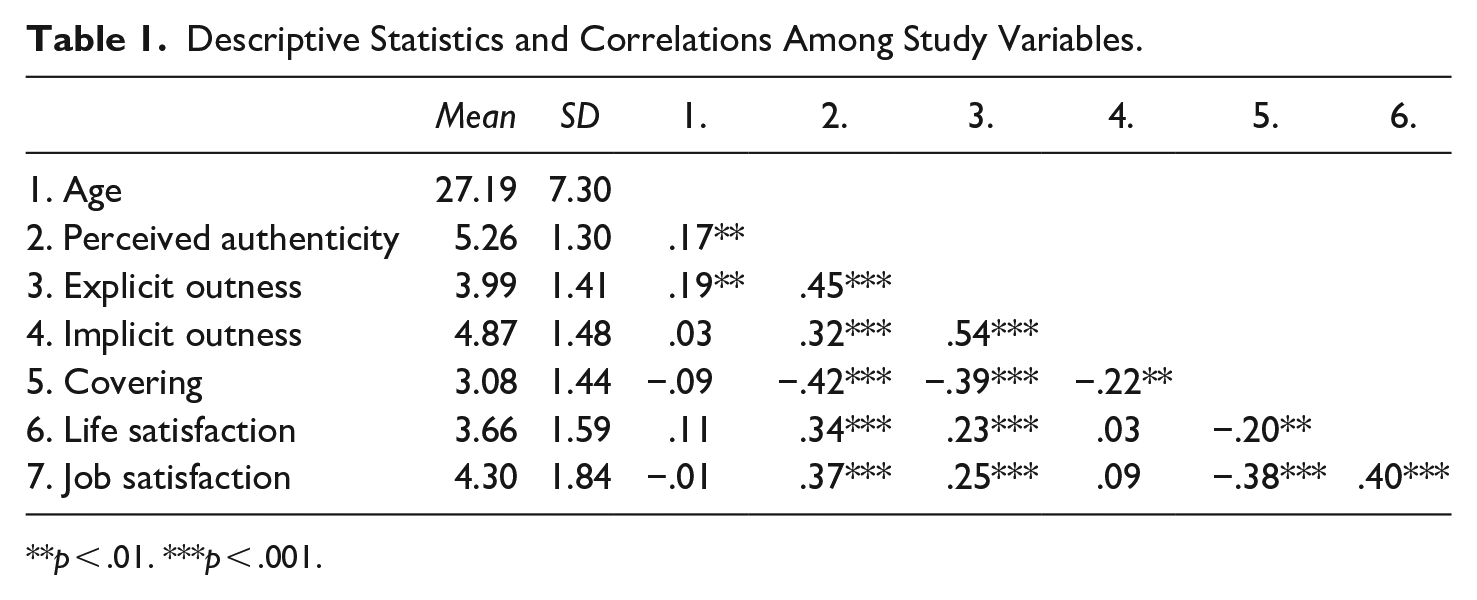
p < .01. ***p < .001.
Open-Ended Question
Finally, after participants had taken the survey, we asked: “Is there anything you would like to share about your trans identity at or outside of the workplace?” Sixty-seven participants responded with a total of 3,307 words. Following results from hypothesis testing, we briefly share verbatim quotes that highlight nuance in our quantitative findings (Tracy, 2019). Participant responses and voice are helpful in contextualizing and humanizing the findings tied to the planned structural model tested herein.
Results
Confirmatory Factor Analysis, Power, and Hypothesized Structural Model
We used the r package “lavaan” 0.6.15 (Rosseel, 2012) to compute a confirmatory factor analysis (CFA). The CFA and structural equation model (SEM) used the maximum likelihood estimator, and CFAs used the variance standardization method (for a description, see Kline, 2016). The initial CFA model did not fit well: χ2 = 504.42, df = 180; RMSEA = 0.10, CFI = 0.86, and SRMR = 0.17. However, model fit improved substantially with the exclusion of items with low shared-variance to the latent and as detailed above, we pruned one item from covering and one from perceived authenticity (DeVellis & Thorpe, 2021). In addition, modification indices suggested model improvement by allowing two indicators for explicit outness to covary. The final CFA model fit well (Hu & Bentler, 1999): χ2 = 255.66, df = 173; RMSEA = 0.05, CFI = 0.96, and SRMR = 0.06.
A post hoc power analysis was conducted to determine if the covariance structure was sufficiently powered to yield stable fit indices. Specifically, we followed MacCallum et al.’s (1996) method of calculating power using null and alternative RMSEA values. This method relies on the confidence intervals associated with the given model and sample parameters. We used Preacher and Coffman’s (2006) power and sample size tool for generating R syntax and set an alpha value of .05, used the reported RMSEA and df, and an alternative RMSEA = .08. The analysis indicated that our sample is sufficiently powered to detect accurate model fit at 1.00.
We next conducted a structural equation model (SEM) as specified in the hypotheses. The overall model fit was acceptable when fit-indices are considered in concert, χ2 = 322.56, df = 178; RMSEA = 0.06, CFI = 0.94, and SRMR = 0.08, though the CFI-value is a bit low. Since the SEM constrains relationships with the hypothesized paths, it fit slightly worse than the CFA, but this model was still sufficiently powered at 0.81. This model is depicted in Figure 1.
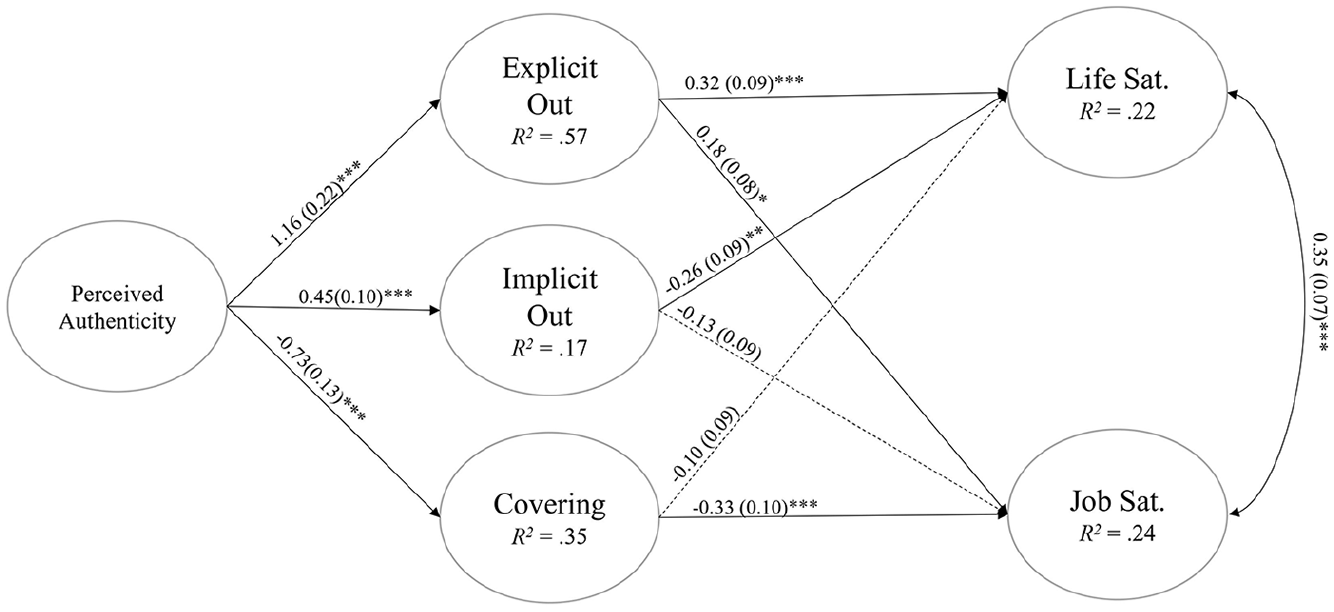
Hypothesized model.
Main Effects
Hypothesis 1 predicted that perceived authenticity would be associated with each identity communication variable. H1a was supported by a positive relationship between authenticity and explicit outness (b = 1.16, SE = 0.22, p < .001). H1b was also supported by a positive relationship between authenticity and implicit outness (b = 0.45, SE = 0.10 p < .001). Lastly, H1c was supported by a negative relationship between authenticity and covering (b = −0.73, SE = 0.13, p < .001). H1a, H1b, and H1c were all supported as authenticity predicted identity communication, consistent with our approach to the crystallized self.
Hypothesis 2 predicted that explicit outness would be positively related to both outcomes. H2a was supported by a positive relationship between explicit outness and life satisfaction (b = 0.32, SE = 0.09, p < .001). H2b was also supported as explicit outness was positively associated with job satisfaction (b = 0.18, SE = 0.08, p = .021).
Similarly, H3 predicted implicit outness would be positively related to both outcomes. H3a was not supported as there was a negative association between implicit outness and life satisfaction (b = −0.26, SE = 0.09, p = .004). H3b was also not supported because of a nonsignificant relationship between implicit outness and job satisfaction (b = −0.13, SE = 0.09, p = .126).
In contrast, H4 predicted a negative relationship between covering and outcomes. H4a was not supported as there was no significant relationship between covering and life satisfaction (b = −0.10, SE = 0.09, p = .275). However, H4b was supported because of a significant negative relationship between covering and job satisfaction (b = −0.33, SE = 0.10, p < .001).
Among the identity communication variables, nuanced relationships emerged in the structural model. Authenticity predicted each form of identity communication in the hypothesized direction, supporting H1. In all, authenticity predicted 57% of the variance in explicit outness, 17% in implicit outness, and 35% in covering. Explicit outness was positively associated with both job and life satisfaction, supporting H2. Implicit outness was negatively associated with life satisfaction and not significantly related to job satisfaction, contradicting H3a with no support for H3b. Finally, against H4a, covering was unrelated to life satisfaction, but supporting H4b, covering was negatively associated with job satisfaction. We next consider the indirect effects in this model.
Indirect Effects
We used the phantom model approach (Macho & Ledermann, 2011) with 10,000 bootstrap estimates to test for indirect effects between authenticity and outcomes. The phantom model approach entails creating a duplicate latent model that represents specific indirect effects through defined latent parameters derived as part of the total effects present in the main model. Like the model for hypothesis testing, the phantom model is constructed of latent variables, but in the phantom model parameters are constrained to facilitate comparison of effects (Macho & Ledermann, 2011). The phantom model approach also facilitates “bootstrapped confidence intervals which are usually superior to those computed by means of the delta method, especially with small sample sizes” (p. 34). Two indirect effects did not include zero in the confidence interval (CI) and were statistically significant. Specifically, there was an indirect effect of explicit outness in the relationship between authenticity and life satisfaction (b = 0.38, SE = 0.16, 95% CI[0.04, 0.79]), partially supporting H5a. In addition, there was a significant indirect effect on the relationship between authenticity and job satisfaction via covering (b = 0.28, SE = 0.14, 95% CI [0.06, 0.60]), partially supporting H7b. In all, H5a and H7b were partially supported, but all other indirect effects (H5b, H6a, H6b, H7a) were not significant (see Table 2).
Indirect Effects.
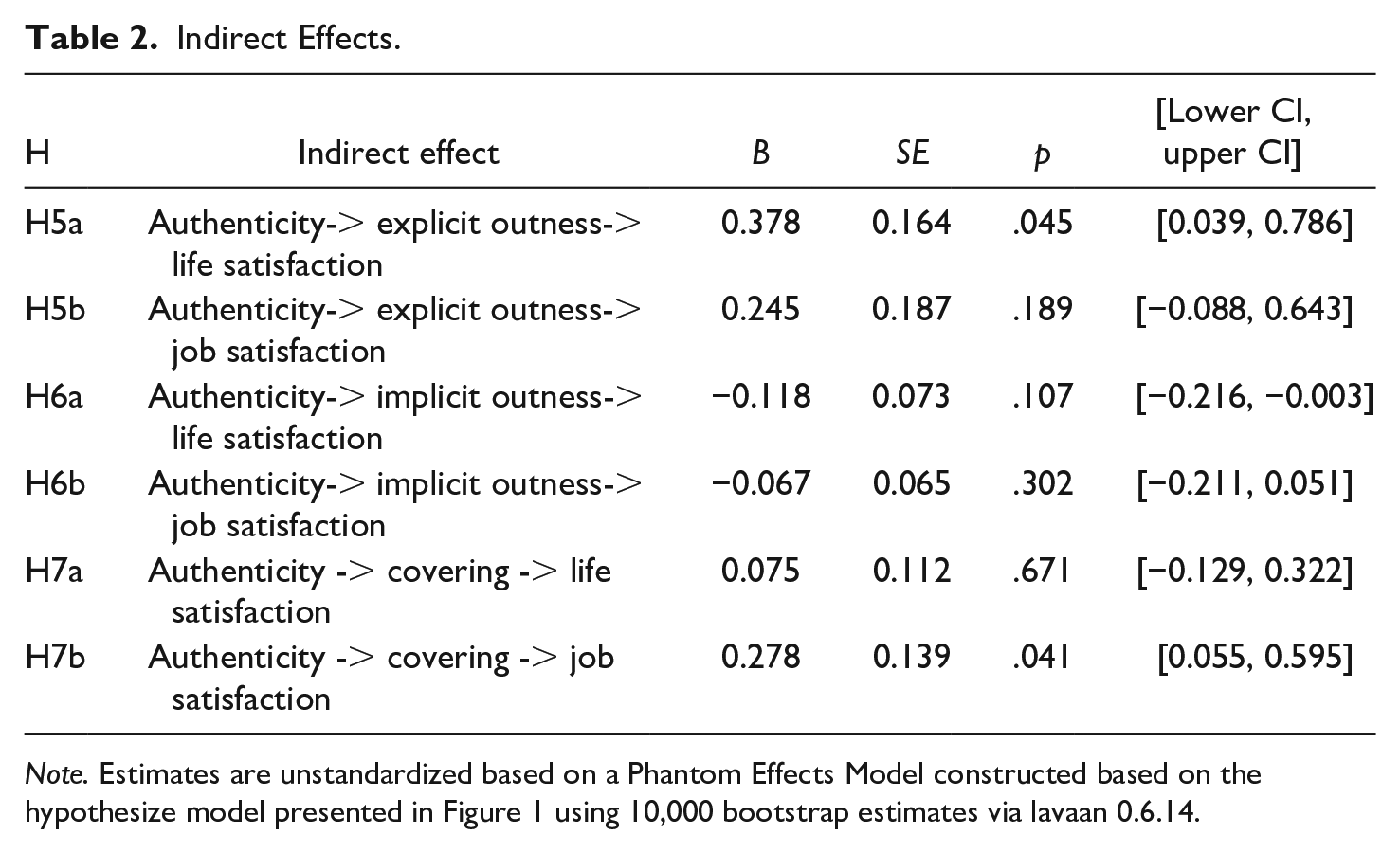
Note. Estimates are unstandardized based on a Phantom Effects Model constructed based on the hypothesize model presented in Figure 1 using 10,000 bootstrap estimates via lavaan 0.6.14.
Post Hoc Participant Insights
The original conceptualization of the crystallized self acknowledges the intricacies of managing organizational and social discourses that may compete with an individual’s self-expression. Tracy and Trethewey (2005) emphasize developing “alternate subject positions” and incorporating “multilayered notions of the self in research methodologies” (p. 185). Thus, participants’ insights provide examples illustrative of the unique experiences of trans folks navigating identity presentation in the workplace and allow for a more comprehensive understanding of identity crystallization. We briefly present a few responses to the open-ended question included at the end of our survey, which allowed participants to talk about their trans identities and work. This post hoc addition is meant to add participant voice and context regarding the process and tensions of crystallization revealed in our statistical findings.
Participant insights emphasize the difficulty of navigating cisnormative organizational environments and their preferred sense of self depending on when and with whom they shared their identity. Many participants recounted tailoring their identities to meet a work environment’s organizationally preferred self, downplaying aspects of their trans identity in the process. One participant wrote: “The job is too new, I’m still feeling out whether my identity would be accepted.” Another pointed out challenges in presenting with varied audiences: “Among staff I’m much more open, but with clients I need to stay as neutral about literally everything. . .to avoid assault” because “I never know who I’m going to get as a client.” Other responses also emphasized presenting different facets of self in different contexts, noting that revealing one’s identity “highly depends where I’m at.”
Participants also reflected the dominant managerial discourse relative to themselves. For instance, one participant wrote: “Being trans in the workplace usually requires being fully cis-passing, otherwise there is a large amount of hostility from both customers and coworkers.” Some saw the dominant discourse as inhibiting their ability to engage in crystallization, as HR management and organizational structures and policies forced disclosure: “One of my biggest issues is how careless jobs are with revealing deadnames, it’s printed on the schedule every week and I have to scribble over it and write my name.” Another participant shared how, inside and outside of work, identity crystallization is challenged by policies, documents, and emotional labor:
It’s very hard to be trans at work. Even if it’s not overt transphobia. . . there’s just things that people say or do that make it alienating. Not only that, but I’m someone who doesn’t have my documents consistent with my documentation which basically instantly outs me to people who see that information. . . it also makes it absurdly difficult to find another job because few people want to hire trans people.
However, other participants talked about being supported by the organizations and being able to enact a crystallized self: “Out of all of the jobs I’ve had, my most current organization is where I’ve felt the most comfortable expressing my identity. I am even able to use my pronouns on my name tag. Things must be improving.” Another shared: “My last job was at [Supermarket Chain]. I specifically chose to work there so that I could be as comfortably trans as I wanted to be and honestly it was the best employment decision I have ever made.” The responses participants shared highlight the interplay of organizational conditions and participants’ efforts toward identity crystallization. This small set of responses adds to our statistical findings about the varied and tension-laden process of expressing one’s preferred self at work. These quotes also serve as an invitation for future research to explore crystallized trans identity with more rigorous and interpretive or critical methods (Tracy, 2019).
Discussion
This study examines how perceived authenticity and various forms of identity communication (i.e., explicit outness, implicit outness, and covering) capture crystallization of the self to predict life satisfaction and job satisfaction for trans folks. Results show that perceived authenticity is positively related to explicit outness and implicit outness and negatively related to covering. Explicit outness is positively associated with both job and life satisfaction, while implicit outness was negatively associated with life satisfaction, and covering was negatively associated with job satisfaction. We also found two substantive indirect effects between authenticity and these outcomes via identity communication; specifically, there was an indirect relationship between authenticity and life satisfaction via explicit outness and a relationship between authenticity and job satisfaction via covering. These findings further extend the discussion regarding the “real-self ↔ fake-self” dichotomy, which is central to crystallized identity theorization (Tracy & Trethewey, 2005). Below, we share how these findings recast and extend existing theory, then present practical implications.
Theoretical Implications
Feeling Authentic
To test the crystallized self, we measured both perceived authenticity and identity communication. Our approach to crystallized self, a poststructuralist critical empirical theory, comes through a novel operationalization that “blur[s] the paradigmatic edges” of this theory (Tracy, 2019, p. 47). Doing so both reveals and conceals aspects of “crystallized self” as theorized. We came to this approach followingprevious research on trans identity and authenticity that highlights the dynamic and, at times, contradictory nature of authenticity and identity expression (Hennekam & Ladge, 2023). These findings reveal the overlap between how one feels (i.e., being true to the self and behaving in line with values and beliefs) and communicates. When one feels they are authentic in their behavior, this behavior presents in communicative acts and is associated with increased job and life satisfaction.
Measuring perceived authenticity and identity communication as a proxy for crystallized self as a way to highlight the multifaceted nature of identity shows promise. Although Tracy and Trethewey (2005) push back against using the term “authenticity,” instead advocating for “preferred self,” perceived self-authenticity and identity communication are central to crystallized self. McEwan and Flood (2018) argue that while authenticity is relative, “different sides of the crystallized self may be more appropriate to present to particular audiences at particular times” (p. 1717). The post hoc quotes from participants reiterate this claim. Thus, our findings align with Tracy and Trethewey’s (2005) argument that it is essential to recognize all aspects of self are important, and that inauthenticity manifests in communication.
Participants engaged in crystallization when they were able to be open about their trans identity. Being open about their identities merges what is often conceptualized as a “nonwork” identity within their organizational environment, thus breaking away from the “real-self ↔ fake-self” discourse. When our trans participants felt they consistently engaged at work in ways that aligned with their overall sense of self, they were more likely to communicate their identities implicitly and explicitly and were less likely to distance themselves from their identities (i.e., covering). In turn, this crystallized self led to beneficial outcomes regarding work and life outcomes, showing the importance of being able to liberate oneself from the “real-self ↔ fake-self” dichotomy.
Communicating (In)Authentically
In line with our hypotheses, the results show that varied forms of identity communication are associated with both job and life satisfaction. In particular, life satisfaction is positively associated with explicit outness and, against hypotheses, negatively associated with implicit outness. Additionally, while explicit outness positively affects job satisfaction, covering has a negative effect.
Across these findings, explicit outness (e.g., verbal and nonverbal communication in ways that affirm one’s gender identity) at work is beneficial to both one’s life satisfaction and job satisfaction. This reveals the importance of communicating in ways consistent with how one sees oneself. Evidence already shows that workplaces supportive of diverse identities promote life satisfaction (Fletcher & Everly, 2021). This makes sense because personal identity pervades the complex fabric of work. As Jones (2020) explained, using participant quotes, “Unsurprisingly, being able to perform an authentic identity across contexts bolstered feelings of self-worth, which was signified by internal contentment, honesty with self (‘I can be who I am’), or recognition (‘people seeing me how I see me’)” (p. 260). Our findings that feeling authentic and explicitly communicating about one’s sense of self are not particularly surprising, but they add to the growing evidence and theory suggesting value in communicating the self holistically, especially at work (Sutton, 2020; Tracy & Town, 2020).
Interestingly, implicit outness at work had a negative relationship to life satisfaction. This relationship emerged despite nonsignificant correlations between implicit outness and either outcome (see Table 1). While this may seem surprising, we feel confident in the result—this negative relationship reflects the value of SEM. This statistical suppression effect (i.e., an effect not present in the correlations is present in the structural model) is “due to controlling for other predictors” in the structural framework (Kline, 2016, p. 37). Indeed, this relationship is not just about statistical suppression but can also be attributed to identity suppression, whereby one is not explicitly out (which bears a strong positive effect on life satisfaction) but is implicitly or covertly advocating for their identity (e.g., making objections to anti-trans talk, supporting trans depictions in media).
Furthermore, the negative relationship between implicit outness and life satisfaction may also be telling of the emotional labor tied to socially stigmatized identities that are often associated with a diminished voice (Jones, 2020). There is nuance in being out as a trans individual, emphasizing the complexities of identity communication and, thus, crystallization. In all, implicit outness makes sense as an advocacy strategy; indeed, it is strongly and positively correlated with explicit outness and negatively with covering. But alone, implicit identity communication is not enough to increase job or life satisfaction. Further, when implicit outness is considered alongside explicit outness communication, its role in self-expression does not translate into life satisfaction.
As expected, covering at work had a negative relationship to job satisfaction, but it was unrelated to life satisfaction. Both findings are interesting because these relationships reiterate the claims by Tracy and Trethewey (2005) that suppressing one’s identity can harm or negatively reinforce one’s sense of self. Specifically, the crystallized self offers three potential mechanisms to explain disconnects in facets of identity: self-subordination (prioritizing a work-self over other identities), perpetually deferred self (putting off identity portrayals to meet perceived work discourses), and auto-dressage (evaluating the self in light of internalized managerialist discourse; Tracy & Trethewey, 2005). Though additional data is necessary to decipher which, if any, identity suppression might be at play, we suspect each could offer a potential explanation for the effects of implicit outness and covering. Those who cover their identity directly or conceal it by advocating for others (but not explicitly for the self) may be reinforcing and internalizing social stigmas tied to such identities. The lack of relationship between both covering and life satisfaction and implicit outness and job satisfaction may signal how each communicative behavior affects varied domains of the self for individuals, with some communication mattering more in one context than another (McEwan & Flood, 2018).
Facets of the Crystal: The Effect of Communication in Context
The explanatory power of perceived authentic behavior and identity communication for trans folks at work is dramatic. In total, this model explained almost a quarter of the variance in both job (R2 = .24) and life satisfaction (R2 = .22). Additional theoretical contributions come from the indirect relationships between perceived authenticity and job and life satisfaction. These indirect paths reveal cleavages in the crystallized version of the self and reiterate that, like crystals, identities have varied facets. There was an indirect effect via explicit outness on life satisfaction and via covering on job satisfaction. These indirect effects highlight the value of being explicitly out about one’s identity in workplace communication. This facet is quite clear: Feeling that you can be authentic is tied to overt and explicit communication about the self, which in turn affects life satisfaction.
In conjunction, the second significant indirect effect was between perceived authenticity and job satisfaction via covering. Here, the negative relationship between perceived authenticity and covering and between covering and job satisfaction is additive. In the measure and in the analogy of the crystallized self, covering represents concealing part of the self. Unsurprisingly, given the tenets of crystallized self, inauthentic presentations of the self via communicative behaviors that cover one’s identity harm an individual’s satisfaction at work. Of course, workplaces are often not accepting or open, so trans and gender-nonconforming individuals may feel compelled to engage in covering as a survival strategy (McDonald & Kenney, 2021). In all, some inherent tensions arise in this process of identity crystallization.
Paradox and the Crystallized Self
A major tension that permeates crystallized self theorizing is an assumption that individuals are free to express their identities or to enact their “preferred self” (Tracy & Town, 2020, p. 5). Tracy and Trethewey (2005) acknowledge that social and environmental discourses constrain who a person “is” in the eyes of others but nonetheless conclude that “a space for agency lies in the ability to traverse, intersect, and hold in tension competing discourses and attendant ways of being” (p. 188). In this view, “crystallized selves” are idealized versions of the self that are perceived as authentic and, therefore, harmed less by societal discourses. Furthermore, they contend that those who engage in crystallization will be happier, less burned out, and more satisfied. While there is evidence here and in existing publications that authenticity has positive implications for well-being (e.g., increasing job satisfaction and decreasing perceived discrimination; Martinez et al., 2017; Sutton, 2020), the challenges tied to dominant heteronormative and cisnormative discourses cannot be ignored (Jones, 2020).
Much of our discussion has embraced a beneficial view of authenticity, but as people with competing and complex identities, we recognize that this is an unrealistically high bar.
Given this complex dynamic raised by crystallized notions of self and identity, especially identities that are stigmatized in the workplace, we recognize the privileged perspective the crystallized self takes on authenticity and acknowledge that it is not always feasible or reasonable to share about the self at work. Even our novel approach to crystallized self focused on trans identity at the risk of compressing complex workplace identities (McEwan & Flood, 2018). Trans folks and others who hold one or more of the numerous personal attributes and experiences that are stigmatized (e.g., getting divorced, being a member of a minority religious group, living with a disability) are often not afforded the ability to be authentic.
Moreover, authenticity and identity crystallization lend themselves to the narrative of “coming out,” which oftentimes overemphasizes the importance of identity disclosure, neglecting the nuanced situational, cultural, and contextual factors that shape one’s identity disclosure experiences (McDonald et al., 2020). Further, we must acknowledge that even when organizations create an environment that supports trans identities (such as well-established HR policies), individuals still may choose not to disclose their identity. Workplaces can and should create environments that afford LGBTQ+ individuals a choice in identity disclosure (Di Marco et al., 2024; Parkinson et al., 2019). While it is important to recognize individuals’ preference to disclose their identities, the literature also points to aspects like workplace support as facilitating identity disclosure and leading to better well-being outcomes. This emphasizes the tensions of any kind of identity disclosure, and researchers ought to recognize the constraints to identity communication while acknowledging the benefits.
Practical Implications
Queer theory lends valuable insight into the challenge of crystallization for trans people by encouraging work environments to embrace difference as part-and-parcel of all organizing processes (McDonald, 2015). We emphasize shifting the onus of identity crystallization to organizations themselves. Workplaces must take responsibility for creating an environment where trans individuals feel safe and supported in their identity and are treated with dignity. Organizations ought to build cultures that welcome and engage identities and perspectives that have been historically excluded from workplaces. We highlight the significance of supportive workplaces as a mechanism to foster a sense of personal agency, as emphasized by the practice of crystallization (Tracy & Trethewey, 2005), by giving rise to the opportunity and choice to engage in authentic communication. Thus, we reiterate the importance of the organization, managers, and coworkers in creating accepting social structures that benefit and lift all employees.
Inclusivity in the workplace is, at best, a critical value and hot topic and, at worst, a trend yielding insincere discussion. Our findings reveal that workers who feel uncomfortable sharing their full selves in the workplace suffer reduced life and job satisfaction. As McEwan and Flood (2018) contend, employees produce “identity presentations in line with [perceived] organizational needs and wants” (p. 1728). Our participants echo this consideration, talking about when, why, and how they feel comfortable sharing their identities.
Since recent evidence shows LGBTQ+ individuals have increased life satisfaction when supportive work environments are partnered with individual-level authenticity (Fletcher & Everly, 2021), we argue there is great value in creating cultures that value authentic living and authentic communication surrounding one’s identity in the workplace. Thus, work environments can encourage crystallization and reshape dominant discourses, especially discourses affecting individuals with marginalized identities. Such an effort by organizations would provide more agency for individuals to engage in more holistic identity communication, allowing their multifaceted identities and brilliance to refract rather than be flattened. This could involve workplaces taking the initiative to use inclusive language that transcends traditional gender binaries, providing allyship workshops to foster inclusivity, assessing policies to ensure they accommodate trans employees, and fostering interpersonal relationships, all of which are supported by existing research (Webster et al., 2018). We call for future research to explore how to create workplace conditions that value authenticity and explicit communication that reflects the self. Further, we call for additional research on creating supportive workplaces where all workers, regardless of their identity, can practice crystallization.
Limitations and Future Directions
Several important limitations are worth mentioning, and this study provides ample opportunities for future work. Initially, the findings of this study have a bias toward how trans individuals communicate in the workplace. For each scale (except life satisfaction), the questions were phrased to focus on communication in the workplace. However, it would be interesting to explore identity communication in everyday life. Further, the satisfaction with life scale we use (Diener et al., 1985) also has a dynamic temporal form (Pavot et al., 1998), which measures perceptions of past, present, and future anticipated life satisfaction, and might be useful for exploring how identity changes and future projection relate to crystallization.
Further, unfortunately, our sample was insufficient to include specific gender identities (e.g., masc, fem, or agender; binary, nonbinary, etc.) as a control variable, so future work will benefit from exploring how varied gender identities might be associated with crystallization. By understanding how cisnormativity operates in organizational environments, we can continue to disrupt binary constructs and further identify ways that workplaces can work to dismantle these normative ideals and create more inclusive environments. Future research should continue to explore inclusive ways to capture gender identity. Further crystallized self theorization often focuses on power and status as key dynamics affecting crystallization (Tracy & Trethewey, 2005); for example, those with high-status jobs may prefer their work-based identity attributes while those with low-status jobs might be more likely to prefer their non-work self. In this sample, we cannot make inferences based on participants’ status or power dynamics at work, but future research ought to explore this potential.
As with prior work using the trans identity communication scale, covering was the least reliable identity communication variable (see, Brewster et al., 2012) yet was implicated in several consequential findings. On the basis of this limitation, we urge caution and encourage expansion of the covering construct in future work. Covering is about distancing oneself from one’s trans identity and likely shares some variance with passing. Passing, in the trans community, refers to being perceived as cisgender (A. D. Anderson et al., 2020). Both concepts are predicated on the notion that individuals can conceal their transness in a sense, with passing sharing significant overlap with binary notions of gender as individuals may strive to be seen a certain way in order to pass. So, these concepts might apply well to trans individuals who fall within the binary, but non-binary trans folks (e.g., nonbinary, genderqueer, two-spirit) often have a more fluid gender presentation that often lends to a more visible trans identity, so covering or passing may be less relevant to their identity and experiences (A. D. Anderson et al., 2020; Miller & Grollman, 2015). This is one of the reasons we choose to focus on the interplay of perceived authenticity and communication as a manifestation of identity crystallization, and we invite future scholars to further problematize constructs that assume gender binaries. Further, a strength of our study is the focus on individuals who self-identify as trans (a narrower approach than LGBTQ+ sampling in much existing literature). We encourage future work that emphasizes the experiences of trans people in particular.
Another important limitation is our sampling strategy and the sample size included in this study. While we carefully screened the data and only included participants with relevant life experiences (i.e., who identified as trans and who had worked recently), these participants still represent a convenience sample. Additionally, the participant demographics are predominately white, with the majority being employed as well as having some form of higher education. Thus, our analysis largely overlooks how intersecting identities, like race, ability, and socioeconomic status, influence identity disclosure in the workplace. Further, though sufficiently powered, the sample size was just sufficient, and perhaps even low, relative to the tests we conducted (Wolf et al., 2013). Luckily, given the loading values and magnitude of relationships, the findings seem tenable. Lastly, as with any cross-sectional data, it is not appropriate to make causal inferences from these findings. Indeed, while we report the findings where perceived authenticity precedes identity communication (with moderate effect sizes), only a randomized experiment or longitudinal analysis could demonstrate causality.
Alongside limitations based on the study’s design, there are valuable avenues for future research regarding additional theories and perspectives to provide more insight into the operationalization of the crystallized self. First, our study only accounted for how trans individuals currently perceived their identity presentation at work. Organizational contexts constrain and enable behavior so it is essential for future research to consider the organizational environment and the implicit and explicit messages trans workers receive that communicate preferred organizational identities, as emphasized by our participants’ insights. Thus, we encourage qualitative, critical, and mixed-methods studies that can showcase these messages to provide more nuance to the processes shaping crystallized identity in ways not fully addressed with quantitative research alone.
In addition, other theories, such as the Communication Theory of Identity (CTI; Hecht et al., 2005), might be paired with the metaphor of the crystallized self to add depth to the conversation about authenticity and identity communication. CTI has been applied to qualitatively understand how trans individuals navigate identity disclosure (Nuru, 2014; Wagner et al., 2016), and the concept of identity gaps could work nicely with the metaphor of the crystallized self to emphasize presenting different facets of self in various contexts. Measures such as Jung and Hecht’s (2004) identity gap instrument have fruitfully been applied to explore how relational dynamics affect communicative outcomes (e.g., Rubinsky, 2019). The two constructs of personal-enacted identity gaps and personal-relational identity gaps likely capture self-authenticity and relational-communication dynamics, which our study demonstrates are important to trans workers’ identity management. So, CTI and its accompanying measures could couple nicely with exploring how crystallization unfolds temporally, as crystallization spans time and space as it is enacted in unique moments across daily activities (Tracy & Trethewey, 2005).
Conclusion
This study analyzed survey data from 206 trans individuals who were currently or recently employed to test the tenets of the crystallized self. Findings from an SEM generally support the theory and extend understanding about how trans individuals’ communication surrounding their identity in the workplace leads to both life and job satisfaction. The SEM reveals nuance in the relationship between perceived authenticity, identity communication, and job and life satisfaction. Explicit outness, which involves overt communication behaviors that share one’s trans identity, was positively associated with perceived authenticity and, in turn, positively related to both job and life satisfaction. Covering communication, which involves distancing from one’s trans identity, had negative relationships with both perceived authenticity and job satisfaction. Further, implicit outness (advocacy about trans matters) had a negative relationship with life satisfaction in the structural model. We interpret this structural relationship in light of both the strong positive relationship between life satisfaction and explicit outness and the value of being explicitly out. Finally, indirect effects between perceived authenticity and life satisfaction via explicit outness and between perceived authenticity and job satisfaction via covering reveal the nuance of identity crystallization across contexts. In all, we take these findings as additional support and extension surrounding the tensions of the crystallized self and suggest both implications and future work to understand how workplaces can support trans individuals.
Supplemental Material
sj-docx-1-crx-10.1177_00936502241234840 – Supplemental material for Crystallized Trans Identity: How Authenticity and Identity Communication Affect Job and Life Satisfaction
Supplemental material, sj-docx-1-crx-10.1177_00936502241234840 for Crystallized Trans Identity: How Authenticity and Identity Communication Affect Job and Life Satisfaction by Rebecca J. Baumler and Cameron W. Piercy in Communication Research
Footnotes
Date Availability Statement
The data underlying this article cannot be shared publicly due to approved protocol. The data will be shared on reasonable request to the corresponding author.
Declaration of Conflicting Interests
The authors declared no potential conflicts of interest with respect to the research, authorship, and/or publication of this article.
Funding
The author(s) disclosed receipt of the following financial support for the research, authorship, and/or publication of this article: This work was funded by the Department of Communication Studies at the University of Kansas.

Supplemental Material
Supplemental material for this article is available online.
Author Biographies
References
Supplementary Material
Please find the following supplemental material available below.
For Open Access articles published under a Creative Commons License, all supplemental material carries the same license as the article it is associated with.
For non-Open Access articles published, all supplemental material carries a non-exclusive license, and permission requests for re-use of supplemental material or any part of supplemental material shall be sent directly to the copyright owner as specified in the copyright notice associated with the article.
