




Abstract
Social media expose users to an abundance of information about various issues. But they also make it difficult for users to assess the quality of this information. If users do not recognize this, they may overestimate their knowledge about those issues. Knowledge overestimation may lead to increased social media engagement and can be linked to attitudes deeming expert knowledge inferior to common sense, such as science-related populist attitudes. We investigate this during the COVID-19 pandemic in two preregistered, cross-sectional survey experiments in Germany and Taiwan, two countries with different cultures, media environments, and responses to the pandemic. Our study offers two contributions: First, we develop a novel measure of COVID-19-related knowledge. Second, we provide comparative evidence on how social media affordances shape the interplay between knowledge overestimation, social media exposure and engagement, and populist attitudes. We do not find that frequent exposure to COVID-19 information is associated with a higher likelihood of knowledge overestimation. However, we show that overestimation is linked to more user engagement with social media content about COVID-19. Experimental data indicate that engagement depends on whether users are in a private or public communication environment. We find minor differences between Germany and Taiwan.
Introduction
People who know little about a topic often think they are more knowledgeable than they actually are (Kruger & Dunning, 1999). Such a discrepancy between self-perceived and actual knowledge has been conceptualized as knowledge overestimation. It is one of multiple metacognitive phenomena 1 that were summarized as overconfidence (Moore & Schatz, 2017).
Knowledge overestimation can have negative implications in contexts where scientific expertise is important. For example, it is associated with less adherence to policies recommended by scientists (Teovanović et al., 2021) and support for pseudo-scientific ideas (Arroyo-Barrigüete et al., 2023). It is also conceptually related to skepticism towards the knowledge claims of epistemic authorities (Haim & Neuberger, 2022) and “science-related populism,” which describes a preference for people’s common sense over the expertise of academic elites—and thus also implies appreciation of personal lay knowledge and depreciation of external expert knowledge (Mede & Schäfer, 2020).
Knowledge overestimation can also be linked to exposure to and engagement with science-related information on social media, such as social networking sites (SNS) and instant messengers (IM). SNSs and IMs have many differences (e.g., public vs. semi-public/private communication), but also an important similarity: Both give users access to an abundance of scientific information—but they may not necessarily allow users to recognize that some of this information is false, because the properties and features of SNSs and IMs (their “affordances”) can cause users to suspend credibility judgments (Yamamoto & Yang, 2022). Knowledge overestimation may also be associated with higher engagement with social media content about science, as people who overestimate their abilities tend to be more outspoken (J. Yang & Tian, 2021). Users who overestimate their knowledge may engage more on social media both in publicly visible settings (e.g., in public social media groups) and in private spaces (e.g., in private chat messengers), because they are often less afraid to speak out regardless of whether they are in public or private settings (Ronay et al., 2017).
The interplay of knowledge overestimation, social media exposure and engagement, visibility of such engagement, and science-related populism can challenge the legitimacy of scientific institutions and prevent an informed public. It may thus diminish the ability of societies to effectively respond to political, economic, environmental, and health crises. Research on this interplay is therefore highly relevant, particularly in the context of the COVID-19 pandemic, one such crisis where scientific knowledge played a key role. However, it has several limitations. First, most research lacks theoretically informed and empirically validated measures for knowledge overestimation. Many studies employed measures that asked respondents to assess COVID-19 statements whose veracity was not entirely clear at the time of data collection (see Krause et al., 2022), did not cover different conceptual dimensions of knowledge (Howell & Brossard, 2021), measured self-reported overestimation (e.g., Arroyo-Barrigüete et al., 2023), or did not include background knowledge about virology and epidemiology, which is important to contextualize knowledge about COVID-19 specifically (e.g., Teovanović et al., 2021). Second, there is yet no systematic research on the relationship of knowledge overestimation, social media use, and science-related populism during the COVID-19 crisis, which is a scientific issue unlike others, as particularly strong public demand for reliable scientific knowledge met high uncertainty of such knowledge (T. Lee et al., 2023). For example, few studies have examined semi-public or private communication environments like instant messengers, even if these provide distinct affordances for credibility judgments and thus potentially distinct conditions for knowledge overestimation (Sundar, 2008). Moreover, studies considering the role of science-related populist attitudes are scarce, even if these attitudes were described as particularly relevant during the COVID-19 pandemic (Staerklé et al., 2022) and correlate with people’s knowledge about science (Mede et al., 2022) and social media behavior (Mede et al., 2023). Third, few studies examined non-Western countries, albeit research suggests that the media environments of East-Asian countries like Singapore provide different conditions to knowledge overestimation than those of Western countries like the United States (S. Lee, Yamamoto, & Tandoc, 2022).
We tackle these gaps with two preregistered cross-sectional surveys in Germany and Taiwan (N = 2,882) that examine the following research question: How do knowledge overestimation, social media exposure and engagement, public visibility of such engagement, and science-related populist attitudes interact with each other during the COVID-19 pandemic?
Our study goes beyond previous research as it (1) develops and applies a novel, comprehensive measure of COVID-19-related knowledge, (2) considers both social networking sites and instant messengers and distinguishes between them, (3) tests how knowledge overestimation and social media engagement interact in situations where engagement is publicly visible versus not publicly visible, (4) examines the role of science-related populist attitudes, and (5) compares a Western with a non-Western country. We selected Germany and Taiwan to compare whether their different cultures and (online) media environments affect people’s perceived and actual knowledge, such as that knowledge overestimation may be more likely in Taiwan, where messaging services are an important news source (see Rauchfleisch & Chi, 2020). Germany and Taiwan also exhibit different intensities and varieties of science-related populism, with Taiwan showing less resilience against it than Germany (Mede, 2023b), potentially because of an eroding “cultural authority of science” (Li & Tsai, 2019, p. 192) and civic movements critiquing knowledge claims of political elites (Fan, 2023). In addition, the two countries vary in how experienced they are in dealing with epidemic diseases, how severely they have been affected by the COVID-19 pandemic, and how they have coped with it. Taiwan, which faced the SARS and MERS outbreaks in 2002 and 2012, enforced comparably strict COVID-19 containment policies and registered only 4.6 COVID-19 cases per 1,000 inhabitants until November 2020. Not a single case was reported during data collection (see Methods section). On the other hand, Germany had less rigorous regulations but as many as 351.5 cases per 1,000 inhabitants during the same period (Mathieu et al., 2020).
Literature Review and Concepts
Our study includes five concepts: overestimation of knowledge about COVID-19 and virology/epidemiology, science-related populist attitudes, SNS/IM exposure, SNS/IM engagement, and visibility of engagement (see Figure 1). Below we review relevant literature about these concepts and their relationships to derive our hypotheses.
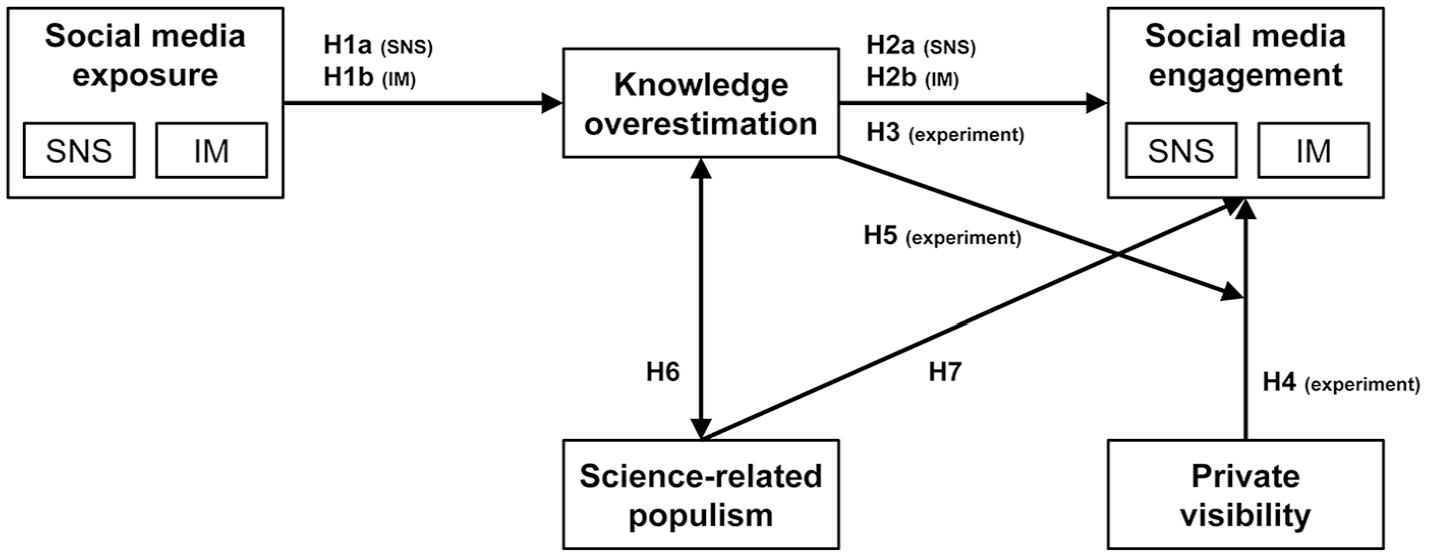
Hypothesized relationships of components investigated in this study.
Knowledge Overestimation
Metacognitive judgments—that is, assessments of one’s own cognitive abilities—are prone to flaws (Kahneman, 2011). One such flaw is that individuals with less competence tend to perceive themselves as more competent than they actually are (Kruger & Dunning, 1999). Scholars have described many variants of inflated self-assessments like these, analyzing different domains (knowledge, skills, traits) and reference points of assessments (comparisons to peers, experts, pre-defined benchmarks, prior self-assessment). Flawed metacognitive judgments have been observed for several topics, including science (Drummond Otten & Fischhoff, 2023) and science-related issues like climate change and vaccination (Light et al., 2022), and were studied in many countries, including Germany (Pieschl, 2021), South Korea (Chang et al., 2018), and Singapore (S. Lee, Yamamoto, & Tandoc, 2022).
One variant of inflated self-assessment that has been considered detrimental to individual and societal well-being is knowledge overestimation. It may undermine the legitimacy of expert knowledge and prevent an informed public in situations where these are crucial, such as the COVID-19 pandemic. Our study therefore focuses on knowledge overestimation, which we define as the degree to which people’s perceived knowledge exceeds their actual knowledge (Teovanović et al., 2021).
Knowledge overestimation may have been especially prevalent during the COVID-19 pandemic, because people often ignore or downplay the limits of their knowledge in times of crisis, in situations where knowledge is uncertain, and in settings where appearing knowledgeable is socially desirable (Gaviria & Corredor, 2021; van Prooijen & Douglas, 2017). Empirical studies have indeed shown that many people overestimated their knowledge about COVID-19 symptoms, treatments, and infection risk, as well as their ability to detect false or misleading information about the pandemic (Gerosa et al., 2021; Glöckner et al., 2020; Lyons et al., 2021; Martínez-Costa et al., 2023; Piehlmaier et al., 2023). However, these studies focused on factual knowledge about COVID-19 specifically, some of which was uncertain at the time of data collection. Yet, science education and communication research conceptualizes knowledge as a multidimensional construct that also includes procedural knowledge (i.e., knowledge about the science behind COVID-19-related facts; Chang et al., 2018), maintains that domain-specific knowledge depends on domain-general knowledge (e.g., about epidemiology and virology; Fischer, 2018), and suggests that assessing knowledge about the pandemic should consider the (un)certainty of knowledge, for example, the “fluidity of evidence about COVID-19 masking” (Krause et al., 2022, p. 113). This indicates that studies of knowledge self-perceptions, such as ours, should not only measure perceptions of one’s factual and domain-specific knowledge but also perceptions of one’s procedural and domain-general knowledge, and must consider the uncertainty of this knowledge. To the best of our knowledge, such measures do not yet exist for COVID-19, which is why we developed one for this study.
Further research showed that knowledge overestimation has attitudinal and communicative correlates, including choice and evaluation of social media content (Yu et al., 2023), attention to media messages (X. Yang et al., 2020), intentions to distribute false information in online media (Lyons et al., 2021), higher susceptibility to misinformation (J. Yang & Tian, 2021), willingness to express controversial opinions (Rios et al., 2018), as well as political views and anti-elite attitudes (van Prooijen & Krouwel, 2020). This suggests that it is crucial not to study knowledge overestimation in isolation but in concert with (social media) communication and individual attitudes towards (allegedly elitist) knowledge claims, such as science-related populist attitudes.
The Relationship of Knowledge Overestimation and Social Media Use
People’s tendency to overestimate their knowledge about an issue can be linked to two components of social media use—first, to how they use social media to get information about this issue (exposure) and second, to how they use social media to interact with such information (engagement). These links have been attributed to the “affordances” of social media, that is, to specific features and properties of these media that influence what users are able to do. For example, algorithmic recommender systems, which afford information exposure, may facilitate inflated knowledge self-assessments (van der Velden & Loecherbach, 2021). Sharing functions, which afford information engagement, were assumed to accommodate the communicative preferences of people who are overconfident about their cognitive abilities (J. Yang & Tian, 2021). Below we will explain that this leads us to hypothesize that COVID-19 knowledge overestimation is related to frequent exposure to social media information about COVID-19 (H1a/b) and higher willingness to engage with it (H2a/b and H4).
Importantly, affordances vary between social media—most notably between SNSs and IMs, which we both conceive as “social media” in this study as they both allow self-presentation and self-disclosure (Kaplan & Haenlein, 2010), enable users to form “intimate likeminded networks” (Gill & Rojas, 2020, p. 487), maintain social ties (Valeriani & Vaccari, 2018), and give people means to participate in social deliberation within “cyberspheres” (Papacharissi, 2002, p. 22). For example, IMs typically do not afford information exposure via algorithmic recommendation, and SNSs do not afford intimate engagement with others in the same way that IMs do (Gill & Rojas, 2020). These differences may affect whether higher exposure is associated with stronger knowledge overestimation, and whether overestimation increases engagement. Moreover, they are especially relevant when studying exposure to and engagement with information about issues where knowledge claims are politically debated and challenged by misinformation, because IMs’ affordances were found to be more conducive to discussing political opinions and distributing falsehoods than SNSs’ affordances (Gill & Rojas, 2020; Valeriani & Vaccari, 2018). One such issue is the COVID-19 pandemic, which makes it even more important to distinguish SNSs and IMs in our study.
Association of Social Media Exposure and Knowledge Overestimation
SNSs and IMs often expose users to an abundance of information, some of which is accurate and reliable, some of which is false or misleading (Tucker et al., 2018). But the affordances of SNSs and IMs can make it difficult for users to identify accurate knowledge claims, remember them, and be aware that these difficulties (Fisher et al., 2021; Z. Wang & Yu, 2023). Frequent social media exposure may thus be associated with a tendency to knowledge overestimation among users.
For example, an exposure-overestimation link can be afforded by popularity metrics of SNS, such as the number of likes, comments, or shares. Users may not realize that these can cue unreliable credibility judgments, leading them to treat inaccurate information as a valid source of knowledge (Waddell, 2018). Moreover, search, bookmarking, and filter functions of SNSs and IMs may trigger inflated knowledge self-assessments, because they tempt users not to remember new information as they know they can access them whenever they need it (Barr et al., 2015). Algorithmic and peer recommendations on SNSs can trigger similar mechanisms, as they may entice users to think that they will supply them with relevant information without searching for and memorizing it, which has been described as “news-find-me perception” (Apuke & Omar, 2021). Other affordances such as preview snippets in SNS feeds or IM apps may cause users to perceive themselves as more knowledgeable than they are, because frequent exposure to such snippets conveys a “feeling of knowing” (Schäfer, 2020) that users may erroneously equate with having profound knowledge (S. Lee, Diehl, & Valenzuela, 2022). Similarly, audiovisual appeals like videos or emojis may lead SNS and IM users to misjudge their knowledge, because people tend to overestimate how much knowledge they acquire from information that is entertaining and easy to comprehend (Daniel & Camp, 2020). Notably, knowledge overestimation depends on further factors, such as (a lack of) digital media literacy (Pieschl, 2021). Moreover, it may not only be an outcome but also a predictor of social media use (Yu et al., 2023). Yet overall, it can be assumed to be a function of frequent social media exposure.
Empirical research supports an exposure-overestimation link, suggesting that users barely acquire knowledge about scientific issues like nanotechnology on social media (Su et al., 2014), but often report feeling well-informed (Chang et al., 2018). However, research is inconclusive as to whether this also applies to knowledge about COVID-19: Nielsen et al. (2020), for example, do not find a positive relationship between social media use and COVID-19 knowledge in six countries, including Germany. However, several studies do suggest that SNS and IM users think they have more knowledge about the pandemic and lower susceptibility to false information about it than they actually do (e.g., Huynh & Senger, 2021; S. Lee, Yamamoto, & Tandoc, 2022). This is plausible given that the pandemic may have triggered people’s innate human desire to be or appear knowledgeable to overcome uncertainty when coping with existential crises (van Prooijen & Douglas, 2017). Accordingly, we assume a positive relationship of exposure to COVID-19 information on SNSs (H1a) as well as in IMs (H1b) and knowledge overestimation (see Table 1 for an overview of all hypotheses). We will explore whether this relationship differs between Germany and Taiwan. After all, their populations have been using different SNSs and IMs to get information about the pandemic and might have had different levels of knowledge about it at the time of data collection, for example, due to differences in news coverage and government information campaigns (Amann et al., 2021; Kuo et al., 2021).
Overview of Preregistered Hypotheses and Research Questions.
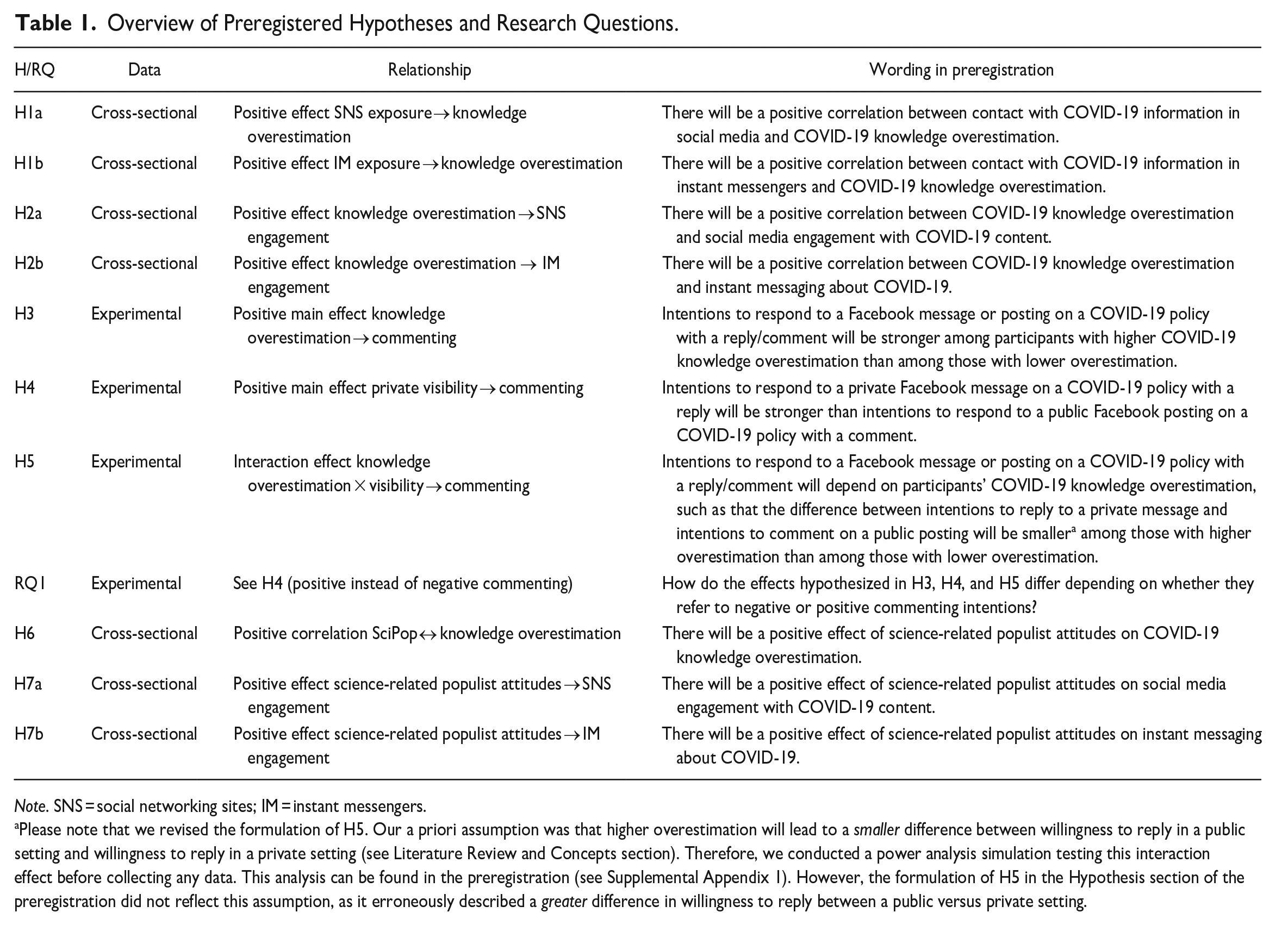
Note. SNS = social networking sites; IM = instant messengers.
Please note that we revised the formulation of H5. Our a priori assumption was that higher overestimation will lead to a smaller difference between willingness to reply in a public setting and willingness to reply in a private setting (see Literature Review and Concepts section). Therefore, we conducted a power analysis simulation testing this interaction effect before collecting any data. This analysis can be found in the preregistration (see Supplemental Appendix 1). However, the formulation of H5 in the Hypothesis section of the preregistration did not reflect this assumption, as it erroneously described a greater difference in willingness to reply between a public versus private setting.
Effects of Knowledge Overestimation on Social Media Engagement
SNS and IM users who perceive themselves as particularly knowledgeable about certain topics—including science—are often more willing to discuss them offline (Kim, 2019; Priest, 2006; Schäfer, 2020) and online, for example in social media comments or through other forms of engagement (Guo et al., 2019; Lu & Luqiu, 2020; Yamamoto et al., 2018). For example, J. Yang and Tian (2021) found that people who think they know much about the COVID-19 pandemic are more likely to share and interact with social media content about it. Pennycook et al. (2020) show that lower knowledge about science is associated with higher willingness to share social media posts containing false information about the pandemic. This leads us to assume that COVID-19 knowledge overestimation is associated with higher willingness to engage with social media content about COVID-19 in three ways. We hypothesize a positive effect of overestimation on willingness to post, like, or comment COVID-19 content (H2a), willingness to post such content in IMs 2 (H2b), and intentions to reply to an authentic social media post about a COVID-19 policy (H3).
Effects of Visibility of Social Media Engagement on Willingness to Engage
People’s willingness to engage with social media content may not only be higher when they overestimate their knowledge. It may also be higher if they assume that their engagement is not publicly visible, as they have less reason to fear social sanctions or disapproval for expressing controversial opinions (Kwon et al., 2015), while publicness often causes self-censorship (Chen, 2018). Environments with high visibility of user behavior, such as public SNS groups, may thus afford less engagement than environments with low visibility, such as IM chats (Valeriani & Vaccari, 2018). Accordingly, we hypothesize that willingness to reply to social media posts about COVID-19 is less likely in a public versus a private setting (H4).
Conditional Effects of Visibility and Overestimation on Willingness to Engage
Further research shows that overconfident individuals condition their actions on whether they happen in a private or a public environment (Radecki & Jaccard, 1995). In particular, people who overestimate their abilities tend to be less inclined to self-censor in public contexts than people with less inflated self-perceptions, possibly because they are less concerned about reputational damage (Ronay et al., 2017). We thus hypothesize that knowledge overestimation moderates the effect of visibility on willingness to reply to social media posts, with higher overestimation leading to a smaller difference between willingness to reply in a public setting and willingness to reply in a private setting (H5).
However, it is unclear if the relationship between knowledge overestimation, visibility, and willingness to reply is contingent upon the valence of comments: Users may be more inclined to respond to social media posts with positive comments if they think that favorable opinions about these messages are socially accepted, for example. On the other hand, they may be more willing to respond with negative comments if they believe that criticisms are warranted or desirable (Gearhart & Zhang, 2014, 2015; Hampton et al., 2014). Hence, we explore if the effects hypothesized in H3, H4, and H5 differ depending on whether they refer to positive or negative comments (RQ1).
How Science-Related Populism is Associated with Knowledge Overestimation and Social Media Use
Orientations towards science and its epistemology are associated with people’s perceptions of their own knowledge (Krumrei-Mancuso et al., 2020), so these orientations should be considered when analyzing knowledge overestimation of social media users. One variant of these orientations are “science-related populist attitudes” which suggest that “ordinary people,” and not an academic elite, should determine the production of “true knowledge,” because their common sense is allegedly superior to allegedly useless and ideologically biased scientific knowledge (Mede, 2023a). We focus on science-related populist attitudes, because they have been particularly relevant during the COVID-19 pandemic, as expert recommendations on how to approach it were challenged by popular demands for commonsensical decision-making in both European and East-Asian countries (Mede & Schäfer, 2022; Mietzner, 2020).
Association of Science-Related Populism and Knowledge Overestimation
Another reason why we focus on science-related populism is that it has conceptual similarities with knowledge overestimation. Both (unwarrantedly) favor people’s personal experience over expert knowledge (Giuliani & Presaghi, 2023; van Prooijen et al., 2022) and often go along with increased intentions to influence others in interpersonal communication or in public (Mede et al., 2023; M. K. Smith et al., 2017). However, a link between COVID-19 knowledge overestimation and science-related populist attitudes has not been tested yet—albeit it is plausible as overestimation was found to be associated with political populist attitudes (Rico et al., 2020), anti-establishment views (van Prooijen & Krouwel, 2020), conspiracy beliefs (Martini et al., 2022), and a preference for non-experts in policy-making (Motta et al., 2018). Lackner et al. (2023), for example, find that negative attitudes to science are most prevalent among people who are particularly confident about their science knowledge but actually have only intermediate knowledge. Hence, we expect a positive correlation of science-related populist attitudes and knowledge overestimation (H6) and will explore whether this correlation differs between Germany and Taiwan. We do not hypothesize a causal relationship as populist ideas about science may be both a predictor and an outcome of inflated self-perceptions.
Effects of Science-Related Populism on Social Media Engagement
Science-related populism and knowledge overestimation share another parallel. Both potentially thrive on SNSs and in IMs. Not only do these media offer conditions that facilitate knowledge overestimation (see above). They also accommodate populism, as their affordances “invite a ‘populist style’ of communication” (Hopster, 2021, p. 556). For example, SNSs and IMs afford the circumvention of editorial filters and easy dissemination of controversial claims—which allows populists to bypass presumed censorship of elite institutions when distributing their messages (Gerbaudo, 2018). Social media may thus provide science-related populist users with a “public arena” (Schroeder, 2019) in which they can spread their claims about COVID-19, perhaps hoping to convey what they deem “true knowledge” about the pandemic and influence public opinion about expert recommendations on how to contain it. Survey research supports this, showing that people with science-related populist attitudes or similar beliefs are more likely to disseminate their views on SNSs by commenting posts about science in general (Mede et al., 2023) and engaging with content about the pandemic in particular (Eberl & Lebernegg, 2022). Further research indicates a similar tendency for populist IM users, and it highlights that SNS and IM affordances affect engagement in different ways—albeit it is unclear how (Mosca & Quaranta, 2021) and whether differences are conditioned by the different IM adoption rates and media environments of Germany and Taiwan (Rauchfleisch & Chi, 2020). We thus assume a positive effect of science-related populist attitudes on willingness to engage with COVID-19-related content on SNSs (H7a) and in IMs (H7b) and will explore country differences.
Methods
In a first step, we conducted two pre-studies in Taiwan and Germany (N = 997) to develop a novel measure for knowledge overestimation. We then used this measure in our main study, which consisted of two preregistered cross-sectional online surveys (N = 2,882) in Taiwan (TWN) and Germany (GER). Hypotheses H1a/b, H2a/b, H6, and H7a/b were tested with cross-sectional data from these surveys (see Table 1). To investigate how knowledge overestimation influences social media engagement in a realistic online setting (H3), test causal effects of private versus public visibility on engagement (H4) as well as moderation effects of knowledge overestimation (H5), and explore how H3–H5 effects vary depending on whether engagement is disapproving or supporting (RQ1), we added a 1-factor experiment to the survey. The two outcome variables of this experiment were intentions to write a positive and a negative comment on a fictitious social media post in a private environment (Facebook messenger) or a public setting (Facebook group). We focused on commenting, because this form of engagement is a particularly useful indicator of overconfident/populist willingness to communicate personal claims, as compared to other forms of engagement that rather amplify others’ claims, such as liking or sharing existing posts. We also added a second experiment to the survey, whose results we do not report here (see Supplemental Appendix for more information).
All analyses presented in the main article and the Supplemental Appendices can be reproduced with the materials we share in a public repository at the Open Science Framework: https://osf.io/yrm8w/. The repository contains data, R code, as well as the original questionnaires.
Ethics Statement and Preregistration
The pre-studies and the main surveys were approved by the Research Ethics Committees of the University of Münster and the National Taiwan University. Participants provided informed consent before taking the surveys and were debriefed at the end. All studies were preregistered at the Open Science Framework (see Supplemental Appendix 1).
Data
Respondents of both the pre-studies and the main surveys were recruited from online panels (TWN: Rakuten Insight; GER: Respondi). The pre-studies were conducted in May 2020 with a valid sample of n = 460 for Taiwan and n = 537 for Germany. The main surveys including the experiment were conducted in November 2020 and had a valid sample of n = 1,295 for Taiwan and n = 1,587 for Germany (see Supplemental Appendix 6).
To estimate sample sizes required to achieve enough statistical power to test our experimental hypotheses (H3–H5), we ran simulation-based power analyses. We aimed for a minimum power of 0.80 with an α level of 0.05, which are established thresholds (Arend & Schäfer, 2019). The simulation 3 indicated that we needed 700 participants in each country to exceed the 0.80 threshold. We sought to achieve even higher statistical power to identify small effects, so we aimed for 1,000 participants in Germany (but not in Taiwan due to budget constraints). These sample sizes gave us for both countries a power of >0.99 to detect the H4 main effect and a power of 0.83 (TWN) and 0.94 (GER) to detect the H5 interaction effect. Power analyses for the second experiment not reported in this article suggested that we needed another 600 participants. After data cleaning, our final sample sizes were n = 1,295 for Taiwan and n = 1,587 for Germany. The samples of these surveys were representative for the German and Taiwanese populations in terms of gender, education, and to some degree for age (see Supplemental Appendix 6 for a note on sample representativity). To ensure data quality, we ran plausibility, satisficing, and speeding checks and used two attention screeners at the beginning of the survey and during the knowledge measurement.
Measures
COVID-19 knowledge overestimation was measured with a continuous score that indicated the difference of perceived knowledge minus actual knowledge about COVID-19 as well as virology/epidemiology. This score operationalized our definition of knowledge overestimation precisely (see section “Knowledge Overestimation”). It allowed us to distinguish between individuals who overestimate their knowledge (positive values), have accurate knowledge self-perceptions regardless of how knowledgeable they are (values close to zero), or underestimate their knowledge (negative values). Unlike other studies, our regression models did not include two separate scores for actual and perceived knowledge (S. Lee, Yamamoto, & Tandoc, 2022) and interaction effects of the two scores (Pennycook et al., 2017). Nevertheless, we additionally report results from models that use these alternative approaches in Supplemental Appendix 9, which corroborate the findings presented below.
The knowledge overestimation score was obtained with a new multi-dimensional 16-item inventory, which we developed and validated before the main study in two pre-studies. It had two components (actual and perceived knowledge), each of which addressed 2 × 2 dimensions (factual and perceived knowledge × COVID-19 and virology/epidemiology knowledge) and used fact-checked statements with high scientific certainty (see Table 2). Our knowledge measure compensates multiple shortcomings of existing measures (see section “Knowledge Overestimation”). It distinguishes between factual and procedural knowledge, differentiates domain-general and domain-specific knowledge, accounts for the “fluidity of evidence” on COVID-19 (Krause et al., 2022, p. 113), and relies on comprehensive tests of item performance and measurement precision (see Supplemental Appendix 4).
Overview of Items Used for the Knowledge Overestimation Measure.
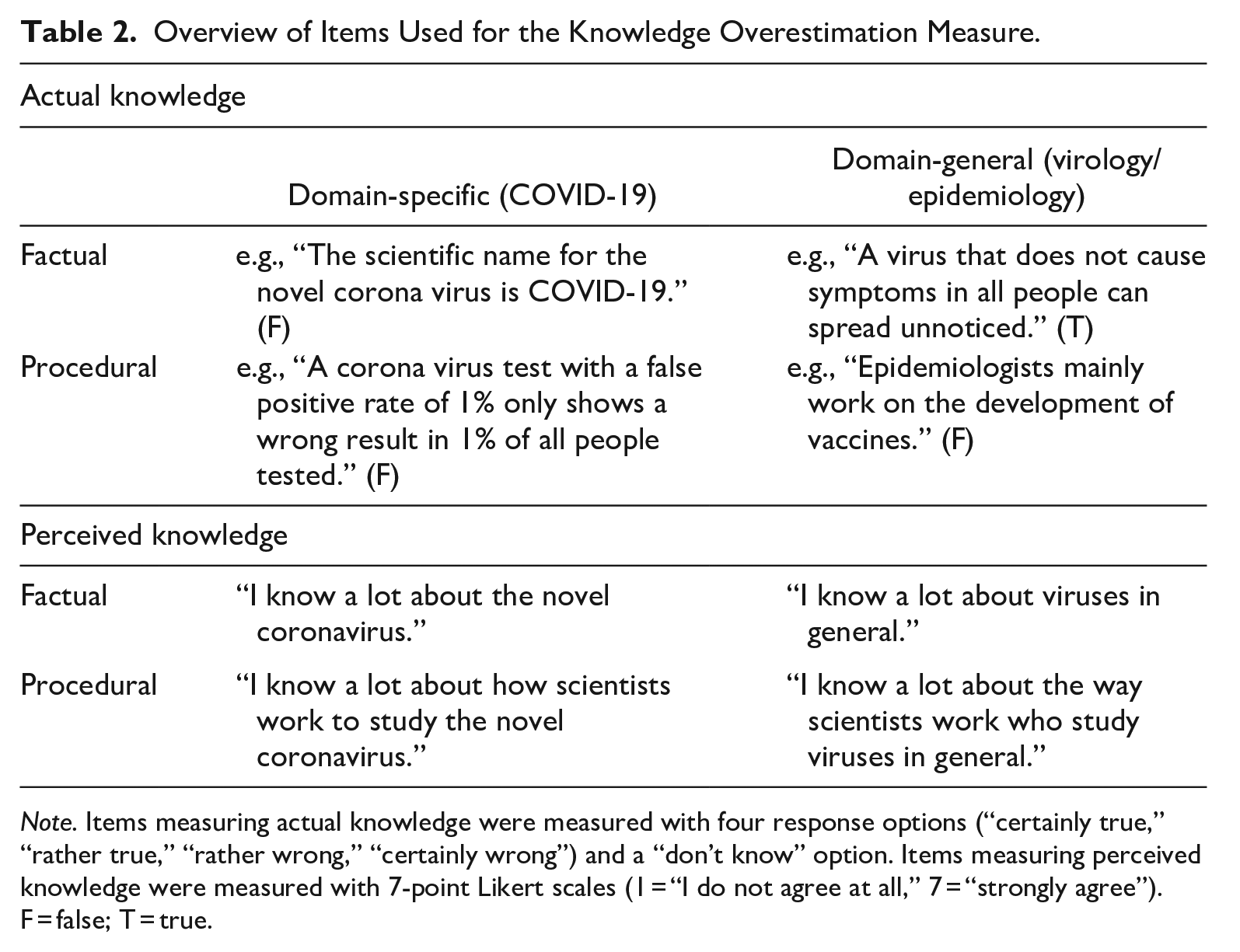
Note. Items measuring actual knowledge were measured with four response options (“certainly true,” “rather true,” “rather wrong,” “certainly wrong”) and a “don’t know” option. Items measuring perceived knowledge were measured with 7-point Likert scales (1 = “I do not agree at all,” 7 = “strongly agree”). F = false; T = true.
Actual knowledge about COVID-19 and virology/epidemiology—the first component of the overestimation score—was measured as follows: In the pre-studies, we tested 24 questions that asked respondents if statements about the COVID-19 pandemic were “certainly true,” “rather true,” “rather wrong,” or “certainly wrong,” or if they do not know. Answers were counted as correct if respondents evaluated wrong statements as either “certainly wrong” or “rather wrong” and true statements as either “certainly true” or “rather true.” The 24 questions covered four conceptual dimensions, that is, factual knowledge about COVID-19, procedural knowledge about COVID-19, factual knowledge about virology/epidemiology, and procedural knowledge about virology/epidemiology (see Table 2 and Table A3 in Supplemental Appendix 4). We adapted many of these questions from prior studies focusing on knowledge about epidemics (Balkhy et al., 2010; Betsch et al., 2020; Lau et al., 2011), but half of them were specifically designed for this study, because previous studies had mainly focused on factual knowledge about a specific epidemic. We then identified 12 questions (three for each dimension) that had varying difficulty levels, helped to discriminate between persons with different knowledge levels, and if possible, reduced so-called differential item functioning (DIF). DIF means that items “have different properties for persons belonging to different groups even if the persons have the same ability” (Bürkner, 2021, p. 8). To do so, we used a 2-parameter logistic item response theory (2PL IRT) model that contained country (Taiwan or Germany) as a covariate, included varying slopes on the item level, and was fitted with the R package brms (see Supplemental Appendix 4 for the complete results). Based on this analysis, we selected 3 items for each dimension that were used to measure respondents’ actual knowledge.
Perceived knowledge—the second component of the knowledge overestimation score—was measured with 4 items that addressed the same four dimensions as the actual knowledge measure. These 4 items asked respondents if they think that they know a lot about COVID-19 and virology/epidemiology and about how research on these topics work (see Table 2).
The overestimation score was composed in the following three steps: First, we estimated respondents’ actual knowledge by extracting ability scores of the 2PL IRT model that included the 12 questions selected in the pre-study. Second, we estimated respondents’ perceived knowledge by computing the mean of the 4 items measuring perceived knowledge. Third, we computed z-scores for the actual knowledge score and the perceived knowledge score and subtracted the actual knowledge z-scores from the perceived knowledge z-scores to obtain respondents’ overestimation scores.
SNS and IM exposure to COVID-19 information were each measured with a single item that asked how often respondents got in contact with information about the novel coronavirus during the past months (1 = “never,” 7 = “very often”).
SNS engagement was measured with a mean index of 3 items that asked respondents how often they post or share, like or favor, and comment social media content about COVID-19 (1 = “never,” 7 = “very often”; αTWN = .89, αGER = .91; ωtTWN = .89, ωtGER = .91). IM engagement was measured with a single item that asked how often respondents share information or opinions about COVID-19 in instant messengers (1 = “never,” 7 = “very often”).
Science-related populist attitudes were measured with the SciPop Scale, a robust and reliable four-dimensional, 8-item survey scale (Mede et al., 2021). To obtain a single aggregate score that quantifies propensity and aversion to science-related populist attitudes, we followed the “Goertz approach,” that is, we computed unweighted mean values of each of the four 2-item subscales for every respondent and then determined the smallest of these four values to represent their “SciPop Score” (Mede et al., 2021, p. 280).
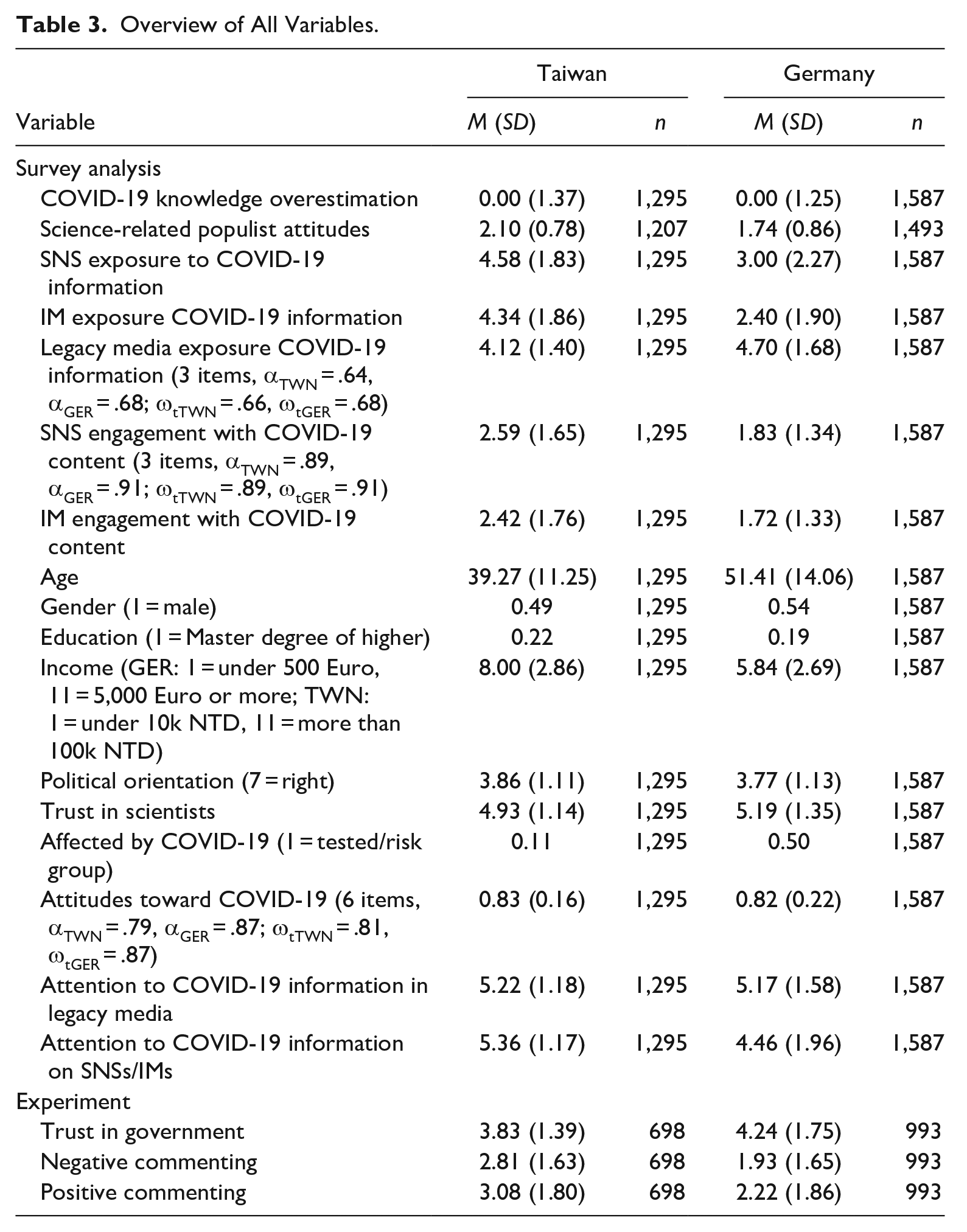
We also measured covariates including age, gender, education, and political orientation (see Table 3 for an overview; see Supplemental Appendix 2 for all items/questions). All questions were translated by a native Chinese speaker familiar with the research topic. An additional measure to reduce potential bias due to language differences was to select knowledge questions with particularly low differential item functioning (see above).
Overview of All Variables.
Procedure
In the first part of the survey, participants answered all questions for the cross-sectional analysis (H1a/b, H2a/b, H6, H7). In the second part, they were randomly assigned to one of two experiments. 4 Participants of the experiment reported in this article were randomly assigned to two experimental groups. They saw either a private Facebook chat message (private visibility condition) or a post in a public Facebook group (public visibility condition; TWN: nprivate = 349, npublic = 349; GER: nprivate = 496, npublic = 497). The chat message and public post included the same text, which stated that the federal government is investing a special budget in the health care system, potentially leading to tax increases for citizens. We used the font and design of Facebook to mimic the real appearance of Facebook chat messages and public posts (see Supplemental Appendix 3). Randomization worked well as we did not find significant differences of age, gender, income, or education between participants of the experimental conditions.
In the public visibility condition, participants were told to imagine that they log in to Facebook and see the public posting (i.e., the stimulus text), below which all comments are publicly visible. In the private visibility condition, participants were told that they should imagine receiving a chat message (i.e., the stimulus text) from a person they know from a Facebook group. We chose this relatively neutral wording to describe the message’s source as we were purely interested in the effect of visibility on commenting behavior. All questions as well as the stimulus material and the instructions were translated by researchers who were fluent in German and Chinese and familiar with the study context.
After the treatment, participants were asked to indicate their willingness to write a comment/reply to express a negative opinion about the government intervention (1—“very unlikely” to 7—“very likely”). A second item measured their willingness to write a positive comment/reply. For a treatment check, we asked participants whether they think that their comment/reply would be private or publicly visible, using a 7-point Likert scale from 1 = “private (not visible to others)” to 7 = “public (visible to everyone).” Commenting the public post was perceived as more public than replying to the private Facebook message in both Taiwan, t(696) = 2.32, p < .05, Mpublic = 3.88, Mprivate = 3.54, and Germany, t(991) = 9.92, p < .001, Mpublic = 4.83, Mprivate = 3.32.
Results
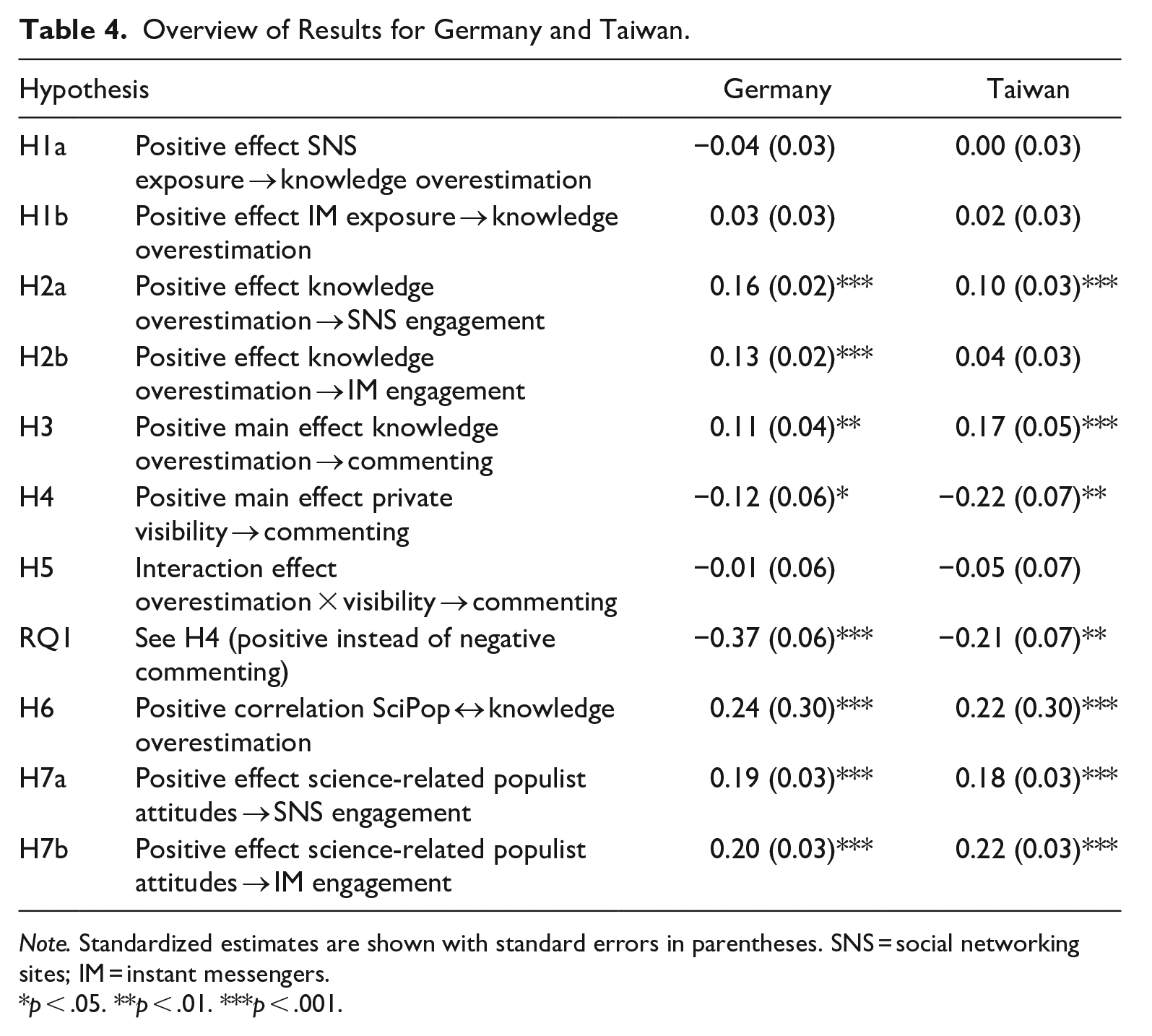
H1a and H1b assumed that exposure to COVID-19 information on SNSs and in IMs is associated with knowledge overestimation. We tested this in two OLS regression analyses (one per country 5 ) with overestimation as the outcome variable and found that overestimation is not significantly affected by SNS or IM exposure in either country (see Table 4 for results of all hypothesis tests; see Supplemental Appendix 5 for complete regression results).
Overview of Results for Germany and Taiwan.
Note. Standardized estimates are shown with standard errors in parentheses. SNS = social networking sites; IM = instant messengers.
p < .05. **p < .01. ***p < .001.
To test H2a, we fitted two OLS regression models that contained SNS engagement with COVID-19 content as the outcome variable. Results supported the hypothesis in both countries: Knowledge overestimation was a predictor of higher SNS engagement (TWN: β = .10, SE = 0.03, p < .001; GER: β = .16, SE = 0.02, p < .001). We ran the same model with IM engagement as the outcome variable to test H2b and found that overestimation increased IM engagement only in Germany, partially supporting H2b (TWN: β = .04, SE = 0.03, p = .136; GER: β = .13, SE = 0.02, p < .001).
To examine social media engagement in a realistic online setting and investigate how engagement is conditioned by its visibility to others, we analyzed the experimental data. The results supported H3, which assumed a positive effect of knowledge overestimation on commenting intentions regardless of whether intentions were measured in the public or private condition (TWN: β = .17, SE = 0.05, p < .01; GER: β = .11, SE = 0.04, p < .01). Further analyses indicated that participants who were exposed to the public Facebook post had lower intentions to write a negative reply (TWN: M = 2.63, SD = 1.58; GER: M = 1.81, SD = 1.59) than participants who saw the same message in a private Facebook chat (TWN: M = 2.99, SD = 1.65; GER: M = 2.04, SD = 1.70). This supports H4 (TWN: β = −.22, SE = 0.07, p < .05; GER: β = −.12, SE = 0.06, p < .05). However, we did not find support for H5: OLS regressions did not indicate significant interaction effects of public versus private visibility and knowledge overestimation on commenting intentions in either country (TWN: β = −.05, SE = 0.07, p = .51; GER: β = −.01, SE = 0.06, p = .80). Figure 2 illustrates that the effect of overestimation on commenting intentions is only marginally conditioned by visibility.
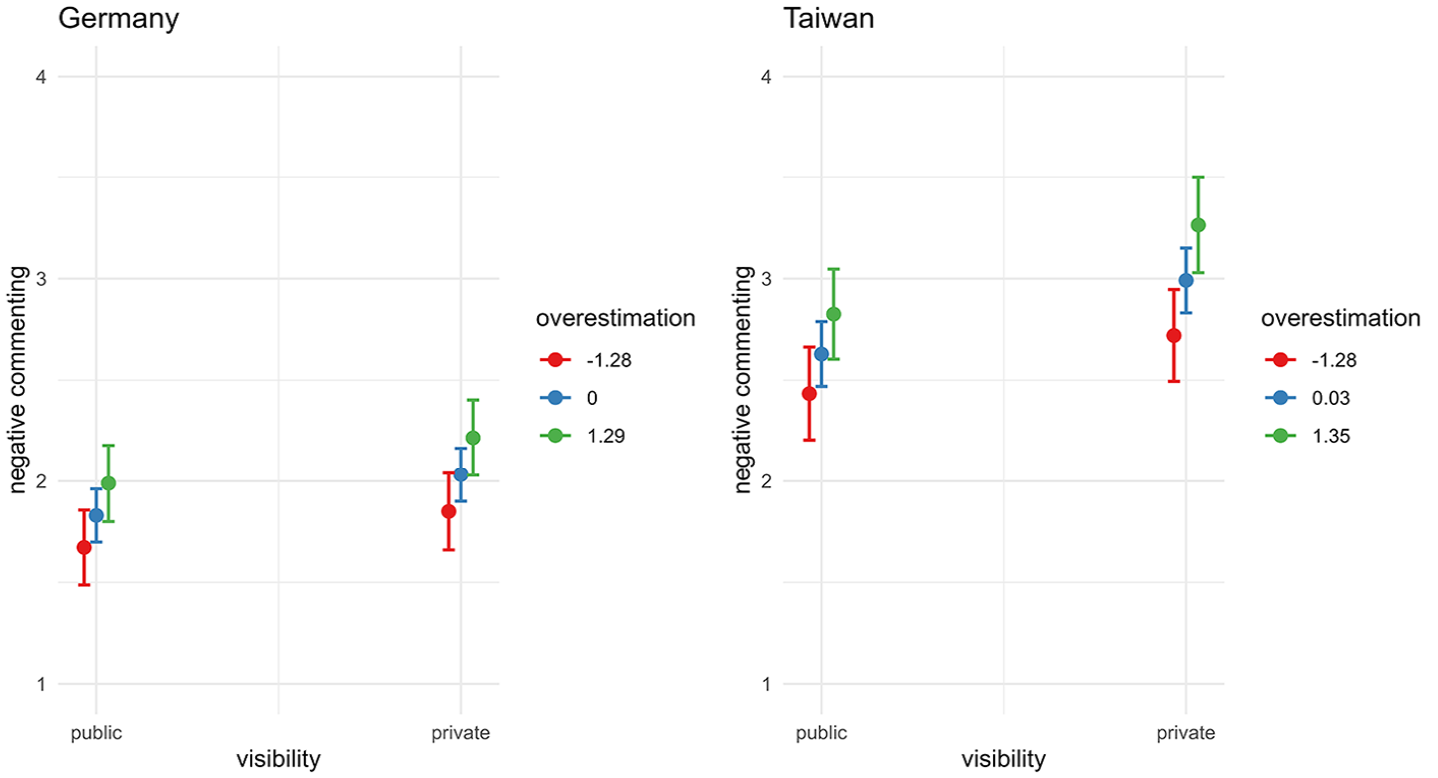
Marginal effects of knowledge overestimation on intentions to respond with a negative comment/reply as a function of visibility (public Facebook group setting vs. private chat messenger setting).
We also preregistered additional analyses on how the visibility of social media engagement affects people’s willingness to write positive comments in the experimental setting (RQ1). To test this, we repeated the H4 analyses with positive instead of negative commenting intentions as outcome variable. Results were in line with those of the H4 analyses: In both countries, participants in the public condition were also less inclined to respond with positive comments (TWN: M = 2.92, SD = 1.79; GER: M = 1.85, SD = 1.58) compared to participants in the private condition (TWN: M = 3.24, SD = 1.79; GER: M = 2.59, SD = 2.04; TWN: β = −.21, SE = 0.07, p < .01; GER: β = −.37, SE = 0.06, p < .01). However, the effect of visibility on negative commenting intentions was stronger in Taiwan, whereas the effect of visibility on positive commenting intentions was stronger in Germany (see Table 4).
H6 assumed that overestimation correlates positively with science-related populist attitudes. We tested this with the model we used for the H2a/b tests and found support for H6 in both countries. Stronger science-related populist attitudes were associated with higher overestimation (TWN: β = .22, SE = 0.03, p < .001; GER: β = .24, SE = 0.04, p < .001).
To test H7a and H7b, we relied on the OLS regression models testing H2a and H2b. Results supported the hypotheses: In both Taiwan and Germany, science-related populist attitudes were significant predictors of higher SNS engagement (TWN: β = .18, SE = 0.03, p < .001; GER: β = .19, SE = 0.03, p < .001) and IM engagement (TWN: β = .22, SE = 0.03, p < .001; GER: β = .20, SE = 0.03, p < .001). An additional specification curve analysis showed that our findings are robust (see Supplemental Appendix 7; Simonsohn et al., 2020).
Discussion
Social networking sites and instant messengers can lead users to perceive themselves as more knowledgeable than they actually are, due to a lack of ability to recognize that the affordances of SNSs and IMs convey a “feeling of knowing” without actually increasing knowledge (Schäfer, 2020). Knowledge overestimation, in turn, may be linked to populist attitudes and cause users to show more engagement with social media content, depending on whether engagement is publicly visible. We tested this during the COVID-19 pandemic in two preregistered, cross-sectional, national surveys in Germany and Taiwan. They included a survey experiment and used a novel knowledge overestimation measure that we validated in two pre-studies. Overall, our study offers two major contributions: First, we introduce a comprehensive, theoretically informed, four-dimensional measure for knowledge overestimation that compensates caveats of extant measures. Second, we provide novel cross-country results on the interplay of knowledge overestimation and social media use. These results lead to four main conclusions, which we discuss below.
No Robust Support for a Link Between Social Media Exposure and Knowledge Overestimation
SNS and IM users who are frequently exposed to social media information on current issues like the COVID-19 pandemic do not seem more prone to overestimate their knowledge about these issues than users with less exposure. We found that neither Taiwanese nor German respondents feel more knowledgeable about COVID-19 and virology/epidemiology than they actually are when reporting high use of SNSs and IMs to encounter information on these topics. This finding aligns to some degree with longitudinal evidence in other geographical and topical contexts (Haugsgjerd et al., 2023), but it is not consistent with research in settings similar to ours (S. Lee, Yamamoto, & Tandoc, 2022). After all, it indicates that the affordances of SNSs and IMs have less potential to accommodate inflated knowledge self-perceptions than previously assumed—at least for highly salient topics like COVID-19 and in countries where scientific literacy is relatively high (Wellcome Trust, 2019). Features like popularity metrics or algorithmic curation might actually help users acquire accurate knowledge. This suggests that digital communication research might need to reconsider some of its conceptual assumptions about the implications of social media affordances for metacognitive judgments (S. Lee et al., 2023; Yamamoto & Yang, 2022).
A further reason for a missing link between social media exposure and COVID-19 knowledge overestimation may be that people in Taiwan and Germany had become aware of the tentativeness of information about the pandemic at the time of data collection, perhaps due to media coverage emphasizing scientific uncertainties and limitations of pandemic research (Fleerackers et al., 2022) or because many social media users have actually recognized their potential confusion about information overabundance (Nagler et al., 2020). Exploratory analyses suggest an additional explanation: It was only after we included science-related populist attitudes as a predictor in the regression models that correlations between SNS use and knowledge overestimation became non-significant. This indicates that overestimation might be a function of fundamental epistemological orientations rather than of behavioral and situational variables. Therefore, scholarly and public concerns about a “COVID-19 infodemic” which supposedly drove users to acquire superficial knowledge, believe misinformation, or support conspiracy theories, may not be warranted (see Simon & Camargo, 2023).
Further analyses should nevertheless explore other factors that potentially influence the association of social media exposure and knowledge overestimation. To contextualize our results, we conducted such analyses for two of these factors, that is, political orientation (see van Prooijen & Krouwel, 2020) and attention to COVID-19 information on SNSs/IMs (see X. Yang et al., 2020). We found a positive interaction effect of attention × SNS exposure on knowledge overestimation in Germany, but no interaction effects of political orientation × SNS exposure on overestimation in either country (see Table A20 and Figure A9 in Supplemental Appendix 11). Future research should investigate further moderating factors, such as personality traits (Leman et al., 2023), cognitive sophistication (Trémolière & Djeriouat, 2021), and digital media literacy (Pieschl, 2021). Moreover, it may want to employ longitudinal study designs to test causal relationships of social media exposure and knowledge overestimation (Haugsgjerd et al., 2023). Experimental research finds, for example, that biased knowledge perceptions may not only be a consequence but also a determinant of social media behavior, affecting the selection and evaluation of online videos among South Korean YouTube users (Yu et al., 2023).
Knowledge Overestimation as a Predictor of Social Media Engagement
We find that overestimating their knowledge about an issue can still affect people’s social media use, leading them to communicate more actively on SNSs and in IMs: In both Germany and Taiwan, we find cross-sectional and experimental evidence that COVID-19 knowledge overestimation is associated with an increased willingness to post, like, and comment social media content about COVID-19, chat about it in instant messengers, and respond with public comments or private chat messages to social media posts describing pandemic policies. However, there is one exception: Taiwanese do not seem to be more outspoken in IMs if they overestimate their knowledge, whereas Germans are. This could be due to differences in local cultures and media ecosystems. Taiwanese may have higher fear of isolation and lower willingness to share potentially contentious opinions (Lin & Pfau, 2007), perhaps because of collectivistic socialization (Eilders & Porten-Cheé, 2023), hence they might be less likely to speak out on social media. Meanwhile, Taiwan shows exceptionally high adoption rates for instant messaging services like LINE, which is commonly used as a way to consume and engage with news content (Newman et al., 2021; Rauchfleisch & Chi, 2020). Taiwanese might therefore be more experienced in scrutinizing the credibility of information received via IMs and reflecting upon their own skills to judge that credibility, which makes knowledge overestimation less likely to affect their IM engagement. Future studies should still not rule out an effect of knowledge overestimation and IM engagement, as specification curve analyses indicated that it might indeed exist (see Supplemental Appendix 7).
Nonetheless, our results suggest that knowledge overestimation goes hand in hand with being more vocal on social media, a finding also supported by alternative model specifications reported in Supplemental Appendix 9. This is in line with research showing that high (self-perceived) knowledge about COVID-19 raises peoples’ intentions to engage online (Pennycook et al., 2020; J. Yang & Tian, 2021). This finding indicates that albeit SNS and IMs afford user engagement in different ways (Valeriani & Vaccari, 2018), they both accommodate the tendency of overconfident users to share their opinions and claims with others. Overestimation may thus indeed contribute to an ‘overabundance of information’ about COVID-19 and the spread of inaccurate or deceiving claims about it. Overestimation can thus be assumed to be one factor that drives social media engagement—next to other factors, such as personality traits like extraversion or narcissism (Meng & Leung, 2021) and perceptions of holding majority opinions, low fear of isolation, limited willingness to self-censor, and other mechanisms discussed in the literature on the “spiral of silence” (Gearhart & Zhang, 2014, 2015; Hampton et al., 2014).
The Driving Potential of Science-Related Populism
Our results demonstrate that another driving force of social media engagement next to knowledge overestimation may be science-related populism (Mede & Schäfer, 2020). Our analyses indicate, firstly, substantial positive correlations between overestimation and science-related populist attitudes in Germany and Taiwan—which may be because both phenomena criticize external expertise and valorize personal knowledge. Secondly, our results also show that proponents of science-related populism are more likely than others to engage with content about COVID-19 on SNSs and in IMs in both countries—which may be because these media provide populists with a “suitable channel” to articulate commonsensical claims or anti-intellectual demands (Gerbaudo, 2018, p. 746). This suggests that science-related populism can be conceived as common sociopsychological root of people’s tendency to overestimate their knowledge and their outspokenness on social media. Furthermore, science-related populist attitudes seem to be similarly conducive to overestimation and outspokenness in Germany and Taiwan, as we find similar effect sizes in both countries—although the cultures and media ecosystems of these countries as well as the media diets, pandemic experiences, and science-related populist attitudes of their populations differ (Mede, 2023b; Newman et al., 2021; Rauchfleisch & Chi, 2020). While this speaks against between-country differences, we do find within-country differences in Germany. Additional exploratory analyses show that the potential of science-related populism to drive knowledge overestimation diminishes as people’s attention to legacy media coverage on COVID-19 increases (see Table A21 and Figure A10 in Supplemental Appendix 11).
Interestingly, SNS and IM engagement intentions have stronger correlations with science-related populist attitudes than with knowledge overestimation. This suggests that variation in social media engagement during the COVID-19 pandemic was more likely to depend on specific anti-science views than on people’s metacognitive mechanisms. From this perspective, social media may indeed have fueled single aspects of a “COVID-19 infodemic” (i.e., a proliferation of populist criticisms of science, scientists, and scientific knowledge) through enabling science-related populists to engage with other users, possibly attempting to communicate their anti-intellectual opinions to them.
Overestimation and Its Correlates Depend on the Communicative Environment
Our study also suggests that the communicative setting affects engagement intentions, regardless of whether people overestimate their knowledge. Experimental results show that both Taiwanese and Germans are more likely to reply to private chat messages than to comment on public Facebook posts about COVID-19, without knowledge overestimation affecting this likelihood significantly. This corresponds with findings from Taiwan showing that user responses to online information differ depending on whether information exposure takes place on private or public platforms (A. H.-E. Wang, 2022) and highlights that the degree to which social media afford intimate or public communication shapes the way people use them (Gill & Rojas, 2020). It also suggests that information about the pandemic spreads more easily in private online conversations than in public social media groups or feeds—which is in line with a German study suggesting that (false) information about the pandemic has been more likely to disseminate in the IM service WhatsApp than on SNSs like Facebook, YouTube, or Twitter (correctiv.org, 2020). Scholars and journalists might thus underestimate the extent to which the overabundance of information about the pandemic has been perpetuated by communication “under the surface” (R. Smith et al., 2020). However, knowledge overestimation may not necessarily exacerbate such communication, as our results do not indicate significant interaction effects of overestimation and visibility on engagement intentions in either country. The absence of these effects corresponds with related research that did not find overconfidence to have a moderating role in misinformation effects (van Huijstee et al., 2022). Accordingly, publicly inaccessible echo chambers, which have been feared to harbor pseudoscientific and anti-intellectual sentiments (Dattani, 2021), might have been less of a problem during the COVID-19 pandemic.
Limitations and Conclusions
Our study has some limitations, many of which are typical for research like ours. For example, our cross-sectional study design prevented us from testing causal claims about effects of social media exposure on knowledge overestimation. Another limitation is that we utilized online panels that provided respondents whose social media use presumably differs from the general population. This lends our study ecological validity, but also means that we cannot claim that knowledge overestimation exacerbates the spread of an “infodemic” outside social media. Moreover, we measured exposure to social media content about COVID-19 with single items, relied on short self-report measures for willingness to engage with such content, and did not distinguish between different SNS and IM platforms. This approach reduced the complexity of our conceptual rationale and study design—and eased respondents’ cognitive load, giving them higher capacity to provide high-quality responses to our knowledge measures and stronger motivation to complete the survey. However, using aggregate measures for SNS and IM exposure meant that we could not consider that social media affordances—and their conduciveness to knowledge overestimation, exposure, engagement and science-related populism—also differ across SNS and IM platforms (Mahl et al., 2023). A second methodological tradeoff was the decision to place the experiment at the end of the survey. This might have come at the cost that participants were primed by the knowledge questions, for example, but it was necessary as we would have conditioned on post-treatment variables in the H5 analyses had we measured knowledge overestimation after the experiment (Montgomery et al., 2018).
Another caveat of our study is that it examined two distinct geographical, temporal, and topical contexts. For example, visibility of social media engagement may not have conditioned commenting intentions had we used a less contentious issue as experimental stimulus or fielded our study at a time when scientific expertise on COVID-19 was less politicized (Staerklé et al., 2022). Exposure to COVID-19-related social media content may have indeed been a predictor of knowledge overestimation in earlier phases of the pandemic, when people’s uncertainty and desire to appear knowledgeable were even higher than in May and November 2020 (see van Prooijen & Douglas, 2017). However, we are confident that our findings generalize well to other settings, since we came to similar conclusions like studies in other contexts (e.g., Huynh & Senger, 2021; S. Lee, Yamamoto, & Tandoc, 2022; Teovanović et al., 2021) and went beyond one specific case (two countries, both SNSs and IMs, overestimation of both COVID-19 and background knowledge about epidemiology/virology).
But despite these limitations and although some of the hypothesized effects were weak or absent, our study indicates that knowledge overestimation, science-related populism, and social media engagement have driven each other during the COVID-19 pandemic in Germany and Taiwan. This dynamic is concerning, because it potentially undermines societies’ capability to deal with pandemics. Social media platforms, policymakers, and science communication practitioners should thus seek to alleviate this dynamic. Platforms could nudge users to reflect upon their ability to understand and judge the credibility of information they engage with (Pennycook et al., 2020). However, platforms would need to consider that nudging interventions are often perceived differently depending on whether they are implemented on SNSs or IMs, target users with lower or higher media literacy, and conflict or align with people’s political preferences (A. H.-E. Wang, 2022). Moreover, politicians may adopt regulatory measures obliging platforms to implement such interventions (Helberger, 2020). After all, science communicators and educators need to continue addressing societal milieus harboring science-related populism and other critical attitudes toward expert knowledge (Light et al., 2022). Meanwhile, the normative and ethical implications of any such efforts need to be discussed.
Our findings can also stimulate further research to inform these efforts. Such research would need to use empirically validated and theoretically informed knowledge overestimation measures such as ours and advance them, employ longitudinal designs to scrutinize causal effects, investigate other countries than Germany and Taiwan, or incorporate analyses of social media sources and contents that the study participants report using. Such research will further our understanding of how social media, knowledge overestimation, and support for alternative epistemologies interact in public health crises and beyond.
Supplemental Material
sj-docx-1-crx-10.1177_00936502241230203 – Supplemental material for The Interplay of Knowledge Overestimation, Social Media Use, and Populist Ideas: Cross-Sectional and Experimental Evidence From Germany and Taiwan
Supplemental material, sj-docx-1-crx-10.1177_00936502241230203 for The Interplay of Knowledge Overestimation, Social Media Use, and Populist Ideas: Cross-Sectional and Experimental Evidence From Germany and Taiwan by Niels G. Mede, Adrian Rauchfleisch, Julia Metag and Mike S. Schäfer in Communication Research
Footnotes
Acknowledgements
We would like to thank Paul-Christian Bürkner for reviewing R code that we used to develop our measure for knowledge overestimation. We are also grateful to Andreas Jungherr and Marko Bachl for their assistance with the power analyses. Additionally, we want to thank Tzu-Hsuan Tseng for his help with translations. We also appreciated discussing our study with Ralph Schroeder, which helped us reflect on the implications of our findings.
Correction (May 2024):
Open Science Badges added
Declaration of Conflicting Interests
The authors declared no potential conflicts of interest with respect to the research, authorship, and/or publication of this article.
Funding
The authors disclosed receipt of the following financial support for the research, authorship, and/or publication of this article: This research was funded by the National Taiwan University, the University of Münster, and the University of Zurich. Adrian Rauchfleisch’s work was supported by the National Science and Technology Council, Taiwan (ROC), grant no. 112-2628-H-002-002.
Open Practices
The data and code that support the findings of this study as well as the questionnaires are available in a public repository at the Open Science Framework: https://osf.io/yrm8w/. The preregistrations of the main study can be accessed at: https://osf.io/32xnp/. Preregistrations and additional materials of the experiment can be accessed at: https://osf.io/5dx3u/ (preregistration) and  (materials).
Supplemental Material
Supplemental material for this article is available online.
Notes
Author Biographies
References
Supplementary Material
Please find the following supplemental material available below.
For Open Access articles published under a Creative Commons License, all supplemental material carries the same license as the article it is associated with.
For non-Open Access articles published, all supplemental material carries a non-exclusive license, and permission requests for re-use of supplemental material or any part of supplemental material shall be sent directly to the copyright owner as specified in the copyright notice associated with the article.
