




Abstract
In many countries, the COVID-19 pandemic led to increased public support for societal institutions including science, a phenomenon described as “rally-round-the-flag” dynamic. However, it is unclear if this dynamic has also reduced public resentment toward science such as science-related populist attitudes, that is, the preference of people’s common sense over allegedly elitist scientific knowledge. We test this, relying on individual-level data from panel surveys before and during the pandemic in Switzerland. Results show that science-related populist attitudes decreased after the pandemic started. The decrease was more pronounced among people who had been strong supporters of science-related populism prior to the pandemic, but otherwise spread equally across different sociodemographic and attitudinal segments of the Swiss population. This shows that the Coronavirus outbreak has the potential to undermine persistent (populist) resentments toward science and its epistemology among the general population.
For people around the world, the COVID-19 pandemic is a threatening, uncertain situation in which many of them seek security and authority (Heinzel and Liese, 2021). During past health crises like the SARS and H1N1 outbreaks, this often resulted in increased public confidence in governments, health agencies, and other institutions, because many people trusted them to provide crisis solutions (Deurenberg-Yap et al., 2005). This phenomenon has been described as “‘rally-round-the-flag’ dynamic” (Devine et al., 2021: 277).
Research on rally dynamics often focuses on political institutions (e.g. governments), political power claims (e.g. calls for specific policies), and increases in affirmative public sentiment (e.g. trust). But the COVID-19 pandemic is a potentially different case. First, it is a crisis in which scientific institutions are particularly salient in people’s daily lives, for example, because scientists are featured extensively in news media (Eisenegger et al., 2020). Second, it is characterized by a high importance of scientific truth and power claims, as reliable knowledge and the disinterestedness of those producing it are essential in containing the pandemic (van Bavel et al., 2020). Third, and contrary to many public and media statements (Brooks, 2020), the pandemic may also have driven a decrease of negative public sentiment toward societal institutions (Sibley et al., 2020). During the COVID-19 pandemic, rally-round-the-flag effects may thus not only manifest in heightened support for political authorities—but also in lower public resentment toward science.
One variant of such resentment is “science-related populism” (Mede and Schäfer, 2020). Science-related populism has been conceptualized as a set of ideas suggesting that the virtuous “ordinary people” and their common sense—and not allegedly corrupt academic elites—should determine what is deemed “true knowledge,” how it is produced, and on which topics scientific research should focus (Mede and Schäfer, 2020: 482). Science-related populist attitudes therefore cover four dimensions: (positive) conceptions of the ordinary people, (negative) conceptions of the academic elite, demands for (science-related) decision-making sovereignty, and demands for truth-speaking sovereignty (Mede et al., 2021). These attitudes reflect negative public sentiment toward scientific institutions and pertain to scientific power and truth claims—and, as such, address the specific conditions under which rally-round-the-flag dynamics may emerge during the COVID-19 pandemic. Accordingly, pandemic-induced rally dynamics may manifest as a decline of science-related populist attitudes. As this has not yet been researched, we do so in this study.
Scholarship put forward several explanations for people’s rising support for authorities in times of crises (Yam et al., 2020). It argues that situations of high perceived threat and powerlessness activate individuals’ evolutionary desire for security, which causes them to endorse accepted authorities they deem capable of fulfilling this desire (van der Toorn et al., 2015). Authority endorsement may then go along with higher willingness to overcome personal resentments to establish coherent in-group norms and uphold societal unity (Jost et al., 2004). These cohesion-seeking tendencies can also manifest as cross-partisan consensus among political elites (Merkley et al., 2020) and may be further intensified by exposure to news coverage, because political consensus tends to increase journalistic consensus through “indexing” (Bennett, 2015). Consensus coverage, in turn, can then reinforce public support for official authorities (Thorbjørnsrud and Figenschou, 2018). Countries where news media use has been high during the COVID-19 crisis may therefore exhibit particularly high public approval of authorities (Merkley and Loewen, 2021).
Rally dynamics like these have been assumed to erode “the tenets of a political system driven by the will of the people” (Agadjanian, 2021: 351) and potentially undermine support for populist ideologies, which emphasize this will and criticize societal institutions (Canovan, 2002). One institution that has been particularly salient during the COVID-19 crisis is science, which many individuals expected to reduce perceived threats and powerlessness (Heinzel and Liese, 2021). Science-related rally dynamics manifesting as reduced (populist) resentment toward science are thus plausible to assume.
Empirical research corroborates this assumption: Population surveys indicate that public support for political authorities and opposition to populist worldviews increased during the pandemic in several countries (Arin et al., 2021; Jørgensen et al., 2021; Yam et al., 2020), potentially due to high exposure to pro-government media coverage in countries such as Switzerland (Eisenegger et al., 2020; Liu et al., 2020). Further research shows that public approval of scientific authorities—for example, trust in science and scientists—has grown in some countries (Daniele et al., 2020; Jensen et al., 2021; Sibley et al., 2020). Moreover, surveys conducted before and after the first lockdown in the United Kingdom indicate a significant decrease in agreement with Elchardus and Spruyt’s (2016) populism scale, which focuses on political populism but includes aspects of science-related populism (Arin et al., 2021). Correspondingly, a panel survey comparing 2017 and 2020 data finds that technocratic orientations—which are at odds with science-related populism—increased in the Netherlands after the COVID-19 outbreak (Reeskens et al., 2021).
But such shifts in public opinion may not be distributed equally across populations: During the COVID-19 pandemic, politics-related rally-round-the-flag dynamics seem more pronounced among people who are older and have lower income (Hegewald and Schraff, 2020). Science-related rally effects, in turn, might be less pronounced among people who are more religious, support populist ideas, and live in non-urban areas, as these milieus are more likely to endorse COVID-19 conspiracy theories (Eberl et al., 2021), reject vaccination against COVID-19 (Edwards et al., 2021), and criticize the values of pandemic researchers (Evans and Hargittai, 2020).
Yet overall, scholarship is inconclusive in at least three ways:
Research on public perceptions of science during the COVID-19 pandemic has not been based on the concept of science-related populism, but only investigated single aspects of it (e.g. anti-intellectualism; Merkley and Loewen, 2021) or phenomena that are similar, yet not identical (e.g. (dis)trust in science; Daniele et al., 2020).
Few studies examined within-subject changes, comparing attitudes before and after the pandemic among the same individuals. Instead, many studies rely on cross-sectional surveys (Sibley et al., 2020) or panel surveys launched after the outbreak (Algan et al., 2021).
There is a growing number of studies investigating the United States or EU countries, but Switzerland has barely been studied—although it represents an interesting case: While its population is well-educated and has high trust in science (Swiss Academies of Arts and Sciences, 2021), it also offers favorable conditions for (science-related) populism: Switzerland’s direct democratic political system may invite the “ordinary people” to expect to have a say in societal decision-making processes (Ernst et al., 2017). In addition, prominent populist actors often engage in public discourses around science-related issues, and the populist Swiss Peoples’ Party (SVP) is an established political force (Udris, 2012).
Our study aims to fill these gaps: Relying on individual-level panel data from surveys conducted in 2019 and 2020 in Switzerland, we test if a within-subject decrease of science-related populist attitudes has occurred after the COVID-19 pandemic started (H1) and examine whether a decrease, if existing, is more pronounced in specific population groups (RQ1):
H1: Science-related populist attitudes decreased in Switzerland after the COVID-19 pandemic began.
RQ1: Which sociodemographic and attitudinal variables can explain such a decrease?
1. Data, method, and analysis
Data
We tested H1 and RQ1 in a two-wave panel survey in all three linguistic regions of Switzerland in June/July 2019 and November 2020 (N = 154). Respondents were recruited as follows: In the 2019 cross-sectional survey of the Science Barometer Switzerland (a recurring, nationally representative, trilingual telephone survey of the Swiss population), all 1050 respondents were asked if they would participate in follow-up studies. 511 agreed and were contacted in November 2020 to participate in an online survey that contained most questions of the 2019 survey. 167 completed the November 2020 survey, but we excluded 13 because their 2019 and 2020 responses to the gender question did not match or because they reported ages that differed by more than two years. The final panel sample comprised 154 respondents, each interviewed before and during the pandemic (50.0% female; age2019: M = 49.4, SD = 15.8; education2019: 57.1% university degree). Comparisons with the remainder of the 2019 cross-sectional sample, a 2020 cross-sectional Science Barometer Switzerland survey, and Swiss census data indicate that the panel sample closely resembled other Swiss survey samples and the Swiss population in terms of age, gender, and place of residence. However, panelists had higher education and proximity to science (see Supplemental Material).
Measures
Key variables were time of data collection (0 = June/July 2019; 1 = November 2020) and an aggregate score reflecting science-related populist attitudes, which we measured with the SciPop Scale, a reliable 8-item survey scale capturing the four conceptual dimensions of science-related populist attitudes with four 2-item subscales (Mede et al., 2021; see Supplemental Table S2 for all variables and questions). To obtain the aggregate “SciPop Score,” we computed mean values of these subscales for all respondents and determined the smallest value to indicate their intensity of science-related populist attitudes. This procedure accounts for the conceptual premise that science-related populism requires the concurrent presence of all its components, and has been termed the “Goertz approach” (Wuttke et al., 2020: 362). Moreover, we measured a range of sociodemographic and attitudinal covariates: age, gender, linguistic region, urbanity of residence, education, proximity to science, political orientation, religiosity, interest in science, trust in science, trust in scientists, and being affected by COVID-19.
Analysis strategy
All analyses can be reproduced with the materials shared at https://osf.io/3hgpe/. H1 analyses relied on a paired samples t-test and a linear regression model that included varying intercepts for respondents, time of data collection as a dummy predictor, and within-subject covariates. RQ1 analyses relied on a linear regression model predicting SciPop Score differences (2020 value minus 2019 value) with the 2019 measurements of the SciPop Score and the covariates. We also ran these analyses with the four subscale means.
In addition, we employed two robustness tests: First, we repeated the H1 analyses using repeated-measures ANOVAs with time-varying covariates, an alternative approach to test within-subject differences of science-related populist attitudes between 2019 and 2020 (Misangyi et al., 2006). Second, we repeated all analyses with alternative SciPop Scores, because analyses using aggregation procedures other than the Goertz approach (i.e. “Bollen” or “Sartori” approaches) sometimes yield different results (Wuttke et al., 2020). We calculated four additional SciPop Scores, employing computation procedures used in research on political populist attitudes (Rico and Anduiza, 2019; van Hauwaert et al., 2019; Vehrkamp and Merkel, 2020; Wuttke et al., 2020; see Supplemental Table S3).
2. Results
Decline of science-related populist attitudes
Our analyses support H1: While the average SciPop Score of respondents was 2.03 in June/July 2019 (SD = 0.71), it decreased to 1.79 (SD = 0.67) in November 2020 when the same respondents were interviewed again (Supplemental Figure S2). This decline is significant (Table 1), even when controlling for all covariates (Table 2). Moreover, we find that the SciPop Score variance between respondents makes up 39.6% of the overall SciPop Score variance, while the SciPop Score variance within respondents accounts for 60.4% of the overall SciPop Score variance. This demonstrates that the majority of attitude variation is due to changes over time within the same respondents rather than to deviations between different respondents.
Means and standard deviations of science-related populist attitudes and its dimensions, and results of paired samples t-tests of mean differences between 2019 and 2020.
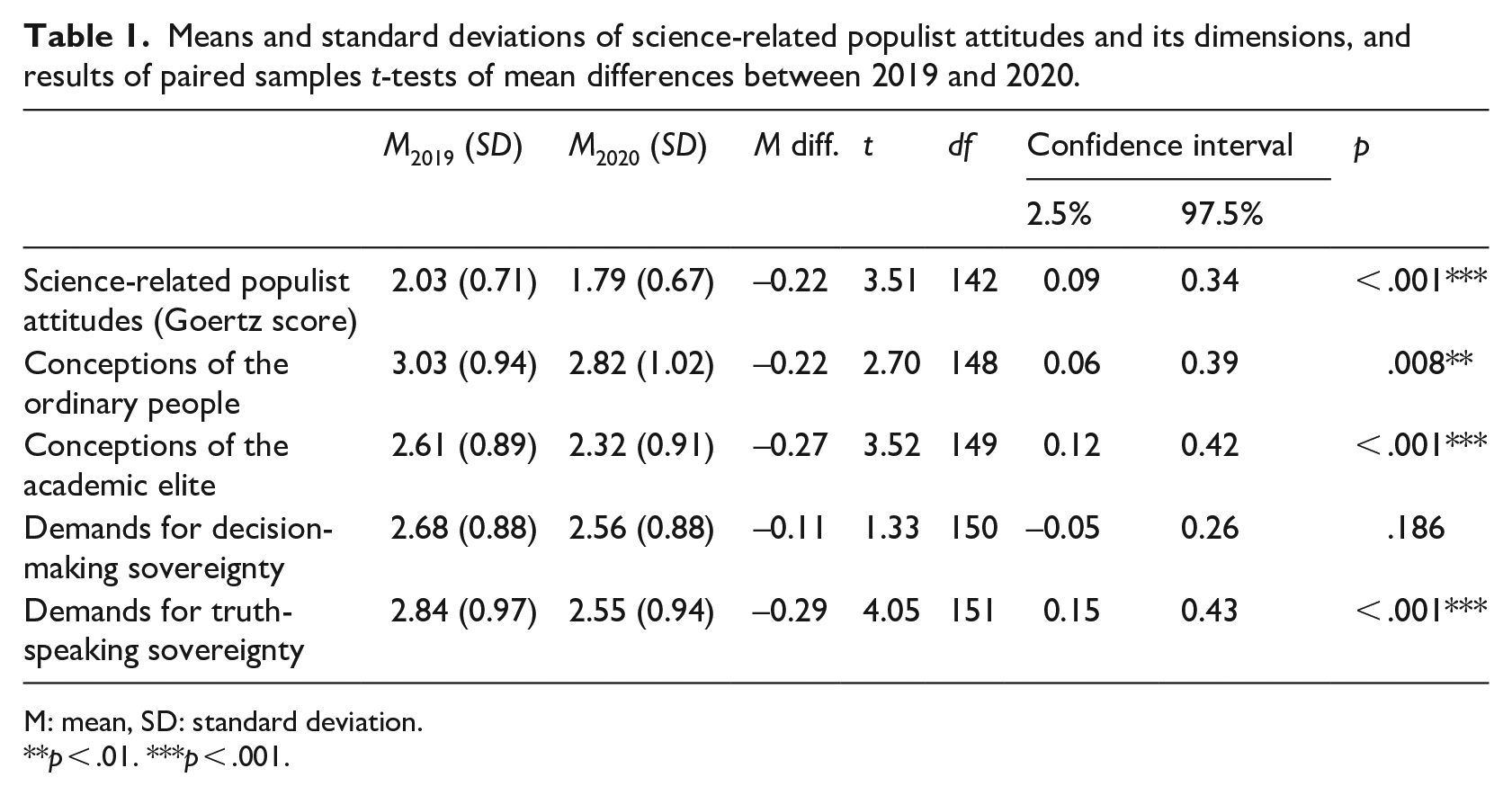
M: mean, SD: standard deviation.
**p <.01. ***p <.001.
Results of linear regressions with varying intercepts for respondents and within-subjects covariates to predict science-related populist attitudes and its dimensions.
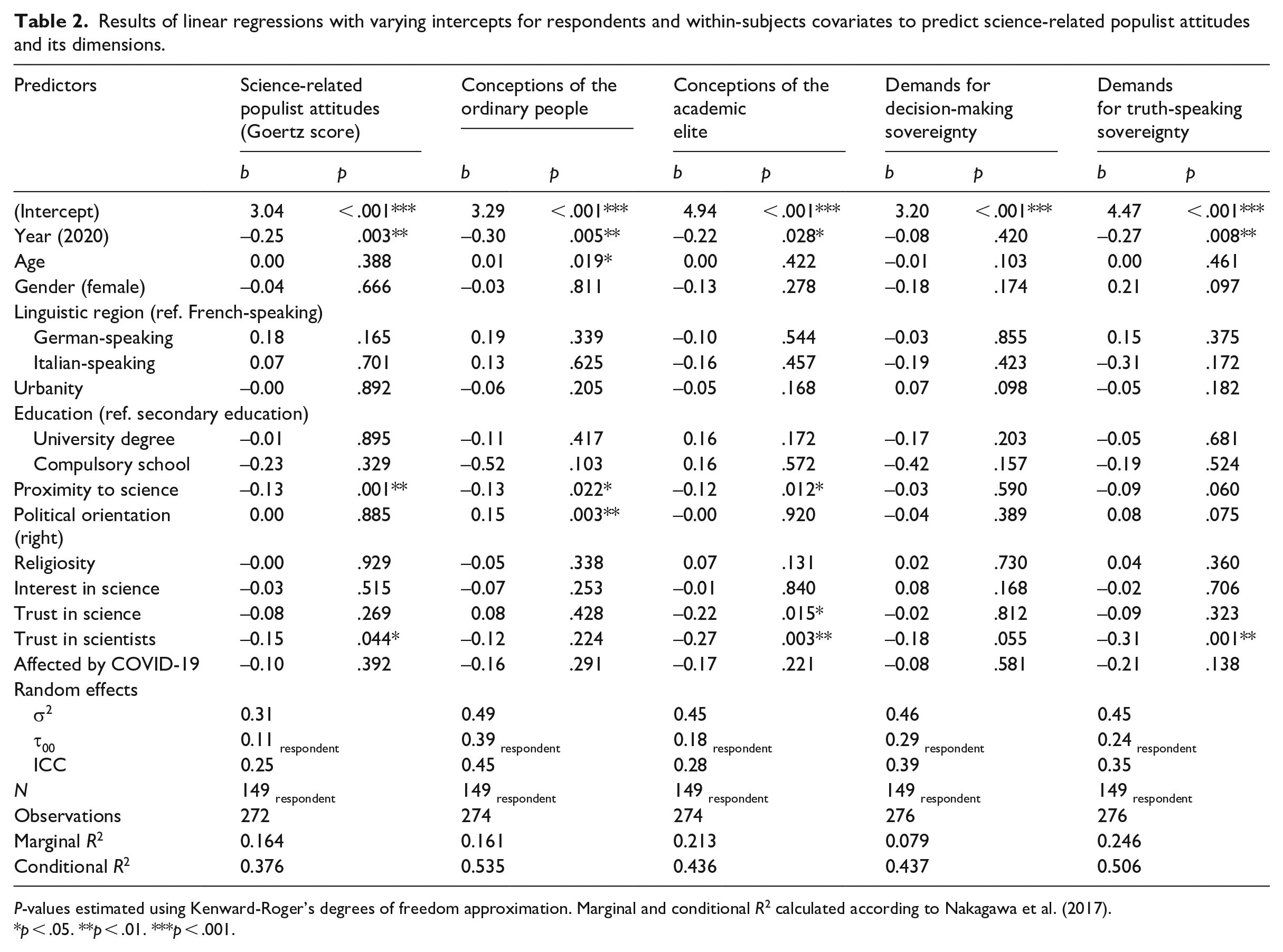
P-values estimated using Kenward-Roger’s degrees of freedom approximation. Marginal and conditional R2 calculated according to Nakagawa et al. (2017).
p <.05. **p <.01. ***p <.001.
Further analyses show that all subscale scores decreased during the COVID-19 pandemic (Supplemental Figure S2). Decreases were significant for conceptions of the ordinary people, conceptions of the academic elite, and demands for truth-speaking sovereignty, but not for demands for decision-making sovereignty (Tables 1 and 2).
Robustness tests support these findings: The repeated-measures ANOVA testing 2019 vs 2020 mean differences in science-related populist attitudes yielded equivalent results (Supplemental Table S4). Paired samples t-tests with the four alternative SciPop Scores indicated significant declines of three scores (Supplemental Table S5), while linear and logistic varying-intercepts regressions suggested significant declines of all four scores (Supplemental Table S6). Repeated-measures ANOVAs confirmed these results for two scores (Supplemental Table S4).
Explaining the decline of science-related populist attitudes
Analyses on RQ1 show that science-related populist attitudes declined primarily among respondents who had higher SciPop Scores before the COVID-19 pandemic (Table 3). Beyond that, declines are distributed rather evenly across our panel sample: Only lower educated respondents exhibit smaller decreases of science-related populist attitudes, while all other sociodemographic characteristics as well as respondents’ political orientation, religiosity, and general perceptions of science do not explain changes in their propensity to science-related populism between 2019 and 2020.
Results of linear regressions predicting changes in science-related populist attitudes and dimensions (2019 vs 2020).
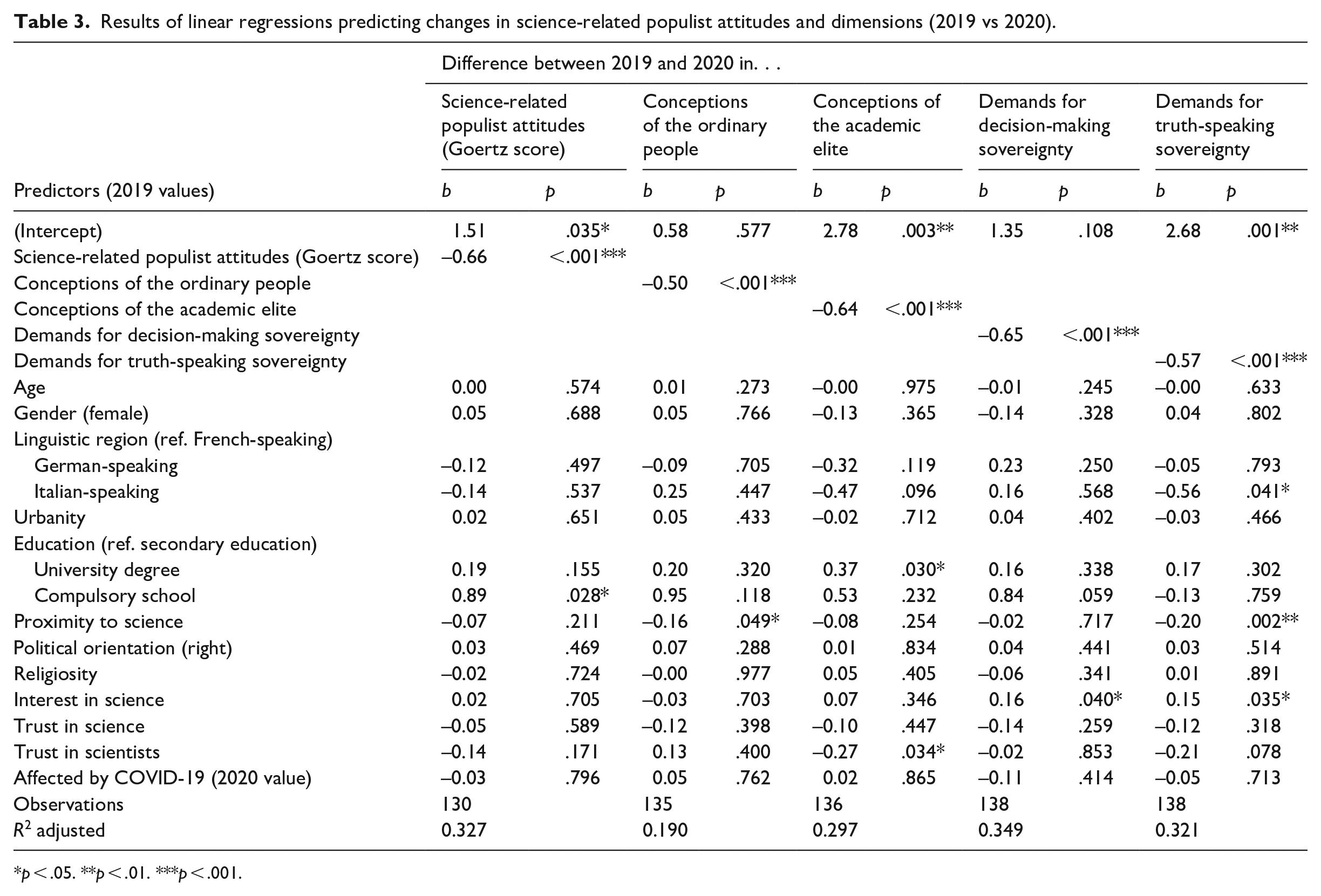
p <.05. **p <.01. ***p <.001.
Analyses of the four subscale scores yield similar results, indicating that support for every dimension of science-related populist attitudes declined most among those who had supported them most in 2019. Moreover, we find that some of these declines are more pronounced among respondents with high trust in scientists (conceptions of the academic elite) and less so among those with high interest in science (demands for decision-making and truth-speaking sovereignty; Table 3).
Robustness tests again corroborate these findings: Within-subject decreases of all four alternative SciPop Scores are significantly bigger for respondents who had stronger science-related populist attitudes before the pandemic (Supplemental Table S7). However, these tests neither confirm that the decrease was smaller among the lower educated nor offer consistent evidence that it was associated with other sociodemographic and attitudinal variables.
3. Discussion
During the COVID-19 pandemic, many people experienced high degrees of uncertainty about how to cope with it. This led many to “rally around” authorities, that is, to rely more on established societal institutions—including science. We analyzed whether the pandemic also resulted in a decline of science-related populist attitudes among the public. We provide such evidence for Switzerland, using individual-level panel data of population surveys before and during the pandemic.
First, we find that respondents showed less support for science-related populism and its four components after the pandemic unfolded. This is consistent with the “rally-round-the-flag effect,” which assumes heightened public confidence in societal institutions during crises (Devine et al., 2021), and research indicating that public trust in science increased as the pandemic started (Jensen et al., 2021). It also suggests that substantial health crises potentially attenuate persistent resentment toward science, perhaps because science provides people with knowledge and advice which give them “a sense of collective self-efficacy and hope” (van Bavel et al., 2020: 466).
Second, we find that the decline of science-related populist attitudes was most pronounced among people who had been more prone to science-related populism before the COVID-19 pandemic. This corresponds with research showing that pandemic-induced rally dynamics are driven by a “catch-up effect,” which suggests that (political) trust has increased most among subpopulations who had been more distrustful before the Coronavirus outbreak (Hegewald and Schraff, 2020). It also indicates that the pandemic may have contributed to a convergence rather than fragmentation of pro- and anti-science population segments (see Klinger et al., forthcoming).
Third, our findings show that the decrease of science-related populist attitudes was quite evenly distributed across our sample—albeit the Swiss vary considerably in their attitudes toward science (Schäfer et al., 2018). Perhaps the pandemic affected science-related (populist) attitudes in different sociodemographic and attitudinal milieus in similar ways. This resonates with evolutionary approaches to the rally effect, which explain it as a symptom of people’s innate tendency to endorse authorities in times of crises, rather than as a function of their individual attitudes (Yam et al., 2020).
These findings are subject to minor limitations, some of them inevitable for panel surveys: First, we relied on a relatively small, non-probability sample, which consisted of respondents from a larger representative sample who wanted to participate again in this study and who had better education, higher familiarity with science, and presumably more positive attitudes toward science than comparable survey samples and the Swiss population. Yet in a (quasi-)experimental study on within-subject changes such as ours, non-probability sampling does not necessarily cause validity issues, because deviations of the sample and population are consistent across time (Exadaktylos et al., 2013). However, the sample’s pro-science bias may have led to floor effects which exacerbated the catch-up effect.
Second, switching survey modes between 2019 (CATI) and 2020 (online) may have introduced minor bias (Fricker et al., 2005). However, research investigating political attitudes and political participation in several countries including Switzerland suggests that switching modes between panel waves is often unproblematic and yields reliable individual-level data (Ansolabehere and Schaffner, 2014; Voorpostel et al., 2020).
Third, our study cannot offer evidence on how public endorsement for science-related populism fluctuated immediately after the pandemic reached Switzerland in February 2020. Other longitudinal surveys on the COVID-19 pandemic (Wissenschaft im Dialog, 2020) and prior pandemics (van der Weerd et al., 2011) show that public trust in science and health institutions peaked after pandemics started and declined slightly in subsequent months. The decrease of science-related populism may therefore have been even more pronounced in early 2020 and lost some of its magnitude by November.
Fourth, some of our findings may be specific to Switzerland: Science-related rally dynamics may be less pronounced, or less equally distributed, in countries which have lower resilience to the spread of commonsensical or pseudoscientific claims (e.g. Greece; see Humprecht et al., 2020), are more polarized along populist or anti-science attitudes (e.g. the United States; see Merkley et al., 2020), and saw more public criticism of government responses to the pandemic (e.g. Italy; see Christensen and Lægreid, 2020) than Switzerland. However, misleading information, populist anti-science skepticism, and backlash against political decisions were also prevalent in Switzerland during the pandemic. It is thus not implausible to assume a similar decline of science-related populism for other countries.
Notwithstanding these caveats, our study suggests that the COVID-19 pandemic triggered science-related rally-round-the-flag dynamics. These dynamics may be worthwhile, because low public anti-science resentment is crucial in containing the pandemic (van Dijck and Alinead, 2020). Political decision-makers could capitalize on them by publicly referring to scientific experts to increase acceptance of containment policies (Algan et al., 2021). However, even small levels of science-related populism may be detrimental to the societal legitimacy of scientific expertise. Science communication should thus aim to address critical audience segments specifically—during the COVID-19 pandemic and beyond. Meanwhile, future research will need to provide evidence to inform these efforts, for example, by investigating different countries, other anti-intellectual beliefs, and changes in public sentiment as the pandemic develops further.
Supplemental Material
sj-pdf-1-pus-10.1177_09636625211056871 – Supplemental material for Science-related populism declining during the COVID-19 pandemic: A panel survey of the Swiss population before and after the Coronavirus outbreak
Supplemental material, sj-pdf-1-pus-10.1177_09636625211056871 for Science-related populism declining during the COVID-19 pandemic: A panel survey of the Swiss population before and after the Coronavirus outbreak by Niels G. Mede and Mike S. Schäfer in Public Understanding of Science
Footnotes
Acknowledgements
We would like to thank Robert A. Huber for valuable suggestions on the statistical analysis. We also thank Julia Metag and Kira Klinger from the Science Barometer Switzerland team for substantial contributions to the design of the survey(s) we analyze in this Research Note.
Funding
This research was funded by the Gebert Rüf Foundation, the Mercator Foundation Switzerland, the University of Zurich, and the Swiss Academies of Arts and Sciences.

Supplemental material
Supplemental material for this article is available online.
Author biographies
References
Supplementary Material
Please find the following supplemental material available below.
For Open Access articles published under a Creative Commons License, all supplemental material carries the same license as the article it is associated with.
For non-Open Access articles published, all supplemental material carries a non-exclusive license, and permission requests for re-use of supplemental material or any part of supplemental material shall be sent directly to the copyright owner as specified in the copyright notice associated with the article.
