




Abstract
This study examines the narratives presented on Quarantine Stories, an online platform where users posted their home-quarantine experiences amid the COVID-19 pandemic. It investigates the recurrent themes in quarantine stories and how tellers constructed their lives in isolation. Quarantine stories submitted worldwide were examined via semantic tag and concordance analyses to identify their recurrent themes and narrative elements. The results reveal that digital storytelling allowed tellers and readers to form a community of shared support beyond spatiotemporal boundaries. Most quarantine stories were characterised by fragmentation and simultaneity, whereas others had Labovian narrative structures. The recurrent themes found (quarantine duration, favourite quarantine spots and self-healing) demonstrated how tellers used time stamps to create meaning. The present study contributes to social media research by suggesting the further categorisation of breaking stories into major and minor and by regarding self-reflection as a sub-type of evaluation.
Introduction
The COVID-19 pandemic has drastically disrupted people’s lives worldwide. By February 2023, more than 90 countries implemented regional and national lockdown measures such as curfews; quarantines; travel restrictions; mandatory closures of schools, restaurants and other venues; and stay-at-home orders (Sandford, 2020). In these past 3 years, adjusting to the ‘new normal’ has caused a cultural shift. Wearing face masks and disinfecting one’s hands with sanitiser has become part of our daily routine, while graduations and weddings have been cancelled. Staying at home for weeks or months during lockdowns caused individuals to reinvent themselves and changed their perceptions and behaviours (Büssing et al., 2020). Elderly people became more tech-savvy (Poon and Holder, 2020), while long-distance couples found creative ways to maintain their relationships (e.g. dressing up for online dates). Others resorted to online narrative writing and shared their feelings and experiences with people far away, as the writing of self-narratives can relieve stress (He et al., 2012).
Although several studies focussed on the challenges that individuals have encountered during isolation, most deployed the interview or survey approach to collect responses (Mathew et al., 2020; Stoecklin et al., 2021). It is important to delve deep into individuals’ self-narratives during the COVID-19 crisis because narratives serve as channels for writers to express their feelings and can be used to understand social phenomena, historical periods and one’s identity (Butina, 2015). Digital narratives allow the sharing and updating of oneself on social media, thus regarded as ‘life-writing of the moment’ (Georgakopoulou, 2015a). Therefore, studying quarantine stories could reveal how tellers collectively marked the COVID-19 pandemic as a key moment and adapted to the ‘new normal’.
This study aims to provide an empirical basis for the quarantine period as a social media event. It investigates the digital life stories of individuals under quarantine amidst the COVID-19 pandemic. The following research questions guided the study: (a) What did people describe and express most often in these stories? (b) How were quarantine experiences discursively shared and represented online?
The rationale behind this study is twofold. First, the quarantine imposed worldwide in 2020 due to the spread of COVID-19 was unprecedented and large-scale; thus, the relevant personal narratives constitute collective memories and indicate how tellers deploy narratives to process a universal and large-scale social phenomenon (Simões Marques and Koven, 2017). Second, narrative research in recent decades has shifted its focus to social media stories, which have more elastic and unstable narrative structures (Georgakopoulou, 2007) than prototypical narratives (Labov, 1972).
Lockdown and quarantine
The word ‘quarantine’ refers to a period of isolation imposed on individuals, animals or plants for preventing the spread of a contagious disease (Gensini et al., 2004). It emphasises physical separation over a specified period. In fact, physical isolation was first practiced in ancient times. In recent decades, different countries and regions have also enforced quarantine measures, such as the quarantine on Gruinard Island, Scotland, where British forces tested biological weapons in 1942 (during World War II); the restrictions were eventually lifted in 1990 (Shashi, 2020). The SARS outbreak affected 29 different countries and regions, infecting more than 8000 people and causing 774 deaths. Comparatively, the COVID-19 outbreak has been more large-scale, devastating and persistent.
The massive lockdown and quarantine measures can be regarded as ‘spectacular media event[s]’ (Kellner, 2002: 22), capturing public attention, reaching a wide audience across traditional media and social media. The pandemic has stimulated interest in narrative research, while most studies deployed survey or interview approaches for collecting tellers’ narratives. For instance, in Italy, university students were asked to write about their thoughts and emotional experiences resulting from the lockdown (Procentese et al., 2021). The textual analysis revealed that many students portrayed the time spent in home confinement as static, while the discontinuity between past and present instilled in them a sense of loss (Procentese et al., 2021).
Other studies demonstrated how social actors adapted to and embraced challenges amid the pandemic. For instance, Stoecklin et al. (2021) used online surveys and face-to-face narrative interviews to collect data on the views of children from Switzerland, Canada, and Estonia. The researchers found that although the children were unable to interact with others or engage in activities as usual, they explored new ways of spending time (e.g. learning new activities such as gardening and sewing), thereby showing the capacity to adjust to new situations (Stoecklin et al., 2021). In a similar vein, young people from refugee backgrounds in Australia said during consultations and interviews that they engaged in innovation and volunteering, such as creating the hashtag #weseeyou to document the lives of residents confined in their apartments and those of the young people helping them. This study showed that refugees were actively engaged in their roles of carers, providers and innovators for their families and communities (Couch et al., 2021). These studies have undoubtedly shed light on the problems experienced by different social actors and their adaptation approaches across diverse communities and countries during the COVID-19 pandemic, providing various parties (e.g. schools and governments) with valuable insights to support the vulnerable and disadvantaged.
While the interview or survey approaches have limited the scope of the data obtained (as the questions themselves may have guided participants to certain answers), collecting individuals’ narratives from an open platform (e.g. a website) may enable participants to freely express themselves, revealing what they are most concerned about and how they felt during the lockdown. Social media environments urge people to ‘shar[e] life in miniaturised form’ with different semiotic resources, including photos and emoticons (Georgakopoulou, 2017: 269). Studying online narratives will deepen our understanding of how tellers’ experiences, memories and identities are collectively and discursively represented amid the pandemic.
Narrative structures and types
Webster’s dictionary (Gove, 1966) defines the term ‘narrative’ as ‘discourse, or an example of it, designed to represent a connected succession of happenings’ (p. 1503). It also comprises mental states, providing us with access to narrators’ inner world (Lieblich et al., 1998). As Bruner (1991) points out, these constituents do not have meaning per se, but the overall arrangement of the sequence gives them meaning and life. People describe and recount their experiences in narratives, attributing coherence and meaning to life events and making sense of history and the future (Rappaport, 1993). The organisation of temporality in narratives is determined by how narrators select and arrange the events (Abbott, 2002). Therefore, narrators are active agents in their narratives (Elliott, 2005); thus, when narrating experiences, they ‘become’ the stories (Riessman, 2003: 7) and reveal how individuals construct and reconstruct their identities across events and situations and readers perceive their reformed identities (Mishler, 2006).
Some researchers have noted the differences between a narrative and a story. For instance, Abbott (2002) indicates that a narrative is ‘the representation of events, consisting of story and narrative discourse’ (p. 16, emphasis in the original). Contrarily, a story is ‘an event or sequence of events (the action)’ (Abbott, 2002: 16) and the narrative discourse expresses it. Paley (2009) added that the narrative discourse as text can be likened to a ship, whereas the story is its cargo. Thus, the same story can be expressed in different narratives. As this study is more concerned about the discursive representations in the narrative, rather than how the story is being told, we consider them interchangeable.
According to Hay (1996), a crisis comprises a moment and process of ‘decisive intervention’ and ‘transformation’ subjectively perceived, defined and constituted in and through narrative (p. 254). The crisis narrative, being ‘rhetorically rich, attention-grasping and broadly pejorative’ (Hay, 1999: 318), is characterised by its newsworthiness. As COVID-19 posed a serious threat to public health, its depiction has been, more often than not, positioned within a crisis narrative. Drawing on over 120 official texts from the UK government, Jarvis (2021) explored the construction of temporality of official narratives of the COVID-19 crisis. He notes that by situating the virus historically and charting its likely development in the future, the executive discourse is saturated with the specific framings of temporality, which help to express and justify the government’s response to COVID-19. However, to the best of our knowledge, no investigation has been conducted on the individual narratives of COVID-19 presented on social media. Therefore, the current study potentially extends our understanding of how the COVID-19 crisis has been interpreted and narrated to a broader spectrum of social media used by ordinary internet users.
Regarding narrative approaches, Labov (1972) defines the narrative as an approach to recalling past experiences. Labov and Waletzky (1967) proposed that the basic structure of a fully-developed narrative comprises six components: abstract (summarises the story and induces the readers’ expectations), orientation (comprising the story’s background–time, place and main characters), complication (the problem the character encounters), evaluation (evaluative elements that assess or judge the character or incident positively or negatively), resolution (what finally happened and how the issue was resolved) and coda (concluding the story and giving a wider meaning to the readers, e.g. what lessons have they learned?). Despite this approach being widely employed in narrative research, it applies to traditional and prototypical narratives and is not concerned with the surrounding context and the organisation of temporality and causality (Ochs and Capps, 2001); it focusses on the linguistic elements of a story, neglecting readers’ active role in storytelling, which is crucial in the context of computer-mediated communication (Dayter, 2015). Furthermore, not all stories are related to the past despite varying storytelling sequence; therefore, stories told in spoken and social media contexts, to some extent, do not conform to Labov’s theory (Page, 2012). Nevertheless, social media stories, though different from the prototypical template, still contain one or several traditional narrative elements such as orientation, complication and coda, exhibiting a Labovian narrative structure. As such, the analysis of online narratives can benefit from the Labovian paradigm.
In social media contexts, people tell stories about their everyday lives and personal experiences. Referring to Ochs and Capps (2001) narrative dimensions, Page (2012) explained the elasticity of social media stories concerning linearity (the organisation of storytelling material), tellership (whether stories are told by one or multiple tellers), embeddedness (the relevance of story to the context) and tellability (whether the story is worth telling). Regarding linearity, social media stories appear more open-ended and fragmented (e.g. Facebook status updates and Tweets), unlike prototypical narratives, sequencing past-tense events in a particular order (Page, 2012). They emphasise immediacy, reporting what is happening in the present or what might happen in the future (Page, 2012). Regarding tellership, social media stories can be episodic and distributed across posts and comments. They can be collaboratively told by multiple participants, for example, Wikipedia pages. However, participants’ contributions are not equal, as bloggers could ignore or delete offencive or irrelevant posts (Page, 2012). Regarding embeddedness, social media stories are situated in dynamic and multifaceted contexts. How we interpret the narratives is largely determined by the participants involved in online interaction, the imagined contexts created by participants, and extrasituational (e.g. age, gender and ethnic and national identity etc.), textual (e.g. verbal co-text and surrounding discourse, such as comments and other posts) and generic contexts (the code of conduct, purpose and topics stated by the website) (Page, 2012: 14–15). Regarding tellability, social media story topics are varied and diverse, encompassing lightweight reports (e.g. having a cup of coffee in the morning), highly personal and emotive issues (e.g. disabled people describing their life struggles) and significant life events (e.g. engagement announcements) (Page, 2012). Despite the stories being trivial slices of tellers’ everyday lives or of great interest, they can discursively construct tellers’ identities and their interactions with other online participants (Page, 2012).
Social media stories (e.g. Facebook status updates) are similar to what Georgakopoulou (2006) termed ‘small stories’, which are ‘a gamut of under-represented and “a-typical” narrative activities, such as tellings of ongoing events, future, or hypothetical events, shared (known) events, but also allusions to tellings, deferrals of tellings, and refusals to tell’ (p. 130). She identified various genres of small stories, including breaking news, projections and shared stories, and suggested that they are important for meaning-making and identity construction. Breaking news items are ‘small stories of very recent (“yesterday”) and/or still happening, evolving (“just now”) events that routinely lead to further narrative making with updates and/or projections’ (Georgakopoulou, 2013: 96). Projections are the narration of near-future events, hinting at future actions. Further, shared stories focus on past experiences or present events that are known by other speakers. For example, a group of female adolescents could share with each other events (breaking news) that transpired recently, reporting mediated interactions (e.g. sharing MSN or Skype messages about prospective romantic partners – shared stories) (Georgakopoulou, 2015b). In telling stories, these female adolescents collaborate and co-construct anticipated and imagined scenarios (projections) (e.g. the actions of their prospective romantic partners) (Georgakopoulou, 2015b). All of these kinds of small stories are scarcely explained by Labov’s model because the tellers do not have enough time to plan for the development of a story (Georgakopoulou, 2015b). Most often, the tellers do not know the point of a story; it emerges while the tellers narrate the stories and collaborate with the audience (Georgakopoulou, 2015b).
Similar to Page (2012), Georgakopoulou (2017) proposed that the features of social media platforms such as Facebook, YouTube and Twitter enable users to present fragmented and open-ended stories, resisting the neat beginning-middle-end structures of prototypical narratives. She added that social media stories have ‘a tendency for reporting mundane, ordinary and [. . .] trivial events from the poster’s everyday life, rather than big complications or disruptions’, addressing sizeable and unforeseeable audiences simultaneously. Dayter (2015) study about the tweets of a ballet enthusiast community found that while some multi-tweet stories exhibit a Labovian narrative structure, breaking news items are more common; the latter either have low tellability and no resolution (tiny stories) or delayed resolution co-constructed by participants in subsequent tweets (delayed resolution narratives).
The present study
This study focusses on a collaborative platform, Quarantine Stories. Some stories appear more lengthy and complete, whereas others are snippets containing only one or a few sentences. Given the dynamicity of these quarantine stories, we have considered the narrative frameworks proposed by Labov (1972), Page (2012) and Georgakopoulou (2017) when analysing them. We situated the quarantine stories into small stories (Georgakopoulou, 2017) because our findings demonstrate that they are based on the recency and iterativity of events and story fragmentation. Notably, Georgakopoulou (2017) categorised breaking news into routines (‘ordinary mediated encounters with characters behaving more or less appropriately’, p. 212) and transgressions (‘report mediated encounters that go wrong’, p. 212) from the spoken classroom discourse. However, based on what we observed from the written single-teller quarantine stories, we subdivided the breaking news into ‘minor breaking news’ that report regular and mundane events which have low-tellability and ‘major breaking news’ that report sudden and unexpected events with possibly dire consequences. The latter harbour the traditional narrative structure suggested by Labov (1972), containing one or few story elements, such as orientation, complication, evaluation and coda. Labov (1972) defined evaluation as the elements that assess or judge the character; it presents the point of the story, clarifying its tellability and reportability (Wang, 2021). However, this definition does not apply to social media stories because tellers often do not know their point (Georgakopoulou, 2017) and focus on self-representation (Dayter, 2015). The tellers of quarantine stories express their feelings by depicting the changes in nature or their favourite home quarantine spots. Thus, in this study, we propose a subtype of evaluation – self-reflection, focussing on one’s thoughts and feelings, instead of assessment or judgement.
Methodology
Materials
This study was based on an analysis of life stories collected from the website Quarantine Stories. This platform, initiated by RNDR, a design studio for interactive media, documents the impact of social distancing and constructs a collaborative experience by gathering stories of people in self-isolation during the COVID-19 pandemic. With the goal of building a collaborative experience to support communities worldwide, the studio encourages people to submit their stories of self-isolation during the pandemic. Regarding the ‘affordance’ (Gibson, 1977) of the platform, tellers are expected to upload a photo of the view from their window and write a personal story according to the story topic ‘what do you see from your window?’. They are allowed to write in any type of language they feel comfortable with, with the goal of ‘reaching the broadest audience possible’. The view page is composed of two parts: while the left part lists the latest posts from other users, the right part contains Google Maps data showing users’ nearest locations and the number of posts from each of the locations marked. Further, clicking the number allows readers to zoom in on the specific posting location, affording more detailed geographic information about the post. Moreover, the website is open to everyone for submitting their quarantine stories without undergoing screening and selection; anyone can view these stories without restrictions. However, site availability and story access cannot be guaranteed.
Only the stories written in English language were collected during November 2021, accounting for 149 stories, totalling 13,495 words written by 149 tellers residing in 32 countries, while most were from the Netherlands, the U.S., Italy, the UK and Germany. These were published between 2020 and 2021. We set this timeframe because many regions worldwide were placed under lockdown in an effort to reduce the spread of COVID-19 during this time. As such, most users posted their stories during this period. The minimum length was six words and the maximum was 320 words. The average word count was 90.6 words. Of particular note is that the paradigm of small stories allows for the inclusion of a wide range of data aligned to a certain degree with the traditional narrative canon (Bamberg and Georgakopoulou, 2008). We did not approach quarantine stories’ narrative as a yes/no question, but rather as a more/less statement. As such, though some stories might only fulfil the minimal definitional criteria, we still accepted and included them in our analysis.
Ethical considerations
There is no access restriction to the website Quarantine Stories; anyone can read the quarantine stories without login. Thus, we share Seale et al.’s (2010) belief that the research use of publicly accessible materials on the Internet does not require informed consent from the contributors. Furthermore, tellers only need to provide a name (real first name or a pseudonym) and the city they reside in, yet there are no specific usernames, membership number or other personal information that might reveal their identity. Nevertheless, for confidentiality purposes, we did not include the names provided by these tellers on the site nor the cities they resided in.
Methods
The analysis involved three stages:
Stage 1. Corpus compilation and semantic tag analysis
The 149 stories collected from the website Quarantine Stories were compiled into a corpus and saved as a plain text file and uploaded to Wmatrix5 (Rayson, 2021). This study contributes to corpus linguistics research by extending the keywords approach to key semantic domains. Referring to the Longman Lexicon of Contemporary English (McArthur, 1981) and WordNet, all the words from the corpus were automatically categorised into various semantic fields, 1 such as Plants (L3), Sports (K5.1), Law and order (G2.1) and Work and employment (I3). The minimum statistical significance was calculated by log likelihood and set at p ⩽ 10−2, LL ⩾ 6.63, which is typically adopted in corpus-based studies (McEnery, 2006).
To identify what people wrote in their quarantine stories, we identified the key semantic fields of the corpus by comparing them to those of the reference corpus ‘British English 2006’ provided by Wmatrix5, comprising 929,862 words from published general written British English texts. Additionally, as the users of the platform were located worldwide, we also employed another reference corpus, ‘American English 2006’ (a 966,609-word corpus of published written American English texts), embedded in Wmatrix 5 to include more language variations. The results showed that the top key semantic fields were almost identical. Next, we identified the themes (i.e. the common topics being written about) based on the key semantic field analysis. For instance, we identified the topic of time in the sentence ‘it is the third week of social distancing in Maputo’ and ‘after 21 days at home, the balcony is my horizon’ through the lexical terms ‘week’ and ‘days’. More examples of lexical terms are shown in Table 1. Subsequently, we conducted a concordance analysis to examine how the lexical terms from these key semantic fields were deployed to create meaning in the quarantine stories.
Top 20 key semantic fields.
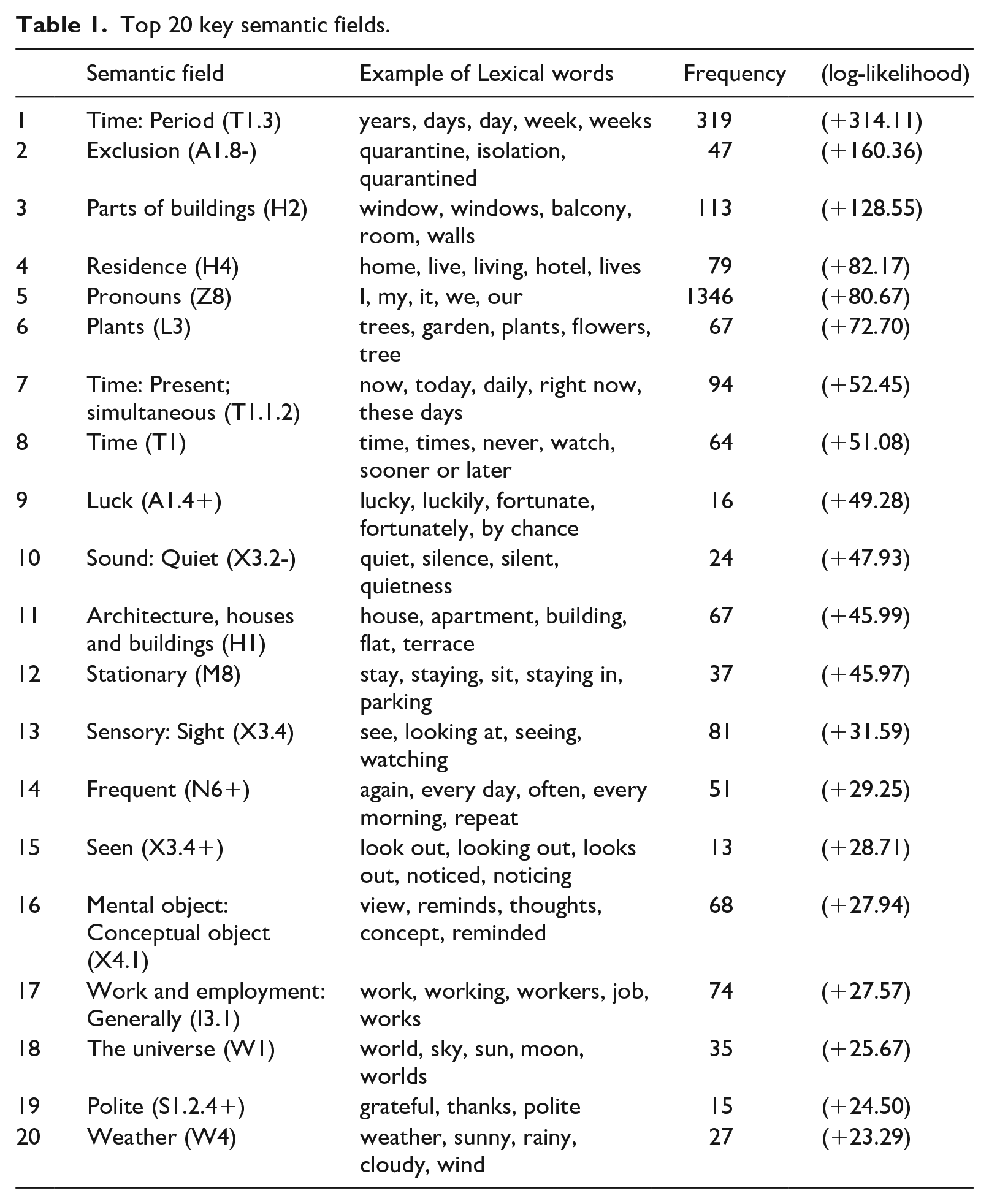
In the following section, we will discuss the recurrent themes found in these semantic fields, which were used as different story components in breaking news and prototypical stories.
Stage 2. Close reading and categorisation of story elements
Although the key semantic field and concordance analyses illustrate the common topics described in the quarantine stories, a qualitative analysis of the stories must also be conducted to examine how the tellers discursively represented their quarantine lives and themselves. Thus, we conducted a closer reading of all the collected quarantine stories and identified the narrative dimension (Ochs and Capps, 2001). Due to space limitations, we will only discuss tellership, linearity and tellability in this study.
Next, we manually coded the stories with story elements with reference to the previous approaches (Georgakopoulou, 2013; Labov, 1972; Page, 2012). These stories each exhibit some of the genres and elements from small social media stories and prototypical narratives. After coding, we sorted the data and compared the same story elements across different quarantine stories and identified the lexicogrammatical patterns and features, which we used as the starting point to investigate the discursive construction of the collective identities and shared attitudes between the tellers and audiences. Another researcher uninvolved in the project reviewed the identification and interpretation of story elements. We discussed and explained the inconsistencies until we reached a consensus.
Stage 3. Data interpretation
Regarding data interpretation, this study employed mediated narrative analysis (Page, 2018). Compared with traditional narrative approaches focussing on the narrative structures or concrete interactions between tellers, mediated narrative analysis concerns the ways in which (1) ‘stories mediate between the people who produce, consume and reproduce them’ and (2) are ‘mediated by various technological resources used in the contexts of production and reception’, as well as (3) the mediated position and the constitutive role of stories ‘between the tellers and their social contexts’ (Page, 2018: 3–4). Accordingly, we examined how the quarantine stories mediated the interaction between users around the world (who described their feelings and experiences, sent prayers and expressed support to readers worldwide, through which a shared sense of identity was developed), how those stories were mediated by the technological affordances of the platform (i.e. the photo-uploading function allowing users to present their environment vividly and the posting function to spread their message to a global audience) and, lastly, how the stories mediated users’ relationship with the global context of the COVID-19 pandemic (e.g. establishing and recording a collective memory of COVID-19 and supporting the communities during the time of crisis). This study references the insights of different frameworks, such as critical discourse analysis (CDA) and narrative approaches. We situated the discursive representation and identity within CDA. Tellers present a particular view of reality through language, creating a discursive representation (Chilton, 2004). The discursive representations of the self and others reveal how tellers discursively construct their identities (De Fina et al., 2006); it is a dynamic construct. Identity is also multiple (e.g. individual or collective) and fluid, influencing the identity construction of one another (Flowerdew and Richardson, 2018).
Findings and discussion
Quarantine stories are personal narratives that establish a common ground with readers, conveying mutual support and encouragement (Reyes, 2015). Once the tellers submitted the stories, they were not allowed to delete them. Thus, the tellership (Ochs and Capps, 2001) is not as dynamic as the other social media story genres, in which their parts are often distributed across posts and comments (Page, 2012). While readers could not leave comments, they could give likes and share the stories by copying and pasting the shareable links (see Figure 1).
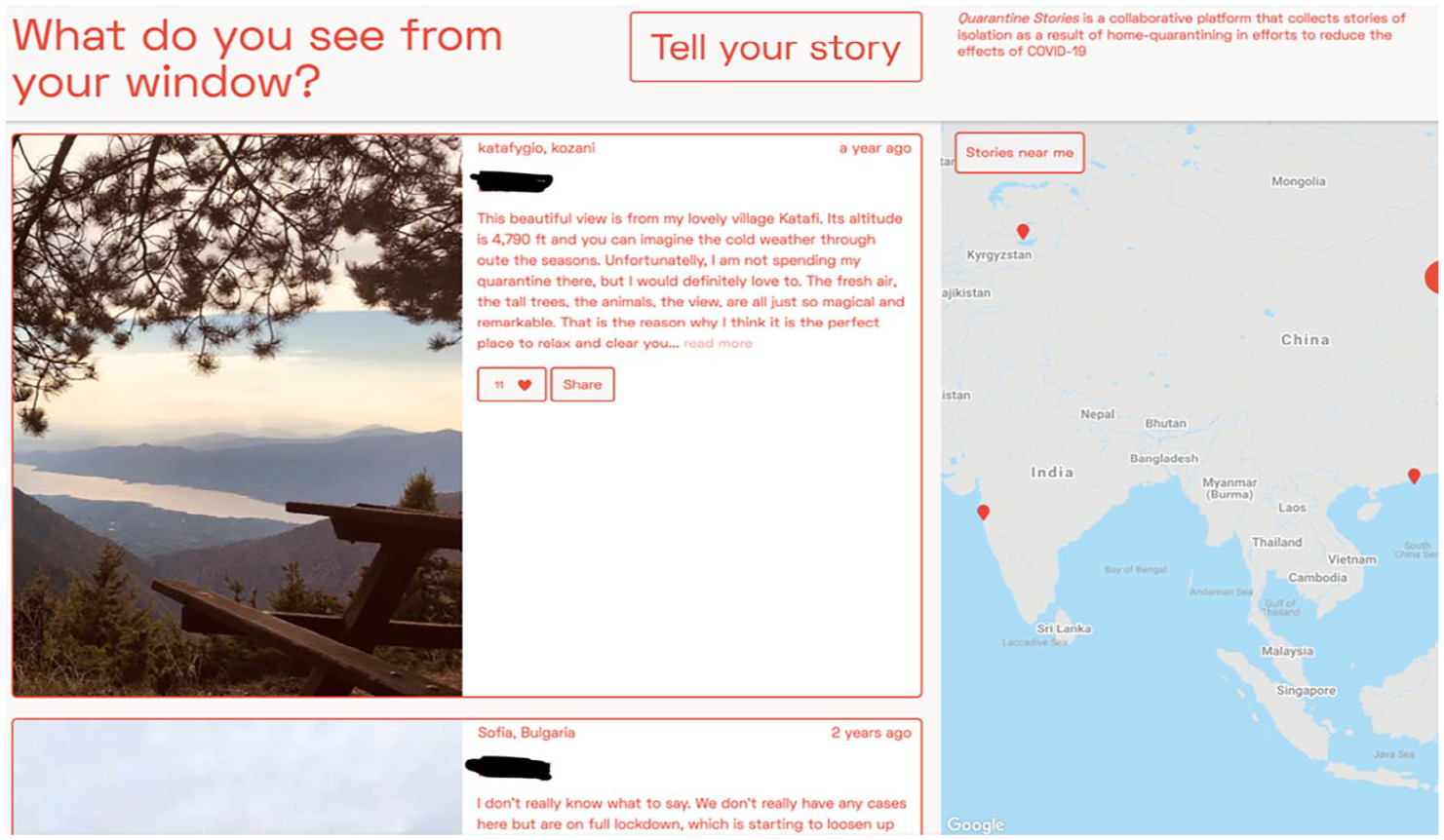
The single tellership of quarantine stories (names are redacted for confidentiality).
Atypical and quasi-prototypical narratives
This comprises the structure of storytelling coherence and the temporal sequence of events (Page, 2012). The latter is manifested by the time stamps used in storytelling or can sometimes be inferred from the discursive and wider contexts wherein the stories are situated, whereas structural coherence is the chronological frame constructed in the stories (Page, 2012). Regarding temporality, tellers focus on the present, situating their quarantine stories in the existential dimension – without knowing what would come next (Ryan, 1993). This explains why quarantine stories often appear fragmented and incomplete. We categorise these stories as either minor or major breaking news.
Minor and major breaking news
Out of 149 quarantine stories, 96 (64.4%) were short (comprising one or a few sentences), fragmented, and open-ended, featuring social media stories (Page, 2012). Unlike the official discourse examined by Jarvis (2021), such short stories ‘can be easily missed out by an analytical lens’ (Bamberg and Georgakopoulou, 2008: 381), even if they have no shortage of relevance in subject matter (Page, 2018). We regarded these stories as breaking news because the events described were mundane, characterised by recency and iterativity (Georgakopoulou, 2017). We term Examples 1 and 2 (the first sentence) as minor breaking news as they report mundane daily events:
(1) I sit around and wonder, daydream, drink coffee, work[,] make music and wait.
(2) I’m chilling on the hammock, (finally) reading a book. When I take a break from the pages[,] I admire the blue sky and I feel so lucky to be in Paris and to have a balcony.
Examples 1 and 2 are the only stories that their respective tellers submitted to the online platform. They narrated their individual experiences, indicating what they were doing when taking the photo and sharing their experiences as they were happening right then. In both examples, time orientation is linguistically signalled through verb tense and aspect. In Example 1, the teller posted a photo of empty roads and some buildings. Subsequently, he described his day-to-day activities using first-person singular present-tense verbs, such as ‘sit’, ‘wonder’ and ‘drink’, which shows that he undertook these activities regularly during quarantine, demonstrating his habitual present (Georgakopoulou, 2007). In Example 2, the teller shared a photo of herself lying in a hammock on her balcony, with a book placed on her lap, and the place reference is simply manifested in the linguistic cue ‘in Paris’. The first sentence of her story depicts the objects in the photo. In this example, the auxiliary verb provided temporal information about the non-finite verbs ‘chilling’ and ‘reading’, revealing that the teller was describing the exact moment while writing, showing different temporality, compared with Example 1. Additionally, while Example 1 only reports ordinary and regular events during self-isolation, Example 2 reveals the teller’s positive assessment of feelings (i.e. self-reflection) about having a balcony and enjoying the pleasant weather during quarantine in Paris.
Besides reporting regular events, tellers also reported urgent and unexpected events, which we categorised as ‘major breaking news’:
(3) Now I’m at the hospital, because of a (fortunately) little pneumonia. . . obviously I’m Covid-19+, but it’s ok, I’m lucky because my conditions are pretty good. I’ll be home in a couple of days. Stay home, stay home. . .stay safe! ♥
(4) Day 6 and I’m still stuck with close to 40 degrees of fever. All the symptoms seem to match.
In Examples 3 and 4, the tellers narrated their experiences after having (possibly) contracted COVID-19. When composing, both tellers assumed the shared knowledge, viz, the use of the terms ‘pneumonia’ and ‘COVID-19’ and the mention of the symptom ‘close to 40 degrees’, between them and their readers, which drew them together. By using the present tense form of auxiliary verbs, they reported the immediate moment while writing. The deictic time expression ‘now’ in Example 3 was located at the beginning of the clause (i.e. the ‘thematic position’, as Halliday and Matthiessen [2013] named it), stressing that the important thing was happening at the moment (Myers, 2010), thus emphasising the recency of the post. Using a plus sign and a heart emoticon underscores the features of social media discourse – the former indicates the brevity of expression and reduces the awkwardness of making a direct statement, the latter conveys caring and invokes solidarity (Zappavigna, 2012). Moreover, Example 3 provided an evaluation, as evidenced by the use of explication (i.e. the use of ‘because’) (Labov, 1972), to detail the reasons why she felt fortunate. The teller included a coda (Labov, 1972) for her story through the formulaic construction ‘stay home, stay safe’ – the lesson she learnt, the moral of this story, is to adhere to social distancing rules and spend more time at home. The use of imperative and repetition manifest the intensifier (Labov, 1972), showing that staying home is the only way to stay healthy and avoid being infected. Meanwhile, the last sentence may also be viewed as a directive, that is, projected towards audiences who will follow the action she directed (Myers, 2010). By giving this coda, the teller used her story to remind readers to adhere to the self-isolation rules. In major breaking news, the temporality focus differs from that in minor breaking news, in that the emphasises an important event in the present.
Quasi-prototypical narratives
Some quarantine stories’ structures are more complete and coherent, resembling prototypical narratives, as they are more well-planned. Contrarily, Facebook or Twitter updates emphasise immediacy (Sadler, 2021). Tellers used the platform to share their feelings and thoughts about the lockdown and the changes they experienced. Thus, 53% of the stories included elements, such as orientation, complication and resolution (Labov, 1972), sequencing past-tense events and exhibiting prototypical stories’ linearity (Ochs and Capps, 2001). More story elements and figurative language reveal that Examples 5 and 6 are more well-planned stories, similar to prototypical narratives.
(5)
Self-reflection
In Example 5, the first-person singular deictic form reports the teller’s individual experience. Lines 1 and 2 manifest the orientation (Labov, 1972) as they contain the story’s background information, including time (moving to Malta from Milan 3 years ago) and place (Malta). The past was linked to the present in line 3, describing the teller’s routine activity – looking at the sea through the window after waking up every morning. The teller’s self-reflection from the second part of line 3 conveys the teller’s feelings about seeing the sea. The word ‘challenge’ is a metonym for ‘COVID-19 pandemic’ or ‘self-quarantine’, implying he was optimistic amid the undesirable situation. Line 3 manifests the resolution, whereas line 4 presents the outcomes of the global health crisis (i.e. the resolution; Labov, 1972) he encountered. Further, looking at the sea serves as a substitute for travelling, returning to his home country, visiting others and going out to eat or drink, giving him comfort and retaining a good mood. Thus, this corroborates the view that resolution is arranged early in computer-mediated stories and more reportable (Arendholz, 2010; Dayter, 2015). The early appearance of resolution might be because social media stories are personal, expressive and short, capturing readers’ attention immediately. Thus, the social media genre influences the way the tellers narrate their stories.
(6)
Self-reflection
Evaluation
The teller in Example 6 used more figurative expressions to express her feelings about COVID-19 and its impact. A teller’s rhetorical skills can enhance the tellability of their story (Ochs and Capps, 2001). Evaluation is found in line 1, wherein the teller first assessed the ambience and neighbourhood, highlighting the timeless present (Georgakopoulou, 2007). Subsequently, she used a contrastive to underscore the difference between the empty streets and her thoughts in line 2, providing orientation and self-reflection simultaneously. Line 3 is a resolution to the complication suggested in the wider context – the spread of COVID-19 and the imposition of quarantine. She revealed that she was working from home like many others, revealing her habitual present (Georgakopoulou, 2007). Line 4 manifests self-reflection, providing another contrast between spring’s beauty and COVID-19′s destructiveness by personifying the spring and conveying a contrast between people facing the chaos and nature’s cyclical stability. The teller’s self-reflection continued in line 6 – she felt blessed because she could still go out for a walk. The story ends with a coda through the formulaic construction ‘take care’, conveying the teller’s blessing to the readers. Overall, Example 6 exhibits a quasi-prototypical narrative structure. However, it does not fit well within the canon, as the complication (i.e. the global outbreak of COVID-19) of the narrative is established as a shared but unspoken datum, and the evaluation is positioned before orientation.
These stories demonstrate that the tellers used the platform to express their thoughts and feelings, hoping for their voices to be heard and obtain support from online readers worldwide. Thus, the platform reminds tellers to stay positive during COVID-19.
The foci of quarantine stories
Tellability is ontological (Bruner, 1991) – the way tellers told their quarantine stories revealed how they conceptualised the quarantine. Given the sensational nature (Ochs and Capps, 2001) of COVID-19 (i.e. its destructiveness, universality and unprecedented nature), some quarantine stories are highly tellable. These stories help tellers establish a collective memory and narrative practices during this key moment, allowing readers to share and retell their experiences. Tellers’ narrative practices and stories’ meaning (Wang, 2021) are characterised by their recurrent topics and themes. As the key semantic field analysis demonstrated, the subject matter of the quarantine stories revolved around time, isolation and tellers’ residence, as illustrated in Table 1.
Recording the quarantine’s length
Time was a recurrent theme in the quarantine stories, as tellers made temporal references (recent, more distant past, or future) to attain various discursive goals. Of the tellers, 23% used the online platform to record the number of days or weeks they spent in quarantine, especially for orientation, marking the historic present. Some expressed their boredom when indicating the length of quarantine, as follows:
(7) The days are long and the nights are even longer. The streets are completely empty. We have been quarantined for 10 days already. There are many people who don’t take the crisis seriously and the government was forced to take stricter measures.
(8) I’m home now [after] more than 2 weeks and I’m trying to go out only if really needed. I often spend time thinking about time, it feels like [the] days are much longer. This is such an absurd situation, no one could ever even imagine.
In both examples, the tellers emphasised the length of the days and nights and the quietness of streets to express their boredom and loneliness, followed by their evaluation (Labov, 1972) of other people and COVID-19. The co-occurrence of descriptions of the lengthiness of time and the use of evaluative adjectives and adverbs (e.g. ‘empty’, ‘absurd’, ‘stricter’ and ‘seriously’) underscored the urgency and unprecedentedness of the pandemic, implying that the tellers missed their prior lifestyles.
The quarantine’s length was also recorded when tellers expressed how they enjoyed the quarantine period:
(9) Today is the 29th day of quarantine in Lucca and I have been spending my days with my boyfriend in our sweet home in the city centre.
(10) It is the third week of social distancing in Maputo, I’ve been spending [the time] [in] the [countryside]; it is considerable calmer than the city and a great opportunity to read and create more!
In Example 9, even after spending 29 days in quarantine, the teller expressed happiness about being with her boyfriend (by using the expression ‘our sweet home’), discursively transforming quarantine into a honeymoon period, suggesting that what mattered most to her was having good company. Similarly, Example 10 shows that the quarantine period enabled the teller to utilise her time in the countryside by reading and boosting her creativity. Here, tellers focussed more on the positive aspects of quarantine, seeking a reprieve from the shock and dangers of COVID-19. Moreover, both of the examples use the present perfect progressive tense (’I have been spending’ and ‘I’ve been spending’), indicating the evolving quality of their quarantine stories.
In Examples 7–10, tellers seized the opportunity to record this unprecedented experience. The information tellers provided about the quarantine’s duration enabled readers to understand COVID-19 and policies in the different cities where tellers resided and encouraged tellers to express their feelings about the quarantine. Furthermore, tellers could establish their orientation and set the scene for their personal narratives, which allowed for the simultaneity of ongoing events across space and time. Finally, they developed shared sense of identity as they recognised one another as part of an in-group (Simões Marques and Koven, 2017).
Changes and favourite spots
Tellers mentioned various changes in their surroundings, lives, routines and in nature. For instance, they (15%) compared between past and present to differentiate between what they could see from their windows before and after the pandemic:
(11) The street and sidewalk have become much emptier in recent days. Last week[,] I was afraid that my neighbourhood in Wedding would not take the pandemic seriously, but since the beginning of the week their behaviour has changed a lot .
(12) My window doesn’t face the street. I haven’t watched the world grind to a halt; rather, I’ve watched it come to life. What used to be a chance encounter across balconies or brief eye contact through the window is now very much the norm.
(13) Usually[,] the weekends are wild[,] bustling with people, but now we just see an empty parking lot.
In Examples 11 and 13, the tellers indicated substantially fewer people on the streets, sidewalks and parking lots since the lockdown implementation. In Example 11, the teller was relieved that the community members were willing to alter their behaviour. In Example 12, the teller noted that people spent more time looking through their windows or in their balconies and could see what the neighbours were doing. The use of present perfect tense (Examples 11 and 12) and contrastive (the use of ‘but’ in Example 13) enabled the tellers transition between past and present. These stories highlighted a spatiotemporal contrast between the lively and quiet neighbourhood before and after the pandemic, respectively, giving readers a glimpse of how COVID-19 had changed their views and lives.
Tellers also discussed change when mentioning their favourite spots for spending the time during quarantine. In most cases, outdoor spaces, such as balconies, rooftops and terraces were focal points:
(14) During my quarantine, my daily routine completely changed[,] and since day one I’ve been experimenting [with different] ways to work from home with comfort and effectiveness, trying to balance work and personal life in the same small space of my apartment. I choose my balcony as my favourite home-office spot[. It] is incredible how nature has this power to make us feel better and to contribute to our wellbeing and peace of mind. How privileged I am for having this view during this isolation time.
(15) So many things happened during the last few weeks that just made me [realise] how fragile our lives are. . . the only time I manage to feel more relaxed and less worried about the future is when I’m in my balcony enjoying this view, which I’m glad to be able to share with you. . . Stay safe.
(16) My amazing neighbour let me use his roof terrace as [an] office. Spacing with the view all around Amsterdam Oost brings me a lot of quietness and concentration.
In Examples 14 and 15, both tellers indicated the changes they encountered during the quarantine. Besides expressing their frustration and worries, they also emphasised how spending time outdoors enabled them to appreciate nature and enjoy the view. Likewise, in Example 16, tellers indicated that having a terrace allowed him to enjoy serenity and focus on work. Evaluative adjectives, such as ‘incredible’, ‘better’, ‘privileged’, ‘relaxed’ and ‘less worried’, evidenced tellers’ self-reflection about their feelings in isolation. Further, outdoor spaces are a turning point in quarantine stories; getting a breath of fresh air is like a resolution (Labov, 1972) to the problem of being isolated at home and in the city, giving the tellers peace of mind.
Daily routines
Besides the topics of quarantine duration and change, tellers (44%) referred to the present and recorded regular daily events amid the COVID-19 pandemic.
(17) Spending most of my days at home in front of [the screen] working and studying, small routines and habits [have] started creeping up on me.
(18) Happy I can stay productive working from home during this quarantine time, although it is sometimes challenging when my neighbours do their daily well-intended Zumba session on the roof terrace, right next to our window.
(19) What was mundane yesterday is inspirational today when my motivation is running low. . . I can see Lady-Yoga in the top right flat across the courtyard. I noticed that she is particularly flexible when the sun is out.
As in the above examples, tellers spent most of the day working or studying from home. They also highlighted that they started seeing their neighbours more frequently and depicted their characteristics and activities in their stories. For instance, the teller of Example 18 photographed his neighbours doing Zumba in the terrace and evaluated (Labov, 1972) how this could distract him. The teller of Example 19 indicated that she spotted her neighbour doing yoga every early morning and referred to her as ‘Lady-Yoga’. The humour used in tellers’ description of their neighbours gave readers a laugh, steering their attention away from the lockdown restrictions. This is important, as humour can prompt in-group bonding in the digital arena, enabling tellers and readers to defuse difficult situations (Demjén, 2016).
Writing about their daily routines enabled tellers to share how they kept themselves and others sane during quarantine:
(20) Calling my family in Italy is now a daily activity that divides [my] working hours from [my] free-time in the evenings. Daily activities such as cleaning, reading, gardening, exercising, [and] planning trips are central to keep myself calm when my focus is missing or the news makes me sad.
(21) I can see my very nice neighbour, Elise. I started to talk to her, she’s 70 years old and [lives] in front of [my home]. Very polite she didn’t want to disturb me. I told her that talking to someone is [what] we all need right now. I guess I needed this quarantine to talk to my neighbours. We meet every day at 8 PM to applaud the medical team. I told her that once this is all over, we have to meet.
In both examples, tellers narrated considering relationships important during the quarantine period. In Example 20, the teller indicated that one of her daily activities was to call her family in Italy; in Example 21, the teller developed a friendship with her neighbour and suggested meeting each other after the quarantine, thereby establishing a coda for her story (Labov, 1972). Other activities, such as planning trips, gardening and thanking the medical team for their efforts, facilitated optimism and empowered the healthcare workers. Sharing these minor breaking news items on the online platform served the function of spreading happiness and encouraging others to keep a positive mindset.
Interestingly, tellers narrated their unchanged routines during quarantine and depicted nature’s cycle in their stories. Tellers (10%) highlighted the contrast between nature and the pandemic in their self-reflections:
(22) Everything seems so normal even when the situation is so catastrophic. How can so many people die, when the vegetation is blooming in the silence of my suburb? I like the idea of sharing my view.
(23) During the quarantine, my boyfriend and I saw our little friend [plant] growing and growing. He feels really good next to our lower basement window. This reminded me of something: It might seem that during quarantine our world stopped turning, so it feels nice to see that nature never stops growing [. . .] That makes me calm down and reminds me that even though we might feel bad sometimes, it reminds me that we’re not alone, the world won’t stop turning and nature is there, right in front of your window.
(24) I have been looking at this view of the park in front of my apartment for so long that it is becoming a frozen image in my mind. Every time a bird flies, [the] leaves of [the] trees [move] with the wind, [and] I am reminded that life goes on despite the quarantine.
In these examples, the tellers established two main contrasts. First, the discrepancy between the destructiveness of COVID-19 (exemplified by the expressions ‘catastrophic’ and ‘many people die’) and the beauty of nature (exemplified by the expressions ‘blooming vegetation’, ‘squirrel’ and ‘little friend [plant]’). Second, undergoing confinement and establishing a regular routine at home were likened to the world stopping (exemplified by the expressions ‘frozen image’ and ‘our world stopped turning’), compared the environment’s natural cycle, which continued its course despite the pandemic. Consequently, the tellers implicitly expressed their sadness and powerlessness vis-à-vis the chaos of COVID-19 and imparted positivity and encouraged others to change their state of mind.
Notably, the habitual and ongoing engagements of daily routines and adaptation, which are opposed to the research-prompted, past event in the Labovian paradigm, become the source of a collective sense of who we are at the time of the ‘new normal’ (Bamberg and Georgakopoulou, 2008).
Self-healing
Tellers can integrate their feelings and memories through narration while depicting what they have seen, learnt and done during the quarantine. The healing process allows tellers to talk about and face undesirable experiences (Gemignani, 2011). Noteworthily, tellers often referenced nature, describing how it alleviated their stress and worries amid the pandemic:
(25) Unfortunately, I am not spending my quarantine there, but I would definitely love to. The fresh air, the tall trees, the animals, [and] the view are all just so magical and remarkable. That is the reason why I think it is the perfect place to relax and clear your mind from all the madness of the world right now.
(26) I’m cherishing the chance to enjoy the little things in life. Like seeing my little garden springing back into life with the first bit of spring sunshine. It’s important to appreciate what we have at times like this.
(27) I am extremely grateful for this beautiful weather in Hamburg for the past 2 weeks. It made everything a bit lighter – literally.
In Example 25, the teller discursively represented nature as a magical world (exemplified by the expressions ‘magical’, ‘remarkable’ and ‘perfect’). She was disappointed about not spending the quarantine period in her hometown with a beautiful landscape because nature can help distract her from the stress of the pandemic. Similarly, in Examples 26 and 27, the tellers appreciated her blooming garden and the pleasant weather, suggesting that we should treasure what we have despite the adversity.
In describing nature, the tellers also expressed their hope for a better future, as reflected in the stories’ coda (Labov, 1972):
(28) This morning[,] a small kid was trying to enter the park, but he was not allowed to. It is sunny and beautiful; I hope that sunny days are [more common] for all of us.
(29) Some days have been tougher than others but with spring on the doorstep I already feel the positive vibes [. . .] I am confident that a better and safer world will be there to welcome [my baby] soon!
(30) I’m keeping an eye on the blossoming tree outside our window and thinking about how the world can change for the better when we come out of the other end of this.
In Examples 28 and 29, the tellers admitted that they found the quarantine period and COVID-19 difficult to overcome. They also expressed hope by associating sunny days and spring with a desirable future – 1 day the COVID-19 will be over and everyone will be able to remove their face masks. By spreading the message that we should all enjoy the present, tellers (e.g. Example 30) also suggested that people should ask themselves how they can work together to improve once the pandemic is over. Discursively, this constructed an affective frame (Giaxoglou, 2019) linking tellers’ quarantine experiences to wider societal issues, such as the public health system’s resilience and preparedness. These further empower readers and other tellers, encouraging them to hang on and stay strong during such a difficult time.
Conclusion
This study identified the recurrent themes and discursive representations used by tellers in these quarantine stories. Three implications emerged from the findings.
First, most quarantine stories, given their recency and iterative quality, were presented as breaking news. In spite of their ‘smallness’, the quarantine stories, as a form of social practice, documented matters of public concern and engaged ordinary tellers with the global discussion of COVID-19 alongside their ‘big’ counterparts (e.g. official discourses). Then, we added nuance to the general descriptor of ‘breaking news’: while major breaking news report sudden and crucial events, stressing the immediate and historic present, minor breaking news report routine events during quarantine, focussing on the habitual present. In this study, both breaking news occurred in fragmented forms, exhibiting no clear ending and conforming to social media stories’ brevity and spontaneity.
Second, quarantine stories showed traces of traditional narrative components, allowing the repositioning of narratives’ prototypical paradigm within a broader spectrum that includes the practice of social media storytelling (Page, 2018) – tellers reported on their quarantine’s duration and location, thereby establishing stories’ orientation, established complications in their stories by depicting the boredom and hardships experienced during quarantine and the uncertainty of COVID-19, conveyed their stories’ resolution by highlighting how they enjoyed the time they spent in their apartments’ outdoor spaces and the joy of knowing that the natural cycle continued. They also deployed formulaic constructions in their stories’ codas, encouraging people to take care and stay strong amid the quarantine. However, different from traditional narratives, quarantine stories presented their resolutions earlier. This reveals that social media stories are personal, expressive and brief. Thus, by placing resolutions earlier in the stories, tellers could capture readers’ attention immediately.
Third, tellers not only wrote about the prompt provided (i.e. what they saw from their window) but also used the online platform to narrate their quarantine experiences, which established a collective memory during COVID-19 and formed a collective identity among those living the new normal. This was established via tellers sharing the changes in their neighbourhood and routines before and after the COVID-19 outbreak; self-adaptation and learning during quarantine; relationships with neighbours, acquaintances and families; and by presenting hopeful expressions regarding the post-pandemic era. Tellers’ use of present-tense verbs, first-person deictic forms and photos enhanced the instantaneousness and timeliness of the breaking news. Similar to executive discourse (Jarvis, 2021), the narratives produced by ordinary internet users also have their own discursive functions. In this case, tellers utilised their individual experiences of the global health crisis to build collective identities with unknown and geographically dispersed tellers and readers (Simões Marques and Koven, 2017).
Fourth, this study also provided insights into how tellers use different time stamps to make sense of their stories. The temporality of the quarantine stories was manifested in the historic, timeless and habitual present. This marked the historicity of COVID-19 and expressed the simultaneity between the time of narration and the experiences themselves – underscoring the immediacy of social media stories. Furthermore, tellers’ retrospective narrative structure transitioning the past to the present highlight the contrast between what they saw and how they felt before and during the pandemic. This, together with the timeless present, conveyed the evaluation of the effects of this public health crisis. The habitual present was employed to indicate tellers’ daily routines and convey their self-reflection vis-à-vis learning from and adapting to the pandemic. Finally, tellers also established future projections – their digital storytelling practices enabled tellers and readers to form a shared community (Wang, 2021), establishing solidarity and mutual support in the digital sphere, unfettered by spatiotemporal restrictions.
Taken together, stories’ time stamps linked the quarantines narratives via simultaneity; they moved between the longing for the pre-pandemic past, immediate present and uncertain future. This demonstrates that tellers clung onto memories and braved the unpleasantness of the pandemic, discovering things they had never noticed and striving to adapt to the new normal. Despite their challenges, tellers conveyed their optimism for a near or remote future wherein social distancing restrictions would be lifted and people would be able to see each other and travel freely again. More importantly, the people’s collective struggles and adjustments during the pandemic will one day become survival guides for new readers.
Footnotes
Declaration of conflicting interests
The author(s) declared no potential conflicts of interest with respect to the research, authorship, and/or publication of this article.
Funding
The author(s) disclosed receipt of the following financial support for the research, authorship, and/or publication of this article: This work was supported by the Faculty Research Grant, Lingnan University: [Grant Number 101884].