




Abstract
In line with the urgency of problems related to climate change, studies on the framing of this issue have flourished in recent years. However, as in framing research overall, a lack of definitions complicates the synthesis of theoretical/empirical insights. This systematic review contrasts trends of framing in climate change communication to those observed in reviews of communication research overall and harnesses framing’s power to bridge perspectives by comparing frames across different frame locations (i.e., frame production, frame content, audience frames, and framing effects), as part of the wider cultural framing repository. Combining quantitative and qualitative approaches of content analysis, this review draws on 25 years of peer-reviewed literature on the framing of climate change (n = 275). Among the findings, we observe that research has not made use of framing’s bridging potential. Hence, the conceptual (mis)fit between frame locations will be discussed, and directions for future research will be given.
Framing is one of the most popular contemporary theoretical approaches in communication research (e.g., Cacciatore et al., 2016). Many studies refer to the concept but sometimes fail to provide definitions, resulting in a diversity of phenomena subsumed under this conceptual umbrella (e.g., Reese, 2007). This complicates attempts to synthesize theoretical and empirical insights—which has often been described as a problem for communication research (e.g., D’Angelo et al., 2019; Reese, 2010). Systematic reviews aim to help overcome such problems by identifying common trends, locating research gaps, and guiding future research (e.g., for framing: Borah, 2011; Matthes, 2009). However, the reviews available have not made much use of one of the unique characteristics of the framing approach: its bridging potential (e.g., Gamson et al., 1992; Reese, 2007). This relates to the fact that framing is able to consider the entire communication process, with all its aspects, and thus bridges different (interdisciplinary) perspectives: strategic communication by a variety of actors (including their cognitions); journalistic cognitions, processing of information, and subsequent reporting; frames of audiences; framing effects; as well as the broader cultural contexts in which frames emerge and compete for attention (e.g., Gamson et al., 1992; Matthes, 2014; Reese, 2007). Entman (1993) refers to frame locations in the communication process: the communicator, the text/message, the receiver, and the culture. Here we argue that by systematically reviewing how framing has been applied across frame locations and by elucidating the most salient frames at each location, we gain indications about the cultural framing repository—that is, the (competitive) environment of salient and culturally/cognitively available frames (e.g., Brüggemann, 2014).
Reviewing the literature and assessing a cultural framing repository is best performed when selecting one specific topic for which many studies are available. Here we focus on the framing of climate change (e.g., Metag, 2016; Schäfer & O’Neill, 2017) for a number of reasons. (1) Since climate change is one of the most important contemporary global problems (e.g., Moser, 2010), exploring its communication is highly relevant. Audiences continue to rely on a set of different sources to obtain information about the issue but nevertheless find the topic difficult to engage with and understand; in this context, frames also affect (the support for) actions audiences are willing to undertake (e.g., Bolsen & Shapiro, 2018; Nisbet et al., 2018). Furthermore, climate change is a special topic due to its unobtrusiveness, complexity, and scientific (un)certainty (e.g., Guenther et al., 2022; Schäfer & O’Neill, 2017; Schmidt-Petri & Arlt, 2016), as well as the required connections between experts, policy, sources of information, and audiences for combating it: framing is able to “break through the communication barriers” (e.g., Nisbet, 2009, p. 15). Certainly, many scholars also share the normative expectation that studying framing helps develop communication strategies (for target audiences), build consensus, and support actions to fight climate change (e.g., Bolsen & Shapiro, 2018). To do this effectively, framing needs to be explored across frame locations. (2) Since research on framing in climate change communication is growing steadily (for overviews, see Metag, 2016; Nisbet, 2009; Schäfer & O’Neill, 2017), future research will benefit from a systematic review. Systematic reviews can take stock and guide future research more thoroughly when many studies are published in a specific field. In climate change communication, research has been conducted on communicator’s frames (e.g., Daub, 2010), journalist’s frames (e.g., Engesser & Brüggemann, 2016), frame content (e.g., Feldman et al., 2017; O’Neill et al., 2015), as well as audiences frames (e.g., van Eck et al., 2020), and framing effects (e.g., Bilandzic et al., 2017; Bolsen et al., 2018)—allowing for an assessment across frame locations. (3) There is a limited number of systematic reviews available for framing in communication research overall (e.g., Borah, 2011; Matthes, 2009). Attention should be given to whether common trends observed elsewhere are also evident in framing research on climate change communication. Only then can we assess if there are field-specific applications, which potentially also have implications for studying framing in communication research overall. Indeed, researchers assume that the application of framing varies across subtopics; for instance, there are specific features of framing in health communication (e.g., Guenther et al., 2021). Field-specific insights add to the limited number of studies that systematically examine published literature on framing.
Hence, the present study will conduct a systematic review on the framing of climate change and compare findings to those from reviews covering framing in communication research overall (i.e., Borah, 2011; Matthes, 2009). Furthermore, the present study will focus on the most salient frames across frame locations to harness framing’s potential as an integrative bridging concept. Thus, we aim to connect research on frame production (i.e., frames of communicators and journalists), frame content (i.e., the frames most salient in communication), audience frames, and framing effects—which provides indications of the cultural framing repository and allows identification of the conceptual (mis)fit across frame locations. A misfit means that subsequent studies did not identify or relate to the same frames and thus do not contribute to closing the climate change communication cycle (Schäfer & O’Neill, 2017). Combining quantitative and qualitative approaches of content analysis, this study will draw on 25 years of published literature on climate change framing.
Framing as a Theoretical Concept
One of the unique characteristics of framing is that researchers using the concept come from a variety of different scientific fields and disciplines (e.g., D’Angelo, 2002; Reese, 2010; D. A. Scheufele & Tewksbury, 2007). Interdisciplinary diversity has been named as one of the reasons why there is no single accepted definition of what a frame is, how frames can be conceptualized, and consequently operationalized in empirical studies (e.g., B. T. Scheufele, 2004; B. T. Scheufele & Scheufele, 2010). There are numerous definitions available of what a frame is (e.g., Gamson & Modigliani, 1989; Reese, 2010); nevertheless, most research in this area refers to Entman (1993). What his definition entails is not just the specification of frames as typical combinations of four so-called frame elements (i.e., problem definition, causal interpretation, moral evaluation, and treatment recommendation; see also Kohring & Matthes, 2002; Matthes & Kohring, 2008), but the fact that framing encompasses both selection and salience. Through framing, certain aspects of reality are selected and made more salient, which also means that some information will be left out or neglected. Framing, thus, opens a window (see already Tuchman, 1978) to a specific reality or aspects thereof, in which certain interpretations become more likely. Frame elements organize and structure information in a systematic manner, which is in line with the definition of framing as so-called packages of interpretation (see also Gamson & Modigliani, 1989). However, Cacciatore et al. (2016) argue that framing relates to applicability rather than accessibility, visibility, or salience, which shows that definitions are (still) contested.
Besides the fact that there is no accepted definition of what a frame is, researchers have also debated the theoretical underpinnings of framing. For some, framing is a theory or even a (fractured) paradigm able to unify different aspects of communication research (Entman, 1993). For others, framing is a multi-paradigmatic research program (D’Angelo, 2002), in which it is seen as a major advantage that different perspectives accumulate more knowledge. D’Angelo et al. (2019) see the multi-faceted nature of the concept as a strength of the theoretical approach. This is in line with Reese (2010), for whom the diversity of approaches adds to the interdisciplinary quality of research on framing. What researchers agree on is that framing is a constructivist concept: a program to understand better how reality is socially constructed (e.g., Schäfer & O’Neill, 2017; D. A. Scheufele, 1999). Nevertheless, it has often been criticized that there is a vast number of studies referring to framing, although their conceptualizations and operationalization of frames and framing, contradictory to some extent, can hardly be summarized under one umbrella (B. T. Scheufele & Scheufele, 2010). That is why discussions are ongoing about definitions and conceptualizations, theoretical underpinnings, and operationalization, which includes similarities and differences to related concepts, such as agenda-setting and priming (e.g., Borah, 2011; D. A. Scheufele, 1999; D. A. Scheufele & Iyengar, 2014; D. A. Scheufele & Tewksbury, 2007).
Two traditions of framing research can be distinguished: sociological (e.g., Gamson & Modigliani, 1989; Goffman, 1974) and psychological (e.g., D. A. Scheufele & Iyengar, 2014). The dual nature is often summarized as frames in texts, images, or news (sociological) and frames in individuals’ minds (psychological) (Borah, 2011). Often, the psychological tradition is further divided into equivalence framing (based on prospect theory, dealing with different linguistic presentations of the same information; Tversky & Kahneman, 1981) and emphasis framing (presenting a topic differently through selection and salience of content, such as episodic vs. thematic framing; D. A. Scheufele & Iyengar, 2014). For some researchers, only equivalence framing is the type of framing that is in line with the psychological tradition (Cacciatore et al., 2016; D. A. Scheufele & Iyengar, 2014). If communicators are successful and journalists or members of the public adopt frames, communication researchers refer to frame building and frame setting, respectively (e.g., Brüggemann, 2014; Matthes, 2014; Tewksbury & Riles, 2018). The process in which communicators or journalists develop frames and research on their cognitive frames is referred to as frame production (e.g., Borah, 2011).
Furthermore, researchers—regardless of traditions of framing—differentiate two types of frames: generic and thematic. Generic frames, also referred to as consistent frames (Borah, 2011), are found across themes (Iyengar, 1991); hence, they are not dependent on the thematic focus of a research study. Generic framing includes the differentiation between episodic and thematic framing (see also D. A. Scheufele & Iyengar, 2014) or frames such as attribution of responsibility, conflict, human interest, (economic) consequences, and morality (e.g., Semetko & Valkenburg, 2000). In contrast, thematic frames, also referred to as issue-specific or unique frames (Borah, 2011), are applicable to specific topics (e.g., Entman, 1993; Kohring & Matthes, 2002). Only a few studies aim to combine both types of frames (e.g., Borah, 2011; Brüggemann & D’Angelo, 2018).
As highlighted earlier, a limited number of systematic reviews are available for framing in communication research (e.g., Borah, 2011; Matthes, 2009). To summarize, these reviews show the following trends: (1) Only a few studies focus on aspects of frame production by communicators and journalists (Borah, 2011; D’Angelo et al., 2019; Guenther et al., 2021). (2) While most research studies focus on media/content frames and thus on the sociological tradition of framing (Borah, 2011), they do so by mainly analyzing text-based frames but not visual ones (D’Angelo et al., 2019; Matthes, 2014). (3) Research is also more concerned with thematic than generic frames (Borah, 2011; Matthes, 2009). (4) Framing effect studies have predominantly tested single frames in experimental conditions and not the effects of multiple or competing frames (Borah, 2011; Chong & Druckman, 2007), that is, settings in which participants receive a set of mixed frames. To answer if these trends observed are also applicable to the framing of climate change, the first research question (RQ1) of this paper is: How has the theoretical concept of framing been used in research on climate change communication?
Although broad, this question can be answered with respect to the summary provided so far (e.g., traditions and types: see Borah, 2011) and will allow comparisons to framing in other topic domains, which may bear implications for framing research overall.
Linking Frame Locations: The Cultural Framing Repository of Climate Change Communication
As emphasized earlier, the available reviews have seldom treated framing as the bridging concept it is supposed to be, connecting frames across frame locations: the frames of communicators, journalists, frame content, and subsequent audience frames and framing effects. The idea is that looking at the most salient frames across these locations bears indications of the cultural framing repository. Focusing on the framing of climate change (e.g., Metag, 2016; Schäfer & O’Neill, 2017), the present paper will work towards filling this conceptual gap and, at this stage, provide a short introduction into different frame locations—and link those aspects to research on the framing of climate change.
Frame Production: Frames of Communicators and Journalists
In general, only a few studies focus on questions regarding frame production, that is, processes of how frames are created by (public) actors or descriptions of their frames, as well as intends of these communicators (e.g., Borah, 2011; Guenther et al, 2021; see also Entman’s, 2004 cascade model). Theoretically, communicators such as politicians or members of movements actively construct frames to shape public communication, a process also called strategic framing (e.g., Matthes, 2014). Strategic frames can enter framing contests over which frames become more dominant and are thus able to shape public discourse. Journalist’s frames—as patterns of cognitions of individual journalists—also fall under frame production. Journalists rely on their own set of frames (Nisbet, 2009). However, processes of frame building (i.e., how frames enter media content), frame sending (i.e., passing on frames set by others), or frame setting (i.e., passing on a journalist’s own interpretation) have also hardly been investigated empirically (e.g., Brüggemann, 2014). Neither has the degree to which the audience’s reaction leads to the revision of frames (Entman, 2004).
This is also true for framing in climate change communication (Schäfer & O’Neill, 2017), in which competing actors aim to establish their perspectives (e.g., Anderson, 2009), such as conservative think tanks framing climate change as scientifically uncertain (e.g., Nisbet, 2009). Communicators can use frames strategically to support their agenda, and this may be one cause of polarization in audiences, complicating the prioritization of the fight against climate change (e.g., Bolsen & Shapiro, 2018). Common questions related to this frame location concern the frames of and framing strategies by elite (governmental) actors who aim to affect journalistic reporting on climate change (e.g., Robbins, 2020), the cognitive frames of (climate) journalists (e.g., Engesser & Brüggemann, 2016; Moernaut et al., 2018), or how a variety of actors can shape a frame (such as a climate rights frame; Jodoin et al., 2020). Although research on this topic seems to be sparse, the present study aimed to give a systematic overview of research in this area and to provide insights into the most salient frames identified. Comparing the most salient frames in the other frame locations helps assess if there is a conceptual (mis)fit across frame locations. Consequently, our second RQ is split: (1) How has frame production been considered in studies on framing in climate change communication and (2) what are the most salient frames identified?
Frame content
Media frames, or news frames, are patterns of meaning articulated through journalistic content (e.g., Brüggemann, 2014), which could be text, visuals (e.g., O’Neill, 2013; Rodriguez & Dimitrova, 2011), and multimodal formats (e.g., Wessler et al., 2016). Like frame production studies, some of these frames are deductively defined, and others are created inductively (e.g., Metag, 2016). Media frames relate to but are not identical to journalists’ frames because the news production process is more complex than journalists’ frames could explain alone. We refer to frame content to include so-called strategic frames (e.g., Matthes, 2014); hence, frames in the content of non-journalistic actors. As noted earlier, this may be especially important in climate change communication, a contested field in which strategic actors such as scientists, NGOs, politicians, and industry actors use their own frames (e.g., Anderson, 2009; Schlichting, 2013), some of them still trying to emphasize uncertainty perspectives (e.g., Guenther et al., 2022; Schmidt-Petri & Arlt, 2016). Audiences rely heavily on the information provided in sources of information they use (e.g., Schäfer & O’Neill, 2017). The fact that framing varies across content sources is partly linked, for instance, to partisan divides in the United States (US; e.g., Bolsen & Shapiro, 2018; Nisbet, 2009). Common questions related to this frame location concern the content of both journalistic and non-journalistic sources, for instance, how the news covers climate change or how the topic is framed in political documents.
Nevertheless, research overviews point to the fact that this research area is characterized by analyses of text-based media coverage, which in some cases is compared between countries, media sources, or over time (e.g., Metag, 2016; Schäfer & O’Neill, 2017). There is less research on strategic frames, although they are a noteworthy research subject (e.g., Moser, 2010). For this frame location, the third RQ is: (1) How has frame content been considered in studies on framing in climate change communication and (2) what are the most salient frames identified?
Audience frames
Audience frames are sets of (activated) cognitive schemas of members of the audience (e.g., B. T. Scheufele & Scheufele, 2010) that guide information processing. Audiences rely on such (mental) frames to make sense of issues (e.g., Nisbet, 2009; D. A. Scheufele, 1999). Mostly through media, but also other types of communication, audience frames can be activated, altered, or established in the first place (e.g., B. T. Scheufele, 2004; D. A. Scheufele & Tewksbury, 2007). Frame contents are usually compared to and can potentially be integrated into existing interpretations (e.g., Nisbet, 2009) if applicable (e.g., Cacciatore et al., 2016). Common questions related to this frame location concern how members of the audience express their frames (e.g., Devaney et al., 2020; Porter & Hellsten, 2014) or which frames specific groups of people have established (e.g., Asplund, 2016; Houser, 2018).
In their overview on framing in climate change communication, Schäfer and O’Neill (2017) have excluded audience frames studies. Likewise, audience frames are not part of systematic reviews for framing in communication research (e.g., Borah, 2011; Matthes, 2009), which makes our fourth RQ all the more relevant. RQ4: (1) How have audience frames been considered in studies on framing in climate change communication and (2) what are the most salient frames identified?
Framing effects
Lastly, in framing effect studies, different stimuli (i.e., frames) are usually tested in experimental conditions to see which affect audience members perceptions, values, attitudes, or even behaviors (e.g., Nisbet, 2009). Audience frames can serve as predictors of attitude and behavior change (e.g., Schäfer & O’Neill, 2017). However, not all frames are effective for all audiences (if they are effective at all)—frames need to resonate with audiences, and there are important moderators and mediators of framing effects (e.g., Borah, 2011). For instance, predispositions, sociodemographic factors, but also existing knowledge could be interacting variables (e.g., B. T. Scheufele, 2004). Normatively, framing effects studies may show which frames resonate best with audiences, engage them, and lead to attitude change and thus to stronger support for action on climate change (e.g., Bolsen & Shapiro). Hence, common questions related to this frame location concern which frame (compared to others) is most effective in predicting a defined dependent variable, such as knowledge about climate change, attitudes, or behavior/behavioral intentions.
In their overview, Schäfer and O’Neill (2017) have also excluded framing effect studies. Consequently, RQ5 is: (1) How have framing effects been considered in studies on framing in climate change communication and (2) what are the most salient frames used in experiments?
In total, answering the RQs allows an assessment of the cultural framing repository of climate change communication and comparisons while taking stock of the conceptual (mis)fit across frame locations.
Method
To answer the RQs, the present study relies on content analysis with mainly quantitative but also qualitative parts.
Sample and Sample Description
The units of analysis are peer-reviewed scientific journal articles that deal with framing in climate change communication. We gave preference to journal articles over books, book chapters, conference presentations, and other grey literature due to their quality and impact (see also Borah, 2011; Guenther et al., 2021). Before conducting the sample, we decided to consider only articles in which the study’s context (i.e., framing and climate change) was addressed in either the title, keywords, or abstract of the articles. However, we decided to also consider articles that used keywords with similar meanings. We noticed that some articles did not analyze the framing of climate change in particular, but specific topics such as flooding, wildfires, and sustainability, while nevertheless referring to climate change in their titles, keywords, or abstracts. Because those topics are linked strongly to the meta-topic climate change, we decided to include them in the first step of sample selection and assess them (see also Schäfer & Schlichting, 2014). Only English-language articles were considered. This is an important limitation, which was made in light of the notion that English serves as the lingua franca in science (e.g., Guenther & Joubert, 2017). However, this led to a biased sample and needs to be considered when answering the RQs.
Sample selection was threefold: (1) We used the Web of Science Core Collections (N = 3,046) and Ebsco Communication and Mass Media Complete (N = 1,700) with “(‘frame’ OR ‘frames’ OR ‘framing’) AND (‘global warming’ OR ‘climate change’)” as a search string 1 in November 2020. From these 4,746 articles, we identified 485 articles that fulfilled our criteria and were accessible and thus downloaded. 2 If articles were not accessible through institutional access, we emailed the corresponding author. (2) Using existing overviews that deal with the framing of climate change or aspects thereof (e.g., Metag, 2016; Moser, 2010; Schäfer & O’Neill, 2017; Schlichting, 2013), we further extended the sample by 26 articles that were missed by our search queries. (3) Lastly, all articles were checked in detail by screening the abstracts and critically assessing the articles. At this stage, two of the authors corresponded and decided whether to include an article or not. Some articles contained all keywords but were not dealing with framing in a climate change communication context. For instance, content analyses focusing on media representations but not using the framing concept although mentioning it in the abstract, or articles dealing with the framing of nuclear energy or fracking, which just mentioned climate change in passing. This step led to a final sample size of N = 275. The final list of articles included can be found in the Supplemental Material (see Table S1).
Systematic Content Analysis
The content analysis contained both quantitative and qualitative parts. For the first, more quantitative part, coders were required to familiarize themselves with the article, read the title, abstract, and keywords, as well as the introduction, methods, and results sections. They were also asked to browse through the theoretical part(s) and the discussion, with attention to detail when uncertain about some of the categories.
For formal quantitative categories (e.g., Borah, 2011; Guenther & Joubert, 2017; Schäfer & Schlichting, 2014), coders mainly referred to the title page and coded the publication year, journal, number of authors, author details (names, countries, gender 3 ), and the country focus of the study. If there was more than one author present, it was assessed if it was an international collaboration. The content-related quantitative categories (see also Borah, 2011; Guenther et al., 2021; Matthes, 2009) assessed the methods used, the study design (qualitative, quantitative, mixed), the tradition of framing (frame production, sociological, psychological, mixed), types of frames (thematic, generic, mixed), if frames were the (in)dependent variable, and the focus (communicators, journalists, media/content, or audiences). For studies that fall under frame production (RQ2), we further coded if frames were developed inductively or deductively. We also openly coded the specific communicator whose frame production was analyzed, as well as the names and content description of the identified frames. Openly coded refers to the fact that this information was extracted the way the authors of these studies referred to them. Similarly, for all studies falling under frame content (RQ3), we assessed the type of media (e.g., newspapers, pop culture), if they were traditional or online/social media, if the study counts as (audio)visual or text-based analysis, if frames were developed inductively or deductively, and we openly coded names and content description of the identified frames. For studies dealing with audience frames (RQ4), we openly coded the specific audiences whose frames were analyzed, as well as the audience frames (names, content description). Lastly, for framing effects studies (RQ5), we coded the type of stimuli (e.g., newspaper articles, videos), if they were traditional or online/social media, if they count as (audio)visual or text-based, as well as if single or competitive frames were used, and if this can be considered equivalency or emphasis framing. We also openly coded the frames used as stimuli (names, content description) and the identified framing effects. The codebook can be found in the Supplemental Material (see Table S2).
For the second part, and working towards the cultural framing repository of climate change, we develop a frame categorization to compare the identified/used frames across frame production, frame content, audience frames, and framing effect studies. For this, we started drawing a matrix with the frames adopted from Engesser and Brüggemann (2016), Nisbet (2009), Semetko and Valkenburg (2000; see also Dirikx & Gelders, 2010), Feldman et al. (2017), O’Neill (2013), O’Neill et al. (2015), Rebich-Hespanha et al. (2015), Lück et al. (2018), Bolsen and Shapiro (2018), as well as Pan et al. (2019). We thus included aspects of frame production and content studies for both qualitative and quantitative designs, including thematic and generic frames, and across text-based, visual, and multimodal frames. This resulted in 18 pre-defined frames. In many instances, frames can be thought of as opposites, for example, “Climate action” versus “Defending status quo” frames. However, this is not always the case. Furthermore, while it is beneficial to separate frames such as “Consensus” versus “Uncertainty and hoax” or economic risks and benefits, this is not done in many studies; hence we needed to also include broader frames such as “Science” and “Economic consequences.” We then assessed all openly coded frame content descriptions of the production studies, the content studies, the audience studies, and the effect studies deductively and coded under which pre-defined frame categories the respective description would fall best. This process was open for further inductive inclusion of more frames. Through this process, we dropped three frames, added a new one, and a final list of 16 pre-defined frames was deemed most suitable. Table 1 provides the names, descriptions, and examples of these pre-defined frames.
Pre-defined Frame Categorization Used for Qualitative Assessments (With Examples).
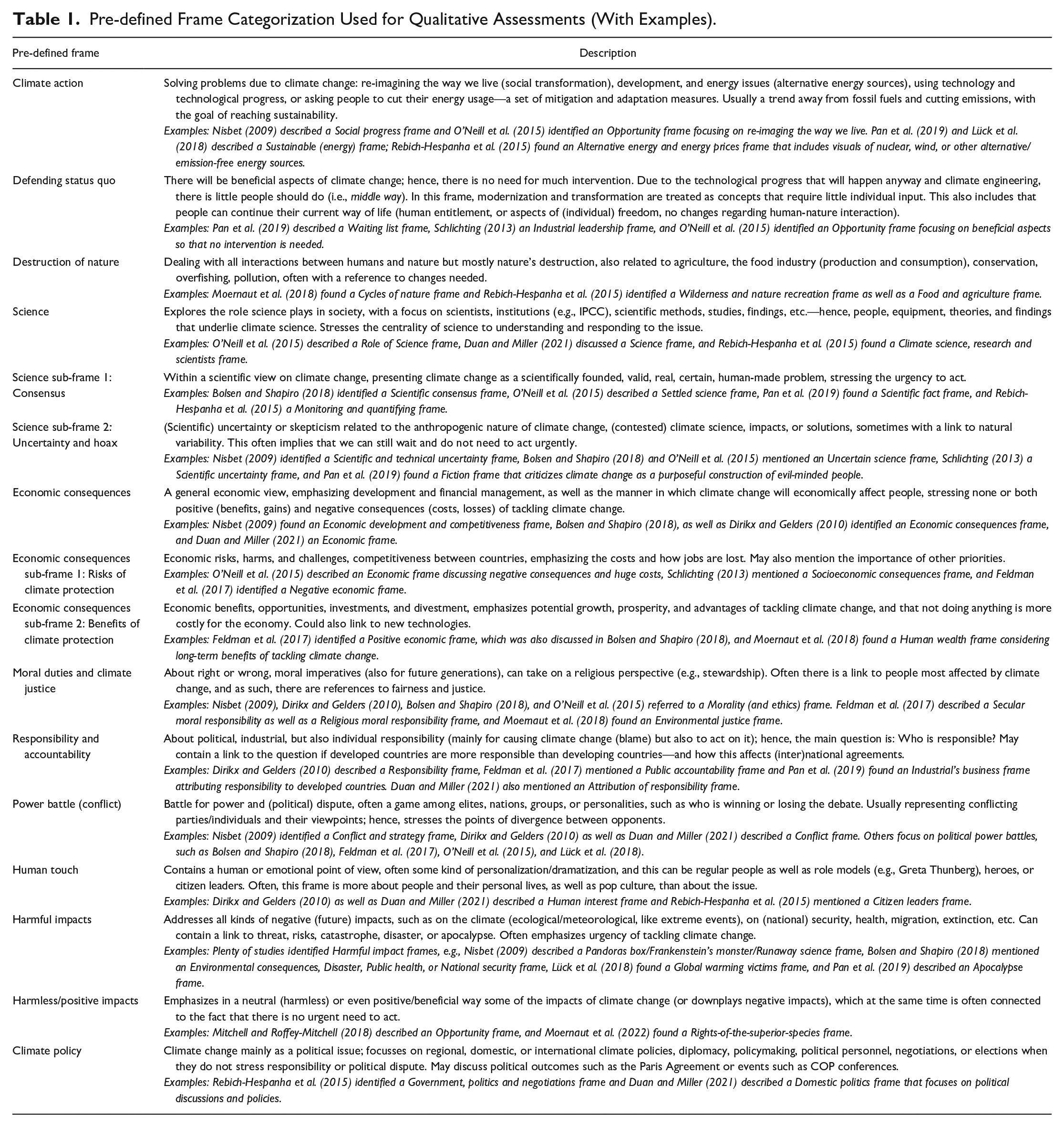
Each openly coded content description was matched with the pre-defined frame that fitted best, if suitable. That means frame matching/classification was only done when most descriptions were identical; for instance, Schlichting’s (2013) “Scientific uncertainty” frame deals with the reality and causes of climate change that are questioned and thus matched the pre-defined “Uncertainty and hoax” frame. This also meant that not all frames identified/manipulated could be considered. For instance, Lück et al.’s (2018) “Common sense” frame represents basic knowledge about climate change and did not correspond to a specific pre-defined frame (and seemed unique to this specific study). Frame matching was also done only once per article (e.g., Feldman et al. (2017) refer to several frames that fitted the “Harmful impacts” pre-defined frame category: environmental, public health, and national security). In a minority of cases, a content description had to be coded more than once, for example, when it affected different pre-defined frames equally. For instance, Schmidt-Petri and Arlt’s (2016) “The phenomenon of climate change” frame emphasizes scientific consensus and negative consequences equally (i.e., pre-defined “Consensus” and “Harmful impacts” frames).
Three coders familiarized themselves with the codebook and the coding process in several training sessions. For the first, quantitative part, intercoder reliability was assessed with a random sample of 20 articles. Using Krippendorff’s Alpha, the coders reached satisfactory results, with all scores higher than α ≥ .75 (see Table S3 in the Supplemental Material); thus, the coders independently coded the total sample. For the second part, two coders underwent training, coded the pre-defined frames separately, and commented each time they classified a frame. They met regularly and discussed their coding and comments to increase the reliability of this step. When coders disagreed, they discussed these cases until they reached an agreement. This process thus combined elements of qualitative and quantitative content analysis—allowing both: interpretation of the data and quantification
Results
Framing as a Theoretical Concept in Climate Change Communication
Regarding RQ1, we noted an increase of publications over time, with most papers in our sample published between 2016 and 2020 (n = 165; 60%). The first paper was published in 1996. Many papers in the sample were published in journals such as Environmental Communication (n = 33; 12%), Climatic Change (n = 18; 7%), or Global Environmental Change (n = 14; 5%). Usually, these sampled papers had two (n = 88; 32%), one (n = 82; 30%), three (n = 52; 19%), or four (n = 29; 11%) authors. Most author mentions (n = 670) indicated a male author (n = 356; 53%), affiliated with a European country (n = 271; 40%), the US (n = 242; 36%), or Australia (n = 61; 9%)—but as stated earlier, in this study we only included English-language articles. International collaboration in authorship was only counted for a minority of papers (n = 43; 22% 4 ). Like the author affiliations, the countries that were analyzed were often the US (n = 99; 36%), European countries (n = 79; 29%), or Australia (n = 16; 6%)—almost a fifth of the studies had an international perspective (n = 52; 19%).
Almost 14% of papers in the sample (n = 37) were theoretical work. Of the empirical studies (n = 238) most were single method studies (n = 197; 83%). Content analyses were most often used (see Table 2), followed by surveys with an experimental design and interviews. Case studies, focus groups, and regular surveys and observations were hardly used. These empirical studies were mainly quantitative, followed by qualitative and mixed designs. They mostly relied on the sociological compared to the psychological tradition of framing. Only eight articles were coded as frame production studies. When it comes to types of frames, most were thematic, followed by generic and combinations of the two. Frames were most often dependent variables. Across the frame locations, studies most often dealt with frames that fit with the pre-defined “Harmful impacts” and “Climate actions” frames (see Table 3), with the scientific and economic frames (three each) and “Moral duties and climate justice” as well as “Responsibility and accountability” following. There were notable differences regarding the location of frames in the communication process—something we will explore in RQs 2–5.
Overview of Descriptive Data Across the Sample.
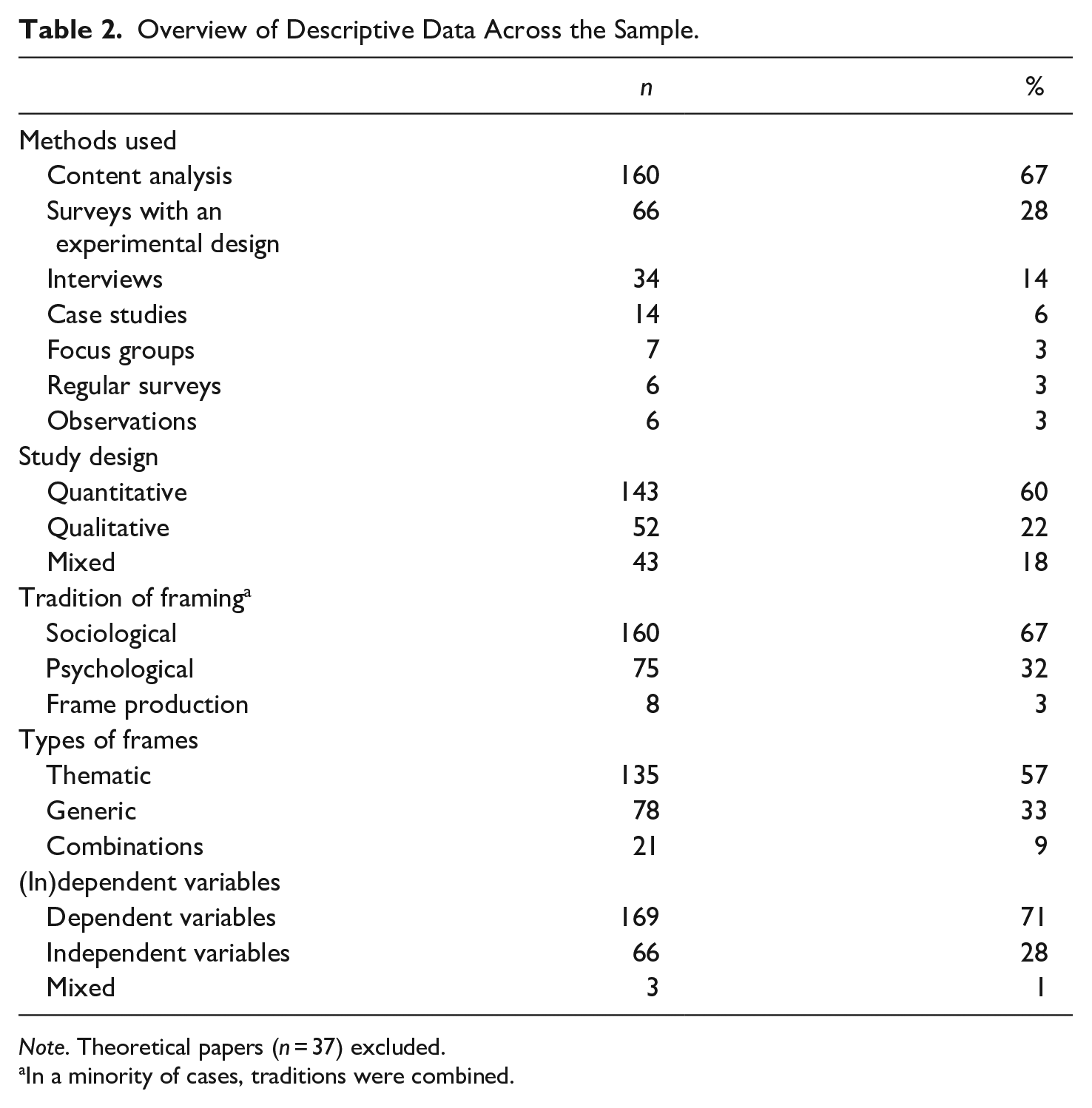
Note. Theoretical papers (n = 37) excluded.
In a minority of cases, traditions were combined.
Pre-defined Frames Across the Sample and Different Frame Locations.
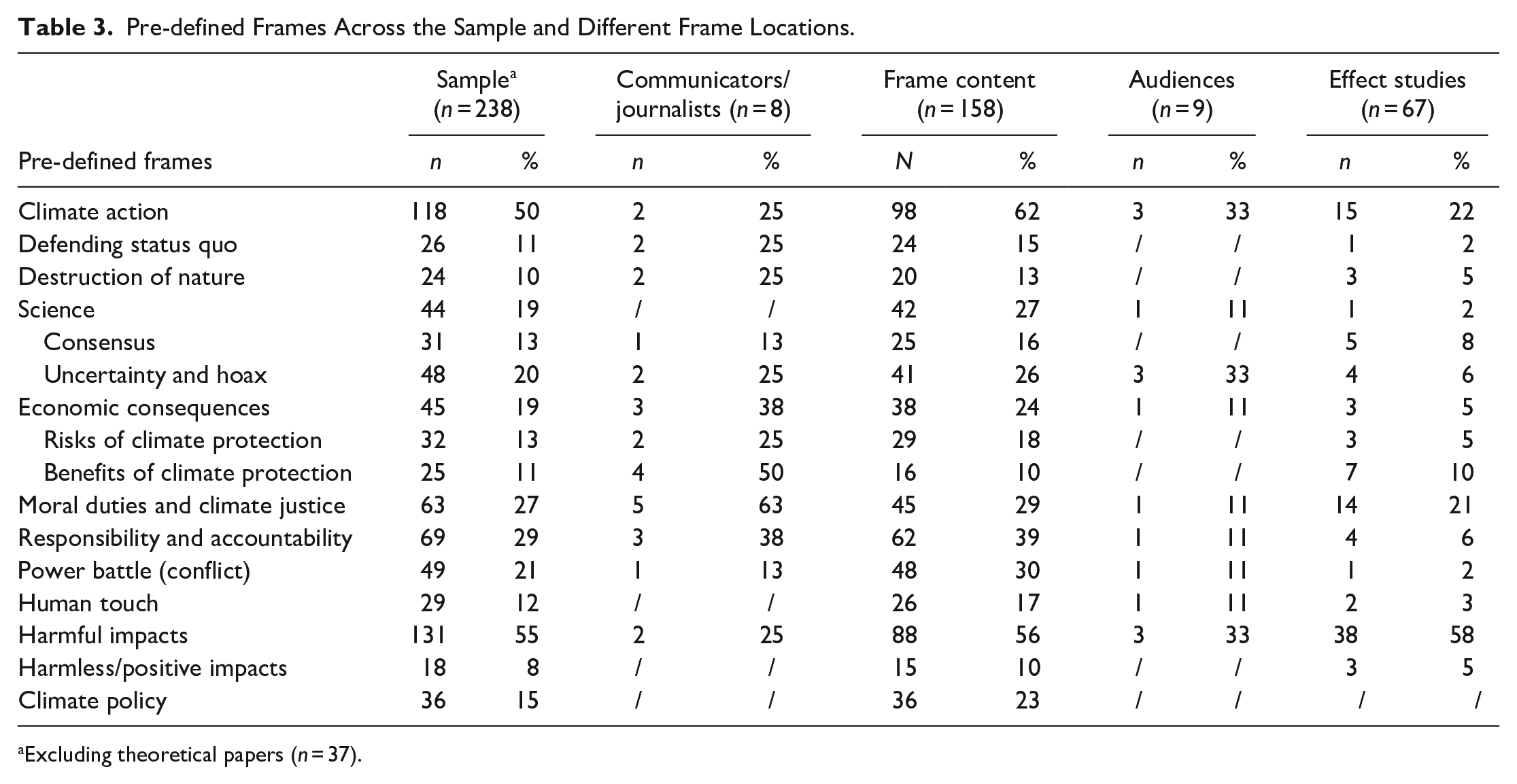
Excluding theoretical papers (n = 37).
Frame Production: Frames of Communicators and Journalists
Only eight studies in the sample identified frames related to frame production (RQ2). 5 Most of them relied on interviews (n = 7; 88%), using a qualitative design (n = 6; 75%), with a focus on thematic frames (n = 5; 63%). Naturally, frames were the dependent variable in all studies and were often inductively developed (n = 5; 63%).
These studies focused on different communicators (e.g., politicians, NGOs, scientists, companies) and equally on journalists. Due to the small sample size, Table 3 does not separate different communicators and journalists; however, it shows that the “Moral duties and climate justice,” the three economic, and the “Responsibility and accountability” frames were most often detected. For instance, Robbins (2020) identified morality, economic, and responsibility frames in representatives of the government in Ireland. Jodoin et al. (2020) have a unique focus on climate rights; Fleming et al. (2015) interviewed key staff of wine companies and identified economic frames and a responsibility frame (i.e., climate change as a social responsibility). Moernaut et al. (2018) show the economic frames of (climate) journalists. Table 3 also reveals that frames such as “Human touch,” “Harmless/positive impacts,” or “Climate policy” have so far not been detected in frame production studies.
Frame Content
For frame content (RQ3), 158 studies were in the sample. These studies heavily relied on content analysis (n = 155; 98%), usually with a quantitative (n = 78; 49%) and less often with a qualitative (n = 45; 29%) or mixed design (n = 35; 22%). Regarding types of frames, thematic (n = 92; 58%) dominated over generic (n = 47; 30%) frames, or combinations thereof (n = 17; 11%). Frames were always the dependent variable in these studies. Among the different media and types of content considered, most studies related to newspapers (n = 102; 64%) or non-journalistic sources (such as studies, tweets, [policy] documents, reports, press releases, and newsletters; n = 56; 35%). Magazines (n = 12; 8%), television (n = 10; 6%), popular culture (such as documentaries, memes; n = 3; 2%), or radio (n = 1; 1%) were hardly ever considered. Hence, there was also a dominance of traditional sources (n = 95; 60%), compared to online sources (n = 24; 15%), social media (n = 8; 5%), or any combination of these sources (n = 24; 15%). Furthermore, the frames identified in these studies were mainly text-based (n = 125; 79%)—only a minority were based on audiovisual (n = 9; 6%) or visuals elements (n = 7; 4%), or any multimodal combination (n = 17; 11%). Inductive identification of frames (n = 64; 41%), outweighed deductive identification (n = 50; 32%), or a combination of these approaches (n = 44; 28%).
While all pre-defined frames were detected, the two frames identified most often (see Table 3) were “Climate action” and “Harmful impacts.” The “Responsibility and accountability” and each of the three science and economic frames were also common. Examples included hope, action, mitigation/adaptation, solution, efficiency, (social) progress, innovation, and development frames subsumed under “Climate action.” Typical examples of the “Harmful impacts” frame were impact, ecological/meteorological, apocalypse, disaster, risk/threat, and consequences/effects frames. 6
Audience Frames
Regarding RQ4, it was very rare (n = 9) that studies focused on the cognitive frames present in different audiences. These studies make use of interviews (n = 3; 33%) and focus groups (n = 4; 44%), often as a mix between qualitative and quantitative designs (n = 5; 56%). They usually fall under the psychological tradition of framing (n = 8; 89%), with a focus on thematic frames (n = 5; 56%) and treating frames as dependent variables (n = 8; 89%).
Because of the low number of studies and diversity of audiences, Table 3 does not separate between different audiences but gives indications that “Climate action,” “Harmful impacts,” and “Uncertainty and hoax” frames were most often identified. For instance, Asplund (2016) and Houser (2018), with a focus on farmers, identified the “Uncertainty and hoax” as well as the “Harmful impacts” frames.
Framing Effects
Regarding RQ5, 67 studies fell under framing effect studies (see also Table 3). These studies were almost exclusively surveys with experimental designs (n = 66; 99%), with a quantitative focus (n = 63; 96%). For this subsample, there was more balance in types of frames, as thematic frames (n = 35; 52%) only slightly dominated over generic frames (n = 29; 43%). As can be expected, in almost all effect studies, frames were the independent variables. When it came to frame manipulation, most studies either used newspaper articles (n = 18; 27%) or non-journalistic sources (n = 19; 28%); to our surprise, many studies did not report on their stimuli (n = 24; 36%). The studies that did report on their stimuli usually considered traditional media sources (n = 24; 36%—in most cases, there was no information about this [n = 33; 49%]), and they most often used text-based stimuli (n = 44; 66%). Across the studies, there was a focus on emphasis framing (n = 57; 85%), and in most studies, single frames were tested in experimental conditions (n = 57; 85%).
Table 3 reveals that for framing effect studies, there was a clear dominance of the “Harmful impacts” frame—with “Climate action” and “Moral duties and climate justice” as distant seconds. The dominance of the “Harmful impacts” frame relates to the dominance of impact/consequences, national security, public health, and risk/threat frames that were often tested in these studies. Examples of the “Climate action” frame included efficacy, (gain and loss) solution, action, and benefits frames, while examples for the “Moral duties and climate justice” frame were morality, human rights, Christian stewardship/religion, justice, and norm frames. Table 3 also shows that frames such as “Climate policy” were not tested so far.
Discussion
The starting point for this paper was the notion that framing is not always well-defined and has different meanings for different researchers. At the same time, the research output referring to the concept has increased over the last decades. It seems that framing is a fruitful approach, often used in studies on climate change communication, with different methodologies, research designs, frame locations, and understandings of what frames are and how to operationalize them (e.g., Schäfer & O’Neill, 2017). Systematic reviews help identify research trends and gaps, thus pointing towards future research directions.
Among the goals of this study was to assess the field-specific application of framing in research on climate change communication and compare what we know about how framing has been applied in communication research to link back to research trends and gaps. After reviewing 275 papers systematically, it is fair to say that research on the framing of climate change shares many similarities with trends observed for framing research overall (see Borah, 2011; Matthes, 2009). (1) There is a lack of research on frame production. The limited studies in the sample highlight a first step towards finding out more about how communicators and journalists frame climate change and what their cognitive frames are (see also Schäfer & O’Neill, 2017). In a highly debated field such as climate change, different voices aim to enter and shape the discourse (Anderson, 2009); hence, it is pertinent to know more about actors’ motivations and to assess their success in framing contests. We want to extend this perspective by also highlighting that more research needs to focus on audience frames—and this may very well be true for how framing has been applied in communication research overall, but the reviews available (e.g., Borah, 2011; Matthes, 2009) have no explicit assessments of audience frames. (2) While most research is devoted to frame content (and thus the sociological tradition of framing), there are nevertheless research gaps, and they contain a strong focus on newspapers and on text-based frames, which confirms prior claims (e.g., Metag, 2016; Schäfer & O’Neill, 2017). Communication research, in general, should aim to include more aspects of visual framing (D’Angelo et al., 2019). More recent research in climate change communication has aimed to broaden perspectives, for instance, through multimodal approaches (Guenther et al., 2022; Wessler et al., 2016)—which could serve as good practice for communication research overall. (3) There is a dominance of thematic and thus unique and topic-centered frames. First attempts to unify generic and thematic perspectives (e.g., Brüggemann & D’Angelo, 2018) aim to overcome this. Thematic frames have their own significance; the risk is nevertheless that they may not connect to other studies or even conceptual issues in framing overall (Borah, 2011). (4) When looking at sampled framing effect studies, single frames are often tested in experimental conditions. Single frame conditions do not mirror real-life experiences in which individuals are exposed to many different frames. This review also stated that in many cases, information about stimuli is lacking or incomplete. It would be interesting to know if this finding is also true for how framing has been applied in communication research overall.
Based on the review provided in this paper, a recommendation that emerged concerns that researchers could more strongly situate their own research within the wider frame context, for instance, defining what they mean by frames, as well as the traditions and types (e.g., generic or issue-specific) they most align with—and this concerns framing climate change the same way as framing in communication research overall.
This review also showed that researchers affiliated with European or US-based institutions do most (English-language) research in this area—accordingly, these studies often focus on these countries, with few international collaborations. Schäfer and O’Neill (2017) had already highlighted that Western European, North American, and Australian perspectives dominate research in this area. Certainly, our sample selection was biased towards English-language literature, but to make the international journal literature in English really international, more studies of countries beyond the Anglo-Saxon world need to be conducted and published in English-language journals. This is especially true for countries that seem to be most vulnerable to climate change (see also Schäfer & Schlichting, 2014). Established researchers could show more effort to either collaborate with colleagues from less investigated countries or include such countries when thinking about sample selection. Again, it would be interesting to know to what extent this finding is also true for the application of framing in communication research overall.
A second central goal of the present study was to embrace framing’s power to bridge perspectives and thus to compare the most salient frames identified/manipulated across studies focusing on communicators/journalists, content, audiences, and framing effects, as part of the wider cultural framing repository. The research reviewed here does not allow the closing of the climate change communication cycle (Schäfer & O’Neill, 2017) due to a number of evident gaps. The first is the lack of studies on important steps in the communication process: studies on frame production are rare, content and effect studies are abundant, and studies on audiences are again rare. The framing process can probably only be understood if frames are reconstructed for communicators/journalists, their content, and audience reactions, as well as feedback loops and frame revisions, as Entman (2004) has called for, which may also provide more indications on cultural frame repositories (e.g., Brüggemann, 2014). Furthermore, studies that combine different frame locations are almost non-existent. Yet, we have to acknowledge that such studies are hard to conduct. Hence, a first step would be to reconnect studies on frame production with various communicators and journalists by focusing on the frames that are actually salient in communication and for which framing effects have been detected. A second step would be to further reconnection to audience frames by conducting more research in this area.
Unfortunately, we find a second gap related to the cultural framing repository: the studies are not connected by addressing/testing the same frames, indicating tendencies of a conceptual misfit. The few studies on frame production focused on a small number of communicators and journalists; they mostly have qualitative designs and consider different public actors. It is impossible to answer yet what the most salient frames are and how they differ between communicators and journalists. Content studies show how diverse the cultural framing repository is; nevertheless, “Climate action” and “Harmful impacts” frames are found most frequently across journalistic and non-journalistic sources. However, the frame production studies cannot answer where these frames originate and why they seem to dominate the public discourse on climate change. Framing effect studies do not explore the frame diversity detected in content studies but focus mostly on “Harmful impacts”—the single most often tested frame in effect studies. Effectively, many studies fail to focus on the frames salient in content, and they may simulate an artificial dominance of one frame. Lastly, we do hardly know which frames are most salient among audiences and hence, which frames resonate most with them. Based on only a few studies dealing with audience frames, and their different foci, it is impossible to answer what the most salient audience frames are and how they differ between members of the audience (e.g., farmers compared to others). Linking back to the importance of climate change communication, tackling this global problem requires work across frame locations, for instance, to develop communication strategies.
The systematic review at hand has some limitations that may guide future reviews. We made a conscious decision to include only peer-reviewed and English-language papers in the systematic review. However, the framing of climate change is dealt with in many different publications and in many different languages. Future research may want to extend our review. Furthermore, our sample selection was based on a broad search string used in two databases. Using another search term or different databases may result in a different sample size. Data collection as employed here (e.g., identification of relevant papers) always contains the possibility that some studies may have been missed (see also Borah, 2011). In the present study, content descriptions of frames were categorized into an existing matrix of pre-defined frames; however, these pre-defined frames can either be narrowed or extended to smaller/larger sets of frames. However, we do not think that this would affect the assessments based on our review. The use of a pre-defined list of frames also needs to be evaluated in light of country-specific factors as well as potential changes in frames over time (e.g., Schäfer & O’Neill, 2017). In addition, although we gathered data on the frames, the respective countries and communicators/media/audiences in much more detail, it would be beyond the scope of the present study to also look at such aspects, but future reviews may do that. Lastly, this review only considered framing; there is also research on messaging or narratives that was beyond the scope of this paper but may be included in studies to come.
We believe that this systematic review can guide future research on the framing in climate change communication. Future studies then also may want to revisit some of the theoretical/conceptual weaknesses of the framing concept (e.g., D. A. Scheufele & Iyengar, 2014; D. A. Scheufele & Tewksbury, 2007) or the differences in methodologies used (e.g., B. T. Scheufele & Scheufele, 2010) that were beyond the scope of this paper but would allow for further growth of the theoretical concept (Borah, 2011).
Supplemental Material
sj-docx-1-crx-10.1177_00936502221137165 – Supplemental material for Framing as a Bridging Concept for Climate Change Communication: A Systematic Review Based on 25 Years of Literature
Supplemental material, sj-docx-1-crx-10.1177_00936502221137165 for Framing as a Bridging Concept for Climate Change Communication: A Systematic Review Based on 25 Years of Literature by Lars Guenther, Susan Jörges, Daniela Mahl and Michael Brüggemann in Communication Research
Footnotes
Acknowledgements
We would like to thank Shorouk Elkobros for her assistance in downloading and coding relevant articles, and Millie Peach for proofreading the article.
Declaration of Conflicting Interests
The authors declared no potential conflicts of interest with respect to the research, authorship, and/or publication of this article.
Funding

Data Availability
The data that support the findings of this study are available from the corresponding author [LG], upon reasonable request.
Supplemental Material
Supplemental material for this article is available online.
Notes
Author Biographies
References
Supplementary Material
Please find the following supplemental material available below.
For Open Access articles published under a Creative Commons License, all supplemental material carries the same license as the article it is associated with.
For non-Open Access articles published, all supplemental material carries a non-exclusive license, and permission requests for re-use of supplemental material or any part of supplemental material shall be sent directly to the copyright owner as specified in the copyright notice associated with the article.
