




Abstract
This study addresses how issue familiarity conditions longitudinal news framing effect dynamics. Comparing how the economic consequences frame impacts interpretation of two global problems—antimicrobial resistance and climate change—we study longitudinal effects across two similar issues varying significantly in salience and politicization, focusing on how various effect dynamics (single, repetitive, and counter-framing exposure) influence citizens’ beliefs over time. A longitudinal experiment conducted with a probability-recruited sample in Sweden (N = 1,956) reveals (1) clear framing effects for both issues, (2) dynamics driven primarily by recency mechanisms, and (3) that individual differences in baseline belief certainty condition news framing effects. In sum, while the same news frame can have very similar effects on different issues, the findings suggest a “dual role” of issue familiarity, potentially conditioning the specific longitudinal effect dynamics, on the one hand, and effect susceptibility, on the other hand.
The nature and consequences of news framing effects are key for understanding the role of news media in shaping citizens’ beliefs about societal problems. Questions regarding the when, how, and why of framing effects concern the differential impact of news coverage across issues, individuals, and over time. While past research has provided us with substantive knowledge on these factors separately (Lecheler & de Vreese, 2019), we still know surprisingly little about how effect dynamics might differ between issues and individuals’ pre-existing issue beliefs.
This study addresses how issue familiarity conditions longitudinal framing effect dynamics. From a societal perspective, issues vary substantially in how familiar they are to citizens. Some issues have a long history on the media, political, and public agendas—being highly salient topics for decades—providing extensive opportunities for people to learn about and develop firm issue-specific beliefs. Other issues are much less familiar, being either completely novel or low-salient topics to most citizens. Thus, variation in issue familiarity reflects a fundamental real-world characteristic with potentially significant impact on public opinion dynamics. From a scientific perspective, however, issue familiarity has received less attention—particularly in studies of longitudinal framing effect dynamics. While issue familiarity is frequently referred to in the literature as a potentially crucial factor conditioning media effects (Baden & Lecheler, 2012; McLeod et al., 2022), only few empirical studies actually address whether and how longitudinal news framing effects depend on familiarity with the issues covered in the media.
One reason for this lacuna is the difficulty in identifying real-world issues that are comparable—highly similar as societal problems but different in terms of familiarity—and designing studies allowing analyses of longitudinal effect dynamics. By comparing how citizens respond to the same news frames on two issues—antimicrobial resistance (AMR) and climate change (CC)—this study seeks to improve knowledge of how issue familiarity matters in this regard. While AMR and CC share several important issue characteristics, such as the implications of these global challenges for people and societies all around the world (IPCC, 2022; United Nations, 2019), they also differ greatly in terms of their salience on the political, media, and public agenda during the past two decades—differences that should matter for how people respond to news frames provided by the media (Druckman & Leeper, 2012; Lecheler et al., 2009).
Furthermore, we bring the concept issue familiarity into the growing literature on longitudinal effect dynamics, addressing recent calls for more realistic experiments on framing effects (Aarøe, 2017; Lecheler & de Vreese, 2019)—including specific analyses of how issue familiarity influences framing effects over time (Baden & Lecheler, 2012; McLeod et al., 2022). In contrast to the classic one-shot design (Lecheler & de Vreese, 2019; McLeod et al., 2022), research increasingly explores dynamic framing effects using longitudinal experiments to study how various sequences of news frames matter (Tewksbury & Scheufele, 2019). Therefore, apart from comparing framing effects on beliefs about AMR and CC, we employ a longitudinal experimental design which allows testing the impact of three exposure conditions: (a) single exposure, (b) repeated exposure to the same frame, as well as (c) counter-framing effects, over time. These conditions are designed to resemble a range of news exposure dynamics as citizens encounter them in their everyday lives—across two issues that vary in salience and familiarity.
In sum, this study contributes to the literature on news framing effects by focusing on how issue differences and pre-existing beliefs condition longitudinal effect dynamics—addressing the question: do over-time effects depend on issue familiarity? To analyze the dynamic nature of framing effects on citizens’ beliefs about societal problems, the study presents findings from a longitudinal experiment with one pre- and two post-measurements, using a probability sample (N = 1,956) conducted in Sweden. Participants were exposed to combinations of news stories that framed AMR and CC either in terms of economic consequences (EC) or public health consequences (PH). We focus particularly on effects of the EC frame on citizens’ issue interpretations and use the PH frame primarily as a competing frame to address specific questions regarding dynamic framing effects over time. Before presenting the study and empirical findings, however, the next section reviews research on dynamic news framing effects and provides a conceptual discussion of issue familiarity as a moderator of such processes. We then also introduce and compare AMR and CC in light of these theoretical considerations, leading up to a set of hypotheses and research questions.
News Framing and Longitudinal Effect Dynamics
Research on framing effects suggests that citizens are responsive to the issue-specific frames provided by the news media. In contrast to equivalency frame, which refer to logically identical but differently presented information (Chong & Druckman, 2007; Lecheler & de Vreese, 2019), this study focuses on emphasis framing. Emphasis frames refer to “qualitatively different yet potentially relevant considerations” (Chong & Druckman, 2007, p. 114). Compared to equivalence, emphasis framing reflects better how journalists frame stories in the real world (Lecheler & de Vreese, 2019; McLeod et al., 2022; Nelson, 2019). Along these lines, Entman (1993) defines framing as a matter of “selection and salience.” To “frame is to select some aspects of a perceived reality and make them more salient in a communicating text, in such a way as to promote a particular problem definition, causal interpretation, moral evaluation, and/or treatment recommendation for the item described” (Entman, 1993, p. 52). As such, framing focuses primarily on how people understand or think about specific issues (Chong & Druckman, 2007). This is frequently referred to as “issue interpretation” (Matthes & Schemer, 2012; Tewksbury & Scheufele, 2009) with changes in issue interpretations reflecting “the presence, weight, and importance of considerations” (Matthes & Schemer, 2012, p. 321).
Most framing research has been characterized by one-shot experiments, frequently criticized for low external validity (Lecheler & de Vreese, 2016; McLeod et al., 2022), as well as for not capturing the longitudinal and dynamic nature of news framing effects (Lecheler & de Vreese, 2016; Matthes & Schemer, 2012). For instance, questions about the duration of framing effects inevitably also concern the “relevance” of such effects. As noted by Gaines et al. (2007), “[w]ithout knowing the duration of the effects . . . users of survey experiments cannot determine the relevance of their findings” (p. 5). To address this, and to allow for more realistic news exposure environments, a growing number of framing experiments use longitudinal designs with various treatment conditions (Lecheler & de Vreese, 2016; McLeod et al., 2022). Repetitive framing and counter-framing represent two prototypical sequences of frame exposure dynamics (Lecheler & de Vreese, 2019).
First, repetitive framing scenarios refer to situations in which people are exposed to the same news frame at least twice over time (Lecheler et al., 2015). Research on repetitive framing concludes that being exposed to a frame more than once affects the consolidation and duration of effects (for an overview, see Lecheler & de Vreese, 2019; McLeod et al., 2022). Lecheler et al. (2015) found that the effect of exposure to a repetitive frame lasted longer than the effect of single exposure to the same frame. Repeating a frame also leads to more strongly held attitudes, which renders them resistant against a later counter-frame (Druckman et al., 2012). At the same time, studies emphasize that repetition does not increase the magnitude of effects by simply multiplying the effect of the first and second frame exposure (Lecheler & de Vreese, 2013). Most importantly, even though “[s]tudies focusing on repetitive news framing are inconclusive” (Lecheler & de Vreese, 2019, p. 83), theories of memory and forgetting suggest that initial effects will fade in the absence of reminders. Being repeatedly exposed to certain frames should thus prevent effect decay and function as a reminder of frame-relevant considerations (Lecheler et al., 2015; Shehata et al., 2024).
Second, counter-framing scenarios refer to situations in which exposure to an initial frame is followed by exposure to a competing frame (Chong & Druckman, 2013). A competing news frame emphasizes alternative problem definitions and considerations—thereby triggering different issue interpretations and trains of thought (Chong & Druckman, 2007; Lecheler & de Vreese, 2019). Competing frames thus focus attention on other aspects of an issue and thus potentially away from considerations activated by the initial news frame. This scenario represents something qualitatively different than receiving no news coverage (or frames) at all. Studies on counter-framing conclude that the effect of the initial frame is limited by exposure to the following, competing, frame and that recency effects tend to prevail (Chong & Druckman, 2010; Lecheler & de Vreese, 2013). As suggested by McLeod et al. (2022), “[n]ot only are [. . .] effects likely to be short-lived as time passes, they may dissipate as individuals are exposed to competing frames and other information after the experiment has concluded” (p. 12).
While a growing number of studies address longitudinal framing effect dynamics in response to various exposure scenarios, whether and how such processes vary across issues remains unclear.
The Role of Issue Familiarity in Framing Effect Dynamics
To be sure, the idea that framing effects may vary between issues is not new. Already in his seminal work, Iyengar (1991) concluded based on results from several studies on episodic framing that the effects were “far from uniform across the various issue areas investigated” (p. 128). One potentially crucial factor behind such observed non-uniformity of framing effects is issue familiarity (Han et al., 2009).
The concept of issue familiarity is frequently referred to in the framing and media effects literature (Baden & Lecheler, 2012; Chapman & Gerber, 2019; McLeod et al., 2022), but the concept is often imprecise and seldom theoretically defined. We argue that issue familiarity is closely related to cognitive schemas and schema development. Conceptually, a schema represents a person’s pre-existing knowledge of a concept, and “such an abstract representation includes the concept’s attributes and relations among them” (Fiske & Taylor, 2017, p. 111; see also, Ghosh & Gilboa, 2014; Scheufele, 2004). Although several framing effects studies include measures of individual differences in political knowledge, issue familiarity and schemas extend beyond such variables. As argued by Rhee and Cappella (1997), “[p]olitical schema carries other structural baggage that is not directly measured by simple knowledge scores” (p. 200). Others refer to sophistication (e.g., Nelson et al., 1997) or knowledge density (Baden & Lecheler, 2012) in this context. Issue familiarity is less about possessing accurate knowledge, than about whether people hold pre-existing beliefs about a topic and how well-developed these beliefs are. In that sense, schemas vary with respect to content but also in terms of structure depending on the issue area: More well-developed schemas do not only contain more information, but are also better organized and integrated with “more concepts, larger chunks, and more linkage among the concepts” (Fiske et al., 1983, p. 384). As such, schemas guide information processing, facilitate the processing of newly encountered information, and speed up retrieval processes (Fiske et al., 1983; Ghosh & Gilboa, 2014).
How well-developed schemas are—or how familiar citizens are with a societal issue—is influenced by numerous factors, such as experiences with specific instances, social interaction, and news coverage (Fiske & Taylor, 2017; Matthes, 2008; Mutz, 1998). The latter is particularly important for issues that are difficult for ordinary citizens to experience directly—for which news media play a crucial role as a source of information (Barabas & Jerit, 2009; McCombs & Valenzuela, 2021). In this regard, issue history with respect to salience and establishment on the media agenda over longer periods of time seems to be critical for knowledge and familiarity among citizens—as opportunities to encounter, explore and learn about these issues increase. The distinction between new and established issues is widely recognized in the public opinion literature, with media effects assumed to be both stronger and more consequential for novel than for well-established issues (Druckman & Leeper, 2012; Zucker, 1978).
In line with the schema literature, familiarity can vary both between issues and between individuals. While some issues are more familiar among the general public—depending on how salient and well-established they are on the political and media agenda—familiarity also depends on individual-level factors as some people have more well-developed issue-specific schemas than others. Research addressing such individual-level differences has primarily used measures of political knowledge—with mixed findings (Lecheler & de Vreese, 2019; McLeod et al., 2022). Some studies indicate that framing effects are stronger among individuals already possessing issue- or frame-relevant knowledge, while other studies suggest the opposite (Lecheler & de Vreese, 2019; McLeod et al., 2022).
As noted above, however, standard measures of political knowledge are not ideal operationalizations of issue familiarity—and schemas—as conceptualized here. People can possess well-developed schemas on certain topics without scoring high on a specific set of knowledge questions. An alternative proxy is pre-existing belief certainty, which has been identified as a potentially crucial individual-level moderator of news framing effects (Chong & Druckman, 2011; McLeod et al., 2022; Shehata et al., 2021). Research on attitude strength indicates that strong attitudes endure over time, are less sensitive to countering information, influence how information is processed, and impact behavior strongly (Howe & Krosnick, 2017; Petty & Krosnick, 2014). For example, Chong and Druckman (2011) found that whether a competing frame exerts an effect depends on the strength with which an initial attitude was formed (see also, Chong & Druckman, 2010). Following this line of argumentation and findings, we focus on baseline belief certainty—the strength with which individuals hold specific beliefs—as an individual-level proxy for issue familiarity. Building upon related conceptualizations from research on attitudes, one could define belief certainty as a subjective “sense of confidence or conviction one has about” a belief (Tormala & Rucker, 2018, p. 73; see also, Feldman et al., 2014). Thus, citizens who feel more certain about their issue-specific beliefs should be less susceptible to news framing effects (Chong & Druckman, 2007; McLeod et al., 2022; Shehata et al., 2021).
***
In sum, while both these moderating factors of news framing effects—longitudinal exposure dynamics and issue familiarity—have been partly addressed in research, no study has thus far combined the two strands. This is surprising given that several researchers have pointed to the relevance of issue familiarity for framing effects in a longitudinal and dynamic perspective. McLeod et al. (2022), for example, name neglecting the time component in framing effects as a potential reason for inconclusive findings on the role of issue familiarity and prior knowledge (see also Lecheler & de Vreese, 2016). In particular, we see two distinct gaps in relation to previous framing effects research. First, studies of whether and how issue familiarity conditions various longitudinal effect dynamics, such as frame repetition and counterframing, are rare. While there are a few single studies providing pieces to this puzzle, a comprehensive treatment has so far not been presented. Second, studies that address issue familiarity by both comparing effects across issues and between individuals with different levels of pre-existing belief certainty are also rare. One of the main challenges in this regard is identifying issues that are comparable: similar in terms of important issue characteristics but simultaneously varying with respect to familiarity.
Selection of Issues and Hypotheses
Before presenting the research questions and hypotheses derived from the theoretical and empirical considerations, we elaborate on the selection of the two issues in focus of this study. Issues may differ on various dimensions and salience as well as establishment on the media agenda are crucial for how familiar citizens are with the respective issues (Shehata, 2021; Zucker, 1978)—which, in turn, may condition framing effects of interest (McLeod et al., 2022; Price & Tewksbury, 1997). Since societal problems differ in important ways, comparing two issues allows testing some critical assumptions of news framing effects theory. For this purpose, we contrast framing effects across two issues: antimicrobial resistance (AMR) and climate change (CC). On the one hand, these issues are highly similar and comparable societal problems since both pose major global challenges to humanity (Laxminarayan et al., 2013). As emphasized by scientific experts in the World Health Organization (WHO) and the Intergovernmental Panel on Climate Change (IPCC), the social, physical, and economic consequences of both AMR and CC will impact the future of our societies severely. With regards to AMR, the United Nations referred to a global health emergency with a “disastrous impact within a generation” (United Nations, 2019, p. 4). The severity of CC has long been noted by the IPCC (IPCC, 2022). CC and AMR are also mainly caused by human activity. Emissions of greenhouse gases (CC), as well as overuse and misuse of antibiotics (AMR), are identified as key factors behind these developments (IPCC, 2022; Prestinaci et al., 2015). As such, the two issues are similar in important ways—in terms of their “scientific character” and the strong scientific consensus surrounding them, their massive implications for humans and societies, as well as their anthropogenic character.
On the other hand, and most crucial for our study, AMR and CC differ in the degree to which they are established and salient issues on the political, media, and public agendas. While citizens have been increasingly aware of CC since the 1980s (for the EU: European Commission, 2019; for the US: Nisbet & Myers, 2007), the “public have an incomplete understanding of and misperceptions about antibiotic resistance” (McCullough et al., 2016, p. 13). Differences can also be found in media coverage. While AMR remains a low-salient issue in the news media in various countries around the world (e.g., Boklage & Lehmkuhl, 2019; Davis et al., 2020; Singh et al., 2016), CC has received extensive media coverage in most countries for many years (Schmidt et al., 2013). Comparing news coverage of AMR and CC in Sweden, Djerf-Pierre and Shehata (2018) found that AMR “has not yet received much attention . . . in comparison with a global environmental issue such as the climate issue, there are significantly fewer articles” (p. 174, own translation). In addition, a recent study confirmed these massive differences in the amount of news coverage of CC and AMR in Swedish media between 2018 and 2020 (Glogger & Shehata, 2022).
Against the theoretical backdrop of framing effect dynamics and issue differences, we present two sections of hypotheses and research questions. The first set comprises tests of the well-established framing effects and serve both the purpose of replication and as well as a point of departure for the subsequent analyses focusing on issue familiarity (for an overview, see Lecheler & de Vreese, 2019), as well as effect dynamics (e.g., Lecheler & de Vreese, 2013).
H1 (framing effect): Exposure to emphasis frames in the news has an instantaneous effect on beliefs about societal problems (issue interpretations).
H2 (repeated exposure effect): Repeated exposure to emphasis frames leads to reminder effects over time compared to participants in a single exposure condition.
H3 (competitive exposure effect): Exposure to countering frames over time leads to recency effects, with the latest frame having the strongest impact on beliefs.
The second set focuses on the role of issue familiarity. Even though there are various nuances in the literature on how familiarity may condition framing effects (Baden & Lecheler, 2012; McLeod et al., 2022), our basic expectation follows the main argument that greater familiarity decreases susceptibility to communication effects (Druckman & Leeper, 2012; Matthes & Schemer, 2012). This should be reflected on two levels. At the between-issue level we expect weaker framing effects on well-established and salient issues compared to novel and low-salient issues (Druckman & Leeper, 2012; Geiß, 2019; Zucker, 1978). At the individual-level, we expect people who already hold issue-specific beliefs with high certainty at the outset to be less susceptible to news framing effects. This dimension of issue familiarity focuses on the strength of news framing effects—or variations in susceptibility to effects. However, since little is known about how differences in issue familiarity matter for longitudinal effect dynamics, we pose two open research questions with respect to frame repetition and counter-framing. These RQs focus on another effect dimension: whether issue familiarity influences effect dynamics over time.
H4: News framing effects are stronger for (a) AMR than for CC as well as among (b) individuals with lower levels of issue-specific belief certainty.
RQ1: What is the difference in effects of repetitive frame exposure between AMR and CC?
RQ2: What is the difference in effects of counter-framing between AMR and CC?
Research Design, Method, and Measures
To address our hypotheses and research questions, we conducted a longitudinal experiment. We made particular attempts to strengthen external validity of the study in three ways. First, the experiment responds to calls for more realistic treatment conditions by incorporating various exposure dynamics over time. Second, stimuli were produced together with a professional journalist in order to have realistic news articles as treatments. Third, the study moves beyond convenience or student samples used in many experiments, relying instead on a high-quality probability-recruited sample of respondents. Although none of these strategies are unique on their own (Amsalem & Zoizner, 2022; Lecheler & de Vreese, 2016; McLeod et al., 2022), they were part of a general ambition to strengthen the external validity of the study.
Design
We conducted a longitudinal experiment with a control-group pretest-posttest design, varying the issue (CC vs. AMR) and the frame exposure (single vs. repeated vs. countering exposure). Following established framing studies, the main focus of our experiment is exposure to the economic consequences (EC) news frame (Semetko & Valkenburg, 2000). The economic consequences frame is well-established in the framing literature and entails presenting “an event, problem, or issue in terms of the economic consequences it will have on an individual, group, institution, region, or country” (Valkenburg et al., 1999, p. 552; see also, de Vreese, 2010). As an example of a widely applied generic news frame, the EC frame is equally applicable and relevant to coverage of AMR and CC. To enable analyses of dynamic counter-framing effects, the study also includes a competing frame condition. For this purpose, we used the public health (PH) frame, which is also applicable to both AMR and CC and emphasizes human health-related aspects connected to an event, problem, or issue (McCright et al., 2016; Myers et al., 2012; see also, Hawkins & Linvill, 2010). In total, this approach resulted in 12 experimental and 2 control groups (Supplemental Table A1 in Appendix).
Procedure and Participants
Participants were recruited from a standing online panel of probability-recruited respondents, in collaboration with the Laboratory of Opinion Research (LORE) at the University of Gothenburg. Since there are relatively few comparable longitudinal framing effects studies with identical design, we were unable to make informed assumptions for a power analysis. Instead we conducted a systematic review of relevant previous framing experiments to make sure we were not underpowering the study (see also Lecheler & de Vreese [2016] who found that the typical study of framing effect duration has a sample size of 40–70 participants per condition). A sample of 4,157 individuals from this panel—pre-stratified on age, gender, and education—were invited for participation. After participants were randomly assigned to one of the experimental groups or to the control groups, we assessed prior issue beliefs and belief certainty in the pre-test measurement that took place in December 2020. The t1-sample comprised 1,956 participants, with the number of participants varying between the 127 and 146 in the various conditions. 49% were female, mostly middle-aged (under 30 = 8%; 30–39 = 15%; 40–49 = 18%; 50–59 = 20 %; 60–69 = 19%, and 70 or above = 19%), and high-educated (“up to nine years of schooling” = 4%; “up to 12 years of schooling” = 30%; “12 years and vocational training” = 19%; “12 years and university degree” = 47%).
Seven weeks later, in January 2021, the participants were exposed to a framed news story, followed directly by assessing our outcome variables (t2) (N = 1,804). After ten days, participants in the repetitive exposure conditions were exposed again to a framed news story; participants in the counter-framing exposure conditions were exposed to a story that relied either on the economic consequences or the public health consequences frame, depending on what they had been exposed to at t2; participants in the single exposure groups only filled out the follow-up questionnaire (t3) (N = 1,721). Participants in the control groups were not exposed to any stimuli. Employing both a passive control group (not reading any story) and a competing frame condition (PH frame) at each stage, allows a stronger test of whether it is reading a news story about the topic as such, or being exposed to the a specific frame, that generates belief effects. Figure 1 illustrates the basic design, which was replicated for both AMR and CC.
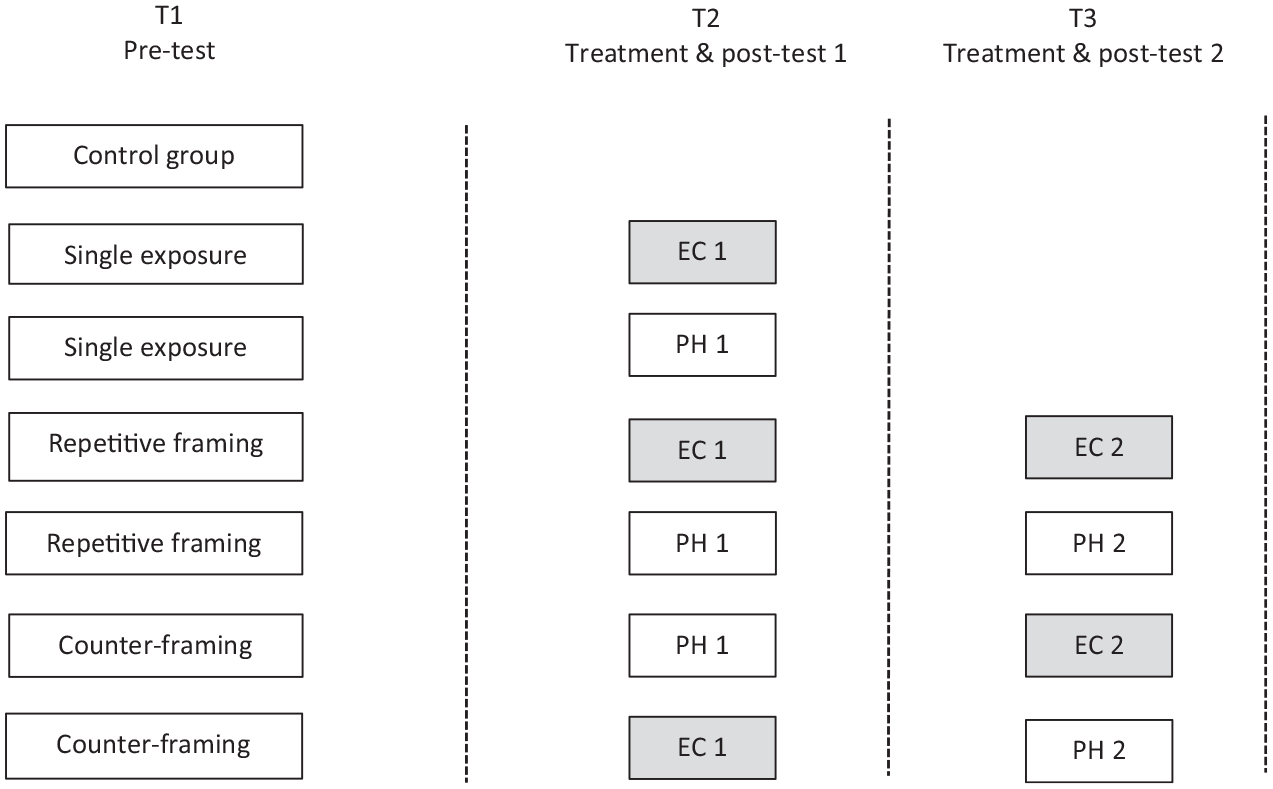
Design of experiment (replicated for AMR and CC).
We conducted one multivariate ANOVA between groups at t1 for each issue to assess whether randomization was successful. The conditions did not vary in terms of political interest, interest in societal issues, interest in research and science, and prior beliefs and belief certainty about CC and AMR. Chi-square-tests were conducted for the categorial variables of age, gender, and education; again, no significant differences were found between the groups (Supplemental Tables A2 and A3 in Appendix).
Measures
In this study, we are interested in how individuals think about AMR and CC, that is, issue interpretation (Matthes & Schemer, 2012; Tewksbury & Scheufele, 2009). Following previous operationalizations (Matthes, 2008), two alternative measures are used to comprehensively test our hypotheses. First, an open-ended “most important problem”-question asked: “When thinking about how antibiotic resistance [climate change] impacts society, what do you think will be the largest problem in the future?” Participants could either provide an open answer or select the “Don’t know”-option. Since the main focus here concerns effects of the EC-frame, while the PH-frame condition primarily acts as a control condition allowing analysis of counter-framing effects, the responses to the open-ended question were coded for references to economic aspects in all experimental and control groups. All responses mentioning “economy*” or “cost*” were coded as 1; responses lacking any of these words were coded 0. Variations of these two terms were selected as they broadly capture various considerations relating to economic consequences and implications in the Swedish language. 1 Second, we also used a close-ended battery following the survey question: “How large impact do you believe antibiotic resistance [climate change] will have on the following in the future?,” with “The Economy” being one of the items rated (other outcomes included “Public health,” “Unemployment,” “The Environment” and “Health Care”). Each outcome was assessed on a 7-point scale, reaching from 1 “very small impact” to 7 “very large impact,” including a “Don’t know”-option.
Belief certainty was measured with one item per issue (AMR and CC) that globally assessed how certain participants were about their beliefs, ranging from 1 “not certain at all” to 7 “very certain.” In addition, some of the statistical analyses include controls for issue-specific interpersonal communication and news media use during the data collection period, gender, age, political interest, and left-right ideology.
Stimuli
The stimulus material consisted of a total of eight news articles: four at T2 (EC1 vs. PH1 frame × issue) and four at T3 (EC2 vs. PH2 × issue), as outlined in Figure 1 above. To increase external validity and authenticity of news stories, a professional journalist helped produce the articles. Scientific experts in the field of AMR and CC were interviewed—and included as sources in the news articles produced.
At T2, all stories focused on global consequences of either AMR or CC. Also, the bases for the articles were publicly released reports from relevant public agencies. For instance, the EC-framed AMR story “Antibiotics: The Costs of Resistance Hit the World Economy,” focuses on a UN report on the global economic impact of AMR, comparing it to the global financial crisis in 2008 to 2009. The PH-framed AMR story “Antibiotics: More People Die From Resistant Bacteria Around the World” is also based on a UN report, but focuses on the risk of future deaths caused by AMR. The CC stories were constructed similarly, with the EC-framed article “Climate: Extreme Weather Increasingly Expensive for the World Economy” focusing on the growing future costs of extreme weather events. The PH-framed story “Climate: More Cases of Dengue Fever Around the World” discussed the global public health consequences of rising temperatures.
At T3 four different news stories were used to avoid artificial repetition from a participant’s perspective. The articles were constructed in a similar manner as for T2, but now focusing on economic (EC) or public health consequences (PH) of AMR and CC in Sweden. The EC-framed AMR story “Antibiotics: Billion-Cost to be Expected When Resistance Bacteria Increase in Sweden” discusses economic consequences based on a public report from the Swedish Public Health Agency. The PH-framed story: “Antibiotics: Urinary Infections Potentially Life-threatening When Resistant Bacteria Increase in Sweden” focuses on health-related consequences of AMR. For CC, the EC-framed story “Climate: Societal Costs Increases When Sweden Becomes Warmer” relates the changing climate to increasing economic costs following more extreme weather events in Sweden. Finally, the PH-framed story “Climate: Dangerous tick-borne diseases are spreading in Sweden” focuses on health diseases that are likely to increase due to climate change (see Supplemental Appendix for full transcripts of the stimuli).
Analytical Strategy
Our analyses are based on two approaches. OLS regression models are used to estimate the between-group effects of different experimental conditions. This allows testing the effect of being exposed to a specific news frame as well as particular framing dynamics over time. To control for potential over-time confounders, we include issue-specific between-treatment media use and interpersonal talk. In addition, we make use of the panel structure of the data by estimating pure within-person effects over time, based on two-way fixed effects panel models. These models capture framing dynamics at the intra-individual level as participants are randomly exposed to different news stories over time. To test differential effects across issues, we include interaction terms between issue (AMR vs. CC) and experimental treatment. All interaction models were estimated using random effects panel models, following a Hausman test of difference between fixed effects and random effects estimators (Allison, 2009).
Results
Before addressing the hypotheses and research questions, we first assess empirically the underlying assumption that citizens are more familiar with and, hence, have more well-developed issue-specific schemas for CC than for AMR. Using baseline belief prevalence as an indicator of issue familiarity, we expect more respondents to express substantial beliefs about CC than AMR at the outset. As illustrated in Supplemental Figure A1 in the Appendix, the share of participants who at T1 selected the response option “I don’t know how [AMR/CC] impacts society” following the open-ended survey MIP question, was 26% for AMR, but only 14% for CC. The pattern is the same for the close-ended measure: The share providing the “Don’t know” response regarding how “the Economy” in society is impacted is higher for AMR (14%) than for CC (5%). These baseline issue-differences are also statistically significant when applying logistic regressions using the “Don’t know”-responses as dependent variable (open-ended item: b = −0.78, p < .001; close-ended item: b = −1.13, p < .001) The fact that a higher share of respondents say that they “don’t know” how AMR impacts society compared to CC, supports our theoretically derived expectation that people in general are more familiar with CC as a societal problem. It also suggests that more people already at T1 think about CC in economic terms, compared to AMR.
Our first hypothesis (H1) posed that exposure to emphasis frames in the news has an instantaneous effect on issue interpretations. Reading EC-framed news stories should thus increase the likelihood of assessing issues in economic terms. Figure 2 presents findings relating to initial, instantaneous, effects (T2), effect duration (T3), as well as effects of additional exposure (T3) to news stories framing AMR and CC in terms of economic consequences (EC) and public health (PH)—using the control group (no treatment) as the category of reference. The top row of the figure displays findings using the open-ended survey items, while the bottom row replicates these analyses using the close-ended question. The left-hand side of Figure 2 displays the immediate effect, referring to the instantaneous impact of frame exposure at T2. Compared to the control group, reading a story framing AMR and CC in terms of economic consequences increases the tendency to assess these issues in such terms. This is the case in the open-ended (b = 1.40, p < .01) and in the close-ended case (b = 0.38, p < .001). Being exposed to an EC-framed story thus increases perceptions of the economic impact of AMR/CC by 0.38 units on the 1 to 7 close-ended belief scale, and from a probability of naming economic aspects as the most important problem of 0.02 to 0.07 using the open-ended responses. While these effects are not particularly strong, they corroborate and replicate the well-established framing effects documented in previous research, and lend consistent support to H1.
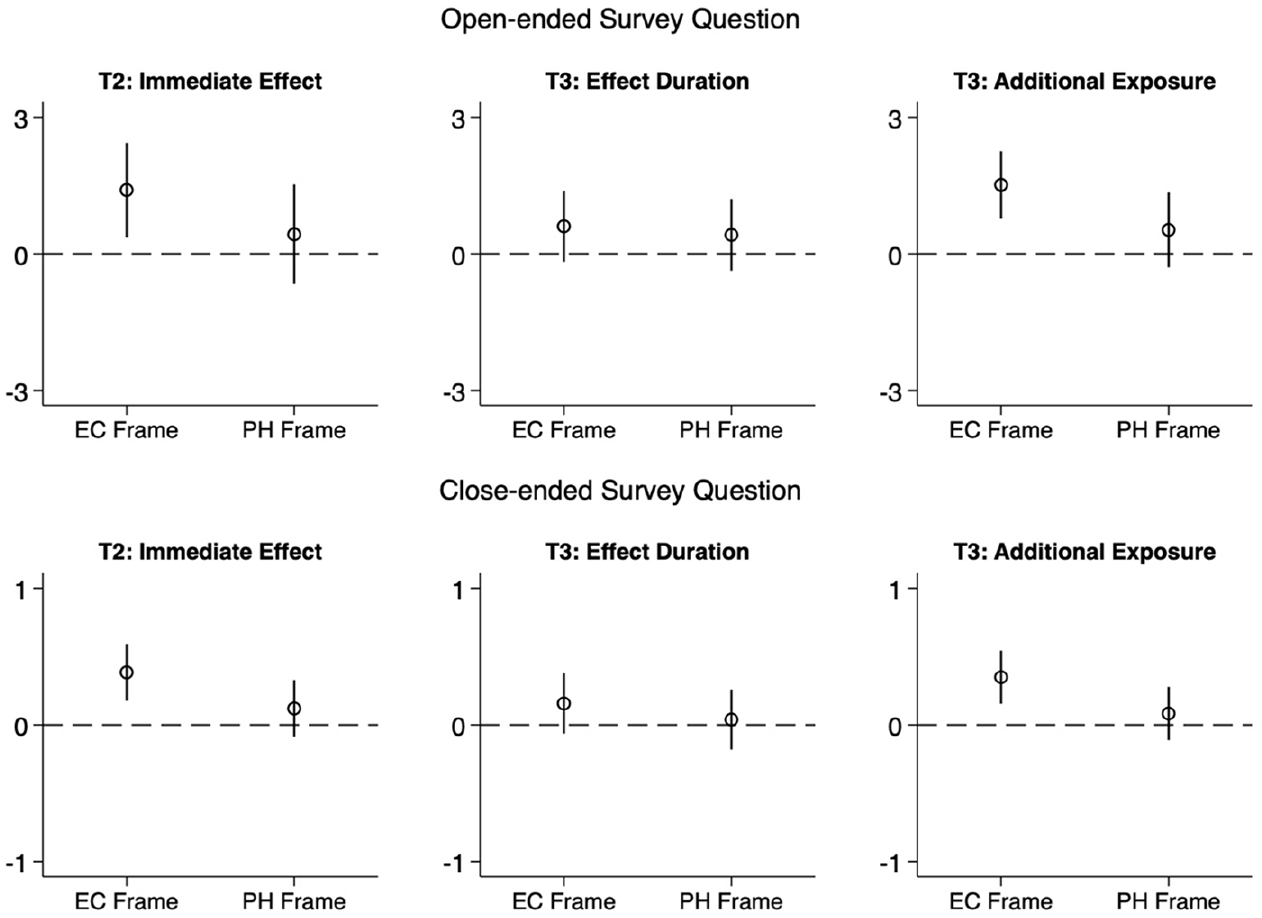
Effects of frame exposure on economic perceptions at T2 and T3.
Figure 2 also shows what happens to these initial effects over time. The effect duration plot illustrates that the effect of initial treatment (T2) is gone at T3—both for the open-ended (b = 0.60, p > .05) and close-ended (b = 0.16, p > .05) case. However, the initial effects from T2 are replicated at T3 if participants are additionally exposed to an economically framed news story about AMR and CC, as shown in the right-hand side of Figure 2. Again, this replication effect is consistent across the open-ended (b = 1.51, p < .001) and close-ended (b = 0.35, p < .001) measures. In sum, these findings indicate that (1) there is an instantaneous effect of frame exposure at T2, which (2) dissipates at T3, if (3) there is no additional exposure to an economic consequences frame.
Figure 3 turns to the specific effect dynamics behind the patterns documented above. A number of findings are of particular relevance. First, the overall patterns are highly similar for both the open-ended and the close-ended measures, although somewhat stronger using the open-ended measure. With respect to the contrast between single and repetitive frame exposure (H2), the findings confirm that the initial effect of EC-framed news is gone at T3 if participants are not repeatedly exposed to an EC-framed story. These reminder effects are significant in the open-ended case (b = 1.12, p < .05), but does not reach the threshold for significance in the close-ended case (b = 0.24, p > .05), lending partial support to H2.
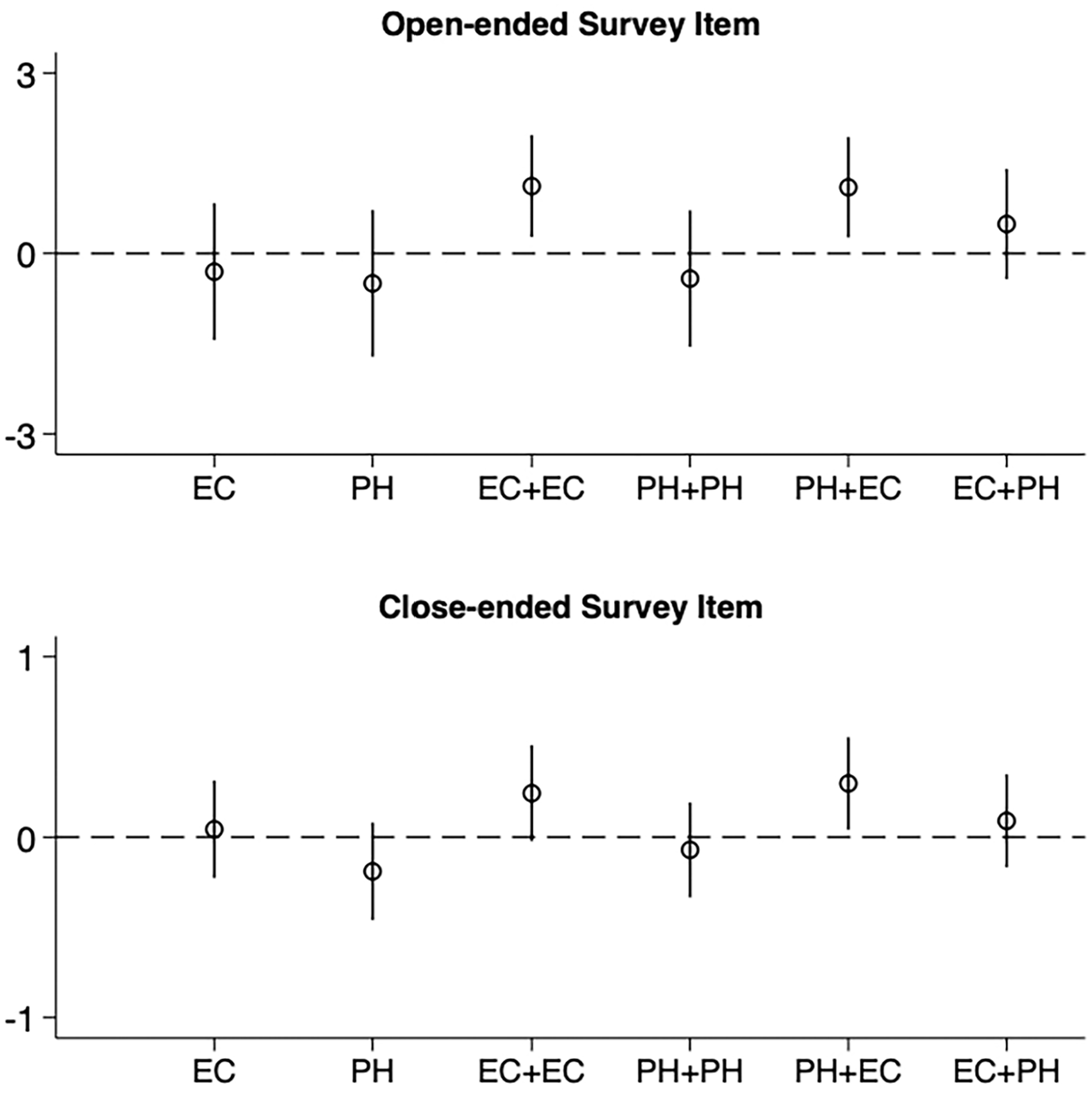
News framing effect dynamics.
Figure 3 also displays findings concerning counter-framing effects. H3 predicted that exposure to shifting frames over time would lead to recency effects, with the latest frame having the strongest impact on beliefs. This hypothesis is supported by the data. In both the open-ended (b = 1.10, p < .05) and close-ended (b = 0.30, p < .05) case, respondents who first read a PH-framed story at T2, followed by an EC-framed story at T3, are significantly more likely to assess AMR and CC in economic terms. In addition, this effect is on par with the effect of repetitive exposure, suggesting that recency is a stronger driver of news framing effects than repetition.
RQ1 and RQ2 asked about how repetition effects and recency effects differ between the two selected issues. We included interaction terms between treatment and issue to the presented models to assess potential effects of issue familiarity. However, no issue differences were found; neither for repetitive exposure effects (RQ1) nor for counter-framing effects (RQ2).
Findings thus far clearly suggest a pattern of framing effects driven by recency mechanisms. Another way of testing such recency effects relies on a pure intra-individual modelling approach. Given our longitudinal experimental design with repeated measurements (T1, T2, and T3), we are also able to estimate pure within-person effects of being randomly exposed to different news frames over time. With such random within-person variation in treatments, we are thus able to test whether the framing dynamics documented above hold at the intra-individual level as well. This also allows for a more powerful test of H4, focusing on issue-differences (H4a) and belief certainty (H4b) as moderators of media effects. A time-variant treatment variable was created capturing whether each respondent (i) was exposed to no news story, an EC-framed or a PH-framed story, at each time point (t). Two-way fixed effects models, focusing exclusively on within-person effects, were then estimated (Allison, 2009). Time dummies are included to control for the overall time trend.
The findings, presented in Table 1, lend clear support to the presence of instantaneous within-person framing effects. Model 1 displays the pure intra-individual effects for the open-ended (b = 1.59, p < .001) and the close-ended (b = 0.28, p < .001) measure. To provide an additional, combined, test of the issue-conditionality of these immediate news framing effects, Model 2 includes an issue-interaction term. 2 Findings reveal a clear issue-difference on the open-ended survey item (b = −1.53, p < .001), but not for the close-ended (b = 0.03, p > .05) item. Thus, using the open-ended measure, respondents are significantly more responsive to news framing on AMR than CC—lending partial support for H4a.
Effects of Frame Exposure (Two-Way Fixed and Random Effects Models).
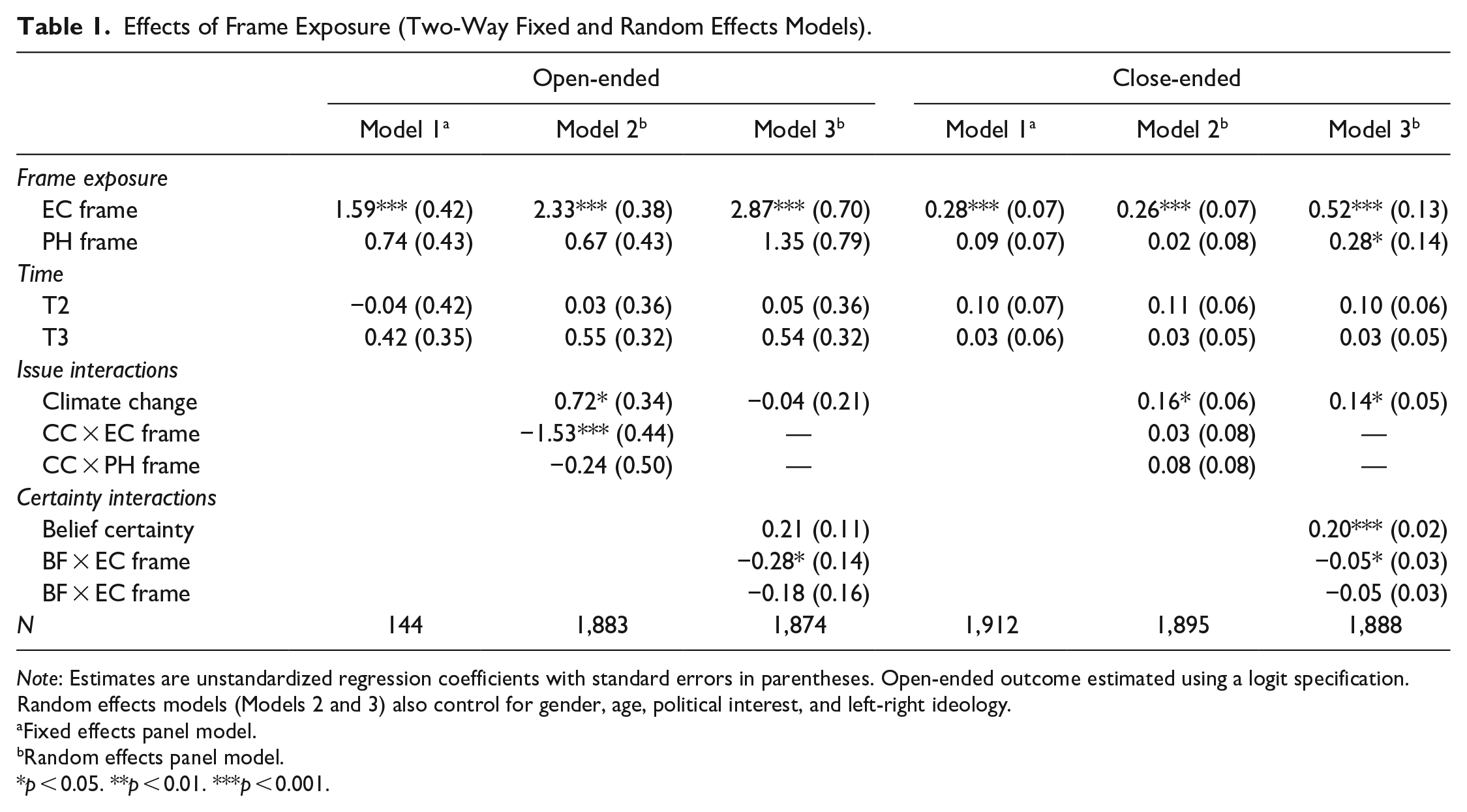
Note: Estimates are unstandardized regression coefficients with standard errors in parentheses. Open-ended outcome estimated using a logit specification. Random effects models (Models 2 and 3) also control for gender, age, political interest, and left-right ideology.
Fixed effects panel model.
Random effects panel model.
p < 0.05. **p < 0.01. ***p < 0.001.
Finally, Model 3 addresses H4b focusing on individual belief certainty as a moderator of framing effects. In line with H4b, the results suggest that higher levels of baseline belief certainty, that is, measured prior to treatments, weaken news framing effects. The negative interaction term is significant in both the open-ended (b = −0.28, p < 0.05) and the close-ended (b = −0.05, p < 0.05) case. These conditional framing effects are illustrated in Figure 4, which displays the effect of reading an EC-framed story for different values of belief certainty. The figure shows that the framing effects are positive and statistically significant for low values of belief certainty but gets smaller and eventually non-significant as certainty increases.
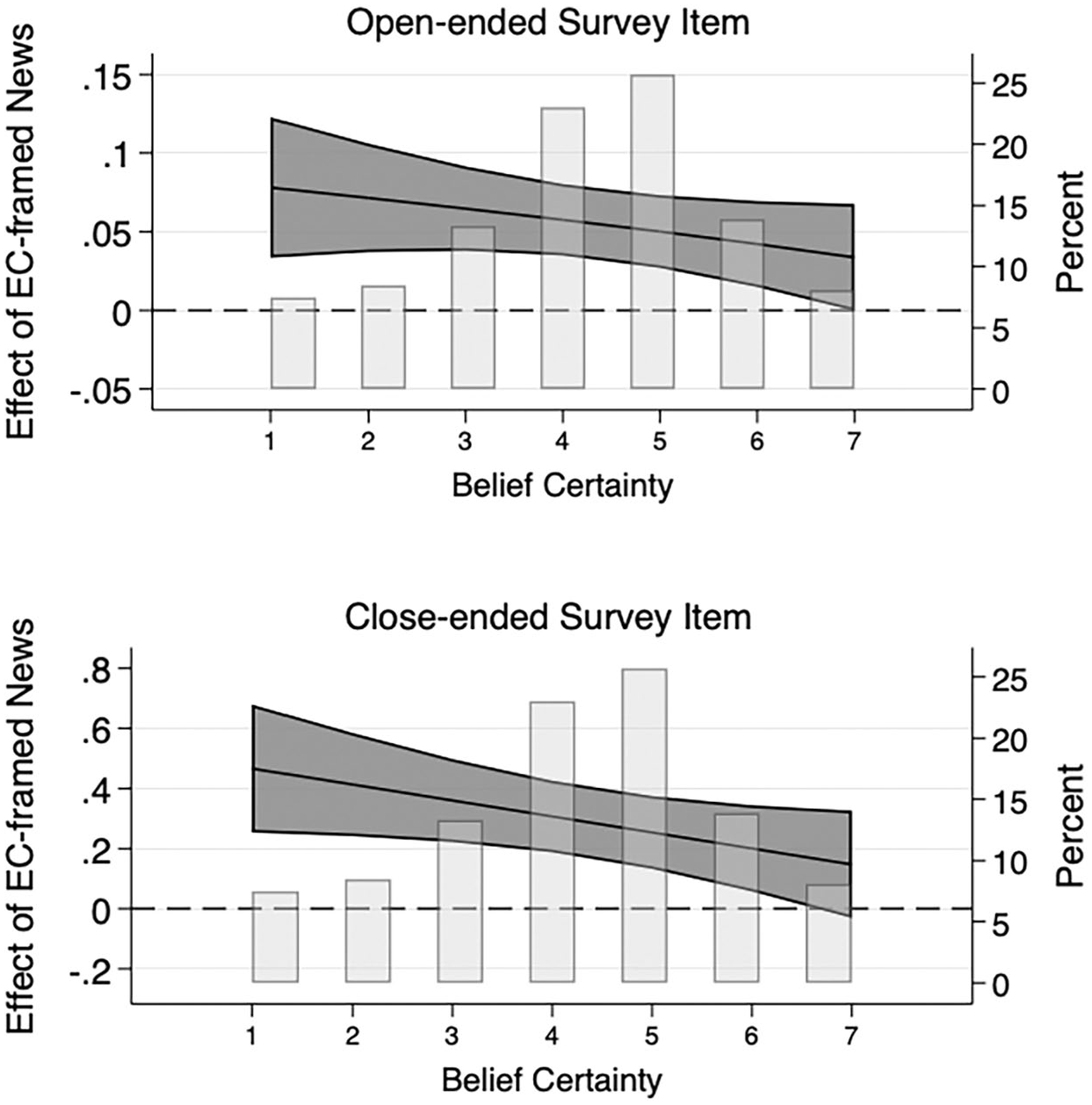
News framing effect dynamics.
Conclusion and Discussion
Research on framing effects shows that news frames matter. By emphasizing particular problem definitions and perspectives, frames can have instantaneous effects on citizens’ issue interpretations and attitudes (Chong & Druckman, 2007; McLeod et al., 2022). Beyond the typical one-shot experiment (Lecheler & de Vreese, 2016; McLeod et al., 2022), however, we still know relatively little about the when, how and why of news framing effects over time (Aarøe, 2017; Lecheler & de Vreese, 2019). Against this background, focusing on one of the most common journalistic news frames—the economic consequences frame (de Vreese, 2010; Valkenburg et al., 1999)—the current study has looked more closely into how issue familiarity conditions news framing effects over time. By comparing dynamic effects of exposure to the same news frame on beliefs about two similar global societal problems—AMR and CC—we seek to better understand issue familiarity as a factor at both the issue and the individual level.
To begin with, dynamic news framing effects on issue beliefs were clear and particularly driven by a recency mechanism. Citizens reading a news story framing AMR and CC in terms of economic consequences were significantly more likely to assess the economic impact of these issues (de Vreese, 2010; Valkenburg et al., 1999). These effects were immediate and quickly fading in the absence of reminders through additional and repetitive exposure. Thus, while frame repetition likely contributes to the maintenance (or stability) of beliefs over time (Lecheler et al., 2015; Shehata et al., 2024), being exposed to a competing frame in a counter-framing scenario, weakens the impact of the initial frame. Taken together, the most consistent effect pattern documented suggests that people rely most heavily on the most recent news frame. These patterns replicate findings in previous studies (Lecheler & de Vreese, 2019; McLeod et al., 2022).
Turning to the main contribution of the study, the findings provide novel insights into how issue familiarity matters for dynamic news framing effects—in expected but also somewhat less expected ways. On the one hand, a recency bias seems to drive belief dynamics on both topics over time, indicating similar effect mechanisms irrespective of issue. When exposed to an EC-framed news story about AMR or CC, citizens are immediately more likely to think about each issue in such terms. This effect then quickly fades in the absence of reminders. The similarity in these effect dynamics suggests that an (universal) accessibility mechanism operates on both issues, temporarily raising economic considerations in relation to AMR and CC—without influencing processing of the next news frame (Cacciatore et al., 2016; Matthes & Schemer, 2012). As theorized by Baden and Lecheler (2012), the implication of such accessibility-driven framing effect dynamics is that “the second frame is processed just as if no frame had been presented before [. . .] Repeated exposure raises the same fleeting effect again, and the effects of subsequent competing frames are unaffected” (p. 373; see also Shehata et al., 2024). This effect dynamic is precisely what is documented in the present study—regardless of issue familiarity—which may be due to a relatively quick fading processes leaving little lasting imprint when the second news story was consumed. On the other hand, while the specific effect dynamic appears independent of issue familiarity, the psychological barrier against these recency-driven news framing effects is not. Comparing the two issues, recency effects were significantly stronger for AMR than for CC using the open-ended measure of beliefs. Similarly, people with higher pre-existing (baseline) belief certainty proved less susceptible to recency effects—using both the open-ended and close-ended measures. These findings are in line with previous studies on attitude strength (Druckman & Leeper, 2012; Matthes & Schemer, 2012)—confirming that the strength with which people hold beliefs about societal problems matter for news framing. These effect dynamics are also in line with previous studies indicating that exposure recency is more important than frequency (repetition) among low-motivation information processors in particular (Chong & Druckman, 2010; Shehata et al., 2021).
Taken together, these findings suggest a dual role that issue familiarity may play in news framing effects: conditioning (1) longitudinal effect dynamics, on the one hand, and (2) effect susceptibility, on the other hand. Our evidence indicates that while the effect dynamics—in this case favoring a recency bias for both issues—may be independent of issue familiarity, individual susceptibility to such framing effects is more dependent on this factor. Thus, the longitudinal effect processes over time are the same, but the strength of these effects is conditioned by familiarity. While this conceptual distinction is important, how these processes play out in different contexts will most likely depend on how citizens process the news frames they are exposed to. If individual motivations for deep and effortful processing of news content are high—for whatever reasons—framing effects may not only be stronger initially but also more persistent and, thereby, bias processing of subsequent news frames (Baden & Lecheler, 2012; Matthes & Schemer, 2012), thus influencing the specific effect dynamic as well. The pattern uncovered here, however, resembles more a context of accessibility-driven, low-effort, continuous belief updating dynamic, with citizens being sensible to the latest frame they were exposed to (Lecheler, et al., 2015; Shehata et al., 2024).
While this study has made some specific contributions to the framing effects literature, a number of limitations and caveats needs to be highlighted. For instance, our focus on emphasis framing in a longitudinal experimental setting required careful construction of stimuli in order to vary news frames in relevant ways, keep other story attributes as consistent as possible while at the same time maximize authenticity of the news stories without being too repetitive over time from a respondent’s perspective. Consequentially, striking this balance meant that we also lost on internal validity, as the news stories also varied in the information provided in stories. This was a price we had to pay in order to have keep news stories authentic to respondents over time—and thereby mimic real-world exposure dynamics (external validity) as closely as possible (see McLeod et al., 2022 for a discussion of these methodological tradeoffs). Furthermore, the study focused specifically on issue interpretation (beliefs), and the likelihood that participants think about antimicrobial resistance and climate change in economic terms, as the main outcome variable of interest. While focusing on issue interpretation follows the core idea of framing effects theory (Matthes & Schemer, 2012; Scheufele, 2004), other outcomes such as attitudes or behaviors were not specifically addressed here. The use of single-item belief measures is not optimal, but partly compensated by employing two alternative operationalizations (open and close-ended items) of beliefs. Focusing on other outcome variables may potentially generate different findings and should therefore be accounted for in future studies (McLeod et al., 2022). Furthermore, even though findings point towards a dominance of recency in framing effects, these conclusions are based on two treatments—repetitive or competitive—over time only. In order to fully capture the importance of recency in more extended repetitive and competitive framing environments, longer time spans and a larger number of treatments are necessary. This is however difficult using experimental designs. Future research should therefore combine well-planned experiments with longitudinal studies based on observational data over longer periods of time, in ways that allow for tight comparisons between the two. Most framing effects research is still based on experimental designs (Lecheler et al., 2009; McLeod et al., 2022; Shehata et al., 2021), and very few studies combine experiments with long-term panel survey and media content data to analyze the role of recency, repetition, and counter-framing in real-world scenarios. Future longitudinal studies would also gain from the pre-registration of hypotheses, which was not the case here. As suggested by the findings presented here, such research could build on, develop, and test the notion of a dual role of issue familiarity as a moderator of effect dynamics, on the one hand, and effect susceptibility, on the other hand.
Supplemental Material
sj-docx-1-crx-10.1177_00936502241259690 – Supplemental material for Same News Frames, Different Issues: Issue Familiarity and Dynamic Framing Effects
Supplemental material, sj-docx-1-crx-10.1177_00936502241259690 for Same News Frames, Different Issues: Issue Familiarity and Dynamic Framing Effects by Adam Shehata, Isabella Glogger, Monika Djerf-Pierre, Maria Zuiderveld, Christina Åhrén and Fredrik Hedenus in Communication Research
Footnotes
Declaration of Conflicting Interests
The authors declared no potential conflicts of interest with respect to the research, authorship, and/or publication of this article.
Funding
The authors disclosed receipt of the following financial support for the research, authorship, and/or publication of this article: This project has received funding from the European Research Council (ERC) under the European Union’s Horizon 2020 research and innovation program (Grant Agreement No. 804662). Any opinions, findings, and conclusions or recommendations expressed in this article are those of the author(s) and do not necessarily reflect the views of the ERC.
Supplemental Material
Supplemental material for this article is available online.

Notes
Author Biographies
References
Supplementary Material
Please find the following supplemental material available below.
For Open Access articles published under a Creative Commons License, all supplemental material carries the same license as the article it is associated with.
For non-Open Access articles published, all supplemental material carries a non-exclusive license, and permission requests for re-use of supplemental material or any part of supplemental material shall be sent directly to the copyright owner as specified in the copyright notice associated with the article.
