




Abstract
Political parties increasingly rely on sophisticated targeting strategies to persuade potential voters. However, questions have been raised about the effectiveness of targeted political ads, considering that citizens frequently oppose the use of their data for political purposes. In this study, we investigate three avoidance behaviors that citizens might employ in order to circumvent targeted political ads: cognitive avoidance, blocking behaviors, and privacy-protective behaviors. We test if privacy concerns, perceived personalization, and overload explain why individuals resort to avoidance behaviors. Moreover, we explore interrelations between the different avoidance strategies. Findings from a two-wave panel study (N = 428) in the context of the Viennese state election showed that privacy concerns increased cognitive avoidance and privacy-protective behaviors. In contrast, perceived personalization decreased cognitive avoidance and blocking behaviors. Cognitive avoidance further reduced privacy-protective behaviors over time, indicating that low-effort strategies might inhibit preventive actions against data collection practices.
The practice of tailoring political ads to the specific interests and needs of citizens on social media has become a crucial component of digital campaign strategies. Over the last decade, social media platforms have built massive databases which are frequently regarded as the most sophisticated tool for predicting human behavior (Johnson, 2019). These technologies have extended campaigners’ capability of reaching the most susceptible citizens at the right time. The goal of such targeted political campaigns is to increase the relevance of ads to citizens and, ultimately, to win votes (C. J. Bennett, 2016).
However, the increasing amount of targeted political advertising meets citizens who follow the “popular lifestyle choice of political avoidance” (W. L. Bennett & Iyengar, 2008, p. 721). Social media users devote little attention to political content on social media (Vraga et al., 2016). What aggravates the situation for targeted political ads is that the majority of the population opposes the use of personal data for political purposes (Auxier, 2020). This negative evaluation of targeting practices might not only result in actions of attention withdrawal and skipping, but lead to more drastic, preventive measures to avoid targeted political ads.
By zooming in on individuals’ targeted ad avoidance in a political context, this study advances the current literature in three ways. First, we extend prior conceptualizations of ad avoidance for the context of targeted ads by conceptualizing privacy-protective behaviors as a new, distinct strategy to avoid targeted advertising. Building on the concepts of cognitive and behavioral avoidance by Cho and Cheon (2004), we argue that ignoring the targeted political ad (i.e., cognitive avoidance), engaging with the ad by selecting the options to block or hide it (i.e., blocking behaviors as a form of behavioral avoidance), or using preventive measures against data collection (i.e., privacy-protective behaviors as a form of behavioral avoidance) are separate forms of targeted ad avoidance. We systematically differentiate these three dimensions based on their required effort and the distinct goals (reactive and preventive) they serve. To see if these three behaviors might also be triggered by distinct factors, we examine privacy concerns and perceived overload as avoidance-enhancing factors and perceived personalization as an avoidance-reducing factor. By investigating privacy concerns and perceived personalization, we investigate established factors influencing the risk-benefit analysis of targeted advertising based on the privacy calculus model. Furthermore, we introduce a new perspective by examining avoidance from an information processing perspective, testing if targeted ad avoidance behaviors constitute a coping mechanism against perceived overload with targeted political ads.
Second, going beyond prior, unidimensional measures of targeted ad avoidance, we test how these different forms of avoidance interact. Since attention is a prerequisite for more elaboration and active engagement with social media content (Wieland & Kleinen-von Königslöw, 2020), cognitive avoidance might inhibit more effortful, privacy-protective forms of targeted ad avoidance.
Third, we provide new insight into the area of targeted political advertising. Understanding individuals’ coping mechanisms against targeted political advertising is critical, considering that it can be used to mislead citizens by using “deliberate attempts to divide, demobilize, and disinform citizens” (Roemmele & Gibson, 2020, p. 607). Furthermore, targeted political advertising constitutes a unique case of targeted advertising. As opposed to consumer decisions, voting is a collective choice between complex and intangible options (Lock & Harris, 1996). Voting, as opposed to most consumer decisions, has far-reaching societal consequences that span over several years. Since the stakes of decision-making are high, citizens might also be more critical toward targeted political than commercial ads: At an information processing level, Peng and Hackley (2009) found that citizens exhibit a stronger emotional charge when evaluating political advertising and engage in “a deeper level of critical analysis of the advertising texts than one might expect from laypeople” (p. 183). This tendency for deep elaboration is also reflected in individuals’ reactions to targeting strategies. Across different countries, survey respondents consistently rate targeting for political purposes as less acceptable as compared to targeting for commercial purposes (Kozyreva et al., 2021). Recipients also evaluate political parties, but not brands, more negatively when they promote their content on social media (Boerman & Kruikemeier, 2016). Therefore, the political context might constitute a boundary condition to the persuasive appeal of targeted ads found in commercial contexts.
To fill these gaps, we conducted a two-wave panel study in the context of the 2020 Viennese state election in Austria. Going beyond prior, predominantly cross-sectional studies, this research design allows us to examine how avoidance behaviors change over time and if our proposed predictors can explain these changes. It also gives insight into the yet understudied European context, which might critically differ from findings obtained in the context of the U.S. (Kozyreva et al., 2021).
Avoidance Behaviors
According to approach-avoidance theory, two basic drives of human behavior are to avoid pain and approach pleasure (Elliot, 2008). The study of approach and avoidance tendencies has a long history in social psychology, going back to early work by Lewin (1935). These first ideas already recognized that approach and avoidance tendencies can stand in conflict with each other—in some situations, we might both feel pulled toward a certain stimulus because it helps us to fulfill a goal, while at the same time wanting to retreat from it in order to avoid potential negative consequences. These competing goals can lead to considerable tension, which can’t be easily resolved if both drives are incompatible and similar in strength (Miller, 1944). Applied to the field of mass communication, this means that people seek out content that is useful and pleasurable and avoid information that might induce negative outcomes (Kelly et al., 2020). Such avoidance behaviors can have critical implications for communication: For the sender of a message, avoidant recipients can not be reached, informed, or persuaded.
An iconic study by Speck and Elliott (1997) revealed the rich avoidance repertoires that individuals have at hand to avert advertising. At a time when advertising reached the majority of people through TV screens, audiences developed strategies such as switching channels, leaving the room, or simply taking their eyes off the screen as a reaction to commercial content (Speck & Elliott, 1997). In recent decades, the resourcefulness of citizens’ avoidance strategies has fueled an arms race between senders and recipients. One recent tool for sidestepping avoidance is the personalization of content based on online data on social media. By tailoring messages to the recipients’ needs, marketers hope to remove one of the most important drivers of ad avoidance: The irrelevance of the ad (Baek & Morimoto, 2012; Ham, 2017; Kelly et al., 2020). Also political parties place hope—and put considerable amounts of money (Homonoff, 2020)—into targeting voters on social media. Yet, the effectiveness of such attempts critically depends on whether or not individuals’ have already developed avoidance repertoires in response to this tactic. In the following, we conceptualize three different ways in which individuals might avoid targeted advertising on social media.
Dimensions of Targeted Ad Avoidance
Previous research has established that ad avoidance is a multidimensional concept. Cho and Cheon (2004) theorize ad avoidance as a latent variable that is composed of the subdimensions of cognitive, affective, and behavioral avoidance. Cognitive avoidance describes the act of diverting one’s attention away from the stimulus, for example, by simply taking the eyes off the ad. Affective avoidance is defined as a negative emotional reaction to an ad, such as a strong disliking. Behavioral avoidance describes all “actions other than lack of attendance” (Cho & Cheon, 2004, p. 91).
To date, a number of studies have investigated ad avoidance in the context of targeted ads, yet many have treated targeted ad avoidance as a unidimensional construct (Baek & Morimoto, 2012; Ham, 2017; Jung, 2017). However, a recent study shows that Cho and Cheon’s (2004) conceptualized subdimensions form separate constructs, which need to be empirically distinguished in the context of targeting (Dodoo & Wen, 2019). Furthermore, different forms of targeted ad avoidance can be triggered by specific factors: Cognitive avoidance is especially driven by negative cognitions about the targeted ad, while behavioral avoidance emerges in response to strong negative emotions (Youn & Kim, 2019). Thus, to fully understand individuals’ repertoires of avoidance behaviors, targeted ad avoidance needs to be studied as a multidimensional construct.
In our study, we want to contribute to the literature on targeted ad avoidance on social media by building on prior work by Cho and Cheon (2004). We understand ad avoidance as “all actions that media users employ to reduce exposure to advertising content” (Speck & Elliott, 1997, p. 61), or in our case, targeted advertising content. Therefore, in line with other studies (Youn & Kim, 2019), we focus on cognitive and behavioral acts of avoidance, while not studying the evaluative component of affective avoidance, which more closely resembles attitudes toward the ad. Further extending prior literature, we conceptualize two different forms of behavioral targeted ad avoidance: blocking behaviors and privacy-protective behaviors. While prior studies applied a broad definition to the concept of behavioral avoidance as “actions other than lack of attendance” (Cho & Cheon, 2004, p. 91), we argue that a more nuanced view is warranted. In the following, we will describe targeted ad avoidance behaviors and discuss systematic differences based on their intensity of behavioral effort and their function.
Cognitive avoidance
In the context of targeted political advertising, cognitive avoidance encompasses behaviors that help individuals pull away their attention from the ad such as intentionally looking away or scrolling past the content in one’s newsfeed (Cho & Cheon, 2004; Speck & Elliott, 1997). Although the act of scrolling has sometimes been categorized as behavioral avoidance (Cho & Cheon, 2004), we argue that scrolling is an automatic, effortless reaction that helps individuals to redirect their gaze away from ads and impedes the in-depth processing (Wieland & Kleinen-von Königslöw, 2020). This is in line with Youn and Kim (2019), who investigated cognitive avoidance of targeted ads as the act of scrolling by and ignoring content.
Blocking behaviors as behavioral avoidance
Prior studies have focused on behavioral avoidance of online ads in the form of ad-hoc reactions other than simply ignoring content (Cho & Cheon, 2004). In line with Youn and Kim (2019), we investigate blocking and hiding content as social-media-specific behavioral avoidance responses. We term this set of behaviors blocking behaviors. We define blocking behaviors as individuals’ deliberate act of hiding or blocking specific content that they encounter in their social media feeds (e.g., by selecting the “hide this ad”-option). In prior research, the term “blocking” has also been used to describe the use of ad blockers. However, since ad blockers cannot be used to block out targeted advertising in individuals’ newsfeeds on social media, we do not consider the use of ad blockers within the context of this study.
While it is not possible to opt out of targeted advertising entirely, Facebook and other social media platforms such as Instagram or Twitter allow users to “influence the types of ads you see by giving us feedback or hiding ads and advertisers that you don’t want to see” (Facebook, 2021a). By curating which ads they want to block out, social media users create a user-tailored experience (i.e., customization, see Sundar & Marathe, 2010). This provides social media platforms with additional feedback and therefore with even more information about individuals’ preferences with regard to tailored advertising. However, blocking behaviors also mark the end of the connection between the advertiser and the audience (Tang et al., 2015).
Privacy-protective behaviors as behavioral avoidance
Similar to blocking, where individuals reject a certain source, privacy-protective behaviors can be used with the aim to avoid or limit data collection online. Thus, these behaviors try to avoid specifically targeted ads that are based on large quantities of data by managing and controlling the data collection online (Büchi et al., 2017). Closely targeted content can be perceived as an intrusion into individuals’ privacy, so that social media users might be especially motivated to avoid highly targeted content per se as a specific form of advertising. Neither cognitive avoidance nor blocking behaviors can fulfill this function, since they do not limit the collection of data that serves as the basis for targeting. Instead, individuals need to employ privacy-protective behaviors to “limit online data collection through tracking” (Boerman et al., 2021, pp. 688–689) and therefore avoid or reduce the exposure to ads that are targeted to the individual. Drawing on Boerman et al. (2021), we define privacy-protective behaviors as people’s actions taken to “mitigate the collection, usage, and sharing of their personal information to protect their online privacy” (pp. 955–956). Specifically, we focus on the routine deletion of cookies and search histories of individuals in response to exposure to targeted ads, since these practices limit the collection of behavioral data that might be used in targeted political ads (Boerman et al., 2021; Bujlow et al., 2017). Boerman et al. (2021) showed in their study that these two behaviors are the most prevalent privacy-protective behaviors among citizens. However, while these behaviors seem to be important privacy tools for social media users, privacy-protective behaviors are a yet understudied strategy to avoid targeted ads. However, this strategy is especially important, since it gives individuals a limited, but still existent level of control to avoid highly targeted political advertising.
Mapping the differences between targeted ad avoidance behaviors
Why is it necessary to differentiate between different forms of targeted ad avoidance and how do they differ? On the one hand, the employed strategies might differ in the amount of behavioral effort, requiring different levels of motivations and skills to initiate them. However, they also differ in the function that they fulfill. Based on these lines of reasoning, we conceptualize systematic differences between the three dimensions of avoidance based on their intensity of behavioral effort and reactive or preventive focus (see Figure 1).
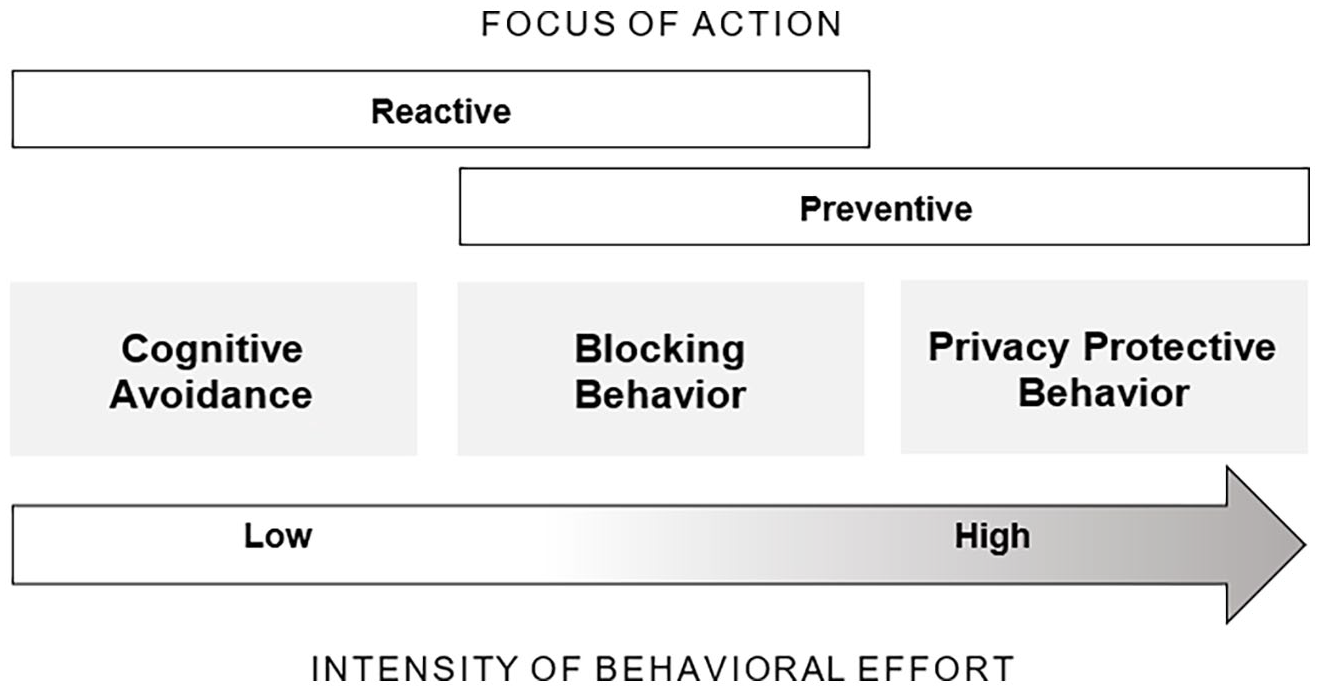
Conceptualization of targeted ad avoidance behaviors.
Intensity of behavioral effort
While some reactions to social media content require higher levels of elaboration and awareness, others occur more passively as a form of automatic or impulsive behavior. Scrolling by or redirecting the gaze to more relevant content requires little conscious effort (Wieland & Kleinen-von Königslöw, 2020). In addition, directing attention to a stimulus is theorized as a precondition for effortful elaboration (Eveland, 2001). Therefore, we categorize cognitive avoidance as low in behavioral effort, because already attention to the stimulus is low. This is also in line with Tang et al.’s (2015) conceptualization of passive avoidance. On the contrary, as stated by Speck and Elliot (1997), “elimination requires more thought and initiative than flipping past” (p. 68). Theories on the processing of incidentally encountered content state that once individuals stop and interact with content on social media, they require a higher level of awareness and conscious effort (Wieland & Kleinen-von Königslöw, 2020). Therefore, blocking behaviors and privacy-protective behaviors rank higher in behavioral effort as compared to cognitive avoidance (see also active avoidance, Tang et al., 2015). Even more so, privacy-protective behaviors require individuals to interrupt their browsing session and navigate the social media settings, which requires considerable amounts of time and effort (Gerber et al., 2019; Shirazi & Volkamer, 2014). Therefore, we theorize that privacy-protective behaviors rank highest in the intensity of behavioral effort.
Reactive or preventive focus
Second, targeted ad avoidance behaviors can be characterized by the different functions they fulfill. On the one hand, individuals can set certain actions to avoid advertising in the moment. We call this function a reactive function. As such, cognitive avoidance is an immediate reaction to a specific stimulus. It can help individuals to “[inhibit] the processing of information associated with threat [ . . . ] by turning attention away from threat-related cues” (Krohne et al., 2002, p. 220). Similarly, blocking also immediately removes the ad from one’s newsfeed and therefore is an ad-hoc response to a specific ad.
In contrast to cognitive avoidance, blocking also has more long-term consequences for what types of content individuals see in the future. Therefore, it simultaneously serves a preventive function. Preventive targeted ad avoidance is marked by affecting individuals’ future interactions with content. Since targeted ads pose a threat to individuals’ perceived right to privacy, simply ignoring these ads might not be sufficient. Instead, individuals might “take a decisive action to ensure advertisers no longer have the opportunity to target them with any personalized messages” (Brinson et al., 2018, p. 141).
Similarly, privacy-protective behaviors also fulfill a preventive function when it comes to the specific content displayed to social media users. While the use of privacy-protective behaviors cannot prevent that ads are shown to individuals or will use data at all, they reduce the amount of data that parties and intermediaries can use to narrowly tailor the message to specific interests and characteristics of the user (Büchi et al., 2017; Bujlow et al., 2017).
Drivers of Targeted Ad Avoidance
Previous advertising research found that avoidance can be induced by concerns and negative evaluations in regard to the ad or the sender (Dodoo & Wen, 2019; Kelly et al., 2010), but also result from the irrelevance of the content (Cho & Cheon, 2004; Dodoo & Wen, 2019; Kelly et al., 2010). Based on the privacy calculus model, we revisit these factors. The privacy calculus model takes a rational perspective on human decision-making, theorizing that individuals weigh potential benefits from self-disclosing information against perceived risks (Dienlin & Metzger, 2016). In the context of targeting, perceived risks arise from violations of one’s privacy and can manifest in individuals’ online privacy concerns (Culnan & Armstrong, 1999). On the other hand, targeted ads come with benefits, such as the increased personalization of content. Such personalization increases the relevance of content, making it more interesting and useful (Dodoo & Wen, 2019; Jung, 2017; Kelly et al., 2010). Prior studies show that considerations of costs and benefits co-exist and determine how recipients evaluate and interact with targeted advertising (Baek & Morimoto, 2012; Ham, 2017).
As a second factor, going beyond prior research, we also highlight the role of individuals’ information processing by investigating overload with targeted political ads. Overload has been a shown to be a decisive driver of news avoidance (Skovsgaard & Andersen, 2020) and might be especially important in election times, when individuals might feel overwhelmed by the amount of political content. Therefore, there is still a need to understand if avoidance is not just the result of rational cost-benefit analyses, but also acts as a coping mechanism against the overabundance of political information in the hot phase of an election campaign.
Privacy Concerns
In line with Hong and Thong (2013, p. 276), we define privacy concerns as “the degree to which an Internet user is concerned about website practices related to the collection and use of his or her personal information.” Based on reactance theory (Brehm, 1966), privacy concerns could elicit targeted ad avoidance behaviors: When individuals are concerned about their privacy they perceive targeted ads as to intrude their private space and impair their personal freedom (Baek & Morimoto, 2012; Brinson et al., 2018). Individuals then try to restore their freedom, for example, in the form of targeted ad avoidance (Ham, 2017).
A series of recent studies in commercial advertising indicated that privacy concerns are associated with ad avoidance (Baek & Morimoto, 2012; Ham, 2017; Jung, 2017; Morimoto, 2021). However, there is a need for additional evidence. The above-mentioned research studied avoidance as a unidimensional concept. Therefore, it is yet unclear which exact targeted ad avoidance strategies individuals turn to. In the context of targeted advertising, this is an especially interesting question: As outlined, not all avoidance behaviors serve to protect individuals’ privacy. Thus, it is important to know whether individuals might turn to maladaptive forms of coping, such as simply ignoring the ad.
So far, the evidence for effects of privacy concerns on cognitive avoidance is mixed. On the one hand, prior studies found a positive correlation between the related concept of ad intrusiveness and cognitive avoidance (Dodoo & Wen, 2019; Youn & Kim, 2019). On the other hand, Jung (2017) found that privacy concerns did not affect the degree to which individuals paid attention to targeted ads. Since cognitive avoidance does not help individuals to protect their data, it is yet unclear if cognitive avoidance is a viable response to targeted ads for privacy-concerned citizens. Nevertheless, cognitive avoidance might serve as a coping mechanism to avoid unpleasant feelings elicited by privacy intrusion (Sweeny et al., 2010). Due to these conflicting assumptions, we pose a research question:
RQ1: How do privacy concerns affect cognitive avoidance behaviors over time?
Drawing on findings in a commercial context, there is tentative evidence that privacy concerns drive behavioral avoidance. First, users name concerns over data use and privacy among the most important reasonings for blocking advertising, for example, using ad blockers online (Tudoran, 2019). Second, meta-analytical evidence confirms that privacy concerns increase individuals’ privacy-protective behaviors (Baruh et al., 2017). Therefore, we hypothesize:
H1: Privacy concerns positively predict a) blocking behaviors and b) privacy-protective behaviors over time.
Perceived Personalization
According to self-referencing theory, people can be more easily persuaded by messages which are personally relevant to them (Rogers et al., 1977). Targeting content to individuals’ needs, therefore, fulfills the function to make the messages more relevant and thus, persuasive. In this context, individuals’ perception that the content is tailored to them is even more important than actual targeting to explain subsequent effects (Li, 2016). Prior research shows that higher levels of personalization can also help advertisers to reduce avoidance of the content. Both Ham (2017) and Baek and Morimoto (2012) found a negative correlation between perceived personalization and their overall measure of ad avoidance. Similarly, further studies found that increases in ad relevance, which is the prime goal of personalization, dampens individuals’ targeted ad avoidance on social media for each different dimension of avoidance (Dodoo & Wen, 2019; see also Kelly et al., 2010).
Yet, there is still a need to address this relationship in the context of targeted political advertising. Calls to regulate and reduce highly personalized content have grown louder in recent years. Scholars raised concerns that targeted political advertising could increase polarizing tendencies in the electorate and facilitate the formation of so-called echo chambers (Roemmele & Gibson, 2020). To see if these fears are warranted, it is important to investigate if individuals would attend to such content, if they might block it out, or if they might even resort to privacy-protective measures to reduce a higher degree of personalization in the future.
The context of targeted political advertising is also an interesting test case for theoretical advancement in this area since it might constitute a boundary condition to the negative effect of personalization on avoidance. In survey studies, citizens have voiced strong reservations against targeted political advertising, while showing higher acceptance of the use of data for commercial ends (Auxier, 2020; Kozyreva et al., 2021). One reason might be that political targeting involves sensitive data, for instance on individuals’ political ideology or minority status (Kozyreva et al., 2021). A higher degree of personalization could therefore be ineffective or even backfire in this specific context. Thus, there is a strong need to understand if personalization can also reduce avoidance behaviors directed at targeted political ads.
Based on self-referencing theory (Rogers et al., 1977), we hypothesize the following:
H2: Perceived personalization negatively predicts a) cognitive avoidance, b) blocking behaviors, and c) privacy-protective behaviors over time.
Overload
When active on social media channels, many individuals experience what is called an information overload (Matthes et al., 2020). Upon exposure to an excessive amount of information, individuals experience the amount of information to be overwhelming and beyond their abilities to process said information (see, e.g., limited capacity model, Lang, 2000). Prior findings from research on news avoidance and information avoidance on social media suggest that individuals employ mainly two strategies to cope with overload. They either reduce the cognitive stimulus by ignoring information and “tuning out” (i.e., cognitive avoidance), or they actively apply management techniques to organize, prioritize and/or block certain information (Guo et al., 2020; Park, 2019; Song et al., 2017). Blocking behavior could therefore function as an information management application because blocking certain information will refine the algorithm to better match the individuals’ preferences. By filtering out unwanted content, individuals might reduce an overburdening amount of advertising clutter (Cho & Cheon, 2004). Applying these results to our proposed model, we hypothesize the relationship between overload and targeted ad avoidance as follows:
H3: Overload positively predicts a) cognitive avoidance and b) blocking behaviors over time.
Due to a lack of empirical evidence, we can only make an educated guess about how overload is related to privacy-protective behaviors. Ultimately, privacy-protective behaviors cannot reduce the amount of information but only the extent to which it is tailored to the individual. Following the rationale of how blocking behavior might be advantageous for individuals to view less irrelevant ads and therefore reduce clutter, privacy-protective behavior would be counterproductive. However, because the empirical state of the art does not allow for the formulation of a hypothesis, we investigate the following research question instead:
RQ2: How is overload related to privacy-protective behaviors?
Relationships Between Avoidance Behaviors
Furthermore, we theorize that different avoidance behaviors might not occur independently from each other. Specifically, we argue that cognitive avoidance might lead to less blocking behaviors and privacy-protective behaviors over time. Advertising research suggests that under certain circumstances, low attention might be beneficial for campaigners, as it prevents more extreme resistance strategies such as the blocking of advertising (Santoso et al., 2020). In other words, individuals first have to consciously take notice of advertising and process it in more depth before taking the decision to hide and block the ad or change their settings to prevent the further use of their data (see also Wieland & Kleinen-von Königslöw, 2020). Content that is ignored might not motivate individuals sufficiently to take decisive action against future targeting through high-effort behaviors. Based on this reasoning, we hypothesize that the more individuals turn to cognitive avoidance, the less they use preventive avoidance strategies:
H4: Cognitive avoidance negatively predicts a) blocking behaviors and b) privacy-protective behaviors over time.
Methods
Context
We conducted a two-wave panel survey during the election campaign period of the 2020 Viennese state election campaign. During the time of the election campaign, the COVID-19 regulations restricted major campaign appearances of the candidates. In the 2 months before the election day, the major political parties spent considerable amounts of money to mobilize voters via tailored advertising on social media (“Die Social-Media-Schlacht um Wien [The social media battle for Vienna],” 2020). As compared to the predominantly researched U.S. context, targeted political advertising is less advanced in Western European countries (C. J. Bennett, 2016). Several reasons add to this circumstance: First, European countries, especially EU members, apply stricter data privacy regulations (i.e., GDPR) compared to the U.S. and its more liberal frameworks (C. J. Bennett, 2016; Zuiderveen Borgesius et al., 2018). Second, the U.S. and (most) European countries differ in terms of their political (two-party system vs. multi-party system) and electoral (majoritarian vs. proportional system) systems. Additionally, campaign financing varies and is more limited in the European context (Zuiderveen Borgesius et al., 2018). Despite these factors, targeted political advertising is increasingly integrated into European online campaigns (C. J. Bennett, 2016).
Sample
The data was collected by the private market research company Dynata between August 2020 (W1) and October 2020 (W2), right before the election day on October 11, 2020. The study was part of a larger survey on political communication in the election, which also included measures of incidental exposure to political content (Nanz & Matthes, 2022) and dirty campaigning. However, there is no conceptual overlap or overlap in any of our focal variables between this study and other research projects that used the same sample. Specifically, no other project addressed targeted political advertising or issues pertaining to privacy, personalization, overload, or avoidance behaviors. There was an approximate time difference of 6 weeks between both survey waves. Only participants who provided their consent and who had the right to vote, that is, Austrian citizenship and main residence in Vienna, took part in the overall survey. In order to reduce potential biases in our data, we excluded careless responses based on response times (Leiner, 2019). We took a conservative approach and only excluded cases in Wave 1 that took less than 10 minutes for the survey. The expected survey duration after a pre-test among the researchers was 20 minutes. The median of the survey duration for finished responses lies at 22 minutes and 38 seconds. We chose a cut-off point of 10 minutes since it indicates that careless responders took less than half the amount of time of the median respondent to answer the survey. The same cut-off point was also applied in previous studies of the same length (Reiter & Matthes, 2021). Upon the above-outlined criteria, 524 participants took part in the survey during both waves (NW1 = 802 respondents, NW2 = 524 respondents). Since this study focuses on the exposure to targeted political advertising on social media, only participants who reported using social media in both waves answered this part of the survey, leading to a final sample size of 428 participants across both waves.
The retention rate of the completed cases between Wave 1 and Wave 2 was 59.61%. Our sample was derived from quotas for age (18–65 years, M = 43.32, SD = 13.16) and gender (54% females). Educational backgrounds were heterogeneously distributed among participants (25.9% lower education level, 46.5% medium education level, 27.6% higher education level). We did not find significant differences regarding gender, χ2(1) = .47, p = .495, and education, χ2(6) = 3.45, p = .745, of participants who took part only in the first wave and participants who also completed the second wave. We observed, however, a significant difference in participants’ age, showing that respondents who took part in both waves were significantly older (M = 43.32, SD = 13.16) compared to those completing only Wave 1, M = 39.14, SD = 13.44, t(716) = −4.13, p = .000. Ethical approval for this study was obtained from the Institutional Review Board of the Department of Communication at the University of Vienna (approval ID: 20200722_01).
Measures
We provided all participants with a short definition of targeted political advertising on social media, i.e., ads on social media tailored to specific groups of people, based on for example, demographic data, interests, or clicking behavior (for a similar description, see Facebook, 2021b). All variables were assessed on a 7-point Likert-type scale ranging from 1 (do not agree at all) to 7 (agree completely), if not stated otherwise. All items are presented in Appendix A.
Independent variables
In order to gauge participants’ privacy concerns on social media, we included 3 items for which participants had to indicate their level of agreement. The items were based on Mani and Chouk (2017) and adapted to the social media context (MW1 = 4.8, SDW1 = 1.7, MW2 = 4.8, SDW2 = 1.6, Cronbach’s αW1 = .89, αW2 = .86).
We measured perceived personalization with 2 items that were based on Dijkstra (2005) and adapted to the context of targeting. Participants were asked to indicate to what extent they agreed that the targeted political ads they encountered on social media during the Viennese state election campaign were (1) tailored to them and (2) aimed directly at people like them (MW1 = 2.7, SDW1 = 1.6, MW2 = 3.1, SDW2 = 1.5, Cronbach’s αW1 = .83, αW2 = .82).
We assessed participants’ overload with targeted political advertising on social media using 4 items based on Karr-Wisniewski and Lu (2010). The items were adjusted to this study context (e.g., “I often had the feeling that I received too much targeted political advertising on social media to make good decisions”; MW1 = 2.5, SDW1 = 1.6, MW2 = 2.8, SDW2 = 1.6, Cronbach’s αW1 = .90, αW2 = .90).
Measurement of avoidance
The avoidance behaviors of targeted political advertising on social media were assessed with three distinctive dimensions: (1) cognitive avoidance (MW1 = 4.6, SDW1 = 1.7, MW2 = 4.8, SDW2 = 1.6, Cronbach’s αW1 = .92, αW2 = .90) and (2) blocking behaviors were adapted from Dodoo and Wen (2019; MW1 = 3.7, SDW1 = 2.0, MW2 = 3.6, SDW2 = 1.9, Cronbach’s αW1 = .83, αW2 = .76), and (3) privacy-protective behaviors were derived from Boerman et al. (2021; MW1 = 3.4, SDW1 = 2.1, MW2 = 3.4, SDW2 = 2.0, Cronbach’s αW1 = .85, αW2 = .80). All items were slightly adapted to be in line with the focus of the present study. Participants were asked to evaluate on a scale ranging from 1 (never) to 7 (often) how often they engaged in the outlined avoidance behaviors when encountering targeted political ads on social media.
Control variables
We controlled for participants’ demographics (i.e., age, gender, education) and political ideology, measured on a 10-point scale ranging from 0 (left) to 10 (right) (M = 4.5, SD = 2.3). We assessed participants’ political distrust with 2 items taken from Craig et al. (1990, M = 4.2, SD = 1.5, α = .80). Furthermore, we measured participants’ political interest with two items (M = 5.3, SD = 1.5, α = .82) and controlled for participants’ knowledge about online behavioral advertising. Participants had to evaluate statements based on a scale by Smit et al. (2014). Right answers to all knowledge items were added up to a knowledge scale ranging from 0 to 6 (M = 4.3, SD = 1.4).
In addition, we controlled for individuals’ perceived amount of targeted political advertising exposure (M = 5.9, SD = 6.0, range: 0–28). Participants indicated on how many days in a regular week they received targeted political ads on a) Facebook, b) Instagram, c) YouTube, and d) Twitter, ranging from 0 (never) to 7 (7 days). Answers that indicated that individuals did not use the platform were recoded to 0, indicating no exposure to targeted political ads on this specific platform. All items were added up to form a summative index.
All predictors and control variables were measured in Wave 1, except for political ideology and knowledge about online behavioral advertising.
Results
Statistical Models
We turned to structural equation modeling using the lavaan package in R (Rosseel, 2012). In the first step, we examined the accuracy of our measurement model. A cut-off value of λ > .40 was used to identify weak factor loadings. Next, we tested the full structural model. In our models, we used robust Maximum Likelihood estimation because a QQ-plot indicated a violation of multivariate normality. We applied the conventional criteria for the Comparative Fit Index (CFI) ≥ .95, Tucker Lewis Index (TLI) ≥ .95 and the Root Mean Square Error of Approximation (RMSEA) ≤ .05 (Byrne, 2016). We report robust measures for CFI, TLI, and RMSEA. Error terms of identical items from Wave 1 and Wave 2 were allowed to covary. We also freely estimated covariances between the latent predictors in Wave 1 and the perceived amount of targeted political ad exposure, since we expected them to be related (e.g., the amount of targeting in a regular week would be related to avoidance behaviors in Wave 1). The dataset that underlies the analyses can be accessed via osf (doi: 10.17605/OSF.IO/TF8NJ).
Preliminary Analyses
In line with recommendations by Gerbing and Hamilton (1996), we test our measurement model of targeted ad avoidance using an exploratory factor analysis (EFA) prior to a CFA. First, we turned to an EFA with principal axis factoring and Oblimin rotation. The analysis was conducted on variables measured in Wave 1. The Kaiser-Meyer-Olkin statistic, KMO = .88, and Bartett’s Test of Sphericity, p < .001, supported that the data is factorable. The EFA revealed that 1 item cross-loaded on two factors, which was therefore excluded from further analyses (“. . . I have closed the website to avoid this ad”). For the final 9 items, parallel analysis indicated a three-factor solution explaining 68.3% of the total variance (see Table 1). Confirmatory factor analyses further showed acceptable model fit on most fit indices in Wave 1, χ2(24) = 83.25, p < .001, CFI = .97, TLI = .95, RMSEA = .08, and Wave 2, χ2(24) = 52.00, p < .001, CFI = .98, TLI = .97, RMSEA = .06. Factor loadings are reported in Appendix B, Figure B1.
Pattern Matrix of an Exploratory Factor Analysis on Targeted Ad Avoidance Behaviors Using Oblimin Rotation (N = 428).
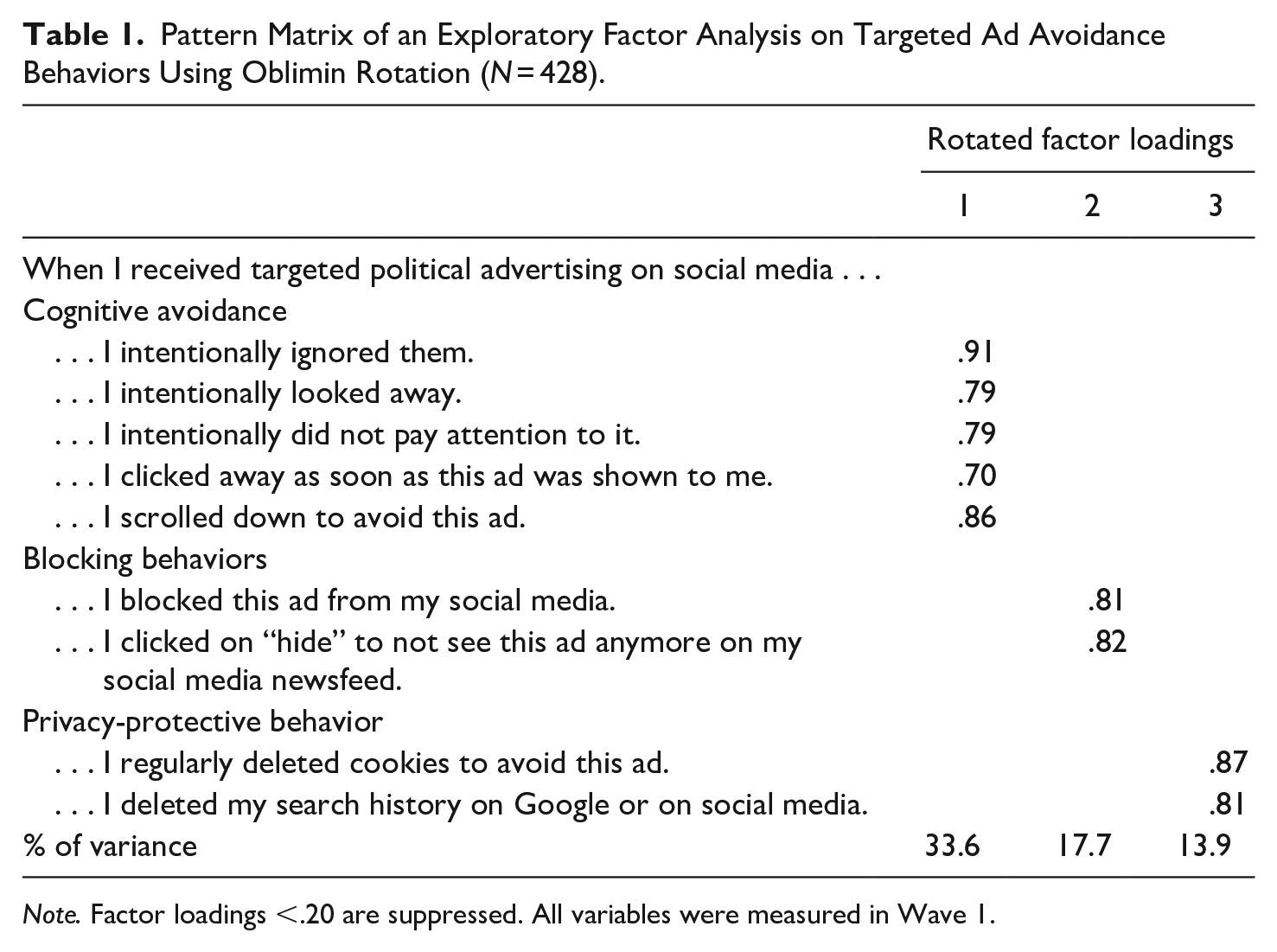
Note. Factor loadings <.20 are suppressed. All variables were measured in Wave 1.
Next, we tested for measurement invariance, which constitutes a precondition for examining change in a concept in longitudinal research (e.g., Taris, 2011). We compared the model fit between the configural model (Model 1), a model with constrained factor loadings (Model 2), and constrained intercepts (Model 3). There was no significant difference between Models 1 and 2, Δχ2(6) = 4.97, p = .547, and Models 2 and 3, Δχ2(6) = 4.05, p = .670.
Hypotheses Testing
The CFA of the measurement model met our criteria for good fit, χ2(341) = 493.38, p < .001, CFI = .98, TLI = .97, RMSEA=.03. Factor loadings range from λ = .74 to .93. The full structural model controlled for autoregressive effects of the dependent variable from Wave 1 in addition to the control variables listed in the method section. Model fit was overall acceptable, although the Tucker-Lewis Index missed the criteria by Byrne (2016) by a narrow margin, χ2(532) = 893.81, p < .001, CFI = .95, TLI = .94, RMSEA = .04. An overview of the effects and regression coefficients are provided in Figure 2 and Table B1 in Appendix B.
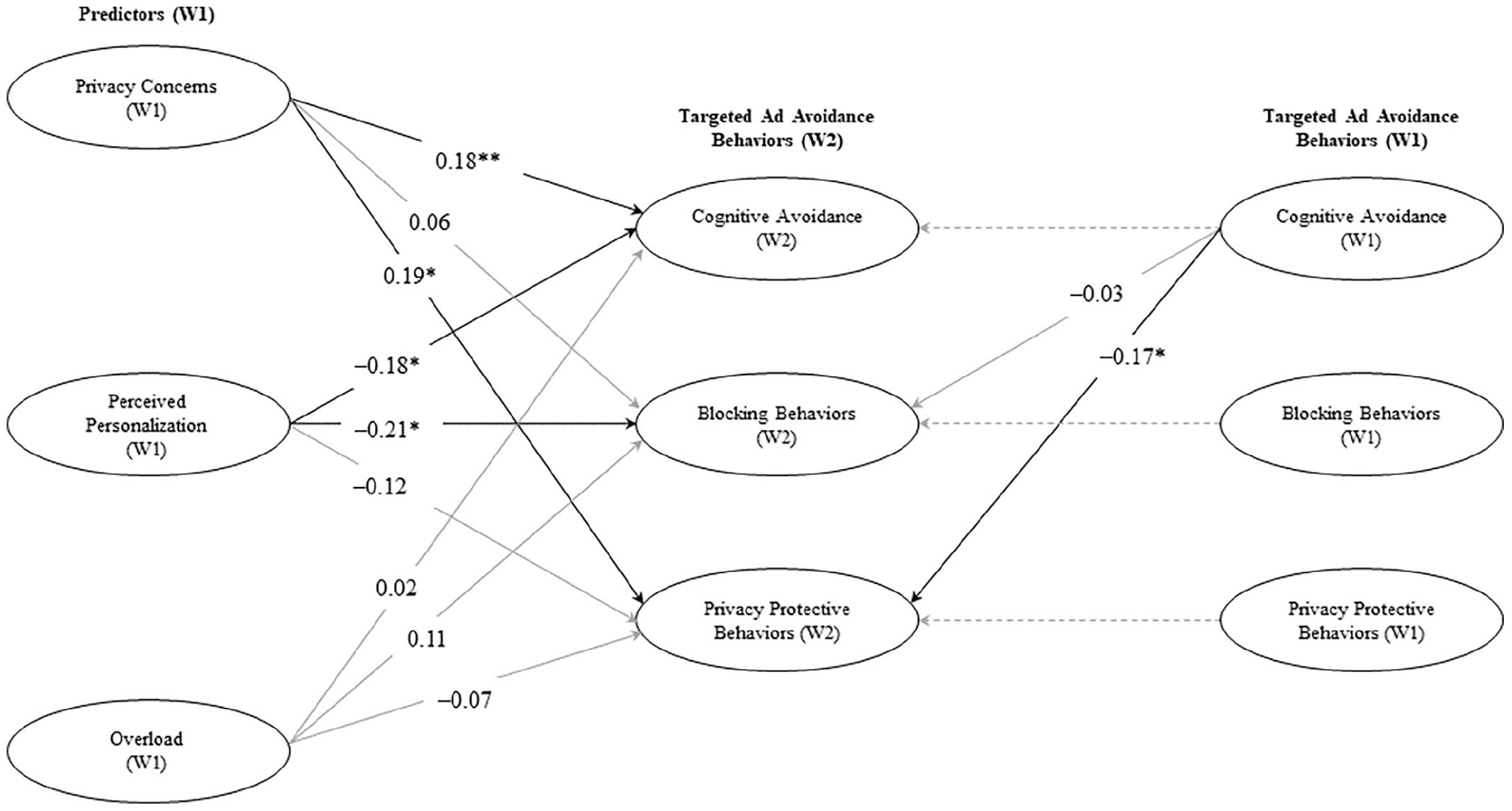
Model examining the relationships between privacy concerns, perceived personalization, and overload on different dimensions of targeted ad avoidance behaviors controlling for autoregressive effects.
First, we examined the effects of privacy concerns on cognitive avoidance (RQ1), blocking behaviors (H1a), and privacy-protective behaviors (H1b). Privacy concerns significantly predicted cognitive avoidance, b = 0.18, SE = 0.07, β = .16, p = .006, and privacy-protective behaviors, b = 0.19, SE = 0.07, β = .14, p = .010, but not blocking behaviors, b = 0.06, SE = 0.08, β = .05, p = .426. H1b is supported, while H1a is rejected.
With regard to the effects of perceived personalization, we found that H2a was supported: Perceived personalization negatively predicted cognitive avoidance over time, b = −0.18, SE = 0.07, β = −.16, p = .012. In support of H2b, we found a negative relationship between perceived personalization and blocking behaviors, b = −0.21, SE = 0.08, β = −.17, p = .011. Against our expectations (H2c), there was no significant relationship between perceived personalization and privacy-protective behaviors, b = −0.12, SE = 0.07, β = −.09, p = .088.
Next, we tested the effects of overload on the different dimensions of avoidance behaviors. We could not confirm a significant relationship between overload and cognitive avoidance (H3a), b = 0.02, SE = 0.06, β = .02, p = .705, or blocking behaviors (H3b), b = 0.11, SE = 0.09, β = .09, p = .202. Regarding RQ2, we also found no significant effects of overload on privacy-protective behaviors, b = −0.07, SE = 0.08, β = −.06, p = .331.
Lastly, we investigated the relationship between cognitive avoidance and blocking behaviors (H4a) as well as privacy-protective behaviors (H4b). We found no effect of cognitive avoidance on blocking behaviors over time, b = −0.03, SE = 0.09, β = −.03, p = .742. In line with our hypothesis, the relationship between cognitive avoidance and privacy-protective behaviors was supported, b = −0.17, SE = 0.07, β = −.16, p = .018. Investigating reciprocal relationships, post-hoc analyses indicate no significant effects of privacy-protective behaviors and blocking behaviors on cognitive avoidance (for full reporting, see Appendix B)
Discussion
This study investigated if targeted political ads actually reach citizens considering the rich avoidance repertoires they have at hand (Cho & Cheon, 2004; Speck & Elliott, 1997). Specifically, we developed a new conceptual framework that identified three distinct avoidance behaviors for the context of targeted political ads: ignoring advertising and scrolling past advertising as ways to withdraw attention (cognitive avoidance), hiding and blocking targeted political advertising (blocking behaviors), and preventing the use and collection of personal behavioral data (privacy-protective behaviors). We further theorized that individuals might resort to these practices in response to privacy concerns, perceived personalization, and overload with targeted political advertising. To test these hypotheses, we relied on data from a two-wave panel study in the context of the Viennese state election in October 2020.
Privacy concerns emerged as a significant driver of cognitive avoidance and privacy-protective behaviors over time. The more citizens voiced their concern in regard to data collection, the more they reported scrolling past and ignoring targeted political ads or deleting cookies and search histories in response to targeted political ads. For the first time, our findings could confirm that earlier studies on privacy concerns and avoidance from commercial contexts also apply to the realm of political campaigning (Dodoo & Wen, 2019; Ham, 2017).
Against our expectations, privacy concerns had no effect on individuals’ blocking behaviors over time. One possible explanation for this null-finding might be a general dislike of tailored content by privacy concerned citizens. Blocking behaviors lead to a curated newsfeed that is more adapted to individuals’ preferences and provides additional feedback to the selection algorithms (Sundar & Marathe, 2010). Consequently, blocking might not be the right response to mitigate privacy concerns. However, this assumption implies that privacy concerned citizens understand the effects of blocking on the future selection of content. Future studies could test if privacy knowledge acts as a moderator of this relationship since knowledge and concern in concert might actually reduce blocking behaviors.
Perceived personalization, in contrast, partly attenuated targeted ad avoidance behaviors. When targeted political ads matched citizens’ preferences, they reported less cognitive avoidance and blocking behaviors. This might be due to the increased relevance of ads, which leads to greater attention (Baek & Morimoto, 2012; Jung, 2017). In addition, perceived personalization might also reduce the amount of irrelevant content in individuals’ newsfeeds, which makes further customization of the content obsolete. Interestingly, our findings did not support a relationship between perceived personalization and privacy-protective behaviors. Privacy-protective behaviors might not primarily result from receiving targeted political advertising, but are driven by a number of factors (Boerman et al., 2021). Receiving more relevant political ads might not sufficiently motivate citizens to drop their guard against other forms of targeting, such as the use of their data for commercial purposes.
Going beyond prior research, this study also investigated individuals’ overload with targeted political advertising. Inconsistent with studies on news avoidance (see, e.g., Skovsgaard & Andersen, 2020), the results showed that overload did not increase targeted ad avoidance behaviors across all dimensions. However, we do not completely dismiss the possibility that overload contributes to targeted ad avoidance behaviors because these null-findings might have several reasons. First, we measured overload 6 weeks prior to the election, at a time when the campaign online and offline had not yet reached its peak. Therefore, the results might change when testing our hypotheses in the hot phase of campaigning, when overload is most likely to occur. In addition, we specifically measured overload by targeted political advertising. Supposedly, this measure might be too limited to give insights into the full scope of overload. Citizens might not feel that there is too much targeted political advertising to cope with. Instead, they might be overwhelmed with the overall amount of political content, including news and offline campaigns. Thus, while our findings tentatively suggest that overload is not a driving factor of avoidance, future studies should revisit this hypothesis.
Furthermore, our results cast new light on how different types of targeted ad avoidance behaviors interact. We could not confirm that cognitive avoidance reduces blocking behaviors over time. Consequently, it is possible that individuals frequently block content by parties that don’t match their political ideology and simultaneously also encounter irrelevant political targeted advertising, which they simply ignore. Thus, depending on the content and context in question, individuals might switch between both behaviors. Regarding the relationship between cognitive avoidance and privacy-protective behaviors, our results suggest that the act of ignoring and scrolling away from content leads to less privacy-protective behaviors over time. Thus, a momentary, low-effort strategy can reduce individuals’ preventive efforts to protect themselves from the use of their data (Santoso et al., 2020).
Lastly, it is notable that targeted ad avoidance behaviors were not applied equally frequently in our sample. As can be seen from our descriptive statistics, cognitive avoidance was by far the most prevalent type of avoidance, while blocking behaviors and privacy-protective behaviors were employed to a much smaller extent. This mirrors earlier findings from the privacy protection literature, which suggest that only a small number of online users engage in privacy-protective behaviors (Boerman et al., 2021; Smit et al., 2014).
Theoretical Implications
In the current study, we built on Cho and Cheon’s (2004) concepts of cognitive and behavioral avoidance. We extended the understanding of behavioral avoidance by investigating two different types—blocking behaviors and privacy-protective behaviors. We conceptualized that those are distinct behaviors that differ in the extent to which they fulfill a preventive and reactive function and in the intensity of behavioral effort that is required to perform the behavior (see also Tang et al., 2015). This distinction highlights that citizens might not only avoid advertising per se, but might also try to avoid specific sources (by blocking) or content features such as narrow targeting (through reducing the amount of available data using privacy-protective behaviors). The latter might be especially important for types of information that are considered sensitive, such as minority status or political affiliation (Kozyreva et al., 2021). Further research could test if targeted ad avoidance in the form of privacy-protective behaviors is especially prevalent in more sensitive contexts, contrasting political and commercial usages.
Moreover, for the first time, we shed light on how engaging in one type of targeted ad avoidance behavior might affect individuals’ use of other strategies over time. Theoretically, this could indicate that low-effort behaviors such as cognitive avoidance already fulfill the psychological motivations that drive avoidance. When the goal is to avoid negative cognitions and feelings that stem from targeted political advertising, cognitive avoidance might serve as a sufficient coping tool (Krohne et al., 2002; Sweeny et al., 2010). In addition, it might need especially high levels of motivation to overcome inertia and induce more effortful behaviors (Brehm et al., 1983). Since this was only a first test, additional studies are needed to corroborate these assumptions. Future studies could further test the role of different motivations and their strength in predicting high-effort avoidance behaviors. Furthermore, self-efficacy and skills could moderate these effects. Methodologically, our panel study allows insights into the dynamics of targeted ad avoidance over time and in a real-life campaigning context and therefore complements current experimental and cross-sectional evidence.
Practical Implications
The results of this longitudinal study imply that political campaigners should be aware of the possible positive but also negative effects of targeted political ads. While higher perceived personalization can lead to less targeted ad avoidance, privacy concerns can harm the effectiveness of political campaigning by increasing targeted ad avoidance. Therefore, from the sender’s side, it seems important to decrease the perceived concerns toward targeted ads to increase the effectiveness of the message. As one possibility, platforms and advertisers could be more transparent about which data is collected and accessed (Ham, 2017). Reactance, and more specifically, targeted ad avoidance occurs when people have the feeling that their freedom of choice is threatened (Brehm, 1966). Thus, empowering users by providing them with information regarding their data might be one effective way of reducing privacy concerns. Another avenue might be that political campaigners should refrain from using data that is perceived as highly sensitive to avoid potential backlash from inducing privacy concerns.
Limitations
This study is not without limitations. First of all, we did not take the actual content of the targeted political ads into account. Since we relied on self-reported data and perceptual measures, it might be possible that some targeted ads may stick more in users’ minds and thus, can be easier recalled than others. Thus, with this study we are not able to generalize our results to all possible targeted political ads. To allow for this generalization, it would be necessary to conduct a systematic content analysis during the time frame of the panel study. Furthermore, experimental studies might provide greater insights into how users react to specific ads. Also, the measures used in this study come with limitations because they might have led to perceptual bias. However, former studies showed that when investigating the effects of targeted ads perceived targeting rather than actual targeting can drive effects (Li, 2016). Nevertheless, a validation of the results of this study with non-perceptual measures is highly warranted.
Second, in our study, we tried to take various possible avoidance behaviors into account. However, due to constant technological developments there are even more possible avoidance behaviors that users could employ. Therefore, we can only draw conclusions for the specific avoidance behaviors measured in this study. Third, our study was conducted in the context of a federal state election in Vienna. We therefore need to replicate our findings in the context of national elections and in other countries. Finally, despite the strengths of performing autoregressive panel analyses, our study included only two waves. Thus, we are not able to estimate change processes over different phases of the campaign.
Conclusion
This study highlights the role of citizens’ avoidance repertoires as a defense mechanism against targeted political advertising. A sizeable share of targeted political ads might be ignored, others blocked or hidden. Other ads might never reach their intended target, because citizens protect themselves against the collection of their online data. The greatest share of citizens in our sample resorts to simple cognitive avoidance, allowing for a low-effort form of resistance to targeted political ads – as the Beatles sing in their song Strawberry Fields: “living is easy with eyes closed.” While privacy concerns can intensify avoidance behaviors in some cases, successfully tailored ads might mitigate some forms of targeted ad avoidance. Our findings also point to a worrying trend of ignorance: The more individuals turn a blind eye on targeted political ads through cognitive avoidance, the less they engage in more sustainable and effective ways to prevent the collection and use of their data.
Supplemental Material
sj-docx-1-crx-10.1177_00936502221130840 – Supplemental material for Living is Easy With Eyes Closed: Avoidance of Targeted Political Advertising in Response to Privacy Concerns, Perceived Personalization, and Overload
Supplemental material, sj-docx-1-crx-10.1177_00936502221130840 for Living is Easy With Eyes Closed: Avoidance of Targeted Political Advertising in Response to Privacy Concerns, Perceived Personalization, and Overload by Marlis Stubenvoll, Alice Binder, Selina Noetzel, Melanie Hirsch and Jörg Matthes in Communication Research
Footnotes
Declaration of Conflicting Interests
The authors declared no potential conflicts of interest with respect to the research, authorship, and/or publication of this article.
Funding
The authors received no financial support for the research, authorship, and/or publication of this article.

Supplemental Material
Supplemental material for this article is available online.
Author Biographies
References
Supplementary Material
Please find the following supplemental material available below.
For Open Access articles published under a Creative Commons License, all supplemental material carries the same license as the article it is associated with.
For non-Open Access articles published, all supplemental material carries a non-exclusive license, and permission requests for re-use of supplemental material or any part of supplemental material shall be sent directly to the copyright owner as specified in the copyright notice associated with the article.
