




Abstract
This study moves beyond previous research by demonstrating how prior exposure to stereotypical content can reinforce the selection of comparable biased news content and by clarifying its intergroup and interpersonal consequences. With two experiments (N = 236, N = 270), we show that media effects and selectivity of biased media content about Arabic migrant workers are connected by automatic (i.e., implicit) stereotypes. The findings reveal that exposure to moderate doses of stereotypic news primes affects the selection of biased news via implicit stereotypes and subsequently shifts intergroup and interpersonal outcomes in the direction of the activated biased beliefs. These effects did not surface for high doses of stereotypic news primes, suggesting that individuals resist and inhibit activation processes when exposure is perceived to be too extreme. As subtle forms of bias are omnipresent in news environments and implicit stereotypes operate partly under the radar of conscious awareness, they may affect selection without individuals being aware of it. The findings imply that audiences’ biased selectivity should not be seen in isolation from prior media exposure.
Stereotypes and prejudiced beliefs can be significant barriers to the social, political, and economic opportunities available to underserved groups, such as racial/ethnic minorities. For decades, research has demonstrated that mass media can create and reinforce these views through the repeated dissemination of one-sided, stereotyped portrayals of social groups (e.g., Mastro, 2009; Saleem et al., 2016). Yet, evidence also indicates that media can function to alleviate bias. Studies applying insights from a variety of theoretical perspectives have highlighted the positive role that media may serve in improving intergroup dynamics (e.g., Park, 2012; Wojcieszak & Azrout, 2016). Of course, to achieve these positive outcomes, audiences must be exposed to auspicious media depictions of outgroup members (Mastro & Tukachinsky, 2011; Schieferdecker & Wessler, 2017). For this to occur, not only must such representations exist for consumption, but audiences must also select them. What this implies is that audience members’ specific media choices, whether or not consciously, may serve to help or hurt outgroup bias.
Accordingly, critical questions remain in the literature regarding the relationship between stereotypical media depictions of underserved groups, audience members’ media selection preferences, and the consequences of exposure to such stereotypic content. Given that individuals tend to choose media content that supports group identity (e.g., Appiah et al., 2013; Harwood, 1999) and that stereotypical media messages activate outgroup bias which may also serve to bolster identity (e.g., Arendt, 2015), this study argues that the effects of media stereotypes are inherently linked to selectivity via automatic (i.e., implicit) stereotypical beliefs.
This study is set out to investigate the mediating role of implicit stereotypes in the interplay between media exposure and selection of biased news messages. To this end, a comprehensive conceptual model of media effects processes and content selection is tested in the contexts of news coverage of Arabic migrant workers in the Netherlands, a group whose employment opportunities are hampered by negative stereotypes and discrimination. By simultaneously modeling media selection and effects processes, this research brings clarity to both the antecedents and consequences of exposure to stereotypical media content. In so doing, the proposed model extends prior scholarship in two important ways. First, this study builds on insights from social cognition research, which indicates that (news) selection processes are not merely the outcome of controlled, evaluative judgments, but also originate from unconscious, media-induced evaluations (Arendt et al., 2016; Galdi et al., 2012; Peters & Gawronski, 2011). As such, this research offers novel insights into the antecedents of biased media selections. Second, the model clarifies the consequences of biased selectivity for interracial/ethnic dynamics in society at the intergroup and interpersonal levels. Herewith, this study sheds light on previously unspecified links between biased selectivity and actual inclusion-related outcomes while additionally pinpointing reasons why negative effects of biased news may or may not materialize. Theoretical insights and empirical evidence from the media stereotyping literature, selective exposure scholarship, as well as BIAS map (i.e., behaviors from interpersonal affect and stereotypes) and stereotype content model (SCM) research (Cuddy et al., 2008; Fiske et al., 2002) guide this work.
Implicit Stereotype Activation by the Media
Associations between outgroup members and stereotypical traits in individuals’ memory can become activated on explicit and implicit levels. Explicit stereotypes can be defined as beliefs that are consciously recognized by individuals and, therefore, can be readily communicated or withheld (Dovidio et al., 2002). Implicit stereotypes refer to non-conscious beliefs that are not apparent to the individual and are typically subtle, reflexive, and less controllable (e.g., Greenwald & Banaji, 1995). Explicit and implicit stereotypes can vary strikingly. Perhaps the most important distinction between the two is that implicit beliefs may exert effects on media selection and intergroup judgments even when individuals believe they are not prejudiced (Dovidio & Gaertner, 2000).
Empirical evidence supports the assertion that exposure to media stereotypes influences conscious beliefs about and the treatment of diverse groups in society (Mastro, 2009). Across numerous contexts, studies have shown that biased media content can prompt overt, explicit stereotype-based responses consistent with the traditional cognitive stereotypes associated with specific groups as well as those tied to the underlying trait dimensions associated with stereotypes more broadly conceptualized (i.e., warmth and competence; Fiske et al., 2002; Seate & Mastro, 2016; Sink et al., 2018). Far less evidence exists regarding the media’s ability to activate implicit stereotypes. Given that “participants often feel obligated to report that they are much less prejudiced than what they are” (Ramasubramanian, 2011, p. 15), researchers have long stressed the importance of considering implicit stereotypes in these contexts (Devine, 1989; see also Jones & Sigall, 1971). Indeed, studies that have incorporated implicit measures generally corroborate the claim that (even subtle) stereotypical media depictions prime or activate implicit stereotypes (e.g., Weisbuch et al., 2009).
Furthermore, research examining the effects of news primes on the activation of stereotypes demonstrates “dose-dependent effects” such that a curvilinear relationship appears to exist between exposure frequency and explicit stereotypes whereas a monotonic relationship best describes the relationship between exposure and implicit stereotype activation (Arendt, 2013, 2015). In other words, the effect of media priming on explicit stereotype activation seems to deteriorate at high frequency levels, with no such decay emerging for implicit priming. Arendt (2013, p. 843) stresses the significance of this relationship, stating, “[o]nly by using implicit measures of stereotypes were we able to find such otherwise hidden media effects.” Of course this does not negate the well-documented ability of even a single media exposure to prompt overt and explicit forms of bias; however, it reveals that there may be exposure thresholds, boundary conditions, and social desirability pressures in the context of explicit stereotype activation that do not exist for implicit bias (Arendt, 2013).
Accordingly, recognizing implicit stereotypes in this context is critical as they appear to better predict both prejudice and discrimination as well as affective responses to outgroup members, than explicit views (Nosek et al., 2007). Once implicit stereotypes have become activated (by the media or other external cues), they have the potential to affect the future selection of media messages that validate activated biased beliefs. Hence, implicit stereotypes could be important factors driving biased selectivity.
Implicit Antecedents of Biased Selectivity
Although predispositions toward different social groups and the selection of stereotypical media messages are likely interrelated facets of media usage patterns pertaining to intergroup bias, they are rarely studied together (cf. Schemer, 2012). Instead, much of the previous research has focused on the selection of ingroup-rich content, driven by group membership and group identification (e.g., Knobloch-Westerwick & Hastall, 2010; Schieferdecker & Wessler, 2017). Largely missing are studies that take into account prior media exposure and other psychological predictors of preferences for media content. Moreover, the implications of biased selectivity for intergroup (e.g., racial prejudice) and interpersonal outcomes (e.g., individual-level discrimination) are generally overlooked.
Understanding the mechanisms driving the selection of media is particularly urgent when considering that audiences can now, more than ever, curate an environment in-line with their biased preconceptions, altogether eliminating exposure to diverse or alternate perspectives. Defined as “systematic bias in selected messages that diverge from the composition of accessible messages” (Knobloch-Westerwick, 2015, p. 6), selective exposure addresses the factors that predict the crafting of audiences’ media diets. One of the central tenets of selective exposure is that consumers may choose messages that resonate with prior attitudes. Ample evidence has accumulated supporting the assertion that citizens tend to prefer messages that reflect attitudinal predispositions (Knobloch-Westerwick, 2015). These findings pertain mainly to the selection of media content that is consistent with views toward attitude objects (e.g., political issues, policy changes) rather than toward stereotyped groups (e.g., immigrants), as “comparatively little research has examined how predispositions related to social groups affect media choices” (Knobloch-Westerwick & Hastall, 2010, p. 516).
However, evidence from research applying social identity and social cognitive approaches find that group membership, ingroup identification, and self-esteem can predict the selection of biased media content (e.g., Knobloch-Westerwick et al., 2008). Accordingly, this scholarship supports the notion that self-consistency motives (i.e., seeking out content reinforcing prior beliefs), social identity motives (i.e., seeking out content that offers representations of valued ingroups), and self-enhancement motives (i.e., seeking out content to downwardly compare to feel better about oneself) have the potential to prompt the selection of stereotypical media messages (Luong & Knobloch-Westerwick, 2017).
To illustrate, Schemer’s (2012) work on reinforcing spirals reveals that group-based identity needs are tied to exposure to content which validates biased views about outgroups. Schemer finds that attention to biased political ads about minorities not only enhances attention to comparable messages in the future but also induces anti-minority sentiment. This selection-based finding is consistent with work from Arendt and colleagues (2016), which reveals that audience members’ attitudes predict selection of news about political issues. In this, and related research, selection of news content is found not only to operate as a function of explicit, controlled processes but also to emerge based on implicit, unconscious mechanisms, with implicit stereotypes possibly exerting an even stronger influence than explicit views due to the incidental, associative nature of implicit bias (e.g., Appiah et al., 2013; Arendt et al., 2016). Given this, the relationship between selection and reinforcement can be better understood if the trait dimensions of stereotypes—known to prescribe distinct group-based emotions and behaviors—are considered. Scholarship based on the SCM and the BIAS map inform this issue (Cuddy et al., 2008; Fiske et al., 2002).
Trait Dimensions of Stereotypes: The Case of Arabic Migrant Workers
According to SCM (Fiske et al., 2002) and the BIAS map (Cuddy et al., 2008), stereotypes are captured by two underlying dimensions: warmth and competence. Specifically, outgroups that do not pose a threat (e.g., cooperative groups) are judged as warm (e.g., reliable, trustworthy, friendly) and moral (e.g., sincere, tolerant, understanding), whereas outgroups that elicit fear or pose a threat (e.g., competitive groups) are believed to lack warmth (e.g., unreliable, untrustworthy) (Wojciszke et al., 1998). Hence, low-warmth stereotypes are rooted in competitiveness (Cuddy et al., 2008). At the same time, groups considered as high status are seen as competent (e.g., productive, efficient) whereas groups viewed as low status are judged as incompetent (e.g., not clever, not knowledgeable). Thus, competence stereotypes are rooted in status (Cuddy et al., 2008).
The positioning of groups along the array of warmth and competence dimensions is not inconsequential. As research reveals, the extent to which groups are defined by these dimensions predicts the emotions that are experienced in relation to the groups, ultimately governing judgments about and behaviors toward them in society (e.g., Cuddy et al., 2008). When considering stereotypes associated with Arabic migrant workers in the Dutch labor market, a potentially detrimental environment is revealed. Owing in part to the perceived low status and threat posed by this group to the economic systems and resources of host-countries, Arabic migrant workers across Europe are deemed unreliable, violent, dishonest, and criminal (e.g., Kamans et al., 2009). These characterizations are reiterated in media coverage of this group, both in European and U.S. contexts (Ahmed & Matthes, 2017; Midberry, 2017). This appraisal squarely situates Arabic migrant workers in the low-warmth, low-competence quadrant of the BIAS map (see Fiske et al., 2002, p. 104).
Although a group’s embodiment of both warmth and competence offer important predictive insights into the differentiated bias that may emerge in intergroup contexts, this study focuses on warmth for the following reasons. Primarily, individuals infer warmth significantly faster than competence, with an overall larger effect on attitudes (Cuddy et al., 2011). In addition, perceptions of high-threat or competitiveness—which foster low-warmth stereotypes (Cuddy et al., 2008)—are especially important in explaining labor market outcomes (Kunovich, 2013). Thus, the low-warmth standing of Arab migrant workers is particularly significant.
A number of individual, social, and institutional factors contribute to the formation of these group-based perceptions, with media use known to be one such influence (see Mastro, 2009). Notably, research demonstrates that media exposure is not only implicated in the development of traditional stereotype-based conceptualizations of diverse groups, but it can also shape perceptions of these groups’ ratings on the SCM and BIAS map dimensions of warmth and competence (Sink et al., 2018). Accordingly, the consistent framing of Arab migrant workers in the news in a manner that situates them as a low-warmth (and low competence) group has the potential to satisfy a variety of selection-based motives for dominant group viewers ranging from social identity needs to self-enhancement needs to belief-consistency needs (e.g., Luong & Knobloch-Westerwick, 2017).
Implicit Components of Media Selection and Effects: This Study
In aggregate, the research detailed above suggests that implicit stereotypes induced (i.e., primed) by news exposure will impact on the selection of news content along three distinct domains. Grounded in BIAS map and SCM research (Cuddy et al., 2008; Fiske et al., 2002), these domains include (a) cognitive (stereotypes), (b) affective (emotional prejudice), and (c) behavioral (discrimination) bias. Although these forms of bias have typically been used to predict responses to outgroups in society, they also serve as a meaningful categorization scheme for delineating bias in media content.
When applying this conceptualization of bias, it is clear that cognitive, affective, and behavioral components all are represented in media characterizations of Arabic migrants. First, the tendency to portray this group as untrustworthy and violent in the media (e.g., Ahmed & Matthes, 2017) reflects low-warmth features, which can be understood in terms of cognitive or stereotype-based bias. Second, the tendency to frame immigrants as a threat to the cultural and economic status quo is consistent with the affective components of bias discussed within SCM and BIAS map research. Finally, the instructive and prescriptive nature of media messages (news media, in particular) offers action-based directives (e.g., close borders, increase penalties for immigrants) that align with the behavioral components of bias defined in these frameworks.
By incorporating the insights offered in the domains of media stereotyping and selective exposure, we anticipate that implicit stereotypes are important in explaining the relationship between media exposure and the selection of news messages containing cognitive, affective, and behavioral components of bias—but not neutral news about outgroup (vs. ingroup) members (see Figure 1). Thus, informed by previous research that argues that implicit stereotyping might be amplified as a function of the level of exposure (Arendt, 2013, 2015), we investigate this relationship for moderate levels and high levels of stereotypical news primes. We formulate:
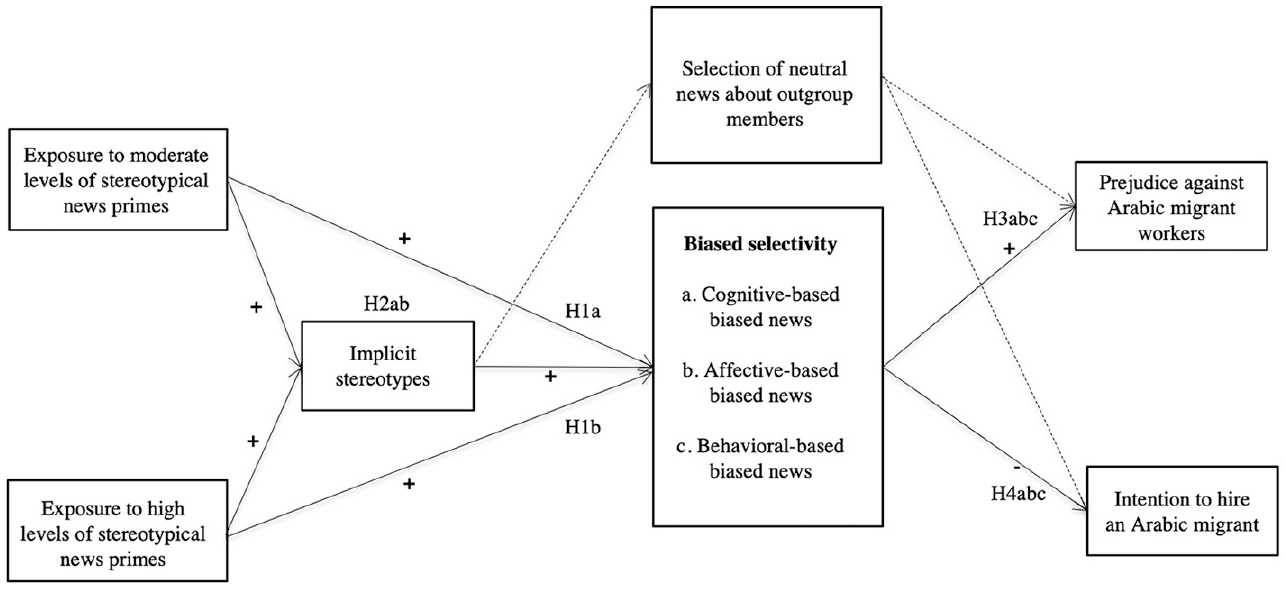
Conceptual overview of the study.
Intergroup and Interpersonal Consequences of Biased Selectivity
The types of media bias distinguished in this study would be expected to work in synchrony with one another in affecting both intergroup and interpersonal behaviors. In other words, implicit media stereotypes alongside the cognitive, affective, and behavioral components of appraisals may work together to distinctly predict interpersonal and group-based dynamics in society. Given the importance of determining the trait dimensions along which outgroup members are defined, mediated cues that characterize immigrants in terms of specific qualities are meaningful in understanding the consequences of outgroup bias and interpersonal behaviors. Recent evidence supports this notion; Seate and Mastro (2017) show that exposure to immigration threat in the news increases active and passive harming behaviors through feelings of contempt. The authors conclude that a predictable pattern of behaviors, consistent with SCM and BIAS map research, emerges when media exposure cues the relationship between group traits and associated feelings regarding the warmth and competence of outgroup members.
Importantly, these effects do not occur in isolation. Instead, they originate in part from selective exposure to biased media messages. Recent evidence suggests that self-selected mediated exposure to outgroup members decreases negative outgroup sentiment (Wojcieszak & Azrout, 2016), but only if this content is positive. By the same logic, if citizens self-select into negative biased content, negative effects can be anticipated (Schieferdecker & Wessler, 2017). Self-consistency motives might also play a role here: Individuals might align their outgroup perceptions with the news choices they made (Heider, 1958). Therefore, it is anticipated that the selection of news content depicting Arabic migrants in terms of low-warmth traits (i.e., cognitive bias), high threat (i.e., affective bias), and with displays of discriminatory behaviors (i.e., behavioral bias) will elicit intergroup bias and harming behavior on the interpersonal level. Considering the case of the labor market integration of Arabic migrant workers, we focus on prejudice regarding this group as a proxy for intergroup outcomes, and individuals’ likelihood to hire an Arabic migrant as a proxy for interpersonal discriminatory outcomes. We expect:
Method
Sample Study 1
The consequences of exposure to biased news for the employment outcomes of Arabic migrant workers are arguably most consequential to members of the labor force—who make daily decisions regarding whom to work for and with, and whom to hire or fire. The hypotheses are therefore tested among a sample of members of the Dutch labor force with a non-migration background recruited by Survey Sampling International (SSI) between December 12 and 18, 2017. Quotas were set for age and gender, to ensure representativeness within the Dutch labor force regarding these characteristics. To ensure that participants carefully read the instructions and stimuli, they were exposed to three attention checks. With a completion rate of 57%, 252 participants passed the three attention checks and consequently attentively completed the experiment. Sixteen participants were removed because they indicated that they and/or their parents are immigrants, or because they did not meet the quota criteria, making the final sample size N = 236 (50.8% female). Participants were between 19 and 65 years of age (M = 45.48, SD = 13.79). In total, 86.9% (n = 205) of the sample completed at least secondary vocational education. Most participants (78.8%, n = 186) worked at least 20 hours per week. Across participants, 38.9% worked in the public sector, 39.4% worked in the private sector, and 16.5% worked at a public-private sector organization. Almost a quarter (24.1%) of the participants held a managerial position. About half of the participants (47.5%) indicated having less than a single contact with Arabic migrants per week.
Sample Study 2
Between February 18 and 25, 2019, a second sample was recruited by the same panel company. Of the 506 participants that completed the survey, 16.4% (n = 83) was removed due to incorrect answers on the two attention checks. In addition, 153 participants were removed as they did not comply with pre-defined inclusion criteria (51 participants did not consider themselves to be Dutch, 102 participants were not employed). This makes the final sample size 270 (mean age = 38.49, SD = 14.33). Participants were generally highly educated (51% completed at least secondary vocational education). The majority of participants (64.1%, n = 173) worked between 20 and 40 hours per week. 23.3% (n = 63) participants held a managerial position, and roughly 48.14% (n = 130) worked for a public sector organization. On average, participants had little contact with Arabic migrant workers (64.1% encountered Arabic migrant workers less than a single time per week).
Design and Procedure
A between-subjects design (four vs. two vs. control media stereotype primes) was used to investigate the antecedents and consequences of biased selectivity in an online experiment using Qualtrics software. After complying with informed consent, the participants were randomly assigned to one of the conditions. Participants in the stereotype-prime conditions were exposed to the stimulus material, afterward they were directed to an external online environment to conduct the Implicit Association Test (IAT). The participants in the control condition proceeded immediately to the IAT. After completing the IAT, participants were redirected to the Qualtrics environment. Subsequently, participants were exposed to multiple choice trials to measure biased selectivity on several dimensions. Then, participants responded to items measuring the outcome variables, control variables, and demographic measures. A between-subjects randomization check confirmed that the experimental conditions in both Study 1 and Study 2 did not differ regarding the following variables: age, gender, education, contact with Arabic migrant workers, and internal motivation to avoid stereotyping.
Stimuli materials
To increase the external validity of the experiment, the news articles and news headlines used for the experimental stimuli and news selection variables were derived from existing news articles about Arabic workers that appeared in Dutch newspapers in the past 10 years. LexisNexis and popular Dutch online news websites were searched to identify news articles and headlines about Arabic migrant workers. Appropriate articles and news headlines were occasionally modified for the purpose of the study and their content elements were categorized according to our typology of media bias (i.e., cognitive, affective, and behavioral bias). The news articles and news headlines were tested during two pilot tests among undergraduate students in Communication Science and Psychology at a large university in the Netherlands (Pilot 1; N = 84, Pilot 2: N = 50). The results, presented in Table A1, Online Appendix A, substantiate the manipulation of both the stimulus material (i.e., media stereotype prime articles) and the selective exposure measures (i.e., news headlines).
Measures
Independent variables: Stereotypical news prime levels: Control, moderate, high
Participants were exposed to moderate doses of news stereotypes (two stereotypical news articles, Study 1: n = 80, Study 2: n = 79) or high doses of news stereotypes (four stereotypical news articles, Study 1: n = 73, Study 2: n = 94). Participants in the control condition were not exposed to news media content (Study 1: n = 83, Study 2: n = 97). In the exposure conditions, participants were asked to carefully read news articles that portrayed Arabic migrant workers in a stereotypical manner. The news articles highlighted low-warmth characteristics of Arabic migrant workers, portraying them in terms of untrustworthiness, unreliability, hostility, and criminality. For example, the news articles highlighted difficulties that employers experience regarding the socialization of Arabic migrant workers in the workplace and depicted Arabic migrant workers as “difficult to handle,” “aggressive,” and “not adjusted to Dutch social standards of the workplace.” Online Appendix B includes an overview of the stimulus materials.
Implicit stereotypes of Arabic migrant workers
For the purpose of this study, an IAT (Greenwald et al., 2003) was developed to measure the association between two target categories (“Arabic migrant workers” and “Native Dutch workers”) and two attribute categories (“Cold” and “Warm”). Visual stimuli were used for the target categories. The validated Radboud Faces Database (RaFD) was used to select pictures of neutral faces of four Caucasian male adults and four Arabic (Moroccan) male adults (Langner et al., 2010). Verbal stimuli were used for the attribute categories based on the theoretical dimensions of warmth stereotypes (Fiske et al., 2002). The stimulus items for high-warmth characteristics were trustworthy, sincere, tolerant, warm, and good-natured. The stimulus items for low-warmth characteristics were untrustworthy, unreliable, hostile, cold, and frigid. The D2SD scoring algorithm was used to compute respondents’ implicit scores (Greenwald et al., 2003), as this algorithm return slightly higher split-half results (0.62) compared to the D600 scoring algorithm (0.61). Higher scores indicate a stronger implicit association between Arabic migrant workers (vs. Dutch native workers) and low-warmth characteristics (vs. high-warmth characteristics) (Study 1: M = 0.47, SD = 0.46; Study 2: M = 0.43, SD = 0.44).
Selective exposure measures
Participants were exposed to 20 choice trials. In each trial, participants were exposed to two headlines and asked to select the one they would most likely choose to read when they came across it in their everyday life (following Arendt et al., 2016; Galdi et al., 2012). Both the order of the trials and the order of the pairs of headlines were randomized. The first target selection task consisted of neutral news regarding outgroup (vs. ingroup) members. Consistent with this study’s typology of media bias, the other target selection tasks consisted of cognitive, affective, and behavioral-based media bias. The target task including neutral news about outgroup (vs. ingroup) members was included to ensure that selection effects of biased news content were not due to mere exposure to news about outgroup members, but rather a consequence of specific biased content characteristics. All headlines can be found in Online Appendix B.
Selection of neutral news about outgroup (vs. ingroup) members
Participants were asked to select between a news headline about outgroup members (i.e., Arabic migrant workers) (1) or ingroup members (i.e., Dutch native workers) (0) during this target task. The headlines were neutral in tone (see Table A1, Online Appendix A) and covered comparable topics in each trial. For example, participants were presented with headlines about trade unions for both the outgroup (“Arab migrant workers’ rights topic of debate at trade union”) and the ingroup (“Trade union discusses labor rights of native Dutch workers”). In five choice trials, participants had to decide between news headlines about outgroup versus ingroup members. Internal consistency analysis suggested removing one choice trial to improve reliability (Study 1: Cronbach’s α = .60, Study 2: Cronbach’s α = .40). The mean value of choice decisions was computed (Sum of the choice decision/N of choice trials). Higher values indicate a greater tendency to select headlines discussing outgroup members (relative to the ingroup members) (Study 1: M = 0.35, SD = 0.31; Study 2: M = 0.39, SD = 0.25).
Selection of cognitive-based biased news
In this target category, headlines were manipulated regarding the presence or absence of cognitive-based bias. In five choice trials, participants were asked to decide between a news headline containing negative stereotypes about Arabic migrant workers’ low-warmth traits (e.g., “Criminality common problem among Arab migrant workers”) (1) and a news headline containing positive stereotypes about Arabic migrant workers’ high-warmth traits (e.g., “Arab migrant workers appreciated for their reliability”) (0). Low-warmth traits consisted of: unreliability, a lack of morality and social skills. Two choice trials had to be removed to improve internal consistency (Study 1: Cronbach’s α = .71; Study 2: Cronbach’s α = .64). The mean score of choice decisions was computed (Study 1: M = 0.52, SD = 0.40; Study 2: M = 0.56, SD = 0.38). Higher values indicate a greater tendency to select headlines discussing negative stereotypes about Arabic migrant workers’ low-warmth characteristics (relative to positive stereotypes about Arabic migrant workers’ high-warmth characteristics).
Selection of affective-based biased news
In this target category, headlines were manipulated regarding the presence or absence of affective-based bias. In five choice trials, participants were asked to decide between a threatening (e.g., “Labor market crowding due to Arab migrant workers”) and non-threatening (e.g., “Arab migrant workers stimulate employment”) news headline. The five choice trials formed a reliable scale (Study 1: Cronbach’s α = .85; Study 2: Cronbach’s α = .76). The mean score of choice decisions was computed (Study 1: M = 0.45, SD = 0.39; Study 2: M = 0.46, SD = 0.37). Higher values indicate a greater tendency to select headlines highlighting threats to the economy posed by Arabic migrant workers (relative to headlines that do not discuss economic threats).
Selection of behavioral-based biased news
This target category comprised headlines with or without behavioral-based bias. In five choice trials, participants were asked to decide between a headline highlighting harmful (e.g., “Plans presented in the parliament to expel Arab labor migrants”) and or helpful (e.g., “The government intends to welcome more Arab labor migrants”) behavioral intentions. The reliability of the five choice trials is acceptable (Study 1: Cronbach’s α = .71; Study 2: Cronbach’s α = .79). The mean score of choice decisions was computed (Study 1: M = 0.41, SD = 0.32; Study 2: M = 0.42, SD = 0.34). Higher values indicate a greater tendency to select headlines highlighting harmful behavioral intentions (relative to helpful behavioral intentions).
Intergroup outcomes: Prejudice against Arabic migrant workers
As an indicator of intergroup outcomes, an adapted version of the “Anti-Immigrant Prejudice” scale was used (Pehrson et al., 2009). Five items tapping into negative perceptions of Arabic migrant workers were used (example item: “Arabic migrant workers are generally good for the Dutch economy” [reverse coded]). One item was removed due to problematic factor loadings. Internal validity of the items is good (Study 1: Cronbach’s α = .86; Study 2: Cronbach’s α = .85). The measurement model confirmed the factor structure: all items loaded sufficiently on the intended factor (>.72). Higher scores indicate stronger prejudice against Arabic workers (Study 1: M = 4.45, SD = 1.36; Study 2: M = 4.14, SD = 1.16).
Interpersonal outcomes: Intention to hire an Arabic migrant worker
As an indicator of interpersonal outcomes, intention to hire an Arabic migrant worker was assessed; measured in a simulation and decision task. Participants were asked to imagine that they were the employer of a travel agency and notified that due to the resignation of a co-worker, a new employee could be hired. Participants were informed that two candidates sent in their résumé and were asked to read short profiles about them. The two profiles were identical, except for the ethnicity of the candidates: One candidate had a typical Arabic name (i.e., Mohammed Alaoui) while the other candidate had a typical Dutch name (i.e., Daan de Groot) (Blommaert et al., 2014). The following precautions were taken to ensure that the candidates were comparable; both were males and had equivalent levels of work experience and education. A validation check confirmed that the candidates were judged as equally suitable for the job. The ethnicity of the candidates was randomly reversed across the profiles so that half of the participants were exposed to the scenario where candidate A was Arabic and candidate B was Dutch, and the other half of the participants were exposed to the scenario where candidate A was Dutch and candidate B was Arabic. Participants were asked how likely they were to hire Mohammed Alaoui (1 = not likely at all, 7 = very likely) (Study 1: M = 4.45, SD = 1.36; Study 2: M = 4.43, SD = 1.50).
Analyses
To investigate main effects of exposure to stereotypical news messages on selection (H1), we rely on analysis of variance (ANOVA). Next, and to better understand the process through which exposure and selections may be related, Hypotheses 2, 3, and 4 were tested using a partially latent structural equation model with maximum likelihood (ML) estimation. Analyses were conducted in r, using the Lavaan package (0.5-23.1097). Standard cut-off points for adequate model fit were indicated by a non-significant chi-square ratio, comparative fit index (CFI), and Tucker-Lewis index (TLI) values above 0.95, root mean square error of approximation (RMSEA) values below 0.05, and standardized root mean square residual (SRMR) values below 0.08 (Bentler & Bonett, 1980; Byrne, 2001; Hu & Bentler, 1999; Kline, 2011). Bootstrapping was employed to calculate confidence intervals of the indirect pathways using 10,000 bootstrap samples from the data. The error terms of the exposure measures were allowed to covary, reflecting the assumption that these variables may have causes in common that are not explicitly modeled (Kline, 2011, p. 115).
Results Study 1
In a first step, we test the main effect of moderate and high levels of stereotypical news primes on the selection of stereotypical news articles (H1ab). A multivariate analysis of variance (MANOVA) using Pillai’s trace revealed no main effect of the treatments on the selection of cognitive-based, affective-based, and behavioral-based biased news headlines, V = .03, F(8, 233) = 0.96, p = .468. We reject H1ab. To further understand the role that implicit stereotypes fulfill in explaining the relationship between exposure to stereotypical news content and selection, we use structural equation modeling (SEM) techniques. The hypothesized model had a good fit: χ2(43) = 57.11, p = .07; CFI = 0.98; TLI = 0.98; RMSEA = 0.04, 90% CI [0.00, 0.06]; SRMR = 0.04.
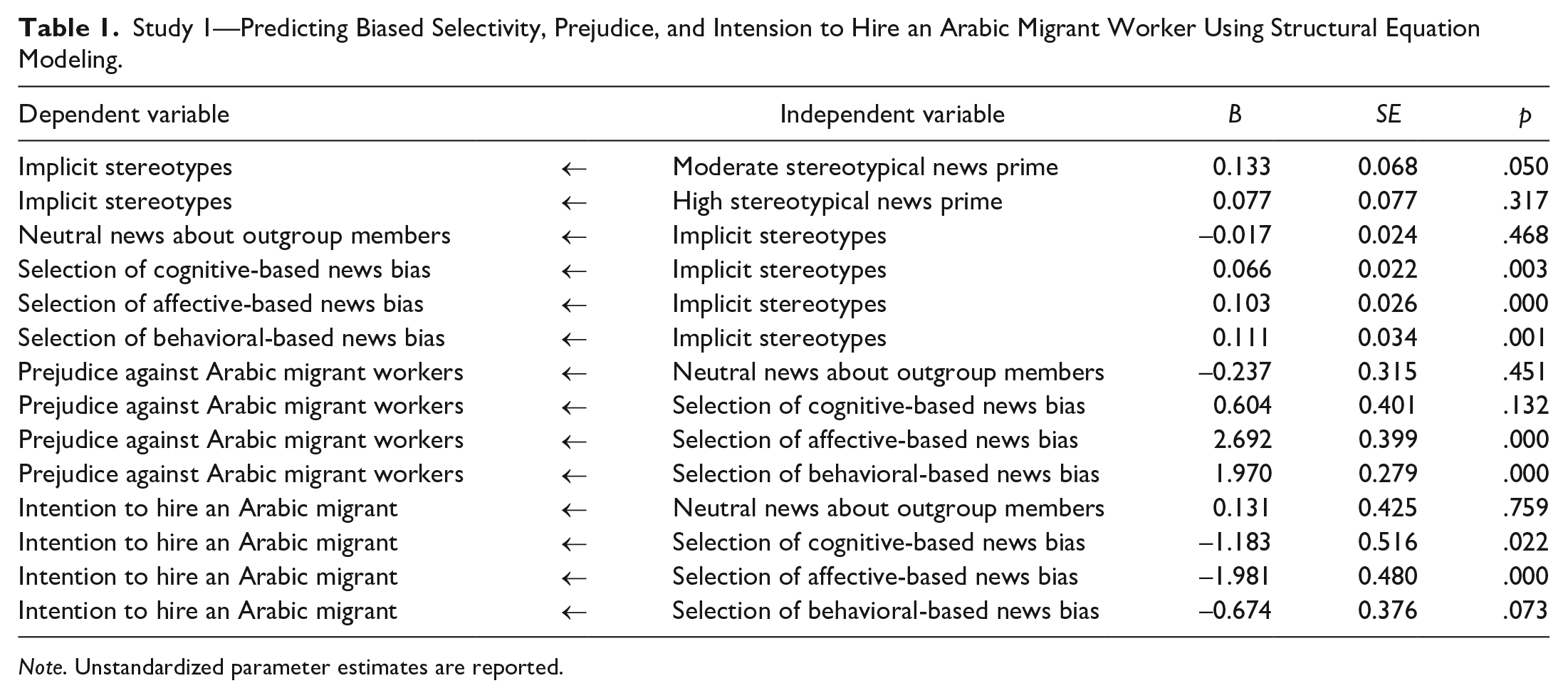
We expected that the positive relationship between exposure to (a) moderate and (b) high levels of stereotypical news primes and the selection of cognitive-based, affect-based, and behavior-based biased news messages is mediated by implicit stereotypes (H2). Table 1 displays the unstandardized results from Study 1. The results show that the moderate stereotype prime condition significantly increased implicit stereotypes. This indicates that after exposure to a moderate stereotypical prime, participants’ implicit associations between Arabic migrant (vs. native Dutch) workers and low-warmth (vs. high warmth) traits increased. Exposure to strong stereotypical news primes, however, did not activate implicit stereotypes. In addition, implicit stereotypes significantly predicted the selection of cognitive-based, affective-based, and behavioral-based biased news headlines.
Study 1—Predicting Biased Selectivity, Prejudice, and Intension to Hire an Arabic Migrant Worker Using Structural Equation Modeling.
Note. Unstandardized parameter estimates are reported.
Furthermore, mediation analysis revealed significant indirect effects of moderate levels of stereotypical news primes on the selection of biased articles via implicit stereotypes. Implicit stereotypes mediate the path between moderate levels of stereotypical news primes and the selection of cognitive-based (b = .009, SE = 0.005, 95% CI [0.0003, 0.024]), affective-based (b = .0145, SE = 0.009, 95% CI [0.001, 0.038]), and behavioral-based bias (b = .0137, SE = 0.007, 95% CI [0.001, 0.032]). Implicit stereotypes did not affect the selection of neutral messages about outgroup (vs. ingroup) members. As we do not find activation effects at high levels of stereotypical news primes, implicit stereotypes were not useful in explaining the relationship between exposure to high levels of stereotypical news primes and selection of stereotypical messages. This implies that exposure to moderate levels of stereotypical news primes rather than high levels of stereotypical primes increases the selection of biased news through activated implicit stereotypes: We accept H2a and reject H2b.
Next, we investigated the consequences of selecting biased news messages for intergroup and interpersonal outcomes. It was anticipated that the selection of cognitive-based, affective-based, and behavioral-based biased news messages would increase unfavorable intergroup outcomes (i.e., strengthen prejudice against Arabic migrant workers) (H3abc). In line with expectations, we find that the selection of cognitive-based, affective-based, and behavioral-based biased news messages was associated with increased prejudiced beliefs about Arabic migrant workers, offering support for H3abc. In addition, we expected that the selection of biased news messages would exert negative effects on interpersonal outcomes (i.e., decrease the likelihood to hire an Arabic migrant worker) (H4abc). In line with this expectation, we find that the selection of cognitive and affective biased news headlines exerted significant and negative effects on the intention to hire an Arabic migrant worker. The effect of behavioral-based biased news headlines points to the same direction but did not reach statistical significance. We accept H4ab, and reject H4c.
Results Study 2
Study 2 set out to replicate Study 1’s findings and to draw stronger conclusions regarding the robustness of the set of results. As in Study 1, we did not find main effects of the treatment on selection in Study 2 (V = .02, F(8, 267) = 0.96, p = .588) (reject H1ab). We proceed to the use of SEM techniques. The model fits the data reasonably well: χ2(43) = 79.62, p = .001; CFI = 0.97; TLI = 0.95; RMSEA = 0.06, 90% CI [0.04, 0.08]; SRMR = 0.05.
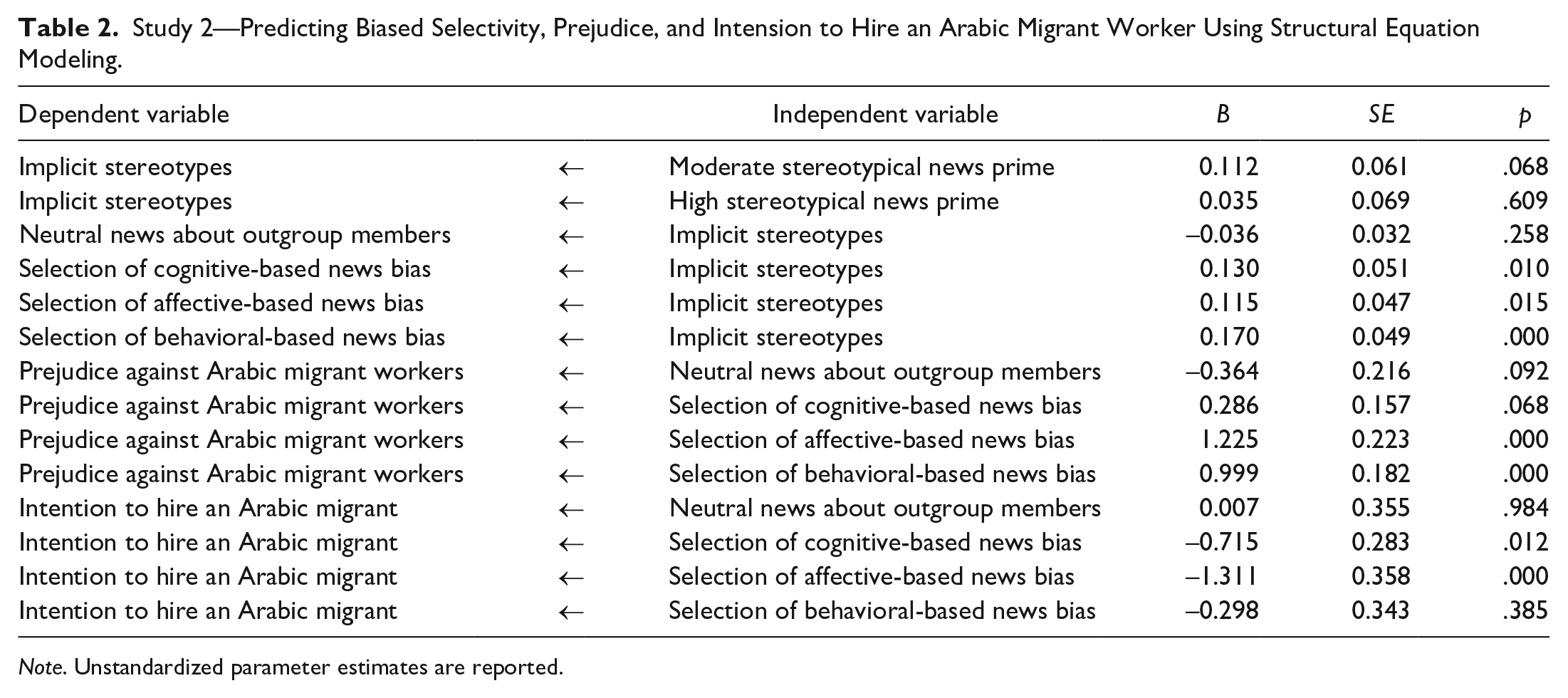
Table 2 displays the results from Study 2. Table 2 shows that, consistent with Study 1, exposure to moderate levels of stereotypical news primes of Arabic migrant workers exerts a marginally significant and positive effect on implicit stereotypes. Again, we do not find an effect of high exposure levels on implicit beliefs. In addition, and replicating Study 1’s findings, implicit stereotypes predicted the selection of cognitive-based, affective-based, and behavioral-based biased news messages. The significance of the indirect paths was tested. Implicit stereotypes mediated the relation between exposure to moderate levels of stereotype primes and the selection of cognitive-based (CI [0.0002, 0.045]), affective-based (CI [0.001, 0.052]), and behavioral-based bias (CI [0.0001, 0.040]). As no activation effects for high levels of stereotype primes were found, implicit stereotypes proved not useful in explaining the relationship between exposure to high levels of media stereotypes and selection of stereotypical messages (H2a accepted, H2b rejected).
Study 2—Predicting Biased Selectivity, Prejudice, and Intension to Hire an Arabic Migrant Worker Using Structural Equation Modeling.
Note. Unstandardized parameter estimates are reported.
We investigated the consequences of selecting biased news headlines. The results show that affective-based and behavioral-based biased news headlines were significant and positively related to prejudice toward Arabic migrant workers. The effect of cognitive-based bias did not reach statistical significance (H3a rejected, H3bc accepted). Furthermore, the selection of cognitive-based and affective-based (but not behavioral-based) headlines decreased the intension to hire an Arabic migrant worker (H4ab accepted, H4c rejected). In conclusion, Study 2 largely replicates Study 1’s findings. It was found that exposure to moderate levels—rather than high levels—of stereotypical news content increases the selection of biased news through activated implicit stereotypes. The selection of biased headlines, in turn, largely fostered negative outgroup perceptions and decreased the likelihood to hire an Arabic migrant worker.
Discussion
This study moves beyond previous research by demonstrating why exposure to and selection of stereotypical media messages are interrelated processes, and by clarifying the intergroup and interpersonal consequences of these processes. The results presented here demonstrate that media effects and selectivity of biased media content are connected by automatic processes (i.e., implicit stereotypes). These processes are activated by exposure to moderate doses of stereotypical news messages, and in turn prompt the selection of biased news messages, leading to adverse outcomes at the intergroup and interpersonal levels. Hence, these findings indicate that implicit stereotypes encourage selections in line with activated beliefs, and subsequently shift intergroup and interpersonal outcomes in the direction of those beliefs. These effects did not surface for high doses of news stereotype primes, suggesting that individuals resist and inhibit activation processes when stereotypes are perceived too blatant. As subtle forms of bias are omnipresent in news environments and implicit stereotypes operate partly under the radar of conscious awareness, they may affect selection without individuals being aware of it. The findings imply that audiences’ biased selectivity should not be seen in isolation from prior media exposure.
Despite theoretical and empirical agreement regarding the reciprocal and mutually dependent relationship between effects and selectivity of biased media messages (Schemer, 2012), these processes are only rarely modeled simultaneously. Consequently, little is known about the mechanisms underlying the relationship between exposure and selection of stereotypical media messages. As such, this study’s key contribution lies in providing a conceptual framework and empirical substantiation for the mediating role of implicit stereotypes in the interplay between media exposure and selection of biased news messages.
The limited available evidence linking media effects to selectivity pertains exclusively to overtly expressed beliefs regarding outgroup members (Schieferdecker & Wessler, 2017). This is surprising, as research in the media-stereotyping domain can be considered socially sensitive, limiting explicit measures validity due to participants’ impression-management biases (Appiah et al., 2013; Arendt et al., 2016). This study’s conceptualization of implicit stereotypes as important channels in the process between media effects and selection was based on two key assumptions. First, research consistently shows that media can activate implicit stereotypical evaluations of outgroup members. Second, implicit stereotypes are deemed important predictors of decision-making. Yet, even though evidence exists for the predictive power of implicit attitudes in selection processes (Arendt et al., 2016), previous research has largely neglected the role of implicit stereotypes as predictors of selection biases.
The results showed that moderate rather than high levels of media stereotypes activated implicit stereotypes, and subsequently set in motion a process of biased news selection. Arendt (2013) suggests that although implicit stereotypes are monotonically activated by increased doses of stereotype primes, higher doses can concurrently set negation processes in motion. These negation processes, in turn, dampen total effects of implicit stereotypes in higher dose conditions (Arendt, 2013). Scholarship contends that stereotype activation can be controlled by distinct and separable processes and is thus dependent upon both situational and chronic variables (e.g., Glaser & Knowles, 2008; Kunda & Spencer, 2003; Moskowitz, 2010). Arguably, in this study, stereotype primes in the high-level condition might have been consciously perceived as (excessively) stereotypical, signaling contrasts between blatant media depictions and individual egalitarian norms and self-concepts (see Moskowitz, 2010; Moskowitz & Li, 2011), resulting in conscious efforts to resist, negate, and inhibit activation processes. Nevertheless, in a real-world setting, subtle forms of media bias are likely more prevalent while at the same time resistant to conscious identification, making them especially concerning (Weisbuch et al., 2009).
The present results suggest that biased news preferences are the partial outcome of media-induced implicit stereotypes. Uniformly, support was found for the mediating role of implicit stereotypes in the model of media bias predicted in this study, that is, the selection of news messages conveying cognitive-based, affective-based, and behavioral-based bias. This implies that activated biased beliefs about outgroup members motivate individuals to actively pursue further reinforcement of such stereotypes while avoiding being confronted with information that disconfirms prejudiced beliefs. Implicit stereotypes played a substantial role in this process. As individuals are not always mindful of their implicit biases (Arendt et al., 2016), automatically activated beliefs may affect news selection without awareness.
These findings flesh out the idea that media-induced predispositions toward outgroup members promote selective exposure to messages that are consistent with activated stereotypical beliefs. This seems to suggest that self-consistency motives (i.e., seeking out media messages reinforcing prior beliefs) and self-enhancement motives (i.e., seeking out media messages to downwardly compare to feel better about oneself) play a role in the process of message selection regarding outgroup members (Appiah et al., 2013; Luong & Knobloch-Westerwick, 2017). Put differently, the selection of biased news articles, in line with activated stereotypical beliefs, may help individuals feel their stereotypical beliefs are legitimate rather than biased, in turn strengthening positive feelings about one’s self and one’s ingroup. As the selection of biased messages further strengthens unfavorable intergroup and interpersonal outcomes, this process ultimately reinforces the status quo, limiting media’s capacity to break through the spiral of social conflict and exclusion. These conclusions are consistent with Schieferdecker and Wessler’s (2017) argument that users’ selectivity poses a boundary condition to media’s ability to fostering positive outgroup beliefs.
Along these lines it can be concluded that individuals with strong biases may allocate more time to media exposure that reinforces their negative beliefs regarding outgroup members’ characteristics. Particularly, the selection of biased news content increased outgroup prejudice and decreased individuals’ willingness to hire an Arabic migrant worker. These findings align with the BIAS map prediction that low-warmth targets trigger feelings of contempt toward outgroup members, which in turn may trigger negative outgroup perceptions and harming behaviors (Cuddy et al., 2008; Seate & Mastro, 2017).
This study began by highlighting the potential for media to exacerbate or overcome intergroup bias. Recent evidence suggests that the answer to this question ultimately depends on audience’s choices. This study refines this argument by showing that audience’s biased selectivity can and should not be seen in isolation from prior media exposure. Previous exposure to mass-mediated stereotypical cues promote the formation and entrenchment of stereotypes in individuals’ memory (Arendt & Northup, 2015; Devine, 1989), making them easily accessible as cognitive shortcuts (Ramasubramanian, 2011). These predispositions, in turn, determine media selectivity. Hence, media ultimately fulfill a crucial role in reinforcing patterns of media exposure by virtue of the fact that, over time, implicit stereotypes are formed and triggered among audience members (see Arendt & Northup, 2015).
This suggests that, despite the harmful intergroup patterns found here, media may fulfill a crucial role in fostering more positive intergroup outcomes by reducing the accessibility of media stereotypes, if favorable representations were prevalent in the media landscape. Accordingly, the existence of more positive media portrayals of Arabic migrants could ultimately produce auspicious intergroup outcomes, by way of the same mechanisms and processes that lead to antisocial responses. Both European and US-based research indicates that when Arabic and Muslim migrants are presented in the media, negative stereotypes predominate (e.g., Ahmed & Matthes, 2017), frequently linking this group to criminal behavior, violence, and terrorism. This study suggests that more positive media depictions of outgroup members could contribute to the activation of positive implicit stereotypes, which, in turn, could lead to the selection of a less biased media diet.
In light of the study’s limitations, it should be stated that our design does not allow drawing strong conclusions regarding the directionality of the association between news choices and the intergroup and interpersonal outcomes. As participants only made selection choices, but were not exposed to the selected biased news articles, we are only able to draw conclusions about the consequences of selecting biased headlines. In addition, and despite its centrality to intergroup and interpersonal outcomes, this study’s focus exclusively on the warmth dimension of Arabic migrants’ stereotypes means that any novel effects of status (i.e., competence) remain unspecified. Given that the trait dimensions of stereotypes consist of both warmth and competence dimensions, future research should investigate the role of competence stereotypes in mediating the relationship between news exposure and selectivity. Furthermore, the generalizability of the findings reported here is limited to the case of Arabic migrant workers, although similar outcomes would be expected for other groups associated with similar cognitive, affective, and behavioral components of bias. Yet, as outgroup members frequently are characterized by low-warmth stereotypes, we believe that this study’s findings have merits beyond the specific case of Arabic migrant workers.
In sum, the findings point to the important role of media content in activating stereotypes, setting in motion a sequence of reinforcing selection processes and unfavorable effects on intergroup and interpersonal outcomes. On a positive note, this indicates that media are capable of removing key peripheral cues that activate stereotypes on an implicit level. The findings illustrate that a more constructive, inclusive portrayal of Arabic migrants in the media environment may encourage audience members to self-select a more nuanced media diet, in turn leading to more favorable intergroup perceptions and prevent discriminatory outcomes in the workplace.
Supplemental Material
SupplementaryMaterials_CR – Supplemental material for Confirming Bias Without Knowing? Automatic Pathways Between Media Exposure and Selectivity
Supplemental material, SupplementaryMaterials_CR for Confirming Bias Without Knowing? Automatic Pathways Between Media Exposure and Selectivity by Anne C. Kroon, Toni G. L. A. van der Meer and Dana Mastro in Communication Research
Footnotes
Declaration of Conflicting Interests
The authors declared no potential conflicts of interest with respect to the research, authorship, and/or publication of this article.
Funding
The authors received no financial support for the research, authorship, and/or publication of this article.

Supplemental Material
Supplemental material for this article is available online.
Author Biographies
References
Supplementary Material
Please find the following supplemental material available below.
For Open Access articles published under a Creative Commons License, all supplemental material carries the same license as the article it is associated with.
For non-Open Access articles published, all supplemental material carries a non-exclusive license, and permission requests for re-use of supplemental material or any part of supplemental material shall be sent directly to the copyright owner as specified in the copyright notice associated with the article.
